INDUSTRIAL POLLUTION
AND ITS CONTROL
SEE-607 3(2-1)
Department of Structures &
Environmental Engineering
Engr. Imran Shaukat
Course Description
• Theory
• Industrial Effluents; its types, sources. Material Balance Modelling for the
assessment of industrial effluents. Water treatment; Collection of
wastewater; Wastewater characteristics; Wastewater Treatment technique,
thermal water pollution design of wastewater treatment plant, utilization
and disposal; Sewage effluent irrigation; Sludge treatment and disposal;
Industrial waste treatment and disposal; Techniques applicable to non-
point source water pollution; Pollution control of effluents in fertilizer
industry; Oil pollution prevention and control; Pesticide-pollution and
abatement; Environmental pollution and control in pulp and paper
industry; Treatment and disposal of sugar cane industry effluent; Pollution
control in textile and tannery industry, Air pollution and its control in
industries and work places, Design of chimneys and effluent discharges.
• Practical
• Field study and industry related exercises and assignments; Study of parameters of
the industrial wastewater.
Suggested Readings
• Eddy, M. and G. Tchobanoglous. 2013. Wastewater
Engineering Treatment, Disposal and Reuse. McGraw Hill
Inc., New York, USA.
• Arceivala, J.S. 2007. Wastewater Treatment for Pollution
Control. 3rd
Ed. Tata McGraw Hill Publishing Company, New
Delhi, India.
• Eckenfelder, W.W. 2000. Industrial Water Pollution Control.
McGraw Hill Publishing Company Ltd., New York, USA.
• Lazarova, V. 2004. Water Reuse for Irrigation. Ondeo
Services, CIRSEE, LePecq, France.
• Punmia, B.C. and A. Jain. 2003. Wastewater Engineering.
Laxmi Publications, New Delhi, India
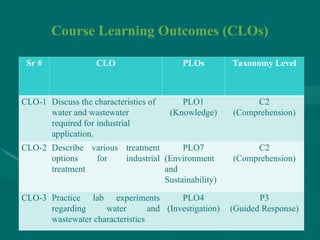
Course Learning Outcomes (CLOs)
Sr # CLO PLOs Taxonomy Level
CLO-1 Discuss the characteristics of
water and wastewater
required for industrial
application.
PLO1
(Knowledge)
C2
(Comprehension)
CLO-2 Describe various treatment
options for industrial
treatment
PLO7
(Environment
and
Sustainability)
C2
(Comprehension)
CLO-3 Practice lab experiments
regarding water and
wastewater characteristics
PLO4
(Investigation)
P3
(Guided Response)
Industrial effluents
Industrial pollution
pollution
• Industrial pollution refers to the contamination
Industrial pollution refers to the contamination
of the environment by industrial activities. It
includes the release of pollutants into the air,
water, and soil from manufacturing processes,
power plants, mining operations, and other
industrial activities.
Types of
Types of Industrial pollution
pollution
Air Pollution: Emission of harmful gases (e.g., sulfur dioxide,
nitrogen oxides, carbon monoxide) and particulate matter into the
atmosphere.
Water Pollution: Discharge of industrial effluents, heavy metals,
chemicals, and thermal pollution into water bodies.
Soil Pollution: Deposition of hazardous waste, chemicals, and
heavy metals onto the land.
Noise Pollution: Loud noises from industrial machinery and
processes.
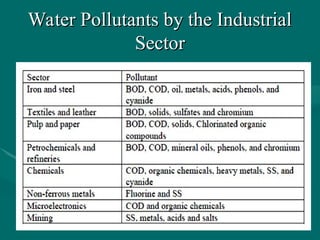
Water Pollutants by the Industrial
Sector
Sector
General Categories of Industrial
Effluents
Effluents
• Organic Industrial effluent
Organic Industrial effluent
• In-Organic Industrial effluent
In-Organic Industrial effluent
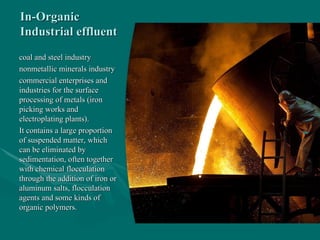
In-Organic
In-Organic
Industrial effluent
Industrial effluent
coal and steel industry
nonmetallic minerals industry
commercial enterprises and
industries for the surface
processing of metals (iron
picking works and
picking works and
electroplating plants).
It contains a large proportion
of suspended matter, which
can be eliminated by
sedimentation, often together
with chemical flocculation
through the addition of iron or
aluminum salts, flocculation
agents and some kinds of
organic polymers.
organic polymers.
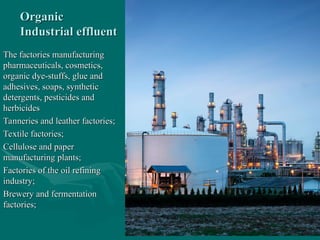
Organic
Organic
Industrial effluent
Industrial effluent
The factories manufacturing
pharmaceuticals, cosmetics,
organic dye-stuffs, glue and
adhesives, soaps, synthetic
detergents, pesticides and
herbicides
herbicides
Tanneries and leather factories;
Textile factories;
Textile factories;
Cellulose and paper
Cellulose and paper
manufacturing plants;
Factories of the oil refining
industry;
industry;
Brewery and fermentation
factories;
factories;
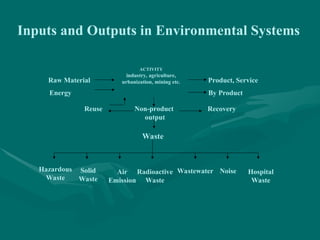
ACTIVITY
industry, agriculture,
urbanization, mining etc.
Recovery
Raw Material
Energy
Product, Service
By Product
Non-product
output
Hazardous
Waste
Reuse
Waste
Solid
Waste
Air
Emission
Radioactive
Waste
Wastewater Noise Hospital
Waste
Inputs and Outputs in Environmental Systems
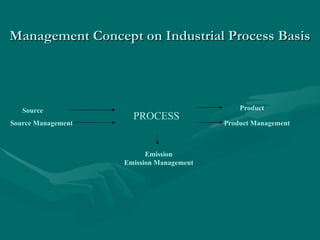
Management Concept on Industrial Process Basis
PROCESS
Source
Source Management Product Management
Product
Emission
Emission Management
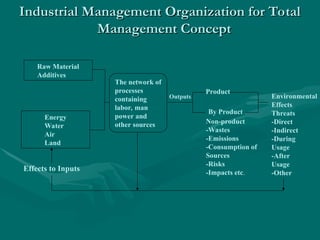
Industrial Management Organization for Total
Management Concept
Management Concept
Raw Material
Additives
Energy
Water
Air
Land
The network of
processes
containing
labor, man
power and
other sources
Environmental
Effects
Threats
-Direct
-Indirect
-During
Usage
-After
Usage
-Other
Outputs
Product
By Product
Non-product
-Wastes
-Emissions
-Consumption of
Sources
-Risks
-Impacts etc.
Effects to Inputs
Mass and energy balance
• For each process, mass and energy balance
For each process, mass and energy balance
are made to reach waste characterization
and species and amounts of the pollutants.
• It is important that which pollutants should
It is important that which pollutants should
be analyzed and selected as analytical
methods.
methods.
Mass and energy balance (continued)
• For example, in milk and milk product
For example, in milk and milk product
industry, if A process (pasteurization unit)
does not use CN material as input, this
pollutant should not be characterized in
waste analysis.
waste analysis.
• Mass and energy balance supplies the
Mass and energy balance supplies the
integration of the process and waste survey.
Mass and energy balance (continued)
• In other words, nobody can do waste survey
In other words, nobody can do waste survey
unless doing mass and energy balance
related any process.
• For example, air pollutants can not be
For example, air pollutants can not be
characterized without knowing the type of
energy and incineration process.
Commonly used dimensions
• Volume
Volume
• Concentration
Concentration
• Load
Load
• Are used as main units in pollution profile
Are used as main units in pollution profile
• Volume is used especially for wastewater
Volume is used especially for wastewater
based on time or product such as m
based on time or product such as m3
3
/h,
/h,
m
m3
3
/day, m
/day, m3
3
/product
/product
Commonly used dimensions
(continued)
(continued)
• Product dimension which are produced in
Product dimension which are produced in
certain periods such as m
certain periods such as m3
3
/m
/m2
2
textile, m
textile, m3
3
/m
/m
metal, m
metal, m3
3
/ton cows, m
/ton cows, m3
3
/kwh, m
/kwh, m3
3
/oil equ.
/oil equ.
energy, m
energy, m3
3
/m
/m3
3
beer etc.
beer etc.
• Question: For dimensions above, which
Question: For dimensions above, which
parameters are based. Product, raw material,
energy?
energy?
Pollution Load
Pollution Load
• Based on time
Based on time
• Based on production
Based on production
• Load means mass unit of a specific pollutant
Load means mass unit of a specific pollutant
per time unit or product characteristic.
• For instance, it expresses the loaded specific
For instance, it expresses the loaded specific
pollutant to environment.
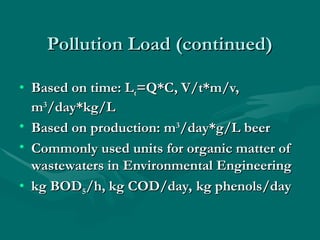
Pollution Load (continued)
• Based on time: L
Based on time: Lt
t=Q*C, V/t*m/v,
=Q*C, V/t*m/v,
m
m3
3
/day*kg/L
/day*kg/L
• Based on production: m
Based on production: m3
3
/day*g/L beer
/day*g/L beer
• Commonly used units for organic matter of
Commonly used units for organic matter of
wastewaters in Environmental Engineering
• kg BOD
kg BOD5
5/h, kg COD/day, kg phenols/day
/h, kg COD/day, kg phenols/day
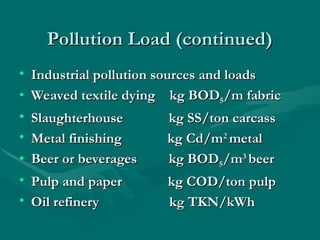
Pollution Load (continued)
• Industrial pollution sources and loads
Industrial pollution sources and loads
• Weaved textile dying
Weaved textile dying kg BOD
kg BOD5
5/m fabric
/m fabric
• Slaughterhouse kg SS/ton carcass
Slaughterhouse kg SS/ton carcass
• Metal finishing kg Cd/m
Metal finishing kg Cd/m2
2
metal
metal
• Beer or beverages
Beer or beverages kg BOD
kg BOD5
5/m
/m3
3
beer
beer
• Pulp and paper
Pulp and paper kg COD/ton pulp
kg COD/ton pulp
• Oil refinery
Oil refinery kg TKN/kWh
kg TKN/kWh
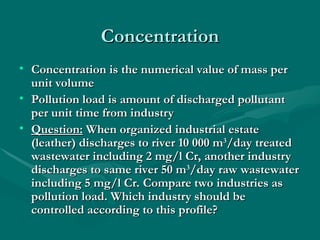
Concentration
Concentration
• Concentration is the numerical value of mass per
Concentration is the numerical value of mass per
unit volume
unit volume
• Pollution load is amount of discharged pollutant
Pollution load is amount of discharged pollutant
per unit time from industry
• Question:
Question: When organized industrial estate
When organized industrial estate
(leather) discharges to river 10 000 m
(leather) discharges to river 10 000 m3
3
/day treated
/day treated
wastewater including 2 mg/l Cr, another industry
discharges to same river 50 m
discharges to same river 50 m3
3
/day raw wastewater
/day raw wastewater
including 5 mg/l Cr. Compare two industries as
pollution load. Which industry should be
controlled according to this profile?
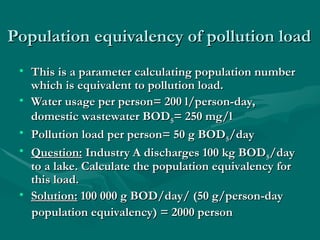
Population equivalency of pollution load
• This is a parameter calculating population number
This is a parameter calculating population number
which is equivalent to pollution load.
• Water usage per person= 200 l/person-day,
Water usage per person= 200 l/person-day,
domestic wastewater BOD
domestic wastewater BOD5
5= 250 mg/l
= 250 mg/l
• Pollution load per person= 50 g BOD
Pollution load per person= 50 g BOD5
5/day
/day
• Question:
Question: Industry A discharges 100 kg BOD
Industry A discharges 100 kg BOD5
5/day
/day
to a lake. Calculate the population equivalency for
this load.
this load.
• Solution:
Solution: 100 000 g BOD/day/ (50 g/person-day
100 000 g BOD/day/ (50 g/person-day
population equivalency) = 2000 person
Waste Classification
Definition:
Definition: Industrial waste classification is made
Industrial waste classification is made
in based on 8 types of waste. These are;
• Wastewater
Wastewater
• Air emission
Air emission
• Solid waste
Solid waste
• Hazardous waste
Hazardous waste
• Medical or hospital waste
Medical or hospital waste
• Radioactive waste
Radioactive waste
• Noise pollution
Noise pollution
• Sludge & Slurry
Sludge & Slurry
Wastewater Classification
• Waste in form of liquid
Waste in form of liquid(but water)
(but water) is known as waste water
is known as waste water
in industry and it is taken out.
• Wastewater generated by processes and other units
Wastewater generated by processes and other units
• Condensation water
Condensation water
• Cleaning and washing tool ,equipment and building water
Cleaning and washing tool ,equipment and building water
• Off water of steam generator , boiler condensation water
Off water of steam generator , boiler condensation water
softening process and its regeneration waters originated by
supplementary processes
• Domestic, social facilities, such as shower, toilet, cafeteria
Domestic, social facilities, such as shower, toilet, cafeteria
and laundry
and laundry
• Field drainage and rain water
Field drainage and rain water
Wastewater Classification
(continued)
(continued)
Classification of Industrial Wastewater
based on pollution:
based on pollution:
• Process wastewater
Process wastewater
• Associated processes wastewater
Associated processes wastewater
• Domestic wastewater
Domestic wastewater
Hazardous Waste
Hazardous Waste
Definitions:
Definitions:
• These wastes are defined as any material that are no longer
These wastes are defined as any material that are no longer
desired and has no current or perceived value at a given
place. Among variety of waste , hazardous waste is a
hazardous substance that has been discarded or otherwise
designated as a waste material , or one that may become
hazardous by interaction with other substances.
• Generally, hazardous waste is defined as any waste which
Generally, hazardous waste is defined as any waste which
has hazard potential and hazardous effects to human health
and environment. They required different management
system from other conventional and traditional waste.
Hazardous Waste (continued)
A “solid waste” was defined by Congress as :
• Any garbage, refuse sludge from a waste treatment plant , water supply
Any garbage, refuse sludge from a waste treatment plant , water supply
treatment plant, air pollution control facilities and other discarded
materials, including solid, liquid, semi solid or contained gaseous
material resulting from industrial, commercial, mining and agricultural
operations and from community activities.
A “hazardous waste” was defined by Congress as :
• Solid waste, or combination of solid wastes, which because of its
Solid waste, or combination of solid wastes, which because of its
quantity, concentration, or physical, chemical, or infectious
characteristics may-
• cause, or significantly contribute to an increase in serious irreversible,
cause, or significantly contribute to an increase in serious irreversible,
or incapacitating reversible, illness; or
• pose a substantial present or potential hazard to human health or the
pose a substantial present or potential hazard to human health or the
environment when improperly treated, stored, transported, or disposed
of, or otherwise managed.
Hazardous Waste (continued)
From this definitional beginning, Congress
directed EPA in RCRA Section 3001 to follow a
two-step process leading to the identification of
hazardous wastes. First, EPA was directed to
establish “criteria” to be used to identify the
characteristics of hazardous waste and to actually
list hazardous wastes. Factors that EPA had to
consider in establishing the criteria included:
• toxicity, persistence, and degradability in nature;
toxicity, persistence, and degradability in nature;
• potential for accumulation in tissue, AND
potential for accumulation in tissue, AND
• other related factors such as flammability,
other related factors such as flammability,
corrosiveness, and other hazardous characteristics.
Hazardous Waste (continued)
• Their effects in two ways;
Their effects in two ways;
- short-term effects (acute)
- long-term effects (chronic)
• These are considered in four criteria;
These are considered in four criteria;
- toxicity
- toxicity
- corrosiveness
- corrosiveness
- flammability
- flammability
- reactivity
- reactivity
Management of Hazardous Waste
• definition of hazardous waste
definition of hazardous waste
• determination of hazardous waste
determination of hazardous waste
• listing hazardous waste
listing hazardous waste
• T/S/D Treatment technologies / Storage/
T/S/D Treatment technologies / Storage/
Disposal
Disposal
• Biological treatment
Biological treatment
• Physical- chemical treatment
Physical- chemical treatment
• Incineration
Incineration
Management of Hazardous
Waste (continued)
Waste (continued)
In addition;
In addition;
• deep well injection
deep well injection
• spent mining filling
spent mining filling
• dumping to oceans
dumping to oceans
• dumping to space by rockets, etc.
dumping to space by rockets, etc.
• controlling the hazardous waste sites
controlling the hazardous waste sites
Definition of Hazardous Waste
• Wastes which have environmental acute or chronic
Wastes which have environmental acute or chronic
hazard potential can be flammable, reactive,
corrosive and toxic with their compositions,
including material amount, physical forms,
dispersion and diffusion in environment, usage
styles going to environment by human activities,
therefore; differing from conventional treatment
and disposal methods and requiring management
systems that includes environmental system’s
(ecosystem) politic, social and economic concepts
and identifying by specification and listing.
• (furthermore reading: Zararlı Atıkların Tanımı ve
(furthermore reading: Zararlı Atıkların Tanımı ve
Yönetimi Projesi İ. Talınlı, 1995)
Air Emissions
Air Emissions
Assessment of the air pollutants in two ways;
• Emissions (in chimney)
Emissions (in chimney)
• Emissions (in process area, open and closed)
Emissions (in process area, open and closed)
Emission sources in industries;
• Incineration of the fuels to provide the
Incineration of the fuels to provide the
energy for processes, offices and closed area.
These emissions are evaluated in chimney
according to thermodynamic conditions,
boilers specifications and capacity.
Air Emissions (continued)
• Emissions in open and closed area may be sourced
Emissions in open and closed area may be sourced
by volatile materials used in process in gaseous
form or dust and smog. They can be collected by
vacuum or aspiration through chimney to
atmosphere. They are known as controlled
emissions in media however some gaseous
pollutants may be still stay in the process
atmosphere or in he labor or human lung. Indoor
air quality should be evaluated according to
occupational safety health.
Air Emissions (continued)
• Some particulate air pollutants are also
Some particulate air pollutants are also
uncontrolled emissions. For example, storage of
the refractor materials in open area, dust occurs
and is transferred to atmosphere. Materials such as
clinkers and refractors are stored in open area and
transferred to atmosphere by wind.
• Chimney emissions: Incineration gases, volatile
Chimney emissions: Incineration gases, volatile
gases to chimney by asp., particulate materials to
chimney.
chimney.
• Medium emissions: Uncontrolled air pollutants
Medium emissions: Uncontrolled air pollutants
and hazardous gases by inhalation.
Pollution based industrial
categorization
categorization
The categorization approach is based on;
• Production type
Production type
• Materials used in production
Materials used in production
• Occupational branches
Occupational branches
• Pollution
Pollution
• SIC (standard industrial classification) index-main
SIC (standard industrial classification) index-main
headings
headings
• Aim of the classification based on pollution is to
Aim of the classification based on pollution is to
determine the homogenous groups of industries
with similar pollution profiles, on which control
methods will depend on.
Main and sub-categorization
Main factors for sub-categorization;
• Production process and technology
Production process and technology
• Raw materials
Raw materials
• Product
Product
• Water usage
Water usage
• Plant capacity
Plant capacity
• Plant age and efficiency
Plant age and efficiency
• Personnel groups (shifts)
Personnel groups (shifts)
• Pollution profiles (waste characteristics)
Pollution profiles (waste characteristics)
• Treatment technologies
Treatment technologies
• Investment costs
Investment costs
Question
Question
Write an appropriate main factor for each subcategory given
below;
below;
• Main head: Textile industry
Main head: Textile industry
• Spring wool cleaning
Spring wool cleaning
• Wool fabric finishing
Wool fabric finishing
• Broad-woven fabric finishing
Broad-woven fabric finishing
• Knit-woven finishing
Knit-woven finishing
• Carpet fabric finishing
Carpet fabric finishing
• Stock ad fiber fabric finishing
Stock ad fiber fabric finishing
• Process modified for reduced water usage
Process modified for reduced water usage
• Non-woven fabric finishing
Non-woven fabric finishing
• Felt fabric finishing
Felt fabric finishing
• Silk finishing
Silk finishing
Question (continued)
• Main head: Metal finishing
Main head: Metal finishing
• Ordinary metals
Ordinary metals
• Precious metals
Precious metals
• Complex metals
Complex metals
• Hexavalent chromium plating
Hexavalent chromium plating
• Cyanide used processes
Cyanide used processes
• Oily wastewater
Oily wastewater
• Wastewater including solvents
Wastewater including solvents
Question (continued)
• Main head: Milk and milk production industries
Main head: Milk and milk production industries
• Milk reception
Milk reception
• Milk preparation and cream production
Milk preparation and cream production
• Yoghurt and ayran production
Yoghurt and ayran production
• Butter
Butter
• Cheese
Cheese
• Ice-cream
Ice-cream
• Concentrated milk
Concentrated milk
• Milk powder production
Milk powder production
• Concentrated cheese water
Concentrated cheese water
• Cheese water drying
Cheese water drying
Question (continued)
• Main head: Pharmaceutical industry
Main head: Pharmaceutical industry
• Fermentation processes
Fermentation processes
• Chemical synthesis
Chemical synthesis
• Formulation
Formulation
• Biological extraction and anti-biotics
Biological extraction and anti-biotics
Conceptual design of wastewater
treatment system
treatment system
The scope of this chapter is to make
interpretations for the treatability test results
and to build the optimum treatment system
variations by building relationships between
the parameters that are acquired from the
waste water characterization which will be
the basis for conceptual design in treatment
of industrial waste water and pollution
profile with the basic performance of the
treatment system units
treatment system units.
.
Conceptual design of wastewater
treatment system
treatment system (continued)
(continued)
In the frame of this goal:
• The concept of total management application approach in
The concept of total management application approach in
industries is taken as basis,
• Wastewater pollutant parameters are examined,
Wastewater pollutant parameters are examined,
• The basic units used in wastewater treatment system and the
The basic units used in wastewater treatment system and the
cooperative units are examined and the basic functions and
performances are evaluated
• The relationships between the collective and individual parameters
The relationships between the collective and individual parameters
are stated,
are stated,
• In order to calculate the treatment plant performance in the basis
In order to calculate the treatment plant performance in the basis
of parameters with integration in the whole system and between
the unit performance and the parameter that is supposed to be
removed, a matrix and a method are developed
By this way, it is hoped that without the treatability tests that are
necessary for the appropriate and right system especially in
wastewater treatment system design, a concept design and
variations will be built for environmental engineering.
TOTAL
TOTAL MANAGMENT
MANAGMENT
APPLICATION IN INDUSTRIES
Reasons for implemented a waste monitoring program
include:
1. To assure the regulatory agencies that the industry is in
compliance with the effluent quality requirements in the
discharge permit;
2. To ensure cognizance of product and material losses to the
sewer;
3. To maintain sufficient control of plant operations so
that violation of
permit specifications are minimized; and
4. To develop the necessary data needed to ensure proper
operation of the wastewater treatment facilities
Process and Waste Survey
In conducting a monitoring program,
existing knowledge of the waste flow is
usually insufficient to provide the basis
for establishing comprehensive study.
The process and waste survey will
provide material balance of the flow of
pollutants through a system.
Process and Waste Survey
(continued)
(continued)
The requirements of a useful flow diagram are
summarized below:
summarized below:
1.
1. Detailed information concerning each
Detailed information concerning each
production process
production process
2.
2. The type of operations should be identified as
The type of operations should be identified as
continuous, batch, or intermittent, with
frequency of waste releases given for the latter
two.
two.
3.
3. Raw materials, products and wastes should be
Raw materials, products and wastes should be
listed on the flow diagram.
4.
4. The waste characteristics, such as flow,
The waste characteristics, such as flow,
temperature and pH, should also be included.
Process and Waste Survey
(continued)
(continued)
Important factors to be considered in
selecting the sampling stations are:
1.
1. The flow of the waste stream should be
The flow of the waste stream should be
known or easily estimated or measured
known or easily estimated or measured.
.
2.
2. The sampling station should be easily
The sampling station should be easily
accessible with adequate safeguards
accessible with adequate safeguards.
.
3.
3. The wastewater should be well mixed.
The wastewater should be well mixed.
SAMPLING TECHNIQUES
SAMPLING TECHNIQUES
The basis for any plant pollution abatement program
or anticipated design criteria depends on
information
information obtained by sampling.
obtained by sampling.
Thus, all subsequent decisions may be based on
incorrect information if this step is
incorrect information if this step is not accurate;
not accurate;
implemented.
implemented.
If a few basic principles
If a few basic principles are observed, and if those
are observed, and if those
persons responsible for
persons responsible for sampling are forewarned,
sampling are forewarned,
reliable results can be
reliable results can be obtained without expensive
obtained without expensive
and costly re sampling.
A good sampling program should:
• Ensure that the sample taken is truly representative
Ensure that the sample taken is truly representative
of the waste stream;
• Use proper sampling techniques; and
Use proper sampling techniques; and
• Protect the samples until they are analyzed waste
Protect the samples until they are analyzed waste
Biochemical Oxygen Demand
The biochemical oxygen demand (BOD) is
an estimate of the amount of oxygen
required to stabilize biodegradable organic
materials in a sample of wastewater by
heterogeneous microbial population
heterogeneous microbial population.
.
Chemical Oxygen Demand
The chemical oxygen demand (COD) is a
measure of the oxygen equivalent of the
organic fraction in the sample which is
susceptible to permanganate or
dichromate oxidation in an acid solution.
Chemical Oxygen Demand
(continued)
(continued)
Generally, one would expect the ultimate BOD of a
wastewater to approach the COD
wastewater to approach the COD There are many factors
There are many factors
which would negate this statement, however, especially
when determining the BOD and COD for complex
industrial wastes. These factors include:
1.
1. Many organic compounds, which are dichromate
Many organic compounds, which are dichromate
oxidizable, are not biochemically oxidizable.
2.
2. Certain inorganic substances, such as sulfides, sulfites,
Certain inorganic substances, such as sulfides, sulfites,
thiosulfates, nitrites, and ferrous iron are oxidized by
dichromate, creating an inorganic COD, which is
misleading when estimating the organic content of a
wastewater.
wastewater.
3.
3. The BOD results may be affected by lack of seed
The BOD results may be affected by lack of seed
acclimation, giving erroneously low readings. The COD
results are independent of this variable.
4.
4. Certain organic compounds (e.g. straight chain, saturated
Certain organic compounds (e.g. straight chain, saturated
aliphatic acids and alcohols) are not efficiently oxidized
by Cr
by Cr2
20
07
7
2
2-
-
. A silver sulfate catalyst is added to ensure
efficient oxidation of these compounds
efficient oxidation of these compounds.
.
Total Organic Carbon
The organic carbon determination is free of the
many variables, which plague the COD and BOD
analyses, with more reliable and reproducible
data being the net result.
The total organic carbon concentration in a
wastewater is a measure of organic content.
While TOC measurements give no indication of
the oxidation state of the carbon, correlations can
often be made between TOC and occasionally
BOD values for individual wastes
BOD values for individual wastes.
.
Total Organic Carbon (continued)
In summary, it can be stated that
COD/TOC and BOD/TOC are both
valid measures of the organic
character and both can be correlated
to C
to COD
OD values in many applications
values in many applications.
.
Commonly used treatment units
in
in wastewater
wastewater treatment systems
treatment systems
• Neutralization Tank
Neutralization Tank
• Coagulation& Flocculation
Coagulation& Flocculation
• DAF
DAF
• Activated Carbon Adsorption
Activated Carbon Adsorption
• Ion Exchange
Ion Exchange
• Chemical Oxidation
Chemical Oxidation
• Granular Filtration
Granular Filtration
• Activated Sludge
Activated Sludge
• Anaerobic Treatment
Anaerobic Treatment
• Reverse Osmosis
Reverse Osmosis
Neutralization
Neutralization
• Many wastewaters contain acidic or alkaline
Many wastewaters contain acidic or alkaline
substances which must be neutralized prior
to being discharged into receiving bodies of
water or conveyed to subsequent unit
treatment processes.
• Neutralization, or adjustment of pH, may be
Neutralization, or adjustment of pH, may be
used in the later case not only to protect
downstream processes, but also to optimize
their effectiveness.
Coagulation and Precipitation
• Coagulation has been defined as the addition of a
Coagulation has been defined as the addition of a
chemical to a colloidal dispersion which results in
particle destabilization by the reduction in forces
which tend to keep particles apart.
• Coagulation involves the reduction of surface
Coagulation involves the reduction of surface
charges and the formation of complex hydrous
oxides.
oxides.
• The process involves forming either flocculant
The process involves forming either flocculant
suspensions of compounds which entrap desired
pollutants and carry them out of solution or the
formation of insoluble precipitates of the pollutants
themselves.
themselves.
Coagulation and Precipitation
(continued)
(continued)
• Examples of former include organic
Examples of former include organic
suspended materials and examples of the
latter include precipitates of phosphorus and
heavy metals.
heavy metals.
• After coagulation to destabilize the particles
After coagulation to destabilize the particles
and flocculation to generate large particles,
the materials can subsequently be separated
from the wastewater by sedimentation,
flotation, or filtration.
Dissolved Air Flotation
• Dissolved air flotation (DAF) has been used for
Dissolved air flotation (DAF) has been used for
many years in the treatment of wastewaters for
separation of suspended solids, oils, greases, fibers,
and other low density solids from the carrier liquid
as well as for the thickening of activated sludge and
flocculated chemical sludges.
• The flotation process is accomplished by
The flotation process is accomplished by
introducing pressurized wastewaters to atmospheric
pressure and releasing the dissolved gas in excess of
saturation. This reduces the specific gravity of SS or
oily material by the attachment of fine gas bubbles to
the particulate matter, enhancing gravity separation.
Activated Sludge
Activated Sludge
• The AS process is a continuous system in which
The AS process is a continuous system in which
aerobic biological growths are mixed with
wastewaters then separated in a gravity clarifier.
• This process should provide an effluent with a
This process should provide an effluent with a
soluble BOD
soluble BOD5
5 of 15 to 40 mg/l, although the
of 15 to 40 mg/l, although the
organic concentration of the effluent in terms of
COD in the industrial sector may be as high as 500
to 1000 mg/l, depending on the concentration of
non-biodegradable compounds originally in the
wastewaters.
wastewaters.
Activated Sludge (continued)
• There are many impurities in industrial
There are many impurities in industrial
wastewaters that must be removed or altered by
preliminary operations (pretreatment) before
subsequent AS treatment can be considered.
• High concentrations of SS discharged directly to
High concentrations of SS discharged directly to
secondary biological processes can decrease
overall process efficiency, either by reducing the
active biological solids fraction or by creating a
sludge less amenable to sludge handling.
• Removing oil by gravity separation is required in
Removing oil by gravity separation is required in
many industrial plants because oily waters have a
deleterious effect on most secondary and tertiary
treatment process.
treatment process.
Anaerobic Treatment of
Organic Wastes
Organic Wastes
• Traditionally, anaerobic degradation of organic
Traditionally, anaerobic degradation of organic
materials has been associated with digestion of
wastewater sludges which resulted from primary
sedimentation of degradable organic solids or were
generated during biological oxidation of soluble and
colloidal organic materials.
• Anaerobic processes are also very effective for treating
Anaerobic processes are also very effective for treating
soluble and colloidal organic materials and to
biologically reduce nitrogen in the form of nitrate to
harmless nitrogen gas.
• Since the anaerobic system can obtain 50 to 70 percent
Since the anaerobic system can obtain 50 to 70 percent
organic destruction at a relatively low energy input, it
may also be utilized very effectively for pre-treating
soluble organic wastewaters prior to aerobic systems.
Activated Carbon Adsorption
• Activated carbon adsorption is most often
Activated carbon adsorption is most often
employed for the removal of organic
constituents from wastewater.
• Although carbon is sometimes used as a
Although carbon is sometimes used as a
catalyst for decholorination or oxidation of
cyanide and for the removal of certain heavy
metals, these special cases have limited
applications to wastewater treatment.
Activated Carbon Adsorption
(continued)
(continued)
• The principal applications of carbon adsorption for
The principal applications of carbon adsorption for
the treatment of organic wastewaters include the
removal of non-degradable substances, such as
color producing compounds and pesticides, and
the reduction of specific organic constituents, such
as phenols, in waste streams which contain
relatively small concentrations of specific organic
species.
species.
• This process may be performed in combination
This process may be performed in combination
with biological treatment for the removal of either
degradable or refractory organic constituents.
Ion Exchange
Ion Exchange
• Ion exchange is a process in which ions, held
Ion exchange is a process in which ions, held
by electrostatic forces to functional groups
on the surface of a solid, are exchanged for
ions of a similar charge in solution.
• Ion exchange is more often applied for the
Ion exchange is more often applied for the
removal or exchange of dissolved inorganic
salts in waters or wastewaters, such as
hardness (calcium and magnesium) or heavy
metals.
metals.
Chemical Oxidation
Chemical Oxidation
• The vocabulary of some regulatory authorities is
The vocabulary of some regulatory authorities is
rapidly evolving to include such terms as
“resistant,” “refractory,” “incompatible,” and
“perdurable” to describe those constituents which
are not removed by conventional wastewater
treatment methods.
treatment methods.
• The objective of chemical oxidation in water and
The objective of chemical oxidation in water and
wastewater treatment is to transform undesirable
chemical constituents to a more oxidized state
which reduces the pollution potential.
Chemical Oxidation (continued)
• It is often unnecessary to carry the oxidation of a
It is often unnecessary to carry the oxidation of a
compound to completion since, depending on the
oxidant and oxidizing conditions, the intermediate
oxidation products which may be formed will be of
much lower toxicity or less objectionable
characteristic than the original materials.
• Complete oxidation may not only be impractible
Complete oxidation may not only be impractible
from a treatment standpoint, but also represents a
non-justified economical outlay.
Chemical Oxidation (continued)
• Subsequently, chemical oxidation might be
Subsequently, chemical oxidation might be
considered as a selective modification or
elimination of objectionable or toxic substances,
including
including :
:
• Inorganic constituents, such as Mn(II), Fe(II),
Inorganic constituents, such as Mn(II), Fe(II),
S
S2-
2-
, CN
, CN-
-
, SO
, SO3
3
2-
2-
and
and
• Organic compounds, such as phenols, amines,
Organic compounds, such as phenols, amines,
humic acids, other taste, odor, or color producing
or toxic compounds, bacteria and algae
APPROACH FOR THE TREATABILITY OF THE
INDUSTRIAL WASTEWATERS
In fact, this approach depends on the predictions on which
parameters and in what efficiency will the treatment units
will work while the consideration that the effects of these
units on the other units in the system is taken account, by
using the table of unit removal efficiency.
At this point it is important to realize that, the relationships
between the parameters are have to be taken account.
For instance if the parameter of COD is to be removed than
the parameters such as Oil & Grease, Suspended Solids and
all the other organic and inorganic parameters should be
evaluated carefully.
At this point, the most important parameters are collective
parameters such as COD, BOD, SS, Oil& Grease, Phenols
CONCLUSION
CONCLUSION
In the frame of the approach that is discussed above:
First of all, process survey must be done for the industrial wastewaters
in order to learn about the inputs and outputs in the industry.
A waste survey should be prepared according to process survey and
then pollution profile must be done without any mistake.
Only with a perfect characterization of a wastewater can an efficient
design be done.
design be done.
Relationships between the parameters should be evaluated, especially
the collective parameters must be considered as the most important
ones
ones
For all the industrial wastewaters, treat ability tests must be done.
However with a good characterization and perfect unit performance
knowledge it is possible to have conceptual design in a very short
period of time and in a safe way.
All the units that will be used as the base of the design of the treatment
system should be well defined.
The effects of the treatment units on the other units in the system
should be well evaluated
should be well evaluated.
.
CONCLUSION (continued)
• “
“if you don’t satisfy by your solutions and
if you don’t satisfy by your solutions and
answ
answe
ers, imagine that your brain is the best
rs, imagine that your brain is the best
ecosystem and you have to balance some
ethical pollution in it.”
• “
“each quantity has a quality of its own
each quantity has a quality of its own
which was never reached before and which
shall never be reached again.”
CONCLUSION (continued)
• “
“Y
Your destiny can behold for a good future,
our destiny can behold for a good future,
if you have a scientific thinking in your brain
and clarity in y
and clarity in your
our heart.”
heart.”
• “
“taking an exam is nothing, thinking and its
taking an exam is nothing, thinking and its
quality is everything. All achievements have
quality of their own.”
İ. TALINLI
İ. TALINLI
CONCLUSION (continued)
• Do not hate multiple choice because you
Do not hate multiple choice because you
will have to choose during your life, even
your partner.
your partner.
• The choices you made by your wisdom will
The choices you made by your wisdom will
always be much more effective than
everything will.
everything will.
İ. TALINLI
İ. TALINLI
CONCLUSION (continued)
• “
“we can make several things
we can make several things
clearer, but we can not make
anything clear.”
anything clear.”
Frank P. RAMSEY
Frank P. RAMSEY

Industrial Pollution Control lecture 1.ppt

  • 1.
    INDUSTRIAL POLLUTION AND ITSCONTROL SEE-607 3(2-1) Department of Structures & Environmental Engineering Engr. Imran Shaukat
  • 2.
    Course Description • Theory •Industrial Effluents; its types, sources. Material Balance Modelling for the assessment of industrial effluents. Water treatment; Collection of wastewater; Wastewater characteristics; Wastewater Treatment technique, thermal water pollution design of wastewater treatment plant, utilization and disposal; Sewage effluent irrigation; Sludge treatment and disposal; Industrial waste treatment and disposal; Techniques applicable to non- point source water pollution; Pollution control of effluents in fertilizer industry; Oil pollution prevention and control; Pesticide-pollution and abatement; Environmental pollution and control in pulp and paper industry; Treatment and disposal of sugar cane industry effluent; Pollution control in textile and tannery industry, Air pollution and its control in industries and work places, Design of chimneys and effluent discharges. • Practical • Field study and industry related exercises and assignments; Study of parameters of the industrial wastewater.
  • 3.
    Suggested Readings • Eddy,M. and G. Tchobanoglous. 2013. Wastewater Engineering Treatment, Disposal and Reuse. McGraw Hill Inc., New York, USA. • Arceivala, J.S. 2007. Wastewater Treatment for Pollution Control. 3rd Ed. Tata McGraw Hill Publishing Company, New Delhi, India. • Eckenfelder, W.W. 2000. Industrial Water Pollution Control. McGraw Hill Publishing Company Ltd., New York, USA. • Lazarova, V. 2004. Water Reuse for Irrigation. Ondeo Services, CIRSEE, LePecq, France. • Punmia, B.C. and A. Jain. 2003. Wastewater Engineering. Laxmi Publications, New Delhi, India
  • 4.
    Course Learning Outcomes(CLOs) Sr # CLO PLOs Taxonomy Level CLO-1 Discuss the characteristics of water and wastewater required for industrial application. PLO1 (Knowledge) C2 (Comprehension) CLO-2 Describe various treatment options for industrial treatment PLO7 (Environment and Sustainability) C2 (Comprehension) CLO-3 Practice lab experiments regarding water and wastewater characteristics PLO4 (Investigation) P3 (Guided Response)
  • 5.
  • 6.
    Industrial pollution pollution • Industrialpollution refers to the contamination Industrial pollution refers to the contamination of the environment by industrial activities. It of the environment by industrial activities. It includes the release of pollutants into the air, includes the release of pollutants into the air, water, and soil from manufacturing processes, water, and soil from manufacturing processes, power plants, mining operations, and other power plants, mining operations, and other industrial activities. industrial activities.
  • 7.
    Types of Types ofIndustrial pollution pollution Air Pollution: Emission of harmful gases (e.g., sulfur dioxide, nitrogen oxides, carbon monoxide) and particulate matter into the atmosphere. Water Pollution: Discharge of industrial effluents, heavy metals, chemicals, and thermal pollution into water bodies. Soil Pollution: Deposition of hazardous waste, chemicals, and heavy metals onto the land. Noise Pollution: Loud noises from industrial machinery and processes.
  • 8.
    Water Pollutants bythe Industrial Water Pollutants by the Industrial Sector Sector
  • 9.
    General Categories ofIndustrial General Categories of Industrial Effluents Effluents • Organic Industrial effluent Organic Industrial effluent • In-Organic Industrial effluent In-Organic Industrial effluent
  • 10.
    In-Organic In-Organic Industrial effluent Industrial effluent coaland steel industry coal and steel industry nonmetallic minerals industry nonmetallic minerals industry commercial enterprises and commercial enterprises and industries for the surface industries for the surface processing of metals (iron processing of metals (iron picking works and picking works and electroplating plants). electroplating plants). It contains a large proportion It contains a large proportion of suspended matter, which of suspended matter, which can be eliminated by can be eliminated by sedimentation, often together sedimentation, often together with chemical flocculation with chemical flocculation through the addition of iron or through the addition of iron or aluminum salts, flocculation aluminum salts, flocculation agents and some kinds of agents and some kinds of organic polymers. organic polymers.
  • 11.
    Organic Organic Industrial effluent Industrial effluent Thefactories manufacturing The factories manufacturing pharmaceuticals, cosmetics, pharmaceuticals, cosmetics, organic dye-stuffs, glue and organic dye-stuffs, glue and adhesives, soaps, synthetic adhesives, soaps, synthetic detergents, pesticides and detergents, pesticides and herbicides herbicides Tanneries and leather factories; Tanneries and leather factories; Textile factories; Textile factories; Cellulose and paper Cellulose and paper manufacturing plants; manufacturing plants; Factories of the oil refining Factories of the oil refining industry; industry; Brewery and fermentation Brewery and fermentation factories; factories;
  • 12.
    ACTIVITY industry, agriculture, urbanization, miningetc. Recovery Raw Material Energy Product, Service By Product Non-product output Hazardous Waste Reuse Waste Solid Waste Air Emission Radioactive Waste Wastewater Noise Hospital Waste Inputs and Outputs in Environmental Systems
  • 13.
    Management Concept onIndustrial Process Basis Management Concept on Industrial Process Basis PROCESS Source Source Management Product Management Product Emission Emission Management
  • 14.
    Industrial Management Organizationfor Total Industrial Management Organization for Total Management Concept Management Concept Raw Material Additives Energy Water Air Land The network of processes containing labor, man power and other sources Environmental Effects Threats -Direct -Indirect -During Usage -After Usage -Other Outputs Product By Product Non-product -Wastes -Emissions -Consumption of Sources -Risks -Impacts etc. Effects to Inputs
  • 15.
    Mass and energybalance Mass and energy balance • For each process, mass and energy balance For each process, mass and energy balance are made to reach waste characterization are made to reach waste characterization and species and amounts of the pollutants. and species and amounts of the pollutants. • It is important that which pollutants should It is important that which pollutants should be analyzed and selected as analytical be analyzed and selected as analytical methods. methods.
  • 16.
    Mass and energybalance (continued) Mass and energy balance (continued) • For example, in milk and milk product For example, in milk and milk product industry, if A process (pasteurization unit) industry, if A process (pasteurization unit) does not use CN material as input, this does not use CN material as input, this pollutant should not be characterized in pollutant should not be characterized in waste analysis. waste analysis. • Mass and energy balance supplies the Mass and energy balance supplies the integration of the process and waste survey. integration of the process and waste survey.
  • 17.
    Mass and energybalance (continued) Mass and energy balance (continued) • In other words, nobody can do waste survey In other words, nobody can do waste survey unless doing mass and energy balance unless doing mass and energy balance related any process. related any process. • For example, air pollutants can not be For example, air pollutants can not be characterized without knowing the type of characterized without knowing the type of energy and incineration process. energy and incineration process.
  • 18.
    Commonly used dimensions Commonlyused dimensions • Volume Volume • Concentration Concentration • Load Load • Are used as main units in pollution profile Are used as main units in pollution profile • Volume is used especially for wastewater Volume is used especially for wastewater based on time or product such as m based on time or product such as m3 3 /h, /h, m m3 3 /day, m /day, m3 3 /product /product
  • 19.
    Commonly used dimensions Commonlyused dimensions (continued) (continued) • Product dimension which are produced in Product dimension which are produced in certain periods such as m certain periods such as m3 3 /m /m2 2 textile, m textile, m3 3 /m /m metal, m metal, m3 3 /ton cows, m /ton cows, m3 3 /kwh, m /kwh, m3 3 /oil equ. /oil equ. energy, m energy, m3 3 /m /m3 3 beer etc. beer etc. • Question: For dimensions above, which Question: For dimensions above, which parameters are based. Product, raw material, parameters are based. Product, raw material, energy? energy?
  • 20.
    Pollution Load Pollution Load •Based on time Based on time • Based on production Based on production • Load means mass unit of a specific pollutant Load means mass unit of a specific pollutant per time unit or product characteristic. per time unit or product characteristic. • For instance, it expresses the loaded specific For instance, it expresses the loaded specific pollutant to environment. pollutant to environment.
  • 21.
    Pollution Load (continued) PollutionLoad (continued) • Based on time: L Based on time: Lt t=Q*C, V/t*m/v, =Q*C, V/t*m/v, m m3 3 /day*kg/L /day*kg/L • Based on production: m Based on production: m3 3 /day*g/L beer /day*g/L beer • Commonly used units for organic matter of Commonly used units for organic matter of wastewaters in Environmental Engineering wastewaters in Environmental Engineering • kg BOD kg BOD5 5/h, kg COD/day, kg phenols/day /h, kg COD/day, kg phenols/day
  • 22.
    Pollution Load (continued) PollutionLoad (continued) • Industrial pollution sources and loads Industrial pollution sources and loads • Weaved textile dying Weaved textile dying kg BOD kg BOD5 5/m fabric /m fabric • Slaughterhouse kg SS/ton carcass Slaughterhouse kg SS/ton carcass • Metal finishing kg Cd/m Metal finishing kg Cd/m2 2 metal metal • Beer or beverages Beer or beverages kg BOD kg BOD5 5/m /m3 3 beer beer • Pulp and paper Pulp and paper kg COD/ton pulp kg COD/ton pulp • Oil refinery Oil refinery kg TKN/kWh kg TKN/kWh
  • 23.
    Concentration Concentration • Concentration isthe numerical value of mass per Concentration is the numerical value of mass per unit volume unit volume • Pollution load is amount of discharged pollutant Pollution load is amount of discharged pollutant per unit time from industry per unit time from industry • Question: Question: When organized industrial estate When organized industrial estate (leather) discharges to river 10 000 m (leather) discharges to river 10 000 m3 3 /day treated /day treated wastewater including 2 mg/l Cr, another industry wastewater including 2 mg/l Cr, another industry discharges to same river 50 m discharges to same river 50 m3 3 /day raw wastewater /day raw wastewater including 5 mg/l Cr. Compare two industries as including 5 mg/l Cr. Compare two industries as pollution load. Which industry should be pollution load. Which industry should be controlled according to this profile? controlled according to this profile?
  • 24.
    Population equivalency ofpollution load Population equivalency of pollution load • This is a parameter calculating population number This is a parameter calculating population number which is equivalent to pollution load. which is equivalent to pollution load. • Water usage per person= 200 l/person-day, Water usage per person= 200 l/person-day, domestic wastewater BOD domestic wastewater BOD5 5= 250 mg/l = 250 mg/l • Pollution load per person= 50 g BOD Pollution load per person= 50 g BOD5 5/day /day • Question: Question: Industry A discharges 100 kg BOD Industry A discharges 100 kg BOD5 5/day /day to a lake. Calculate the population equivalency for to a lake. Calculate the population equivalency for this load. this load. • Solution: Solution: 100 000 g BOD/day/ (50 g/person-day 100 000 g BOD/day/ (50 g/person-day population equivalency) = 2000 person population equivalency) = 2000 person
  • 25.
    Waste Classification Waste Classification Definition: Definition:Industrial waste classification is made Industrial waste classification is made in based on 8 types of waste. These are; in based on 8 types of waste. These are; • Wastewater Wastewater • Air emission Air emission • Solid waste Solid waste • Hazardous waste Hazardous waste • Medical or hospital waste Medical or hospital waste • Radioactive waste Radioactive waste • Noise pollution Noise pollution • Sludge & Slurry Sludge & Slurry
  • 26.
    Wastewater Classification Wastewater Classification •Waste in form of liquid Waste in form of liquid(but water) (but water) is known as waste water is known as waste water in industry and it is taken out. in industry and it is taken out. • Wastewater generated by processes and other units Wastewater generated by processes and other units • Condensation water Condensation water • Cleaning and washing tool ,equipment and building water Cleaning and washing tool ,equipment and building water • Off water of steam generator , boiler condensation water Off water of steam generator , boiler condensation water softening process and its regeneration waters originated by softening process and its regeneration waters originated by supplementary processes supplementary processes • Domestic, social facilities, such as shower, toilet, cafeteria Domestic, social facilities, such as shower, toilet, cafeteria and laundry and laundry • Field drainage and rain water Field drainage and rain water
  • 27.
    Wastewater Classification Wastewater Classification (continued) (continued) Classificationof Industrial Wastewater Classification of Industrial Wastewater based on pollution: based on pollution: • Process wastewater Process wastewater • Associated processes wastewater Associated processes wastewater • Domestic wastewater Domestic wastewater
  • 28.
    Hazardous Waste Hazardous Waste Definitions: Definitions: •These wastes are defined as any material that are no longer These wastes are defined as any material that are no longer desired and has no current or perceived value at a given desired and has no current or perceived value at a given place. Among variety of waste , hazardous waste is a place. Among variety of waste , hazardous waste is a hazardous substance that has been discarded or otherwise hazardous substance that has been discarded or otherwise designated as a waste material , or one that may become designated as a waste material , or one that may become hazardous by interaction with other substances. hazardous by interaction with other substances. • Generally, hazardous waste is defined as any waste which Generally, hazardous waste is defined as any waste which has hazard potential and hazardous effects to human health has hazard potential and hazardous effects to human health and environment. They required different management and environment. They required different management system from other conventional and traditional waste. system from other conventional and traditional waste.
  • 29.
    Hazardous Waste (continued) HazardousWaste (continued) A “solid waste” was defined by Congress as : A “solid waste” was defined by Congress as : • Any garbage, refuse sludge from a waste treatment plant , water supply Any garbage, refuse sludge from a waste treatment plant , water supply treatment plant, air pollution control facilities and other discarded treatment plant, air pollution control facilities and other discarded materials, including solid, liquid, semi solid or contained gaseous materials, including solid, liquid, semi solid or contained gaseous material resulting from industrial, commercial, mining and agricultural material resulting from industrial, commercial, mining and agricultural operations and from community activities. operations and from community activities. A “hazardous waste” was defined by Congress as : A “hazardous waste” was defined by Congress as : • Solid waste, or combination of solid wastes, which because of its Solid waste, or combination of solid wastes, which because of its quantity, concentration, or physical, chemical, or infectious quantity, concentration, or physical, chemical, or infectious characteristics may- characteristics may- • cause, or significantly contribute to an increase in serious irreversible, cause, or significantly contribute to an increase in serious irreversible, or incapacitating reversible, illness; or or incapacitating reversible, illness; or • pose a substantial present or potential hazard to human health or the pose a substantial present or potential hazard to human health or the environment when improperly treated, stored, transported, or disposed environment when improperly treated, stored, transported, or disposed of, or otherwise managed. of, or otherwise managed.
  • 30.
    Hazardous Waste (continued) HazardousWaste (continued) From this definitional beginning, Congress From this definitional beginning, Congress directed EPA in RCRA Section 3001 to follow a directed EPA in RCRA Section 3001 to follow a two-step process leading to the identification of two-step process leading to the identification of hazardous wastes. First, EPA was directed to hazardous wastes. First, EPA was directed to establish “criteria” to be used to identify the establish “criteria” to be used to identify the characteristics of hazardous waste and to actually characteristics of hazardous waste and to actually list hazardous wastes. Factors that EPA had to list hazardous wastes. Factors that EPA had to consider in establishing the criteria included: consider in establishing the criteria included: • toxicity, persistence, and degradability in nature; toxicity, persistence, and degradability in nature; • potential for accumulation in tissue, AND potential for accumulation in tissue, AND • other related factors such as flammability, other related factors such as flammability, corrosiveness, and other hazardous characteristics. corrosiveness, and other hazardous characteristics.
  • 31.
    Hazardous Waste (continued) HazardousWaste (continued) • Their effects in two ways; Their effects in two ways; - short-term effects (acute) - short-term effects (acute) - long-term effects (chronic) - long-term effects (chronic) • These are considered in four criteria; These are considered in four criteria; - toxicity - toxicity - corrosiveness - corrosiveness - flammability - flammability - reactivity - reactivity
  • 32.
    Management of HazardousWaste Management of Hazardous Waste • definition of hazardous waste definition of hazardous waste • determination of hazardous waste determination of hazardous waste • listing hazardous waste listing hazardous waste • T/S/D Treatment technologies / Storage/ T/S/D Treatment technologies / Storage/ Disposal Disposal • Biological treatment Biological treatment • Physical- chemical treatment Physical- chemical treatment • Incineration Incineration
  • 33.
    Management of Hazardous Managementof Hazardous Waste (continued) Waste (continued) In addition; In addition; • deep well injection deep well injection • spent mining filling spent mining filling • dumping to oceans dumping to oceans • dumping to space by rockets, etc. dumping to space by rockets, etc. • controlling the hazardous waste sites controlling the hazardous waste sites
  • 34.
    Definition of HazardousWaste Definition of Hazardous Waste • Wastes which have environmental acute or chronic Wastes which have environmental acute or chronic hazard potential can be flammable, reactive, hazard potential can be flammable, reactive, corrosive and toxic with their compositions, corrosive and toxic with their compositions, including material amount, physical forms, including material amount, physical forms, dispersion and diffusion in environment, usage dispersion and diffusion in environment, usage styles going to environment by human activities, styles going to environment by human activities, therefore; differing from conventional treatment therefore; differing from conventional treatment and disposal methods and requiring management and disposal methods and requiring management systems that includes environmental system’s systems that includes environmental system’s (ecosystem) politic, social and economic concepts (ecosystem) politic, social and economic concepts and identifying by specification and listing. and identifying by specification and listing. • (furthermore reading: Zararlı Atıkların Tanımı ve (furthermore reading: Zararlı Atıkların Tanımı ve Yönetimi Projesi İ. Talınlı, 1995) Yönetimi Projesi İ. Talınlı, 1995)
  • 35.
    Air Emissions Air Emissions Assessmentof the air pollutants in two ways; Assessment of the air pollutants in two ways; • Emissions (in chimney) Emissions (in chimney) • Emissions (in process area, open and closed) Emissions (in process area, open and closed) Emission sources in industries; Emission sources in industries; • Incineration of the fuels to provide the Incineration of the fuels to provide the energy for processes, offices and closed area. energy for processes, offices and closed area. These emissions are evaluated in chimney These emissions are evaluated in chimney according to thermodynamic conditions, according to thermodynamic conditions, boilers specifications and capacity. boilers specifications and capacity.
  • 36.
    Air Emissions (continued) AirEmissions (continued) • Emissions in open and closed area may be sourced Emissions in open and closed area may be sourced by volatile materials used in process in gaseous by volatile materials used in process in gaseous form or dust and smog. They can be collected by form or dust and smog. They can be collected by vacuum or aspiration through chimney to vacuum or aspiration through chimney to atmosphere. They are known as controlled atmosphere. They are known as controlled emissions in media however some gaseous emissions in media however some gaseous pollutants may be still stay in the process pollutants may be still stay in the process atmosphere or in he labor or human lung. Indoor atmosphere or in he labor or human lung. Indoor air quality should be evaluated according to air quality should be evaluated according to occupational safety health. occupational safety health.
  • 37.
    Air Emissions (continued) AirEmissions (continued) • Some particulate air pollutants are also Some particulate air pollutants are also uncontrolled emissions. For example, storage of uncontrolled emissions. For example, storage of the refractor materials in open area, dust occurs the refractor materials in open area, dust occurs and is transferred to atmosphere. Materials such as and is transferred to atmosphere. Materials such as clinkers and refractors are stored in open area and clinkers and refractors are stored in open area and transferred to atmosphere by wind. transferred to atmosphere by wind. • Chimney emissions: Incineration gases, volatile Chimney emissions: Incineration gases, volatile gases to chimney by asp., particulate materials to gases to chimney by asp., particulate materials to chimney. chimney. • Medium emissions: Uncontrolled air pollutants Medium emissions: Uncontrolled air pollutants and hazardous gases by inhalation. and hazardous gases by inhalation.
  • 38.
    Pollution based industrial Pollutionbased industrial categorization categorization The categorization approach is based on; The categorization approach is based on; • Production type Production type • Materials used in production Materials used in production • Occupational branches Occupational branches • Pollution Pollution • SIC (standard industrial classification) index-main SIC (standard industrial classification) index-main headings headings • Aim of the classification based on pollution is to Aim of the classification based on pollution is to determine the homogenous groups of industries determine the homogenous groups of industries with similar pollution profiles, on which control with similar pollution profiles, on which control methods will depend on. methods will depend on.
  • 39.
    Main and sub-categorization Mainand sub-categorization Main factors for sub-categorization; Main factors for sub-categorization; • Production process and technology Production process and technology • Raw materials Raw materials • Product Product • Water usage Water usage • Plant capacity Plant capacity • Plant age and efficiency Plant age and efficiency • Personnel groups (shifts) Personnel groups (shifts) • Pollution profiles (waste characteristics) Pollution profiles (waste characteristics) • Treatment technologies Treatment technologies • Investment costs Investment costs
  • 40.
    Question Question Write an appropriatemain factor for each subcategory given Write an appropriate main factor for each subcategory given below; below; • Main head: Textile industry Main head: Textile industry • Spring wool cleaning Spring wool cleaning • Wool fabric finishing Wool fabric finishing • Broad-woven fabric finishing Broad-woven fabric finishing • Knit-woven finishing Knit-woven finishing • Carpet fabric finishing Carpet fabric finishing • Stock ad fiber fabric finishing Stock ad fiber fabric finishing • Process modified for reduced water usage Process modified for reduced water usage • Non-woven fabric finishing Non-woven fabric finishing • Felt fabric finishing Felt fabric finishing • Silk finishing Silk finishing
  • 41.
    Question (continued) Question (continued) •Main head: Metal finishing Main head: Metal finishing • Ordinary metals Ordinary metals • Precious metals Precious metals • Complex metals Complex metals • Hexavalent chromium plating Hexavalent chromium plating • Cyanide used processes Cyanide used processes • Oily wastewater Oily wastewater • Wastewater including solvents Wastewater including solvents
  • 42.
    Question (continued) Question (continued) •Main head: Milk and milk production industries Main head: Milk and milk production industries • Milk reception Milk reception • Milk preparation and cream production Milk preparation and cream production • Yoghurt and ayran production Yoghurt and ayran production • Butter Butter • Cheese Cheese • Ice-cream Ice-cream • Concentrated milk Concentrated milk • Milk powder production Milk powder production • Concentrated cheese water Concentrated cheese water • Cheese water drying Cheese water drying
  • 43.
    Question (continued) Question (continued) •Main head: Pharmaceutical industry Main head: Pharmaceutical industry • Fermentation processes Fermentation processes • Chemical synthesis Chemical synthesis • Formulation Formulation • Biological extraction and anti-biotics Biological extraction and anti-biotics
  • 44.
    Conceptual design ofwastewater Conceptual design of wastewater treatment system treatment system The scope of this chapter is to make The scope of this chapter is to make interpretations for the treatability test results interpretations for the treatability test results and to build the optimum treatment system and to build the optimum treatment system variations by building relationships between variations by building relationships between the parameters that are acquired from the the parameters that are acquired from the waste water characterization which will be waste water characterization which will be the basis for conceptual design in treatment the basis for conceptual design in treatment of industrial waste water and pollution of industrial waste water and pollution profile with the basic performance of the profile with the basic performance of the treatment system units treatment system units. .
  • 45.
    Conceptual design ofwastewater Conceptual design of wastewater treatment system treatment system (continued) (continued) In the frame of this goal: In the frame of this goal: • The concept of total management application approach in The concept of total management application approach in industries is taken as basis, industries is taken as basis, • Wastewater pollutant parameters are examined, Wastewater pollutant parameters are examined, • The basic units used in wastewater treatment system and the The basic units used in wastewater treatment system and the cooperative units are examined and the basic functions and cooperative units are examined and the basic functions and performances are evaluated performances are evaluated • The relationships between the collective and individual parameters The relationships between the collective and individual parameters are stated, are stated, • In order to calculate the treatment plant performance in the basis In order to calculate the treatment plant performance in the basis of parameters with integration in the whole system and between of parameters with integration in the whole system and between the unit performance and the parameter that is supposed to be the unit performance and the parameter that is supposed to be removed, a matrix and a method are developed removed, a matrix and a method are developed By this way, it is hoped that without the treatability tests that are By this way, it is hoped that without the treatability tests that are necessary for the appropriate and right system especially in necessary for the appropriate and right system especially in wastewater treatment system design, a concept design and wastewater treatment system design, a concept design and variations will be built for environmental engineering. variations will be built for environmental engineering.
  • 46.
    TOTAL TOTAL MANAGMENT MANAGMENT APPLICATION ININDUSTRIES APPLICATION IN INDUSTRIES Reasons for implemented a waste monitoring program include: 1. To assure the regulatory agencies that the industry is in compliance with the effluent quality requirements in the discharge permit; 2. To ensure cognizance of product and material losses to the sewer; 3. To maintain sufficient control of plant operations so that violation of permit specifications are minimized; and 4. To develop the necessary data needed to ensure proper operation of the wastewater treatment facilities
  • 47.
    Process and WasteSurvey Process and Waste Survey In conducting a monitoring program, In conducting a monitoring program, existing knowledge of the waste flow is existing knowledge of the waste flow is usually insufficient to provide the basis usually insufficient to provide the basis for establishing comprehensive study. for establishing comprehensive study. The process and waste survey will The process and waste survey will provide material balance of the flow of provide material balance of the flow of pollutants through a system. pollutants through a system.
  • 48.
    Process and WasteSurvey Process and Waste Survey (continued) (continued) The requirements of a useful flow diagram are The requirements of a useful flow diagram are summarized below: summarized below: 1. 1. Detailed information concerning each Detailed information concerning each production process production process 2. 2. The type of operations should be identified as The type of operations should be identified as continuous, batch, or intermittent, with continuous, batch, or intermittent, with frequency of waste releases given for the latter frequency of waste releases given for the latter two. two. 3. 3. Raw materials, products and wastes should be Raw materials, products and wastes should be listed on the flow diagram. listed on the flow diagram. 4. 4. The waste characteristics, such as flow, The waste characteristics, such as flow, temperature and pH, should also be included. temperature and pH, should also be included.
  • 49.
    Process and WasteSurvey Process and Waste Survey (continued) (continued) Important factors to be considered in Important factors to be considered in selecting the sampling stations are: selecting the sampling stations are: 1. 1. The flow of the waste stream should be The flow of the waste stream should be known or easily estimated or measured known or easily estimated or measured. . 2. 2. The sampling station should be easily The sampling station should be easily accessible with adequate safeguards accessible with adequate safeguards. . 3. 3. The wastewater should be well mixed. The wastewater should be well mixed.
  • 50.
    SAMPLING TECHNIQUES SAMPLING TECHNIQUES Thebasis for any plant pollution abatement program The basis for any plant pollution abatement program or anticipated design criteria depends on or anticipated design criteria depends on information information obtained by sampling. obtained by sampling. Thus, all subsequent decisions may be based on Thus, all subsequent decisions may be based on incorrect information if this step is incorrect information if this step is not accurate; not accurate; implemented. implemented. If a few basic principles If a few basic principles are observed, and if those are observed, and if those persons responsible for persons responsible for sampling are forewarned, sampling are forewarned, reliable results can be reliable results can be obtained without expensive obtained without expensive and costly re sampling. and costly re sampling. A good sampling program should: A good sampling program should: • Ensure that the sample taken is truly representative Ensure that the sample taken is truly representative of the waste stream; of the waste stream; • Use proper sampling techniques; and Use proper sampling techniques; and • Protect the samples until they are analyzed waste Protect the samples until they are analyzed waste
  • 51.
    Biochemical Oxygen Demand BiochemicalOxygen Demand The biochemical oxygen demand (BOD) is The biochemical oxygen demand (BOD) is an estimate of the amount of oxygen an estimate of the amount of oxygen required to stabilize biodegradable organic required to stabilize biodegradable organic materials in a sample of wastewater by materials in a sample of wastewater by heterogeneous microbial population heterogeneous microbial population. .
  • 52.
    Chemical Oxygen Demand ChemicalOxygen Demand The chemical oxygen demand (COD) is a The chemical oxygen demand (COD) is a measure of the oxygen equivalent of the measure of the oxygen equivalent of the organic fraction in the sample which is organic fraction in the sample which is susceptible to permanganate or susceptible to permanganate or dichromate oxidation in an acid solution. dichromate oxidation in an acid solution.
  • 53.
    Chemical Oxygen Demand ChemicalOxygen Demand (continued) (continued) Generally, one would expect the ultimate BOD of a Generally, one would expect the ultimate BOD of a wastewater to approach the COD wastewater to approach the COD There are many factors There are many factors which would negate this statement, however, especially which would negate this statement, however, especially when determining the BOD and COD for complex when determining the BOD and COD for complex industrial wastes. These factors include: industrial wastes. These factors include: 1. 1. Many organic compounds, which are dichromate Many organic compounds, which are dichromate oxidizable, are not biochemically oxidizable. oxidizable, are not biochemically oxidizable. 2. 2. Certain inorganic substances, such as sulfides, sulfites, Certain inorganic substances, such as sulfides, sulfites, thiosulfates, nitrites, and ferrous iron are oxidized by thiosulfates, nitrites, and ferrous iron are oxidized by dichromate, creating an inorganic COD, which is dichromate, creating an inorganic COD, which is misleading when estimating the organic content of a misleading when estimating the organic content of a wastewater. wastewater. 3. 3. The BOD results may be affected by lack of seed The BOD results may be affected by lack of seed acclimation, giving erroneously low readings. The COD acclimation, giving erroneously low readings. The COD results are independent of this variable. results are independent of this variable. 4. 4. Certain organic compounds (e.g. straight chain, saturated Certain organic compounds (e.g. straight chain, saturated aliphatic acids and alcohols) are not efficiently oxidized aliphatic acids and alcohols) are not efficiently oxidized by Cr by Cr2 20 07 7 2 2- - . A silver sulfate catalyst is added to ensure . A silver sulfate catalyst is added to ensure efficient oxidation of these compounds efficient oxidation of these compounds. .
  • 54.
    Total Organic Carbon TotalOrganic Carbon The organic carbon determination is free of the The organic carbon determination is free of the many variables, which plague the COD and BOD many variables, which plague the COD and BOD analyses, with more reliable and reproducible analyses, with more reliable and reproducible data being the net result. data being the net result. The total organic carbon concentration in a The total organic carbon concentration in a wastewater is a measure of organic content. wastewater is a measure of organic content. While TOC measurements give no indication of While TOC measurements give no indication of the oxidation state of the carbon, correlations can the oxidation state of the carbon, correlations can often be made between TOC and occasionally often be made between TOC and occasionally BOD values for individual wastes BOD values for individual wastes. .
  • 55.
    Total Organic Carbon(continued) Total Organic Carbon (continued) In summary, it can be stated that In summary, it can be stated that COD/TOC and BOD/TOC are both COD/TOC and BOD/TOC are both valid measures of the organic valid measures of the organic character and both can be correlated character and both can be correlated to C to COD OD values in many applications values in many applications. .
  • 56.
    Commonly used treatmentunits Commonly used treatment units in in wastewater wastewater treatment systems treatment systems • Neutralization Tank Neutralization Tank • Coagulation& Flocculation Coagulation& Flocculation • DAF DAF • Activated Carbon Adsorption Activated Carbon Adsorption • Ion Exchange Ion Exchange • Chemical Oxidation Chemical Oxidation • Granular Filtration Granular Filtration • Activated Sludge Activated Sludge • Anaerobic Treatment Anaerobic Treatment • Reverse Osmosis Reverse Osmosis
  • 57.
    Neutralization Neutralization • Many wastewaterscontain acidic or alkaline Many wastewaters contain acidic or alkaline substances which must be neutralized prior substances which must be neutralized prior to being discharged into receiving bodies of to being discharged into receiving bodies of water or conveyed to subsequent unit water or conveyed to subsequent unit treatment processes. treatment processes. • Neutralization, or adjustment of pH, may be Neutralization, or adjustment of pH, may be used in the later case not only to protect used in the later case not only to protect downstream processes, but also to optimize downstream processes, but also to optimize their effectiveness. their effectiveness.
  • 58.
    Coagulation and Precipitation Coagulationand Precipitation • Coagulation has been defined as the addition of a Coagulation has been defined as the addition of a chemical to a colloidal dispersion which results in chemical to a colloidal dispersion which results in particle destabilization by the reduction in forces particle destabilization by the reduction in forces which tend to keep particles apart. which tend to keep particles apart. • Coagulation involves the reduction of surface Coagulation involves the reduction of surface charges and the formation of complex hydrous charges and the formation of complex hydrous oxides. oxides. • The process involves forming either flocculant The process involves forming either flocculant suspensions of compounds which entrap desired suspensions of compounds which entrap desired pollutants and carry them out of solution or the pollutants and carry them out of solution or the formation of insoluble precipitates of the pollutants formation of insoluble precipitates of the pollutants themselves. themselves.
  • 59.
    Coagulation and Precipitation Coagulationand Precipitation (continued) (continued) • Examples of former include organic Examples of former include organic suspended materials and examples of the suspended materials and examples of the latter include precipitates of phosphorus and latter include precipitates of phosphorus and heavy metals. heavy metals. • After coagulation to destabilize the particles After coagulation to destabilize the particles and flocculation to generate large particles, and flocculation to generate large particles, the materials can subsequently be separated the materials can subsequently be separated from the wastewater by sedimentation, from the wastewater by sedimentation, flotation, or filtration. flotation, or filtration.
  • 60.
    Dissolved Air Flotation DissolvedAir Flotation • Dissolved air flotation (DAF) has been used for Dissolved air flotation (DAF) has been used for many years in the treatment of wastewaters for many years in the treatment of wastewaters for separation of suspended solids, oils, greases, fibers, separation of suspended solids, oils, greases, fibers, and other low density solids from the carrier liquid and other low density solids from the carrier liquid as well as for the thickening of activated sludge and as well as for the thickening of activated sludge and flocculated chemical sludges. flocculated chemical sludges. • The flotation process is accomplished by The flotation process is accomplished by introducing pressurized wastewaters to atmospheric introducing pressurized wastewaters to atmospheric pressure and releasing the dissolved gas in excess of pressure and releasing the dissolved gas in excess of saturation. This reduces the specific gravity of SS or saturation. This reduces the specific gravity of SS or oily material by the attachment of fine gas bubbles to oily material by the attachment of fine gas bubbles to the particulate matter, enhancing gravity separation. the particulate matter, enhancing gravity separation.
  • 61.
    Activated Sludge Activated Sludge •The AS process is a continuous system in which The AS process is a continuous system in which aerobic biological growths are mixed with aerobic biological growths are mixed with wastewaters then separated in a gravity clarifier. wastewaters then separated in a gravity clarifier. • This process should provide an effluent with a This process should provide an effluent with a soluble BOD soluble BOD5 5 of 15 to 40 mg/l, although the of 15 to 40 mg/l, although the organic concentration of the effluent in terms of organic concentration of the effluent in terms of COD in the industrial sector may be as high as 500 COD in the industrial sector may be as high as 500 to 1000 mg/l, depending on the concentration of to 1000 mg/l, depending on the concentration of non-biodegradable compounds originally in the non-biodegradable compounds originally in the wastewaters. wastewaters.
  • 62.
    Activated Sludge (continued) ActivatedSludge (continued) • There are many impurities in industrial There are many impurities in industrial wastewaters that must be removed or altered by wastewaters that must be removed or altered by preliminary operations (pretreatment) before preliminary operations (pretreatment) before subsequent AS treatment can be considered. subsequent AS treatment can be considered. • High concentrations of SS discharged directly to High concentrations of SS discharged directly to secondary biological processes can decrease secondary biological processes can decrease overall process efficiency, either by reducing the overall process efficiency, either by reducing the active biological solids fraction or by creating a active biological solids fraction or by creating a sludge less amenable to sludge handling. sludge less amenable to sludge handling. • Removing oil by gravity separation is required in Removing oil by gravity separation is required in many industrial plants because oily waters have a many industrial plants because oily waters have a deleterious effect on most secondary and tertiary deleterious effect on most secondary and tertiary treatment process. treatment process.
  • 63.
    Anaerobic Treatment of AnaerobicTreatment of Organic Wastes Organic Wastes • Traditionally, anaerobic degradation of organic Traditionally, anaerobic degradation of organic materials has been associated with digestion of materials has been associated with digestion of wastewater sludges which resulted from primary wastewater sludges which resulted from primary sedimentation of degradable organic solids or were sedimentation of degradable organic solids or were generated during biological oxidation of soluble and generated during biological oxidation of soluble and colloidal organic materials. colloidal organic materials. • Anaerobic processes are also very effective for treating Anaerobic processes are also very effective for treating soluble and colloidal organic materials and to soluble and colloidal organic materials and to biologically reduce nitrogen in the form of nitrate to biologically reduce nitrogen in the form of nitrate to harmless nitrogen gas. harmless nitrogen gas. • Since the anaerobic system can obtain 50 to 70 percent Since the anaerobic system can obtain 50 to 70 percent organic destruction at a relatively low energy input, it organic destruction at a relatively low energy input, it may also be utilized very effectively for pre-treating may also be utilized very effectively for pre-treating soluble organic wastewaters prior to aerobic systems. soluble organic wastewaters prior to aerobic systems.
  • 64.
    Activated Carbon Adsorption ActivatedCarbon Adsorption • Activated carbon adsorption is most often Activated carbon adsorption is most often employed for the removal of organic employed for the removal of organic constituents from wastewater. constituents from wastewater. • Although carbon is sometimes used as a Although carbon is sometimes used as a catalyst for decholorination or oxidation of catalyst for decholorination or oxidation of cyanide and for the removal of certain heavy cyanide and for the removal of certain heavy metals, these special cases have limited metals, these special cases have limited applications to wastewater treatment. applications to wastewater treatment.
  • 65.
    Activated Carbon Adsorption ActivatedCarbon Adsorption (continued) (continued) • The principal applications of carbon adsorption for The principal applications of carbon adsorption for the treatment of organic wastewaters include the the treatment of organic wastewaters include the removal of non-degradable substances, such as removal of non-degradable substances, such as color producing compounds and pesticides, and color producing compounds and pesticides, and the reduction of specific organic constituents, such the reduction of specific organic constituents, such as phenols, in waste streams which contain as phenols, in waste streams which contain relatively small concentrations of specific organic relatively small concentrations of specific organic species. species. • This process may be performed in combination This process may be performed in combination with biological treatment for the removal of either with biological treatment for the removal of either degradable or refractory organic constituents. degradable or refractory organic constituents.
  • 66.
    Ion Exchange Ion Exchange •Ion exchange is a process in which ions, held Ion exchange is a process in which ions, held by electrostatic forces to functional groups by electrostatic forces to functional groups on the surface of a solid, are exchanged for on the surface of a solid, are exchanged for ions of a similar charge in solution. ions of a similar charge in solution. • Ion exchange is more often applied for the Ion exchange is more often applied for the removal or exchange of dissolved inorganic removal or exchange of dissolved inorganic salts in waters or wastewaters, such as salts in waters or wastewaters, such as hardness (calcium and magnesium) or heavy hardness (calcium and magnesium) or heavy metals. metals.
  • 67.
    Chemical Oxidation Chemical Oxidation •The vocabulary of some regulatory authorities is The vocabulary of some regulatory authorities is rapidly evolving to include such terms as rapidly evolving to include such terms as “resistant,” “refractory,” “incompatible,” and “resistant,” “refractory,” “incompatible,” and “perdurable” to describe those constituents which “perdurable” to describe those constituents which are not removed by conventional wastewater are not removed by conventional wastewater treatment methods. treatment methods. • The objective of chemical oxidation in water and The objective of chemical oxidation in water and wastewater treatment is to transform undesirable wastewater treatment is to transform undesirable chemical constituents to a more oxidized state chemical constituents to a more oxidized state which reduces the pollution potential. which reduces the pollution potential.
  • 68.
    Chemical Oxidation (continued) ChemicalOxidation (continued) • It is often unnecessary to carry the oxidation of a It is often unnecessary to carry the oxidation of a compound to completion since, depending on the compound to completion since, depending on the oxidant and oxidizing conditions, the intermediate oxidant and oxidizing conditions, the intermediate oxidation products which may be formed will be of oxidation products which may be formed will be of much lower toxicity or less objectionable much lower toxicity or less objectionable characteristic than the original materials. characteristic than the original materials. • Complete oxidation may not only be impractible Complete oxidation may not only be impractible from a treatment standpoint, but also represents a from a treatment standpoint, but also represents a non-justified economical outlay. non-justified economical outlay.
  • 69.
    Chemical Oxidation (continued) ChemicalOxidation (continued) • Subsequently, chemical oxidation might be Subsequently, chemical oxidation might be considered as a selective modification or considered as a selective modification or elimination of objectionable or toxic substances, elimination of objectionable or toxic substances, including including : : • Inorganic constituents, such as Mn(II), Fe(II), Inorganic constituents, such as Mn(II), Fe(II), S S2- 2- , CN , CN- - , SO , SO3 3 2- 2- and and • Organic compounds, such as phenols, amines, Organic compounds, such as phenols, amines, humic acids, other taste, odor, or color producing humic acids, other taste, odor, or color producing or toxic compounds, bacteria and algae or toxic compounds, bacteria and algae
  • 70.
    APPROACH FOR THETREATABILITY OF THE APPROACH FOR THE TREATABILITY OF THE INDUSTRIAL WASTEWATERS INDUSTRIAL WASTEWATERS In fact, this approach depends on the predictions on which In fact, this approach depends on the predictions on which parameters and in what efficiency will the treatment units parameters and in what efficiency will the treatment units will work while the consideration that the effects of these will work while the consideration that the effects of these units on the other units in the system is taken account, by units on the other units in the system is taken account, by using the table of unit removal efficiency. using the table of unit removal efficiency. At this point it is important to realize that, the relationships At this point it is important to realize that, the relationships between the parameters are have to be taken account. between the parameters are have to be taken account. For instance if the parameter of COD is to be removed than For instance if the parameter of COD is to be removed than the parameters such as Oil & Grease, Suspended Solids and the parameters such as Oil & Grease, Suspended Solids and all the other organic and inorganic parameters should be all the other organic and inorganic parameters should be evaluated carefully. evaluated carefully. At this point, the most important parameters are collective At this point, the most important parameters are collective parameters such as COD, BOD, SS, Oil& Grease, Phenols parameters such as COD, BOD, SS, Oil& Grease, Phenols
  • 71.
    CONCLUSION CONCLUSION In the frameof the approach that is discussed above: In the frame of the approach that is discussed above: First of all, process survey must be done for the industrial wastewaters First of all, process survey must be done for the industrial wastewaters in order to learn about the inputs and outputs in the industry. in order to learn about the inputs and outputs in the industry. A waste survey should be prepared according to process survey and A waste survey should be prepared according to process survey and then pollution profile must be done without any mistake. then pollution profile must be done without any mistake. Only with a perfect characterization of a wastewater can an efficient Only with a perfect characterization of a wastewater can an efficient design be done. design be done. Relationships between the parameters should be evaluated, especially Relationships between the parameters should be evaluated, especially the collective parameters must be considered as the most important the collective parameters must be considered as the most important ones ones For all the industrial wastewaters, treat ability tests must be done. For all the industrial wastewaters, treat ability tests must be done. However with a good characterization and perfect unit performance However with a good characterization and perfect unit performance knowledge it is possible to have conceptual design in a very short knowledge it is possible to have conceptual design in a very short period of time and in a safe way. period of time and in a safe way. All the units that will be used as the base of the design of the treatment All the units that will be used as the base of the design of the treatment system should be well defined. system should be well defined. The effects of the treatment units on the other units in the system The effects of the treatment units on the other units in the system should be well evaluated should be well evaluated. .
  • 72.
    CONCLUSION (continued) CONCLUSION (continued) •“ “if you don’t satisfy by your solutions and if you don’t satisfy by your solutions and answ answe ers, imagine that your brain is the best rs, imagine that your brain is the best ecosystem and you have to balance some ecosystem and you have to balance some ethical pollution in it.” ethical pollution in it.” • “ “each quantity has a quality of its own each quantity has a quality of its own which was never reached before and which which was never reached before and which shall never be reached again.” shall never be reached again.”
  • 73.
    CONCLUSION (continued) CONCLUSION (continued) •“ “Y Your destiny can behold for a good future, our destiny can behold for a good future, if you have a scientific thinking in your brain if you have a scientific thinking in your brain and clarity in y and clarity in your our heart.” heart.” • “ “taking an exam is nothing, thinking and its taking an exam is nothing, thinking and its quality is everything. All achievements have quality is everything. All achievements have quality of their own.” quality of their own.” İ. TALINLI İ. TALINLI
  • 74.
    CONCLUSION (continued) CONCLUSION (continued) •Do not hate multiple choice because you Do not hate multiple choice because you will have to choose during your life, even will have to choose during your life, even your partner. your partner. • The choices you made by your wisdom will The choices you made by your wisdom will always be much more effective than always be much more effective than everything will. everything will. İ. TALINLI İ. TALINLI
  • 75.
    CONCLUSION (continued) CONCLUSION (continued) •“ “we can make several things we can make several things clearer, but we can not make clearer, but we can not make anything clear.” anything clear.” Frank P. RAMSEY Frank P. RAMSEY