1COMBUSTION CONTROL
DECEMBER 2017 INTERNATIONAL CEMENT REVIEW
Industrial Internet in lime
The lime industry is harnessing the use of intelligent platforms to tackle advanced burning
analysis and combustion optimisation. QualiCal looks at a case study where its MOSAICO™
platform has helped increase burning and combustion efficiency in a parallel flow
regenerative (PFR) kiln.
n by QualiCal, Italy
Parallel Flow Regenerative (PFR)
technology provides the best solution
for the calcination process in vertical lime
kilns, assuring lower production costs
as well as simplified maintenance and
operations. Since its invention in the 1960s,
PFR kiln technology has remained virtually
unaltered. What has changed, however, is
the arrival of the Industrial Internet.
Milan-based QualiCal has been
a member of the Industrial Internet
Consortium (IIC) since November 2014.
With over 240 members, the IIC aims to
accelerate the development, adoption
and use of interconnected machines and
devices, intelligent analytics, and people
at work. QualiCal has been working in the
lime industry for the past 20 years and has
developed an intelligent Industrial Internet
platform, known as mosaico™, which
includes the abaco™ application (Advanced
Burning Analysis and Combustion
Optimisation).
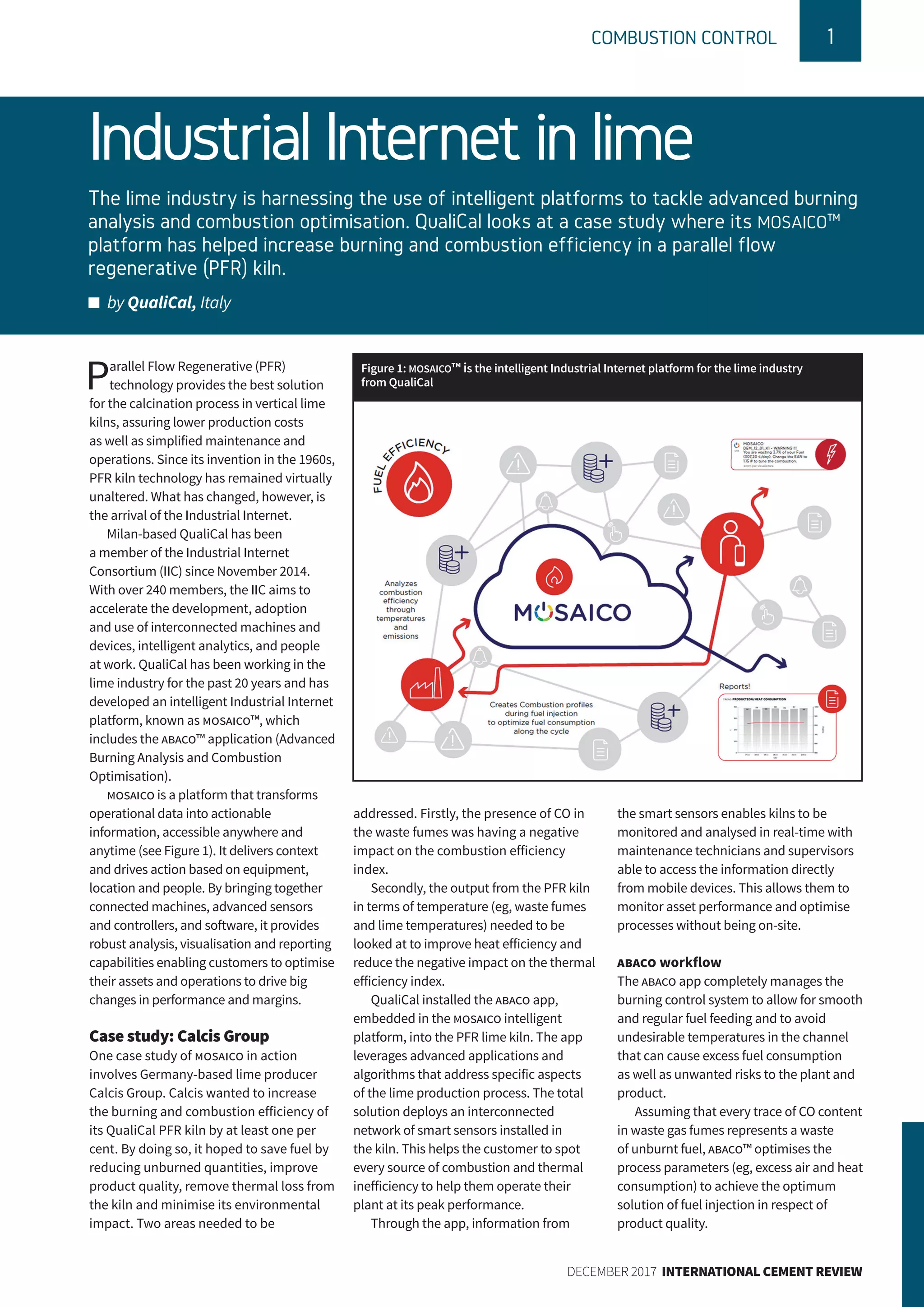
mosaico is a platform that transforms
operational data into actionable
information, accessible anywhere and
anytime (see Figure 1). It delivers context
and drives action based on equipment,
location and people. By bringing together
connected machines, advanced sensors
and controllers, and software, it provides
robust analysis, visualisation and reporting
capabilities enabling customers to optimise
their assets and operations to drive big
changes in performance and margins.
Case study: Calcis Group
One case study of mosaico in action
involves Germany-based lime producer
Calcis Group. Calcis wanted to increase
the burning and combustion efficiency of
its QualiCal PFR kiln by at least one per
cent. By doing so, it hoped to save fuel by
reducing unburned quantities, improve
product quality, remove thermal loss from
the kiln and minimise its environmental
impact. Two areas needed to be
addressed. Firstly, the presence of CO in
the waste fumes was having a negative
impact on the combustion efficiency
index.
Secondly, the output from the PFR kiln
in terms of temperature (eg, waste fumes
and lime temperatures) needed to be
looked at to improve heat efficiency and
reduce the negative impact on the thermal
efficiency index.
QualiCal installed the abaco app,
embedded in the mosaico intelligent
platform, into the PFR lime kiln. The app
leverages advanced applications and
algorithms that address specific aspects
of the lime production process. The total
solution deploys an interconnected
network of smart sensors installed in
the kiln. This helps the customer to spot
every source of combustion and thermal
inefficiency to help them operate their
plant at its peak performance.
Through the app, information from
the smart sensors enables kilns to be
monitored and analysed in real-time with
maintenance technicians and supervisors
able to access the information directly
from mobile devices. This allows them to
monitor asset performance and optimise
processes without being on-site.
abaco workflow
The abaco app completely manages the
burning control system to allow for smooth
and regular fuel feeding and to avoid
undesirable temperatures in the channel
that can cause excess fuel consumption
as well as unwanted risks to the plant and
product.
Assuming that every trace of CO content
in waste gas fumes represents a waste
of unburnt fuel, abaco™ optimises the
process parameters (eg, excess air and heat
consumption) to achieve the optimum
solution of fuel injection in respect of
product quality.
Figure 1: MOSAICO™ is the intelligent Industrial Internet platform for the lime industry
from QualiCal
2 COMBUSTION CONTROL
INTERNATIONAL CEMENT REVIEW DECEMBER 2017
By managing the real-time feedback
of waste gases analysis, abaco™ creates
fuel injection profiles during the cycle
that automatically adjust the excess of
air to avoid the waste of unburnt fuel.
Daily, weekly, monthly and annual reports
provide vital evaluations of the system in
terms of efficiency and cost (see Figure 2).
Results and savings
For Calcis, by spreading real-time
operational information over different
people and locations, the mosaico
platform increased process awareness and
reduced the time taken to make decisions.
Meanwhile, the abaco app enabled
the plan to monitor and analyse the
combustion process to detect any thermal
inefficiency.
This analysis helped to predict and
prevent fuel and thermal losses at the
plant, leading to better administration of
the fuel/air ratio to the kiln. This resulted
in estimated fuel savings of E5000/month/
plant (see Figure 3).
Using big data analysis, abaco also
provided air-coal mix injection profiles
during the cycle that automatically
adjusted the excess of air, thus avoiding
the waste of unburnt fuel and increasing
combustion efficiency by up to six per cent
at the production facility. n
Figure 2: MOSAICO™ creates profiles to target combustion and thermal efficiency throughout the cycle
Figure 3: by using MOSAICO™ and the ABACO™ app, QualiCal reduced the fuel and thermal losses
at Calcis Group’s PFR kiln
“This[abaco]analysis
helpedtopredictand
preventfuelandthermal
losses,leadingtobetter
administrationofthefuel/
airrationtothekiln.This
resultedinestimatedfuel
savingsofE5000/month/
plant(...).
©Copyright Tradeship Publications Ltd 2017

Industrial Internet in lime

  • 1.
    1COMBUSTION CONTROL DECEMBER 2017INTERNATIONAL CEMENT REVIEW Industrial Internet in lime The lime industry is harnessing the use of intelligent platforms to tackle advanced burning analysis and combustion optimisation. QualiCal looks at a case study where its MOSAICO™ platform has helped increase burning and combustion efficiency in a parallel flow regenerative (PFR) kiln. n by QualiCal, Italy Parallel Flow Regenerative (PFR) technology provides the best solution for the calcination process in vertical lime kilns, assuring lower production costs as well as simplified maintenance and operations. Since its invention in the 1960s, PFR kiln technology has remained virtually unaltered. What has changed, however, is the arrival of the Industrial Internet. Milan-based QualiCal has been a member of the Industrial Internet Consortium (IIC) since November 2014. With over 240 members, the IIC aims to accelerate the development, adoption and use of interconnected machines and devices, intelligent analytics, and people at work. QualiCal has been working in the lime industry for the past 20 years and has developed an intelligent Industrial Internet platform, known as mosaico™, which includes the abaco™ application (Advanced Burning Analysis and Combustion Optimisation). mosaico is a platform that transforms operational data into actionable information, accessible anywhere and anytime (see Figure 1). It delivers context and drives action based on equipment, location and people. By bringing together connected machines, advanced sensors and controllers, and software, it provides robust analysis, visualisation and reporting capabilities enabling customers to optimise their assets and operations to drive big changes in performance and margins. Case study: Calcis Group One case study of mosaico in action involves Germany-based lime producer Calcis Group. Calcis wanted to increase the burning and combustion efficiency of its QualiCal PFR kiln by at least one per cent. By doing so, it hoped to save fuel by reducing unburned quantities, improve product quality, remove thermal loss from the kiln and minimise its environmental impact. Two areas needed to be addressed. Firstly, the presence of CO in the waste fumes was having a negative impact on the combustion efficiency index. Secondly, the output from the PFR kiln in terms of temperature (eg, waste fumes and lime temperatures) needed to be looked at to improve heat efficiency and reduce the negative impact on the thermal efficiency index. QualiCal installed the abaco app, embedded in the mosaico intelligent platform, into the PFR lime kiln. The app leverages advanced applications and algorithms that address specific aspects of the lime production process. The total solution deploys an interconnected network of smart sensors installed in the kiln. This helps the customer to spot every source of combustion and thermal inefficiency to help them operate their plant at its peak performance. Through the app, information from the smart sensors enables kilns to be monitored and analysed in real-time with maintenance technicians and supervisors able to access the information directly from mobile devices. This allows them to monitor asset performance and optimise processes without being on-site. abaco workflow The abaco app completely manages the burning control system to allow for smooth and regular fuel feeding and to avoid undesirable temperatures in the channel that can cause excess fuel consumption as well as unwanted risks to the plant and product. Assuming that every trace of CO content in waste gas fumes represents a waste of unburnt fuel, abaco™ optimises the process parameters (eg, excess air and heat consumption) to achieve the optimum solution of fuel injection in respect of product quality. Figure 1: MOSAICO™ is the intelligent Industrial Internet platform for the lime industry from QualiCal
  • 2.
    2 COMBUSTION CONTROL INTERNATIONALCEMENT REVIEW DECEMBER 2017 By managing the real-time feedback of waste gases analysis, abaco™ creates fuel injection profiles during the cycle that automatically adjust the excess of air to avoid the waste of unburnt fuel. Daily, weekly, monthly and annual reports provide vital evaluations of the system in terms of efficiency and cost (see Figure 2). Results and savings For Calcis, by spreading real-time operational information over different people and locations, the mosaico platform increased process awareness and reduced the time taken to make decisions. Meanwhile, the abaco app enabled the plan to monitor and analyse the combustion process to detect any thermal inefficiency. This analysis helped to predict and prevent fuel and thermal losses at the plant, leading to better administration of the fuel/air ratio to the kiln. This resulted in estimated fuel savings of E5000/month/ plant (see Figure 3). Using big data analysis, abaco also provided air-coal mix injection profiles during the cycle that automatically adjusted the excess of air, thus avoiding the waste of unburnt fuel and increasing combustion efficiency by up to six per cent at the production facility. n Figure 2: MOSAICO™ creates profiles to target combustion and thermal efficiency throughout the cycle Figure 3: by using MOSAICO™ and the ABACO™ app, QualiCal reduced the fuel and thermal losses at Calcis Group’s PFR kiln “This[abaco]analysis helpedtopredictand preventfuelandthermal losses,leadingtobetter administrationofthefuel/ airrationtothekiln.This resultedinestimatedfuel savingsofE5000/month/ plant(...). ©Copyright Tradeship Publications Ltd 2017