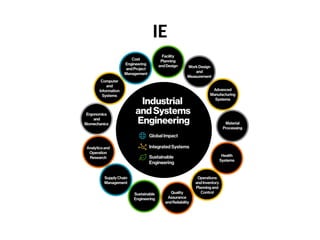
Industrial Engineering
• Industrial engineering is a branch of
engineering that deals with the optimization
of processes or systems.
IE
• In other words, it involves the science of
engineering things to make them efficient,
along with reducing production costs and
improving the quality of the products and
services.
IE
4M
• Man
• Machine
• Methods
• Materials
A concept of utilizing and coordinating 4 M to
attain a desired output rate with the optimum
utilization of energy, knowledge, money, and
time.
What is Industrial Engineering?
• Electrical Engineering – to engineer an electrical
product or system.
• Computer Engineering – to engineer a computer or a
system of networked computers.
• Industrial Engineering?
– To engineer an industry ?? Yes/No.
– To engineer an industrial product or system
(efficiently and effectively): for manufactured
goods or services, originally
– To engineer a product or system for industry, the
military, government, education, etc.
– Efficiency and Quality Engineering!!
IE empowers its students to better the
world…
• IE students learn how to:
– improve quality of products and services
– minimize costs
– improve security
– reduce risk of injury
– minimize delays
– improve accommodation for the disabled
– improve quality of work life of employees
– improve service to customers
– reduce human errors
– improve on-time performance
Role:
Industrial Engineer
• The role of the Industrial Engineer is to
effectively and efficiently utilize technologies,
machine tools, math, scientific concepts, and
human resources
• In order to solve problems, provide products
or services at minimal cost, and produce on
time at the optimum output level to satisfy
customer demands.
Industrial Engineer: Objectives
1- Increase the productivity.
2- Eliminating waste and non-value added
activities.
3- Improving the effective utilization of
resources.
Scope of
Industrial Engineering
• Industrial engineers work in every sector
• Combine technical skills with business acumen
• Understand ‘big data’
• Focus on processes
• Customize IE to match your interests
Scope
Industrial Engineering
Activities
• Selection of processes and assembling methods.
• Selection of design of tools and equipment.
• Design of facilities including plant location,
layout of buildings, machines, etc.
• Design and improvement of planning and
control systems for production, inventory,
quality, etc.
• Development of time standards, costing and
performance standards.
• Performance evaluation.
Industrial Engineering
Approach
• To carrying out the various activities, the industrial
engineering department uses the scientific approach.
• Industrial engineering department select the operation
or job for improvement.
• They gathers and analyses facts, prepares the
alternative solutions.
• All the details related to job or operation are collected
and recorded using various techniques.
• All the recorded facts are subjected to critical
examination.
• Alternative ways of doing the operation
and/or job is found out by using various
techniques.
• Based upon the criteria fixed for evaluation,
the best alternative is selected.
Qualities of an
Industrial engineer
• Good knowledge of methods and various
systems of production
• Mentally sound and suited to work
• Knowledge of different manufacturing processes
• Well Educated
• Positive thinking etc
Industrial Engineering
Techniques
• The techniques and tools, aim at improving
the productivity of the organization by
optimum utilization of resources.
31
Techniques of Industrial Engineering
Following tools and techniques are used to improve productivity of the
organization by optimum utilization of resources.
1- Method Study.
2- Time Study (Work Measurement).
3- Motion Economy.
4- Financial and Non Financial Incentives.
5- Value Analysis.
6- Production, Planning and Control.
7- Inventory Control.
8- Job Evaluation.
9- Material Handling Analysis.
10-Ergonomics (Human Engineering).
12- Operations Research Techniques and others.
Method Study
• To establish a standard method of performing a job
or an operation after thorough analysis of the jobs
and to establish the layout of production facilities
to have a uniform flow of material without back
tracking.
Time Study(work measurement)
• This is a technique used to establish a standard
time for a job or for an operation.
Motion Economy
• This is used to analyses the motions employed by the
operators do the work. The principles of motion
economy and motion analysis are very useful in mass
production or for short cycle repetitive jobs.
Value analysis
• It ensures that no unnecessary costs are built into the
product and it tries to provide the required functions at
the minimum cost. Hence, helps to enhance the worth
of the product.
Production, Planning and control
• This includes the planning for the resources (like men,
materials and machine) proper scheduling and
controlling production activities to ensure the right
quantity, quality of product at predetermined time and
pre-established cost.
Inventory control
• To find the economic lot size and the reorder levels for
the items so that the item should be made available to
the production at the right time and quantity to avoid
stock out situation and with minimum capital lock-up.
Material handling
• To scientifically analysis the movement of materials
through various departments to eliminate unnecessary
movement to enhance the efficiency of material handling.
Ergonomics (Human Engineering)
• It is concerned with study of relationship between man
and his working conditions to minimize mental and
physical stress. It is concerned with man-machine
system.
Organizations
• Organization is a process of defining and
grouping the activities of the enterprise and
establishing the authority relationship among
them.
• An organization is an entity comprising
multiple people, such as an institution or an
association, that has a collective goal and is
linked to an external environment
Necessity
• Increasing size of manufacturing plant
• Introduction of complex methods of production
• Tough competition and labour problems has
necessitated every factory to be well organized
• Growing competition
• Optimal utilization of resources
• Fixation of responsibility and authorities
• Proper co-ordination
• Success and failure of any enterprise largely
depends on nature of organization
Types of Organization
• Small organization
• Medium organization
• Large organization
Small organization
– It consisting less than 100 direct workers
– In a small company or organization two or three
industrial engineers may undertake all the
responsibilities.
– Typically the emphasis will be on work methods,
fixation of time and performance standards, plant
layout, estimating, cost reduction, etc.
Layout
Medium organization
– It consisting 100 to 300 direct workers
– The organization generally takes the form of
individual sections for various activities of
industrial engineering.
– Functions are well defined and titles like: Time
study engineer, Method study engineer, Process
engineer, etc., are exist there.
Large organization
– Generally have more than 300 workers
– In a large organization increased emphasis is
placed on such functions as value engineering,
Lean manufacturing, Six Sigma, TQM, TPM,
Kaizens, Green Engineering, operation research,
training, wage programmes etc.
Lean manufacturing companies
• NIKE
• Caterpillar
• Intel
• Illinois Tool Works
• John Deere
• Toyota
• Ford
LSS companies
• 3M
• Amazon
• GE
• Bank Of America
• Boeing
• Caterpillar Inc.
• Computer Sciences Corporation
• Convergys
• AT&T
• Wells Fargo
• Cooper Tire & Rubber Company
• Credit Suisse
• Damco
• Coca-Cola
• Deere & Company
• VIP Industries
• Dell
• Tata Steel
• Eastman Kodak Company
• Evonik Industries
• Ford Motor Company
• LG
• General Electric
• Telco
• Lionbridge
Maersk
Asian Paints
Motorola
Mumbai’s Dabbawalas
Northrop Grumman
Walmart
L&T Switchgear
Polyone Corporation
Berkshire Hathaway
Reliance
Whirlpool
Raytheon
Tata
Honeywell
TVS
Shop Direct
Suzuki
General Electric
Starwood Hotels & Resorts Worldwide
Tata Consultancy
Pidilite Industries
The Vanguard Group
Wipro
Organizational Structure
• An organizational structure defines how
activities such as task allocation, coordination
and supervision are directed toward the
achievement of organizational aims.
• Persons arrange according to rank and work
• It is a framework for dividing activities
• It is a authority structure and reporting relationship
• It differs from industry to industry and mainly depends upon:
 Size of organization
 Nature of product being manufactured
 Complexity etc
Types of Organization Structure
• Line Organization
• Functional Organization
• Line and staff organization
• Classical theories of organization associated
with Henri Fayol, Frederick W. Taylor, and
others who pioneered new administrative
strategies in the late 1800s and early 1900s
define formal organizations
as collective enterprises identified by a
clear division of labour and authority.
Line organization
• Line organization is the most oldest and
simplest method of administrative
organization.
• According to this type of organization, the
authority flows from top to bottom in a
concern. The line of command is carried out
from top to bottom.
Line/Military Organization
Line organization
• This is the reason for calling this organization as
scalar organization which means scalar chain of
command is a part and parcel of this type of
administrative organization.
• In this type of organization, the line of
command flows on an even basis without any
gaps in communication and co-ordination taking
place.
Features of Line Organization
• It is the most simplest form of organization.
• Line of authority flows from top to bottom.
• Specialized and supportive services do not take place in these
organization.
• Unified control by the line officers can be maintained since they
can independently take decisions in their areas and spheres.
• This kind of organization always helps in bringing efficiency in
communication and bringing stability to a concern.
• Advantages:
– It is simple and easy to understand
– It is flexible
– It make clear division of authority
– It encourages speedy action
• Disadvantages:
– It neglects specialist
– It is limited to very small concerns
– It overload a few key executives
Functional organization
• A functional organization is a common type of
organizational structure in which the organization is
divided into smaller groups based on specialized
functional areas, such as IT, finance, or marketing.
• Functional departmentalization arguably allows for
greater operational efficiency because employees
with shared skills and knowledge are grouped
together by function.
Functional organization
• A disadvantage of this type of structure is that
the different functional groups may not
communicate with one another, potentially
decreasing flexibility and innovation.
• A recent trend aimed at combating this
disadvantage is the use of teams that cross
traditional departmental lines.
• In a highly centralized structure, decisions are made
by a few executives or managers and flow downward
through the enterprise.
• However, as organizations grow in scope and
complexity, they need to be flexible in the extent to
which coordination and control are centrally applied.
• The principle of line-staff organization introduces
flexibility into hierarchical lines of authority while
trying to preserve a unified command structure.
Functional Organization
Office
Route Clerk: The route clerk specifies route of
production i.e. sequence to perform various
mechanical and manual operations. He also decides the
job to be done for the day & where it is to be done.
Instruction Card Clerk: The main function of instruction
card clerk is to draft the instructions according to which
workers have to perform their jobs.
Time and Cost Clerk: Time and Cost Clerk fixes the time
for starting and completing the work and prepares the
cost sheet for each job
Disciplinarian: He is responsible to ensure discipline in
the work place. He is concerned with the coordination
in each job from planning to successful execution. He
enforces rules and regulations and maintains discipline.
• Gang boss makes the arrangement of workers, machines,
tools etc.
• Speed boss concerned with maintaining the speed and to
remove delays in the production process.
• Repair boss concerned with maintenance of machine, tools
and equipments.
• Inspector is concerned with maintaining the quality of
product.
SHOP
• Advantages:
– A foreman is responsible for one function, he can
perform his duties in a better manner
– Expert guidance reduces the number of accidents and
wastage of material
– Quality of work improved
• Disadvantages:
– It makes industrial relationship more complex
– Worker always remains confused about the authority
– It is very difficult to fix up the responsibilities
Line and staff organization
• In management, approach in which authorities
(e.g., managers) establish goals and directives
that are then fulfilled by staff and other
workers.
• A line-staff organizational structure attempts to
render a large and complex enterprise more
flexible without sacrificing managerial authority.
Line and staff organization
• Advantages:
– Quality of product is improved
– There is no confusion as exists in functional
organization
– Less wastage of material
• Disadvantages:
– Product cost will increase
– Jealousies can developed between staff

Industrial engineering for mechanical engineering

  • 1.
    Industrial Engineering • Industrialengineering is a branch of engineering that deals with the optimization of processes or systems.
  • 3.
    IE • In otherwords, it involves the science of engineering things to make them efficient, along with reducing production costs and improving the quality of the products and services.
  • 4.
  • 5.
    4M • Man • Machine •Methods • Materials
  • 6.
    A concept ofutilizing and coordinating 4 M to attain a desired output rate with the optimum utilization of energy, knowledge, money, and time.
  • 8.
    What is IndustrialEngineering? • Electrical Engineering – to engineer an electrical product or system.
  • 9.
    • Computer Engineering– to engineer a computer or a system of networked computers.
  • 10.
    • Industrial Engineering? –To engineer an industry ?? Yes/No.
  • 11.
    – To engineeran industrial product or system (efficiently and effectively): for manufactured goods or services, originally – To engineer a product or system for industry, the military, government, education, etc. – Efficiency and Quality Engineering!!
  • 12.
    IE empowers itsstudents to better the world… • IE students learn how to: – improve quality of products and services – minimize costs – improve security – reduce risk of injury – minimize delays – improve accommodation for the disabled – improve quality of work life of employees – improve service to customers – reduce human errors – improve on-time performance
  • 14.
  • 15.
    • The roleof the Industrial Engineer is to effectively and efficiently utilize technologies, machine tools, math, scientific concepts, and human resources • In order to solve problems, provide products or services at minimal cost, and produce on time at the optimum output level to satisfy customer demands.
  • 17.
    Industrial Engineer: Objectives 1-Increase the productivity. 2- Eliminating waste and non-value added activities. 3- Improving the effective utilization of resources.
  • 18.
  • 19.
    • Industrial engineerswork in every sector • Combine technical skills with business acumen • Understand ‘big data’ • Focus on processes • Customize IE to match your interests
  • 20.
  • 21.
  • 22.
    • Selection ofprocesses and assembling methods. • Selection of design of tools and equipment. • Design of facilities including plant location, layout of buildings, machines, etc. • Design and improvement of planning and control systems for production, inventory, quality, etc.
  • 23.
    • Development oftime standards, costing and performance standards. • Performance evaluation.
  • 24.
  • 25.
    • To carryingout the various activities, the industrial engineering department uses the scientific approach. • Industrial engineering department select the operation or job for improvement. • They gathers and analyses facts, prepares the alternative solutions. • All the details related to job or operation are collected and recorded using various techniques.
  • 26.
    • All therecorded facts are subjected to critical examination. • Alternative ways of doing the operation and/or job is found out by using various techniques. • Based upon the criteria fixed for evaluation, the best alternative is selected.
  • 27.
  • 28.
    • Good knowledgeof methods and various systems of production • Mentally sound and suited to work • Knowledge of different manufacturing processes • Well Educated • Positive thinking etc
  • 29.
  • 30.
    • The techniquesand tools, aim at improving the productivity of the organization by optimum utilization of resources.
  • 31.
    31 Techniques of IndustrialEngineering Following tools and techniques are used to improve productivity of the organization by optimum utilization of resources. 1- Method Study. 2- Time Study (Work Measurement). 3- Motion Economy. 4- Financial and Non Financial Incentives. 5- Value Analysis. 6- Production, Planning and Control. 7- Inventory Control. 8- Job Evaluation. 9- Material Handling Analysis. 10-Ergonomics (Human Engineering). 12- Operations Research Techniques and others.
  • 32.
    Method Study • Toestablish a standard method of performing a job or an operation after thorough analysis of the jobs and to establish the layout of production facilities to have a uniform flow of material without back tracking.
  • 33.
    Time Study(work measurement) •This is a technique used to establish a standard time for a job or for an operation.
  • 34.
    Motion Economy • Thisis used to analyses the motions employed by the operators do the work. The principles of motion economy and motion analysis are very useful in mass production or for short cycle repetitive jobs.
  • 35.
    Value analysis • Itensures that no unnecessary costs are built into the product and it tries to provide the required functions at the minimum cost. Hence, helps to enhance the worth of the product.
  • 36.
    Production, Planning andcontrol • This includes the planning for the resources (like men, materials and machine) proper scheduling and controlling production activities to ensure the right quantity, quality of product at predetermined time and pre-established cost.
  • 37.
    Inventory control • Tofind the economic lot size and the reorder levels for the items so that the item should be made available to the production at the right time and quantity to avoid stock out situation and with minimum capital lock-up.
  • 38.
    Material handling • Toscientifically analysis the movement of materials through various departments to eliminate unnecessary movement to enhance the efficiency of material handling.
  • 43.
    Ergonomics (Human Engineering) •It is concerned with study of relationship between man and his working conditions to minimize mental and physical stress. It is concerned with man-machine system.
  • 47.
  • 48.
    • Organization isa process of defining and grouping the activities of the enterprise and establishing the authority relationship among them.
  • 49.
    • An organizationis an entity comprising multiple people, such as an institution or an association, that has a collective goal and is linked to an external environment
  • 50.
    Necessity • Increasing sizeof manufacturing plant • Introduction of complex methods of production • Tough competition and labour problems has necessitated every factory to be well organized • Growing competition
  • 51.
    • Optimal utilizationof resources • Fixation of responsibility and authorities • Proper co-ordination • Success and failure of any enterprise largely depends on nature of organization
  • 52.
  • 53.
    • Small organization •Medium organization • Large organization
  • 54.
    Small organization – Itconsisting less than 100 direct workers – In a small company or organization two or three industrial engineers may undertake all the responsibilities. – Typically the emphasis will be on work methods, fixation of time and performance standards, plant layout, estimating, cost reduction, etc.
  • 55.
  • 57.
    Medium organization – Itconsisting 100 to 300 direct workers – The organization generally takes the form of individual sections for various activities of industrial engineering. – Functions are well defined and titles like: Time study engineer, Method study engineer, Process engineer, etc., are exist there.
  • 60.
    Large organization – Generallyhave more than 300 workers – In a large organization increased emphasis is placed on such functions as value engineering, Lean manufacturing, Six Sigma, TQM, TPM, Kaizens, Green Engineering, operation research, training, wage programmes etc.
  • 61.
    Lean manufacturing companies •NIKE • Caterpillar • Intel • Illinois Tool Works • John Deere • Toyota • Ford
  • 62.
    LSS companies • 3M •Amazon • GE • Bank Of America • Boeing • Caterpillar Inc. • Computer Sciences Corporation • Convergys • AT&T • Wells Fargo • Cooper Tire & Rubber Company • Credit Suisse • Damco • Coca-Cola • Deere & Company • VIP Industries • Dell • Tata Steel • Eastman Kodak Company • Evonik Industries • Ford Motor Company • LG • General Electric • Telco • Lionbridge Maersk Asian Paints Motorola Mumbai’s Dabbawalas Northrop Grumman Walmart L&T Switchgear Polyone Corporation Berkshire Hathaway Reliance Whirlpool Raytheon Tata Honeywell TVS Shop Direct Suzuki General Electric Starwood Hotels & Resorts Worldwide Tata Consultancy Pidilite Industries The Vanguard Group Wipro
  • 64.
  • 65.
    • An organizationalstructure defines how activities such as task allocation, coordination and supervision are directed toward the achievement of organizational aims.
  • 66.
    • Persons arrangeaccording to rank and work • It is a framework for dividing activities • It is a authority structure and reporting relationship • It differs from industry to industry and mainly depends upon:  Size of organization  Nature of product being manufactured  Complexity etc
  • 68.
    Types of OrganizationStructure • Line Organization • Functional Organization • Line and staff organization
  • 69.
    • Classical theoriesof organization associated with Henri Fayol, Frederick W. Taylor, and others who pioneered new administrative strategies in the late 1800s and early 1900s define formal organizations as collective enterprises identified by a clear division of labour and authority.
  • 70.
    Line organization • Lineorganization is the most oldest and simplest method of administrative organization. • According to this type of organization, the authority flows from top to bottom in a concern. The line of command is carried out from top to bottom.
  • 71.
  • 73.
    Line organization • Thisis the reason for calling this organization as scalar organization which means scalar chain of command is a part and parcel of this type of administrative organization. • In this type of organization, the line of command flows on an even basis without any gaps in communication and co-ordination taking place.
  • 75.
    Features of LineOrganization • It is the most simplest form of organization. • Line of authority flows from top to bottom. • Specialized and supportive services do not take place in these organization. • Unified control by the line officers can be maintained since they can independently take decisions in their areas and spheres. • This kind of organization always helps in bringing efficiency in communication and bringing stability to a concern.
  • 76.
    • Advantages: – Itis simple and easy to understand – It is flexible – It make clear division of authority – It encourages speedy action • Disadvantages: – It neglects specialist – It is limited to very small concerns – It overload a few key executives
  • 77.
    Functional organization • Afunctional organization is a common type of organizational structure in which the organization is divided into smaller groups based on specialized functional areas, such as IT, finance, or marketing. • Functional departmentalization arguably allows for greater operational efficiency because employees with shared skills and knowledge are grouped together by function.
  • 79.
    Functional organization • Adisadvantage of this type of structure is that the different functional groups may not communicate with one another, potentially decreasing flexibility and innovation. • A recent trend aimed at combating this disadvantage is the use of teams that cross traditional departmental lines.
  • 81.
    • In ahighly centralized structure, decisions are made by a few executives or managers and flow downward through the enterprise. • However, as organizations grow in scope and complexity, they need to be flexible in the extent to which coordination and control are centrally applied. • The principle of line-staff organization introduces flexibility into hierarchical lines of authority while trying to preserve a unified command structure.
  • 82.
  • 83.
    Office Route Clerk: Theroute clerk specifies route of production i.e. sequence to perform various mechanical and manual operations. He also decides the job to be done for the day & where it is to be done. Instruction Card Clerk: The main function of instruction card clerk is to draft the instructions according to which workers have to perform their jobs.
  • 84.
    Time and CostClerk: Time and Cost Clerk fixes the time for starting and completing the work and prepares the cost sheet for each job Disciplinarian: He is responsible to ensure discipline in the work place. He is concerned with the coordination in each job from planning to successful execution. He enforces rules and regulations and maintains discipline.
  • 85.
    • Gang bossmakes the arrangement of workers, machines, tools etc. • Speed boss concerned with maintaining the speed and to remove delays in the production process. • Repair boss concerned with maintenance of machine, tools and equipments. • Inspector is concerned with maintaining the quality of product. SHOP
  • 86.
    • Advantages: – Aforeman is responsible for one function, he can perform his duties in a better manner – Expert guidance reduces the number of accidents and wastage of material – Quality of work improved • Disadvantages: – It makes industrial relationship more complex – Worker always remains confused about the authority – It is very difficult to fix up the responsibilities
  • 87.
    Line and stafforganization • In management, approach in which authorities (e.g., managers) establish goals and directives that are then fulfilled by staff and other workers. • A line-staff organizational structure attempts to render a large and complex enterprise more flexible without sacrificing managerial authority.
  • 88.
    Line and stafforganization
  • 89.
    • Advantages: – Qualityof product is improved – There is no confusion as exists in functional organization – Less wastage of material • Disadvantages: – Product cost will increase – Jealousies can developed between staff