Amjad Ali Rana
• Ph.D research scholar
• acyber310@gmail.com
• +923006885750
• For social science research help feel free and join us
INDONESIA
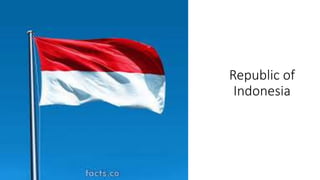
Republic of
Indonesia
Overview
• Indonesia came into being in 17 August 1945
• Its Capital name is Jakarta
• Official languages: Indonesian
• Currency: Indonesian rupiah
• Religions: Muslim 87.2%, Christian 7%, Roman Catholic 2.9%, Hindu
1.7%, other 0.9% (includes Buddhist and Confucian), unspecified 0.4%
(2010 est.)
• Land use: agricultural land 31.2%, arable land 13%, permanent crops
12.1%, permanent pasture 6.1%
Cont.….
• Population: 258,316,051 (July 2016 est.)
• The population is expected to grow to around 270 million by 2020
and 321 million by 2050.
• Age structure: 0-14 years: 25.42%
• 15-24 years: 17.03%
• 25-54 years: 42.35%
• 55-64 years: 8.4%
• 65 years and over: 6.79%
Cont.…
• Population growth rate: 0.89%
• Birth rate: 16.4 births/1,000 population (2016 est.)
• Death rate: 6.4 deaths/1,000 population (2016 est.)
• Life expectancy at birth: total population: 72.7 years
Cont.…
• Indonesia is the world's 15th largest country in terms of land area with
1,919,440 square km
• And world's 7thlargest country in terms of combined sea and land
area.
• Its average population density is 134 people per square km
• although Java province, the world's most populous island, has a
population density of 940 people per square km
Labor force
by occupation:
• agriculture: 38.9%
• industry: 13.2%
• services: 47.9% (2012 est.)
• Unemployment rate: 5.5% (2015 est.)
• Population below poverty line: 11.3% (2014 est.)
• HDI (2015) 0.684
Government and politics
• Indonesia is a republic with a presidential system
• The president of Indonesia is the
• head of state
• head of government
• Commander-in-chief of Indonesian National Armed Forces
• and the director of domestic governance, policy making and foreign
affairs.
Military
Indonesia's Armed Forces include
• The Army
• Navy
• and Air Force
• The army has about 400,000 active duty personnel.
Administrative divisions
• Administratively, Indonesia consists
• of 34 provinces, Each province has its own legislature and governor
The provinces are subdivided into regencies and cities
• which are further subdivided into districts
• and again into administrative villages
• Furthermore, a village is divided into several community groups
Location and total area
• Indonesia located in Southeast Asia mainly Situated between the
Indian Ocean and Pacific oceans,
• It is the world's largest island country
• According to a survey conducted between 2007 and 2010 by National
Coordinating Agency for Survey and Mapping, Indonesia has 13,466
islands
• These are scattered over both sides of the equator
Climate
• Indonesia has a tropical climate, with two distinct monsoonal wet and
dry seasons
• Average annual rainfall range from 70 inches to 240 inches
• Humidity is generally high, averaging about 80%.
• Temperatures vary little throughout the year; the average daily
temperature range of Jakarta is 26–30 °C
Education
• Education in Indonesia is compulsory for twelve years
• The enrolment rate is 94% for primary education
• 75% for secondary education
• and 27% for tertiary education.
• there are 118 state universities in Indonesia.
• Over all literacy rate is 93%
natural resources
• natural resources including
• crude oil
• natural gas
• tin
• Copper
• fertile soils
• and gold.
Economy
• The largest economy in Southeast Asia and a member of the G20
major economies.
• Indonesia's estimated gross domestic product (nominal), as of 2016,
is US$936.955 billion
• while GDP in PPP terms is US$$3.010 trillion
• It is the sixteenth largest economy in the world by nominal GDP
• Eighth largest in terms of GDP (PPP).
Cont.…
• per capita GDP in PPP is US$11,633 (international dollars)
• while Nominal per capita GDP is US$3,620
• GDP - composition by sector: agriculture: 13.6% industry: 42.8%
services: 43.6%
• The tourism sector contributes to around US$10.1 billion of foreign
exchange
• Singapore, Malaysia, Australia, China and Japan are the top five
source of visitors to Indonesia.
Major imports and exports
• Indonesia was the 25th biggest exporting country in the world in 2015
• The major exports are coal, palm oil, petroleum gas , crude petroleum
rubber, electrical appliances, plywood and textiles
• Exports - partners: Japan 12%, US 10.8%, China 10%, Singapore 8.4%,
India 7.8%, South Korea 5.1%, Malaysia 5.1% (2015)
• Indonesia's major imports include machinery and equipment,
chemicals, fuels, and foodstuffs
• Imports - partners: China 20.6%, Singapore 12.6%, Japan 9.3%,
Malaysia 6%, South Korea 5.9%, Thailand 5.7%, US 5.3% (2015)
Palm oil
• Palm oil production is important to the economy of Indonesia as the
country is the
• world's biggest producer and consumer of the Palm oil, providing
about half the world supply.
• Oil palm plantations stretch across 6 million hectares
Poverty status
• People living bellow poverty line are 11%
• Poverty in rural areas is 13.8%
• Poverty in urban areas is 8.2%
• HDI ranking is 110 with 0.684
Why Indonesia is not consider a rich country?
• Indonesia has low GDP per capita, $3,511 and 117th in the world
• Indonesia's Human Development Index (HDI) is categorized as
medium
• Indonesia is too Jakarta-centric
• lack of excellent transportation systems
• The educated people are corrupt, while the uneducated one play
music for money
• many Indonesians who lived in poverty not realized that they are
poor

Indonisa rural development presentation

  • 1.
    Amjad Ali Rana •Ph.D research scholar • acyber310@gmail.com • +923006885750 • For social science research help feel free and join us
  • 2.
  • 3.
  • 4.
    Overview • Indonesia cameinto being in 17 August 1945 • Its Capital name is Jakarta • Official languages: Indonesian • Currency: Indonesian rupiah • Religions: Muslim 87.2%, Christian 7%, Roman Catholic 2.9%, Hindu 1.7%, other 0.9% (includes Buddhist and Confucian), unspecified 0.4% (2010 est.) • Land use: agricultural land 31.2%, arable land 13%, permanent crops 12.1%, permanent pasture 6.1%
  • 5.
    Cont.…. • Population: 258,316,051(July 2016 est.) • The population is expected to grow to around 270 million by 2020 and 321 million by 2050. • Age structure: 0-14 years: 25.42% • 15-24 years: 17.03% • 25-54 years: 42.35% • 55-64 years: 8.4% • 65 years and over: 6.79%
  • 6.
    Cont.… • Population growthrate: 0.89% • Birth rate: 16.4 births/1,000 population (2016 est.) • Death rate: 6.4 deaths/1,000 population (2016 est.) • Life expectancy at birth: total population: 72.7 years
  • 7.
    Cont.… • Indonesia isthe world's 15th largest country in terms of land area with 1,919,440 square km • And world's 7thlargest country in terms of combined sea and land area. • Its average population density is 134 people per square km • although Java province, the world's most populous island, has a population density of 940 people per square km
  • 8.
    Labor force by occupation: •agriculture: 38.9% • industry: 13.2% • services: 47.9% (2012 est.) • Unemployment rate: 5.5% (2015 est.) • Population below poverty line: 11.3% (2014 est.) • HDI (2015) 0.684
  • 9.
    Government and politics •Indonesia is a republic with a presidential system • The president of Indonesia is the • head of state • head of government • Commander-in-chief of Indonesian National Armed Forces • and the director of domestic governance, policy making and foreign affairs.
  • 10.
    Military Indonesia's Armed Forcesinclude • The Army • Navy • and Air Force • The army has about 400,000 active duty personnel.
  • 11.
    Administrative divisions • Administratively,Indonesia consists • of 34 provinces, Each province has its own legislature and governor The provinces are subdivided into regencies and cities • which are further subdivided into districts • and again into administrative villages • Furthermore, a village is divided into several community groups
  • 12.
    Location and totalarea • Indonesia located in Southeast Asia mainly Situated between the Indian Ocean and Pacific oceans, • It is the world's largest island country • According to a survey conducted between 2007 and 2010 by National Coordinating Agency for Survey and Mapping, Indonesia has 13,466 islands • These are scattered over both sides of the equator
  • 13.
    Climate • Indonesia hasa tropical climate, with two distinct monsoonal wet and dry seasons • Average annual rainfall range from 70 inches to 240 inches • Humidity is generally high, averaging about 80%. • Temperatures vary little throughout the year; the average daily temperature range of Jakarta is 26–30 °C
  • 14.
    Education • Education inIndonesia is compulsory for twelve years • The enrolment rate is 94% for primary education • 75% for secondary education • and 27% for tertiary education. • there are 118 state universities in Indonesia. • Over all literacy rate is 93%
  • 15.
    natural resources • naturalresources including • crude oil • natural gas • tin • Copper • fertile soils • and gold.
  • 16.
    Economy • The largesteconomy in Southeast Asia and a member of the G20 major economies. • Indonesia's estimated gross domestic product (nominal), as of 2016, is US$936.955 billion • while GDP in PPP terms is US$$3.010 trillion • It is the sixteenth largest economy in the world by nominal GDP • Eighth largest in terms of GDP (PPP).
  • 17.
    Cont.… • per capitaGDP in PPP is US$11,633 (international dollars) • while Nominal per capita GDP is US$3,620 • GDP - composition by sector: agriculture: 13.6% industry: 42.8% services: 43.6% • The tourism sector contributes to around US$10.1 billion of foreign exchange • Singapore, Malaysia, Australia, China and Japan are the top five source of visitors to Indonesia.
  • 18.
    Major imports andexports • Indonesia was the 25th biggest exporting country in the world in 2015 • The major exports are coal, palm oil, petroleum gas , crude petroleum rubber, electrical appliances, plywood and textiles • Exports - partners: Japan 12%, US 10.8%, China 10%, Singapore 8.4%, India 7.8%, South Korea 5.1%, Malaysia 5.1% (2015) • Indonesia's major imports include machinery and equipment, chemicals, fuels, and foodstuffs • Imports - partners: China 20.6%, Singapore 12.6%, Japan 9.3%, Malaysia 6%, South Korea 5.9%, Thailand 5.7%, US 5.3% (2015)
  • 19.
    Palm oil • Palmoil production is important to the economy of Indonesia as the country is the • world's biggest producer and consumer of the Palm oil, providing about half the world supply. • Oil palm plantations stretch across 6 million hectares
  • 20.
    Poverty status • Peopleliving bellow poverty line are 11% • Poverty in rural areas is 13.8% • Poverty in urban areas is 8.2% • HDI ranking is 110 with 0.684
  • 21.
    Why Indonesia isnot consider a rich country? • Indonesia has low GDP per capita, $3,511 and 117th in the world • Indonesia's Human Development Index (HDI) is categorized as medium • Indonesia is too Jakarta-centric • lack of excellent transportation systems • The educated people are corrupt, while the uneducated one play music for money • many Indonesians who lived in poverty not realized that they are poor