Indirect bonding
By
Dr. Vineeth Kumar.S
Content
• Introduction
• History
• Indirect bonding for labial case
• Indirect bonding for lingual case
• Advantage
• Disadvantage
• Direct vs indirect bonding
• Conclusion
• References
Introduction
• Indirect bonding is a technique in which orthodontic
brackets or other attachments are transferred from
dental casts & bonded to the dentition using a
transfer device.
• It was first described in detail as a concept in 1972 by
Silverman & Cohen.
• The use of light cured materials was mentioned as early as
1972 in the original Silverman and Cohen technique and
elaborated on by them in 1974.
• In 1974, Newman discussed the use of acrylic-base adhesives
to direct & in-direct bond plastic & mesh base brackets.
• Thomas in his original thesis in 1979, discussed a modification
of the Silverman & Cohen technique & was first to described
the construction of these custom composite bases.
History
• Fried & Newman discussed the use of a no-mix adhesive in
indirect bonding in 1983.
• In 1984, the concept of a rapidly setting curing system took
place when Aguirre experimented with varying setting times
by changing catalyse/base composites.
• In 1990, Read & O’Brien used a visible light-cured adhesive in
indirect bonding on foil mesh based brackets.
• Hamula discussed the advantages of using light-cured
adhesives for indirect bonding in 1991.
• Read and Pearson, in 1998, were the first to discuss the use of
a light-cured, lightly filled sealant to attach brackets with a
custom resin base to the teeth via an indirect method.
• In 2001, White used a self-etching primer and a quick cure
composite adhesive in indirect bonding.
• A flowable composite developed for use in restorative
dentistry for air abrasion, tunnel preparations, shallow Class V
cavities, and as a fissure sealant, was first incorporated into an
indirect bonding technique by Miles in 2002.
Indirect bonding for labial
Nuva-Tach facing on the model
• Impressions of the teeth to be taken and make two sets
of models.
• Separating medium to be applied on the stone teeth of
the work model.
• Cover almost the entire labial and buccal surfaces of the
teeth short of the contact points and the gingiva with a
layer of Nuva-Tach which forms a backing for the
attachments and a facing for the teeth.
Technique given by Silverman & Cohen(1972)
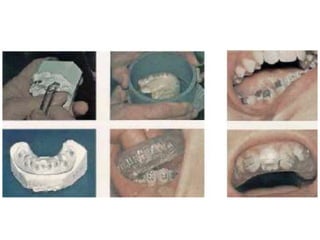
Placing the brackets on the model
• After the Nuva-Tach has been shaped to the desired
backing or facing on the model teeth, brackets are
placed in their desired positions on each of the teeth,
with their flanges covered.
Curing the facings on the model
• When all the attachments have been placed, the
individual teeth on the model are treated with the
ultraviolet light to cure the Nuva-Tach.
• Once the Nuva-Tach on the model teeth has been
polymerized, a plastic wafer is vacuum-molded over
the teeth, facings and attachments. The material used
is about 1/16" thickness.
Vacuum-formed plastic tray
• When the vacuum-formed plastic wafer is removed from
the work model, it takes the attachments and the
hardened Nuva-Tach facings with it.
• The wafer is then trimmed.
• Now we have a plastic tray ready to be placed in the
mouth
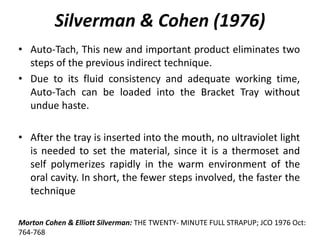
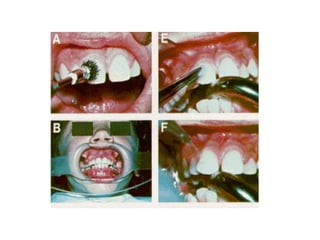
Tooth surface preparation
• The first step in preparing the tooth surface is pumicing
followed by acid conditioning.
Polymerizing the Nuva-Seal coating
• The Nuva-Seal is then painted on the tooth surfaces and
polymerized with the ultraviolet light.
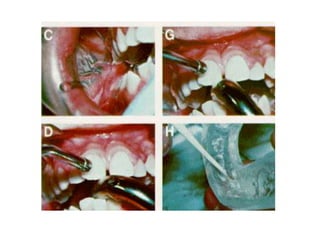
Seating the tray
• With the thin layer of fresh Nuva-Tach applied to the backings to
be bonded, the tray is placed directly in the mouth and forced
onto the teeth, both sides at the same time. However, generally
bond only one side at a time.
• the tray is seated completely, the brackets and facings are
exposed to the ultraviolet light for 90 seconds per tooth through
the tray.
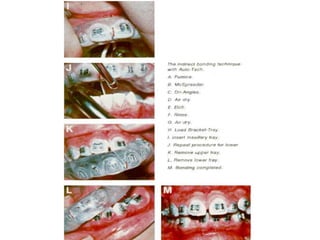
• Auto-Tach, This new and important product eliminates two
steps of the previous indirect technique.
• Due to its fluid consistency and adequate working time,
Auto-Tach can be loaded into the Bracket Tray without
undue haste.
• After the tray is inserted into the mouth, no ultraviolet light
is needed to set the material, since it is a thermoset and
self polymerizes rapidly in the warm environment of the
oral cavity. In short, the fewer steps involved, the faster the
technique
Silverman & Cohen (1976)
Morton Cohen & Elliott Silverman: THE TWENTY- MINUTE FULL STRAPUP; JCO 1976 Oct:
764-768
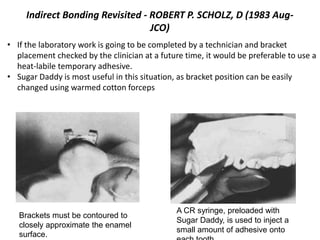
Indirect Bonding Revisited - ROBERT P. SCHOLZ, D (1983 Aug-
JCO)
Brackets must be contoured to
closely approximate the enamel
surface.
A CR syringe, preloaded with
Sugar Daddy, is used to inject a
small amount of adhesive onto
• If the laboratory work is going to be completed by a technician and bracket
placement checked by the clinician at a future time, it would be preferable to use a
heat-labile temporary adhesive.
• Sugar Daddy is most useful in this situation, as bracket position can be easily
changed using warmed cotton forceps
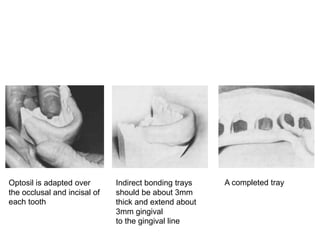
Optosil is adapted over
the occlusal and incisal of
each tooth
Indirect bonding trays
should be about 3mm
thick and extend about
3mm gingival
to the gingival line
A completed tray
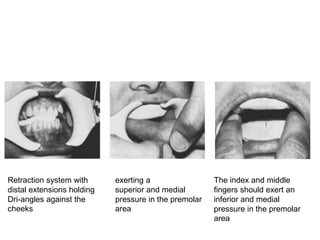
Retraction system with
distal extensions holding
Dri-angles against the
cheeks
exerting a
superior and medial
pressure in the premolar
area
The index and middle
fingers should exert an
inferior and medial
pressure in the premolar
area
A New Indirect Bonding Resin:
• a new resin was required specifically for indirect bonding. This
resin was developed with the aid of 3M Unitek (Sondhi Rapid
Set, 3M Unitek).
• The viscosity of the new resin was increased with the use of a
fine-particle-fumed silica filler (approximately 5%), so that it
would have the ability of filling any such voids without
compromising bond strength.
• Second, because there is no need for increased working time
once the trays have been placed, the new resin was
developed with a quick-set time of 30 seconds.
Indirect Bonding: The Sondhi Method (1999)
Anoop Sondhi: Efficient and effective indirect bonding: AJO- DO 1999;115:352-9
• The latter significantly decreases the time needed to
hold the bonding tray in place during curing. The
resin is completely cured in 2 minutes, which allows
for rapid removal of the bonding tray. This new resin
has been specifically designed for indirect bonding
and would not be useful for direct bonding.
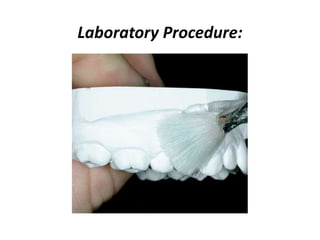
Laboratory Procedure:
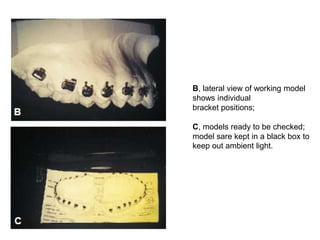
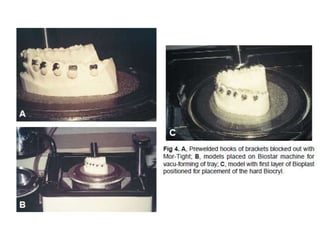
B, lateral view of working model
shows individual
bracket positions;
C, models ready to be checked;
model sare kept in a black box to
keep out ambient light.
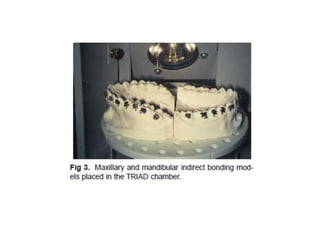
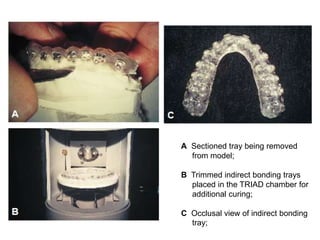
A Sectioned tray being removed
from model;
B Trimmed indirect bonding trays
placed in the TRIAD chamber for
additional curing;
C Occlusal view of indirect bonding
tray;
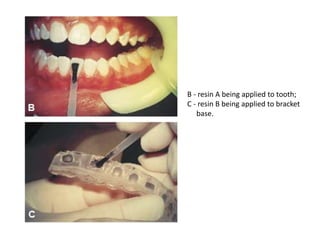
B - resin A being applied to tooth;
C - resin B being applied to bracket
base.
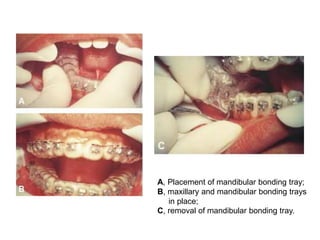
A, Placement of mandibular bonding tray;
B, maxillary and mandibular bonding trays
in place;
C, removal of mandibular bonding tray.
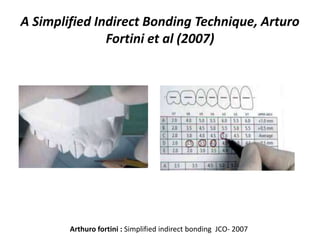
A Simplified Indirect Bonding Technique, Arturo
Fortini et al (2007)
Arthuro fortini : Simplified indirect bonding JCO- 2007
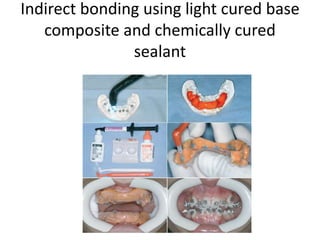
Indirect bonding using light cured base
composite and chemically cured
sealant
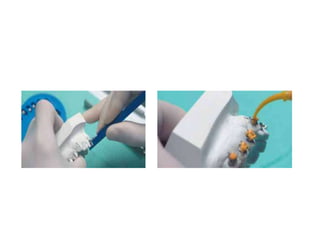
1. Take an impression and pour up a stone (not plaster) model.
2. Select brackets for each tooth.
3. Isolate the stone model with a separating medium.
4. Attach the brackets to the teeth on the model with light-cured or
thermally cured composite resin, or use adhesive precoated
brackets.
5. Check all measurements and alignments. Reposition if needed.
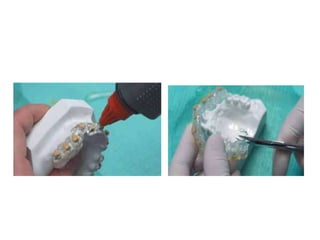
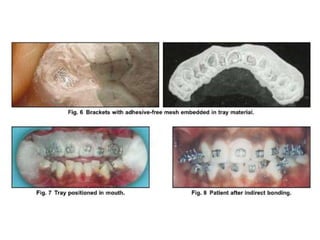
6. Make a transfer tray for the brackets. Material can be putty silicone,
thermoplastics, or similar.
7. After removing the transfer trays, gently sandblast the adhesive
bases with a microetching unit, taking care not to abrade the resin
base..
8. Apply acetone to the bases to dissolve the remaining separating
medium.
9. Prepare the patient’s teeth as for a direct application.
10. Apply Sondhi Rapid Set resin A to the tooth surfaces and resin B
to the bracket bases.
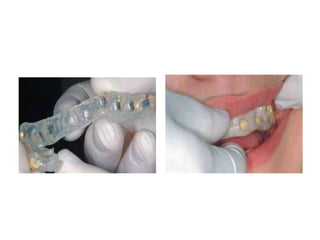
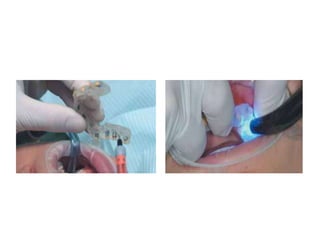
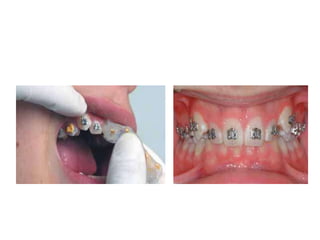
11. Seat the tray on the prepared arch and with the fingers apply
equal pressure to the occlusal, labial, and buccal surfaces. Hold for
a minimum of 30 seconds, and allow for 2 minutes or more of
curing time before removing the tray.
12. Remove excess flash of resin from the gingival and contact areas
of the teeth with a scaler or contra-angle handpiece and tungsten
carbide bur.
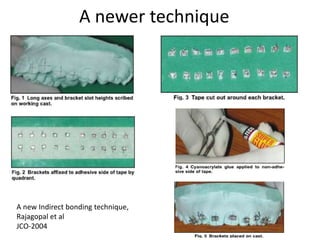
A newer technique
A new Indirect bonding technique,
Rajagopal et al
JCO-2004
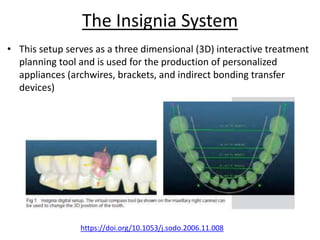
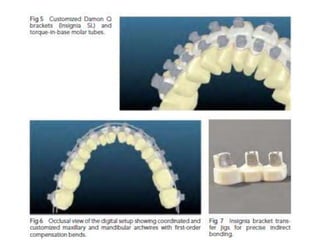
The Insignia System
• This setup serves as a three dimensional (3D) interactive treatment
planning tool and is used for the production of personalized
appliances (archwires, brackets, and indirect bonding transfer
devices)
https://doi.org/10.1053/j.sodo.2006.11.008
Indirect bonding for lingual
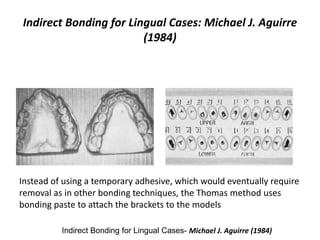
Indirect Bonding for Lingual Cases: Michael J. Aguirre
(1984)
Indirect Bonding for Lingual Cases- Michael J. Aguirre (1984)
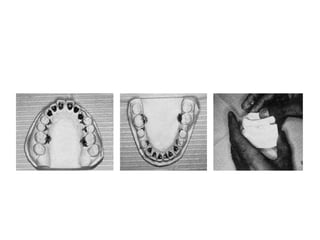
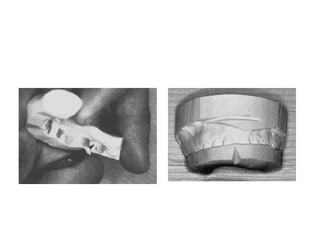
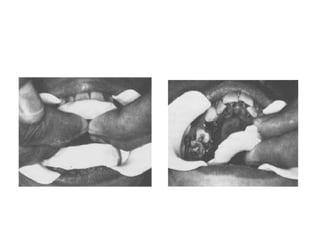
Instead of using a temporary adhesive, which would eventually require
removal as in other bonding techniques, the Thomas method uses
bonding paste to attach the brackets to the models
Various system of lingual set up
1. TARG (Torque angulation reference guide )
2. FILLION’S indirect bonding system
3. THE CLASS SYSTEM (customized lingual
appliance set up service).
4. HIRO SYSTEM
5. THE RAY SET SYSTEM
6. LINGUAL BRACKET JIG
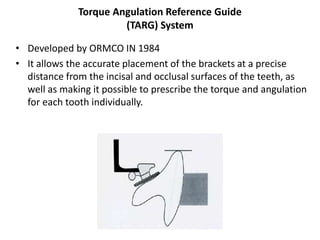
Torque Angulation Reference Guide
(TARG) System
• Developed by ORMCO IN 1984
• It allows the accurate placement of the brackets at a precise
distance from the incisal and occlusal surfaces of the teeth, as
well as making it possible to prescribe the torque and angulation
for each tooth individually.
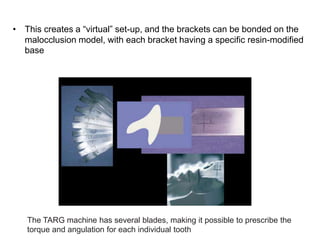
The TARG machine has several blades, making it possible to prescribe the
torque and angulation for each individual tooth
• This creates a “virtual” set-up, and the brackets can be bonded on the
malocclusion model, with each bracket having a specific resin-modified
base
Fillion’s indirect bonding system
• Developed by Dr.Didier fillion of france in 1987
• Also known as Bonding with equalized specific thickness(BEST).
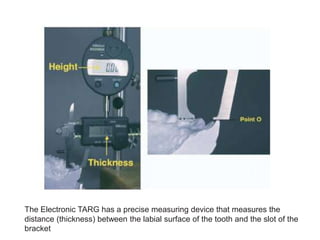
• an important feature missing from the original TARG machine—a
device to measure the distance in the horizontal plane from the
labial surface of the tooth to the slot of the lingual bracket
The Electronic TARG has a precise measuring device that measures the
distance (thickness) between the labial surface of the tooth and the slot of the
bracket
CLASS system (Custom Lingual Appliance Set-
up Service)
• Described by scott huge .
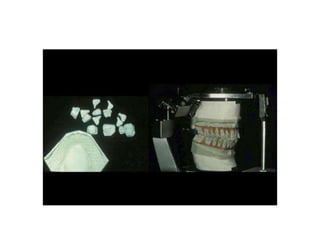
• It takes anatomical discrepancies in lingual surface of the teeth
into account.
• A pre-treatment diagnostic setup is manufactured and then used
as a template for definitive bracket fitting.
• the number of laboratory procedures involved, this system ends
up being more complex, more costly, yet less accurate.
• An evolution of the CLASS method is the BASS (Basetta Alveolare
Sistema set-up), which allows a more precise transfer from the
set-up to the mal-occlusion models.
Hiro system
• Introduced by Hiro and later improved by Takemoto and Scuzzo
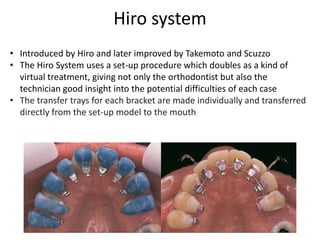
• The Hiro System uses a set-up procedure which doubles as a kind of
virtual treatment, giving not only the orthodontist but also the
technician good insight into the potential difficulties of each case
• The transfer trays for each bracket are made individually and transferred
directly from the set-up model to the mouth
• This method aims to make the laboratory process as easy as possible,
avoiding the need to purchase costly instruments or electronic devices,
and comes much closer to a straight-wire system.
• Since this modified CLASS technique does not use a TARG device for
bracket positioning, the set-up is different from the usual diagnostic set-
up
• A full size ideal wire .018 x .025 stainless steel as a transfer tool, all
over corrections have to be preprogrammed in the set-up.
• After completing the set-up the technician shapes an ideal
arch and fits all the brackets to this wire, keeping them as
close as possible to the lingual surfaces. Once it has been
ascertained that all brackets are positioned correctly, single
rigid transfer trays for each tooth are fabricated.
• The relative simplicity of this method means that no second
transferred set-up to the malocclusion model is necessary,
which minimizes the risk of error and allows easier and more
precise re-bonding.
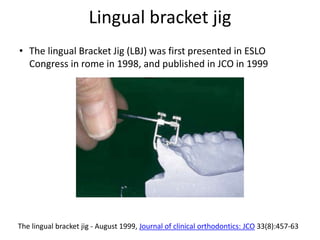
Lingual bracket jig
• The lingual Bracket Jig (LBJ) was first presented in ESLO
Congress in rome in 1998, and published in JCO in 1999
The lingual bracket jig - August 1999, Journal of clinical orthodontics: JCO 33(8):457-63
• The LBJ developed by Geron is the only system that
allows direct as well as indirect positioning of brackets.
• It consists of a set of six jigs for the anterior maxillary
teeth, one universal jig for the posterior teeth, and a
special ruler.
• The jigs transfer the Andrews labial bracket prescription
to the lingual surface.
• An occlusal stop measures the height of the bracket from
the incisal edge
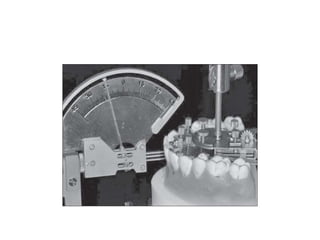
Korean indirect bonding set up
• The KIS system was developed by members of the Korean
Society of Lingual Orthodontics (KSLO) and uses a bracket-
positioning machine that allows the positioning of all brackets
at once
• it is a very precise system that places the bracket
accurately and eliminates the need for any bracket
repositioning during treatment.
• It allows for bracket height differences between anterior
and posterior teeth, which facilitates the intrusion of
anterior teeth.
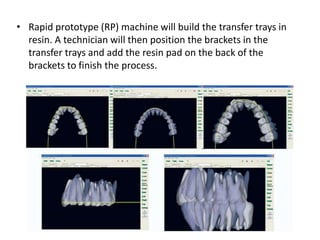
Orapix system
• A scanner will scan a patient’s model and create a three
dimensional (3D) data file. The orthodontist will receive the 3D
data file of the patient and a 3-Txer software package via the
Internet.
• With the 3-Txer software the orthodontist will visualize a 3D
model and will be able to create his own virtual set-up on his
computer for that particular patient
• Rapid prototype (RP) machine will build the transfer trays in
resin. A technician will then position the brackets in the
transfer trays and add the resin pad on the back of the
brackets to finish the process.
THE ADVANTAGES OF INDIRECT BONDING:
There are some significant advantages to indirect bonding:
1. Accurate bracket positioning
2. Reduced chair side time
3. Avoiding band on posterior teeth
4. No need for separators
5. Enhance ability to bond posterior teeth
6. Enhance patient comfort and hygiene
DISADVANTAGES OF INDIRECT BONDING
1. Technique sensitive
2. Extra set of impressions needed
3. Posterior attachments more likely to debond if patient chews.
• Bond strengths and failure locations in direct and indirect bonding of
orthodontic brackets with foil mesh bonding pads were compared in an
in vitro study that used extracted human premolars.
• The direct technique comprised bonding the attachments directly to the
premolars with composite resin.
• The indirect technique comprised bonding the attachments to die-stone
models of the teeth with composite resin, making silicone positioners to
transfer the attachments from the models to the teeth, and bonding to
the teeth with the use of two-part unfilled resin.
• One part of the unfilled resin was applied to the teeth and the other part
to the composite resin that was already bonded to the attachments. And
concluded that
Indirect versus direct bonding: Richard A.
Hocevar, Howard F. Vincent(1988)
1. Comparison of bond strengths between in vitro direct
and indirect bonded attachments showed no
significant difference between the two groups.
2. On visual inspection, voids could be detected in 65%
of the indirect samples; unfilled voids yielded a
significant decrease in bond strength (P < 0.001).
3. Sealing voids with liquid resin produced bond
strengths comparable to direct bonds and void-free
indirect bonds.
4. Although 72% of the indirect group failed
predominately at the enamel-resin interface (vs. 56%
of the direct sample), no significant decrease in bond
strength resulted.
Conclusion
• The improvement in tools and techniques enable us
to achieve great results with far less discomfort and
in a much shorter treatment time than was ever
before possible
• Whichever system is chosen, only with practice
will the clinician become more familiar and
probably more selective.
References
• Graber vanarsdall 5th edition
• Morton Cohen & Elliott Silverman: Completely indirect
bonded practice; JCO 1974 July:384-405
• Morton Cohen & Elliott Silverman: THE TWENTY- MINUTE
FULL STRAPUP; JCO 1976 Oct: 764-768
• Robert P. Scholz: Indirect Bonding Revisited: JCO 1983 Aug:
529-536
• Anoop Sondhi: Efficient and effective indirect bonding: AJO-
DO 1999;115:352-9
• Arthuro fortini : Simplified indirect bonding JCO2007
• Vasumurthy :Lingual orthodontic a review –IJDA,
1(1), 2009
• Anurag gupta :Lingual orthodontics A REVIEW –JIOS
2005
• Prabhuraj: Indirect bonding in lingual orthodontics-a
review –Vol. - III Issue 4 Oct – Dec 2011
• Rajgopal et al Indirect bonding –new technique al
jco 2004 nov .

Indirect bonding

  • 1.
  • 2.
    Content • Introduction • History •Indirect bonding for labial case • Indirect bonding for lingual case • Advantage • Disadvantage • Direct vs indirect bonding • Conclusion • References
  • 3.
    Introduction • Indirect bondingis a technique in which orthodontic brackets or other attachments are transferred from dental casts & bonded to the dentition using a transfer device. • It was first described in detail as a concept in 1972 by Silverman & Cohen.
  • 4.
    • The useof light cured materials was mentioned as early as 1972 in the original Silverman and Cohen technique and elaborated on by them in 1974. • In 1974, Newman discussed the use of acrylic-base adhesives to direct & in-direct bond plastic & mesh base brackets. • Thomas in his original thesis in 1979, discussed a modification of the Silverman & Cohen technique & was first to described the construction of these custom composite bases. History
  • 5.
    • Fried &Newman discussed the use of a no-mix adhesive in indirect bonding in 1983. • In 1984, the concept of a rapidly setting curing system took place when Aguirre experimented with varying setting times by changing catalyse/base composites. • In 1990, Read & O’Brien used a visible light-cured adhesive in indirect bonding on foil mesh based brackets. • Hamula discussed the advantages of using light-cured adhesives for indirect bonding in 1991.
  • 6.
    • Read andPearson, in 1998, were the first to discuss the use of a light-cured, lightly filled sealant to attach brackets with a custom resin base to the teeth via an indirect method. • In 2001, White used a self-etching primer and a quick cure composite adhesive in indirect bonding. • A flowable composite developed for use in restorative dentistry for air abrasion, tunnel preparations, shallow Class V cavities, and as a fissure sealant, was first incorporated into an indirect bonding technique by Miles in 2002.
  • 7.
  • 8.
    Nuva-Tach facing onthe model • Impressions of the teeth to be taken and make two sets of models. • Separating medium to be applied on the stone teeth of the work model. • Cover almost the entire labial and buccal surfaces of the teeth short of the contact points and the gingiva with a layer of Nuva-Tach which forms a backing for the attachments and a facing for the teeth. Technique given by Silverman & Cohen(1972)
  • 9.
    Placing the bracketson the model • After the Nuva-Tach has been shaped to the desired backing or facing on the model teeth, brackets are placed in their desired positions on each of the teeth, with their flanges covered. Curing the facings on the model • When all the attachments have been placed, the individual teeth on the model are treated with the ultraviolet light to cure the Nuva-Tach. • Once the Nuva-Tach on the model teeth has been polymerized, a plastic wafer is vacuum-molded over the teeth, facings and attachments. The material used is about 1/16" thickness.
  • 10.
    Vacuum-formed plastic tray •When the vacuum-formed plastic wafer is removed from the work model, it takes the attachments and the hardened Nuva-Tach facings with it. • The wafer is then trimmed. • Now we have a plastic tray ready to be placed in the mouth Tooth surface preparation • The first step in preparing the tooth surface is pumicing followed by acid conditioning.
  • 11.
    Polymerizing the Nuva-Sealcoating • The Nuva-Seal is then painted on the tooth surfaces and polymerized with the ultraviolet light. Seating the tray • With the thin layer of fresh Nuva-Tach applied to the backings to be bonded, the tray is placed directly in the mouth and forced onto the teeth, both sides at the same time. However, generally bond only one side at a time. • the tray is seated completely, the brackets and facings are exposed to the ultraviolet light for 90 seconds per tooth through the tray.
  • 13.
    • Auto-Tach, Thisnew and important product eliminates two steps of the previous indirect technique. • Due to its fluid consistency and adequate working time, Auto-Tach can be loaded into the Bracket Tray without undue haste. • After the tray is inserted into the mouth, no ultraviolet light is needed to set the material, since it is a thermoset and self polymerizes rapidly in the warm environment of the oral cavity. In short, the fewer steps involved, the faster the technique Silverman & Cohen (1976) Morton Cohen & Elliott Silverman: THE TWENTY- MINUTE FULL STRAPUP; JCO 1976 Oct: 764-768
  • 17.
    Indirect Bonding Revisited- ROBERT P. SCHOLZ, D (1983 Aug- JCO) Brackets must be contoured to closely approximate the enamel surface. A CR syringe, preloaded with Sugar Daddy, is used to inject a small amount of adhesive onto • If the laboratory work is going to be completed by a technician and bracket placement checked by the clinician at a future time, it would be preferable to use a heat-labile temporary adhesive. • Sugar Daddy is most useful in this situation, as bracket position can be easily changed using warmed cotton forceps
  • 18.
    Optosil is adaptedover the occlusal and incisal of each tooth Indirect bonding trays should be about 3mm thick and extend about 3mm gingival to the gingival line A completed tray
  • 19.
    Retraction system with distalextensions holding Dri-angles against the cheeks exerting a superior and medial pressure in the premolar area The index and middle fingers should exert an inferior and medial pressure in the premolar area
  • 20.
    A New IndirectBonding Resin: • a new resin was required specifically for indirect bonding. This resin was developed with the aid of 3M Unitek (Sondhi Rapid Set, 3M Unitek). • The viscosity of the new resin was increased with the use of a fine-particle-fumed silica filler (approximately 5%), so that it would have the ability of filling any such voids without compromising bond strength. • Second, because there is no need for increased working time once the trays have been placed, the new resin was developed with a quick-set time of 30 seconds. Indirect Bonding: The Sondhi Method (1999) Anoop Sondhi: Efficient and effective indirect bonding: AJO- DO 1999;115:352-9
  • 21.
    • The lattersignificantly decreases the time needed to hold the bonding tray in place during curing. The resin is completely cured in 2 minutes, which allows for rapid removal of the bonding tray. This new resin has been specifically designed for indirect bonding and would not be useful for direct bonding.
  • 22.
  • 23.
    B, lateral viewof working model shows individual bracket positions; C, models ready to be checked; model sare kept in a black box to keep out ambient light.
  • 26.
    A Sectioned traybeing removed from model; B Trimmed indirect bonding trays placed in the TRIAD chamber for additional curing; C Occlusal view of indirect bonding tray;
  • 27.
    B - resinA being applied to tooth; C - resin B being applied to bracket base.
  • 28.
    A, Placement ofmandibular bonding tray; B, maxillary and mandibular bonding trays in place; C, removal of mandibular bonding tray.
  • 29.
    A Simplified IndirectBonding Technique, Arturo Fortini et al (2007) Arthuro fortini : Simplified indirect bonding JCO- 2007
  • 35.
    Indirect bonding usinglight cured base composite and chemically cured sealant
  • 36.
    1. Take animpression and pour up a stone (not plaster) model. 2. Select brackets for each tooth. 3. Isolate the stone model with a separating medium. 4. Attach the brackets to the teeth on the model with light-cured or thermally cured composite resin, or use adhesive precoated brackets. 5. Check all measurements and alignments. Reposition if needed. 6. Make a transfer tray for the brackets. Material can be putty silicone, thermoplastics, or similar. 7. After removing the transfer trays, gently sandblast the adhesive bases with a microetching unit, taking care not to abrade the resin base..
  • 37.
    8. Apply acetoneto the bases to dissolve the remaining separating medium. 9. Prepare the patient’s teeth as for a direct application. 10. Apply Sondhi Rapid Set resin A to the tooth surfaces and resin B to the bracket bases. 11. Seat the tray on the prepared arch and with the fingers apply equal pressure to the occlusal, labial, and buccal surfaces. Hold for a minimum of 30 seconds, and allow for 2 minutes or more of curing time before removing the tray. 12. Remove excess flash of resin from the gingival and contact areas of the teeth with a scaler or contra-angle handpiece and tungsten carbide bur.
  • 38.
    A newer technique Anew Indirect bonding technique, Rajagopal et al JCO-2004
  • 40.
    The Insignia System •This setup serves as a three dimensional (3D) interactive treatment planning tool and is used for the production of personalized appliances (archwires, brackets, and indirect bonding transfer devices) https://doi.org/10.1053/j.sodo.2006.11.008
  • 43.
  • 44.
    Indirect Bonding forLingual Cases: Michael J. Aguirre (1984) Indirect Bonding for Lingual Cases- Michael J. Aguirre (1984) Instead of using a temporary adhesive, which would eventually require removal as in other bonding techniques, the Thomas method uses bonding paste to attach the brackets to the models
  • 48.
    Various system oflingual set up 1. TARG (Torque angulation reference guide ) 2. FILLION’S indirect bonding system 3. THE CLASS SYSTEM (customized lingual appliance set up service). 4. HIRO SYSTEM 5. THE RAY SET SYSTEM 6. LINGUAL BRACKET JIG
  • 49.
    Torque Angulation ReferenceGuide (TARG) System • Developed by ORMCO IN 1984 • It allows the accurate placement of the brackets at a precise distance from the incisal and occlusal surfaces of the teeth, as well as making it possible to prescribe the torque and angulation for each tooth individually.
  • 50.
    The TARG machinehas several blades, making it possible to prescribe the torque and angulation for each individual tooth • This creates a “virtual” set-up, and the brackets can be bonded on the malocclusion model, with each bracket having a specific resin-modified base
  • 51.
    Fillion’s indirect bondingsystem • Developed by Dr.Didier fillion of france in 1987 • Also known as Bonding with equalized specific thickness(BEST). • an important feature missing from the original TARG machine—a device to measure the distance in the horizontal plane from the labial surface of the tooth to the slot of the lingual bracket
  • 52.
    The Electronic TARGhas a precise measuring device that measures the distance (thickness) between the labial surface of the tooth and the slot of the bracket
  • 53.
    CLASS system (CustomLingual Appliance Set- up Service) • Described by scott huge . • It takes anatomical discrepancies in lingual surface of the teeth into account. • A pre-treatment diagnostic setup is manufactured and then used as a template for definitive bracket fitting. • the number of laboratory procedures involved, this system ends up being more complex, more costly, yet less accurate. • An evolution of the CLASS method is the BASS (Basetta Alveolare Sistema set-up), which allows a more precise transfer from the set-up to the mal-occlusion models.
  • 55.
    Hiro system • Introducedby Hiro and later improved by Takemoto and Scuzzo • The Hiro System uses a set-up procedure which doubles as a kind of virtual treatment, giving not only the orthodontist but also the technician good insight into the potential difficulties of each case • The transfer trays for each bracket are made individually and transferred directly from the set-up model to the mouth
  • 56.
    • This methodaims to make the laboratory process as easy as possible, avoiding the need to purchase costly instruments or electronic devices, and comes much closer to a straight-wire system. • Since this modified CLASS technique does not use a TARG device for bracket positioning, the set-up is different from the usual diagnostic set- up • A full size ideal wire .018 x .025 stainless steel as a transfer tool, all over corrections have to be preprogrammed in the set-up.
  • 57.
    • After completingthe set-up the technician shapes an ideal arch and fits all the brackets to this wire, keeping them as close as possible to the lingual surfaces. Once it has been ascertained that all brackets are positioned correctly, single rigid transfer trays for each tooth are fabricated. • The relative simplicity of this method means that no second transferred set-up to the malocclusion model is necessary, which minimizes the risk of error and allows easier and more precise re-bonding.
  • 58.
    Lingual bracket jig •The lingual Bracket Jig (LBJ) was first presented in ESLO Congress in rome in 1998, and published in JCO in 1999 The lingual bracket jig - August 1999, Journal of clinical orthodontics: JCO 33(8):457-63
  • 59.
    • The LBJdeveloped by Geron is the only system that allows direct as well as indirect positioning of brackets. • It consists of a set of six jigs for the anterior maxillary teeth, one universal jig for the posterior teeth, and a special ruler. • The jigs transfer the Andrews labial bracket prescription to the lingual surface. • An occlusal stop measures the height of the bracket from the incisal edge
  • 60.
    Korean indirect bondingset up • The KIS system was developed by members of the Korean Society of Lingual Orthodontics (KSLO) and uses a bracket- positioning machine that allows the positioning of all brackets at once • it is a very precise system that places the bracket accurately and eliminates the need for any bracket repositioning during treatment. • It allows for bracket height differences between anterior and posterior teeth, which facilitates the intrusion of anterior teeth.
  • 62.
    Orapix system • Ascanner will scan a patient’s model and create a three dimensional (3D) data file. The orthodontist will receive the 3D data file of the patient and a 3-Txer software package via the Internet. • With the 3-Txer software the orthodontist will visualize a 3D model and will be able to create his own virtual set-up on his computer for that particular patient
  • 63.
    • Rapid prototype(RP) machine will build the transfer trays in resin. A technician will then position the brackets in the transfer trays and add the resin pad on the back of the brackets to finish the process.
  • 64.
    THE ADVANTAGES OFINDIRECT BONDING: There are some significant advantages to indirect bonding: 1. Accurate bracket positioning 2. Reduced chair side time 3. Avoiding band on posterior teeth 4. No need for separators 5. Enhance ability to bond posterior teeth 6. Enhance patient comfort and hygiene DISADVANTAGES OF INDIRECT BONDING 1. Technique sensitive 2. Extra set of impressions needed 3. Posterior attachments more likely to debond if patient chews.
  • 65.
    • Bond strengthsand failure locations in direct and indirect bonding of orthodontic brackets with foil mesh bonding pads were compared in an in vitro study that used extracted human premolars. • The direct technique comprised bonding the attachments directly to the premolars with composite resin. • The indirect technique comprised bonding the attachments to die-stone models of the teeth with composite resin, making silicone positioners to transfer the attachments from the models to the teeth, and bonding to the teeth with the use of two-part unfilled resin. • One part of the unfilled resin was applied to the teeth and the other part to the composite resin that was already bonded to the attachments. And concluded that Indirect versus direct bonding: Richard A. Hocevar, Howard F. Vincent(1988)
  • 66.
    1. Comparison ofbond strengths between in vitro direct and indirect bonded attachments showed no significant difference between the two groups. 2. On visual inspection, voids could be detected in 65% of the indirect samples; unfilled voids yielded a significant decrease in bond strength (P < 0.001). 3. Sealing voids with liquid resin produced bond strengths comparable to direct bonds and void-free indirect bonds. 4. Although 72% of the indirect group failed predominately at the enamel-resin interface (vs. 56% of the direct sample), no significant decrease in bond strength resulted.
  • 67.
    Conclusion • The improvementin tools and techniques enable us to achieve great results with far less discomfort and in a much shorter treatment time than was ever before possible • Whichever system is chosen, only with practice will the clinician become more familiar and probably more selective.
  • 68.
    References • Graber vanarsdall5th edition • Morton Cohen & Elliott Silverman: Completely indirect bonded practice; JCO 1974 July:384-405 • Morton Cohen & Elliott Silverman: THE TWENTY- MINUTE FULL STRAPUP; JCO 1976 Oct: 764-768 • Robert P. Scholz: Indirect Bonding Revisited: JCO 1983 Aug: 529-536 • Anoop Sondhi: Efficient and effective indirect bonding: AJO- DO 1999;115:352-9 • Arthuro fortini : Simplified indirect bonding JCO2007
  • 69.
    • Vasumurthy :Lingualorthodontic a review –IJDA, 1(1), 2009 • Anurag gupta :Lingual orthodontics A REVIEW –JIOS 2005 • Prabhuraj: Indirect bonding in lingual orthodontics-a review –Vol. - III Issue 4 Oct – Dec 2011 • Rajgopal et al Indirect bonding –new technique al jco 2004 nov .