BALANCE OF PAYMENT AND
      EXCHANGE


Submitted To: Prof. Shrikant Iyenger
                                         Submitted By:
                                            Piyush Gaur
                                         Krutarth Gandhi
                                           Nishidh Shah
                                 Pratyancha Suryavanshi
                                           Sonal Nagpal
Balance of Payments
 The BOP is a statistical record of the flow of all of the
  payments between the residents of a country and the rest
  of the world in a given year.

 Transactions are recorded on the basis of double entry
  bookkeeping – by definition it has to balance.
  - Every “source” must have a “use”.

 The two main components are:
  - Current Account
  - Capital/Financial Account
Importance of BOP
  The BOP is an important indicator of pressure on
 a country’s foreign exchange rate .

 The BOP helps to forecast a country’s market
 potential, especially in the short run.

  Changes in a country’s BOP may signal the
 imposition or removal of controls over payment of
 dividends and interest, license fees, royalty fees, or
 other cash disbursements to foreign firms or
 investors.
FOREIGN EXCHANGE
                        TRANSACTIONS

          Current Account                                   Capital Account


                                               FDI        Portfolio       Loan
 Trade                  Invisibles
                            Tour                                      (Govt/
                            Travel                                    Pvt(ECB)
                            Remittance
            Imports         Gift                Foreign          Indian
Exports                     Profit/Div/int      Source           Source
                                                                              Fcy A/C
                                             (FII)         (GDR/ADR)          RI & NRI
                                                                                  4
Contents of BOP
Current account
Capital account
Financial account
Net errors and omissions account
Reserves and related items
Current account (CA)
 This is record of a country’s trade in goods and
   services in the current period.

            CA = Exports (X) – Imports (M)
 It is divided into 4 sub-categories:
       Goods trade
       Services trade
       Income
       Current transfers

 The sum of the four sub-categories = CA balance
Current Account Deficit ( % of
GDP)
Current Account Convertibility
 In India, In Current Account can be converted into
 Foreign Currency (E.g. $) or Vice-versa.

 It is Freely permitted in India by Reserve Bank of
 India.
Capital account (KA)
 This includes all short- and long-term transactions
   pertaining to financial assets.
   KA = Capital Inflow (cr) – Capital outflow (dr)
 The two main components:
    Capital account.
    Financial account (direct, portfolio, other).


 KA balance = Sum of capital account and financial
   account.
Capital Account Convertibility
 In India, Partial Capital Account convertibility is
  there, i.e. up to $200,000 is allowed by Reserve bank
  of India.

 Up to $500 million the bank need not to take
  permission from RBI for Foreign Loan.
Capital Account Balance
(in US $ Bn)
Financial account
  Net foreign direct investment
  Net portfolio investment
  Other financial items
Net Foreign Investment in India
(in US $ Bn)
Net errors and omissions
account
  Missing data such as illegal
  transfers
Official Reserves
 Records the purchase or sale of official reserve assets by the
  central bank. These assets include
     Commercial paper, Treasury bills and bonds
     Foreign currency
     Money deposited with the IMF
 This account shows the change in foreign exchange reserves
   held by the central bank.
 Since the BOP must balance
                      CA + KA + ∆RFX = 0
                        CA + KA = – ∆RFX
 For floating rate regime countries, such as the U.S., official
    reserves are relatively unimportant.
India’s Foreign Currency
Reserve (in $ Bn)
India’s Overall Balance Of Payment (April-Sept
 2010 USD $ Million)
Item                           Credit             Debit             Net

A.CURRENT ACCOUNT

I. MERCHANDISE                          110,518           177,457         -66,939

II.INVISIBLES                            87,982            48,924         39,058

Total Current Account (I+II)            198,500           226,381         -27,881

B. CAPITAL ACCOUNT

1. Foreign Investment                   120,179            91,042         29,137

2.Loans                                  50,110            34,394          15,716

3. Banking Capital                       33,735            32,901            834

4. Rupee Debt Service                         -               17              -17

5. Other Capital                          3,756            12,765          -9,009

Total Capital Account (1to5)
                                        207,780           171,119         36,661

C. Errors & Omissions
                                              -             1,750          -1,750


D. Overall Balance
BOP Trends and 1991 crisis
 Protectionist Policies
  The main objective of the Second Five Year Plan (1956-57 to 1960-61) was
   to attain self reliance through industrialization.

  Heavy capital goods were imported but other imports were severely
   restricted to shut off competition in order to promote domestic
   industries.

  The high degree of protection to Indian industries led to inefficiency and
   poor quality products due to lack of competition. The high cost of
   production further eroded our competitive strength.

  Rising petroleum products demand, the two oil shocks, harvest failure,
   all put severe strain on the economy. The BOP situation remained weak
   throughout the 1980s, till it reached the crisis situation in 1990-91.
External Debt
 India had to resort to large scale foreign borrowings for its
  developmental efforts in the field of basic social and
  industrial infrastructure.

 Government of India resorted to heavy foreign
  borrowings to correct the BOP situation in the short run
  out of panicky.

 By the Seventh Five Year Plan, the debt service
  obligations rose sharply because of harder average terms
  of external debt, involving commercial borrowing,
  repayments to the IMF and a fall in concessional aid flow.
Exchange rate
 The instability of the exchange value of the rupee was another problem. The
  constant devaluations (to promote exports) raised the amount of external debt

 India followed a strongly inward looking policy, laying stress on import
  substitution.

 Ideally, imports should be financed by export earnings. But because there was
  export pessimism, the deficit was financed either by the invisible earnings or
  by foreign aid or depletion of valuable foreign exchange reserve.

 Much import constraint to check trade deficit was also not possible because
  India’s imports were mainly ‘maintenance imports’. On one hand import
  reduction was not possible and on the other exports suffered due to the
  recession in the 1980s.

 india’s BOP was thus beset with several problems. The process of liberalization
  began from the mid 1980s. Restriction on certain imports were removed,
  particularly those which were used as inputs for export production. But by
  then the situation was already bad and all the mismanagement ultimately led
  to the 1990-91 BOP crisis.
Components of the trade
Imports
-bulk imports: petroleum, crude oil products, bulk
  consumption goods, other bulk items.
-non bulk imports: capital goods, mainly export related
  items
Exports
-agriculture and allied products, ores and minerals,
  manufactured goods, mineral fuels.
Specialization And Trade
 Absolute Advantage:
  Where one country can produce goods with fewer
   resources than others.

 Comparative Advantage:
  Where one country can produce the goods with low
   opportunity costs – It sacrifices its less resources in
   production.
India’s Foreign Trade
Major Export Destinations
      Country                2008-09
                             ($ bn)    % share in Total
 1    USA                    19.7      12%

 2    United Arab Emirates   17.8      11%
 3    China                  8.5       5%

 4    Singapore              7.6       5%
 5    Hong Kong              6.4       4%
 6    United Kingdom         6.2       4%
 7    Germany                5.9       4%
 8    Netherlands            5.9       4%
 9    Saudi Arabia           4.8       3%
 10   Belgium                4.3       3%

                                                          23
India’s Foreign Trade
Major Import Commodities
     Commodity                                  2008-09   % share in Total
                                                ($ bn)
1    Petroleum, Crude and products              93.1      32.36%

2    Machinery, Electrical and non-electrical   24.3      8.44%
3    Electronic goods                           21.5      7.48%
4    Gold and silver                            19.5      6.76%
5    Fertilizer, crude and manufactured         13.6      4.72%
6    Pearls, precious and semi-precious         12.8      4.44%
7    Organic and inorganic chemicals            12.8      4.43%
8    Coal, coke and briquettes                  10.5      3.64%
9    Iron & Steel                               9.5       3.30%
10   Metaliferrous ores and metal scrap         8.3       2.89%

                                                                             24
Export, Import & Trade Deficit
(in $ Bn)
Invisibles Inflow & Outflow in
India
Invisibles (in $ Bn)
How to correct the Balance of
Payment ?
 Monetary Measures for Correcting the BoP
1. Deflation
2. Exchange Depreciation
3. Devaluation
4. Exchange Control
 Non-Monetary Measures for Correcting the BoP
1. Tariffs
2. Quotas
3. Export Promotion
4. Import Substitution
BOP & Macroeconomic
Variables
A nation’s balance of payments interacts with nearly
 all of its key macroeconomic variables.


Interacts means that the BOP affects and is affected
 by such key macroeconomic factors as:
  Gross Domestic Product (GDP)
  Exchange rate
  Interest rates
  Inflation rates
FOREIGN EXCHANGE
Method by which rights to wealth expressed in terms of
 currency of one country are converted into rights to
 wealth in terms of currency of another country are known
 as Foreign Exchange.
 Prices of foreign currencies expressed in terms of other
 currencies is called Foreign Exchange Rate.

 Determinants of Exchange Rates:
 Exchange rates are determined by the demand for and
 the supply of currencies on the foreign exchange
 market
Exchange Rates
The demand and supply of currencies is in turn
 determined by:
   Relative interest rates
   The demand for imports
   The demand for exports
   Investment opportunities
   Speculative sentiments
   Global trading patterns
   Changes in relative inflation rates
Foreign Exchange Includes
 A Currency Note                      Bills of Exchange


Bank balance in Foreign Currency   Travellers Cheque
FOREIGN EXCHANGE
MARKETS
Peculiarities
Largest financial market in the world.
No single location, No barriers.
Open 24 hours a day.
Indian market timings are 9.00 am to 5.00 pm
An over the counter market (OTC).
Exchange rate fluctuate almost every 2/3 seconds.
Controls/policies of respective countries.
Effect of other markets-Money,capital,debt.
Like any other commodity,
foreign exchange also has follow
market set up
     WHOLESALE MARKET
             OR
     INTER BANK MARKET


       RETAIL MARKET
Sources of Foreign Exchanges
 Export Receipts (Diamond, Pharmacy, Cotton, etc)


 Inward Remittances
(Money sent by NRI through bank to India)

 Borrowings
 (Company borrow from Foreign banks)
Application of Foreign
Exchanges
 Import Payments


                     (Gold, Crude Oil, Electronic
  Goods)
 Outward Remittances
  (People send money Abroad)

 Loan Repayments
Players in Foreign Exchange
 Market
Reserve Bank of Indi                 Exchange brokers

                Authorized Money Changers


Authorized Dealers                     FEDAI
Money Changers in India
 Restricted Money Changers
     Can only Buy Foreign Currency
     e.g. Hotels

 Full Fledged Money Changers
     Can buy & sell Foreign currency
     e.g. Thomas Cook
Indirect quotations
  INR 1 = USD 0.02225
  INR 1 = GBP 0.01419
- Home currency fixed.
 - Foreign currency variable .

(Indirect quotations were being used in India till July
 1993)
Direct quotations
     USD 1 = INR 45.58
     GBP 1 = INR 73.70
    - Foreign currency fixed
    - Home currency variable
   (Used in India from August 1993)
Inflation And Foreign Exchange


 High Inflation in India
  (5% Average Inflation in India, more than 8% now)
  Whereas In developed countries Inflation is below 1%
 Due to High Inflation Interest rate are higher in India
 Foreign Currency is Appreciating & Indian Currency is
  Depreciating
Fixed Exchange Rate
 In a fixed exchange rate system – foreign central
  banks buy and sell their currencies at a fixed price
  in terms of the domestic currency
 Prior to 1973, most countries had fixed exchange
  rates against each other
 However, if the country persistently runs deficits in
  the BOP, the central bank eventually runs out of
  foreign currencies, and will not be able to carry out
  the interventions
 In such a situation, the central bank will have to
  ultimately devalue its currency
Fixed Exchange Rate

                     E                    E
Exchange rate
                E
                                              E


         E2


         E


         E1


                    Quantity of dollars
                                                  43
Pros and Cons of Fixed
 Exchange Rate
 Argument in favor of fixed exchange rate
     Certainty
     Less inflationary
     Promotes money and capital markets
     Helps in the smooth working of the international monetary
     system
    Prevents monetary shocks
 Argument against fixed exchange rate
    Heavy burden on exchange reserve
    Country must have sufficient reserve
    Fails to solve the balance of payment disequilibrium
    Does not prevent real shock
    It is not a long term solution if the underlying economy is weak
Flexible Exchange Rate
 In a flexible exchange rate system, the central
  bank allows the exchange rate to adjust to equate
  the supply and demand for foreign currency. In
  effect since 1973
 Clean floating – the central bank stands aside
  completely and allows the exchange rate to be freely
  determined in the forex market – official reserve
  transactions are zero
 Managed float - the central bank intervenes to buy
  or sell foreign currencies periodically in an attempt
  to influence the exchange rates
Flexible Exchange Rate
Exchange rate


                                                    S

                                $2
       E2


       E1           $1                         $”


       E                             $’
                $
                                                             D2

                                                        D1
                                          D


                         Quantity of dollars

                                                                  46
Pros and Cons of Flexible
       Exchange Rate
 Argument in favor of flexible exchange rate
     Simple operation, smoother, more fluid adjustment
     Brings realism in forex transactions
     Disequilibrium in balance of payment autostabilized
     No need for forex reserve to manage exchange rate
     Prevents real shocks
     Reinforces the effectiveness of monetary policy
           expansionary
           contractionary

 Argument against flexible exchange rate
    Exchange rate risk –futures market
    Adverse effect of speculation
    Encourages inflation
    Far from perfect system, but no better system exists
Bretton Woods I

The original Bretton Woods system was the system of
 fixed exchange rates that existed from the end of
 World War II (1946), until its collapse in 1971.
  John Maynard Keynes was a principle architect of the
   Bretton Woods System.
  Global financial system would have fixed exchange
   rates in order to prevent the beggar-thy-neighbor
   policies of currency devaluations that characterized the
   1930’s.
  The dollar could be converted to any other major
                                                              48
Role of IBRD & IMF
IBRD: International Bank For Reconstruction And
 Development
   Give loans to countries for reconstruction of
    Infrastructure.

IMF: International Monetary Fund
   To monitor Exchange rate stability
   Advice country to follow Fixed exchange rate system
   Give loans to countries to overcome BOP problems
End of Bretton
Woods I
By the early 1970s, as the Vietnam War accelerated
 inflation, the United States was running not just a
 balance of payments deficit but also a trade deficit.
 The crucial turning point was 1970, which saw U.S.
 gold coverage deteriorate from 55% to 22%.
In the first six months of 1971, assets for $22 billion
 fled the United States. In response, on August 15, 1971,
 President Nixon unilaterally “closed the gold
 window.”


                                                            50
Bretton Woods II
“Bretton Woods II” is a term coined by three
 Deutsche Bank economists — Michael Dooley, Peter
 Garber, and David Folkers-Landau — in a series of
 papers in 2003–2004 to describe the current
 international monetary system:
In this system, the United States and the Asian
 economies have entered into an implicit contract
 where the U.S. runs current account deficits and the
 Asian countries keep their currencies fixed and
 undervalued by buying U.S. government debt.

                                                        51
Bretton Woods II
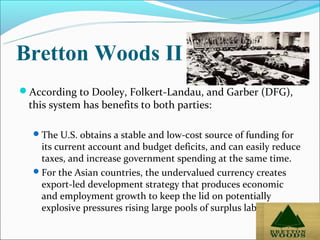
According to Dooley, Folkert-Landau, and Garber (DFG),
 this system has benefits to both parties:

   The U.S. obtains a stable and low-cost source of funding for
    its current account and budget deficits, and can easily reduce
    taxes, and increase government spending at the same time.
   For the Asian countries, the undervalued currency creates
    export-led development strategy that produces economic
    and employment growth to keep the lid on potentially
    explosive pressures rising large pools of surplus labor.

                                                                   52
US-China Currency Issue
 China have trade surplus with USA & World.
 Chinese central bank maintained currency exchange
  fixed ($ = 8.28 Yuan)
    YEAR            China Forex      China Trade
                    Reserve (in $)   Surplus (in $)

    2006            1.06 Trillion    178 Billion

    2007            1.5 Trillion     268 Billion

    2008            1.9 Trillion     297 Billion

    2009            2.39 Trillion    198 Billion

    2010            2.64 Trillion    184.7 Billion
US Trade with China
US-China Currency Issue


China Modified its Currency Policy on
  July 21, 2005.
Yuan’s Exchange rate become adjustable with respect
 to Market Demand & Supply of currency in Basket.
Basket includes Dollar, Euro, & Yen etc.
So $ = 8.11 Yuan (2.1% appreciation)
Also Yuan can fluctuate by 0.3% on daily basis against
 basket.
US-China Currency Issue
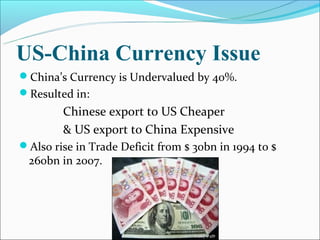
China’s Currency is Undervalued by 40%.
Resulted in:
        Chinese export to US Cheaper
        & US export to China Expensive
Also rise in Trade Deficit from $ 30bn in 1994 to $
 260bn in 2007.
1988 Omnibus Trade &
Competitiveness Act.
Act requires the Treasury Department to report on
 exchange rate policies of Countries which have large
 Global Current Account Surplus & Trade Surplus with
 US.
The aim was to find out, if they manipulate their
 currencies against dollar.
And if manipulation found than Treasury is required
 to negotiate & end such practices.
China reformed its currency in July 2005 and
Treasury made following observation about
China:
Current Account Surplus has reduced by Chinese
 Government.

2006 – China made progress to make currency more
 flexible.

2007 – Under US law China has no currency
 manipulation.

2007 – China should accelerate the appreciation of
 RMB’s effective exchange rate in order to minimize risk.
China Foreign Currency reserve
 China has highest foreign currency reserve because of:

 High amount of Export

 & Hot money arrival i.e. foreign funds bought into the
  country.

 To tackle this the value of RMB should increase.

 In 2008 Foreign Exchange Regulations approach RMB
  exchange rate against other fully convertible currencies
  using floating system, based on Demand & Supply of
  Foreign Currency.
China Foreign Currency Reserve
Reasons China should let RMB appreciate,
 in its own interest
1.   Overheating of economy

2. Reserves are excessive.
      It gets harder to sterilize the inflow over time.


1.   Attaining internal and external balance.
      In a large country like China,
        expenditure-switching policy should be the exchange rate.

1.   Avoiding future crashes.


                                                               61
Policies to reduce the US CA deficit
Reduce the US budget deficit over time,
  thus raising national saving.
  After all, this is where the deficits originated.


Depreciate the $ more.
  Better to do it in a controlled way
       than in a sudden free-fall.
  The $ already depreciated a lot against the €
     & other currencies
     from 2002 to 2007.

  Who is left?
  The RMB is conspicuous as the one major currency
                                                       62
Problems with BW2: People’
Bank of China
U.S. absorbs 80 percent of world’s savings not
 invested at their home country.
The large CAD sends billions of dollars abroad,
 particularly to China.
People’s Bank of China uses the inflow of dollars to
 purchase assets, mostly U.S. Treasuries.
Much of the $400 billion fiscal deficit is financed by
 China.
If China stops purchasing U.S. assets and switches to
 Japan, Europe, or other markets, it will cause a fall in
 the dollar and long-term interest rates will increase.
                                                            63
Conclusions
In any case, the new Chinese Exchange Rate
 Mechanism is a step to the right direction.
The United States, in contrast, has not done
 anything.
President Bush has not vetoed a single spending bill.
 The government spending has increased faster than at
 any time since the 1960’s (“the Great Society” welfare
 programs and Vietnam War).
The massive tax cuts passed in 2001–2003 are set to
 expire in 2008–2010.                                   64
What the China should do?
If China intends to allow a series of small appreciations in
  the renminbi then it either has to
   1. Keep its interest rates below U.S. rates, so that low interest
      rates offset the expected return from renminbi appreciation
      over time (currently bank deposit rates in China are capped
      at 2.5%, below the 3.5% federal funds rate).
   2. Intervene a lot.
   3. Or do both.
Either way, this policy prevents independent Chinese
  monetary policy.
                                                                       65
What the U.S. Should Do?
Since these are temporary tax cuts and the likelihood
 they waill be made permanent is low, basic economic
 theory tells us that their positive incentive effects are
 small.

Since the President and the Congress are unable to
 control spending, the simplest way for the U.S. to
 reduce its fiscal deficit (and, indirectly, current
 account deficit) would be to repeal the 2001–2003 tax
 cuts.
                                                             66
References
RBI’s Master circular on risk management.
 ( www.rbi.org.in)
FEDAI Rules
www.tradingeconomics.com
www.chinability.com/Reserves.htm
International Economics - H G Mannur
Any Questions??????

India's forex situation & issues

  • 1.
    BALANCE OF PAYMENTAND EXCHANGE Submitted To: Prof. Shrikant Iyenger Submitted By: Piyush Gaur Krutarth Gandhi Nishidh Shah Pratyancha Suryavanshi Sonal Nagpal
  • 2.
    Balance of Payments The BOP is a statistical record of the flow of all of the payments between the residents of a country and the rest of the world in a given year.  Transactions are recorded on the basis of double entry bookkeeping – by definition it has to balance. - Every “source” must have a “use”.  The two main components are: - Current Account - Capital/Financial Account
  • 3.
    Importance of BOP The BOP is an important indicator of pressure on a country’s foreign exchange rate . The BOP helps to forecast a country’s market potential, especially in the short run. Changes in a country’s BOP may signal the imposition or removal of controls over payment of dividends and interest, license fees, royalty fees, or other cash disbursements to foreign firms or investors.
  • 4.
    FOREIGN EXCHANGE TRANSACTIONS Current Account Capital Account FDI Portfolio Loan Trade Invisibles Tour (Govt/ Travel Pvt(ECB) Remittance Imports Gift Foreign Indian Exports Profit/Div/int Source Source Fcy A/C (FII) (GDR/ADR) RI & NRI 4
  • 5.
    Contents of BOP Currentaccount Capital account Financial account Net errors and omissions account Reserves and related items
  • 6.
    Current account (CA) This is record of a country’s trade in goods and services in the current period.  CA = Exports (X) – Imports (M)  It is divided into 4 sub-categories:  Goods trade  Services trade  Income  Current transfers  The sum of the four sub-categories = CA balance
  • 7.
  • 8.
    Current Account Convertibility In India, In Current Account can be converted into Foreign Currency (E.g. $) or Vice-versa.  It is Freely permitted in India by Reserve Bank of India.
  • 9.
    Capital account (KA) This includes all short- and long-term transactions pertaining to financial assets. KA = Capital Inflow (cr) – Capital outflow (dr)  The two main components:  Capital account.  Financial account (direct, portfolio, other).  KA balance = Sum of capital account and financial account.
  • 10.
    Capital Account Convertibility In India, Partial Capital Account convertibility is there, i.e. up to $200,000 is allowed by Reserve bank of India.  Up to $500 million the bank need not to take permission from RBI for Foreign Loan.
  • 11.
  • 12.
    Financial account Net foreign direct investment  Net portfolio investment  Other financial items
  • 13.
    Net Foreign Investmentin India (in US $ Bn)
  • 14.
    Net errors andomissions account  Missing data such as illegal transfers
  • 15.
    Official Reserves  Recordsthe purchase or sale of official reserve assets by the central bank. These assets include  Commercial paper, Treasury bills and bonds  Foreign currency  Money deposited with the IMF  This account shows the change in foreign exchange reserves held by the central bank.  Since the BOP must balance CA + KA + ∆RFX = 0  CA + KA = – ∆RFX  For floating rate regime countries, such as the U.S., official reserves are relatively unimportant.
  • 16.
  • 17.
    India’s Overall BalanceOf Payment (April-Sept 2010 USD $ Million) Item Credit Debit Net A.CURRENT ACCOUNT I. MERCHANDISE 110,518 177,457 -66,939 II.INVISIBLES 87,982 48,924 39,058 Total Current Account (I+II) 198,500 226,381 -27,881 B. CAPITAL ACCOUNT 1. Foreign Investment 120,179 91,042 29,137 2.Loans 50,110 34,394 15,716 3. Banking Capital 33,735 32,901 834 4. Rupee Debt Service - 17 -17 5. Other Capital 3,756 12,765 -9,009 Total Capital Account (1to5) 207,780 171,119 36,661 C. Errors & Omissions - 1,750 -1,750 D. Overall Balance
  • 18.
    BOP Trends and1991 crisis Protectionist Policies  The main objective of the Second Five Year Plan (1956-57 to 1960-61) was to attain self reliance through industrialization.  Heavy capital goods were imported but other imports were severely restricted to shut off competition in order to promote domestic industries.  The high degree of protection to Indian industries led to inefficiency and poor quality products due to lack of competition. The high cost of production further eroded our competitive strength.  Rising petroleum products demand, the two oil shocks, harvest failure, all put severe strain on the economy. The BOP situation remained weak throughout the 1980s, till it reached the crisis situation in 1990-91.
  • 19.
    External Debt  Indiahad to resort to large scale foreign borrowings for its developmental efforts in the field of basic social and industrial infrastructure.  Government of India resorted to heavy foreign borrowings to correct the BOP situation in the short run out of panicky.  By the Seventh Five Year Plan, the debt service obligations rose sharply because of harder average terms of external debt, involving commercial borrowing, repayments to the IMF and a fall in concessional aid flow.
  • 20.
    Exchange rate  Theinstability of the exchange value of the rupee was another problem. The constant devaluations (to promote exports) raised the amount of external debt  India followed a strongly inward looking policy, laying stress on import substitution.  Ideally, imports should be financed by export earnings. But because there was export pessimism, the deficit was financed either by the invisible earnings or by foreign aid or depletion of valuable foreign exchange reserve.  Much import constraint to check trade deficit was also not possible because India’s imports were mainly ‘maintenance imports’. On one hand import reduction was not possible and on the other exports suffered due to the recession in the 1980s.  india’s BOP was thus beset with several problems. The process of liberalization began from the mid 1980s. Restriction on certain imports were removed, particularly those which were used as inputs for export production. But by then the situation was already bad and all the mismanagement ultimately led to the 1990-91 BOP crisis.
  • 21.
    Components of thetrade Imports -bulk imports: petroleum, crude oil products, bulk consumption goods, other bulk items. -non bulk imports: capital goods, mainly export related items Exports -agriculture and allied products, ores and minerals, manufactured goods, mineral fuels.
  • 22.
    Specialization And Trade Absolute Advantage: Where one country can produce goods with fewer resources than others.  Comparative Advantage: Where one country can produce the goods with low opportunity costs – It sacrifices its less resources in production.
  • 23.
    India’s Foreign Trade MajorExport Destinations Country 2008-09 ($ bn) % share in Total 1 USA 19.7 12% 2 United Arab Emirates 17.8 11% 3 China 8.5 5% 4 Singapore 7.6 5% 5 Hong Kong 6.4 4% 6 United Kingdom 6.2 4% 7 Germany 5.9 4% 8 Netherlands 5.9 4% 9 Saudi Arabia 4.8 3% 10 Belgium 4.3 3% 23
  • 24.
    India’s Foreign Trade MajorImport Commodities Commodity 2008-09 % share in Total ($ bn) 1 Petroleum, Crude and products 93.1 32.36% 2 Machinery, Electrical and non-electrical 24.3 8.44% 3 Electronic goods 21.5 7.48% 4 Gold and silver 19.5 6.76% 5 Fertilizer, crude and manufactured 13.6 4.72% 6 Pearls, precious and semi-precious 12.8 4.44% 7 Organic and inorganic chemicals 12.8 4.43% 8 Coal, coke and briquettes 10.5 3.64% 9 Iron & Steel 9.5 3.30% 10 Metaliferrous ores and metal scrap 8.3 2.89% 24
  • 25.
    Export, Import &Trade Deficit (in $ Bn)
  • 26.
    Invisibles Inflow &Outflow in India
  • 27.
  • 28.
    How to correctthe Balance of Payment ?  Monetary Measures for Correcting the BoP 1. Deflation 2. Exchange Depreciation 3. Devaluation 4. Exchange Control  Non-Monetary Measures for Correcting the BoP 1. Tariffs 2. Quotas 3. Export Promotion 4. Import Substitution
  • 29.
    BOP & Macroeconomic Variables Anation’s balance of payments interacts with nearly all of its key macroeconomic variables. Interacts means that the BOP affects and is affected by such key macroeconomic factors as: Gross Domestic Product (GDP) Exchange rate Interest rates Inflation rates
  • 30.
    FOREIGN EXCHANGE Method bywhich rights to wealth expressed in terms of currency of one country are converted into rights to wealth in terms of currency of another country are known as Foreign Exchange. Prices of foreign currencies expressed in terms of other currencies is called Foreign Exchange Rate.  Determinants of Exchange Rates: Exchange rates are determined by the demand for and the supply of currencies on the foreign exchange market
  • 31.
    Exchange Rates The demandand supply of currencies is in turn determined by:  Relative interest rates  The demand for imports  The demand for exports  Investment opportunities  Speculative sentiments  Global trading patterns  Changes in relative inflation rates
  • 32.
    Foreign Exchange Includes A Currency Note Bills of Exchange Bank balance in Foreign Currency Travellers Cheque
  • 33.
    FOREIGN EXCHANGE MARKETS Peculiarities Largest financialmarket in the world. No single location, No barriers. Open 24 hours a day. Indian market timings are 9.00 am to 5.00 pm An over the counter market (OTC). Exchange rate fluctuate almost every 2/3 seconds. Controls/policies of respective countries. Effect of other markets-Money,capital,debt.
  • 34.
    Like any othercommodity, foreign exchange also has follow market set up WHOLESALE MARKET OR INTER BANK MARKET RETAIL MARKET
  • 35.
    Sources of ForeignExchanges  Export Receipts (Diamond, Pharmacy, Cotton, etc)  Inward Remittances (Money sent by NRI through bank to India)  Borrowings (Company borrow from Foreign banks)
  • 36.
    Application of Foreign Exchanges Import Payments (Gold, Crude Oil, Electronic Goods)  Outward Remittances (People send money Abroad)  Loan Repayments
  • 37.
    Players in ForeignExchange Market Reserve Bank of Indi Exchange brokers Authorized Money Changers Authorized Dealers FEDAI
  • 38.
    Money Changers inIndia  Restricted Money Changers Can only Buy Foreign Currency e.g. Hotels  Full Fledged Money Changers Can buy & sell Foreign currency e.g. Thomas Cook
  • 39.
    Indirect quotations INR 1 = USD 0.02225 INR 1 = GBP 0.01419 - Home currency fixed. - Foreign currency variable . (Indirect quotations were being used in India till July 1993)
  • 40.
    Direct quotations USD 1 = INR 45.58 GBP 1 = INR 73.70 - Foreign currency fixed - Home currency variable (Used in India from August 1993)
  • 41.
    Inflation And ForeignExchange  High Inflation in India (5% Average Inflation in India, more than 8% now) Whereas In developed countries Inflation is below 1%  Due to High Inflation Interest rate are higher in India  Foreign Currency is Appreciating & Indian Currency is Depreciating
  • 42.
    Fixed Exchange Rate In a fixed exchange rate system – foreign central banks buy and sell their currencies at a fixed price in terms of the domestic currency  Prior to 1973, most countries had fixed exchange rates against each other  However, if the country persistently runs deficits in the BOP, the central bank eventually runs out of foreign currencies, and will not be able to carry out the interventions  In such a situation, the central bank will have to ultimately devalue its currency
  • 43.
    Fixed Exchange Rate E E Exchange rate E E E2 E E1 Quantity of dollars 43
  • 44.
    Pros and Consof Fixed Exchange Rate  Argument in favor of fixed exchange rate  Certainty  Less inflationary  Promotes money and capital markets  Helps in the smooth working of the international monetary system  Prevents monetary shocks  Argument against fixed exchange rate  Heavy burden on exchange reserve  Country must have sufficient reserve  Fails to solve the balance of payment disequilibrium  Does not prevent real shock  It is not a long term solution if the underlying economy is weak
  • 45.
    Flexible Exchange Rate In a flexible exchange rate system, the central bank allows the exchange rate to adjust to equate the supply and demand for foreign currency. In effect since 1973  Clean floating – the central bank stands aside completely and allows the exchange rate to be freely determined in the forex market – official reserve transactions are zero  Managed float - the central bank intervenes to buy or sell foreign currencies periodically in an attempt to influence the exchange rates
  • 46.
    Flexible Exchange Rate Exchangerate S $2 E2 E1 $1 $” E $’ $ D2 D1 D Quantity of dollars 46
  • 47.
    Pros and Consof Flexible Exchange Rate  Argument in favor of flexible exchange rate  Simple operation, smoother, more fluid adjustment  Brings realism in forex transactions  Disequilibrium in balance of payment autostabilized  No need for forex reserve to manage exchange rate  Prevents real shocks  Reinforces the effectiveness of monetary policy expansionary  contractionary  Argument against flexible exchange rate  Exchange rate risk –futures market  Adverse effect of speculation  Encourages inflation  Far from perfect system, but no better system exists
  • 48.
    Bretton Woods I Theoriginal Bretton Woods system was the system of fixed exchange rates that existed from the end of World War II (1946), until its collapse in 1971. John Maynard Keynes was a principle architect of the Bretton Woods System. Global financial system would have fixed exchange rates in order to prevent the beggar-thy-neighbor policies of currency devaluations that characterized the 1930’s. The dollar could be converted to any other major 48
  • 49.
    Role of IBRD& IMF IBRD: International Bank For Reconstruction And Development  Give loans to countries for reconstruction of Infrastructure. IMF: International Monetary Fund  To monitor Exchange rate stability  Advice country to follow Fixed exchange rate system  Give loans to countries to overcome BOP problems
  • 50.
    End of Bretton WoodsI By the early 1970s, as the Vietnam War accelerated inflation, the United States was running not just a balance of payments deficit but also a trade deficit. The crucial turning point was 1970, which saw U.S. gold coverage deteriorate from 55% to 22%. In the first six months of 1971, assets for $22 billion fled the United States. In response, on August 15, 1971, President Nixon unilaterally “closed the gold window.” 50
  • 51.
    Bretton Woods II “BrettonWoods II” is a term coined by three Deutsche Bank economists — Michael Dooley, Peter Garber, and David Folkers-Landau — in a series of papers in 2003–2004 to describe the current international monetary system: In this system, the United States and the Asian economies have entered into an implicit contract where the U.S. runs current account deficits and the Asian countries keep their currencies fixed and undervalued by buying U.S. government debt. 51
  • 52.
    Bretton Woods II Accordingto Dooley, Folkert-Landau, and Garber (DFG), this system has benefits to both parties:  The U.S. obtains a stable and low-cost source of funding for its current account and budget deficits, and can easily reduce taxes, and increase government spending at the same time.  For the Asian countries, the undervalued currency creates export-led development strategy that produces economic and employment growth to keep the lid on potentially explosive pressures rising large pools of surplus labor. 52
  • 53.
    US-China Currency Issue China have trade surplus with USA & World. Chinese central bank maintained currency exchange fixed ($ = 8.28 Yuan) YEAR China Forex China Trade Reserve (in $) Surplus (in $) 2006 1.06 Trillion 178 Billion 2007 1.5 Trillion 268 Billion 2008 1.9 Trillion 297 Billion 2009 2.39 Trillion 198 Billion 2010 2.64 Trillion 184.7 Billion
  • 54.
  • 55.
    US-China Currency Issue ChinaModified its Currency Policy on July 21, 2005. Yuan’s Exchange rate become adjustable with respect to Market Demand & Supply of currency in Basket. Basket includes Dollar, Euro, & Yen etc. So $ = 8.11 Yuan (2.1% appreciation) Also Yuan can fluctuate by 0.3% on daily basis against basket.
  • 56.
    US-China Currency Issue China’sCurrency is Undervalued by 40%. Resulted in: Chinese export to US Cheaper & US export to China Expensive Also rise in Trade Deficit from $ 30bn in 1994 to $ 260bn in 2007.
  • 57.
    1988 Omnibus Trade& Competitiveness Act. Act requires the Treasury Department to report on exchange rate policies of Countries which have large Global Current Account Surplus & Trade Surplus with US. The aim was to find out, if they manipulate their currencies against dollar. And if manipulation found than Treasury is required to negotiate & end such practices.
  • 58.
    China reformed itscurrency in July 2005 and Treasury made following observation about China: Current Account Surplus has reduced by Chinese Government. 2006 – China made progress to make currency more flexible. 2007 – Under US law China has no currency manipulation. 2007 – China should accelerate the appreciation of RMB’s effective exchange rate in order to minimize risk.
  • 59.
    China Foreign Currencyreserve China has highest foreign currency reserve because of: High amount of Export & Hot money arrival i.e. foreign funds bought into the country. To tackle this the value of RMB should increase. In 2008 Foreign Exchange Regulations approach RMB exchange rate against other fully convertible currencies using floating system, based on Demand & Supply of Foreign Currency.
  • 60.
  • 61.
    Reasons China shouldlet RMB appreciate, in its own interest 1. Overheating of economy 2. Reserves are excessive.  It gets harder to sterilize the inflow over time. 1. Attaining internal and external balance.  In a large country like China, expenditure-switching policy should be the exchange rate. 1. Avoiding future crashes. 61
  • 62.
    Policies to reducethe US CA deficit Reduce the US budget deficit over time, thus raising national saving. After all, this is where the deficits originated. Depreciate the $ more. Better to do it in a controlled way  than in a sudden free-fall. The $ already depreciated a lot against the €  & other currencies  from 2002 to 2007. Who is left? The RMB is conspicuous as the one major currency 62
  • 63.
    Problems with BW2:People’ Bank of China U.S. absorbs 80 percent of world’s savings not invested at their home country. The large CAD sends billions of dollars abroad, particularly to China. People’s Bank of China uses the inflow of dollars to purchase assets, mostly U.S. Treasuries. Much of the $400 billion fiscal deficit is financed by China. If China stops purchasing U.S. assets and switches to Japan, Europe, or other markets, it will cause a fall in the dollar and long-term interest rates will increase. 63
  • 64.
    Conclusions In any case,the new Chinese Exchange Rate Mechanism is a step to the right direction. The United States, in contrast, has not done anything. President Bush has not vetoed a single spending bill. The government spending has increased faster than at any time since the 1960’s (“the Great Society” welfare programs and Vietnam War). The massive tax cuts passed in 2001–2003 are set to expire in 2008–2010. 64
  • 65.
    What the Chinashould do? If China intends to allow a series of small appreciations in the renminbi then it either has to 1. Keep its interest rates below U.S. rates, so that low interest rates offset the expected return from renminbi appreciation over time (currently bank deposit rates in China are capped at 2.5%, below the 3.5% federal funds rate). 2. Intervene a lot. 3. Or do both. Either way, this policy prevents independent Chinese monetary policy. 65
  • 66.
    What the U.S.Should Do? Since these are temporary tax cuts and the likelihood they waill be made permanent is low, basic economic theory tells us that their positive incentive effects are small. Since the President and the Congress are unable to control spending, the simplest way for the U.S. to reduce its fiscal deficit (and, indirectly, current account deficit) would be to repeal the 2001–2003 tax cuts. 66
  • 67.
    References RBI’s Master circularon risk management. ( www.rbi.org.in) FEDAI Rules www.tradingeconomics.com www.chinability.com/Reserves.htm International Economics - H G Mannur
  • 68.

Editor's Notes

  • #5 Assss cvvv hhhh