The Associated Chambers of Commerce and Industry of India
Indian Banking Industry
Sustaining Growth with Equity
 
2 
 
Indian Banking Industry: Sustaining Growth with Equity 
Message	from	ASSOCHAM	
	
The Indian banking sector has been one of the strongest pillars supporting the Indian economy in these 
challenging times. As the pace of integration of the Indian economy with the world economy increases, 
several new challenges emerge. The need to strengthen the banking sector has become all the more 
important  and  urgent.  Since  the  majority  of  Indian  population  lives  in  rural  areas,  it  is  becoming 
increasingly important to bring this segment into the fold of the formal financial sector. This segment 
not only presents a good business opportunity but is also important for achieving inclusive growth.      
Social banking and financial inclusion present a significant challenge and a unique opportunity to build a 
broad based and stable financial system. This will not only contribute to growth in the real sector but 
also to the overall economic prosperity of the masses.  
Keeping this in mind ASSOCHAM in partnership with Resurgent India has come out with a background 
paper to generate healthy discussion on issues & challenges that need to be effectively addressed for 
strengthening  the  Indian  banking  sector.  This  paper  exhaustively  deals  with  the  challenges  while 
addressing the gaps that persist in this prominent segment.  
We  firmly  believe  that  this  would  be  a  very  good  reference  book  for  all  the  stake  holders.  We 
acknowledge the efforts made by Resurgent India Team and ASSOCHAM Team in bring out this well 
researched paper. Any suggestions / comments are welcome. 
D. S. Rawat New Delhi
Secretary General 16th September, 2013
ASSOCHAM
 
 
3 
 
Indian Banking Industry: Sustaining Growth with Equity 
Message	from	Resurgent	
India Banking Industry, despite serving the second most populated country in the world, reaches only 
half  of  the  country’s  household.  Further,  the  problems  faced  by  the  sector  include  raising  NPA, 
implementing Financial Inclusion, capital adequacy and many others. However on the brighter side, the 
rising consumerism from the emerging ‘middle’ India and the higher purchasing power in rural India on 
account of rising employment provides opportunities for banks to look beyond the traditional customer 
segments.  Further,  banks  should  design  flexible  operating  modules  that  would  make  sure  that  it  is 
beneficial for the customers and bank as well. 
Going ahead, financial inclusion is on promoting sustainable development and generating employment 
for a vast majority of the population especially in the rural areas. It has been made an integral part of 
the  banking  sector  policy  in  India.  RBI  is  pushing  financial  inclusion  in  a  mission  mode  through  a 
combination  of  strategies  ranging  from  relaxation  of  regulatory  guidelines,  provision  of  innovative 
products, encouraging use of technology and other supportive measures for achieving sustainable and 
scalable financial inclusion. Financial inclusion is the gateway for achieving inclusive growth in India. 
In  this  research  work  we  have  put  together  various  aspects  such  as  trends,  opportunities,  growth 
drivers,  significant  innovations  and  many  more.  We  hope  this  Research  Paper  serves  as  an  useful 
reference for all the stakeholders.   
 
Jyoti Prakash Gadia New Delhi
Managing Director/CEO 16th September, 2013
Resurgent India Limited
 
 
4 
 
Indian Banking Industry: Sustaining Growth with Equity 


TABLE	OF	CONTENTS
INDUSTRY OVERVIEW AND TRENDS  5 
CHALLENGES, OPPORTUNITIES AND GROWTH DRIVER  11 
MSME FUNDING – CATALYST FOR FUTURE GROWTH 15 
INFRA FUNDING – FOUNDATION FOR OVERALL GROWTH  19 
PEST ANALYSIS OF THE BANKING INDUSTRY  23 
CAPITAL RAISING CHALLENGES FOR PUBLIC SECTOR BANKS   26 
FINANCIAL INCLUSION PLAN  30 
CONCLUSION  31 
   
 
5 
 
Indian Banking Industry: Sustaining Growth with Equity 
	
	
The  Indian  banking  sector  has  emerged  as  one  of  the 
strongest  drivers  of  India’s  economic  growth.  The  Indian 
banking  industry  has  attained  phenomenal  advancement 
during  the  last  few  years,  despite  its  global  counterpart 
struggling  with  financial  meltdown.  India's  economic 
development and financial sector liberalization have led to 
a transformation of the Indian banking sector over the past 
two decades. 
In the near future, the Indian banking industry is expected 
to  see  consolidation  in  the  wake  of  future  economic 
growth,  changes  in  banking  regulations  and  increase  in 
competition  from  foreign  banks.  Further,  technological 
innovation  and  especially  mobile  banking  have  paved  the 
way  for  dramatic  growth  in  the  industry  in  the  coming 
years. 
The  growth  story  of  banking  during  the  last  decade  has 
been  spectacular  and  beyond  the  consistent  double  digit 
growth. The key trends were strong regulatory framework, 
use of multiple channels and technology; strong customer 
oriented  banking  services  and  a  growing  economy. 
Although  the  past  couple  of  years  have  witnessed  a 
slowdown  in  the  face  of  high  domestic  inflation, 
depreciation of the rupee and the after‐math of the crisis in 
US and Europe, the sector still performs better in India as 
compared  to  developing  countries  in  terms  of  growth, 
profitability, capital adequacy and asset quality etc. 
Further, the future seems to be promising despite a series 
of  challenges  like  the  overall  slowdown  in  the  economy 
impacting  credit  growth,  deteriorating  asset  quality  and 
rising NPAs, accompanying financial inclusion and Basel III 
implementation  are  all  lingering  issues,  the  sector  is  well 
cushioned  with  factors  like  a  positive  demographic 
dividend,  increasing  investment  in  infrastructure, 
innovation  in  technology  and  most  importantly 
constructive regulatory policies. 
Indian Banks’ total asset size is recorded at US$ 1.5 trillion 
in FY12 and is expected to reach US$ 28.5 trillion by 2025. 
INDUSTRY OVERVIEW AND TRENDS
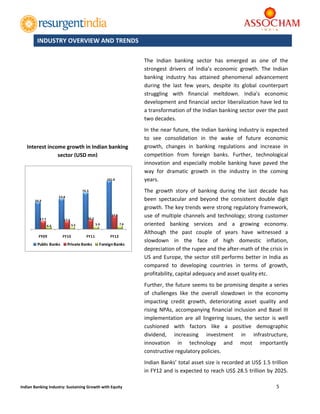
56.9
63.8
76.3
101.0
17.7 17.3 20.2
27.9
6.3 5.5 5.9 7.6
FY09 FY10 FY11 FY12
Public Banks Private Banks Foreign Banks
 
Interest income growth in Indian banking 
sector (USD mn) 
 
6 
 
Indian Banking Industry: Sustaining Growth with Equity 
Further, assets of public sector banks grew at an average of 
7.5%,  while  Private  sector  expanded  at  a  CAGR  of  11.3% 
and  foreign  banks  posted  a  growth  of  6.7%.  Increase  in 
working  population  and  growing  disposable  incomes  will 
increase  the  demand  for  banking  and  related  services. 
Housing and personal finance are expected to remain key 
demand drivers. 
Currently,  there  are  87  scheduled  commercial  banks  with 
deposits worth Rs.71.6 trillion (US$ 1.21 trillion) as on 31 
May,  2013.  Of  this,  26  are  public  sector  banks,  which 
accounts for 73% of interest income in the sector. Besides, 
20 are private banks and 41 are foreign banks. Of the total, 
41  banks  are  listed  with  a  total  market  capitalization  of 
Rs.9.35 trillion (US$ 158.16 mn) as per the recent statistics.  
Credit off‐take has registered impressive growth during the 
past  decade,  aided  by  strong  economic  growth,  rising 
disposable  incomes,  increasing  consumerism  and  easier 
access to credit. During FY06–13, credit off‐take expanded 
at a CAGR of 22.8% to US$ 991 mn. Total credit off‐take is 
estimated to grow to US$ 1,140 mn in FY14. Demand has 
grown for both corporate and retail loans.  
Currently, Private Banks are focusing on the faster growing 
retail  loans  and  also  improving  the  growth  rate  in  fee 
income  by  increasing  transaction  fees.  Whereas,  Public 
Sector  Banks  are  emphasising  on  higher  recoveries  and 
upgrades  in  Non  Performing  Loans  (NPL)  and  also 
improving their deposits mix by reducing the share of bulk 
deposits. 
However,  despite  the  global  financial  crisis,  net  non‐
performing  assets  (NPA)  of  Indian  banking  sector  have 
shrunk during the past few years, even though the net NPA 
levels increased to 1.28% in FY12 from 0.97% in FY11, it is 
relatively stable.  
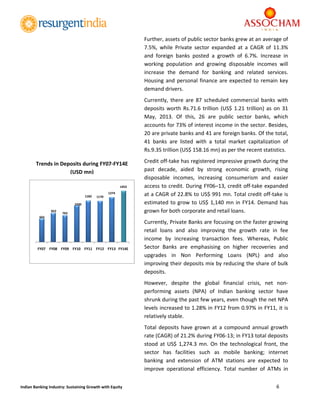
Total deposits have grown  at  a  compound  annual growth 
rate (CAGR) of 21.2% during FY06‐13; in FY13 total deposits 
stood  at US$  1,274.3  mn.  On  the  technological  front,  the 
sector  has  facilities  such  as  mobile  banking;  internet 
banking  and  extension  of  ATM  stations  are  expected  to 
improve  operational  efficiency.  Total  number  of  ATMs  in 
665
822
763
1030
1182 1170
1274
1453
FY07 FY08 FY09 FY10 FY11 FY12 FY13 FY14E
 
Trends in Deposits during FY07‐FY14E 
(USD mn) 
 
7 
 
Indian Banking Industry: Sustaining Growth with Equity 
India  has  increased  to  104,500  now  and  is  expected  to 
double over the next two years. 
Deposit  growth  has  resulted  due  to  strong  growth  in 
savings  amid  rising  disposable  income  levels.  Further, 
access to the banking system has also improved over the 
years  due  to  continuous  government  initiatives;  at  the 
same  time  India’s  banking  sector  has  remained  stable 
despite  global  upheavals,  thereby  retaining  public 
confidence over the years. 
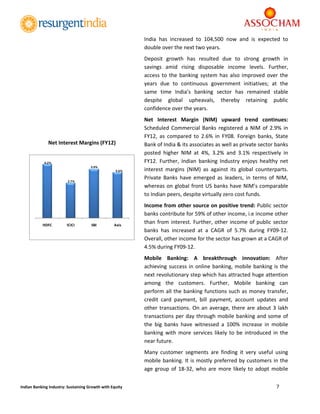
Net  Interest  Margin  (NIM)  upward  trend  continues: 
Scheduled Commercial Banks registered a NIM of 2.9% in 
FY12,  as  compared  to  2.6%  in  FY08.  Foreign  banks,  State 
Bank of India & its associates as well as private sector banks 
posted  higher  NIM  at  4%,  3.2%  and  3.1%  respectively  in 
FY12.  Further,  Indian  banking  Industry  enjoys  healthy  net 
interest  margins  (NIM)  as  against  its  global  counterparts. 
Private  Banks  have  emerged  as  leaders,  in  terms  of  NIM, 
whereas on global front US banks have NIM’s comparable 
to Indian peers, despite virtually zero cost funds. 
Income from other source on positive trend: Public sector 
banks contribute for 59% of other income, i.e income other 
than from interest. Further, other income of public sector 
banks  has  increased  at  a  CAGR  of  5.7%  during  FY09‐12. 
Overall, other income for the sector has grown at a CAGR of 
4.5% during FY09‐12. 
Mobile  Banking:  A  breakthrough  innovation:  After 
achieving success in online banking, mobile banking is the 
next revolutionary step which has attracted huge attention 
among  the  customers.  Further,  Mobile  banking  can 
perform all the banking functions such as money transfer, 
credit  card  payment,  bill  payment,  account  updates  and 
other transactions. On an average, there are about 3 lakh 
transactions per day through mobile banking and some of 
the  big  banks  have  witnessed  a  100%  increase  in  mobile 
banking  with  more  services  likely  to be  introduced in  the 
near future.  
Many  customer  segments  are  finding  it  very  useful  using 
mobile banking. It is mostly preferred by customers in the 
age group of 18‐32, who are more likely to adopt mobile 
4.2%
2.7%
3.9%
3.6%
HDFC ICICI SBI Axis
 
Net Interest Margins (FY12) 
 
8 
 
Indian Banking Industry: Sustaining Growth with Equity 
banking  than  older  users.  Overall  the  growth  in  mobile 
banking that has taken place in the country till date, though 
at a great pace, but is yet to reach the critical mass that will 
enable  it  to  deliver  on  its  promise  of  taking  banking, 
including  payment  services,  at  a  cheaper,  secure  and 
seamless manner to the existing and potential customers.  
Products offered by Indian Banks:  
Retail Banking: 
 Retail  banking  is  a  buzzword  in  India  that  focuses 
strictly on the consumer market 
 Most  banks  have  retail  portfolios  as  part  of  their 
total lending portfolio (18.4% on average).  
 This segment has been growing at a high rate of 30‐
35% per annum 
 As per a survey, Consumer credit penetration is only 
8% of the GDP in India, thus offering huge potential 
for further growth 
 The  growth  is  mainly  led  by  growth  in  credit  card 
receivables and other personal loans  
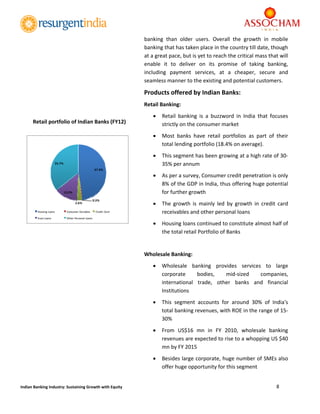
 Housing loans continued to constitute almost half of 
the total retail Portfolio of Banks 
 
Wholesale Banking: 
 Wholesale  banking  provides  services  to  large 
corporate  bodies,  mid‐sized  companies, 
international  trade,  other  banks  and  financial 
Institutions 
 This  segment  accounts  for  around  30%  of  India's 
total banking revenues, with ROE in the range of 15‐
30% 
 From  US$16  mn  in  FY  2010,  wholesale  banking 
revenues are expected to rise to a whopping US $40 
mn by FY 2015 
 Besides large corporate, huge number of SMEs also 
offer huge opportunity for this segment 
47.9%
0.3%
2.6%
13.5%
35.7%
Housing Loans Consumer Durables Credit Card
Auto Loans Other Personal Loans
 
Retail portfolio of Indian Banks (FY12) 
 
9 
 
Indian Banking Industry: Sustaining Growth with Equity 
 
Treasury Management: 
 The  core  function  of  a  treasury  is  of  measuring, 
monitoring,  and  controlling  of  interest  rate  risk 
(IRR).  For  this  banks  would  need  various  standard 
and proprietary models to measure this risk 
 Traditionally,  the  treasury  function  in  banks  was 
limited to management of funds to meet the day‐to‐
day requirements and deploying surplus funds from 
operations 
 The  scope  of  treasury  has  now  expanded  beyond 
liquidity management and it has now evolved as a 
profit  centre  with  its  own  trading  and  investment 
activity 
 Treasury  activity  in  a  bank  depends  on  its  size, 
complexity of operations, and risk profile 
Recent trends in Banking Industry: 
Improved  risk  management  practices:  Indian  banks  are 
increasingly  focusing  on  adopting  integrated  approach  to 
risk  management  and  have  already  embraced  the 
international  banking  supervision  accord  of  Basel  II; 
interestingly,  according  to  RBI,  majority  of  the  banks 
already  meet  capital  requirements  of  Basel  III.  Further, 
most  of  the  banks  have  drawn  a  framework  for  asset‐
liability match, credit and derivatives risk management. 
Diversification of revenue stream: Banks are emphasizing 
on  diversifying  the  source  of  revenue  stream  to  protect 
themselves  from  interest  rate  cycle  and  its  impact  on 
interest income. Focusing on increasing fee and fund based 
income  by  launching  plethora  of  new  asset  management, 
wealth management and treasury products  
Technological Improvement: Indian banks, including public 
sector banks are aggressively emphasizing on improving the 
technological  aspect  of  operation  to  enhance  customer 
experience  and  gain  competitive  advantage.  Further, 
internet and mobile banking are becoming popular among 
the  customers.  Further,  Customer  Relationship 
Management  (CRM)  and  data  warehousing  will  drive  the 
next wave of technology in banks. 
Indian  Banking  space  is  witnessing 
diversification  in  revenue  stream  and 
also  has  known  the  importance  of 
technological  innovation,  because  of 
which  more  and  more  banks  are 
increasing  its  investment  in  improving 
technology. 
 
10 
 
Indian Banking Industry: Sustaining Growth with Equity 
Focus on Financial Inclusion: RBI has asked banks to focus 
on  spreading  the  reach  of  banking  services  to  the  un‐
banked  population  of  India.  With  this  regard,  players  are 
stretching  their  branch  network  in  the  rural  areas  to 
capture the new business opportunity. 
Derivatives and risk management products: In a changing 
business  scenario  and  financial  sophistication  which  has 
increased  the  need  for  customized  exotic  financial 
products, Banking firms are developing Innovative financial 
products  and  advanced  risk  management  methods  to 
capture the market share. 
Consolidation:  As  foreign  banks  ventured  into  Indian 
scenario,  competition  has  intensified  and  banks  are 
increasingly  looking  at  consolidation  to  derive  greater 
benefits  such  as  enhanced  synergy,  cost  take‐outs  from 
economies  of  scale,  organizational  efficiency,  and 
diversification of risks. 
Wide  usability  of  RTGS  and  NEFT:  Real  Time  Gross 
Settlement  (RTGS)  and  National  Electronic  Funds  Transfer 
(NEFT)  are  being  implemented  by  Indian  banks  for  fund 
transaction and have been well received by the consumers 
as  it  saves  time  and  energy  on  their  part.  Further, 
regulatory body, Securities Exchange Board of India (SEBI) 
has  included  NEFT  and  RTGS  payment  system  to  the 
existing  list  of  methods  that  a  company  can  use  for 
payment  of  dividend  or  other  cash  benefits  to  their 
shareholders and investors. Further, wide scope and ease 
of  online  banking  has  led  to  a  paradigm  shift  from 
traditional  branch  banking  to  net  banking.  The  total 
customers using net banking has increased to 7% in 2012. 
Besides,  extensions  of  facilities  such  as  fund  transfer, 
account  maintenance  and  bill  payment  at  ATM  stations 
have reduced branch banking footfall. 


The main focus area of Indian Banks has 
been  Financial  Inclusion,  Consolidation 
and  Increase  use  of  Internet  Banking. 
This  signifies  the  changing  attitude  of 
the  bankers  to  reach  more  and  more 
customers  and  simultaneously  provide 
better services. 
 
11 
 
Indian Banking Industry: Sustaining Growth with Equity 
	
 
Challenges: 
Developing countries like India, still has a huge number of 
people who do not have access to banking services due to 
scattered  and  fragmented  locations.  But  if  we  talk  about 
those  people  who  are  availing  banking  services,  their 
expectations  are  raising  as  the  level  of  services  are 
increasing  due  to  the  emergence  of  Information 
Technology  and  competition.  Since,  foreign  banks  are 
playing  in  Indian  market,  the  number  of  services  offered 
has increased and banks have laid emphasis on meeting the 
customer expectations.  
Now, the existing situation has created various challenges 
and opportunities for Indian Commercial Banks. In order to 
encounter  the  general  scenario  of  banking  industry  we 
need to understand the challenges and opportunities lying 
with banking industry of India. 
Introduction  of  Basel‐III  Norms:  As  per  Basel‐  III  norms, 
Indian Banks will have to bring in an additional capital of Rs. 
5 lakhs crore to meet the Basel III norms. The government 
on its part has to infuse Rs. 90,000 crore into the state‐run 
banks to maintain majority shareholding as per the Basel III. 
Further, this norm will be implemented in a phased manner 
starting from January 2013 and to be implemented to the 
fullest by March 2018 
Intensifying  Competition:  Intense  competition  due  to  a 
large number of players in the banking industry and other 
players  such  as  NBFCs  (less  regulation)  has  resulted  in 
reducing market share of the existing banks. 
Increasing  NPA:  Economic  slow‐down  and  aggressive 
lending by the banks has turned loans into non‐ performing 
assets and thus impacting the profitability of the banks as 
they are required to have higher provisioning amounts. 
Licensing requirement: For setting up of a banking business 
in India, a banking license from the RBI has to be acquired 
which has served as an associated protocol and formalities. 
The  requirements  are  so  stringent  that  the  last  licenses 
CHALLENGES, OPPORTUNITIES AND GROWTH DRIVER
The main problem faced by Indian Banks 
is  that,  half  of  the  population  has  no 
access  to  formal  banking  facilities. 
However,  this  challenge  is  blessing  in 
disguise and also offer huge opportunity 
to explore untouched market. 
 
12 
 
Indian Banking Industry: Sustaining Growth with Equity 
issued were to Kotak Mahindra Bank and Yes Bank in 2003 
and 2004 respectively. 
Opportunities: 
Mortgages  to  cross  Rs  40  lakh  crores  by  2020:  The  total 
mortgages in the books of banks have grown from 1.5% to 
more than 10% of the total bank advances/loans in the last 
period  of  10  years.  The  total  ratio  of  outstanding 
mortgages, including the Housing Finance Companies to the 
GDP is 10%. Further, as per a  survey, by 2020, this ratio 
were to reach 20%, a number similar to that of China, then 
the  mortgage  industry  can  be  expected  to  grow  at  an 
average  rate  of  over  20%  during  the  next  decade.  The 
outstanding  mortgages  are  expected  to  cross  Rs.  40  lakh 
crores by 2020 
Wealth management to boost the growth: Further, wealth 
is expected to get further concentrated in the hands of a 
few.  The  top  band  of  income  distribution  is  expected  to 
grow most rapidly over the next decade. By the end of this 
decade, the top 5% house‐holds, predominantly residing in 
the metros and Tier I cities, will account for 30% of the total 
disposable income. In such a situation, wealth management 
services will be an integral part of the product portfolio for 
both private as well as public sector banks. 
Rapid  growth  of  branches  and  ATMs:  India’s  penetration 
rate  of  branches  and  ATMs  is  very  low  as  compared  to 
other  developed  and  developing  nations.  Currently  there 
are 85 ATMs for one mn population, i.e. 1,04,500. Further, 
the ATMs are expected to grow and double their number in 
the next two years. As such, most of the new ATMs, 50‐65 
% will be deployed in tier 2 and 3 cities, while tier 1 cities 
will grow at around 20%. 
Mobile  banking  to  grow  exponentially:  The  Internet  is 
widely used by all banking segments around the world to 
purchase financial services products. Further, by 2015, it is 
estimated  that  the  mobile  banking  transaction  volume 
worldwide  will  reach  US$500  mn.  and  on  domestic  front, 
mobile banking transactions are expected to result in a cost 
savings of US$  22 mn ( Rs 1,100 crore). 
Opportunities  for  the  banks  in  India, 
include  increase  in  outstanding 
mortgages,  rapid  growth  in  branches 
and  ATM,  Mobile  Banking,  Infra 
Financing and SME Finance. 
 
13 
 
Indian Banking Industry: Sustaining Growth with Equity 
Infrastructure  financing:  Currently,  Banking  sector  is  the 
major financer for the infrastructure in India, accounting for 
more than half of the funding of this segment. Further, to 
sustain India’s economic growth, the Planning Commission  
envisages that $1 trillion (about 10% of GDP) will be spent 
on infrastructure during the 12th plan from 2012 to 2017, 
thus providing huge opportunity for banking industry. 
New  Models  to  serve  the  Small  &  Medium  Enterprises 
(SME): As per a survey, large customers in banking segment 
are more satisfied than the medium and small sized ones. 
Due to higher risk and lower ticket size, SMEs typically get 
less  attention.  This  provides  the  opportunity  to  create 
innovative models to serve SMEs with sufficient and timely 
credit at the right price. 
Growth Drivers: 
Economic and demographic drivers: 
 Favourable demographics and rising income levels  
 The  sector  will  benefit  from  structural  economic 
stability  and  continued  credibility  of  Monetary 
Policy  
 Growth  in  infrastructure,  industry,  services  and 
agriculture is expected to grow corporate credit in 
the economy 
 Nearly 35% of the Indian population has a median 
age of 25.5 years which signifies that India will gain 
from its demographic dividend 
 India  not  only  enjoys  a  favourable  demographic 
dividend  but  also  has  a  strong  population  of  High 
Net worth Individuals (HNWI) 
 
Policy Support: 
 Extension  of  interest  subsidy  to  low  cost  home 
buyers  
 Simplifying  of  KYC  norms,  introduction  of  no‐frills 
accounts  and  Kisan  Credit  Cards  to  increase  rural 
banking penetration 
 RBI  is  considering  giving  more  licenses  to  private 
sector players to increase banking penetration  
Nearly  35%  of  the  Indian  population  has  a 
median  age  of  25.5  years  which  signifies 
that  India  will  gain  from  its  demographic 
dividend.  Besides,  India  also  has  a  strong 
population  of  High  Net  worth  Individuals 
(HNWI) 
 
 
14 
 
Indian Banking Industry: Sustaining Growth with Equity 
Financial Inclusion: 
 In  India,  40%  of  the  population  lack  access  to  the 
simplest kind of formal financial services. With this 
regard, the RBI mandated banks to allocate at least 
25%  of  the  total  number  of  branches  proposed  to 
be opened during a year in unbanked rural centers 
 Banks  considering  Financial  Inclusion  as  a  banking 
opportunity rather than a Regulatory obligation are 
likely  to  see  long  term  profitable  growth  and  a 
cushion against market volatility 
Technology Innovation: 
 Innovation in banking services such as ATM, internet 
banking,  mobile  banking  have  increased 
productivity and helped in acquiring new customers 
 As per estimates, currently banks spend around 15% 
of the total expenditure on technology. 
 Technological  innovation  will  not  only  help  to 
improve products and services but also to reach out 
to the masses in cost effective way  


40% of the population lack access to the 
simplest kind of formal financial services. 
With  this  regard,  the  RBI  mandated 
banks  to  allocate  at  least  25%  of  the 
total number of branches proposed to be 
opened during a year in unbanked rural 
centres. 
 
15 
 
Indian Banking Industry: Sustaining Growth with Equity 
	
	
The Micro, Small and Medium Enterprises (MSMEs) play a 
pivotal role in the economic and social development of the 
country,  often  acting  as  a  nursery  of  entrepreneurship. 
They  also  play  a  pivotal  role  in  the  development  of  the 
economy  with  their  effective,  efficient,  flexible  and 
innovative  entrepreneurial  spirit.  The  MSME  sector  has 
been  a  significant  contributor  to  the  country,  generating 
the highest employment growth as well as accounting for a 
major share of industrial production and exports. 
MSMEs could have contributed more, if they had access to 
financing,  necessary  facilities  and  skills.  Considering  the 
high growth aspiration levels of MSME promoters, lack of 
adequate finance has proved to be an obstacle. As per an 
estimate,  around,  33‐34%  of  the  MSMEs  have  access  to 
bank or institutional financing channels and in the absence 
of  this  finance,  prefer to raise  financing through personal 
Channels  (friends,  family,  informal  financiers  etc).  This 
situation provides, a significant opportunity for the flow of 
banking  credit.  To  encourage  greater  bank  led  financing, 
the Reserve Bank of India (RBI) had increased its focus on 
this sector through directed lending policies such as priority 
sector lending (PSL) norms. However, given the significant 
demand‐supply constraints, the financing gap has widen. 
It  is  observed  that,  the  problem  faced  by  Indian  finance 
system  is  that  there  is  no  transparency  regarding  the 
financial conditions of MSMEs. The reason for this may be 
that  some  enterprise  owners  themselves  may  not  grasp 
their financial conditions well. This will result in hesitation 
from banks to give loan to small scale units. In fact, there is 
evidence to establish that a fairly significant proportion of 
loans  given  to  small  enterprises  in  the  past  have 
compounded the problem of non‐performing assets (NPAs). 
Unless  there  is  fairly  detailed  information  on  small  firms, 
banks  would  hesitate  to  take  risk.  Hence,  securing 
transparency of financial conditions, eventually, influences 
decisions on loan finance. 
MSME FUNDING – CATALYST FOR FUTURE GROWTH
After realizing the importance of MSME 
sector,  Government  has  taken  various 
initiatives  to  boost  the  growth  of  the 
segment.  Further,  the  key  attributes  of 
the sector  such  as,  high contribution to 
domestic  production,  significant  export 
earnings,  low  investment  requirements, 
operational  flexibility  and  many  others 
have lead to tap opportunities in various 
industries. 
 
16 
 
Indian Banking Industry: Sustaining Growth with Equity 
Recently, the Credit Guarantee System for MSMEs has been 
introduced by commercial and other financial institutions. 
For  instance,  under  the  Credit  Guarantee  Fund  Trust  for 
MSEs (CGTMSE) life insurance cover for the chief promoters 
of  enterprises  is  guaranteed.  Further,  various  industry 
associations have signed MoUs with commercial banks and 
other  financial  institutions  to  offer  collateral  security  to 
upcoming entrepreneurs for their credit requirements. The 
CGTMSE  will  function  under  the  monitoring  of  the  SIDBI. 
Unless  the  credit  guarantee  system  is  strengthened  and 
streamlined smaller units would continue to suffer neglect 
in accessing the much needed credit for both inception and 
expansion. 
Small  Industries  Development  Bank  of  India  (SIDBI)  has 
estimated  the  overall  debt  finance  demand  of  the  MSME 
sector  currently  is  at  Rs.  32.50  lakh  crores,  22%  of  which 
comes from the debt financed through the formal sector, in 
which  banks  have  the  largest  share  (approximately  85 
percent).  Most  of  this  debt  flows  to  the  registered 
enterprises, as the risk perception attached to unregistered 
or  unorganised  enterprises  due  to  a  lack  of  transparent 
financial  data,  limited  immovable  collateral  and  lack  of 
credit  assessment  skills  of  some  sub‐segments  and  the 
preference  for  ‘less  hassled’,  informal  financing,  reduces 
addressable  demand  considerably.  Working  capital 
financing,  and  to  a  lesser  degree  debt  for  capital 
expenditure are the two key offerings sought by MSMEs. 
Geographically,  MSMEs  in  Eastern  Indian  and  particularly 
North  Eastern  states  have  been  lagging  behind  as 
compared to the other states in terms of access to formal 
source  of  finance.  Lack  of  facilities  such  as  infrastructure 
and electricity and roads has been a significant obstacle for 
the  growth  of  MSME  industries  in  these  regions  and 
consequently their access to organized lending from banks. 
The MSME industry clusters in these states are varied and 
range  from  the  trade  and  metal  processing  centres  in 
Orissa,  Jharkhand  and  Chhattisgarh  to  forest  product  and 
handloom related centres in the North Eastern states. 
As  awareness  of  formal  financing  opportunities  increase 
within the MSME sector, banks get an opportunity to grow 
Small  Industries  Development  Bank  of 
India  (SIDBI)  has  estimated  the  overall 
debt  finance  demand  of  the  MSME 
sector  at  Rs.  32.50  lakh  crores,  22%  of 
which  comes  from  the  debt  financed 
through  the  formal  sector,  in  which 
banks have the largest share 
 
17 
 
Indian Banking Industry: Sustaining Growth with Equity 
their credit exposures, limit risks and seek better spreads 
by developing and implementing specific policies for MSME 
sector.  The  regulatory  framework  defined  by  the  Central 
Bank has set standards to be achieved by the Banks with 
regards  to  MSME  funding.  Currently,  it  is set at  7‐15%  of 
lending  portfolio  to  be  allocated  for  financing  micro 
enterprises) and an overall 40% of their annual credit to be 
allocated  to  priority  sector  lending.  Further,  the  Nair 
Committee  has  also  recommended  a  limit  to  5%  on  the 
indirect lending portfolio earlier used by banks who lent to 
NBFCs to further lend to MSMEs, to meet PSL norms. 
In  view  of  the  significant  variance  in  MSME  knowledge, 
extensive branch network linked liability relationships and 
regional versus centralized credit assessment skills between 
public  sector  banks  (PSBs)  as  compared  to  private  and 
foreign  banks  on  the  other,  it  is  no  surprise  that  PSBs 
account for over 70% of the debt financing to this sector, 
while private and foreign banks account for 22% of credit 
flow. 
Considering  all  these  factors,  the  traditional  challenges 
faced by MSMEs are:  
 Limited  skills  in  terms  of  market  assessment  at  branches 
(and limited ability to gather and analyze proxy data)  
 Centralized product design across rather than need based 
customized products that address the needs of specific sub 
segments 
 Vanilla  models  of  fund  based  products  and  limited  credit 
assessment  skills  for  knowledge  based  industries  with 
limited immovable collateral 
Most  of  the  banks  consider  funding  to  this  segment  as  a 
necessity  for  meeting  compliance  norms,  rather  than  an 
opportunity.  Many  such  banks  tend  to  narrow  the 
definition of such enterprises (investment in assets) rather 
than seek a broader definition that could include revenues, 
order flows, past cash flows etc. 
Banks need to work with SMEs linked to the supply chains 
of  their  large  corporate  customers  and  leverage  this 
relationship to manage and control credit exposures. Most 
of the banks have succeeded in implementing supplier and 
 
18 
 
Indian Banking Industry: Sustaining Growth with Equity 
dealer  financing  products  and  processes  and  thus 
increasing penetration deeper and across a larger number 
of  corporate  clients.  Another  way  could  be  to  Co‐write 
credit with a trusted Non Banking Finance Company (NBFC) 
partner,  where  first  lien  on  collections  remains  with  the 
bank.  The  main  advantage  of  this  model  is  that  both 
partners leverage their respective strengths. Further, with 
the  recently  imposed  limits  on  indirect  financing,  this 
model would be favourable and attractive due to following 
aspects: 
1. Cluster based financing has already been implemented by 
many banks and has been successful by focussing on small 
sub‐sectors  that  are  geographically  concentrated  into 
specific  areas  and  have  very  similar  market  cycles  and 
supply  chain  linkages.  By  creating  specialist  credit 
capabilities  for  each  sub‐sector,  banks  have  been  able  to 
reduce  their  credit  risks  substantially  through  the 
modulation of credit flows based on knowledge of business 
cycles. 
2. Linking  personal  and  small  business  accounts  has  helped 
many  banks  to  develop  a  close  link  with  promoters  and 
proprietors.  The  availability  of  data  linked  to  personal 
accounts provides good insight to support credit decisions 
to the group. 
3. Strengthening of support infrastructure: 
a. Legal and regulatory framework such as a single consistent 
definition of the sector, extending the Securitisation Asset 
Reconstruction  and  Enforcement  of    Security  Interests 
(SARFAESI)  coverage  and  also  expanding  the  coverage  of 
credit  rating  agencies,  enhancing  credit  guarantee 
coverage,  securitisation  of  trade  receivables  through 
conducive  legal  infrastructure,  creating  a  single  collateral 
registry  for  immovable  assets,  supporting  Asset 
Reconstruction Companies (ARCs) etc. 
b. Governmental  support  –  Government  should  facilitate 
platforms for market linkages, skills development, technology 
up‐gradation  and  promoting  cluster  development,  enhancing 
advisory support, supporting the growth of venture funds. 


19 
 
Indian Banking Industry: Sustaining Growth with Equity 
 
 
Indian has witnessed high economic growth in the last few 
years,  but  lately  the  growth  has  moderated.  The  growth 
rate faced strong headwinds and has declined. Along with 
the various reasons for slowdown in the economy, lack of 
adequate and quality infrastructure has also been one for 
them.  The  relationship  between  infrastructure 
development and economic growth is well established, as 
infrastructure  development  facilitates  economic  growth; 
that  in  turn  increases  demand  for  more  infrastructure. 
Thus, development of adequate and quality infrastructure 
is  a  necessity  to  maintain  growth  momentum  in  any 
economy. 
In  India,  escalating  infrastructure  spending  is  inevitable. 
The rapid growth of the economy has put a lot of strain on 
infrastructure  areas  like  power,  railways,  roads,  ports, 
airports, irrigation and urban/rural water supply.  
The  eleventh  five  year  plan  recognized  inadequate 
infrastructure  as  a  major  constraint  on  rapid  growth.  In 
order  to  overcome  this  and  stimulate  economic  growth, 
Government  of  India  planned  to  raise  infrastructure 
investment to over 8% of GDP by the end of the Eleventh 
Five  Year  Plan  (2007‐12).  The  total  revised  estimated 
expenditure  for  investment  in  infrastructure  during  the 
eleventh  five  year  plan  is  estimated  at  around  Rs.  21 
trillion. The total investment in infrastructure is estimated 
to have increased from 5.7% of GDP in the base year (2006‐
07) of the Eleventh Plan to around 8.0% in the last year of 
the Plan. To step up investment in the infrastructure sector, 
apart  from  increasing  budgetary allocation  for  the  sector, 
the  Government  has  been encouraging  the  private  sector 
to participate and invest in the sector. Resultantly, during 
the past four years, a number of Public‐Private Partnerships 
(PPP) have come up in the sector. It may be mentioned that 
private  investments  accounted  for  about  36%  of  total 
investment in infrastructure in the Eleventh Plan. 
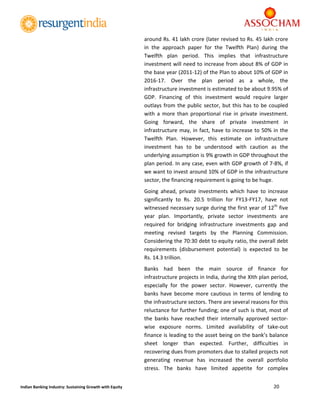
To  support  the  high  economic  growth,  the  investment 
requirements in the infrastructure sector is estimated to be 
INFRA FUNDING – FOUNDATION FOR OVERALL GROWTH
304
359
403
460
528
619
713
810
918
1040
FY08 FY09 FY10 FY11 FY12 FY13 FY14 FY15 FY16 FY17
XI Plan                               XII Plan
 
Infrastructure investment, FY08 ‐ FY17 
(RS. bn) 
 
20 
 
Indian Banking Industry: Sustaining Growth with Equity 
around Rs. 41 lakh crore (later revised to Rs. 45 lakh crore 
in  the  approach  paper  for  the  Twelfth  Plan)  during  the 
Twelfth  plan  period.  This  implies  that  infrastructure 
investment will need to increase from about 8% of GDP in 
the base year (2011‐12) of the Plan to about 10% of GDP in 
2016‐17.  Over  the  plan  period  as  a  whole,  the 
infrastructure investment is estimated to be about 9.95% of 
GDP.  Financing  of  this  investment  would  require  larger 
outlays from the public sector, but this has to be coupled 
with a more  than proportional rise  in private  investment. 
Going  forward,  the  share  of  private  investment  in 
infrastructure may, in fact, have to increase to 50% in the 
Twelfth  Plan.  However,  this  estimate  on  infrastructure 
investment  has  to  be  understood  with  caution  as  the 
underlying assumption is 9% growth in GDP throughout the 
plan period. In any case, even with GDP growth of 7‐8%, if 
we want to invest around 10% of GDP in the infrastructure 
sector, the financing requirement is going to be huge. 
Going  ahead,  private  investments  which  have  to  increase 
significantly  to  Rs.  20.5  trillion  for  FY13‐FY17,  have  not 
witnessed necessary surge during the first year of 12th
 five 
year  plan.  Importantly,  private  sector  investments  are 
required  for  bridging  infrastructure  investments  gap  and 
meeting  revised  targets  by  the  Planning  Commission. 
Considering the 70:30 debt to equity ratio, the overall debt 
requirements  (disbursement  potential)  is  expected  to  be 
Rs. 14.3 trillion. 
Banks  had  been  the  main  source  of  finance  for 
infrastructure projects in India, during the XIth plan period, 
especially  for  the  power  sector.  However,  currently  the 
banks have become more cautious in terms of lending to 
the infrastructure sectors. There are several reasons for this 
reluctance for further funding; one of such is that, most of 
the  banks  have  reached  their  internally  approved  sector‐
wise  exposure  norms.  Limited  availability  of  take‐out 
finance is leading to the asset being on the bank’s balance 
sheet  longer  than  expected.  Further,  difficulties  in 
recovering dues from promoters due to stalled projects not 
generating  revenue  has  increased  the  overall  portfolio 
stress.  The  banks  have  limited  appetite  for  complex 
 
21 
 
Indian Banking Industry: Sustaining Growth with Equity 
structures, which are more popular with NBFCs for smaller 
deals. 
The corporate debt market in India is not well developed, 
thus further restricting the channelization of capital flows 
towards  the  infrastructure  sector.  The  corporate  bond 
issuer  profile  is  dominated  by  banks  and  public  sector 
companies, with minuscule participation from nonfinancial 
private  issuers.  Besides,  most  of  such  issues  are  raised 
through  private  placement,  with  nearly  no  secondary 
market in place to encourage market‐making, liquidity and 
price efficiency of debt issues. Without this key avenue for 
diversification  of  funding  sources  away  from  the  bank 
dominated  financial  system,  infrastructure  developers  are 
finding it difficult to raise long term money efficiently from 
the  capital  markets.  The  takeout  financing  scheme 
introduced  in  2010  by  the  government  through  Indian 
Infrastructure  Finance  Company  Limited  (IIFCL)  sought  to 
assist banks in avoiding an asset‐liability mismatch and also 
free  up  funds  to  finance  new  projects.  However,  the 
scheme experienced limited success since the government 
restricted  IIFCL  from  continuing  to  fund  the  project  after 
the lead bank exits. In April 2013, a committee comprising 
of  finance  ministry  officials  was  established  to  make 
takeout financing work better. Besides, the government is 
planning to relax the norms which would assist the state‐
owned IIFCL provide longer‐term funding to such projects 
at economical terms. 
Insurance companies, who have access to long term funds, 
are  restricted  by  regulator‐imposed  sector  investment 
limits which further restrict the flow towards infrastructure 
projects.  
Demand  supply  gap  has  lead  to  the  rise  of  External 
Commercial  Borrowings  (ECBs)  as  a  competitive  alternate 
source  of  supply.  Infrastructure  developers  have  raised 
money in foreign currency at a significant cost advantage; 
however  they  continue  to  remain  wary  of  global  group 
policies  of  the  lending  banks  which  had  created  issues  in 
the sector in 2008. 
Developers  are  in  a  mood  to  agree  a  higher  cost  for 
structured  products.  Besides,  as  they  are  ending  their 
 
22 
 
Indian Banking Industry: Sustaining Growth with Equity 
equity  investment  capacity,  increasing  number  of 
developers are looking for alternate options of funding the 
project  such  as  quasi  equity,  mezzanine  debt,  holding 
company debt, viability gap funding, etc. 
On  the  other  hand,  Indian  banks  are  reluctant  about 
innovative structures as is evident from long cycle time for 
sanctions,  primarily  a  result  of  strict  regulatory  capital 
standards  for  products  deemed  riskier  by  RBI.  Smaller 
NBFCs  and  foreign  banks  active  in  this  space  have 
demonstrated a more dexterous and fast‐moving approach 
towards closing deals of this nature. These products remain 
significantly higher yielding than standard project loans or 
corporate term loans. 
Lastly, a large amount of funding is expected to come from 
the private sector. Banks, which have been the main source 
of funding until now have become cautious recently as they 
are experiencing significant stress on their portfolio due to 
underlying business issues. Unless government takes strong 
policy  initiatives,  addressing  the  supply  constraints, 
approval  delays  and  creates  enablers  for  infrastructure 
growth,  infrastructure  finance  would  remain  a  tough 
proposition for the financers.  


23 
 
Indian Banking Industry: Sustaining Growth with Equity 
	
Political  Factors  Affecting  the  Indian  Banking 
Industry: 
 The  Indian  banking  Industry  is  governed  by  the 
monetary  policy  decided  by  the  Reserve  Bank  of 
India 
 Rigid norms in terms of capital and liquidity directly 
affects the business of banks 
 Banks have to adjust their interest rates as per the 
direction  of  regulatory  bodies,  which  may  or  may 
not be favourable for them. 
 Banks have to act in accordance with the guidelines 
of  the  Central  Bank,  which  comprises  of  credit 
growth in all sectors 
 The  government  can  also  ask  banks  to  increase 
credit in particular sectors such as increase in farm 
credit, increase in infrastructure credit etc.(priority 
lending) 
 At  times  the  government  gives  debt  waivers  to 
certain  sections  of  the  society  that  need  to  be 
adhered to by banks as well 
Economic  Factors  Affecting  the  Indian  Banking 
Industry: 
 Economic  factors  prevailing  in  the  country  also 
effect  the  Banking  Industry  both  favourably  and 
unfavourably 
 If the economy is in good state with regards to high 
per  capita  income,  good  agriculture  harvest  and 
normal inflation, banks have an edge as people are 
left with more money to deposit  with banks 
 This  assists  in  more  capital  formation  as  more 
deposits can be realised 
 Also in a situation of Economic Boom, more Foreign 
Direct Investment can be attracted through banking 
channels,  that  results  in  improving  business  and 
economy in general 
 Economic  prosperity  encourages  lending  business 
for the banks, in the same way during the time of 
PEST ANALYSIS OF THE BANKING INDUSTRY
 
24 
 
Indian Banking Industry: Sustaining Growth with Equity 
distress,  banks  face  problem  in  recovering  money, 
issue fresh credit and NIMs are lower too 
 
Social  Factors  Affecting  the  Indian  Banking 
Industry: 
 The Indian banking system has been progressing at 
a faster pace than before, besides, there are several 
untapped  rural  markets,  despite  the  large  number 
of banks in India 
 Most  of    the  farmers  still  take  credit  from 
moneylenders at a very high interest rate  
 Changes  are  anticipated  in  near  future  in  the 
unorganised space 
 The growing population in the country also provides 
a huge opportunity as a lot of people in the country 
want  to  open  a  bank  account  and  develop  good 
savings habits  
 Changing  lifestyle  of  the  Indian  urban  population 
who want easy ways of financing to their desires 
Technical  Factors  Affecting  the  Indian  Banking 
Industry: 
 Indian  Banking  Industry  has  been  continuously 
working towards the development of technological 
changes and its usage in its operations 
 By implementing new and improved technologies in 
operation,  the  banks  are  anticipated  to  reduce 
costs, time and provide higher customer satisfaction 
 In  this  regard  internet  banking  or  mobile  banking 
has been considered as  remarkable milestones 
 Mobile  banking  enables  customers  to  check  their 
account balance, transfer funds 24x7, bill payments, 
booking  of  bus/flight  tickets,  recharge  prepaid 
mobile and do a lot more effortlessly and securely 
 Mobile banking also benefits the banks as well as it 
helps in cost reduction and also results in reducing 
employee  expenses  by  decreasing  head  count  at 
branches 
 
25 
 
Indian Banking Industry: Sustaining Growth with Equity 
 Technological  developments  facilitate  the  flow  of 
information and data leading to faster appraisal and 
decision‐making as well 
 
26 
 
Indian Banking Industry: Sustaining Growth with Equity 
	
Capital is one of the most significant inputs of any business; 
same  applies  to  the  banking  system  as  well.  Capital 
requirement is a force that pushes the banks to maintain 
minimum  ratio,  as  mentioned  in  the  guidelines  by  the 
regulatory bodies. Some of such ratios are of capital (such 
as the bank’s equity, long term debts etc.) to assets (such 
as the loans and investments it holds). The purpose of this 
is to ensure that banks can overcome unexpected losses of 
the assets they hold while still honouring withdrawals and 
other essential obligations. Stability in any financial system 
depends on effective and adequate capital availability and 
the 2008 crisis did reveal serious problems with the existing 
requirements.  
Assessment  of  Capital  requirement:  Since  1992,  capital 
was regulated with a simple guideline known as ‘Basel I’, by 
keeping  8%  capital  to  risk  weighted  assets  (RWA).  A 
‘revised framework’ known as Basel II was released in June 
2004. The simplified Basel II approach was more ‘granular’ 
than  Basel  I,  but  had  kept  its  basic  features.  The  revised 
version covers minimum risk capital covering credit, market 
and  operational  risks.  Banks  had  an  option  to  choose 
between  an  approach  based  on  external  ratings;  and 
second  an  internal  ratings  based  (IRB)  approach  for 
sophisticated  banks,  driven  by  their  own  internal  rating 
models. 
Basel II was in different stage of implementation among the 
leading economies of the world, when the global financial 
crisis  hit  the  overall  economic  scenario.  As  the  global 
economy  is  on  the  road  to  recovery,  the  financial 
authorities and regulators agreed on new norms for banks’ 
capital adequacy standards (Basel III). 
Basel III – the new norms: In India, as per the guidelines of 
RBI, implementation of Basel III started from 1 April 2013 
and  has  to  be  completed  by  31  March  2018  in  a  phased 
manner. The key elements of Basel III norms are: 
 Definition of capital; 
 Enhancing risk coverage of capital; 
 Leverage ratio; and  
CAPITAL RAISING CHALLENGES FOR PUBLIC SECTOR BANKS
Since  1992,  capital  in  Banks  was 
regulated with a simple guideline known 
as  ‘Basel  I’.  Further,  a  ‘revised 
framework’  known  as  Basel  II  was 
released  in  June  2004.  Currently,  the 
regulators  have  again  agreed  to  add 
new  norms  for  capital  adequacy 
standards in banks. 
 
27 
 
Indian Banking Industry: Sustaining Growth with Equity 
 Liquidity framework. 
Under the guidelines of the RBI, with regards to Basel III, 
minimum  tier  1  capital  ratio  has  been  fixed  at  7%  of  risk 
weighted assets (RWAs), of which 5.5% is common equity. 
The unique features of Basel III is that all non‐common tier I 
and tier II instruments issued by banks will have a provision 
that requires such instruments, to be either written off or 
converted  into  common  equity  upon  the  bank  which  has 
solvency issues. 
Further,  Basel  III  also  prescribes  a  capital  conservation 
buffer (CCB) of 2.5% of RWAs, comprising common equity 
tier I capital, over and above the minimum common equity 
requirement of 5.5% and total capital requirement of 9%. 
This  can  be  drawn  down  as  losses  are  incurred  during 
periods  of  stress.  In  India,  RBI  has  not  published  the 
requirements  on  countercyclical  capital  buffer  (0‐2.5%  of 
RWAs), which is aimed at ensuring that the banking sector 
capital  requirements  take  account  of  the  macro‐financial 
environment in which banks operate. 
Basel  III  also  wants  the  Banks  to  credit  valuation 
adjustment  (CVA)  capital  charge  to  protect  themselves 
from the potential mark to market losses associated with 
deterioration in the creditworthiness of the counterparty, if 
the deals are done in over the counter (OTC) market. These 
capital  requirement  are  supported  by  non‐risk‐based 
leverage ratio (a minimum Tier 1 leverage ratio of 4.5% in 
India,  during  the  parallel  run  period)  that  will  serve  as  a 
backstop to the risk‐based measures described above. 
Basel III has also introduced two new liquidity standards to 
improve the buoyancy of banks to liquidity shocks: 
 The Liquidity Coverage Ratio would require banks to 
hold  necessary  high  quality  liquid  assets  (including 
cash, government bonds and other liquid securities) 
to meet a severe cash outflow for at least 30 days.  
 The Net Stable Funding Ratio is intended to ensure 
banks  hold  sufficient  stable  funding  (capital  and 
long‐term  debt  instruments,  retail  deposits  and 
wholesale funding with a maturity longer than one 
Basel  III    prescribes  a  capital 
conservation  buffer  (CCB)  of  2.5%  of 
RWAs, comprising common equity tier I 
capital,  over  and  above  the  minimum 
common equity requirement of 5.5% and 
total capital requirement of 9%. 
 
28 
 
Indian Banking Industry: Sustaining Growth with Equity 
year) to match their medium and long term lending 
needs. 
To begin with, Basel III norms on capital requirements may 
not  affect  Indian  banks  as  most  of  the  Indian  banks  are 
operating  at  6‐8%  of  common  equity.  However,  as  the 
Capital Conservation Buffer creeps in from 2015 and if loan 
growth outpaces the internal capital generation, banks may 
face  challenges  in  terms  of  adequate  capital  for  growth. 
The  banks  may  have  to  relook  into  their  business  at  this 
situation and change their strategy accordingly, which will 
be dictated by the availability of capital. One of the other 
challenges in terms of non‐equity capital is that the Indian 
market has not developed an appetite for Basel III bonds, 
which  requires  a  loss  absorbing  capacity.  The  banks  may 
find it difficult to price these bonds and find buyers for the 
same. 
For banks with subsidiaries/Joint ventures (JVs), aggregate 
investments  in  subsidiaries  exceeding  10%  of  the  bank’s 
equity capital would be deducted from core‐equity,  while 
investments up to 10% of the equity capital would be risk‐
weighted at 250%. Fortunately, most of the Indian banks’ 
holdings in their JVs and subsidiaries are less than 10% of 
Tier I capital. 
Indian  banks  are  already  in  line  with  the  terms  of  RBI 
regulations on liquidity in terms of Statutory Liquidity Ratio 
(23% of Net Demand and Time Liabilities) and Cash Reserve 
Ratio (4% of NDTL), which acts as liquidity buffer in times of 
distress. Since 27% money is already set aside for statutory 
requirements,  and  given  government’s  high  deficit 
financing through market borrowings, it will be interesting 
to see how RBI allows these liquid assets to be part of the 
Basel  III  liquidity  estimations.  The  final  calibration  of 
liquidity ratios and leverage ratio will be made after further 
quantitative impact study and observation. 
Additional  Capital  Requirement  under  Basel  III:  RBI  has 
estimated  that  Indian  banks  will  require  an  additional 
capital  of  Rs  5  trillion  to  meet  the  new  global  banking 
norms.  This  would  comprise  an  equity  capital  of  Rs.  1.6‐
1.75  trillion.  Since  the  government  is  the  majority 
shareholder  in  PSBs  it  will  have  to  pump  in  around  Rs. 
 
29 
 
Indian Banking Industry: Sustaining Growth with Equity 
415,955  crores  till  FY21  to  retain  its  shareholding  in  the 
public sector banks at the current level to meet the norms.  
Further, the implementation of new norms will affect the 
investor  returns.  They  have  to  look  at  a  longer  horizon, 
where a stable financial system will ensure a better and less 
volatile  return.  As  these  norms  come  into  effect,  sectors 
like  retail  will  be  attractive  as  these  require  less  capital. 
However,  banks  need  appropriate  infrastructure  (Human 
resource  (HR),  technology  and  analytics)  to  manage  large 
pool of retail assets. The buyer of OTC derivatives will find 
costlier  as  the  credit  valuation  adjustment  (CVA)  charges 
will  be  applicable  for  such  derivative  transactions  from      
1st
 January 2014. The banks will most probably pass on the 
same to customers. 
Lastly, the question that keeps recurring is the repercussion 
of  implementing  Basel  III,  can  capital  requirements  be 
improved  without  undermining  economic  growth.  
Assuming  that  banks  may  be  able  to  raise  the  increased 
capital requirement under Basel III from the shareholders 
and  markets,  but  concerns  are  raised  of  its  impact  on 
economic growth and profitability of banks. In general, the 
increase in equity capital requirement is likely to increase 
the weighted average cost of capital, part of which could be 
passed  to  the  borrowers  by  increasing  lending  rates.  This 
would result in slight increase in lending rates and result in 
slower  credit  growth.  However,  on  the  basis  of  past 
experience  the  financial  system  globally  had  fallout  as  a 
result  of  allowing  the  banks  to  expand  credit  on  an 
inadequate  base  of  capital.  It  is  time  to  recognise  that 
longer  horizon  of  stability  comprising  of  prudent 
regulations and market disciplines are better propositions 
to  keep  the  banks  in  check  while  also  enabling  economic 
growth. 
 
30 
 
Indian Banking Industry: Sustaining Growth with Equity 
The focus of financial inclusion is on promoting sustainable 
development  and  generating  employment  for  a  vast 
majority of the population especially in the rural areas. In 
the  first‐ever  Index  of  Financial  Inclusion  to  find  out  the 
extent  of reach  of  banking services  among  100  countries, 
India  has  been  ranked  50.  The  RBI  has  aimed  to  provide 
banking services through a banking branch in every village 
having a population of more than 2000.  
Out  of  19.9  crore  households  in  India,  only  6.82  crore 
households have access to banking services. As far as rural 
areas are concerned, out of 13.83 crore rural households in 
India, only 4.16 crore rural households have access to basic 
banking services. In respect of urban areas, only half of the 
population have access to banking services and 34% of the 
India’s urban population with annual income less than Rs. 
50,000 have access to banking services.  
As a result of Financial Inclusion Plan, banking connectivity 
increased  by  threefold  from  67,694  villages,  at  the 
beginning  of  the  plan  period,  to  211,234  by  December 
2012.  Besides,  Basic  Savings  Bank  Deposit  Accounts 
(BSBDA)  has  gone  up  from  73.45  mn  in  2010  to  171.43 
million by 2012. Kissan Credit Cards outstanding have gone 
up from 24.3 mn in 2010 to 31.7 mn by 2012, while General 
Credit Cards outstanding have gone up from 1.4 million to 
3.1 mn during the same period. 
Lastly, financial inclusion has been made an integral part of 
the banking sector policy in India. RBI is pushing financial 
inclusion  in  a  mission  mode  through  a  combination  of 
strategies ranging from relaxation of regulatory guidelines, 
provision  of  innovative  products,  encouraging  use  of 
technology  and  other  supportive  measures  for  achieving 
sustainable  and  scalable  financial  inclusion.  Financial 
inclusion  is  the  gateway  for  achieving  inclusive  growth  in 
India.  All  the  commercial  banks  in  India  including 
cooperative  banks  are  actively  involved  in  financial 
inclusion process through opening of new branches in rural 
and urban areas. Thus ensuring that all the Indians should 
have  access  to  basic  banking  services  for  achieving 
sustainable economic development.
FINANCIAL INCLUSION PLAN 
 
31 
 
Indian Banking Industry: Sustaining Growth with Equity 
 
The financial sector reforms have brought about significant 
changes  and  had  positive  impact  in  the  financial strength 
and the competitiveness of the Indian banking system. The 
prudential norms, accounting and disclosure standards, risk 
management  practices,  etc  are  keeping  pace  with  global 
standards,  making  the  banking  system  resilient  to  global 
shocks. 
Recently,  the  Indian  Banks  have  undergone  significant 
developments  and  investments.  In  this  sector,  there  are 
huge  opportunities  and  numerous  challenges.  Challenges 
include, financial inclusion, deregulation of interest rates on 
saving  deposits,  slow  industrial  growth,  management  of 
asset  quality,  increased  stress  on some sectors, transition 
to  the  International  Financial  Reporting  System, 
implementation of Basel III & so on. 
The  Indian  Banks  have  managed  to  grow  with  resilience 
during  the  post  reform  era.  However  the  Indian  banking 
sector still has a large market unexplored. With the Indian 
households  being  one  of  the  highest  savers  in  the  world 
accounting for 69% of India’s gross national saving of which 
only 47% is accessed by the banks. More than half of the 
Indian  population  is  still  unbanked  with  only  55%  of  the 
population having a deposit account and 9% having credit 
accounts  with  banks.  India  has  the  highest  number  of 
households (145 million) excluded from Banking & has only 
one bank branch per 14,000 people. This kind of statistics 
shows  that  there  is  huge  unexplored  market  for  Indian 
Banking System. 


CONCLUSION 
 
32 
 
Indian Banking Industry: Sustaining Growth with Equity 
	
	ABOUT	ASSOCHAM
ASSOCHAM  acknowledged  as  Knowledge  Chamber  of  India  has  emerged  as  a  forceful,  pro‐active, 
effective  and  forward  looking  institution  playing  its  role  as  a  catalyst  between  the  Government  and 
Industry.  ASSOCHAM  established  in  1920  and  has  been  successful  in  influencing  the  Government  in 
shaping  India’s  economic,  trade,  fiscal  and  social  policies  which  will  be  of  benefit  to  the  trade  and 
industry. 
 
ASSOCHAM  renders  its  services  to  over  4,00,000  members  which  includes  multinational  companies, 
India’s top corporates, medium and small scale units and Associations representing all the sectors of 
Industry. ASSOCHAM is also known as a Chamber of Chambers representing the interest of more than 
350 Chambers & Trade Associations from all over India encompassing all sectors. 
 
ASSOCHAM has over 100 National Committees covering the entire gamut of economic activities in India. 
It has been especially acknowledged as a significant voice of Indian industry in the field of Corporate 
Social  Responsibility,  Environment  &  Safety,  Corporate  Governance,  Information  Technology, 
Agriculture, Nanotechnology, Biotechnology, Pharmaceuticals, Telecom, Banking & Finance, Company 
Law,  Corporate  Finance,  Economic  and  International  Affairs,  Tourism,  Civil  Aviation,  Infrastructure, 
Energy & Power, Education, Legal Reforms, Real Estate, Rural Development etc. The Chamber has its 
international  offices  in  China,  Sharjah,  Moscow,  UK  and  USA.  ASSOCHAM  has  also  signed  MoU 
partnership with Business Chambers in more than 90 countries. 
 
33 
 
Indian Banking Industry: Sustaining Growth with Equity 
ASSOCHAM CORPORATE OFFICE 
5, Sardar Patel Marg, Chanakyapuri, New Delhi ‐ 110 021 
Phone: +91‐11‐46550555 (Hunting Line) • Fax: +91‐11‐23017008, 23017009 
E‐mail: assocham@nic.in • Website: www.assocham.org 
ASSOCHAM REGIONAL OFFICES 
ASSOCHAM Southern Regional Office 
D‐13, D‐14, D Block, Brigade MM, 
1st Floor, 7th Block, Jayanagar, 
Bangalore – 560070 
Tel: +91‐80‐40943251‐53 
Fax: +91‐80‐41256629 
E‐mail: events.south@assocham.com 
director.south@assocham.com 
ASSOCHAM Western Regional Office 
4th Floor, Heritage Tower, 
Bh. Visnagar Bank, Ashram Road, 
Usmanpura, Ahmedabad‐380 014 
Tel: +91‐79‐2754 1728/ 29, 2754 1867 
Fax: +91‐79‐30006352 
E‐mail: assocham.ahd1@assocham.com 
assocham.ahd2@assocham.com 
ASSOCHAM Eastern Regional Office 
F‐4, “Maurya Centre” 48, Gariahat Road 
Kolkata‐700019 
Tel: 91‐33‐4005 3845/41 
HP: 91‐98300 52478 
Fax: 91‐33‐4000 1149 
E‐mail: Debmalya.banerjee@assocham.com 
ASSOCHAM Regional Office Ranchi 
503/D, Mandir Marg‐C, 
Ashok Nagar, Ranchi‐834 002 
Phone: 09835040255 
E‐mail: Head.RORanchi@assocham.com 
ASSOCHAM Bhopal Office 
262, 1st Floor, Room No. 2, 
M.P. Nagar, Opposite Hotel Tulsi Exotica, 
Bhopal‐462011 
Tel: 09303134310 
ASSOCHAM Jaipur Office 
The City Place, 
Jaleb Chowk, 
Jaipur‐302002 
ASSOCHAM OVERSEAS OFFICES 
AUSTRALIA 
Chief Representative 
ASSOCHAM Australia Chapter 
Suite 4, 168A Burwood Road 
Burwood | NSW | 2134 | Australia 
Tel: +61 (0) 421 590 791 
Email: yateen@assochamaustralia.org 
Website: www.assochamaustralia.org 
JAPAN 
Chief Representative 
ASSOCHAM Japan Chapter & President 
Sun and Sands 
EGG Japan, 10F, Shin Marunouchi Bldg, 
Marunouchi 1‐5‐1, Tokyo 100‐6510 
Phone: +81‐3‐3287‐7360 
Fax: +81‐3‐3287‐7359 
Email: sanjeev.sinha@SunAndSands.com 
UAE 
Chief Representative 
ASSOCHAM – Middle East 
India Trade & Exhibition Centre 
M.E. IBPC‐SHARJAH 
IBPC‐SHARJAH 
P.O. Box 66301, SHARJAH 
Tel: 00‐97150‐6268801 
Fax: 00‐9716‐5304403 
USA 
Chief Representative 
ASSOCHAM – USA Chapter 
55 EAST 77th Street 
Suite No 509 
New York 10162 
 
34 
 
Indian Banking Industry: Sustaining Growth with Equity 


RESURGENT	INDIA LIMITED
	
EQUITY	I	DEBT	I	ADVISORY	
Resurgent India is a full service investment bank providing customized solutions in the areas of debt, 
equity and advisory. We offer independent advice on capital raising, mergers and acquisition, business 
and  financial  restructuring,  valuation,  business  planning  and  achieving  operational  excellence  to  our 
clients.  
Our strength lies in our outstanding team, sector expertise, superior execution capabilities and a strong 
professional  network.  We  have  served  clients  across  key  industry  sectors  including  Infrastructure  & 
Energy,  Consumer  Products  &  Services,  Real  Estate,  Metals  &  Industrial  Products,  Healthcare  & 
Pharmaceuticals, Telecom, Media and Technology.  
In the short period since our inception, we have grown to a 100 people team with a pan‐India presence 
through  our  offices  in  New  Delhi,  Kolkata,  Mumbai,  and  Bangalore.  Resurgent  is  part  of  the  Golden 
Group,  which  includes  GINESYS  (an  emerging  software  solutions  company  specializing  in  the  retail 
industry)  and  Saraf  &  Chandra  (a  full  service  accounting  firm,  specializing  in  taxation,  auditing, 
management consultancy and outsourcing). 
 
www.resurgentindia.com 
© Resurgent India Limited, 2013. All rights reserved. 
Disclosures 
This document was prepared by Resurgent India Ltd. The copyright and usage of the document is owned by Resurgent India Ltd. 
Information  and  opinions  contained  herein  have  been  compiled  or  arrived  by  Resurgent  India  Ltd  from  sources  believed  to  be  reliable,  but  Resurgent  India  Ltd  has  not 
independently verified the contents of this document. Accordingly, no representation or warranty, express or implied, is made as to and no reliance should be placed on the 
fairness, accuracy, completeness or correctness of the information and opinions contained in this document. Resurgent India ltd accepts no liability for any loss arising from the 
use of this document or its contents or otherwise arising in connection therewith. 
The document is being furnished information purposes. This document is not to be relied upon or used in substitution for the exercise of independent judgment and may not be 
reproduced or published in any media, website or otherwise, in part or as a whole, without the prior consent in writing of Resurgent. Persons who receive this document should 
make themselves aware of and adhere to any such restrictions. 
 
 
35 
 
Indian Banking Industry: Sustaining Growth with Equity 


Contact	Details:
NCR Office: 
903‐904, Tower C, 
Unitech Business Zone, Nirvana Country, 
Sector 50, 
Gurgaon – 122018 
Tel No. : 0124‐4754550 
Fax No. : 0124‐4754584 
 
Kolkata 
CFB F‐1, 1st
 Floor, Paridhan Garment Park, 
19 Canal South Road, Kolkata ‐ 700015 
Tel. No. : 033‐64525594 
Fax No. : 033‐22902469 
 
Mumbai 
Express Zone  A‐509  
5th floor Western Express Highway 
Malad East  
Mumbai ‐ 400097  
Telephone No. : 
 022‐29810219 
Fax No. : 022‐28727937 
 
 
www.resurgentindia.com 
 
Bengaluru 
No. 49/1, 2nd Floor, 
Anees Plaza, R V Road, 
Basavangudi,  
Bengaluru ‐ 560004 
Telephone No.:  
080–26570757 


info@resurgentindia.com 


Indian Banking Industry - Sustaining Growth with Equity

  • 1.
  • 2.
      2    Indian Banking Industry: Sustaining Growth with Equity  Message from ASSOCHAM The Indian banking sector has been one of the strongest pillars supporting the Indian economy in these  challenging times. As the pace of integration of the Indian economy with the world economy increases,  several new challenges emerge. The need to strengthen the banking sector has become all the more  important  and  urgent. Since  the  majority  of  Indian  population  lives  in  rural  areas,  it  is  becoming  increasingly important to bring this segment into the fold of the formal financial sector. This segment  not only presents a good business opportunity but is also important for achieving inclusive growth.       Social banking and financial inclusion present a significant challenge and a unique opportunity to build a  broad based and stable financial system. This will not only contribute to growth in the real sector but  also to the overall economic prosperity of the masses.   Keeping this in mind ASSOCHAM in partnership with Resurgent India has come out with a background  paper to generate healthy discussion on issues & challenges that need to be effectively addressed for  strengthening  the  Indian  banking  sector.  This  paper  exhaustively  deals  with  the  challenges  while  addressing the gaps that persist in this prominent segment.   We  firmly  believe  that  this  would  be  a  very  good  reference  book  for  all  the  stake  holders.  We  acknowledge the efforts made by Resurgent India Team and ASSOCHAM Team in bring out this well  researched paper. Any suggestions / comments are welcome.  D. S. Rawat New Delhi Secretary General 16th September, 2013 ASSOCHAM  
  • 3.
      3    Indian Banking Industry: Sustaining Growth with Equity  Message from Resurgent India Banking Industry, despite serving the second most populated country in the world, reaches only  half  of  the country’s  household.  Further,  the  problems  faced  by  the  sector  include  raising  NPA,  implementing Financial Inclusion, capital adequacy and many others. However on the brighter side, the  rising consumerism from the emerging ‘middle’ India and the higher purchasing power in rural India on  account of rising employment provides opportunities for banks to look beyond the traditional customer  segments.  Further,  banks  should  design  flexible  operating  modules  that  would  make  sure  that  it  is  beneficial for the customers and bank as well.  Going ahead, financial inclusion is on promoting sustainable development and generating employment  for a vast majority of the population especially in the rural areas. It has been made an integral part of  the  banking  sector  policy  in  India.  RBI  is  pushing  financial  inclusion  in  a  mission  mode  through  a  combination  of  strategies  ranging  from  relaxation  of  regulatory  guidelines,  provision  of  innovative  products, encouraging use of technology and other supportive measures for achieving sustainable and  scalable financial inclusion. Financial inclusion is the gateway for achieving inclusive growth in India.  In  this  research  work  we  have  put  together  various  aspects  such  as  trends,  opportunities,  growth  drivers,  significant  innovations  and  many  more.  We  hope  this  Research  Paper  serves  as  an  useful  reference for all the stakeholders.      Jyoti Prakash Gadia New Delhi Managing Director/CEO 16th September, 2013 Resurgent India Limited  
  • 4.
      4    Indian Banking Industry: Sustaining Growth with Equity                  TABLE OF CONTENTS INDUSTRY OVERVIEW AND TRENDS  5  CHALLENGES, OPPORTUNITIES AND GROWTH DRIVER  11  MSME FUNDING – CATALYST FOR FUTURE GROWTH15  INFRA FUNDING – FOUNDATION FOR OVERALL GROWTH  19  PEST ANALYSIS OF THE BANKING INDUSTRY  23  CAPITAL RAISING CHALLENGES FOR PUBLIC SECTOR BANKS   26  FINANCIAL INCLUSION PLAN  30  CONCLUSION  31     
  • 5.
      5    Indian Banking Industry: Sustaining Growth with Equity  The  Indian  banking sector  has  emerged  as  one  of  the  strongest  drivers  of  India’s  economic  growth.  The  Indian  banking  industry  has  attained  phenomenal  advancement  during  the  last  few  years,  despite  its  global  counterpart  struggling  with  financial  meltdown.  India's  economic  development and financial sector liberalization have led to  a transformation of the Indian banking sector over the past  two decades.  In the near future, the Indian banking industry is expected  to  see  consolidation  in  the  wake  of  future  economic  growth,  changes  in  banking  regulations  and  increase  in  competition  from  foreign  banks.  Further,  technological  innovation  and  especially  mobile  banking  have  paved  the  way  for  dramatic  growth  in  the  industry  in  the  coming  years.  The  growth  story  of  banking  during  the  last  decade  has  been  spectacular  and  beyond  the  consistent  double  digit  growth. The key trends were strong regulatory framework,  use of multiple channels and technology; strong customer  oriented  banking  services  and  a  growing  economy.  Although  the  past  couple  of  years  have  witnessed  a  slowdown  in  the  face  of  high  domestic  inflation,  depreciation of the rupee and the after‐math of the crisis in  US and Europe, the sector still performs better in India as  compared  to  developing  countries  in  terms  of  growth,  profitability, capital adequacy and asset quality etc.  Further, the future seems to be promising despite a series  of  challenges  like  the  overall  slowdown  in  the  economy  impacting  credit  growth,  deteriorating  asset  quality  and  rising NPAs, accompanying financial inclusion and Basel III  implementation  are  all  lingering  issues,  the  sector  is  well  cushioned  with  factors  like  a  positive  demographic  dividend,  increasing  investment  in  infrastructure,  innovation  in  technology  and  most  importantly  constructive regulatory policies.  Indian Banks’ total asset size is recorded at US$ 1.5 trillion  in FY12 and is expected to reach US$ 28.5 trillion by 2025.  INDUSTRY OVERVIEW AND TRENDS 56.9 63.8 76.3 101.0 17.7 17.3 20.2 27.9 6.3 5.5 5.9 7.6 FY09 FY10 FY11 FY12 Public Banks Private Banks Foreign Banks   Interest income growth in Indian banking  sector (USD mn) 
  • 6.
      6    Indian Banking Industry: Sustaining Growth with Equity  Further, assets of public sector banks grew at an average of  7.5%,  while  Private sector  expanded  at  a  CAGR  of  11.3%  and  foreign  banks  posted  a  growth  of  6.7%.  Increase  in  working  population  and  growing  disposable  incomes  will  increase  the  demand  for  banking  and  related  services.  Housing and personal finance are expected to remain key  demand drivers.  Currently,  there  are  87  scheduled  commercial  banks  with  deposits worth Rs.71.6 trillion (US$ 1.21 trillion) as on 31  May,  2013.  Of  this,  26  are  public  sector  banks,  which  accounts for 73% of interest income in the sector. Besides,  20 are private banks and 41 are foreign banks. Of the total,  41  banks  are  listed  with  a  total  market  capitalization  of  Rs.9.35 trillion (US$ 158.16 mn) as per the recent statistics.   Credit off‐take has registered impressive growth during the  past  decade,  aided  by  strong  economic  growth,  rising  disposable  incomes,  increasing  consumerism  and  easier  access to credit. During FY06–13, credit off‐take expanded  at a CAGR of 22.8% to US$ 991 mn. Total credit off‐take is  estimated to grow to US$ 1,140 mn in FY14. Demand has  grown for both corporate and retail loans.   Currently, Private Banks are focusing on the faster growing  retail  loans  and  also  improving  the  growth  rate  in  fee  income  by  increasing  transaction  fees.  Whereas,  Public  Sector  Banks  are  emphasising  on  higher  recoveries  and  upgrades  in  Non  Performing  Loans  (NPL)  and  also  improving their deposits mix by reducing the share of bulk  deposits.  However,  despite  the  global  financial  crisis,  net  non‐ performing  assets  (NPA)  of  Indian  banking  sector  have  shrunk during the past few years, even though the net NPA  levels increased to 1.28% in FY12 from 0.97% in FY11, it is  relatively stable.   Total deposits have grown  at  a  compound  annual growth  rate (CAGR) of 21.2% during FY06‐13; in FY13 total deposits  stood  at US$  1,274.3  mn.  On  the  technological  front,  the  sector  has  facilities  such  as  mobile  banking;  internet  banking  and  extension  of  ATM  stations  are  expected  to  improve  operational  efficiency.  Total  number  of  ATMs  in  665 822 763 1030 1182 1170 1274 1453 FY07 FY08 FY09 FY10 FY11 FY12 FY13 FY14E   Trends in Deposits during FY07‐FY14E  (USD mn) 
  • 7.
      7    Indian Banking Industry: Sustaining Growth with Equity  India  has  increased to  104,500  now  and  is  expected  to  double over the next two years.  Deposit  growth  has  resulted  due  to  strong  growth  in  savings  amid  rising  disposable  income  levels.  Further,  access to the banking system has also improved over the  years  due  to  continuous  government  initiatives;  at  the  same  time  India’s  banking  sector  has  remained  stable  despite  global  upheavals,  thereby  retaining  public  confidence over the years.  Net  Interest  Margin  (NIM)  upward  trend  continues:  Scheduled Commercial Banks registered a NIM of 2.9% in  FY12,  as  compared  to  2.6%  in  FY08.  Foreign  banks,  State  Bank of India & its associates as well as private sector banks  posted  higher  NIM  at  4%,  3.2%  and  3.1%  respectively  in  FY12.  Further,  Indian  banking  Industry  enjoys  healthy  net  interest  margins  (NIM)  as  against  its  global  counterparts.  Private  Banks  have  emerged  as  leaders,  in  terms  of  NIM,  whereas on global front US banks have NIM’s comparable  to Indian peers, despite virtually zero cost funds.  Income from other source on positive trend: Public sector  banks contribute for 59% of other income, i.e income other  than from interest. Further, other income of public sector  banks  has  increased  at  a  CAGR  of  5.7%  during  FY09‐12.  Overall, other income for the sector has grown at a CAGR of  4.5% during FY09‐12.  Mobile  Banking:  A  breakthrough  innovation:  After  achieving success in online banking, mobile banking is the  next revolutionary step which has attracted huge attention  among  the  customers.  Further,  Mobile  banking  can  perform all the banking functions such as money transfer,  credit  card  payment,  bill  payment,  account  updates  and  other transactions. On an average, there are about 3 lakh  transactions per day through mobile banking and some of  the  big  banks  have  witnessed  a  100%  increase  in  mobile  banking  with  more  services  likely  to be  introduced in  the  near future.   Many  customer  segments  are  finding  it  very  useful  using  mobile banking. It is mostly preferred by customers in the  age group of 18‐32, who are more likely to adopt mobile  4.2% 2.7% 3.9% 3.6% HDFC ICICI SBI Axis   Net Interest Margins (FY12) 
  • 8.
      8    Indian Banking Industry: Sustaining Growth with Equity  banking  than  older users.  Overall  the  growth  in  mobile  banking that has taken place in the country till date, though  at a great pace, but is yet to reach the critical mass that will  enable  it  to  deliver  on  its  promise  of  taking  banking,  including  payment  services,  at  a  cheaper,  secure  and  seamless manner to the existing and potential customers.   Products offered by Indian Banks:   Retail Banking:   Retail  banking  is  a  buzzword  in  India  that  focuses  strictly on the consumer market   Most  banks  have  retail  portfolios  as  part  of  their  total lending portfolio (18.4% on average).    This segment has been growing at a high rate of 30‐ 35% per annum   As per a survey, Consumer credit penetration is only  8% of the GDP in India, thus offering huge potential  for further growth   The  growth  is  mainly  led  by  growth  in  credit  card  receivables and other personal loans    Housing loans continued to constitute almost half of  the total retail Portfolio of Banks    Wholesale Banking:   Wholesale  banking  provides  services  to  large  corporate  bodies,  mid‐sized  companies,  international  trade,  other  banks  and  financial  Institutions   This  segment  accounts  for  around  30%  of  India's  total banking revenues, with ROE in the range of 15‐ 30%   From  US$16  mn  in  FY  2010,  wholesale  banking  revenues are expected to rise to a whopping US $40  mn by FY 2015   Besides large corporate, huge number of SMEs also  offer huge opportunity for this segment  47.9% 0.3% 2.6% 13.5% 35.7% Housing Loans Consumer Durables Credit Card Auto Loans Other Personal Loans   Retail portfolio of Indian Banks (FY12) 
  • 9.
      9    Indian Banking Industry: Sustaining Growth with Equity    Treasury Management:   The  core function  of  a  treasury  is  of  measuring,  monitoring,  and  controlling  of  interest  rate  risk  (IRR).  For  this  banks  would  need  various  standard  and proprietary models to measure this risk   Traditionally,  the  treasury  function  in  banks  was  limited to management of funds to meet the day‐to‐ day requirements and deploying surplus funds from  operations   The  scope  of  treasury  has  now  expanded  beyond  liquidity management and it has now evolved as a  profit  centre  with  its  own  trading  and  investment  activity   Treasury  activity  in  a  bank  depends  on  its  size,  complexity of operations, and risk profile  Recent trends in Banking Industry:  Improved  risk  management  practices:  Indian  banks  are  increasingly  focusing  on  adopting  integrated  approach  to  risk  management  and  have  already  embraced  the  international  banking  supervision  accord  of  Basel  II;  interestingly,  according  to  RBI,  majority  of  the  banks  already  meet  capital  requirements  of  Basel  III.  Further,  most  of  the  banks  have  drawn  a  framework  for  asset‐ liability match, credit and derivatives risk management.  Diversification of revenue stream: Banks are emphasizing  on  diversifying  the  source  of  revenue  stream  to  protect  themselves  from  interest  rate  cycle  and  its  impact  on  interest income. Focusing on increasing fee and fund based  income  by  launching  plethora  of  new  asset  management,  wealth management and treasury products   Technological Improvement: Indian banks, including public  sector banks are aggressively emphasizing on improving the  technological  aspect  of  operation  to  enhance  customer  experience  and  gain  competitive  advantage.  Further,  internet and mobile banking are becoming popular among  the  customers.  Further,  Customer  Relationship  Management  (CRM)  and  data  warehousing  will  drive  the  next wave of technology in banks.  Indian  Banking  space  is  witnessing  diversification  in  revenue  stream  and  also  has  known  the  importance  of  technological  innovation,  because  of  which  more  and  more  banks  are  increasing  its  investment  in  improving  technology. 
  • 10.
      10    Indian Banking Industry: Sustaining Growth with Equity  Focus on Financial Inclusion: RBI has asked banks to focus  on  spreading  the reach  of  banking  services  to  the  un‐ banked  population  of  India.  With  this  regard,  players  are  stretching  their  branch  network  in  the  rural  areas  to  capture the new business opportunity.  Derivatives and risk management products: In a changing  business  scenario  and  financial  sophistication  which  has  increased  the  need  for  customized  exotic  financial  products, Banking firms are developing Innovative financial  products  and  advanced  risk  management  methods  to  capture the market share.  Consolidation:  As  foreign  banks  ventured  into  Indian  scenario,  competition  has  intensified  and  banks  are  increasingly  looking  at  consolidation  to  derive  greater  benefits  such  as  enhanced  synergy,  cost  take‐outs  from  economies  of  scale,  organizational  efficiency,  and  diversification of risks.  Wide  usability  of  RTGS  and  NEFT:  Real  Time  Gross  Settlement  (RTGS)  and  National  Electronic  Funds  Transfer  (NEFT)  are  being  implemented  by  Indian  banks  for  fund  transaction and have been well received by the consumers  as  it  saves  time  and  energy  on  their  part.  Further,  regulatory body, Securities Exchange Board of India (SEBI)  has  included  NEFT  and  RTGS  payment  system  to  the  existing  list  of  methods  that  a  company  can  use  for  payment  of  dividend  or  other  cash  benefits  to  their  shareholders and investors. Further, wide scope and ease  of  online  banking  has  led  to  a  paradigm  shift  from  traditional  branch  banking  to  net  banking.  The  total  customers using net banking has increased to 7% in 2012.  Besides,  extensions  of  facilities  such  as  fund  transfer,  account  maintenance  and  bill  payment  at  ATM  stations  have reduced branch banking footfall.  The main focus area of Indian Banks has  been  Financial  Inclusion,  Consolidation  and  Increase  use  of  Internet  Banking.  This  signifies  the  changing  attitude  of  the  bankers  to  reach  more  and  more  customers  and  simultaneously  provide  better services. 
  • 11.
      11    Indian Banking Industry: Sustaining Growth with Equity    Challenges:  Developing countries like India, still has a huge number of  people who do not have access to banking services due to  scattered  and  fragmented locations.  But  if  we  talk  about  those  people  who  are  availing  banking  services,  their  expectations  are  raising  as  the  level  of  services  are  increasing  due  to  the  emergence  of  Information  Technology  and  competition.  Since,  foreign  banks  are  playing  in  Indian  market,  the  number  of  services  offered  has increased and banks have laid emphasis on meeting the  customer expectations.   Now, the existing situation has created various challenges  and opportunities for Indian Commercial Banks. In order to  encounter  the  general  scenario  of  banking  industry  we  need to understand the challenges and opportunities lying  with banking industry of India.  Introduction  of  Basel‐III  Norms:  As  per  Basel‐  III  norms,  Indian Banks will have to bring in an additional capital of Rs.  5 lakhs crore to meet the Basel III norms. The government  on its part has to infuse Rs. 90,000 crore into the state‐run  banks to maintain majority shareholding as per the Basel III.  Further, this norm will be implemented in a phased manner  starting from January 2013 and to be implemented to the  fullest by March 2018  Intensifying  Competition:  Intense  competition  due  to  a  large number of players in the banking industry and other  players  such  as  NBFCs  (less  regulation)  has  resulted  in  reducing market share of the existing banks.  Increasing  NPA:  Economic  slow‐down  and  aggressive  lending by the banks has turned loans into non‐ performing  assets and thus impacting the profitability of the banks as  they are required to have higher provisioning amounts.  Licensing requirement: For setting up of a banking business  in India, a banking license from the RBI has to be acquired  which has served as an associated protocol and formalities.  The  requirements  are  so  stringent  that  the  last  licenses  CHALLENGES, OPPORTUNITIES AND GROWTH DRIVER The main problem faced by Indian Banks  is  that,  half  of  the  population  has  no  access  to  formal  banking  facilities.  However,  this  challenge  is  blessing  in  disguise and also offer huge opportunity  to explore untouched market. 
  • 12.
      12    Indian Banking Industry: Sustaining Growth with Equity  issued were to Kotak Mahindra Bank and Yes Bank in 2003  and 2004 respectively.  Opportunities:  Mortgages  to  cross Rs  40  lakh  crores  by  2020:  The  total  mortgages in the books of banks have grown from 1.5% to  more than 10% of the total bank advances/loans in the last  period  of  10  years.  The  total  ratio  of  outstanding  mortgages, including the Housing Finance Companies to the  GDP is 10%. Further, as per a  survey, by 2020, this ratio  were to reach 20%, a number similar to that of China, then  the  mortgage  industry  can  be  expected  to  grow  at  an  average  rate  of  over  20%  during  the  next  decade.  The  outstanding  mortgages  are  expected  to  cross  Rs.  40  lakh  crores by 2020  Wealth management to boost the growth: Further, wealth  is expected to get further concentrated in the hands of a  few.  The  top  band  of  income  distribution  is  expected  to  grow most rapidly over the next decade. By the end of this  decade, the top 5% house‐holds, predominantly residing in  the metros and Tier I cities, will account for 30% of the total  disposable income. In such a situation, wealth management  services will be an integral part of the product portfolio for  both private as well as public sector banks.  Rapid  growth  of  branches  and  ATMs:  India’s  penetration  rate  of  branches  and  ATMs  is  very  low  as  compared  to  other  developed  and  developing  nations.  Currently  there  are 85 ATMs for one mn population, i.e. 1,04,500. Further,  the ATMs are expected to grow and double their number in  the next two years. As such, most of the new ATMs, 50‐65  % will be deployed in tier 2 and 3 cities, while tier 1 cities  will grow at around 20%.  Mobile  banking  to  grow  exponentially:  The  Internet  is  widely used by all banking segments around the world to  purchase financial services products. Further, by 2015, it is  estimated  that  the  mobile  banking  transaction  volume  worldwide  will  reach  US$500  mn.  and  on  domestic  front,  mobile banking transactions are expected to result in a cost  savings of US$  22 mn ( Rs 1,100 crore).  Opportunities  for  the  banks  in  India,  include  increase  in  outstanding  mortgages,  rapid  growth  in  branches  and  ATM,  Mobile  Banking,  Infra  Financing and SME Finance. 
  • 13.
      13    Indian Banking Industry: Sustaining Growth with Equity  Infrastructure  financing:  Currently, Banking  sector  is  the  major financer for the infrastructure in India, accounting for  more than half of the funding of this segment. Further, to  sustain India’s economic growth, the Planning Commission   envisages that $1 trillion (about 10% of GDP) will be spent  on infrastructure during the 12th plan from 2012 to 2017,  thus providing huge opportunity for banking industry.  New  Models  to  serve  the  Small  &  Medium  Enterprises  (SME): As per a survey, large customers in banking segment  are more satisfied than the medium and small sized ones.  Due to higher risk and lower ticket size, SMEs typically get  less  attention.  This  provides  the  opportunity  to  create  innovative models to serve SMEs with sufficient and timely  credit at the right price.  Growth Drivers:  Economic and demographic drivers:   Favourable demographics and rising income levels    The  sector  will  benefit  from  structural  economic  stability  and  continued  credibility  of  Monetary  Policy    Growth  in  infrastructure,  industry,  services  and  agriculture is expected to grow corporate credit in  the economy   Nearly 35% of the Indian population has a median  age of 25.5 years which signifies that India will gain  from its demographic dividend   India  not  only  enjoys  a  favourable  demographic  dividend  but  also  has  a  strong  population  of  High  Net worth Individuals (HNWI)    Policy Support:   Extension  of  interest  subsidy  to  low  cost  home  buyers    Simplifying  of  KYC  norms,  introduction  of  no‐frills  accounts  and  Kisan  Credit  Cards  to  increase  rural  banking penetration   RBI  is  considering  giving  more  licenses  to  private  sector players to increase banking penetration   Nearly  35%  of  the  Indian  population  has  a  median  age  of  25.5  years  which  signifies  that  India  will  gain  from  its  demographic  dividend.  Besides,  India  also  has  a  strong  population  of  High  Net  worth  Individuals  (HNWI)   
  • 14.
      14    Indian Banking Industry: Sustaining Growth with Equity  Financial Inclusion:   In  India, 40%  of  the  population  lack  access  to  the  simplest kind of formal financial services. With this  regard, the RBI mandated banks to allocate at least  25%  of  the  total  number  of  branches  proposed  to  be opened during a year in unbanked rural centers   Banks  considering  Financial  Inclusion  as  a  banking  opportunity rather than a Regulatory obligation are  likely  to  see  long  term  profitable  growth  and  a  cushion against market volatility  Technology Innovation:   Innovation in banking services such as ATM, internet  banking,  mobile  banking  have  increased  productivity and helped in acquiring new customers   As per estimates, currently banks spend around 15%  of the total expenditure on technology.   Technological  innovation  will  not  only  help  to  improve products and services but also to reach out  to the masses in cost effective way     40% of the population lack access to the  simplest kind of formal financial services.  With  this  regard,  the  RBI  mandated  banks  to  allocate  at  least  25%  of  the  total number of branches proposed to be  opened during a year in unbanked rural  centres. 
  • 15.
      15    Indian Banking Industry: Sustaining Growth with Equity  The Micro, Small and Medium Enterprises (MSMEs) play a  pivotal role in the economic and social development of the  country,  often  acting as  a  nursery  of  entrepreneurship.  They  also  play  a  pivotal  role  in  the  development  of  the  economy  with  their  effective,  efficient,  flexible  and  innovative  entrepreneurial  spirit.  The  MSME  sector  has  been  a  significant  contributor  to  the  country,  generating  the highest employment growth as well as accounting for a  major share of industrial production and exports.  MSMEs could have contributed more, if they had access to  financing,  necessary  facilities  and  skills.  Considering  the  high growth aspiration levels of MSME promoters, lack of  adequate finance has proved to be an obstacle. As per an  estimate,  around,  33‐34%  of  the  MSMEs  have  access  to  bank or institutional financing channels and in the absence  of  this  finance,  prefer to raise  financing through personal  Channels  (friends,  family,  informal  financiers  etc).  This  situation provides, a significant opportunity for the flow of  banking  credit.  To  encourage  greater  bank  led  financing,  the Reserve Bank of India (RBI) had increased its focus on  this sector through directed lending policies such as priority  sector lending (PSL) norms. However, given the significant  demand‐supply constraints, the financing gap has widen.  It  is  observed  that,  the  problem  faced  by  Indian  finance  system  is  that  there  is  no  transparency  regarding  the  financial conditions of MSMEs. The reason for this may be  that  some  enterprise  owners  themselves  may  not  grasp  their financial conditions well. This will result in hesitation  from banks to give loan to small scale units. In fact, there is  evidence to establish that a fairly significant proportion of  loans  given  to  small  enterprises  in  the  past  have  compounded the problem of non‐performing assets (NPAs).  Unless  there  is  fairly  detailed  information  on  small  firms,  banks  would  hesitate  to  take  risk.  Hence,  securing  transparency of financial conditions, eventually, influences  decisions on loan finance.  MSME FUNDING – CATALYST FOR FUTURE GROWTH After realizing the importance of MSME  sector,  Government  has  taken  various  initiatives  to  boost  the  growth  of  the  segment.  Further,  the  key  attributes  of  the sector  such  as,  high contribution to  domestic  production,  significant  export  earnings,  low  investment  requirements,  operational  flexibility  and  many  others  have lead to tap opportunities in various  industries. 
  • 16.
      16    Indian Banking Industry: Sustaining Growth with Equity  Recently, the Credit Guarantee System for MSMEs has been  introduced by commercial and other financial institutions.  For  instance,  under the  Credit  Guarantee  Fund  Trust  for  MSEs (CGTMSE) life insurance cover for the chief promoters  of  enterprises  is  guaranteed.  Further,  various  industry  associations have signed MoUs with commercial banks and  other  financial  institutions  to  offer  collateral  security  to  upcoming entrepreneurs for their credit requirements. The  CGTMSE  will  function  under  the  monitoring  of  the  SIDBI.  Unless  the  credit  guarantee  system  is  strengthened  and  streamlined smaller units would continue to suffer neglect  in accessing the much needed credit for both inception and  expansion.  Small  Industries  Development  Bank  of  India  (SIDBI)  has  estimated  the  overall  debt  finance  demand  of  the  MSME  sector  currently  is  at  Rs.  32.50  lakh  crores,  22%  of  which  comes from the debt financed through the formal sector, in  which  banks  have  the  largest  share  (approximately  85  percent).  Most  of  this  debt  flows  to  the  registered  enterprises, as the risk perception attached to unregistered  or  unorganised  enterprises  due  to  a  lack  of  transparent  financial  data,  limited  immovable  collateral  and  lack  of  credit  assessment  skills  of  some  sub‐segments  and  the  preference  for  ‘less  hassled’,  informal  financing,  reduces  addressable  demand  considerably.  Working  capital  financing,  and  to  a  lesser  degree  debt  for  capital  expenditure are the two key offerings sought by MSMEs.  Geographically,  MSMEs  in  Eastern  Indian  and  particularly  North  Eastern  states  have  been  lagging  behind  as  compared to the other states in terms of access to formal  source  of  finance.  Lack  of  facilities  such  as  infrastructure  and electricity and roads has been a significant obstacle for  the  growth  of  MSME  industries  in  these  regions  and  consequently their access to organized lending from banks.  The MSME industry clusters in these states are varied and  range  from  the  trade  and  metal  processing  centres  in  Orissa,  Jharkhand  and  Chhattisgarh  to  forest  product  and  handloom related centres in the North Eastern states.  As  awareness  of  formal  financing  opportunities  increase  within the MSME sector, banks get an opportunity to grow  Small  Industries  Development  Bank  of  India  (SIDBI)  has  estimated  the  overall  debt  finance  demand  of  the  MSME  sector  at  Rs.  32.50  lakh  crores,  22%  of  which  comes  from  the  debt  financed  through  the  formal  sector,  in  which  banks have the largest share 
  • 17.
      17    Indian Banking Industry: Sustaining Growth with Equity  their credit exposures, limit risks and seek better spreads  by developing and implementing specific policies for MSME  sector.  The  regulatory framework  defined  by  the  Central  Bank has set standards to be achieved by the Banks with  regards  to  MSME  funding.  Currently,  it  is set at  7‐15%  of  lending  portfolio  to  be  allocated  for  financing  micro  enterprises) and an overall 40% of their annual credit to be  allocated  to  priority  sector  lending.  Further,  the  Nair  Committee  has  also  recommended  a  limit  to  5%  on  the  indirect lending portfolio earlier used by banks who lent to  NBFCs to further lend to MSMEs, to meet PSL norms.  In  view  of  the  significant  variance  in  MSME  knowledge,  extensive branch network linked liability relationships and  regional versus centralized credit assessment skills between  public  sector  banks  (PSBs)  as  compared  to  private  and  foreign  banks  on  the  other,  it  is  no  surprise  that  PSBs  account for over 70% of the debt financing to this sector,  while private and foreign banks account for 22% of credit  flow.  Considering  all  these  factors,  the  traditional  challenges  faced by MSMEs are:    Limited  skills  in  terms  of  market  assessment  at  branches  (and limited ability to gather and analyze proxy data)    Centralized product design across rather than need based  customized products that address the needs of specific sub  segments   Vanilla  models  of  fund  based  products  and  limited  credit  assessment  skills  for  knowledge  based  industries  with  limited immovable collateral  Most  of  the  banks  consider  funding  to  this  segment  as  a  necessity  for  meeting  compliance  norms,  rather  than  an  opportunity.  Many  such  banks  tend  to  narrow  the  definition of such enterprises (investment in assets) rather  than seek a broader definition that could include revenues,  order flows, past cash flows etc.  Banks need to work with SMEs linked to the supply chains  of  their  large  corporate  customers  and  leverage  this  relationship to manage and control credit exposures. Most  of the banks have succeeded in implementing supplier and 
  • 18.
      18    Indian Banking Industry: Sustaining Growth with Equity  dealer  financing  products and  processes  and  thus  increasing penetration deeper and across a larger number  of  corporate  clients.  Another  way  could  be  to  Co‐write  credit with a trusted Non Banking Finance Company (NBFC)  partner,  where  first  lien  on  collections  remains  with  the  bank.  The  main  advantage  of  this  model  is  that  both  partners leverage their respective strengths. Further, with  the  recently  imposed  limits  on  indirect  financing,  this  model would be favourable and attractive due to following  aspects:  1. Cluster based financing has already been implemented by  many banks and has been successful by focussing on small  sub‐sectors  that  are  geographically  concentrated  into  specific  areas  and  have  very  similar  market  cycles  and  supply  chain  linkages.  By  creating  specialist  credit  capabilities  for  each  sub‐sector,  banks  have  been  able  to  reduce  their  credit  risks  substantially  through  the  modulation of credit flows based on knowledge of business  cycles.  2. Linking  personal  and  small  business  accounts  has  helped  many  banks  to  develop  a  close  link  with  promoters  and  proprietors.  The  availability  of  data  linked  to  personal  accounts provides good insight to support credit decisions  to the group.  3. Strengthening of support infrastructure:  a. Legal and regulatory framework such as a single consistent  definition of the sector, extending the Securitisation Asset  Reconstruction  and  Enforcement  of    Security  Interests  (SARFAESI)  coverage  and  also  expanding  the  coverage  of  credit  rating  agencies,  enhancing  credit  guarantee  coverage,  securitisation  of  trade  receivables  through  conducive  legal  infrastructure,  creating  a  single  collateral  registry  for  immovable  assets,  supporting  Asset  Reconstruction Companies (ARCs) etc.  b. Governmental  support  –  Government  should  facilitate  platforms for market linkages, skills development, technology  up‐gradation  and  promoting  cluster  development,  enhancing  advisory support, supporting the growth of venture funds.     
  • 19.
      19    Indian Banking Industry: Sustaining Growth with Equity      Indian has witnessed high economic growth in the last few  years,  but  lately the  growth  has  moderated.  The  growth  rate faced strong headwinds and has declined. Along with  the various reasons for slowdown in the economy, lack of  adequate and quality infrastructure has also been one for  them.  The  relationship  between  infrastructure  development and economic growth is well established, as  infrastructure  development  facilitates  economic  growth;  that  in  turn  increases  demand  for  more  infrastructure.  Thus, development of adequate and quality infrastructure  is  a  necessity  to  maintain  growth  momentum  in  any  economy.  In  India,  escalating  infrastructure  spending  is  inevitable.  The rapid growth of the economy has put a lot of strain on  infrastructure  areas  like  power,  railways,  roads,  ports,  airports, irrigation and urban/rural water supply.   The  eleventh  five  year  plan  recognized  inadequate  infrastructure  as  a  major  constraint  on  rapid  growth.  In  order  to  overcome  this  and  stimulate  economic  growth,  Government  of  India  planned  to  raise  infrastructure  investment to over 8% of GDP by the end of the Eleventh  Five  Year  Plan  (2007‐12).  The  total  revised  estimated  expenditure  for  investment  in  infrastructure  during  the  eleventh  five  year  plan  is  estimated  at  around  Rs.  21  trillion. The total investment in infrastructure is estimated  to have increased from 5.7% of GDP in the base year (2006‐ 07) of the Eleventh Plan to around 8.0% in the last year of  the Plan. To step up investment in the infrastructure sector,  apart  from  increasing  budgetary allocation  for  the  sector,  the  Government  has  been encouraging  the  private  sector  to participate and invest in the sector. Resultantly, during  the past four years, a number of Public‐Private Partnerships  (PPP) have come up in the sector. It may be mentioned that  private  investments  accounted  for  about  36%  of  total  investment in infrastructure in the Eleventh Plan.  To  support  the  high  economic  growth,  the  investment  requirements in the infrastructure sector is estimated to be  INFRA FUNDING – FOUNDATION FOR OVERALL GROWTH 304 359 403 460 528 619 713 810 918 1040 FY08 FY09 FY10 FY11 FY12 FY13 FY14 FY15 FY16 FY17 XI Plan                               XII Plan   Infrastructure investment, FY08 ‐ FY17  (RS. bn) 
  • 20.
      20    Indian Banking Industry: Sustaining Growth with Equity  around Rs. 41 lakh crore (later revised to Rs. 45 lakh crore  in  the  approach paper  for  the  Twelfth  Plan)  during  the  Twelfth  plan  period.  This  implies  that  infrastructure  investment will need to increase from about 8% of GDP in  the base year (2011‐12) of the Plan to about 10% of GDP in  2016‐17.  Over  the  plan  period  as  a  whole,  the  infrastructure investment is estimated to be about 9.95% of  GDP.  Financing  of  this  investment  would  require  larger  outlays from the public sector, but this has to be coupled  with a more  than proportional rise  in private  investment.  Going  forward,  the  share  of  private  investment  in  infrastructure may, in fact, have to increase to 50% in the  Twelfth  Plan.  However,  this  estimate  on  infrastructure  investment  has  to  be  understood  with  caution  as  the  underlying assumption is 9% growth in GDP throughout the  plan period. In any case, even with GDP growth of 7‐8%, if  we want to invest around 10% of GDP in the infrastructure  sector, the financing requirement is going to be huge.  Going  ahead,  private  investments  which  have  to  increase  significantly  to  Rs.  20.5  trillion  for  FY13‐FY17,  have  not  witnessed necessary surge during the first year of 12th  five  year  plan.  Importantly,  private  sector  investments  are  required  for  bridging  infrastructure  investments  gap  and  meeting  revised  targets  by  the  Planning  Commission.  Considering the 70:30 debt to equity ratio, the overall debt  requirements  (disbursement  potential)  is  expected  to  be  Rs. 14.3 trillion.  Banks  had  been  the  main  source  of  finance  for  infrastructure projects in India, during the XIth plan period,  especially  for  the  power  sector.  However,  currently  the  banks have become more cautious in terms of lending to  the infrastructure sectors. There are several reasons for this  reluctance for further funding; one of such is that, most of  the  banks  have  reached  their  internally  approved  sector‐ wise  exposure  norms.  Limited  availability  of  take‐out  finance is leading to the asset being on the bank’s balance  sheet  longer  than  expected.  Further,  difficulties  in  recovering dues from promoters due to stalled projects not  generating  revenue  has  increased  the  overall  portfolio  stress.  The  banks  have  limited  appetite  for  complex 
  • 21.
      21    Indian Banking Industry: Sustaining Growth with Equity  structures, which are more popular with NBFCs for smaller  deals.  The corporate debt market in India is not well developed,  thus further restricting the channelization of capital flows  towards  the  infrastructure sector.  The  corporate  bond  issuer  profile  is  dominated  by  banks  and  public  sector  companies, with minuscule participation from nonfinancial  private  issuers.  Besides,  most  of  such  issues  are  raised  through  private  placement,  with  nearly  no  secondary  market in place to encourage market‐making, liquidity and  price efficiency of debt issues. Without this key avenue for  diversification  of  funding  sources  away  from  the  bank  dominated  financial  system,  infrastructure  developers  are  finding it difficult to raise long term money efficiently from  the  capital  markets.  The  takeout  financing  scheme  introduced  in  2010  by  the  government  through  Indian  Infrastructure  Finance  Company  Limited  (IIFCL)  sought  to  assist banks in avoiding an asset‐liability mismatch and also  free  up  funds  to  finance  new  projects.  However,  the  scheme experienced limited success since the government  restricted  IIFCL  from  continuing  to  fund  the  project  after  the lead bank exits. In April 2013, a committee comprising  of  finance  ministry  officials  was  established  to  make  takeout financing work better. Besides, the government is  planning to relax the norms which would assist the state‐ owned IIFCL provide longer‐term funding to such projects  at economical terms.  Insurance companies, who have access to long term funds,  are  restricted  by  regulator‐imposed  sector  investment  limits which further restrict the flow towards infrastructure  projects.   Demand  supply  gap  has  lead  to  the  rise  of  External  Commercial  Borrowings  (ECBs)  as  a  competitive  alternate  source  of  supply.  Infrastructure  developers  have  raised  money in foreign currency at a significant cost advantage;  however  they  continue  to  remain  wary  of  global  group  policies  of  the  lending  banks  which  had  created  issues  in  the sector in 2008.  Developers  are  in  a  mood  to  agree  a  higher  cost  for  structured  products.  Besides,  as  they  are  ending  their 
  • 22.
      22    Indian Banking Industry: Sustaining Growth with Equity  equity  investment  capacity, increasing  number  of  developers are looking for alternate options of funding the  project  such  as  quasi  equity,  mezzanine  debt,  holding  company debt, viability gap funding, etc.  On  the  other  hand,  Indian  banks  are  reluctant  about  innovative structures as is evident from long cycle time for  sanctions,  primarily  a  result  of  strict  regulatory  capital  standards  for  products  deemed  riskier  by  RBI.  Smaller  NBFCs  and  foreign  banks  active  in  this  space  have  demonstrated a more dexterous and fast‐moving approach  towards closing deals of this nature. These products remain  significantly higher yielding than standard project loans or  corporate term loans.  Lastly, a large amount of funding is expected to come from  the private sector. Banks, which have been the main source  of funding until now have become cautious recently as they  are experiencing significant stress on their portfolio due to  underlying business issues. Unless government takes strong  policy  initiatives,  addressing  the  supply  constraints,  approval  delays  and  creates  enablers  for  infrastructure  growth,  infrastructure  finance  would  remain  a  tough  proposition for the financers.      
  • 23.
      23    Indian Banking Industry: Sustaining Growth with Equity  Political  Factors  Affecting the  Indian  Banking  Industry:   The  Indian  banking  Industry  is  governed  by  the  monetary  policy  decided  by  the  Reserve  Bank  of  India   Rigid norms in terms of capital and liquidity directly  affects the business of banks   Banks have to adjust their interest rates as per the  direction  of  regulatory  bodies,  which  may  or  may  not be favourable for them.   Banks have to act in accordance with the guidelines  of  the  Central  Bank,  which  comprises  of  credit  growth in all sectors   The  government  can  also  ask  banks  to  increase  credit in particular sectors such as increase in farm  credit, increase in infrastructure credit etc.(priority  lending)   At  times  the  government  gives  debt  waivers  to  certain  sections  of  the  society  that  need  to  be  adhered to by banks as well  Economic  Factors  Affecting  the  Indian  Banking  Industry:   Economic  factors  prevailing  in  the  country  also  effect  the  Banking  Industry  both  favourably  and  unfavourably   If the economy is in good state with regards to high  per  capita  income,  good  agriculture  harvest  and  normal inflation, banks have an edge as people are  left with more money to deposit  with banks   This  assists  in  more  capital  formation  as  more  deposits can be realised   Also in a situation of Economic Boom, more Foreign  Direct Investment can be attracted through banking  channels,  that  results  in  improving  business  and  economy in general   Economic  prosperity  encourages  lending  business  for the banks, in the same way during the time of  PEST ANALYSIS OF THE BANKING INDUSTRY
  • 24.
      24    Indian Banking Industry: Sustaining Growth with Equity  distress,  banks  face problem  in  recovering  money,  issue fresh credit and NIMs are lower too    Social  Factors  Affecting  the  Indian  Banking  Industry:   The Indian banking system has been progressing at  a faster pace than before, besides, there are several  untapped  rural  markets,  despite  the  large  number  of banks in India   Most  of    the  farmers  still  take  credit  from  moneylenders at a very high interest rate    Changes  are  anticipated  in  near  future  in  the  unorganised space   The growing population in the country also provides  a huge opportunity as a lot of people in the country  want  to  open  a  bank  account  and  develop  good  savings habits    Changing  lifestyle  of  the  Indian  urban  population  who want easy ways of financing to their desires  Technical  Factors  Affecting  the  Indian  Banking  Industry:   Indian  Banking  Industry  has  been  continuously  working towards the development of technological  changes and its usage in its operations   By implementing new and improved technologies in  operation,  the  banks  are  anticipated  to  reduce  costs, time and provide higher customer satisfaction   In  this  regard  internet  banking  or  mobile  banking  has been considered as  remarkable milestones   Mobile  banking  enables  customers  to  check  their  account balance, transfer funds 24x7, bill payments,  booking  of  bus/flight  tickets,  recharge  prepaid  mobile and do a lot more effortlessly and securely   Mobile banking also benefits the banks as well as it  helps in cost reduction and also results in reducing  employee  expenses  by  decreasing  head  count  at  branches 
  • 25.
      25    Indian Banking Industry: Sustaining Growth with Equity   Technological  developments facilitate  the  flow  of  information and data leading to faster appraisal and  decision‐making as well 
  • 26.
      26    Indian Banking Industry: Sustaining Growth with Equity  Capital is one of the most significant inputs of any business;  same  applies  to the  banking  system  as  well.  Capital  requirement is a force that pushes the banks to maintain  minimum  ratio,  as  mentioned  in  the  guidelines  by  the  regulatory bodies. Some of such ratios are of capital (such  as the bank’s equity, long term debts etc.) to assets (such  as the loans and investments it holds). The purpose of this  is to ensure that banks can overcome unexpected losses of  the assets they hold while still honouring withdrawals and  other essential obligations. Stability in any financial system  depends on effective and adequate capital availability and  the 2008 crisis did reveal serious problems with the existing  requirements.   Assessment  of  Capital  requirement:  Since  1992,  capital  was regulated with a simple guideline known as ‘Basel I’, by  keeping  8%  capital  to  risk  weighted  assets  (RWA).  A  ‘revised framework’ known as Basel II was released in June  2004. The simplified Basel II approach was more ‘granular’  than  Basel  I,  but  had  kept  its  basic  features.  The  revised  version covers minimum risk capital covering credit, market  and  operational  risks.  Banks  had  an  option  to  choose  between  an  approach  based  on  external  ratings;  and  second  an  internal  ratings  based  (IRB)  approach  for  sophisticated  banks,  driven  by  their  own  internal  rating  models.  Basel II was in different stage of implementation among the  leading economies of the world, when the global financial  crisis  hit  the  overall  economic  scenario.  As  the  global  economy  is  on  the  road  to  recovery,  the  financial  authorities and regulators agreed on new norms for banks’  capital adequacy standards (Basel III).  Basel III – the new norms: In India, as per the guidelines of  RBI, implementation of Basel III started from 1 April 2013  and  has  to  be  completed  by  31  March  2018  in  a  phased  manner. The key elements of Basel III norms are:   Definition of capital;   Enhancing risk coverage of capital;   Leverage ratio; and   CAPITAL RAISING CHALLENGES FOR PUBLIC SECTOR BANKS Since  1992,  capital  in  Banks  was  regulated with a simple guideline known  as  ‘Basel  I’.  Further,  a  ‘revised  framework’  known  as  Basel  II  was  released  in  June  2004.  Currently,  the  regulators  have  again  agreed  to  add  new  norms  for  capital  adequacy  standards in banks. 
  • 27.
      27    Indian Banking Industry: Sustaining Growth with Equity   Liquidity framework.  Under the guidelines of the RBI, with regards to Basel III,  minimum  tier 1  capital  ratio  has  been  fixed  at  7%  of  risk  weighted assets (RWAs), of which 5.5% is common equity.  The unique features of Basel III is that all non‐common tier I  and tier II instruments issued by banks will have a provision  that requires such instruments, to be either written off or  converted  into  common  equity  upon  the  bank  which  has  solvency issues.  Further,  Basel  III  also  prescribes  a  capital  conservation  buffer (CCB) of 2.5% of RWAs, comprising common equity  tier I capital, over and above the minimum common equity  requirement of 5.5% and total capital requirement of 9%.  This  can  be  drawn  down  as  losses  are  incurred  during  periods  of  stress.  In  India,  RBI  has  not  published  the  requirements  on  countercyclical  capital  buffer  (0‐2.5%  of  RWAs), which is aimed at ensuring that the banking sector  capital  requirements  take  account  of  the  macro‐financial  environment in which banks operate.  Basel  III  also  wants  the  Banks  to  credit  valuation  adjustment  (CVA)  capital  charge  to  protect  themselves  from the potential mark to market losses associated with  deterioration in the creditworthiness of the counterparty, if  the deals are done in over the counter (OTC) market. These  capital  requirement  are  supported  by  non‐risk‐based  leverage ratio (a minimum Tier 1 leverage ratio of 4.5% in  India,  during  the  parallel  run  period)  that  will  serve  as  a  backstop to the risk‐based measures described above.  Basel III has also introduced two new liquidity standards to  improve the buoyancy of banks to liquidity shocks:   The Liquidity Coverage Ratio would require banks to  hold  necessary  high  quality  liquid  assets  (including  cash, government bonds and other liquid securities)  to meet a severe cash outflow for at least 30 days.    The Net Stable Funding Ratio is intended to ensure  banks  hold  sufficient  stable  funding  (capital  and  long‐term  debt  instruments,  retail  deposits  and  wholesale funding with a maturity longer than one  Basel  III    prescribes  a  capital  conservation  buffer  (CCB)  of  2.5%  of  RWAs, comprising common equity tier I  capital,  over  and  above  the  minimum  common equity requirement of 5.5% and  total capital requirement of 9%. 
  • 28.
      28    Indian Banking Industry: Sustaining Growth with Equity  year) to match their medium and long term lending  needs.  To begin with, Basel III norms on capital requirements may  not  affect  Indian banks  as  most  of  the  Indian  banks  are  operating  at  6‐8%  of  common  equity.  However,  as  the  Capital Conservation Buffer creeps in from 2015 and if loan  growth outpaces the internal capital generation, banks may  face  challenges  in  terms  of  adequate  capital  for  growth.  The  banks  may  have  to  relook  into  their  business  at  this  situation and change their strategy accordingly, which will  be dictated by the availability of capital. One of the other  challenges in terms of non‐equity capital is that the Indian  market has not developed an appetite for Basel III bonds,  which  requires  a  loss  absorbing  capacity.  The  banks  may  find it difficult to price these bonds and find buyers for the  same.  For banks with subsidiaries/Joint ventures (JVs), aggregate  investments  in  subsidiaries  exceeding  10%  of  the  bank’s  equity capital would be deducted from core‐equity,  while  investments up to 10% of the equity capital would be risk‐ weighted at 250%. Fortunately, most of the Indian banks’  holdings in their JVs and subsidiaries are less than 10% of  Tier I capital.  Indian  banks  are  already  in  line  with  the  terms  of  RBI  regulations on liquidity in terms of Statutory Liquidity Ratio  (23% of Net Demand and Time Liabilities) and Cash Reserve  Ratio (4% of NDTL), which acts as liquidity buffer in times of  distress. Since 27% money is already set aside for statutory  requirements,  and  given  government’s  high  deficit  financing through market borrowings, it will be interesting  to see how RBI allows these liquid assets to be part of the  Basel  III  liquidity  estimations.  The  final  calibration  of  liquidity ratios and leverage ratio will be made after further  quantitative impact study and observation.  Additional  Capital  Requirement  under  Basel  III:  RBI  has  estimated  that  Indian  banks  will  require  an  additional  capital  of  Rs  5  trillion  to  meet  the  new  global  banking  norms.  This  would  comprise  an  equity  capital  of  Rs.  1.6‐ 1.75  trillion.  Since  the  government  is  the  majority  shareholder  in  PSBs  it  will  have  to  pump  in  around  Rs. 
  • 29.
      29    Indian Banking Industry: Sustaining Growth with Equity  415,955  crores  till FY21  to  retain  its  shareholding  in  the  public sector banks at the current level to meet the norms.   Further, the implementation of new norms will affect the  investor  returns.  They  have  to  look  at  a  longer  horizon,  where a stable financial system will ensure a better and less  volatile  return.  As  these  norms  come  into  effect,  sectors  like  retail  will  be  attractive  as  these  require  less  capital.  However,  banks  need  appropriate  infrastructure  (Human  resource  (HR),  technology  and  analytics)  to  manage  large  pool of retail assets. The buyer of OTC derivatives will find  costlier  as  the  credit  valuation  adjustment  (CVA)  charges  will  be  applicable  for  such  derivative  transactions  from       1st  January 2014. The banks will most probably pass on the  same to customers.  Lastly, the question that keeps recurring is the repercussion  of  implementing  Basel  III,  can  capital  requirements  be  improved  without  undermining  economic  growth.   Assuming  that  banks  may  be  able  to  raise  the  increased  capital requirement under Basel III from the shareholders  and  markets,  but  concerns  are  raised  of  its  impact  on  economic growth and profitability of banks. In general, the  increase in equity capital requirement is likely to increase  the weighted average cost of capital, part of which could be  passed  to  the  borrowers  by  increasing  lending  rates.  This  would result in slight increase in lending rates and result in  slower  credit  growth.  However,  on  the  basis  of  past  experience  the  financial  system  globally  had  fallout  as  a  result  of  allowing  the  banks  to  expand  credit  on  an  inadequate  base  of  capital.  It  is  time  to  recognise  that  longer  horizon  of  stability  comprising  of  prudent  regulations and market disciplines are better propositions  to  keep  the  banks  in  check  while  also  enabling  economic  growth. 
  • 30.
      30    Indian Banking Industry: Sustaining Growth with Equity  The focus of financial inclusion is on promoting sustainable  development  and  generating employment  for  a  vast  majority of the population especially in the rural areas. In  the  first‐ever  Index  of  Financial  Inclusion  to  find  out  the  extent  of reach  of  banking services  among  100  countries,  India  has  been  ranked  50.  The  RBI  has  aimed  to  provide  banking services through a banking branch in every village  having a population of more than 2000.   Out  of  19.9  crore  households  in  India,  only  6.82  crore  households have access to banking services. As far as rural  areas are concerned, out of 13.83 crore rural households in  India, only 4.16 crore rural households have access to basic  banking services. In respect of urban areas, only half of the  population have access to banking services and 34% of the  India’s urban population with annual income less than Rs.  50,000 have access to banking services.   As a result of Financial Inclusion Plan, banking connectivity  increased  by  threefold  from  67,694  villages,  at  the  beginning  of  the  plan  period,  to  211,234  by  December  2012.  Besides,  Basic  Savings  Bank  Deposit  Accounts  (BSBDA)  has  gone  up  from  73.45  mn  in  2010  to  171.43  million by 2012. Kissan Credit Cards outstanding have gone  up from 24.3 mn in 2010 to 31.7 mn by 2012, while General  Credit Cards outstanding have gone up from 1.4 million to  3.1 mn during the same period.  Lastly, financial inclusion has been made an integral part of  the banking sector policy in India. RBI is pushing financial  inclusion  in  a  mission  mode  through  a  combination  of  strategies ranging from relaxation of regulatory guidelines,  provision  of  innovative  products,  encouraging  use  of  technology  and  other  supportive  measures  for  achieving  sustainable  and  scalable  financial  inclusion.  Financial  inclusion  is  the  gateway  for  achieving  inclusive  growth  in  India.  All  the  commercial  banks  in  India  including  cooperative  banks  are  actively  involved  in  financial  inclusion process through opening of new branches in rural  and urban areas. Thus ensuring that all the Indians should  have  access  to  basic  banking  services  for  achieving  sustainable economic development. FINANCIAL INCLUSION PLAN 
  • 31.
      31    Indian Banking Industry: Sustaining Growth with Equity    The financial sector reforms have brought about significant  changes  and  had positive  impact  in  the  financial strength  and the competitiveness of the Indian banking system. The  prudential norms, accounting and disclosure standards, risk  management  practices,  etc  are  keeping  pace  with  global  standards,  making  the  banking  system  resilient  to  global  shocks.  Recently,  the  Indian  Banks  have  undergone  significant  developments  and  investments.  In  this  sector,  there  are  huge  opportunities  and  numerous  challenges.  Challenges  include, financial inclusion, deregulation of interest rates on  saving  deposits,  slow  industrial  growth,  management  of  asset  quality,  increased  stress  on some sectors, transition  to  the  International  Financial  Reporting  System,  implementation of Basel III & so on.  The  Indian  Banks  have  managed  to  grow  with  resilience  during  the  post  reform  era.  However  the  Indian  banking  sector still has a large market unexplored. With the Indian  households  being  one  of  the  highest  savers  in  the  world  accounting for 69% of India’s gross national saving of which  only 47% is accessed by the banks. More than half of the  Indian  population  is  still  unbanked  with  only  55%  of  the  population having a deposit account and 9% having credit  accounts  with  banks.  India  has  the  highest  number  of  households (145 million) excluded from Banking & has only  one bank branch per 14,000 people. This kind of statistics  shows  that  there  is  huge  unexplored  market  for  Indian  Banking System.    CONCLUSION 
  • 32.
      32    Indian Banking Industry: Sustaining Growth with Equity  ABOUT ASSOCHAM ASSOCHAM  acknowledged  as Knowledge  Chamber  of  India  has  emerged  as  a  forceful,  pro‐active,  effective  and  forward  looking  institution  playing  its  role  as  a  catalyst  between  the  Government  and  Industry.  ASSOCHAM  established  in  1920  and  has  been  successful  in  influencing  the  Government  in  shaping  India’s  economic,  trade,  fiscal  and  social  policies  which  will  be  of  benefit  to  the  trade  and  industry.    ASSOCHAM  renders  its  services  to  over  4,00,000  members  which  includes  multinational  companies,  India’s top corporates, medium and small scale units and Associations representing all the sectors of  Industry. ASSOCHAM is also known as a Chamber of Chambers representing the interest of more than  350 Chambers & Trade Associations from all over India encompassing all sectors.    ASSOCHAM has over 100 National Committees covering the entire gamut of economic activities in India.  It has been especially acknowledged as a significant voice of Indian industry in the field of Corporate  Social  Responsibility,  Environment  &  Safety,  Corporate  Governance,  Information  Technology,  Agriculture, Nanotechnology, Biotechnology, Pharmaceuticals, Telecom, Banking & Finance, Company  Law,  Corporate  Finance,  Economic  and  International  Affairs,  Tourism,  Civil  Aviation,  Infrastructure,  Energy & Power, Education, Legal Reforms, Real Estate, Rural Development etc. The Chamber has its  international  offices  in  China,  Sharjah,  Moscow,  UK  and  USA.  ASSOCHAM  has  also  signed  MoU  partnership with Business Chambers in more than 90 countries. 
  • 33.
      33    Indian Banking Industry: Sustaining Growth with Equity  ASSOCHAM CORPORATE OFFICE  5, Sardar Patel Marg, Chanakyapuri, New Delhi ‐ 110 021  Phone: +91‐11‐46550555 (Hunting Line) • Fax: +91‐11‐23017008, 23017009  E‐mail: assocham@nic.in • Website: www.assocham.org  ASSOCHAM REGIONAL OFFICES  ASSOCHAM Southern Regional Office  D‐13, D‐14, D Block, Brigade MM,  1st Floor, 7th Block, Jayanagar,  Bangalore – 560070  Tel: +91‐80‐40943251‐53  Fax: +91‐80‐41256629  E‐mail: events.south@assocham.com  director.south@assocham.com  ASSOCHAM Western Regional Office  4th Floor, Heritage Tower,  Bh. Visnagar Bank, Ashram Road,  Usmanpura, Ahmedabad‐380 014  Tel: +91‐79‐2754 1728/ 29, 2754 1867  Fax: +91‐79‐30006352  E‐mail: assocham.ahd1@assocham.com  assocham.ahd2@assocham.com  ASSOCHAM Eastern Regional Office  F‐4, “Maurya Centre” 48, Gariahat Road  Kolkata‐700019  Tel: 91‐33‐4005 3845/41  HP: 91‐98300 52478  Fax: 91‐33‐4000 1149  E‐mail: Debmalya.banerjee@assocham.com  ASSOCHAM Regional Office Ranchi  503/D, Mandir Marg‐C,  Ashok Nagar, Ranchi‐834 002  Phone: 09835040255  E‐mail: Head.RORanchi@assocham.com  ASSOCHAM Bhopal Office  262, 1st Floor, Room No. 2,  M.P. Nagar, Opposite Hotel Tulsi Exotica,  Bhopal‐462011  Tel: 09303134310  ASSOCHAM Jaipur Office  The City Place,  Jaleb Chowk,  Jaipur‐302002  ASSOCHAM OVERSEAS OFFICES  AUSTRALIA  Chief Representative  ASSOCHAM Australia Chapter  Suite 4, 168A Burwood Road  Burwood | NSW | 2134 | Australia  Tel: +61 (0) 421 590 791  Email: yateen@assochamaustralia.org  Website: www.assochamaustralia.org  JAPAN  Chief Representative  ASSOCHAM Japan Chapter & President  Sun and Sands  EGG Japan, 10F, Shin Marunouchi Bldg,  Marunouchi 1‐5‐1, Tokyo 100‐6510  Phone: +81‐3‐3287‐7360  Fax: +81‐3‐3287‐7359  Email: sanjeev.sinha@SunAndSands.com  UAE  Chief Representative  ASSOCHAM – Middle East  India Trade & Exhibition Centre  M.E. IBPC‐SHARJAH  IBPC‐SHARJAH  P.O. Box 66301, SHARJAH  Tel: 00‐97150‐6268801  Fax: 00‐9716‐5304403  USA  Chief Representative  ASSOCHAM – USA Chapter  55 EAST 77th Street  Suite No 509  New York 10162 
  • 34.
      34    Indian Banking Industry: Sustaining Growth with Equity  RESURGENT INDIA LIMITED EQUITY I DEBT I ADVISORY Resurgent India is a full service investment bank providing customized solutions in the areas of debt,  equity and advisory. We offer independent advice on capital raising, mergers and acquisition, business  and  financial restructuring,  valuation,  business  planning  and  achieving  operational  excellence  to  our  clients.   Our strength lies in our outstanding team, sector expertise, superior execution capabilities and a strong  professional  network.  We  have  served  clients  across  key  industry  sectors  including  Infrastructure  &  Energy,  Consumer  Products  &  Services,  Real  Estate,  Metals  &  Industrial  Products,  Healthcare  &  Pharmaceuticals, Telecom, Media and Technology.   In the short period since our inception, we have grown to a 100 people team with a pan‐India presence  through  our  offices  in  New  Delhi,  Kolkata,  Mumbai,  and  Bangalore.  Resurgent  is  part  of  the  Golden  Group,  which  includes  GINESYS  (an  emerging  software  solutions  company  specializing  in  the  retail  industry)  and  Saraf  &  Chandra  (a  full  service  accounting  firm,  specializing  in  taxation,  auditing,  management consultancy and outsourcing).    www.resurgentindia.com  © Resurgent India Limited, 2013. All rights reserved.  Disclosures  This document was prepared by Resurgent India Ltd. The copyright and usage of the document is owned by Resurgent India Ltd.  Information  and  opinions  contained  herein  have  been  compiled  or  arrived  by  Resurgent  India  Ltd  from  sources  believed  to  be  reliable,  but  Resurgent  India  Ltd  has  not  independently verified the contents of this document. Accordingly, no representation or warranty, express or implied, is made as to and no reliance should be placed on the  fairness, accuracy, completeness or correctness of the information and opinions contained in this document. Resurgent India ltd accepts no liability for any loss arising from the  use of this document or its contents or otherwise arising in connection therewith.  The document is being furnished information purposes. This document is not to be relied upon or used in substitution for the exercise of independent judgment and may not be  reproduced or published in any media, website or otherwise, in part or as a whole, without the prior consent in writing of Resurgent. Persons who receive this document should  make themselves aware of and adhere to any such restrictions.   
  • 35.
      35    Indian Banking Industry: Sustaining Growth with Equity  Contact Details: NCR Office:  903‐904, Tower C,  Unitech Business Zone, Nirvana Country,  Sector 50,  Gurgaon – 122018  Tel No. : 0124‐4754550  Fax No. : 0124‐4754584    Kolkata  CFB F‐1, 1st  Floor, Paridhan Garment Park,  19 Canal South Road, Kolkata ‐ 700015  Tel. No. : 033‐64525594  Fax No. : 033‐22902469    Mumbai  Express Zone  A‐509   5th floor Western Express Highway  Malad East   Mumbai ‐ 400097   Telephone No. :   022‐29810219  Fax No. : 022‐28727937      www.resurgentindia.com    Bengaluru  No. 49/1, 2nd Floor,  Anees Plaza, R V Road,  Basavangudi,   Bengaluru ‐ 560004  Telephone No.:   080–26570757        info@resurgentindia.com