SUBJECT; ACCOUNTING THEORY
Submitted By:
Shashank h s
1st Mcom
MIT First Grade
College
SUBMITTED TO:
SUNITHA S R MAM
TOPIC: INDIAN
ACCOUNTING STANDARD
(IND AS) 33, IAS33
EARNINGS PER SHARE
EARNINGS PER SHARE
'Earnings per share' is essentially a ratio used in the financial analysis of
a set of financial statements. This ratio is, however, so useful and
popular that the standard.
the numerator: earnings; and
the denominator: the number of shares
IAS 33, had to be developed to control the method of calculation
thereof. This standard sets out how to calculate:
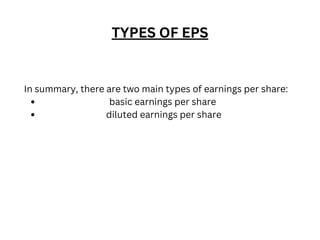
TYPES OF EPS
basic earnings per share
diluted earnings per share
In summary, there are two main types of earnings per share:
TYPES OF SHAREHOLDERS
▸ Ordinary shareholders buy a share in a company to earn dividends and
for capital growth. These dividends fluctuate annually depending on
profits and available cash reserves etc.
▸ Preference shareholders have more rights than ordinary shareholders.
Not only do they have preference on liquidation, but they also have a
fixed amount paid out each year in dividends
BASIC EARNINGS PER SHARE
Basic earnings per share is calculated by dividing earnings attributable
to the ordinary shareholders by the weighted average number of
ordinary shares in issue during the year
Earnings
________________________________
Number of shares
DILUTED EARNINGS PER SHARE
Dilution means to make thinner or less concentrated. With respect to
earnings per share, dilution would occur if the same earnings have to be
shared amongst more shareholders than are currently in existence.
Many entities at year-end have potential shares outstanding, which if
converted into shares, would dilute the earnings per share.
- Diluted earnings per share shows the lowest earnings per share
possible assuming that these potential ordinary shares are created.
-It logically follows that diluted earnings per share can never be
higher than basic earnings per share
Thank you

Indian accounting standard eps

  • 1.
    SUBJECT; ACCOUNTING THEORY SubmittedBy: Shashank h s 1st Mcom MIT First Grade College SUBMITTED TO: SUNITHA S R MAM
  • 2.
    TOPIC: INDIAN ACCOUNTING STANDARD (INDAS) 33, IAS33 EARNINGS PER SHARE
  • 3.
    EARNINGS PER SHARE 'Earningsper share' is essentially a ratio used in the financial analysis of a set of financial statements. This ratio is, however, so useful and popular that the standard. the numerator: earnings; and the denominator: the number of shares IAS 33, had to be developed to control the method of calculation thereof. This standard sets out how to calculate:
  • 4.
    TYPES OF EPS basicearnings per share diluted earnings per share In summary, there are two main types of earnings per share:
  • 5.
    TYPES OF SHAREHOLDERS ▸Ordinary shareholders buy a share in a company to earn dividends and for capital growth. These dividends fluctuate annually depending on profits and available cash reserves etc. ▸ Preference shareholders have more rights than ordinary shareholders. Not only do they have preference on liquidation, but they also have a fixed amount paid out each year in dividends
  • 6.
    BASIC EARNINGS PERSHARE Basic earnings per share is calculated by dividing earnings attributable to the ordinary shareholders by the weighted average number of ordinary shares in issue during the year Earnings ________________________________ Number of shares
  • 8.
    DILUTED EARNINGS PERSHARE Dilution means to make thinner or less concentrated. With respect to earnings per share, dilution would occur if the same earnings have to be shared amongst more shareholders than are currently in existence. Many entities at year-end have potential shares outstanding, which if converted into shares, would dilute the earnings per share.
  • 9.
    - Diluted earningsper share shows the lowest earnings per share possible assuming that these potential ordinary shares are created. -It logically follows that diluted earnings per share can never be higher than basic earnings per share
  • 10.