Incredible India!
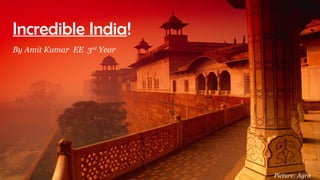
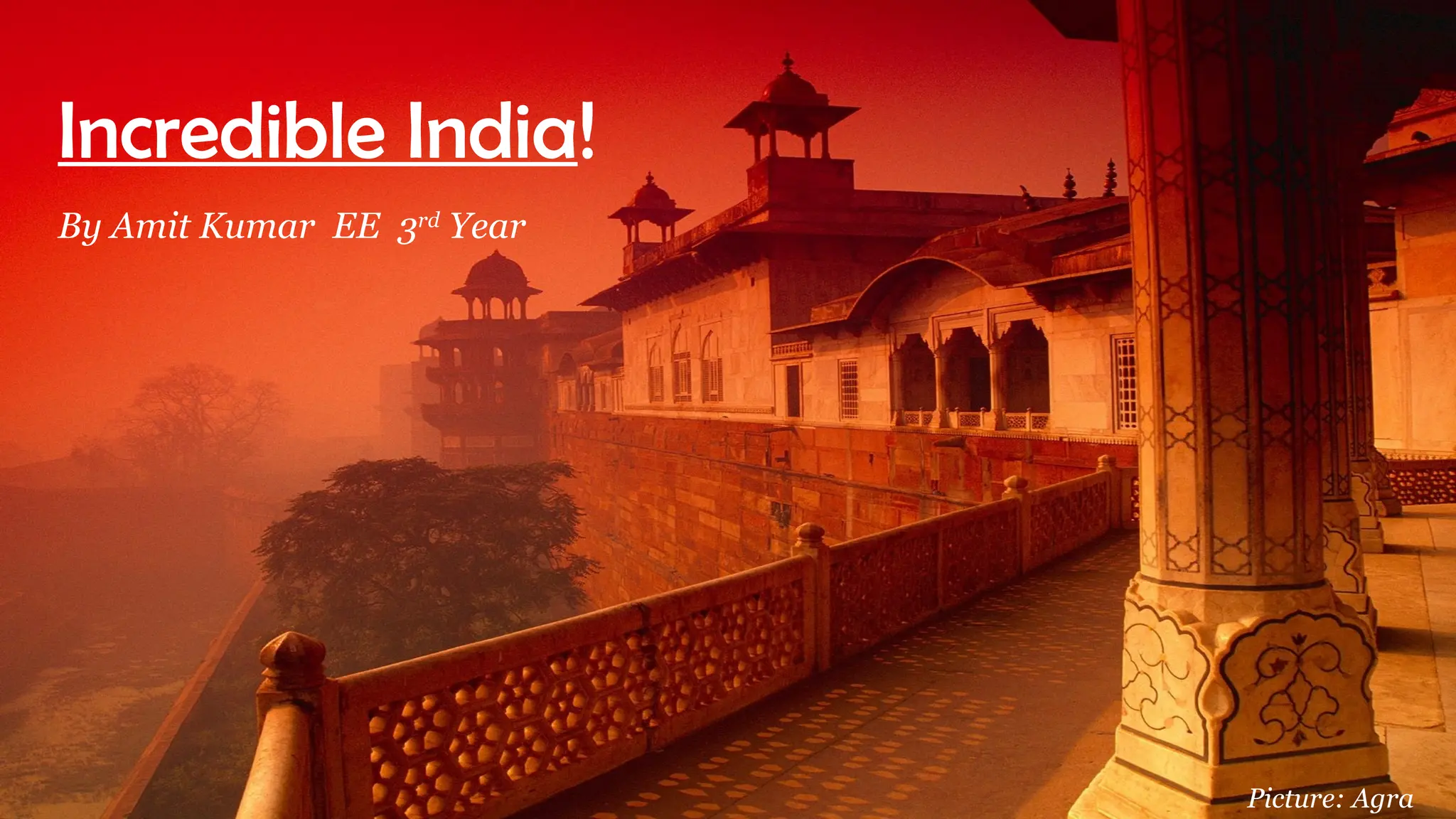
Picture: Agra
By Amit Kumar EE 3rd
Year
Today
• Introduction to India
• Peek into my Life
Happily raise your
hand if you have a
question
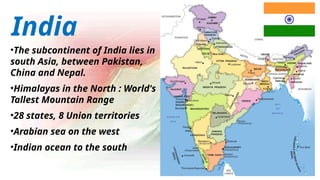
•The subcontinent of India lies in
south Asia, between Pakistan,
China and Nepal.
•Himalayas in the North : World's
Tallest Mountain Range
•28 states, 8 Union territories
•Arabian sea on the west
•Indian ocean to the south
India
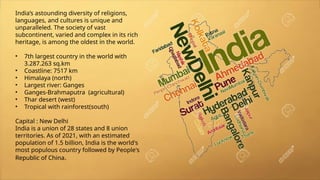
India’s astounding diversity of religions,
languages, and cultures is unique and
unparalleled. The society of vast
subcontinent, varied and complex in its rich
heritage, is among the oldest in the world.
• 7th largest country in the world with
3.287.263 sq.km
• Coastline: 7517 km
• Himalaya (north)
• Largest river: Ganges
• Ganges-Brahmaputra (agricultural)
• Thar desert (west)
• Tropical with rainforest(south)
Capital : New Delhi
India is a union of 28 states and 8 union
territories. As of 2021, with an estimated
population of 1.5 billion, India is the world's
most populous country followed by People's
Republic of China.
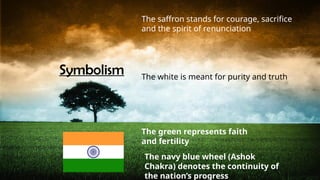
Symbolism
The saffron stands for courage, sacrifice
and the spirit of renunciation
The white is meant for purity and truth
The green represents faith
and fertility
The navy blue wheel (Ashok
Chakra) denotes the continuity of
the nation’s progress
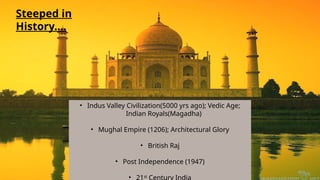
Steeped in
History….
• Indus Valley Civilization(5000 yrs ago); Vedic Age;
Indian Royals(Magadha)
• Mughal Empire (1206); Architectural Glory
• British Raj
• Post Independence (1947)
• 21st
Century India
• These words describe a country like India, that is incredibly rich in culture and heritage,
most aptly.
• The warmth in the relations and euphoria in celebrations make the country stand out
distinctively in the clutter. The cuisines, festivals, music, literature and
theatre….everything is special in this “land of Gods”.
• With over one billion people, 22 different languages, and a compelling history rich with
dynamism and determination, India is a country like no other.
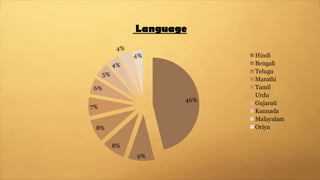
46%
9%
8%
8%
7%
6%
5%
4%
4%
4%
Language
Hindi
Bengali
Telugu
Marathi
Tamil
Urdu
Gujarati
Kannada
Malayalam
Oriya
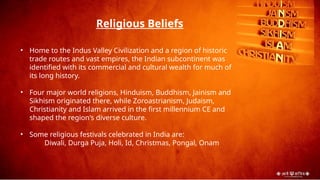
• Home to the Indus Valley Civilization and a region of historic
trade routes and vast empires, the Indian subcontinent was
identified with its commercial and cultural wealth for much of
its long history.
• Four major world religions, Hinduism, Buddhism, Jainism and
Sikhism originated there, while Zoroastrianism, Judaism,
Christianity and Islam arrived in the first millennium CE and
shaped the region's diverse culture.
• Some religious festivals celebrated in India are:
Diwali, Durga Puja, Holi, Id, Christmas, Pongal, Onam
Religious Beliefs
Major Indian Literature
To be or not to be……..
• Ancient epics: Mahabharata and
Ramayana
• Classics written in native
languages
in different regions
• Indian poetry is often rooted in
the deep religious movements
and musical traditions of the
country and during the Indian
Freedom Movement served as a
medium to vocalise nationalism
and protest
• Famous writers like Bengali poet
Rabindranath Tagore, R. K.
Narayan among others.
Indian Political
System
• India is the largest democracy in the world. India has the biggest number of people
with franchise rights and the largest number of political parties, which take part in
election campaign. In the 2014 national elections, almost 700 million people voted
and an average of 26 candidates competed for each of the 543 territorial
constituency seats.
• Elections are held at different levels. The two major election levels are at national
level, after which the national government is established and at state level after
which the state government is established. Elections are also held for city, town and
village councils.
• There are different political issues in Indian politics. Some are national level and
some regional level.
• Politics in India take place within the framework of its constitution, as India is a
federal parliamentary democratic republic in which the President of India is the head
of state and the Prime Minister of India is the head of government. India follows the
dual polity system, i.e. a double government which consists of the central authority
at the centre and states at the periphery.
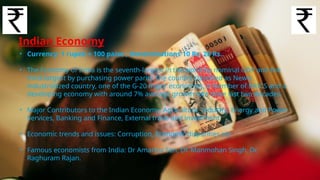
Indian Economy
• Currency: 1 rupee = 100 paise ; Denominations 10 Rs, 20 Rs..
• The Economy of India is the seventh-largest in the world by nominal GDP and the
third-largest by purchasing power parity The country classified as Newly
industrialized country, one of the G-20 major economies, a member of BRICS and a
developing economy with around 7% average growth rate since last two decades.
• Major Contributors to the Indian Economy: Agriculture, Industry, Energy and Power
Services, Banking and Finance, External trade and investment.
• Economic trends and issues: Corruption, Economic disparities etc
• Famous economists from India: Dr Amartya Sen, Dr. Manmohan Singh, Dr.
Raghuram Rajan.
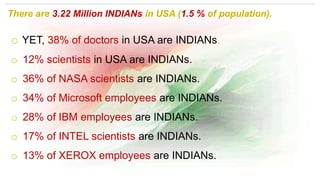
There are 3.22 Million INDIANs in USA (1.5 % of population).
o YET, 38% of doctors in USA are INDIANs.
o 12% scientists in USA are INDIANs.
o 36% of NASA scientists are INDIANs.
o 34% of Microsoft employees are INDIANs.
o 28% of IBM employees are INDIANs.
o 17% of INTEL scientists are INDIANs.
o 13% of XEROX employees are INDIANs.
Thank You!

incredible india ppt by Amit Kumar .pptx

  • 1.
    Incredible India! Picture: Agra ByAmit Kumar EE 3rd Year
  • 2.
    Today • Introduction toIndia • Peek into my Life Happily raise your hand if you have a question
  • 4.
    •The subcontinent ofIndia lies in south Asia, between Pakistan, China and Nepal. •Himalayas in the North : World's Tallest Mountain Range •28 states, 8 Union territories •Arabian sea on the west •Indian ocean to the south India
  • 5.
    India’s astounding diversityof religions, languages, and cultures is unique and unparalleled. The society of vast subcontinent, varied and complex in its rich heritage, is among the oldest in the world. • 7th largest country in the world with 3.287.263 sq.km • Coastline: 7517 km • Himalaya (north) • Largest river: Ganges • Ganges-Brahmaputra (agricultural) • Thar desert (west) • Tropical with rainforest(south) Capital : New Delhi India is a union of 28 states and 8 union territories. As of 2021, with an estimated population of 1.5 billion, India is the world's most populous country followed by People's Republic of China.
  • 6.
    Symbolism The saffron standsfor courage, sacrifice and the spirit of renunciation The white is meant for purity and truth The green represents faith and fertility The navy blue wheel (Ashok Chakra) denotes the continuity of the nation’s progress
  • 7.
    Steeped in History…. • IndusValley Civilization(5000 yrs ago); Vedic Age; Indian Royals(Magadha) • Mughal Empire (1206); Architectural Glory • British Raj • Post Independence (1947) • 21st Century India
  • 8.
    • These wordsdescribe a country like India, that is incredibly rich in culture and heritage, most aptly. • The warmth in the relations and euphoria in celebrations make the country stand out distinctively in the clutter. The cuisines, festivals, music, literature and theatre….everything is special in this “land of Gods”. • With over one billion people, 22 different languages, and a compelling history rich with dynamism and determination, India is a country like no other.
  • 9.
  • 11.
    • Home tothe Indus Valley Civilization and a region of historic trade routes and vast empires, the Indian subcontinent was identified with its commercial and cultural wealth for much of its long history. • Four major world religions, Hinduism, Buddhism, Jainism and Sikhism originated there, while Zoroastrianism, Judaism, Christianity and Islam arrived in the first millennium CE and shaped the region's diverse culture. • Some religious festivals celebrated in India are: Diwali, Durga Puja, Holi, Id, Christmas, Pongal, Onam Religious Beliefs
  • 13.
    Major Indian Literature Tobe or not to be…….. • Ancient epics: Mahabharata and Ramayana • Classics written in native languages in different regions • Indian poetry is often rooted in the deep religious movements and musical traditions of the country and during the Indian Freedom Movement served as a medium to vocalise nationalism and protest • Famous writers like Bengali poet Rabindranath Tagore, R. K. Narayan among others.
  • 14.
    Indian Political System • Indiais the largest democracy in the world. India has the biggest number of people with franchise rights and the largest number of political parties, which take part in election campaign. In the 2014 national elections, almost 700 million people voted and an average of 26 candidates competed for each of the 543 territorial constituency seats. • Elections are held at different levels. The two major election levels are at national level, after which the national government is established and at state level after which the state government is established. Elections are also held for city, town and village councils. • There are different political issues in Indian politics. Some are national level and some regional level. • Politics in India take place within the framework of its constitution, as India is a federal parliamentary democratic republic in which the President of India is the head of state and the Prime Minister of India is the head of government. India follows the dual polity system, i.e. a double government which consists of the central authority at the centre and states at the periphery.
  • 15.
    Indian Economy • Currency:1 rupee = 100 paise ; Denominations 10 Rs, 20 Rs.. • The Economy of India is the seventh-largest in the world by nominal GDP and the third-largest by purchasing power parity The country classified as Newly industrialized country, one of the G-20 major economies, a member of BRICS and a developing economy with around 7% average growth rate since last two decades. • Major Contributors to the Indian Economy: Agriculture, Industry, Energy and Power Services, Banking and Finance, External trade and investment. • Economic trends and issues: Corruption, Economic disparities etc • Famous economists from India: Dr Amartya Sen, Dr. Manmohan Singh, Dr. Raghuram Rajan.
  • 17.
    There are 3.22Million INDIANs in USA (1.5 % of population). o YET, 38% of doctors in USA are INDIANs. o 12% scientists in USA are INDIANs. o 36% of NASA scientists are INDIANs. o 34% of Microsoft employees are INDIANs. o 28% of IBM employees are INDIANs. o 17% of INTEL scientists are INDIANs. o 13% of XEROX employees are INDIANs.
  • 18.