Index Notation for Vector Calculus
by
Ilan Ben-Yaacov and Francesc Roig
Copyright c

 2006
Index notation, also commonly known as subscript notation or tensor notation,
is an extremely useful tool for performing vector algebra. Consider the coordinate
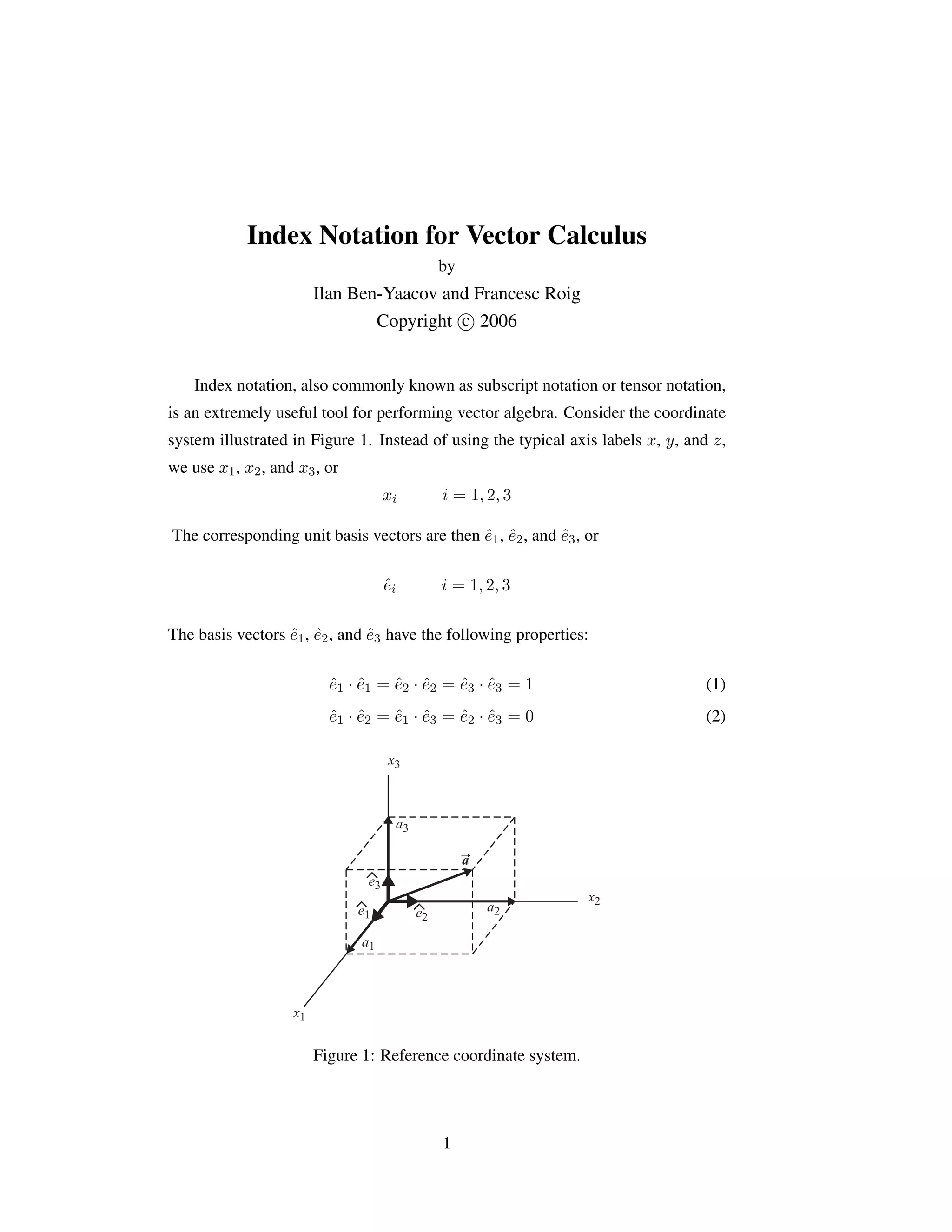
system illustrated in Figure 1. Instead of using the typical axis labels x, y, and z,
we use x1, x2, and x3, or
xi i = 1, 2, 3
The corresponding unit basis vectors are then ê1, ê2, and ê3, or
êi i = 1, 2, 3
The basis vectors ê1, ê2, and ê3 have the following properties:
ê1 · ê1 = ê2 · ê2 = ê3 · ê3 = 1 (1)
ê1 · ê2 = ê1 · ê3 = ê2 · ê3 = 0 (2)
x1
x2
x3
a1
a2
a3
a
e1 e2
e3
Figure 1: Reference coordinate system.
1
2 Index Notation
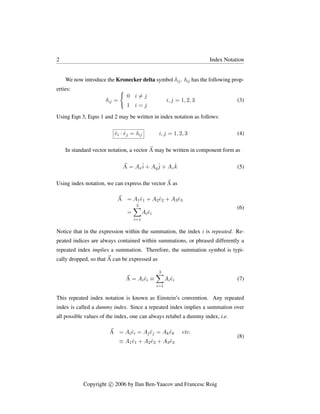
We now introduce the Kronecker delta symbol δij. δij has the following prop-
erties:
δij =
(
0 i 6= j
1 i = j
i, j = 1, 2, 3 (3)
Using Eqn 3, Eqns 1 and 2 may be written in index notation as follows:
êi · êj = δij i, j = 1, 2, 3 (4)
In standard vector notation, a vector ~
A may be written in component form as
~
A = Axî + Ayĵ + Azk̂ (5)
Using index notation, we can express the vector ~
A as
~
A = A1ê1 + A2ê2 + A3ê3
=
3
X
i=1
Aiêi
(6)
Notice that in the expression within the summation, the index i is repeated. Re-
peated indices are always contained within summations, or phrased differently a
repeated index implies a summation. Therefore, the summation symbol is typi-
cally dropped, so that ~
A can be expressed as
~
A = Aiêi ≡
3
X
i=1
Aiêi (7)
This repeated index notation is known as Einstein’s convention. Any repeated
index is called a dummy index. Since a repeated index implies a summation over
all possible values of the index, one can always relabel a dummy index, i.e.
~
A = Aiêi = Ajêj = Akêk etc.
≡ A1ê1 + A2ê2 + A3ê3
(8)
Copyright c

 2006 by Ilan Ben-Yaacov and Francesc Roig
Index Notation 3
The Scalar Product in Index Notation
We now show how to express scalar products (also known as inner products
or dot products) using index notation. Consider the vectors ~
a and ~
b, which can be
expressed using index notation as
~
a = a1ê1 + a2ê2 + a3ê3 = aiêi
~
b = b1ê1 + b2ê2 + b3ê3 = bjêj
(9)
Note that we use different indices (i and j) for the two vectors to indicate that the
index for~
b is completely independent of that used for ~
a. We will first write out the
scalar product ~
a ·~
b in long-hand form, and then express it more compactly using
some of the properties of index notation.
~
a ·~
b =
3
X
i=1
aiêi
!
·


3
X
j=1
bjêj


=
3
X
i=1
3
X
j=1
[(aiêi) · (bjêj)]
=
3
X
i=1
3
X
j=1
[aibj (êi · êj)] (commutative property)
=
3
X
i=1
3
X
j=1
(aibjδij) (from Eqn 3)
Summing over all values of i and j, we get
~
a ·~
b = a1b1δ11 + a1b2δ12 + a1b3δ13
+ a2b1δ21 + a2b2δ22 + a2b3δ23
+ a3b1δ31 + a3b2δ32 + a3b3δ33
= a1b1δ11 + a2b2δ22 + a3b3δ33
= a1b1 + a2b2 + a3b3
=
3
X
i=1
aibi
= aibi = ajbj = akbk
Copyright c

 2006 by Ilan Ben-Yaacov and Francesc Roig
4 Index Notation
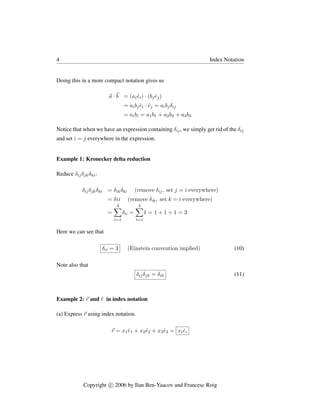
Doing this in a more compact notation gives us
~
a ·~
b = (aiêi) · (bjêj)
= aibjêi · êj = aibjδij
= aibi = a1b1 + a2b2 + a3b3
Notice that when we have an expression containing δij, we simply get rid of the δij
and set i = j everywhere in the expression.
Example 1: Kronecker delta reduction
Reduce δijδjkδki:
δijδjkδki = δikδki (remove δij, set j = i everywhere)
= δii (remove δik, set k = i everywhere)
=
3
X
i=1
δii =
3
X
i=1
1 = 1 + 1 + 1 = 3
Here we can see that
δii = 3 (Einstein convention implied) (10)
Note also that
δijδjk = δik (11)
Example 2: ~
r and r̂ in index notation
(a) Express ~
r using index notation.
~
r = x1ê1 + x2ê2 + x3ê3 = xiêi
Copyright c

 2006 by Ilan Ben-Yaacov and Francesc Roig
Index Notation 5
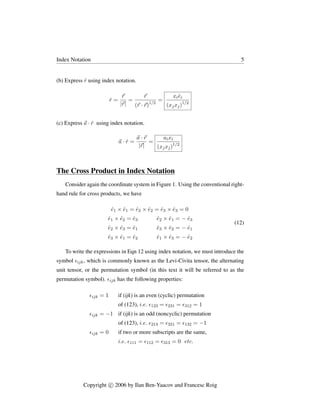
(b) Express r̂ using index notation.
r̂ =
~
r
|~
r|
=
~
r
(~
r · ~
r)1/2
=
xiêi
(xjxj)1/2
(c) Express ~
a · r̂ using index notation.
~
a · r̂ =
~
a · ~
r
|~
r|
=
aixi
(xjxj)1/2
The Cross Product in Index Notation
Consider again the coordinate system in Figure 1. Using the conventional right-
hand rule for cross products, we have
ê1 × ê1 = ê2 × ê2 = ê3 × ê3 = 0
ê1 × ê2 = ê3 ê2 × ê1 = − ê3
ê2 × ê3 = ê1 ê3 × ê2 = − ê1
ê3 × ê1 = ê2 ê1 × ê3 = − ê2
(12)
To write the expressions in Eqn 12 using index notation, we must introduce the
symbol ijk, which is commonly known as the Levi-Civita tensor, the alternating
unit tensor, or the permutation symbol (in this text it will be referred to as the
permutation symbol). ijk has the following properties:
ijk = 1 if (ijk) is an even (cyclic) permutation
of (123), i.e. 123 = 231 = 312 = 1
ijk = −1 if (ijk) is an odd (noncyclic) permutation
of (123), i.e. 213 = 321 = 132 = −1
ijk = 0 if two or more subscripts are the same,
i.e. 111 = 112 = 313 = 0 etc.
Copyright c

 2006 by Ilan Ben-Yaacov and Francesc Roig
6 Index Notation
Hence, we may rewrite the expressions in Eqn 12 as follows:
ê1 × ê2 = 123ê3 ê2 × ê1 = 213ê3
ê2 × ê3 = 231ê1 ê3 × ê2 = 321ê1
ê3 × ê1 = 312ê2 ê1 × ê3 = 132ê2
(13)
Now, we may write a single generalized expression for all the terms in Eqn 13:
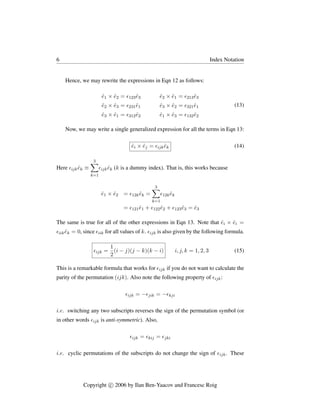
êi × êj = ijkêk (14)
Here ijkêk ≡
3
X
k=1
ijkêk (k is a dummy index). That is, this works because
ê1 × ê2 = 12kêk =
3
X
k=1
12kêk
= 121ê1 + 122ê2 + 123ê3 = ê3
The same is true for all of the other expressions in Eqn 13. Note that êi × êi =
iikêk = 0, since iik for all values of k. ijk is also given by the following formula.
ijk =
1
2
(i − j)(j − k)(k − i) i, j, k = 1, 2, 3 (15)
This is a remarkable formula that works for ijk if you do not want to calculate the
parity of the permutation (ijk). Also note the following property of ijk:
ijk = −jik = −kji
i.e. switching any two subscripts reverses the sign of the permutation symbol (or
in other words ijk is anti-symmetric). Also,
ijk = kij = jki
i.e. cyclic permutations of the subscripts do not change the sign of ijk. These
Copyright c

 2006 by Ilan Ben-Yaacov and Francesc Roig
Index Notation 7
properties also follow from the formula in Eqn 15.
Now, let’s consider the cross product of two vectors ~
a and~
b, where
~
a = aiêi
~
b = bjêj
Then
~
a ×~
b = (aiêi) × (bjêj) = aibjêi × êj = aibjijkêk
Thus we write for the cross product:
~
a ×~
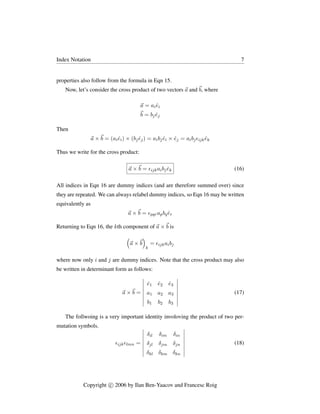
b = ijkaibjêk (16)
All indices in Eqn 16 are dummy indices (and are therefore summed over) since
they are repeated. We can always relabel dummy indices, so Eqn 16 may be written
equivalently as
~
a ×~
b = pqrapbqêr
Returning to Eqn 16, the kth component of ~
a ×~
b is

~
a ×~
b

k
= ijkaibj
where now only i and j are dummy indices. Note that the cross product may also
be written in determinant form as follows:
~
a ×~
b =

Index notation

  • 1.
    Index Notation forVector Calculus by Ilan Ben-Yaacov and Francesc Roig Copyright c 2006 Index notation, also commonly known as subscript notation or tensor notation, is an extremely useful tool for performing vector algebra. Consider the coordinate system illustrated in Figure 1. Instead of using the typical axis labels x, y, and z, we use x1, x2, and x3, or xi i = 1, 2, 3 The corresponding unit basis vectors are then ê1, ê2, and ê3, or êi i = 1, 2, 3 The basis vectors ê1, ê2, and ê3 have the following properties: ê1 · ê1 = ê2 · ê2 = ê3 · ê3 = 1 (1) ê1 · ê2 = ê1 · ê3 = ê2 · ê3 = 0 (2) x1 x2 x3 a1 a2 a3 a e1 e2 e3 Figure 1: Reference coordinate system. 1
  • 2.
    2 Index Notation Wenow introduce the Kronecker delta symbol δij. δij has the following prop- erties: δij = ( 0 i 6= j 1 i = j i, j = 1, 2, 3 (3) Using Eqn 3, Eqns 1 and 2 may be written in index notation as follows: êi · êj = δij i, j = 1, 2, 3 (4) In standard vector notation, a vector ~ A may be written in component form as ~ A = Axî + Ayĵ + Azk̂ (5) Using index notation, we can express the vector ~ A as ~ A = A1ê1 + A2ê2 + A3ê3 = 3 X i=1 Aiêi (6) Notice that in the expression within the summation, the index i is repeated. Re- peated indices are always contained within summations, or phrased differently a repeated index implies a summation. Therefore, the summation symbol is typi- cally dropped, so that ~ A can be expressed as ~ A = Aiêi ≡ 3 X i=1 Aiêi (7) This repeated index notation is known as Einstein’s convention. Any repeated index is called a dummy index. Since a repeated index implies a summation over all possible values of the index, one can always relabel a dummy index, i.e. ~ A = Aiêi = Ajêj = Akêk etc. ≡ A1ê1 + A2ê2 + A3ê3 (8) Copyright c 2006 by Ilan Ben-Yaacov and Francesc Roig
  • 3.
    Index Notation 3 TheScalar Product in Index Notation We now show how to express scalar products (also known as inner products or dot products) using index notation. Consider the vectors ~ a and ~ b, which can be expressed using index notation as ~ a = a1ê1 + a2ê2 + a3ê3 = aiêi ~ b = b1ê1 + b2ê2 + b3ê3 = bjêj (9) Note that we use different indices (i and j) for the two vectors to indicate that the index for~ b is completely independent of that used for ~ a. We will first write out the scalar product ~ a ·~ b in long-hand form, and then express it more compactly using some of the properties of index notation. ~ a ·~ b = 3 X i=1 aiêi ! ·   3 X j=1 bjêj   = 3 X i=1 3 X j=1 [(aiêi) · (bjêj)] = 3 X i=1 3 X j=1 [aibj (êi · êj)] (commutative property) = 3 X i=1 3 X j=1 (aibjδij) (from Eqn 3) Summing over all values of i and j, we get ~ a ·~ b = a1b1δ11 + a1b2δ12 + a1b3δ13 + a2b1δ21 + a2b2δ22 + a2b3δ23 + a3b1δ31 + a3b2δ32 + a3b3δ33 = a1b1δ11 + a2b2δ22 + a3b3δ33 = a1b1 + a2b2 + a3b3 = 3 X i=1 aibi = aibi = ajbj = akbk Copyright c 2006 by Ilan Ben-Yaacov and Francesc Roig
  • 4.
    4 Index Notation Doingthis in a more compact notation gives us ~ a ·~ b = (aiêi) · (bjêj) = aibjêi · êj = aibjδij = aibi = a1b1 + a2b2 + a3b3 Notice that when we have an expression containing δij, we simply get rid of the δij and set i = j everywhere in the expression. Example 1: Kronecker delta reduction Reduce δijδjkδki: δijδjkδki = δikδki (remove δij, set j = i everywhere) = δii (remove δik, set k = i everywhere) = 3 X i=1 δii = 3 X i=1 1 = 1 + 1 + 1 = 3 Here we can see that δii = 3 (Einstein convention implied) (10) Note also that δijδjk = δik (11) Example 2: ~ r and r̂ in index notation (a) Express ~ r using index notation. ~ r = x1ê1 + x2ê2 + x3ê3 = xiêi Copyright c 2006 by Ilan Ben-Yaacov and Francesc Roig
  • 5.
    Index Notation 5 (b)Express r̂ using index notation. r̂ = ~ r |~ r| = ~ r (~ r · ~ r)1/2 = xiêi (xjxj)1/2 (c) Express ~ a · r̂ using index notation. ~ a · r̂ = ~ a · ~ r |~ r| = aixi (xjxj)1/2 The Cross Product in Index Notation Consider again the coordinate system in Figure 1. Using the conventional right- hand rule for cross products, we have ê1 × ê1 = ê2 × ê2 = ê3 × ê3 = 0 ê1 × ê2 = ê3 ê2 × ê1 = − ê3 ê2 × ê3 = ê1 ê3 × ê2 = − ê1 ê3 × ê1 = ê2 ê1 × ê3 = − ê2 (12) To write the expressions in Eqn 12 using index notation, we must introduce the symbol ijk, which is commonly known as the Levi-Civita tensor, the alternating unit tensor, or the permutation symbol (in this text it will be referred to as the permutation symbol). ijk has the following properties: ijk = 1 if (ijk) is an even (cyclic) permutation of (123), i.e. 123 = 231 = 312 = 1 ijk = −1 if (ijk) is an odd (noncyclic) permutation of (123), i.e. 213 = 321 = 132 = −1 ijk = 0 if two or more subscripts are the same, i.e. 111 = 112 = 313 = 0 etc. Copyright c 2006 by Ilan Ben-Yaacov and Francesc Roig
  • 6.
    6 Index Notation Hence,we may rewrite the expressions in Eqn 12 as follows: ê1 × ê2 = 123ê3 ê2 × ê1 = 213ê3 ê2 × ê3 = 231ê1 ê3 × ê2 = 321ê1 ê3 × ê1 = 312ê2 ê1 × ê3 = 132ê2 (13) Now, we may write a single generalized expression for all the terms in Eqn 13: êi × êj = ijkêk (14) Here ijkêk ≡ 3 X k=1 ijkêk (k is a dummy index). That is, this works because ê1 × ê2 = 12kêk = 3 X k=1 12kêk = 121ê1 + 122ê2 + 123ê3 = ê3 The same is true for all of the other expressions in Eqn 13. Note that êi × êi = iikêk = 0, since iik for all values of k. ijk is also given by the following formula. ijk = 1 2 (i − j)(j − k)(k − i) i, j, k = 1, 2, 3 (15) This is a remarkable formula that works for ijk if you do not want to calculate the parity of the permutation (ijk). Also note the following property of ijk: ijk = −jik = −kji i.e. switching any two subscripts reverses the sign of the permutation symbol (or in other words ijk is anti-symmetric). Also, ijk = kij = jki i.e. cyclic permutations of the subscripts do not change the sign of ijk. These Copyright c 2006 by Ilan Ben-Yaacov and Francesc Roig
  • 7.
    Index Notation 7 propertiesalso follow from the formula in Eqn 15. Now, let’s consider the cross product of two vectors ~ a and~ b, where ~ a = aiêi ~ b = bjêj Then ~ a ×~ b = (aiêi) × (bjêj) = aibjêi × êj = aibjijkêk Thus we write for the cross product: ~ a ×~ b = ijkaibjêk (16) All indices in Eqn 16 are dummy indices (and are therefore summed over) since they are repeated. We can always relabel dummy indices, so Eqn 16 may be written equivalently as ~ a ×~ b = pqrapbqêr Returning to Eqn 16, the kth component of ~ a ×~ b is ~ a ×~ b k = ijkaibj where now only i and j are dummy indices. Note that the cross product may also be written in determinant form as follows: ~ a ×~ b =
  • 15.
    ê1 ê2 ê3 a1a2 a3 b1 b2 b3
  • 23.
    (17) The follwoing isa very important identity involoving the product of two per- mutation symbols. ijklmn =
  • 31.
    δil δim δin δjlδjm δjn δkl δkm δkn
  • 39.
    (18) Copyright c 2006by Ilan Ben-Yaacov and Francesc Roig
  • 40.
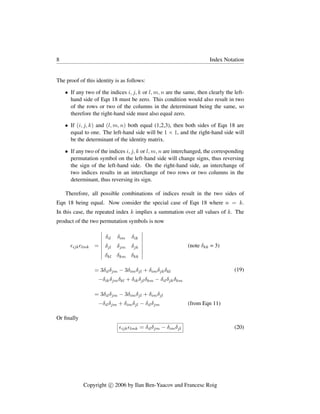
    8 Index Notation Theproof of this identity is as follows: • If any two of the indices i, j, k or l, m, n are the same, then clearly the left- hand side of Eqn 18 must be zero. This condition would also result in two of the rows or two of the columns in the determinant being the same, so therefore the right-hand side must also equal zero. • If (i, j, k) and (l, m, n) both equal (1,2,3), then both sides of Eqn 18 are equal to one. The left-hand side will be 1 × 1, and the right-hand side will be the determinant of the identity matrix. • If any two of the indices i, j, k or l, m, n are interchanged, the corresponding permutation symbol on the left-hand side will change signs, thus reversing the sign of the left-hand side. On the right-hand side, an interchange of two indices results in an interchange of two rows or two columns in the determinant, thus reversing its sign. Therefore, all possible combinations of indices result in the two sides of Eqn 18 being equal. Now consider the special case of Eqn 18 where n = k. In this case, the repeated index k implies a summation over all values of k. The product of the two permutation symbols is now ijklmk =
  • 48.
    δil δim δik δjlδjm δjk δkl δkm δkk
  • 56.
    (note δkk =3) = 3δilδjm − 3δimδjl + δimδjkδkl −δikδjmδkl + δikδjlδkm − δilδjkδkm = 3δilδjm − 3δimδjl + δimδjl −δilδjm + δimδjl − δilδjm (from Eqn 11) (19) Or finally ijklmk = δilδjm − δimδjl (20) Copyright c 2006 by Ilan Ben-Yaacov and Francesc Roig
  • 57.
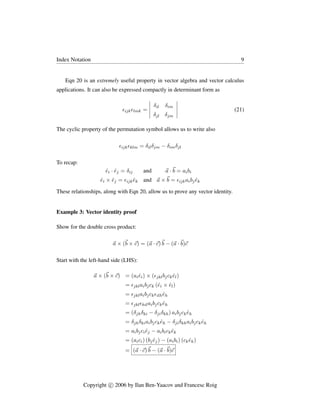
    Index Notation 9 Eqn20 is an extremely useful property in vector algebra and vector calculus applications. It can also be expressed compactly in determinant form as ijklmk =
  • 62.
  • 67.
    (21) The cyclic propertyof the permutation symbol allows us to write also ijkklm = δilδjm − δimδjl To recap: êi · êj = δij and ~ a ·~ b = aibi êi × êj = ijkêk and ~ a ×~ b = ijkaibjêk These relationships, along with Eqn 20, allow us to prove any vector identity. Example 3: Vector identity proof Show for the double cross product: ~ a × (~ b × ~ c) = (~ a · ~ c)~ b − (~ a ·~ b)~ c Start with the left-hand side (LHS): ~ a × (~ b × ~ c) = (aiêi) × (jklbjckêl) = jklaibjck (êi × êl) = jklaibjckilhêh = jklhilaibjckêh = (δjhδki − δjiδkh) aibjckêh = δjhδkiaibjckêh − δjiδkhaibjckêh = aibjciêj − aibickêk = (aici) (bjêj) − (aibi) (ckêk) = (~ a · ~ c)~ b − (~ a ·~ b)~ c Copyright c 2006 by Ilan Ben-Yaacov and Francesc Roig
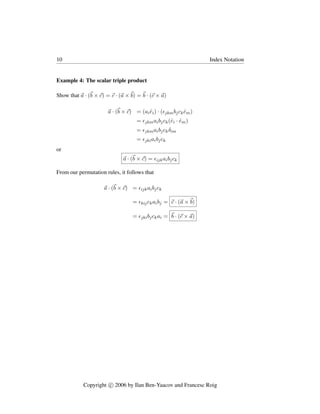
  • 68.
    10 Index Notation Example4: The scalar triple product Show that ~ a · (~ b × ~ c) = ~ c · (~ a ×~ b) = ~ b · (~ c × ~ a) ~ a · (~ b × ~ c) = (aiêi) · (jkmbjckêm) = jkmaibjck(êi · êm) = jkmaibjckδim = jkiaibjck or ~ a · (~ b × ~ c) = ijkaibjck From our permutation rules, it follows that ~ a · (~ b × ~ c) = ijkaibjck = kijckaibj = ~ c · (~ a ×~ b) = jkibjckai = ~ b · (~ c × ~ a) Copyright c 2006 by Ilan Ben-Yaacov and Francesc Roig