1 | P a g e
IND AS Roadmap
HISTORY
Before adoption of IND AS, Companies used to follow the Accounting Standard from Indian Generally
Accepted Accounting Principles (GAAP) issued by ICAI, notified by MCA under “Company Accounting
Standard Rules 2006”. Accounting Standards (AS) are still complied by non companies operating in
India. At present there are 27 effective Accounting Standard for professional accounting i.e AS 1 to 29
except AS 6 and AS 8. Various limitation of AS like difficulty between choosing alternatives and restricted
scope lead to adoption of IND AS.
BACKGROUND
Every country needs to have a good financial reporting system for achieving economic development.
Institute of Chartered Accountants of India (ICAI) has always formulated Accounting Standards that is
required according to the time. In past few years, the adoption of International Financial Reporting
Standards has gained a tremendous acceptance in various parts of the world. It has been accepted in
almost 140 countries. It is considered as a common language for financial reporting in all over the world.
Adopting IFRS as IND AS is one of the most significant step taken by MCA in consultation with ICAI that
will make the performance of Indian companies comparable with overseas or international companies
and entities. Adopting IND AS will bring transparency in financial reporting.
INTRODUCTION
On Feb 16, 2015 Ministry of Corporate Affairs (MCA) notified the new set of Accounting Standards
under The Companies (Indian Accounting Standards) Rules, 2015 known as Indian Accounting Standard
(IND AS). As on date MCA has notified 41 IND AS. The base of Indian Accounting Standards is
International Accounting Standards (IAS) and International Financial Reporting Standards (IFRS). IND AS
has chosen the path of IFRS rather than adoption of it with certain carve-outs.
IND AS is applicable to all the companies of India on the phase manner. Voluntary application was done
from FY 2015-16. From FY 2016-17 mandatory application phase had begun. However, for banking
companies, NBFCs and Insurance companies it is to be still applied. Once IND AS is applied then this
option cannot be revoked later on.
APPLICATION OF IND AS TO “COMPANIES”
2 | P a g e
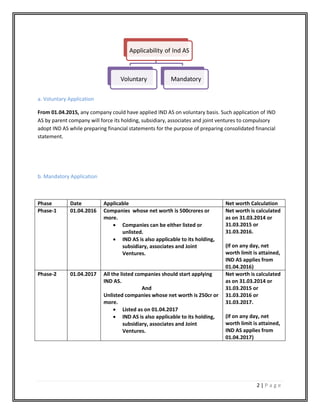
a. Voluntary Application
From 01.04.2015, any company could have applied IND AS on voluntary basis. Such application of IND
AS by parent company will force its holding, subsidiary, associates and joint ventures to compulsory
adopt IND AS while preparing financial statements for the purpose of preparing consolidated financial
statement.
b. Mandatory Application
Phase Date Applicable Net worth Calculation
Phase-1 01.04.2016 Companies whose net worth is 500crores or
more.
 Companies can be either listed or
unlisted.
 IND AS is also applicable to its holding,
subsidiary, associates and Joint
Ventures.
Net worth is calculated
as on 31.03.2014 or
31.03.2015 or
31.03.2016.
(If on any day, net
worth limit is attained,
IND AS applies from
01.04.2016)
Phase-2 01.04.2017 All the listed companies should start applying
IND AS.
And
Unlisted companies whose net worth is 250cr or
more.
 Listed as on 01.04.2017
 IND AS is also applicable to its holding,
subsidiary, associates and Joint
Ventures.
Net worth is calculated
as on 31.03.2014 or
31.03.2015 or
31.03.2016 or
31.03.2017.
(If on any day, net
worth limit is attained,
IND AS applies from
01.04.2017)
Applicability of Ind AS
Voluntary Mandatory
3 | P a g e
PROVISIONS FOR BANKING COMPANIES, NBFCs AND INSURANCE COMPANIES
1. Banking companies
 Scheduled Commercial Banks except Rural Banks are required to adopt IND AS from 01.04.2019.
 Early or voluntary application i.e. before 01.04.2019 is not allowed for banking companies.
 Initially, MCA plan was to implement IND AS from 01.04.2018 onwards but RBI deferred the
implementation of IND AS by one year for banks.
2. Non-Banking Financial Institutions (NBFCs)
 All listed NBFCs or unlisted NBFCs whose net worth is 500crore or more are required to adopt
IND AS from 01.04.2018
 NBFCs whose net worth is 250crore or more are required to adopt IND AS from 01.04.2019.
 Early or voluntary application i.e. before 01.04.2019 is not allowed for NBFC companies.
 IND AS is also applicable to its holding, subsidiary, associates and Joint Ventures.
3. Insurance Companies
 All Insurance companies are required to adopt IND AS from 01.04.2019.
 IND AS is also applicable to its holding, subsidiary, associates and Joint Ventures.
NET WORTH
 Net worth does not include Revaluations reserves, capital reserve arising due to other reserve
and other specific reserve (like development rebate reserve).
NON APPLICABILITY OF IND AS FOR COMPANIES
Companies which are not covered above are required to apply MCA 2006 standards. In this case, as on
the date, companies can be classified into two parts:
Net worth = Paid up equity share capital + Free Reserves – Losses + Capital Reserve arising on
receipt of grant (Promoter contribution grant) + ESOP (share based payment reserves)
4 | P a g e
1. Non Small & Medium Companies:
These are the companies with following characteristics:
 Banking companies, Insurance companies and Non Banking Financial Institutions.
 Companies whose turnover exceeds 50crores in previous year.
 Companies whose borrowing exceeds 10crores at anytime in previous year.
 Holding and subsidiary of the above companies.
2. Small & Medium Companies:
 All other companies are Small & Medium Companies.
 These companies have some exemption from AS
Exemptions from AS:
 Full exemption: AS 3, AS 7.
 Partial exemption: AS 15, AS 19, AS 20, AS 28, AS 29.
 Selected exemption: AS 21, AS 23, AS 25 and AS 27.
SET OF FINANCIAL STATEMENTS REQUIRED UNDER IND AS
Following set of financial statements are required to be reported under IND AS:
1. Balance (main, transitional, comparative).
2. Statement of profit and loss (include OCI)
3. Statement of cash flows.
4. Notes to accounts.
Companies
Non Small &
Medium
Companies
Small & Medium
Companies
Non applicability
of Ind AS
5 | P a g e
5. Statements of changes in equity
CARVE OUTS AND REASONS
Standards Carve outs Objective
IND AS 101- First-time adoption
of Indian Accounting Standards
IFRS-1 defines previous GAAP as
the basis of accounting used
immediately before adopting
IFRS IND AS 101 defines previous
GAAP as used for reporting
requirement in India
immediately before adopting
IND AS.
To ensure that Companies
consider the financials prepared
in accordance with Companies
(Accounting Standard) Rules,
2006 as previous GAAP.
IND AS 101- First-time adoption
of Indian Accounting Standards
Exchange difference arising on
translation of long-term foreign
currency monetary items to be
continued for already recognized
differences on date of transition
To allow consistency with the
objective of introducing AS 11–
which was introduced
considering the full convertibility
of Indian Rupee
IND AS 101- First-time adoption
of Indian Accounting Standards
Allowing the use of carrying cost
of property, plant and
equipment on the date of
transition.
Determining fair value on date of
transition or retrospective
application of IND AS 16 may
impose practical difficulties.
IND AS 103 – Business
Combinations
Capital reserve to be recognized
for gain on bargain purchase
instead of P&L
Considering the Indian scenario,
treatment of capital profit as
revenue was removed.
IND AS 32 – Financial
Instruments
As per IAS 32, the equity
conversion option embedded in
a convertible bond denominated
in foreign currency to acquire a
fixed number of the entity’s own
equity instruments is considered
a derivative liability instrument.
In IND AS 32, an exception has
been included to the definition
of ‘financial liability’ whereby
conversion option in FCCB to
acquire fixed number of entity’s
own equity instruments is
classified as equity instrument if
the exercise price is fixed in any
currency
Since the number of shares
convertible on the exercise of
the option remains fixed and the
amount at which option is to be
exercised in terms of foreign
currency is also fixed, merely the
difference in the currency should
not affect the nature of the
derivative.
IND AS 40- Investment Property Fair value model for investment
property is not permitted in IND
AS
To remove different accounting
treatments by different
companies
IND AS 28 – Investment in
Associates and Joint Ventures
IAS 28 requires that if the
associate’s accounting policies
Purpose is to exempt IndAS
applicability where it may be
6 | P a g e
are different from those of the
investor, the investor should
change the financial statements
of the associate by using same
accounting policies. The phrase,
‘unless impracticable to do so’
has been added in the relevant
requirements.
practically difficult to implement
in terms of cost and work
involved.
IND AS 17 – Leases IFRS 17 requires all lease rentals
to be charges to statement of
profit and loss account on
straight line basis. Carve out that
escalation in line with expected
inflation need not be straight-
lined.
Lease arrangements in India
contain periodic escalation rent
escalation, which covers the
Indian inflationary situation.
IND AS 1 – Presentatio n of
Financial Statements
Breach of material covenants in
long-term loans, when lender
agrees not to demand before
the financials statements are
approved for issue can be
treated as adjusting events and
continue to be classified as
non-current.
Considering that if breach is
rectified before approval of
financial statements, it would
be appropriate that users are
informed about true nature of
liabilities being non-current and
not current liabilities.
CONCLUSION
Even though IND AS has already been introduced, it has not completely replaced the existing Accounting
Standards. For those class of companies not covered in the notification, existing Accounting Standards
will continue to apply. However, the recent amendments in the existing Accounting Standards are
almost in line with IND AS provisions. Government does not wants to completely replace the existing
IND AS but it wants the nation to gradually shift towards adoption of IND AS.
By: Rojita Ghimire
Registration Number: CRO0575876
Mobile Number: 8929740794
Email Id: rojita21364@gmail.com
3rd floor, J&K block 44, Near MCD school, New Delhi-110092

Ind as roadmap

  • 1.
    1 | Pa g e IND AS Roadmap HISTORY Before adoption of IND AS, Companies used to follow the Accounting Standard from Indian Generally Accepted Accounting Principles (GAAP) issued by ICAI, notified by MCA under “Company Accounting Standard Rules 2006”. Accounting Standards (AS) are still complied by non companies operating in India. At present there are 27 effective Accounting Standard for professional accounting i.e AS 1 to 29 except AS 6 and AS 8. Various limitation of AS like difficulty between choosing alternatives and restricted scope lead to adoption of IND AS. BACKGROUND Every country needs to have a good financial reporting system for achieving economic development. Institute of Chartered Accountants of India (ICAI) has always formulated Accounting Standards that is required according to the time. In past few years, the adoption of International Financial Reporting Standards has gained a tremendous acceptance in various parts of the world. It has been accepted in almost 140 countries. It is considered as a common language for financial reporting in all over the world. Adopting IFRS as IND AS is one of the most significant step taken by MCA in consultation with ICAI that will make the performance of Indian companies comparable with overseas or international companies and entities. Adopting IND AS will bring transparency in financial reporting. INTRODUCTION On Feb 16, 2015 Ministry of Corporate Affairs (MCA) notified the new set of Accounting Standards under The Companies (Indian Accounting Standards) Rules, 2015 known as Indian Accounting Standard (IND AS). As on date MCA has notified 41 IND AS. The base of Indian Accounting Standards is International Accounting Standards (IAS) and International Financial Reporting Standards (IFRS). IND AS has chosen the path of IFRS rather than adoption of it with certain carve-outs. IND AS is applicable to all the companies of India on the phase manner. Voluntary application was done from FY 2015-16. From FY 2016-17 mandatory application phase had begun. However, for banking companies, NBFCs and Insurance companies it is to be still applied. Once IND AS is applied then this option cannot be revoked later on. APPLICATION OF IND AS TO “COMPANIES”
  • 2.
    2 | Pa g e a. Voluntary Application From 01.04.2015, any company could have applied IND AS on voluntary basis. Such application of IND AS by parent company will force its holding, subsidiary, associates and joint ventures to compulsory adopt IND AS while preparing financial statements for the purpose of preparing consolidated financial statement. b. Mandatory Application Phase Date Applicable Net worth Calculation Phase-1 01.04.2016 Companies whose net worth is 500crores or more.  Companies can be either listed or unlisted.  IND AS is also applicable to its holding, subsidiary, associates and Joint Ventures. Net worth is calculated as on 31.03.2014 or 31.03.2015 or 31.03.2016. (If on any day, net worth limit is attained, IND AS applies from 01.04.2016) Phase-2 01.04.2017 All the listed companies should start applying IND AS. And Unlisted companies whose net worth is 250cr or more.  Listed as on 01.04.2017  IND AS is also applicable to its holding, subsidiary, associates and Joint Ventures. Net worth is calculated as on 31.03.2014 or 31.03.2015 or 31.03.2016 or 31.03.2017. (If on any day, net worth limit is attained, IND AS applies from 01.04.2017) Applicability of Ind AS Voluntary Mandatory
  • 3.
    3 | Pa g e PROVISIONS FOR BANKING COMPANIES, NBFCs AND INSURANCE COMPANIES 1. Banking companies  Scheduled Commercial Banks except Rural Banks are required to adopt IND AS from 01.04.2019.  Early or voluntary application i.e. before 01.04.2019 is not allowed for banking companies.  Initially, MCA plan was to implement IND AS from 01.04.2018 onwards but RBI deferred the implementation of IND AS by one year for banks. 2. Non-Banking Financial Institutions (NBFCs)  All listed NBFCs or unlisted NBFCs whose net worth is 500crore or more are required to adopt IND AS from 01.04.2018  NBFCs whose net worth is 250crore or more are required to adopt IND AS from 01.04.2019.  Early or voluntary application i.e. before 01.04.2019 is not allowed for NBFC companies.  IND AS is also applicable to its holding, subsidiary, associates and Joint Ventures. 3. Insurance Companies  All Insurance companies are required to adopt IND AS from 01.04.2019.  IND AS is also applicable to its holding, subsidiary, associates and Joint Ventures. NET WORTH  Net worth does not include Revaluations reserves, capital reserve arising due to other reserve and other specific reserve (like development rebate reserve). NON APPLICABILITY OF IND AS FOR COMPANIES Companies which are not covered above are required to apply MCA 2006 standards. In this case, as on the date, companies can be classified into two parts: Net worth = Paid up equity share capital + Free Reserves – Losses + Capital Reserve arising on receipt of grant (Promoter contribution grant) + ESOP (share based payment reserves)
  • 4.
    4 | Pa g e 1. Non Small & Medium Companies: These are the companies with following characteristics:  Banking companies, Insurance companies and Non Banking Financial Institutions.  Companies whose turnover exceeds 50crores in previous year.  Companies whose borrowing exceeds 10crores at anytime in previous year.  Holding and subsidiary of the above companies. 2. Small & Medium Companies:  All other companies are Small & Medium Companies.  These companies have some exemption from AS Exemptions from AS:  Full exemption: AS 3, AS 7.  Partial exemption: AS 15, AS 19, AS 20, AS 28, AS 29.  Selected exemption: AS 21, AS 23, AS 25 and AS 27. SET OF FINANCIAL STATEMENTS REQUIRED UNDER IND AS Following set of financial statements are required to be reported under IND AS: 1. Balance (main, transitional, comparative). 2. Statement of profit and loss (include OCI) 3. Statement of cash flows. 4. Notes to accounts. Companies Non Small & Medium Companies Small & Medium Companies Non applicability of Ind AS
  • 5.
    5 | Pa g e 5. Statements of changes in equity CARVE OUTS AND REASONS Standards Carve outs Objective IND AS 101- First-time adoption of Indian Accounting Standards IFRS-1 defines previous GAAP as the basis of accounting used immediately before adopting IFRS IND AS 101 defines previous GAAP as used for reporting requirement in India immediately before adopting IND AS. To ensure that Companies consider the financials prepared in accordance with Companies (Accounting Standard) Rules, 2006 as previous GAAP. IND AS 101- First-time adoption of Indian Accounting Standards Exchange difference arising on translation of long-term foreign currency monetary items to be continued for already recognized differences on date of transition To allow consistency with the objective of introducing AS 11– which was introduced considering the full convertibility of Indian Rupee IND AS 101- First-time adoption of Indian Accounting Standards Allowing the use of carrying cost of property, plant and equipment on the date of transition. Determining fair value on date of transition or retrospective application of IND AS 16 may impose practical difficulties. IND AS 103 – Business Combinations Capital reserve to be recognized for gain on bargain purchase instead of P&L Considering the Indian scenario, treatment of capital profit as revenue was removed. IND AS 32 – Financial Instruments As per IAS 32, the equity conversion option embedded in a convertible bond denominated in foreign currency to acquire a fixed number of the entity’s own equity instruments is considered a derivative liability instrument. In IND AS 32, an exception has been included to the definition of ‘financial liability’ whereby conversion option in FCCB to acquire fixed number of entity’s own equity instruments is classified as equity instrument if the exercise price is fixed in any currency Since the number of shares convertible on the exercise of the option remains fixed and the amount at which option is to be exercised in terms of foreign currency is also fixed, merely the difference in the currency should not affect the nature of the derivative. IND AS 40- Investment Property Fair value model for investment property is not permitted in IND AS To remove different accounting treatments by different companies IND AS 28 – Investment in Associates and Joint Ventures IAS 28 requires that if the associate’s accounting policies Purpose is to exempt IndAS applicability where it may be
  • 6.
    6 | Pa g e are different from those of the investor, the investor should change the financial statements of the associate by using same accounting policies. The phrase, ‘unless impracticable to do so’ has been added in the relevant requirements. practically difficult to implement in terms of cost and work involved. IND AS 17 – Leases IFRS 17 requires all lease rentals to be charges to statement of profit and loss account on straight line basis. Carve out that escalation in line with expected inflation need not be straight- lined. Lease arrangements in India contain periodic escalation rent escalation, which covers the Indian inflationary situation. IND AS 1 – Presentatio n of Financial Statements Breach of material covenants in long-term loans, when lender agrees not to demand before the financials statements are approved for issue can be treated as adjusting events and continue to be classified as non-current. Considering that if breach is rectified before approval of financial statements, it would be appropriate that users are informed about true nature of liabilities being non-current and not current liabilities. CONCLUSION Even though IND AS has already been introduced, it has not completely replaced the existing Accounting Standards. For those class of companies not covered in the notification, existing Accounting Standards will continue to apply. However, the recent amendments in the existing Accounting Standards are almost in line with IND AS provisions. Government does not wants to completely replace the existing IND AS but it wants the nation to gradually shift towards adoption of IND AS. By: Rojita Ghimire Registration Number: CRO0575876 Mobile Number: 8929740794 Email Id: rojita21364@gmail.com 3rd floor, J&K block 44, Near MCD school, New Delhi-110092