1
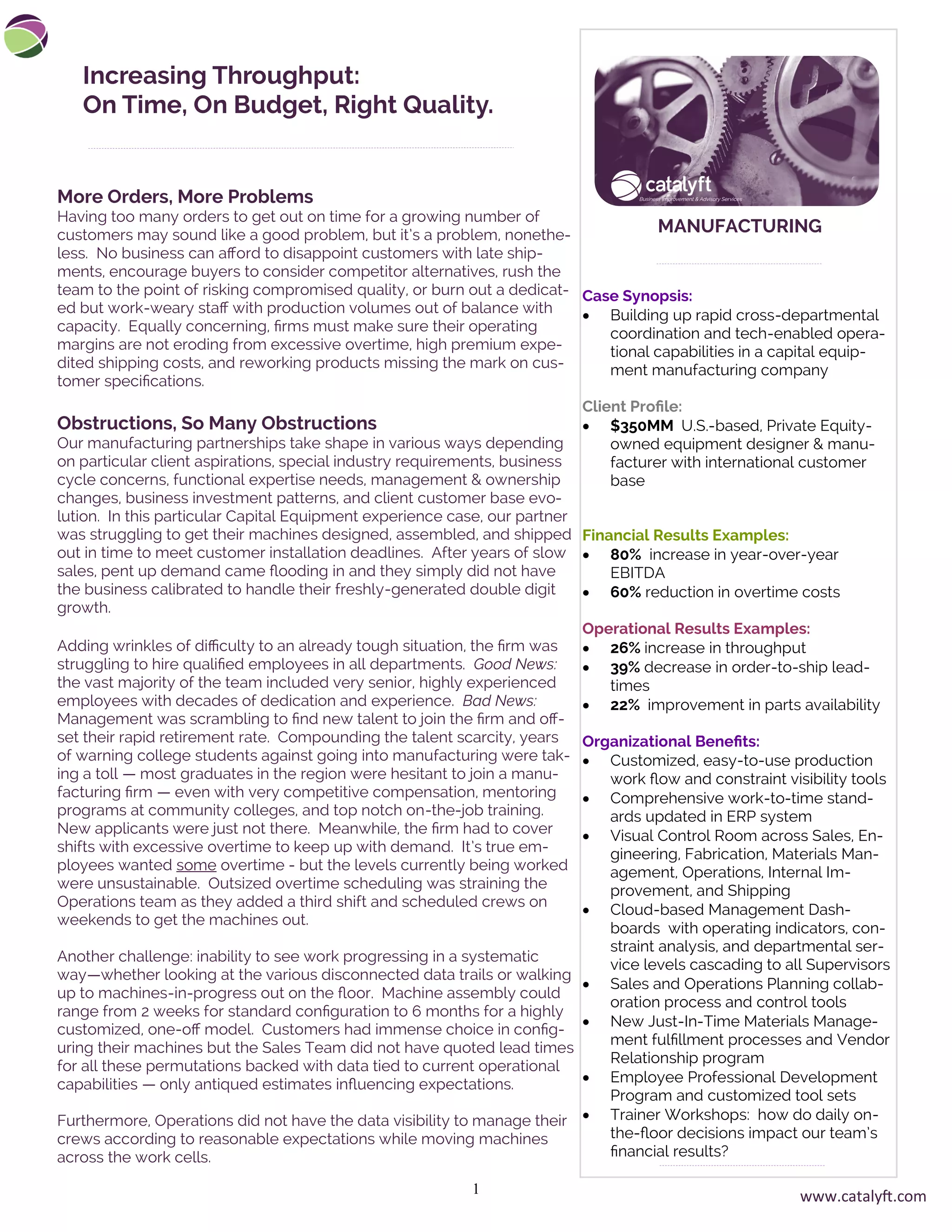
Increasing Throughput:
On Time, On Budget, Right Quality.
Case Synopsis:
• Building up rapid cross-departmental
coordination and tech-enabled opera-
tional capabilities in a capital equip-
ment manufacturing company
Client Profile:
• $350MM U.S.-based, Private Equity-
owned equipment designer & manu-
facturer with international customer
base
Financial Results Examples:
• 80% increase in year-over-year
EBITDA
• 60% reduction in overtime costs
Operational Results Examples:
• 26% increase in throughput
• 39% decrease in order-to-ship lead-
times
• 22% improvement in parts availability
Organizational Benefits:
• Customized, easy-to-use production
work flow and constraint visibility tools
• Comprehensive work-to-time stand-
ards updated in ERP system
• Visual Control Room across Sales, En-
gineering, Fabrication, Materials Man-
agement, Operations, Internal Im-
provement, and Shipping
• Cloud-based Management Dash-
boards with operating indicators, con-
straint analysis, and departmental ser-
vice levels cascading to all Supervisors
• Sales and Operations Planning collab-
oration process and control tools
• New Just-In-Time Materials Manage-
ment fulfillment processes and Vendor
Relationship program
• Employee Professional Development
Program and customized tool sets
• Trainer Workshops: how do daily on-
the-floor decisions impact our team’s
financial results?
More Orders, More Problems
Having too many orders to get out on time for a growing number of
customers may sound like a good problem, but it’s a problem, nonethe-
less. No business can afford to disappoint customers with late ship-
ments, encourage buyers to consider competitor alternatives, rush the
team to the point of risking compromised quality, or burn out a dedicat-
ed but work-weary staff with production volumes out of balance with
capacity. Equally concerning, firms must make sure their operating
margins are not eroding from excessive overtime, high premium expe-
dited shipping costs, and reworking products missing the mark on cus-
tomer specifications.
Obstructions, So Many Obstructions
Our manufacturing partnerships take shape in various ways depending
on particular client aspirations, special industry requirements, business
cycle concerns, functional expertise needs, management & ownership
changes, business investment patterns, and client customer base evo-
lution. In this particular Capital Equipment experience case, our partner
was struggling to get their machines designed, assembled, and shipped
out in time to meet customer installation deadlines. After years of slow
sales, pent up demand came flooding in and they simply did not have
the business calibrated to handle their freshly-generated double digit
growth.
Adding wrinkles of difficulty to an already tough situation, the firm was
struggling to hire qualified employees in all departments. Good News:
the vast majority of the team included very senior, highly experienced
employees with decades of dedication and experience. Bad News:
Management was scrambling to find new talent to join the firm and off-
set their rapid retirement rate. Compounding the talent scarcity, years
of warning college students against going into manufacturing were tak-
ing a toll — most graduates in the region were hesitant to join a manu-
facturing firm — even with very competitive compensation, mentoring
programs at community colleges, and top notch on-the-job training.
New applicants were just not there. Meanwhile, the firm had to cover
shifts with excessive overtime to keep up with demand. It’s true em-
ployees wanted some overtime - but the levels currently being worked
were unsustainable. Outsized overtime scheduling was straining the
Operations team as they added a third shift and scheduled crews on
weekends to get the machines out.
Another challenge: inability to see work progressing in a systematic
way—whether looking at the various disconnected data trails or walking
up to machines-in-progress out on the floor. Machine assembly could
range from 2 weeks for standard configuration to 6 months for a highly
customized, one-off model. Customers had immense choice in config-
uring their machines but the Sales Team did not have quoted lead times
for all these permutations backed with data tied to current operational
capabilities — only antiqued estimates influencing expectations.
Furthermore, Operations did not have the data visibility to manage their
crews according to reasonable expectations while moving machines
across the work cells.
MANUFACTURING
www.catalyft.com
2
Another issue: Management had plenty of standard financial reports
and several ad hoc operating reports created in isolation by industrious
managers — but not a comprehensive data hierarchy with leading oper-
ational indicators locked on financial goals and flowing into existing fi-
nancial reporting. Most perplexing, departments did not have a good
grasp on the types of constraints tripping up their teams along the way.
Without the data to confirm they were on the right track or sound the
alarm when machines were behind, management reviews were more
about voicing conjecture and past experiences rather than allowing the
data to plead the case. The team needed to be able to pinpoint when
problems arose, what were the chances of this recurring, and what was
being done to prevent future constraints from becoming more preva-
lent.
Finally, the team’s biggest obstruction to getting machines out unfortu-
nately originated across several key departments — Sales, Engineering,
Materials, Assembly, and Shipping — due to inefficient and counterpro-
ductive communication channels. The departments were working with
furious intensity albeit with a myopic focus to get their own responsibili-
ties accomplished; unfortunately, their isolated effort was optimizing
components of production rather than the total flow — causing unfore-
seen problems down the line, creating painfully expensive headaches
for their colleagues in other departments, and crippling overall order-to
-ship times. One example: Assembly was notorious for grabbing com-
ponents out of docked shipments before Materials even had a chance
to enter receipt of goods and place the components in their rightful ar-
ea. No surprise: moving outside of the system created all sorts of
problems including unreliable inventory levels, parts floating around the
shop floor, and frustrating animosity between Materials and Assembly.
Always A Collaborative Partnership
Engaged to quickly build up throughput capabilities without exorbitant
labor and material costs, our improvement team was comprised of 25
members - including Executives, Department Managers, Supervisors,
Controllers, and Consultants.
While skills sets varied (specialties included data analysis, lean manu-
facturing, supply chain, talent management program implementation,
data hierarchy development, dashboard implementation, process opti-
mization, change management, and project management), all team
members knew the goal: building up embedded throughput capabilities
so desperately needed (yesterday) while generating millions in cost-
savings through our collaboration.
Agile Approach, Customized Fixes
After our initial analysis outlined the most valuable opportunities to ac-
celerate production flow, the team designed, tested, and implemented
key production and cost controls incorporated into the firm’s existing
lean processes and information systems. Our partnership was instru-
mental to quickly overcoming painful, expensive issues plaguing get-
ting machines out on time and aligned with customer expectations.
Through our focused collaboration, the team achieved everybody’s
shared objective of getting more machines out while simultaneously
ratcheting down excess labor costs, material handling costs, and em-
ployee frustrations in the process. Several key system elements doing
the heavy lifting and accelerating finished goods velocity included:
Updated Work-To-Time Data Flow Through Enterprise Resource Planning
System — new data flow and data maintenance process allowed Man-
agers and Supervisors to know where the team stood on all machines-
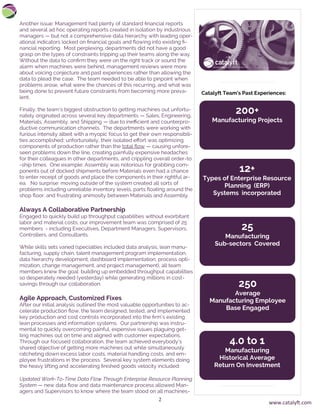
200+
Manufacturing Projects
Catalyft Team’s Past Experiences:
12+
Types of Enterprise Resource
Planning (ERP)
Systems incorporated
25
Manufacturing
Sub-sectors Covered
250
Average
Manufacturing Employee
Base Engaged
4.0 to 1
Manufacturing
Historical Average
Return On Investment
www.catalyft.com
3
in-process and for work to be planned and realistically segmented
across work cells. Trustworthy work-to-time relationships allowed all
Supervisors every shift to manage their team more precisely and sound
the alarm for help earlier in production before time and resources
evaporated in the their struggle.
Revamped Sales And Operations Planning (S&OP) — Operations devel-
oped a very precise, clear view of machines-in-process. The team
used timely performance data to manage the floor and, with alacrity,
now shared their production insights with Sales. The weekly S&OP
review meetings were built around facts rolling from up the shop floor
rather than perpetuating the former, unhelpful practice of laying deep-
er blame across departments. Now, Sales could estimate delivery
times with greater accuracy and set proper expectations with custom-
ers based on current production flow.
Centralized Control Room — essential to getting the departments col-
laborating with a regular cadence and get away from working in isola-
tion, the Control Room allowed the team to visualize their work, under-
stand the implications of their decisions on other departments, see po-
tential problems before they arose, and provide a forum to explore so-
lutions together using data. This new capability was a particular favor-
ite for our partners because the process and tool sets employed were
highly visual, easy to understand, and simple to maintain.
Management Dashboards With Cascading Data — with operational per-
formance data now rolling up from every Supervisor to Department
Managers and right on up to the Plant Manager, current progress was
very easy to see in a clear, compelling way. The team was now able to
tackle constraints in a more logical, cost-effective manner through pa-
reto analysis capturing barriers to getting machines out every shift.
Nice and simple constraint visibility allowed Management to see where
they could lend more support to a particular department or shift. Now,
the team was working on their schedule-busting top priorities every
week as a normal course of managing their business.
Materials Management Parts Flow Redesign — the team reconfigured
receiving docks, staging areas, storage rack systems, and parts han-
dling protocol to allow parts kits to be placed right next to each ma-
chine. The Radio Frequency Identification (RFID) tagging system was
optimized to ensure all parts never lost their way or found unauthorized
homes. In addition, easy-to-read visual monitors sharing parts status
and flagging concerns were placed right out on the shop floor for all
departments to see.
Talent Management Improvements — our partnership developed a
comprehensive supervisory training program to support all Supervisors
and make sure all received training on the new tools and work flow.
Additionally, customized training content clearly illustrating how their
day-to-day operational decisions had surprising financial repercussions
was created. Finally, the team designed and implemented an easy-to-
use Employee Scorecard to make sure Management was providing the
skills development and professional environment pathways needed to
retain seasoned veterans while developing newer employees at the
pace they needed.
The Team’s Results
Parts availability improved by 22%, overtime was reduced by 60%, and
order-to-ship lead times were cut by 39%. Chipping away at con-
straints, machine throughput went up 26% . With Sales and Operations
aligned around improved production capabilities and timely data,
EBITDA grew by 80% year-over-year.
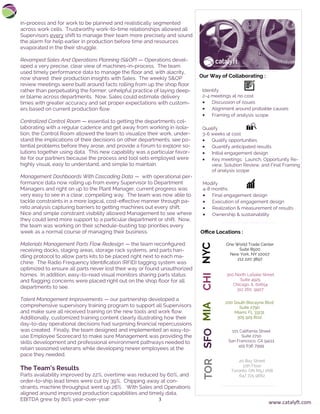
One World Trade Center
Suite 8500
New York, NY 10007
212 220 3897
NYC
300 North LaSalle Street
Suite 4925
Chicago, IL 60654
312 260 9907
CHIMIA
200 South Biscayne Blvd
Suite 2790
Miami, FL 33131
305 925 8112
Identify
2-4 meetings at no cost
• Discussion of issues
• Alignment around probable causes
• Framing of analysis scope
.
Qualify
3-6 weeks at cost
• Qualify opportunities
• Quantify anticipated results
• Initial engagement design
• Key meetings: Launch, Opportunity Re-
view, Solution Review, and Final Framing
of analysis scope
.
Modify
4-8 months
• Final engagement design
• Execution of engagement design
• Realization & measurement of results
• Ownership & sustainability
Our Way of Collaborating :
Office Locations :
SFO
101 California Street
Suite 2710
San Francisco, CA 94111
415 636 7999
TOR
20 Bay Street
11th Floor
Toronto, ON M5J 2N8
647 725 9662
www.catalyft.com

Increasing Production Throughput

  • 1.
    1 Increasing Throughput: On Time,On Budget, Right Quality. Case Synopsis: • Building up rapid cross-departmental coordination and tech-enabled opera- tional capabilities in a capital equip- ment manufacturing company Client Profile: • $350MM U.S.-based, Private Equity- owned equipment designer & manu- facturer with international customer base Financial Results Examples: • 80% increase in year-over-year EBITDA • 60% reduction in overtime costs Operational Results Examples: • 26% increase in throughput • 39% decrease in order-to-ship lead- times • 22% improvement in parts availability Organizational Benefits: • Customized, easy-to-use production work flow and constraint visibility tools • Comprehensive work-to-time stand- ards updated in ERP system • Visual Control Room across Sales, En- gineering, Fabrication, Materials Man- agement, Operations, Internal Im- provement, and Shipping • Cloud-based Management Dash- boards with operating indicators, con- straint analysis, and departmental ser- vice levels cascading to all Supervisors • Sales and Operations Planning collab- oration process and control tools • New Just-In-Time Materials Manage- ment fulfillment processes and Vendor Relationship program • Employee Professional Development Program and customized tool sets • Trainer Workshops: how do daily on- the-floor decisions impact our team’s financial results? More Orders, More Problems Having too many orders to get out on time for a growing number of customers may sound like a good problem, but it’s a problem, nonethe- less. No business can afford to disappoint customers with late ship- ments, encourage buyers to consider competitor alternatives, rush the team to the point of risking compromised quality, or burn out a dedicat- ed but work-weary staff with production volumes out of balance with capacity. Equally concerning, firms must make sure their operating margins are not eroding from excessive overtime, high premium expe- dited shipping costs, and reworking products missing the mark on cus- tomer specifications. Obstructions, So Many Obstructions Our manufacturing partnerships take shape in various ways depending on particular client aspirations, special industry requirements, business cycle concerns, functional expertise needs, management & ownership changes, business investment patterns, and client customer base evo- lution. In this particular Capital Equipment experience case, our partner was struggling to get their machines designed, assembled, and shipped out in time to meet customer installation deadlines. After years of slow sales, pent up demand came flooding in and they simply did not have the business calibrated to handle their freshly-generated double digit growth. Adding wrinkles of difficulty to an already tough situation, the firm was struggling to hire qualified employees in all departments. Good News: the vast majority of the team included very senior, highly experienced employees with decades of dedication and experience. Bad News: Management was scrambling to find new talent to join the firm and off- set their rapid retirement rate. Compounding the talent scarcity, years of warning college students against going into manufacturing were tak- ing a toll — most graduates in the region were hesitant to join a manu- facturing firm — even with very competitive compensation, mentoring programs at community colleges, and top notch on-the-job training. New applicants were just not there. Meanwhile, the firm had to cover shifts with excessive overtime to keep up with demand. It’s true em- ployees wanted some overtime - but the levels currently being worked were unsustainable. Outsized overtime scheduling was straining the Operations team as they added a third shift and scheduled crews on weekends to get the machines out. Another challenge: inability to see work progressing in a systematic way—whether looking at the various disconnected data trails or walking up to machines-in-progress out on the floor. Machine assembly could range from 2 weeks for standard configuration to 6 months for a highly customized, one-off model. Customers had immense choice in config- uring their machines but the Sales Team did not have quoted lead times for all these permutations backed with data tied to current operational capabilities — only antiqued estimates influencing expectations. Furthermore, Operations did not have the data visibility to manage their crews according to reasonable expectations while moving machines across the work cells. MANUFACTURING www.catalyft.com
  • 2.
    2 Another issue: Managementhad plenty of standard financial reports and several ad hoc operating reports created in isolation by industrious managers — but not a comprehensive data hierarchy with leading oper- ational indicators locked on financial goals and flowing into existing fi- nancial reporting. Most perplexing, departments did not have a good grasp on the types of constraints tripping up their teams along the way. Without the data to confirm they were on the right track or sound the alarm when machines were behind, management reviews were more about voicing conjecture and past experiences rather than allowing the data to plead the case. The team needed to be able to pinpoint when problems arose, what were the chances of this recurring, and what was being done to prevent future constraints from becoming more preva- lent. Finally, the team’s biggest obstruction to getting machines out unfortu- nately originated across several key departments — Sales, Engineering, Materials, Assembly, and Shipping — due to inefficient and counterpro- ductive communication channels. The departments were working with furious intensity albeit with a myopic focus to get their own responsibili- ties accomplished; unfortunately, their isolated effort was optimizing components of production rather than the total flow — causing unfore- seen problems down the line, creating painfully expensive headaches for their colleagues in other departments, and crippling overall order-to -ship times. One example: Assembly was notorious for grabbing com- ponents out of docked shipments before Materials even had a chance to enter receipt of goods and place the components in their rightful ar- ea. No surprise: moving outside of the system created all sorts of problems including unreliable inventory levels, parts floating around the shop floor, and frustrating animosity between Materials and Assembly. Always A Collaborative Partnership Engaged to quickly build up throughput capabilities without exorbitant labor and material costs, our improvement team was comprised of 25 members - including Executives, Department Managers, Supervisors, Controllers, and Consultants. While skills sets varied (specialties included data analysis, lean manu- facturing, supply chain, talent management program implementation, data hierarchy development, dashboard implementation, process opti- mization, change management, and project management), all team members knew the goal: building up embedded throughput capabilities so desperately needed (yesterday) while generating millions in cost- savings through our collaboration. Agile Approach, Customized Fixes After our initial analysis outlined the most valuable opportunities to ac- celerate production flow, the team designed, tested, and implemented key production and cost controls incorporated into the firm’s existing lean processes and information systems. Our partnership was instru- mental to quickly overcoming painful, expensive issues plaguing get- ting machines out on time and aligned with customer expectations. Through our focused collaboration, the team achieved everybody’s shared objective of getting more machines out while simultaneously ratcheting down excess labor costs, material handling costs, and em- ployee frustrations in the process. Several key system elements doing the heavy lifting and accelerating finished goods velocity included: Updated Work-To-Time Data Flow Through Enterprise Resource Planning System — new data flow and data maintenance process allowed Man- agers and Supervisors to know where the team stood on all machines- 200+ Manufacturing Projects Catalyft Team’s Past Experiences: 12+ Types of Enterprise Resource Planning (ERP) Systems incorporated 25 Manufacturing Sub-sectors Covered 250 Average Manufacturing Employee Base Engaged 4.0 to 1 Manufacturing Historical Average Return On Investment www.catalyft.com
  • 3.
    3 in-process and forwork to be planned and realistically segmented across work cells. Trustworthy work-to-time relationships allowed all Supervisors every shift to manage their team more precisely and sound the alarm for help earlier in production before time and resources evaporated in the their struggle. Revamped Sales And Operations Planning (S&OP) — Operations devel- oped a very precise, clear view of machines-in-process. The team used timely performance data to manage the floor and, with alacrity, now shared their production insights with Sales. The weekly S&OP review meetings were built around facts rolling from up the shop floor rather than perpetuating the former, unhelpful practice of laying deep- er blame across departments. Now, Sales could estimate delivery times with greater accuracy and set proper expectations with custom- ers based on current production flow. Centralized Control Room — essential to getting the departments col- laborating with a regular cadence and get away from working in isola- tion, the Control Room allowed the team to visualize their work, under- stand the implications of their decisions on other departments, see po- tential problems before they arose, and provide a forum to explore so- lutions together using data. This new capability was a particular favor- ite for our partners because the process and tool sets employed were highly visual, easy to understand, and simple to maintain. Management Dashboards With Cascading Data — with operational per- formance data now rolling up from every Supervisor to Department Managers and right on up to the Plant Manager, current progress was very easy to see in a clear, compelling way. The team was now able to tackle constraints in a more logical, cost-effective manner through pa- reto analysis capturing barriers to getting machines out every shift. Nice and simple constraint visibility allowed Management to see where they could lend more support to a particular department or shift. Now, the team was working on their schedule-busting top priorities every week as a normal course of managing their business. Materials Management Parts Flow Redesign — the team reconfigured receiving docks, staging areas, storage rack systems, and parts han- dling protocol to allow parts kits to be placed right next to each ma- chine. The Radio Frequency Identification (RFID) tagging system was optimized to ensure all parts never lost their way or found unauthorized homes. In addition, easy-to-read visual monitors sharing parts status and flagging concerns were placed right out on the shop floor for all departments to see. Talent Management Improvements — our partnership developed a comprehensive supervisory training program to support all Supervisors and make sure all received training on the new tools and work flow. Additionally, customized training content clearly illustrating how their day-to-day operational decisions had surprising financial repercussions was created. Finally, the team designed and implemented an easy-to- use Employee Scorecard to make sure Management was providing the skills development and professional environment pathways needed to retain seasoned veterans while developing newer employees at the pace they needed. The Team’s Results Parts availability improved by 22%, overtime was reduced by 60%, and order-to-ship lead times were cut by 39%. Chipping away at con- straints, machine throughput went up 26% . With Sales and Operations aligned around improved production capabilities and timely data, EBITDA grew by 80% year-over-year. One World Trade Center Suite 8500 New York, NY 10007 212 220 3897 NYC 300 North LaSalle Street Suite 4925 Chicago, IL 60654 312 260 9907 CHIMIA 200 South Biscayne Blvd Suite 2790 Miami, FL 33131 305 925 8112 Identify 2-4 meetings at no cost • Discussion of issues • Alignment around probable causes • Framing of analysis scope . Qualify 3-6 weeks at cost • Qualify opportunities • Quantify anticipated results • Initial engagement design • Key meetings: Launch, Opportunity Re- view, Solution Review, and Final Framing of analysis scope . Modify 4-8 months • Final engagement design • Execution of engagement design • Realization & measurement of results • Ownership & sustainability Our Way of Collaborating : Office Locations : SFO 101 California Street Suite 2710 San Francisco, CA 94111 415 636 7999 TOR 20 Bay Street 11th Floor Toronto, ON M5J 2N8 647 725 9662 www.catalyft.com