1
ST. LIDETA COLLEGE OF HEALTH SCIENCE AND
BUSINESS
HEALTH SERVICE MANAGEMNT
Course code: Comh 3181
Pharmacy
CREDIT HR : 3
SEYOUM SHIFERAW ( HO & MAPMP)
2
CHAPTER two
Part one
THE MANAGEMENT FUNCTIONS
SEYOUM SHIFERAW ( HO & MAPMP)
3
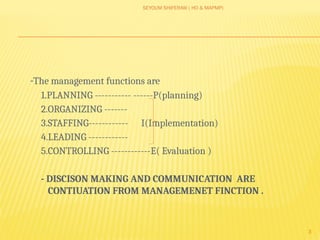
-The management functions are
1.PLANNING ----------- ------P(planning)
2.ORGANIZING -------
3.STAFFING------------ I(Implementation)
4.LEADING ------------
5.CONTROLLING ------------E( Evaluation )
- DISCISON MAKING AND COMMUNICATION ARE
CONTIUATION FROM MANAGEMENET FINCTION .
SEYOUM SHIFERAW ( HO & MAPMP)
4
PLANNING
DEFINITIONS OF PLANNING
Planning is deciding in advance what is to be done
it is projected course of action for the future.
a process that lays the base for future action.
SEYOUM SHIFERAW ( HO & MAPMP)
5
CONT…
 Health Planning:- is the process of defining community
health problems, identifying needs and resources, establishing
priority goals, and setting out the administrative actions
needed to reach those goals:
The important components of this and other similar definitions
are concepts of:-
Where are we going?(objectives)
With what? (Resources)
How? (efficient and appropriate implementation)
When? (future)
SEYOUM SHIFERAW ( HO & MAPMP)
6
CONT….
THE RATIONALE FOR PLANNING:
it helps for:-
Coping with future uncertainty and change
Focusing attention on objectives
obtaining economical operations
Providing performance standards and facilitates control
foreseeing and identifying potential risks.
TYPES OF PLANNING
Based on time/duration covered by the plan
Short term – 1 to 2 years
Medium term – 3 to 4 years
Long term – 5 years or more
Based on scope of activities
Strategic plan and Operational/Tactical plan
SEYOUM SHIFERAW ( HO & MAPMP)
7
CONT…
1- STRATEGIC PLANNING
Long term planning, usually for 5 or more years
It is finding the best future for your organization and the best
path to reach that destination.
It is often used in place of long range planning.
SEYOUM SHIFERAW ( HO & MAPMP)
8
CONT…
2. TACTICAL/OPERATIONAL PLANNING
Short-range planning that emphasizes the current
operations of various parts of the organization.
a type of planning extending only for about one year or less
into the future.
Managers use tactical/operational planning to outline what
the various parts of the organization must do for the
organization to be successful at some point one-year or
less into future.
SEYOUM SHIFERAW ( HO & MAPMP)
9
CONT…
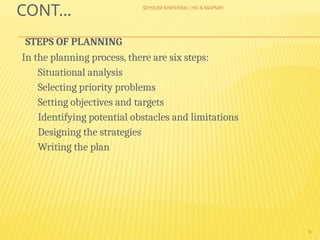
STEPS OF PLANNING
In the planning process, there are six steps:
Situational analysis
Selecting priority problems
Setting objectives and targets
Identifying potential obstacles and limitations
Designing the strategies
Writing the plan
SEYOUM SHIFERAW ( HO & MAPMP)
10
CONT…
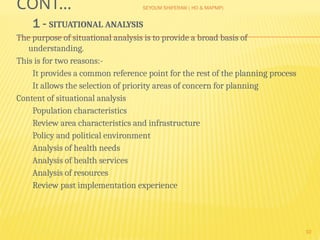
1 - SITUATIONAL ANALYSIS
The purpose of situational analysis is to provide a broad basis of
understanding.
This is for two reasons:-
It provides a common reference point for the rest of the planning process
It allows the selection of priority areas of concern for planning
Content of situational analysis
Population characteristics
Review area characteristics and infrastructure
Policy and political environment
Analysis of health needs
Analysis of health services
Analysis of resources
Review past implementation experience
SEYOUM SHIFERAW ( HO & MAPMP)
11
CONT…
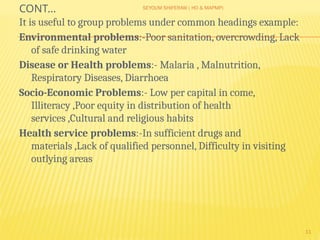
It is useful to group problems under common headings example:
Environmental problems:-Poor sanitation, overcrowding, Lack
of safe drinking water
Disease or Health problems:- Malaria , Malnutrition,
Respiratory Diseases, Diarrhoea
Socio-Economic Problems:- Low per capital in come,
Illiteracy ,Poor equity in distribution of health
services ,Cultural and religious habits
Health service problems:-In sufficient drugs and
materials ,Lack of qualified personnel, Difficulty in visiting
outlying areas
SEYOUM SHIFERAW ( HO & MAPMP)
12
CONT…
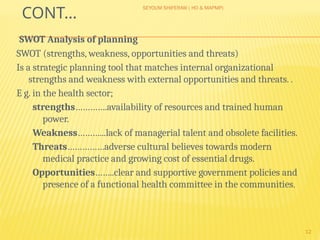
SWOT Analysis of planning
SWOT (strengths, weakness, opportunities and threats)
Is a strategic planning tool that matches internal organizational
strengths and weakness with external opportunities and threats. .
E g. in the health sector;
strengths………….availability of resources and trained human
power.
Weakness………...lack of managerial talent and obsolete facilities.
Threats……………adverse cultural believes towards modern
medical practice and growing cost of essential drugs.
Opportunities……..clear and supportive government policies and
presence of a functional health committee in the communities.
SEYOUM SHIFERAW ( HO & MAPMP)
13
CONT…
2 - SELECTING CRITICAL PRIORITY PROBLEMS
Setting priority is, perhaps the most critical and hardest planning stage and
yet cannot be avoided.
This is because we cannot solve all the problems simultaneously as our
resources are scare. The selection criteria for priority settings are:
Magnitude of the problem
Degree of severity (consequent suffering and disability)
Feasibility-in terms of cost effectiveness and social acceptability of
intervention.
Sustainability in terms of resources and organizational capacity
Community concern
Political and social acceptability with consideration of equity
Consistence with multi--sectoral approach
Consistence with governmental planning and budgetary system
etc
SEYOUM SHIFERAW ( HO & MAPMP)
14
CONT…
Ranking/likert scale of the identified problems most important
& can be done by using criteria on five point scale
5 points-very high
4 points-high
3 points-moderate
2 points-low
1 point-very low
SEYOUM SHIFERAW ( HO & MAPMP)
15
CONT…
3 -SETTING OBJECTIVES AND TARGETS
Let us first define some related terms a clear understanding of which is
important for a rationale planning.
WHAT IS
 Goals:- Are broad statements. There is generally one goal for a service.
e.g :' Health for all by 2000 and beyond.
 Aims:- There are a number of aims relating to the goal. They are specific to
particular health problems.
e.g. to raise the nutritional status of women and children.‘
 Objective:- For each programme aim, there may be a number of objectives
which are specified in measurable terms. An objective for the above aim might
be:
To ensure that 95% of children are adequately nourished by 2005
SEYOUM SHIFERAW ( HO & MAPMP)
16
CONT…
Objectives must be SMART:-
S = Specific
M = Measurable
A = Achievable
R = Realistic
T = Time specific/Time framed
Example- By the end of 2002, 90% of eligible children will be vaccinated
against six target diseases in Bole sub city Woreda 12
 Targets:- for each objective, there may be various targets which specify
various points on the way to the attainment of the objective. They are
defined in relation to a point in time. For example, a target for the above
objective might be:
By the end of 2001, 70% of eligible children will be vaccinated against six
target diseases in Bole sub city Woreda 12
By the end of 2002, 20% of eligible children will be vaccinated against six
target diseases in Bole sub city Woreda 12.'
SEYOUM SHIFERAW ( HO & MAPMP)
17
CONT…
4- IDENTIFYING OBSTACLES AND LIMITATIONS
After setting objectives and targets, the planner should ask
himself/herself about the presence of any obstacle/limitation.
The limitations/obstacles may be:
1 Resources:-People, Equipment, Money, Time, Information,
2 Environmental obstacles:-Geographical features, Climate, Technical
difficulties, Social factors
5 - DESIGNING THE STRATEGIES
Choosing the best strategy again entails analyzing resources available and
needed for each strategy.
The potential strategies often include
technology to be applied,
procedures to be used and
defining the role of communities and other sectors.
SEYOUM SHIFERAW ( HO & MAPMP)
18
CONT…
6- WRITING THE PLAN
The purposes of writing the plan are:-
To request funds or resources from the government or funding agencies
For monitoring and evaluating the implementation process by all
concerned
A plan can be written in several ways. Some organizations may require plans
to be written on specific way.
An outline of writing a plan:
1. cover page
2. content
3. Introduction
4.Detail planning process
SEYOUM SHIFERAW ( HO & MAPMP)
19
LEADING
Learning objectives
Define leadership
Discuss on the differences between leaders and managers
Discuss on contemporary views and approaches to leadership
Discuss on the skills for effective leadership
SEYOUM SHIFERAW ( HO & MAPMP)
20
Definition: Leadership is a process of directing and influencing
the task-related activities of group members.
Is the process through which an individual attempts to
intentionally influence another individual or a group in order
to accomplish a goal.
It is one of the most important things managers do.
The means by which things are accomplished in organizations
SEYOUM SHIFERAW ( HO & MAPMP)
21
A LEADER
believes that working in concert with others, can make a difference
creates something of value that did not exist before
exhibits positive energy
actualizes
welcome changes
SEYOUM SHIFERAW ( HO & MAPMP)
22
LEADERSHIP STYLES:
The leaders’ behaviors were divided into three distinct patterns
called leadership styles:
authoritarian
Democratic
laissez-faire.
SEYOUM SHIFERAW ( HO & MAPMP)
23
The authoritarian leader maintains strong control over people in the
group.
Authoritarian leaders give orders and expect group members to obey
these orders.
Directions are given as commands, not suggestions.
The leader alone, not by the group, does decision making
Authoritarian leadership is particularly suitable in an emergency
situation when clear directions are the highest priority.
It is also appropriate when the entire focus is on getting the job done or
in large group when it is difficult to share decision making for some
reason.
SEYOUM SHIFERAW ( HO & MAPMP)
24
IN CONTRAST, DEMOCRATIC LEADERSHIP IS BASED ON THE FOLLOWING PRINCIPLES:
1. Every group member should participate in decision-
making.
2. Freedom of belief and action is allowed within reasonable
bounds that are set by society and by the group.
3. Each individual is responsible for him self or her self and for
the welfare of he group.
4. There should be concern and consideration for each group
member as a unique individual
SEYOUM SHIFERAW ( HO & MAPMP)
25
Democratic leadership is much more participative and far less
controlling than authoritarian leadership. however. The
democratic leader actively stimulates and guides the group
toward fulfillment of the principles listed and toward
achievement of the group's goals.
Democratic leadership is particularly appropriate for groups of
people who will work together for an extended time, when
interpersonal relationships can substantially affect the work of
the group. It is often called supportive or participative leadership
today
SEYOUM SHIFERAW ( HO & MAPMP)
26
The laissez faire leader is generally inactive, passive, and non-
directive. The laissez- faire leader leave virtually all of the control
and decision making to the group and provides little or no
direction, guidance, or encouragement . Laissez faire leaders offer
very little to the group : few commands, questions, suggestions, or
criticism. They are very permissive, set almost no limits, and
allow almost any behavior.
SEYOUM SHIFERAW ( HO & MAPMP)
27
Some laissez faire leaders are quite supportive of individual group
members and will provide information or suggestions when
asked. The more extreme laissez faire leader, however, will turn
such a request back to the group When the laissez faire style
becomes extreme, no leadership exists at all
In most situations, however, laissez faire leadership is
unproductive, inefficient, and unsatisfactory.
SEYOUM SHIFERAW ( HO & MAPMP)
28
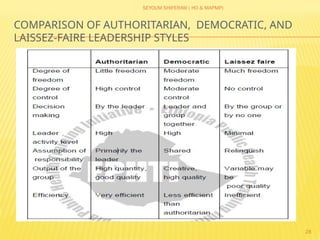
COMPARISON OF AUTHORITARIAN, DEMOCRATIC, AND
LAISSEZ-FAIRE LEADERSHIP STYLES
SEYOUM SHIFERAW ( HO & MAPMP)
29
ORGANIZING
Organizing
Is deciding what work needs to be done and
deals with formal assignment of tasks , authority ,
coordination and arranging them into a decision-
making framework
SEYOUM SHIFERAW ( HO & MAPMP)
30
Organization/s:
A pattern of relationship through which people pursue to achieve common goals.
are groups of people, with ideas and resources, working toward common goals.
next step after planning.
A key issue in accomplishing the goals identified in the planning process:
structuring the work of the organization.
The purpose is:
to make the best use of the organization's resources to achieve organizational
goals.
to make the organization a stable place for employees
SEYOUM SHIFERAW ( HO & MAPMP)
31
Organizational Principles
following principles should be applied
Command: Each group of tasks must have one person in charge
Responsibility: The person in charge of a team is responsible for the
performance of its members.
Authority: subordinates must be given authority over resources needed for
task accomplishment.
span of control: No person in charge expected to control more than six to
ten other people
SEYOUM SHIFERAW ( HO & MAPMP)
32
CHARACTERISTICS OF ORGANIZATIONS:
Whatever their purpose, all organizations have four characteristics:
1. coordination of effort
2. common goal or purpose
3. division of labor, and
4. hierarchy of authority.
SEYOUM SHIFERAW ( HO & MAPMP)
33
 Organizational Design
The determination of the organizational structure that is most appropriate for the
strategy, people, technology and tasks of the organization.
Organization design is the creation of an organization's structure, the overall
layout of departments, positions and interrelationships
Matching goals ,strategic plan, capabilities with environment.
SEYOUM SHIFERAW ( HO & MAPMP)
34
 Organizational Structure
The way, in which an organization’s activities are divided, organized
and coordinated.
Is the formal decision-making framework by which job tasks are
divided, grouped, and coordinated
SEYOUM SHIFERAW ( HO & MAPMP)
35
 Organization charts
The formal organization can be seen and represented in chart form.
An organization chart
 displays the organizational structure and shows job titles,
lines of authority, and relationships between departments.
 is helpful for managers as it is an organizational blue print for
deploying human resource.
SEYOUM SHIFERAW ( HO & MAPMP)
36
Dimensions of Organization charts
Representing the organization's structural skeleton, organization
charts have dimensions representing
 vertical hierarchy and
 horizontal specialization.
Vertical hierarchy is the chain of command.
Horizontal specialization involves the division of labor.
SEYOUM SHIFERAW ( HO & MAPMP)
37
Functional Steps in Organizing
The four building blocks are:
 Division of work
 Departmentalization
 Hierarchy
 Coordination
SEYOUM SHIFERAW ( HO & MAPMP)
38
1. Division of work / Division of labour/ work specialization
is the degree to which tasks in an organization are divided into separate jobs.
is breaking of a complex task into components
 Individuals are responsible for a limited set of activities instead of the
entire task.
Work process requirements and employee skill level determine the degree of
specialization
Placing capable people in each job ties directly with productivity improvement.
SEYOUM SHIFERAW ( HO & MAPMP)
39
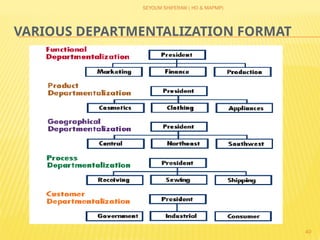
2. Departmentalization
Departmentalization is the basis on which work or individuals are
grouped into manageable units.
An organization chart shows the formal relationships
 Each single box in an organizational chart represents
departments
 Number and type of departments vary in each organization
SEYOUM SHIFERAW ( HO & MAPMP)
40
VARIOUS DEPARTMENTALIZATION FORMAT
SEYOUM SHIFERAW ( HO & MAPMP)
41
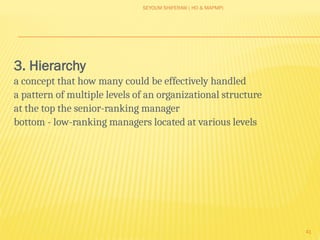
3. Hierarchy
a concept that how many could be effectively handled
a pattern of multiple levels of an organizational structure
at the top the senior-ranking manager
bottom - low-ranking managers located at various levels
SEYOUM SHIFERAW ( HO & MAPMP)
42
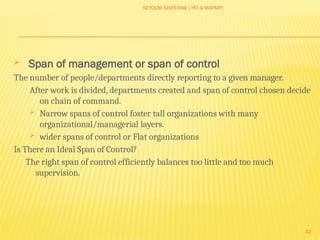
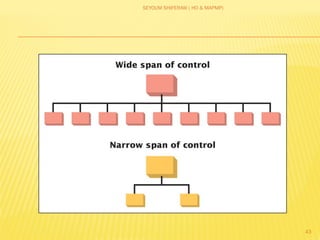
 Span of management or span of control
The number of people/departments directly reporting to a given manager.
After work is divided, departments created and span of control chosen decide
on chain of command.
 Narrow spans of control foster tall organizations with many
organizational/managerial layers.
 wider spans of control or Flat organizations
Is There an Ideal Span of Control?
The right span of control efficiently balances too little and too much
supervision.
SEYOUM SHIFERAW ( HO & MAPMP)
43
SEYOUM SHIFERAW ( HO & MAPMP)
44
CHAPTER TWO
PART TWO
 CONTROLING
 COMMUNICATION
 DECISION MAKING

HSM Chapter two part one.pptx.............

  • 1.
    1 ST. LIDETA COLLEGEOF HEALTH SCIENCE AND BUSINESS HEALTH SERVICE MANAGEMNT Course code: Comh 3181 Pharmacy CREDIT HR : 3 SEYOUM SHIFERAW ( HO & MAPMP)
  • 2.
    SEYOUM SHIFERAW (HO & MAPMP) 2 CHAPTER two Part one THE MANAGEMENT FUNCTIONS
  • 3.
    SEYOUM SHIFERAW (HO & MAPMP) 3 -The management functions are 1.PLANNING ----------- ------P(planning) 2.ORGANIZING ------- 3.STAFFING------------ I(Implementation) 4.LEADING ------------ 5.CONTROLLING ------------E( Evaluation ) - DISCISON MAKING AND COMMUNICATION ARE CONTIUATION FROM MANAGEMENET FINCTION .
  • 4.
    SEYOUM SHIFERAW (HO & MAPMP) 4 PLANNING DEFINITIONS OF PLANNING Planning is deciding in advance what is to be done it is projected course of action for the future. a process that lays the base for future action.
  • 5.
    SEYOUM SHIFERAW (HO & MAPMP) 5 CONT…  Health Planning:- is the process of defining community health problems, identifying needs and resources, establishing priority goals, and setting out the administrative actions needed to reach those goals: The important components of this and other similar definitions are concepts of:- Where are we going?(objectives) With what? (Resources) How? (efficient and appropriate implementation) When? (future)
  • 6.
    SEYOUM SHIFERAW (HO & MAPMP) 6 CONT…. THE RATIONALE FOR PLANNING: it helps for:- Coping with future uncertainty and change Focusing attention on objectives obtaining economical operations Providing performance standards and facilitates control foreseeing and identifying potential risks. TYPES OF PLANNING Based on time/duration covered by the plan Short term – 1 to 2 years Medium term – 3 to 4 years Long term – 5 years or more Based on scope of activities Strategic plan and Operational/Tactical plan
  • 7.
    SEYOUM SHIFERAW (HO & MAPMP) 7 CONT… 1- STRATEGIC PLANNING Long term planning, usually for 5 or more years It is finding the best future for your organization and the best path to reach that destination. It is often used in place of long range planning.
  • 8.
    SEYOUM SHIFERAW (HO & MAPMP) 8 CONT… 2. TACTICAL/OPERATIONAL PLANNING Short-range planning that emphasizes the current operations of various parts of the organization. a type of planning extending only for about one year or less into the future. Managers use tactical/operational planning to outline what the various parts of the organization must do for the organization to be successful at some point one-year or less into future.
  • 9.
    SEYOUM SHIFERAW (HO & MAPMP) 9 CONT… STEPS OF PLANNING In the planning process, there are six steps: Situational analysis Selecting priority problems Setting objectives and targets Identifying potential obstacles and limitations Designing the strategies Writing the plan
  • 10.
    SEYOUM SHIFERAW (HO & MAPMP) 10 CONT… 1 - SITUATIONAL ANALYSIS The purpose of situational analysis is to provide a broad basis of understanding. This is for two reasons:- It provides a common reference point for the rest of the planning process It allows the selection of priority areas of concern for planning Content of situational analysis Population characteristics Review area characteristics and infrastructure Policy and political environment Analysis of health needs Analysis of health services Analysis of resources Review past implementation experience
  • 11.
    SEYOUM SHIFERAW (HO & MAPMP) 11 CONT… It is useful to group problems under common headings example: Environmental problems:-Poor sanitation, overcrowding, Lack of safe drinking water Disease or Health problems:- Malaria , Malnutrition, Respiratory Diseases, Diarrhoea Socio-Economic Problems:- Low per capital in come, Illiteracy ,Poor equity in distribution of health services ,Cultural and religious habits Health service problems:-In sufficient drugs and materials ,Lack of qualified personnel, Difficulty in visiting outlying areas
  • 12.
    SEYOUM SHIFERAW (HO & MAPMP) 12 CONT… SWOT Analysis of planning SWOT (strengths, weakness, opportunities and threats) Is a strategic planning tool that matches internal organizational strengths and weakness with external opportunities and threats. . E g. in the health sector; strengths………….availability of resources and trained human power. Weakness………...lack of managerial talent and obsolete facilities. Threats……………adverse cultural believes towards modern medical practice and growing cost of essential drugs. Opportunities……..clear and supportive government policies and presence of a functional health committee in the communities.
  • 13.
    SEYOUM SHIFERAW (HO & MAPMP) 13 CONT… 2 - SELECTING CRITICAL PRIORITY PROBLEMS Setting priority is, perhaps the most critical and hardest planning stage and yet cannot be avoided. This is because we cannot solve all the problems simultaneously as our resources are scare. The selection criteria for priority settings are: Magnitude of the problem Degree of severity (consequent suffering and disability) Feasibility-in terms of cost effectiveness and social acceptability of intervention. Sustainability in terms of resources and organizational capacity Community concern Political and social acceptability with consideration of equity Consistence with multi--sectoral approach Consistence with governmental planning and budgetary system etc
  • 14.
    SEYOUM SHIFERAW (HO & MAPMP) 14 CONT… Ranking/likert scale of the identified problems most important & can be done by using criteria on five point scale 5 points-very high 4 points-high 3 points-moderate 2 points-low 1 point-very low
  • 15.
    SEYOUM SHIFERAW (HO & MAPMP) 15 CONT… 3 -SETTING OBJECTIVES AND TARGETS Let us first define some related terms a clear understanding of which is important for a rationale planning. WHAT IS  Goals:- Are broad statements. There is generally one goal for a service. e.g :' Health for all by 2000 and beyond.  Aims:- There are a number of aims relating to the goal. They are specific to particular health problems. e.g. to raise the nutritional status of women and children.‘  Objective:- For each programme aim, there may be a number of objectives which are specified in measurable terms. An objective for the above aim might be: To ensure that 95% of children are adequately nourished by 2005
  • 16.
    SEYOUM SHIFERAW (HO & MAPMP) 16 CONT… Objectives must be SMART:- S = Specific M = Measurable A = Achievable R = Realistic T = Time specific/Time framed Example- By the end of 2002, 90% of eligible children will be vaccinated against six target diseases in Bole sub city Woreda 12  Targets:- for each objective, there may be various targets which specify various points on the way to the attainment of the objective. They are defined in relation to a point in time. For example, a target for the above objective might be: By the end of 2001, 70% of eligible children will be vaccinated against six target diseases in Bole sub city Woreda 12 By the end of 2002, 20% of eligible children will be vaccinated against six target diseases in Bole sub city Woreda 12.'
  • 17.
    SEYOUM SHIFERAW (HO & MAPMP) 17 CONT… 4- IDENTIFYING OBSTACLES AND LIMITATIONS After setting objectives and targets, the planner should ask himself/herself about the presence of any obstacle/limitation. The limitations/obstacles may be: 1 Resources:-People, Equipment, Money, Time, Information, 2 Environmental obstacles:-Geographical features, Climate, Technical difficulties, Social factors 5 - DESIGNING THE STRATEGIES Choosing the best strategy again entails analyzing resources available and needed for each strategy. The potential strategies often include technology to be applied, procedures to be used and defining the role of communities and other sectors.
  • 18.
    SEYOUM SHIFERAW (HO & MAPMP) 18 CONT… 6- WRITING THE PLAN The purposes of writing the plan are:- To request funds or resources from the government or funding agencies For monitoring and evaluating the implementation process by all concerned A plan can be written in several ways. Some organizations may require plans to be written on specific way. An outline of writing a plan: 1. cover page 2. content 3. Introduction 4.Detail planning process
  • 19.
    SEYOUM SHIFERAW (HO & MAPMP) 19 LEADING Learning objectives Define leadership Discuss on the differences between leaders and managers Discuss on contemporary views and approaches to leadership Discuss on the skills for effective leadership
  • 20.
    SEYOUM SHIFERAW (HO & MAPMP) 20 Definition: Leadership is a process of directing and influencing the task-related activities of group members. Is the process through which an individual attempts to intentionally influence another individual or a group in order to accomplish a goal. It is one of the most important things managers do. The means by which things are accomplished in organizations
  • 21.
    SEYOUM SHIFERAW (HO & MAPMP) 21 A LEADER believes that working in concert with others, can make a difference creates something of value that did not exist before exhibits positive energy actualizes welcome changes
  • 22.
    SEYOUM SHIFERAW (HO & MAPMP) 22 LEADERSHIP STYLES: The leaders’ behaviors were divided into three distinct patterns called leadership styles: authoritarian Democratic laissez-faire.
  • 23.
    SEYOUM SHIFERAW (HO & MAPMP) 23 The authoritarian leader maintains strong control over people in the group. Authoritarian leaders give orders and expect group members to obey these orders. Directions are given as commands, not suggestions. The leader alone, not by the group, does decision making Authoritarian leadership is particularly suitable in an emergency situation when clear directions are the highest priority. It is also appropriate when the entire focus is on getting the job done or in large group when it is difficult to share decision making for some reason.
  • 24.
    SEYOUM SHIFERAW (HO & MAPMP) 24 IN CONTRAST, DEMOCRATIC LEADERSHIP IS BASED ON THE FOLLOWING PRINCIPLES: 1. Every group member should participate in decision- making. 2. Freedom of belief and action is allowed within reasonable bounds that are set by society and by the group. 3. Each individual is responsible for him self or her self and for the welfare of he group. 4. There should be concern and consideration for each group member as a unique individual
  • 25.
    SEYOUM SHIFERAW (HO & MAPMP) 25 Democratic leadership is much more participative and far less controlling than authoritarian leadership. however. The democratic leader actively stimulates and guides the group toward fulfillment of the principles listed and toward achievement of the group's goals. Democratic leadership is particularly appropriate for groups of people who will work together for an extended time, when interpersonal relationships can substantially affect the work of the group. It is often called supportive or participative leadership today
  • 26.
    SEYOUM SHIFERAW (HO & MAPMP) 26 The laissez faire leader is generally inactive, passive, and non- directive. The laissez- faire leader leave virtually all of the control and decision making to the group and provides little or no direction, guidance, or encouragement . Laissez faire leaders offer very little to the group : few commands, questions, suggestions, or criticism. They are very permissive, set almost no limits, and allow almost any behavior.
  • 27.
    SEYOUM SHIFERAW (HO & MAPMP) 27 Some laissez faire leaders are quite supportive of individual group members and will provide information or suggestions when asked. The more extreme laissez faire leader, however, will turn such a request back to the group When the laissez faire style becomes extreme, no leadership exists at all In most situations, however, laissez faire leadership is unproductive, inefficient, and unsatisfactory.
  • 28.
    SEYOUM SHIFERAW (HO & MAPMP) 28 COMPARISON OF AUTHORITARIAN, DEMOCRATIC, AND LAISSEZ-FAIRE LEADERSHIP STYLES
  • 29.
    SEYOUM SHIFERAW (HO & MAPMP) 29 ORGANIZING Organizing Is deciding what work needs to be done and deals with formal assignment of tasks , authority , coordination and arranging them into a decision- making framework
  • 30.
    SEYOUM SHIFERAW (HO & MAPMP) 30 Organization/s: A pattern of relationship through which people pursue to achieve common goals. are groups of people, with ideas and resources, working toward common goals. next step after planning. A key issue in accomplishing the goals identified in the planning process: structuring the work of the organization. The purpose is: to make the best use of the organization's resources to achieve organizational goals. to make the organization a stable place for employees
  • 31.
    SEYOUM SHIFERAW (HO & MAPMP) 31 Organizational Principles following principles should be applied Command: Each group of tasks must have one person in charge Responsibility: The person in charge of a team is responsible for the performance of its members. Authority: subordinates must be given authority over resources needed for task accomplishment. span of control: No person in charge expected to control more than six to ten other people
  • 32.
    SEYOUM SHIFERAW (HO & MAPMP) 32 CHARACTERISTICS OF ORGANIZATIONS: Whatever their purpose, all organizations have four characteristics: 1. coordination of effort 2. common goal or purpose 3. division of labor, and 4. hierarchy of authority.
  • 33.
    SEYOUM SHIFERAW (HO & MAPMP) 33  Organizational Design The determination of the organizational structure that is most appropriate for the strategy, people, technology and tasks of the organization. Organization design is the creation of an organization's structure, the overall layout of departments, positions and interrelationships Matching goals ,strategic plan, capabilities with environment.
  • 34.
    SEYOUM SHIFERAW (HO & MAPMP) 34  Organizational Structure The way, in which an organization’s activities are divided, organized and coordinated. Is the formal decision-making framework by which job tasks are divided, grouped, and coordinated
  • 35.
    SEYOUM SHIFERAW (HO & MAPMP) 35  Organization charts The formal organization can be seen and represented in chart form. An organization chart  displays the organizational structure and shows job titles, lines of authority, and relationships between departments.  is helpful for managers as it is an organizational blue print for deploying human resource.
  • 36.
    SEYOUM SHIFERAW (HO & MAPMP) 36 Dimensions of Organization charts Representing the organization's structural skeleton, organization charts have dimensions representing  vertical hierarchy and  horizontal specialization. Vertical hierarchy is the chain of command. Horizontal specialization involves the division of labor.
  • 37.
    SEYOUM SHIFERAW (HO & MAPMP) 37 Functional Steps in Organizing The four building blocks are:  Division of work  Departmentalization  Hierarchy  Coordination
  • 38.
    SEYOUM SHIFERAW (HO & MAPMP) 38 1. Division of work / Division of labour/ work specialization is the degree to which tasks in an organization are divided into separate jobs. is breaking of a complex task into components  Individuals are responsible for a limited set of activities instead of the entire task. Work process requirements and employee skill level determine the degree of specialization Placing capable people in each job ties directly with productivity improvement.
  • 39.
    SEYOUM SHIFERAW (HO & MAPMP) 39 2. Departmentalization Departmentalization is the basis on which work or individuals are grouped into manageable units. An organization chart shows the formal relationships  Each single box in an organizational chart represents departments  Number and type of departments vary in each organization
  • 40.
    SEYOUM SHIFERAW (HO & MAPMP) 40 VARIOUS DEPARTMENTALIZATION FORMAT
  • 41.
    SEYOUM SHIFERAW (HO & MAPMP) 41 3. Hierarchy a concept that how many could be effectively handled a pattern of multiple levels of an organizational structure at the top the senior-ranking manager bottom - low-ranking managers located at various levels
  • 42.
    SEYOUM SHIFERAW (HO & MAPMP) 42  Span of management or span of control The number of people/departments directly reporting to a given manager. After work is divided, departments created and span of control chosen decide on chain of command.  Narrow spans of control foster tall organizations with many organizational/managerial layers.  wider spans of control or Flat organizations Is There an Ideal Span of Control? The right span of control efficiently balances too little and too much supervision.
  • 43.
    SEYOUM SHIFERAW (HO & MAPMP) 43
  • 44.
    SEYOUM SHIFERAW (HO & MAPMP) 44 CHAPTER TWO PART TWO  CONTROLING  COMMUNICATION  DECISION MAKING