Income tax Multiple Choice Questions (MCQs) with answers
Assessment Year 2022 – 23 (Previous year 2021 – 22)
In this page you get income tax objective types questions with answers which are asked in various exams of Mumbai
University, Dibrugarh University, Gauhati University, Kolkata University and Assam University.
Also, these questions are useful for B. Com exams of various universities covered under CBCS pattern.
Also,these income tax objective typequestionsandanswersare also useful for NTA Net Commerce Exam, CMA, CA, CS
and other competitive exams.
Income tax Multiple Choice Questions (MCQs) with answers
Assessment Year 2022 – 23 (Previous year 2021 – 22)
Choose the correct answers to the following:
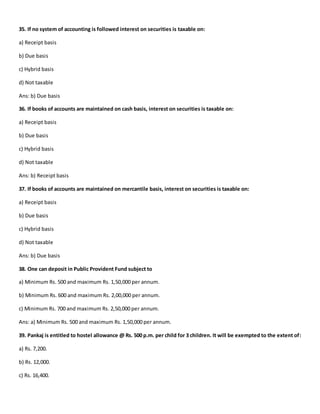
1. Income tax Act extends to:
a) Whole of India
b) Whole of India except Jammu & Kashmir
c) Whole of India except Sikkim
d) Whole of India except NE region
Ans: a) Whole of India
2. Taxable income is determined on the basis of:
a) Residential Status
b) Total Income
c) Citizenship
Ans: a) Residential Status (Total income of a person is determined on the basis of his residential status)
3. Residential status is to be determined for
a) Previous year.
b) Assessment year.
c) Accounting year.
Ans: a) Previous year
4. Income tax act was passed in the year:
a) 1860
b) 1947
c) 1961
Ans: c) 1961 (Income Tax Act was passed on 1-4-1961)
5. Income tax is treated as:
a) Direct expenses
b) Indirect expenses
c) Business expenses
d) Personal expenses
Ans: d) Personal expenses
Also Read: Income Tax Chapterwise MCQs (2022 - 2023)
1. 700+ Income Tax MCQs 2022-23 [Free PDF], Income Tax Laws and Practice MCQs
2. 50+ MCQ on Residential Status, Income Tax MCQs 2022 - 23 [Free PDF]
3. 100+ MCQs on Income From Salary, Income Tax MCQs 2022 - 23 [Free PDF]
4. 50 Income from House Property MCQ, Income Tax MCQs 2022 - 23 [Free PDF]
5. 50+ Profits and Gains from Business and Profession (PGBP) MCQs, Income Tax MCQs 2022 - 23 [Free PDF]
6. 50 MCQ on Capital Gains, Income Tax MCQs 2022 - 23 [Free PDF]
7. 30+ MCQ on Set off and Carry forward of Losses, Income Tax MCQs 2022 - 23, Master Chart [Free PDF]
8. 25+ Income Tax Deductions MCQs (80C to 80 U), Income Tax MCQs 2022 – 23 [Free PDF]
**********************
6. Finance bill becomes the Finance Act when it is passed by:
a) The Lok Sabha
b) The Rajya Sabha
c) Both by Lok Sabha and Rajya Sabha
d) Both by Lok Sabha and Rajya Sabha and given the assent of the President
Ans: d) Both by Lok Sabha and Rajya Sabha and given the assent of the President
7. The circulars issued by CBDT are binding on:
a) Assessee
b) Finance Ministry
c) Income tax authorities
d) Assessing officer only
Ans: c) Income tax authorities
8. AOP (Association of Person) should consists of:
a) Individuals only
b) Person other than individuals
c) Both the above
d) Artificial Judicial person
Ans: c) Both the above
9. BOI (Body of Individuals) should consists of:
a) Individuals only
b) Person other than individuals
c) Both the above
d) Artificial Judicial person
Ans: a) Individuals only
10. Income tax rates are fixed in which act?
a) Income Tax Act 1961
b) Finance Act
c) Companies Act 2013
d) None of the above
Ans: b) Finance Act
11. In which case income of the previous year is assessed in the same year?
a) Shipping business of non-residents
b) Assessment of persons leaving India
c) Discontinued business
d) All of the above
Ans: d) All of the above
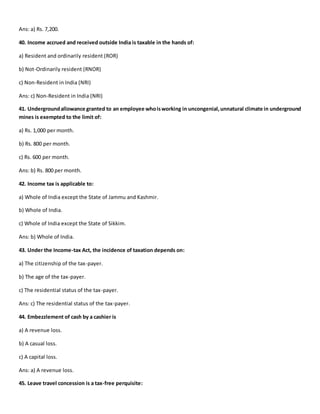
12. Q sets up a new business on 15.7.2021 and he commencedhis business from 1.2.2022. Firstprevious year shall be:
a) 1-4-2021 to 31-3-2022
b) 1-4-2022 to 31-3-2023
c) 1-2-2022 to 31-3-2023
d) 15-7-2021 to 31-3-2022
Ans: d) 15-7-2021 to 31-3-2022
13. An AOP formed on 1-6-2021 for a particular event which is completed on 12-12-2021. What is the assessment year
for AOP?
a) 1-4-2021 to 31-3-2022
b) 1-4-2022 to 31-3-2023
c) 1-2-2022 to 31-3-2023
d) 15-7-2021 to 31-3-2022
Ans: a) 1-4-2021 to 31-3-2022
14. If the total income of an assessee has beencomputedas rupees12,50,794.90, the total income after roundingoff
will be taken as:
a) 12,50,790
b) 12,50,800
c) 12,50,795
d) None of the above
Ans:a) 12,50,790
(Hint: The total income and income tax shall be rounded off to the nearest multiple of 10 rupees)
15. Which of the following statements are correct?
a) Assessee is always a person but a person may or may not be an assessee.
b) A person may not have assessable income but may still be assessee.
c) In some cases assessment year and previous year can be same financial year.
d) All of the above
Ans: d) All of the above
16. When was income tax levied in India for the first time?
a) 1961
b) 1860
c) 1947
Ans: b) 1860 (The income tax was introduced in India for the first time in 1860 by British rulers.)
17. Artificial Juridical person’s example is:
a) State Bank of India, Dibrugarh.
b) Delhi University.
c) Guwahati Municipal Corporation.
d) Amul
Ans: b) Delhi University.
18. Example of an Association of Persons (AOP) is:
a) A village Panchayat.
b) Mark fed.
c) Reliance Industries Limited.
d) Delhi university
Ans: a) A village Panchayat.
19. Which of the following income is exempted from tax?
a) Agricultural income
b) Sum received by a member from HUF
c) Share of profit of a partner from a firm
d) All of the above
Ans: d) All of the above
20. The daily allowance received by a Member of the Parliament is
a) Taxable.
b) Exempt.
c) Included in total income for rate purposes.
Ans: b) Exempt.
21. C is entitled to hostel expenditure allowance @ Rs. 600 p.m. per child for 3 children. It will be exempt to the
extent of:
a) Rs. 1,800/-
b) Rs. 900/-
c) Rs. 600/- p.m.
Ans: c) Rs. 600/- p.m. (Hostel expenditure allowance is exempted upto R.s 300 per month per child for a maximum of
two children)
22. The ceiling limit of deduction u/s 24 (b) in respect of Interest of Loan taken on 01.06.2014 for construction of a
self-occupied house is:
a) Rs. 1,50,000/-
b) Rs. 30,000/-
c) No limit.
Ans: a) Rs. 1,50,000/-
23. For the assessment year 2022 - 23 rebate under Section 87A is available in the case of the residential individual, if
his taxable income is:
a) Rs. 3,00,000 or less.
b) Rs. 4,00,000 or less.
c) Rs. 5,00,000 or less.
Ans: c) Rs. 5,00,000 or less.
24. If title of ownership of a house property is under dispute in a court of law, the decision as to who is the owner
rests with?
a) Government of India.
b) State Government.
c) Income Tax Department.
Ans: c) Income Tax Department.
25. An appeal against the order of the assessing officer lies with:
a) Commissioner (Appeals) [Sec 246A].
b) Principal Commissioner of Income Tax.
c) Joint Commissioner of Income Tax.
Ans: a) Commissioner (Appeals) [Sec 246A].
26. As per National Pension System, it is mandatory for persons entering the government service on or after January
1, 2004 to contribute:
a) 20% of salary every month towards NPS.
b) 15% of salary every month towards NPS.
c) 10% of salary every month towards NPS. (Salary = Basic +DA)
Ans: c) 10% of salary every month towards NPS. (Salary = Basic +DA)
27. Perquisitesorbenefitsor any other remunerationreceivedfromother than the employer, wouldbe taxable under
the head:
a) Income from Salaries.
b) Income from House Property.
c) Income from Other Sources.
Ans: c) Income from Other Sources.
28. Tribal areas/Scheduled areas allowances as specified in rule 2BB, exemption to State, Assam and other similar
States are subject to limit of:
a) Rs. 500 per month.
b) Rs. 200 per month.
c) Rs. 100 per month.
Ans: b) Rs. 200 per month.
29. Which of the following is not taxable under the head income from other sources?
a) Rent received from letting business building
b) Sum received under Keyman insurance policy
c) Gift received from unrelated persons
d) Gift of shares received by firm or a closely held company
Ans: a) Rent received from letting business building
30. Mohan is entitled to education allowance @ 6,000 p.a. per child for 3 children. It will be exempted to the extent
of:
a) Rs. 4,000.
b) Rs. 2,400.
c) Rs. 1,200.
Ans:b) Rs.2,400.
31. The contribution made by the Central Government in the previous year, to the account of an employee under a
pension scheme referred to in:
a) Section 80C.
b) Section 80CCC.
c) Section 80CCD
Ans: c) Section 80CCD
32. Where an assessee uses his property for carrying on any business or profession, no income is chargeable to tax
under the head:
a) Income from Salaries.
b) Income from House Property.
c) Income from Other Sources.
Ans: b) Income from House Property.
33. The Appellate Tribunal, constituted by the Central Government, functions under the Ministry of Law, consists of
which of the following two classes of members?
a) Judicial and accountant.
b) Commissioners and accountant.
c) Inspector of income tax and accountant.
Ans: a) Judicial and accountant.
34. Statutory Provident Fund is set up under the provisions of the:
a) Provident Fund Act, 1952
b) Provident Fund Act, 1925
c) Income-tax Act, 1961
Ans: b) Provident Fund Act, 1925
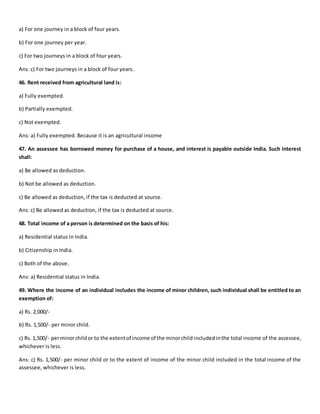
35. If no system of accounting is followed interest on securities is taxable on:
a) Receipt basis
b) Due basis
c) Hybrid basis
d) Not taxable
Ans: b) Due basis
36. If books of accounts are maintained on cash basis, interest on securities is taxable on:
a) Receipt basis
b) Due basis
c) Hybrid basis
d) Not taxable
Ans: b) Receipt basis
37. If books of accounts are maintained on mercantile basis, interest on securities is taxable on:
a) Receipt basis
b) Due basis
c) Hybrid basis
d) Not taxable
Ans: b) Due basis
38. One can deposit in Public Provident Fund subject to
a) Minimum Rs. 500 and maximum Rs. 1,50,000 per annum.
b) Minimum Rs. 600 and maximum Rs. 2,00,000 per annum.
c) Minimum Rs. 700 and maximum Rs. 2,50,000 per annum.
Ans: a) Minimum Rs. 500 and maximum Rs. 1,50,000 per annum.
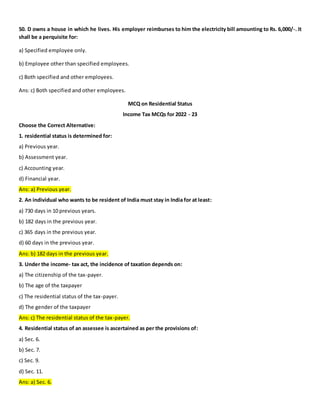
39. Pankaj is entitled to hostel allowance @ Rs. 500 p.m. per child for 3 children. It will be exempted to the extent of:
a) Rs. 7,200.
b) Rs. 12,000.
c) Rs. 16,400.
Ans: a) Rs. 7,200.
40. Income accrued and received outside India is taxable in the hands of:
a) Resident and ordinarily resident (ROR)
b) Not-Ordinarily resident (RNOR)
c) Non-Resident in India (NRI)
Ans: c) Non-Resident in India (NRI)
41. Undergroundallowance granted to an employee whoisworking in uncongenial,unnatural climate in underground
mines is exempted to the limit of:
a) Rs. 1,000 per month.
b) Rs. 800 per month.
c) Rs. 600 per month.
Ans: b) Rs. 800 per month.
42. Income tax is applicable to:
a) Whole of India except the State of Jammu and Kashmir.
b) Whole of India.
c) Whole of India except the State of Sikkim.
Ans: b) Whole of India.
43. Under the Income-tax Act, the incidence of taxation depends on:
a) The citizenship of the tax-payer.
b) The age of the tax-payer.
c) The residential status of the tax-payer.
Ans: c) The residential status of the tax-payer.
44. Embezzlement of cash by a cashier is
a) A revenue loss.
b) A casual loss.
c) A capital loss.
Ans: a) A revenue loss.
45. Leave travel concession is a tax-free perquisite:
a) For one journey in a block of four years.
b) For one journey per year.
c) For two journeys in a block of four years.
Ans: c) For two journeys in a block of four years.
46. Rent received from agricultural land is:
a) Fully exempted.
b) Partially exempted.
c) Not exempted.
Ans: a) Fully exempted. Because it is an agricultural income
47. An assessee has borrowed money for purchase of a house, and interest is payable outside India. Such interest
shall:
a) Be allowed as deduction.
b) Not be allowed as deduction.
c) Be allowed as deduction, if the tax is deducted at source.
Ans: c) Be allowed as deduction, if the tax is deducted at source.
48. Total income of a person is determined on the basis of his:
a) Residential status in India.
b) Citizenship in India.
c) Both of the above.
Ans: a) Residential status in India.
49. Where the income of an individual includes the income of minor children, such individual shall be entitled to an
exemption of:
a) Rs. 2,000/-
b) Rs. 1,500/- per minor child.
c) Rs. 1,500/- perminorchildor to the extentof income of the minorchild includedinthe total income of the assessee,
whichever is less.
Ans: c) Rs. 1,500/- per minor child or to the extent of income of the minor child included in the total income of the
assessee, whichever is less.
50. D owns a house in which he lives. His employer reimburses to him the electricity bill amounting to Rs. 6,000/-. It
shall be a perquisite for:
a) Specified employee only.
b) Employee other than specified employees.
c) Both specified and other employees.
Ans: c) Both specified and other employees.
MCQ on Residential Status
Income Tax MCQs for 2022 - 23
Choose the Correct Alternative:
1. residential status is determined for:
a) Previous year.
b) Assessment year.
c) Accounting year.
d) Financial year.
Ans: a) Previous year.
2. An individual who wants to be resident of India must stay in India for at least:
a) 730 days in 10 previous years.
b) 182 days in the previous year.
c) 365 days in the previous year.
d) 60 days in the previous year.
Ans: b) 182 days in the previous year.
3. Under the income- tax act, the incidence of taxation depends on:
a) The citizenship of the tax-payer.
b) The age of the taxpayer
c) The residential status of the tax-payer.
d) The gender of the taxpayer
Ans: c) The residential status of the tax-payer.
4. Residential status of an assessee is ascertained as per the provisions of:
a) Sec. 6.
b) Sec. 7.
c) Sec. 9.
d) Sec. 11.
Ans: a) Sec. 6.
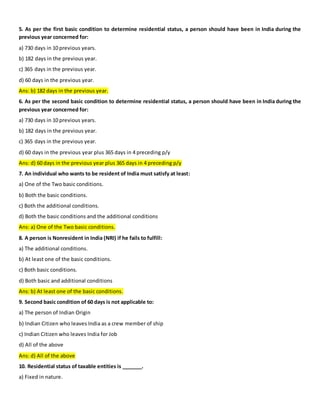
5. As per the first basic condition to determine residential status, a person should have been in India during the
previous year concerned for:
a) 730 days in 10 previous years.
b) 182 days in the previous year.
c) 365 days in the previous year.
d) 60 days in the previous year.
Ans: b) 182 days in the previous year.
6. As per the second basic condition to determine residential status, a person should have been in India during the
previous year concerned for:
a) 730 days in 10 previous years.
b) 182 days in the previous year.
c) 365 days in the previous year.
d) 60 days in the previous year plus 365 days in 4 preceding p/y
Ans: d) 60 days in the previous year plus 365 days in 4 preceding p/y
7. An individual who wants to be resident of India must satisfy at least:
a) One of the Two basic conditions.
b) Both the basic conditions.
c) Both the additional conditions.
d) Both the basic conditions and the additional conditions
Ans: a) One of the Two basic conditions.
8. A person is Nonresident in India (NRI) if he fails to fulfill:
a) The additional conditions.
b) At least one of the basic conditions.
c) Both basic conditions.
d) Both basic and additional conditions
Ans: b) At least one of the basic conditions.
9. Second basic condition of 60 days is not applicable to:
a) The person of Indian Origin
b) Indian Citizen who leaves India as a crew member of ship
c) Indian Citizen who leaves India for Job
d) All of the above
Ans: d) All of the above
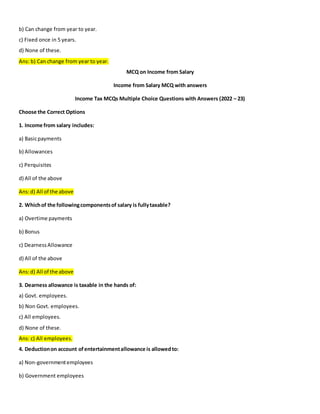
10. Residential status of taxable entities is _______.
a) Fixed in nature.
b) Can change from year to year.
c) Fixed once in 5 years.
d) None of these.
Ans: b) Can change from year to year.
MCQ on Income from Salary
Income from Salary MCQ with answers
Income Tax MCQs Multiple Choice Questions with Answers (2022 – 23)
Choose the Correct Options
1. Income from salary includes:
a) Basicpayments
b) Allowances
c) Perquisites
d) All of the above
Ans:d) All of the above
2. Whichof the followingcomponentsof salary is fullytaxable?
a) Overtime payments
b) Bonus
c) DearnessAllowance
d) All of the above
Ans:d) All of the above
3. Dearness allowance is taxable in the hands of:
a) Govt. employees.
b) Non Govt. employees.
c) All employees.
d) None of these.
Ans: c) All employees.
4. Deductionon account ofentertainmentallowance is allowedto:
a) Non-governmentemployees
b) Government employees
c) Both the above
d) None of the above
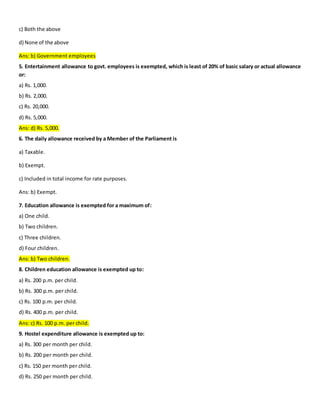
Ans: b) Government employees
5. Entertainment allowance to govt. employees is exempted, which is least of 20% of basic salary or actual allowance
or:
a) Rs. 1,000.
b) Rs. 2,000.
c) Rs. 20,000.
d) Rs. 5,000.
Ans: d) Rs. 5,000.
6. The daily allowance received by a Member of the Parliament is
a) Taxable.
b) Exempt.
c) Included in total income for rate purposes.
Ans: b) Exempt.
7. Education allowance is exempted for a maximum of:
a) One child.
b) Two children.
c) Three children.
d) Four children.
Ans: b) Two children.
8. Children education allowance is exempted up to:
a) Rs. 200 p.m. per child.
b) Rs. 300 p.m. per child.
c) Rs. 100 p.m. per child.
d) Rs. 400 p.m. per child.
Ans: c) Rs. 100 p.m. per child.
9. Hostel expenditure allowance is exempted up to:
a) Rs. 300 per month per child.
b) Rs. 200 per month per child.
c) Rs. 150 per month per child.
d) Rs. 250 per month per child.
Ans: a) Rs. 300 per month per child.
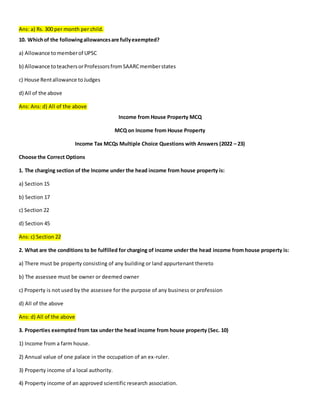
10. Whichof the followingallowancesare fullyexempted?
a) Allowance tomemberof UPSC
b) Allowance toteachersorProfessorsfromSAARCmemberstates
c) House Rentallowance toJudges
d) All of the above
Ans: Ans: d) All of the above
Income from House Property MCQ
MCQ on Income from House Property
Income Tax MCQs Multiple Choice Questions with Answers (2022 – 23)
Choose the Correct Options
1. The charging section of the Income under the head income from house property is:
a) Section 15
b) Section 17
c) Section 22
d) Section 45
Ans: c) Section 22
2. What are the conditions to be fulfilled for charging of income under the head income from house property is:
a) There must be property consisting of any building or land appurtenant thereto
b) The assessee must be owner or deemed owner
c) Property is not used by the assessee for the purpose of any business or profession
d) All of the above
Ans: d) All of the above
3. Properties exempted from tax under the head income from house property (Sec. 10)
1) Income from a farm house.
2) Annual value of one palace in the occupation of an ex-ruler.
3) Property income of a local authority.
4) Property income of an approved scientific research association.
5) Property income of an educational institution and hospital.
6) Property income of a registered trade union.
7) Income from property held for charitable purposes.
8) Property income of a political party.
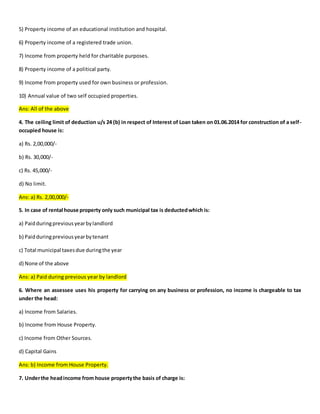
9) Income from property used for own business or profession.
10) Annual value of two self occupied properties.
Ans: All of the above
4. The ceiling limit of deduction u/s 24 (b) in respect of Interest of Loan taken on 01.06.2014 for construction of a self-
occupied house is:
a) Rs. 2,00,000/-
b) Rs. 30,000/-
c) Rs. 45,000/-
d) No limit.
Ans: a) Rs. 2,00,000/-
5. In case of rental house property only such municipal tax is deductedwhich is:
a) Paidduringpreviousyearbylandlord
b) Paidduringpreviousyearbytenant
c) Total municipal taxesdue duringthe year
d) None of the above
Ans: a) Paid during previous year by landlord
6. Where an assessee uses his property for carrying on any business or profession, no income is chargeable to tax
under the head:
a) Income from Salaries.
b) Income from House Property.
c) Income from Other Sources.
d) Capital Gains
Ans: b) Income from House Property.
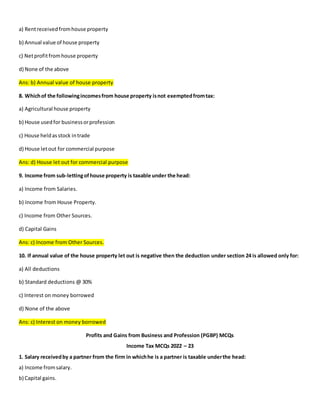
7. Underthe headincome from house propertythe basis of charge is:
a) Rentreceivedfromhouse property
b) Annual value of house property
c) Netprofitfromhouse property
d) None of the above
Ans: b) Annual value of house property
8. Whichof the followingincomesfrom house property isnot exemptedfromtax:
a) Agricultural house property
b) House usedfor businessorprofession
c) House heldasstock intrade
d) House letout for commercial purpose
Ans: d) House let out for commercial purpose
9. Income from sub-lettingofhouse property is taxable under the head:
a) Income from Salaries.
b) Income from House Property.
c) Income from Other Sources.
d) Capital Gains
Ans: c) Income from Other Sources.
10. If annual value of the house property let out is negative then the deduction under section 24 is allowed only for:
a) All deductions
b) Standard deductions @ 30%
c) Interest on money borrowed
d) None of the above
Ans: c) Interest on money borrowed
Profits and Gains from Business and Profession (PGBP) MCQs
Income Tax MCQs 2022 – 23
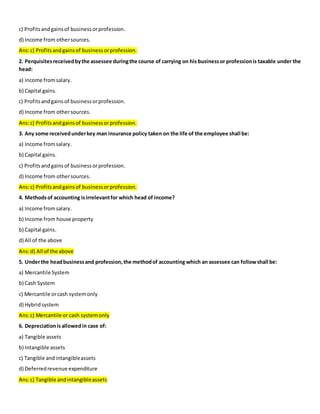
1. Salary receivedby a partner from the firm in whichhe is a partner is taxable underthe head:
a) Income fromsalary.
b) Capital gains.
c) Profitsandgainsof businessorprofession.
d) Income from othersources.
Ans:c) Profitsandgainsof business orprofession.
2. Perquisitesreceivedbythe assessee duringthe course of carrying on his businessor professionis taxable under the
head:
a) Income fromsalary.
b) Capital gains.
c) Profitsandgainsof businessorprofession.
d) Income from othersources.
Ans:c) Profitsandgainsof businessorprofession.
3. Any some receivedunderkey man insurance policy taken on the life of the employee shall be:
a) Income fromsalary.
b) Capital gains.
c) Profitsandgainsof businessorprofession.
d) Income from othersources.
Ans:c) Profitsandgainsof businessorprofession.
4. Methodsof accounting isirrelevantfor which head of income?
a) Income fromsalary.
b) Income from house property
b) Capital gains.
d) All of the above
Ans:d) All of the above
5. Underthe headbusinessand profession,the methodof accounting which an assessee can followshall be:
a) Mercantile System
b) Cash System
c) Mercantile orcash systemonly
d) Hybridsystem
Ans:c) Mercantile or cash systemonly
6. Depreciationis allowedin case of:
a) Tangible assets
b) Intangible assets
c) Tangible andintangibleassets
d) Deferredrevenue expenditure
Ans:c) Tangible andintangibleassets
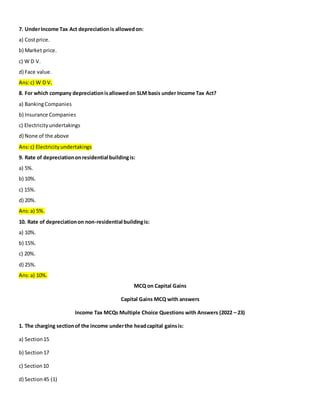
7. UnderIncome Tax Act depreciationis allowedon:
a) Costprice.
b) Market price.
c) W D V.
d) Face value.
Ans:c) W D V.
8. For which company depreciationisallowedon SLM basis under Income Tax Act?
a) BankingCompanies
b) Insurance Companies
c) Electricityundertakings
d) None of the above
Ans:c) Electricityundertakings
9. Rate of depreciationonresidential buildingis:
a) 5%.
b) 10%.
c) 15%.
d) 20%.
Ans:a) 5%.
10. Rate of depreciationon non-residential buildingis:
a) 10%.
b) 15%.
c) 20%.
d) 25%.
Ans:a) 10%.
MCQ on Capital Gains
Capital Gains MCQ with answers
Income Tax MCQs Multiple Choice Questions with Answers (2022 – 23)
1. The charging sectionof the income underthe headcapital gainsis:
a) Section15
b) Section17
c) Section10
d) Section45 (1)
Ans:d) Section45 (1)
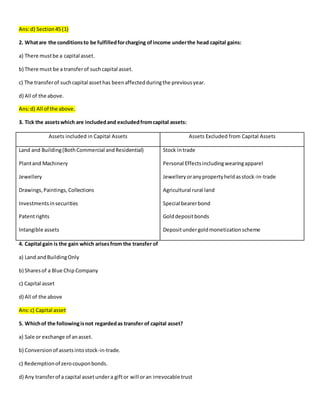
2. Whatare the conditionsto be fulfilledforcharging ofincome underthe head capital gains:
a) There mustbe a capital asset.
b) There must be a transferof suchcapital asset.
c) The transferof suchcapital assethas beenaffectedduringthe previousyear.
d) All of the above.
Ans:d) All of the above.
3. Tick the assetswhich are includedand excludedfromcapital assets:
Assets included in Capital Assets Assets Excluded from Capital Assets
Land and Building(BothCommercial andResidential)
Plantand Machinery
Jewellery
Drawings,Paintings,Collections
Investmentsinsecurities
Patentrights
Intangible assets
Stock intrade
Personal Effectsincludingwearingapparel
Jewellery oranypropertyheldasstock-in-trade
Agricultural rural land
Special bearerbond
Golddepositbonds
Depositundergoldmonetizationscheme
4. Capital gain is the gain which arisesfrom the transfer of
a) Land andBuildingOnly
b) Sharesof a Blue Chip Company
c) Capital asset
d) All of the above
Ans:c) Capital asset
5. Whichof the followingisnot regardedas transfer of capital asset?
a) Sale or exchange of anasset.
b) Conversionof assetsintostock-in-trade.
c) Redemptionof zerocouponbonds.
d) Any transferof a capital assetundera giftor will oran irrevocable trust
Ans:d) Anytransferof a capital assetundera giftor will oran irrevocable trust
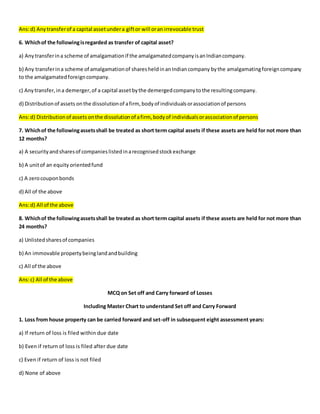
6. Whichof the followingisregarded as transfer of capital asset?
a) Anytransferina scheme of amalgamationif the amalgamatedcompanyisanIndiancompany.
b) Any transferina scheme of amalgamationof sharesheldinanIndiancompany bythe amalgamatingforeigncompany
to the amalgamatedforeigncompany.
c) Anytransfer,ina demerger,of a capital assetbythe demergedcompanytothe resultingcompany.
d) Distributionof assets onthe dissolutionof afirm, bodyof individualsorassociationof persons
Ans:d) Distributionof assets onthe dissolutionof afirm, bodyof individualsorassociationof persons
7. Whichof the followingassetsshall be treated as short term capital assets if these assets are held for not more than
12 months?
a) A securityandsharesof companieslistedinarecognisedstockexchange
b) A unitof an equity orientedfund
c) A zerocouponbonds
d) All of the above
Ans:d) All of the above
8. Whichof the followingassetsshall be treated as short term capital assets if these assets are held for not more than
24 months?
a) Unlistedsharesof companies
b) An immovable propertybeinglandandbuilding
c) All of the above
Ans:c) All of the above
MCQ on Set off and Carry forward of Losses
Including Master Chart to understand Set off and Carry Forward
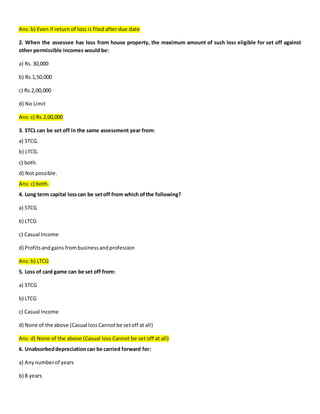
1. Loss from house property can be carried forward and set-off in subsequent eight assessment years:
a) If return of loss is filed within due date
b) Even if return of loss is filed after due date
c) Even if return of loss is not filed
d) None of above
Ans: b) Even if return of loss is filed after due date
2. When the assessee has loss from house property, the maximum amount of such loss eligible for set off against
other permissible incomes would be:
a) Rs. 30,000
b) Rs.1,50,000
c) Rs.2,00,000
d) No Limit
Ans: c) Rs.2,00,000
3. STCL can be set off in the same assessment year from:
a) STCG.
b) LTCG.
c) both.
d) Not possible.
Ans: c) both.
4. Long term capital losscan be setoff from which ofthe following?
a) STCG
b) LTCG
c) Casual Income
d) Profitsandgains frombusinessandprofession
Ans: b) LTCG
5. Loss of card game can be set off from:
a) STCG
b) LTCG
c) Casual Income
d) None of the above (Casual lossCannotbe setoff at all)
Ans: d) None of the above (Casual loss Cannot be set off at all)
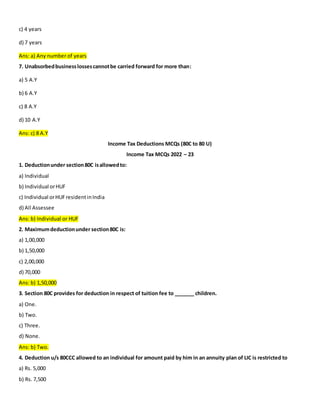
6. Unabsorbeddepreciationcan be carried forward for:
a) Any numberof years
b) 8 years
c) 4 years
d) 7 years
Ans: a) Any number of years
7. Unabsorbedbusinesslossescannotbe carried forward for more than:
a) 5 A.Y
b) 6 A.Y
c) 8 A.Y
d) 10 A.Y
Ans: c) 8 A.Y
Income Tax Deductions MCQs (80C to 80 U)
Income Tax MCQs 2022 – 23
1. Deductionunder section80C isallowedto:
a) Individual
b) Individual orHUF
c) Individual orHUFresidentinIndia
d) All Assessee
Ans: b) Individual or HUF
2. Maximumdeductionunder section80C is:
a) 1,00,000
b) 1,50,000
c) 2,00,000
d) 70,000
Ans: b) 1,50,000
3. Section 80C provides for deduction in respect of tuition fee to _______ children.
a) One.
b) Two.
c) Three.
d) None.
Ans: b) Two.
4. Deduction u/s 80CCC allowed to an individual for amount paid by him in an annuity plan of LIC is restricted to
a) Rs. 5,000
b) Rs. 7,500
c) Rs. 1,50,000
d) Rs. 12,500
Ans: c) Rs. 1,50,000
5. Deductionunder section80D is allowedto:
a) Individual
b) Individual orHUF
c) Individual orHUFresidentinIndia
d) All Assessee
Ans: b) Individual or HUF
6. Medical insurance premiumincurred for seniorcitizenis eligible fordeductionupto ________ under section80D.
a) Rs. 30,000
b) Rs. 50,000
c) Rs. 1,00,000
d) Rs. 60,000
Ans: b) Rs. 50,000
7. The maximum amount of deduction under section 80D in the case of a senior citizen is:
a) Rs: 10,000.
b) Rs: 15,000.
c) Rs: 50,000.
d) Rs: 25,000.
Ans: c) Rs: 50,000.
8. The maximum amount of deduction under section 80D if both taxpayer and parents are senior citizen is:
a) Rs: 10,000.
b) Rs: 15,000.
c) Rs: 50,000.
d) Rs: 1,00,000.
Ans: c) Rs: 1,00,000.
9. Deductionunder section80DD is allowedto:
a) Individual
b) Individual orHUF
c) Individual orHUFresidentinIndia
d) All Assessee
Ans: b) Individual or HUF
10. The amount of deduction under section 80DD regarding disability which is less than 80%
a) Rs: 30,000.
b) Rs: 50,000.
c) Rs: 75,000.
d) Actual expense.
Ans: c) Rs: 75,000.

income tax mcq PDF.docx

  • 1.
    Income tax MultipleChoice Questions (MCQs) with answers Assessment Year 2022 – 23 (Previous year 2021 – 22) In this page you get income tax objective types questions with answers which are asked in various exams of Mumbai University, Dibrugarh University, Gauhati University, Kolkata University and Assam University. Also, these questions are useful for B. Com exams of various universities covered under CBCS pattern. Also,these income tax objective typequestionsandanswersare also useful for NTA Net Commerce Exam, CMA, CA, CS and other competitive exams. Income tax Multiple Choice Questions (MCQs) with answers Assessment Year 2022 – 23 (Previous year 2021 – 22) Choose the correct answers to the following: 1. Income tax Act extends to: a) Whole of India b) Whole of India except Jammu & Kashmir c) Whole of India except Sikkim d) Whole of India except NE region Ans: a) Whole of India 2. Taxable income is determined on the basis of: a) Residential Status b) Total Income c) Citizenship Ans: a) Residential Status (Total income of a person is determined on the basis of his residential status) 3. Residential status is to be determined for a) Previous year. b) Assessment year. c) Accounting year. Ans: a) Previous year 4. Income tax act was passed in the year: a) 1860
  • 2.
    b) 1947 c) 1961 Ans:c) 1961 (Income Tax Act was passed on 1-4-1961) 5. Income tax is treated as: a) Direct expenses b) Indirect expenses c) Business expenses d) Personal expenses Ans: d) Personal expenses Also Read: Income Tax Chapterwise MCQs (2022 - 2023) 1. 700+ Income Tax MCQs 2022-23 [Free PDF], Income Tax Laws and Practice MCQs 2. 50+ MCQ on Residential Status, Income Tax MCQs 2022 - 23 [Free PDF] 3. 100+ MCQs on Income From Salary, Income Tax MCQs 2022 - 23 [Free PDF] 4. 50 Income from House Property MCQ, Income Tax MCQs 2022 - 23 [Free PDF] 5. 50+ Profits and Gains from Business and Profession (PGBP) MCQs, Income Tax MCQs 2022 - 23 [Free PDF] 6. 50 MCQ on Capital Gains, Income Tax MCQs 2022 - 23 [Free PDF] 7. 30+ MCQ on Set off and Carry forward of Losses, Income Tax MCQs 2022 - 23, Master Chart [Free PDF] 8. 25+ Income Tax Deductions MCQs (80C to 80 U), Income Tax MCQs 2022 – 23 [Free PDF] ********************** 6. Finance bill becomes the Finance Act when it is passed by: a) The Lok Sabha b) The Rajya Sabha c) Both by Lok Sabha and Rajya Sabha d) Both by Lok Sabha and Rajya Sabha and given the assent of the President Ans: d) Both by Lok Sabha and Rajya Sabha and given the assent of the President
  • 3.
    7. The circularsissued by CBDT are binding on: a) Assessee b) Finance Ministry c) Income tax authorities d) Assessing officer only Ans: c) Income tax authorities 8. AOP (Association of Person) should consists of: a) Individuals only b) Person other than individuals c) Both the above d) Artificial Judicial person Ans: c) Both the above 9. BOI (Body of Individuals) should consists of: a) Individuals only b) Person other than individuals c) Both the above d) Artificial Judicial person Ans: a) Individuals only 10. Income tax rates are fixed in which act? a) Income Tax Act 1961 b) Finance Act c) Companies Act 2013 d) None of the above Ans: b) Finance Act 11. In which case income of the previous year is assessed in the same year? a) Shipping business of non-residents b) Assessment of persons leaving India
  • 4.
    c) Discontinued business d)All of the above Ans: d) All of the above 12. Q sets up a new business on 15.7.2021 and he commencedhis business from 1.2.2022. Firstprevious year shall be: a) 1-4-2021 to 31-3-2022 b) 1-4-2022 to 31-3-2023 c) 1-2-2022 to 31-3-2023 d) 15-7-2021 to 31-3-2022 Ans: d) 15-7-2021 to 31-3-2022 13. An AOP formed on 1-6-2021 for a particular event which is completed on 12-12-2021. What is the assessment year for AOP? a) 1-4-2021 to 31-3-2022 b) 1-4-2022 to 31-3-2023 c) 1-2-2022 to 31-3-2023 d) 15-7-2021 to 31-3-2022 Ans: a) 1-4-2021 to 31-3-2022 14. If the total income of an assessee has beencomputedas rupees12,50,794.90, the total income after roundingoff will be taken as: a) 12,50,790 b) 12,50,800 c) 12,50,795 d) None of the above Ans:a) 12,50,790 (Hint: The total income and income tax shall be rounded off to the nearest multiple of 10 rupees) 15. Which of the following statements are correct? a) Assessee is always a person but a person may or may not be an assessee. b) A person may not have assessable income but may still be assessee. c) In some cases assessment year and previous year can be same financial year.
  • 5.
    d) All ofthe above Ans: d) All of the above 16. When was income tax levied in India for the first time? a) 1961 b) 1860 c) 1947 Ans: b) 1860 (The income tax was introduced in India for the first time in 1860 by British rulers.) 17. Artificial Juridical person’s example is: a) State Bank of India, Dibrugarh. b) Delhi University. c) Guwahati Municipal Corporation. d) Amul Ans: b) Delhi University. 18. Example of an Association of Persons (AOP) is: a) A village Panchayat. b) Mark fed. c) Reliance Industries Limited. d) Delhi university Ans: a) A village Panchayat. 19. Which of the following income is exempted from tax? a) Agricultural income b) Sum received by a member from HUF c) Share of profit of a partner from a firm d) All of the above Ans: d) All of the above 20. The daily allowance received by a Member of the Parliament is a) Taxable.
  • 6.
    b) Exempt. c) Includedin total income for rate purposes. Ans: b) Exempt. 21. C is entitled to hostel expenditure allowance @ Rs. 600 p.m. per child for 3 children. It will be exempt to the extent of: a) Rs. 1,800/- b) Rs. 900/- c) Rs. 600/- p.m. Ans: c) Rs. 600/- p.m. (Hostel expenditure allowance is exempted upto R.s 300 per month per child for a maximum of two children) 22. The ceiling limit of deduction u/s 24 (b) in respect of Interest of Loan taken on 01.06.2014 for construction of a self-occupied house is: a) Rs. 1,50,000/- b) Rs. 30,000/- c) No limit. Ans: a) Rs. 1,50,000/- 23. For the assessment year 2022 - 23 rebate under Section 87A is available in the case of the residential individual, if his taxable income is: a) Rs. 3,00,000 or less. b) Rs. 4,00,000 or less. c) Rs. 5,00,000 or less. Ans: c) Rs. 5,00,000 or less. 24. If title of ownership of a house property is under dispute in a court of law, the decision as to who is the owner rests with? a) Government of India. b) State Government. c) Income Tax Department. Ans: c) Income Tax Department. 25. An appeal against the order of the assessing officer lies with:
  • 7.
    a) Commissioner (Appeals)[Sec 246A]. b) Principal Commissioner of Income Tax. c) Joint Commissioner of Income Tax. Ans: a) Commissioner (Appeals) [Sec 246A]. 26. As per National Pension System, it is mandatory for persons entering the government service on or after January 1, 2004 to contribute: a) 20% of salary every month towards NPS. b) 15% of salary every month towards NPS. c) 10% of salary every month towards NPS. (Salary = Basic +DA) Ans: c) 10% of salary every month towards NPS. (Salary = Basic +DA) 27. Perquisitesorbenefitsor any other remunerationreceivedfromother than the employer, wouldbe taxable under the head: a) Income from Salaries. b) Income from House Property. c) Income from Other Sources. Ans: c) Income from Other Sources. 28. Tribal areas/Scheduled areas allowances as specified in rule 2BB, exemption to State, Assam and other similar States are subject to limit of: a) Rs. 500 per month. b) Rs. 200 per month. c) Rs. 100 per month. Ans: b) Rs. 200 per month. 29. Which of the following is not taxable under the head income from other sources? a) Rent received from letting business building b) Sum received under Keyman insurance policy c) Gift received from unrelated persons d) Gift of shares received by firm or a closely held company Ans: a) Rent received from letting business building
  • 8.
    30. Mohan isentitled to education allowance @ 6,000 p.a. per child for 3 children. It will be exempted to the extent of: a) Rs. 4,000. b) Rs. 2,400. c) Rs. 1,200. Ans:b) Rs.2,400. 31. The contribution made by the Central Government in the previous year, to the account of an employee under a pension scheme referred to in: a) Section 80C. b) Section 80CCC. c) Section 80CCD Ans: c) Section 80CCD 32. Where an assessee uses his property for carrying on any business or profession, no income is chargeable to tax under the head: a) Income from Salaries. b) Income from House Property. c) Income from Other Sources. Ans: b) Income from House Property. 33. The Appellate Tribunal, constituted by the Central Government, functions under the Ministry of Law, consists of which of the following two classes of members? a) Judicial and accountant. b) Commissioners and accountant. c) Inspector of income tax and accountant. Ans: a) Judicial and accountant. 34. Statutory Provident Fund is set up under the provisions of the: a) Provident Fund Act, 1952 b) Provident Fund Act, 1925 c) Income-tax Act, 1961 Ans: b) Provident Fund Act, 1925
  • 9.
    35. If nosystem of accounting is followed interest on securities is taxable on: a) Receipt basis b) Due basis c) Hybrid basis d) Not taxable Ans: b) Due basis 36. If books of accounts are maintained on cash basis, interest on securities is taxable on: a) Receipt basis b) Due basis c) Hybrid basis d) Not taxable Ans: b) Receipt basis 37. If books of accounts are maintained on mercantile basis, interest on securities is taxable on: a) Receipt basis b) Due basis c) Hybrid basis d) Not taxable Ans: b) Due basis 38. One can deposit in Public Provident Fund subject to a) Minimum Rs. 500 and maximum Rs. 1,50,000 per annum. b) Minimum Rs. 600 and maximum Rs. 2,00,000 per annum. c) Minimum Rs. 700 and maximum Rs. 2,50,000 per annum. Ans: a) Minimum Rs. 500 and maximum Rs. 1,50,000 per annum. 39. Pankaj is entitled to hostel allowance @ Rs. 500 p.m. per child for 3 children. It will be exempted to the extent of: a) Rs. 7,200. b) Rs. 12,000. c) Rs. 16,400.
  • 10.
    Ans: a) Rs.7,200. 40. Income accrued and received outside India is taxable in the hands of: a) Resident and ordinarily resident (ROR) b) Not-Ordinarily resident (RNOR) c) Non-Resident in India (NRI) Ans: c) Non-Resident in India (NRI) 41. Undergroundallowance granted to an employee whoisworking in uncongenial,unnatural climate in underground mines is exempted to the limit of: a) Rs. 1,000 per month. b) Rs. 800 per month. c) Rs. 600 per month. Ans: b) Rs. 800 per month. 42. Income tax is applicable to: a) Whole of India except the State of Jammu and Kashmir. b) Whole of India. c) Whole of India except the State of Sikkim. Ans: b) Whole of India. 43. Under the Income-tax Act, the incidence of taxation depends on: a) The citizenship of the tax-payer. b) The age of the tax-payer. c) The residential status of the tax-payer. Ans: c) The residential status of the tax-payer. 44. Embezzlement of cash by a cashier is a) A revenue loss. b) A casual loss. c) A capital loss. Ans: a) A revenue loss. 45. Leave travel concession is a tax-free perquisite:
  • 11.
    a) For onejourney in a block of four years. b) For one journey per year. c) For two journeys in a block of four years. Ans: c) For two journeys in a block of four years. 46. Rent received from agricultural land is: a) Fully exempted. b) Partially exempted. c) Not exempted. Ans: a) Fully exempted. Because it is an agricultural income 47. An assessee has borrowed money for purchase of a house, and interest is payable outside India. Such interest shall: a) Be allowed as deduction. b) Not be allowed as deduction. c) Be allowed as deduction, if the tax is deducted at source. Ans: c) Be allowed as deduction, if the tax is deducted at source. 48. Total income of a person is determined on the basis of his: a) Residential status in India. b) Citizenship in India. c) Both of the above. Ans: a) Residential status in India. 49. Where the income of an individual includes the income of minor children, such individual shall be entitled to an exemption of: a) Rs. 2,000/- b) Rs. 1,500/- per minor child. c) Rs. 1,500/- perminorchildor to the extentof income of the minorchild includedinthe total income of the assessee, whichever is less. Ans: c) Rs. 1,500/- per minor child or to the extent of income of the minor child included in the total income of the assessee, whichever is less.
  • 12.
    50. D ownsa house in which he lives. His employer reimburses to him the electricity bill amounting to Rs. 6,000/-. It shall be a perquisite for: a) Specified employee only. b) Employee other than specified employees. c) Both specified and other employees. Ans: c) Both specified and other employees. MCQ on Residential Status Income Tax MCQs for 2022 - 23 Choose the Correct Alternative: 1. residential status is determined for: a) Previous year. b) Assessment year. c) Accounting year. d) Financial year. Ans: a) Previous year. 2. An individual who wants to be resident of India must stay in India for at least: a) 730 days in 10 previous years. b) 182 days in the previous year. c) 365 days in the previous year. d) 60 days in the previous year. Ans: b) 182 days in the previous year. 3. Under the income- tax act, the incidence of taxation depends on: a) The citizenship of the tax-payer. b) The age of the taxpayer c) The residential status of the tax-payer. d) The gender of the taxpayer Ans: c) The residential status of the tax-payer. 4. Residential status of an assessee is ascertained as per the provisions of: a) Sec. 6. b) Sec. 7. c) Sec. 9. d) Sec. 11. Ans: a) Sec. 6.
  • 13.
    5. As perthe first basic condition to determine residential status, a person should have been in India during the previous year concerned for: a) 730 days in 10 previous years. b) 182 days in the previous year. c) 365 days in the previous year. d) 60 days in the previous year. Ans: b) 182 days in the previous year. 6. As per the second basic condition to determine residential status, a person should have been in India during the previous year concerned for: a) 730 days in 10 previous years. b) 182 days in the previous year. c) 365 days in the previous year. d) 60 days in the previous year plus 365 days in 4 preceding p/y Ans: d) 60 days in the previous year plus 365 days in 4 preceding p/y 7. An individual who wants to be resident of India must satisfy at least: a) One of the Two basic conditions. b) Both the basic conditions. c) Both the additional conditions. d) Both the basic conditions and the additional conditions Ans: a) One of the Two basic conditions. 8. A person is Nonresident in India (NRI) if he fails to fulfill: a) The additional conditions. b) At least one of the basic conditions. c) Both basic conditions. d) Both basic and additional conditions Ans: b) At least one of the basic conditions. 9. Second basic condition of 60 days is not applicable to: a) The person of Indian Origin b) Indian Citizen who leaves India as a crew member of ship c) Indian Citizen who leaves India for Job d) All of the above Ans: d) All of the above 10. Residential status of taxable entities is _______. a) Fixed in nature.
  • 14.
    b) Can changefrom year to year. c) Fixed once in 5 years. d) None of these. Ans: b) Can change from year to year. MCQ on Income from Salary Income from Salary MCQ with answers Income Tax MCQs Multiple Choice Questions with Answers (2022 – 23) Choose the Correct Options 1. Income from salary includes: a) Basicpayments b) Allowances c) Perquisites d) All of the above Ans:d) All of the above 2. Whichof the followingcomponentsof salary is fullytaxable? a) Overtime payments b) Bonus c) DearnessAllowance d) All of the above Ans:d) All of the above 3. Dearness allowance is taxable in the hands of: a) Govt. employees. b) Non Govt. employees. c) All employees. d) None of these. Ans: c) All employees. 4. Deductionon account ofentertainmentallowance is allowedto: a) Non-governmentemployees b) Government employees
  • 15.
    c) Both theabove d) None of the above Ans: b) Government employees 5. Entertainment allowance to govt. employees is exempted, which is least of 20% of basic salary or actual allowance or: a) Rs. 1,000. b) Rs. 2,000. c) Rs. 20,000. d) Rs. 5,000. Ans: d) Rs. 5,000. 6. The daily allowance received by a Member of the Parliament is a) Taxable. b) Exempt. c) Included in total income for rate purposes. Ans: b) Exempt. 7. Education allowance is exempted for a maximum of: a) One child. b) Two children. c) Three children. d) Four children. Ans: b) Two children. 8. Children education allowance is exempted up to: a) Rs. 200 p.m. per child. b) Rs. 300 p.m. per child. c) Rs. 100 p.m. per child. d) Rs. 400 p.m. per child. Ans: c) Rs. 100 p.m. per child. 9. Hostel expenditure allowance is exempted up to: a) Rs. 300 per month per child. b) Rs. 200 per month per child. c) Rs. 150 per month per child. d) Rs. 250 per month per child.
  • 16.
    Ans: a) Rs.300 per month per child. 10. Whichof the followingallowancesare fullyexempted? a) Allowance tomemberof UPSC b) Allowance toteachersorProfessorsfromSAARCmemberstates c) House Rentallowance toJudges d) All of the above Ans: Ans: d) All of the above Income from House Property MCQ MCQ on Income from House Property Income Tax MCQs Multiple Choice Questions with Answers (2022 – 23) Choose the Correct Options 1. The charging section of the Income under the head income from house property is: a) Section 15 b) Section 17 c) Section 22 d) Section 45 Ans: c) Section 22 2. What are the conditions to be fulfilled for charging of income under the head income from house property is: a) There must be property consisting of any building or land appurtenant thereto b) The assessee must be owner or deemed owner c) Property is not used by the assessee for the purpose of any business or profession d) All of the above Ans: d) All of the above 3. Properties exempted from tax under the head income from house property (Sec. 10) 1) Income from a farm house. 2) Annual value of one palace in the occupation of an ex-ruler. 3) Property income of a local authority. 4) Property income of an approved scientific research association.
  • 17.
    5) Property incomeof an educational institution and hospital. 6) Property income of a registered trade union. 7) Income from property held for charitable purposes. 8) Property income of a political party. 9) Income from property used for own business or profession. 10) Annual value of two self occupied properties. Ans: All of the above 4. The ceiling limit of deduction u/s 24 (b) in respect of Interest of Loan taken on 01.06.2014 for construction of a self- occupied house is: a) Rs. 2,00,000/- b) Rs. 30,000/- c) Rs. 45,000/- d) No limit. Ans: a) Rs. 2,00,000/- 5. In case of rental house property only such municipal tax is deductedwhich is: a) Paidduringpreviousyearbylandlord b) Paidduringpreviousyearbytenant c) Total municipal taxesdue duringthe year d) None of the above Ans: a) Paid during previous year by landlord 6. Where an assessee uses his property for carrying on any business or profession, no income is chargeable to tax under the head: a) Income from Salaries. b) Income from House Property. c) Income from Other Sources. d) Capital Gains Ans: b) Income from House Property. 7. Underthe headincome from house propertythe basis of charge is:
  • 18.
    a) Rentreceivedfromhouse property b)Annual value of house property c) Netprofitfromhouse property d) None of the above Ans: b) Annual value of house property 8. Whichof the followingincomesfrom house property isnot exemptedfromtax: a) Agricultural house property b) House usedfor businessorprofession c) House heldasstock intrade d) House letout for commercial purpose Ans: d) House let out for commercial purpose 9. Income from sub-lettingofhouse property is taxable under the head: a) Income from Salaries. b) Income from House Property. c) Income from Other Sources. d) Capital Gains Ans: c) Income from Other Sources. 10. If annual value of the house property let out is negative then the deduction under section 24 is allowed only for: a) All deductions b) Standard deductions @ 30% c) Interest on money borrowed d) None of the above Ans: c) Interest on money borrowed Profits and Gains from Business and Profession (PGBP) MCQs Income Tax MCQs 2022 – 23 1. Salary receivedby a partner from the firm in whichhe is a partner is taxable underthe head: a) Income fromsalary. b) Capital gains.
  • 19.
    c) Profitsandgainsof businessorprofession. d)Income from othersources. Ans:c) Profitsandgainsof business orprofession. 2. Perquisitesreceivedbythe assessee duringthe course of carrying on his businessor professionis taxable under the head: a) Income fromsalary. b) Capital gains. c) Profitsandgainsof businessorprofession. d) Income from othersources. Ans:c) Profitsandgainsof businessorprofession. 3. Any some receivedunderkey man insurance policy taken on the life of the employee shall be: a) Income fromsalary. b) Capital gains. c) Profitsandgainsof businessorprofession. d) Income from othersources. Ans:c) Profitsandgainsof businessorprofession. 4. Methodsof accounting isirrelevantfor which head of income? a) Income fromsalary. b) Income from house property b) Capital gains. d) All of the above Ans:d) All of the above 5. Underthe headbusinessand profession,the methodof accounting which an assessee can followshall be: a) Mercantile System b) Cash System c) Mercantile orcash systemonly d) Hybridsystem Ans:c) Mercantile or cash systemonly 6. Depreciationis allowedin case of: a) Tangible assets b) Intangible assets c) Tangible andintangibleassets d) Deferredrevenue expenditure Ans:c) Tangible andintangibleassets
  • 20.
    7. UnderIncome TaxAct depreciationis allowedon: a) Costprice. b) Market price. c) W D V. d) Face value. Ans:c) W D V. 8. For which company depreciationisallowedon SLM basis under Income Tax Act? a) BankingCompanies b) Insurance Companies c) Electricityundertakings d) None of the above Ans:c) Electricityundertakings 9. Rate of depreciationonresidential buildingis: a) 5%. b) 10%. c) 15%. d) 20%. Ans:a) 5%. 10. Rate of depreciationon non-residential buildingis: a) 10%. b) 15%. c) 20%. d) 25%. Ans:a) 10%. MCQ on Capital Gains Capital Gains MCQ with answers Income Tax MCQs Multiple Choice Questions with Answers (2022 – 23) 1. The charging sectionof the income underthe headcapital gainsis: a) Section15 b) Section17 c) Section10 d) Section45 (1)
  • 21.
    Ans:d) Section45 (1) 2.Whatare the conditionsto be fulfilledforcharging ofincome underthe head capital gains: a) There mustbe a capital asset. b) There must be a transferof suchcapital asset. c) The transferof suchcapital assethas beenaffectedduringthe previousyear. d) All of the above. Ans:d) All of the above. 3. Tick the assetswhich are includedand excludedfromcapital assets: Assets included in Capital Assets Assets Excluded from Capital Assets Land and Building(BothCommercial andResidential) Plantand Machinery Jewellery Drawings,Paintings,Collections Investmentsinsecurities Patentrights Intangible assets Stock intrade Personal Effectsincludingwearingapparel Jewellery oranypropertyheldasstock-in-trade Agricultural rural land Special bearerbond Golddepositbonds Depositundergoldmonetizationscheme 4. Capital gain is the gain which arisesfrom the transfer of a) Land andBuildingOnly b) Sharesof a Blue Chip Company c) Capital asset d) All of the above Ans:c) Capital asset 5. Whichof the followingisnot regardedas transfer of capital asset? a) Sale or exchange of anasset. b) Conversionof assetsintostock-in-trade. c) Redemptionof zerocouponbonds. d) Any transferof a capital assetundera giftor will oran irrevocable trust
  • 22.
    Ans:d) Anytransferof acapital assetundera giftor will oran irrevocable trust 6. Whichof the followingisregarded as transfer of capital asset? a) Anytransferina scheme of amalgamationif the amalgamatedcompanyisanIndiancompany. b) Any transferina scheme of amalgamationof sharesheldinanIndiancompany bythe amalgamatingforeigncompany to the amalgamatedforeigncompany. c) Anytransfer,ina demerger,of a capital assetbythe demergedcompanytothe resultingcompany. d) Distributionof assets onthe dissolutionof afirm, bodyof individualsorassociationof persons Ans:d) Distributionof assets onthe dissolutionof afirm, bodyof individualsorassociationof persons 7. Whichof the followingassetsshall be treated as short term capital assets if these assets are held for not more than 12 months? a) A securityandsharesof companieslistedinarecognisedstockexchange b) A unitof an equity orientedfund c) A zerocouponbonds d) All of the above Ans:d) All of the above 8. Whichof the followingassetsshall be treated as short term capital assets if these assets are held for not more than 24 months? a) Unlistedsharesof companies b) An immovable propertybeinglandandbuilding c) All of the above Ans:c) All of the above MCQ on Set off and Carry forward of Losses Including Master Chart to understand Set off and Carry Forward 1. Loss from house property can be carried forward and set-off in subsequent eight assessment years: a) If return of loss is filed within due date b) Even if return of loss is filed after due date c) Even if return of loss is not filed d) None of above
  • 23.
    Ans: b) Evenif return of loss is filed after due date 2. When the assessee has loss from house property, the maximum amount of such loss eligible for set off against other permissible incomes would be: a) Rs. 30,000 b) Rs.1,50,000 c) Rs.2,00,000 d) No Limit Ans: c) Rs.2,00,000 3. STCL can be set off in the same assessment year from: a) STCG. b) LTCG. c) both. d) Not possible. Ans: c) both. 4. Long term capital losscan be setoff from which ofthe following? a) STCG b) LTCG c) Casual Income d) Profitsandgains frombusinessandprofession Ans: b) LTCG 5. Loss of card game can be set off from: a) STCG b) LTCG c) Casual Income d) None of the above (Casual lossCannotbe setoff at all) Ans: d) None of the above (Casual loss Cannot be set off at all) 6. Unabsorbeddepreciationcan be carried forward for: a) Any numberof years b) 8 years
  • 24.
    c) 4 years d)7 years Ans: a) Any number of years 7. Unabsorbedbusinesslossescannotbe carried forward for more than: a) 5 A.Y b) 6 A.Y c) 8 A.Y d) 10 A.Y Ans: c) 8 A.Y Income Tax Deductions MCQs (80C to 80 U) Income Tax MCQs 2022 – 23 1. Deductionunder section80C isallowedto: a) Individual b) Individual orHUF c) Individual orHUFresidentinIndia d) All Assessee Ans: b) Individual or HUF 2. Maximumdeductionunder section80C is: a) 1,00,000 b) 1,50,000 c) 2,00,000 d) 70,000 Ans: b) 1,50,000 3. Section 80C provides for deduction in respect of tuition fee to _______ children. a) One. b) Two. c) Three. d) None. Ans: b) Two. 4. Deduction u/s 80CCC allowed to an individual for amount paid by him in an annuity plan of LIC is restricted to a) Rs. 5,000 b) Rs. 7,500
  • 25.
    c) Rs. 1,50,000 d)Rs. 12,500 Ans: c) Rs. 1,50,000 5. Deductionunder section80D is allowedto: a) Individual b) Individual orHUF c) Individual orHUFresidentinIndia d) All Assessee Ans: b) Individual or HUF 6. Medical insurance premiumincurred for seniorcitizenis eligible fordeductionupto ________ under section80D. a) Rs. 30,000 b) Rs. 50,000 c) Rs. 1,00,000 d) Rs. 60,000 Ans: b) Rs. 50,000 7. The maximum amount of deduction under section 80D in the case of a senior citizen is: a) Rs: 10,000. b) Rs: 15,000. c) Rs: 50,000. d) Rs: 25,000. Ans: c) Rs: 50,000. 8. The maximum amount of deduction under section 80D if both taxpayer and parents are senior citizen is: a) Rs: 10,000. b) Rs: 15,000. c) Rs: 50,000. d) Rs: 1,00,000. Ans: c) Rs: 1,00,000. 9. Deductionunder section80DD is allowedto: a) Individual b) Individual orHUF c) Individual orHUFresidentinIndia d) All Assessee Ans: b) Individual or HUF 10. The amount of deduction under section 80DD regarding disability which is less than 80%
  • 26.
    a) Rs: 30,000. b)Rs: 50,000. c) Rs: 75,000. d) Actual expense. Ans: c) Rs: 75,000.