(http://globaljournalist.org)
Misinformation, arrests deter
demonstration coverage
Tens of thousands of opposition protesters
marched in the Venezuelan capital of Caracas
this month demanding President Nicolás
! A woman bangs a pot to protest Venezuela's President
Nicolas Maduro in Los Teques on the outskirts of Caracas,
Venezuela, Sept. 7, 2016. Venezuelans are marching in cities
across the country to demand authorities allow a recall
referendum against Maduro to go forward this year. (AP
Photo/Ariana Cubillos)
IN VENEZUELA, CONFLICT EXTENDS
TO PROTEST REPORTING
Maduro be removed from office by a recall ref-
erendum. The protests are the largest since vio-
lent demonstrations shook the country two
years ago.
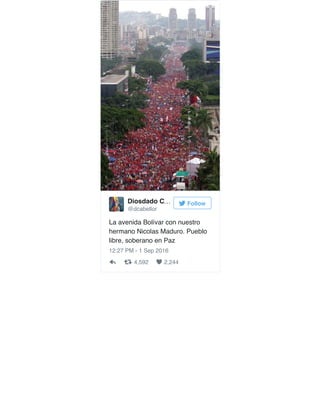
But if you were observing protests on Sept. 1
through the tweets of Maduro loyalist Diosdado
Cabello, a member of Venezuela’s parliament
and its former speaker, you’d have thought tens
of thousands had jammed Caracas’s streets in
support of the government. That’s because Ca-
bello distributed a photo of a huge crowd of
people wearing red, the color of Maduro’s Unit-
ed Socialist Party of Venezuela.
A member of the Venezuelan National Assem-
bly posted an image on Twitter on the day of
the protest showing a large number of Maduro
supporters occupying the streets of Caracas.
La avenida Bolívar con nuestro
hermano Nicolas Maduro. Pueblo
libre, soberano en Paz
12:27 PM - 1 Sep 2016
4,592 2,244
Diosdado C…
@dcabellor
Follow
“Bolivar Avenue with our brother Nicolás
Maduro. Free, sovereign people in peace,” Ca-
bello wrote.
It was soon discovered that the photo was from
a 2012 protest, and news of the deception went
viral. But Cabello’s tweet was just one part of
the Maduro government’s efforts to manipulate
public images of the recall effort in a country in
the midst of economic crisis. Among its other
tactics: banning the use of drones to take im-
ages of opposition protests, barring foreign re-
porters from entering the country and jailing a
reporter who shared video online of Maduro
being heckled in the streets.
Of course such strategies are hardly new in
Venezuela, where over 370 websites are
blocked, about a third of which were news sites
or blogs critical of the government (the largest
share were related to exchanging currency on
the black market), according to the PanAm Post.
Under Maduro’s socialist predecessor Hugo
Chávez, penalties were toughened for speech
that “offended” government officials and broad-
casting regulations used to suspend and harass
television channels, radio stations and web
sites critical of the government, as documented
by Human Rights Watch
(https://www.hrw.org/news/2013/03/05/venezuela-
chavezs-authoritarian-legacy) and other groups.
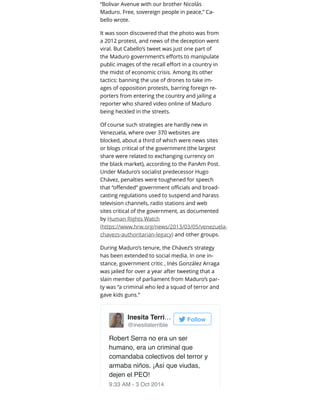
During Maduro’s tenure, the Chávez’s strategy
has been extended to social media. In one in-
stance, government critic , Inés González Arraga
was jailed for over a year after tweeting that a
slain member of parliament from Maduro’s par-
ty was “a criminal who led a squad of terror and
gave kids guns.”
Robert Serra no era un ser
humano, era un criminal que
comandaba colectivos del terror y
armaba niños. ¡Así que viudas,
dejen el PEO!
9:33 AM - 3 Oct 2014
Inesita Terri…
@inesitaterrible
Follow
To learn more about the Venezuelan govern-
ment’s efforts to control coverage of the effort
to recall Maduro, Global Journalist’s Tomás Ori-
huela spoke with Carmen Beatriz Fernández, di-
rector of the political consulting firm DataS-
trategia and a political science professor at
Spain’s Universidad de Navarra.
(http://i0.wp.com/globaljournalist.org/wp-
content/uploads/2016/09/Unknown.jpeg)
Carmen Beatriz Fernández
(courtesy)
Global Journalist: There was a large protest
calling for Maduro’s recall on Sept. 1. Can you
give some examples of how the government
tried to censor coverage?
Fernández: A few days before the protest, the
government began to enforce a rule that pro-
hibited drones in order to avoid aerial pictures
of the march. Alejandro Puglia, who works with
the president of the parliament [Henry Ramos
Allup, of the opposition Democratic Action par-
ty], took videos from a drone, and he was ar-
rested.
Also, the day after the protest, Maduro traveled
to Margarita [a Venezuelan island in the Car-
ibbean] in order to be surrounded by support-
ers in a very pro-Chávez area in [the town of]
Villa Rosa. He was met by people banging
kitchen pots and shouting insults. Maduro exit-
ed his car and argued with the people. This was
filmed by dozens on their mobile phones and it
spread nationally. The hashtag #VillaRosa end-
ed up trending for two days.
The first media outlet to publish this was Re-
porte Confidencial, and its editor Braulio Jatar
(https://twitter.com/brauliojatara), was arrested
hours later at his home.
GJ: In advance of the Sept. 1 protests an al-
Jazeera camera crew and three other foreign
journalists, including NPR’s John Otis, were
kicked out of Venezuela. Is this typical?
Fernández: It was surprising. The Venezuelan
government has been shutting off dissident
voices, but they’ve been doing this kind of thing
in much more subtle ways. [This] is going a step
further. They felt the protest was a threat to
their interests, and that’s why they tried to mini-
mize the number of witnesses, even though
they knew it would have a negative impact.
GJ: Diosdado Cabello, a member of the legisla-
ture, shared a fake photo of the protests show-
ing the streets filled with government support-
ers . What do you make of intentional misinfor-
mation on social media?
Fernández: Cabello has a whole production
team for his social and for his TV program. It
wasn’t just a mistake. The fact that he tweeted
this photo didn’t make sense because it was
easy to discover the truth.
Note: Fernández’s interview was conducted in
Spanish and translated and condensed. With con-
tributions from Anna Sutterer, Jonah McKeown
and Federico Maccioni.
Correction: Due to an editing error, an earlier ver-
sion of this story said Maduro was heckled on the
streets of Caracas. The episode occurred in Villa
Rosa.
Colombia (http://globaljournal-
ist.org/tag/colombia/)
Hugo Chavez (http://globaljournal-
ist.org/tag/hugo-chavez/)
Nicolas Maduro (http://globaljournal-
ist.org/tag/nicolas-maduro/)
Press Freedom (http://globaljournal-
ist.org/tag/press-freedom/)
recall (http://globaljournal-
ist.org/tag/recall/)
Venezuela (http://globaljournal-
ist.org/tag/venezuela/)
RELATED POSTS
(http://globaljournalist.org/2014/05/venezuela-
rifts-grow-
protests-persist/)
Venezuela rifts
grow as protests
persist
(http://globaljournalist.org/2014/05/venezuela-
rifts-grow-
protests-persist/)
(http://globaljournalist.org/2016/09/venezuelas-
descent-
program/)
Venezuela’s
descent
(http://globaljournalist.org/2016/09/venezuelas-
descent-
program/)
(http://globaljournalist.org/2015/07/twice-
fired-venezuelan-
journalist-fights-
on/)
Twice-fired
Venezuelan
journalist fights
on
(http://globaljournalist.org/2015/07/twice-
fired-venezuelan-
journalist-fights-
on/)
(http://globaljournalist.org/2015/07/venezuelas-
many-crises-
program/)
Venezuela’s many
crises
(http://globaljournalist.org/2015/07/venezuelas-
many-crises-
program/)
(http://globaljournalist.org/2015/03/project-
exile-venezuela-
tv-journalist-
finds-security-in-
miami/)
Project Exile:
Venezuela TV
journalist finds
security in Miami
(http://globaljournalist.org/2015/03/project-
exile-venezuela-
tv-journalist-
finds-security-in-
miami/)
(http://globaljournalist.org/2015/07/fired-
for-report-
venezuelan-
journalist-thrives-
online/)
Forced to resign,
Venezuelan
journalist thrives
online
(http://globaljournalist.org/2015/07/fired-
for-report-
venezuelan-
journalist-thrives-
online/)
PAST DIGITAL EDITIONS
( http://globaljournalist.jour.missouri.edu/digi-
tal-edition/ )
ARCHIVES
Archives Select Month
()
FOR PREVIOUS STORIES,
RADIO AND VIDEO PROGRAMS:
()
(http://globaljournalist.jour.missouri.edu )
OUR PARTNERS
(http://globaljournalist.org/?p=2366)
© 2014 Global Journalist. All rights reserved.
(http://globaljournalist.org/?p=2366)Global
Journalist is produced by the () Missouri School of
Journalism (http://journalism.missouri.edu/)

In venezuela, conflict extends to protest reporting

  • 1.
    (http://globaljournalist.org) Misinformation, arrests deter demonstrationcoverage Tens of thousands of opposition protesters marched in the Venezuelan capital of Caracas this month demanding President Nicolás ! A woman bangs a pot to protest Venezuela's President Nicolas Maduro in Los Teques on the outskirts of Caracas, Venezuela, Sept. 7, 2016. Venezuelans are marching in cities across the country to demand authorities allow a recall referendum against Maduro to go forward this year. (AP Photo/Ariana Cubillos) IN VENEZUELA, CONFLICT EXTENDS TO PROTEST REPORTING
  • 2.
    Maduro be removedfrom office by a recall ref- erendum. The protests are the largest since vio- lent demonstrations shook the country two years ago. But if you were observing protests on Sept. 1 through the tweets of Maduro loyalist Diosdado Cabello, a member of Venezuela’s parliament and its former speaker, you’d have thought tens of thousands had jammed Caracas’s streets in support of the government. That’s because Ca- bello distributed a photo of a huge crowd of people wearing red, the color of Maduro’s Unit- ed Socialist Party of Venezuela. A member of the Venezuelan National Assem- bly posted an image on Twitter on the day of the protest showing a large number of Maduro supporters occupying the streets of Caracas.
  • 3.
    La avenida Bolívarcon nuestro hermano Nicolas Maduro. Pueblo libre, soberano en Paz 12:27 PM - 1 Sep 2016 4,592 2,244 Diosdado C… @dcabellor Follow
  • 4.
    “Bolivar Avenue withour brother Nicolás Maduro. Free, sovereign people in peace,” Ca- bello wrote. It was soon discovered that the photo was from a 2012 protest, and news of the deception went viral. But Cabello’s tweet was just one part of the Maduro government’s efforts to manipulate public images of the recall effort in a country in the midst of economic crisis. Among its other tactics: banning the use of drones to take im- ages of opposition protests, barring foreign re- porters from entering the country and jailing a reporter who shared video online of Maduro being heckled in the streets. Of course such strategies are hardly new in Venezuela, where over 370 websites are blocked, about a third of which were news sites or blogs critical of the government (the largest share were related to exchanging currency on the black market), according to the PanAm Post. Under Maduro’s socialist predecessor Hugo Chávez, penalties were toughened for speech that “offended” government officials and broad- casting regulations used to suspend and harass television channels, radio stations and web sites critical of the government, as documented by Human Rights Watch (https://www.hrw.org/news/2013/03/05/venezuela- chavezs-authoritarian-legacy) and other groups. During Maduro’s tenure, the Chávez’s strategy has been extended to social media. In one in- stance, government critic , Inés González Arraga was jailed for over a year after tweeting that a slain member of parliament from Maduro’s par- ty was “a criminal who led a squad of terror and gave kids guns.” Robert Serra no era un ser humano, era un criminal que comandaba colectivos del terror y armaba niños. ¡Así que viudas, dejen el PEO! 9:33 AM - 3 Oct 2014 Inesita Terri… @inesitaterrible Follow
  • 5.
    To learn moreabout the Venezuelan govern- ment’s efforts to control coverage of the effort to recall Maduro, Global Journalist’s Tomás Ori- huela spoke with Carmen Beatriz Fernández, di- rector of the political consulting firm DataS- trategia and a political science professor at Spain’s Universidad de Navarra. (http://i0.wp.com/globaljournalist.org/wp- content/uploads/2016/09/Unknown.jpeg) Carmen Beatriz Fernández (courtesy) Global Journalist: There was a large protest calling for Maduro’s recall on Sept. 1. Can you give some examples of how the government tried to censor coverage? Fernández: A few days before the protest, the government began to enforce a rule that pro- hibited drones in order to avoid aerial pictures of the march. Alejandro Puglia, who works with the president of the parliament [Henry Ramos Allup, of the opposition Democratic Action par- ty], took videos from a drone, and he was ar- rested. Also, the day after the protest, Maduro traveled to Margarita [a Venezuelan island in the Car- ibbean] in order to be surrounded by support- ers in a very pro-Chávez area in [the town of] Villa Rosa. He was met by people banging kitchen pots and shouting insults. Maduro exit- ed his car and argued with the people. This was
  • 6.
    filmed by dozenson their mobile phones and it spread nationally. The hashtag #VillaRosa end- ed up trending for two days. The first media outlet to publish this was Re- porte Confidencial, and its editor Braulio Jatar (https://twitter.com/brauliojatara), was arrested hours later at his home. GJ: In advance of the Sept. 1 protests an al- Jazeera camera crew and three other foreign journalists, including NPR’s John Otis, were kicked out of Venezuela. Is this typical? Fernández: It was surprising. The Venezuelan government has been shutting off dissident voices, but they’ve been doing this kind of thing in much more subtle ways. [This] is going a step further. They felt the protest was a threat to their interests, and that’s why they tried to mini- mize the number of witnesses, even though they knew it would have a negative impact. GJ: Diosdado Cabello, a member of the legisla- ture, shared a fake photo of the protests show- ing the streets filled with government support- ers . What do you make of intentional misinfor- mation on social media? Fernández: Cabello has a whole production team for his social and for his TV program. It wasn’t just a mistake. The fact that he tweeted this photo didn’t make sense because it was easy to discover the truth. Note: Fernández’s interview was conducted in Spanish and translated and condensed. With con- tributions from Anna Sutterer, Jonah McKeown
  • 7.
    and Federico Maccioni. Correction:Due to an editing error, an earlier ver- sion of this story said Maduro was heckled on the streets of Caracas. The episode occurred in Villa Rosa. Colombia (http://globaljournal- ist.org/tag/colombia/) Hugo Chavez (http://globaljournal- ist.org/tag/hugo-chavez/) Nicolas Maduro (http://globaljournal- ist.org/tag/nicolas-maduro/) Press Freedom (http://globaljournal- ist.org/tag/press-freedom/) recall (http://globaljournal- ist.org/tag/recall/) Venezuela (http://globaljournal- ist.org/tag/venezuela/) RELATED POSTS
  • 8.
    (http://globaljournalist.org/2014/05/venezuela- rifts-grow- protests-persist/) Venezuela rifts grow asprotests persist (http://globaljournalist.org/2014/05/venezuela- rifts-grow- protests-persist/) (http://globaljournalist.org/2016/09/venezuelas- descent- program/) Venezuela’s descent (http://globaljournalist.org/2016/09/venezuelas- descent- program/) (http://globaljournalist.org/2015/07/twice- fired-venezuelan- journalist-fights- on/) Twice-fired Venezuelan journalist fights on (http://globaljournalist.org/2015/07/twice- fired-venezuelan- journalist-fights- on/) (http://globaljournalist.org/2015/07/venezuelas- many-crises- program/) Venezuela’s many crises (http://globaljournalist.org/2015/07/venezuelas- many-crises- program/) (http://globaljournalist.org/2015/03/project- exile-venezuela- tv-journalist- finds-security-in- miami/) Project Exile: Venezuela TV journalist finds security in Miami (http://globaljournalist.org/2015/03/project- exile-venezuela- tv-journalist- finds-security-in- miami/) (http://globaljournalist.org/2015/07/fired- for-report- venezuelan- journalist-thrives- online/) Forced to resign, Venezuelan journalist thrives online (http://globaljournalist.org/2015/07/fired- for-report- venezuelan- journalist-thrives- online/)
  • 9.
    PAST DIGITAL EDITIONS (http://globaljournalist.jour.missouri.edu/digi- tal-edition/ ) ARCHIVES Archives Select Month () FOR PREVIOUS STORIES, RADIO AND VIDEO PROGRAMS: () (http://globaljournalist.jour.missouri.edu ) OUR PARTNERS (http://globaljournalist.org/?p=2366)
  • 10.