#In this project you will write a program play TicTacToe
#using two players (labels 0,1) or one play (label 0) playing with the machine (label 1).
#The TicTacToe board has 9 integers board = [1,2,3,4,5,6,7,8,9]. The following
# are the modules for the program
#
#def reset() resets the board to the original values
# board = [1,2,3,4,5,6,7,8,9]
#
#def printBoard() print the current state of the board using the format
#
#The current TicTacToe Board
# | 1 | 2 | 3 |
# | 4 | 5 | 6 |
# | 7 | O | 9 |
#
#The current TicTacToe Board
# | X | 2 | 3 |
# | 4 | 5 | 6 |
# | 7 | O | 9 |
#Note from the above that player 0 and 1 have played numbers 8 and 1
#respectively and the board display O for player 0 and X from player 1
#
#def changeBoard(num1, player) using the chosen box number to change
#the value of the box to 0 or -1 depending on whether the player is 0 or 1,
#respectively.
#
#def play(player) prints the player number (0 or 1) and prompts the player
# to enter a box value that have not changed to 'O' or 'X'
#
#def checkRows(value) checks to see which of the rows of the board
# has the same value and returns True, otherwise, returns False
#
#def checkCols(value) checks to see which of the cols of the board
# has the same value and returns True, otherwise, returns False
#
#def checkDiagonal(value) checks to see which of the diagonals of the board
# has the same value and returns True, otherwise, returns False
#
#def win(player) checks if a player wins the game, returns True of the player wins
# and False otherwise
#
#def machinePlay(player) plays the role of the player using random number.
# this function generates numbers in the interval [1,9] and uses the first
# generated random number that has not been used to play the game. The
#
#def ticTacToe(numPlayers) accepts the number of players and simulates the
#ticTapToe, asking players to enter unused box numbers.
#
#def main() is the driver module that accepts the number of players from the user
# and calls the ticTacToe module
#Assignment: Complete the follwoing modules:
#checkCols
#checkRows
#checkDiagonal
#win
#Sample of the output is
#
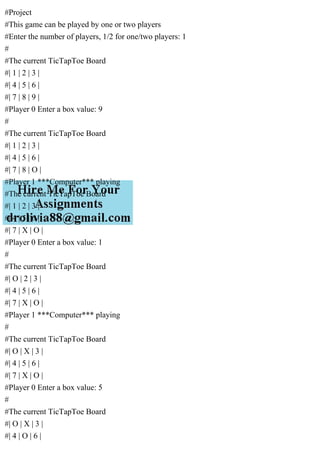
#Project
#This game can be played by one or two players
#Enter the number of players, 1/2 for one/two players: 1
#
#The current TicTapToe Board
#| 1 | 2 | 3 |
#| 4 | 5 | 6 |
#| 7 | 8 | 9 |
#Player 0 Enter a box value: 9
#
#The current TicTapToe Board
#| 1 | 2 | 3 |
#| 4 | 5 | 6 |
#| 7 | 8 | O |
#Player 1 ***Computer*** playing
#The current TicTapToe Board
#| 1 | 2 | 3 |
#| 4 | 5 | 6 |
#| 7 | X | O |
#Player 0 Enter a box value: 1
#
#The current TicTapToe Board
#| O | 2 | 3 |
#| 4 | 5 | 6 |
#| 7 | X | O |
#Player 1 ***Computer*** playing
#
#The current TicTapToe Board
#| O | X | 3 |
#| 4 | 5 | 6 |
#| 7 | X | O |
#Player 0 Enter a box value: 5
#
#The current TicTapToe Board
#| O | X | 3 |
#| 4 | O | 6 |
#| 7 | X | O |
#Player 0 Wins
#Do you want to quit?
#Begin Program
#import random number generator
#from random library
#from random import randint, seed
#Global variable board representing the ticTacToe board
board = [1,2,3,4,5,6,7,8,9]
#This module resets the ticTacToe board to the original values
def reset():
for k in range(1,10): #loop through a sequence [1,2,3,..,9]
board[k-1] = k
#This module prints the ticTacToe board in a 3 by 3 matrix
#using the format
# | 1 | 2 | 3 |
# | 4 | 5 | 6 |
# | 7 | 8 | 9 |
#
def printBoard ():
print(' The current TicTapToe Board')
for m in range(3):
string = '| '
for n in range(3):
if board[n+3*m] == 0:
string = string + ' O |'
elif board[n+3*m] == -1:
string = string + ' X |'
else:
string = string + ' ' + str(board[n+3*m]) + ' |'
print(string)
#This module changes the value (num1) of a box in the ticTacTop board chosen
# by player 0 to 0 and player 1 to -1
#
def changeBoard(num1,player):
for k in range(len(board)):
if board[k] == num1 and player == 0:
board[k] = 0
elif board[k] == num1 and player == 1:
board[k] = -1
#This module prompts the player to enter a box value. The format is
# 'Player Enter a box value'
#
def printBoard ():
print(' The current TicTapToe Board')
for m in range(3):
string = '| '
for n in range(3):
if board[n+3*m] == 0:
string = string + ' O |'
elif board[n+3*m] == -1:
string = string + ' X |'
else:
string = string + ' ' + str(board[n+3*m]) + ' |'
print(string)
#This module checks if boxes in anyone of the rows have the same value
#The module returns True if that is the case and False otherwise
#
def checkRows(value):
#Complete
# horizontally , first row of the board contains same mark, it is win
if(board[1] == board[2] and board[2] == board[3]):
return True;
# horizontally , second row of the board contains same mark, it is win
elif(board[4] == board[5] and board[5] == board[6]):
return True;
# horizontally , third row of the board contains same mark, it is win
elif(board[7] == board[8] and board[8] == board[9]):
return True;
# if all the above cases fails, then it is lose
else:
return False;
#
#This module checks if boxes in anyone of the cols have the same value
#The module returns True if that is the case and False otherwise
#
def checkCols(value):
#Complete
# vertically , first column of the board contains same mark, it is win
if (board[1] == board[4] and board[4] == board[7]):
return True;
# vertically , second column of the board contains same mark, it is win
elif (board[2] and board[5] and board[5] == board[8]):
return True;
# vertically , third column of the board contains same mark, it is win
elif (board[3] and board[6] and board[6] == board[9]):
return True;
else:
return False;
#
#This module checks if boxes in anyone of the diagonals have the same value
#The module returns True if that is the case and False otherwise
#
def checkDiagonal(value):
#Complete
#diagonal check for same mark. if yes , then it is win
if (board[1] and board[5] and board[5] == board[9]):
return True;
#diagonal check for same mark. if yes , then it is win
elif (board[3] and board[5] and board[5] == board[7]):
return True;
else:
return False;
#This module determines whether or not a player wins after playing the
# a turn. This module uses checkDiagonal, checkRows and checkCols to
# ascertain if the player wins. As least one of the options (checkDiagonal,
# checkCols and checkRows must return a True.
# This module returns True if the player wins and False, otherwise
# This module also print
# 'Player 0 Wins' if player 0 wins
# 'Player 1 Wins' if player 1 wins
def win(player):
#Complete
if(checkRows(player)==True or checkCols(player)==True or checkDiagonal(player)==True):
if(player==0):
print('Player 0 wins');
else:
print('Player 1 wins');
return True;
else:
return False;
#This module is only for 1 player only. In this case, this player
#plays with the machine. The machine uses random numbers. Random numbers are
#generated and tested to determine whether or not the generated random number has been
#played. The first generated random number that has not been played is chosen.
#If after 100 trials, no unplayed is found, nothing is done and a warning is
#sent to the player. IT IS ASSUMED THAT THIS SCENARIO WILL NOT OCCUR. NOTE
THAT
#THERE IS NOT INTELLIGENCE BUILT IN TO PROGRAM THAT WILL ALLOW
COMPUTER TO
#CHOOSE THE BEST NUMBER TO PLAY. YOU WILL RECEIVE BONUS POINT IF YOU
COULD
#MODIFY THE MODULE TO ALLOW COMPUTER SELECT THE BEST NUMBER.
#
def machinePlay(player):
print('Player ', player, '***Computer*** playing')
seed()
r = randint(1,9)
index = 0
while index<100 and (board[r-1] ==0 or board[r-1] ==-1):
r = randint(1,9)
index = index + 1
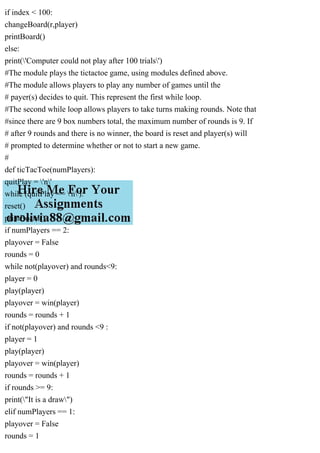
if index < 100:
changeBoard(r,player)
printBoard()
else:
print('Computer could not play after 100 trials')
#The module plays the tictactoe game, using modules defined above.
#The module allows players to play any number of games until the
# payer(s) decides to quit. This represent the first while loop.
#The second while loop allows players to take turns making rounds. Note that
#since there are 9 box numbers total, the maximum number of rounds is 9. If
# after 9 rounds and there is no winner, the board is reset and player(s) will
# prompted to determine whether or not to start a new game.
#
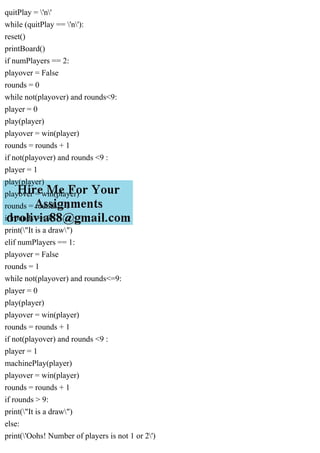
def ticTacToe(numPlayers):
quitPlay = 'n'
while (quitPlay == 'n'):
reset()
printBoard()
if numPlayers == 2:
playover = False
rounds = 0
while not(playover) and rounds<9:
player = 0
play(player)
playover = win(player)
rounds = rounds + 1
if not(playover) and rounds <9 :
player = 1
play(player)
playover = win(player)
rounds = rounds + 1
if rounds >= 9:
print("It is a draw")
elif numPlayers == 1:
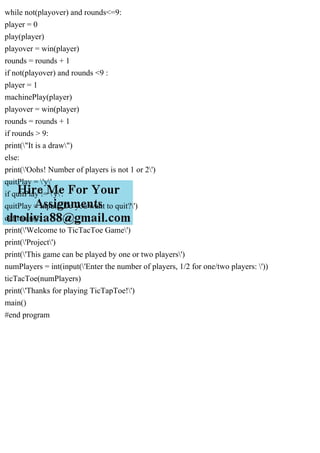
playover = False
rounds = 1
while not(playover) and rounds<=9:
player = 0
play(player)
playover = win(player)
rounds = rounds + 1
if not(playover) and rounds <9 :
player = 1
machinePlay(player)
playover = win(player)
rounds = rounds + 1
if rounds > 9:
print("It is a draw")
else:
print('Oohs! Number of players is not 1 or 2')
quitPlay = 'y'
if quitPlay != 'y':
quitPlay = input('Do you want to quit?')
def main():
print('Welcome to TicTacToe Game')
print('Project')
print('This game can be played by one or two players')
numPlayers = int(input('Enter the number of players, 1/2 for one/two players: '))
ticTacToe(numPlayers)
print('Thanks for playing TicTapToe!')
main()
#end program
Solution
#In this project you will write a program play TicTacToe
#using two players (labels 0,1) or one play (label 0) playing with the machine (label 1).
#The TicTacToe board has 9 integers board = [1,2,3,4,5,6,7,8,9]. The following
# are the modules for the program
#
#def reset() resets the board to the original values
# board = [1,2,3,4,5,6,7,8,9]
#
#def printBoard() print the current state of the board using the format
#
#The current TicTacToe Board
# | 1 | 2 | 3 |
# | 4 | 5 | 6 |
# | 7 | O | 9 |
#
#The current TicTacToe Board
# | X | 2 | 3 |
# | 4 | 5 | 6 |
# | 7 | O | 9 |
#Note from the above that player 0 and 1 have played numbers 8 and 1
#respectively and the board display O for player 0 and X from player 1
#
#def changeBoard(num1, player) using the chosen box number to change
#the value of the box to 0 or -1 depending on whether the player is 0 or 1,
#respectively.
#
#def play(player) prints the player number (0 or 1) and prompts the player
# to enter a box value that have not changed to 'O' or 'X'
#
#def checkRows(value) checks to see which of the rows of the board
# has the same value and returns True, otherwise, returns False
#
#def checkCols(value) checks to see which of the cols of the board
# has the same value and returns True, otherwise, returns False
#
#def checkDiagonal(value) checks to see which of the diagonals of the board
# has the same value and returns True, otherwise, returns False
#
#def win(player) checks if a player wins the game, returns True of the player wins
# and False otherwise
#
#def machinePlay(player) plays the role of the player using random number.
# this function generates numbers in the interval [1,9] and uses the first
# generated random number that has not been used to play the game. The
#
#def ticTacToe(numPlayers) accepts the number of players and simulates the
#ticTapToe, asking players to enter unused box numbers.
#
#def main() is the driver module that accepts the number of players from the user
# and calls the ticTacToe module
#Assignment: Complete the follwoing modules:
#checkCols
#checkRows
#checkDiagonal
#win
#Sample of the output is
#
#Project
#This game can be played by one or two players
#Enter the number of players, 1/2 for one/two players: 1
#
#The current TicTapToe Board
#| 1 | 2 | 3 |
#| 4 | 5 | 6 |
#| 7 | 8 | 9 |
#Player 0 Enter a box value: 9
#
#The current TicTapToe Board
#| 1 | 2 | 3 |
#| 4 | 5 | 6 |
#| 7 | 8 | O |
#Player 1 ***Computer*** playing
#The current TicTapToe Board
#| 1 | 2 | 3 |
#| 4 | 5 | 6 |
#| 7 | X | O |
#Player 0 Enter a box value: 1
#
#The current TicTapToe Board
#| O | 2 | 3 |
#| 4 | 5 | 6 |
#| 7 | X | O |
#Player 1 ***Computer*** playing
#
#The current TicTapToe Board
#| O | X | 3 |
#| 4 | 5 | 6 |
#| 7 | X | O |
#Player 0 Enter a box value: 5
#
#The current TicTapToe Board
#| O | X | 3 |
#| 4 | O | 6 |
#| 7 | X | O |
#Player 0 Wins
#Do you want to quit?
#Begin Program
#import random number generator
#from random library
#from random import randint, seed
#Global variable board representing the ticTacToe board
board = [1,2,3,4,5,6,7,8,9]
#This module resets the ticTacToe board to the original values
def reset():
for k in range(1,10): #loop through a sequence [1,2,3,..,9]
board[k-1] = k
#This module prints the ticTacToe board in a 3 by 3 matrix
#using the format
# | 1 | 2 | 3 |
# | 4 | 5 | 6 |
# | 7 | 8 | 9 |
#
def printBoard ():
print(' The current TicTapToe Board')
for m in range(3):
string = '| '
for n in range(3):
if board[n+3*m] == 0:
string = string + ' O |'
elif board[n+3*m] == -1:
string = string + ' X |'
else:
string = string + ' ' + str(board[n+3*m]) + ' |'
print(string)
#This module changes the value (num1) of a box in the ticTacTop board chosen
# by player 0 to 0 and player 1 to -1
#
def changeBoard(num1,player):
for k in range(len(board)):
if board[k] == num1 and player == 0:
board[k] = 0
elif board[k] == num1 and player == 1:
board[k] = -1
#This module prompts the player to enter a box value. The format is
# 'Player Enter a box value'
#
def printBoard ():
print(' The current TicTapToe Board')
for m in range(3):
string = '| '
for n in range(3):
if board[n+3*m] == 0:
string = string + ' O |'
elif board[n+3*m] == -1:
string = string + ' X |'
else:
string = string + ' ' + str(board[n+3*m]) + ' |'
print(string)
#This module checks if boxes in anyone of the rows have the same value
#The module returns True if that is the case and False otherwise
#
def checkRows(value):
#Complete
# horizontally , first row of the board contains same mark, it is win
if(board[1] == board[2] and board[2] == board[3]):
return True;
# horizontally , second row of the board contains same mark, it is win
elif(board[4] == board[5] and board[5] == board[6]):
return True;
# horizontally , third row of the board contains same mark, it is win
elif(board[7] == board[8] and board[8] == board[9]):
return True;
# if all the above cases fails, then it is lose
else:
return False;
#
#This module checks if boxes in anyone of the cols have the same value
#The module returns True if that is the case and False otherwise
#
def checkCols(value):
#Complete
# vertically , first column of the board contains same mark, it is win
if (board[1] == board[4] and board[4] == board[7]):
return True;
# vertically , second column of the board contains same mark, it is win
elif (board[2] and board[5] and board[5] == board[8]):
return True;
# vertically , third column of the board contains same mark, it is win
elif (board[3] and board[6] and board[6] == board[9]):
return True;
else:
return False;
#
#This module checks if boxes in anyone of the diagonals have the same value
#The module returns True if that is the case and False otherwise
#
def checkDiagonal(value):
#Complete
#diagonal check for same mark. if yes , then it is win
if (board[1] and board[5] and board[5] == board[9]):
return True;
#diagonal check for same mark. if yes , then it is win
elif (board[3] and board[5] and board[5] == board[7]):
return True;
else:
return False;
#This module determines whether or not a player wins after playing the
# a turn. This module uses checkDiagonal, checkRows and checkCols to
# ascertain if the player wins. As least one of the options (checkDiagonal,
# checkCols and checkRows must return a True.
# This module returns True if the player wins and False, otherwise
# This module also print
# 'Player 0 Wins' if player 0 wins
# 'Player 1 Wins' if player 1 wins
def win(player):
#Complete
if(checkRows(player)==True or checkCols(player)==True or checkDiagonal(player)==True):
if(player==0):
print('Player 0 wins');
else:
print('Player 1 wins');
return True;
else:
return False;
#This module is only for 1 player only. In this case, this player
#plays with the machine. The machine uses random numbers. Random numbers are
#generated and tested to determine whether or not the generated random number has been
#played. The first generated random number that has not been played is chosen.
#If after 100 trials, no unplayed is found, nothing is done and a warning is
#sent to the player. IT IS ASSUMED THAT THIS SCENARIO WILL NOT OCCUR. NOTE
THAT
#THERE IS NOT INTELLIGENCE BUILT IN TO PROGRAM THAT WILL ALLOW
COMPUTER TO
#CHOOSE THE BEST NUMBER TO PLAY. YOU WILL RECEIVE BONUS POINT IF YOU
COULD
#MODIFY THE MODULE TO ALLOW COMPUTER SELECT THE BEST NUMBER.
#
def machinePlay(player):
print('Player ', player, '***Computer*** playing')
seed()
r = randint(1,9)
index = 0
while index<100 and (board[r-1] ==0 or board[r-1] ==-1):
r = randint(1,9)
index = index + 1
if index < 100:
changeBoard(r,player)
printBoard()
else:
print('Computer could not play after 100 trials')
#The module plays the tictactoe game, using modules defined above.
#The module allows players to play any number of games until the
# payer(s) decides to quit. This represent the first while loop.
#The second while loop allows players to take turns making rounds. Note that
#since there are 9 box numbers total, the maximum number of rounds is 9. If
# after 9 rounds and there is no winner, the board is reset and player(s) will
# prompted to determine whether or not to start a new game.
#
def ticTacToe(numPlayers):
quitPlay = 'n'
while (quitPlay == 'n'):
reset()
printBoard()
if numPlayers == 2:
playover = False
rounds = 0
while not(playover) and rounds<9:
player = 0
play(player)
playover = win(player)
rounds = rounds + 1
if not(playover) and rounds <9 :
player = 1
play(player)
playover = win(player)
rounds = rounds + 1
if rounds >= 9:
print("It is a draw")
elif numPlayers == 1:
playover = False
rounds = 1
while not(playover) and rounds<=9:
player = 0
play(player)
playover = win(player)
rounds = rounds + 1
if not(playover) and rounds <9 :
player = 1
machinePlay(player)
playover = win(player)
rounds = rounds + 1
if rounds > 9:
print("It is a draw")
else:
print('Oohs! Number of players is not 1 or 2')
quitPlay = 'y'
if quitPlay != 'y':
quitPlay = input('Do you want to quit?')
def main():
print('Welcome to TicTacToe Game')
print('Project')
print('This game can be played by one or two players')
numPlayers = int(input('Enter the number of players, 1/2 for one/two players: '))
ticTacToe(numPlayers)
print('Thanks for playing TicTapToe!')
main()
#end program

#In this project you will write a program play TicTacToe #using tw.pdf

  • 1.
    #In this projectyou will write a program play TicTacToe #using two players (labels 0,1) or one play (label 0) playing with the machine (label 1). #The TicTacToe board has 9 integers board = [1,2,3,4,5,6,7,8,9]. The following # are the modules for the program # #def reset() resets the board to the original values # board = [1,2,3,4,5,6,7,8,9] # #def printBoard() print the current state of the board using the format # #The current TicTacToe Board # | 1 | 2 | 3 | # | 4 | 5 | 6 | # | 7 | O | 9 | # #The current TicTacToe Board # | X | 2 | 3 | # | 4 | 5 | 6 | # | 7 | O | 9 | #Note from the above that player 0 and 1 have played numbers 8 and 1 #respectively and the board display O for player 0 and X from player 1 # #def changeBoard(num1, player) using the chosen box number to change #the value of the box to 0 or -1 depending on whether the player is 0 or 1, #respectively. # #def play(player) prints the player number (0 or 1) and prompts the player # to enter a box value that have not changed to 'O' or 'X' # #def checkRows(value) checks to see which of the rows of the board # has the same value and returns True, otherwise, returns False # #def checkCols(value) checks to see which of the cols of the board # has the same value and returns True, otherwise, returns False #
  • 2.
    #def checkDiagonal(value) checksto see which of the diagonals of the board # has the same value and returns True, otherwise, returns False # #def win(player) checks if a player wins the game, returns True of the player wins # and False otherwise # #def machinePlay(player) plays the role of the player using random number. # this function generates numbers in the interval [1,9] and uses the first # generated random number that has not been used to play the game. The # #def ticTacToe(numPlayers) accepts the number of players and simulates the #ticTapToe, asking players to enter unused box numbers. # #def main() is the driver module that accepts the number of players from the user # and calls the ticTacToe module #Assignment: Complete the follwoing modules: #checkCols #checkRows #checkDiagonal #win #Sample of the output is # #Project #This game can be played by one or two players #Enter the number of players, 1/2 for one/two players: 1 # #The current TicTapToe Board #| 1 | 2 | 3 | #| 4 | 5 | 6 | #| 7 | 8 | 9 | #Player 0 Enter a box value: 9 # #The current TicTapToe Board #| 1 | 2 | 3 | #| 4 | 5 | 6 | #| 7 | 8 | O |
  • 3.
    #Player 1 ***Computer***playing #The current TicTapToe Board #| 1 | 2 | 3 | #| 4 | 5 | 6 | #| 7 | X | O | #Player 0 Enter a box value: 1 # #The current TicTapToe Board #| O | 2 | 3 | #| 4 | 5 | 6 | #| 7 | X | O | #Player 1 ***Computer*** playing # #The current TicTapToe Board #| O | X | 3 | #| 4 | 5 | 6 | #| 7 | X | O | #Player 0 Enter a box value: 5 # #The current TicTapToe Board #| O | X | 3 | #| 4 | O | 6 | #| 7 | X | O | #Player 0 Wins #Do you want to quit? #Begin Program #import random number generator #from random library #from random import randint, seed #Global variable board representing the ticTacToe board board = [1,2,3,4,5,6,7,8,9] #This module resets the ticTacToe board to the original values def reset(): for k in range(1,10): #loop through a sequence [1,2,3,..,9]
  • 4.
    board[k-1] = k #Thismodule prints the ticTacToe board in a 3 by 3 matrix #using the format # | 1 | 2 | 3 | # | 4 | 5 | 6 | # | 7 | 8 | 9 | # def printBoard (): print(' The current TicTapToe Board') for m in range(3): string = '| ' for n in range(3): if board[n+3*m] == 0: string = string + ' O |' elif board[n+3*m] == -1: string = string + ' X |' else: string = string + ' ' + str(board[n+3*m]) + ' |' print(string) #This module changes the value (num1) of a box in the ticTacTop board chosen # by player 0 to 0 and player 1 to -1 # def changeBoard(num1,player): for k in range(len(board)): if board[k] == num1 and player == 0: board[k] = 0 elif board[k] == num1 and player == 1: board[k] = -1 #This module prompts the player to enter a box value. The format is # 'Player Enter a box value' # def printBoard (): print(' The current TicTapToe Board') for m in range(3): string = '| ' for n in range(3):
  • 5.
    if board[n+3*m] ==0: string = string + ' O |' elif board[n+3*m] == -1: string = string + ' X |' else: string = string + ' ' + str(board[n+3*m]) + ' |' print(string) #This module checks if boxes in anyone of the rows have the same value #The module returns True if that is the case and False otherwise # def checkRows(value): #Complete # horizontally , first row of the board contains same mark, it is win if(board[1] == board[2] and board[2] == board[3]): return True; # horizontally , second row of the board contains same mark, it is win elif(board[4] == board[5] and board[5] == board[6]): return True; # horizontally , third row of the board contains same mark, it is win elif(board[7] == board[8] and board[8] == board[9]): return True; # if all the above cases fails, then it is lose else: return False; # #This module checks if boxes in anyone of the cols have the same value #The module returns True if that is the case and False otherwise # def checkCols(value): #Complete # vertically , first column of the board contains same mark, it is win if (board[1] == board[4] and board[4] == board[7]): return True; # vertically , second column of the board contains same mark, it is win elif (board[2] and board[5] and board[5] == board[8]): return True;
  • 6.
    # vertically ,third column of the board contains same mark, it is win elif (board[3] and board[6] and board[6] == board[9]): return True; else: return False; # #This module checks if boxes in anyone of the diagonals have the same value #The module returns True if that is the case and False otherwise # def checkDiagonal(value): #Complete #diagonal check for same mark. if yes , then it is win if (board[1] and board[5] and board[5] == board[9]): return True; #diagonal check for same mark. if yes , then it is win elif (board[3] and board[5] and board[5] == board[7]): return True; else: return False; #This module determines whether or not a player wins after playing the # a turn. This module uses checkDiagonal, checkRows and checkCols to # ascertain if the player wins. As least one of the options (checkDiagonal, # checkCols and checkRows must return a True. # This module returns True if the player wins and False, otherwise # This module also print # 'Player 0 Wins' if player 0 wins # 'Player 1 Wins' if player 1 wins def win(player): #Complete if(checkRows(player)==True or checkCols(player)==True or checkDiagonal(player)==True): if(player==0): print('Player 0 wins'); else: print('Player 1 wins'); return True; else:
  • 7.
    return False; #This moduleis only for 1 player only. In this case, this player #plays with the machine. The machine uses random numbers. Random numbers are #generated and tested to determine whether or not the generated random number has been #played. The first generated random number that has not been played is chosen. #If after 100 trials, no unplayed is found, nothing is done and a warning is #sent to the player. IT IS ASSUMED THAT THIS SCENARIO WILL NOT OCCUR. NOTE THAT #THERE IS NOT INTELLIGENCE BUILT IN TO PROGRAM THAT WILL ALLOW COMPUTER TO #CHOOSE THE BEST NUMBER TO PLAY. YOU WILL RECEIVE BONUS POINT IF YOU COULD #MODIFY THE MODULE TO ALLOW COMPUTER SELECT THE BEST NUMBER. # def machinePlay(player): print('Player ', player, '***Computer*** playing') seed() r = randint(1,9) index = 0 while index<100 and (board[r-1] ==0 or board[r-1] ==-1): r = randint(1,9) index = index + 1 if index < 100: changeBoard(r,player) printBoard() else: print('Computer could not play after 100 trials') #The module plays the tictactoe game, using modules defined above. #The module allows players to play any number of games until the # payer(s) decides to quit. This represent the first while loop. #The second while loop allows players to take turns making rounds. Note that #since there are 9 box numbers total, the maximum number of rounds is 9. If # after 9 rounds and there is no winner, the board is reset and player(s) will # prompted to determine whether or not to start a new game. # def ticTacToe(numPlayers):
  • 8.
    quitPlay = 'n' while(quitPlay == 'n'): reset() printBoard() if numPlayers == 2: playover = False rounds = 0 while not(playover) and rounds<9: player = 0 play(player) playover = win(player) rounds = rounds + 1 if not(playover) and rounds <9 : player = 1 play(player) playover = win(player) rounds = rounds + 1 if rounds >= 9: print("It is a draw") elif numPlayers == 1: playover = False rounds = 1 while not(playover) and rounds<=9: player = 0 play(player) playover = win(player) rounds = rounds + 1 if not(playover) and rounds <9 : player = 1 machinePlay(player) playover = win(player) rounds = rounds + 1 if rounds > 9: print("It is a draw") else: print('Oohs! Number of players is not 1 or 2')
  • 9.
    quitPlay = 'y' ifquitPlay != 'y': quitPlay = input('Do you want to quit?') def main(): print('Welcome to TicTacToe Game') print('Project') print('This game can be played by one or two players') numPlayers = int(input('Enter the number of players, 1/2 for one/two players: ')) ticTacToe(numPlayers) print('Thanks for playing TicTapToe!') main() #end program Solution #In this project you will write a program play TicTacToe #using two players (labels 0,1) or one play (label 0) playing with the machine (label 1). #The TicTacToe board has 9 integers board = [1,2,3,4,5,6,7,8,9]. The following # are the modules for the program # #def reset() resets the board to the original values # board = [1,2,3,4,5,6,7,8,9] # #def printBoard() print the current state of the board using the format # #The current TicTacToe Board # | 1 | 2 | 3 | # | 4 | 5 | 6 | # | 7 | O | 9 | # #The current TicTacToe Board # | X | 2 | 3 | # | 4 | 5 | 6 | # | 7 | O | 9 | #Note from the above that player 0 and 1 have played numbers 8 and 1 #respectively and the board display O for player 0 and X from player 1
  • 10.
    # #def changeBoard(num1, player)using the chosen box number to change #the value of the box to 0 or -1 depending on whether the player is 0 or 1, #respectively. # #def play(player) prints the player number (0 or 1) and prompts the player # to enter a box value that have not changed to 'O' or 'X' # #def checkRows(value) checks to see which of the rows of the board # has the same value and returns True, otherwise, returns False # #def checkCols(value) checks to see which of the cols of the board # has the same value and returns True, otherwise, returns False # #def checkDiagonal(value) checks to see which of the diagonals of the board # has the same value and returns True, otherwise, returns False # #def win(player) checks if a player wins the game, returns True of the player wins # and False otherwise # #def machinePlay(player) plays the role of the player using random number. # this function generates numbers in the interval [1,9] and uses the first # generated random number that has not been used to play the game. The # #def ticTacToe(numPlayers) accepts the number of players and simulates the #ticTapToe, asking players to enter unused box numbers. # #def main() is the driver module that accepts the number of players from the user # and calls the ticTacToe module #Assignment: Complete the follwoing modules: #checkCols #checkRows #checkDiagonal #win #Sample of the output is #
  • 11.
    #Project #This game canbe played by one or two players #Enter the number of players, 1/2 for one/two players: 1 # #The current TicTapToe Board #| 1 | 2 | 3 | #| 4 | 5 | 6 | #| 7 | 8 | 9 | #Player 0 Enter a box value: 9 # #The current TicTapToe Board #| 1 | 2 | 3 | #| 4 | 5 | 6 | #| 7 | 8 | O | #Player 1 ***Computer*** playing #The current TicTapToe Board #| 1 | 2 | 3 | #| 4 | 5 | 6 | #| 7 | X | O | #Player 0 Enter a box value: 1 # #The current TicTapToe Board #| O | 2 | 3 | #| 4 | 5 | 6 | #| 7 | X | O | #Player 1 ***Computer*** playing # #The current TicTapToe Board #| O | X | 3 | #| 4 | 5 | 6 | #| 7 | X | O | #Player 0 Enter a box value: 5 # #The current TicTapToe Board #| O | X | 3 | #| 4 | O | 6 |
  • 12.
    #| 7 |X | O | #Player 0 Wins #Do you want to quit? #Begin Program #import random number generator #from random library #from random import randint, seed #Global variable board representing the ticTacToe board board = [1,2,3,4,5,6,7,8,9] #This module resets the ticTacToe board to the original values def reset(): for k in range(1,10): #loop through a sequence [1,2,3,..,9] board[k-1] = k #This module prints the ticTacToe board in a 3 by 3 matrix #using the format # | 1 | 2 | 3 | # | 4 | 5 | 6 | # | 7 | 8 | 9 | # def printBoard (): print(' The current TicTapToe Board') for m in range(3): string = '| ' for n in range(3): if board[n+3*m] == 0: string = string + ' O |' elif board[n+3*m] == -1: string = string + ' X |' else: string = string + ' ' + str(board[n+3*m]) + ' |' print(string) #This module changes the value (num1) of a box in the ticTacTop board chosen # by player 0 to 0 and player 1 to -1 #
  • 13.
    def changeBoard(num1,player): for kin range(len(board)): if board[k] == num1 and player == 0: board[k] = 0 elif board[k] == num1 and player == 1: board[k] = -1 #This module prompts the player to enter a box value. The format is # 'Player Enter a box value' # def printBoard (): print(' The current TicTapToe Board') for m in range(3): string = '| ' for n in range(3): if board[n+3*m] == 0: string = string + ' O |' elif board[n+3*m] == -1: string = string + ' X |' else: string = string + ' ' + str(board[n+3*m]) + ' |' print(string) #This module checks if boxes in anyone of the rows have the same value #The module returns True if that is the case and False otherwise # def checkRows(value): #Complete # horizontally , first row of the board contains same mark, it is win if(board[1] == board[2] and board[2] == board[3]): return True; # horizontally , second row of the board contains same mark, it is win elif(board[4] == board[5] and board[5] == board[6]): return True; # horizontally , third row of the board contains same mark, it is win elif(board[7] == board[8] and board[8] == board[9]): return True; # if all the above cases fails, then it is lose
  • 14.
    else: return False; # #This modulechecks if boxes in anyone of the cols have the same value #The module returns True if that is the case and False otherwise # def checkCols(value): #Complete # vertically , first column of the board contains same mark, it is win if (board[1] == board[4] and board[4] == board[7]): return True; # vertically , second column of the board contains same mark, it is win elif (board[2] and board[5] and board[5] == board[8]): return True; # vertically , third column of the board contains same mark, it is win elif (board[3] and board[6] and board[6] == board[9]): return True; else: return False; # #This module checks if boxes in anyone of the diagonals have the same value #The module returns True if that is the case and False otherwise # def checkDiagonal(value): #Complete #diagonal check for same mark. if yes , then it is win if (board[1] and board[5] and board[5] == board[9]): return True; #diagonal check for same mark. if yes , then it is win elif (board[3] and board[5] and board[5] == board[7]): return True; else: return False; #This module determines whether or not a player wins after playing the # a turn. This module uses checkDiagonal, checkRows and checkCols to # ascertain if the player wins. As least one of the options (checkDiagonal,
  • 15.
    # checkCols andcheckRows must return a True. # This module returns True if the player wins and False, otherwise # This module also print # 'Player 0 Wins' if player 0 wins # 'Player 1 Wins' if player 1 wins def win(player): #Complete if(checkRows(player)==True or checkCols(player)==True or checkDiagonal(player)==True): if(player==0): print('Player 0 wins'); else: print('Player 1 wins'); return True; else: return False; #This module is only for 1 player only. In this case, this player #plays with the machine. The machine uses random numbers. Random numbers are #generated and tested to determine whether or not the generated random number has been #played. The first generated random number that has not been played is chosen. #If after 100 trials, no unplayed is found, nothing is done and a warning is #sent to the player. IT IS ASSUMED THAT THIS SCENARIO WILL NOT OCCUR. NOTE THAT #THERE IS NOT INTELLIGENCE BUILT IN TO PROGRAM THAT WILL ALLOW COMPUTER TO #CHOOSE THE BEST NUMBER TO PLAY. YOU WILL RECEIVE BONUS POINT IF YOU COULD #MODIFY THE MODULE TO ALLOW COMPUTER SELECT THE BEST NUMBER. # def machinePlay(player): print('Player ', player, '***Computer*** playing') seed() r = randint(1,9) index = 0 while index<100 and (board[r-1] ==0 or board[r-1] ==-1): r = randint(1,9) index = index + 1
  • 16.
    if index <100: changeBoard(r,player) printBoard() else: print('Computer could not play after 100 trials') #The module plays the tictactoe game, using modules defined above. #The module allows players to play any number of games until the # payer(s) decides to quit. This represent the first while loop. #The second while loop allows players to take turns making rounds. Note that #since there are 9 box numbers total, the maximum number of rounds is 9. If # after 9 rounds and there is no winner, the board is reset and player(s) will # prompted to determine whether or not to start a new game. # def ticTacToe(numPlayers): quitPlay = 'n' while (quitPlay == 'n'): reset() printBoard() if numPlayers == 2: playover = False rounds = 0 while not(playover) and rounds<9: player = 0 play(player) playover = win(player) rounds = rounds + 1 if not(playover) and rounds <9 : player = 1 play(player) playover = win(player) rounds = rounds + 1 if rounds >= 9: print("It is a draw") elif numPlayers == 1: playover = False rounds = 1
  • 17.
    while not(playover) androunds<=9: player = 0 play(player) playover = win(player) rounds = rounds + 1 if not(playover) and rounds <9 : player = 1 machinePlay(player) playover = win(player) rounds = rounds + 1 if rounds > 9: print("It is a draw") else: print('Oohs! Number of players is not 1 or 2') quitPlay = 'y' if quitPlay != 'y': quitPlay = input('Do you want to quit?') def main(): print('Welcome to TicTacToe Game') print('Project') print('This game can be played by one or two players') numPlayers = int(input('Enter the number of players, 1/2 for one/two players: ')) ticTacToe(numPlayers) print('Thanks for playing TicTapToe!') main() #end program