Publication Ethics
Authorship
Dr Bidita Khandelwal
Prof & HoD, Medicine, SMIMS, SMU
Ex Director, Directorate of Research, SMU
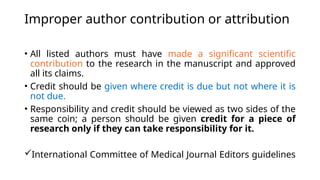
Improper author contribution or attribution
• All listed authors must have made a significant scientific
contribution to the research in the manuscript and approved
all its claims.
• Credit should be given where credit is due but not where it is
not due.
• Responsibility and credit should be viewed as two sides of the
same coin; a person should be given credit for a piece of
research only if they can take responsibility for it.
International Committee of Medical Journal Editors guidelines
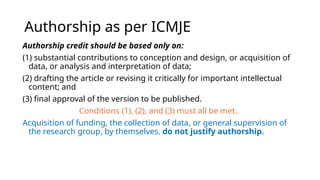
Authorship as per ICMJE
Authorship credit should be based only on:
(1) substantial contributions to conception and design, or acquisition of
data, or analysis and interpretation of data;
(2) drafting the article or revising it critically for important intellectual
content; and
(3) final approval of the version to be published.
Conditions (1), (2), and (3) must all be met.
Acquisition of funding, the collection of data, or general supervision of
the research group, by themselves, do not justify authorship.
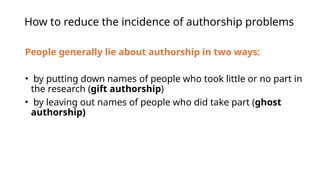
How to reduce the incidence of authorship problems
People generally lie about authorship in two ways:
• by putting down names of people who took little or no part in
the research (gift authorship)
• by leaving out names of people who did take part (ghost
authorship)
How to reduce the incidence of authorship problems
Three principles:
Encourage a culture of ethical authorship
Start discussing authorship when you plan your research
Decide authorship before you start each article
Key concepts in authorship
• Acknowledgements
• Appeals: You may ask a journal to withdraw your name
from a paper if it has been included against your wishes.
• Contributorship: Authors should provide a description of
what each contributed, and editors should publish that
information.
• Corresponding author: Journal editors view this as a purely
administrative role, but some authors equate it with
seniority.
Key concepts in authorship
• First and last authors: e.g. Smith et al.
• Ghost Authors: Professional writers (often paid by
commercial sponsors) "important to acknowledge their
contribution"
• Gift authors: e.g. Heads of department
• Group authorship: Some journals permit the use of group
names e.g. The XYZ Study Group, but many require
contributors to be listed (often alphabetically)
• Order of Authors: Should be a joint decision of the co
authors

important points regarding authorship in publication

  • 1.
    Publication Ethics Authorship Dr BiditaKhandelwal Prof & HoD, Medicine, SMIMS, SMU Ex Director, Directorate of Research, SMU
  • 2.
    Improper author contributionor attribution • All listed authors must have made a significant scientific contribution to the research in the manuscript and approved all its claims. • Credit should be given where credit is due but not where it is not due. • Responsibility and credit should be viewed as two sides of the same coin; a person should be given credit for a piece of research only if they can take responsibility for it. International Committee of Medical Journal Editors guidelines
  • 3.
    Authorship as perICMJE Authorship credit should be based only on: (1) substantial contributions to conception and design, or acquisition of data, or analysis and interpretation of data; (2) drafting the article or revising it critically for important intellectual content; and (3) final approval of the version to be published. Conditions (1), (2), and (3) must all be met. Acquisition of funding, the collection of data, or general supervision of the research group, by themselves, do not justify authorship.
  • 4.
    How to reducethe incidence of authorship problems People generally lie about authorship in two ways: • by putting down names of people who took little or no part in the research (gift authorship) • by leaving out names of people who did take part (ghost authorship)
  • 5.
    How to reducethe incidence of authorship problems Three principles: Encourage a culture of ethical authorship Start discussing authorship when you plan your research Decide authorship before you start each article
  • 6.
    Key concepts inauthorship • Acknowledgements • Appeals: You may ask a journal to withdraw your name from a paper if it has been included against your wishes. • Contributorship: Authors should provide a description of what each contributed, and editors should publish that information. • Corresponding author: Journal editors view this as a purely administrative role, but some authors equate it with seniority.
  • 7.
    Key concepts inauthorship • First and last authors: e.g. Smith et al. • Ghost Authors: Professional writers (often paid by commercial sponsors) "important to acknowledge their contribution" • Gift authors: e.g. Heads of department • Group authorship: Some journals permit the use of group names e.g. The XYZ Study Group, but many require contributors to be listed (often alphabetically) • Order of Authors: Should be a joint decision of the co authors