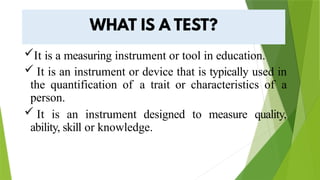
It is a measuring instrument or tool in education.
 It is an instrument or device that is typically used in
the quantification of a trait or characteristics of a
person.
 It is an instrument designed to measure quality,
ability, skill or knowledge.
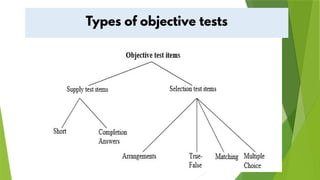
SIMPLE-RECALL TYPE
(IDENTIFICATION)
 The response requires the subject to
recall previously learned material and the
answers are usually short consisting of either a
word or a phrase.
I. SUPPLY TYPE
SIMPLE-RECALL TYPE
(IDENTIFICATION)
EXAMPLES:
1. How many centimeters make up 2 meters?
1.
2. Convert 7, 000 grams to kilograms.
3. It is the fundamental unit of
element.
2.
3.
I. SUPPLY TYPE
Suggestions for the Construction of
Simple- Recall Type (Identification)
1. The direct-question form is usually preferable
to the statement form.
2. The blanks for the responses should be in a
column preferably at the right column of
the items.
3. The question / item should be so worded
that there is only one correct response.
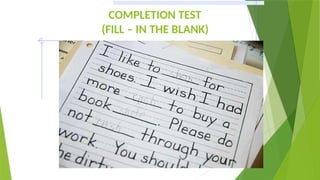
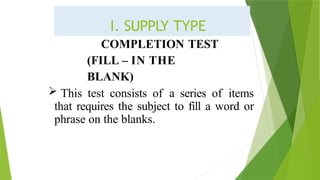
COMPLETION TEST
(FILL – IN THE BLANK)
COMPLETION TEST
(FILL – IN THE
BLANK)
 This test consists of a series of items
that requires the subject to fill a word or
phrase on the blanks.
I. SUPPLY TYPE
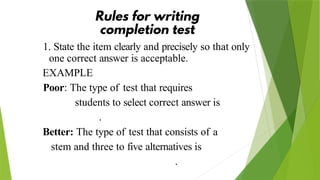
1. State the item clearly and precisely so that only
one correct answer is acceptable.
EXAMPLE
Poor: The type of test that requires
students to select correct answer is
.
Better: The type of test that consists of a
stem and three to five alternatives is
.
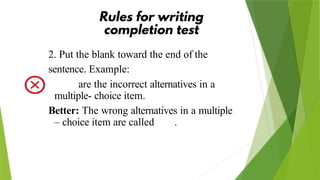
2. Put the blank toward the end of the
sentence. Example:
are the incorrect alternatives in a
multiple- choice item.
Better: The wrong alternatives in a multiple
– choice item are called .
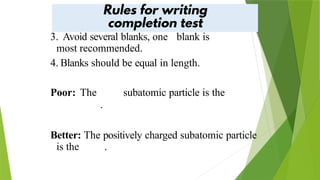
3. Avoid several blanks, one blank is
most recommended.
4. Blanks should be equal in length.
Poor: The subatomic particle is the
.
Better: The positively charged subatomic particle
is the .
6. Avoid giving grammatical clues to the
expected answer.
Poor: A collection of questions held in a
system of storage is called a .
Better: A collection of questions held in a
system of storage is called
a/an .
7. Avoid copying exact words of the
textbook.
II. SELECTION TYPE
A. ALTERNATIVE RESPONSE TEST /
TRUE – FALSE TEST
True – False items require students to
identify statements which are correct or
incorrect. Only two possible responses are
possible in this item format – true or
false, right or wrong, yes or no.
1. Do not give a hint (inadvertently) in
the body of the question.
•Example: The Philippines gained its
independence in 1898 and therefore
celebrated its centennial year in
2000.
2. Avoid specific determiners or give-
away qualifiers “always, never
, often, seldom”
and other adverbs that tend to be either,
always true or always false.
•Example: Christmas always falls on
a Sunday because it is a Sabbath
day.
3. Avoid long sentences as these tend to
be “true”. Keep sentences short.
•Example: Tests need to be valid, reliable
and useful, although, it would require a
great amount of time and effort to
ensure that tests possess these test
characteristics.
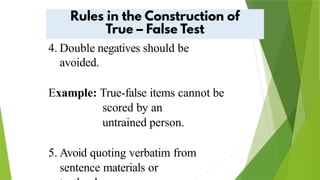
4. Double negatives should be
avoided.
Example: True-false items cannot be
scored by an
untrained person.
5. Avoid quoting verbatim from
sentence materials or
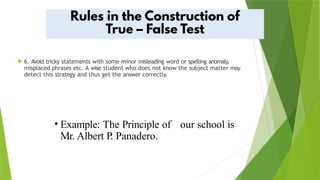
 6. Avoid tricky statements with some minor misleading word or spelling anomaly,
misplaced phrases etc. A wise student who does not know the subject matter may
detect this strategy and thus get the answer correctly.
• Example: The Principle of our school is
Mr. Albert P. Panadero.
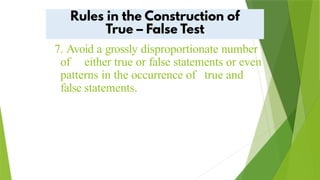
7. Avoid a grossly disproportionate number
of either true or false statements or even
patterns in the occurrence of true and
false statements.
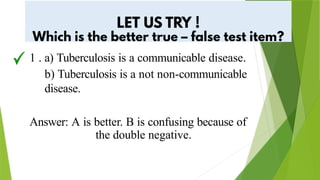
1 . a) Tuberculosis is a communicable disease.
b) Tuberculosis is a not non-communicable
disease.
Answer: A is better. B is confusing because of
the double negative.
2 . a) The true-false item is more subject to
guessing but it should be used in place of multiple
choice item, if well
constructed, when there is a dearth of distracters that
are plausible.
b) The true-false item should be used in place of
the multiple choice item when only two
alternatives are possible.
Answer: B is better. The language in B is simple, clear
and concise. Avoid long and complex sentences.
3 . a) A statement of opinion should
never be used in a true – false item.
b) A statement of opinion cannot be
marked true or false.
Answer: B is better. Avoid using determiners
or give-away qualifiers.
4. a) The true – false item is also called
alternative response item.
b) The true – false item, which is favored by all
tests experts, is also called an alternative
response.
Answer: A is better. B contains two ideas that
are confusing.
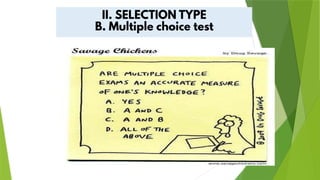
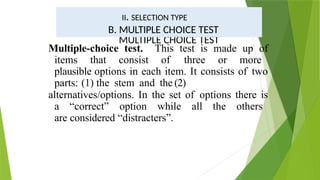
Multiple-choice test. This test is made up of
items that consist of three or more
plausible options in each item. It consists of two
parts: (1) the stem and the (2)
alternatives/options. In the set of options there is
a “correct” option while all the others
are considered “distracters”.
II. SELECTION TYPE /
RECOGNITION TYPE
MULTIPLE CHOICE TEST
II. SELECTION TYPE
B. MULTIPLE CHOICE TEST
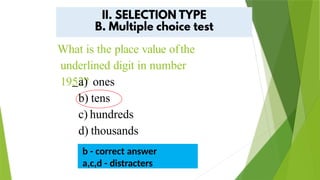
What is the place value ofthe
underlined digit in number
1952?
a) ones
b) tens
c) hundreds
d) thousands
b - correct answer
a,c,d - distracters
GUIDELINES
IN THE CONSTRUCTION OF
MULTIPLE CHOICE ITEMS
A. STEM
B. OPTION
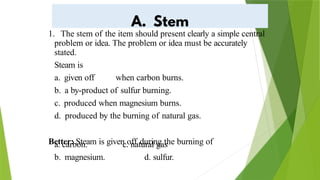
1. The stem of the item should present clearly a simple central
problem or idea. The problem or idea must be accurately
stated.
Steam is
a. given off when carbon burns.
b. a by-product of sulfur burning.
c. produced when magnesium burns.
d. produced by the burning of natural gas.
Better: Steam is given off during the burning of
a. carbon.
b. magnesium.
c. natural gas
d. sulfur.
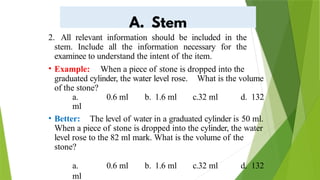
2. All relevant information should be included in the
stem. Include all the information necessary for the
examinee to understand the intent of the item.
• Example: When a piece of stone is dropped into the
graduated cylinder, the water level rose. What is the volume
of the stone?
a. 0.6 ml b. 1.6 ml c.32 ml d. 132
ml
• Better: The level of water in a graduated cylinder is 50 ml.
When a piece of stone is dropped into the cylinder, the water
level rose to the 82 ml mark. What is the volume of the
stone?
a. 0.6 ml b. 1.6 ml c.32 ml d. 132
ml
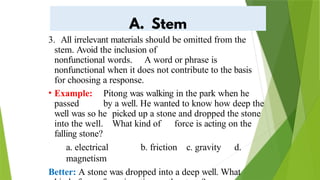
3. All irrelevant materials should be omitted from the
stem. Avoid the inclusion of
nonfunctional words. A word or phrase is
nonfunctional when it does not contribute to the basis
for choosing a response.
• Example: Pitong was walking in the park when he
passed by a well. He wanted to know how deep the
well was so he picked up a stone and dropped the stone
into the well. What kind of force is acting on the
falling stone?
a. electrical b. friction c. gravity d.
magnetism
Better: A stone was dropped into a deep well. What
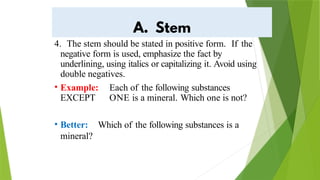
4. The stem should be stated in positive form. If the
negative form is used, emphasize the fact by
underlining, using italics or capitalizing it. Avoid using
double negatives.
• Example: Each of the following substances
EXCEPT ONE is a mineral. Which one is not?
• Better: Which of the following substances is a
mineral?
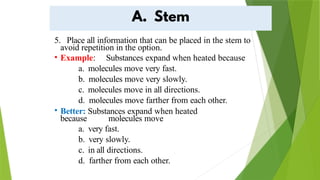
5. Place all information that can be placed in the stem to
avoid repetition in the option.
• Example: Substances expand when heated because
a. molecules move very fast.
b. molecules move very slowly.
c. molecules move in all directions.
d. molecules move farther from each other.
• Better: Substances expand when heated
because molecules move
a. very fast.
b. very slowly.
c. in all directions.
d. farther from each other.
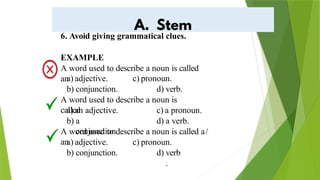
6. Avoid giving grammatical clues.
EXAMPLE
A word used to describe a noun is called
an
a) adjective.
b) conjunction.
c) pronoun.
d) verb.
A word used to describe a noun is
called
a) an adjective.
b) a
conjunction.
c) a pronoun.
d) a verb.
A word used to describe a noun is called a/
an
a) adjective.
b) conjunction.
c) pronoun.
d) verb
.
1. The option should be homogeneous in the sense that
each should be a member of the same set of
things.
• Example: Which one of the following animals is
most clearly in danger ofextinction?
c.
sampaguita
d. tamaraw
a. mackerel
b. monkey-eating
eagle
• Better:
a. carabao
b. cow
c. horse
d.
tamaraw
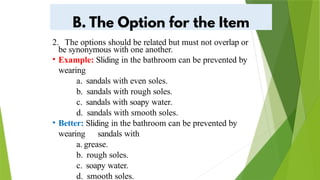
2. The options should be related but must not overlap or
be synonymous with one another.
• Example: Sliding in the bathroom can be prevented by
wearing
a. sandals with even soles.
b. sandals with rough soles.
c. sandals with soapy water.
d. sandals with smooth soles.
• Better: Sliding in the bathroom can be prevented by
wearing sandals with
a. grease.
b. rough soles.
c. soapy water.
d. smooth soles.
3. The key (correct option) should be of the same length as
the distracters to avoid giving a clue.
• Example: One problem met by scientists about
cloning animals is that cloned animals.
a. get old fast.
b. remain young.
c. do not reproduce.
d. do not live long as uncloned animas do.
Better:
a. die early.c. get old fast.
b. stay young. d. do not reproduce.
•Research: Numerous studies have indicated that
items are easier when the answer is noticeably
longer than the distracters as compared when all
of the alternatives are similar in length
(Haladyna & Downing, 1986 as cited by Burton
et. al. 1991)
4. Make all the options grammatically consistent
and parallel in form with the stem of the item.
Example: How is the movement of bones made
possible?
a) By pushing the skeletal muscle
b) By pulling the skeletal muscles
c) Muscles and bones are combined
d) Muscle pushes the other muscles
- Options C and D are not parallel in form with
the key. They must be revised.
a
Better
a) By pushing the skeletal muscle
b) By pulling the skeletal muscles
c) By pulling and pushing the muscles
d) By combining the muscles and
bones
5. State options in sequential (natural)
order, whether alphabetically or
numerically.
• Example: Mars’ gravity is 0.38 times that of
Earth. What will be the weight on planet Mars
of an astronaut who weighs 400 N on
Earth?
a. 3.62 N
b. 10.5 N
c. 152 N
d. 400.38 N
Which animal is hatched from eggs?
a. carabao
b. goat
c. rabbit
d. snake
Options are arranged alphabetically.
6. Place a period at the end of every alternative if
the stem is an incomplete statement and do
not place a blank line toward the end of the
sentence.
Example: Substances expand when heated
because molecules move
A. very fast.
B. very slowly.
C. in all directions.
D. farther from each other.
7. If alternatives are sentences or phrases,
arrange them in order of increasing
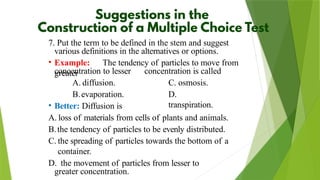
7. Put the term to be defined in the stem and suggest
various definitions in the alternatives or options.
• Example: The tendency of particles to move from
greater
concentration to lesser
A. diffusion.
B.evaporation.
concentration is called
C. osmosis.
D.
transpiration.
• Better: Diffusion is
A. loss of materials from cells of plants and animals.
B.the tendency of particles to be evenly distributed.
C. the spreading of particles towards the bottom of a
container.
D. the movement of particles from lesser to
greater concentration.
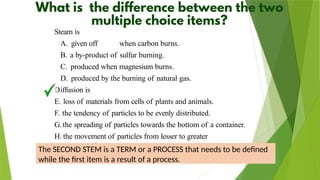
D
Steam is
A. given off when carbon burns.
B. a by-product of sulfur burning.
C. produced when magnesium burns.
D. produced by the burning of natural gas.
iffusion is
E. loss of materials from cells of plants and animals.
F. the tendency of particles to be evenly distributed.
G.the spreading of particles towards the bottom of a container.
H. the movement of particles from lesser to greater
concentration.
The SECOND STEM is a TERM or a PROCESS that needs to be defined
while the first item is a result of a process.
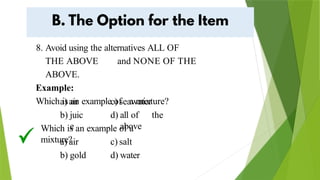
8. Avoid using the alternatives ALL OF
THE ABOVE and NONE OF THE
ABOVE.
Example:
Which is an example of a mixture?
a) air
b) juic
e
c) seawater
d) all of the
above
Which is an example of a
mixture?
a) air
b) gold
c) salt
d) water
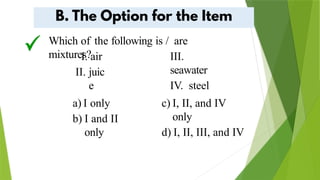
Which of the following is / are
mixtures?
I. air
II. juic
e
III.
seawater
IV. steel
a) I only
b) I and II
only
c) I, II, and IV
only
d) I, II, III, and IV
• Most of the time, the item writer has difficulty of
thinking any option so that ALL OF THE ABOVE
or NONE OF THE ABOVE is used.
• The alternative ( all of the above or none of the
above) can be considered a clue for the student
• All of the above – all the other options are correct
• None of the above – all the options are wrong
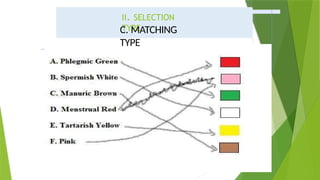
II. SELECTION
TYPE
C. MATCHING
TYPE
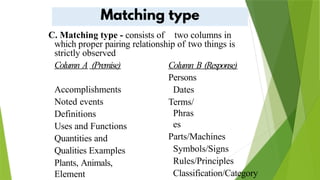
C. Matching type - consists of two columns in
which proper pairing relationship of two things is
strictly observed
Column A (Premise)
Accomplishments
Noted events
Definitions
Uses and Functions
Quantities and
Qualities Examples
Plants, Animals,
Element
Column B (Response)
Persons
Dates
Terms/
Phras
es
Parts/Machines
Symbols/Signs
Rules/Principles
Classification/Category
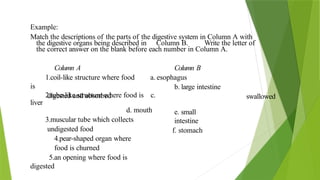
Example:
Match the descriptions of the parts of the digestive system in Column A with
the digestive organs being described in Column B. Write the letter of
the correct answer on the blank before each number in Column A.
Column A
1.coil-like structure where food
is
digested and absorbed
Column B
a. esophagus
b. large intestine
2.tube-like structure where food is c.
liver
d. mouth
3.muscular tube which collects
undigested food
4.pear-shaped organ where
food is churned
5.an opening where food is
digested
swallowed
e. small
intestine
f. stomach
1. Use only homogeneous material in a single matching exercise.
2. Include an unequal number of responses and premises.
3. Keep the list of items to be matched brief, and place the
shorter at the right.
4. Arrange the list of responses in logical order.
5. Indicate in the directions the basis for matching the responses
and premises.
6. Place all the items for one matching exercise on one page.
This type consists of a multiple option
item where it requires a
chronological, logical, rank, etc.
order.
Example: The group of sentences numbered 1 to 5 below consists of
one paragraph. Read the sentences in each number and arrange the
best order to have a complete and well-organized paragraph.
Choose from the options the best order.
1. Miss Castro, their teacher, gave then a good grade.
2. The study was on the determination of protein content of
dried anchovy.
3. One day, the students in the chemistry class conducted
an experiment.
4. All of them were happy.
5. They were all successful in their analysis.
a) 32514
b) 31425
c) 35241 e)
25143
d) 23514
• Essay, is classified as non-objective test, allow for the
assessment of higher order thinking skills. Such tests
require students to organize their thoughts on a
subject matter in coherent sentences in order to
inform an audience.
• In essay tests, students are required to write one or more
paragraphs on a specified topic.
Essay questions can be used to measure attainment of a variety of
objectives. Stecklein (1955) has listed 14 types of abilities that can be
measured by essay items:
• Comparisons between two or more things
• The development and defense of an opinion
• Questions of cause and effect
• Explanations of meanings
• Summarizing of information in a designated area
• Analysis
• Knowledge of relationship
• Illustrations of rules, principles, procedures and applications
• Applications of rules, laws and principles to new situations
• Criticisms of the adequacy, relevance or correctness of a concept, idea
or information
• Formulation of new questions and problems
• Reorganization of facts
• Discriminations between objects, concepts or events
• Inferential thinking
Note that all of these involve the higher-level skills mentioned in
Bloom’s Taxonomy.
1. RESTRICTED-RESPONSE ESSAY
• Restricted Response Limit the ways in which you will permit the
students to answer. There are correct answers and we allow
students to express the answer in their own words.
• Restricted response is predicated on the notion that students supply
the answers rather than selecting the answer from a group options
Examples
1.A car traveling 50 mph leaves Chicago at 9am. A train traveling at
70 mph leaves Milwaukee at 10 am. Who will arrive in Toledo (250
miles away) first? Show your work.
2.Write an essay on the topic “Plant Photosynthesis” using
the keywords and phrases: chlorophyll, sunlight, water, carbon
dioxide, oxygen, by product, stomata.
1. EXTENDED-RESPONSE ESSAY
• Extended Response allow students to express their
own ideas and interrelationships among ideas and use
their own strategy for organization.
Examples
• Design an experiment to calculate the height of
a redwood tree.
• Do you think teachers should be allowed to
work abroad as domestic helpers? Explain your
answer.
•Because the focus is on logical argument and
reasoned answering the teacher must be open
and accept uncomfortable responses
1.State questions that require clear, specific and narrow task or topic to
be performed.
• Some sample terms to use that make the task clear and specific are
as follows: compare, describe, explain, summarize, relate
differentiate, criticize and appraise.
• Give explicit instructions on type of answer desired
Example: Your answer should be confined to 100-150 words. It will
be evaluated in terms of the appropriateness of the facts and
examples presented and the skill with which it is written.
2. Give enough time limit for answering each essay question.
3 . Make it clear to students if spelling, punctuation, content, clarity and
style are to be considered in scoring the essay questions. When these
criteria are clear and specific to students, the item becomes valid.
4. Grade each essay question by the point
method, using well-defined criteria.
• By using certain criteria as guide, scoring essay questions becomes
less subjective and more objective.
Examples of criteria to be used in scoring an essay
• Completeness of ideas presented (40%)
• Clarity of expressions used (30%)
• Organization of ideas (30%)
6. Evaluate all of the students’ responses to one
question before going to the next question.
7. Evaluate answers to essay questions without identifying
the student.
• A good lesson makes a good question
• A good question makes a good content
• A good content makes a good test
• A good test makes a good grade
• A good grade makes a good student
• A good student makes a good
COMMUNITY
Jesus Ochave Ph.D.
VP Research Planning &
Development PNU
• Balagtas, Marilyn U and Dacana, Antonio G, Licensure
Examination for Teachers Refresher Course, Phillipine
Normal University
• Burton, Steven. J. et. al. 1991. How to Prepare Better Multiple Choice
Test Items: Guidelines for University Faculty. Brigham Young
University Instructional
Testing Services and The Department of
Science.
• Guttierez, Danilo S. 2007.
Assessment Outcome (Cognitive Domain)
Book 1. Kerusso
of
Learning
Malabon:
• Lorenzo, Natividad E. 2011. Lecture on
Traditional Mariano Marcos State
University College Education.
Assessment,
of Teacher
• Okonkwo, C.A. 2006. Measurement and Evaluation. National
Open
University of Nigeria. www. NOU.EDU.NG.
• Rivera, Arnel O. Test Construction: The Art of
Effective
Evaluation. UPHSD Molino Campus (PPt, slide
share)
• Santos, Rosita D. 2007. Assessment of Learning 1.
Lorimar
Publishing Inc. Cubao,
Quezon
City

Importance and sample of test-construction.pptx

  • 4.
    It is ameasuring instrument or tool in education.  It is an instrument or device that is typically used in the quantification of a trait or characteristics of a person.  It is an instrument designed to measure quality, ability, skill or knowledge.
  • 6.
    SIMPLE-RECALL TYPE (IDENTIFICATION)  Theresponse requires the subject to recall previously learned material and the answers are usually short consisting of either a word or a phrase. I. SUPPLY TYPE
  • 7.
    SIMPLE-RECALL TYPE (IDENTIFICATION) EXAMPLES: 1. Howmany centimeters make up 2 meters? 1. 2. Convert 7, 000 grams to kilograms. 3. It is the fundamental unit of element. 2. 3. I. SUPPLY TYPE
  • 8.
    Suggestions for theConstruction of Simple- Recall Type (Identification) 1. The direct-question form is usually preferable to the statement form. 2. The blanks for the responses should be in a column preferably at the right column of the items. 3. The question / item should be so worded that there is only one correct response.
  • 9.
  • 10.
    COMPLETION TEST (FILL –IN THE BLANK)  This test consists of a series of items that requires the subject to fill a word or phrase on the blanks. I. SUPPLY TYPE
  • 11.
    1. State theitem clearly and precisely so that only one correct answer is acceptable. EXAMPLE Poor: The type of test that requires students to select correct answer is . Better: The type of test that consists of a stem and three to five alternatives is .
  • 12.
    2. Put theblank toward the end of the sentence. Example: are the incorrect alternatives in a multiple- choice item. Better: The wrong alternatives in a multiple – choice item are called .
  • 13.
    3. Avoid severalblanks, one blank is most recommended. 4. Blanks should be equal in length. Poor: The subatomic particle is the . Better: The positively charged subatomic particle is the .
  • 14.
    6. Avoid givinggrammatical clues to the expected answer. Poor: A collection of questions held in a system of storage is called a . Better: A collection of questions held in a system of storage is called a/an . 7. Avoid copying exact words of the textbook.
  • 15.
    II. SELECTION TYPE A.ALTERNATIVE RESPONSE TEST / TRUE – FALSE TEST
  • 16.
    True – Falseitems require students to identify statements which are correct or incorrect. Only two possible responses are possible in this item format – true or false, right or wrong, yes or no.
  • 17.
    1. Do notgive a hint (inadvertently) in the body of the question. •Example: The Philippines gained its independence in 1898 and therefore celebrated its centennial year in 2000.
  • 18.
    2. Avoid specificdeterminers or give- away qualifiers “always, never , often, seldom” and other adverbs that tend to be either, always true or always false. •Example: Christmas always falls on a Sunday because it is a Sabbath day.
  • 19.
    3. Avoid longsentences as these tend to be “true”. Keep sentences short. •Example: Tests need to be valid, reliable and useful, although, it would require a great amount of time and effort to ensure that tests possess these test characteristics.
  • 20.
    4. Double negativesshould be avoided. Example: True-false items cannot be scored by an untrained person. 5. Avoid quoting verbatim from sentence materials or
  • 21.
     6. Avoidtricky statements with some minor misleading word or spelling anomaly, misplaced phrases etc. A wise student who does not know the subject matter may detect this strategy and thus get the answer correctly. • Example: The Principle of our school is Mr. Albert P. Panadero.
  • 22.
    7. Avoid agrossly disproportionate number of either true or false statements or even patterns in the occurrence of true and false statements.
  • 23.
    1 . a)Tuberculosis is a communicable disease. b) Tuberculosis is a not non-communicable disease. Answer: A is better. B is confusing because of the double negative.
  • 24.
    2 . a)The true-false item is more subject to guessing but it should be used in place of multiple choice item, if well constructed, when there is a dearth of distracters that are plausible. b) The true-false item should be used in place of the multiple choice item when only two alternatives are possible. Answer: B is better. The language in B is simple, clear and concise. Avoid long and complex sentences.
  • 25.
    3 . a)A statement of opinion should never be used in a true – false item. b) A statement of opinion cannot be marked true or false. Answer: B is better. Avoid using determiners or give-away qualifiers.
  • 26.
    4. a) Thetrue – false item is also called alternative response item. b) The true – false item, which is favored by all tests experts, is also called an alternative response. Answer: A is better. B contains two ideas that are confusing.
  • 28.
    Multiple-choice test. Thistest is made up of items that consist of three or more plausible options in each item. It consists of two parts: (1) the stem and the (2) alternatives/options. In the set of options there is a “correct” option while all the others are considered “distracters”. II. SELECTION TYPE / RECOGNITION TYPE MULTIPLE CHOICE TEST II. SELECTION TYPE B. MULTIPLE CHOICE TEST
  • 29.
    What is theplace value ofthe underlined digit in number 1952? a) ones b) tens c) hundreds d) thousands b - correct answer a,c,d - distracters
  • 30.
    GUIDELINES IN THE CONSTRUCTIONOF MULTIPLE CHOICE ITEMS A. STEM B. OPTION
  • 31.
    1. The stemof the item should present clearly a simple central problem or idea. The problem or idea must be accurately stated. Steam is a. given off when carbon burns. b. a by-product of sulfur burning. c. produced when magnesium burns. d. produced by the burning of natural gas. Better: Steam is given off during the burning of a. carbon. b. magnesium. c. natural gas d. sulfur.
  • 32.
    2. All relevantinformation should be included in the stem. Include all the information necessary for the examinee to understand the intent of the item. • Example: When a piece of stone is dropped into the graduated cylinder, the water level rose. What is the volume of the stone? a. 0.6 ml b. 1.6 ml c.32 ml d. 132 ml • Better: The level of water in a graduated cylinder is 50 ml. When a piece of stone is dropped into the cylinder, the water level rose to the 82 ml mark. What is the volume of the stone? a. 0.6 ml b. 1.6 ml c.32 ml d. 132 ml
  • 33.
    3. All irrelevantmaterials should be omitted from the stem. Avoid the inclusion of nonfunctional words. A word or phrase is nonfunctional when it does not contribute to the basis for choosing a response. • Example: Pitong was walking in the park when he passed by a well. He wanted to know how deep the well was so he picked up a stone and dropped the stone into the well. What kind of force is acting on the falling stone? a. electrical b. friction c. gravity d. magnetism Better: A stone was dropped into a deep well. What
  • 34.
    4. The stemshould be stated in positive form. If the negative form is used, emphasize the fact by underlining, using italics or capitalizing it. Avoid using double negatives. • Example: Each of the following substances EXCEPT ONE is a mineral. Which one is not? • Better: Which of the following substances is a mineral?
  • 35.
    5. Place allinformation that can be placed in the stem to avoid repetition in the option. • Example: Substances expand when heated because a. molecules move very fast. b. molecules move very slowly. c. molecules move in all directions. d. molecules move farther from each other. • Better: Substances expand when heated because molecules move a. very fast. b. very slowly. c. in all directions. d. farther from each other.
  • 36.
    6. Avoid givinggrammatical clues. EXAMPLE A word used to describe a noun is called an a) adjective. b) conjunction. c) pronoun. d) verb. A word used to describe a noun is called a) an adjective. b) a conjunction. c) a pronoun. d) a verb. A word used to describe a noun is called a/ an a) adjective. b) conjunction. c) pronoun. d) verb .
  • 37.
    1. The optionshould be homogeneous in the sense that each should be a member of the same set of things. • Example: Which one of the following animals is most clearly in danger ofextinction? c. sampaguita d. tamaraw a. mackerel b. monkey-eating eagle • Better: a. carabao b. cow c. horse d. tamaraw
  • 38.
    2. The optionsshould be related but must not overlap or be synonymous with one another. • Example: Sliding in the bathroom can be prevented by wearing a. sandals with even soles. b. sandals with rough soles. c. sandals with soapy water. d. sandals with smooth soles. • Better: Sliding in the bathroom can be prevented by wearing sandals with a. grease. b. rough soles. c. soapy water. d. smooth soles.
  • 39.
    3. The key(correct option) should be of the same length as the distracters to avoid giving a clue. • Example: One problem met by scientists about cloning animals is that cloned animals. a. get old fast. b. remain young. c. do not reproduce. d. do not live long as uncloned animas do. Better: a. die early.c. get old fast. b. stay young. d. do not reproduce.
  • 40.
    •Research: Numerous studieshave indicated that items are easier when the answer is noticeably longer than the distracters as compared when all of the alternatives are similar in length (Haladyna & Downing, 1986 as cited by Burton et. al. 1991)
  • 41.
    4. Make allthe options grammatically consistent and parallel in form with the stem of the item. Example: How is the movement of bones made possible? a) By pushing the skeletal muscle b) By pulling the skeletal muscles c) Muscles and bones are combined d) Muscle pushes the other muscles - Options C and D are not parallel in form with the key. They must be revised. a
  • 42.
    Better a) By pushingthe skeletal muscle b) By pulling the skeletal muscles c) By pulling and pushing the muscles d) By combining the muscles and bones
  • 43.
    5. State optionsin sequential (natural) order, whether alphabetically or numerically. • Example: Mars’ gravity is 0.38 times that of Earth. What will be the weight on planet Mars of an astronaut who weighs 400 N on Earth? a. 3.62 N b. 10.5 N c. 152 N d. 400.38 N
  • 44.
    Which animal ishatched from eggs? a. carabao b. goat c. rabbit d. snake Options are arranged alphabetically.
  • 45.
    6. Place aperiod at the end of every alternative if the stem is an incomplete statement and do not place a blank line toward the end of the sentence. Example: Substances expand when heated because molecules move A. very fast. B. very slowly. C. in all directions. D. farther from each other. 7. If alternatives are sentences or phrases, arrange them in order of increasing
  • 46.
    7. Put theterm to be defined in the stem and suggest various definitions in the alternatives or options. • Example: The tendency of particles to move from greater concentration to lesser A. diffusion. B.evaporation. concentration is called C. osmosis. D. transpiration. • Better: Diffusion is A. loss of materials from cells of plants and animals. B.the tendency of particles to be evenly distributed. C. the spreading of particles towards the bottom of a container. D. the movement of particles from lesser to greater concentration.
  • 47.
    D Steam is A. givenoff when carbon burns. B. a by-product of sulfur burning. C. produced when magnesium burns. D. produced by the burning of natural gas. iffusion is E. loss of materials from cells of plants and animals. F. the tendency of particles to be evenly distributed. G.the spreading of particles towards the bottom of a container. H. the movement of particles from lesser to greater concentration. The SECOND STEM is a TERM or a PROCESS that needs to be defined while the first item is a result of a process.
  • 48.
    8. Avoid usingthe alternatives ALL OF THE ABOVE and NONE OF THE ABOVE. Example: Which is an example of a mixture? a) air b) juic e c) seawater d) all of the above Which is an example of a mixture? a) air b) gold c) salt d) water
  • 49.
    Which of thefollowing is / are mixtures? I. air II. juic e III. seawater IV. steel a) I only b) I and II only c) I, II, and IV only d) I, II, III, and IV
  • 50.
    • Most ofthe time, the item writer has difficulty of thinking any option so that ALL OF THE ABOVE or NONE OF THE ABOVE is used. • The alternative ( all of the above or none of the above) can be considered a clue for the student • All of the above – all the other options are correct • None of the above – all the options are wrong
  • 51.
  • 52.
    C. Matching type- consists of two columns in which proper pairing relationship of two things is strictly observed Column A (Premise) Accomplishments Noted events Definitions Uses and Functions Quantities and Qualities Examples Plants, Animals, Element Column B (Response) Persons Dates Terms/ Phras es Parts/Machines Symbols/Signs Rules/Principles Classification/Category
  • 53.
    Example: Match the descriptionsof the parts of the digestive system in Column A with the digestive organs being described in Column B. Write the letter of the correct answer on the blank before each number in Column A. Column A 1.coil-like structure where food is digested and absorbed Column B a. esophagus b. large intestine 2.tube-like structure where food is c. liver d. mouth 3.muscular tube which collects undigested food 4.pear-shaped organ where food is churned 5.an opening where food is digested swallowed e. small intestine f. stomach
  • 54.
    1. Use onlyhomogeneous material in a single matching exercise. 2. Include an unequal number of responses and premises. 3. Keep the list of items to be matched brief, and place the shorter at the right. 4. Arrange the list of responses in logical order. 5. Indicate in the directions the basis for matching the responses and premises. 6. Place all the items for one matching exercise on one page.
  • 55.
    This type consistsof a multiple option item where it requires a chronological, logical, rank, etc. order.
  • 56.
    Example: The groupof sentences numbered 1 to 5 below consists of one paragraph. Read the sentences in each number and arrange the best order to have a complete and well-organized paragraph. Choose from the options the best order. 1. Miss Castro, their teacher, gave then a good grade. 2. The study was on the determination of protein content of dried anchovy. 3. One day, the students in the chemistry class conducted an experiment. 4. All of them were happy. 5. They were all successful in their analysis. a) 32514 b) 31425 c) 35241 e) 25143 d) 23514
  • 58.
    • Essay, isclassified as non-objective test, allow for the assessment of higher order thinking skills. Such tests require students to organize their thoughts on a subject matter in coherent sentences in order to inform an audience. • In essay tests, students are required to write one or more paragraphs on a specified topic.
  • 59.
    Essay questions canbe used to measure attainment of a variety of objectives. Stecklein (1955) has listed 14 types of abilities that can be measured by essay items: • Comparisons between two or more things • The development and defense of an opinion • Questions of cause and effect • Explanations of meanings • Summarizing of information in a designated area • Analysis • Knowledge of relationship
  • 60.
    • Illustrations ofrules, principles, procedures and applications • Applications of rules, laws and principles to new situations • Criticisms of the adequacy, relevance or correctness of a concept, idea or information • Formulation of new questions and problems • Reorganization of facts • Discriminations between objects, concepts or events • Inferential thinking Note that all of these involve the higher-level skills mentioned in Bloom’s Taxonomy.
  • 61.
    1. RESTRICTED-RESPONSE ESSAY •Restricted Response Limit the ways in which you will permit the students to answer. There are correct answers and we allow students to express the answer in their own words. • Restricted response is predicated on the notion that students supply the answers rather than selecting the answer from a group options
  • 62.
    Examples 1.A car traveling50 mph leaves Chicago at 9am. A train traveling at 70 mph leaves Milwaukee at 10 am. Who will arrive in Toledo (250 miles away) first? Show your work. 2.Write an essay on the topic “Plant Photosynthesis” using the keywords and phrases: chlorophyll, sunlight, water, carbon dioxide, oxygen, by product, stomata.
  • 63.
    1. EXTENDED-RESPONSE ESSAY •Extended Response allow students to express their own ideas and interrelationships among ideas and use their own strategy for organization. Examples • Design an experiment to calculate the height of a redwood tree. • Do you think teachers should be allowed to work abroad as domestic helpers? Explain your answer.
  • 64.
    •Because the focusis on logical argument and reasoned answering the teacher must be open and accept uncomfortable responses
  • 65.
    1.State questions thatrequire clear, specific and narrow task or topic to be performed. • Some sample terms to use that make the task clear and specific are as follows: compare, describe, explain, summarize, relate differentiate, criticize and appraise. • Give explicit instructions on type of answer desired Example: Your answer should be confined to 100-150 words. It will be evaluated in terms of the appropriateness of the facts and examples presented and the skill with which it is written.
  • 66.
    2. Give enoughtime limit for answering each essay question. 3 . Make it clear to students if spelling, punctuation, content, clarity and style are to be considered in scoring the essay questions. When these criteria are clear and specific to students, the item becomes valid.
  • 67.
    4. Grade eachessay question by the point method, using well-defined criteria. • By using certain criteria as guide, scoring essay questions becomes less subjective and more objective. Examples of criteria to be used in scoring an essay • Completeness of ideas presented (40%) • Clarity of expressions used (30%) • Organization of ideas (30%)
  • 68.
    6. Evaluate allof the students’ responses to one question before going to the next question. 7. Evaluate answers to essay questions without identifying the student.
  • 69.
    • A goodlesson makes a good question • A good question makes a good content • A good content makes a good test • A good test makes a good grade • A good grade makes a good student • A good student makes a good COMMUNITY Jesus Ochave Ph.D. VP Research Planning & Development PNU
  • 70.
    • Balagtas, MarilynU and Dacana, Antonio G, Licensure Examination for Teachers Refresher Course, Phillipine Normal University • Burton, Steven. J. et. al. 1991. How to Prepare Better Multiple Choice Test Items: Guidelines for University Faculty. Brigham Young University Instructional Testing Services and The Department of Science. • Guttierez, Danilo S. 2007. Assessment Outcome (Cognitive Domain) Book 1. Kerusso of Learning Malabon: • Lorenzo, Natividad E. 2011. Lecture on Traditional Mariano Marcos State University College Education. Assessment, of Teacher • Okonkwo, C.A. 2006. Measurement and Evaluation. National Open University of Nigeria. www. NOU.EDU.NG. • Rivera, Arnel O. Test Construction: The Art of Effective Evaluation. UPHSD Molino Campus (PPt, slide share) • Santos, Rosita D. 2007. Assessment of Learning 1. Lorimar Publishing Inc. Cubao, Quezon City