Import and Export Quality
Control: WTO, SAFTA
Ensuring Quality and Compliance in International Trade
Jeevan Shahi
Quality Control
• In general, import and export quality control refers to a
deliberate and planned activity that determines the quality
of a product with a view to accepting it as such in case it
satisfies stipulated requirements.
• It is essential for maintaining product integrity, complying
with regulations, building trust with consumers, and
fostering sustainable business relationships across
borders.
• Quality control is an essential aspect of international trade.
It is a key factor in the success and growth of companies
engaged in global commerce.
Import Quality Control
• Import Quality Control (IQC) is the process of monitoring the
quality of materials and/or components beginning imported.
• It ensures that the products being imported meet the required
standards of safety, quality, and conformity.
• Importance for ensuring product safety and compliance with
standards.
• The process involves inspecting the quality of purchased goods
when the international supplier sends them.
• The quality is inspected by sampling, analyzing, and finally, it is
judged whether the batch of products is accepted or rejected.
Export Quality Control
• Export Quality Control (EQC) is a process that ensures the quality of
products that are exported to other countries meets the required
standards and specifications.
• It’s the critical process of ensuring products meet international
standards and regulations.
• It helps to prevent quality issues with the finished product later on,
which could cost you a lot more money, time, and resources.
• Export Quality Control is importance for building trust with
international partners.
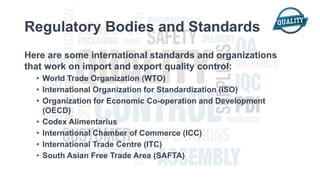
Regulatory Bodies and Standards
Here are some international standards and organizations
that work on import and export quality control:
• World Trade Organization (WTO)
• International Organization for Standardization (ISO)
• Organization for Economic Co-operation and Development
(OECD)
• Codex Alimentarius
• International Chamber of Commerce (ICC)
• International Trade Centre (ITC)
• South Asian Free Trade Area (SAFTA)
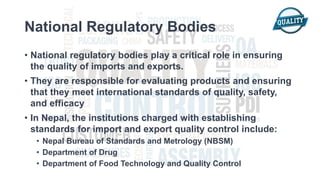
National Regulatory Bodies
• National regulatory bodies play a critical role in ensuring
the quality of imports and exports.
• They are responsible for evaluating products and ensuring
that they meet international standards of quality, safety,
and efficacy
• In Nepal, the institutions charged with establishing
standards for import and export quality control include:
• Nepal Bureau of Standards and Metrology (NBSM)
• Department of Drug
• Department of Food Technology and Quality Control
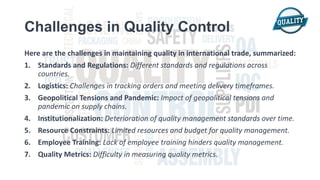
Challenges in Quality Control
Here are the challenges in maintaining quality in international trade, summarized:
1. Standards and Regulations: Different standards and regulations across
countries.
2. Logistics: Challenges in tracking orders and meeting delivery timeframes.
3. Geopolitical Tensions and Pandemic: Impact of geopolitical tensions and
pandemic on supply chains.
4. Institutionalization: Deterioration of quality management standards over time.
5. Resource Constraints: Limited resources and budget for quality management.
6. Employee Training: Lack of employee training hinders quality management.
7. Quality Metrics: Difficulty in measuring quality metrics.
World Trade Organization (WTO)
Introduction
• WTO is only international organization dealing with the global
rules of trade.
• It has 164 members since 29 July 2016.
• Nepal became member of WTO on Nepal - 23 April, 2004.
Objectives
• Promote trade flows by encouraging nations to adopt non
discriminatory and predictable trade policies.
• Raising standard of living and income.
• Introduce sustainable development.
World Trade Organization (WTO)
Functions :
The WTO’s overriding function is to help trade flow smoothly, freely and
predictably. It does this by:
• administering trade agreements
• acting as a forum for trade negotiations
• settling trade disputes
• reviewing national trade policies
• building the trade capacity of developing economies
• cooperating with other international organizations
WTO Agreements
• The WTO agreements are a set of international trade legal
frameworks that cover goods, services, and intellectual
property
• There are two main agreement of our concern:
• SPS Agreement: Also called Agreements on Sanitary and
Phytosanitary Measures.
• Examples of SPS Measures: Food additives, contaminants or
poisonous substance in food and drinks.
• TBT Agreement: Also called Agreement on Technical Barrier to
Trade.
• Examples of SPS Measures: Labeling of food and drink.
SAFTA (South Asian Free Trade Area)
• The South Asian Free Trade Area (SAFTA) is an agreement
reached on 6 January 2004 at the 12th SAARC summit in
Islamabad, Pakistan.
• It created a free trade area for more than 1.6 billion people
in SAARC region (2011).
• The South Asian Free Trade Area (SAFTA) is an agreement
among eight countries: Afghanistan, Bangladesh, Bhutan,
India, the Maldives, Nepal, Pakistan, and Sri Lanka.
• The main goals of SAFTA are to boost trade, help SAFTA
countries work together, and reduce poverty.
SAFTA (South Asian Free Trade Area)
Objectives and benefits of SAFTA for member countries
• To promote trade liberalization in the South Asian region.
• To provide a framework for the elimination of tariffs and
non-tariff barriers to trade among member countries.
• To promote economic cooperation and integration among
member countries.
• To boost trade, help SAFTA countries work together, and
reduce poverty.
• To bring transparency and integrity among the nations.
Quality Control in SAFTA
• Harmonized Standards: SAFTA encourages adoption of international or
mutually recognized standards across member states, reducing trade
barriers and ensuring product compatibility.
• Technical Regulations & Conformity: Member states strive for transparency
and coordination in technical regulations and conformity assessment
procedures for product safety and technical specifications.
• Institutional Mechanisms: SASCOSQAM oversees quality control activities,
while SAB aims to establish a regional accreditation system for testing and
certification bodies.
• Capacity Building: SAFTA promotes technical assistance, training, and best
practice sharing to improve quality control capabilities, especially in
developing nations.
• Information Sharing & Cooperation: Information exchange on quality
measures, regulations, and market surveillance facilitates regional
cooperation and dispute resolution.
• Dispute Settlement: A dedicated mechanism exists to address quality-
related concerns and ensure compliance with agreed-upon standards and
regulations.
Conclusion
• Quality control plays a crucial role in international trade for
sustainable growth.
• Facilitating International Trade: Quality management standards such
as ISO 9000 were originally designed to facilitate international trade.
• Reducing Operational Costs: Prioritizing quality can lead to reduced
operational costs and business losses in the form of rejected goods,
delayed shipments, storage fees, container charges, and more.
• Promoting Sustainable Practices: The growing importance of
sustainable practices in international trade is driven by consumer
demand, regulatory measures, and economic advantages.
• Mitigating Risks and Fostering Innovation: Sustainable practices
offer economic benefits, mitigate risks, and foster innovation.
• In conclusion, quality control is not just about maintaining standards,
but also about driving sustainable growth in international trade.
Thank You!
Any Question?

Import and Export Quality Control

  • 1.
    Import and ExportQuality Control: WTO, SAFTA Ensuring Quality and Compliance in International Trade Jeevan Shahi
  • 2.
    Quality Control • Ingeneral, import and export quality control refers to a deliberate and planned activity that determines the quality of a product with a view to accepting it as such in case it satisfies stipulated requirements. • It is essential for maintaining product integrity, complying with regulations, building trust with consumers, and fostering sustainable business relationships across borders. • Quality control is an essential aspect of international trade. It is a key factor in the success and growth of companies engaged in global commerce.
  • 3.
    Import Quality Control •Import Quality Control (IQC) is the process of monitoring the quality of materials and/or components beginning imported. • It ensures that the products being imported meet the required standards of safety, quality, and conformity. • Importance for ensuring product safety and compliance with standards. • The process involves inspecting the quality of purchased goods when the international supplier sends them. • The quality is inspected by sampling, analyzing, and finally, it is judged whether the batch of products is accepted or rejected.
  • 4.
    Export Quality Control •Export Quality Control (EQC) is a process that ensures the quality of products that are exported to other countries meets the required standards and specifications. • It’s the critical process of ensuring products meet international standards and regulations. • It helps to prevent quality issues with the finished product later on, which could cost you a lot more money, time, and resources. • Export Quality Control is importance for building trust with international partners.
  • 5.
    Regulatory Bodies andStandards Here are some international standards and organizations that work on import and export quality control: • World Trade Organization (WTO) • International Organization for Standardization (ISO) • Organization for Economic Co-operation and Development (OECD) • Codex Alimentarius • International Chamber of Commerce (ICC) • International Trade Centre (ITC) • South Asian Free Trade Area (SAFTA)
  • 6.
    National Regulatory Bodies •National regulatory bodies play a critical role in ensuring the quality of imports and exports. • They are responsible for evaluating products and ensuring that they meet international standards of quality, safety, and efficacy • In Nepal, the institutions charged with establishing standards for import and export quality control include: • Nepal Bureau of Standards and Metrology (NBSM) • Department of Drug • Department of Food Technology and Quality Control
  • 7.
    Challenges in QualityControl Here are the challenges in maintaining quality in international trade, summarized: 1. Standards and Regulations: Different standards and regulations across countries. 2. Logistics: Challenges in tracking orders and meeting delivery timeframes. 3. Geopolitical Tensions and Pandemic: Impact of geopolitical tensions and pandemic on supply chains. 4. Institutionalization: Deterioration of quality management standards over time. 5. Resource Constraints: Limited resources and budget for quality management. 6. Employee Training: Lack of employee training hinders quality management. 7. Quality Metrics: Difficulty in measuring quality metrics.
  • 8.
    World Trade Organization(WTO) Introduction • WTO is only international organization dealing with the global rules of trade. • It has 164 members since 29 July 2016. • Nepal became member of WTO on Nepal - 23 April, 2004. Objectives • Promote trade flows by encouraging nations to adopt non discriminatory and predictable trade policies. • Raising standard of living and income. • Introduce sustainable development.
  • 9.
    World Trade Organization(WTO) Functions : The WTO’s overriding function is to help trade flow smoothly, freely and predictably. It does this by: • administering trade agreements • acting as a forum for trade negotiations • settling trade disputes • reviewing national trade policies • building the trade capacity of developing economies • cooperating with other international organizations
  • 10.
    WTO Agreements • TheWTO agreements are a set of international trade legal frameworks that cover goods, services, and intellectual property • There are two main agreement of our concern: • SPS Agreement: Also called Agreements on Sanitary and Phytosanitary Measures. • Examples of SPS Measures: Food additives, contaminants or poisonous substance in food and drinks. • TBT Agreement: Also called Agreement on Technical Barrier to Trade. • Examples of SPS Measures: Labeling of food and drink.
  • 11.
    SAFTA (South AsianFree Trade Area) • The South Asian Free Trade Area (SAFTA) is an agreement reached on 6 January 2004 at the 12th SAARC summit in Islamabad, Pakistan. • It created a free trade area for more than 1.6 billion people in SAARC region (2011). • The South Asian Free Trade Area (SAFTA) is an agreement among eight countries: Afghanistan, Bangladesh, Bhutan, India, the Maldives, Nepal, Pakistan, and Sri Lanka. • The main goals of SAFTA are to boost trade, help SAFTA countries work together, and reduce poverty.
  • 12.
    SAFTA (South AsianFree Trade Area) Objectives and benefits of SAFTA for member countries • To promote trade liberalization in the South Asian region. • To provide a framework for the elimination of tariffs and non-tariff barriers to trade among member countries. • To promote economic cooperation and integration among member countries. • To boost trade, help SAFTA countries work together, and reduce poverty. • To bring transparency and integrity among the nations.
  • 13.
    Quality Control inSAFTA • Harmonized Standards: SAFTA encourages adoption of international or mutually recognized standards across member states, reducing trade barriers and ensuring product compatibility. • Technical Regulations & Conformity: Member states strive for transparency and coordination in technical regulations and conformity assessment procedures for product safety and technical specifications. • Institutional Mechanisms: SASCOSQAM oversees quality control activities, while SAB aims to establish a regional accreditation system for testing and certification bodies. • Capacity Building: SAFTA promotes technical assistance, training, and best practice sharing to improve quality control capabilities, especially in developing nations. • Information Sharing & Cooperation: Information exchange on quality measures, regulations, and market surveillance facilitates regional cooperation and dispute resolution. • Dispute Settlement: A dedicated mechanism exists to address quality- related concerns and ensure compliance with agreed-upon standards and regulations.
  • 14.
    Conclusion • Quality controlplays a crucial role in international trade for sustainable growth. • Facilitating International Trade: Quality management standards such as ISO 9000 were originally designed to facilitate international trade. • Reducing Operational Costs: Prioritizing quality can lead to reduced operational costs and business losses in the form of rejected goods, delayed shipments, storage fees, container charges, and more. • Promoting Sustainable Practices: The growing importance of sustainable practices in international trade is driven by consumer demand, regulatory measures, and economic advantages. • Mitigating Risks and Fostering Innovation: Sustainable practices offer economic benefits, mitigate risks, and foster innovation. • In conclusion, quality control is not just about maintaining standards, but also about driving sustainable growth in international trade.
  • 15.