Comparison between Information Technology andComparison between Information Technology and
Information SystemInformation System
Submitted To: Inam Ul-Haq
Lecturer of Computer Science
Submitted By:
Group 12
Daniyal Anwar 3056
M. Waqas 3057
Basit Ayub 3058
Usman Malik 3059
Waseem Bashir 3060
IntroductionIntroduction
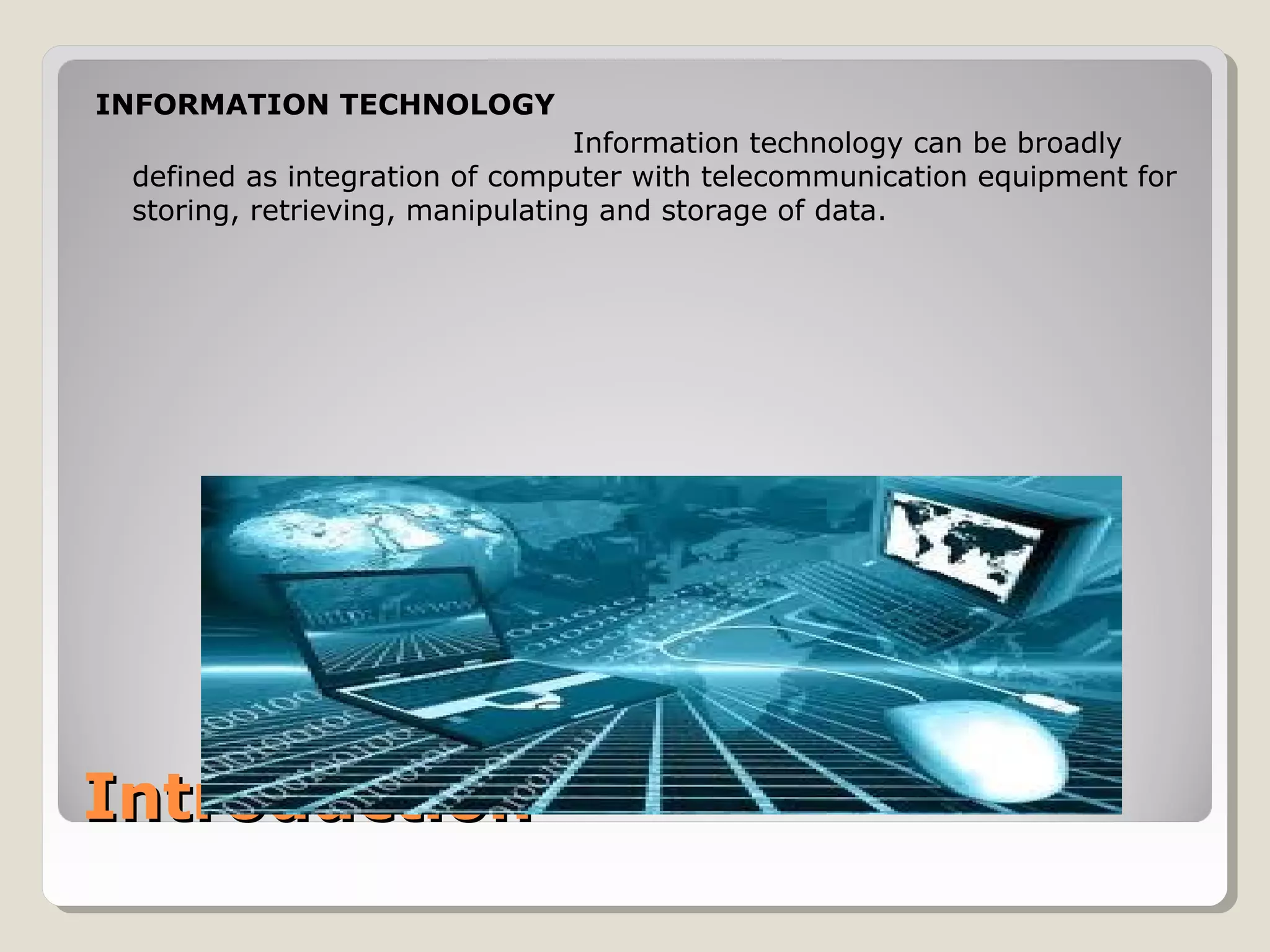
INFORMATION TECHNOLOGY
Information technology can be broadly
defined as integration of computer with telecommunication equipment for
storing, retrieving, manipulating and storage of data.
IntroductionIntroduction
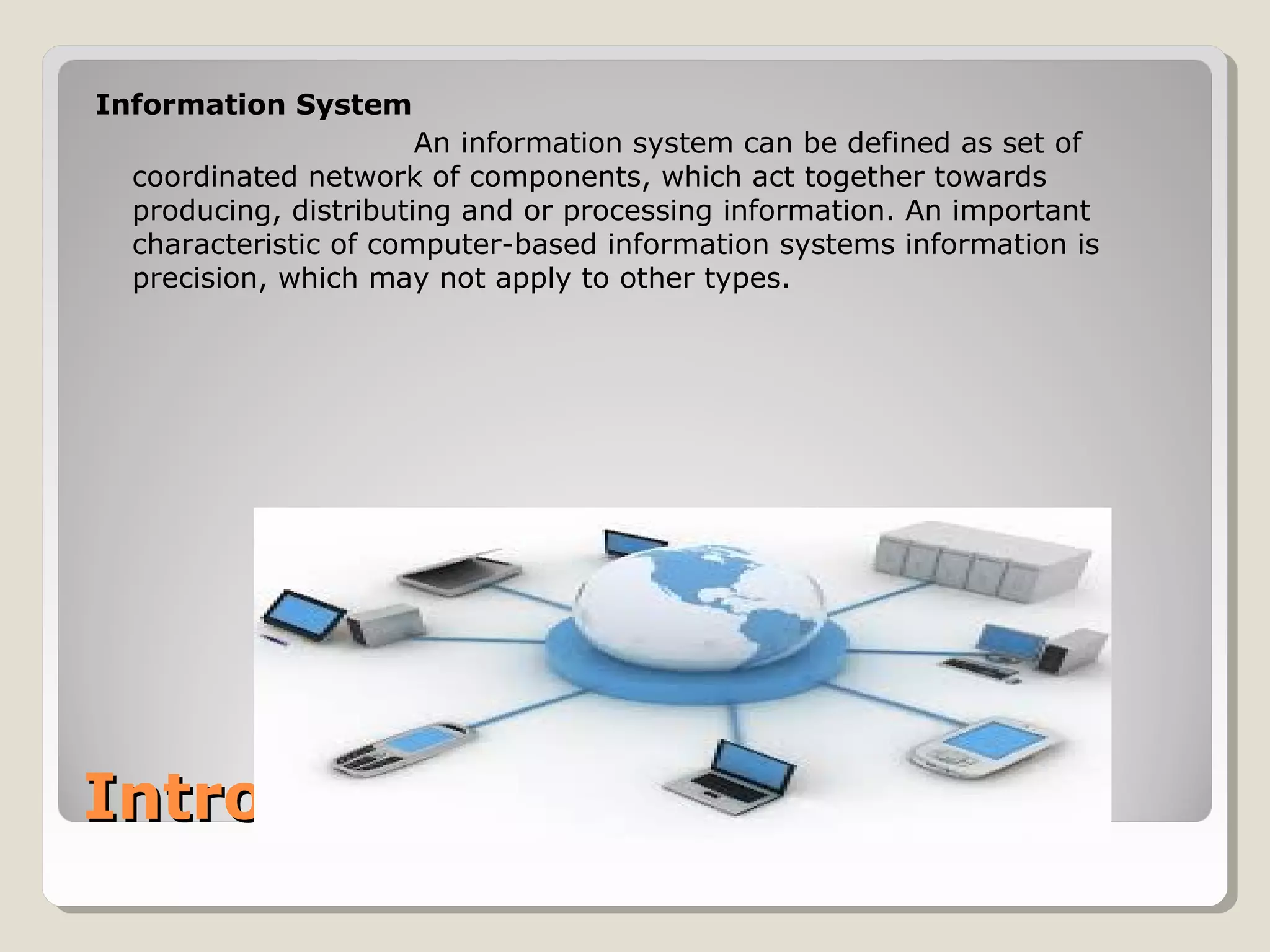
Information System
An information system can be defined as set of
coordinated network of components, which act together towards
producing, distributing and or processing information. An important
characteristic of computer-based information systems information is
precision, which may not apply to other types.
ObjectiveObjective
 Information Technology:
 Its objective is to define and
support technology standard
 The technology used for the study,
understanding planning, design , construction, testing,
distribution, support and operation software computers
and computer related systems that exist for the purpose of
data information and knowledge processing.
 Provide a reliable, efficient, friendly and easily-accessible
organization for information technology and biomedical
engineering support and guidance
ObjectiveObjective
 Information system:
 Identity data requirements
 Understand the IS in automation, organizational learning
and strategic support.
 Understand IS for strategic organizational success
 Understand technological innovation to improve
competitive advantage
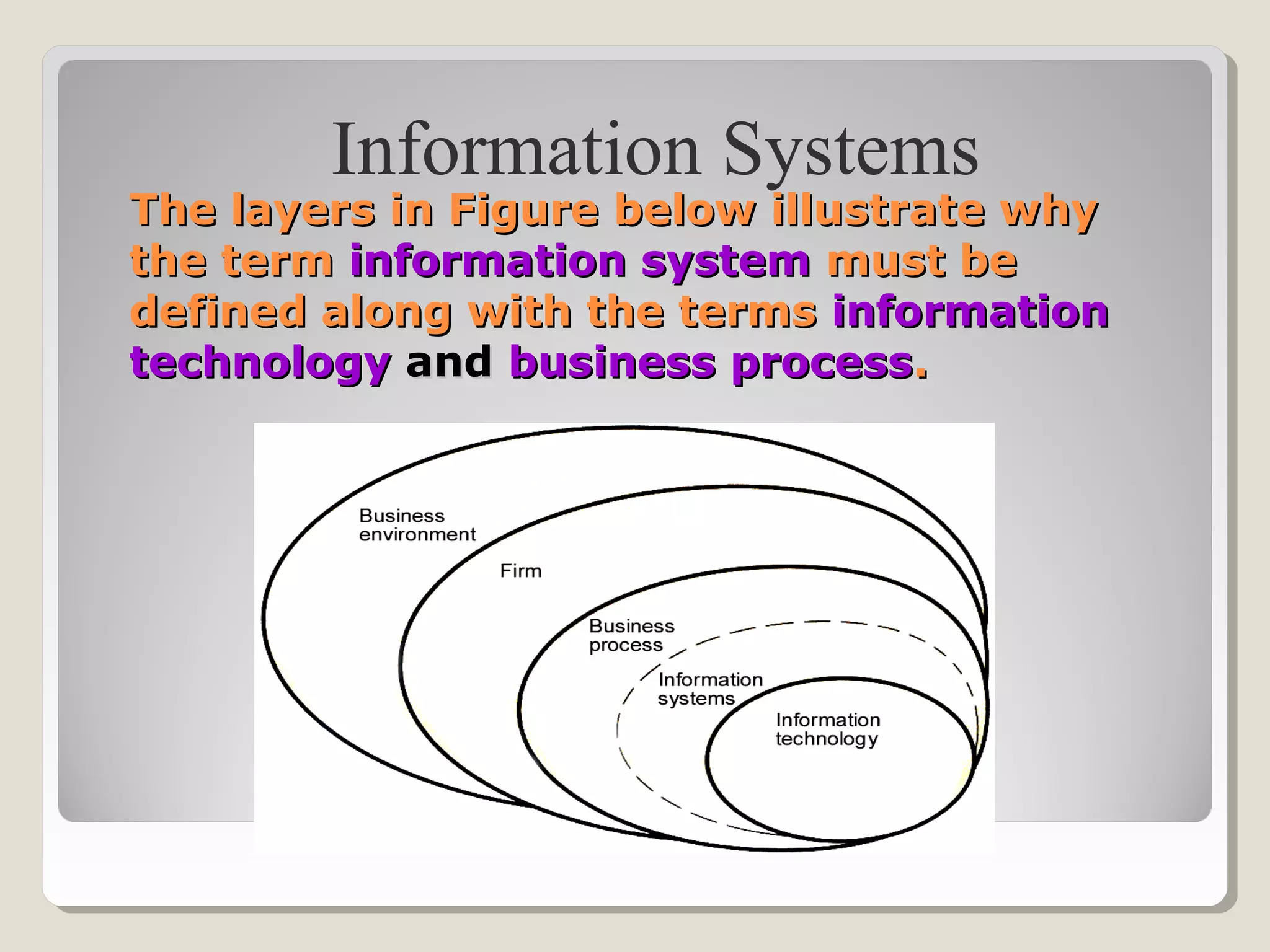
The layers in FigureThe layers in Figure belowbelow illustrate whyillustrate why
the termthe term information systeminformation system must bemust be
defined along with the termsdefined along with the terms informationinformation
technologytechnology andand business processbusiness process..
Information Systems
Information technology is the hardware and
software that make information systems
possible.
An information system is a system that uses
information technology to capture, transmit,
store, retrieve, manipulate, or display
information used in one or more business
processes.
Firms consist of groups of business processes
and compete in a business environment.
A business process is a related group of
steps or activities that use people,
information, and other resources to create
value for internal or external customers.
The business environment includes the firm
itself and everything else that affects its
success, such as competitors, suppliers,
customers, regulatory agencies, and
Comparison b/w IT & ISComparison b/w IT & IS
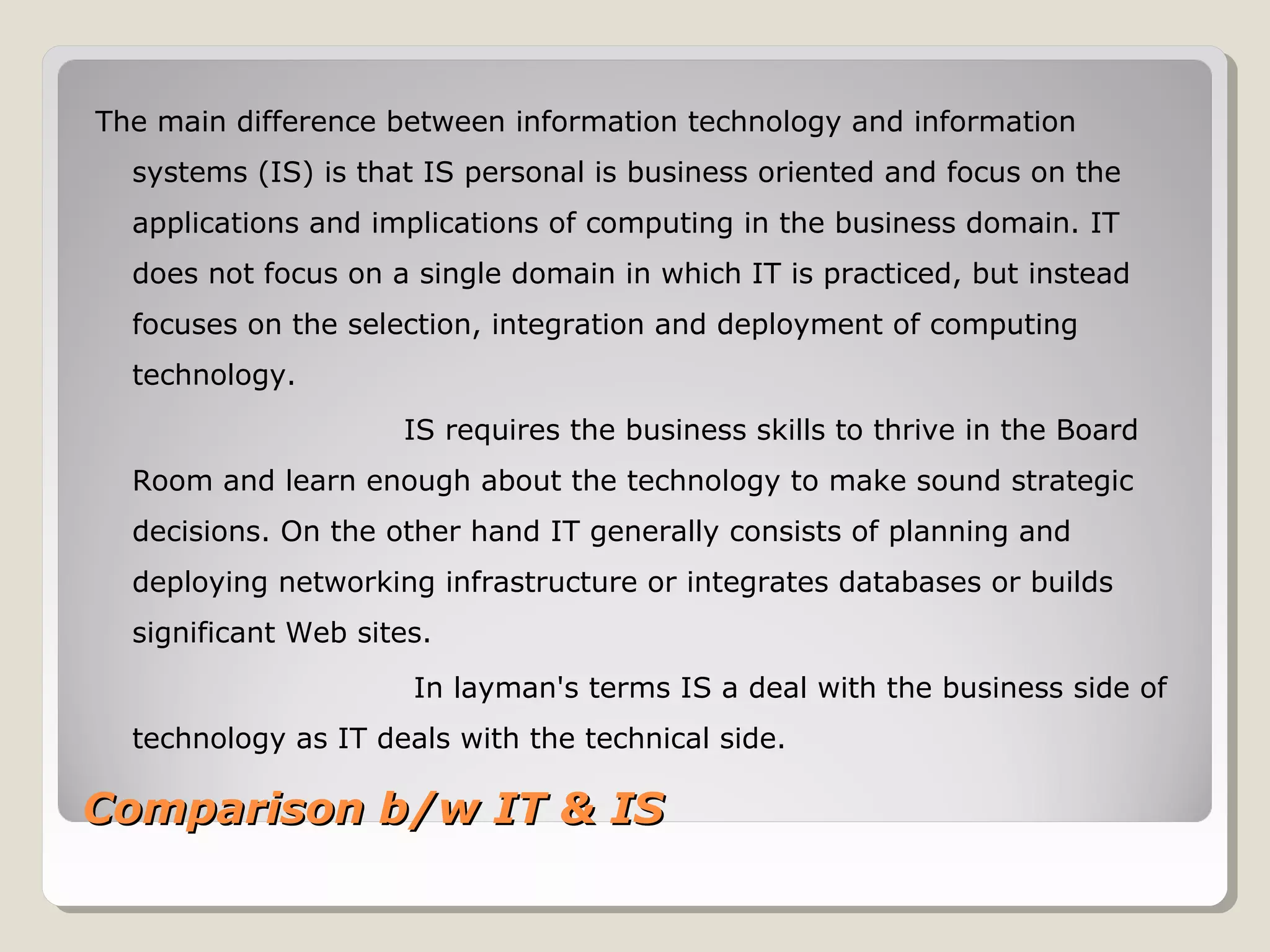
The main difference between information technology and information
systems (IS) is that IS personal is business oriented and focus on the
applications and implications of computing in the business domain. IT
does not focus on a single domain in which IT is practiced, but instead
focuses on the selection, integration and deployment of computing
technology.
IS requires the business skills to thrive in the Board
Room and learn enough about the technology to make sound strategic
decisions. On the other hand IT generally consists of planning and
deploying networking infrastructure or integrates databases or builds
significant Web sites.
In layman's terms IS a deal with the business side of
technology as IT deals with the technical side.
Examples in construction include:
 Feasibility studies
 Scheme design
 Detail design
 Estimating and tendering
 Project planning
 Construction on site
 Administration
Business processes consist of steps related in time and place, have a beginning and end, and
have inputs and outputs.
Business process
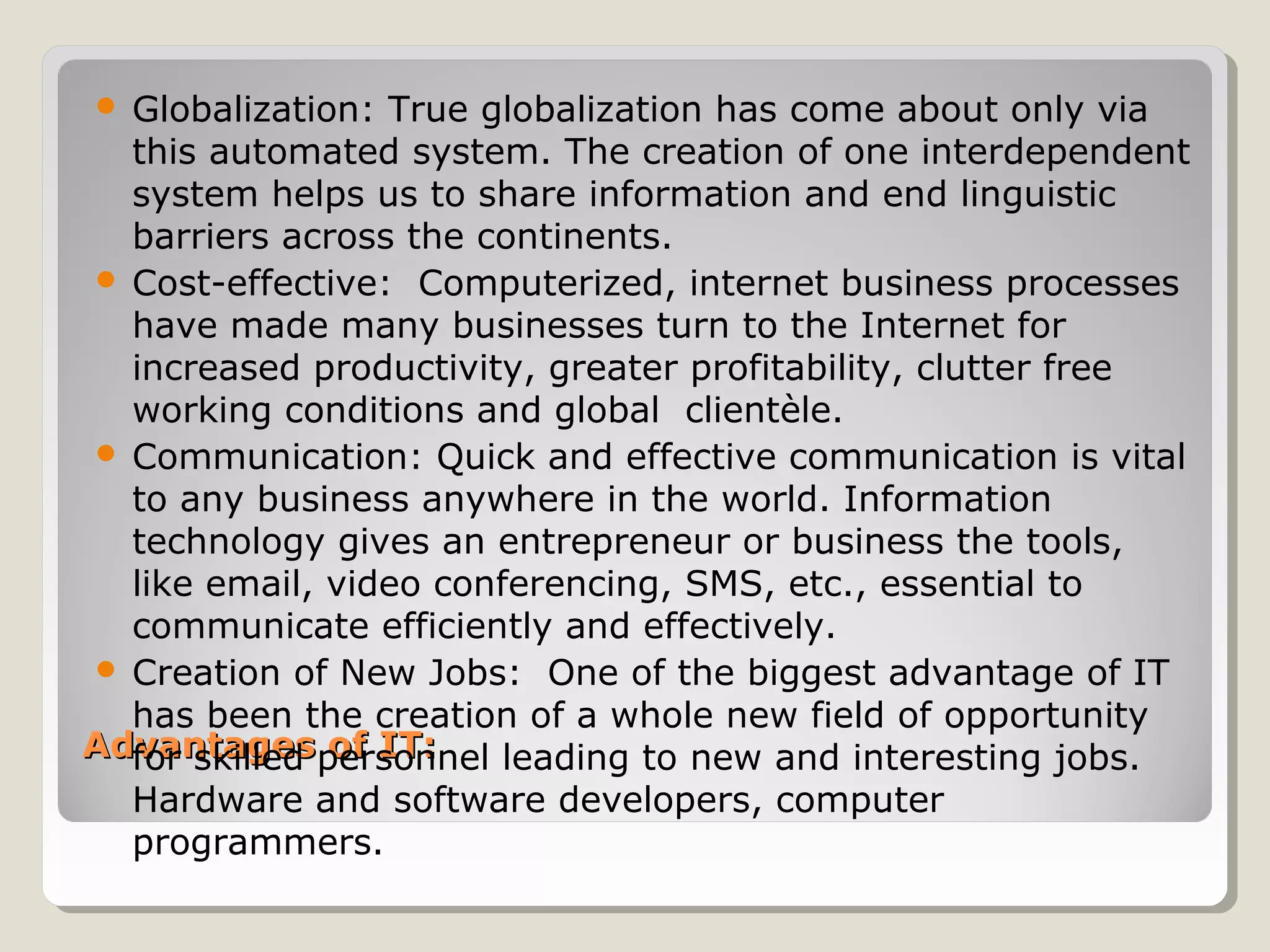
GGeneral framework for thinking about business processes and theeneral framework for thinking about business processes and the
information systems that support them.information systems that support them.
Advantages of IT:Advantages of IT:
 Globalization: True globalization has come about only via
this automated system. The creation of one interdependent
system helps us to share information and end linguistic
barriers across the continents.
 Cost-effective: Computerized, internet business processes
have made many businesses turn to the Internet for
increased productivity, greater profitability, clutter free
working conditions and global clientèle.
 Communication: Quick and effective communication is vital
to any business anywhere in the world. Information
technology gives an entrepreneur or business the tools,
like email, video conferencing, SMS, etc., essential to
communicate efficiently and effectively.
 Creation of New Jobs: One of the biggest advantage of IT
has been the creation of a whole new field of opportunity
for skilled personnel leading to new and interesting jobs.
Hardware and software developers, computer
programmers.
Advantages of using information systems:Advantages of using information systems:
 Increased Productivity: When automation takes over some
of the burden of the more mundane and routine tasks, the
rapid speed increases productivity.
 Increased Efficiency: Inputting data into information
systems where it can be sorted, filed and processed is
highly efficient. Long gone are the days of filing cabinets,
missing papers, misfiled documents and other important
details.
 Better Profitability Levels: Initially investing in computer
information systems is a large investment, but when
strategically planned through proper system analysis, the
investment in information systems can pay off handsomely
over the long term.
Disadvantages of Information System:Disadvantages of Information System:
 Depending on organization deployment, usage and
extraneous factors, some disadvantages related to
Management Information Systems can come to the fore.
Allocation of budgets for MIS upgrades, modifications and
other revisions can be quite tricky at times. Integration
issues with legacy systems can affect the quality of output
and vital business intelligence reports.
 System dependent
 Limited functionality, by design
 Information overload for some managers
 Benefits hard to quantify
 High implementation costs
 System may become slow, large, and hard to manage
 Need good internal processes for data management
 May lead to less reliable and less secure data
Some Disadvantages of Information TechnologySome Disadvantages of Information Technology
 Telephone: We cant take it wherever we go so we will
not be able to receive phone calls , it occupies lot space
, needs lots of connections
 Internet: A very good tool for hackers, robbers and
cyber scam group. Because of this they are accessed to
all hte groups of people and it may lead to bank
robbing.
 Unemployment: While information technology may have
streamlined the business process it has also crated job
redundancies, downsizing and outsourcing. This means
that a lot of lower and middle level jobs have been done
away with causing more people to become unemployed.
ReferenceReference
 www2.ce.metu.edu.tr/~ce733/Slideshows/CE733Lecture1.ppt
http://www.morgan.edu/Documents/ACADEMICS/SBM/INSS/IS
%20CS-EE%20compared.pdf
http://www.katabah.com/2013/02/dITference-between-information-
system.html
 http://www.buzzle.com/articles/advantages-of-information-
technology.html
 www.insidebusiness360.com index.php/advantages-of-using-information-
systems-in-business-14410
 http://www.managementparadise.com/forums/infosystems-mis/167046-
advantages-disadvantages-information-syatem.html
 http://www.studymode.com/essays/Some-Disadvantages-Of-Information-
Technology-Include-714377.html

comparision between IT and Information system

  • 1.
    Comparison between InformationTechnology andComparison between Information Technology and Information SystemInformation System Submitted To: Inam Ul-Haq Lecturer of Computer Science Submitted By: Group 12 Daniyal Anwar 3056 M. Waqas 3057 Basit Ayub 3058 Usman Malik 3059 Waseem Bashir 3060
  • 2.
    IntroductionIntroduction INFORMATION TECHNOLOGY Information technologycan be broadly defined as integration of computer with telecommunication equipment for storing, retrieving, manipulating and storage of data.
  • 3.
    IntroductionIntroduction Information System An informationsystem can be defined as set of coordinated network of components, which act together towards producing, distributing and or processing information. An important characteristic of computer-based information systems information is precision, which may not apply to other types.
  • 4.
    ObjectiveObjective  Information Technology: Its objective is to define and support technology standard  The technology used for the study, understanding planning, design , construction, testing, distribution, support and operation software computers and computer related systems that exist for the purpose of data information and knowledge processing.  Provide a reliable, efficient, friendly and easily-accessible organization for information technology and biomedical engineering support and guidance
  • 5.
    ObjectiveObjective  Information system: Identity data requirements  Understand the IS in automation, organizational learning and strategic support.  Understand IS for strategic organizational success  Understand technological innovation to improve competitive advantage
  • 6.
    The layers inFigureThe layers in Figure belowbelow illustrate whyillustrate why the termthe term information systeminformation system must bemust be defined along with the termsdefined along with the terms informationinformation technologytechnology andand business processbusiness process.. Information Systems
  • 7.
    Information technology isthe hardware and software that make information systems possible. An information system is a system that uses information technology to capture, transmit, store, retrieve, manipulate, or display information used in one or more business processes. Firms consist of groups of business processes and compete in a business environment. A business process is a related group of steps or activities that use people, information, and other resources to create value for internal or external customers. The business environment includes the firm itself and everything else that affects its success, such as competitors, suppliers, customers, regulatory agencies, and
  • 8.
    Comparison b/w IT& ISComparison b/w IT & IS The main difference between information technology and information systems (IS) is that IS personal is business oriented and focus on the applications and implications of computing in the business domain. IT does not focus on a single domain in which IT is practiced, but instead focuses on the selection, integration and deployment of computing technology. IS requires the business skills to thrive in the Board Room and learn enough about the technology to make sound strategic decisions. On the other hand IT generally consists of planning and deploying networking infrastructure or integrates databases or builds significant Web sites. In layman's terms IS a deal with the business side of technology as IT deals with the technical side.
  • 9.
    Examples in constructioninclude:  Feasibility studies  Scheme design  Detail design  Estimating and tendering  Project planning  Construction on site  Administration Business processes consist of steps related in time and place, have a beginning and end, and have inputs and outputs. Business process
  • 10.
    GGeneral framework forthinking about business processes and theeneral framework for thinking about business processes and the information systems that support them.information systems that support them.
  • 11.
    Advantages of IT:Advantagesof IT:  Globalization: True globalization has come about only via this automated system. The creation of one interdependent system helps us to share information and end linguistic barriers across the continents.  Cost-effective: Computerized, internet business processes have made many businesses turn to the Internet for increased productivity, greater profitability, clutter free working conditions and global clientèle.  Communication: Quick and effective communication is vital to any business anywhere in the world. Information technology gives an entrepreneur or business the tools, like email, video conferencing, SMS, etc., essential to communicate efficiently and effectively.  Creation of New Jobs: One of the biggest advantage of IT has been the creation of a whole new field of opportunity for skilled personnel leading to new and interesting jobs. Hardware and software developers, computer programmers.
  • 12.
    Advantages of usinginformation systems:Advantages of using information systems:  Increased Productivity: When automation takes over some of the burden of the more mundane and routine tasks, the rapid speed increases productivity.  Increased Efficiency: Inputting data into information systems where it can be sorted, filed and processed is highly efficient. Long gone are the days of filing cabinets, missing papers, misfiled documents and other important details.  Better Profitability Levels: Initially investing in computer information systems is a large investment, but when strategically planned through proper system analysis, the investment in information systems can pay off handsomely over the long term.
  • 13.
    Disadvantages of InformationSystem:Disadvantages of Information System:  Depending on organization deployment, usage and extraneous factors, some disadvantages related to Management Information Systems can come to the fore. Allocation of budgets for MIS upgrades, modifications and other revisions can be quite tricky at times. Integration issues with legacy systems can affect the quality of output and vital business intelligence reports.  System dependent  Limited functionality, by design  Information overload for some managers  Benefits hard to quantify  High implementation costs  System may become slow, large, and hard to manage  Need good internal processes for data management  May lead to less reliable and less secure data
  • 14.
    Some Disadvantages ofInformation TechnologySome Disadvantages of Information Technology  Telephone: We cant take it wherever we go so we will not be able to receive phone calls , it occupies lot space , needs lots of connections  Internet: A very good tool for hackers, robbers and cyber scam group. Because of this they are accessed to all hte groups of people and it may lead to bank robbing.  Unemployment: While information technology may have streamlined the business process it has also crated job redundancies, downsizing and outsourcing. This means that a lot of lower and middle level jobs have been done away with causing more people to become unemployed.
  • 15.
    ReferenceReference  www2.ce.metu.edu.tr/~ce733/Slideshows/CE733Lecture1.ppt http://www.morgan.edu/Documents/ACADEMICS/SBM/INSS/IS %20CS-EE%20compared.pdf http://www.katabah.com/2013/02/dITference-between-information- system.html  http://www.buzzle.com/articles/advantages-of-information- technology.html www.insidebusiness360.com index.php/advantages-of-using-information- systems-in-business-14410  http://www.managementparadise.com/forums/infosystems-mis/167046- advantages-disadvantages-information-syatem.html  http://www.studymode.com/essays/Some-Disadvantages-Of-Information- Technology-Include-714377.html

Editor's Notes

  • #7 Information systems are systems that use information technology to capture, transmit, store, retrieve, manipulate, or display information used in one or more business processes. Firms consist of groups of business processes and compete in a business environment. Information systems can sometimes be seen as business processes themselves. In sectors such as banking IS/IT is virtually synonymous with business, hence the dotted line in Figure 1.
  • #8 -Hardware is the devices and other physical things involved in processing information, such as computers, workstations, physical networks, and data storage and transmission devices. Software is the computer programs that interpret user inputs and tell the hardware what to do. Software includes operating systems, end-user software such as word processors, and application software related to specialized business tasks such as recording credit card transactions or planning a construction of a facility. -. For example, a department store’s bar-code system for collecting data at the point of sale is part of a larger purchasing and distribution system that includes purchasing decisions and physical movement of goods to the stores. -A business process is a related group of steps or activities that use people, information, and other resources to create value for internal or external customers. Business processes consist of steps related in time and place, have a beginning and end, and have inputs and outputs. Examples in a factory include manufacturing products, hiring employees, and maintaining equipment. -The business environment includes the firm itself and everything else that affects its success, such as competitors, suppliers, customers, regulatory agencies, and demographic, social, and economic conditions.
  • #10 Each of these business processes consists of a group of related activities that have a beginning and end and have inputs and outputs. Although some business processes such as providing customer service are directed at external customers, many business processes create products or services for internal customers within the organization. Information systems will increasingly form the basis for redefining or re-engineering the building processes. Information systems are a critical factor in the future development of the building process. Mechanisms to ensure all parties are informed and coordinated via information and communications technology is one of the engines of change.
  • #11 The WCA framework consists of six linked elements that can be used for thinking about any information system or other business processes and the information systems that support them. The internal or external customers of the business process The products (or services) generated by the business process The steps in the business process The participants in the business process The information the business process uses or creates. The technology the business process uses