Implemention Iso
Implemention Iso
22000 in Steps
22000 in Steps
TASBEIH SHAHEIN
TASBEIH SHAHEIN
According to iso22000 the company must carry out the
following activities in the sequence below:
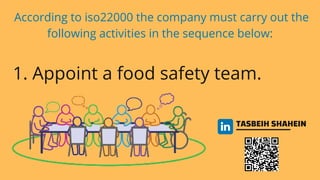
1. Appoint a food safety team.
TASBEIH SHAHEIN
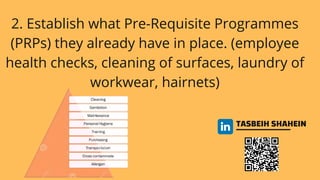
2. Establish what Pre-Requisite Programmes
(PRPs) they already have in place. (employee
health checks, cleaning of surfaces, laundry of
workwear, hairnets)
TASBEIH SHAHEIN
3. These PRPs should then have the activities
to be controlled documents (establish work
instructions/procedures/control forms)
TASBEIH SHAHEIN
4. You should then develop specifications for all raw
materials (including water, packaging and equipment) -
These should reference to the national standards where
appropriate (Ex: Salads, Ketchup, Meat, Poultry)
TASBEIH SHAHEIN
5. Establish specifications for all end products
(dishes) - Including the expected uses of the
products.
TASBEIH SHAHEIN
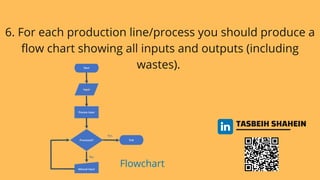
6. For each production line/process you should produce a
flow chart showing all inputs and outputs (including
wastes).
Flowchart
TASBEIH SHAHEIN
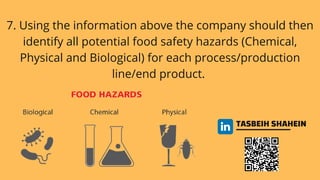
7. Using the information above the company should then
identify all potential food safety hazards (Chemical,
Physical and Biological) for each process/production
line/end product.
TASBEIH SHAHEIN
8. Now you have a list of all the potential
hazards you think you could have.
TASBEIH SHAHEIN
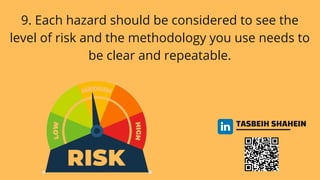
9. Each hazard should be considered to see the
level of risk and the methodology you use needs to
be clear and repeatable.
TASBEIH SHAHEIN
Ex: Hazard = Physical contamination by hair in product,
the current controls are for all employees to wear
hairnets and arm covers; This is a lower risk.
Ex: Hazard = Microbiology in cooked rice, the current controls
mean the rice is left in the microwave for 12 hours and heated
when needed; This has a high risk.
TASBEIH SHAHEIN
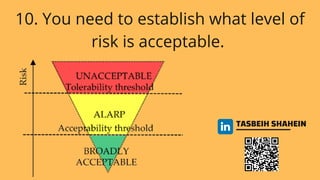
10. You need to establish what level of
risk is acceptable.
TASBEIH SHAHEIN
11. Once they know the level of
acceptable risk they must address all
hazards which are over that level.
TASBEIH SHAHEIN
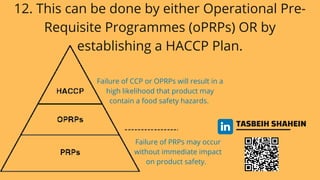
12. This can be done by either Operational Pre-
Requisite Programmes (oPRPs) OR by
establishing a HACCP Plan.
Failure of CCP or OPRPs will result in a
high likelihood that product may
contain a food safety hazards.
Failure of PRPs may occur
without immediate impact
on product safety.
TASBEIH SHAHEIN
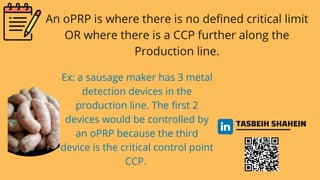
An oPRP is where there is no defined critical limit
OR where there is a CCP further along the
Production line.
Ex: a sausage maker has 3 metal
detection devices in the
production line. The first 2
devices would be controlled by
an oPRP because the third
device is the critical control point
CCP.
TASBEIH SHAHEIN
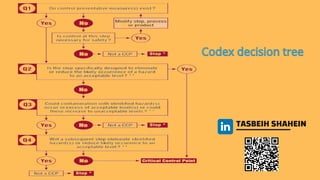
13. You must select the control measures to address the
hazard using a defined methodology (normally the Codex
decision tree) - this decision methodology must be
repeatable and the record available to show it was
followed.
TASBEIH SHAHEIN
Codex decision tree
Codex decision tree
TASBEIH SHAHEIN
14. You must Validate the control measures
to confirm they will reduce the hazards to
below the acceptable level.
TASBEIH SHAHEIN
15. Once the validation confirms that the hazard
will be reduced effectively they need to document
and implement the control measures
16. Once implemented these need to be
verified periodically.
TASBEIH SHAHEIN
I
h
o
p
e
y
o
u
f
i
n
d
t
h
i
s
useful and see y
o
u
i
n
t
h
e
n
e
x
t
o
n
e
.
TASBEIH SHAHEIN

Implementation of Iso 22000 in Steps.pdf

  • 1.
    Implemention Iso Implemention Iso 22000in Steps 22000 in Steps TASBEIH SHAHEIN
  • 2.
    TASBEIH SHAHEIN According toiso22000 the company must carry out the following activities in the sequence below: 1. Appoint a food safety team.
  • 3.
    TASBEIH SHAHEIN 2. Establishwhat Pre-Requisite Programmes (PRPs) they already have in place. (employee health checks, cleaning of surfaces, laundry of workwear, hairnets)
  • 4.
    TASBEIH SHAHEIN 3. ThesePRPs should then have the activities to be controlled documents (establish work instructions/procedures/control forms)
  • 5.
    TASBEIH SHAHEIN 4. Youshould then develop specifications for all raw materials (including water, packaging and equipment) - These should reference to the national standards where appropriate (Ex: Salads, Ketchup, Meat, Poultry)
  • 6.
    TASBEIH SHAHEIN 5. Establishspecifications for all end products (dishes) - Including the expected uses of the products.
  • 7.
    TASBEIH SHAHEIN 6. Foreach production line/process you should produce a flow chart showing all inputs and outputs (including wastes). Flowchart
  • 8.
    TASBEIH SHAHEIN 7. Usingthe information above the company should then identify all potential food safety hazards (Chemical, Physical and Biological) for each process/production line/end product.
  • 9.
    TASBEIH SHAHEIN 8. Nowyou have a list of all the potential hazards you think you could have.
  • 10.
    TASBEIH SHAHEIN 9. Eachhazard should be considered to see the level of risk and the methodology you use needs to be clear and repeatable.
  • 11.
    TASBEIH SHAHEIN Ex: Hazard= Physical contamination by hair in product, the current controls are for all employees to wear hairnets and arm covers; This is a lower risk. Ex: Hazard = Microbiology in cooked rice, the current controls mean the rice is left in the microwave for 12 hours and heated when needed; This has a high risk.
  • 12.
    TASBEIH SHAHEIN 10. Youneed to establish what level of risk is acceptable.
  • 13.
    TASBEIH SHAHEIN 11. Oncethey know the level of acceptable risk they must address all hazards which are over that level.
  • 14.
    TASBEIH SHAHEIN 12. Thiscan be done by either Operational Pre- Requisite Programmes (oPRPs) OR by establishing a HACCP Plan. Failure of CCP or OPRPs will result in a high likelihood that product may contain a food safety hazards. Failure of PRPs may occur without immediate impact on product safety.
  • 15.
    TASBEIH SHAHEIN An oPRPis where there is no defined critical limit OR where there is a CCP further along the Production line. Ex: a sausage maker has 3 metal detection devices in the production line. The first 2 devices would be controlled by an oPRP because the third device is the critical control point CCP.
  • 16.
    TASBEIH SHAHEIN 13. Youmust select the control measures to address the hazard using a defined methodology (normally the Codex decision tree) - this decision methodology must be repeatable and the record available to show it was followed.
  • 17.
    TASBEIH SHAHEIN Codex decisiontree Codex decision tree
  • 18.
    TASBEIH SHAHEIN 14. Youmust Validate the control measures to confirm they will reduce the hazards to below the acceptable level.
  • 19.
    TASBEIH SHAHEIN 15. Oncethe validation confirms that the hazard will be reduced effectively they need to document and implement the control measures
  • 20.
    16. Once implementedthese need to be verified periodically. TASBEIH SHAHEIN
  • 21.
    I h o p e y o u f i n d t h i s useful and seey o u i n t h e n e x t o n e . TASBEIH SHAHEIN