1
Tutorial Day 4
2
What is health ?
WHO definition:- Health is a complete physical, mental & social well-
being and not merely an absence of disease or infirmity.
In recent years, this statement has been amplified to include the ability
to lead a “socially and economically productive life”.
3
Determinants of health
• Biological
• Behavioral & Socio-cultural coditions
• Environmental
• Socio-Economic Conditions
• Health Services
• Ageing of the population
• Gender
• Human Rights
• Equity & social justice
• Science & Technology
• Information & Communication
4
Dimensions of health
• Physical
• Mental
• Social
• Spiritual
• Emotional
• Vocational
• Others
5
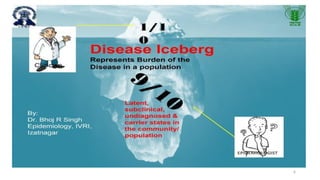
ICEBERG Phenomenon
6
7
Not shown by
• Measles
• Tetanus
• Rubella
• Pertusis
• Rabies
8
EPIDEMIOLOGY
• The study of the occurrence and distribution of health-related events,
states, and processes in specified populations, including the study of
the determinants influencing such processes, and the application of
this knowledge to control relevant health problems
9
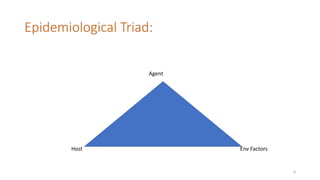
Epidemiological Triad:
Agent
Host Env Factors
10
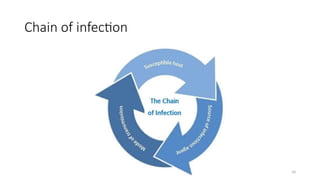
Chain of infection
11
Components of epidemiology:
• Disease frequency
• Distribution-Time, Place, Person
• Determinants-Eg.-Lung cancer, CVD
12
Tools of Measurement in epidemiology:
• Rate-Numerator, Denominator, Time specification & Multiplier
• Ratio-Numerator is not a component of the denominator
• Proportion- is a ratio that indicates the relation in the magnitude of a
part of the whole. The numerator is always included in the
denominator
13
Incidence
• The Number of new cases
occurring in a defined
population during a specified
period of time
• I=No. of new cases of specified
ds. during a given time
period/Population during that
period×1000
Prevalence
• A Total number of individuals
who have an attribute or disease
at a particular time(or during a
particular period) divided by the
population at risk of having the
attribute or disease at this point
of time or midway through the
period
14
Endemic, Epidemic,Pandemic
• Endemic: constant presence of disease or infectious agent within a
given geographic area or population group without importation from
outside
• Epidemic: The occurrence in a community or region of cases of an
illness, specific health-related behaviour, or other health –related
events clearly in excess of normal expectancy
• Pandemic: An epidemic occurring over a very wide area, crossing
international boundaries, and usually affecting a large number of
people
15
Modes of transmission:
Direct
• Direct contact
• Droplet infection
• Contact with soil
• Inoculation into skin or mucosa
• Transplacental
Indirect
• Vehicle borne
• Vector borne-Mechanical,
Biological
• Air borne-Droplet nuclei, Dust
• Fomite Borne
• Unclean hands and fingers
16
Carrier & Types of carrier:
• An infected person or animal that harbors a specific infectious agent
without discernible clinical disease and serves as a potential source of
infection for others.
• By Type: Incubatory Carriers, Convalescent Carriers, Healthy Carrier
• By Duration: Temporary,Chronic
17
Incubation Period:
• The time interval between invasion by an infectious agent and the
appearance of the 1st
sign or symptom of the disease in question
18
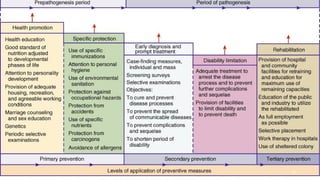
Levels of prevention
Natural history of disease
19
• Primordial- before the emergence of risk factors
Health education
• Primary- risk factor present but no disease
prevention in pre pathogenesis stage
Health promotion & Specific protection
• Secondary- disease started
pathogenesis phase
Early Dx and T/t
• Tertiary- Diseases in progress/over
Disability limitation, Rehab
20
21
Attack rate & Secondary attack Rate & Case
fatality rate :
• Attack Rate: No. of new cases of a specified ds. during a specified time
interval/Total population at risk during the same interval×100
• SAR: No. of exposed persons developing the disease within the range
of incubation period following exposure to a primary case
• Case fatality rate: No.of deaths from a specified disease during a
specified time period /no, of cases of the disease during the same
time period×100
22
PQLI & HDI
23
• PQLI :- Physical quality of life index (1-100)= India 77.67(rank 117/193)
1. Literacy rate
2. Infant mortality rate
3. Life expectancy @1 yr of age
• HDI:- Human development Index (0-1)= India 0.644 (rank 134/ 193)
1. Mean years of schooling/Education index/ Enrollment ratio
2. Purchasing power parity/ income per capita
3. Life expectancy @birth
Highest PQLI state
Lowest PQLI state
Odisha?
Highest HDI state
Lowest HDI state
Odisha?
24
Mortality Indicators
Crude death rate
Life expectancy
MMR (rate/ratio)
IMR
Under 5 Mortality rate
Age-specific death rate
Case fatality rate
25
Morbidity Indicators
Incidence
Prevalence
Notification rate
Admission rate
Discharge rate
26
Disability Rates
Event type ( No of days restricted/ Bed disability days/ work loss days)
Person type ( Limitation of mobility/ Limitation of activity)
DALE
QALY
DALY=(YLL+YLD)
27
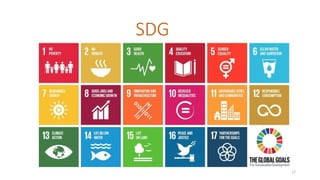
SDG
28
Health specific goal
• SDG3 – Good Health & well being ; Ensure healthy lives & promote
well being for all at all ages
29
Disease Control:
• Reduction In transmission to such a low level that it stops to be public
health concern
• Reduction in INCIDENCE
DURATION
FINANCIAL BURDEN
COMPLICATIONS
30
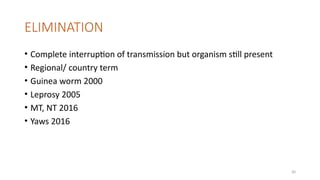
ELIMINATION
• Complete interruption of transmission but organism still present
• Regional/ country term
• Guinea worm 2000
• Leprosy 2005
• MT, NT 2016
• Yaws 2016
31
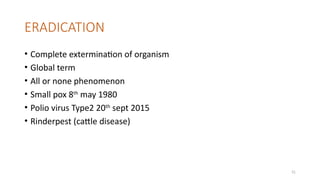
ERADICATION
• Complete extermination of organism
• Global term
• All or none phenomenon
• Small pox 8th
may 1980
• Polio virus Type2 20th
sept 2015
• Rinderpest (cattle disease)
32
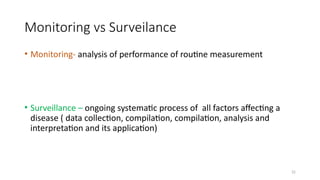
Monitoring vs Surveilance
• Monitoring- analysis of performance of routine measurement
• Surveillance – ongoing systematic process of all factors affecting a
disease ( data collection, compilation, compilation, analysis and
interpretation and its application)
33
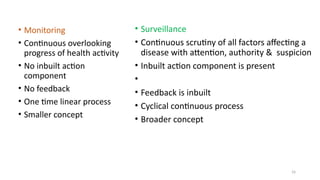
• Monitoring
• Continuous overlooking
progress of health activity
• No inbuilt action
component
• No feedback
• One time linear process
• Smaller concept
• Surveillance
• Continuous scrutiny of all factors affecting a
disease with attention, authority & suspicion
• Inbuilt action component is present
•
• Feedback is inbuilt
• Cyclical continuous process
• Broader concept
34
Sentinel Surveillance
• Used to identify missed or hidden cases
• HIV- in blood bank, anti natal clinic, STD clinic
• Identify both old and new cases
35
Types of study design in epidemiology:
Observational:
• Descriptive: Case Report, Case
Series,
• Analytical: Cross-sectional,
Cohort, Case-control, Ecological,
Nested case-control
Experimental/interventional
• Randomized Control trials
• Field trial
• Community trial
36
Blinding
• A process where study participants are prevented from knowing
certain information that may somehow influence them.
• Single blind: participants
• Double blind: Doctor & Study participants
• Tripple blind: Investigator, participant, person analyzing data
37
Randomization
• Randomization is a statistical procedure by which the participants are
allocated into groups usually called study and control groups, to
receive or not to receive an experimental preventive or therapeutic
procedure, manoeuvre, or intervention

Day4 Tutorial 1 Edited cm tutorial for test.pptx

  • 1.
  • 2.
    2 What is health? WHO definition:- Health is a complete physical, mental & social well- being and not merely an absence of disease or infirmity. In recent years, this statement has been amplified to include the ability to lead a “socially and economically productive life”.
  • 3.
    3 Determinants of health •Biological • Behavioral & Socio-cultural coditions • Environmental • Socio-Economic Conditions • Health Services • Ageing of the population • Gender • Human Rights • Equity & social justice • Science & Technology • Information & Communication
  • 4.
    4 Dimensions of health •Physical • Mental • Social • Spiritual • Emotional • Vocational • Others
  • 5.
  • 6.
  • 7.
    7 Not shown by •Measles • Tetanus • Rubella • Pertusis • Rabies
  • 8.
    8 EPIDEMIOLOGY • The studyof the occurrence and distribution of health-related events, states, and processes in specified populations, including the study of the determinants influencing such processes, and the application of this knowledge to control relevant health problems
  • 9.
  • 10.
  • 11.
    11 Components of epidemiology: •Disease frequency • Distribution-Time, Place, Person • Determinants-Eg.-Lung cancer, CVD
  • 12.
    12 Tools of Measurementin epidemiology: • Rate-Numerator, Denominator, Time specification & Multiplier • Ratio-Numerator is not a component of the denominator • Proportion- is a ratio that indicates the relation in the magnitude of a part of the whole. The numerator is always included in the denominator
  • 13.
    13 Incidence • The Numberof new cases occurring in a defined population during a specified period of time • I=No. of new cases of specified ds. during a given time period/Population during that period×1000 Prevalence • A Total number of individuals who have an attribute or disease at a particular time(or during a particular period) divided by the population at risk of having the attribute or disease at this point of time or midway through the period
  • 14.
    14 Endemic, Epidemic,Pandemic • Endemic:constant presence of disease or infectious agent within a given geographic area or population group without importation from outside • Epidemic: The occurrence in a community or region of cases of an illness, specific health-related behaviour, or other health –related events clearly in excess of normal expectancy • Pandemic: An epidemic occurring over a very wide area, crossing international boundaries, and usually affecting a large number of people
  • 15.
    15 Modes of transmission: Direct •Direct contact • Droplet infection • Contact with soil • Inoculation into skin or mucosa • Transplacental Indirect • Vehicle borne • Vector borne-Mechanical, Biological • Air borne-Droplet nuclei, Dust • Fomite Borne • Unclean hands and fingers
  • 16.
    16 Carrier & Typesof carrier: • An infected person or animal that harbors a specific infectious agent without discernible clinical disease and serves as a potential source of infection for others. • By Type: Incubatory Carriers, Convalescent Carriers, Healthy Carrier • By Duration: Temporary,Chronic
  • 17.
    17 Incubation Period: • Thetime interval between invasion by an infectious agent and the appearance of the 1st sign or symptom of the disease in question
  • 18.
  • 19.
    19 • Primordial- beforethe emergence of risk factors Health education • Primary- risk factor present but no disease prevention in pre pathogenesis stage Health promotion & Specific protection • Secondary- disease started pathogenesis phase Early Dx and T/t • Tertiary- Diseases in progress/over Disability limitation, Rehab
  • 20.
  • 21.
    21 Attack rate &Secondary attack Rate & Case fatality rate : • Attack Rate: No. of new cases of a specified ds. during a specified time interval/Total population at risk during the same interval×100 • SAR: No. of exposed persons developing the disease within the range of incubation period following exposure to a primary case • Case fatality rate: No.of deaths from a specified disease during a specified time period /no, of cases of the disease during the same time period×100
  • 22.
  • 23.
    23 • PQLI :-Physical quality of life index (1-100)= India 77.67(rank 117/193) 1. Literacy rate 2. Infant mortality rate 3. Life expectancy @1 yr of age • HDI:- Human development Index (0-1)= India 0.644 (rank 134/ 193) 1. Mean years of schooling/Education index/ Enrollment ratio 2. Purchasing power parity/ income per capita 3. Life expectancy @birth Highest PQLI state Lowest PQLI state Odisha? Highest HDI state Lowest HDI state Odisha?
  • 24.
    24 Mortality Indicators Crude deathrate Life expectancy MMR (rate/ratio) IMR Under 5 Mortality rate Age-specific death rate Case fatality rate
  • 25.
  • 26.
    26 Disability Rates Event type( No of days restricted/ Bed disability days/ work loss days) Person type ( Limitation of mobility/ Limitation of activity) DALE QALY DALY=(YLL+YLD)
  • 27.
  • 28.
    28 Health specific goal •SDG3 – Good Health & well being ; Ensure healthy lives & promote well being for all at all ages
  • 29.
    29 Disease Control: • ReductionIn transmission to such a low level that it stops to be public health concern • Reduction in INCIDENCE DURATION FINANCIAL BURDEN COMPLICATIONS
  • 30.
    30 ELIMINATION • Complete interruptionof transmission but organism still present • Regional/ country term • Guinea worm 2000 • Leprosy 2005 • MT, NT 2016 • Yaws 2016
  • 31.
    31 ERADICATION • Complete exterminationof organism • Global term • All or none phenomenon • Small pox 8th may 1980 • Polio virus Type2 20th sept 2015 • Rinderpest (cattle disease)
  • 32.
    32 Monitoring vs Surveilance •Monitoring- analysis of performance of routine measurement • Surveillance – ongoing systematic process of all factors affecting a disease ( data collection, compilation, compilation, analysis and interpretation and its application)
  • 33.
    33 • Monitoring • Continuousoverlooking progress of health activity • No inbuilt action component • No feedback • One time linear process • Smaller concept • Surveillance • Continuous scrutiny of all factors affecting a disease with attention, authority & suspicion • Inbuilt action component is present • • Feedback is inbuilt • Cyclical continuous process • Broader concept
  • 34.
    34 Sentinel Surveillance • Usedto identify missed or hidden cases • HIV- in blood bank, anti natal clinic, STD clinic • Identify both old and new cases
  • 35.
    35 Types of studydesign in epidemiology: Observational: • Descriptive: Case Report, Case Series, • Analytical: Cross-sectional, Cohort, Case-control, Ecological, Nested case-control Experimental/interventional • Randomized Control trials • Field trial • Community trial
  • 36.
    36 Blinding • A processwhere study participants are prevented from knowing certain information that may somehow influence them. • Single blind: participants • Double blind: Doctor & Study participants • Tripple blind: Investigator, participant, person analyzing data
  • 37.
    37 Randomization • Randomization isa statistical procedure by which the participants are allocated into groups usually called study and control groups, to receive or not to receive an experimental preventive or therapeutic procedure, manoeuvre, or intervention