Background Subtraction
Validation
Overview
●Problem Statement
●Background Subtraction Methods
●Methodology in creating ROC curve
●Data Sets Used
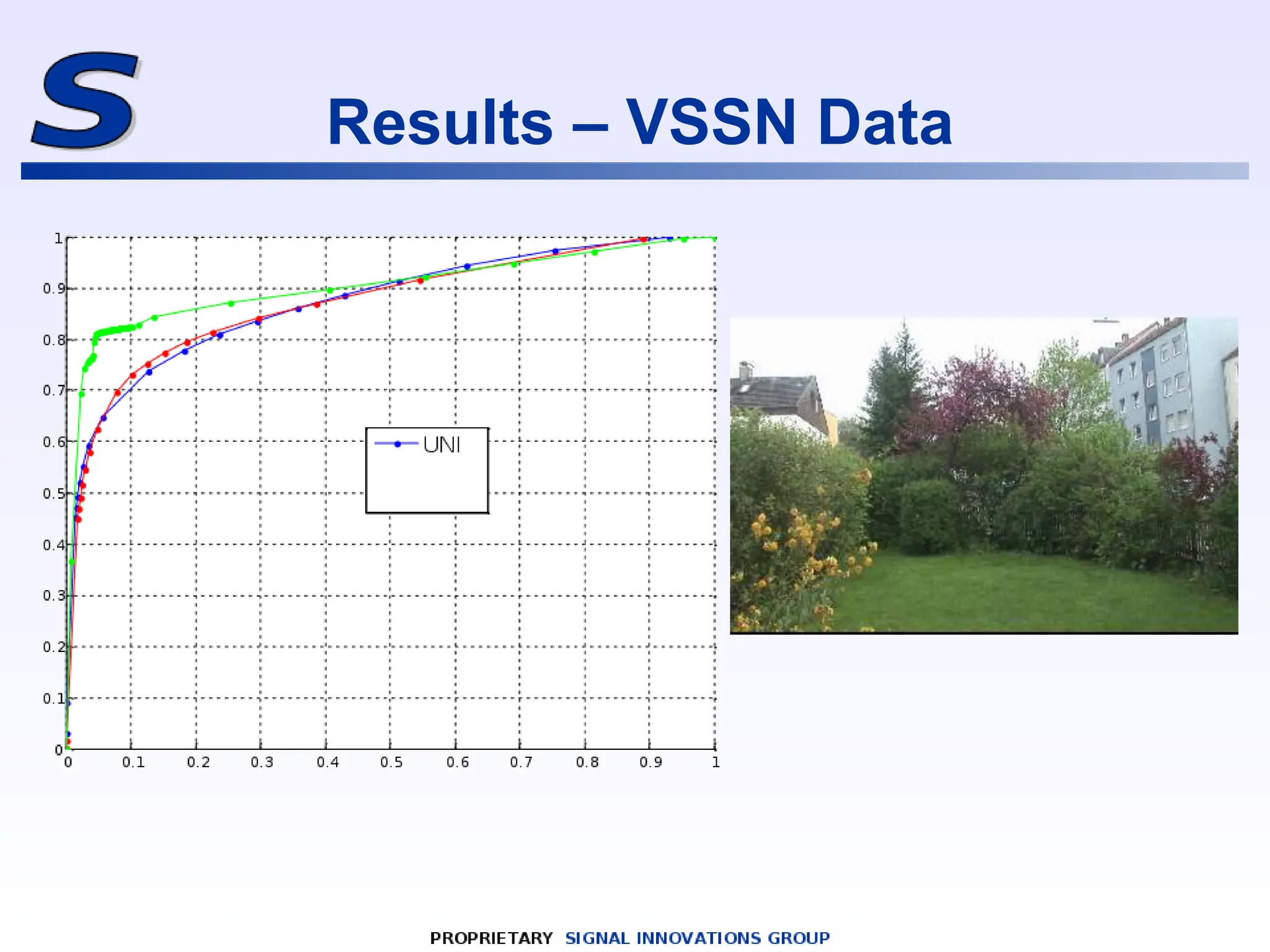
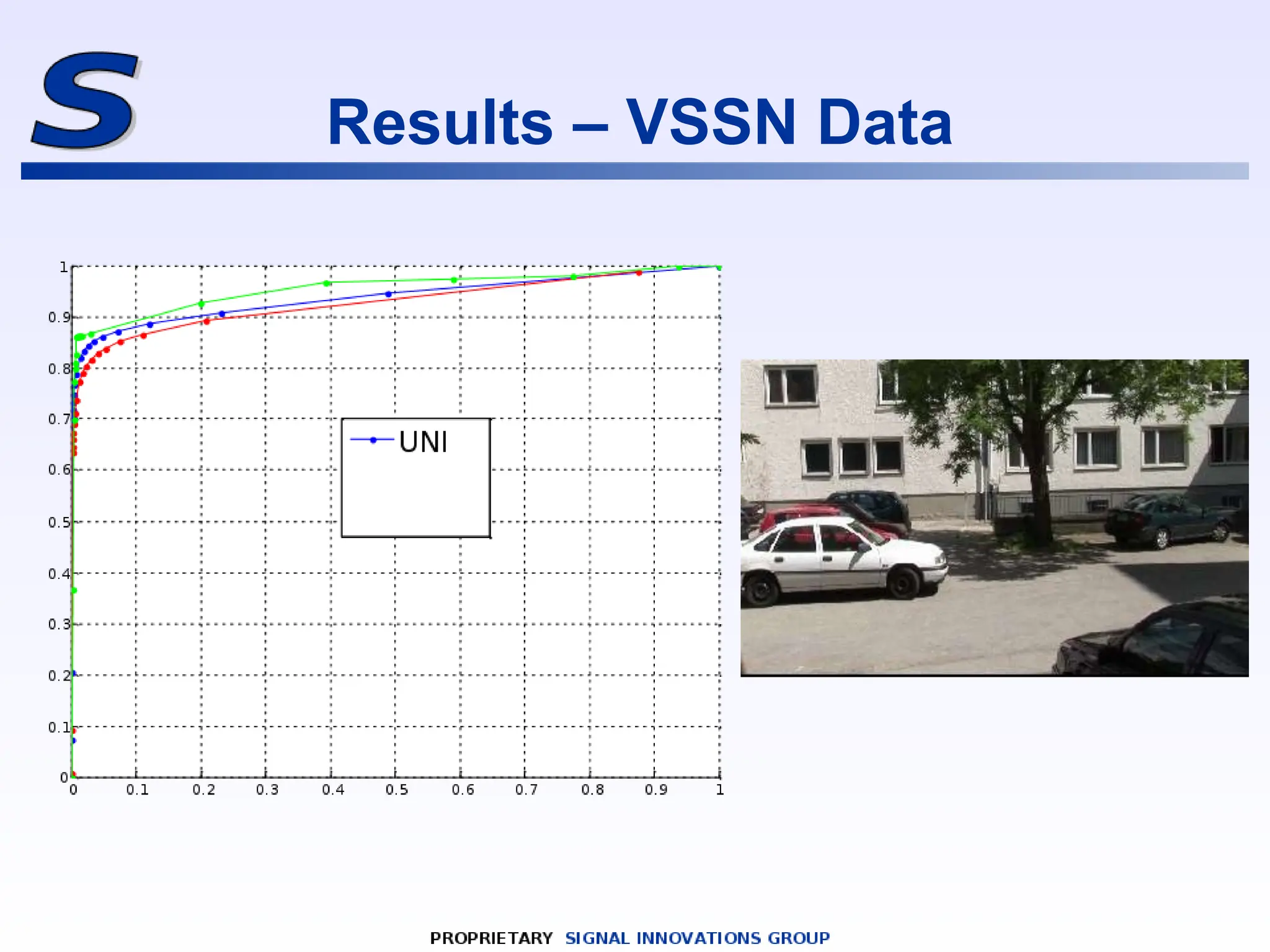
●ROC Results
●Conclusions/Discussion
Problem Statement
●Review and compare current methods of
Background Subtraction that have been
implemented, internally in SIG as well as in
Machine Vision community.
●Create a methodology to quantitatively compare
these methods of background subtraction.
●Summarize strengths and weakness of methods
●Conclusions / Discussion points going forward
Methods in Community
Gaussian Parametric Models
Mixture of Gaussians (MoG)
●Adaptive background mixture models for real-time tracking - C
Stauffer, WEL Grimson
●Understanding background mixture models for foreground
segmentation - PW Power, JA Schoonees
Bimodal
●W 4: real-time surveillance of people and theiractivities - I
Haritaoglu, D Harwood, LS Davis
Univariate Guassian
●Pfinder: Real-Time Tracking of the Human Body - CR Wren, A
Azarbayejani, T Darrell
Methods in Community
Non Parametric
Kernel Density Estimation
●Non-parametric model for background subtraction - A Elgammal, D
Harwood, L Davis
●Motion-based background subtraction using adaptive kernel density
estimation - A Mittal, N Paragios
●Background and Foreground Modeling Using Nonparametric Kernel
Density for Visual Surveillance - A Elgammal, R Duraiswami, D
Harwood, LS Davis
Codebook
●Background modeling and subtraction by codebook construction - K
Kim, TH Chalidabhongse, D Harwood, L Davis
Methods in Community
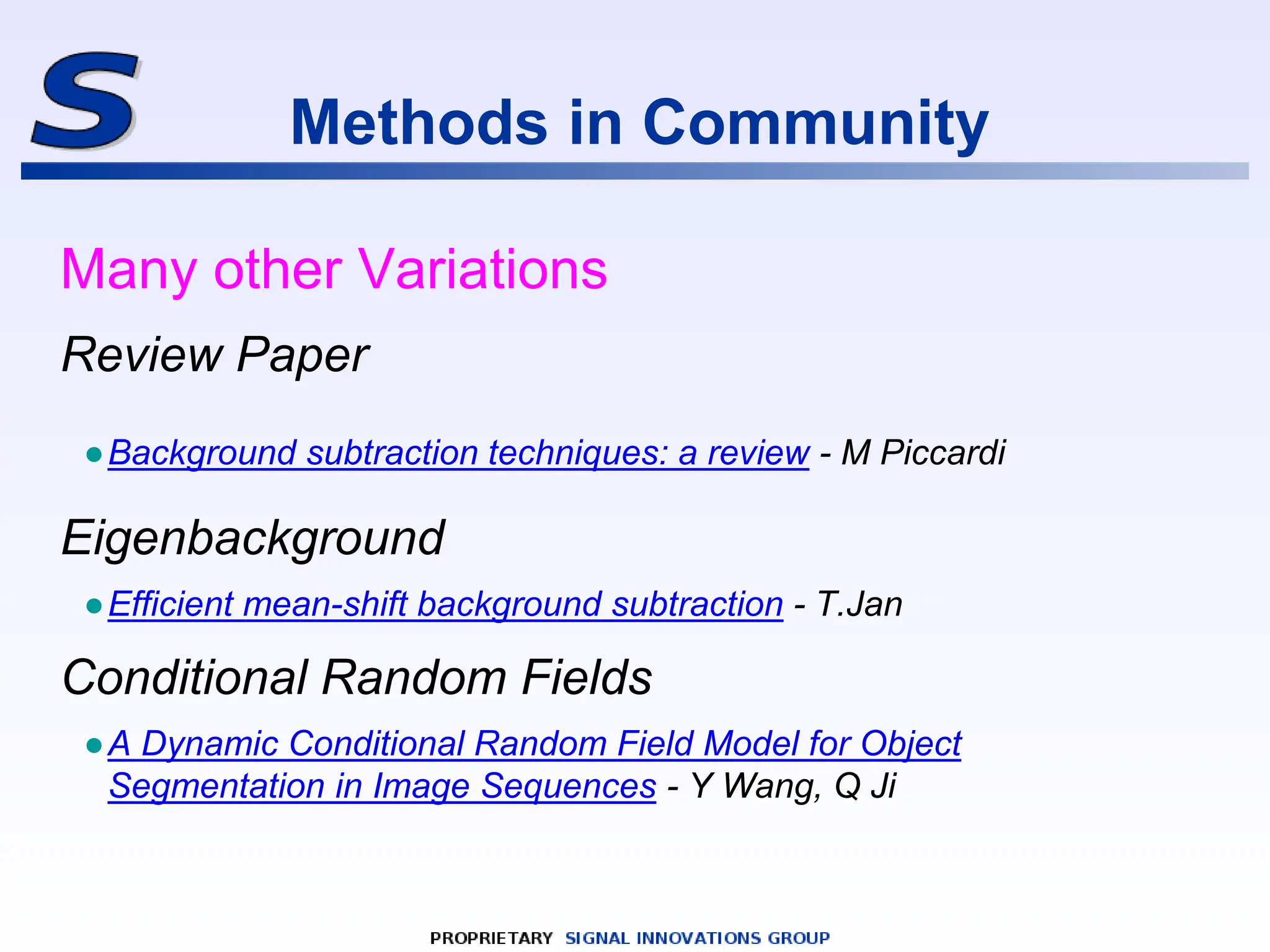
Many other Variations
Review Paper
●Background subtraction techniques: a review - M Piccardi
Eigenbackground
●Efficient mean-shift background subtraction - T.Jan
Conditional Random Fields
●A Dynamic Conditional Random Field Model for Object
Segmentation in Image Sequences - Y Wang, Q Ji
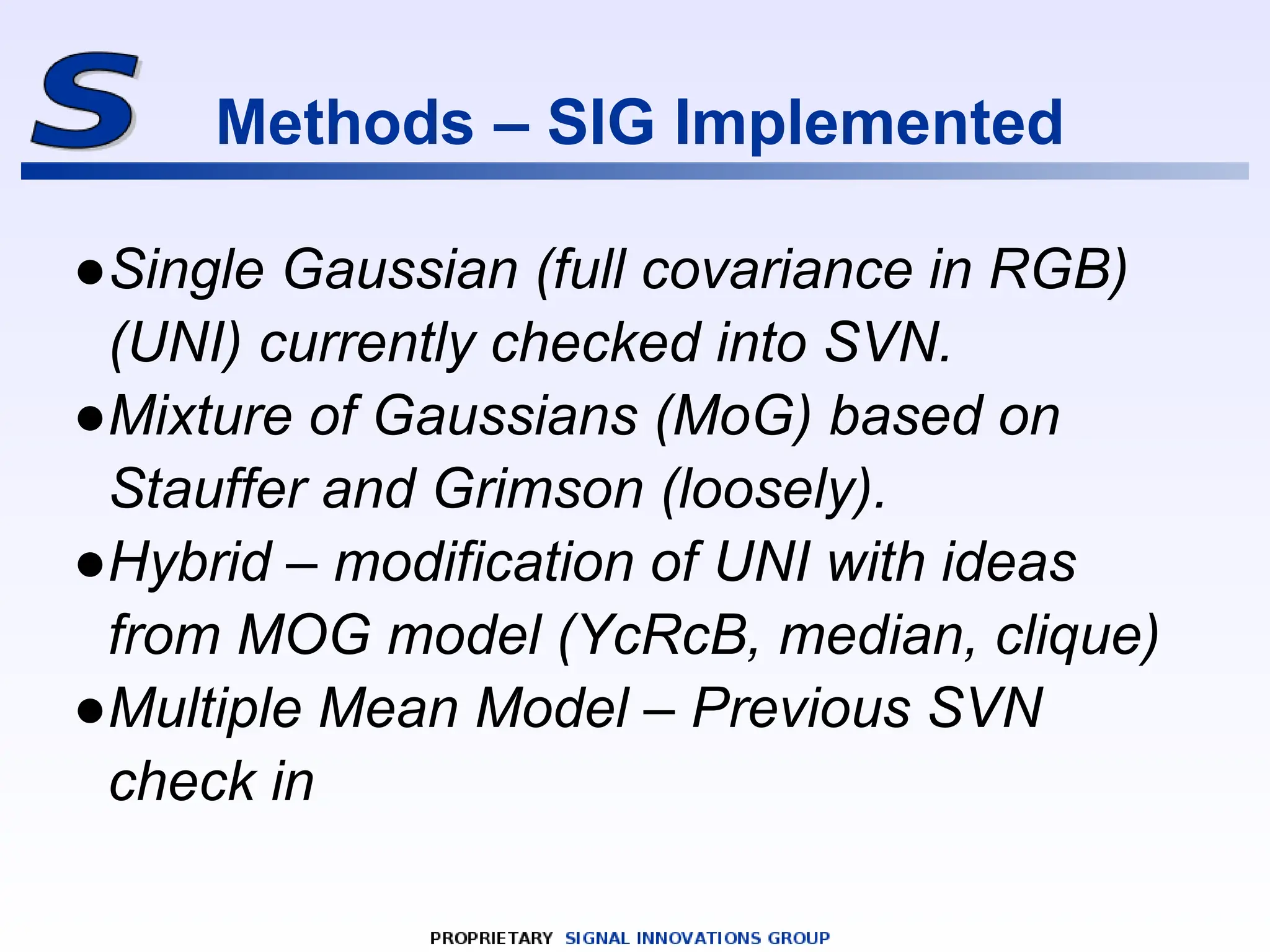
Methods – SIG Implemented
●Single Gaussian (full covariance in RGB)
(UNI) currently checked into SVN.
●Mixture of Gaussians (MoG) based on
Stauffer and Grimson (loosely).
●Hybrid – modification of UNI with ideas
from MOG model (YcRcB, median, clique)
●Multiple Mean Model – Previous SVN
check in
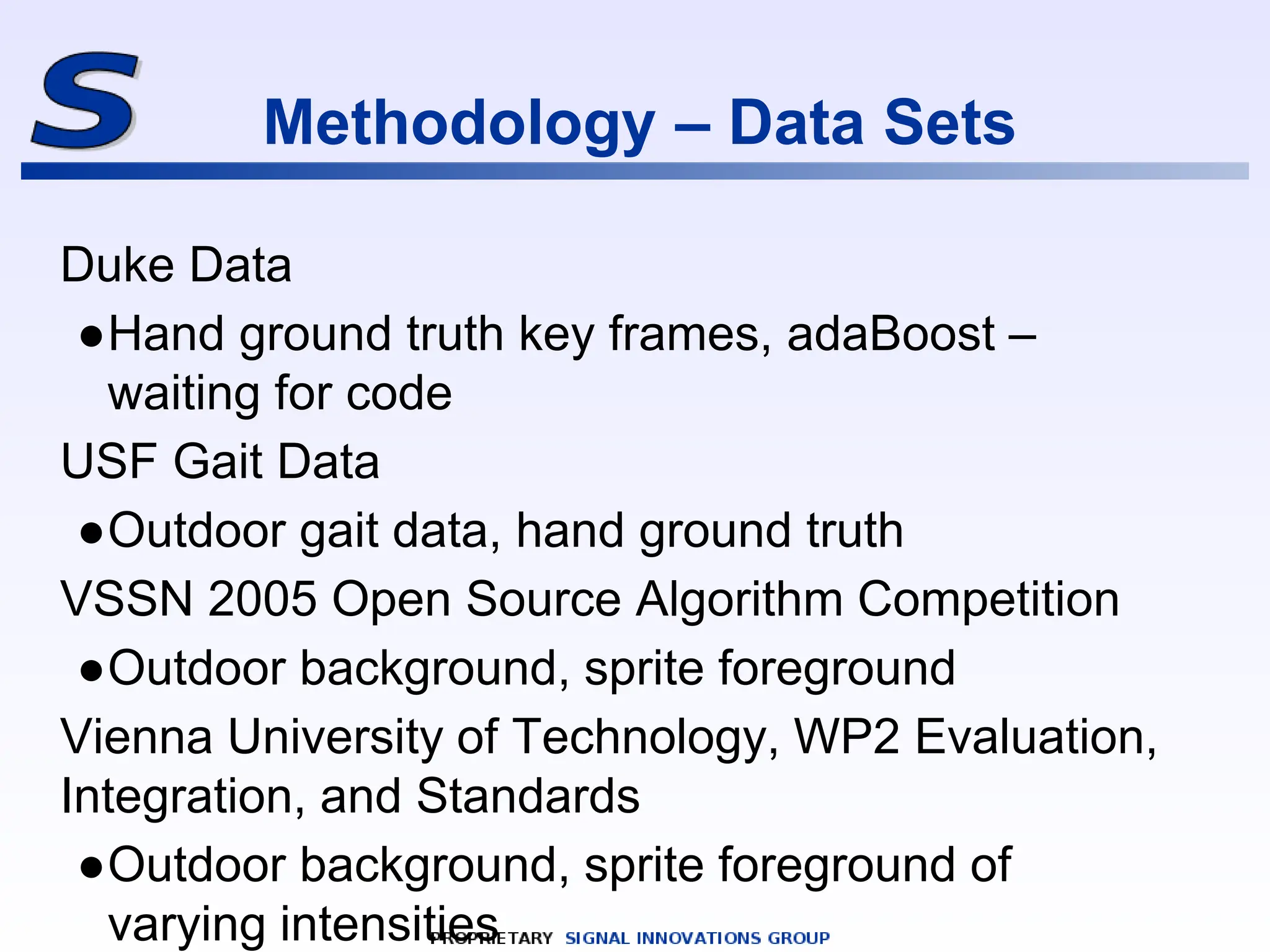
Methodology – Data Sets
Duke Data
●Hand ground truth key frames, adaBoost –
waiting for code
USF Gait Data
●Outdoor gait data, hand ground truth
VSSN 2005 Open Source Algorithm Competition
●Outdoor background, sprite foreground
Vienna University of Technology, WP2 Evaluation,
Integration, and Standards
●Outdoor background, sprite foreground of
varying intensities
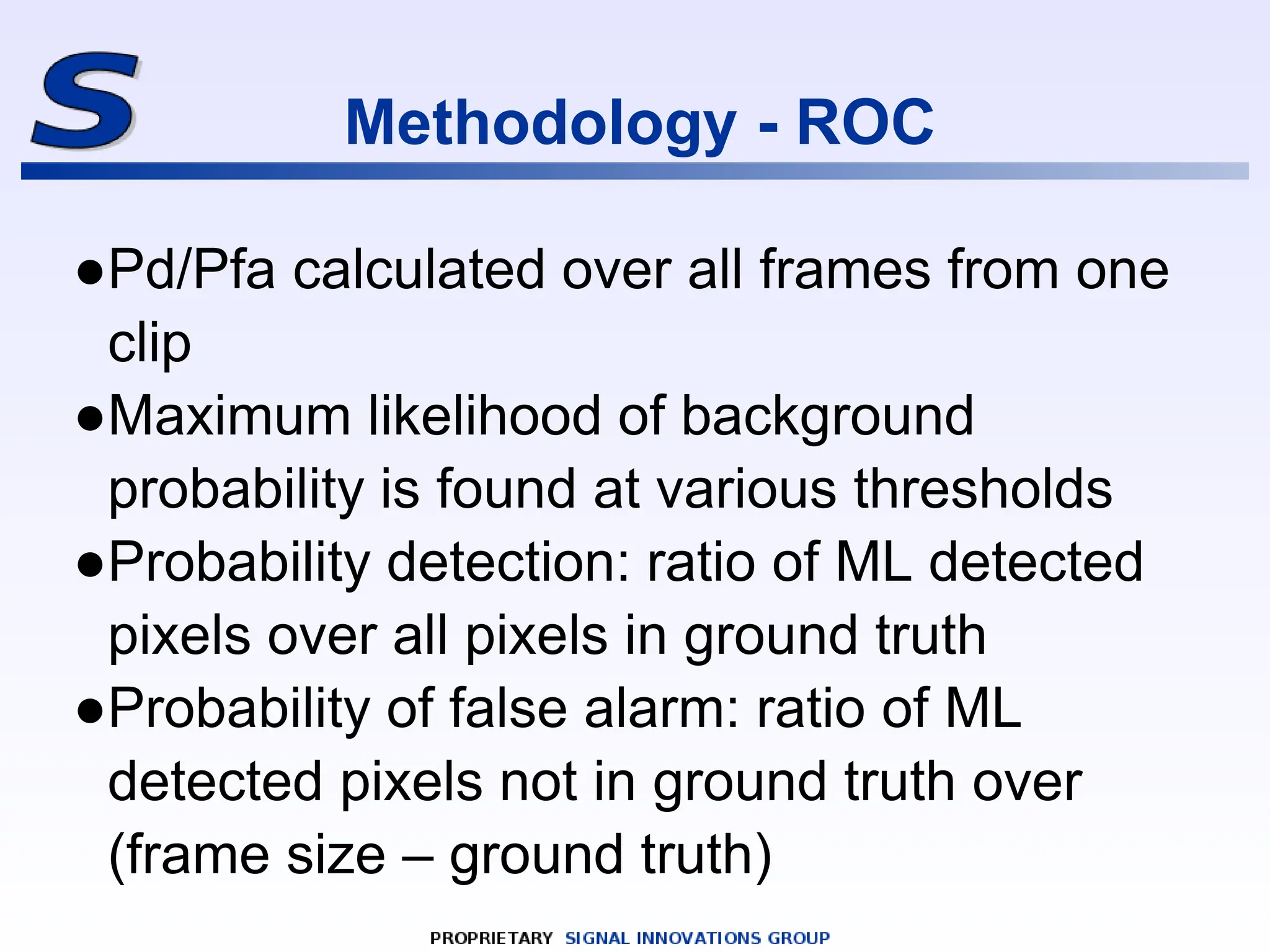
Methodology - ROC
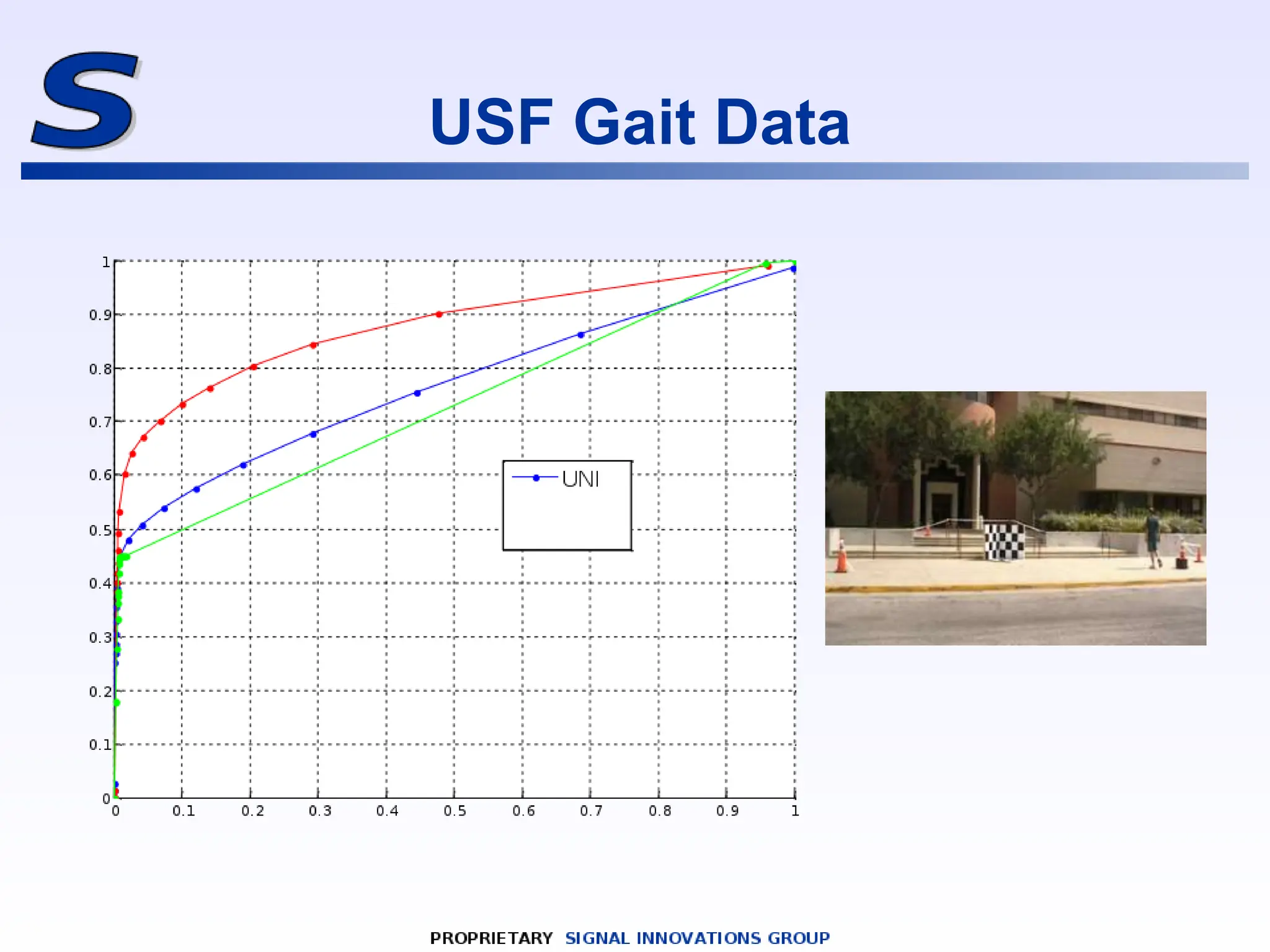
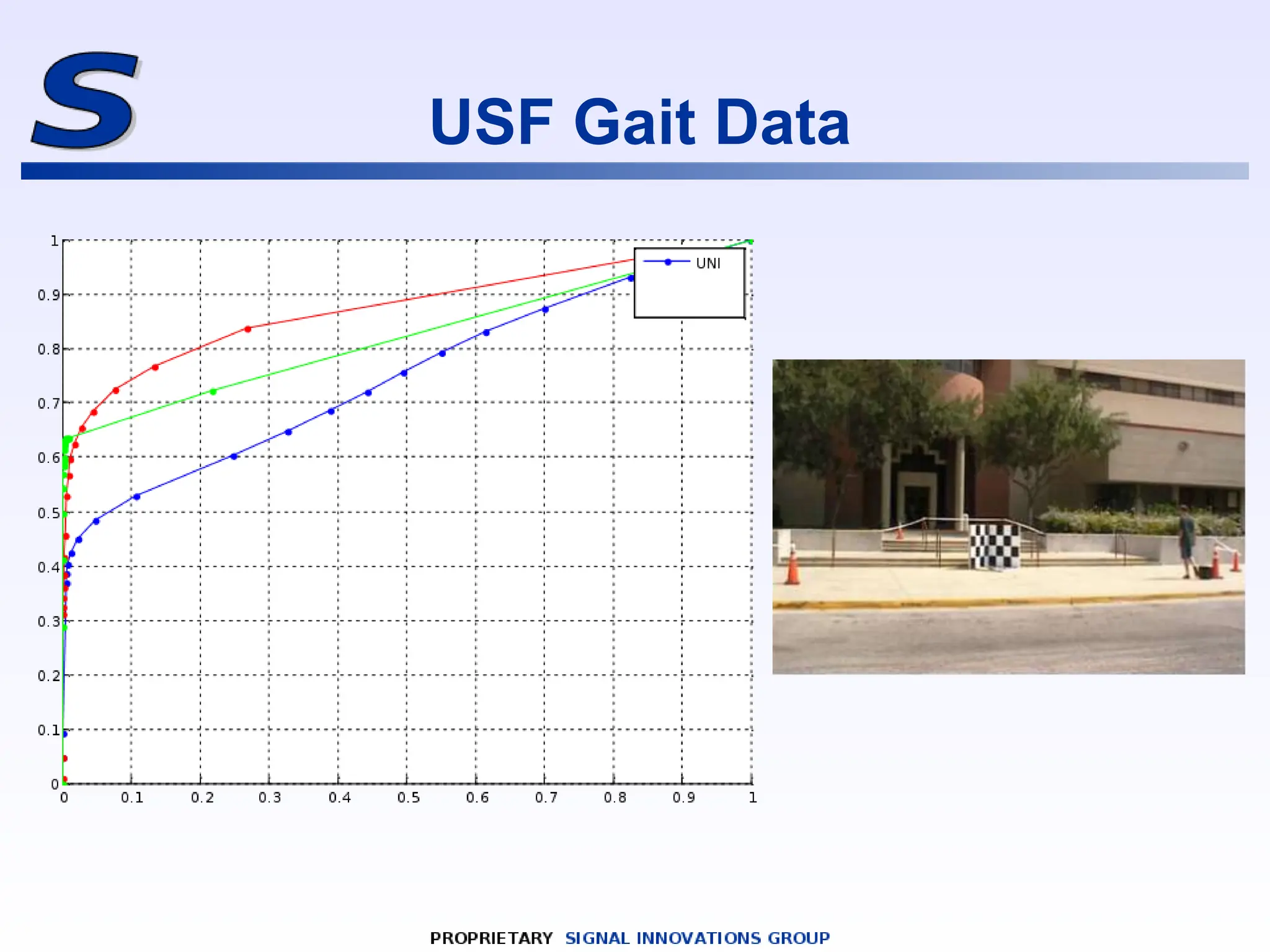
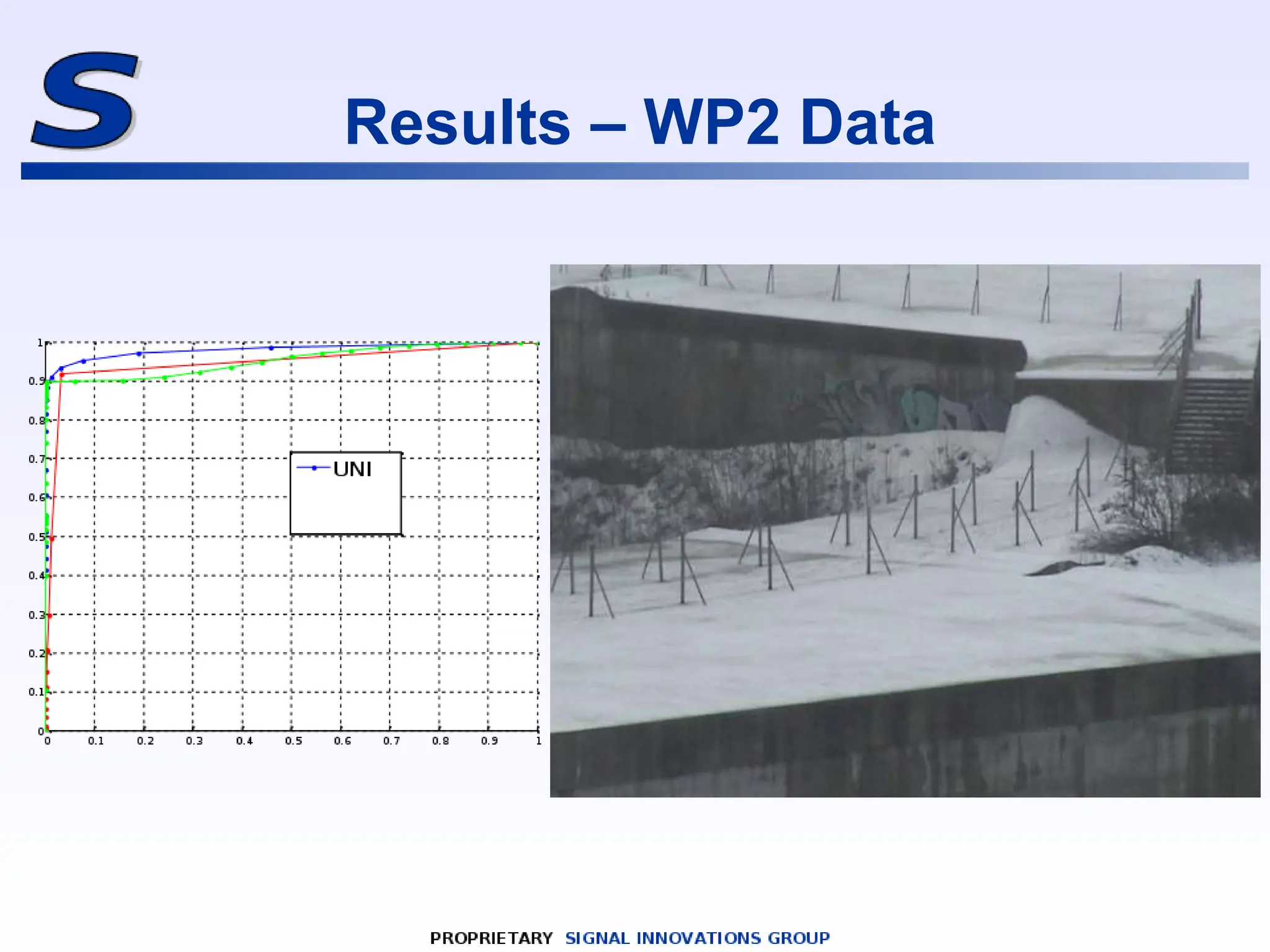
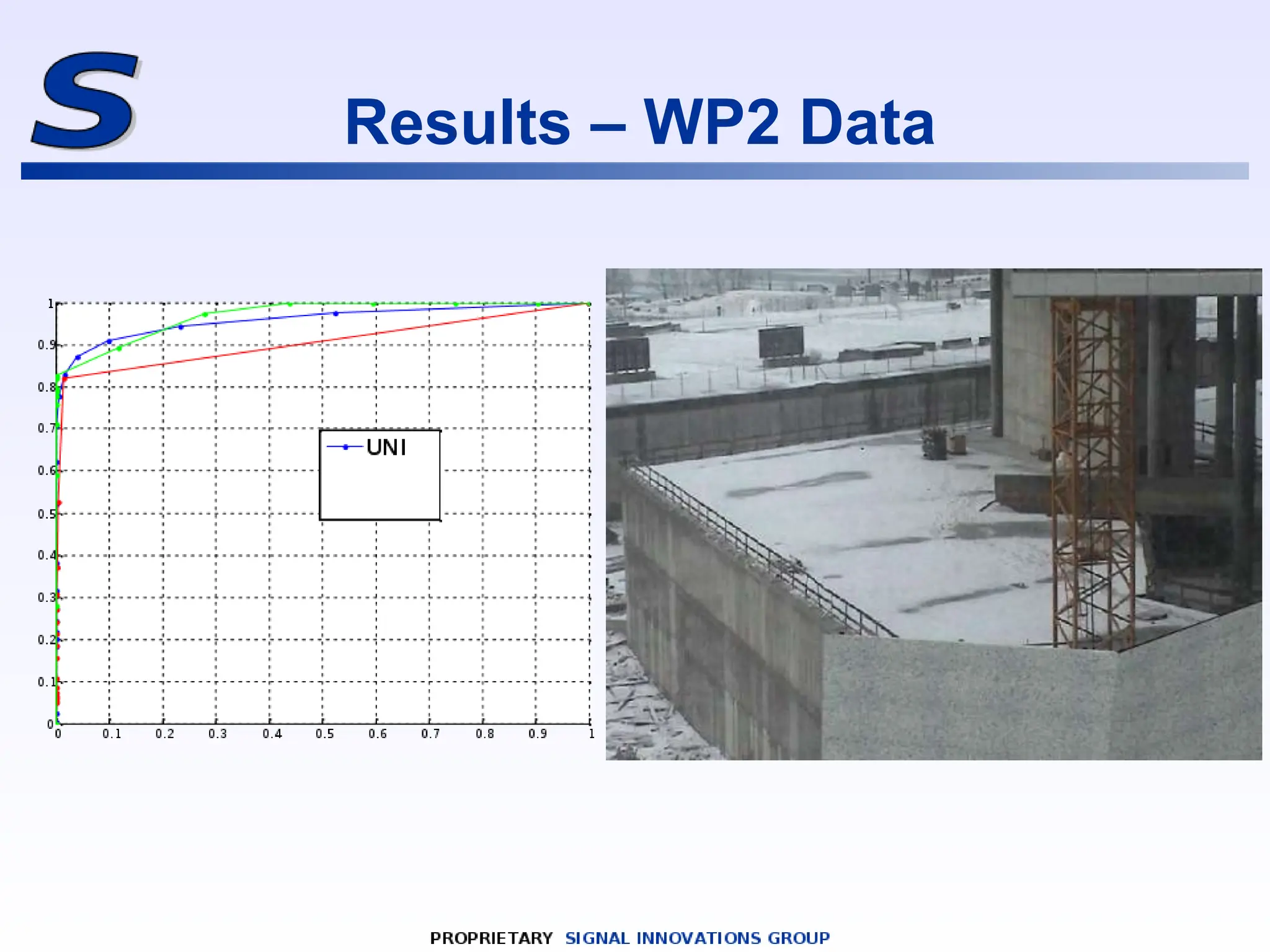
●Pd/Pfa calculated over all frames from one
clip
●Maximum likelihood of background
probability is found at various thresholds
●Probability detection: ratio of ML detected
pixels over all pixels in ground truth
●Probability of false alarm: ratio of ML
detected pixels not in ground truth over
(frame size – ground truth)
USF Gait Data
USF Gait Data
Results – WP2 Data
Results – WP2 Data
Results – VSSN Data
Results – VSSN Data
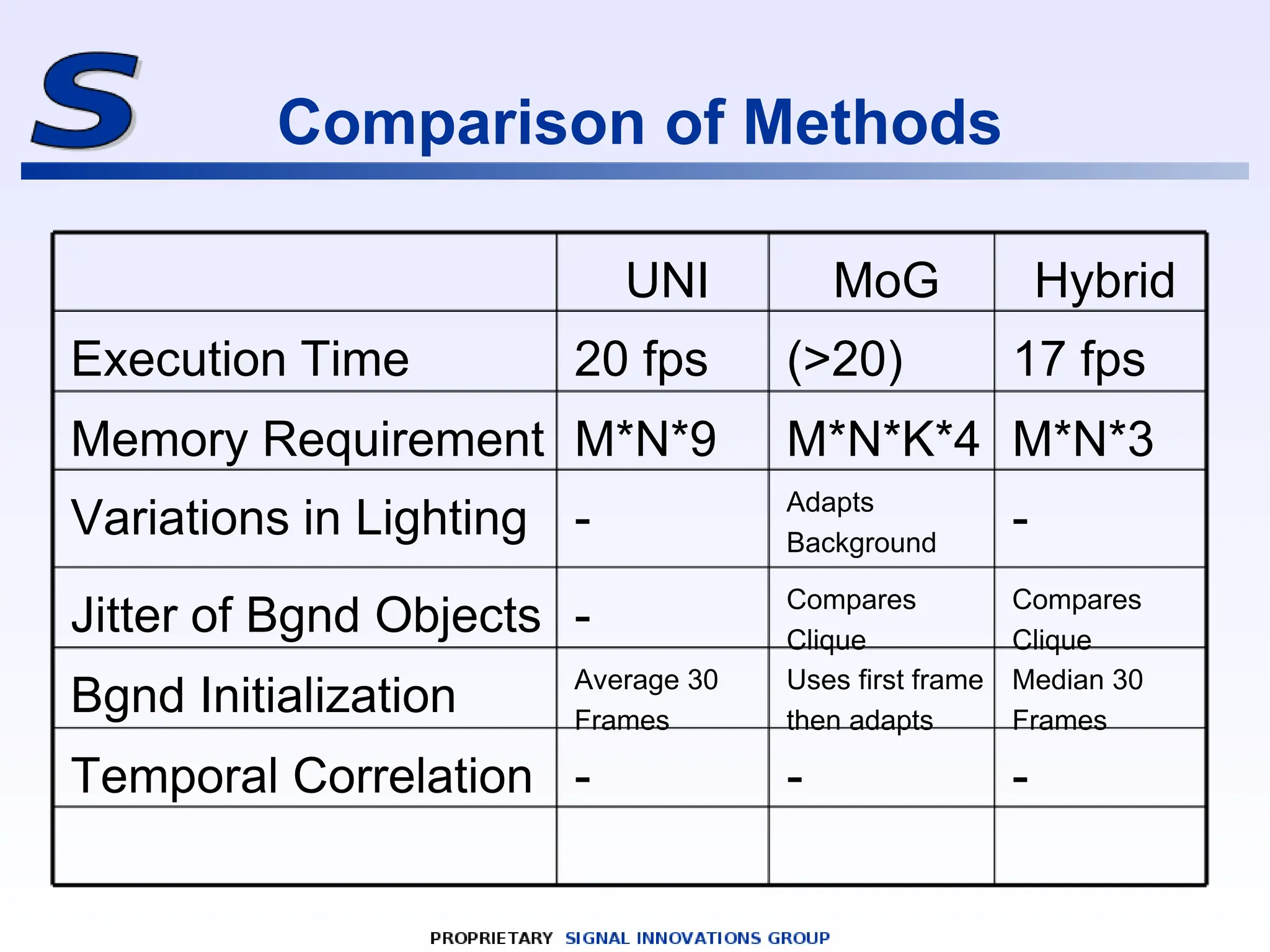
Comparison of Methods
UNI MoG Hybrid
Execution Time 20 fps (>20) 17 fps
Memory Requirement M*N*9 M*N*K*4 M*N*3
Variations in Lighting - Adapts
Background
-
Jitter of Bgnd Objects - Compares
Clique
Compares
Clique
Bgnd Initialization Average 30
Frames
Uses first frame
then adapts
Median 30
Frames
Temporal Correlation - - -
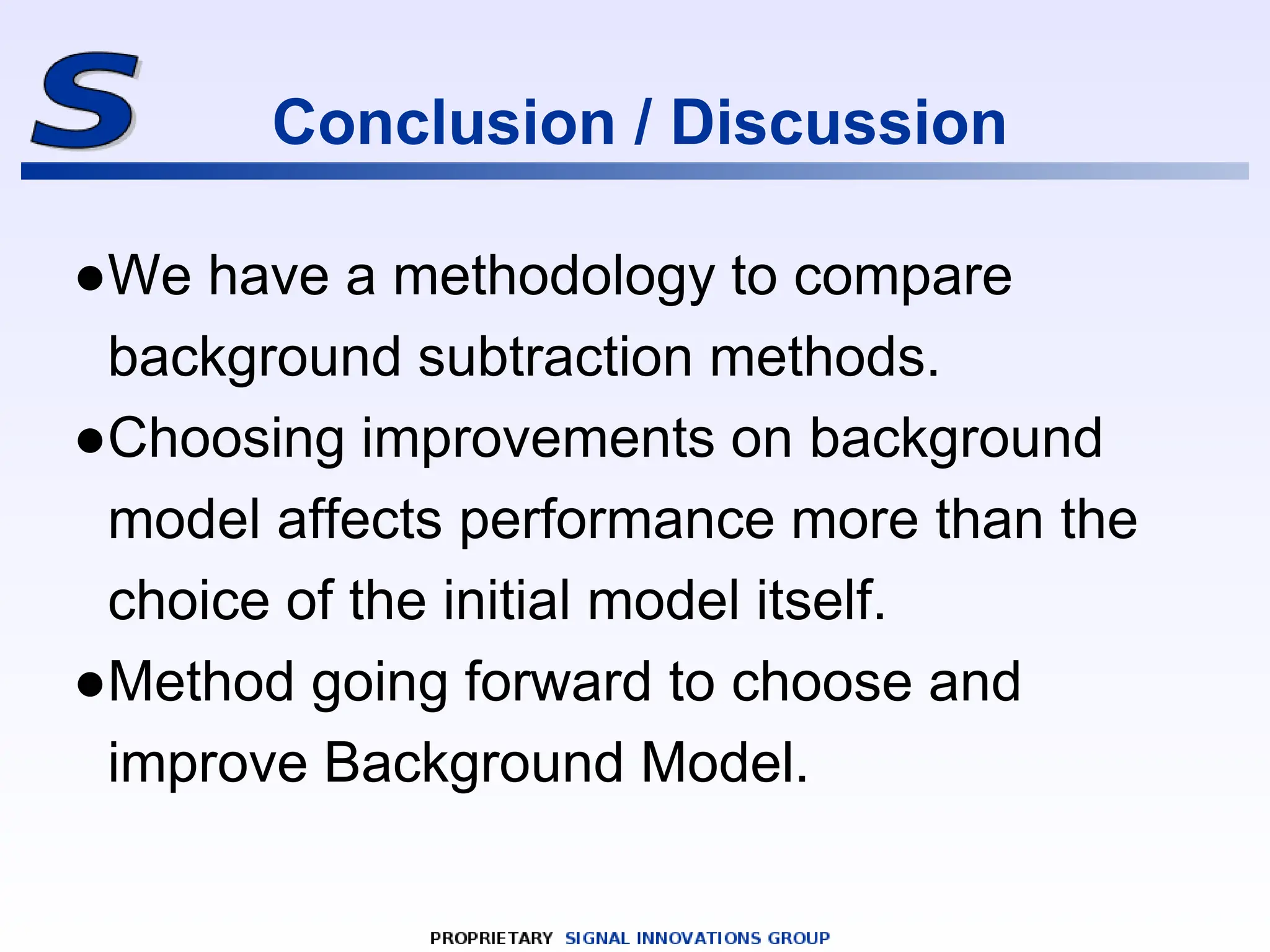
Conclusion / Discussion
●We have a methodology to compare
background subtraction methods.
●Choosing improvements on background
model affects performance more than the
choice of the initial model itself.
●Method going forward to choose and
improve Background Model.

Image Processing Background Elimination in Video Editting

  • 1.
  • 2.
    Overview ●Problem Statement ●Background SubtractionMethods ●Methodology in creating ROC curve ●Data Sets Used ●ROC Results ●Conclusions/Discussion
  • 3.
    Problem Statement ●Review andcompare current methods of Background Subtraction that have been implemented, internally in SIG as well as in Machine Vision community. ●Create a methodology to quantitatively compare these methods of background subtraction. ●Summarize strengths and weakness of methods ●Conclusions / Discussion points going forward
  • 4.
    Methods in Community GaussianParametric Models Mixture of Gaussians (MoG) ●Adaptive background mixture models for real-time tracking - C Stauffer, WEL Grimson ●Understanding background mixture models for foreground segmentation - PW Power, JA Schoonees Bimodal ●W 4: real-time surveillance of people and theiractivities - I Haritaoglu, D Harwood, LS Davis Univariate Guassian ●Pfinder: Real-Time Tracking of the Human Body - CR Wren, A Azarbayejani, T Darrell
  • 5.
    Methods in Community NonParametric Kernel Density Estimation ●Non-parametric model for background subtraction - A Elgammal, D Harwood, L Davis ●Motion-based background subtraction using adaptive kernel density estimation - A Mittal, N Paragios ●Background and Foreground Modeling Using Nonparametric Kernel Density for Visual Surveillance - A Elgammal, R Duraiswami, D Harwood, LS Davis Codebook ●Background modeling and subtraction by codebook construction - K Kim, TH Chalidabhongse, D Harwood, L Davis
  • 6.
    Methods in Community Manyother Variations Review Paper ●Background subtraction techniques: a review - M Piccardi Eigenbackground ●Efficient mean-shift background subtraction - T.Jan Conditional Random Fields ●A Dynamic Conditional Random Field Model for Object Segmentation in Image Sequences - Y Wang, Q Ji
  • 7.
    Methods – SIGImplemented ●Single Gaussian (full covariance in RGB) (UNI) currently checked into SVN. ●Mixture of Gaussians (MoG) based on Stauffer and Grimson (loosely). ●Hybrid – modification of UNI with ideas from MOG model (YcRcB, median, clique) ●Multiple Mean Model – Previous SVN check in
  • 8.
    Methodology – DataSets Duke Data ●Hand ground truth key frames, adaBoost – waiting for code USF Gait Data ●Outdoor gait data, hand ground truth VSSN 2005 Open Source Algorithm Competition ●Outdoor background, sprite foreground Vienna University of Technology, WP2 Evaluation, Integration, and Standards ●Outdoor background, sprite foreground of varying intensities
  • 9.
    Methodology - ROC ●Pd/Pfacalculated over all frames from one clip ●Maximum likelihood of background probability is found at various thresholds ●Probability detection: ratio of ML detected pixels over all pixels in ground truth ●Probability of false alarm: ratio of ML detected pixels not in ground truth over (frame size – ground truth)
  • 10.
  • 11.
  • 12.
  • 13.
  • 14.
  • 15.
  • 16.
    Comparison of Methods UNIMoG Hybrid Execution Time 20 fps (>20) 17 fps Memory Requirement M*N*9 M*N*K*4 M*N*3 Variations in Lighting - Adapts Background - Jitter of Bgnd Objects - Compares Clique Compares Clique Bgnd Initialization Average 30 Frames Uses first frame then adapts Median 30 Frames Temporal Correlation - - -
  • 17.
    Conclusion / Discussion ●Wehave a methodology to compare background subtraction methods. ●Choosing improvements on background model affects performance more than the choice of the initial model itself. ●Method going forward to choose and improve Background Model.