www.iaset.us editor@iaset.us
A HYPSOMETRIC PERSPECTIVE IN COMPREHENSING THE GEOMORPHIC
DEVELOPMENT OF TAMBRAPARNI RIVER BASIN, WESTERN FLANK, SOUTH
WESTERN GHATS
KARTHIKA KRISHNAN
Research Scholar, Department of Geography, School of Earth and Atmospheric Sciences,
Madurai Kamaraj University, Madurai, India
ABSTRACT
This paper deals with a part of the author’s research work dealing with the geomorphometry and geomorphology
of the Tambraparni River Basin (TRB) of Kanyakumari District of southern Tamil Nadu, located on the western flank of
South Western Ghats. The Western Ghats Mountain chain is today internationally recognized as a region of immense
global importance for the conservation of its biological diversity, besides its association of areas of great geological,
cultural and aesthetic importance. Hypsometric analysis quantifies the geologic stages of development and erosional
proneness of a river basin. In this study, efforts were made to estimate the hypsometric values of the Tambraparni River
Basin and so as to understand the geologic as well as geomorphic evolution and stages of the basin. In the present study as
the value of hypsometric integral is 0.0484, which is associated with a highly concave hypsometric curve, it indicates that
the major portion of the basin of Tambraparni River lies at a comparatively low relief. Typically, the basin is associated
with highly dissected and eroded landscape as a result of fluvial action.
KEYWORDS: Analysis, Geomorphometry, Geomorphic Stages, Hypsometry, TRB, Western Ghats
INTRODUCTION
Hypsometry is a term that pertains to elevation measurements of the Earths terrestrial surface. Hypsometric
analysis is the study of the distribution of ground surface area, or horizontal cross-sectional area, of a landmass with
respect to elevation (Strahler, 1952). Langbein (1947) appears to have been introduced the hypsometric curve, which is an
empirical cumulative distribution function of elevations in drainage basin. However it was Strahler who popularised the
study of hypsometric curve through his excellent paper (Strahler 1952) in which he has demonstrated the usefulness of
hypsometric curve in geomorphometric research of drainage basins. Hypsometery is used to evaluate different
measurements for different natural drainage basins, or well defined areas, to determine the types and rates of different
processes that shape the Earth’s surface over time.
The two common approaches used to measure the landscape hypsometric studies are (1) the hypsometric curve
and (2) the hypsometric integral. Hypsometric curve is simply a histogram that depicts the distribution of basin area with
elevation, usually as a proportion of area above a unit of elevation (Langbein, 1947 and Strahler, 1952). Hypsometric
integral, on the other hand measures the percentage volume of earth material remaining after the erosion of an original
landmass having volume equal to the reference solid with base equal to basin area and the height equal to total height range
in the basin. It was Strahler who proposed the dimensionless hypsometric integral. This is used as a measure of landscape
International Journal of Humanities
and Social Sciences (IJHSS)
ISSN(P): 2319-393X; ISSN(E): 2319-3948
Vol. 4, Issue 5, Aug - Sep 2015, 11-18
© IASET
12 Karthika Krishnan
Impact Factor (JCC): 2.7367 NAAS Rating: 3.19
evolution.
Strahler suggested the percentage hypsometric curve in which he showed concretely how a detailed analysis of
percentage hypsometric curve can provide valuable indications of the stage of evolution of a particular drainage basin
associated with uplift and denudation. In very detailed studies, Strahler (1952) and Schumm (1956) have demonstrated the
multiple possibilities of interpretation of hypsometric curves regarding the stage of basinal evolution.
HYPSOMETRIC CURVE
A hypsometric curve is an empirical cumulative distribution function of elevations of a watershed or drainage
basin. A hypsometric curve is essentially a graph that shows the proportion of land area that exists at various elevations by
plotting relative area against relative height. There are basically two kinds of hypsometric curves employed in
geomorphometric studies. The first one is hypsometric curve in absolute units, and the other one being the percentage
hypsometric curves.
Hypsometric Curve in Absolute Units: The simplest form of hypsometric curve is that prepared in absolute
units of measure. It is also known as hypsographic curve. It is obtained by plotting on ordinate (y-axis) elevations in feet or
meters) and, and on abscissa the area (in square miles or kilometers) lying above a contour of given elevation.
Percentage Hypsometric Curves: Typical drainage basins in homogeneous materials have generally pear-shaped
outline. For hypsometric study, a geometric unit of reference consists of a solid bounded on the sides by the vertical
projection of the basin perimeter and a set of parallel planes on the top and base, the former passing through the summit
and the latter through the river mouth respectively. Although these reference planes may be expected to change as with the
evolution of the basin with time with progressive degradation, they are real reference surfaces of a drainage basin which
can always be determined. Apart from the fact that the hypsometric curve provides a comprehensive idea of the three
dimensional form of a drainage basin, subsequent studies have also revealed that hydrograph peak (flood) and travel time
(Harlin, 1984), dominant erosion process (Moglen and Bras, 1995) and the regional ground water base flow
(Marani et.al, 2001) are also related to the configuration of the hypsometric curves.
The percentage hypsometric method, which has been used as early as 1947 by Langbein (1947), deals with the
area enclosed between a given contour and the upper segment of the basin perimeter to the height of that contour above the
basal plane. Two ratios are involved in this hypsometric method: (1) ratio of area between the contour and the upper
perimeter to total drainage basin area, represented by the abscissa on the coordinate system, and (2) Ratio of height of
contour above base (h) to total height of basin (H), represented by values of the ordinate.
THE TAMBRAPARNI BASIN (TRB)
The Western Ghats Mountain chain is today internationally recognized as a region of immense global importance
for the conservation of its biological diversity, besides its association of areas of great geological, cultural and aesthetic
importance. The Ghats form a mountain chain running parallel to India’s western coast, located approximately 30-50 km
inland, and extends from the state of Gujarat in the north up to Tamil Nadu in the south , over a distance of 1600 km
uninterruptedly (except only by the 30 km Palghat Gap at around 11˚N). The southernmost sector of the Western Ghats,
south of the Shencottah Gap, is known as Agastyamalai Hills or Ashambu Hills (Agasthyamalai Sub-Cluster). This
mountain sector supports one of the richest concentrations of biodiversity in the whole Western Ghats chain.
A Hypsometric Perspective in Comprehensing the Geomorphic Development of Tambraparni 13
River Basin, Western Flank, South Western Ghats
www.iaset.us editor@iaset.us
The Tambraparni basin is located in Kanyakumari district of Tamil Nadu (Figure 1). The Tambraparni river basin
which is located in the south-west of Indian peninsula and occupying the western flank of the Sahyadri Ranges is
composed of the basins of Kodayar, Paraliar and Kuzhithuraiar. The geographic location of the basin is between the north
latitudes 8˚
10'58"to 8˚
34'39" and the east longitudes of 77˚
05'47" to77˚
29'31". The basin has an areal extent of 867.52 sq.
km.
Geologically, TRB can be broadly subdivided into two types of terrains, namely (a) Sedimentary terrain and, (b)
hard rock terrain (Figure 2). Sedimentary rocks, referable to Tertiary and Quaternary ages of Phanerozoic age cover about
15 percent of the area of TRB and are found restricted along the coastal tract and adjoining lowland zone of the basin. The
sedimentary rocks of the coastal belt include younger fluviatile, fluvio-marine sequences, of Quaternary and of Recent age
together with a small occurrence of aeolian sediments (at Kalingarajapuram) and a succession correlated with Cuddalore
Sandstone Formation. The last one is considered as homotaxial equivalent of Warkalli Sandstone Formation of Kerala
coast. Crystalline rocks of Archaean to late Proterozoic age occupy the major portion of TRB and the region of exposure of
these rocks constitutes the hard rock terrain of the basin. These rocks make up the bulk of the Western Ghats sector of the
basin and its associated foothills and further southward up to the border of the sedimentary terrain. The major rock types
exposed in the hard rock terrain are those of granulitic and gneissic metamorphic rocks referable to (a) charnockite and
khondalite groups, (b) garnetiferous quartzo-feldspathic gneiss and, (c) garnet- biotite gneiss.
Figure 1
14 Karthika Krishnan
Impact Factor (JCC): 2.7367 NAAS Rating: 3.19
Figure 2
TOOLS AND TECHNIQUES
The entire basin of Tambraparni River has been captured from the latest available Survey of India topographic
sheets of 1:25,000 scale and delineated with the of ArcGIS 9.3 software. In the subsequent phase of hypsometric study of
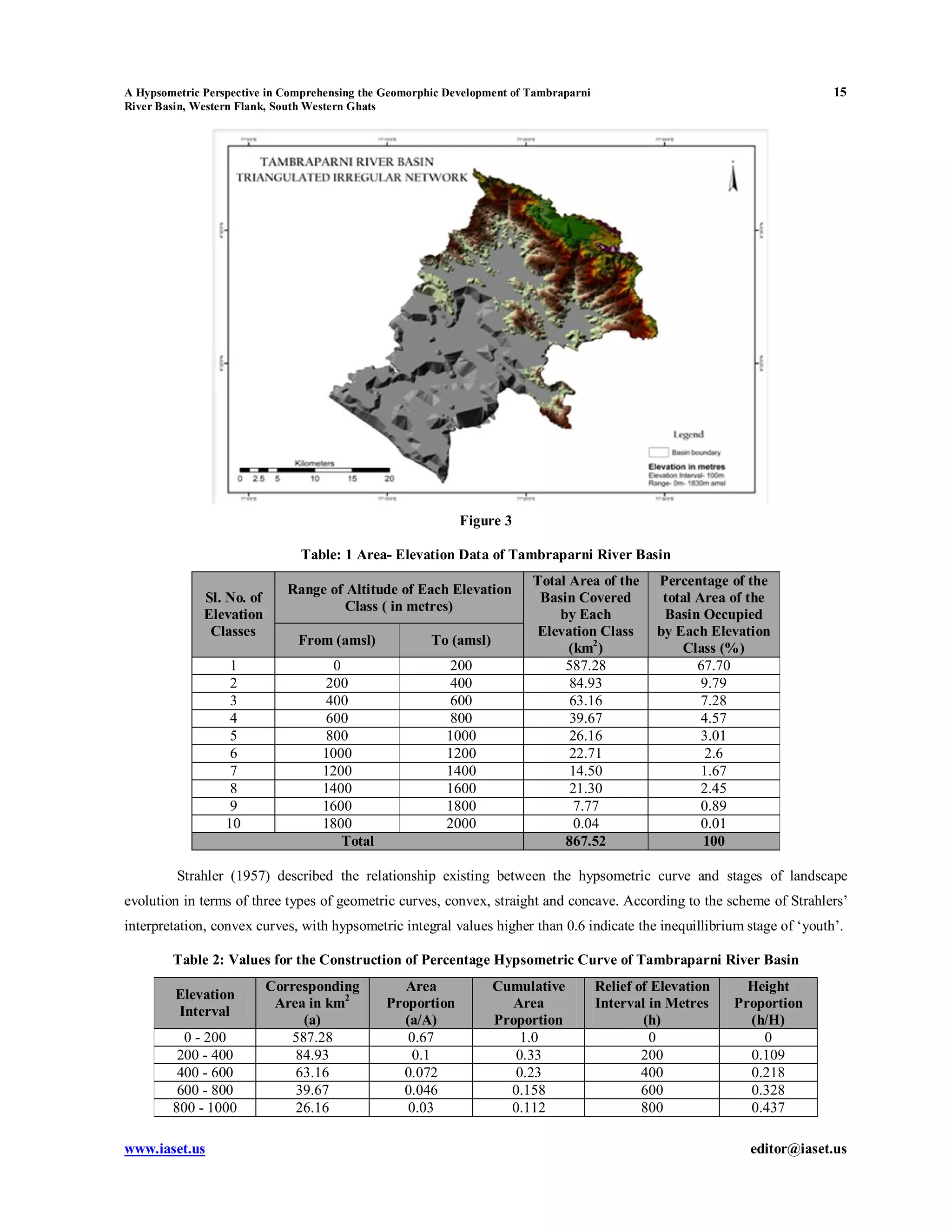
the basin GIS has been used extensively in the present work. All the elevation data relevant the drainage basin has been
transferred to GIS platform (Figure 3). These data were then converted to vector format to enable further analysis. With the
help of ArcGIS software, quantitative parameters were gathered and processed through Microsoft Excel. These were then
computed and tabulated and various sets of hypsometric graphs were generated using CorelDRAW X6 and ArcGIS 9.3.
RESULTS AND ANALYSIS
The measured area-elevation data of TRB is given in table 1 and shown as histogram in figure 4. Using this data,
the proportions of each elevation class with respect to the aggregate basinal area, have been calculated and the values are
tabulated in table 2 and shown in figure 5.
The resulting hypsometric curve drawn for TRB is shown in figure 3. It expresses simply the manner in which the
volume lying beneath the ground surface is distributed from base to top. The curve must always originate in the upper
left-hand corner of the square (x = 0, y = 1) and reach the lower right hand corner (x = 1, y = 0). It may, however, take any
one of a variety of paths between these points, depending upon the distribution of the landmass from base to top.
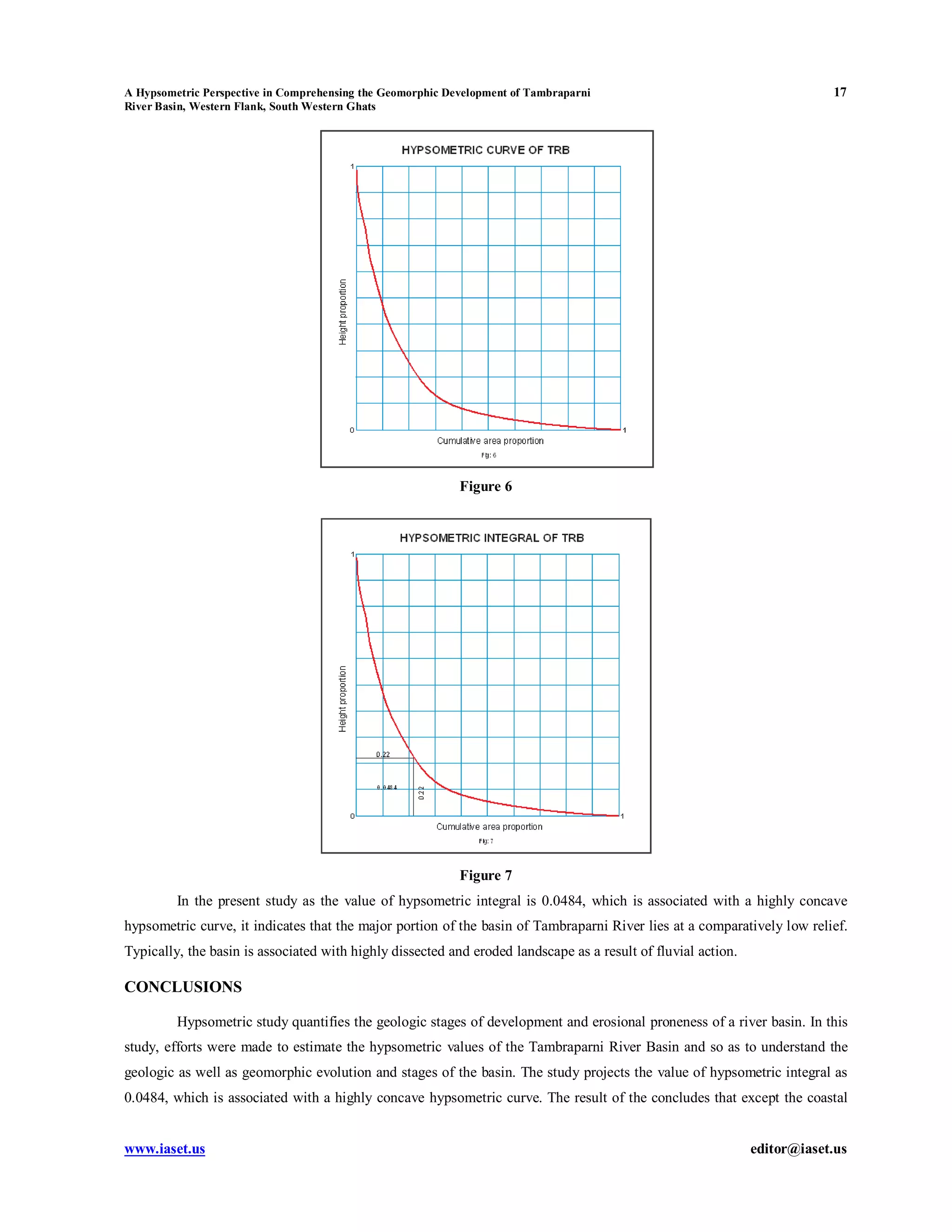
The computation of the hypsometric integral (HI) of TRB, based on the hypsometric curve (Figure 6) has resulted in a
value of 0.0484 (Figure 7).
A Hypsometric Perspective in Comprehensing the Geomorphic Development of Tambraparni 15
River Basin, Western Flank, South Western Ghats
www.iaset.us editor@iaset.us
Figure 3
Table: 1 Area- Elevation Data of Tambraparni River Basin
Sl. No. of
Elevation
Classes
Range of Altitude of Each Elevation
Class ( in metres)
Total Area of the
Basin Covered
by Each
Elevation Class
(km2
)
Percentage of the
total Area of the
Basin Occupied
by Each Elevation
Class (%)
From (amsl) To (amsl)
1 0 200 587.28 67.70
2 200 400 84.93 9.79
3 400 600 63.16 7.28
4 600 800 39.67 4.57
5 800 1000 26.16 3.01
6 1000 1200 22.71 2.6
7 1200 1400 14.50 1.67
8 1400 1600 21.30 2.45
9 1600 1800 7.77 0.89
10 1800 2000 0.04 0.01
Total 867.52 100
Strahler (1957) described the relationship existing between the hypsometric curve and stages of landscape
evolution in terms of three types of geometric curves, convex, straight and concave. According to the scheme of Strahlers’
interpretation, convex curves, with hypsometric integral values higher than 0.6 indicate the inequillibrium stage of ‘youth’.
Table 2: Values for the Construction of Percentage Hypsometric Curve of Tambraparni River Basin
Elevation
Interval
Corresponding
Area in km2
(a)
Area
Proportion
(a/A)
Cumulative
Area
Proportion
Relief of Elevation
Interval in Metres
(h)
Height
Proportion
(h/H)
0 - 200 587.28 0.67 1.0 0 0
200 - 400 84.93 0.1 0.33 200 0.109
400 - 600 63.16 0.072 0.23 400 0.218
600 - 800 39.67 0.046 0.158 600 0.328
800 - 1000 26.16 0.03 0.112 800 0.437
16 Karthika Krishnan
Impact Factor (JCC): 2.7367 NAAS Rating: 3.19
1000 - 1200 22.71 0.03 0.082 1000 0.546
1200 - 1400 14.50 0.017 0.052 1200 0.655
1400 - 1600 21.30 0.025 0.035 1400 0.765
1600 - 1800 7.77 0.009 0.01 1600 0.874
1800 - 2000 0.04 0.001 0.001 1800 0.984
Smoothly S-shaped curves that cross approximately in the centre of the hypsometric diagram have integrals
ranging in from 0.6 to 0.4, expressing the equilibrium stage of ‘maturity’ or the ‘old stage’. Strongly concave curves, with
very low hypsomtgeric integral values less than 0.4 results only where monadnock masses or remanents are present.
Figure 4
Figure 5
A Hypsometric Perspective in Comprehensing the Geomorphic Development of Tambraparni 17
River Basin, Western Flank, South Western Ghats
www.iaset.us editor@iaset.us
Figure 6
Figure 7
In the present study as the value of hypsometric integral is 0.0484, which is associated with a highly concave
hypsometric curve, it indicates that the major portion of the basin of Tambraparni River lies at a comparatively low relief.
Typically, the basin is associated with highly dissected and eroded landscape as a result of fluvial action.
CONCLUSIONS
Hypsometric study quantifies the geologic stages of development and erosional proneness of a river basin. In this
study, efforts were made to estimate the hypsometric values of the Tambraparni River Basin and so as to understand the
geologic as well as geomorphic evolution and stages of the basin. The study projects the value of hypsometric integral as
0.0484, which is associated with a highly concave hypsometric curve. The result of the concludes that except the coastal
18 Karthika Krishnan
Impact Factor (JCC): 2.7367 NAAS Rating: 3.19
belt of the basin, the major portion of terrain of the basin under study falls under moderately dissected to very highly
dissected terrain category with high maturity to old stage of river basin development and thereby indicating eroded
landscape characteristic of fluvial denudation.
REFERENCES
1. HARLIN, J. M., 1984. Watershed morphometry and time to hydrograph peak, Jour. Hydrol., Vol. 67, pp. 141-
154, doi: 10.1016/0022-1694(84)90238-5.
2. LANGBEIN, W.B., 1947. Topographic characteristics of drainage basins, USGS Water Supply Paper: 968C, US
Geological Survey, pp. 125-157.
3. MARANI, M., ELTAHIR, E. and RINALDO, A., 2001. Geomorphic controls on regional base flow, Water
Resour. Res., Vol. 37, pp. 2619-2630, doi: 10.1029/2000WR000119.
4. MOGLEN, G.E. and BRAS, R.L., 1995. The effect of spatial heterogeneities on geomorphic expression in a
model of basin evolution, Water Resource Research, Vol. 31, pp. 2613-2623.
5. SCHUMM, S.A., 1956. Evolution of drainage systems and slopes in badlands at Perth Amboy, Geological Society
of America Bulletin, New Jersy, Vol. 67, pp. 597-646.
6. STRAHLER, A.N., 1952. Hypsometric (area-altitude) analysis of erosional topology, Geological Society of
America Bulletin, Vol. 63, No. 11, pp. 1117- 1142.

IJHSS - KARTHIKA KRISHNAN FOR JOURNAL

  • 1.
    www.iaset.us editor@iaset.us A HYPSOMETRICPERSPECTIVE IN COMPREHENSING THE GEOMORPHIC DEVELOPMENT OF TAMBRAPARNI RIVER BASIN, WESTERN FLANK, SOUTH WESTERN GHATS KARTHIKA KRISHNAN Research Scholar, Department of Geography, School of Earth and Atmospheric Sciences, Madurai Kamaraj University, Madurai, India ABSTRACT This paper deals with a part of the author’s research work dealing with the geomorphometry and geomorphology of the Tambraparni River Basin (TRB) of Kanyakumari District of southern Tamil Nadu, located on the western flank of South Western Ghats. The Western Ghats Mountain chain is today internationally recognized as a region of immense global importance for the conservation of its biological diversity, besides its association of areas of great geological, cultural and aesthetic importance. Hypsometric analysis quantifies the geologic stages of development and erosional proneness of a river basin. In this study, efforts were made to estimate the hypsometric values of the Tambraparni River Basin and so as to understand the geologic as well as geomorphic evolution and stages of the basin. In the present study as the value of hypsometric integral is 0.0484, which is associated with a highly concave hypsometric curve, it indicates that the major portion of the basin of Tambraparni River lies at a comparatively low relief. Typically, the basin is associated with highly dissected and eroded landscape as a result of fluvial action. KEYWORDS: Analysis, Geomorphometry, Geomorphic Stages, Hypsometry, TRB, Western Ghats INTRODUCTION Hypsometry is a term that pertains to elevation measurements of the Earths terrestrial surface. Hypsometric analysis is the study of the distribution of ground surface area, or horizontal cross-sectional area, of a landmass with respect to elevation (Strahler, 1952). Langbein (1947) appears to have been introduced the hypsometric curve, which is an empirical cumulative distribution function of elevations in drainage basin. However it was Strahler who popularised the study of hypsometric curve through his excellent paper (Strahler 1952) in which he has demonstrated the usefulness of hypsometric curve in geomorphometric research of drainage basins. Hypsometery is used to evaluate different measurements for different natural drainage basins, or well defined areas, to determine the types and rates of different processes that shape the Earth’s surface over time. The two common approaches used to measure the landscape hypsometric studies are (1) the hypsometric curve and (2) the hypsometric integral. Hypsometric curve is simply a histogram that depicts the distribution of basin area with elevation, usually as a proportion of area above a unit of elevation (Langbein, 1947 and Strahler, 1952). Hypsometric integral, on the other hand measures the percentage volume of earth material remaining after the erosion of an original landmass having volume equal to the reference solid with base equal to basin area and the height equal to total height range in the basin. It was Strahler who proposed the dimensionless hypsometric integral. This is used as a measure of landscape International Journal of Humanities and Social Sciences (IJHSS) ISSN(P): 2319-393X; ISSN(E): 2319-3948 Vol. 4, Issue 5, Aug - Sep 2015, 11-18 © IASET
  • 2.
    12 Karthika Krishnan ImpactFactor (JCC): 2.7367 NAAS Rating: 3.19 evolution. Strahler suggested the percentage hypsometric curve in which he showed concretely how a detailed analysis of percentage hypsometric curve can provide valuable indications of the stage of evolution of a particular drainage basin associated with uplift and denudation. In very detailed studies, Strahler (1952) and Schumm (1956) have demonstrated the multiple possibilities of interpretation of hypsometric curves regarding the stage of basinal evolution. HYPSOMETRIC CURVE A hypsometric curve is an empirical cumulative distribution function of elevations of a watershed or drainage basin. A hypsometric curve is essentially a graph that shows the proportion of land area that exists at various elevations by plotting relative area against relative height. There are basically two kinds of hypsometric curves employed in geomorphometric studies. The first one is hypsometric curve in absolute units, and the other one being the percentage hypsometric curves. Hypsometric Curve in Absolute Units: The simplest form of hypsometric curve is that prepared in absolute units of measure. It is also known as hypsographic curve. It is obtained by plotting on ordinate (y-axis) elevations in feet or meters) and, and on abscissa the area (in square miles or kilometers) lying above a contour of given elevation. Percentage Hypsometric Curves: Typical drainage basins in homogeneous materials have generally pear-shaped outline. For hypsometric study, a geometric unit of reference consists of a solid bounded on the sides by the vertical projection of the basin perimeter and a set of parallel planes on the top and base, the former passing through the summit and the latter through the river mouth respectively. Although these reference planes may be expected to change as with the evolution of the basin with time with progressive degradation, they are real reference surfaces of a drainage basin which can always be determined. Apart from the fact that the hypsometric curve provides a comprehensive idea of the three dimensional form of a drainage basin, subsequent studies have also revealed that hydrograph peak (flood) and travel time (Harlin, 1984), dominant erosion process (Moglen and Bras, 1995) and the regional ground water base flow (Marani et.al, 2001) are also related to the configuration of the hypsometric curves. The percentage hypsometric method, which has been used as early as 1947 by Langbein (1947), deals with the area enclosed between a given contour and the upper segment of the basin perimeter to the height of that contour above the basal plane. Two ratios are involved in this hypsometric method: (1) ratio of area between the contour and the upper perimeter to total drainage basin area, represented by the abscissa on the coordinate system, and (2) Ratio of height of contour above base (h) to total height of basin (H), represented by values of the ordinate. THE TAMBRAPARNI BASIN (TRB) The Western Ghats Mountain chain is today internationally recognized as a region of immense global importance for the conservation of its biological diversity, besides its association of areas of great geological, cultural and aesthetic importance. The Ghats form a mountain chain running parallel to India’s western coast, located approximately 30-50 km inland, and extends from the state of Gujarat in the north up to Tamil Nadu in the south , over a distance of 1600 km uninterruptedly (except only by the 30 km Palghat Gap at around 11˚N). The southernmost sector of the Western Ghats, south of the Shencottah Gap, is known as Agastyamalai Hills or Ashambu Hills (Agasthyamalai Sub-Cluster). This mountain sector supports one of the richest concentrations of biodiversity in the whole Western Ghats chain.
  • 3.
    A Hypsometric Perspectivein Comprehensing the Geomorphic Development of Tambraparni 13 River Basin, Western Flank, South Western Ghats www.iaset.us editor@iaset.us The Tambraparni basin is located in Kanyakumari district of Tamil Nadu (Figure 1). The Tambraparni river basin which is located in the south-west of Indian peninsula and occupying the western flank of the Sahyadri Ranges is composed of the basins of Kodayar, Paraliar and Kuzhithuraiar. The geographic location of the basin is between the north latitudes 8˚ 10'58"to 8˚ 34'39" and the east longitudes of 77˚ 05'47" to77˚ 29'31". The basin has an areal extent of 867.52 sq. km. Geologically, TRB can be broadly subdivided into two types of terrains, namely (a) Sedimentary terrain and, (b) hard rock terrain (Figure 2). Sedimentary rocks, referable to Tertiary and Quaternary ages of Phanerozoic age cover about 15 percent of the area of TRB and are found restricted along the coastal tract and adjoining lowland zone of the basin. The sedimentary rocks of the coastal belt include younger fluviatile, fluvio-marine sequences, of Quaternary and of Recent age together with a small occurrence of aeolian sediments (at Kalingarajapuram) and a succession correlated with Cuddalore Sandstone Formation. The last one is considered as homotaxial equivalent of Warkalli Sandstone Formation of Kerala coast. Crystalline rocks of Archaean to late Proterozoic age occupy the major portion of TRB and the region of exposure of these rocks constitutes the hard rock terrain of the basin. These rocks make up the bulk of the Western Ghats sector of the basin and its associated foothills and further southward up to the border of the sedimentary terrain. The major rock types exposed in the hard rock terrain are those of granulitic and gneissic metamorphic rocks referable to (a) charnockite and khondalite groups, (b) garnetiferous quartzo-feldspathic gneiss and, (c) garnet- biotite gneiss. Figure 1
  • 4.
    14 Karthika Krishnan ImpactFactor (JCC): 2.7367 NAAS Rating: 3.19 Figure 2 TOOLS AND TECHNIQUES The entire basin of Tambraparni River has been captured from the latest available Survey of India topographic sheets of 1:25,000 scale and delineated with the of ArcGIS 9.3 software. In the subsequent phase of hypsometric study of the basin GIS has been used extensively in the present work. All the elevation data relevant the drainage basin has been transferred to GIS platform (Figure 3). These data were then converted to vector format to enable further analysis. With the help of ArcGIS software, quantitative parameters were gathered and processed through Microsoft Excel. These were then computed and tabulated and various sets of hypsometric graphs were generated using CorelDRAW X6 and ArcGIS 9.3. RESULTS AND ANALYSIS The measured area-elevation data of TRB is given in table 1 and shown as histogram in figure 4. Using this data, the proportions of each elevation class with respect to the aggregate basinal area, have been calculated and the values are tabulated in table 2 and shown in figure 5. The resulting hypsometric curve drawn for TRB is shown in figure 3. It expresses simply the manner in which the volume lying beneath the ground surface is distributed from base to top. The curve must always originate in the upper left-hand corner of the square (x = 0, y = 1) and reach the lower right hand corner (x = 1, y = 0). It may, however, take any one of a variety of paths between these points, depending upon the distribution of the landmass from base to top. The computation of the hypsometric integral (HI) of TRB, based on the hypsometric curve (Figure 6) has resulted in a value of 0.0484 (Figure 7).
  • 5.
    A Hypsometric Perspectivein Comprehensing the Geomorphic Development of Tambraparni 15 River Basin, Western Flank, South Western Ghats www.iaset.us editor@iaset.us Figure 3 Table: 1 Area- Elevation Data of Tambraparni River Basin Sl. No. of Elevation Classes Range of Altitude of Each Elevation Class ( in metres) Total Area of the Basin Covered by Each Elevation Class (km2 ) Percentage of the total Area of the Basin Occupied by Each Elevation Class (%) From (amsl) To (amsl) 1 0 200 587.28 67.70 2 200 400 84.93 9.79 3 400 600 63.16 7.28 4 600 800 39.67 4.57 5 800 1000 26.16 3.01 6 1000 1200 22.71 2.6 7 1200 1400 14.50 1.67 8 1400 1600 21.30 2.45 9 1600 1800 7.77 0.89 10 1800 2000 0.04 0.01 Total 867.52 100 Strahler (1957) described the relationship existing between the hypsometric curve and stages of landscape evolution in terms of three types of geometric curves, convex, straight and concave. According to the scheme of Strahlers’ interpretation, convex curves, with hypsometric integral values higher than 0.6 indicate the inequillibrium stage of ‘youth’. Table 2: Values for the Construction of Percentage Hypsometric Curve of Tambraparni River Basin Elevation Interval Corresponding Area in km2 (a) Area Proportion (a/A) Cumulative Area Proportion Relief of Elevation Interval in Metres (h) Height Proportion (h/H) 0 - 200 587.28 0.67 1.0 0 0 200 - 400 84.93 0.1 0.33 200 0.109 400 - 600 63.16 0.072 0.23 400 0.218 600 - 800 39.67 0.046 0.158 600 0.328 800 - 1000 26.16 0.03 0.112 800 0.437
  • 6.
    16 Karthika Krishnan ImpactFactor (JCC): 2.7367 NAAS Rating: 3.19 1000 - 1200 22.71 0.03 0.082 1000 0.546 1200 - 1400 14.50 0.017 0.052 1200 0.655 1400 - 1600 21.30 0.025 0.035 1400 0.765 1600 - 1800 7.77 0.009 0.01 1600 0.874 1800 - 2000 0.04 0.001 0.001 1800 0.984 Smoothly S-shaped curves that cross approximately in the centre of the hypsometric diagram have integrals ranging in from 0.6 to 0.4, expressing the equilibrium stage of ‘maturity’ or the ‘old stage’. Strongly concave curves, with very low hypsomtgeric integral values less than 0.4 results only where monadnock masses or remanents are present. Figure 4 Figure 5
  • 7.
    A Hypsometric Perspectivein Comprehensing the Geomorphic Development of Tambraparni 17 River Basin, Western Flank, South Western Ghats www.iaset.us editor@iaset.us Figure 6 Figure 7 In the present study as the value of hypsometric integral is 0.0484, which is associated with a highly concave hypsometric curve, it indicates that the major portion of the basin of Tambraparni River lies at a comparatively low relief. Typically, the basin is associated with highly dissected and eroded landscape as a result of fluvial action. CONCLUSIONS Hypsometric study quantifies the geologic stages of development and erosional proneness of a river basin. In this study, efforts were made to estimate the hypsometric values of the Tambraparni River Basin and so as to understand the geologic as well as geomorphic evolution and stages of the basin. The study projects the value of hypsometric integral as 0.0484, which is associated with a highly concave hypsometric curve. The result of the concludes that except the coastal
  • 8.
    18 Karthika Krishnan ImpactFactor (JCC): 2.7367 NAAS Rating: 3.19 belt of the basin, the major portion of terrain of the basin under study falls under moderately dissected to very highly dissected terrain category with high maturity to old stage of river basin development and thereby indicating eroded landscape characteristic of fluvial denudation. REFERENCES 1. HARLIN, J. M., 1984. Watershed morphometry and time to hydrograph peak, Jour. Hydrol., Vol. 67, pp. 141- 154, doi: 10.1016/0022-1694(84)90238-5. 2. LANGBEIN, W.B., 1947. Topographic characteristics of drainage basins, USGS Water Supply Paper: 968C, US Geological Survey, pp. 125-157. 3. MARANI, M., ELTAHIR, E. and RINALDO, A., 2001. Geomorphic controls on regional base flow, Water Resour. Res., Vol. 37, pp. 2619-2630, doi: 10.1029/2000WR000119. 4. MOGLEN, G.E. and BRAS, R.L., 1995. The effect of spatial heterogeneities on geomorphic expression in a model of basin evolution, Water Resource Research, Vol. 31, pp. 2613-2623. 5. SCHUMM, S.A., 1956. Evolution of drainage systems and slopes in badlands at Perth Amboy, Geological Society of America Bulletin, New Jersy, Vol. 67, pp. 597-646. 6. STRAHLER, A.N., 1952. Hypsometric (area-altitude) analysis of erosional topology, Geological Society of America Bulletin, Vol. 63, No. 11, pp. 1117- 1142.