PRESENTS
CASE BOOK
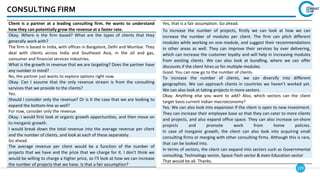
2023-24
2
ISSUE DETAILS AND COPYRIGHT
Edition 4
Case Book, Consult Club, IIM Calcutta
Notice:
No part of this publication may be reproduced in any form without prior consent of the Consult Club of IIM Calcutta.
©2023, Consult Club, IIM Calcutta
All rights reserved
Edition 3: September 2022
Edition 4: September 2023
3
FOREWORD
Greetings!
The Consult Club of IIM Calcutta is delighted to present the fourth edition of the IIM C Casebook. The purpose of this book is to better equip students, with a
keen interest in pursuing a career in the field of management consulting, with the different types of cases asked during the recruitment process in both
summer and final placements. In this edition, we have completely overhauled the existing cases and industry reports as well as introduced multiple new cases
across the 6 case types
This casebook is a concise guide to developing the essential analytical approach to solving cases that is sought by most recruiting firms. It has been curated
with utmost care with inputs from the 59th and earlier batches and includes a collection of cases in the final interviews and in the buddy programs of various
firms.
We are sharing this casebook on public domains to assist students with their preparation. Please note that this is meant to supplement the excellent work
done by our and other schools in earlier casebooks and interview experience compendia, so we strongly encourage you to not make this your sole reference.
We hope you enjoy reading this book and practicing cases with your peers. The process is just as fun as the destination!
Godspeed.
Regards,
Consult Club
IIM Calcutta
4
ACKNOWLEDGEMENT
Dear Reader,
We would like to take this opportunity to express our gratitude to all the people who have supported us by sharing their cases which has encouraged us to
prepare this comprehensive consulting preparation resource for all the past and present batches.
In particular – we are extremely grateful to the following students who have actively contributed to preparing this casebook:
• 59th Batch: Ruchi Mehta, Tusita, Anuja Jain, Shounak Bhattacharya, Sneha Choudhary, Chiraag Thakur, Lucky Daga
• 60th Batch: Harsh Parekh, Parth Kaushik, Saumil Nagpal, Sanskar Sarawagi, Jayshree Poddar
• Consult Club Core Team: Shubham Garg, Sree Sahithi, Apoorva Singh, Amogh Zare, Nimisha Pandey, Siddhant Dasgupta, Shruti Dash, Prajwal Umathe
Without the proactive contribution of all of the above and the support of many other PGP2s in sharing their cases as well as giving valuable inputs in both
casebook and industry report, none of this would have been possible.
Last but not the least, we would also like to thank 58th and all the previous batches who had created a wonderful base for us from where we could take this
casebook forward.
Regards,
Consult Club,
IIM Calcutta
5
HOW TO USE THIS BOOK
Dear Reader,
In lieu of the upcoming summer placements for the 60th Batch, we have put together this concise guide to different types of cases that are asked during the
course of the selection process of various consulting firms. Apart from the different types of frameworks used, we have selected a bunch of cases that were
asked to the previous batches during their buddy calls and final interviews with various firms.
Before you dive into the vast pool of literature available to you in the form of casebooks, we urge you to make a note of the following:
• Do not memorize frameworks: Frameworks used in specific types of cases are mere guidelines and tools to enable you to think. Keep in mind that they
are not necessarily applicable in every situation as the interviewer might also test your ability to think on your feet.
• Work in non-homogenous groups: In order to maximize your learning when practicing cases, we urge you to work with groups of different people to
consider different aspects and points of view of the problem statement. We suggest the reader should use the interview transcripts in this casebook to set
up a case in groups of at least 2. An observer may keep note of hygiene factors.
• Structure is key: Always be MECE (Mutually Exclusive Collectively Exhaustive) when it comes to structuring your thoughts. Be exhaustive and list down all
possible alternatives under any scenario before the interviewer leads you in a particular direction.
We wish you all the best for your placements and hope you land a job of your choice. Feel free to reach out to us in case you require any assistance.
Regards,
Consult Club,
IIM Calcutta
6
CONTENTS
S. No Particulars Page No.
1 The Case Interview Process
1.1 What is a Case Interview? 10
1.2 Case Interview Format 11
1.3 Fit Questions 12
1.4 Clarifying Questions 13
1.5 Case Framework 14
1.6 Brainstorming 15
1.7 Guide to Doing Analysis 16
1.8 Conclusion 17
2 Industry Overview
2.1 Automobile 19
2.2 Aviation 20
2.3 Cement 21
2.4 E-Commerce 22
2.5 Financial Services -All 23
2.6 Financial Services - Banking Sector 24
2.7 Fast Moving Consumer Goods 25
S. No Particulars Page No.
2.8 Iron & Steel 26
2.9 IT & ITES 27
2.10 Metals & Mining 28
2.11 Oil & Gas 29
2.12 Pharmaceutical 30
2.13 Power 31
2.14 Telecommunication 32
3 Frameworks
3.1 General Frameworks 34
3.2 Porter's Five Forces 35
3.3 Important Matrices 37
3.4 Case Themes 40
4 Profitability
4.1 Preliminary Questions 42
4.2 Basic Framework 43
4.3 Customer Journey 44
4.4 Cost Reduction 45
7
CONTENTS
S. No Particulars Page No.
4.5 Declining Revenues 46
4.6 Case 1: Delhi Metro Network 47
4.7 Case 2: Five Star Hotel 49
4.8 Case 3: Car Insurance Company 52
4.9 Case 4: Tractor Insurance Provider 54
4.10 Case 5: Large Insurance Multinational 57
4.11 Case 6: Beer Manufacturer 60
4.12 Case 7: Kirana Store Owner 62
4.13 Case 8: Light Bulb Manufacturer 64
4.14 Case 9: Bakery Shop 66
4.15 Case 10: French Museum 68
4.16 Case 11: BPO Company 70
4.17 Case 12: High-End Restaurant 73
4.18 Case 13: Hospital Chain 75
4.19 Case 14: Flower Shop 78
4.20 Case 15: Thermal Power Plant 80
4.21 Case 16: Hotel Chain- Value Added Services 82
4.22 Case 17: Resort in Goa 85
4.23 Case 18: Deodorant Company 87
5 Market Entry
5.1 Framework 90
5.2 Case 19: Edible Oil Manufacturer 93
5.3 Case 20: Bike Taxi Launch 95
5.4 Case 21: Chemical Company 98
5.5 Case 22: Ice Cream Franchise 101
5.6 Case 23: Automobile Manufacturer 103
5.7 Case 24: Contact Lens 107
6 Pricing
6.1 Framework 112
6.2 Case 25: Korean Fertilizer Manufacturer 113
6.3 Case 26: Toothbrush Manufacturer 115
6.4 Case 27: Teleporting Machine 117
6.5 Case 28: Global Event Pricing 119
6.6 Case 29: Expressway Pricing 121
7 Growth
7.1 Framework 125
7.2 International Expansion 126
7.3 Case 30: Automobile Parts Manufacturer 127
8
CONTENTS
S. No Particulars Page No.
9 Guesstimates
9.1 Framework 169
9.2
Guesstimate 1: Monthly residential electricity
consumption in India
171
9.3
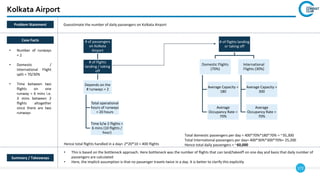
Guesstimate 2: Daily passengers in Calcutta
airport
172
9.4
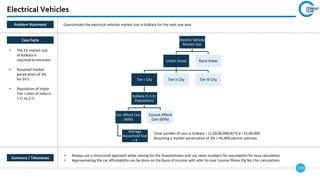
Guesstimate 3: Estimate the electrical car
market size in India/ any city
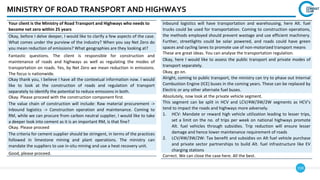
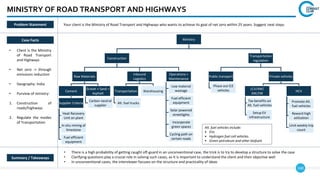
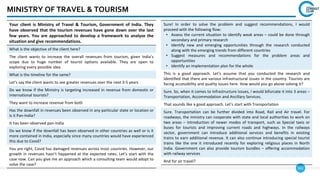
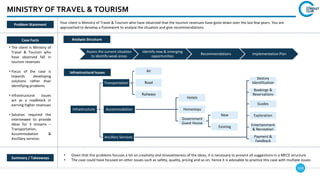
173
9.5
Guesstimate 4: Total revenue of a fast-food
chain/restaurant
174
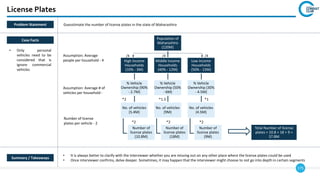
9.6
Guesstimate 5: Number of License Plates in
Maharashtra
175
9.7
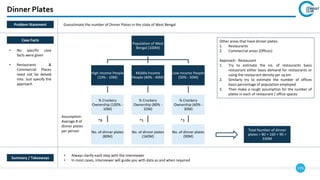
Guesstimate 6: Number of Dinner Plates in the
State of West Bengal
176
9.8
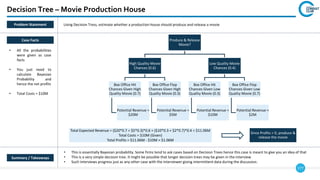
Guesstimate 7: Decision Tree- Movie
Production House
177
10 Appendices
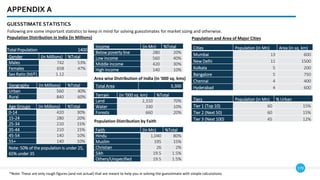
10.1 A: Guesstimate Statistics 179
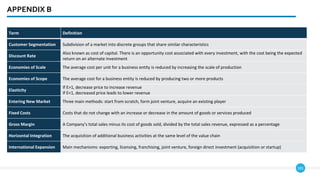
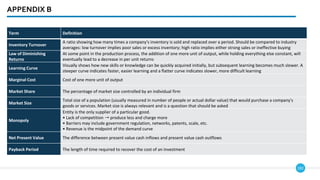
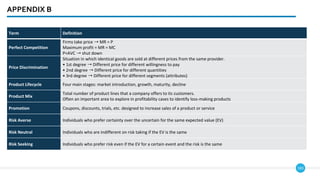
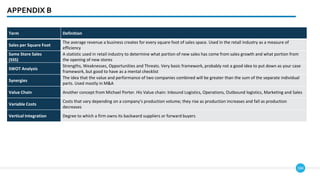
10.2 B: Glossary 180
S. No Particulars Page No.
7.4 Case 31: Consulting Firm 129
7.5 Case 32: Flipkart 131
7.6 Case 33: South African Telecom Operator 134
7.7 Case 34: Online Travel Aggregator 137
7.8 Case 35: SaaS Firm 139
7.9 Case 36: Pharmaceutical Industry 141
8 Unconventional
8.1 Increasing Capacity 144
8.2 Merger & Acquisition 145
8.3 Case 37: IT Services 146
8.4 Case 38: Google MSMEs 148
8.5 Case 39: Oil Manufacturer 150
8.6 Case 40: Consulting Firm 153
8.7 Case 41: VC Firm 155
8.8 Case 42: Education Ministry 157
8.9
Case 43: Ministry of Road Transport and
Highways
159
8.10 Case 44: Ministry of Travel & Tourism 161
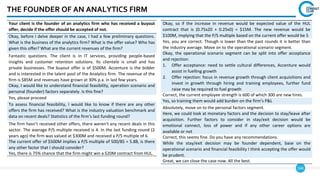
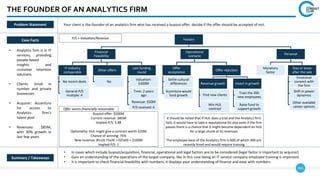
8.11 Case 45: Founder of an Analytics Firm 164
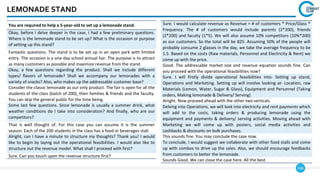
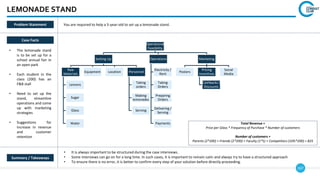
8.12 Case 46: Lemonade Stand 166
9
THE CASE INTERVIEW
PROCESS
10
WHAT IS A CASE INTERVIEW?
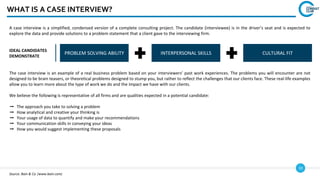
A case interview is a simplified, condensed version of a complete consulting project. The candidate (interviewee) is in the driver’s seat and is expected to
explore the data and provide solutions to a problem statement that a client gave to the interviewing firm.
IDEAL CANDIDATES
DEMONSTRATE
PROBLEM SOLVING ABILITY INTERPERSONAL SKILLS CULTURAL FIT
The case interview is an example of a real business problem based on your interviewers’ past work experiences. The problems you will encounter are not
designed to be brain teasers, or theoretical problems designed to stump you, but rather to reflect the challenges that our clients face. These real-life examples
allow you to learn more about the type of work we do and the impact we have with our clients.
We believe the following is representative of all firms and are qualities expected in a potential candidate:
➞ The approach you take to solving a problem
➞ How analytical and creative your thinking is
➞ Your usage of data to quantify and make your recommendations
➞ Your communication skills in conveying your ideas
➞ How you would suggest implementing these proposals
Source: Bain & Co. (www.bain.com)
11
CASE INTERVIEW FORMAT
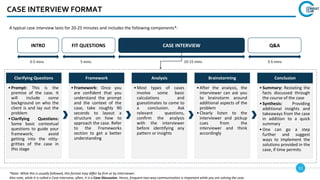
A typical case interview lasts for 20-25 minutes and includes the following components*:
*Note: While this is usually followed, this format may differ by firm or by interviewer.
Also note, while it is called a Case Interview, often, it is a Case Discussion. Hence, frequent two-way communication is important while you are solving the case
INTRO FIT QUESTIONS CASE INTERVIEW Q&A
3-5 mins 5 mins 10-15 mins 3-5 mins
Clarifying Questions
•Prompt: This is the
premise of the case. It
will include some
background on who the
client is and lay out the
problem
•Clarifying Questions:
Some basic contextual
questions to guide your
framework; avoid
getting into the nitty-
gritties of the case in
this stage
Framework
•Framework: Once you
are confident that you
understand the prompt
and the context of the
case, take roughly 90
seconds to layout a
structure on how to
approach the case. Refer
to the Frameworks
section to get a better
understanding
Analysis
•Most types of cases
involve some basic
calculations and
guesstimates to come to
a conclusion. Ask
relevant questions,
confirm the analysis
with the interviewer
before identifying any
pattern or insights
Brainstorming
•After the analysis, the
interviewer can ask you
to brainstorm around
additional aspects of the
problem
•Clearly listen to the
interviewer and pickup
cues from the
interviewer and think
accordingly
Conclusion
•Summary: Restating the
facts discussed through
the course of the case
•Synthesis: Providing
additional insights and
takeaways from the case
in addition to a quick
summary
•One can go a step
further and suggest
ways to implement the
solutions provided in the
case, if time permits
12
FIT QUESTIONS
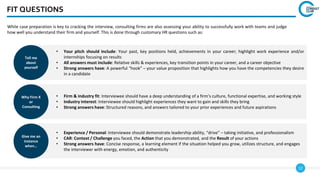
While case preparation is key to cracking the interview, consulting firms are also assessing your ability to successfully work with teams and judge
how well you understand their firm and yourself. This is done through customary HR questions such as:
Tell me
about
yourself
Why Firm X
or
Consulting
Give me an
instance
when…
• Your pitch should include: Your past, key positions held, achievements in your career; highlight work experience and/or
internships focusing on results
• All answers must include: Relative skills & experiences, key transition points in your career, and a career objective
• Strong answers have: A powerful “hook” – your value proposition that highlights how you have the competencies they desire
in a candidate
• Firm & industry fit: Interviewee should have a deep understanding of a firm’s culture, functional expertise, and working style
• Industry interest: Interviewee should highlight experiences they want to gain and skills they bring
• Strong answers have: Structured reasons, and answers tailored to your prior experiences and future aspirations
• Experience / Personal: Interviewee should demonstrate leadership ability, “drive” – taking initiative, and professionalism
• CAR: Context / Challenge you faced, the Action that you demonstrated, and the Result of your actions
• Strong answers have: Concise response, a learning element if the situation helped you grow, utilizes structure, and engages
the interviewer with energy, emotion, and authenticity
13
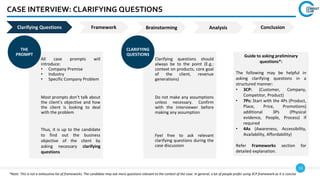
CASE INTERVIEW: CLARIFYING QUESTIONS
Guide to asking preliminary
questions*:
The following may be helpful in
asking clarifying questions in a
structured manner:
• 3CP: (Customer, Company,
Competitor, Product)
• 7Ps: Start with the 4Ps (Product,
Place, Price, Promotions)
additional 3Ps (Physical
evidence, People, Process) if
required
• 4As (Awareness, Accessibility,
Availability, Affordability)
Refer Frameworks section for
detailed explanation.
All case prompts will
introduce:
• Company Premise
• Industry
• Specific Company Problem
Most prompts don’t talk about
the client’s objective and how
the client is looking to deal
with the problem
Thus, it is up to the candidate
to find out the business
objective of the client by
asking necessary clarifying
questions
THE
PROMPT
Clarifying questions should
always be to the point (E.g.:
context on products, core goal
of the client, revenue
generations)
Do not make any assumptions
unless necessary. Confirm
with the interviewer before
making any assumption
Feel free to ask relevant
clarifying questions during the
case discussion
CLARIFYING
QUESTIONS
*Note: This is not a exhaustive list of frameworks. The candidate may ask more questions relevant to the context of the case. In general, a lot of people prefer using 3CP framework as it is concise
Clarifying Questions Framework Analysis
Brainstorming Conclusion
14
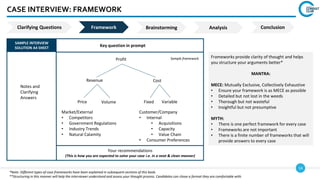
CASE INTERVIEW: FRAMEWORK
Frameworks provide clarity of thought and helps
you structure your arguments better*
MANTRA:
MECE: Mutually Exclusive, Collectively Exhaustive
• Ensure your framework is as MECE as possible
• Detailed but not lost in the weeds
• Thorough but not wasteful
• Insightful but not presumptive
MYTH:
• There is one perfect framework for every case
• Frameworks are not important
• There is a finite number of frameworks that will
provide answers to every case
Key question in prompt
Notes and
Clarifying
Answers
SAMPLE INTERVIEW
SOLUTION A4 SHEET
Your recommendations
(This is how you are expected to solve your case i.e. in a neat & clean manner)
Profit
Cost
Revenue
Volume
Price Variable
Fixed
Market/External
• Competitors
• Government Regulations
• Industry Trends
• Natural Calamity
Customer/Company
• Internal
• Acquisitions
• Capacity
• Value Chain
• Consumer Preferences
*Note: Different types of case frameworks have been explained in subsequent sections of this book.
**Structuring in this manner will help the interviewer understand and assess your thought process. Candidates can chose a format they are comfortable with.
Clarifying Questions Framework Analysis
Brainstorming Conclusion
Sample framework
15
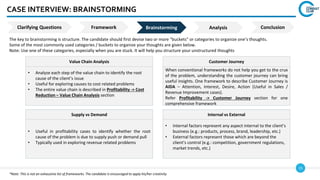
CASE INTERVIEW: BRAINSTORMING
The key to brainstorming is structure. The candidate should first devise two or more “buckets” or categories to organize one’s thoughts.
Some of the most commonly used categories / buckets to organize your thoughts are given below.
Note: Use one of these categories, especially when you are stuck. It will help you structure your unstructured thoughts
*Note: This is not an exhaustive list of frameworks. The candidate is encouraged to apply his/her creativity
Clarifying Questions Framework Analysis
Brainstorming Conclusion
When conventional frameworks do not help you get to the crux
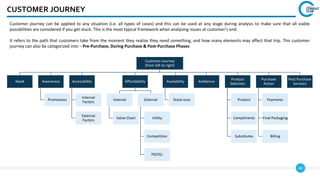
of the problem, understanding the customer journey can bring
useful insights. One framework to describe Customer Journey is
AIDA – Attention, Interest, Desire, Action (Useful in Sales /
Revenue Improvement cases).
Refer Profitability -> Customer Journey section for one
comprehensive framework
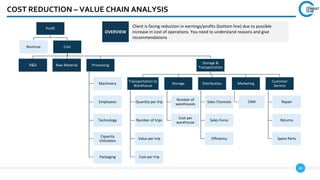
• Analyze each step of the value chain to identify the root
cause of the client’s issue
• Useful for exploring causes to cost related problems
• The entire value chain is described in Profitability -> Cost
Reduction – Value Chain Analysis section
Value Chain Analysis Customer Journey
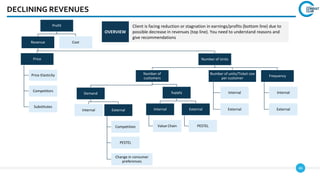
• Useful in profitability cases to identify whether the root
cause of the problem is due to supply push or demand pull
• Typically used in exploring revenue related problems
Supply vs Demand
• Internal factors represent any aspect internal to the client’s
business (e.g.: products, process, brand, leadership, etc.)
• External factors represent those which are beyond the
client’s control (e.g.: competition, government regulations,
market trends, etc.)
Internal vs External
16
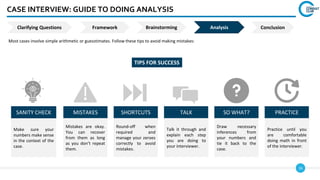
CASE INTERVIEW: GUIDE TO DOING ANALYSIS
Most cases involve simple arithmetic or guesstimates. Follow these tips to avoid making mistakes:
SANITY CHECK MISTAKES SHORTCUTS TALK SO WHAT? PRACTICE
Make sure your
numbers make sense
in the context of the
case.
Mistakes are okay.
You can recover
from them as long
as you don’t repeat
them.
Round-off when
required and
manage your zeroes
correctly to avoid
mistakes.
Talk it through and
explain each step
you are doing to
your interviewer.
Draw necessary
inferences from
your numbers and
tie it back to the
case.
Practice until you
are comfortable
doing math in front
of the interviewer.
TIPS FOR SUCCESS
Clarifying Questions Framework Analysis
Brainstorming Conclusion
17
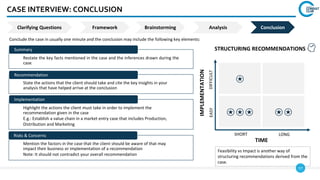
CASE INTERVIEW: CONCLUSION
Conclude the case in usually one minute and the conclusion may include the following key elements:
Clarifying Questions Framework Brainstorming Analysis Conclusion
Restate the key facts mentioned in the case and the inferences drawn during the
case
Summary
State the actions that the client should take and cite the key insights in your
analysis that have helped arrive at the conclusion
Highlight the actions the client must take in order to implement the
recommendation given in the case
E.g.: Establish a value chain in a market entry case that includes Production,
Distribution and Marketing
Mention the factors in the case that the client should be aware of that may
impact their business or implementation of a recommendation
Note: It should not contradict your overall recommendation
STRUCTURING RECOMMENDATIONS
⍟
⍟⍟
⍟⍟⍟
TIME
IMPLEMENTATION
EASY
DIFFICULT
SHORT LONG
Feasibility vs Impact is another way of
structuring recommendations derived from the
case.
Recommendation
Implementation
Risks & Concerns
18
INDUSTRY OVERVIEW
Note: The following is a non-exhaustive list of commonly tested industries. The interviewer may test the candidate on industries based on his/her prior
experience
19
Source: IBEF, Invest India
Note: Mfg. refers to Manufacturing
During Production
Key Drivers Industry Trends & Challenges Recent policy updates & news
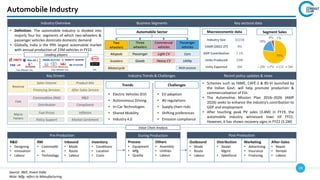
Industry Overview
• Definition: The automobile industry is divided into
majorly four biz. segments of which two-wheelers &
passenger vehicles dominate domestic demand
• Globally, India is the fifth largest automobile market
with annual production of 23M vehicles in FY22.
Business Segments Key sectoral data
Automobile Sector
Two
wheelers
Three
wheelers
Commercial
vehicles
Passenger
vehicles
Mopeds
Scooters
Motorcycle
Passenger
Goods
Light CV
Heavy CV
Cars
Utility
Multi-purpose
Leading players
Value Chain Analysis
Automobile Industry
77%
18%
4% 1%
2W PV CV 3W
Segment Sales
Industry Size $222B
CAGR (2022-27) 9%
GDP Contribution 7.1%
Units Produced 23M
Units Exported 6M
Macroeconomic data
Revenue
Sales Volume
Financing Services
Product Mix
After Sales Service
Cost
Commodities (RM)
Distribution
R&D
Compliance
Macro
Factors
Fuel Prices
Policy Support
Inflation
Market Sentiment
Trends
• Electric Vehicles (EV)
• Autonomous Driving
• In-Car Technologies
• Shared Mobility
• Industry 4.0
Challenges
• EV adoption
• AV regulations
• Supply chain risks
• Shifting preferences
• Emission compliance
Pre-Production
R&D
• Designing
• Innovation
• Labour
RM
• Commoditi
es
• Technology
Inbound
• Mode
• Route
• Labour
Inventory
• Conditions
• Location
• Costs
Post-Production
Outbound
• Mode
• Route
• Labour
Distribution
• Dealer
Mgmt.
• Salesforce
Marketing
• Advertising
• Insurance
• Financing
After-Sales
• Repair
• Rentals
• Labour
Process
• Equipment
• Mfg.
• Quality
Others
• Assembly
• Utilities
• Labour
• Schemes such as FAME, CAFÉ-2 & BS-VI launched by
the Indian Govt. will help promote production &
commercialization of EVs
• The Automotive Mission Plan 2016–2026 (AMP
2026) seeks to enhance the industry’s contribution to
GDP and employment
• After touching peak PV sales (3.4M) in FY19, the
automobile industry witnessed lows till FY21.
However, it has shown recovery signs in FY22 (3.1M)
Two-Wheeler Cos. Four-Wheeler Cos. EVs
20
Source: IBEF. Note: MRO refers to Maintenance, Repair & Overhaul. AAI: Airports Authority of India, AIS refers to advanced information systems, MCA refers to Ministry of Civil Aviation
*The Aviation Governance pie-chart indicates the total number of airports & airstrips governed by different acts in India, **Other often used method to analyze Aviation Value Chain is to map customer journey
Key Drivers Industry Trends & Challenges Recent policy updates & news
• India plans to mandate the use of 1% sustainable
aviation fuel for domestic airlines by 2025
• The MCA has launched UDAN 5.1 to enhance
connectivity in remote areas through helicopters
• Both Air India & IndiGo have placed large orders for
aircraft purchase from Airbus and Boeing
• On the other hand, GoFirst and SpiceJet are facing
insolvency crisis due to different reasons
• AirIndia to merge subsidiaries & operate two airlines
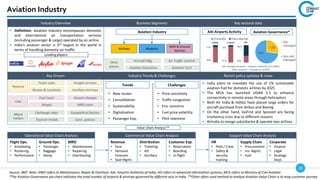
Industry Overview
• Definition: Aviation industry encompasses domestic
and international air transportation services
(including passenger & cargo) operated by an airline
• India’s aviation sector is 3rd largest in the world in
terms of handling domestic air-traffic
Business Segments Key sectoral data
Aviation Industry
Leading players
Value Chain Analysis**
Aviation Industry
Aviation Governance*
AAI Airports Activity
Revenue
Ticket sales
Routes & Locations
Freight services
Ancillary revenues
Cost
Fuel Costs
Wages
Airport charges
MRO costs
Macro
Factors
Exchange rates
Tourism trends
Geopolitical factors
Govt. policies
Trends
• New routes
• Consolidation
• Sustainability
• Digitalization
• Passenger Exp.
Challenges
• Price sensitivity
• Traffic congestion
• Env. concerns
• Fuel price volatility
• Pilot retention
Operational Value Chain Analysis
Flight Ops.
• Scheduling
• Rostering
• Performance
Ground Ops.
• Passenger
• Baggage
• Ramp
MRO
• Maintenance
• Repairing
• Overhauling
Other
players
Aircraft Mfg.
Aviation Education
Air Traffic Control
Aviation Tech
125
339
AAI
managed
Non-AAI
managed
MRO & Ground
Services
Airlines Airports
AAI managed airports – Airports Authority Act (1994)
Other airports – Aircraft Act (1934)
89% 91% 39%
11% 9% 62%
Domestic International
189M 3 MMT 2M
Commercial Value Chain Analysis
Revenue
• Fare
• Demand
Forecast
• Seat Mgmt.
Distribution
• Ticketing
• AIS
• Ancillary
Customer Exp.
• Reservation
• Boarding
• In-flight
Support Value Chain Analysis
HR
• Pilot / Crew
• Safety &
security
training
Supply Chain
• Procurement
• Inv. Mgmt.
• Fuel
Corporate
• Finance
• Legal
• Strategy
Dept.
21
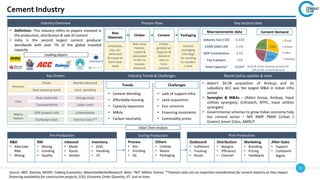
Source: IBEF, Statista, MOSPI, Trading Economics, MaximizeMarketResearch. Note: *MT: Million Tonnes, **Interest rates are an important consideration for cement industry as they impact
financing availability for construction projects, EOQ: Economic Order Quantity, JIT: Just-in-time.
During Production
Key Drivers Industry Trends & Challenges Recent policy updates & news
• Adani’s $6.5B acquisition of Ambuja and its
subsidiary ACC was the largest M&A in Indian infra
sector.
• Synergies & M&As – (Adani Group, Ambuja, Input
utilities synergies); (Ultratech, NTPC, input utilities
synergies)
• Governmental schemes to grow Indian economy help
the cement sector – NIP, NMP, PMAY (Urban /
Gramin) Smart Cities, AMRUT
Industry Overview
• Definition: This industry refers to players involved in
the production, distribution & sale of cement
• India is the second largest cement producer
worldwide with over 7% of the global installed
capacity
Process Flow Key sectoral data
Leading players
Value Chain Analysis
Cement Industry
Cement Demand
Industry Size (‘22) $143B
CAGR (2021-29) 5.5%
GDP Contribution 4.5%
Top 4 players 75%
Total Capacity* 360MT
Macroeconomic data
Revenue
Prices
Real estate growth
Market demand
Govt. spending
Cost
Raw materials
Transportation
Energy costs
Labor costs
Macro
Factors
GDP growth rate
Exchange rates
Urbanization
Interest rates**
Trends
• Cement blending
• Affordable housing
• Capacity expansion
• M&As
• Carbon neutrality
Challenges
• Lack of support infra.
• Land acquisition
• Env. concerns
• Financing constraints
• Commodity prices
Pre-Production
R&D
• Alternate
RMs
• MIxing
RM
• Mining
• Grinding
• Quality
Inbound
• Mode
• Route
• Vendor
Inventory
• EOQ
• Handling
• JIT
Post-Production
Outbound
• Fulfilment
• Tracking
• Route
Distribution
• Margins
• Efficiency
• Channel
Marketing
• Branding
• Pricing
• Feedbacks
After-Sales
• Support
• Complaint
Mgmt.
Process
• Kiln
• Grinding
• QC
Others
• Utilities
• Waste
• Packaging
Rural & urban housing account for
52% of the cement demand
29%
25%
23%
23%
Rural
Urban
Infra.
Industry
Raw
Materials
Limestone,
clay, etc.
extracted
& mixed to
form Raw
meal
Clinker Cement Packaging
Raw meal
heated,
cooled &
calcinated
in Kiln to
remove
moisture
Clinker
grinded w/
Gypsum &
stored in
silos to
form
cement
Cement
packaging
into bags
for sending
to retailers
/ sites
22
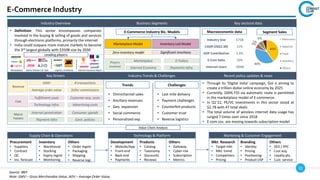
Source: IBEF
Note: GMV – Gross Merchandise Value, AOV – Average Order Value,
Key Drivers Industry Trends & Challenges Recent policy updates & news
Industry Overview
• Definition: This sector encompasses companies
involved in the buying & selling of goods and services
through electronic platforms, primarily the internet
• India could outpace more mature markets to become
the 3rd largest globally with $350B size by 2030
Business Segments Key sectoral data
Leading players
Value Chain Analysis
E-Commerce Industry
Segment Sales
Industry Size $75B
CAGR (2022-30) 21%
GDP Contribution 2.4%
E-Com Sales 10%
Internet Users 780M
Macroeconomic data
Trends
• Omnichannel sales
• Ancillary revenues
• Geo. expansion
• Social commerce
• Personalized exp.
Challenges
• Last mile delivery
• Payment challenges
• Counterfeit products
• Customer trust
• Reverse logistics
• Through its ‘Digital India’ campaign, GoI is aiming to
create a trillion-dollar online economy by 2025
• Currently, 100% FDI via automatic route is permitted
in the marketplace model of E-commerce.
• In Q1’22, PE/VC investments in this sector stood at
$2.7B with 47 total deals
• The total volume of wireless internet data usage has
surged 7 times over since 2018
• E-com cos. are moving towards subscription model
Marketplace Online Retailers (E-Tail) Internet Economy Players
Logistics & Delivery
E-Commerce Industry Biz. Models
Players
Involved
Marketplace
Internet Economy
E-Tailers
Payments Infra.
Marketplace Model
Zero inventory model
Inventory Led Model
Significant inventory
40%
40%
7%
7%
6% Electronics
Apparels
Food
Jewellery
Others
Revenue
GMV
Average order value
# transactions
Seller commissions
Cost
Fulfillment costs
Technology infra.
Customer acq. costs
Advertising costs
Macro
Factors
Internet penetration
Payment infra
Consumer spends
Govt. policies
Supply Chain & Operations
Procurement
• Suppliers
• Contract
• QC
• Inv. forecast
Inventory
• Warehouse
• Stocking
• Expiry mgmt.
• Monitoring
Others
• Order mgmt.
• Packaging
• Shipping
• Reverse logi.
Technology & Platform
Development
• Website/App
• Front-end
• Back-end
• Payments
Products
• Catalog
• Taxonomy
• Discounts
• Reviews
Others
• Gateway
• Cyber-risk
• Subscription
• Metrics
Marketing & Customer Engagement
Mkt. Research
• Target mkt.
• Mkt. trend
• Competitors
• Pricing
Branding
• Identity
• Pricing
• Positioning
• Product USP
Others
• SEO / PPC
• Cust acq.
• Loyalty pts.
• Cust. service
23
Source: IBEF, Note: GS refers to Goldman Sachs, iB/RB/CB: Investment Banking, Retail Banking, Commercial Banking; MF AUM: Mutual Fund Industry Asset Under Management, AML / KYC
refers to Anti-money laundering & know your customer processes.
Key Drivers Industry Trends & Challenges Recent policy updates & news
• GoI has approved 100% FDI for insurance
intermediaries and increased limit to 74% in
insurance from the previous 49%
• A pilot programme for Central Bank Digital Currency
(CBDC) was launched by RBI in November 2022
• In September 2021, 8 banks announced that they are
expecting to roll out account aggregator framework
• Key Deals: (HDFC Bank, HDFC); (Piramal Group,
DHFL); (LIC IPO); (Axis Bank, Citi Bank retail business)
Industry Overview
• Definition: This sector encompasses various financial
institutions & organizations that provide financial
products & services to individuals & businesses
• According to GS, India’s stock market is likely to reach
$5T surpassing UK to become the 5th largest by 2024
Business Segments Key sectoral data
Leading players
Value Chain Analysis
Financial Services Industry – All
44%
33%
22%
1%
Corporates
HNIs
Retail
Others
MF breakdown
Gross Savings / GDP 29.3%
Insurance AUM (’25E) $1T
MF AUM $478B
MF Penetration 5-6%
IPO Capital Raised $7B
Macroeconomic data
Revenue
Client base
Cross-selling
AUM
Ancillary fees
Cost
Employee benefits
Rents & Leases
Tech infra. costs
Compliance
Macro
Factors
Economic stability
Exchange rates
Interest rates
Financial literacy
Trends
• Digitalization
• Rise of FinTech
• Financial inclusion
• Account aggregation
• ESG Focus
Challenges
• Cybersecurity
• NPA management
• Debt market liquidity
• Customer trust
• Economic volatility
Multi-segment players Insurance NBFC
Financial Services Industry
Capital
Markets
Insurance NBFCs
MFs
Broking
IB
Life
Non-Life
Asset fin.
Loan cos.
Commercial
& Retail
Banks
Banks
Industry regulators: RBI, SEBI, IRDAI
Operational Value Chain Analysis
Risk mgmt.
• Risk analysis
• Underwriting
• Risk
mitigation
Investment
• Financial
planning
• Portfolio
mgmt.
Settlements
• Payment
processing
• Trade
execution
Commercial Value Chain Analysis
Marketing
• Branding
• Research
• Lead
generation
Onboarding
• Prospecting
• Conversion
• Account
setup
Relationship
• Cust.
Support
• Cross-selling
• Loyalty pts.
Support Value Chain Analysis
Tech. infra.
• H/W & S/W
mgmt.
• N/w mgmt.
• Data security
Compliance
• Regulations
• Filings
• Audits
• AML / KYC.
HR
• Workforce
planning
• Employee
benefits
24
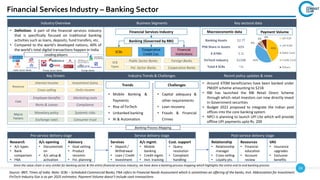
Source: IBEF, Times of India. Note: SCBs – Scheduled Commercial Banks, FNA refers to Financial Needs Assessment which is sometimes an offering of the banks, Invt. Abbreviation for Investment.
FinTech Industry Size is as per 2025 estimates. Payment Volume doesn’t include cash transactions
Key Drivers Industry Trends & Challenges Recent policy updates & news
• Around 470M beneficiaries have been banked under
PMJDY scheme amounting to $21B
• RBI has launched the RBI Retail Direct Scheme
through which retail investors can now directly invest
in Government securities
• Budget 2022 proposed to integrate the Indian post
offices into the core banking system
• NPCI is planning to launch UPI Lite which will provide
offline UPI payments upto Rs. 200
Industry Overview
• Definition: A part of the financial services industry
that is specifically focused on traditional banking
activities such as loans, deposits, fund transfers, etc.
• Compared to the world's developed nations, 40% of
the world's total digital transactions happen in India
Business Segments Key sectoral data
Leading players
Banking Process Mapping
Financial Services Industry – Banking Sector
Payment Volume
Banking Assets $2.7T
PSB Share in Assets 60%
# ATMs 2.1L
FinTech Industry $150B
Total # SCBs ~1L
Macroeconomic data
Revenue
Interest Income
Cross-selling
Investment Gains
ForEx Income
Cost
Employee benefits
Rents & Leases
Marketing costs
Compliance
Macro
Factors
Monetary policy
Exchange rates
Systemic risks
Consumer trust
Trends
• Mobile Banking &
Payments
• Rise of FinTech
• Unbanked banking
• AI & Automation
Challenges
• Capital adequacy &
other requirements
• Loan recovery
• Frauds & Financial
Crimes
Public Sector Banks Private Sector Banks Foreign Banks
Pre-service delivery stage
Research
• A/c types
• Bank
comparison
• FNA
A/c opening
• Documentati
on
• A/c setup &
activation
Advisory
• Goal setting
• Product
recomm.
• Fin. planning
Service delivery stage
Services
• Deposit /
Withdrawal
• Loan / Credit
• Investment
A/c mgmt.
• Mobile
banking
• Credit mgmt.
• Invt. tracking
Cust. support
• Query
resolution
• Compliant
handling
Post-service delivery stage
Relationship
• Relationship
manager
• Cross-selling
• Loyalty pts.
Resources
• Financial
education
• Account
review
VAS
• Insurance
upgrades
• Exclusive
benefits
Financial Services Industry
SCBs
Cooperative
Credit Cos.
Financial
Institutions
SCB
Types
Public Sector Banks
Pvt. Sector Banks
Foreign Banks
Cooperative Banks
Banking (Governed by RBI)
43%
42%
4%
3%
8% UPI P2P
UPI P2M
Debit Card
Credit Card
Others
Since the value chain is very similar for banking sector & the entire financial services industry, we have done a banking process mapping which highlights the entire end to end banking process
25
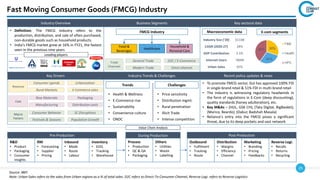
Source: IBEF.
Note: Urban Sales refers to the sales from Urban regions as a % of total sales. D2C refers to Direct-To-Consumer Channel, Reverse Logi. refers to Reverse Logistics
During Production
Key Drivers Industry Trends & Challenges Recent policy updates & news
• To promote FMCG sector, GoI has approved 100% FDI
in single-brand retail & 51% FDI in multi-brand retail
• The industry is witnessing regulatory headwinds in
the form of regulations in E-Com (deep discounting),
quality standards (honey adulteration), etc.
• Key M&As – (HUL, GSK CH); (Tata Digital, BigBasket);
(Marico, Beardo); (Dabur, Badshah Masala)
• Reliance's entry into the FMCG poses a significant
threat, due to its deep pockets and vast network
Industry Overview
• Definition: The FMCG industry refers to the
production, distribution, and sale of often purchased,
non-durable goods such as household products.
• India's FMCG market grew at 16% in FY21, the fastest
seen in the previous nine years
Business Segments Key sectoral data
FMCG Industry
Leading players
Value Chain Analysis
Fast Moving Consumer Goods (FMCG) Industry
E-com segments
Industry Size (‘20) $110B
CAGR (2020-27) 28%
GDP Contribution 3.5%
Internet Users 780M
Urban Sales 65%
Macroeconomic data
Revenue
Consumer spends
Rural Markets
Urbanization
E-Commerce sales
Cost
Raw Materials
Manufacturing
Packaging
Distribution costs
Macro
Factors
Consumer Behavior
Festivals & Seasons
SC Disruptions
Population Growth
Trends
• Health & Wellness
• E-Commerce rise
• Sustainability
• Convenience culture
• ONDC
Challenges
• Price sensitivity
• Distribution mgmt.
• Rural penetration
• Illicit Trade
• Intense competition
Pre-Production
R&D
• Product
• Packaging
• Consumer
insights
RM
• Forecasting
• Supplier
• Pricing
Inbound
• Mode
• Route
• Labour
Inventory
• EOQ
• Tracking
• Warehouse
Post-Production
Outbound
• Fulfilment
• Tracking
• Route
Distribution
• Margins
• Efficiency
• Channel
Marketing
• Branding
• Pricing
• Feedbacks
Reverse Logi.
• Recalls
• Returns
• Recycling
Process
• Production
• QC & QA
• Packaging
Others
• Utilities
• Waste
• Labelling
Trade
Channels
General Trade
Modern Trade
D2C / E-Commerce
Omni-channel
Household &
Personal Care
Food &
Beverages
Healthcare 30%
30%
40%
F&B
Health
HPC
26
Source: IBEF, Statista, Ministry of Steel, GoI; Note: *MT: Million Tonnes Note: *MT: Million Tonnes, **Interest rates are an important consideration for cement industry as they impact financing
availability for construction projects. #: Steel mfr. were permitted to produce & sell industrial oxygen during Covid-19 pandemic. Curr. steel industry O2 capacity= 1500MT per day. BOF/EAF: Google.
During Production
Key Drivers Industry Trends & Challenges Recent policy updates & news
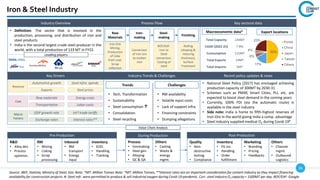
• National Steel Policy (2017) has envisaged achieving
production capacity of 300MT by 2030-31
• Schemes such as PMAY, Smart Cities, PLI, etc. are
expected to boost steel demand in the coming years
• Currently, 100% FDI (via the automatic route) is
available in the steel industry
• Side note: India is home to fifth-highest reserves of
Iron-Ore in the world giving India a comp. advantage
• Steel industry supplied medical O2 during Covid-19#
Industry Overview
• Definition: The sector that is involved in the
production, processing, and distribution of iron and
steel products
• India is the second largest crude steel producer in the
world, with a total production of 133 MT in FY22.
Process Flow Key sectoral data
Leading players
Value Chain Analysis
Iron & Steel Industry
Export locations
Total Capacity 144MT
CAGR (2022-25) 7-8%
Consumption 115MT
Total Exports 14MT
Total Imports 5MT
Macroeconomic data*
Revenue
Automotive growth
Exports
Govt infra. spends
Steel prices
Cost
Raw materials
Transportation
Energy costs
Labor costs
Macro
Factors
GDP growth rate
Exchange rates
Int’l trade tariffs
Interest rates**
Trends
• Tech. Transformation
• Sustainability
• Steel consumption
• Consolidation
• Steel recycling
Challenges
• RM availability
• Volatile input costs
• Lack of support infra.
• Financing constraints
• Dumping allegations
Pre-Production
R&D
• Alloy dev.
• Process
optimizn.
RM
• Mining
• Coking
• Scrap
processing
Inbound
• RM
transport
• Energy
input
Inventory
• EOQ
• Handling
• Tracking
Post-Production
Quality
• Non-
destructive
testing
• Compliance
Inventory
• FG inv.
• Handling
• Order
fulfillment
Marketing
• Branding
• Pricing
• Feedbacks
Others
• Channel
mgmt.
• Outbound
Logistics
Process
• Ironmaking
• Steel gen.
• Alloying
• QC & QA
Others
• Casting
• Waste &
energy
mgmt.
50%
17%
6%
4%
23% Korea
China
Japan
Taiwan
Others
Iron Ore
Mining,
Production
of Coke
from coal,
Scrap
collection
Raw
Materials
Iron-
making
Steel-
making
Finishing
Conversion
of iron ore
to molten
iron
BOF/EAF:
Iron to
Steel
conversion.
Casting of
steel
Rolling
(shaping &
reducing
thickness),
Surface
Treatment
27
Source: IBEF, Statista, Times of India,
Note: FDI Inflows Rank is a rank which indicates that IT & ITES sector has witnessed 2nd highest FDI inflow in the country in the past few years.
Key Drivers Industry Trends & Challenges Recent policy updates & news
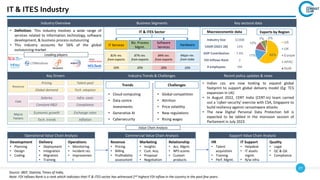
• Indian cos. are now looking to expand global
footprint to support global delivery model (Eg: TCS
expansion in UK)
• In August 2022, CERT India (CERT-In) team carried
out a ‘cyber-security’ exercise with CSA, Singapore to
build resiliency against ransomware attacks
• The new Digital Personal Data Protection bill is
expected to be tabled in the monsoon session of
Parliament in July 2023
Industry Overview
• Definition: This industry involves a wide range of
services related to information technology, software
development, & business process outsourcing
• This industry accounts for 56% of the global
outsourcing market
Business Segments Key sectoral data
Leading players
Value Chain Analysis
IT & ITES Industry
62%
17%
12%
7% 2%
US
UK
Europe
APAC
RoW
Exports by Region
Industry Size $230B
CAGR (2021-28) 13%
GDP Contribution 7.4%
FDI Inflows Rank 2
# employees 5M
Macroeconomic data
Revenue
Pricing
Global demand
Talent pool
Tech. adoption
Cost
Salaries
Constant R&D
Infra. costs
Compliance
Macro
Factors
Economic growth
Tech. trends
Exchange rates
Inflation
Trends
• Cloud computing
• Data centre
investments
• Generative AI
• Cybersecurity
Challenges
• Global competition
• Attrition
• Price volatility
• New regulations
• Rising wages
IT & ITES Sector
IT Services
Biz. Process
Mgmt.
Software
Services
Hardware
84% rev.
from exports
Major rev.
from India
10%
81% rev.
from exports
50%
87% rev.
from exports
20% 20%
Operational Value Chain Analysis
Development
• Planning
• Design
• Coding
Delivery
• Deployment
• Integration
• Migration
• Training
Operations
• Monitoring
• Incident res.
• Improvemen
t
Commercial Value Chain Analysis
Revenue
• Pricing
• Billing
• Profitability
assessment
Marketing
• Insights
• Cust. Acq.
• Proposal
• Negotiation
Relationship
• Acc. Mgmt.
• NPS scores
• Custom
products
Support Value Chain Analysis
HR
• Talent
acquisition
• Training
• Perf. Mgmt.
IT Support
• Helpdesk
• IT assets
mgmt.
• N/w infra
Quality
• Legal
• QC & QA
• Compliance
28
Source: IBEF, Statista, Times of India, ResearchandMarkets. Note: *Ferrous Metals, Limestone, Coal are covered in more details in the industry reports of Iron & Steel, Cement and Power
Industries , Cu/Al/Zn/LST: Copper, Aluminium, Zinc/Limestone. SBI: State Bank of India
Key Drivers Industry Trends & Challenges Recent policy updates & news
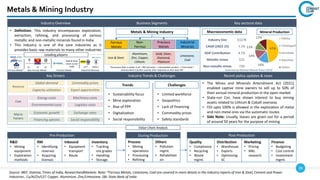
• The Mines and Minerals Amendment Act (2021)
enabled captive mine owners to sell up to 50% of
their annual mineral production in the open market.
• State-run Cos. have shown interest to buy mining
assets related to Lithium & Cobalt overseas
• FDI upto 100% is allowed in the exploration of metal
and non-metal ores via the automatic routes
• Side Note: Usually, leases are given out for a period
of around 50 years for the purpose of mining
Industry Overview
• Definition: This industry encompasses exploration,
extraction, refining, and processing of various
metallic and non-metallic minerals found in India
• This industry is one of the core industries as it
provides basic raw materials to many other industries
Business Segments Key sectoral data
Leading players
Value Chain Analysis
Metals & Mining Industry
Mineral Production
Industry Size $127B
CAGR (2022-25) 7.1%
GDP Contribution 4.1%
Metallic mines 525
Non-metallic mines 720
Macroeconomic data
Revenue
Global demand
Capacity utilization
Commodity prices
Export opportunities
Cost
Energy costs
Environmental costs
Machinery costs
Logistics costs
Macro
Factors
Economic growth
Financing options
Exchange rates
Social responsibility
Trends
• Sustainability focus
• Mine exploration
• Rise of PPP
• Digitalization
• Social responsibility
Challenges
• Limited workforce
• Geopolitics
• Lack of financing
• Commodity prices
• Safety standards
Ferrous Metals* Non-Ferrous Metals Industrial Minerals
Precious Metals
Cu Al
Gold & Silver
mines across
India
Zn LST* Others
Metals & Mining Industry
Ferrous
Metals
Non-
Ferrous
Precious
Metals
Industrial
Minerals
Gold, Silver,
Diamond,
Platinum
Limestone,
Coal
Iron & Steel.
Aluminium,
Zinc, Copper,
Lithium.
The process flow is similar in all – RM extraction -> intermediate product -> Final metal /
mineral which is further used by other industries as their base RM
47%
16%
14%
11%
12% Odisha
Chhatisgarh
Karnataka
Rajasthan
Others
Governed by National Mineral Policy (2019)
During Production
Pre-Production
R&D
• Mining
equipment
• Exploration
methods
RM
• Identifying
reserves
• Acquiring
licenses
Inbound
• Equipment
transport
• Route
Inventory
• Tracking
ore grades
• Handling
• Storage
Post-Production
Quality
• Compliance
• Recycling
• Waste
mgmt.
Distribution
• Warehouse
• Exports
• Optimizing
SC
Marketing
• Pricing
• Mkt.
research
Finance
• Budgeting
• Cost control
• Investment
mgmt.
Process
• Mining
operations
• Processing
• Refining
Others
• Pollution
mgmt.
• Rehabilitati
on
29
Key Drivers Industry Trends & Challenges Recent policy updates & news
Industry Overview
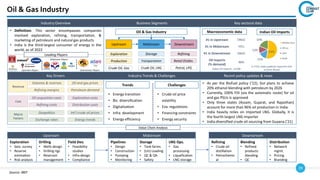
• Definition: This sector encompasses companies
involved exploration, refining, transportation, &
marketing of petroleum and natural gas products
• India is the third-largest consumer of energy in the
world, as of 2022
Business Segments Key sectoral data
Leading Players
Value Chain Analysis
Oil & Gas Industry
53%
15%
13%
19%
Middle East
Africa
USA
RoW
Indian Oil Imports
Macroeconomic data
Trends
• Energy transition
• Biz. diversification
• Digitalization
• Infra. development
• Energy efficiency
Challenges
• Crude oil price
volatility
• Env. regulations
• Financing constraints
• Energy security
• As per the Biofuel policy (‘22), GoI plans to achieve
20% ethanol blending with petroleum by 2026
• Currently, 100% FDI (via the automatic route) for oil
and gas PSUs is approved
• Only three states (Assam, Gujarat, and Rajasthan)
account for more than 96% oil production in India
• India heavily relies on imported LNG. Globally, it is
the fourth largest LNG importer
• India diversified crude oil sourcing from Guyana (‘21)
Upstream Players
Midstream Players
Downstream Players
Upstream
Exploration
• Geo. survey
• Reserve
estimation
• Risk analysis
Drilling
• Wells design
• Drilling rigs
• Reservoir
management
Field Dev.
• Feasibility
studies
• Infra design
• Compliance
Midstream
Pipelines
• Design
• Construction
• Pumping
• Monitoring
Storage
• Tank farms
• (Un) Loading
• QC & QA
• Safety
LNG Ops.
• Gas
processing
• Liquefication
• LNG storage
Downstream
Refining
• Crude oil
distillation
• Petrochemic
al
Blending
• Refined
products
blending
• QC
Distribution
• Network
mgmt.
• Pricing
• Branding
#1 in Upstream ONGC
#1 in Midstream IOCL
#1 in Downstream ONGC
Oil imports
(% demand)
88%
Source: IBEF
Oil & Gas Industry
Upstream
Exploration
Production
Crude Oil, Gas
Midstream
Storage
Transportation
Crude Oil, LNG
Downstream
Refining
Retail Distbn.
Petrol, LPG Indian Oil Imports - $120B
In FY23, India suddenly imported 33%
oil from Russia
Revenue
Volumes & reserves
Refining margins
Oil and gas prices
Petroleum demand
Cost
Oil acquisition costs
Refining costs
Exploration costs
Distribution costs
Macro
Factors
Geopolitics
Exchange rates
Int’l crude oil prices
Energy trends
30
Source: IBEF, CARE
Note: GMP: Good Manufacturing Practice Industry Standards; QC & QA refers to Quality Control & Quality Assurance
During Production
Key Drivers Industry Trends & Challenges Recent policy updates & news
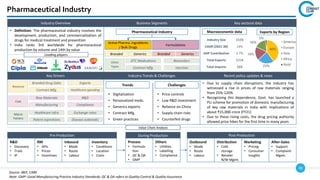
• Due to supply chain disruptions, the industry has
witnessed a rise in prices of raw materials ranging
from 25%-120%
• Recognising this dependence, Govt. has launched a
PLI scheme for promotion of domestic manufacturing
of key raw materials in India with implications of
about ₹15,000 crore (FY21)
• Due to these rising costs, the drug pricing authority
allowed price hikes for the first time in many years
Industry Overview
• Definition: The pharmaceutical industry involves the
development, production, and commercialization of
drugs for medical treatment and prevention
• India ranks 3rd worldwide for pharmaceutical
production by volume and 14th by value
Business Segments Key sectoral data
Pharmaceutical Industry
Active Pharma. Ingredients
/ Bulk Drugs
Formulations
Branded Generics Branded Generics
Leading players
Value Chain Analysis
Pharmaceutical Industry
40%
23%
19%
16%
2%
America
Europe
Asia
Africa
RoW
Exports by Region
Industry Size $50B
CAGR (2021-30) 13%
GDP Contribution 1.7%
Total Exports $25B
Total Imports $8B
Macroeconomic data
Revenue
Branded Drug Sales
Contract Mfg.
Exports
Healthcare spending
Cost
Raw Materials
Manufacturing
R&D
Compliance
Macro
Factors
Healthcare Infra
Patent expirations
Exchange rates
Disease outbreaks
Trends
• Digitalization
• Personalized meds.
• Generics exports
• Contract Mfg.
• Green practices
Challenges
• Price controls
• Low R&D investment
• Reliance on China
• Supply chain risks
• Counterfeit drugs
Pre-Production
R&D
• Discovery
• Trials
• IP
RM
• APIs
• Prices
• Incentives
Inbound
• Mode
• Route
• Labour
Inventory
• Conditions
• Location
• Costs
Post-Production
Outbound
• Mode
• Route
• Labour
Distribution
• Cold
storage
• Retailer
N/W Mgmt.
Marketing
• Pricing
• Consumer
Insights
After-Sales
• Support
• Complaint
Mgmt.
Process
• Formula-
tion
• QC & QA
• GMP
Others
• Utilities
• Labelling
• Compliance
Other
Types
OTC Medications
Contract Mfg.
Biosimilars
Vaccines
31
Key Drivers Industry Trends & Challenges Recent policy updates & news
Industry Overview
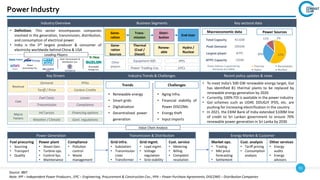
• Definition: This sector encompasses companies
involved in the generation, transmission, distribution,
and consumption of electrical power
• India is the 3rd largest producer & consumer of
electricity worldwide behind China & USA
Business Segments Key sectoral data
Leading Players
Value Chain Analysis
Power Industry
57%
30%
11% 2%
Thermal Renewables
Hydro Nuclear
Power Sources
Macroeconomic data
Revenue
Demand
Tariff / Price
PPAs
Carbon Credits
Cost
Fuel Costs
Transmission
Losses
Compliance
Macro
Factors
Int’l prices
Weather / Climate
Financing options
Govt. regulations
Trends
• Renewable energy
• Smart grids
• Digitalization
• Decentralized power
generation
Challenges
• Aging Infra.
• Financial viability of
Power DISCOMs
• Energy theft
• Input imports
• To meet India’s 500 GW renewable energy target, GoI
has identified 81 thermal plants to be replaced by
renewable energy generation by 2026
• Currently, 100% FDI is available in the power industry
• GoI schemes such as UDAY, DDUGJY IPDS, etc. are
pushing for increasing electrification in the country
• In 2021, the EXIM Bank of India extended $100M line
of credit to Sri Lankan government to ensure 70%
renewable power generation in Sri Lanka by 2030
Power
Generating Cos.
State Transmission &
Distribution Cos.
Renewable
Energy Cos.
Gene-
ration
Trans-
mission
Distri-
bution
End-User
Other
players
Gene-
ration
Sources
Thermal
(Coal /
Diesel)
Renew-
able
Hydro /
Nuclear
Equipment Mfr.
Power Trading Cos.
IPPs
EPCs
Power Generation
Fuel procuring
• Sourcing
• Transport
• Quality
Power plant
• Steam Gen.
• Turbine ops.
• Control Sys.
• Maintenance
Compliance
• Pollution
control
• Waste
management
Transmission & Distribution
Grid infra.
• Substation
• Transmission
Lines
• Transformer
Grid mgmt.
• Load mgmt.
• Voltage
regulation
• Grid stability
Cust. service
• Metering
• Billing
• Complaint
resolution
Energy Market & Customer
Market ops.
• Trading
• Mkt price
forecasting
• Settlement
Cust. analysis
• Tariff pricing
• Consumption
analysis
Other services
• Energy
audits
• Energy
advisors
Total Capacity 411GW
Peak Demand 205GW
Largest player NTPC
NTPC Capacity 72GW
Power industry is governed by
Electricity Act (2003)
Source: IBEF
Note: IPP – Independent Power Producers , EPC – Engineering, Procurement & Construction Cos., PPA – Power Purchase Agreements, DISCOMS – Distribution Companies
32
Source: IBEF, Statista, Times of India, Mordor Intelligence. Note: Industry Size of Telecom Industry includes just Network & Internet Service Providers and not other players mentioned in the
industry. It is interesting to note that, as per IBEF, the Industry Revenues have declined from $40B in 2016 to $37B in 2021. SLA: Service Level Agreement, QOS: Quality of Service
Key Drivers Industry Trends & Challenges Recent policy updates & news
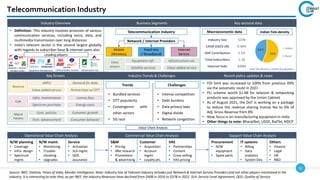
• FDI limit was increased to 100% from previous 49%
via the automatic route in 2021
• PLI scheme worth $1.6B for telecom & networking
products was approved by the Union Cabinet
• As of August 2021, the DoT is working on a package
to reduce the revenue sharing license fee to 6% of
Adj. Gross Revenue from 8%
• Now, focus is on manufacturing equipment in India
• Other things to note: BharatNet, USOF, RailTel, NDCP
Industry Overview
• Definition: This industry involves provision of various
communication services, including voice, data, and
multimedia transmission over long distances
• India's telecom sector is the second largest globally
with regards to subscriber base & internet users also
Business Segments Key sectoral data
Leading players
Value Chain Analysis
Telecommunication Industry
Indian Tele-density
Industry Size $37B
CAGR (2023-28) 9.40%
GDP Contribution 1.1%
Total Subscribers 1.1B
Internet Subs 830M
Macroeconomic data
Revenue
ARPU
Value added service
Demand for data
Partnerships w/ OTT
Cost
Infra. maintenance
Spectrum purchase
License fees
Energy costs
Macro
Factors
Govt. policies
Tech. advancement
Economic growth
Consumer behavior
Trends
• Bundled services
• OTT popularity
• Convergence with
other sectors
• 5G race
Challenges
• Intense competition
• Debt burdens
• Data privacy laws
• Digital divide
• Network congestion
Network + Internet
Providers (ISPs) Infrastructure Cos.
Equipment Manufacturer
The process flow is similar in all – RM extraction -> intermediate product -> Final metal /
mineral which is further used by other industries as their base RM
56%
44% Urban
Rural
Satellite
Communication Services
Business Segments
Telecommunication Industry
Mobile
(Wireless)
Fixed-line
(~Broadband)
Internet
Service
Other
players
Equipment mfr.
Satellite services
Infrastructure cos.
Value added service
Network / Internet Providers
Total Tele-density is at 85% of population
Operational Value Chain Analysis
N/W planning
• Coverage
• Infra. design
• Spectrum
mgmt.
N/W maint.
• Monitoring
• Trouble-
shooting
• Upgrades
Service
• Activation
• SLA mgmt.
• QOS
assurance
Commercial Value Chain Analysis
S&M
• Pricing
• Mkt research
• Promotions
& advertising
Customer
• Acquisition
• Account
mgmt.
• Loyalty pts.
VAS
• Partnerships
• Content
• Cross-selling
• VAS pricing
Support Value Chain Analysis
Procurement
• N/W
equipment
• Spare parts
IT systems
• Billing
• Data
analytics
• System Dev.
Others
• Finance
• Legal
• HR
• R&D
33
FRAMEWORKS
34
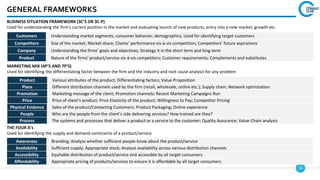
Awareness Branding; Analyze whether sufficient people know about the product/service
Availability Sufficient supply; Appropriate stock; Analyze availability across various distribution channels
Accessibility Equitable distribution of product/service and accessible by all target consumers
Affordability Appropriate pricing of products/services to ensure it is affordable by all target consumers
GENERAL FRAMEWORKS
BUSINESS SITUATION FRAMEWORK (3C’S OR 3C-P)
Used for understanding the firm’s current position in the market and evaluating launch of new products, entry into a new market, growth etc.
Customers Understanding market segments; consumer behavior; demographics; Used for identifying target customers
Competitors Size of the market; Market share; Clients’ performance vis-à-vis competition; Competitors’ future aspirations
Company Understanding the firms’ goals and objectives; Strategy it in the short term and long term
Product Nature of the firms’ product/service vis-à-vis competitors; Customer requirements; Complements and substitutes
MARKETING MIX (4P’S AND 7P’S)
Used for identifying the differentiating factor between the firm and the industry and root cause analysis for any problem
Product Various attributes of the product; Differentiating factors; Value Proposition
Place Different distribution channels used by the firm (retail, wholesale, online etc.); Supply chain; Network optimization
Promotion Marketing message of the client; Promotion channels; Recent Marketing Campaigns Run
Price Price of client's product; Price Elasticity of the product; Willingness to Pay; Competitor Pricing
Physical Evidence Sales of the product/Contacting Customers; Product Packaging; Online experience
People Who are the people from the client’s side delivering services? How trained are they?
Process The systems and processes that deliver a product or a service to the customer; Quality Assurance; Value-Chain analysis
THE FOUR A’s
Used for identifying the supply and demand constraints of a product/service
35
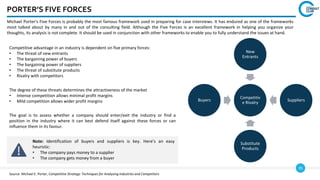
Michael Porter's Five Forces is probably the most famous framework used in preparing for case interviews. It has endured as one of the frameworks
most talked about by many in and out of the consulting field. Although the Five Forces is an excellent framework in helping you organize your
thoughts, its analysis is not complete. It should be used in conjunction with other frameworks to enable you to fully understand the issues at hand.
PORTER’S FIVE FORCES
Competitiv
e Rivalry
New
Entrants
Suppliers
Substitute
Products
Buyers
Competitive advantage in an industry is dependent on five primary forces:
• The threat of new entrants
• The bargaining power of buyers
• The bargaining power of suppliers
• The threat of substitute products
• Rivalry with competitors
The degree of these threats determines the attractiveness of the market
• Intense competition allows minimal profit margins
• Mild competition allows wider profit margins
The goal is to assess whether a company should enter/exit the industry or find a
position in the industry where it can best defend itself against these forces or can
influence them in its favour.
Note: Identification of buyers and suppliers is key. Here’s an easy
heuristic:
• The company pays money to a supplier
• The company gets money from a buyer
Source: Michael E. Porter, Competitive Strategy: Techniques for Analysing Industries and Competitors
36
PORTER’S FIVE FORCES
Source: Michael E. Porter, Competitive Strategy: Techniques for Analysing Industries and Competitors
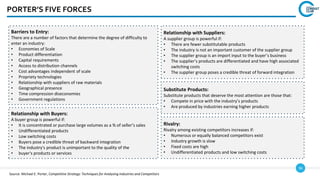
Barriers to Entry:
There are a number of factors that determine the degree of difficulty to
enter an industry:
• Economies of Scale
• Product differentiation
• Capital requirements
• Access to distribution channels
• Cost advantages independent of scale
• Propriety technologies
• Relationship with suppliers of raw materials
• Geographical presence
• Time compression diseconomies
• Government regulations
Relationship with Buyers:
A buyer group is powerful if:
• It is concentrated or purchase large volumes as a % of seller’s sales
• Undifferentiated products
• Low switching costs
• Buyers pose a credible threat of backward integration
• The industry's product is unimportant to the quality of the
• buyer's products or services
Relationship with Suppliers:
A supplier group is powerful if:
• There are fewer substitutable products
• The industry is not an important customer of the supplier group
• The supplier group is an import input to the buyer’s business
• The supplier’s products are differentiated and have high associated
switching costs
• The supplier group poses a credible threat of forward integration
Substitute Products:
Substitute products that deserve the most attention are those that:
• Compete in price with the industry’s products
• Are produced by industries earning higher products
Rivalry:
Rivalry among existing competitors increases if:
• Numerous or equally balanced competitors exist
• Industry growth is slow
• Fixed costs are high
• Undifferentiated products and low switching costs
37
IMPORTANT MATRICES
Matrices are an excellent way to illustrate a small number of potential scenarios or concepts. Some examples include:
▪ High Impact versus Low Impact
▪ High Market Share versus Low Market Share
▪ Broad Market Reach vs Limited Market Reach
Question
Mark
Star
Dog Cash Cow
High Growth Rate
Low Growth Rate
High
Market
Share
Low
Market
Share
BCG – GROWTH SHARE MATRIX
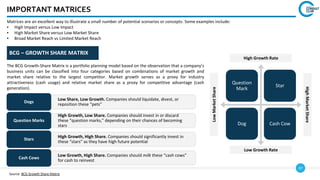
The BCG Growth-Share Matrix is a portfolio planning model based on the observation that a company’s
business units can be classified into four categories based on combinations of market growth and
market share relative to the largest competitor. Market growth serves as a proxy for industry
attractiveness (cash usage) and relative market share as a proxy for competitive advantage (cash
generation).
Low Share, Low Growth. Companies should liquidate, divest, or
reposition these “pets”
Dogs
High Growth, Low Share. Companies should invest in or discard
these “question marks,” depending on their chances of becoming
stars
Question Marks
High Growth, High Share. Companies should significantly invest in
these “stars” as they have high future potential
Stars
Low Growth, High Share. Companies should milk these “cash cows”
for cash to reinvest
Cash Cows
Source: BCG Growth Share Matrix
38
IMPORTANT MATRICES
ANSOFF MATRIX PORTER’S GENERIC STRATEGIES
Market
Penetration
Product
Development
Market
Development
Diversification
Existing Markets
New Markets
New
Products
Existing
Products
Increasing
Risk
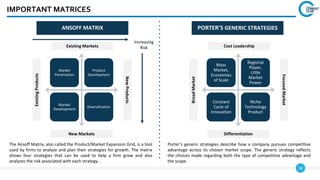
The Ansoff Matrix, also called the Product/Market Expansion Grid, is a tool
used by firms to analyze and plan their strategies for growth. The matrix
shows four strategies that can be used to help a firm grow and also
analyzes the risk associated with each strategy. .
Mass
Market,
Economies
of Scale
Regional
Player,
Little
Market
Power
Constant
Cycle of
Innovation
Niche
Technology
Product
Cost Leadership
Differentiation
Focused
Market
Broad
Market
Porter's generic strategies describe how a company pursues competitive
advantage across its chosen market scope. The generic strategy reflects
the choices made regarding both the type of competitive advantage and
the scope.
39
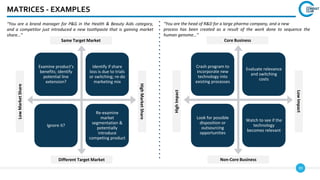
MATRICES - EXAMPLES
Examine product’s
benefits; identify
potential line
extension?
Identify if share
loss is due to trials
or switching; re-do
marketing mix
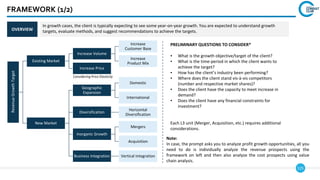
Ignore it?
Re-examine
market
segmentation &
potentially
introduce
competing product
Same Target Market
Different Target Market
High
Market
Share
Low
Market
Share
“You are a brand manager for P&G in the Health & Beauty Aids category,
and a competitor just introduced a new toothpaste that is gaining market
share…”
Crash program to
incorporate new
technology into
existing processes
Evaluate relevance
and switching
costs
Look for possible
disposition or
outsourcing
opportunities
Watch to see if the
technology
becomes relevant
Core Business
Non-Core Business
Low
Impact
High
Impact
“You are the head of R&D for a large pharma company, and a new
process has been created as a result of the work done to sequence the
human genome…”
40
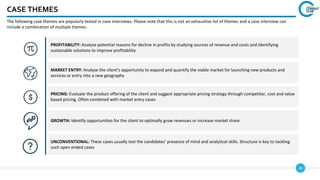
CASE THEMES
The following case themes are popularly tested in case interviews. Please note that this is not an exhaustive list of themes and a case interview can
include a combination of multiple themes.
PROFITABILITY: Analyze potential reasons for decline in profits by studying sources of revenue and costs and identifying
sustainable solutions to improve profitability
MARKET ENTRY: Analyze the client’s opportunity to expand and quantify the viable market for launching new products and
services or entry into a new geography
PRICING: Evaluate the product offering of the client and suggest appropriate pricing strategy through competitor, cost and value
based pricing. Often combined with market entry cases
GROWTH: Identify opportunities for the client to optimally grow revenues or increase market share
UNCONVENTIONAL: These cases usually test the candidates’ presence of mind and analytical skills. Structure is key to tackling
such open ended cases
41
PROFITABILITY
42
PRELIMINARY QUESTIONS
Step 2
Clarifying Questions
(3C P)
Company:
• Revenue streams
• Geography
• Value chain
Product:
• Type of products
• Product mix - B2B as well as B2C
Customer : Segmentation (B2B as well as B2C)
Competition :
• Type of competition (existing, upcoming)
• Market share
• Whether issue is industry wide or specific to us
Note: For each question which segments the company (Geography/Revenue Stream/Products), Also ask if the problem is
specific to one of the segments or all. E.g. Is the drop in profits in any one particular Geography/Revenue Stream/Product
or Is it homogeneous across all?
Reiterate the problem statement, and ensure you understand it clearly – along with the objectives and timelines
Step 1
Understand the Qs
Step 3
Solve the Case
On the Next Page
43
BASIC FRAMEWORK
Profit
Revenue Cost
Price / Unit # of Units
Internal External Supply Demand
Value Chain
of producers
to identify
bottlenecks
Customer
Journey
(On the next
page)
- Pricing
strategy
- Substitute
- Competition
- Government
policies
Value Chain /
Operational Miscellaneous
- R&D : Equipment, human capital
- Demand Forecasting: Software Driven, or
Human Driven
- Raw Material : Cost Price & Logistics
- Processing : Employees, Utilities, Packaging,
Maintenance
- Warehousing : Logistics & Storage Cost
- Distribution
- Marketing
- After Sales
Fixed Costs Variable Costs # of units
44
CUSTOMER JOURNEY
Customer Journey
(from left to right)
Need Awareness
Promotions
Accessibility
Internal
Factors
External
Factors
Affordability
Internal
Value Chain
External
Utility
Competition
PESTEL
Availability
Stock-outs
Ambience
Product
Selection
Product
Compliments
Substitutes
Purchase
Action
Payments
Final Packaging
Billing
Post Purchase
Services
Customer journey can be applied to any situation (i.e. all types of cases) and this can be used at any stage during analysis to make sure that all viable
possibilities are considered if you get stuck. This is the most typical framework when analyzing issues at customer’s end.
It refers to the path that customers take from the moment they realize they need something, and how many elements may affect that trip. This customer
journey can also be categorized into – Pre-Purchase, During Purchase & Post-Purchase Phases
45
COST REDUCTION – VALUE CHAIN ANALYSIS
Profit
Revenue Cost
R&D Raw Material Processing
Machinery
Employees
Technology
Capacity
Utilization
Packaging
Storage &
Transportation
Transportation to
Warehouse
Quantity per trip
Number of trips
Value per trip
Cost per trip
Storage
Number of
warehouses
Cost per
warehouse
Distribution
Sales Channels
Sales Force
Efficiency
Marketing
CRM
Customer
Service
Repair
Returns
Spare Parts
Client is facing reduction in earnings/profits (bottom line) due to possible
increase in cost of operations. You need to understand reasons and give
recommendations
OVERVIEW
46
DECLINING REVENUES
Profit
Revenue
Price
Price Elasticity
Competitors
Substitutes
Number of Units
Number of
customers
Demand
Internal External
Competition
PESTEL
Change in consumer
preferences
Supply
Internal
Value Chain
External
PESTEL
Number of units/Ticket size
per customer
Internal
External
Frequency
Internal
External
Cost
Client is facing reduction or stagnation in earnings/profits (bottom line) due to
possible decrease in revenues (top line). You need to understand reasons and
give recommendations
OVERVIEW
47
DELHI METRO NETWORK
Coming to the outlet rent, is it uniform across stations ?
The rent is higher for stations with high traffic such as CP. However, the overall
revenue of CP is lower among these similar stations
Okay, so it seems CP station has a lower occupancy rate. To break this down
further, a franchise owner would look at the following factors apart from rent:
awareness or branding of the location, awareness of outlet tenders,
administrative requirements of the desired outlets, outlet locations within the
station, other contract specifications and the overall expected revenue.
Yes, these factors are good. You can assume that there are no issues in
awareness or expected revenue. Let’s move to the other contract issues.
Sure. The various terms of a rent agreement include the rent, security deposit
amount, lock-in period. Since the rent is the same, we should look at the other
factors. Is the security deposit amount or lock-in period different which could
be a higher risk for the shopkeeper?
Yes, that is correct. The lock-in period for outlets in other metro stations is 6
months while in CP it is 12 months, due to which they do not prefer to rent
them. Can you suggest recommendations?
Yes. First, we should look into why the lock-in period is 12 months in CP while
6 months in other stations, and if it is possible, it should be reduced. If not,
then we can explore reducing the rent to make our outlets attractive to
franchises. Additionally, we can also explore a differential pricing system
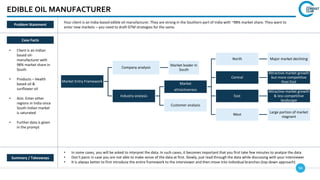
wherein a higher rent can be charged for the 2-month lock in period and a
lower rent can be charged for 6-month lock in period
That’s all. Thanks.
The Delhi Metro network is facing profitability issues. Figure out why and
suggest recommendations.
Since when is the station facing this & what is the difference magnitude?
Since the beginning and there is a considerable difference in profits
As per my knowledge, Delhi Metro Network majorly earns its revenues from
metro operations, is there any other source of revenue ?
They also provide consulting services to other metro projects across the
world, however this issue is observed only in its metro operations
Is this issue being faced across all metro stations or any particular station ?
This issue is being faced only at the Connaught Place (CP) Station
Okay. Now, profits are a function of the revenues & costs. Do we know if the
costs are higher as compared to other stations or there are less revenues?
The revenue is not as high as other stations. You can ignore costs for now
Okay. I would break down the revenue streams into 3 broad categories –
tickets, advertisements & outlets. Should I consider consulting revenue also?
No, you can proceed with these three.
Is there an issue with one of these revenue streams as compared to other
metro stations, or shall I look at all of them to find where the problem is?
The revenue from outlets is less as compared to other metro stations.
Okay. The revenue from the outlets depends on total number of outlet
units, occupancy rate & the rent per outlet. Is there any other factor I should
consider?
No, you can go ahead with these
Are the number of outlet units the same as other metro stations?
Yes, all stations have the same number of outlet units
48
DELHI METRO NETWORK
Case Facts
• The client is facing
lower revenue at CP
Metro station
compared to others
• Occupancy rate of
outlet units is low
• Issue with the rent
agreement of outlet
units
• Lock-in period is the
time-period in which
the tenant cannot
vacate the property
and the landlord
cannot evict you
from the property
• It is important to be MECE at all stages of this problem
• Number of outlets could also be divided into total area, area per outlet and % occupied
• Please don't start listing possible options and rather make use of some structure
Summary / Takeaways
Problem Statement The Delhi Metro network is facing profitability issues. Figure out why and suggest recommendations
Profit
Revenue
Tickets
Advertisements
Outlets
Number of
Outlets
Total Area
Area per Outlet
Percentage of
occupied
outlets
Expected
Revenue
Incurred Costs
Rent
Agreement
Duration
Lock-in
Period
Rent Amount
Rent per Outlet
Cost
49
FIVE STAR HOTEL
Your client is a 5-star hotel in Mumbai. They have been facing lower
profitability. You are required to identify the reasons behind the same.
First, can you please tell whether the client is a hotel chain or single hotel?
It is a single hotel which has been facing the issue
Since how long has the client been facing this issue?
The issue persists since the last 3 years but it has amplified in the last 1 year
Since the loss has been greater in the last 1 year, I think there might be
multiple recent factors affecting the hotel. Next, I would like to know if
other hotels have been facing this issue as well or is it just us?
It’s just our hotel which has faced this issue
Alright! So, this is not a market wide problem. Next, I would like to know
more about the hotel itself. What type of a hotel is this?
It is a luxury hotel with different rooms for different customer types
What are the types of customers that we normally receive at our hotel?
And have we observed any change in their ratios?
Two types – tourists & business customers. The split between them is
30:70. Earlier, the split was 50:50
And what are the revenue streams which our hotel has?
There are 4 streams – rooms, restaurants, banquet hall & ancillary services
Alright! Is there any particular-revenue stream where the client has been
facing this issue?
Let’s start with the room revenues here first and slowly move on to others
Sure! Profits are a function of revenues or costs. So, do we know whether
the revenues of the hotel have gone down or costs have gone up or both?
So, it’s a situation of both. But let’s start with the revenues first
Right! And starting off with the room revenues, we can bifurcate that into 2
parts – room rent and related purchases such as room service.
The problem is being seen in the rental revenue
Perfect! Then I would like to divide my room revenues into the number of
rooms offered by the hotel, the room rent charged and the occupancy rate.
Has there been any change in any of these factors over the last 2-3 years?
There has been no change in the number of rooms & the occupancy rates
have been high as well. Even, the rent charged per room hasn’t reduced
Since none of these factors have changed but we have faced a decline in the
revenues received, it could be a possibility that the hotel is not receiving the
maximum possible revenue for its rooms
Right, what could be the reasons according to you?
(Continued on the next page)
50
FIVE STAR HOTEL
Dining revenue can be looked at through the following aspects: Number of
tables, occupancy rates, average order quantity and the average prices.
There has been no change in any of these factors. Why don’t you go through
the customer journey from reaching the restaurant to leaving it?
Okay! So a customer’s journey can be broken down into the following steps –
Arriving at the restaurant, waiting time (both for being assigned a seat and
for the food ordered), consumption of the meal and then paying for it
Let’s look at the payment aspect. Can you think of the different ways through
which a customer might pay for their meal? Focus on non-cash payments
Yes, that would be via credit/debit card and UPI payments. The issues could
be broken down into following areas – customer side payment issues,
restaurant side receipt issues, discounts and cash backs. As we know that the
order value had not changed, it seems that we are not receiving the money
which customers are paying, which could be due to extra discounts offered
Correct! Most of our recent customers have Zomato Gold or Dineout installed
which is reducing their final payment value & client bears some amount of
this. What are your recommendations? We will close the case after this
Short term, our client can increase prices for room service and other facilities
for the business customers. On a long-term basis, our client can re-negotiate
its contracts with companies as well as Zomato/Dineout to address the
discount issues. It can also limit the number of rooms for business customers
It could be happening due to 3 reasons: First, as every hotel has different
types of rooms, maybe we have reduced the high-rent rooms and replaced
them with the lower-rent versions. 2nd, there could be a difference in the
type of customers which the hotel is getting and 3rd, the payment facility
which the customers are using has changed which has reduced our profits.
Since, we know that the type of customers which we receive has changed
over time, I would like to start off with that aspect here
Okay, how do you think the second factor would be affecting the hotel?
As there is a greater influx of business customers, the hotel can’t charge any
amount higher than what has been agreed with their respective company.
On the other hand, rents charged for general tourists can be higher, thus
reducing the rent collected per person
Correct! Due to a greater number of business customers, the hotel has to
keep a fixed price & is not able to take advantages of higher revenues due to
higher demand which other hotels can. Let’s go to restaurant business now.
Sure! Could you tell me how many restaurants does the hotel have?
So. the hotel has 2 restaurants – an Asian and a Continental one. We have
been facing lower profits in the Continental restaurant
And do we know whether the revenues have fallen, or costs have gone up?
If it is revenue - we can analyse by looking into in-dining revenues & delivery
services?
There has been a fall in the revenues – in particular in-dining revenues
51
Customer
Journey
Arrival
Waiting Time
Meal
Consumption
Payment
Cash
Non-Cash
Customer Side
Restaurant Side
Discounts
Profit
Revenue
Rooms
Rental
# of rooms
Occupancy
Rent charges
Change in
customer type
Change in room
type
Payment
Gateway
Room Service
Restaurant Revenues
# of tables
Occupancy
Avg. order qty.
Avg. order price
Cost
FIVE STAR HOTEL
Case Facts
• The client is a single
hotel which has been
facing lower profits
across multiple business
lines
• Reduction in revenues
received despite no
change in the
occupancy rates
• Issue was with the
greater influx of
business customers,
reducing the per
customer revenue
earned
• In the restaurant side,
more customers with
Zomato Gold or Dineout
discounts were causing
lower revenue for the
restaurant
• Instead of using price/charges, revenue received could be a better option as that would include both price and discounts
• It is always advisable to ask interviewer for suggestion or change in framework if the existing one doesn’t provide the required solutions
Summary / Takeaways
Problem Statement Your client is a hotel in Mumbai who have been facing lower profits. Find out the reasons why
52
CAR INSURANCE COMPANY
Your client is an insurance company who has been facing a decline in its
profits since the past year. Analyze the problem and suggest
recommendations.
Understood. Before I delve deeper, I wanted to ask some clarifying
questions. What kind of insurance does it provide? What are the
geographies in which it operates? How does it sell insurance? Also, is this
an industry wide phenomenon or company specific issue?
It provides many types of insurance but the decline has primarily been in
Automobile Insurance. It operates in India in 3 states - Delhi, Maharashtra
& Gujarat. It has partnered with car dealers to sell insurance at the time of
purchase. Apart from this, renewals continue by directly approaching the
customers. This is happening only with our client.
As Profits = Revenues – Costs. Any information on changes in any of these?
Revenues have been unchanged, and costs have relatively increased.
So this is a cost side issue. I'll break down the costs into fixed and variable
costs. The major cost heads in fixed is operating costs while that in variable
are claims payout & marketing expenses. Has any of these increased?
Yes, the claims payout has increased.
Alright, so the total claims payout cost can be broken down further as no. of
payouts and average amount per payout. Which of these has changed?
Number of payouts have increased. What can be the possible reasons?
There can be 2 types of causes –
1. Internal such as – algorithm / formula determining claims payout could
have changed,
2. External such as higher number of accidents could be happening
We know that the internal algorithm and formula has remained unchanged.
What could be the other reasons?
Understood. In that case, there seems to be an external reason for this
phenomenon. Again, there can be 2 possibilities –
1. Technical flaws like faulty cars leading to more accidents or
2. Interpersonal flaws like irresponsible driving
You are right. We have observed that the young population in our customer
base has been driving recklessly, leading to higher number of claim payouts.
Could you suggest some recommendations in this regard?
Sure. I recommend the client to:
1. In the short term, change their algorithm to either set a cap on
reimbursable damages or incentivize responsible driving via behaviour-
based premiums (low premiums for safe drivers i.e. driving track record
and vice-versa)
2. In the long term, the client should diversify its customers both age wise
and state wise so that this doesn't affect their bottom-line too much
again in the future.
Good recommendations. Thank You. We can close the case here.
53
CAR INSURANCE COMPANY
Case Facts
• The client is facing
lower profits in the
automobile segment
• Variable costs for the
client have increased
• Higher number of
claim payouts over
the past year
• External issues could have also been divided as vehicle issues vs driver issues
• Please don't start laundry-listing options after reaching number of payouts, rather make use of some structure
An insurance company is facing declining profits. Figure out why and suggest recommendations
Profit
Revenue
Costs
Fixed Costs
Operating
Costs
Variable Costs
Claim Payouts
Number of
payouts
Internal Issues
External Issues
Average
amount per
payout
Marketing
Costs
Technical
Issues
Inter-
personal
Issues
Summary / Takeaways
Problem Statement
54
TRACTOR INSURANCE PROVIDER
Okay. Now I would like to break down the profits as revenue minus costs.
Have the costs increased, or revenues reduced or a combination of both?
The revenues have declined.
Can I assume that major revenue comes from the insurance premium
that we collect from customers?
Yes, you can assume that.
The premium would be a function of the total number of customers, the
premium per customer per instalment, and the frequency of paying
instalments. Has there been a change recently in any of these?
Yes, the number of customers has gone down.
Okay. This means that less people are buying insurance for their tractors. This
could be a supply issue or a demand issue? Do we lack capacity to sell the
policies or has the demand reduced?
There is a reduction in demand.
Okay. To see why the demand has reduced, I would go through the journey of
a customer, starting from the need till the post purchase experience. Does
that sound suitable to you?
Yes, you can go ahead with this.
The process that I will consider will include need, awareness, availability,
accessibility, affordability, purchase experience, and post purchase
experience. Do we know if there is an issue with any of these factors?
Yes, the customer need has declined.
Okay, this means that the customer does not need insurance as they used to
before, even though other factors have remained the same (next page)
Your client is an insurance provider facing a decline in profits. Figure out
why and suggest recommendations.
Just to ensure we are on the same page, our client is an insurance provider,
who is facing a decline in profits. I need to find out the root cause and
provide with recommendations
Yes, that’s correct
Before beginning my analysis, I want to clarify a few things. What kind of
insurance does the client provide and since when have they been facing this
issue?
Client deals with tractor insurance and is facing this issue for the past 1 year.
In which geography does the client operate?
The client operates Pan India.
Okay. Since they only deal with tractor insurance, can I assume that their
customers are only people living in rural areas and involved in farming?
Yes, you can assume that.
Can you tell me more about the competitors of the client?
There are 4 more players in the industry, and all have equal market share.
Is this an industry wide issue or is it a client specific problem?
It is an industry wide issue.
How does the client operate? How do they reach out to the customers? Do
they have their own offices with agents, or is there any other tie up?
The client does not follow an agent driven process. We have tie ups with local
banks, the customers can approach any bank to avail the insurance and other
facilities are available are there.
55
TRACTOR INSURANCE PROVIDER
Do we have any information on why the farmers defaulted on their loans?
Yes, it was because of a bad monsoon during the year which affected the
revenues of the farmers. Now that you have identified the root cause, can you
suggest recommendations?
Sure, in short term our client can collaborate with local agricultural
cooperatives, associations, and farming communities to organize workshops
or seminars focused on risk management and the importance of insurance.
Our client can also offer incentives, such as discounted premiums for group
enrollments, to encourage farmers to sign up for insurance coverage.
In long term our client can develop long-term partnerships with tractor
manufacturers and dealerships to offer bundled insurance packages at the
point of tractor purchase or
That would be all, thank you.
Further, the number of insurance policies required for tractor would depend
on the total number of tractors purchased and the percentage of them
buying an insurance policy. So, are less people preferring an insurance policy,
or has the number of people purchasing tractors gone down?
You are correct. The number of tractors purchased has reduced.
Is it a supply side issue or a demand side issue?
No there are no issues on the supply of tractors. You can look into the
demand related factors for tractors
Since the demand for tractors is declining, I will again consider the journey of
a customer when the customer buys a tractor, starting from need till the post
purchase behaviour. Do we know if there is an issue with any of the factors?
The affordability of the customers in particular has declined. Can you analyze
what could be the reasons?
Okay, I will look closely into the ways of buying a tractor, farmer would either
use one’s own finances or borrow money from someone, which can either be
a local bank or local moneylenders. In this case, I think they would be
borrowing money. Do we know the source of their funds?
They generally borrow from a local bank.
The affordability can decline due to a change in income or loan amount
The income is same whereas the loan has become costly.
The loan of a farmer would depend on the price of the tractor and the
interest that the farmer must pay on the money borrowed. Has there
recently been any change in any of these?
Yes. Last year a lot of farmers defaulted on their loans, due to which the local
banks have increased the interest rates.
56
TRACTOR INSURANCE PROVIDER
Profit
Revenue
# of
installments
Premium per
instalment per
Customer
# Customers
Demand
Customer
Journey (Need)
Supply
Cost
# tractors
purchased
% of insurance
purchased
Demand
Customer
Journey
(Affordability)
Income
Tractor price
Interest Rates
Supply
Case Facts
• Client deals with
tractor insurance,
decline in profits
since last year
• Market has five
players with equal
market share;
industry-wide issue
• Demand for tractors
has gone down
• This is a tough case because the problem doesn’t lie within the industry in question, but an industry which is directly linked to it. Customer journey
framework needs to be applied twice to deep dive into the problem.
• These type of cases are generally longer, and it is essential that they are started well, with appropriate preliminary questions to understand the
context well. The recommendations also encourage the interviewee to think out of the box, since very less information is available.
Summary / Takeaways
Problem Statement Our client, an insurance provider, is facing a decline in profits. Figure out why and suggest recommendations.
57
LARGE INSURANCE MULTINATIONAL
Your client is a large insurance multinational who has been facing a
decline in their profits since the last 2 years. Analyze the problem
Understood. I wanted to ask some clarifying questions. Assuming, the large
insurance multinational operates in a variety of insurance products, is there
a specific domain where this effect has been observed? Any geography that
has been affected or has this been happening pan-India? Also, is this an
industry wide phenomenon or company specific?
Yes, the decline has primarily been in Home insurance. No, this has been a
pan-India phenomenon. Moreover, this is happening only with our client.
Right. And how does the client make Home insurance sales?
It mainly operates through 2 channels - online through its app and offline
through door-to-door sales as well as tie ups with banks during time of
home loan purchase.
So, I'll begin my analysis by breaking down profits into revenues and costs.
Is there any information about any of them changing?
Costs have remained the same, but revenues have declined.
Okay, so this is a revenue issue. The major source of revenue for the client
would be premiums. I'll split the total premiums as total no. of customers,
average premiums collected per customer per installment and number of
installments. Has any of them changed?
We've witnessed the no. of customers to have declined with time.
Right, so I'll further break it down as no. of new customers and no. of
renewals with existing customers. Is there any information about them?
No. of new customers which get added over time have seen a decline as
opposed to historical numbers.
Understood, there seems to be an issue in the sales process of new
customers. I'll trace the customer journey to zero-in on the exact cause. I
would go through the journey of a customer, starting from the need till the
post purchase experience. The process I will consider will include need,
awareness, availability, accessibility, affordability, purchase experience, and
post purchase experience
Let’s look into the purchase experience.
Purchase experience can be analyzed using 'People, Process, Product'
framework. Here, 'People' would mean salesperson; 'Process' would be
insurance buying process and ‘Product' would be insurance product.
Let’s look at the salesperson.
There can either be a decline in number of salespeople or a decline in
salesperson’s performance
The performance of salespeople is not up to the mark
Since the profits are declining over last two years, have the performance of
older salespeople gone down or is the issue with the salespeople hired over
the last two years
58
LARGE INSURANCE MULTINATIONAL
The issue is with the latter
The performance of salesperson depends on 2 factors - Ability and
Motivation. Ability is determined by their degree/college as well as training
undertaken. Motivation is driven by monetary and non-monetary factors.
The salespeople aren’t capable enough and have been underperforming.
We started hiring from previously untapped colleges recently and sales
made by them have not been up to the mark. What are your
recommendations?
Sure, I'll suggest the client to do the following –
1. In the short term, consider hiring majority of salespeople from our
previous hiring colleges only
2. Assign experienced and successful salespeople as mentors to the
underperforming individuals. This can provide personalized guidance, share
practical insights, and boost their confidence
3. In the long term, craft detailed training program for all new hires
4. To increase motivation, they can provide monetary and non-monetary
incentives
59
LARGE INSURANCE MULTINATIONAL
Profit
Revenue
# of
installments
Premium per
instalment per
Customer
# Customers
Demand
Customer
Journey
(Purchase
Experience)
Supply
Cost Performance
# of
salespeople
Purchase
process
Salespeople
Product
Existing
New Hires
Motivation
Capability
Case Facts
• Decline in home
insurance PAN India
just for our client
• The number of new
customers has
declined
• Structuring the problem well and breaking it into pieces is the key to identifying the underlying issue
• Please note that this case could have also been solved via the “Supply” bucket. The point here is any approach so long as it is structured, works
Summary / Takeaways
Problem Statement Your client is a large insurance multinational who have been facing a decline in their profits since the last 2 years. Analyze the problem
60
BEER MANUFACTURER
Client is a beer manufacturer. It’s facing decline in profits. You have been
brought in to figure out the reason and suggest some recommendations
To start with, may I know how long has the client been facing this problem?
And does our client have a single product or multiple ones?
Client has been facing this issue since 2-3 years & has multiple beer products.
In which geography does the client operate? Is there any specific region in
which we are seeing this issue?
The client has different brands across the world. The problem is particularly
evident in the US.
Is the problem with only one specific beer product, or is the problem spread
out across different products? Additionally, is this an industry wide problem, or
specific to our client?
The problem is not limited to one product. In fact, the client is facing the
problem across many beer products. It an industry wide issue.
Can you tell me more about the competitors of the client?
There are 4 major players. Our client has almost 50% of the market share.
Okay. Now I would like to break down the profits as revenue minus costs.
Could you please tell me if there are any changes in the revenues or costs over
the past few years?
The revenues have been declining. The costs have remained the same.
Here, I would like to understand about the revenue streams of our client. I
understand that beer is typically sold in liquor shops & pubs. Am I missing any
other revenue stream? Has the revenue gone down in both these channels?
No these are the two major channels. Revenue has gone down in both.
I would like to split the revenue in number of units sold, average
price of a beer bottle and product mix. Could you please let me know if there
are any changes in these parameters?
As a matter of fact, industry prices of beer and our product mix has remained
the same but units sold have gone down.
Okay, has there been any supply issue in distributing the beer through the
channels? Or the demand from the consumer side has reduced?
There has been no change in the supply. Even the margins for the distributors
have remained the same. People are just not buying the product.
Okay Since, this has been an industry wide problem, it looks like an external
issue. I would like to analyze some macro economic factors that could have led
to this. (Applies PESTEL)
Yes. Actually, there has been a social lifestyle change in the beer consumers of
US. They have become more health conscious as beer may lead to long term
obesity and other heart and liver problems.
Okay. That’s why there is a fall in the demand. I think we have identified the
issue. Can I take up a minute to come up with some recommendations?
Sure
I’ll split my recommendations into : Existing products & New Products.
On the existing products, to stimulate demand, we can look at promoting the
beer brands that already have low alcohol content. On the new products side,
we should plan to launch a new alcohol-free brand variants that taste like
beer, but can act as a healthier alternative for our consumers
Looks good. Thanks
61
BEER MANUFACTURER
Case Facts
• The US division is
facing declining
revenues due to an
industry wide
phenomenon
• External issues are
causing the decline
• Lifestyle changes of
consumers is causing
lower bottle sales
• Each cost component should be broken down into multiple cost levers to ensure that nothing is being missed out
• For external factors, frameworks apart from PESTEL such as Porter’s or SWOT (opportunities and threats) can be used
• You can either probe each factor of PESTEL, or ask the interviewer which buckets to look into
Your client is a beer manufacturing company facing declining profits. Figure out why and suggest recommendations
Profit
Revenue
# units sold
Frequency of
purchase
# of customers
Supply
Demand
PESTEL Social healthy
lifestyle
Price per unit
Product mix
Cost
Internal
External
Summary / Takeaways
Problem Statement
62
KIRANA STORE OWNER
Your Client is a Kirana shop owner who is facing a decline in profit for the
past 5-6 months. Identify the root cause for the same
I have a few preliminary questions – Where is the store located? Who are
the customers? Are there any competitors in this locality? Have they been
facing similar issues?
The store is in a Tier-2 city in India. Customers are mostly people from the
city and a few villagers from a nearby village. There are competitors, but
they haven’t been facing this issue.
Alright. A decrease in profits can either be due to a drop in revenue or an
increase in costs or a combination of both. Do we have any info?
Their revenue has dropped in the past few months. Let’s analyze them.
Revenue is a function of the number of customers and average order value.
Do we have any info on what has gone down?
The number of customers and the demand for our products have declined
Alright. This can be due to Internal and External factors. I’ll analyze Internal
factors first, via a customer journey map. The journey involves: Travel ->
Parking -> Product Ask -> Waiting -> Transaction -> Post Purchase –Service.
The issues under each bucket can be – For the travel, if there is any
hindrance in reaching the shop. For the parking, if there is any change in the
current parking system or the existing parking has been blocked. For
products, any change in offerings can be an issue.
Under transaction, unavailability of certain payment modes can be an issue.
Coming to the Post-Service bucket, the Kirana store primarily replaces
products to retain the customers. Any change in this practice can be an issue.
Good analysis but none of this is an issue. Let’s analyze External factors
External factors can be customers, competitors, collaborators / regulators
Okay. Please explain the three buckets.
In the customer’s bucket, any change in customer’s preferences will impact
our revenues. The preferences can be store-specific or brand-specific.
Under competitors, it can either be due to new competitors or existing
competitors. Any new competitor will impact our sales, while
discounts/loyalty programs by existing competitors will also impact our sales
If our collaborators (suppliers) are a constraint, then we might not be
stocking the right qty. or quality of products. Under regulatory sides, any
regulatory challenges like change in market rules etc. can impact our sales.
Great. You have got the answer. One of the competitors has started
providing discounts on orders above INR 500. Since people from the nearby
village visit to buy their monthly ration, their bill is above this amount, and
they have shifted to the competitor. Can you give some recommendations?
Sure. We can replicate the discounts but that will create a price war of sorts
so instead we can enhance offerings such as by providing free home delivery
Good recommendations. Thank you. We can close the case here.
63
KIRANA STORE OWNER
Case Facts
• The Kirana store is in
a tier 2 city in India
• The client’s revenue
has declined due to
decline in number of
orders
• This is not an
industry wide
problem
• Discounts offered by
existing competition
are causing the
decline in this
revenue
• It is important that you confirm each step with the interviewer before you directly jump into the analysis because as in this case, the
entire analysis could be useless if the problem lies somewhere else. The interviewer liked the analysis this time but this might not be the
case every time and could reflect negatively
Summary / Takeaways
Problem Statement A Kirana store owner is facing profitability issues. Figure out why and suggest recommendations
Profit
Revenue
Avg. order
value
# of orders
External
Factors
Regulatory
Collaborators
Competition
New
Competition
Existing
competition
Internal Factors
Cost
Customers
64
LIGHT BULB MANUFACTURER
Your client is a lightbulb manufacturer facing a decline in profits for the last
6 months. Figure out why and suggest recommendations.
Sure. I’d like to ask a few preliminary questions to understand the situation
better. What kind of lightbulbs does the company manufacture?
The client manufactures a single standard lightbulb.
Okay. Where in the value chain does the client operate? What is their
business model?
The client is responsible for R&D and manufacturing light bulbs. They have
their own distribution network. They place orders for raw materials from
suppliers. The client is a B2B company. They deal with big ticket orders.
Alright. Which regions do they operate in?
They manufacture in Uttar Pradesh and sell all over India.
Alright. I’d also like to know whether the drop in profits is an industry wide
phenomenon or is it just limited to our company.
The decline in profits is unique to our client.
Okay. Now, profits are a function of the revenues and costs. So, in the past 6
months, have the costs increase or the revenues declined?
The revenues have declined.
Okay. The revenues could have declined due to decrease in (i) number of
orders (ii) size of order (iii) price per lightbulb. Have we observed a change in
any or these factors?
Yeah, they have seen a decline in price per lightbulb.
Understood. Price per light bulb can be external driven or internal driven. If
a competition is providing light bulbs at a cheaper price, we might have
reduced our prices to match competition. Under internal driven factors, we
might be offering discounts/offers to our customers
The client has had to offer more discounts. The client has a policy that it will
offer discounts if their order is not delivered within a particular time frame.
Interesting. So, the client has had to offer more discounts due to
delayed delivery of the orders. I would like to explore the value chain to
determine the reason for delay.
The value chain would consist of (i) Research and Development (ii) Raw
Material Procurement (iii) Manufacturing (iv) Storage and Transportation (v)
Distribution, (vi) Marketing and (vii) Customer service. I would like to start
with R&D. Have there been any delays in this process?
No delays.
Okay. Have there been any delays in raw material procurement?
When the client places an order for raw materials, they receive it in time.
Alright. Is there an issue with forecasting the requirement of raw materials?
Yes. A new MBA graduate has been put in charge of forecasting 6 months
ago. On his advice, the client has changed its forecasting methodology. This
has caused a delay in raw material procurement. Do you have any
recommendations for the client?
I have 3 recommendations. (i) To understand why the forecasting method
was changed & consider reverting to the previous method. (ii) To explore the
possibility of altering the contract with buyers to reduce discounts. (iii) To
explore the possibility of storing raw material for longer time.
That’s all. Thanks.
65
LIGHT BULB MANUFACTURER
Case Facts
• The manufacturer
manufactures a
single standard light
bulb and is
responsible for R&D
and processing
• The decline in profits
is a client-specific
issue and is revenue
driven
• Client has seen a
decline in price per
bulb due to
discounts
• They are forced to
offer discounts due
to delayed delivery
• It is important to be MECE at all stages of this problem
• Use of value chain simplifies the problem and helps the interviewee provide targeted solutions
Summary / Takeaways
Problem Statement A lightbulb manufacturer is facing profitability issues. Figure out why and suggest recommendations
Profit
Revenue
# of orders
Size of orders
Price per bulb
Discounts
Competition
driven
Cost
R&D
Raw
material
Processing
Storage and
transportation
Distribution Marketing
Customer
service
Forecasting
66
BAKERY SHOP
A bakery shop is experiencing a decline in profits since the past 6 months.
Figure out why.
Where is the bakery located? Does it have one branch or multiple branches?
Does it sell online also?
They have only one branch in Delhi, with dine-in, takeaway and online sales.
Are there any other bakeries or similar food shops nearby? Are they also
facing the same problem?
There are other bakeries nearby, but they are not facing a decline in profits.
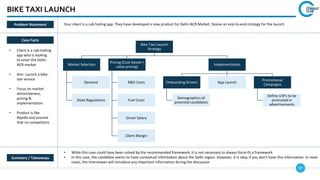
So, it’s a company specific problem. I want to divide Profits into Revenue &
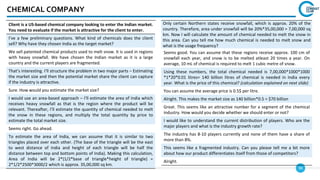
Cost. Profits can decline due to 1. Decline in revenue or 2. Increase in cost or
3. A mixture of both.
The bakery is facing both decline in revenue and increase in cost.
I’ll start with Revenue. Is there a decline in revenue in both online sales and
dine-in/takeaway?
The revenue decline problem is only in dine-in/takeaway segment.
Okay. Revenue can be divided into revenue per customer visit and number
of customer visits. Revenue per customer can be analysed as (Average Price)
x (Number of items purchased per customer visit)
To analyse decline in number of customer visits, the problem can be
analysed from Demand and Supply side i.e., whether there is a decrease in
demand or supply issues.
It’s a demand side issue - the number of customer visits has declined.
Since most bakery products are all-season, can I assume seasonality isn’t an
issue?
Sure.
I will start by analysing the customer journey which is as follows:
Awareness about bakery -> Customer Interest -> Travel to bakery -> Parking
of vehicle if needed -> Entry into bakery -> Select items to buy (own or with
help) -> Placing order -> Billing and payment -> Waiting for order -> Dining or
packed for takeaway -> Exit from bakery -> Customer satisfaction with food
We have problems with parking. There is a construction work going on in the
parking lot, hence customers can’t park their vehicles while visiting.
Got it. So, decline in customer visits and hence in revenue is due to the
parking problems. I’ll move on to cost now. Has cost increased for both online
as well as dine-in/takeaway?
Cost has increased only for the online segment.
Okay. I want to analyse the cost factors and then drill down on the issue. The
major costs for online sales will be maintenance of own website/app (if any),
commissions paid to food delivery platforms, marketing/promotions on such
platforms, personnel handling online orders and their training, processing
fees for online payments, packaging cost, delivery logistics (if provided by us).
The delivery cost has increased.
Delivery cost can be broken down into (Number of deliveries) x (Cost per
delivery); Cost per delivery is dependent on vehicle used, vehicle utilisation,
fuel cost, distance travelled, mileage.
Right. Due to the construction work, we have to take longer route to deliver.
This has led to higher distance travelled and ineffective utilisation of vehicle
leading to higher delivery costs. We can close the case here.
Okay, thank you
67
BAKERY SHOP
Case Facts
• Bakery has one
branch in Delhi with
dine-in, takeaway
and online sales
• Company specific
issue - no other
nearby bakery facing
decline in profits
• Remember to ask about channels if there is a possibility of sales happening through multiple channels
• Notice how the drill-down to the problem at every step is MECE and structured using formula, exhaustive customer journey, etc
• Clarify assumptions – even if it seems obvious
Summary / Takeaways
Problem Statement A bakery shop is experiencing a decline in profits since the past 6 months. Figure out why.
Profit
Revenue
Dine-in/Takeaways
Number of customer
visits
Supply
Demand
Customer journey -
Parking
Revenue per
customer visit
Online
Cost
Dine-in/Takeaway
Online
Cost factors - Delivery
cost
Cost per delivery
Fuel cost
Distance travelled
Mileage
Vehicle utilization
Number of deliveries
68
FRENCH MUSEUM
Your client is a museum in a city in France. Their profits have decreased,
and they have hired you to find the cause and provide recommendations.
I would like to start with a few preliminary questions. What kind of museum
is it? How long have they been facing this issue? What is the magnitude of
the decrease? Are there any competitors and have they faced this issue?
It is an art museum, and the only museum in the city. They have been
facing this issue for the past 1 year – profits have declined by 15%.
Alright. I would like to start the analysis now. Profits is basically Revenue
minus costs. A decline in profits can be due to a decline in revenues, an
increase in costs or a combination of both. Do we know what is happening?
The costs have remained the same. We have seen a decline in revenue.
Sure. The major revenue sources for a museum would be sale of tickets,
auctions, donations and sales from any shops in the museum.
We don’t conduct auctions or receive donations. Our major revenue
streams are ticketing (80%) and sales from an in-house restaurant (20%).
Okay, since the most significant driver of both the revenue streams is the
number of people visiting, I would like to analyze ticket sales first
Sure, go ahead. Just a heads up, the museum is visited by tourists majorly
Okay, The ticket sales would depend on the number of people visiting the
museum and the average ticket price. Have we changed the ticket price?
No, the number of people visiting the museum has declined.
The number of people visiting would depend on the number of tourists
visiting the city and the preference of tourists for the museum
The number of tourists in the city have actually increased.
Interesting. This means that the preference for visiting the museum has
decreased. I would like to divide it further into internal and external issues.
There are no issues with the museum. It is an external issue.
Okay. Since it is an external issue, I would like to analyze the journey of a
tourist in the city – they would arrive in the city, get an accommodation,
research on the places they want to visit or hire a guide/tour planner, and
then actually travel to and visit the places.
Let’s focus on the part where they decide the places to visit or go to tour
guides. We have a partnership with guides – they bring visitors to us.
Visitors research places to visit online these days - are they able to easily
find information about us online? For the tour guides, have we reduced their
incentives or is some other tourist attraction paying additional incentives?
Correct, Disneyland has opened in the city last year, and guides are diverting
all tourists there. They are also running ads online to attract more visitors.
Alright. I would give a few recommendations to potentially increase our
revenues: 1) We can increase the incentives paid to the guides or give bulk
discounts for tickets, 2) We can organize special talks with artists or events
that attract the target audience basis a financial feasibility check
69
FRENCH MUSEUM
Case Facts
• It is an art museum,
and the only
museum in the city
• Facing 15% decline
in profits since the
past 1 year
• Revenue streams -
ticketing (80%), food
and beverage sales
from an in-house
restaurant (20%)
Problem Statement Your client is a museum in a city in France. Their profits have decreased, and they have hired you to find the cause and provide
recommendations.
Profit
Preference
for Museum
Revenue
Ticket Sales
# of people
visiting
museum
People
Visiting the
City
External
Issue
Customer journey –
Disneyland opened
Internal
Issue
Average
Ticket Price
Restaurant
Sales
Cost
• The interviewee mentioned revenue streams for a museum upfront, instead of asking the interviewer – shows good thinking
• It’s a good practice to mention about some feasibility check that might be required while you’re giving recommendations (can also
incorporate numbers if given in the case)
Summary / Takeaways
70
BPO COMPANY
Your client is a BPO company operating out of India. They have witnessed
a significant decline in profits over the past 6 months. Help them identify
the cause and give recommendations.
What kind of customers does our client serve? Where are they located?
What is the timeline of the problem? What all competitors do we have? Are
they also facing similar decline in profits?
Our client serves customers across IT, Pharma, and Banking industries
based in Europe. We have been facing this issue for the past 6 months. We
have several competitors who aren’t facing this issue.
Is the problem specific to any customer segment? Should I consider COVID?
Yes, the decline is majorly due to banking customers. There is a COVID
component as well, however, the problem is broader than that.
Sure. I would like to start the analysis now. Profits is basically Revenue
minus costs. A decline in profits can be due to a decline in revenues, an
increase in costs or a combination of both. Do we know what is happening?
It is a combination of both. The revenues have declined by 5% and the costs
have gone up by 10%. Let’s start the analysis with cost.
Alright. I would like to list down the major cost headers for a BPO company.
The major ones are staff costs, server costs, and utilities. Do we know what
is causing the increase?
The staff costs have gone up.
Interesting. The staff costs would be # of employees multiplied by average
salary per employee. Do we know what has increased in this?
The number of employees have gone up. We had made hiring commitments
before COVID and went ahead with that. We currently have an overcapacity.
Also, we incurred additional costs in providing work from home
infrastructure to our employees. Let’s move to the revenue side.
Sure. Revenue would be dependent on number of contracts and the revenue
per contract. Since the revenue per contract can’t change in a 6-month
period as most BPO contracts are longer than that, I assume it’s due to a
decrease in the number of contracts that we have. I would like to analyze
the same along the lifecycle of a contract.
Yes, that’s right. We have lesser contracts now. Go ahead.
The contract starts from the sales team pitching to potential clients, then we
work on the assigned tasks, deliver the same to the client and finally
revenue is realized. Are we facing an issue at a certain step.
Yes, we are facing an issue at the sales step. We are pitching more than ever
but not winning enough contracts.
Interesting. The sales would depend on the number of clients pitched and
conversion rate. As mentioned by you, here the latter has decreased. It
could be due to internal reasons like the decline in performance of our sales
team as well as external reasons like competitors offering better services.
71
BPO COMPANY
Right. The clients are moving to our competitors. The clients in Europe
desire integrated services and our competitors are selling a bundle of
consulting, IT and BPO services, whereas we offer only BPO services. We
want to improve our revenues in the next 6 months. What should we do?
Setting up our own consulting and IT verticals won’t be possible in the given
timeline. Hence, we can explore M&A with some local firms offering these
services, which will bring in their clients and complement our BPO services.
Local firms will have local sales-personnel who’d help us understand the
local landscape and help in better conversion. If closing an M&A in such a
short-term is not possible, we can develop a revenue sharing agreement
with firms that offer the require services and try to offer a combined service
to the client
Great. We can close the case here. Thank you!
72
BPO COMPANY
Case Facts
• Client is facing lower
revenues and higher
costs
• Client has three
kinds of customers,
however issue is
only with Banking
• Decline is 15% in 6
months: very large in
short term
Problem Statement
Your client is a BPO company operating out of India. They have witnessed a 15% decline in profits over the past 6 months. Help them identify
the cause and give recommendations.
Profit
Revenue
#Contracts
Sales
#Clients
pitched
Conversion
Rate
Internal Issues
External Issues
Work Delivery
Revenue
Realization
Revenue/contr
act
Costs
Salaries
Total
#Employees
Average
Salary/
employee
Server Costs Utilities Miscellaneous
• Sometimes, a lot of redundant information can be given in the problem: being MECE helps ensure you’re clear on what you’re tackling
and why
• An easy way to bucket is to examine things as multiples of independent metrics
Summary / Takeaways
73
HIGH-END RESTAURANT
Your client is a high-end restaurant in Khan Market, Delhi. Their profits
have been declining for the past 2 months. Identify the root cause.
I would like to start with a few preliminary questions. What kind of cuisines
does it serve? Is it dine-in only? Should I consider the COVID scenario? Are
there any competitors in the locality? Have they faced similar decline?
Consider a pre-COVID scenario. The restaurant serves Italian cuisines. We
offer dine-ins, takeaway & delivery orders. We do have several competitors
in the locality, however, none of them has faced a similar decline.
Okay. I would like to start the analysis now. Profits is basically Revenue
minus costs. A decline in profits can be due to a decline in revenues, an
increase in costs or a combination of both. Do we know what is happening?
It is a combination of both.
Sure. I would like to start with the revenue side if that’s fine.
Go ahead.
Revenues would be a sum of the three kind of orders – delivery, dine-in and
takeaway. Have we faced a decline in all three or a particular segment?
Only dine-in revenues have declined.
Alright. Dine-in orders would depend on the number of tables in the
restaurant, average occupancy and average order value. A decline can be
due to a decline in either or all of these. Do we know what’s the case?
The average order value (AOV) has increased.
Oh. Interesting. A higher AOV implies that either we are serving larger groups
or premium clients. Do we have any information on this?
Yes, we have started serving larger groups now. In fact, to accommodate
larger groups, we have clubbed some of our smaller tables to make room for
more people on the same table.
This would have decreased the number of tables for couples/smaller groups.
Have we seen a decline in these customers?
That’s Right. The number of couples/smaller groups has declined sharply.
I think we have arrived at the root-cause for the revenue decline
Yes, Let’s analyze costs next.
Costs can be divided into the following – Variable costs (Raw material costs,
cooking costs, servicing costs, billing costs) and fixed costs (Rent, Utilities
and Salaries). Do we have any information on what has increased?
The raw material costs have increased.
Despite a lower raw material consumption, our costs have increased. Have
we changed the supplier? What is our arrangement with the supplier?
No, we haven’t changed the supplier. Our supplier provides all raw material
every morning. He offers additional discount for larger orders.
Alright. Since our orders would have become smaller due to falling demand,
the discounts would have reduced. Hence higher costs. Is it the reason?
Right. We can close the case here.
74
• Costs could also be looked at through the lens of the value chain
• Please don't start listing possible options and rather make use of some structure
HIGH-END RESTAURANT
Raw Material
Fixed Costs
Rent
Utilities
Staff Salaries
Cooking Costs
Servicing
Costs
Billing Costs
Profit
Revenue
Dine-In
Average Order
Value
Size of the
Order
Costs
Variable Costs
Delivery Take-Away
Number of
tables
Average
Occupancy
Contents of
the order
Case Facts
• The client is facing
declining profits
since past 2 months
(pre-COVID)
• No other
competitors facing
similar issue
• Restaurant serves
Italian cuisine across
delivery, take-away
and dine-in
Summary / Takeaways
Problem Statement Your client is a high-end restaurant in Khan Market, Delhi. Their profits have been declining for the past 2 months. Identify the root cause.
75
HOSPITAL CHAIN
Your client is a hospital chain located in suburban Mumbai which is
experiencing decline in profits since last 6-8 months. Figure out why.
Okay. I would like to ask few clarifying questions to understand the problem
statement in detail. How many hospitals are there in this chain and are all of
them facing a decline in profits?
There are 3 hospitals in the chain & the problem is specific to just 1 hospital
What kind of hospital is this – a general hospital or a specialty hospital
catering to any specific disease? In terms of the ownership, is it a
government or a private hospital? Also is there any specific customer
segment we cater to?
It’s a general hospital owned by a private player. The hospital majorly caters
to the people living in nearby areas across all income segments.
Since, it’s a general hospital I presume the client would be facing
competition from the nearby hospitals. Do we know the no. of competitors,
trend in market share and whether it’s a client specific issue?
There are two more hospitals in the nearby location. Client has been losing
market share in the said period to them so it’s a client specific issue.
Got it. The decline in profits could be due to fall in revenue, increase in cost
or a combination of both. Since the market share of client has fallen, I
presume it would be majorly due to fall in revenues. Do we have any details
around it?
You’re right, the revenues have declined while the costs have remained the
same. Can you figure out why?
A general hospital could have multiple revenue streams – consultancy fees
charged for check-ups, diagnostic fees for carrying out tests and sale of
medicines by pharmacy, if any in the hospital. Do we have details regarding
decline in any?
The revenues from diagnostic services have declined here.
I can break-down the revenue as a function of No. of patients x No. of tests
per patient per year x Avg. price per test. Which one of these have fallen?
The no. of patients have fallen.
Interesting. The no. of patients have fallen yet the consultancy fees hasn’t
declined. Is it a supply side issue wherein we aren’t able to cater to
customers or a demand side issue wherein the customers aren’t visiting us in
first place?
We don’t have any constraints in terms of supply. The demand from
customers have fallen.
I would like to analyse it across the entire customer journey which I would
break down into 5 components – need, awareness, affordability, accessibility
and customer experience. Should I go through them one by one or do we
know the issues lies in which component?
We can look at the awareness component in detail.
There can be multiple channels through which patients could be aware about
a hospital. It is majorly through word of mouth, doctor referrals, print media
and digital media.
The no. of referrals made by doctors have declined in recent past.
76
HOSPITAL CHAIN
So, the referrals can be from existing doctors or the new doctors which we
would have enrolled. Is the decline specific to any one or its across the
board?
The referrals coming from new doctors have declined with more doctors
referring to our competitors.
Got it. I would want to structure the no. of referrals into a funnel - 1) No. of
doctors identified by our sales team 2) No. of doctors to whom our hospital is
pitched 3) No. of doctors convinced about our offering 4) No. of doctors
onboarded 5) No. of onboarded doctors who actually give referrals.
The problem lies in the onboarding stage. Even though the doctors seem
convinced about our offering, very few of them are onboarded successfully.
Onboarding would typically involve execution of a contract. It can have two
aspects. First is terms & conditions of the contract and second would be
convenience associated with executing the contract in terms of time,
documentation, mode of execution etc. Since, the doctors are convinced
about our offering, I presume the problem would lie in convenience front as
they would be well aware of terms & conditions.
Yes, the client takes 10 days to execute a contract whereas the competitors
are able to execute them in a day itself. What can the possible reason for it?
Since, the time difference is drastic & it has been observed in the recent past,
I think it can be related to mode of execution in terms of offline & online.
Correct. The competitors have started digital mode of contract execution but
the client still uses the offline mode. That would be it. Thank you.
77
HOSPITAL CHAIN
Case Facts
• Recent problem
specific to one
hospital
• Loss of market share
to competitors
• Issue with the rent
agreement of outlet
units
Problem Statement Your client is a hospital chain located in suburban Mumbai which is experiencing decline in profits since last 6-8 months. Figure out why.
Profit
Revenue
Consultancy Fees
Diagnostic
Charges
No. of patients
Supply
Demand
Need
Awareness
Old Doctors
New Doctors
Affordability
Accessibility
Customer
Experience
No. of tests per
patient per year
Avg. price per test
Sale of Medicines
Cost
No. of doctors identified No. of doctors pitched No. of doctors convinced No. of doctors onboarded
No. of doctors actually
referring
Value Chain of Referrals
• Being MECE in all steps of a value chain requires care to avoid getting stuck
• You’re not expected to know technical details like revenue streams of a hospital, ask for interviewer’s help after listing the obvious ones
Summary / Takeaways
78
FLOWER SHOP
Your client is a flower shop chain that has two branches. One branch is
profit-making, while other is loss-making. Figure out why.
Okay, I would like to begin by asking some preliminary questions. Could you
please throw some light on the location of these branches, the types of
flowers they sell and also for how long is the client facing this issue?
Both the branches are in different neighborhoods in the same city. Both the
branches receive similar flower supplies from the same supplier. The issue
has been persistent for quite some time but that’s not relevant
Sure, thank you! I would like to take a structured approach to analyze the
situation. I would analyze profits by dividing them into revenue & costs.
Within, revenue – I will look at price, volume & product mix whereas in the
costs, I will analyze the value chain to find out the source of the issue
That sounds like a good approach. You can focus on the revenue aspect.
Okay, because you had mentioned that both the shops receive similar flower
supplies from the same supplier, I would assume that the difference is in
price of the flowers and/or in the volume sold in two shops? Is that okay?
Yes, that’s a fair assumption. Just to give you further context, both the shops
sell the flowers at the same rate.
Okay, so then I would analyze the volume sold in both the shops. To delve
deeper, the difference in the volume sold could arise from either the supply
side issue or from the demand side issue in both the shops.
Correct. Since the supplier is the same for both the shops, the issue doesn’t
lie on the supply-side. You can focus on the demand side
Okay, thank you. I would like to analyze the demand side of the volume sold
by going through the customer journey which can be divided into multiple
buckets such as
1. Pre-purchase which includes – Need, Awareness, Shop Accessibility;
2. During purchase which includes – Affordability, Availability, Ambience,
Product Accessibility, Product Selection & Purchase Action
3. Post purchase which includes – after sales support
That’s a good way to structure customer journey. You can focus on During
purchase bucket
Okay, again since the pricing between the two shops is same & since both the
shops sell similar flower all of which are procured from the same supplier, I
would assume there is no issue in the affordability & availability bit. Is that a
fair assumption?
Yes, you are correct.
Next is "Ambience." This could be a crucial factor. Could you describe the
differences in ambience between the profitable & loss-making branches?
Certainly. The profitable branch has a visually pleasing ambience because it
follows a First-In-First-Out (FIFO) approach, displaying the freshest flowers at
the front. On the other hand, the loss-making branch uses a Last-In-First-Out
(LIFO) approach, displaying newer flowers at the back till older ones are sold.
That's interesting. This difference in ambience affects the demand for the
flowers in both the branches and hence the difference in profitability.
Yes, you are correct. We can close the interview here. Best of luck.
79
FLOWER SHOP
Case Facts
• Two branches – one
profitable, another
loss-making
• Branches are in the
same city but
different
neighbourhood
• Both branches have
the same supplier,
sell similar flowers at
similar rates
• It is important to always confirm your assumptions with the interviewer
• Make assumptions basis some logic only. If you make an assumption in a branch where the problem lies, then it won’t be look good
• It is very important to listen carefully to an interviewer. A point made by the interviewer in the start could prove to be helpful towards the end
Summary / Takeaways
Problem Statement Your client is a flower shop chain that has two branches. One branch is profit-making, while other is loss-making. Figure out why.
Profits
Revenue
Price Volume
Supply Side
Demand
Side
Customer
Journey
Product
Mix
Cost
Value Chain
Customer
Journey
Pre-
purchase
Need
Awareness
Shop
accessibility
During
purchase
Affordability
Availability
Ambience
Product
Accessibility
Product
Selection
Purchase
Action
Post
purchase
After Sales
support
80
THERMAL POWER PLANT
Your client is a power plant based out of Chattisgarh who has witnessed a
decrease in profits in the past four months. Find out why
Okay, before I delve deeper in the case, I had a few preliminary questions.
What kind of a power plant exactly was it – say Thermal / Hydro /
Renewable? Given the power industry has multiple players such as
Generators / Transmission Cos. / Distribution Cos., in what part of the value
chain does the client exactly operate?
Fantastic questions. The client is a thermal power plant. It works in the
electricity generation which is then supplied to Transmission Cos.
Okay, last few question, is this an industry wide issue or an issue specific to
the company? By how much quantum have the profits declined and how
much of it can be attributed to revenue & costs given profit is a function of
revenue & costs?
We don’t have exact data on this but you can assume that it is an industry
wide issue. As far as quantum of profits decline is concerned, most of it can
be attributed to costs.
Okay thank you, I believe I have all the contextual information now. Since,
most of the profit decline can be attributed to increase in costs, I will look at
the costs of the company by analyzing each part of its value chain
Okay. Please proceed
The value chain of a power generation plant will include: Raw material
procurement -> Inbound logistics -> Power generation process -> Outbound
logistics -> Distribution. So, first – is there a significant rise in RM costs?
Yes, there has been a significant increase in raw material costs.
Okay, total raw material costs = total volume of RM required * price of RM
for all the required raw materials. For a thermal power plant, coal is the most
important raw material. So, should I focus on that first?
Yes, you are correct. You can analyse the volume aspect as the prices of coal
have stayed constant or in fact even declined.
Okay then the increase in costs can possibly be attributed to increased
requirement of coal. The causes of this can be looked at in two aspects –
1. Internal reasons which includes – improper handling of Coal, or changes
in the supplier or the type/quality of coal
2. External reasons which includes – political, economic, social,
technological, legal & environmental aspects
Correct, there seems to be some issue in the quality of coal.
Alright, this can again be looked upon in two aspects –
1. Interal aspects of coal mining done by supplier which affects quality -
2. External reasons that are having an impact on the quality of coal
Absolutely, it is because of the external reasons.
Given, you had mentioned that this seems to be an industry wide issue, the
major external factor that can impact the quality of coal is the environment.
Correct, it is rainy season currently. Can you connect the dots now?
Alright, it seems that the moisture content in the coal has increased. This
means more coal is required to produce the same amount of electricity.
Hence, there has been an increase in costs. Correct?
Correct. We can close the case here. All the best.
81
Profits
Revenue Costs
Value
Chain
Raw
materials
Price Volume
Internal
Handling Quality
Internal
Coal
mining
External
Environme
nt
Supplier
External
PESTEL
RM Type
Inbound
logistics
Power
generation
Outbound
logistics
THERMAL POWER PLANT
Case Facts
• Client is a thermal
power plant that is
into electricity
generation
• Problem seems to be
an industry wide
issue
• Most impact of cost
increase on profits
decline
• Prices of Raw
materials have
stayed constant /
have declined
• Some cases may go on for longer & it can happen that beyond a point, you may not be able to structure your thoughts
• In such cases, the easiest way to structure is by categorizing the points into two buckets – internal reasons & external reasons
• In this case the first internal/external split looks at company related issues whereas the second internal/external split looks at coal-specific issues
Summary / Takeaways
Problem Statement Your client is a power plant based out of Chattisgarh who has witnessed a decrease in profits in the past four months. Find out why.
Power
generation
Power
transmission
Power
distribution
End-user
Power Industry Structure
82
HOTEL CHAIN – VALUE ADDED SERVICES
Your client is a hotel chain and has witnessed a decline in profits in the past
few months. Find out why.
Okay, before I delve deeper in the case, I had a few preliminary questions.
How big is the hotel chain? Which geographies does the hotel chain operate
in? In which geographies exactly are we witnessing this issue? Is this an
industry wide issues? Who does the hotel chain think of as its competitors?
The hotel chain has 15 hotels across India. The issue persists in one hotel in
Delhi. This is a hotel specific issue & competitor data is irrelevant for now.
Okay thank you. Just a few more questions – what type of a hotel change
exactly is it – luxury, middle-income, low-priced hotel? Who are its target
customers and finally what are the kind of services / amenities does it offer?
Good question. The client is a luxury hotel chain visited by majorly corporate
guests & high-income families. Apart from hotel rooms, it has services such
as room dining & multiple additional value-added services.
Sure, thank you! I would like to take a structured approach to analyze the
situation. I would analyze profits by dividing them into revenue & costs.
Within, revenue – I will look at price, # of hotel rooms, # of times the rooms
were booked across the year & revenues from other streams whereas in the
costs, I will analyze the value chain to find out the source of the issue
That sounds like a good approach. You can focus on the revenue aspect.
Okay, so have we witnessed any significant change in the price of hotel
rooms even though I believe that since the issue is specific to this hotel that
might not be the case?
Correct, the prices of the rooms have stayed constant.
Okay, so have we witnessed a significant decline in the number of the rooms
that were booked, or the number of times bookings were done?
No, the bookings & the no. of hotel rooms have more or less stayed constant
Alright, so it seems the source of the revenue & thus profits decline lines the
in the additional value-added services that the hotel offers? So, should I
proceed with analysing these services?
Yes, please go ahead
Since it is a luxury hotel, I believe the hotel must be offering a wide range of
services –
1. In room facilities – Room dining, TV, WiFi, extra beds
2. Out-room facilities – Laundry, cab services, concierge, recreational
Is there any particular segment that you want me to focus on?
Correct, you can focus on the recreational bit within out-room facilities
Alright, thank you! So recreational services such as spa, gym, tourist travel
services, other corporate offsite event activities are usually offered in a
luxury hotel. So, are we witnessing any significant change in any of the above
activities?
Correct, the revenue has declined from the spa services.
Alright, as per my current understanding – services such as spa are usually
outsourced to third party contractors who pay a % of their total revenues or a
fixed fee to the hotel chain. Is this how the spa operates in this hotel as well?
Absolutely, there is a third-party contractor who pays a fixed % of the
revenue to the hotel and the spa services booking can only be done through
reception which helps the company track the revenue of the spa
83
HOTEL CHAIN – VALUE ADDED SERVICES
Alright, so the decline in the revenues could be either because the %
commission that is given by the spa contractor to the hotel has decreased or
because the total revenues of the spa have decreased.
Correct, the total revenues of the spa have decreased. You can analyse that.
Alright the total revenues of the spa is a function of the price of the services *
number of bookings done for all the kinds of services that are offered. So, are
we witnessing any particular change in any of the above?
Correct, the total revenues of the spa have decreased because the contractor
has abruptly increased the prices of its services which have impacted the
volumes of the services. Why do you think an increase in prices of spa
services would have affected high-income guests who usually visit this hotel?
I agree, this could either be because of the following reasons –
1. Even high-income guests could be price sensitive
2. They may not be seeing enough value for money in the spa services as
high-income guests could be looking for enhanced services with the
additional price increase
3. They might be lured to other recreational activities such as gym & tourist
activities
Perfect, I think we can close the case here.
84
HOTEL CHAIN – VALUE ADDED SERVICES
Case Facts
• Client is a hotel
chain that has 15
hotels across India.
The issue is being
faced by only one
hotel and it is not an
industry wide issue
• It is a luxury hotel
with corporate
travellers & high-
income families as
its target customers
• The hotel offers a
wide range of value-
added services in
addition to hotel
rooms
• It is always important to be structured during the case interviews.
• Some interviews can go on for a long time. In such cases, it is important to remain calm and always try to have a structured approach
• To ensure there is no error, it is better to confirm every step of your solution before directly proceeding.
Summary / Takeaways
Problem Statement Your client is a hotel chain and has witnessed a decline in profits in the past few months. Find out why.
Profits
Revenue
Price Volume
Value added
services
In-room
facilities
Out-room
facilities
Laundry
Concierge
Cab services
Recreational
Recreational
Spa
Total Revenue
Price
Increase in prices
Volume Service mix
% Commission
Gym Travel activities
85
RESORT IN GOA
Your client is an owner of a resort in Goa who is facing declining profits.
Find out why
Okay, before I delve deeper in the case, I had a few preliminary questions.
How long has the resort been seeing declining profits and in which pricing
segment would you say the resort operates in ?
Fantastic questions. The client is facing declining profits for the last 3-4
months. The resort has positioned itself in the luxury/premium segment
Okay, last few questions, who are the key clients for our resort and what are
the services that the resort offers to its clients ?
The key clients are families and corporates. The resort offers typical services
such as stay services, dining through restaurants and leisure activities for
people to enjoy.
Okay thank you, I believe I have all the contextual information now. Since
profits is a function of revenues and total costs, a decline in profits can be
due to decrease in revenues or a rise in costs or a combination of both
decline in revenues & increases in costs. Can you please tell me which one I
should focus on first?
Okay. Please proceed by first analyzing the revenue aspect.
Revenue for a resort will be a function of a services offered, pricing and
number of customers. So firstly, is there a decline in the number of
customers that are visiting the resort?
Yes, there has been a decline in the number of customers. The resort has
empty rooms on many nights.
Okay, so number of customers decreasing can be a problem from supply side
or demand side or both? Is there any specific side I should focus on?
You can focus on the demand side. There are no changes in the supply side
from the resort’s end or any other issues on the resort’s end.
Okay let me break down the demand further by looking a the customer
journey – Is there any decline in the need or awareness for the customers? Or
any changes in the accessibility or availability for the customers? Additionally,
is there an issue regarding affordability for the customers ?
Correct, there seems to be some issue in the affordability.
Alright, this can again be looked upon in two aspects Internal and External.
Since there is no issue on the resort’s end, I will start by focussing on external
factors. Has there been any political unrest in the area or some policy
changes? Has the income of potential customers gone down ?
None of those reasons are related to our case here.
Okay, has there been any changes in the competitive landscape of the area?
For instance, are there any new competitors that have opened up?
Yes, there is a new competitor that has opened up.
Alright, it looks like the competitor is attracting customers through some
marketing scheme.
Right. The new resort is offering attractive price discounts and cashbacks to
customers. That is the root cause. Now, please give some recommendations
Sure, the resort can offer short travel packages and also offer loyalty points
to its repeat customers. They can also adopt bundling strategy for their
existing services.
86
Profits
Revenue
Number of
Customers
Demand
Availability
Affordability
External
Competition
PESTEL
Utility
Internal
Access
Awareness
Need
Supply
Price
Product Mix
Costs
RESORT IN GOA
Case Facts
• Client is seeing
declining profits for
past 3-4 months
• The resort operates
in the premium
segment
• Key clientele are
families and
corporates
• The resort offers
stay, dining and
leisure activities
• Profitability cases follow a set framework which if followed can lead you to the solution in a structured manner
• In such cases, the easiest way to structure your solution is to keep eliminating parameters as variables are limited and there isn’t much variability
Summary / Takeaways
Problem Statement Your client is an owner of a resort in Goa whose profits are declining. Find out why.
New Resort
Cashbacks Discounts
87
DEODORANT COMPANY
Your client is a Deodorant company and they’ve seen a 20% decline in
profits over the last 4 months. You need to figure out the cause for the
same.
Okay, before I delve deeper in the case, I had a few preliminary questions.
What part of the value chain does our client operate in? What is the product
mix, and who do they sell to? Is it an industry-wide issue or unique to us?
Good questions. The client operates end to end in the value chain. They sell
deodorants to wholesalers & retailers. They have 2 variants – Gasless &
ordinary, and the decline has been uniform across the variants. This decline
is unique to our client.
Okay, I think I’ve got the hold of the issue. Profits being a function of
revenue and cost, do we have any data on which of these has been an issue?
Yes, we have seen a decline in our revenue and interestingly, our cost has
also reduced a bit. Focus on revenues for now.
Okay, that’s interesting. Revenues can decline because of a drop in prices or
number of deodorants sold, or a change in the mix of gasless & ordinary
deodorants sold. Is it okay if I assume that we’ve no other revenue stream?
Sure, we know for a fact that product mix isn’t an issue. We have seen a
decline in unit sales across the mix. And yes, this is our only revenue stream.
Understood. A decline in number of units sold can either be because of a
demand side issue, or a problem in our supply. Do we have any information
on whether the issue related to demand or supply?
You are right, there has been a decrease in quantity demanded. Please look
into that.
Alright, so I’ll break down quantity demanded in a time frame as follows:
Qty. demanded = No. of customers * Deodorants purchased per customer.
Deodorants per customer in a time frame is proportional to -> Number of
sprays * Qty. per spray / Volume of one bottle in same units. Just to check, do
you think this is a comprehensive break-down of items or should I add any
other element to it?
Yes, you are correct. This is great. We know that there has been a decline in
qty. per spray which is leading to the issue we’re facing.
Okay, to look at this decline I’d like to go through the process map of a spray.
There’s deodorant kept in the bottle, and a straw pulls it towards the nozzle,
which then sprays out the deodorant. The problem can either be with the
quality/thickness of the straw or the size of the pore of nozzle. Is that fair?
Correct, you’ve identified the problem. We recently changed the supplier of
our nozzle and the new one has a smaller pore. We’re done with the case! Do
you have any recommendations?
Sure, before I proceed to the recommendations, I’d like to confirm if the
decline in cost was due to change in nozzle type?
Bullseye!
I’d like to break-down my recommendations into 2 parts – Long-term and
short-term. For the short-term, I’d suggest getting back the old nozzle
because the purpose of cost reduction got defeated by revenue reduction.
For the long-term, we can either play on how the new nozzle enhances
current product offering or we can reduce the quantity per bottle.
Sure, good recommendations. Thank you!
88
Revenue
Price Product Mix Quantity
Supply Demand
No. of buyers Qty. per buyer
Sprays per day Qty. per spray
Straw Nozzle
Nozzle pore
DEODORANT COMPANY
Case Facts
• Decline in profit by
20% over 4 months
• The decline is
uniform across 2
product categories.
• The client operates
end-to-end in the
value chain.
• This is a company-
specific issue.
• Always break down problems mathematically to the maximum extent possible. This will help reducing errors in identification.
• Always check with the interviewer if your approach makes sense to the interviewer. Clarity in communication is the most important part of the case
discussion.
Summary / Takeaways
Problem Statement Your client is a Deodorant company and they’ve seen a 20% decline in sales over the last 4 months. You need to figure out the cause for the same.
89
MARKET ENTRY
90
FRAMEWORK (1/3)
Client is considering entering a new market. Your goal is to recommend whether or not they should enter it (through various means).
For these types of cases, it is common that the client is looking to invest in the expansion and get returns. In addition to financial
feasibility of the plan, one must also test: Likelihood of implementation success based on industry conditions and firm capabilities, Risk
Assessment
Some key points of discussion are as below
OVERVIEW
Strategy
•Why are they thinking of
market entry?
•Growth
•Mature current market
•Response to competitors
•Resources and Capabilities
•What does the firm have
that makes them think they
will be successful?
•Brand
•Patents
•Local Expertise
•Mode of Entry
•Self Launch
•Acquisition
•Joint Venture
Economics
•New Market Conditions
•Market Size
•Possible Revenue
•Possible Growth
•Competition in New Market
•Market Share
•Pricing your product vis-à-
vis competitors
•Parameters to Consider
•Investment Required
•Client Capacity to invest
•Expected Revenue
•Expected Profits
•Payback Period for
investment
Risks
•Barrier to Entry
•Regulatory Barriers
•Financial Capabilities
•Existing Players and their
market share
•Porter’s Five Forces
•Risks
•Implementation
•Political
•Currency
•Other macroeconomic
factors
PRELIMINARY QUESTIONS TO
CONSIDER*
• What business is the client
operating?
• How the client performing
currently?
• Does the client have any prior
experience in the new
market/geography?
• What is the aim of the client?
(Revenue, Profit, Payback Period
etc.)
• How is the competitive landscape in
the new market?
• What are the client’s capabilities
and bottlenecks?
*3CP Framework can be used
For a comprehensive framework, refer to the next slide
91
FRAMEWORK (2/3)
Market size? Profit margin in the industry? Growth rate?
Market Entry
Framework
Company analysis
Objective
Resource assessment
Org. readiness
Industry Analysis
Market attractiveness
Customer analysis
Competitor analysis
Implementation feasibility
Financial feasibility
Operational feasibility
Regulatory Factors
Mode of Entry & Risks
Market entry options
Risk analysis &
mitigation
Aim of the company? Evaluation metric?
Core competency? Any patents / licenses?
Any previous experience? Skills? Risk appetite?
Customer needs / preferences? Do we meet them?
Competitor strategy? Use 7Ps framework
Does the company have financial strength to back this growth?
Sales & distribution strategy? Logistics & supply chain?
Any regulatory barriers?
Organic / Inorganic? Exporting / Licensing? JVs / Acquisition?
PESTEL analysis & determine mitigation strategies
Next slide
Another often used framework for GTM / Market Entry cases is Market Attractiveness / Financial Feasibility -> Operational Feasibility -> Risks.
92
FRAMEWORK (3/3)
MARKET SIZING
Once the preliminary questions have been answered and the
situation looks favourable, market sizing needs to be done to
understand the financial viability of the market entry. This
guesstimate can be done either through a top-down or bottom-
up approach.
MARKET SHARE
Understand incumbents’ market share and estimate the possible
market share for the client. This is essential to understand the
serviceable obtainable market (SOM) for the client
PRICE
If the client does not have a price point for the product/service in
mind, you can use any of the approach covered under ‘Pricing’
frameworks to estimate the price.
FIXED COST
This is the initial capital invested by the client in building capacity
and adding resources when entering the market Population
of
India
Urban Households
High Income
Medium Income
Low Income
Rural Households
High Income
Medium Income
Low Income
Example: Estimate the market size of refrigerators in India
Consider Units/Household and Average Life Span of a
Refrigerators to arrive at the final market size
Once the market size and other financial parameters have been estimated,
conduct a feasibility study for implementation.
Production Distribution Marketing After Sales
93
EDIBLE OIL MANUFACTURER
Your client is an India-based edible oil manufacturer. They are strong in the
Southern part of India with ~98% market share. They want to enter new
markets – you need to draft GTM strategies for the same.
Okay. Can you tell me more about the client? Is edible oil their only business
or they have any other source of revenue as well? What is their product
mix? Do they manufacture the products inhouse? How do they distribute it?
Does the client want to enter new markets because the market has
saturated in South since they already have a high market share, or is there
any other reason as well?
Edible oil is their only business. They have 2 types of oils – sunflower oil or
vegetable oil, and health-based oils (soybean, coconut, mustard, etc.). They
manufacture it in-house, and distribute it through third party distributors.
They want to enter new markets because the current market is saturated.
Okay, thank you. Are there any particular markets that are being
considered? Is it restricted to India or can we explore international markets
as well? When is the client looking to enter these markets?
The aim is revenue growth since the south Indian market is saturated. We
are currently considering the north, east, west and central India. We are
open to international markets as well, but for this case consider India only.
You need to figure out which market to target first.
Is the demand of both products similar to South India in each of these
regions? Can you tell me if the market is growing for each of these
products?
No, the demands and growth rates are different.
North West East Central
85% - 3 players 85% - 2 players 25% - 2 players 35% - 3 players
15% - 10 players 15% -
fragmented
75% - fragmented 65% - fragmented
Growth Rates North West East Central
Sunflower Oil -4% 0% 2% 15%
Health Based Oil 12% 5% 25% 50%
Demand
Sunflower Oil 80% 80% 10% 95%
Health Based Oil 20% 20% 90% 5%
This is the data available, you can recommend basis these numbers.
As per this data, firstly I will not target North because 3 players have
dominated the market and it would be tough penetrating the market.
Additionally, in sunflower oil even though there is high demand right now it is
declining. Next, I would also not target West because majority of the market
is of sunflower oil but it is stagnant. When I look at the other two markets, I
would target health-based oil segment in East region, because it has a high
demand and is also growing at a high rate. In Central even though health-
based oil segment has a very high growth rate, the demand for health-based
oil is not attractive. I can look at expanding into sunflower oils in the central
region after entering the East region.
That sounds good. Thank you.
94
Market Entry Framework
Company analysis
Market leader in
South
Industry analysis
Market
attractiveness
North Major market declining
Central
Attractive market growth
but more competitive
than East
East
Attractive market growth
& less competitive
landscape
West
Large portion of market
stagnant
Customer analysis
EDIBLE OIL MANUFACTURER
Case Facts
• Client is an Indian
based oil-
manufacturer with
98% market share in
South
• Products – Health
based oil &
sunflower oil
• Aim: Enter other
regions in India since
South Indian market
is saturated
• Further data is given
in the prompt
• In some cases, you will be asked to interpret the data. In such cases, it becomes important that you first take few minutes to analyze the data
• Don’t panic in case you are not able to make sense of the data at first. Slowly, just read through the data while discussing with your interviewer
• It is always better to first introduce the entire framework to the interviewer and then move into individual branches (top-down approach)
Summary / Takeaways
Problem Statement
Your client is an India-based edible oil manufacturer. They are strong in the Southern part of India with ~98% market share. They want to
enter new markets – you need to draft GTM strategies for the same.
95
BIKE TAXI LAUNCH
Sure, go ahead.
The major costs would be a) R&D costs and b) Variable costs like fuel, driver
salary. On top of that, our client would expect a margin. Do we have any
numbers for these or should I assume some?
That sounds right. We expect no margin initially, but the drivers expect 20k
income per month, out of which he’d be paying the bike EMIs as well.
Assuming 10 trips of average 5 km/day and a mileage of 50 km/L with fuel
costing approximately Rs. 100/L, we can calculate the fuel costs. We can also
do a similar analysis to estimate driver costs per trip assuming 30 working
days. This comes to around Rs.75/trip. However, the per km rate would be a
better way to describe it, which would be about 75/5 = Rs. 15/km.
Calculation – Total trips: 300, Total distance: 1500, # of refuels required:
1500/50 = 30, Total cost: 3000 (fuel) + 20000 (salary), Cost per trip ~75
That’s the cost. How’d you set the price?
Willingness to pay can be estimated by using proxies. An auto rickshaw is a
good proxy for end-mile connectivity, and they charge around 15/km. Since
we are providing a more convenient experience and saving time, we can
charge a premium over the cost and set around the price at Rs 20/km.
Okay. How to implement the product now? What all is to be taken care of?
Implementation would start with onboarding drivers, launching the app, and
bringing in customers (promotion).
Yes. Launching the app is simple. What would be an ideal candidate for a
driver? I want you to list down the criteria for onboarding drivers.
Your client is a cab hailing app. They have developed a new product for
Delhi-NCR Market. Devise an end-to-end strategy for the launch.
I would like to ask a few preliminary questions. What exactly is the
product? What is the objective of the client? Is there a similar product in
the market?
The product is a bike-taxi, you can consider it like Rapido. The objective
here is to analyze three aspects – market selection, pricing and
implementation. Assume there are no similar products in the NCR market.
Sure. That’s interesting. I would like to start with the market selection part.
It would depend on state regulations (as NCR consists of Delhi, parts of UP
and Haryana mainly), and demand of the product.
That’s a great insight. Can you elaborate about regulations and demand?
Yes sure. There are certain rules limiting operations of commercial 2-
wheelers in the state of Delhi, hence we could start by launching either in
Noida or Gurgaon. The demand would depend majorly on the customers
we serve. I believe a good use case would be providing end-mile
connectivity for metro passengers. Since metro coverage is better in
Gurgaon and there are several corporate offices, we should focus on that
for the launch.
Great. Let’s say we start with Gurgaon. How would you price the product?
One way to start with the pricing could be to use cost-based value pricing,
using the cost to set a minimum price, whereas analyzing willingness to pay
to estimate the upper cap.
96
BIKE TAXI LAUNCH
The candidates should own a bike and have a driving license. I would
imagine a young/mid-age man who is comfortable using mobile apps. The
food delivery professionals are a good proxy.
Alright. Moving on to the promotional campaign – What would be the USPs
of your campaign? What channels would you use to promote?
Under the promotional campaigns, I would highlight 3 things – a)
Affordability, b) Time saved in traffic, and c) Safety. Since we are offering
end-mile connectivity to metro passengers, we can place hoarding inside
metro trains and metro stations. We can also set up billboards at office
spaces near metro stations where people would use our product to go to
the metro station post office hours.
Great. That’ll be all. Thank you!
97
BIKE TAXI LAUNCH
Case Facts
• Client is a cab-hailing
app who is looking
to enter the Delhi-
NCR market
• Aim: Launch a bike-
taxi service
• Focus on market
attractiveness,
pricing &
implementation
• Product is like
Rapido and assume
that no competitors
• While this case could have been solved by the recommended framework, it is not necessary to always force-fit a framework
• In this case, the candidate seems to have contextual information about the Delhi region. However, it is okay if you don’t have this information. In most
cases, the interviewer will introduce any important information during the discussion
Summary / Takeaways
Problem Statement Your client is a cab hailing app. They have developed a new product for Delhi-NCR Market. Devise an end-to-end strategy for the launch.
Bike-Taxi Launch
Strategy
Market Selection
Demand
State Regulations
Pricing (Cost-based +
value pricing)
R&D Costs
Fuel Costs
Driver Salary
Client Margin
Implementation
Onboarding Drivers
Demographics of
potential candidates
App Launch
Promotional
Campaigns
Define USPs to be
promoted in
advertisements
98
CHEMICAL COMPANY
Client is a US-based chemical company looking to enter the Indian market.
You need to evaluate if the market is attractive for the client to enter.
I’ve a few preliminary questions. What kind of chemicals does the client
sell? Why have they chosen India as the target market?
We sell patented chemical products used to melt snow. It is used in regions
with heavy snowfall. We have chosen the Indian market as it is a large
country and the current players are fragmented.
That’s interesting. I’ll structure the problem in two major parts – Estimating
the market size and then the potential market share the client can capture
if the industry is attractive.
Sure. How would you estimate the market size?
I would use an area-based approach – I’ll estimate the area of India which
receives heavy snowfall as that is the region where the product will be
relevant. Thereafter, I’ll estimate the quantity of chemical needed to melt
the snow in these regions, and multiply the total quantity by price to
estimate the total market size.
Seems right. Go ahead.
To estimate the area of India, we can assume that it is similar to two
triangles placed over each other. (The base of the triangle will be the east
to west distance of India and height of each triangle will be half the
distance between top and bottom points of India). Making this calculation,
Area of India will be 2*(1/2*base of triangle*height of triangle) =
2*1/2*2500*3000/2 which is approx. 35,00,000 sq km.
Only certain Northern states receive snowfall, which is approx. 20% of the
country. Therefore, area under snowfall will be 20%*35,00,000 = 7,00,000 sq
km. Now I will calculate the amount of chemical needed to melt the snow in
this area. Can you tell me how much chemical is needed to melt snow and
what is the usage frequency?
Seems good. You can assume that these regions receive approx. 100 cm of
snowfall each year, and snow is to be melted atleast 20 times a year. On
average, 10 mL of chemical is required to melt 1 cubic metre of snow.
Using these numbers, the total chemical needed is 7,00,000*1000*1000
*1*20*0.01 litres= 140 billion litres of chemical is needed in India every
year. What is the price of this chemical? (calculation explained on next slide)
You can assume the average price is 0.5$ per litre.
Alright. This makes the market size as 140 billion*0.5 = $70 billion
Great. This seems like an attractive number for a segment of the chemical
industry. How would you decide whether we should enter or not?
I would like to understand the current distribution of players. Who are the
major players and what is the industry growth rate?
The industry has 8-10 players currently and none of them have a share of
more than 8%.
This seems like a fragmented industry. Can you please tell me a bit more
about how our product differentiates itself from those of competitors?
Alright.
99
CHEMICAL COMPANY
Our client has produced a patented solution in an independent research
which melts snow using lesser amount and this would bring down the cost
of thawing. So, given the scenario, should we enter or not?
The market size is attractive. With a patented product in a fragmented
market, I believe that the client can garner a good market share and should
enter the market.
Alright. How should the client enter the market?
The client could either enter independently, acquire small sized players in
the market, or do a joint venture with one of the major competitors. I
would suggest it would be better if the client goes into a Joint Venture with
a couple of the existing local players as the client would be able to use their
local understanding and local distribution network, which coupled with the
strong R&D capabilities and product of the client would ensure success.
Sounds good. Thank you!
100
CHEMICAL COMPANY
Case Facts
• Client is US-based
chemicals company
• Produces chemicals
that are used to melt
snow
• The chemicals have
a patent
• Aim: Enter Indian
market as it is a large
& fragmented
market
• Some cases can be a bit mathematical in nature. In essence, this case was majorly a guesstimate portrayed as a market entry case
• In such cases, it becomes important to first delineate the exact approach for calculation. Calculate the numbers only after the approach is approved
• For simplifying calculations, it is important to bring units of all numbers in a standard format for instance SI units as is used in this case
Summary / Takeaways
Problem Statement
Client is a US-based chemical company looking to enter the Indian market. You need to evaluate if the market is attractive for the client to
enter.
Market Entry
Framework
Industry analysis
Market Size
Litres of chemical
required
Volume of snow
present (in m^3)
Area of snow-clad
region
Height of snow
No. of times
melting required
Litres of chemical
required per m^3
Price of chemical
per litre
Competitor
Analysis
Fragmented
market
Mode of entry
Joint Venture
Independently
Area of India 3500 10^3 sq.km
Area of snow (in sq. km) 700 10^3 sq.km
Area of snow (in sq. m) 700 *10^3*10^3*10^3 sq. m
Amount of snowfall (height) 1 m
No. of times melting required 20
Thus, volume of snow to be melted 14000 *10^9 m^3
Litres of chemical required per m^3 0.01 L
Total litres of chemical required 140 *10^9L
Price per litre of chemical 0.5 $
Total market size 70 Billion $
Calculations (in SI-Units – m/L)
101
ICE CREAM FRANCHISE
Our client is an Ice Cream franchise and is evaluating the possibility of
opening a new outlet in a Stadium in Chennai. Your assistance is required
for the same.
Sure. Can you tell me more about the client?
The client is a well-known player in the Ice-Cream industry with branches
across the country. They serve the mid to high income consumer segment.
Okay. Why does the client want to open a new outlet in a stadium?
Everyone is aware of the sports frenzy in India. The client wants to make
profits out of this while simultaneously promoting its brand to the
spectators.
Fair enough. What kind of stadium is it? Do we have any info on the matches
hosted, frequency of matches etc.?
Yes, it is a cricket stadium. It is set to host matches from the upcoming
season of IPL, a significant event of the year.
Okay. Before I proceed with the analysis, do we have any info on the other
stalls already present in the stadium?
There are several stalls selling snacks & beverages in the stadium. However,
currently there is only one stall among them that sells vanilla softy ice-
creams.
Okay, I’d like to investigate the three main aspects of evaluation when
looking to open a new outlet in any location – Attractiveness of option,
Economic Viability and possible Operating Feasibility & Risks. Do you want
me to look at any aspect in particular?
Sounds good, can you quickly take me through each of these aspects
Sure. We know that IPL is an event that garners an enormous crowd and
given that IPL is scheduled during the summer, it’s a great location to open an
ice-cream outlet. For the second aspect of economic viability, do we have any
information about the prices of our client’s ice-creams? Also, what is the
maximum occupancy and occupancy rate of the stadium per match?
Our client offers a variety of flavours with an average price of Rs 50/- per ice-
cream. The stadium houses a total of 36,000 seats with an average occupancy
rate of 80% per match.
Okay. Based on the information, the average footfall per match is 0.8*36000
= 28,800. The ticket price to the IPL matches is usually on the expensive side
and it is fair to assume that the spectators would be able to afford a Rs 50/-
worth of ice-cream. However, not all people fancy ice-cream & so I’d like to
consider a conservative estimate of 60% of ice-cream purchasers. So, our
client’s revenue would come up to an average of 0.6*28,800*50 = ₹ 8,64,000
per match. Margins can be accordingly estimated.
Sounds good. What would be the possible operating challenges?
Catering to an extremely large crowd, especially when offering multiple SKUs,
can be very challenging in terms of estimating the raw materials required &
the quantity of each individual flavour required. Also, handling the crowd at
the outlet could be challenging. But they can be dealt with by carefully
devised operational strategies. On the whole, opening a new outlet at the
stadium looks like a viable proposition.
Looks about right. That would be all, thank you.
102
ICE CREAM FRANCHISE
• Important to evaluative all 3 aspects of market entry
• Follow MECE at each step of the evaluation to make accurate predictions of potential returns
• Figure out the ease with which hindrances can be dealt with and determine if it is a viable proposition
Summary / Takeaways
Problem Statement
The client is an Ice Cream franchise and is evaluating the possibility of opening a new outlet in a Stadium in Chennai. Your assistance is
required for the same.
Case Facts
• IPL is a significant
event that the client
wants to profit from
• The timing of the IPL
season & footfall per
match make it a
lucrative option
• There are several
snack stalls & direct
competition from
vanilla softy ice-
cream seller.
New Stall in a Stadium
at Chennai
Attractiveness Economic Viability
Operational Feasibility
& Risks
Raw Material
Procurement
Crowd Handling
Inventory levels of
different SKUs
Footfall
Potential Customer
Base
Price per unit
103
AUTOMOBILE MANUFACTURER
Alright! Since, most players already exist in the premium segment, is our
client planning to enter the same segment or a different one?
What would you advise our client to do?
I would advise our client to enter into the economy segment, primarily due
to two reasons
And why would you advise this?
First, lack of options in the economy segment provides our client with an
excellent opportunity and second, as many people in Saudi Arabia have
higher incomes, our cars with similar prices as that in India might fall in the
economy segment
Alright! That makes sense. Let’s proceed with the case
Sure! So, I would like to first check if it is financially feasible for the client to
enter Saudi Arabian market and then analyze the same from an operation
feasibility point of view. Does that make sense?
Yes. That makes sense. Let’s start with the financial angle
Sure. So, profits can be calculated by a formula of Market size, multiplied by
the market share and the margins earned. After this we can subtract the
fixed costs which will give us the profit figure
Sounds fair! Let’s estimate the market size of these vehicles in Saudi Arabia
Your client is an automobile manufacturer based in India who is planning
to enter a foreign market. Please advise them on the same
I would like to ask a few preliminary questions before proceeding with this
case. Which automobiles does our client manufacture?
They make SUV cars mainly for the premium segment in India
Alright, and why are they planning to expand into a different country?
They have 20% excess capacity in their manufacturing units and want to
utilize the same
Do they have any country in mind?
Yes, they want to enter Saudi Arabian market with their SUVs and want you
to help them in pursuing this. Our client considers the market as profitable
in the future and has excellent relations with the Prime Minister of Saudi
Arabia
Alright! What’s the overall growth rate or automobile market in Saudi
Arabia?
It is around 7%
Are there any other competitors for SUVs in the Saudi Arabian market?
Yes, there are 6 major automobile competitors in the market. Out of these,
4 players exist in the SUV market which sell mainly to the premium
segment
104
AUTOMOBILE MANUFACTURER
Yes! So, the total population of Saudi Arabia is roughly 4 crore which can be
divided into a rural-urban split of 50-50. Since its SUVs, I would like to focus
more on the Urban sector and then we can come back to the rural sector to
give some percentage allocation. For the urban sector, the whole
population can be divided into 4 income segments – Lower class, lower-
middle, higher-middle, upper class which can be further divided by 4 to get
SUVs per household
Alright. This sounds good. Let’s continue
From this number of households, we would apply a percentage factor of
households who own cars. Now this number will be higher for upper class
and higher income category than lower income category. Furthermore,
we’ll then apply another percentage factor for the households which own
SUVs. This would give us the total number of SUVs in the market
That makes sense
After this, we’ll have to assume the total life of an SUV and find out the
number of new SUVs which will be bought during the year
Perfect! Okay, let’s assume that it is financially feasible for us to enter Saudi
Arabia. Now I want you to figure out the operational aspect of it.
Sure! Since we already have extra capacity which we plan to utilize, I
assume that we won’t be facing any production issues. However, we will
have to export the cars to the market. Does our client have the financial
resources to undergo export?
Yes, our client is ready to export the cars there
Perfect! Then coming over to the distribution angle. How do we normally
distribute our cars in the Indian market and how is it carried out in Saudi
Arabian market?
In the Indian market, we sell through our own showrooms and third-party
distribution networks and its similar for players in Saudi Arabia
As a new player who are selling extra capacity, it would not make sense for
us to open our own showrooms. Hence, we should explore third party
distribution channels
But how would you get third party channels to sell your car? As mentioned,
there are multiple players already existing in the market who are serviced
by these channels, and they’ll not want another competitor entering their
country
Yeah, that makes sense. But the motivation of a third-party channel to sell
our car would be affected by the following factors – commission, ease of
business, demand for cars and past relations. In the shorter term, we can
offer them higher commissions as well as ease in distribution through our
export channels. As the demand for our product increases, third-party
channels would be willing to sell our cars without higher commissions.
Additionally, due to our good relations with the Saudi Arabia government,
we can enlist their help in obtaining access to third party channels
Alright! Let’s dive into the marketing and promotional angle. How would
you introduce the product into the new market?
105
AUTOMOBILE MANUFACTURER
Sure! We would have to look at the various online and offline promotional
campaigns.
Before we go there, I would like you to look at an overall perspective –
what would be your branding levels, what would be you drive your product
promotion around?
Alright! So, I would like to look at the following aspects of the launch – the
SUV which we are offering, the pricing and customer segment and the
promotional activities.
Okay, that sounds like a structure. Let’s proceed
So, from the product angle, it should be best for us to drive our product
branding around the features of the product as well as the differences
between our SUV and the other SUVs. We should highlight the best
features of our SUVs and show how we provide these at a lower cost than
our competitors
But won’t our brand value be affected since we are a premium brand in
India?
You are right about that. In order to tackle the problem, we can sort this
situation by launching a sub-brand, especially one which relates more to
the Saudi population, or which represents some famous symbol of theirs
Alright! We can close the case here
106
AUTOMOBILE MANUFACTURER
Case Facts
• Client sells SUVs in
the premium
segment and is
planning to sell their
extra capacity in
Saudi Arabia
• There are 4 other
players in the Saudi
Arabia which sell
SUVs
• Saudi Arabia
represents an
attractive
opportunity, and the
company has good
relations with the
Prime Minister of
the Saudi Arabia
• In this case, instead of formulating general promotional strategies, the interviewer asked to form a structure and look beyond the campaigns
• While making estimates about any electronic product, it is always useful to look at the product life to get correct numbers regarding the usage in a
particular year
Summary / Takeaways
Problem Statement Your client is an automobile manufacturer based in India who is planning to enter a foreign market. Please advise them on the same
Market Entry
Financial
Feasibility
Population
Rural-Urban &
Income Split
% owning cars
% SUVs
% buying SUVs
Operational
Feasibility
Production
Distribution
(third-party
channels)
Commission
Ease of
business
Demand
Relations
Marketing
Product
Pricing
Promotion
107
CONTACT LENS
Your client is a contact lens manufacturer & retailer based out of
Western Indian. It is looking to expand its operations in other
geographies of India. You are required to draft the GTM strategy for it.
I would like to ask few clarifying questions to understand the client.
What kind of contact lens do we manufacture and are we only limited to
it, or do we sell ancillary products like lens solution as well? Also, what is
the life of the lens?
The client has 2 kinds of lenses – regular use for corrective vision and
fashion use lens which are typically colored lens. This is available across
price segments ranging from economy to premium. Lenses have a life of 6
months.
What is the current product mix, and do we want to sell both?
90% regular & 10% fashion in terms of volume. Clients want to sell both.
Where is the manufacturing facility and how does it sell its products?
Client has a manufacturing facility in Gujarat, and it sells products through
its own retail outlets in Tier 1/2 cities
What is the reason for expansion and what objectives does the client wants
to achieve? Also, by other geographies, do we have any specific area in
mind?
The client has excess manufacturing capacity at present. It wants to utilise
this capacity to capture market share & generate profits. Let’s just consider
new geographies & not discuss expansion in existing one. We can consider
North, South & East India as the regions & client has to select one.
What’s the timeline we are looking to achieve the objectives?
5 years
What is the competitive scenario in India?
There are 20 players operating in India (incl. our client) having roughly
equal market share. Now all these are regional players again roughly
divided equally between the regions – North, South, East & West.
Interesting. Is it fair to assume that there are no barriers to entry for
regions?
Yes. No barriers as such
I think I have enough data to proceed now. I would first want to evaluate the
economic feasibility in terms of volume & profits and then the operational
feasibility for each of the regions. Then, I can evaluate the associated risks
That sounds fair. We can proceed with economic feasibility
For calculation of volume, I would look at the total market size and the
market share that we can capture. Do we have any data around this?
Why don’t you guesstimate the market size for entire India for regular use
contact lens? You can just tell the approach without the numbers
108
CONTACT LENS
Sure. I would first divide India into urban and rural. Rural region would
have lower use of contact lens. Then I would want to break it down by
income & age. Again, low income and lower-middle income would have
low usage. Age 0-16 & 40+ would also have low usage. Then, I’ll consider
percentage of people requiring glasses/lenses and then apply % for lens
considering above factors. Then, I’ll factor in the life of lenses & multiply
the resultant figure by 2 (12/6).
That’s sound fair. How would the approach change for fashion use lens?
I’ll ignore %age for corrective vision. Restrict the usage to upper income &
16-40 ages. I’ll further consider its use in fashion, theatre & film industry.
Sounds good. Let’s consider you get a cumulative figure of 24 million
through this. Now how would you go about market share?
We can assume that we’ll eventually become a 6-player in the region
having 1/6 regional market share in a period of 5 years. Since, we already
have experience in the business, it seems achievable.
Sounds a little aggressive but sure we can go ahead with this assumption.
For the sake of simplicity, assume volumes are equal across regions. Why
don’t you work out the nos.?
Sure. So, for each region volume is 6 million (24/4 regions). Annual volume
that can be captured by our client is 1 million (6/6 players) in a period of 5
years.
Okay. Let’s look at profits now.
So, I’ll calculate the profits as Volume * (Revenue – Variable Cost) – Fixed
Cost. Since, we are taking 5 years, I’ll also factor the growth rates.
Assume the revenue to be 100 for simplicity. Variable cost is given as % of
revenue: 35% - North, 30% - South, 45% - East. Growth rates in volume are
12% - North, 8% - South, 8% - East. Fixed cost is same across regions
We have assumed market share of 5% will be realized by year 5 end. For
calculation should I consider 1% by year 1, 2% by year 2 and so on?
That’s how one would consider practically but for keeping calculation
simple, just assume 5% in year 1 and continue.
I’ll calculate profits for north and south region only. East can be ruled out
because of higher variable cost but similar growth rate as south. I assume
the reason for this would be higher transportation cost from Western
India.
Yes. We must only evaluate North and South. Why don’t you calculate year-
wise profits and the cumulative for 5 years?
All figures are in millions. The profits are oddly coming out to be similar
Now consider 2 scenarios – i) Operate for more than 5 years ii) Exit within 5
years. Which region would you consider under these?
Region Year 1 Year 2 Year 3 Year 4 Year 5 Total
North 65 73 82 91 102 413
South 70 76 82 88 95 411
109
CONTACT LENS
i) Would select North because of higher growth ii) Would select South
because of higher profits in initial years as present value would be higher
Correct. Let’s discuss selling channels for each of the products now.
We can have 2 selling channels – offline retail outlets (present model) and
online (own website or a marketplace like Flipkart, Amazon etc.). For
regular use lens, we can focus more on offline channel since new
customers would you apprehensive of purchasing lens without having a
look at it once. But for fashion use lens, we can explore the online channel
as well since most of its customers would be well-accustomed to online
shopping.
That sounds good. Thank you.
110
CONTACT LENS
Case Facts
• Client has 2 kinds of
lenses – regular use
for corrective vision
and fashion use lens
which are typically
colored lens
• Client has a
manufacturing
facility in Gujarat,
and it sells products
through its own
retail outlets in Tier
1/2 cities
• Client has excess
capacity in its
manufacturing
facility
• The case focused heavily on numbers and calculations. However, in any GTM case, you should ensure that you’re giving adequate time to both
quantitative and qualitative factors
• The interviewer relied on cash flows for short term decision and growth for long term decision
Summary / Takeaways
Problem Statement Your client is a contact lens manufacturer & retailer based out of Western Indian. It is looking to expand its operations in other geographies
of India
Market Entry
Market Sizing
Population
Rural-Urban &
Income Split
Age Split
% requiring lens
Life of lens
Profits
North
South
111
PRICING
112
FRAMEWORK
While pricing cases can be asked on a standalone basis, they can also be asked in conjunction with market entry cases to estimate the
potential revenues generated by the client upon entry. Your objective is to identify the best approach to estimate the price of the product.
OVERVIEW
Value Based
•Willingness to pay
•Benchmark against
similar products
•Opportunity Cost
Cost Based
•R&D Cost
•Production Cost
•Fixed Costs
•Variable Costs
•Breakeven Period,
Margin
Competitor Based
•Existing Products
•If new product, NPV of
substitutes
•Supply-Demand
Considerations
Note: Consider implications of price elasticity on demand of the product
Pricing
New Product
Value Based Pricing
Cost Based Pricing
Existing Product
Competition Exists
Cost Based Pricing
Competitor Based Pricing
No Competition
Value Based Pricing
Cost Based Pricing
(Modified)
(Innovation) PRELIMINARY QUESTIONS TO CONSIDER*
• What business is the client operating?
• What is the product or service that is being
offered?
• What are the various uses of the product?
• How is it different from what is being offered by
the competitor?
• Who are the competitors and what are their
prices?
• Expected margin
• Substitute products
• Capital investments and expected payback
period
113
KOREAN FERTILIZER MANUFACTURER
Client is a Korean conglomerate and wants to launch a new fertilizer in the
US market. Suggest pricing for the fertilizer.
Okay, can you tell me more about the client? What is the main business of
the client? Where does the client currently operate?
The client manufactures chemicals, fertilizers, and other petroleum
products. They currently operate in the Asian market.
Since the client operates in the Asian market, why are they targeting the US
market?
Fertilizers is not a big market in Asia due to low income of farmers, hence for
high profits the clients want to launch it in US directly.
What is the new fertilizer? Is it different from the fertilizers people generally
use in US?
Yes it is a different to the existing fertilizers in the market, it accelerates the
growth of fruits.
Does it work on all kinds of fruits or any specific types of fruits?
It has been tested successfully on apples; hence the client wants to launch it
only for apples as of now.
Does the client have a patent for this product? Does any similar competing
product that already exists in US?
Yes, the client has a patent. No such similar product exists.
Okay. Does the client plan to set up a manufacturing plant in US or import
the product? How are they planning to sell to the customers?
That will depend on the revenues we are expected to generate, you can
ignore that for now. They plan to sell it through retail chains across US.
Okay. To price the fertilizer, we cannot use competition-based-pricing
since there is no competition, and cost-based pricing also cannot be used
since we don’t know about the cost details, hence I think that value based
pricing will be the best way to monetize this fertilizer. You mentioned that it
accelerates the growth of fruits. By how much does time get reduced?
The time gets reduced by 20%.
How much time does the normal cycle of apples take to grow?
It takes 90 days.
Okay. This means that a farmer can grow 4 cycles in a year, taking 360 days.
Reducing time by 20% means the new cycle will be complete in 0.8*90 = 72
days, and the farmer can now grow 5 cycles in a year. What is the price of the
fertilizer that they currently use?
There is only one type of fertilizer in the market, which costs $40/kg.
How much quantity do they generally require?
Assume 1kg of fertilizer is required per acre and additional revenue per cycle
assuming 1 acre of land is $200
Okay, so clearly the farmer has the potential to earn additional $200 in
revenue due to this fertilizer. However, the farmer will also have to born an
additional cost of $40 for fertilizer for each additional cycle. So a farmer’s
additional profit for every new cycle of production is $160. Hence, the value
of this fertilizer can be at most $160.
That looks good, thank you.
114
KOREAN FERTILIZER MANUFACTURER
Case Facts
• Client is into
chemicals, fertilizers
& petroleum
products
• US is a bigger market
hence client wants
to enter
• The fertilizer helps in
fruit growth (20%-
time decrease)
• Client has a patent &
there are no exact
competitors
• Since it is a new fertilizer, value-based pricing is used
• Here value is derived basis additional revenue & additional costs incurred i.e. overall additional profit for the user
• Finally, a maximum price is determined basis such that new total profit (with this product) > previous total profit (w/o product)
Client is a Korean conglomerate and wants to launch a new fertilizer in the US market. Suggest pricing for the fertilizer.
Pricing
New product
Existing product
(innovation)
Competition exists
No competition
Value based pricing
Additional revenue
generated
Extra cost incurred
Cost based pricing
Summary / Takeaways
Problem Statement
115
TOOTHBRUSH MANUFACTURER
Client is a toothbrush manufacturer. It has recently come up with a
toothbrush which can last forever. The client has hired you to suggest a
price for this toothbrush.
Ok, to begin with, I would like to ask a few question regarding the product.
Could you please tell me a more about the product functionality and
features?
So, it looks like a normal toothbrush only, but it can last the entire lifetime of
a person. Its used as the same way as a regular toothbrush.
What is the cost associated with manufacturing such a product?
The company spend 10 million dollars in R&D. Now it takes around 50Rs to
manufacture this brush.
How does the company plan to distribute this product? Is there any
geography in mind to launch this product?
Initially we plan to sell via retail grocery stores and on OTC medical shops. We
plan to make it available in major Indian cities.
Are there any existing similar products currently in the market?
No there exists no such product which can last for a lifetime.
Does the company plan to recover its R&D cost through its pricing model?
No you can assume the R&D cost to be sunk cost.
Since there are no current competitors, I would like to ignore the competitor
based pricing. I would like to proceed with Cost based and value based
pricing.
Sure that makes sense.
Is there a fixed margin that the client is looking for the product?
They would ideally like a 50% margin over revenue.
Okay. Since the cost to produce the brush is 50 Rs, the brush can
be priced at Rs. 100, to give a margin of 50% on revenue. This price looks very
low for such a novel product.
Ok, sounds good.
Let me move on to value-based pricing. I would like to calculate this using the
value i.e. lifetime functionality the product fives over normal toothbrushes.
Go ahead.
Considering an average age of a person to be 70 years, and if we ignore infant
and old age period, we can assume that a person uses a toothbrush for 60
years and current toothbrushes are typically changed every 2 -3 months.
That’s a fair assumption. You can assume 2 months and go ahead.
This would mean that a person uses around 6*60 = 360 toothbrushes in their
lifetime. If we assume a price of Rs 50 per toothbrush, the ideal value of our
product is 360*50 = Rs 18000.
Ok. What do you think are the factors that will change this price.
I would like to split the factors in two. Factors that will reduce the price and
others that will increase the price.
Sure, that sounds good. What will the be?
I think the factors that will increase this value is inflation, time value of money,
convenience of one time buying and the factors that will reduce the price
would be fear of loss, boredom of single product for entire life .
Awesome. We can close the case here.
116
TOOTHBRUSH MANUFACTURER
Case Facts
• Normal toothbrush
just that it can last a
lifetime
• R&D cost: $10M
• Manufacturing cost
per unit: Rs. 50
• No current
competitors
• 50% margin
preferred
• In case of new / novel products, usually value based pricing is preferred
• Value based pricing can be derived using the additional value (in monetary terms) that the product has the potential to create
• Cost based pricing can then be used for relative comparison with value-based pricing & sense check
Client is a toothbrush manufacturer. It has recently come up with a toothbrush which can last forever. The client has hired you to suggest a
price for this toothbrush.
Pricing
New product
Existing product
(innovation)
Competition exists
No competition
Value based pricing
Cost per normal
toothbrush
Toothbrushes used per
year
Life expectancy
Cost based pricing
Summary / Takeaways
Problem Statement
117
TELEPORTING MACHINE
Your client has created great innovation, a teleporting Machine. They
have approached you to price the product.
Can I assume the significant feature of the teleporting machine is to
transfer to any part of the world?
Yes, you can make that assumption.
Alright. I have a few preliminary questions – Is there any competition for
the client? Where is the machine located? Can that be considered as the
starting point? How much time does it take to teleport someone?
There are no direct competitors. The machine is in Mumbai – you can
consider that as the starting point. It takes approximately 30 mins to
transfer you to any place.
Great. Pricing can be done in 3 ways – 1) Cost-based Pricing; 2) Competitor-
based Pricing and 3) Value-based Pricing. Since it is specialty
product/service, cost-based pricing can be ruled out. Since there are no
competitors, we can rule out competitor-based pricing as well. I’d use
value-based pricing here.
Sure. Go ahead.
The pricing can be done by using the value of time saved as a proxy. The
target customers can be three major segments – 1) CXOs who lose a lot of
valuable time during international travels, 2) Diplomats who have to travel
abroad for urgent matters, 3) Travels related to medical emergencies. I’d
like to price the product for the first segment to begin with.
Seems okay. Let’s focus on the first segment only
Alright. I’d consider the average yearly salary for CXOs to be approximately
INR 10 crores, which means the hourly earnings are somewhat around INR
40k, assuming he/she works 10 hours a day for 250 days in a year.
Seems like a fair assumption. Go ahead.
A typical international trip takes 15 hours on an average. Using the
teleporting machine, it can be completed in 1/2 hour, which indicates a time
saving of 14.5 hours. Now, assuming the CXO can use 70 to 80% of the time
saved in doing other essential work, the actual time benefit for the CXO is
around 10-12 hours. Taking a conservative assumption, I’d assume a total
benefit of around 10 hours. Using the hourly salary of CXO calculated earlier,
this translates to a price of ~INR 4 lacs per use.
Fair logic. Anything else you would like to add to justify your costs?
Yes. We can use a business-class ticket price to justify this price. On an
average, a typical business class international trip costs around INR 2 lacs.
Our price is a 100% premium over this, which seems fair to me. We can
certainly tinker with the price on the basis of the destination of the person
using our machine.
Makes sense. Thank you. We can close the case here.
118
TELEPORTING MACHINE
Case Facts
• Starting location of
the machine:
Mumbai
• Takes 30 mins to go
from one place to
another
• No competitors
• Value based pricing is used as it is a novel product
• Value is derived basis the time saved by the machine for different kinds of users
• The value-based pricing is then compared with international airline tickets to ensure the pricing makes sense
Your client has created great innovation, a teleporting machine. They have approached you to price the product.
Pricing
New product
Speciality Product Value Based Pricing
Time Saved by the
machine
Value of time for the
user
Non-speciality Product
Existing product
(innovation)
Summary / Takeaways
Problem Statement
119
GLOBAL EVENT BID PRICING
Your client is a media & entertainment giant & is looking to bid for a global
event. You are required to determine how much should the client bid
Sure, before I delve deeper, I just had a few preliminary questions related to
the event. Can you please tell me a bit more about the event? More so
related to the timeline of the event, geography? Will advertising be the
primary source of revenue for the winning bidder?
The event is of three weeks. You can think of any sporting World Cup as
reference. Yes, advertising will be the primary source of revenue. You can
assume India for geographic reach of the event
Alright. Just to understand further, what exactly is the objective of our
client? If it is just pure returns, then does the client have a target margin?
Correct, the objective is ROI with 30% margin in mind. Enough questions for
now, please proceed with your approach.
Okay, the approach that I am planning to take for this problem is as follows:
Bid Price = Profits / 1.3;
Profits = Revenue – Costs;
Revenue = Total primetime hours * Primetime advertising rates + Total non-
primetime hours * non-primetime advertising rates
Costs = Total expected cost for streaming the event + Opportunity cost of
streaming something else;
Sounds like a solid approach
Alright, before I proceed, I would need some data around the prevalent
advertising rates for primetime & non-primetime hours.
INR 5L per 30 seconds for primetime & 3L per 30 seconds for non-primetime
Alright, so assuming a total of 10 hours of event streaming everyday -> total
hours can be divided on weekdays & weekends as follows:
Primetime = 3hrs on weekdays + 10 hrs on weekend
Nonprimetime = 7hrs on weekdays + 0hrs on weekend
And what about the opening & closing ceremony?
Yes, so assuming both of them to be of 3 hours and that both happen on
weekends, the total hours can be calculated as:
Primetime hours = (3hrs * 5days * 3weeks) + (10hrs * 2days * 3weeks) +
(6hours) = 111 hours = ~100 hours for simplicity
Nonprimetime hours = (7hrs * 5days * 3weeks) = 105 hours = ~100 hours
Okay, calculate total revenue now.
Alright, assuming 10 mins out of 1 entire hour are available for advertising –
Primetime revenue = 5L/30secs * 60 sec/min * 10min/hour * 100 hours =
3000 crs
Non-primetime revenue = 3L/30secs * 60 sec/min * 10min/hour * 100 hours
= 1800 crs
Thus, total revenue = 4800 crs = ~5000 crs
Is there any assumption here that you are taking?
Yes, I am assuming that all advertising slots are sold
Correct. Moving ahead, you can assume the total costs of the event to be
around 1000 crs. Now go ahead calculate the profit & bid price
Alright, so total profits = 5000 crs – 1000 crs = 4000 crs and
thus, bid price = 4000 / 1.3 = 3000 crs
Correct, we can close the case here.
120
GLOBAL EVENT BID PRICING
Case Facts
• Client is a media &
entertainment giant
• Objective is to
achieve 30% ROI
• Timeline of the
event is 3 weeks
• The event has
opening & closing
ceremony
• Advertising rates are
5L per 30 seconds
for primetime & 3L
per 30 seconds for
non-primetime
• This case was a calculation heavy case
• In such cases, it is most important that you first lay down a structure in your mind as to how you will calculate the final required parameter
• Hence, in such cases, it is recommended to take 1 minute to think your structure through before you proceed with the calculation
Summary / Takeaways
Problem Statement Your client is a media & entertainment giant & is looking to bid for a global event. You are required to determine how much should the client bid
Bid Price
Profits
Total Revenue
Primetime
Revenue
Total primetime
hours -> seconds
Primetime rates /
second
Non-primetime
Revenue
Total non-
primetime hours -
> seconds
Non-primetime
rates / second
Total Costs
1.3 (30% margin
requirement)
Hours Calculation
Weekday Weekend
Primetime Hours 3 10
No. of days 5 2
No. of weeks 3 3
Primetime hours 45 60
Special events (in hours) 6
Total Primetime hours 111 -> ~100 hours
Non-primetime Hours 7 0
No. of days 5 2
No. of weeks 3 3
Non-primetime hours 105 0
Special events 0
Total Non-primetime hours 105 -> ~100 hours
Revenue Calculation
Total primetime hours 100
Total advertising minutes / hour 10
Total seconds per hour 60
Primetime rates / 30 seconds 5L
Total primetime revenue 3000 Crs.
Total non-primetime hours 100
Total advertising minutes / hour 10
Total seconds per hour 60
Primetime rates / 30 seconds 3L
Total non-primetime revenue 1800 Crs.
Total revenue ~5000 Crs.
Bid Price Calculation
Total Revenue 5000 Crs.
Total Costs 1000 Crs.
Total Profits 4000 Crs.
Margin Required 30%
Bid Price ~3000 Crs.
121
EXPRESSWAY PRICING
Your client is a construction company who have recently developed an
expressway. They need your help in identifying the price which they
should charge as part of the toll tax.
This sounds like an interesting problem. Could you tell me more about the
expressway, like where is it located and why has this been built?
The expressway has been built between Delhi and Amritsar. An expressway is a
high-speed corridor which has only a few entry/exit points, thus leading to non-
stop transit. This newly built expressway would reduce the travel time by 2 hours
Who would be controlling the expressway and its revenue collection?
So, the expressway has been built with a BOT model (Build-Operate-Transfer).
Under this agreement, the construction company has built the expressway
without obtaining any payment from the Government. They will earn their
revenues through the toll charges over a period of 10 years, post which the
expressway would be handed over to the government
How many entry/exit points does the expressway have?
Roughly 8-10 points
What are the targets of the construction company?
They want to recover their costs and earn 20% profits
Who are expected to be the normal users of the expressway?
So this expressway would be used by all the people who use any highway – truck
drivers, small car consumers, public transport etc
What is the total amount which has been incurred in the construction?
Let’s assume a total amount of $2.5B has been incurred. Let’s start with your
approach.
Sure. So, the price can be estimated through one of the following ways: Cost-
based model, competitor-based model and Value-added model
Let’s proceed with the cost-based approach first
Sure! Under the cost-based system, the first task would be to identify the
components and amounts of fixed and variable costs. The fixed costs would
include material costs, labour costs, equipment cost, which should represent a
major portion of the $2.5bn spent. On the variable cost side, this would include
the costs incurred to ensure smooth running of the expressway over the next 10
years. This would include labour costs to maintain the toll booths, repair costs,
maintenance and supervision costs
Perfect. Let’s proceed further, give me the structure for estimating your price
Okay. So, the next task would be to estimate the miles covered by a vehicle on the
expressway. Since the expressway has multiple entry and exit points, we need to
estimate the total vehicle miles which would be covered on an expressway. Then,
a pass or ticket can be provided to a vehicle when it enters the expressway and
the same can be collected at an exit point which will be used to estimate the miles
covered and charges involved. So, the final method could be (cost + profit)/vehicle
miles. Additionally, a load aspect can also be added where a certain charge can be
imposed for the load of goods on the vehicle
That sounds good. Let’s go with the competitor approach now
Sure. So firstly, how many other similar highways or substitute transport options
are available for the travel between Delhi and Amritsar?
122
EXPRESSWAY PRICING
There are 2 other highways which can be used for the transit
And are there any similar expressways which cover similar distance or travel time
in India?
Yes, there are roughly 4 other expressways which are very similar in terms of
distance and exit points
Perfect. So, the charges imposed by competitor highways can be used as a base
for the pricing method. Additionally, given that our expressway cuts the travel
time, customers might be willing to pay extra for the time saved. Hence, here we
can check the charges imposed by the similar expressways across India. The toll
tax for the expressway can be between the price charged by competitor highways
and the similar expressways across India.
That sounds like a good approach. Let’s move to the next one
So, the final approach will be the value-based pricing. Under this method, the aim
is to estimate the additional value being generated from the time saved by the
expressway. Here, the value of time saved can be obtained by first, computing the
economic value of 1 day for 1 person. Following that, we will take the average
time saved per user (2 hours) and obtain the economic value of the same. This
economic value so obtained can be added to a base price or competitor price to
obtain the value-based price/toll charges
That sounds good. Let’s close the case here.
123
EXPRESSWAY PRICING
Case Facts
• The client is a
construction company
who have recently built
a new expressway
connecting Delhi and
Amritsar
• The expressway has
been built was a BOT
model and the company
aims to earn 20%
profits
• The company will be
allowed to collect toll
charges over a period of
10 years
• Most pricing cases have a similar structure and can be solved through either of the 3 methods. Key is to adapt those methods with the respective
problem statement
• Competitor based approach should also include aspects of substitutes, even if it is a product-based pricing case
Summary / Takeaways
Problem Statement Your client is a construction company who have recently developed an expressway. They need your help in identifying the price which they
should charge as part of the toll tax.
Toll Tax
Cost-based
Fixed Costs
Variable Costs
Distance
Load factor
Competitor-based
Competitor
Highway
Similar Expressway
Value-based
Value of time
saved
Base Charges
(Fixed + Variable Costs +
Profit)/Vehicle Miles
Load Factor
Value of time saved =
(2/8 hours) * Economic
Value of 1 day
124
GROWTH
125
FRAMEWORK (1/2)
In growth cases, the client is typically expecting to see some year-on-year growth. You are expected to understand growth
targets, evaluate methods, and suggest recommendations to achieve the targets.
OVERVIEW
Revenue
Growth
Target
Existing Market
Increase Volume
Increase
Customer Base
Increase
Product Mix
Increase Price
New Market
Geographic
Expansion
Domestic
International
Diversification
Horizontal
Diversification
Inorganic Growth
Mergers
Acquisition
Business Integration Vertical Integration
Considering Price Elasticity
PRELIMINARY QUESTIONS TO CONSIDER*
▪ What is the growth objective/target of the client?
▪ What is the time-period in which the client wants to
achieve the target?
▪ How has the client’s industry been performing?
▪ Where does the client stand vis-à-vis competitors
(number and respective market shares)?
▪ Does the client have the capacity to meet increase in
demand?
▪ Does the client have any financial constraints for
investment?
Each L3 unit (Merger, Acquisition, etc.) requires additional
considerations.
Note:
In case, the prompt asks you to analyze profit growth opportunities, all you
need to do is individually analyze the revenue prospects using the
framework on left and then also analyze the cost prospects using value
chain analysis.
126
INTERNATIONAL EXPANSION (2/2)
International
Expansion
Internal
Does it match our
growth strategy?
JV with local firm?
Can our resources
succeed overseas?
Do our corporate
values match the new
market?
External
Cultural Differences
of Customers
Contracts with
Governments
Educational
Differences
Economy and
Exchange Rates
Seasonality
Distribution Channel
and Logistics
Political Climate
Local Market (Size,
Competition)
Quantitative
ROI/Hurdle Rate Cash Flows
Amount
Discount Rate
NPV
Payback Period
The following framework can be considered if you
are faced with a problem statement which involves
international expansion growth strategy.
OVERVIEW
127
Growth in the current market & exploring new markets. New markets
geographical expansion, product diversification and business integration.
Describe diversification, integration & logic for deciding new target markets.
By diversification, I mean expanding into new product lines – we can explore
manufacturing parts for other vehicle segments like 2Ws. Next, Integration
can either be forward or backward. Forward integration would be
manufacturing the automobiles ourselves, which is not feasible. Backward
integration would be to acquire a plastic manufacturing unit to cut down on
our RM costs. For geographical expansion, I would start by exploring
international clients who have been working with us in India. The existing
relationship will help us enter the new markets.
Great. Let’s talk about the existing markets.
Revenue in existing markets depends on number of contracts and the
revenue per contract. Since increasing revenue per contract might not be
possible as the market is competitive, we should focus on increasing number
of contracts. Our contracts is a function of total contracts in the market, % of
contracts we’re qualified for, % of contracts we apply to and our win rate.
We can’t control total contracts. The ones we’re qualified for – we can
increase that by focusing on R&D & partnering with new entrants. For the
ones that we apply to – our win rate can be improved by better relations
with the OEM & understanding internal decision-making processes.
Great. That’ll be all. Thank you.
AUTOMOBILE PARTS MANUFACTURER
Client is an automobile parts manufacturer. They want to grow to 2X in
the next 5 years. Analyze the possible options and give recommendations.
Alright, I’ll start with a few preliminary questions to get a better
understanding of the problem at hand. Where is the client based out of?
What do you mean by growth – Is it in terms of revenue or profit or market
share? What is the current market scenario?
The client operates Pan-India. They want to grow their revenues. The
market has a total of 5 players including us, each having 20% market share.
Okay. It seems it is a B2B business with automobile manufacturers as the
major customers, correct? What does the selling process look like?
Yes, 90% of our customers are automobile manufacturers. We manufacture
plastic parts for cars – steering wheel, dashboard etc. sold via tenders
I would like to understand about these tenders. What does the bidding
process look like? What is the delivery mechanism if we get the contract?
The tender is floated when a company decides to launch a new car in the
market. If you win, you get the contract for the entire lifecycle of the
vehicle. The contract is given based on price quoted and existing
relationship with the car manufacturers. Once you get the contract, you
start production.
Interesting. I think I’ve gathered a fair understanding of the context and the
client. I would like to start the analysis now. I would like to divide the case
into two parts –
128
AUTOMOBILE PARTS MANUFACTURER
Revenue Growth
Existing Markets
Increase Number of
Contracts
Total Contracts in market
% of contracts client is
qualified for
% of contracts client applies
to
Win Rate of contracts
Increase
Revenue/Contract
New Markets
Geographical Expansion
Diversification of Products
Business Integration
Case Facts
• The client wants to
grow revenues
• 5 players including
them, each with 20%
market share
• 90% customers are
automobile
manufacturers
• Selling via tenders,
contract received for
entire lifecycle of
product
• Clearly identify if the client wants to focus on acquiring new customers or gaining more from its existing consumer
• Risks & mitigation strategy for the recommendations can be touched upon briefly
Summary / Takeaways
Problem Statement Client is an automobile parts manufacturer. They want to grow to 2X in the next 5 years. Analyze the possible options and give
recommendations.
129
CONSULTING FIRM
Yes, that is a fair assumption. Go ahead.
To increase the number of projects, firstly we can look at how we can
increase the number of modules per client. The firm can pitch different
modules while working on one module, and suggest their recommendations
in other areas as well. They can improve their services by over delivering,
which can increase the customer loyalty and will help in increasing modules
from existing clients. We can also look at bundling, where we can offer
discounts if the client hires us for multiple modules.
Good. You can now go to the number of clients.
To increase the number of clients, we can diversify into different
geographies. We can approach clients in countries we haven’t worked yet.
We can also look at taking projects in more sectors.
Okay. Anything else you want to add? Also, which sectors can the client
target basis current Indian macroeconomy?
Yes. We can also look into expansion if the client is open to new investment.
They can increase their employee base so that they can cater to more clients
and projects, and also expand office space. They can also increase on-shore
projects and promote work from home policies.
In case of inorganic growth, the client can also look into acquiring small
consulting firms or merging with other consulting firms. Although this is rare,
that can be looked into.
In terms of sectors, the client can expand into sectors such as Governmental
consulting, Technology sector, Space-Tech sector & even Education sector
That would be all. Thanks.
Client is a partner at a leading consulting firm. He wants to understand
how they can potentially grow the revenue at a faster rate.
Okay. Where is the firm based? What are the types of clients that they
generally work with?
The firm is based in India, with offices in Bangalore, Delhi and Mumbai. They
deal with clients across India and Southeast Asia, in the oil and gas,
consumer and financial services industries.
What is the growth in revenue that we are targeting? Does the partner have
any number in mind?
No, the partner just wants to explore options right now.
Okay. Can I assume that the only revenue stream is from the consulting
services that we provide to the clients?
Yes.
Should I consider only the revenue? Or is it the case that we are looking to
expand the bottom-line as well?
For now, consider only the revenue.
Okay. I would first look at organic growth opportunities, and then move on
to inorganic growth.
I would break down the total revenue into the average revenue per client
and the number of clients, and look at each of these separately.
Go ahead.
The average revenue per client would be a function of the number of
projects that we have and the price that we charge for it. I don't think we
would be willing to charge a higher price, so I'll look at how we can increase
the number of projects that we have. Is that a fair assumption?
130
CONSULTING FIRM
Case Facts
• Client has offices in
Bangalore, Delhi and
Mumbai
• Deal with clients
across India and
Southeast Asia
• Caters to the oil and
gas, consumer and
financial services
industries
• Feasibility of recommendations need to be touched upon, avoid just listing down
• Service diversification can be included as the current industries are limited
Summary / Takeaways
Problem Statement Client is a partner at a leading consulting firm. He wants to understand how they can potentially grow the revenue at a faster rate.
Revenue Growth
Organic
Average revenue
per client
Number of
Projects
Average price per
project
Number of Clients
Geography
Domestic International
Diversification
Inorganic
Mergers Acquisitions
Bundling
131
FLIPKART
Your Client is Flipkart, and it is the year 2017-18, and they have asked you
to develop their strategy for the next 3-5 years.
What are the current features that are available with Flipkart?
Consider that it has a basic application where users can order the product
and get it delivered.
What is their primary goal for this? Where are they currently operating?
They want to increase profitability and increase the customer base as well.
Their current growth rate is 20%. They operate in Top 4 Indian cities only.
There are two types of growth feasible: 1. Organic, 2. Inorganic. So, do you
want me to concentrate on any particular-type?
Let’s start with Inorganic Growth.
As the company is at the beginning phase for inorganic growth, the better
option would be to go into a partnership rather than a merger or set up
alone. I would begin by evaluating the customer journey and the feasible
option for inorganic growth at each point. Broadly the customer journey
involves four significant buckets:
1. Searching for relevant products, 2. Checkout, 3. The transaction,
4. Delivery & Pickups.
For searching, the company can explore the option of vernacular startups,
Voice-based search options, For checkout to increase the basket size,
Flipkart can look at partnering with sub-products for e.g.:
insurance for laptop, etc., For Transactions, Flipkart can evaluate the option
of Credit service startups which can help them in underwriting the
customers & give out the risk. For Delivery & pickup services, the company
can evaluate integrating with any of the logistics startups to increase their
reach.
Okay. Can you deep dive into the organic branch now?
For the organic structure, we can divide it into three major buckets, namely:
1. New Products, 2. Improving Existing Product Sales, 3. Geographic
Expansion. For the New Products category, Flipkart can look at diversifying
its business from the traditional eCommerce platforms. This can involve: 1.
Customer Engagement Platforms like gaming & Live feed, 2. Video Platform.
3. Can diversify the range of the products available on the website.
Seems good. Let’s move into the next bucket.
For improving the revenue from existing products, there are two ways: 1.
Increase the frequency of buying, 2.Increase the basket size. For increasing
the frequency of buying, Flipkart needs to concentrate on building a strong
customer loyalty program and partnering with banks to increase the number
of offers. To increase the bucket size, Flipkart needs to build a strong
recommendation system to constantly nudge the users.
(continued on next page)
132
FLIPKART
Good points. Let’s discuss your final bucket.
For expanding into new geographies, Flipkart needs to first increase its
reach in all Tier-1 cities in the next 1-2 years and then concentrate on
reaching out to Tier-2 cities. For the Tier-1 customers, the primary
requirement would be a hassle-free experience with minimal involvement,
so Flipkart can explore reducing the customer clicks via Voice checkouts,
offering more payment methods, and hassle-free experience in delivery.
Thank You. We can close the case here.
133
FLIPKART
Growth
Inorganic Growth
Partnerships Customer Journey
Search for products
Add products to
cart
Payment
Delivery
M&A
Organic Growth
Existing Market
Increase Basket
Size
Increase Order
Frequency
Loyalty Program
Bank Offers
New Markets
Diversification
Geographical
Expansion
Tier-1 Cities
Tier-2 Cities
Case Facts
• Basic application for
ordering
• Current growth rate
is 20%
• Want increase in
profitability as well
as customer base
• The client operates
in the Top 4 Indian
cities only.
• Since the interviewer mentioned profitability, asking if focus should be on increasing revenue or decreasing costs or both would have
taken the case into a different direction
• Breaking into customer journey to identify areas of inorganic growth was a good approach
• A brief implementation strategy for Tier 2 cities can be included as well
Summary / Takeaways
Problem Statement Your Client is Flipkart, and it is the year 2017-18, and they have asked you to develop their strategy for the next 3-5 years.
134
SOUTH AFRICAN TELECOM OPERATOR
Your client is a South African telecom operator who entered Zimbabwe 2
years ago. However, the client hasn’t achieved its targeted growth. Find
out why and recommend solutions
Okay, before I get started, I just had a few preliminary questions. What does
not achieving targeted growth exactly mean? What was the target of the
client? Also, can you please throw some light on the scope of operations of
the client in both South Africa & Zimbabwe including its services?
Good question. Our client is the leading player in South Africa with 35%
market share. It was hoping to garner 10% market share in Zimbabwe but
has only achieved 4% market share. Its services include data + voice
connectivity, prepaid + postpaid & it offers better quality than competitors.
You can use lack of targeted profit growth as the major reason why the
client hasn’t achieved its target without going into calculations.
Just one last question, what does the competitive landscape in Zimbabwe
look like? Also, does client target a particular set of the demographic?
There are 2 major local players in Zimbabwe with 40% market share each.
The client offers products to all customers & no specific demographic.
Okay thank you. To analyze the lack of profit growth, I would look into
majorly two aspects – revenue & costs. Revenue can be further categorized
into price per service, no. of customers & range of revenue streams (i.e.
service mix). For costs, we can look into the value chain of the company.
Sounds good. On the cost front, Can you quickly provide a brief overview of
the value chain for a telecom operator assuming first? We will move to
revenue bit later after that.
Alright for a telecom operator, the value chain can be categorized into
1. Operational aspects – network planning & maintenance, quality of service
2. Commercial aspects – Sales & marketing, Customer services, VAS
3. Support aspects – Equipment procurement, IT systems & other support
Sounds good, let’s look into why targeted revenue growth is not met & ways
to achieve it.
Okay, we will analyze – prices, # of customers & service mix. So how are the
clients products priced compared to competitors? Also, does the client any
additional value-added services as is seen in Indian market these days?
Good observation. The client’s services are priced at the same levels or
slightly lower than the competitors, so no issues there and the client doesn’t
offer any value-added services
So, clearly there is a scope for the client to increase revenue by offering value
added services such as partnerships with OTTs assuming the market is ready
for it. Next, looking at the no. of customers – are there any issues related to
the capacity of the client network to support large number of customers i.e.
any supply side issue or is the issue more pertinent on the demand side?
Good that you stated that assumption and no, the issue is not on the supply
side. You can focus on the demand side.
Okay, thank you. I would like to analyze the demand side of the volume sold
by going through the customer journey which can be divided into multiple
buckets such as – pre-purchase, during purchase & post-purchase
Okay, sounds like a good approach
135
SOUTH AFRICAN TELECOM OPERATOR
Okay the three categories are:
1. Pre-purchase which includes – Need, Awareness, Shop Accessibility
2. During purchase which includes – Affordability, Availability, Ambience,
Product Accessibility, Product Selection & Purchase Action
3. Finally, post purchase which includes – after sales support
I would like you to analyze the pre-purchase category further.
Okay, so just to understand, have we witnessed any particular problems
when it comes to the need of the services? Are we meeting the exact
customer needs?
Yes, our clients’ services meet the needs of the customers.
Okay, so is there enough awareness of the client and it’s services?
Correct, this is where this is a slight gap that the client has noticed. Can you
delve further into ways of increasing awareness?
Alright – awareness can be increased & improved in a new country with
cultural differences in majorly 3 ways –
1. Marketing strategy which includes - Digital marketing, Localized content
creation, local influencer partnerships
2. Localization & communication channels which includes – Localized
website & app, localized customer support, localized communication
materials
3. Partnerships & community engagement – Local retailer & distributor tie-
ups, enhancing government relations & finally community engagement
Those are some very good points. We can close the case here.
136
SOUTH AFRICAN TELECOM OPERATOR
Case Facts
• Client is a South
Africa based telecom
giant with 35%
market share in SA
and 4% market share
in Zimbabwe
(Target: 10%)
• Targets not met in
Zimbabwe, 2 major
competitors in
Zimbabwe with 40%
market share each
• Services – voice +
data, prepaid +
postpaid for all
customers at similar
prices as
competitors
• This case is not like a conventional growth case. More often than not, similar cases are asked in an interview i.e. a mixture of two types of cases
• In fact, in an interview, the interviewer doesn’t explicitly mention the case type. In such situations, it becomes important to be on your feet and
bring some structure to your responses.
Summary / Takeaways
Problem Statement
Your client is a South African telecom operator who entered Zimbabwe 2 years ago. However, the client hasn’t achieved its targeted growth.
Find out why and recommend solutions
Profits
Revenue
Price Volume
Supply Side Demand Side
Customer
Journey
Product Mix
VAS
Cost
Value Chain
Operational
Commercial
Support
Customer
Journey
Pre-purchase
Need Awareness
Marketing
Localization
Partnership
Shop
accessibility
During
purchase
Affordability
Availability
Ambience
Product
Accessibility
Product
Selection
Purchase
Action
Post
purchase
After Sales
support
137
ONLINE TRAVEL AGGREGATOR
Your client, an online travel aggregator, wants to become the number one
in India within two years. Please lay down a strategy for them
Thank you. To start, could you please provide some more details about the
services & products of the client? Also, when we say no. 1, in what sense
exactly do we mean? Is it market share / profits / revenue or anything else?
Good question. The client has an online website where you can book tickets
for various kinds of transport. The client is currently 3rd largest & wants to
become the player with the highest market share over next two years
Currently, what is the scope of their operations? I mean, across which
regions does the client operate or is more focused on? Does it additionally
offer add-on services such as hotel-booking or event related booking?
Since the client primarily operates a website, it is accessible pan-India.
However, the client receives most traction from urban youth. Also, it offers
some add-on services, but nothing is structured on that front.
Got it. To become number one, we need to devise a strategy for increasing
their market share. To develop an effective plan, I will analyze the strategy in
two aspects – growing in existing markets & by entering new markets
Sounds like a solid approach. Let's explore those areas step by step.
Sure, Withing existing markets, I would focus on three aspects – increasing
volume & increasing transaction fees assuming the client charges a fee for
each transaction via the platform
Yes, correct, the client charges a fixed 1% fee to both the customer as well
as the travel agency which does the final booking for each transaction. The
client doesn’t want to increase this commission %
Got it. To increase volumes, I'll start by focusing on three main areas: New
Customer Acquisition & Retention, Product and Service Enhancement &
value added services. To increase market share, we need more customers.
How is the client currently acquiring customers?
The client uses both online marketing & partnerships with travel agencies
In online marketing, we could optimize their digital channels through search
engine optimization (SEO), pay-per-click (PPC) advertising, and social media.
The client can focus on improving user experience on their platform, making
it user-friendly and easy to navigate. Offering personalized recommendations
and packages based on user preferences can also enhance customer
engagement. Additionally, introducing loyalty programs and referral
incentives can encourage repeat business.
And what about value added services?
Under Value Added Services, the client should focus on expanding their
offerings to cover emerging modes of transport and travel experiences.
Collaborating with regional transport providers and tailoring their offerings to
local preferences can be effective. Additionally, the client can tie-up with
local tourism players to provide offerings related to local events
Finally, what was your strategy about entering new markets?
To expand their market presence, they could consider entering untapped
segments, such as rural areas or specific demographic groups.
Since the timeline is of just two years, what should the client do first?
It can focus on increasing volumes & value-added services in urban areas
Okay, correct. Let us close the case here.
138
Growth
Strategy
Existing
markets
Volume
Customer
acquisition
SEO
PPC
Social media
Existing service
enhancement
User
experience
Loyalty
programs
Personalization
Value added
services
Local tie-ups
New
transport
modes
Price
New markets
Rural
customers
Different
demographics
ONLINE TRAVEL AGGREGATOR
Case Facts
• Client is a pan-India
online travel
aggregator with
more traction from
urban areas
• Client wants to have
the highest market
share in next 2 years
• Client charges 1%
commission to
customer as well as
booking agency.
Client doesn’t want
to increase this fee
• It offers value-added
services but nothing
structured currently
• Usually, in growth cases, not many numbers / calculations are involved. Neither is there any kind of root cause that is usually seen in profitability
• Thus, in such cases, what becomes important is to cover all the possibilities in a MECE manner
• Recommended ways to widen your understanding about the realm of possibilities in different industries is by reading news & industry reports
Summary / Takeaways
Problem Statement Your client, an online travel aggregator, wants to become the number one in India within two years. Please lay down a strategy for them
139
SaaS Firm
Your client is SaaS firm planning to expand their operations overseas. What
factors will you consider to help them make the decision?
Okay, interesting case. I would like to know more about the firm. What is the
current geography they are operating in? And what is their intention / goal
behind expanding in the first place?
They are based out of USA, and they just want to grow organically; no
specific target / objective apart from organic growth in mind.
Can you please share some information about what kind of work does the
client do as part of SaaS?
They provide integrated software services to High-end clientele.
What kind of clientele do they serve?
Most of their clients are based in Silicon Valley in the USA
Are we planning on expanding in any specific service that we offer or is it
generic?
Generic. Now that you know more about the firm, what factors will you
consider?
I will take a few seconds to jot down my thoughts - if I may?
Sure, go ahead.
(After a pause) I will create a matrix with probable countries that we can
target as columns and factors we want to look at as rows. Countries could be
India, China, European, etc.
Okay, let’s stick to the factors.
(Used PESTEL) I will start with some External factors:
• Geopolitical factors, political stability (P),
• After-effect and return to Normalcy for the economy after COVID-19,
inflation, currency risks, etc. (E),
• Technology edge as we are, after all, a SaaS company (T),
• Human resource available, literacy rate, etc. (S),
• Overall effect of Pandemic (E), and
• Government regulations/barriers to entry for a foreign entity entering (L)
What do you think are some other external factors that might be important
for our client?
Apart from the previous analysis, evaluating the competitive landscape will
also be important. To better understand the market conditions, I will perform
a thorough competitor analysis to understand our competitors’ market share,
USP of our competitors, etc., which will help us understand which area will be
the most suitable for our objective. Post this, I will consider the market entry
strategy that we will need to be successful and finally decide on whether we
want to partner or not and with whom to do so.
Okay good, what are the other parameters that you would look at?
Post this, I will also look at some internal factors on the operational front.
Leveraging the MNC high-end clients to source some customers and have a
look at customer density, probable revenues five years down the line, and
probable cost of running our operations - do an Net Present Value Analysis
(NPV) to look at which location would make the most business sense.
Okay, great – let’s wrap it here
140
SaaS Firm
Case Facts
• The client is based
out of the USA and
wants to grow
organically
• Has High-End
Clientele
• Try to keep the interviewer in the loop while going in any particular direction and seek validation to better understand their expectations.
• Structuring is very important in such open-ended growth cases. Give a one-liner explanation of each bucket and if asked to go into detail, make sure
to include the potential barriers and how to overcome them.
Summary / Takeaways
Problem Statement Your client is SaaS firm planning to expand their operations overseas. What factors will you consider to help them make the decision?
Growth
Political
Organic
Diversificati
on
Integration
Existing
Business
Geographica
l Expansion
External Internal
Revenue
Customer
Base
Frequency of
purchase
Price
Cost
Cost of
running
operations
Manpower
cost
Product
Range
expansion
Inorganic
Competitor
Analysis
Market
Entry
Economical Social
Technologi
cal
Environme
ntal
Legal
141
PHARMACEUTICAL INDUSTRY
So we do not have any competition and we have nearly the entire market
share of the existing market and yet we are facing a growth stagnation.
Yes, that is indeed true.
To tackle this stagnation, we would have to increase the market size. I
understand that the market size in this case would be comprised on patients
who are suffering from the condition?
Yes, the patients who have been diagnosed with the condition take it
Okay, so only the patients who have been able to diagnose the condition take
the medicine, is it safe to assume there might be other undiagnosed patients
with this fatal condition?
Yes, the assumption is fair.
So, I will look into the patient’s journey in getting diagnosed, to understand
how we can increase the market size. Do we know how people get diagnosed?
There is a test that they could take, the test costs 2500Rs.
When does the patient go for taking this test?
The test is recommended by doctors if there is a major injury & the bleeding
does not stop for the patient.
The patients don’t know about this disease before that?
No.
So, as I understand, the major problem is a lack of awareness about the
disease. Since the disease is diagnosed only when the customer is badly
injured, most people would never know that they have the disease. The
problem can be solved by undertaking a major awareness campaign through
partnerships with NGOs, hospitals, schools & corporates, to conduct free tests.
Yes, that is correct. We can conclude.
Your client is in the pharmaceutical industry & is facing stagnation in
growth. You have to investigate the reason & suggest ways to improve?
Sure, Do we have any idea if this is an industry wide growth stagnation
problem or our client is the only one facing this issue?
No, the issue seems to be specific to our client’s company.
I would like to know a bit about the company. What are their products & its
prices? Does the company cater to any specific type of diseases?
The company produces only one kind of medicine, it is priced at ₹10 per
tablet in the market.
What kind of disease is the medicine used for?
The medicine is for a rare blood condition, in which if blood starts flowing a
little, it does not stop. It is a fatal disease.
Okay. Is this medicine a generic medicine?
No, as of now we own the IP Rights to produce this medicine formula and
have more than 15 years of life left in the patent of our medicine formula.
So, is it safe to assume that there are no other competitors manufacturing
the same medicine, since we own the IP?
Yes, the medicine we produce is the only available medicine in the market
that can be used in this rare condition.
Thank you for the information. May I take a moment to gather my thoughts?
Certainly, take your time.
Growth can be made by increasing the market size or by increasing our
share of the market. What is our share in the market?
Since, we are the only company making the medicine, our market share is
greater than 95%.
142
Case Facts
• The client holds
around 95% market
share. Despite this
dominance, the
company is facing
growth stagnation
• Issue with diagnosis ,
too costly and only
done after a critical
situation on doctor’s
recommendation
• Lack of awareness
regarding the
disease
Problem Statement Your client is in the pharmaceutical industry & is facing stagnation in growth. You have to investigate the reason & suggest ways to improve.
Growth
Target
Existing Market
Market Share
Market Size
New Market
Increase Volume
Increase Price
Increase Types of Medicines Sold
Increase Diagnosed Patients
Increase Awareness
PHARMACEUTICAL INDUSTRY
• Understanding the customer journey from symptom recognition to diagnosis is essential. In this case, patients are diagnosed only during
emergencies, indicating a need for early awareness and diagnosis campaigns
• Lack of awareness may pose as a significant barrier to growth
Summary / Takeaways
143
UNCONVENTIONAL
144
INCREASING CAPACITY (1/2)
Should we
Increase
Capacity?
Market
Demand
Industry
Capacity
Competitors’
Plans
Threats
Global
Competition
Substitutes
Market Trends
Seasonality
Economy
Consumer
Preferences
Investment vs
Improvement
Improve
Productivity
Bottlenecks
Design for
Manufacturing
Add Capacity
Add shifts
Acquire
another firm
Outsource
Production
The following framework can be considered if you
are faced with a problem statement which requires
understanding capacity expansion. This can be an
extension of a growth or profitability case where
the client is looking to increase volumes and
required additional capacity.
OVERVIEW
145
MERGER AND ACQUISITION (2/2)
Purpose
Analyze Opportunity
Internal Factors
Strategic Objective
Capacity and
Resources
Acquisition Fit
Strengths and
Weaknesses
External Factors
Industry
Attractiveness
Porter’s Five Forces
3C’s
Identify Acquisition
Candidates
Soft Issues
Culture Fit
Management
Retention of
employees
Hard Issues
Deal Price
Balance Sheet
Deal Rationale
• Cost synergy
• Revenue synergy
• Technology transfer (early stage start-up)
• Response to competitor
Type of Deal
• Vertical integration
• Horizontal diversification
• New market entry
STRATEGIC FIT
Valuation
• Revenue and cost analysis
• CAPEX and Working Capital
• PBT
• PAT
• Cost of Capital (R)
• Value = PAT/R
Deal Price
Synergies
• Cost and Revenue – New Firm Value
New Firm Value > Deal Price
DEAL ECONOMICS
Consider: Prior experience with M&A, Culture
Compatibility, Post Merger Integration, Exit Strategy
146
IT SERVICES
Client is an IT services player. The number of applications for entry level
training program have been reducing. They want to figure out the reason
behind the same.
Sure. Can you tell me more about the client?
The client is a top tier IT player, ERP support is outsourced to them. They
provide offshore support.
Okay. Can you tell me more about the training program? Where do we hire
from, what is the salary offered and what do we expect from the applicants?
We hire freshers from engineering colleges across India, and we are open to
off campus applicants as well. Salaries range from 20-30k per month. We
only hire software engineers.
But we are not receiving enough applications as we used to, is that correct?
Since when has this been happening?
Yes, that is correct. It has been an issue for the past 2 years.
Okay. I will go through the whole journey of the application process and see
where the issue is. Does this work?
Yes, go ahead.
The journey starts when the students apply for jobs during their final year.
After graduation, the three most common options that students resort to
are – taking up a job across different sectors, going for higher studies, or
starting their own venture. Before delving deep, I would like to understand if
the preference of the students has changed in the last couple of years – that
less students are now applying for these software jobs and have different
preferences.
No, the total applicants for taking up a job in colleges are the same.
Given that the number of applicants at the colleges have remained the same,
there are 2 possibilities that I can think of – 1. Applicants are preferring other
IT firms over us 2. New opportunities have emerged in the other sectors
The proportion of job openings in the other sectors has fairly remained the
same. Can you elaborate on the first possibility?
Sure, there could be other companies offering higher salaries or better
profiles. There could also be a possibility that more companies are visiting
campus which gives students a wider pool to choose from and hence they are
not considering applying to our firm.
Yes, recently a lot of start-ups have started recruiting from these campuses
which offer better profiles and better exposure, hence students are preferring
those over us. There is another reason why the applications are reducing. Can
you continue your analysis?
Sure. I would like to continue the journey and now further look at the
process. After the students apply, there are a series of recruitment activities
like tests, interviews, etc. and then finally some candidates are offered full
time employment. Has there been any change recently in the application or
recruitment process, for instance, made longer or tougher?
Yes, we recently moved to an online process since we found the offline
process quite cumbersome, but we are facing issues with it and are still in the
process of fixing it.
Okay, then it seems even the students are facing issues with the system
which might have had an impact on the number of applications for the client
That would be all, thank you.
147
IT SERVICES
• Important to consider both Internal & External factors
• Follow MECE when listing the different aspects of recruitment process
• Check for direction to proceed when there are multiple potential paths
Applications received
Total students applying
for jobs
Percentage of students
applying for firm in
question
Internal factors Recruitment process
Application process
Test, interviews, etc.
Offer communicated,
contract, etc.
External factors
Salaries offered by
other firms
Roles offered by other
firms
More firms visiting
campuses
Job opportunities in
other sectors
Summary / Takeaways
Problem Statement The client was an IT services player and the number of applications for their entry level training program were declining.
Case Facts
• The number of
students applying to
the firm has
decreased
• More start-ups have
begun to visit the
college
• A shift from offline
to online process has
also created hurdles
148
GOOGLE - MSMEs
Google wants to onboard more MSMEs onto the new Google Pay platform.
Figure out the specifics and make recommendations.
Sure. Do they have a particular target number of merchants in mind?
Let’s say, 1/3rd of the market. So that amounts around 20M enterprises.
Okay. There are 2 broad methods to enter this new space - organic and
inorganic methods. So, do we any have preference from the client?
Can you elaborate a bit on this split first?
Sure. Organic methods include customer/merchant acquisition through
feature enhancements and marketing. Inorganic methods would include
partnerships/acquisitions with other firms
Okay. The client doesn’t have a preference as such, but they want to do it as
quickly as possible. What do you think would be the right way to do so?
Inorganic methods will get us bulk merchant acquisitions at once. However,
forming partnerships involves elaborate negotiations & profit sharing. So,
it’ll be better to go for a hybrid approach. Use partnerships to get a quick
jump while simultaneously working on marketing and feature
enhancements.
Okay. Let’s focus on the partnerships for now. How should we choose
potential partners?
We can break it down into a few important factors. 1) Current merchant
count 2) Growth 3) Financial & operational health of the potential partner 4)
Partner’s value proposition 5) Value proposition from GPay to partner.
Makes sense. What value proposition do you think that GPay can offer to
the potential partners?
GPay’s value proposition will be on 3 fronts –
1) Monetary – Discount on transactions, cash backs for the merchants
accessing GPay through the partner
2) Non-monetary – Mini-app, notifications or other linkages with the partner
apps
3) Special features with the partners – will depend on partnership details.
Okay. Now let’s look at the feature enhancement part. How should they go
about adding more features, given that they already have a lot of features
targeted towards MSMEs? I would like you to talk about feature selection
rather than the specific features themselves.
Sure. Given that MSMEs is itself an umbrella term and has lot of internal
categories, we can focus on the needs of these categories for further feature
ideas. For example: For small / medium retail category, inventory
management could be an issue. So we can look at merchants who operate in
these specific categories such that they meet the need of the end MSMEs.
We can filter ideas for the features (& potential partners) based on 3 factors:
1) Number of merchants in the specific MSME category
2) Ease of implementation of the synergy features
3) Potential impact on the end MSMEs
Okay. Anything else you would like to add?
Yes. We can use the category wise approach to also filter down potential
partners, i.e. based on the distribution of merchants on their platform. This
will ensure that there is synergy between the organic and inorganic effort.
That would be all. Thanks.
149
GOOGLE - MSMEs
Merchant
acquisition strategy
Organic
Features
Marketing &
advertisements
Partnerships /
acquisitions
#Merchants
Fin & Op health
Additional value
prop from partner
Monetary
Non-monetary
Special
#Merchants in
category
Ease of
implementation
Impact
Growth
Inorganic
Google wants to onboard more MSMEs onto the new Google Store platform. Figure out the specifics and make recommendations.
Value prop to
partner
Filtering ideas
Filtering
potential
partners
Summary / Takeaways
Problem Statement
Case Facts
• The client is open to
exploring options
• Value proposition
and features
enhancement are 2
aspects of focus
• Important to consider both organic & inorganic strategies, and the possibility of a hybrid strategy
• Follow MECE when listing the different criteria for filtering potential partners
• Check for direction to proceed when there are multiple potential paths
150
OIL MANUFACTURER
Your Client is an Oil Manufacturer, who is concerned about the
transportation of produced oil. They want you to develop a framework
through which they can predict the cost of transportation.
Okay, I would like to ask a few clarifying questions. Where is our client
located, what parts of the value chain do they occupy, and who are their
competitors?
Our client is based in the Middle East. They have their own rigs, and they are
involved in the initial processing. They have no competitors in their country.
Does our client want a model for worldwide shipping, or are they
considering any particular location?
For now, you can just consider the costs of shipping to India as a part of this
discussion
I would like to now know about the transportation. I assume it is a third-
party transportation company that does the job. How many players are in
this business in the Middle East?
You’re correct, it is a third-party company. There are a few players who do
this job so you can assume there is moderate competition among the
transportation players
Okay. The transportation costs for our clients can be modelled as
Volume*Cost/Volume/Km*Distance + Markup. We can assume the distance
to be reasonably constant for a given shipping route. The transporter’s
cost/volume/km is a function of their fuel costs plus a constant overhead.
Our client determines the volume shipped. It would make sense to
understand what the markup is determined by. Do you think this is a good
way to go ahead with this?
Absolutely, go ahead.
Thanks! The markup is a function of the demand and supply of the
transportation ships. Since there is not much competition, we can assume
there is no infinite supply. If I assume that the transportation company serves
all the Middle East players, demand is determined by how much our client
and their competitors are willing to ship to India. This is a function of the
demand for Middle Eastern oil in India and the supply of the same. Indian
Demand for ME Oil is determined by total oil demand in India, the availability
of other (cheaper) sources for oil, and any political considerations on
importing from the Middle East. Total Oil Demand can be divided into
Industrial Demand and Retail Demand. I will not consider the price since oil is
inelastic in the medium to short term. Do you suggest I analyze the
components of Industrial and Retail Demand?
I think this is good enough. What do you mean by political considerations?
For example, if there are sanctions against Iran for example, India would not
import as much from there. Or if there is any diplomatic fall-out, it might
result in trade-barriers.
Good, what do you mean by supply of ME oil?
Any OPEC decision to cut oil production might push India to look for other
sources such as Russia, Venezuela etc.
Okay. How do you break-down the supply of transportation ships?
Supply can be split into number of serviceable ships with the players
*Availability in the Region*Competitors’ share.
(continued on next page)
151
OIL MANUFACTURER
Availability in the region is dependent on better offers available elsewhere
for the transporters. I will now try to split up each of the above to
understand them better.
That’s not necessary. Name three key recommendations for our client to
minimize costs
Okay. Our client can 1. Lease out storage in the destination and ship when
the costs are low, 2. Enter into long-term agreements with any player to
supply at a fixed markup, and 3. Pass on the responsibility to the buyer by
engaging in FOB Origin as much as possible.
That’s all. Thank you!
152
OIL MANUFACTURER
Case Facts
• Transportation costs
can be split into
costs the transporter
bears and markup
charged.
• The demand and
supply of ME oil
determines the
markup.
• Demand for ME oil
can be broken down
into demand for oil
which can be further
broken down into
Industrial and Retail
Demand.
• It is important to be MECE at all stages of this problem and have a structure in place
• Cost of transportation could have been split into fixed and variable costs.
• Demand can be further split into Internal and External.
Summary / Takeaways
Problem Statement
Your client is an Oil Manufacturer concerned about the transportation of produced oil. Develop a framework through which they can predict
the cost of transportation.
Cost of Transportation
Volume
Transporter
Cost
Cost/Volume/Km
Distance
Overhead
Mark-up
Demand for Ships
Demand for ME Oil
Total Demand for Oil
Retail Demand
Availability of Other
Sources
Political
Considerations
Supply of ME Oil
Total Supply
Political
Considerations
Supply of Ships
Industrial
Demand
153
CONSULTING FIRM
You are an associate at a consulting firm. You have been noticing that
recently a partner at your firm has been coming late to office. You need to
figure out why.
Okay, I have a couple of questions. How does the partner come to office?
How long has this been happening for?
The partner comes to office by car. This has been happening for about a
week now.
Has such an event happened before?
No. The partner is generally regular in coming to office, and very particular
about punctuality.
There could be two reasons why he could be late. Either the partner is
leaving home late, or there is a delay on the way. Do we know which one of
these is the reason?
The partner is leaving at the same time everyday. There is a delay on the
way.
Since time = distance/speed, either the partner is taking a different and
longer route to office, or the partner’s speed has reduced.
The partner is taking the same route.
Hence, there is a delay because the partner’s average speed has reduced.
Reasons could be internal or external. External causes refer to issues like
traffic, while internal would be issues related to the car, or the partner or
the driver is generally driving slowly. Has any of these factors changed
recently?
The partner’s driver drops the partner to office, but no changes in the speed
of driving. The car is also fine.
Okay. Shall I ignore internal factors and deep dive into external factors?
Sure, go ahead.
Since average speed is reduced but the driver is driving at the same
place, can I assume that they stop somewhere on the way, and time taken
there has increased?
Yes, you can assume that. Can you figure out where people usually stop on
the road during travelling?
Generally, people stop either at petrol pumps or at expressway tolls.
Yes, that is correct. Which one of these do you think would be the reason?
I think expressway tolls could be the reason. People generally don’t stop on
petrol pumps everyday. Since the partner is being late everyday for a week
petrol pump wouldn’t be a reason.
Yes, that is right. Since last one week one new toll booth has become
operational in the route of the partner, due to which the partner takes a lot
of time to cross it, which is the reason for the partner’s delay. Can you give
some suggestions on what could be done?
We can ask the partner to leave early to ensure that the partner reaches the
office on time but that is if this delay is having a significant impact on the
partner’s performance. Otherwise, we can request the partner to utilize the
to install FastTag so that the partner can quickly bypass the tolls. We can also
recommend the partner to complete other routine tasks during this time but
ofcourse we must only recommend all of this as an extreme action as the
partner must be aware of all of this already. Thank you!
Correct, we can close the case here. Thank you!
154
CONSULTING FIRM
Case Facts
• The partner had
been consistently
late to the office for
a week, despite
previously being
punctual.
• He was encountering
longer commute
times due to the
closure of two toll
booths leading to
congestion.
• Increase in Stop Time can be divided into Administrative (like tolls, checkpoints) or Obstacles (Debris etc)
• Internal reasons can be further divided into the car, driver, other passengers, and partner themselves.
Summary / Takeaways
Problem Statement As an associate at a consulting firm, you have noticed that a partner at your firm has recently been coming late to the office. Figure out why.
Time
Distance
Average Speed
Internal
Car
Driver
External
Traffic on the way
Increase in stop time
Petrol Pump
Tolls
155
VC FIRM
Your client is a VC firm. They are currently valuing a group of early-stage
start-ups that produce home IOT devices. How will you value these
startups?
Okay, before we delve deeper, I just wanted to ask a few preliminary
questions about these start-ups – where are these startups located? What
kind-of home IOT devices do they make? Is it a B2B startup or a B2C one?
You can focus on Indian startups for now. These startups produce a wide-
range of devices such as a small plug and play devices that make existing
products “intelligent” and even new intelligent devices altogether. You don’t
need to differentiate between the two for now. This is a B2C startup and so
are other players. You are just trying to look for the best one and you need
to suggest how should the VC approach the valuation process
Okay, I think I have a basic understanding now. Thank you. I will approach
the valuation in three parts – a. Market & Industry Analysis, b. Company
Evaluation and Technology Assessment, c. Financial and Strategic
Assessment
Can you elaborate on each of these three factors individually?
Sure, I will look at these three factors within each of the three
a. Market & Industry Analysis – Market potential, Competitive Landscape,
Market Trends & Dynamics
b. Company Evaluation & Technology Assessment – Technology
Differentiation, Intellectual Property Portfolio, Scalability & Adaptability
c. Financial & Strategic Assessment – Financial Projects / Performance,
Management Team & Capability, Risk Analysis & Mitigation
Okay, can you describe more on market & industry analysis aspect? What
factors within each of these three will you look at?
Alright, starting with market potential – I will look into the Home Devices IOT
Market size in India, I will check its growth rate and also projected trends. I
will also identify the overall demand for IOT solutions in India
Okay, what will you evaluate in Competitive Landscape?
Right, I will identify the major players & competitors in this sector. I will try to
estimate the market positioning of each of these players, their market shares
and the unique offerings of these players.
Fine, what about Market Trends & Dynamics?
In this segment, I will try to analyse the emerging technologies and shifts in
consumer preferences. I will also look into analyzing regulatory trends and
other standards that will affect the IOT and semiconductor industry at large
Okay, are you aware of any method to value startups?
I have heard of about four methods of startup valuation before –
a. Discounted Cash Flow Analysis – Valuation based on future cashflows
b. Venture Capital Method – Valuation based on expected exit multiples
c. Comparable Method – Valuation based on valuation of similar companies
d. Precedent Transaction – Valuation based on previous transactions of the
same company
Alright, any idea, which one of the above is used most often?
I am not sure, but I believe it is the VC Method owing to lack of certain /
enough data required for other three methods.
Correct, we can close the case here. Best of luck
156
VC FIRM
Case Facts
• These are early-
stage startups which
indicates not
significant revenue /
operations / profits
• These startups
produce a wide-
range of devices
such as a small plug
and play devices that
make existing
products
“intelligent” and
even new intelligent
devices altogether
• This case didn’t involve much calculation but it is possible that in a valuation case the interviewer might ask you to perform some calculations
• The calculations won’t necessarily be tough and might just be simple calculations infact
• It is always better to take some time to think of a structured approach to solve the cases
Summary / Takeaways
Problem Statement
Your client is a VC firm. They are currently valuing a group of semiconductor start-ups for home IOT devices. How will you value these
startups?
Startup
Valuation
Market
Analysis
Market
Potential
Market Size
Overall
Demand
Competitive
Landscape
Major Players
Positioning
Market Trends
Consumer
preference
Regulations
Company
Analysis
Technology
Differentiation
IP Portfolio
Scalability
Financial
Assessment
Financial
Performance
DCF
VC Method
Precedent
Transaction
Comparable
Companies
Management Risk Analysis
157
EDUCATION MINISTRY
Your client is the education ministry of Rajasthan. They have hired you to
improve the Rajasthan State Board results for the students of Class X & XII
Great. To begin with, could you please let me know what exactly constitutes
improving board results? Is there any specific metric we are looking at?
That’s a good question. You can look at pass % as the metric to be improved.
I understand. Will we be looking at improving the results for both private and
public schools?
Let’s focus only on public schools affiliated to the Rajasthan Education Board
Are there any particular problems that are causing poor board results for the
state?
Students often complain that they don’t get enough practice before the
board exams. They also complain that teachers are unable to finish the
syllabus on time and often skip important topics towards the end
What do teachers currently do to ensure that students get enough practice
before the exams?
Apart from their regular teaching, there are monthly tests and 1 full syllabus
exam towards the end of December.
Okay. I would like to approach this first by looking at the various stakeholders
involved in the education scene and changes that can be implemented w.r.t
them
Sure go ahead.
I think the 3 major stakeholders would be Government (Education
officers), School (Principals & Teachers) & Consumers (Students & Parents)
Alright. Walk me through them.
On the government side, I believe past board data should be used to identify
subjects and schools that require the most intervention. A monitoring team
can then be formed in each district to visit such schools regularly. A syllabus
completion planner with well-defined milestones that need to be achieved can
be formed centrally. This will help ensure uniform syllabus completion across
schools and will help in identifying schools which are lagging behind.
Makes sense. What’s next?
Moving on to schools. I would first suggest organizing regular workshops and
training sessions for teachers to upgrade their teaching skills, implement
modern methodologies, and effectively engage with students. Secondly, to
ensure more practice for students, I would recommend 2 Pre-Boards to be
conducted in the month of January & February. Based on the results of 1st Pre-
board, remedial classes can be conducted for poor performing students
Sounds good.
Finally for the 3rd Stakeholders, monthly parent teacher meetings and
awareness session should be organized at every school with student feedback
being shared to the parents. This will emphasize the importance of their active
involvement in their child's academic journey. With regards to the students
who are struggling in classes, summer remedial school & counselling sessions
can be arranged to enable them to catch-up with their peers.
Is there anything else that you think can be implemented as well?
I believe both the state board & schools can introduce scholarship & incentive
programs like fee waivers to motivate students to excel academically.
These are good recommendations. I think we can close the case here.
158
EDUCATION MINISTRY
Case Facts
• Client is Education
Ministry of
Rajasthan
• Aim: To improve
board results for
Class X and XII
students
• Metric for
improvement: Pass
percentages
• It is important to define what the metric for improvement exactly is at the onset itself. This will help give direction to the case.
• Though this is an unconventional case, don’t laundry list all possible options haphazardly. Make sure to use some structure.
• Make sure to remain MECE at all stages of the problem.
Summary / Takeaways
Problem Statement Your client is the education ministry of Rajasthan looking to improve the State Board results for the students of Class X & XII in Rajasthan.
Improve State
Board Results
Improve Pass
percentage
Government
School
Consumers
Monitoring
Team
Syllabus
Completion
Planner
Principals
Teachers
Students
Parents
Arrange 2 Pre-
Boards
Workshops &
Training
sessions
Remedial
Classes &
Counselling
Workshops &
PTMs
Scholarships &
Fee Waivers
159
MINISTRY OF ROAD TRANSPORT AND HIGHWAYS
Your client is the Ministry of Road Transport and Highways who needs to
become net zero within 25 years
Okay, before I delve deeper, I would like to clarify a few aspects of the case.
What comes under the purview of the industry? When you say Net Zero do
you mean reduction of emissions? What geographies are they looking at?
Fantastic questions. The client is responsible for construction and
maintenance of roads and highways as well as regulating the modes of
transportation on roads. Yes, by Net Zero we mean reduction in emissions.
The focus is nationwide.
Okay thank you, I believe I have all the contextual information now. I would
like to look at the construction of roads and regulation of transport
separately to identify the potential to reduce emissions in both.
Okay. Please proceed with the construction component first.
The value chain of construction will include: Raw material procurement ->
Inbound logistics -> Construction operation and maintenance. Coming to
RM, while we can procure from carbon neutral supplier, I would like to take
a deeper look into cement as it is an important RM, is that fine?
Okay. Please proceed
The criteria for cement supplier should be stringent, in terms of the practices
followed in limestone mining and plant operations. The ministry can
mandate the suppliers to use in-situ mining and use a heat recovery unit.
Good, please proceed.
Inbound logistics will have transportation and warehousing, here Alt. fuel
trucks could be used for transportation. Coming to construction operations,
the methods employed should prevent wastage and use efficient machinery.
Further, streetlights could be solar powered, and roads could have green
spaces and cycling lanes to promote use of non-motorized transport means
These are great ideas. You can analyse the transportation regulation.
Okay, here I would like to assess the public transport and private modes of
transport separately.
Okay, go on.
Alright, coming to public transport, the ministry can try to phase out Internal
Combustion Engine (ICE) buses in the coming years. These can be replaced by
Electric or any other alternate fuel buses.
Absolutely, now look at the private vehicle segment.
This segment can be split in HCV and LCV/4W/3W/2W segments as HCV’s
tend to impact the roads and highways more adversely.
1. HCV: Mandate or reward high vehicle utilization leading to lesser trips,
set a limit on the no. of trips per week on national highways promote
Alt. fuel vehicles through subsidies. Trip reduction will ensure lesser
damage and hence lower maintenance requirement of roads
2. LCV/4W/3W/2W: Tax benefit and subsidies on Alt fuel vehicle purchase
and private sector partnerships to build Alt. fuel infrastructure like EV
charging stations
Correct. We can close the case here. All the best.
160
MINISTRY OF ROAD TRANSPORT AND HIGHWAYS
Case Facts
• Client is the Ministry
of Road Transport
and Highways
• Net zero -> through
emissions reduction
• Geography: India
• Purview of ministry:
1. Construction of
roads/highways
2. Regulate the modes
of Transportation
• There is a high probability of getting caught off-guard in an unconventional case, the trick is to try to develop a structure to solve the case
• Clarifying questions play a crucial role in solving such cases, as it is important to understand the client and their objective well
• In unconventional cases, the interviewer focuses on the structure and practicality of ideas
Summary / Takeaways
Problem Statement Your client is the Ministry of Road Transport and Highways who wants to achieve its goal of net zero within 25 years. Suggest next steps.
Ministry
Construction
Transportation
regulation
Raw Materials
Warehousing
Cement
Inbound
Logistics
Heat Recovery
Unit on plant
In-situ mining of
limestone
Fuel efficient
equipment
Supplier Criteria
Carbon neutral
supplier
Gravel + Sand +
Asphalt
Alt. fuel trucks
Transportation
Private vehicles
Phase out ICE
vehicles
Public transport
Promote Alt.
fuel vehicles
Reward high
utilization
Limit weekly trip
count
HCV
Tax benefits on
Alt. fuel vehicles
Low material
wastage
Fuel efficient
equipment
Solar powered
streetlights
Alt. fuel vehicles include:
• EVs
• Hydrogen fuel cell vehicles
• Green petroleum and other biofuels
Setup EV
infrastructure
LCV/4W/
3W/2W
Incorporate
green spaces
Cycling path on
certain roads
Operations +
Maintenance
161
MINISTRY OF TRAVEL & TOURISM
Your client is Ministry of Travel & Tourism, Government of India. They
have observed that the tourism revenues have gone down over the last
few years. You are approached to develop a framework to analyze the
situation and give recommendations.
What is the objective of the client here?
The client wants to increase the overall revenues from tourism, given India’s
scope due to huge number of tourist options available. They are open to
exploring every possible idea
What is the timeline for the same?
Let’s say the client wants to see greater revenues over the next 3-5 years
Do we know if the Ministry is targeting increased in revenue from domestic or
international tourists?
They want to increase revenue from both
Has the downfall in revenues been observed in any particular state or location or
is it Pan-India?
It has been observed pan-India
Do we know if the downfall has been observed in other countries as well or is it
more contained in India, especially since many countries would have experienced
this due to Covid?
You are right, Covid has damaged revenues across most countries. However, our
growth in revenues hasn’t happened at the expected rates. Let’s start with the
case now. Can you give me an approach which a consulting team would adopt to
solve the case?
Sure! In order to solve the problem and suggest recommendations, I would
proceed with the following flow:
• Assess the current situation to identify weak areas – could be done through
secondary and primary research
• Identify new and emerging opportunities through the research conducted
along with the emerging trends from different countries
• Suggest measures and recommendations for the problem areas and
opportunities
• Identify an implementation plan for the whole
This is a good approach. Let’s assume that you conducted the research and
identified that there are various infrastructural issues in the country. Tourists are
facing accessibility and quality issues here. How would you go above solving it?
Sure. So, when it comes to Infrastructure issues, I would bifurcate it into 3 areas –
Transportation, Accommodation and Ancillary Services.
That sounds like a good approach. Let’s start with Transportation
Sure. Transportation can be further divided into Road, Rail and Air travel. For
roadways, the ministry can cooperate with state and local authorities to work on
two areas – Introduction of newer modes of transport, such as Special taxis or
buses for tourists and improving current roads and highways. In the railways
sector, government can introduce additional services and benefits in existing
trains to earn additional revenue. It can also continue introducing special tourist
trains like the one it introduced recently for exploring religious places in North
India. Government can also provide tourism bundles – offering accommodation
with railway services
And for air travel?
162
MINISTRY OF TRAVEL & TOURISM
In order to identify gaps in ancillary issues, I would like to go through the journey of
a tourist and check which areas they would require support in.
Okay, that sounds like an approach
Okay! So a tourist’s journey can be broken down into the following steps –
Identifying the destination for travel, making reservations, reserving the services of
a guide, exploring the destination, and different spots, entertaining themselves
with local food & events, completing the journey by paying any remaining dues and
providing feedback
That seems to cover most activities. Let’s go to recommendations
Yes! The Ministry can focus on promoting different tourist spots and packages to
people inside and outside India. It should heavily market on social media given the
increasing usage of the platform. The Ministry can also focus on releasing short and
feature films on tourist spots to attract more consumers. New or less explored
places should be promoted for tourism. New kinds of tourism like Agricultural
Tourism etc. can be promoted.
For the guide and overall experience aspect of tourists , the Ministry can formalize
the process, establish and train government authorized guides who can properly
support tourists without any risks. The government should focus on skill
development of local population so that they can provide better services to
tourists.
For the destination exploration, the Ministry can establish various packages and
tour plans to adequately cover various tourist spots. It can empower local artists
and performers to showcase India’s heritage and culture and attract more foreign
tourists
These recommendations sound wonderful. I think we can close the case here
Since airlines are mostly operated by private players, government can focus on
improving facilities at the existing airports and constructing newer ones, especially
international airports. It can offer various bundled packages at these airports and
can collaborate with multiple companies and brands who would like to establish
outlets at these airports.
That sounds good. Let’s move on to accommodation now.
Sure! So accommodation can be broadly categorized under the following
categories – Hotels, Homestays and government guest house. In the area of hotels
and homestays, the ministry can provide additional support and loans to
companies willing to maintain and construct them in order to provide greater
availability to tourists. Additionally, government can support various aggregator
platforms such as Trivago to update their databases with additional hotels and
update the data of existing ones. The government can launch its own rating
platform for hotels and homestays to provide tourists with an unbiased platform
for sourcing information.
And can you suggest measures for government guest houses?
Yes. For government guest houses, I would categorize them under the following
two – New and Existing. The Ministry can build newer guesthouses catering to
both premium and general segments which can provide both additional revenues
and reduce infrastructural issues. For the existing ones, the government can focus
on improving the current infra, hiring better staff and enlisting those guest houses
on various aggregator platforms. Additionally, the Ministry can set up various
counters or booths in stations and airports offering exclusive booking to
government guest houses
Alright! That sounds perfect
163
MINISTRY OF TRAVEL & TOURISM
Case Facts
• The client is Ministry of
Travel & Tourism who
have observed fall in
tourism revenues
• Focus of the case is
towards developing
solutions rather than
identifying problems
• Infrastructural issues
act as a roadblock in
earning higher revenues
• Solution required the
interviewee to provide
ideas for 3 streams –
Transportation,
Accommodation &
Ancillary services
• Given that this problems focuses a lot on creativity and innovativeness of the ideas, it is necessary to present all suggestions in a MECE structure
• The case could have focused on other issues such as safety, quality, pricing and so on, hence it is advisable to practice this case with multiple issues
Summary / Takeaways
Problem Statement Your client is Ministry of Travel & Tourism who have observed that the tourism revenues have gone down over the last few years. You are
approached to develop a framework to analyze the situation and give recommendations.
Assess the current situation
to identify weak areas
Identify new & emerging
opportunities
Recommendations Implementation Plan
Analysis Structure
Infrastructural Issues
Infrastructure
Transportation
Air
Road
Railways
Accommodation
Hotels
Homestays
Government
Guest House
New
Existing
Ancillary Services
Destiny
Identification
Bookings &
Reservations
Guides
Exploration
Entertainment
& Recreation
Payment &
Feedback
164
THE FOUNDER OF AN ANALYTICS FIRM
Your client is the founder of an analytics firm who has received a buyout
offer, decide if the offer should be accepted of not.
Okay, before I delve deeper in the case, I had a few preliminary questions.
What is the business of the analytics firm? What is the offer value? Who has
given this offer? What are the current revenues of the firm?
Fantastic questions. The client is in IT services, providing people-based
insights and customer retention solutions. Its clientele is small and has
private businesses. The buyout offer is of $500M. Accenture is the bidder
and is interested in the talent pool of the Analytics firm. The revenue of the
firm is $85M and revenues have grown at 30% p.a. in last few years.
Okay, I would like to understand financial feasibility, operation scenario and
personal (founder) factors separately. Is this fine?
Yes, please proceed
To assess financial feasibility, I would like to know if there are any other
offers the firm has received? What is the industry valuation benchmark and
data on recent deals? Statistics of the firm’s last funding round?
The firm hasn’t received other offers, there weren’t any recent deals in this
sector. The average P/S multiple received is 4. In the last funding round (2
years ago) the firm was valued at $300M and received a P/S multiple of 6.
The current offer of $500M implies a P/S multiple of 500/85 = 5.88, is there
any other factor that I should consider?
Yes, there is 75% chance that the firm might win a $20M contract from HUL.
Okay, so if the increase in revenue would be expected value of the HUL
contract that is (0.75x20 + 0.25x0) = $15M. The new revenue would be
$100M, implying that the P/S multiple based on the current offer would be 5
Yes, you are correct. Though is lower than the past rounds it is better than
the industry average. Move on to the operational scenario segment.
Okay, the operational scenario segment can be split into offer acceptance
and rejection:
1. Offer acceptance: need to settle cultural differences, Accenture would
assist in fuelling growth
2. Offer rejection: focus in revenue growth through client acquisitions and
invest in growth through hiring and training employees, further fund
raise may be required to fuel growth
Correct, the current employee strength is 600 of which 300 are new hires.
Yes, so training them would add burden on the firm’s P&L
Absolutely, move on to the personal factors segment.
Here, we could look at monetary factors and the decision to stay/leave after
acquisition. Further factors to consider in stay/exit decision would be
emotional connect, loss of power and if any other career options are
available or not
Correct, this seems fine. Do you have any recommendations.
While the stay/exit decision may be founder dependent, base on the
operational scenario and financial feasibility I think accepting the offer would
be prudent.
Great, we can close the case now. All the best.
165
THE FOUNDER OF AN ANALYTICS FIRM
Case Facts
• Analytics firm is in IT
services, providing
people-based
insights and
customer retention
solutions
• Clients: Small in
number and private
businesses
• Acquirer: Accenture
for access to
Analytics firm’s
talent pool
• Revenues: $85M,
with 30% growth in
last few years
• In cases which include buyout/acquisition, financial, operational and legal factors are to be considered (legal factor is important to acquirer)
• Gain an understanding of the operations of the target company, like in this case being an IT service company employee training is important
• It is important to check financial feasibility with numbers, it displays your understanding of finance and ease with numbers
Summary / Takeaways
Problem Statement Your client is the founder of an analytics firm who has received a buyout offer, decide if the offer should be accepted of not.
Factors
Financial
Feasibility
Operational
scenario
Personal
Buyout offer: $500M
Current revenue: $85M
Implied P/S: 5.88
Optionality: HUL might give a contract worth $20M
Chance of winning: 75%
New revenue: 85+(0.75x20 + 025x0) = $100M
Implied P/S: 5
No recent deals
General P/S
multiple: 4
IT Industry
comparable
No
Other offers
Valuation:
$300M
Time: 2 years
ago
Revenue: $50M
P/S received: 6
Last funding
round
Settle cultural
differences
Accenture would
fund growth
Offer
acceptance
Offer rejection
Offer seems financially reasonable
Train the 300
new employees
Raise fund to
support growth
Invest in growth
Find new clients
Win HUL
contract
Revenue growth
It should be noted that if HUL does a trial and the Analytics firm
fails, it would have to take a reputational hit also even if the firm
passes there is a chance that it might become dependent on HUL
for a large chunk of its revenues
The employee base of the Analytics firm is 600 of which 300 are
recently hired and would require training
Monetary
factor
Emotional
connect with
the firm
Shift in power
dynamics
Other available
career options
Stay or leave
after the sale
P/S = Valuation/Revenue
166
LEMONADE STAND
You are required to help a 5-year-old to set up a lemonade stand.
Okay, before I delve deeper in the case, I had a few preliminary questions.
Where is the lemonade stand to be set up? What is the occasion or purpose
of setting up this stand?
Fantastic questions. The stand is to be set up in an open park with limited
entry. The occasion is a one-day school annual fair. The purpose is to attract
as many customers as possible and maximize revenue from the stand.
Okay, a few questions regarding the product. Shall we include different
types/ flavors of lemonade? Shall we accompany our lemonades with a
variety of snacks? Also, who makes up the addressable customer base?
Consider the classic lemonade as our only product. The fair is open for all the
students of the class (batch of 200), their families & friends and the faculty.
You can skip the general public for the time being.
Some last few questions. Since lemonade is usually a summer drink, what
weather conditions do I take into consideration? And finally, who are our
competitors?
That is well thought of. For this case you can assume it is the summer
season. Each of the 200 students in the class has a food or beverages stall.
Alright, can I have a minute to structure my thoughts? Thank you! I would
like to begin by laying out the operational feasibilities. I would also like to
structure out the revenue model. What shall I proceed with first?
Sure. Can you touch upon the revenue structure first?
Sure. I would calculate revenue as Revenue = # of customers * Price/Glass *
Frequency. The # of customers would include parents (2*200), friends
(2*200) and faculty (1*5). We will also assume 10% competitors (10%*200)
as our customers. So the total will be 825. Assuming 50% of the people will
probably consume 2 glasses in the day, we take the average frequency to be
1.5. Based on the costs (Raw materials, Personnel and Electricity & Rent) we
come up with the price.
Good. The addressable market size and revenue equation sounds fine. Can
you proceed with the operational feasibilities now?
Sure. I will firstly divide operational feasibilities into- Setting up stand,
Operations and Marketing. Setting up will involve looking at- Location, raw
Materials (Lemon, Water, Sugar & Glass), Equipment and Personnel (Taking
orders, Making lemonade & Delivery/ Serving)
Alright. Now proceed ahead with the other two verticals.
Delving into Operations, we will look into electricity and rent payments which
will add to the costs, taking orders & producing lemonade using the
equipment and payments & delivery/ serving activities. Moving ahead with
Marketing we will come up with posters, social media activities and
cashbacks & discounts on bulk purchases.
This sounds fine. You may conclude the case now.
To conclude, I would suggest we collaborate with other food stalls and come
up with combos to drive up the sales. Also, we should encourage feedbacks
from customers to better the lemonade.
Sounds Good. We can close the case here. All the best.
167
Case Facts
• The lemonade stand
is to be set up for a
school annual fair in
an open park
• Each student in the
class (200) has an
F&B stall
• Need to set up the
stand, streamline
operations and come
up with marketing
strategies
• Suggestions for
increase in revenue
and customer
retention
Summary / Takeaways
Problem Statement You are required to help a 5-year-old to set up a lemonade stand.
• It is always important to be structured during the case interviews.
• Some interviews can go on for a long time. In such cases, it is important to remain calm and always try to have a structured approach
• To ensure there is no error, it is better to confirm every step of your solution before directly proceeding.
LEMONADE STAND
Operational
Feasibility
Setting Up
Raw
Materials
Lemons
Sugar
Glass
Water
Equipment Location Personnel
Taking
orders
Making
lemonades
Serving
Operations
Electricity /
Rent
Taking
Orders
Preparing
Orders
Delivering /
Serving
Payments
Marketing
Posters
Pricing
Incentives
Cashbacks /
Discounts
Social
Media
Total Revenue =
Price per Glass * Frequency of Purchase * Number of customers
Number of customers =
Parents (2*200) + Friends (2*200) + Faculty (1*5) + Competitors (10%*200) = 825
168
GUESSTIMATES
169
GUESSTIMATES
Guesstimates are estimates based on a mixture of guesswork and calculation. They can be given independently or as a part of a case. The
interviewer is generally looking to assess:
• Structure of your approach
• Comfort level with numbers and quick calculations
• Ability to make back of the mind checks to validate the numbers
As a part of the guesstimate you will required to make reasonable and logical assumptions, it is important to state them clearly and seek
confirmation from the interviewer. You will not be expected to calculate the exact value, but a rough number.
Approaches to solving guesstimates:
Top-Down approach
Involves starting with an entire population (in other words, the “top” level) and then breaking it down until you arrive at an answer.
The major elements of a top-down approach are:
• Identifying the correct starting universe
• Applying the right set of filters and relevant conditions. Segmentation can be carried out as follows:
- Demographics (age, sex, income, ethnicity, etc.)
- Psychographics (attitudes, behaviour, values, e.g. smoker vs non-smoker, dog vs cat person, etc.)
- Geography (urban vs rural, Tier I/II/III cities, country, continent, etc.)
- Channels (offline vs online, mobile app vs website, etc.)
170
GUESSTIMATES
Bottom-Up approach
For this approach, rather than starting from the “top” with a high-level figure such as population, the best approach is to start from the “bottom”—
some low-level statistic, such as Revenue per customer, and build your way up to the answer.
Some common bottom-up approaches:
• Household approach
- Example: For a guesstimate involving the number of cars, washing machines etc driving calculation using a household approach is easier
• Population approach
- Example: For estimating the number of mobile phones, chocolates consumed, apparel bought a population approach can be used
• Bottle-neck approach
- Example: For estimating the number of flights per day in a busy airport the number of available runways would serve as a handy
bottleneck to base your calculations. There could also be a limitation on the production capacity of the manufacturer in certain cases
Bottom-Up approaches
Household approach Population approach Bottle-neck approach
171
Residential Electricity Consumption
Summary / Takeaways
• While guesstimates are summarized here as a flowchart, even guesstimates discussion flow like any other case discussion
• You are supposed to ask for details or make & clarify assumptions with the interviewer as the discussion progresses
Case Facts
• Calculation to be
done in terms of
units of consumption
• Average family size
for both Rural and
Urban
• The # of units per
month for each of
the income group
can be assumed
basis some
calculation such as
the monthly
electricity
consumption of your
home
Summary / Takeaways
Problem Statement Guesstimate the monthly residential electricity consumption in India
Population of
India (1,400M)
Urban Population
(400M)
# of households =
400/4 = 100M
High Income
(10% = 10M)
# of units /
month = 600
Middle Income
(40% = 40M)
# of units /
month = 300
Low Income (50%
= 50M)
# of units /
month = 150
Rural Population
(1,000M)
# of households =
1000/4 = 250M
High Income (5%
= 12.5M)
# of units /
month = 500
Middle Income
(25% = 62.5M)
# of units /
month = 250
Low Income (70%
= 175M)
# of units /
month = 150
= 6B Units = 12B Units = 7.5B Units = 6.25B Units = 15.63B Units = 26.25B Units = ~75B Units
172
Kolkata Airport
Summary / Takeaways
• This is based on the bottleneck approach. Here bottleneck was the number of flights that can land/takeoff on one day and basis that daily number of
passengers are calculated
• Here, the implicit assumption is that no passenger travels twice in a day. It is better to clarify this explicitly
Case Facts
• Number of runways
= 2
• Domestic /
International Flight
split = 70/30%
• Time between two
flights on one
runway = 6 mins i.e.
3 mins between 2
flights altogether
since there are two
runways
Summary / Takeaways
Problem Statement Guesstimate the number of daily passengers on Kolkata Airport
Hence total flights handled in a day= 2*20*10 = 400 flights
Total domestic passengers per day = 400*70%*180*70% = ~35,300
Total International passengers per day= 400*30%*300*70%= 25,200
Hence total daily passengers = ~60,000
# of passengers
on Kolkata
Airport
# of flights
landing / taking
off
Depends on the
# runways = 2
Total operational
hours of runways
= 20 hours
Time b/w 2 flights =
6 mins (10 flights /
hour)
# of flights landing
or taking off
Domestic Flights
(70%)
Average Capacity =
180
Average
Occupancy Rate =
70%
International
Flights (30%)
Average Capacity =
300
Average
Occupancy Rate =
70%
173
Electrical Vehicles
Summary / Takeaways
• Always use a structured approach while solving for the Guesstimates and use clean numbers for assumption for easy calculation
• Approximating the car affordability can be done on the basis of income split refer to case License Plates (Pg No ) for calculations
Case Facts
• The EV market size
of Kolkata is
required to estimate
• Assumed market
penetration of 3%
for EV’s
• Population of major
Tier I cities of India is
1 Cr to 2 Cr
Summary / Takeaways
Problem Statement Guesstimate the electrical vehicles market size in Kolkata for the next one year
Electric Vehicle
Market Size
Urban Areas
Tier I City
Kolkata (1.5 Cr
Population)
Can Afford Cars
(40%)
Average
Household Size
= 4
Cannot Afford
Cars (60%)
Tier II City Tier III City
Rural Areas
Total number of cars in Kolkata = (1,50,00,000/4)*0.4 =15,00,000
Assuming a market penetration of 3% = 45,000 electric vehicles
174
Fast Food Chain
Summary / Takeaways
• A similar mathematical approach can be taken to estimate the total revenues via Takeaway and Delivery business
• For Delivery / Takeaway orders, you can include factors such as average order value, any special discounts / cashbacks offered, number of orders in a
hour basis demand
Case Facts
• Focus on Dine-In
orders only
Summary / Takeaways
Problem Statement Guesstimate the daily revenue of a typical fast-food chain in Kolkata
Total Revenue
Average Price # of items sold
Dine-In
Takeaway
Delivery
# of items sold
in Dine-In
# of operational
hours
Capacity (# of
seats)
Average
occupancy
# of items per
person
/ Average time a
seat is occupied
Average Price ₹100
Operational Hours 12
Capacity 50
Average Occupancy 70%
# of items per person 2
/ Average time a seat is occupied* 30 mins = 0.5 hours
Total Daily Revenue ₹1.68L
*The average time every person eats at a fast food restaurant =30
min, therefore 2 (60min/30min) people occupying a seat per hour]
175
License Plates
Summary / Takeaways
Case Facts
• Only personal
vehicles need to be
considered that is
ignore commercial
vehicles
Summary / Takeaways
Problem Statement Guesstimate the number of license plates in the state of Maharashtra
Population of
Maharashtra
(120M)
High Income
Households
(10% - 3M)
% Vehicle
Ownership (90%
- 2.7M)
No. of vehicles
(5.4M)
Number of
license plates
(10.8M)
Middle Income
Households
(40% - 12M)
% Vehicle
Ownership (50%
- 6M)
No. of vehicles
(9M)
Number of
license plates
(18M)
Low Income
Households
(50% - 15M)
% Vehicle
Ownership (30%
- 4.5M)
No. of vehicles
(4.5M)
Number of
license plates
(9M)
Total Number of license
plates = 10.8 + 18 + 9 =
37.8M
Assumption: Average # of
vehicles per household -
*2 *1.5 *1
Number of license
plates per vehicle - 2 *2 *2 *2
Assumption: Average
people per household - 4
/4 /4 /4
• It is always better to clarify with the interviewer whether you are missing out on any other place where the license plates could be used
• Once interviewer confirms, delve deeper. Sometimes, it may happen that the interviewer might choose to not go into depth in certain segments
176
Dinner Plates
Summary / Takeaways
• Always clarify each step with the interviewer
• In most cases, interviewer will guide you with data as and when required
Case Facts
• No specific case
facts were given
• Restaurants &
Commercial Places
need not be delved
into. Just specify the
approach
Summary / Takeaways
Problem Statement Guesstimate the number of Dinner Plates in the state of West Bengal
Population of West
Bengal (100M)
High Income People
(10% - 10M)
% Crockery
Ownership (100% -
10M)
No. of dinner plates
(80M)
Middle Income
People (40% - 40M)
% Crockery
Ownership (80% -
32M)
No. of dinner plates
(160M)
Low Income People
(50% - 50M)
% Crockery
Ownership (60% -
30M)
No. of dinner plates
(90M)
Assumption:
Average # of
dinner plates
per person
*8 *5 *3
Other areas that have dinner plates:
1. Restaurants
2. Commercial areas (Offices)
Approach - Restaurant
1. Try to estimate the no. of restaurants basis
restaurant either basis demand for restaurants or
using the restaurant density per sq.km
2. Similarly try to estimate the number of offices
basis percentage of population employed
3. Then make a rough assumption for the number of
plates in each of restaurant / office spaces
Total Number of dinner
plates = 80 + 160 + 90 =
330M
177
Decision Tree – Movie Production House
Summary / Takeaways
• This is essentially Bayesian probability. Some firms tend to ask cases based on Decision Trees hence this case is meant to give you an idea of that
• This is a very simple decision tree. It might be possible that longer decision trees may be given in the interview
• Such interviews progress just as any other case with the interviewer giving intermittent data during the discussion.
Case Facts
• All the probabilities
were given as case
facts
• You just need to
calculate Bayesian
Probability and
hence the net profits
• Total Costs = $10M
Summary / Takeaways
Problem Statement Using Decision Tress, estimate whether a production house should produce and release a movie
Produce & Release
Movie?
High Quality Movie
Chances (0.6)
Box Office Hit
Chances Given High
Quality Movie (0.7)
Potential Revenue =
$20M
Box Office Flop
Chances Given High
Quality Movie (0.3)
Potential Revenue =
$5M
Low Quality Movie
Chances (0.4)
Box Office Hit
Chances Given Low
Quality Movie (0.3)
Potential Revenue =
$10M
Box Office Flop
Chances Given Low
Quality Movie (0.7)
Potential Revenue =
$2M
Total Expected Revenue = ($20*0.7 + $5*0.3)*0.6 + ($10*0.3 + $2*0.7)*0.4 = $11.06M
Total Costs = $10M (Given)
Total Profits = $11.06M - $10M = $1.06M
Since Profits > 0, produce &
release the movie
178
APPENDICES
179
APPENDIX A
GUESSTIMATE STATISTICS
*Note: These are only rough figures (and not actual) that are meant to help you in solving the guesstimate with simple calculations
Population Distribution in India (in Millions)
Total Population 1400
Gender (in Millions) %Total
Males 742 53%
Females 658 47%
Sex Ratio (M/F) 1.12
Geography (in Millions) %Total
Urban 560 40%
Rural 840 60%
Age Groups (in Millions) %Total
0-14 420 30%
15-24 280 20%
25-34 210 15%
35-44 210 15%
45-54 140 10%
55+ 140 10%
Note: 50% of the population is under 25,
65% under 35
Income (in Mn) %Total
Below poverty line 280 20%
Low income 560 40%
Middle income 420 30%
High income 140 10%
Area wise Distribution of India (in '000 sq. kms)
Total Area 3,300
Terrain (in '000 sq. km) %Total
Land 2,310 70%
Water 330 10%
Forests 660 20%
Population Distribution by Faith
Faith (in Mn) %Total
Hindu 1,040 80%
Muslim 195 15%
Christian 26 2%
Sikh 19.5 1.5%
Others/Unspecified 19.5 1.5%
Population and Area of Major Cities
Cities Population (in Mn) Area (in sq. km)
Mumbai 13 600
New Delhi 11 1500
Kolkata 5 200
Bangalore 5 750
Chennai 4 400
Hyderabad 4 600
Tiers Population (in Mn) % Urban
Tier 1 (Top 10) 60 15%
Tier 2 (Next 50) 60 15%
Tier 3 (Next 100) 45 12%
Following are some important statistics to keep in mind for solving guesstimates for market sizing and otherwise.
180
APPENDIX B
GLOSSARY Following are definitions to some key terms often used during case analysis
Term Definition
Adverse Selection
Situation in which an individual’s demand for insurance is aligned to their risk of loss (i.e. people with the highest expected
value will buy insurance) and the insurer cannot account for this correlation in the price
Arbitrage
The purchase of securities on one market for immediate resale on another market in order to profit from a price
discrepancy
Break-Even Total amount of revenue needed to offset the sum of a firm's costs. Implies that the firm's profit will be $0
CAGR
Compound Annual Growth Rate:
[(Ending Value/Beginning Value)^(1/n)]-1, n=no. of years
Capacity
The maximum level of output of goods and/or services that a given system can potentially produce over a set period of
time
Competitive Advantage
When a firm is able to deliver benefits equal to competitors but at a lower cost OR able to deliver greater benefits than
competitors
Consumer Surplus
Economic gain achieved when consumers purchase a product for a price less than their willingness to pay
Consumer Surplus = Willingness to Pay - Price
Contribution Margin C=P-V, where P is unit price, and V is variable cost per unit
Core Competencies The activities that a firm does well to create competitive advantage
181
APPENDIX B
Term Definition
Customer Segmentation Subdivision of a market into discrete groups that share similar characteristics
Discount Rate
Also known as cost of capital. There is an opportunity cost associated with every investment, with the cost being the expected
return on an alternate investment
Economies of Scale The average cost per unit for a business entity is reduced by increasing the scale of production
Economies of Scope The average cost for a business entity is reduced by producing two or more products
Elasticity
If E>1, decrease price to increase revenue
If E<1, decreased price leads to lower revenue
Entering New Market Three main methods: start from scratch, form joint venture, acquire an existing player
Fixed Costs Costs that do not change with an increase or decrease in the amount of goods or services produced
Gross Margin A Company’s total sales minus its cost of goods sold, divided by the total sales revenue, expressed as a percentage
Horizontal Integration The acquisition of additional business activities at the same level of the value chain
International Expansion Main mechanisms: exporting, licensing, franchising, joint venture, foreign direct investment (acquisition or startup)
182
APPENDIX B
Term Definition
Inventory Turnover
A ratio showing how many times a company's inventory is sold and replaced over a period. Should be compared to industry
averages: low turnover implies poor sales or excess inventory; high ratio implies either strong sales or ineffective buying
Law of Diminishing
Returns
At some point in the production process, the addition of one more unit of output, while holding everything else constant, will
eventually lead to a decrease in per unit returns
Learning Curve
Visually shows how new skills or knowledge can be quickly acquired initially, but subsequent learning becomes much slower. A
steeper curve indicates faster, easier learning and a flatter curve indicates slower, more difficult learning
Marginal Cost Cost of one more unit of output
Market Share The percentage of market size controlled by an individual firm
Market Size
Total size of a population (usually measured in number of people or actual dollar value) that would purchase a company's
goods or services. Market size is always relevant and is a question that should be asked
Monopoly
Entity is the only supplier of a particular good.
• Lack of competition ➝ produce less and charge more
• Barriers may include government regulation, networks, patents, scale, etc.
• Revenue is the midpoint of the demand curve
Net Present Value The difference between present value cash inflows and present value cash outflows
Payback Period The length of time required to recover the cost of an investment
183
APPENDIX B
Term Definition
Perfect Competition
Firms take price ➝ MR = P
Maximum profit = MR = MC
P<AVC ➝ shut down
Price Discrimination
Situation in which identical goods are sold at different prices from the same provider.
• 1st degree ➝ Different price for different willingness to pay
• 2nd degree ➝ Different price for different quantities
• 3rd degree ➝ Different price for different segments (attributes)
Product Lifecycle Four main stages: market introduction, growth, maturity, decline
Product Mix
Total number of product lines that a company offers to its customers.
Often an important area to explore in profitability cases to identify loss-making products
Promotion Coupons, discounts, trials, etc. designed to increase sales of a product or service
Risk Averse Individuals who prefer certainty over the uncertain for the same expected value (EV)
Risk Neutral Individuals who are indifferent on risk taking if the EV is the same
Risk Seeking Individuals who prefer risk even if the EV for a certain event and the risk is the same
184
APPENDIX B
Term Definition
Sales per Square Foot
The average revenue a business creates for every square foot of sales space. Used in the retail industry as a measure of
efficiency
Same Store Sales
(SSS)
A statistic used in retail industry to determine what portion of new sales has come from sales growth and what portion from
the opening of new stores
SWOT Analysis
Strengths, Weaknesses, Opportunities and Threats. Very basic framework, probably not a good idea to put down as your case
framework, but good to have as a mental checklist
Synergies
The idea that the value and performance of two companies combined will be greater than the sum of the separate individual
parts. Used mostly in M&A
Value Chain Another concept from Michael Porter. His Value chain: Inbound Logistics, Operations, Outbound logistics, Marketing and Sales
Variable Costs
Costs that vary depending on a company's production volume; they rise as production increases and fall as production
decreases
Vertical Integration Degree to which a firm owns its backward suppliers or forward buyers
185
Best of Luck!

IIM Calcutta CaseBook 2023-24.pdf

  • 1.
  • 2.
    2 ISSUE DETAILS ANDCOPYRIGHT Edition 4 Case Book, Consult Club, IIM Calcutta Notice: No part of this publication may be reproduced in any form without prior consent of the Consult Club of IIM Calcutta. ©2023, Consult Club, IIM Calcutta All rights reserved Edition 3: September 2022 Edition 4: September 2023
  • 3.
    3 FOREWORD Greetings! The Consult Clubof IIM Calcutta is delighted to present the fourth edition of the IIM C Casebook. The purpose of this book is to better equip students, with a keen interest in pursuing a career in the field of management consulting, with the different types of cases asked during the recruitment process in both summer and final placements. In this edition, we have completely overhauled the existing cases and industry reports as well as introduced multiple new cases across the 6 case types This casebook is a concise guide to developing the essential analytical approach to solving cases that is sought by most recruiting firms. It has been curated with utmost care with inputs from the 59th and earlier batches and includes a collection of cases in the final interviews and in the buddy programs of various firms. We are sharing this casebook on public domains to assist students with their preparation. Please note that this is meant to supplement the excellent work done by our and other schools in earlier casebooks and interview experience compendia, so we strongly encourage you to not make this your sole reference. We hope you enjoy reading this book and practicing cases with your peers. The process is just as fun as the destination! Godspeed. Regards, Consult Club IIM Calcutta
  • 4.
    4 ACKNOWLEDGEMENT Dear Reader, We wouldlike to take this opportunity to express our gratitude to all the people who have supported us by sharing their cases which has encouraged us to prepare this comprehensive consulting preparation resource for all the past and present batches. In particular – we are extremely grateful to the following students who have actively contributed to preparing this casebook: • 59th Batch: Ruchi Mehta, Tusita, Anuja Jain, Shounak Bhattacharya, Sneha Choudhary, Chiraag Thakur, Lucky Daga • 60th Batch: Harsh Parekh, Parth Kaushik, Saumil Nagpal, Sanskar Sarawagi, Jayshree Poddar • Consult Club Core Team: Shubham Garg, Sree Sahithi, Apoorva Singh, Amogh Zare, Nimisha Pandey, Siddhant Dasgupta, Shruti Dash, Prajwal Umathe Without the proactive contribution of all of the above and the support of many other PGP2s in sharing their cases as well as giving valuable inputs in both casebook and industry report, none of this would have been possible. Last but not the least, we would also like to thank 58th and all the previous batches who had created a wonderful base for us from where we could take this casebook forward. Regards, Consult Club, IIM Calcutta
  • 5.
    5 HOW TO USETHIS BOOK Dear Reader, In lieu of the upcoming summer placements for the 60th Batch, we have put together this concise guide to different types of cases that are asked during the course of the selection process of various consulting firms. Apart from the different types of frameworks used, we have selected a bunch of cases that were asked to the previous batches during their buddy calls and final interviews with various firms. Before you dive into the vast pool of literature available to you in the form of casebooks, we urge you to make a note of the following: • Do not memorize frameworks: Frameworks used in specific types of cases are mere guidelines and tools to enable you to think. Keep in mind that they are not necessarily applicable in every situation as the interviewer might also test your ability to think on your feet. • Work in non-homogenous groups: In order to maximize your learning when practicing cases, we urge you to work with groups of different people to consider different aspects and points of view of the problem statement. We suggest the reader should use the interview transcripts in this casebook to set up a case in groups of at least 2. An observer may keep note of hygiene factors. • Structure is key: Always be MECE (Mutually Exclusive Collectively Exhaustive) when it comes to structuring your thoughts. Be exhaustive and list down all possible alternatives under any scenario before the interviewer leads you in a particular direction. We wish you all the best for your placements and hope you land a job of your choice. Feel free to reach out to us in case you require any assistance. Regards, Consult Club, IIM Calcutta
  • 6.
    6 CONTENTS S. No ParticularsPage No. 1 The Case Interview Process 1.1 What is a Case Interview? 10 1.2 Case Interview Format 11 1.3 Fit Questions 12 1.4 Clarifying Questions 13 1.5 Case Framework 14 1.6 Brainstorming 15 1.7 Guide to Doing Analysis 16 1.8 Conclusion 17 2 Industry Overview 2.1 Automobile 19 2.2 Aviation 20 2.3 Cement 21 2.4 E-Commerce 22 2.5 Financial Services -All 23 2.6 Financial Services - Banking Sector 24 2.7 Fast Moving Consumer Goods 25 S. No Particulars Page No. 2.8 Iron & Steel 26 2.9 IT & ITES 27 2.10 Metals & Mining 28 2.11 Oil & Gas 29 2.12 Pharmaceutical 30 2.13 Power 31 2.14 Telecommunication 32 3 Frameworks 3.1 General Frameworks 34 3.2 Porter's Five Forces 35 3.3 Important Matrices 37 3.4 Case Themes 40 4 Profitability 4.1 Preliminary Questions 42 4.2 Basic Framework 43 4.3 Customer Journey 44 4.4 Cost Reduction 45
  • 7.
    7 CONTENTS S. No ParticularsPage No. 4.5 Declining Revenues 46 4.6 Case 1: Delhi Metro Network 47 4.7 Case 2: Five Star Hotel 49 4.8 Case 3: Car Insurance Company 52 4.9 Case 4: Tractor Insurance Provider 54 4.10 Case 5: Large Insurance Multinational 57 4.11 Case 6: Beer Manufacturer 60 4.12 Case 7: Kirana Store Owner 62 4.13 Case 8: Light Bulb Manufacturer 64 4.14 Case 9: Bakery Shop 66 4.15 Case 10: French Museum 68 4.16 Case 11: BPO Company 70 4.17 Case 12: High-End Restaurant 73 4.18 Case 13: Hospital Chain 75 4.19 Case 14: Flower Shop 78 4.20 Case 15: Thermal Power Plant 80 4.21 Case 16: Hotel Chain- Value Added Services 82 4.22 Case 17: Resort in Goa 85 4.23 Case 18: Deodorant Company 87 5 Market Entry 5.1 Framework 90 5.2 Case 19: Edible Oil Manufacturer 93 5.3 Case 20: Bike Taxi Launch 95 5.4 Case 21: Chemical Company 98 5.5 Case 22: Ice Cream Franchise 101 5.6 Case 23: Automobile Manufacturer 103 5.7 Case 24: Contact Lens 107 6 Pricing 6.1 Framework 112 6.2 Case 25: Korean Fertilizer Manufacturer 113 6.3 Case 26: Toothbrush Manufacturer 115 6.4 Case 27: Teleporting Machine 117 6.5 Case 28: Global Event Pricing 119 6.6 Case 29: Expressway Pricing 121 7 Growth 7.1 Framework 125 7.2 International Expansion 126 7.3 Case 30: Automobile Parts Manufacturer 127
  • 8.
    8 CONTENTS S. No ParticularsPage No. 9 Guesstimates 9.1 Framework 169 9.2 Guesstimate 1: Monthly residential electricity consumption in India 171 9.3 Guesstimate 2: Daily passengers in Calcutta airport 172 9.4 Guesstimate 3: Estimate the electrical car market size in India/ any city 173 9.5 Guesstimate 4: Total revenue of a fast-food chain/restaurant 174 9.6 Guesstimate 5: Number of License Plates in Maharashtra 175 9.7 Guesstimate 6: Number of Dinner Plates in the State of West Bengal 176 9.8 Guesstimate 7: Decision Tree- Movie Production House 177 10 Appendices 10.1 A: Guesstimate Statistics 179 10.2 B: Glossary 180 S. No Particulars Page No. 7.4 Case 31: Consulting Firm 129 7.5 Case 32: Flipkart 131 7.6 Case 33: South African Telecom Operator 134 7.7 Case 34: Online Travel Aggregator 137 7.8 Case 35: SaaS Firm 139 7.9 Case 36: Pharmaceutical Industry 141 8 Unconventional 8.1 Increasing Capacity 144 8.2 Merger & Acquisition 145 8.3 Case 37: IT Services 146 8.4 Case 38: Google MSMEs 148 8.5 Case 39: Oil Manufacturer 150 8.6 Case 40: Consulting Firm 153 8.7 Case 41: VC Firm 155 8.8 Case 42: Education Ministry 157 8.9 Case 43: Ministry of Road Transport and Highways 159 8.10 Case 44: Ministry of Travel & Tourism 161 8.11 Case 45: Founder of an Analytics Firm 164 8.12 Case 46: Lemonade Stand 166
  • 9.
  • 10.
    10 WHAT IS ACASE INTERVIEW? A case interview is a simplified, condensed version of a complete consulting project. The candidate (interviewee) is in the driver’s seat and is expected to explore the data and provide solutions to a problem statement that a client gave to the interviewing firm. IDEAL CANDIDATES DEMONSTRATE PROBLEM SOLVING ABILITY INTERPERSONAL SKILLS CULTURAL FIT The case interview is an example of a real business problem based on your interviewers’ past work experiences. The problems you will encounter are not designed to be brain teasers, or theoretical problems designed to stump you, but rather to reflect the challenges that our clients face. These real-life examples allow you to learn more about the type of work we do and the impact we have with our clients. We believe the following is representative of all firms and are qualities expected in a potential candidate: ➞ The approach you take to solving a problem ➞ How analytical and creative your thinking is ➞ Your usage of data to quantify and make your recommendations ➞ Your communication skills in conveying your ideas ➞ How you would suggest implementing these proposals Source: Bain & Co. (www.bain.com)
  • 11.
    11 CASE INTERVIEW FORMAT Atypical case interview lasts for 20-25 minutes and includes the following components*: *Note: While this is usually followed, this format may differ by firm or by interviewer. Also note, while it is called a Case Interview, often, it is a Case Discussion. Hence, frequent two-way communication is important while you are solving the case INTRO FIT QUESTIONS CASE INTERVIEW Q&A 3-5 mins 5 mins 10-15 mins 3-5 mins Clarifying Questions •Prompt: This is the premise of the case. It will include some background on who the client is and lay out the problem •Clarifying Questions: Some basic contextual questions to guide your framework; avoid getting into the nitty- gritties of the case in this stage Framework •Framework: Once you are confident that you understand the prompt and the context of the case, take roughly 90 seconds to layout a structure on how to approach the case. Refer to the Frameworks section to get a better understanding Analysis •Most types of cases involve some basic calculations and guesstimates to come to a conclusion. Ask relevant questions, confirm the analysis with the interviewer before identifying any pattern or insights Brainstorming •After the analysis, the interviewer can ask you to brainstorm around additional aspects of the problem •Clearly listen to the interviewer and pickup cues from the interviewer and think accordingly Conclusion •Summary: Restating the facts discussed through the course of the case •Synthesis: Providing additional insights and takeaways from the case in addition to a quick summary •One can go a step further and suggest ways to implement the solutions provided in the case, if time permits
  • 12.
    12 FIT QUESTIONS While casepreparation is key to cracking the interview, consulting firms are also assessing your ability to successfully work with teams and judge how well you understand their firm and yourself. This is done through customary HR questions such as: Tell me about yourself Why Firm X or Consulting Give me an instance when… • Your pitch should include: Your past, key positions held, achievements in your career; highlight work experience and/or internships focusing on results • All answers must include: Relative skills & experiences, key transition points in your career, and a career objective • Strong answers have: A powerful “hook” – your value proposition that highlights how you have the competencies they desire in a candidate • Firm & industry fit: Interviewee should have a deep understanding of a firm’s culture, functional expertise, and working style • Industry interest: Interviewee should highlight experiences they want to gain and skills they bring • Strong answers have: Structured reasons, and answers tailored to your prior experiences and future aspirations • Experience / Personal: Interviewee should demonstrate leadership ability, “drive” – taking initiative, and professionalism • CAR: Context / Challenge you faced, the Action that you demonstrated, and the Result of your actions • Strong answers have: Concise response, a learning element if the situation helped you grow, utilizes structure, and engages the interviewer with energy, emotion, and authenticity
  • 13.
    13 CASE INTERVIEW: CLARIFYINGQUESTIONS Guide to asking preliminary questions*: The following may be helpful in asking clarifying questions in a structured manner: • 3CP: (Customer, Company, Competitor, Product) • 7Ps: Start with the 4Ps (Product, Place, Price, Promotions) additional 3Ps (Physical evidence, People, Process) if required • 4As (Awareness, Accessibility, Availability, Affordability) Refer Frameworks section for detailed explanation. All case prompts will introduce: • Company Premise • Industry • Specific Company Problem Most prompts don’t talk about the client’s objective and how the client is looking to deal with the problem Thus, it is up to the candidate to find out the business objective of the client by asking necessary clarifying questions THE PROMPT Clarifying questions should always be to the point (E.g.: context on products, core goal of the client, revenue generations) Do not make any assumptions unless necessary. Confirm with the interviewer before making any assumption Feel free to ask relevant clarifying questions during the case discussion CLARIFYING QUESTIONS *Note: This is not a exhaustive list of frameworks. The candidate may ask more questions relevant to the context of the case. In general, a lot of people prefer using 3CP framework as it is concise Clarifying Questions Framework Analysis Brainstorming Conclusion
  • 14.
    14 CASE INTERVIEW: FRAMEWORK Frameworksprovide clarity of thought and helps you structure your arguments better* MANTRA: MECE: Mutually Exclusive, Collectively Exhaustive • Ensure your framework is as MECE as possible • Detailed but not lost in the weeds • Thorough but not wasteful • Insightful but not presumptive MYTH: • There is one perfect framework for every case • Frameworks are not important • There is a finite number of frameworks that will provide answers to every case Key question in prompt Notes and Clarifying Answers SAMPLE INTERVIEW SOLUTION A4 SHEET Your recommendations (This is how you are expected to solve your case i.e. in a neat & clean manner) Profit Cost Revenue Volume Price Variable Fixed Market/External • Competitors • Government Regulations • Industry Trends • Natural Calamity Customer/Company • Internal • Acquisitions • Capacity • Value Chain • Consumer Preferences *Note: Different types of case frameworks have been explained in subsequent sections of this book. **Structuring in this manner will help the interviewer understand and assess your thought process. Candidates can chose a format they are comfortable with. Clarifying Questions Framework Analysis Brainstorming Conclusion Sample framework
  • 15.
    15 CASE INTERVIEW: BRAINSTORMING Thekey to brainstorming is structure. The candidate should first devise two or more “buckets” or categories to organize one’s thoughts. Some of the most commonly used categories / buckets to organize your thoughts are given below. Note: Use one of these categories, especially when you are stuck. It will help you structure your unstructured thoughts *Note: This is not an exhaustive list of frameworks. The candidate is encouraged to apply his/her creativity Clarifying Questions Framework Analysis Brainstorming Conclusion When conventional frameworks do not help you get to the crux of the problem, understanding the customer journey can bring useful insights. One framework to describe Customer Journey is AIDA – Attention, Interest, Desire, Action (Useful in Sales / Revenue Improvement cases). Refer Profitability -> Customer Journey section for one comprehensive framework • Analyze each step of the value chain to identify the root cause of the client’s issue • Useful for exploring causes to cost related problems • The entire value chain is described in Profitability -> Cost Reduction – Value Chain Analysis section Value Chain Analysis Customer Journey • Useful in profitability cases to identify whether the root cause of the problem is due to supply push or demand pull • Typically used in exploring revenue related problems Supply vs Demand • Internal factors represent any aspect internal to the client’s business (e.g.: products, process, brand, leadership, etc.) • External factors represent those which are beyond the client’s control (e.g.: competition, government regulations, market trends, etc.) Internal vs External
  • 16.
    16 CASE INTERVIEW: GUIDETO DOING ANALYSIS Most cases involve simple arithmetic or guesstimates. Follow these tips to avoid making mistakes: SANITY CHECK MISTAKES SHORTCUTS TALK SO WHAT? PRACTICE Make sure your numbers make sense in the context of the case. Mistakes are okay. You can recover from them as long as you don’t repeat them. Round-off when required and manage your zeroes correctly to avoid mistakes. Talk it through and explain each step you are doing to your interviewer. Draw necessary inferences from your numbers and tie it back to the case. Practice until you are comfortable doing math in front of the interviewer. TIPS FOR SUCCESS Clarifying Questions Framework Analysis Brainstorming Conclusion
  • 17.
    17 CASE INTERVIEW: CONCLUSION Concludethe case in usually one minute and the conclusion may include the following key elements: Clarifying Questions Framework Brainstorming Analysis Conclusion Restate the key facts mentioned in the case and the inferences drawn during the case Summary State the actions that the client should take and cite the key insights in your analysis that have helped arrive at the conclusion Highlight the actions the client must take in order to implement the recommendation given in the case E.g.: Establish a value chain in a market entry case that includes Production, Distribution and Marketing Mention the factors in the case that the client should be aware of that may impact their business or implementation of a recommendation Note: It should not contradict your overall recommendation STRUCTURING RECOMMENDATIONS ⍟ ⍟⍟ ⍟⍟⍟ TIME IMPLEMENTATION EASY DIFFICULT SHORT LONG Feasibility vs Impact is another way of structuring recommendations derived from the case. Recommendation Implementation Risks & Concerns
  • 18.
    18 INDUSTRY OVERVIEW Note: Thefollowing is a non-exhaustive list of commonly tested industries. The interviewer may test the candidate on industries based on his/her prior experience
  • 19.
    19 Source: IBEF, InvestIndia Note: Mfg. refers to Manufacturing During Production Key Drivers Industry Trends & Challenges Recent policy updates & news Industry Overview • Definition: The automobile industry is divided into majorly four biz. segments of which two-wheelers & passenger vehicles dominate domestic demand • Globally, India is the fifth largest automobile market with annual production of 23M vehicles in FY22. Business Segments Key sectoral data Automobile Sector Two wheelers Three wheelers Commercial vehicles Passenger vehicles Mopeds Scooters Motorcycle Passenger Goods Light CV Heavy CV Cars Utility Multi-purpose Leading players Value Chain Analysis Automobile Industry 77% 18% 4% 1% 2W PV CV 3W Segment Sales Industry Size $222B CAGR (2022-27) 9% GDP Contribution 7.1% Units Produced 23M Units Exported 6M Macroeconomic data Revenue Sales Volume Financing Services Product Mix After Sales Service Cost Commodities (RM) Distribution R&D Compliance Macro Factors Fuel Prices Policy Support Inflation Market Sentiment Trends • Electric Vehicles (EV) • Autonomous Driving • In-Car Technologies • Shared Mobility • Industry 4.0 Challenges • EV adoption • AV regulations • Supply chain risks • Shifting preferences • Emission compliance Pre-Production R&D • Designing • Innovation • Labour RM • Commoditi es • Technology Inbound • Mode • Route • Labour Inventory • Conditions • Location • Costs Post-Production Outbound • Mode • Route • Labour Distribution • Dealer Mgmt. • Salesforce Marketing • Advertising • Insurance • Financing After-Sales • Repair • Rentals • Labour Process • Equipment • Mfg. • Quality Others • Assembly • Utilities • Labour • Schemes such as FAME, CAFÉ-2 & BS-VI launched by the Indian Govt. will help promote production & commercialization of EVs • The Automotive Mission Plan 2016–2026 (AMP 2026) seeks to enhance the industry’s contribution to GDP and employment • After touching peak PV sales (3.4M) in FY19, the automobile industry witnessed lows till FY21. However, it has shown recovery signs in FY22 (3.1M) Two-Wheeler Cos. Four-Wheeler Cos. EVs
  • 20.
    20 Source: IBEF. Note:MRO refers to Maintenance, Repair & Overhaul. AAI: Airports Authority of India, AIS refers to advanced information systems, MCA refers to Ministry of Civil Aviation *The Aviation Governance pie-chart indicates the total number of airports & airstrips governed by different acts in India, **Other often used method to analyze Aviation Value Chain is to map customer journey Key Drivers Industry Trends & Challenges Recent policy updates & news • India plans to mandate the use of 1% sustainable aviation fuel for domestic airlines by 2025 • The MCA has launched UDAN 5.1 to enhance connectivity in remote areas through helicopters • Both Air India & IndiGo have placed large orders for aircraft purchase from Airbus and Boeing • On the other hand, GoFirst and SpiceJet are facing insolvency crisis due to different reasons • AirIndia to merge subsidiaries & operate two airlines Industry Overview • Definition: Aviation industry encompasses domestic and international air transportation services (including passenger & cargo) operated by an airline • India’s aviation sector is 3rd largest in the world in terms of handling domestic air-traffic Business Segments Key sectoral data Aviation Industry Leading players Value Chain Analysis** Aviation Industry Aviation Governance* AAI Airports Activity Revenue Ticket sales Routes & Locations Freight services Ancillary revenues Cost Fuel Costs Wages Airport charges MRO costs Macro Factors Exchange rates Tourism trends Geopolitical factors Govt. policies Trends • New routes • Consolidation • Sustainability • Digitalization • Passenger Exp. Challenges • Price sensitivity • Traffic congestion • Env. concerns • Fuel price volatility • Pilot retention Operational Value Chain Analysis Flight Ops. • Scheduling • Rostering • Performance Ground Ops. • Passenger • Baggage • Ramp MRO • Maintenance • Repairing • Overhauling Other players Aircraft Mfg. Aviation Education Air Traffic Control Aviation Tech 125 339 AAI managed Non-AAI managed MRO & Ground Services Airlines Airports AAI managed airports – Airports Authority Act (1994) Other airports – Aircraft Act (1934) 89% 91% 39% 11% 9% 62% Domestic International 189M 3 MMT 2M Commercial Value Chain Analysis Revenue • Fare • Demand Forecast • Seat Mgmt. Distribution • Ticketing • AIS • Ancillary Customer Exp. • Reservation • Boarding • In-flight Support Value Chain Analysis HR • Pilot / Crew • Safety & security training Supply Chain • Procurement • Inv. Mgmt. • Fuel Corporate • Finance • Legal • Strategy Dept.
  • 21.
    21 Source: IBEF, Statista,MOSPI, Trading Economics, MaximizeMarketResearch. Note: *MT: Million Tonnes, **Interest rates are an important consideration for cement industry as they impact financing availability for construction projects, EOQ: Economic Order Quantity, JIT: Just-in-time. During Production Key Drivers Industry Trends & Challenges Recent policy updates & news • Adani’s $6.5B acquisition of Ambuja and its subsidiary ACC was the largest M&A in Indian infra sector. • Synergies & M&As – (Adani Group, Ambuja, Input utilities synergies); (Ultratech, NTPC, input utilities synergies) • Governmental schemes to grow Indian economy help the cement sector – NIP, NMP, PMAY (Urban / Gramin) Smart Cities, AMRUT Industry Overview • Definition: This industry refers to players involved in the production, distribution & sale of cement • India is the second largest cement producer worldwide with over 7% of the global installed capacity Process Flow Key sectoral data Leading players Value Chain Analysis Cement Industry Cement Demand Industry Size (‘22) $143B CAGR (2021-29) 5.5% GDP Contribution 4.5% Top 4 players 75% Total Capacity* 360MT Macroeconomic data Revenue Prices Real estate growth Market demand Govt. spending Cost Raw materials Transportation Energy costs Labor costs Macro Factors GDP growth rate Exchange rates Urbanization Interest rates** Trends • Cement blending • Affordable housing • Capacity expansion • M&As • Carbon neutrality Challenges • Lack of support infra. • Land acquisition • Env. concerns • Financing constraints • Commodity prices Pre-Production R&D • Alternate RMs • MIxing RM • Mining • Grinding • Quality Inbound • Mode • Route • Vendor Inventory • EOQ • Handling • JIT Post-Production Outbound • Fulfilment • Tracking • Route Distribution • Margins • Efficiency • Channel Marketing • Branding • Pricing • Feedbacks After-Sales • Support • Complaint Mgmt. Process • Kiln • Grinding • QC Others • Utilities • Waste • Packaging Rural & urban housing account for 52% of the cement demand 29% 25% 23% 23% Rural Urban Infra. Industry Raw Materials Limestone, clay, etc. extracted & mixed to form Raw meal Clinker Cement Packaging Raw meal heated, cooled & calcinated in Kiln to remove moisture Clinker grinded w/ Gypsum & stored in silos to form cement Cement packaging into bags for sending to retailers / sites
  • 22.
    22 Source: IBEF Note: GMV– Gross Merchandise Value, AOV – Average Order Value, Key Drivers Industry Trends & Challenges Recent policy updates & news Industry Overview • Definition: This sector encompasses companies involved in the buying & selling of goods and services through electronic platforms, primarily the internet • India could outpace more mature markets to become the 3rd largest globally with $350B size by 2030 Business Segments Key sectoral data Leading players Value Chain Analysis E-Commerce Industry Segment Sales Industry Size $75B CAGR (2022-30) 21% GDP Contribution 2.4% E-Com Sales 10% Internet Users 780M Macroeconomic data Trends • Omnichannel sales • Ancillary revenues • Geo. expansion • Social commerce • Personalized exp. Challenges • Last mile delivery • Payment challenges • Counterfeit products • Customer trust • Reverse logistics • Through its ‘Digital India’ campaign, GoI is aiming to create a trillion-dollar online economy by 2025 • Currently, 100% FDI via automatic route is permitted in the marketplace model of E-commerce. • In Q1’22, PE/VC investments in this sector stood at $2.7B with 47 total deals • The total volume of wireless internet data usage has surged 7 times over since 2018 • E-com cos. are moving towards subscription model Marketplace Online Retailers (E-Tail) Internet Economy Players Logistics & Delivery E-Commerce Industry Biz. Models Players Involved Marketplace Internet Economy E-Tailers Payments Infra. Marketplace Model Zero inventory model Inventory Led Model Significant inventory 40% 40% 7% 7% 6% Electronics Apparels Food Jewellery Others Revenue GMV Average order value # transactions Seller commissions Cost Fulfillment costs Technology infra. Customer acq. costs Advertising costs Macro Factors Internet penetration Payment infra Consumer spends Govt. policies Supply Chain & Operations Procurement • Suppliers • Contract • QC • Inv. forecast Inventory • Warehouse • Stocking • Expiry mgmt. • Monitoring Others • Order mgmt. • Packaging • Shipping • Reverse logi. Technology & Platform Development • Website/App • Front-end • Back-end • Payments Products • Catalog • Taxonomy • Discounts • Reviews Others • Gateway • Cyber-risk • Subscription • Metrics Marketing & Customer Engagement Mkt. Research • Target mkt. • Mkt. trend • Competitors • Pricing Branding • Identity • Pricing • Positioning • Product USP Others • SEO / PPC • Cust acq. • Loyalty pts. • Cust. service
  • 23.
    23 Source: IBEF, Note:GS refers to Goldman Sachs, iB/RB/CB: Investment Banking, Retail Banking, Commercial Banking; MF AUM: Mutual Fund Industry Asset Under Management, AML / KYC refers to Anti-money laundering & know your customer processes. Key Drivers Industry Trends & Challenges Recent policy updates & news • GoI has approved 100% FDI for insurance intermediaries and increased limit to 74% in insurance from the previous 49% • A pilot programme for Central Bank Digital Currency (CBDC) was launched by RBI in November 2022 • In September 2021, 8 banks announced that they are expecting to roll out account aggregator framework • Key Deals: (HDFC Bank, HDFC); (Piramal Group, DHFL); (LIC IPO); (Axis Bank, Citi Bank retail business) Industry Overview • Definition: This sector encompasses various financial institutions & organizations that provide financial products & services to individuals & businesses • According to GS, India’s stock market is likely to reach $5T surpassing UK to become the 5th largest by 2024 Business Segments Key sectoral data Leading players Value Chain Analysis Financial Services Industry – All 44% 33% 22% 1% Corporates HNIs Retail Others MF breakdown Gross Savings / GDP 29.3% Insurance AUM (’25E) $1T MF AUM $478B MF Penetration 5-6% IPO Capital Raised $7B Macroeconomic data Revenue Client base Cross-selling AUM Ancillary fees Cost Employee benefits Rents & Leases Tech infra. costs Compliance Macro Factors Economic stability Exchange rates Interest rates Financial literacy Trends • Digitalization • Rise of FinTech • Financial inclusion • Account aggregation • ESG Focus Challenges • Cybersecurity • NPA management • Debt market liquidity • Customer trust • Economic volatility Multi-segment players Insurance NBFC Financial Services Industry Capital Markets Insurance NBFCs MFs Broking IB Life Non-Life Asset fin. Loan cos. Commercial & Retail Banks Banks Industry regulators: RBI, SEBI, IRDAI Operational Value Chain Analysis Risk mgmt. • Risk analysis • Underwriting • Risk mitigation Investment • Financial planning • Portfolio mgmt. Settlements • Payment processing • Trade execution Commercial Value Chain Analysis Marketing • Branding • Research • Lead generation Onboarding • Prospecting • Conversion • Account setup Relationship • Cust. Support • Cross-selling • Loyalty pts. Support Value Chain Analysis Tech. infra. • H/W & S/W mgmt. • N/w mgmt. • Data security Compliance • Regulations • Filings • Audits • AML / KYC. HR • Workforce planning • Employee benefits
  • 24.
    24 Source: IBEF, Timesof India. Note: SCBs – Scheduled Commercial Banks, FNA refers to Financial Needs Assessment which is sometimes an offering of the banks, Invt. Abbreviation for Investment. FinTech Industry Size is as per 2025 estimates. Payment Volume doesn’t include cash transactions Key Drivers Industry Trends & Challenges Recent policy updates & news • Around 470M beneficiaries have been banked under PMJDY scheme amounting to $21B • RBI has launched the RBI Retail Direct Scheme through which retail investors can now directly invest in Government securities • Budget 2022 proposed to integrate the Indian post offices into the core banking system • NPCI is planning to launch UPI Lite which will provide offline UPI payments upto Rs. 200 Industry Overview • Definition: A part of the financial services industry that is specifically focused on traditional banking activities such as loans, deposits, fund transfers, etc. • Compared to the world's developed nations, 40% of the world's total digital transactions happen in India Business Segments Key sectoral data Leading players Banking Process Mapping Financial Services Industry – Banking Sector Payment Volume Banking Assets $2.7T PSB Share in Assets 60% # ATMs 2.1L FinTech Industry $150B Total # SCBs ~1L Macroeconomic data Revenue Interest Income Cross-selling Investment Gains ForEx Income Cost Employee benefits Rents & Leases Marketing costs Compliance Macro Factors Monetary policy Exchange rates Systemic risks Consumer trust Trends • Mobile Banking & Payments • Rise of FinTech • Unbanked banking • AI & Automation Challenges • Capital adequacy & other requirements • Loan recovery • Frauds & Financial Crimes Public Sector Banks Private Sector Banks Foreign Banks Pre-service delivery stage Research • A/c types • Bank comparison • FNA A/c opening • Documentati on • A/c setup & activation Advisory • Goal setting • Product recomm. • Fin. planning Service delivery stage Services • Deposit / Withdrawal • Loan / Credit • Investment A/c mgmt. • Mobile banking • Credit mgmt. • Invt. tracking Cust. support • Query resolution • Compliant handling Post-service delivery stage Relationship • Relationship manager • Cross-selling • Loyalty pts. Resources • Financial education • Account review VAS • Insurance upgrades • Exclusive benefits Financial Services Industry SCBs Cooperative Credit Cos. Financial Institutions SCB Types Public Sector Banks Pvt. Sector Banks Foreign Banks Cooperative Banks Banking (Governed by RBI) 43% 42% 4% 3% 8% UPI P2P UPI P2M Debit Card Credit Card Others Since the value chain is very similar for banking sector & the entire financial services industry, we have done a banking process mapping which highlights the entire end to end banking process
  • 25.
    25 Source: IBEF. Note: UrbanSales refers to the sales from Urban regions as a % of total sales. D2C refers to Direct-To-Consumer Channel, Reverse Logi. refers to Reverse Logistics During Production Key Drivers Industry Trends & Challenges Recent policy updates & news • To promote FMCG sector, GoI has approved 100% FDI in single-brand retail & 51% FDI in multi-brand retail • The industry is witnessing regulatory headwinds in the form of regulations in E-Com (deep discounting), quality standards (honey adulteration), etc. • Key M&As – (HUL, GSK CH); (Tata Digital, BigBasket); (Marico, Beardo); (Dabur, Badshah Masala) • Reliance's entry into the FMCG poses a significant threat, due to its deep pockets and vast network Industry Overview • Definition: The FMCG industry refers to the production, distribution, and sale of often purchased, non-durable goods such as household products. • India's FMCG market grew at 16% in FY21, the fastest seen in the previous nine years Business Segments Key sectoral data FMCG Industry Leading players Value Chain Analysis Fast Moving Consumer Goods (FMCG) Industry E-com segments Industry Size (‘20) $110B CAGR (2020-27) 28% GDP Contribution 3.5% Internet Users 780M Urban Sales 65% Macroeconomic data Revenue Consumer spends Rural Markets Urbanization E-Commerce sales Cost Raw Materials Manufacturing Packaging Distribution costs Macro Factors Consumer Behavior Festivals & Seasons SC Disruptions Population Growth Trends • Health & Wellness • E-Commerce rise • Sustainability • Convenience culture • ONDC Challenges • Price sensitivity • Distribution mgmt. • Rural penetration • Illicit Trade • Intense competition Pre-Production R&D • Product • Packaging • Consumer insights RM • Forecasting • Supplier • Pricing Inbound • Mode • Route • Labour Inventory • EOQ • Tracking • Warehouse Post-Production Outbound • Fulfilment • Tracking • Route Distribution • Margins • Efficiency • Channel Marketing • Branding • Pricing • Feedbacks Reverse Logi. • Recalls • Returns • Recycling Process • Production • QC & QA • Packaging Others • Utilities • Waste • Labelling Trade Channels General Trade Modern Trade D2C / E-Commerce Omni-channel Household & Personal Care Food & Beverages Healthcare 30% 30% 40% F&B Health HPC
  • 26.
    26 Source: IBEF, Statista,Ministry of Steel, GoI; Note: *MT: Million Tonnes Note: *MT: Million Tonnes, **Interest rates are an important consideration for cement industry as they impact financing availability for construction projects. #: Steel mfr. were permitted to produce & sell industrial oxygen during Covid-19 pandemic. Curr. steel industry O2 capacity= 1500MT per day. BOF/EAF: Google. During Production Key Drivers Industry Trends & Challenges Recent policy updates & news • National Steel Policy (2017) has envisaged achieving production capacity of 300MT by 2030-31 • Schemes such as PMAY, Smart Cities, PLI, etc. are expected to boost steel demand in the coming years • Currently, 100% FDI (via the automatic route) is available in the steel industry • Side note: India is home to fifth-highest reserves of Iron-Ore in the world giving India a comp. advantage • Steel industry supplied medical O2 during Covid-19# Industry Overview • Definition: The sector that is involved in the production, processing, and distribution of iron and steel products • India is the second largest crude steel producer in the world, with a total production of 133 MT in FY22. Process Flow Key sectoral data Leading players Value Chain Analysis Iron & Steel Industry Export locations Total Capacity 144MT CAGR (2022-25) 7-8% Consumption 115MT Total Exports 14MT Total Imports 5MT Macroeconomic data* Revenue Automotive growth Exports Govt infra. spends Steel prices Cost Raw materials Transportation Energy costs Labor costs Macro Factors GDP growth rate Exchange rates Int’l trade tariffs Interest rates** Trends • Tech. Transformation • Sustainability • Steel consumption • Consolidation • Steel recycling Challenges • RM availability • Volatile input costs • Lack of support infra. • Financing constraints • Dumping allegations Pre-Production R&D • Alloy dev. • Process optimizn. RM • Mining • Coking • Scrap processing Inbound • RM transport • Energy input Inventory • EOQ • Handling • Tracking Post-Production Quality • Non- destructive testing • Compliance Inventory • FG inv. • Handling • Order fulfillment Marketing • Branding • Pricing • Feedbacks Others • Channel mgmt. • Outbound Logistics Process • Ironmaking • Steel gen. • Alloying • QC & QA Others • Casting • Waste & energy mgmt. 50% 17% 6% 4% 23% Korea China Japan Taiwan Others Iron Ore Mining, Production of Coke from coal, Scrap collection Raw Materials Iron- making Steel- making Finishing Conversion of iron ore to molten iron BOF/EAF: Iron to Steel conversion. Casting of steel Rolling (shaping & reducing thickness), Surface Treatment
  • 27.
    27 Source: IBEF, Statista,Times of India, Note: FDI Inflows Rank is a rank which indicates that IT & ITES sector has witnessed 2nd highest FDI inflow in the country in the past few years. Key Drivers Industry Trends & Challenges Recent policy updates & news • Indian cos. are now looking to expand global footprint to support global delivery model (Eg: TCS expansion in UK) • In August 2022, CERT India (CERT-In) team carried out a ‘cyber-security’ exercise with CSA, Singapore to build resiliency against ransomware attacks • The new Digital Personal Data Protection bill is expected to be tabled in the monsoon session of Parliament in July 2023 Industry Overview • Definition: This industry involves a wide range of services related to information technology, software development, & business process outsourcing • This industry accounts for 56% of the global outsourcing market Business Segments Key sectoral data Leading players Value Chain Analysis IT & ITES Industry 62% 17% 12% 7% 2% US UK Europe APAC RoW Exports by Region Industry Size $230B CAGR (2021-28) 13% GDP Contribution 7.4% FDI Inflows Rank 2 # employees 5M Macroeconomic data Revenue Pricing Global demand Talent pool Tech. adoption Cost Salaries Constant R&D Infra. costs Compliance Macro Factors Economic growth Tech. trends Exchange rates Inflation Trends • Cloud computing • Data centre investments • Generative AI • Cybersecurity Challenges • Global competition • Attrition • Price volatility • New regulations • Rising wages IT & ITES Sector IT Services Biz. Process Mgmt. Software Services Hardware 84% rev. from exports Major rev. from India 10% 81% rev. from exports 50% 87% rev. from exports 20% 20% Operational Value Chain Analysis Development • Planning • Design • Coding Delivery • Deployment • Integration • Migration • Training Operations • Monitoring • Incident res. • Improvemen t Commercial Value Chain Analysis Revenue • Pricing • Billing • Profitability assessment Marketing • Insights • Cust. Acq. • Proposal • Negotiation Relationship • Acc. Mgmt. • NPS scores • Custom products Support Value Chain Analysis HR • Talent acquisition • Training • Perf. Mgmt. IT Support • Helpdesk • IT assets mgmt. • N/w infra Quality • Legal • QC & QA • Compliance
  • 28.
    28 Source: IBEF, Statista,Times of India, ResearchandMarkets. Note: *Ferrous Metals, Limestone, Coal are covered in more details in the industry reports of Iron & Steel, Cement and Power Industries , Cu/Al/Zn/LST: Copper, Aluminium, Zinc/Limestone. SBI: State Bank of India Key Drivers Industry Trends & Challenges Recent policy updates & news • The Mines and Minerals Amendment Act (2021) enabled captive mine owners to sell up to 50% of their annual mineral production in the open market. • State-run Cos. have shown interest to buy mining assets related to Lithium & Cobalt overseas • FDI upto 100% is allowed in the exploration of metal and non-metal ores via the automatic routes • Side Note: Usually, leases are given out for a period of around 50 years for the purpose of mining Industry Overview • Definition: This industry encompasses exploration, extraction, refining, and processing of various metallic and non-metallic minerals found in India • This industry is one of the core industries as it provides basic raw materials to many other industries Business Segments Key sectoral data Leading players Value Chain Analysis Metals & Mining Industry Mineral Production Industry Size $127B CAGR (2022-25) 7.1% GDP Contribution 4.1% Metallic mines 525 Non-metallic mines 720 Macroeconomic data Revenue Global demand Capacity utilization Commodity prices Export opportunities Cost Energy costs Environmental costs Machinery costs Logistics costs Macro Factors Economic growth Financing options Exchange rates Social responsibility Trends • Sustainability focus • Mine exploration • Rise of PPP • Digitalization • Social responsibility Challenges • Limited workforce • Geopolitics • Lack of financing • Commodity prices • Safety standards Ferrous Metals* Non-Ferrous Metals Industrial Minerals Precious Metals Cu Al Gold & Silver mines across India Zn LST* Others Metals & Mining Industry Ferrous Metals Non- Ferrous Precious Metals Industrial Minerals Gold, Silver, Diamond, Platinum Limestone, Coal Iron & Steel. Aluminium, Zinc, Copper, Lithium. The process flow is similar in all – RM extraction -> intermediate product -> Final metal / mineral which is further used by other industries as their base RM 47% 16% 14% 11% 12% Odisha Chhatisgarh Karnataka Rajasthan Others Governed by National Mineral Policy (2019) During Production Pre-Production R&D • Mining equipment • Exploration methods RM • Identifying reserves • Acquiring licenses Inbound • Equipment transport • Route Inventory • Tracking ore grades • Handling • Storage Post-Production Quality • Compliance • Recycling • Waste mgmt. Distribution • Warehouse • Exports • Optimizing SC Marketing • Pricing • Mkt. research Finance • Budgeting • Cost control • Investment mgmt. Process • Mining operations • Processing • Refining Others • Pollution mgmt. • Rehabilitati on
  • 29.
    29 Key Drivers IndustryTrends & Challenges Recent policy updates & news Industry Overview • Definition: This sector encompasses companies involved exploration, refining, transportation, & marketing of petroleum and natural gas products • India is the third-largest consumer of energy in the world, as of 2022 Business Segments Key sectoral data Leading Players Value Chain Analysis Oil & Gas Industry 53% 15% 13% 19% Middle East Africa USA RoW Indian Oil Imports Macroeconomic data Trends • Energy transition • Biz. diversification • Digitalization • Infra. development • Energy efficiency Challenges • Crude oil price volatility • Env. regulations • Financing constraints • Energy security • As per the Biofuel policy (‘22), GoI plans to achieve 20% ethanol blending with petroleum by 2026 • Currently, 100% FDI (via the automatic route) for oil and gas PSUs is approved • Only three states (Assam, Gujarat, and Rajasthan) account for more than 96% oil production in India • India heavily relies on imported LNG. Globally, it is the fourth largest LNG importer • India diversified crude oil sourcing from Guyana (‘21) Upstream Players Midstream Players Downstream Players Upstream Exploration • Geo. survey • Reserve estimation • Risk analysis Drilling • Wells design • Drilling rigs • Reservoir management Field Dev. • Feasibility studies • Infra design • Compliance Midstream Pipelines • Design • Construction • Pumping • Monitoring Storage • Tank farms • (Un) Loading • QC & QA • Safety LNG Ops. • Gas processing • Liquefication • LNG storage Downstream Refining • Crude oil distillation • Petrochemic al Blending • Refined products blending • QC Distribution • Network mgmt. • Pricing • Branding #1 in Upstream ONGC #1 in Midstream IOCL #1 in Downstream ONGC Oil imports (% demand) 88% Source: IBEF Oil & Gas Industry Upstream Exploration Production Crude Oil, Gas Midstream Storage Transportation Crude Oil, LNG Downstream Refining Retail Distbn. Petrol, LPG Indian Oil Imports - $120B In FY23, India suddenly imported 33% oil from Russia Revenue Volumes & reserves Refining margins Oil and gas prices Petroleum demand Cost Oil acquisition costs Refining costs Exploration costs Distribution costs Macro Factors Geopolitics Exchange rates Int’l crude oil prices Energy trends
  • 30.
    30 Source: IBEF, CARE Note:GMP: Good Manufacturing Practice Industry Standards; QC & QA refers to Quality Control & Quality Assurance During Production Key Drivers Industry Trends & Challenges Recent policy updates & news • Due to supply chain disruptions, the industry has witnessed a rise in prices of raw materials ranging from 25%-120% • Recognising this dependence, Govt. has launched a PLI scheme for promotion of domestic manufacturing of key raw materials in India with implications of about ₹15,000 crore (FY21) • Due to these rising costs, the drug pricing authority allowed price hikes for the first time in many years Industry Overview • Definition: The pharmaceutical industry involves the development, production, and commercialization of drugs for medical treatment and prevention • India ranks 3rd worldwide for pharmaceutical production by volume and 14th by value Business Segments Key sectoral data Pharmaceutical Industry Active Pharma. Ingredients / Bulk Drugs Formulations Branded Generics Branded Generics Leading players Value Chain Analysis Pharmaceutical Industry 40% 23% 19% 16% 2% America Europe Asia Africa RoW Exports by Region Industry Size $50B CAGR (2021-30) 13% GDP Contribution 1.7% Total Exports $25B Total Imports $8B Macroeconomic data Revenue Branded Drug Sales Contract Mfg. Exports Healthcare spending Cost Raw Materials Manufacturing R&D Compliance Macro Factors Healthcare Infra Patent expirations Exchange rates Disease outbreaks Trends • Digitalization • Personalized meds. • Generics exports • Contract Mfg. • Green practices Challenges • Price controls • Low R&D investment • Reliance on China • Supply chain risks • Counterfeit drugs Pre-Production R&D • Discovery • Trials • IP RM • APIs • Prices • Incentives Inbound • Mode • Route • Labour Inventory • Conditions • Location • Costs Post-Production Outbound • Mode • Route • Labour Distribution • Cold storage • Retailer N/W Mgmt. Marketing • Pricing • Consumer Insights After-Sales • Support • Complaint Mgmt. Process • Formula- tion • QC & QA • GMP Others • Utilities • Labelling • Compliance Other Types OTC Medications Contract Mfg. Biosimilars Vaccines
  • 31.
    31 Key Drivers IndustryTrends & Challenges Recent policy updates & news Industry Overview • Definition: This sector encompasses companies involved in the generation, transmission, distribution, and consumption of electrical power • India is the 3rd largest producer & consumer of electricity worldwide behind China & USA Business Segments Key sectoral data Leading Players Value Chain Analysis Power Industry 57% 30% 11% 2% Thermal Renewables Hydro Nuclear Power Sources Macroeconomic data Revenue Demand Tariff / Price PPAs Carbon Credits Cost Fuel Costs Transmission Losses Compliance Macro Factors Int’l prices Weather / Climate Financing options Govt. regulations Trends • Renewable energy • Smart grids • Digitalization • Decentralized power generation Challenges • Aging Infra. • Financial viability of Power DISCOMs • Energy theft • Input imports • To meet India’s 500 GW renewable energy target, GoI has identified 81 thermal plants to be replaced by renewable energy generation by 2026 • Currently, 100% FDI is available in the power industry • GoI schemes such as UDAY, DDUGJY IPDS, etc. are pushing for increasing electrification in the country • In 2021, the EXIM Bank of India extended $100M line of credit to Sri Lankan government to ensure 70% renewable power generation in Sri Lanka by 2030 Power Generating Cos. State Transmission & Distribution Cos. Renewable Energy Cos. Gene- ration Trans- mission Distri- bution End-User Other players Gene- ration Sources Thermal (Coal / Diesel) Renew- able Hydro / Nuclear Equipment Mfr. Power Trading Cos. IPPs EPCs Power Generation Fuel procuring • Sourcing • Transport • Quality Power plant • Steam Gen. • Turbine ops. • Control Sys. • Maintenance Compliance • Pollution control • Waste management Transmission & Distribution Grid infra. • Substation • Transmission Lines • Transformer Grid mgmt. • Load mgmt. • Voltage regulation • Grid stability Cust. service • Metering • Billing • Complaint resolution Energy Market & Customer Market ops. • Trading • Mkt price forecasting • Settlement Cust. analysis • Tariff pricing • Consumption analysis Other services • Energy audits • Energy advisors Total Capacity 411GW Peak Demand 205GW Largest player NTPC NTPC Capacity 72GW Power industry is governed by Electricity Act (2003) Source: IBEF Note: IPP – Independent Power Producers , EPC – Engineering, Procurement & Construction Cos., PPA – Power Purchase Agreements, DISCOMS – Distribution Companies
  • 32.
    32 Source: IBEF, Statista,Times of India, Mordor Intelligence. Note: Industry Size of Telecom Industry includes just Network & Internet Service Providers and not other players mentioned in the industry. It is interesting to note that, as per IBEF, the Industry Revenues have declined from $40B in 2016 to $37B in 2021. SLA: Service Level Agreement, QOS: Quality of Service Key Drivers Industry Trends & Challenges Recent policy updates & news • FDI limit was increased to 100% from previous 49% via the automatic route in 2021 • PLI scheme worth $1.6B for telecom & networking products was approved by the Union Cabinet • As of August 2021, the DoT is working on a package to reduce the revenue sharing license fee to 6% of Adj. Gross Revenue from 8% • Now, focus is on manufacturing equipment in India • Other things to note: BharatNet, USOF, RailTel, NDCP Industry Overview • Definition: This industry involves provision of various communication services, including voice, data, and multimedia transmission over long distances • India's telecom sector is the second largest globally with regards to subscriber base & internet users also Business Segments Key sectoral data Leading players Value Chain Analysis Telecommunication Industry Indian Tele-density Industry Size $37B CAGR (2023-28) 9.40% GDP Contribution 1.1% Total Subscribers 1.1B Internet Subs 830M Macroeconomic data Revenue ARPU Value added service Demand for data Partnerships w/ OTT Cost Infra. maintenance Spectrum purchase License fees Energy costs Macro Factors Govt. policies Tech. advancement Economic growth Consumer behavior Trends • Bundled services • OTT popularity • Convergence with other sectors • 5G race Challenges • Intense competition • Debt burdens • Data privacy laws • Digital divide • Network congestion Network + Internet Providers (ISPs) Infrastructure Cos. Equipment Manufacturer The process flow is similar in all – RM extraction -> intermediate product -> Final metal / mineral which is further used by other industries as their base RM 56% 44% Urban Rural Satellite Communication Services Business Segments Telecommunication Industry Mobile (Wireless) Fixed-line (~Broadband) Internet Service Other players Equipment mfr. Satellite services Infrastructure cos. Value added service Network / Internet Providers Total Tele-density is at 85% of population Operational Value Chain Analysis N/W planning • Coverage • Infra. design • Spectrum mgmt. N/W maint. • Monitoring • Trouble- shooting • Upgrades Service • Activation • SLA mgmt. • QOS assurance Commercial Value Chain Analysis S&M • Pricing • Mkt research • Promotions & advertising Customer • Acquisition • Account mgmt. • Loyalty pts. VAS • Partnerships • Content • Cross-selling • VAS pricing Support Value Chain Analysis Procurement • N/W equipment • Spare parts IT systems • Billing • Data analytics • System Dev. Others • Finance • Legal • HR • R&D
  • 33.
  • 34.
    34 Awareness Branding; Analyzewhether sufficient people know about the product/service Availability Sufficient supply; Appropriate stock; Analyze availability across various distribution channels Accessibility Equitable distribution of product/service and accessible by all target consumers Affordability Appropriate pricing of products/services to ensure it is affordable by all target consumers GENERAL FRAMEWORKS BUSINESS SITUATION FRAMEWORK (3C’S OR 3C-P) Used for understanding the firm’s current position in the market and evaluating launch of new products, entry into a new market, growth etc. Customers Understanding market segments; consumer behavior; demographics; Used for identifying target customers Competitors Size of the market; Market share; Clients’ performance vis-à-vis competition; Competitors’ future aspirations Company Understanding the firms’ goals and objectives; Strategy it in the short term and long term Product Nature of the firms’ product/service vis-à-vis competitors; Customer requirements; Complements and substitutes MARKETING MIX (4P’S AND 7P’S) Used for identifying the differentiating factor between the firm and the industry and root cause analysis for any problem Product Various attributes of the product; Differentiating factors; Value Proposition Place Different distribution channels used by the firm (retail, wholesale, online etc.); Supply chain; Network optimization Promotion Marketing message of the client; Promotion channels; Recent Marketing Campaigns Run Price Price of client's product; Price Elasticity of the product; Willingness to Pay; Competitor Pricing Physical Evidence Sales of the product/Contacting Customers; Product Packaging; Online experience People Who are the people from the client’s side delivering services? How trained are they? Process The systems and processes that deliver a product or a service to the customer; Quality Assurance; Value-Chain analysis THE FOUR A’s Used for identifying the supply and demand constraints of a product/service
  • 35.
    35 Michael Porter's FiveForces is probably the most famous framework used in preparing for case interviews. It has endured as one of the frameworks most talked about by many in and out of the consulting field. Although the Five Forces is an excellent framework in helping you organize your thoughts, its analysis is not complete. It should be used in conjunction with other frameworks to enable you to fully understand the issues at hand. PORTER’S FIVE FORCES Competitiv e Rivalry New Entrants Suppliers Substitute Products Buyers Competitive advantage in an industry is dependent on five primary forces: • The threat of new entrants • The bargaining power of buyers • The bargaining power of suppliers • The threat of substitute products • Rivalry with competitors The degree of these threats determines the attractiveness of the market • Intense competition allows minimal profit margins • Mild competition allows wider profit margins The goal is to assess whether a company should enter/exit the industry or find a position in the industry where it can best defend itself against these forces or can influence them in its favour. Note: Identification of buyers and suppliers is key. Here’s an easy heuristic: • The company pays money to a supplier • The company gets money from a buyer Source: Michael E. Porter, Competitive Strategy: Techniques for Analysing Industries and Competitors
  • 36.
    36 PORTER’S FIVE FORCES Source:Michael E. Porter, Competitive Strategy: Techniques for Analysing Industries and Competitors Barriers to Entry: There are a number of factors that determine the degree of difficulty to enter an industry: • Economies of Scale • Product differentiation • Capital requirements • Access to distribution channels • Cost advantages independent of scale • Propriety technologies • Relationship with suppliers of raw materials • Geographical presence • Time compression diseconomies • Government regulations Relationship with Buyers: A buyer group is powerful if: • It is concentrated or purchase large volumes as a % of seller’s sales • Undifferentiated products • Low switching costs • Buyers pose a credible threat of backward integration • The industry's product is unimportant to the quality of the • buyer's products or services Relationship with Suppliers: A supplier group is powerful if: • There are fewer substitutable products • The industry is not an important customer of the supplier group • The supplier group is an import input to the buyer’s business • The supplier’s products are differentiated and have high associated switching costs • The supplier group poses a credible threat of forward integration Substitute Products: Substitute products that deserve the most attention are those that: • Compete in price with the industry’s products • Are produced by industries earning higher products Rivalry: Rivalry among existing competitors increases if: • Numerous or equally balanced competitors exist • Industry growth is slow • Fixed costs are high • Undifferentiated products and low switching costs
  • 37.
    37 IMPORTANT MATRICES Matrices arean excellent way to illustrate a small number of potential scenarios or concepts. Some examples include: ▪ High Impact versus Low Impact ▪ High Market Share versus Low Market Share ▪ Broad Market Reach vs Limited Market Reach Question Mark Star Dog Cash Cow High Growth Rate Low Growth Rate High Market Share Low Market Share BCG – GROWTH SHARE MATRIX The BCG Growth-Share Matrix is a portfolio planning model based on the observation that a company’s business units can be classified into four categories based on combinations of market growth and market share relative to the largest competitor. Market growth serves as a proxy for industry attractiveness (cash usage) and relative market share as a proxy for competitive advantage (cash generation). Low Share, Low Growth. Companies should liquidate, divest, or reposition these “pets” Dogs High Growth, Low Share. Companies should invest in or discard these “question marks,” depending on their chances of becoming stars Question Marks High Growth, High Share. Companies should significantly invest in these “stars” as they have high future potential Stars Low Growth, High Share. Companies should milk these “cash cows” for cash to reinvest Cash Cows Source: BCG Growth Share Matrix
  • 38.
    38 IMPORTANT MATRICES ANSOFF MATRIXPORTER’S GENERIC STRATEGIES Market Penetration Product Development Market Development Diversification Existing Markets New Markets New Products Existing Products Increasing Risk The Ansoff Matrix, also called the Product/Market Expansion Grid, is a tool used by firms to analyze and plan their strategies for growth. The matrix shows four strategies that can be used to help a firm grow and also analyzes the risk associated with each strategy. . Mass Market, Economies of Scale Regional Player, Little Market Power Constant Cycle of Innovation Niche Technology Product Cost Leadership Differentiation Focused Market Broad Market Porter's generic strategies describe how a company pursues competitive advantage across its chosen market scope. The generic strategy reflects the choices made regarding both the type of competitive advantage and the scope.
  • 39.
    39 MATRICES - EXAMPLES Examineproduct’s benefits; identify potential line extension? Identify if share loss is due to trials or switching; re-do marketing mix Ignore it? Re-examine market segmentation & potentially introduce competing product Same Target Market Different Target Market High Market Share Low Market Share “You are a brand manager for P&G in the Health & Beauty Aids category, and a competitor just introduced a new toothpaste that is gaining market share…” Crash program to incorporate new technology into existing processes Evaluate relevance and switching costs Look for possible disposition or outsourcing opportunities Watch to see if the technology becomes relevant Core Business Non-Core Business Low Impact High Impact “You are the head of R&D for a large pharma company, and a new process has been created as a result of the work done to sequence the human genome…”
  • 40.
    40 CASE THEMES The followingcase themes are popularly tested in case interviews. Please note that this is not an exhaustive list of themes and a case interview can include a combination of multiple themes. PROFITABILITY: Analyze potential reasons for decline in profits by studying sources of revenue and costs and identifying sustainable solutions to improve profitability MARKET ENTRY: Analyze the client’s opportunity to expand and quantify the viable market for launching new products and services or entry into a new geography PRICING: Evaluate the product offering of the client and suggest appropriate pricing strategy through competitor, cost and value based pricing. Often combined with market entry cases GROWTH: Identify opportunities for the client to optimally grow revenues or increase market share UNCONVENTIONAL: These cases usually test the candidates’ presence of mind and analytical skills. Structure is key to tackling such open ended cases
  • 41.
  • 42.
    42 PRELIMINARY QUESTIONS Step 2 ClarifyingQuestions (3C P) Company: • Revenue streams • Geography • Value chain Product: • Type of products • Product mix - B2B as well as B2C Customer : Segmentation (B2B as well as B2C) Competition : • Type of competition (existing, upcoming) • Market share • Whether issue is industry wide or specific to us Note: For each question which segments the company (Geography/Revenue Stream/Products), Also ask if the problem is specific to one of the segments or all. E.g. Is the drop in profits in any one particular Geography/Revenue Stream/Product or Is it homogeneous across all? Reiterate the problem statement, and ensure you understand it clearly – along with the objectives and timelines Step 1 Understand the Qs Step 3 Solve the Case On the Next Page
  • 43.
    43 BASIC FRAMEWORK Profit Revenue Cost Price/ Unit # of Units Internal External Supply Demand Value Chain of producers to identify bottlenecks Customer Journey (On the next page) - Pricing strategy - Substitute - Competition - Government policies Value Chain / Operational Miscellaneous - R&D : Equipment, human capital - Demand Forecasting: Software Driven, or Human Driven - Raw Material : Cost Price & Logistics - Processing : Employees, Utilities, Packaging, Maintenance - Warehousing : Logistics & Storage Cost - Distribution - Marketing - After Sales Fixed Costs Variable Costs # of units
  • 44.
    44 CUSTOMER JOURNEY Customer Journey (fromleft to right) Need Awareness Promotions Accessibility Internal Factors External Factors Affordability Internal Value Chain External Utility Competition PESTEL Availability Stock-outs Ambience Product Selection Product Compliments Substitutes Purchase Action Payments Final Packaging Billing Post Purchase Services Customer journey can be applied to any situation (i.e. all types of cases) and this can be used at any stage during analysis to make sure that all viable possibilities are considered if you get stuck. This is the most typical framework when analyzing issues at customer’s end. It refers to the path that customers take from the moment they realize they need something, and how many elements may affect that trip. This customer journey can also be categorized into – Pre-Purchase, During Purchase & Post-Purchase Phases
  • 45.
    45 COST REDUCTION –VALUE CHAIN ANALYSIS Profit Revenue Cost R&D Raw Material Processing Machinery Employees Technology Capacity Utilization Packaging Storage & Transportation Transportation to Warehouse Quantity per trip Number of trips Value per trip Cost per trip Storage Number of warehouses Cost per warehouse Distribution Sales Channels Sales Force Efficiency Marketing CRM Customer Service Repair Returns Spare Parts Client is facing reduction in earnings/profits (bottom line) due to possible increase in cost of operations. You need to understand reasons and give recommendations OVERVIEW
  • 46.
    46 DECLINING REVENUES Profit Revenue Price Price Elasticity Competitors Substitutes Numberof Units Number of customers Demand Internal External Competition PESTEL Change in consumer preferences Supply Internal Value Chain External PESTEL Number of units/Ticket size per customer Internal External Frequency Internal External Cost Client is facing reduction or stagnation in earnings/profits (bottom line) due to possible decrease in revenues (top line). You need to understand reasons and give recommendations OVERVIEW
  • 47.
    47 DELHI METRO NETWORK Comingto the outlet rent, is it uniform across stations ? The rent is higher for stations with high traffic such as CP. However, the overall revenue of CP is lower among these similar stations Okay, so it seems CP station has a lower occupancy rate. To break this down further, a franchise owner would look at the following factors apart from rent: awareness or branding of the location, awareness of outlet tenders, administrative requirements of the desired outlets, outlet locations within the station, other contract specifications and the overall expected revenue. Yes, these factors are good. You can assume that there are no issues in awareness or expected revenue. Let’s move to the other contract issues. Sure. The various terms of a rent agreement include the rent, security deposit amount, lock-in period. Since the rent is the same, we should look at the other factors. Is the security deposit amount or lock-in period different which could be a higher risk for the shopkeeper? Yes, that is correct. The lock-in period for outlets in other metro stations is 6 months while in CP it is 12 months, due to which they do not prefer to rent them. Can you suggest recommendations? Yes. First, we should look into why the lock-in period is 12 months in CP while 6 months in other stations, and if it is possible, it should be reduced. If not, then we can explore reducing the rent to make our outlets attractive to franchises. Additionally, we can also explore a differential pricing system wherein a higher rent can be charged for the 2-month lock in period and a lower rent can be charged for 6-month lock in period That’s all. Thanks. The Delhi Metro network is facing profitability issues. Figure out why and suggest recommendations. Since when is the station facing this & what is the difference magnitude? Since the beginning and there is a considerable difference in profits As per my knowledge, Delhi Metro Network majorly earns its revenues from metro operations, is there any other source of revenue ? They also provide consulting services to other metro projects across the world, however this issue is observed only in its metro operations Is this issue being faced across all metro stations or any particular station ? This issue is being faced only at the Connaught Place (CP) Station Okay. Now, profits are a function of the revenues & costs. Do we know if the costs are higher as compared to other stations or there are less revenues? The revenue is not as high as other stations. You can ignore costs for now Okay. I would break down the revenue streams into 3 broad categories – tickets, advertisements & outlets. Should I consider consulting revenue also? No, you can proceed with these three. Is there an issue with one of these revenue streams as compared to other metro stations, or shall I look at all of them to find where the problem is? The revenue from outlets is less as compared to other metro stations. Okay. The revenue from the outlets depends on total number of outlet units, occupancy rate & the rent per outlet. Is there any other factor I should consider? No, you can go ahead with these Are the number of outlet units the same as other metro stations? Yes, all stations have the same number of outlet units
  • 48.
    48 DELHI METRO NETWORK CaseFacts • The client is facing lower revenue at CP Metro station compared to others • Occupancy rate of outlet units is low • Issue with the rent agreement of outlet units • Lock-in period is the time-period in which the tenant cannot vacate the property and the landlord cannot evict you from the property • It is important to be MECE at all stages of this problem • Number of outlets could also be divided into total area, area per outlet and % occupied • Please don't start listing possible options and rather make use of some structure Summary / Takeaways Problem Statement The Delhi Metro network is facing profitability issues. Figure out why and suggest recommendations Profit Revenue Tickets Advertisements Outlets Number of Outlets Total Area Area per Outlet Percentage of occupied outlets Expected Revenue Incurred Costs Rent Agreement Duration Lock-in Period Rent Amount Rent per Outlet Cost
  • 49.
    49 FIVE STAR HOTEL Yourclient is a 5-star hotel in Mumbai. They have been facing lower profitability. You are required to identify the reasons behind the same. First, can you please tell whether the client is a hotel chain or single hotel? It is a single hotel which has been facing the issue Since how long has the client been facing this issue? The issue persists since the last 3 years but it has amplified in the last 1 year Since the loss has been greater in the last 1 year, I think there might be multiple recent factors affecting the hotel. Next, I would like to know if other hotels have been facing this issue as well or is it just us? It’s just our hotel which has faced this issue Alright! So, this is not a market wide problem. Next, I would like to know more about the hotel itself. What type of a hotel is this? It is a luxury hotel with different rooms for different customer types What are the types of customers that we normally receive at our hotel? And have we observed any change in their ratios? Two types – tourists & business customers. The split between them is 30:70. Earlier, the split was 50:50 And what are the revenue streams which our hotel has? There are 4 streams – rooms, restaurants, banquet hall & ancillary services Alright! Is there any particular-revenue stream where the client has been facing this issue? Let’s start with the room revenues here first and slowly move on to others Sure! Profits are a function of revenues or costs. So, do we know whether the revenues of the hotel have gone down or costs have gone up or both? So, it’s a situation of both. But let’s start with the revenues first Right! And starting off with the room revenues, we can bifurcate that into 2 parts – room rent and related purchases such as room service. The problem is being seen in the rental revenue Perfect! Then I would like to divide my room revenues into the number of rooms offered by the hotel, the room rent charged and the occupancy rate. Has there been any change in any of these factors over the last 2-3 years? There has been no change in the number of rooms & the occupancy rates have been high as well. Even, the rent charged per room hasn’t reduced Since none of these factors have changed but we have faced a decline in the revenues received, it could be a possibility that the hotel is not receiving the maximum possible revenue for its rooms Right, what could be the reasons according to you? (Continued on the next page)
  • 50.
    50 FIVE STAR HOTEL Diningrevenue can be looked at through the following aspects: Number of tables, occupancy rates, average order quantity and the average prices. There has been no change in any of these factors. Why don’t you go through the customer journey from reaching the restaurant to leaving it? Okay! So a customer’s journey can be broken down into the following steps – Arriving at the restaurant, waiting time (both for being assigned a seat and for the food ordered), consumption of the meal and then paying for it Let’s look at the payment aspect. Can you think of the different ways through which a customer might pay for their meal? Focus on non-cash payments Yes, that would be via credit/debit card and UPI payments. The issues could be broken down into following areas – customer side payment issues, restaurant side receipt issues, discounts and cash backs. As we know that the order value had not changed, it seems that we are not receiving the money which customers are paying, which could be due to extra discounts offered Correct! Most of our recent customers have Zomato Gold or Dineout installed which is reducing their final payment value & client bears some amount of this. What are your recommendations? We will close the case after this Short term, our client can increase prices for room service and other facilities for the business customers. On a long-term basis, our client can re-negotiate its contracts with companies as well as Zomato/Dineout to address the discount issues. It can also limit the number of rooms for business customers It could be happening due to 3 reasons: First, as every hotel has different types of rooms, maybe we have reduced the high-rent rooms and replaced them with the lower-rent versions. 2nd, there could be a difference in the type of customers which the hotel is getting and 3rd, the payment facility which the customers are using has changed which has reduced our profits. Since, we know that the type of customers which we receive has changed over time, I would like to start off with that aspect here Okay, how do you think the second factor would be affecting the hotel? As there is a greater influx of business customers, the hotel can’t charge any amount higher than what has been agreed with their respective company. On the other hand, rents charged for general tourists can be higher, thus reducing the rent collected per person Correct! Due to a greater number of business customers, the hotel has to keep a fixed price & is not able to take advantages of higher revenues due to higher demand which other hotels can. Let’s go to restaurant business now. Sure! Could you tell me how many restaurants does the hotel have? So. the hotel has 2 restaurants – an Asian and a Continental one. We have been facing lower profits in the Continental restaurant And do we know whether the revenues have fallen, or costs have gone up? If it is revenue - we can analyse by looking into in-dining revenues & delivery services? There has been a fall in the revenues – in particular in-dining revenues
  • 51.
    51 Customer Journey Arrival Waiting Time Meal Consumption Payment Cash Non-Cash Customer Side RestaurantSide Discounts Profit Revenue Rooms Rental # of rooms Occupancy Rent charges Change in customer type Change in room type Payment Gateway Room Service Restaurant Revenues # of tables Occupancy Avg. order qty. Avg. order price Cost FIVE STAR HOTEL Case Facts • The client is a single hotel which has been facing lower profits across multiple business lines • Reduction in revenues received despite no change in the occupancy rates • Issue was with the greater influx of business customers, reducing the per customer revenue earned • In the restaurant side, more customers with Zomato Gold or Dineout discounts were causing lower revenue for the restaurant • Instead of using price/charges, revenue received could be a better option as that would include both price and discounts • It is always advisable to ask interviewer for suggestion or change in framework if the existing one doesn’t provide the required solutions Summary / Takeaways Problem Statement Your client is a hotel in Mumbai who have been facing lower profits. Find out the reasons why
  • 52.
    52 CAR INSURANCE COMPANY Yourclient is an insurance company who has been facing a decline in its profits since the past year. Analyze the problem and suggest recommendations. Understood. Before I delve deeper, I wanted to ask some clarifying questions. What kind of insurance does it provide? What are the geographies in which it operates? How does it sell insurance? Also, is this an industry wide phenomenon or company specific issue? It provides many types of insurance but the decline has primarily been in Automobile Insurance. It operates in India in 3 states - Delhi, Maharashtra & Gujarat. It has partnered with car dealers to sell insurance at the time of purchase. Apart from this, renewals continue by directly approaching the customers. This is happening only with our client. As Profits = Revenues – Costs. Any information on changes in any of these? Revenues have been unchanged, and costs have relatively increased. So this is a cost side issue. I'll break down the costs into fixed and variable costs. The major cost heads in fixed is operating costs while that in variable are claims payout & marketing expenses. Has any of these increased? Yes, the claims payout has increased. Alright, so the total claims payout cost can be broken down further as no. of payouts and average amount per payout. Which of these has changed? Number of payouts have increased. What can be the possible reasons? There can be 2 types of causes – 1. Internal such as – algorithm / formula determining claims payout could have changed, 2. External such as higher number of accidents could be happening We know that the internal algorithm and formula has remained unchanged. What could be the other reasons? Understood. In that case, there seems to be an external reason for this phenomenon. Again, there can be 2 possibilities – 1. Technical flaws like faulty cars leading to more accidents or 2. Interpersonal flaws like irresponsible driving You are right. We have observed that the young population in our customer base has been driving recklessly, leading to higher number of claim payouts. Could you suggest some recommendations in this regard? Sure. I recommend the client to: 1. In the short term, change their algorithm to either set a cap on reimbursable damages or incentivize responsible driving via behaviour- based premiums (low premiums for safe drivers i.e. driving track record and vice-versa) 2. In the long term, the client should diversify its customers both age wise and state wise so that this doesn't affect their bottom-line too much again in the future. Good recommendations. Thank You. We can close the case here.
  • 53.
    53 CAR INSURANCE COMPANY CaseFacts • The client is facing lower profits in the automobile segment • Variable costs for the client have increased • Higher number of claim payouts over the past year • External issues could have also been divided as vehicle issues vs driver issues • Please don't start laundry-listing options after reaching number of payouts, rather make use of some structure An insurance company is facing declining profits. Figure out why and suggest recommendations Profit Revenue Costs Fixed Costs Operating Costs Variable Costs Claim Payouts Number of payouts Internal Issues External Issues Average amount per payout Marketing Costs Technical Issues Inter- personal Issues Summary / Takeaways Problem Statement
  • 54.
    54 TRACTOR INSURANCE PROVIDER Okay.Now I would like to break down the profits as revenue minus costs. Have the costs increased, or revenues reduced or a combination of both? The revenues have declined. Can I assume that major revenue comes from the insurance premium that we collect from customers? Yes, you can assume that. The premium would be a function of the total number of customers, the premium per customer per instalment, and the frequency of paying instalments. Has there been a change recently in any of these? Yes, the number of customers has gone down. Okay. This means that less people are buying insurance for their tractors. This could be a supply issue or a demand issue? Do we lack capacity to sell the policies or has the demand reduced? There is a reduction in demand. Okay. To see why the demand has reduced, I would go through the journey of a customer, starting from the need till the post purchase experience. Does that sound suitable to you? Yes, you can go ahead with this. The process that I will consider will include need, awareness, availability, accessibility, affordability, purchase experience, and post purchase experience. Do we know if there is an issue with any of these factors? Yes, the customer need has declined. Okay, this means that the customer does not need insurance as they used to before, even though other factors have remained the same (next page) Your client is an insurance provider facing a decline in profits. Figure out why and suggest recommendations. Just to ensure we are on the same page, our client is an insurance provider, who is facing a decline in profits. I need to find out the root cause and provide with recommendations Yes, that’s correct Before beginning my analysis, I want to clarify a few things. What kind of insurance does the client provide and since when have they been facing this issue? Client deals with tractor insurance and is facing this issue for the past 1 year. In which geography does the client operate? The client operates Pan India. Okay. Since they only deal with tractor insurance, can I assume that their customers are only people living in rural areas and involved in farming? Yes, you can assume that. Can you tell me more about the competitors of the client? There are 4 more players in the industry, and all have equal market share. Is this an industry wide issue or is it a client specific problem? It is an industry wide issue. How does the client operate? How do they reach out to the customers? Do they have their own offices with agents, or is there any other tie up? The client does not follow an agent driven process. We have tie ups with local banks, the customers can approach any bank to avail the insurance and other facilities are available are there.
  • 55.
    55 TRACTOR INSURANCE PROVIDER Dowe have any information on why the farmers defaulted on their loans? Yes, it was because of a bad monsoon during the year which affected the revenues of the farmers. Now that you have identified the root cause, can you suggest recommendations? Sure, in short term our client can collaborate with local agricultural cooperatives, associations, and farming communities to organize workshops or seminars focused on risk management and the importance of insurance. Our client can also offer incentives, such as discounted premiums for group enrollments, to encourage farmers to sign up for insurance coverage. In long term our client can develop long-term partnerships with tractor manufacturers and dealerships to offer bundled insurance packages at the point of tractor purchase or That would be all, thank you. Further, the number of insurance policies required for tractor would depend on the total number of tractors purchased and the percentage of them buying an insurance policy. So, are less people preferring an insurance policy, or has the number of people purchasing tractors gone down? You are correct. The number of tractors purchased has reduced. Is it a supply side issue or a demand side issue? No there are no issues on the supply of tractors. You can look into the demand related factors for tractors Since the demand for tractors is declining, I will again consider the journey of a customer when the customer buys a tractor, starting from need till the post purchase behaviour. Do we know if there is an issue with any of the factors? The affordability of the customers in particular has declined. Can you analyze what could be the reasons? Okay, I will look closely into the ways of buying a tractor, farmer would either use one’s own finances or borrow money from someone, which can either be a local bank or local moneylenders. In this case, I think they would be borrowing money. Do we know the source of their funds? They generally borrow from a local bank. The affordability can decline due to a change in income or loan amount The income is same whereas the loan has become costly. The loan of a farmer would depend on the price of the tractor and the interest that the farmer must pay on the money borrowed. Has there recently been any change in any of these? Yes. Last year a lot of farmers defaulted on their loans, due to which the local banks have increased the interest rates.
  • 56.
    56 TRACTOR INSURANCE PROVIDER Profit Revenue #of installments Premium per instalment per Customer # Customers Demand Customer Journey (Need) Supply Cost # tractors purchased % of insurance purchased Demand Customer Journey (Affordability) Income Tractor price Interest Rates Supply Case Facts • Client deals with tractor insurance, decline in profits since last year • Market has five players with equal market share; industry-wide issue • Demand for tractors has gone down • This is a tough case because the problem doesn’t lie within the industry in question, but an industry which is directly linked to it. Customer journey framework needs to be applied twice to deep dive into the problem. • These type of cases are generally longer, and it is essential that they are started well, with appropriate preliminary questions to understand the context well. The recommendations also encourage the interviewee to think out of the box, since very less information is available. Summary / Takeaways Problem Statement Our client, an insurance provider, is facing a decline in profits. Figure out why and suggest recommendations.
  • 57.
    57 LARGE INSURANCE MULTINATIONAL Yourclient is a large insurance multinational who has been facing a decline in their profits since the last 2 years. Analyze the problem Understood. I wanted to ask some clarifying questions. Assuming, the large insurance multinational operates in a variety of insurance products, is there a specific domain where this effect has been observed? Any geography that has been affected or has this been happening pan-India? Also, is this an industry wide phenomenon or company specific? Yes, the decline has primarily been in Home insurance. No, this has been a pan-India phenomenon. Moreover, this is happening only with our client. Right. And how does the client make Home insurance sales? It mainly operates through 2 channels - online through its app and offline through door-to-door sales as well as tie ups with banks during time of home loan purchase. So, I'll begin my analysis by breaking down profits into revenues and costs. Is there any information about any of them changing? Costs have remained the same, but revenues have declined. Okay, so this is a revenue issue. The major source of revenue for the client would be premiums. I'll split the total premiums as total no. of customers, average premiums collected per customer per installment and number of installments. Has any of them changed? We've witnessed the no. of customers to have declined with time. Right, so I'll further break it down as no. of new customers and no. of renewals with existing customers. Is there any information about them? No. of new customers which get added over time have seen a decline as opposed to historical numbers. Understood, there seems to be an issue in the sales process of new customers. I'll trace the customer journey to zero-in on the exact cause. I would go through the journey of a customer, starting from the need till the post purchase experience. The process I will consider will include need, awareness, availability, accessibility, affordability, purchase experience, and post purchase experience Let’s look into the purchase experience. Purchase experience can be analyzed using 'People, Process, Product' framework. Here, 'People' would mean salesperson; 'Process' would be insurance buying process and ‘Product' would be insurance product. Let’s look at the salesperson. There can either be a decline in number of salespeople or a decline in salesperson’s performance The performance of salespeople is not up to the mark Since the profits are declining over last two years, have the performance of older salespeople gone down or is the issue with the salespeople hired over the last two years
  • 58.
    58 LARGE INSURANCE MULTINATIONAL Theissue is with the latter The performance of salesperson depends on 2 factors - Ability and Motivation. Ability is determined by their degree/college as well as training undertaken. Motivation is driven by monetary and non-monetary factors. The salespeople aren’t capable enough and have been underperforming. We started hiring from previously untapped colleges recently and sales made by them have not been up to the mark. What are your recommendations? Sure, I'll suggest the client to do the following – 1. In the short term, consider hiring majority of salespeople from our previous hiring colleges only 2. Assign experienced and successful salespeople as mentors to the underperforming individuals. This can provide personalized guidance, share practical insights, and boost their confidence 3. In the long term, craft detailed training program for all new hires 4. To increase motivation, they can provide monetary and non-monetary incentives
  • 59.
    59 LARGE INSURANCE MULTINATIONAL Profit Revenue #of installments Premium per instalment per Customer # Customers Demand Customer Journey (Purchase Experience) Supply Cost Performance # of salespeople Purchase process Salespeople Product Existing New Hires Motivation Capability Case Facts • Decline in home insurance PAN India just for our client • The number of new customers has declined • Structuring the problem well and breaking it into pieces is the key to identifying the underlying issue • Please note that this case could have also been solved via the “Supply” bucket. The point here is any approach so long as it is structured, works Summary / Takeaways Problem Statement Your client is a large insurance multinational who have been facing a decline in their profits since the last 2 years. Analyze the problem
  • 60.
    60 BEER MANUFACTURER Client isa beer manufacturer. It’s facing decline in profits. You have been brought in to figure out the reason and suggest some recommendations To start with, may I know how long has the client been facing this problem? And does our client have a single product or multiple ones? Client has been facing this issue since 2-3 years & has multiple beer products. In which geography does the client operate? Is there any specific region in which we are seeing this issue? The client has different brands across the world. The problem is particularly evident in the US. Is the problem with only one specific beer product, or is the problem spread out across different products? Additionally, is this an industry wide problem, or specific to our client? The problem is not limited to one product. In fact, the client is facing the problem across many beer products. It an industry wide issue. Can you tell me more about the competitors of the client? There are 4 major players. Our client has almost 50% of the market share. Okay. Now I would like to break down the profits as revenue minus costs. Could you please tell me if there are any changes in the revenues or costs over the past few years? The revenues have been declining. The costs have remained the same. Here, I would like to understand about the revenue streams of our client. I understand that beer is typically sold in liquor shops & pubs. Am I missing any other revenue stream? Has the revenue gone down in both these channels? No these are the two major channels. Revenue has gone down in both. I would like to split the revenue in number of units sold, average price of a beer bottle and product mix. Could you please let me know if there are any changes in these parameters? As a matter of fact, industry prices of beer and our product mix has remained the same but units sold have gone down. Okay, has there been any supply issue in distributing the beer through the channels? Or the demand from the consumer side has reduced? There has been no change in the supply. Even the margins for the distributors have remained the same. People are just not buying the product. Okay Since, this has been an industry wide problem, it looks like an external issue. I would like to analyze some macro economic factors that could have led to this. (Applies PESTEL) Yes. Actually, there has been a social lifestyle change in the beer consumers of US. They have become more health conscious as beer may lead to long term obesity and other heart and liver problems. Okay. That’s why there is a fall in the demand. I think we have identified the issue. Can I take up a minute to come up with some recommendations? Sure I’ll split my recommendations into : Existing products & New Products. On the existing products, to stimulate demand, we can look at promoting the beer brands that already have low alcohol content. On the new products side, we should plan to launch a new alcohol-free brand variants that taste like beer, but can act as a healthier alternative for our consumers Looks good. Thanks
  • 61.
    61 BEER MANUFACTURER Case Facts •The US division is facing declining revenues due to an industry wide phenomenon • External issues are causing the decline • Lifestyle changes of consumers is causing lower bottle sales • Each cost component should be broken down into multiple cost levers to ensure that nothing is being missed out • For external factors, frameworks apart from PESTEL such as Porter’s or SWOT (opportunities and threats) can be used • You can either probe each factor of PESTEL, or ask the interviewer which buckets to look into Your client is a beer manufacturing company facing declining profits. Figure out why and suggest recommendations Profit Revenue # units sold Frequency of purchase # of customers Supply Demand PESTEL Social healthy lifestyle Price per unit Product mix Cost Internal External Summary / Takeaways Problem Statement
  • 62.
    62 KIRANA STORE OWNER YourClient is a Kirana shop owner who is facing a decline in profit for the past 5-6 months. Identify the root cause for the same I have a few preliminary questions – Where is the store located? Who are the customers? Are there any competitors in this locality? Have they been facing similar issues? The store is in a Tier-2 city in India. Customers are mostly people from the city and a few villagers from a nearby village. There are competitors, but they haven’t been facing this issue. Alright. A decrease in profits can either be due to a drop in revenue or an increase in costs or a combination of both. Do we have any info? Their revenue has dropped in the past few months. Let’s analyze them. Revenue is a function of the number of customers and average order value. Do we have any info on what has gone down? The number of customers and the demand for our products have declined Alright. This can be due to Internal and External factors. I’ll analyze Internal factors first, via a customer journey map. The journey involves: Travel -> Parking -> Product Ask -> Waiting -> Transaction -> Post Purchase –Service. The issues under each bucket can be – For the travel, if there is any hindrance in reaching the shop. For the parking, if there is any change in the current parking system or the existing parking has been blocked. For products, any change in offerings can be an issue. Under transaction, unavailability of certain payment modes can be an issue. Coming to the Post-Service bucket, the Kirana store primarily replaces products to retain the customers. Any change in this practice can be an issue. Good analysis but none of this is an issue. Let’s analyze External factors External factors can be customers, competitors, collaborators / regulators Okay. Please explain the three buckets. In the customer’s bucket, any change in customer’s preferences will impact our revenues. The preferences can be store-specific or brand-specific. Under competitors, it can either be due to new competitors or existing competitors. Any new competitor will impact our sales, while discounts/loyalty programs by existing competitors will also impact our sales If our collaborators (suppliers) are a constraint, then we might not be stocking the right qty. or quality of products. Under regulatory sides, any regulatory challenges like change in market rules etc. can impact our sales. Great. You have got the answer. One of the competitors has started providing discounts on orders above INR 500. Since people from the nearby village visit to buy their monthly ration, their bill is above this amount, and they have shifted to the competitor. Can you give some recommendations? Sure. We can replicate the discounts but that will create a price war of sorts so instead we can enhance offerings such as by providing free home delivery Good recommendations. Thank you. We can close the case here.
  • 63.
    63 KIRANA STORE OWNER CaseFacts • The Kirana store is in a tier 2 city in India • The client’s revenue has declined due to decline in number of orders • This is not an industry wide problem • Discounts offered by existing competition are causing the decline in this revenue • It is important that you confirm each step with the interviewer before you directly jump into the analysis because as in this case, the entire analysis could be useless if the problem lies somewhere else. The interviewer liked the analysis this time but this might not be the case every time and could reflect negatively Summary / Takeaways Problem Statement A Kirana store owner is facing profitability issues. Figure out why and suggest recommendations Profit Revenue Avg. order value # of orders External Factors Regulatory Collaborators Competition New Competition Existing competition Internal Factors Cost Customers
  • 64.
    64 LIGHT BULB MANUFACTURER Yourclient is a lightbulb manufacturer facing a decline in profits for the last 6 months. Figure out why and suggest recommendations. Sure. I’d like to ask a few preliminary questions to understand the situation better. What kind of lightbulbs does the company manufacture? The client manufactures a single standard lightbulb. Okay. Where in the value chain does the client operate? What is their business model? The client is responsible for R&D and manufacturing light bulbs. They have their own distribution network. They place orders for raw materials from suppliers. The client is a B2B company. They deal with big ticket orders. Alright. Which regions do they operate in? They manufacture in Uttar Pradesh and sell all over India. Alright. I’d also like to know whether the drop in profits is an industry wide phenomenon or is it just limited to our company. The decline in profits is unique to our client. Okay. Now, profits are a function of the revenues and costs. So, in the past 6 months, have the costs increase or the revenues declined? The revenues have declined. Okay. The revenues could have declined due to decrease in (i) number of orders (ii) size of order (iii) price per lightbulb. Have we observed a change in any or these factors? Yeah, they have seen a decline in price per lightbulb. Understood. Price per light bulb can be external driven or internal driven. If a competition is providing light bulbs at a cheaper price, we might have reduced our prices to match competition. Under internal driven factors, we might be offering discounts/offers to our customers The client has had to offer more discounts. The client has a policy that it will offer discounts if their order is not delivered within a particular time frame. Interesting. So, the client has had to offer more discounts due to delayed delivery of the orders. I would like to explore the value chain to determine the reason for delay. The value chain would consist of (i) Research and Development (ii) Raw Material Procurement (iii) Manufacturing (iv) Storage and Transportation (v) Distribution, (vi) Marketing and (vii) Customer service. I would like to start with R&D. Have there been any delays in this process? No delays. Okay. Have there been any delays in raw material procurement? When the client places an order for raw materials, they receive it in time. Alright. Is there an issue with forecasting the requirement of raw materials? Yes. A new MBA graduate has been put in charge of forecasting 6 months ago. On his advice, the client has changed its forecasting methodology. This has caused a delay in raw material procurement. Do you have any recommendations for the client? I have 3 recommendations. (i) To understand why the forecasting method was changed & consider reverting to the previous method. (ii) To explore the possibility of altering the contract with buyers to reduce discounts. (iii) To explore the possibility of storing raw material for longer time. That’s all. Thanks.
  • 65.
    65 LIGHT BULB MANUFACTURER CaseFacts • The manufacturer manufactures a single standard light bulb and is responsible for R&D and processing • The decline in profits is a client-specific issue and is revenue driven • Client has seen a decline in price per bulb due to discounts • They are forced to offer discounts due to delayed delivery • It is important to be MECE at all stages of this problem • Use of value chain simplifies the problem and helps the interviewee provide targeted solutions Summary / Takeaways Problem Statement A lightbulb manufacturer is facing profitability issues. Figure out why and suggest recommendations Profit Revenue # of orders Size of orders Price per bulb Discounts Competition driven Cost R&D Raw material Processing Storage and transportation Distribution Marketing Customer service Forecasting
  • 66.
    66 BAKERY SHOP A bakeryshop is experiencing a decline in profits since the past 6 months. Figure out why. Where is the bakery located? Does it have one branch or multiple branches? Does it sell online also? They have only one branch in Delhi, with dine-in, takeaway and online sales. Are there any other bakeries or similar food shops nearby? Are they also facing the same problem? There are other bakeries nearby, but they are not facing a decline in profits. So, it’s a company specific problem. I want to divide Profits into Revenue & Cost. Profits can decline due to 1. Decline in revenue or 2. Increase in cost or 3. A mixture of both. The bakery is facing both decline in revenue and increase in cost. I’ll start with Revenue. Is there a decline in revenue in both online sales and dine-in/takeaway? The revenue decline problem is only in dine-in/takeaway segment. Okay. Revenue can be divided into revenue per customer visit and number of customer visits. Revenue per customer can be analysed as (Average Price) x (Number of items purchased per customer visit) To analyse decline in number of customer visits, the problem can be analysed from Demand and Supply side i.e., whether there is a decrease in demand or supply issues. It’s a demand side issue - the number of customer visits has declined. Since most bakery products are all-season, can I assume seasonality isn’t an issue? Sure. I will start by analysing the customer journey which is as follows: Awareness about bakery -> Customer Interest -> Travel to bakery -> Parking of vehicle if needed -> Entry into bakery -> Select items to buy (own or with help) -> Placing order -> Billing and payment -> Waiting for order -> Dining or packed for takeaway -> Exit from bakery -> Customer satisfaction with food We have problems with parking. There is a construction work going on in the parking lot, hence customers can’t park their vehicles while visiting. Got it. So, decline in customer visits and hence in revenue is due to the parking problems. I’ll move on to cost now. Has cost increased for both online as well as dine-in/takeaway? Cost has increased only for the online segment. Okay. I want to analyse the cost factors and then drill down on the issue. The major costs for online sales will be maintenance of own website/app (if any), commissions paid to food delivery platforms, marketing/promotions on such platforms, personnel handling online orders and their training, processing fees for online payments, packaging cost, delivery logistics (if provided by us). The delivery cost has increased. Delivery cost can be broken down into (Number of deliveries) x (Cost per delivery); Cost per delivery is dependent on vehicle used, vehicle utilisation, fuel cost, distance travelled, mileage. Right. Due to the construction work, we have to take longer route to deliver. This has led to higher distance travelled and ineffective utilisation of vehicle leading to higher delivery costs. We can close the case here. Okay, thank you
  • 67.
    67 BAKERY SHOP Case Facts •Bakery has one branch in Delhi with dine-in, takeaway and online sales • Company specific issue - no other nearby bakery facing decline in profits • Remember to ask about channels if there is a possibility of sales happening through multiple channels • Notice how the drill-down to the problem at every step is MECE and structured using formula, exhaustive customer journey, etc • Clarify assumptions – even if it seems obvious Summary / Takeaways Problem Statement A bakery shop is experiencing a decline in profits since the past 6 months. Figure out why. Profit Revenue Dine-in/Takeaways Number of customer visits Supply Demand Customer journey - Parking Revenue per customer visit Online Cost Dine-in/Takeaway Online Cost factors - Delivery cost Cost per delivery Fuel cost Distance travelled Mileage Vehicle utilization Number of deliveries
  • 68.
    68 FRENCH MUSEUM Your clientis a museum in a city in France. Their profits have decreased, and they have hired you to find the cause and provide recommendations. I would like to start with a few preliminary questions. What kind of museum is it? How long have they been facing this issue? What is the magnitude of the decrease? Are there any competitors and have they faced this issue? It is an art museum, and the only museum in the city. They have been facing this issue for the past 1 year – profits have declined by 15%. Alright. I would like to start the analysis now. Profits is basically Revenue minus costs. A decline in profits can be due to a decline in revenues, an increase in costs or a combination of both. Do we know what is happening? The costs have remained the same. We have seen a decline in revenue. Sure. The major revenue sources for a museum would be sale of tickets, auctions, donations and sales from any shops in the museum. We don’t conduct auctions or receive donations. Our major revenue streams are ticketing (80%) and sales from an in-house restaurant (20%). Okay, since the most significant driver of both the revenue streams is the number of people visiting, I would like to analyze ticket sales first Sure, go ahead. Just a heads up, the museum is visited by tourists majorly Okay, The ticket sales would depend on the number of people visiting the museum and the average ticket price. Have we changed the ticket price? No, the number of people visiting the museum has declined. The number of people visiting would depend on the number of tourists visiting the city and the preference of tourists for the museum The number of tourists in the city have actually increased. Interesting. This means that the preference for visiting the museum has decreased. I would like to divide it further into internal and external issues. There are no issues with the museum. It is an external issue. Okay. Since it is an external issue, I would like to analyze the journey of a tourist in the city – they would arrive in the city, get an accommodation, research on the places they want to visit or hire a guide/tour planner, and then actually travel to and visit the places. Let’s focus on the part where they decide the places to visit or go to tour guides. We have a partnership with guides – they bring visitors to us. Visitors research places to visit online these days - are they able to easily find information about us online? For the tour guides, have we reduced their incentives or is some other tourist attraction paying additional incentives? Correct, Disneyland has opened in the city last year, and guides are diverting all tourists there. They are also running ads online to attract more visitors. Alright. I would give a few recommendations to potentially increase our revenues: 1) We can increase the incentives paid to the guides or give bulk discounts for tickets, 2) We can organize special talks with artists or events that attract the target audience basis a financial feasibility check
  • 69.
    69 FRENCH MUSEUM Case Facts •It is an art museum, and the only museum in the city • Facing 15% decline in profits since the past 1 year • Revenue streams - ticketing (80%), food and beverage sales from an in-house restaurant (20%) Problem Statement Your client is a museum in a city in France. Their profits have decreased, and they have hired you to find the cause and provide recommendations. Profit Preference for Museum Revenue Ticket Sales # of people visiting museum People Visiting the City External Issue Customer journey – Disneyland opened Internal Issue Average Ticket Price Restaurant Sales Cost • The interviewee mentioned revenue streams for a museum upfront, instead of asking the interviewer – shows good thinking • It’s a good practice to mention about some feasibility check that might be required while you’re giving recommendations (can also incorporate numbers if given in the case) Summary / Takeaways
  • 70.
    70 BPO COMPANY Your clientis a BPO company operating out of India. They have witnessed a significant decline in profits over the past 6 months. Help them identify the cause and give recommendations. What kind of customers does our client serve? Where are they located? What is the timeline of the problem? What all competitors do we have? Are they also facing similar decline in profits? Our client serves customers across IT, Pharma, and Banking industries based in Europe. We have been facing this issue for the past 6 months. We have several competitors who aren’t facing this issue. Is the problem specific to any customer segment? Should I consider COVID? Yes, the decline is majorly due to banking customers. There is a COVID component as well, however, the problem is broader than that. Sure. I would like to start the analysis now. Profits is basically Revenue minus costs. A decline in profits can be due to a decline in revenues, an increase in costs or a combination of both. Do we know what is happening? It is a combination of both. The revenues have declined by 5% and the costs have gone up by 10%. Let’s start the analysis with cost. Alright. I would like to list down the major cost headers for a BPO company. The major ones are staff costs, server costs, and utilities. Do we know what is causing the increase? The staff costs have gone up. Interesting. The staff costs would be # of employees multiplied by average salary per employee. Do we know what has increased in this? The number of employees have gone up. We had made hiring commitments before COVID and went ahead with that. We currently have an overcapacity. Also, we incurred additional costs in providing work from home infrastructure to our employees. Let’s move to the revenue side. Sure. Revenue would be dependent on number of contracts and the revenue per contract. Since the revenue per contract can’t change in a 6-month period as most BPO contracts are longer than that, I assume it’s due to a decrease in the number of contracts that we have. I would like to analyze the same along the lifecycle of a contract. Yes, that’s right. We have lesser contracts now. Go ahead. The contract starts from the sales team pitching to potential clients, then we work on the assigned tasks, deliver the same to the client and finally revenue is realized. Are we facing an issue at a certain step. Yes, we are facing an issue at the sales step. We are pitching more than ever but not winning enough contracts. Interesting. The sales would depend on the number of clients pitched and conversion rate. As mentioned by you, here the latter has decreased. It could be due to internal reasons like the decline in performance of our sales team as well as external reasons like competitors offering better services.
  • 71.
    71 BPO COMPANY Right. Theclients are moving to our competitors. The clients in Europe desire integrated services and our competitors are selling a bundle of consulting, IT and BPO services, whereas we offer only BPO services. We want to improve our revenues in the next 6 months. What should we do? Setting up our own consulting and IT verticals won’t be possible in the given timeline. Hence, we can explore M&A with some local firms offering these services, which will bring in their clients and complement our BPO services. Local firms will have local sales-personnel who’d help us understand the local landscape and help in better conversion. If closing an M&A in such a short-term is not possible, we can develop a revenue sharing agreement with firms that offer the require services and try to offer a combined service to the client Great. We can close the case here. Thank you!
  • 72.
    72 BPO COMPANY Case Facts •Client is facing lower revenues and higher costs • Client has three kinds of customers, however issue is only with Banking • Decline is 15% in 6 months: very large in short term Problem Statement Your client is a BPO company operating out of India. They have witnessed a 15% decline in profits over the past 6 months. Help them identify the cause and give recommendations. Profit Revenue #Contracts Sales #Clients pitched Conversion Rate Internal Issues External Issues Work Delivery Revenue Realization Revenue/contr act Costs Salaries Total #Employees Average Salary/ employee Server Costs Utilities Miscellaneous • Sometimes, a lot of redundant information can be given in the problem: being MECE helps ensure you’re clear on what you’re tackling and why • An easy way to bucket is to examine things as multiples of independent metrics Summary / Takeaways
  • 73.
    73 HIGH-END RESTAURANT Your clientis a high-end restaurant in Khan Market, Delhi. Their profits have been declining for the past 2 months. Identify the root cause. I would like to start with a few preliminary questions. What kind of cuisines does it serve? Is it dine-in only? Should I consider the COVID scenario? Are there any competitors in the locality? Have they faced similar decline? Consider a pre-COVID scenario. The restaurant serves Italian cuisines. We offer dine-ins, takeaway & delivery orders. We do have several competitors in the locality, however, none of them has faced a similar decline. Okay. I would like to start the analysis now. Profits is basically Revenue minus costs. A decline in profits can be due to a decline in revenues, an increase in costs or a combination of both. Do we know what is happening? It is a combination of both. Sure. I would like to start with the revenue side if that’s fine. Go ahead. Revenues would be a sum of the three kind of orders – delivery, dine-in and takeaway. Have we faced a decline in all three or a particular segment? Only dine-in revenues have declined. Alright. Dine-in orders would depend on the number of tables in the restaurant, average occupancy and average order value. A decline can be due to a decline in either or all of these. Do we know what’s the case? The average order value (AOV) has increased. Oh. Interesting. A higher AOV implies that either we are serving larger groups or premium clients. Do we have any information on this? Yes, we have started serving larger groups now. In fact, to accommodate larger groups, we have clubbed some of our smaller tables to make room for more people on the same table. This would have decreased the number of tables for couples/smaller groups. Have we seen a decline in these customers? That’s Right. The number of couples/smaller groups has declined sharply. I think we have arrived at the root-cause for the revenue decline Yes, Let’s analyze costs next. Costs can be divided into the following – Variable costs (Raw material costs, cooking costs, servicing costs, billing costs) and fixed costs (Rent, Utilities and Salaries). Do we have any information on what has increased? The raw material costs have increased. Despite a lower raw material consumption, our costs have increased. Have we changed the supplier? What is our arrangement with the supplier? No, we haven’t changed the supplier. Our supplier provides all raw material every morning. He offers additional discount for larger orders. Alright. Since our orders would have become smaller due to falling demand, the discounts would have reduced. Hence higher costs. Is it the reason? Right. We can close the case here.
  • 74.
    74 • Costs couldalso be looked at through the lens of the value chain • Please don't start listing possible options and rather make use of some structure HIGH-END RESTAURANT Raw Material Fixed Costs Rent Utilities Staff Salaries Cooking Costs Servicing Costs Billing Costs Profit Revenue Dine-In Average Order Value Size of the Order Costs Variable Costs Delivery Take-Away Number of tables Average Occupancy Contents of the order Case Facts • The client is facing declining profits since past 2 months (pre-COVID) • No other competitors facing similar issue • Restaurant serves Italian cuisine across delivery, take-away and dine-in Summary / Takeaways Problem Statement Your client is a high-end restaurant in Khan Market, Delhi. Their profits have been declining for the past 2 months. Identify the root cause.
  • 75.
    75 HOSPITAL CHAIN Your clientis a hospital chain located in suburban Mumbai which is experiencing decline in profits since last 6-8 months. Figure out why. Okay. I would like to ask few clarifying questions to understand the problem statement in detail. How many hospitals are there in this chain and are all of them facing a decline in profits? There are 3 hospitals in the chain & the problem is specific to just 1 hospital What kind of hospital is this – a general hospital or a specialty hospital catering to any specific disease? In terms of the ownership, is it a government or a private hospital? Also is there any specific customer segment we cater to? It’s a general hospital owned by a private player. The hospital majorly caters to the people living in nearby areas across all income segments. Since, it’s a general hospital I presume the client would be facing competition from the nearby hospitals. Do we know the no. of competitors, trend in market share and whether it’s a client specific issue? There are two more hospitals in the nearby location. Client has been losing market share in the said period to them so it’s a client specific issue. Got it. The decline in profits could be due to fall in revenue, increase in cost or a combination of both. Since the market share of client has fallen, I presume it would be majorly due to fall in revenues. Do we have any details around it? You’re right, the revenues have declined while the costs have remained the same. Can you figure out why? A general hospital could have multiple revenue streams – consultancy fees charged for check-ups, diagnostic fees for carrying out tests and sale of medicines by pharmacy, if any in the hospital. Do we have details regarding decline in any? The revenues from diagnostic services have declined here. I can break-down the revenue as a function of No. of patients x No. of tests per patient per year x Avg. price per test. Which one of these have fallen? The no. of patients have fallen. Interesting. The no. of patients have fallen yet the consultancy fees hasn’t declined. Is it a supply side issue wherein we aren’t able to cater to customers or a demand side issue wherein the customers aren’t visiting us in first place? We don’t have any constraints in terms of supply. The demand from customers have fallen. I would like to analyse it across the entire customer journey which I would break down into 5 components – need, awareness, affordability, accessibility and customer experience. Should I go through them one by one or do we know the issues lies in which component? We can look at the awareness component in detail. There can be multiple channels through which patients could be aware about a hospital. It is majorly through word of mouth, doctor referrals, print media and digital media. The no. of referrals made by doctors have declined in recent past.
  • 76.
    76 HOSPITAL CHAIN So, thereferrals can be from existing doctors or the new doctors which we would have enrolled. Is the decline specific to any one or its across the board? The referrals coming from new doctors have declined with more doctors referring to our competitors. Got it. I would want to structure the no. of referrals into a funnel - 1) No. of doctors identified by our sales team 2) No. of doctors to whom our hospital is pitched 3) No. of doctors convinced about our offering 4) No. of doctors onboarded 5) No. of onboarded doctors who actually give referrals. The problem lies in the onboarding stage. Even though the doctors seem convinced about our offering, very few of them are onboarded successfully. Onboarding would typically involve execution of a contract. It can have two aspects. First is terms & conditions of the contract and second would be convenience associated with executing the contract in terms of time, documentation, mode of execution etc. Since, the doctors are convinced about our offering, I presume the problem would lie in convenience front as they would be well aware of terms & conditions. Yes, the client takes 10 days to execute a contract whereas the competitors are able to execute them in a day itself. What can the possible reason for it? Since, the time difference is drastic & it has been observed in the recent past, I think it can be related to mode of execution in terms of offline & online. Correct. The competitors have started digital mode of contract execution but the client still uses the offline mode. That would be it. Thank you.
  • 77.
    77 HOSPITAL CHAIN Case Facts •Recent problem specific to one hospital • Loss of market share to competitors • Issue with the rent agreement of outlet units Problem Statement Your client is a hospital chain located in suburban Mumbai which is experiencing decline in profits since last 6-8 months. Figure out why. Profit Revenue Consultancy Fees Diagnostic Charges No. of patients Supply Demand Need Awareness Old Doctors New Doctors Affordability Accessibility Customer Experience No. of tests per patient per year Avg. price per test Sale of Medicines Cost No. of doctors identified No. of doctors pitched No. of doctors convinced No. of doctors onboarded No. of doctors actually referring Value Chain of Referrals • Being MECE in all steps of a value chain requires care to avoid getting stuck • You’re not expected to know technical details like revenue streams of a hospital, ask for interviewer’s help after listing the obvious ones Summary / Takeaways
  • 78.
    78 FLOWER SHOP Your clientis a flower shop chain that has two branches. One branch is profit-making, while other is loss-making. Figure out why. Okay, I would like to begin by asking some preliminary questions. Could you please throw some light on the location of these branches, the types of flowers they sell and also for how long is the client facing this issue? Both the branches are in different neighborhoods in the same city. Both the branches receive similar flower supplies from the same supplier. The issue has been persistent for quite some time but that’s not relevant Sure, thank you! I would like to take a structured approach to analyze the situation. I would analyze profits by dividing them into revenue & costs. Within, revenue – I will look at price, volume & product mix whereas in the costs, I will analyze the value chain to find out the source of the issue That sounds like a good approach. You can focus on the revenue aspect. Okay, because you had mentioned that both the shops receive similar flower supplies from the same supplier, I would assume that the difference is in price of the flowers and/or in the volume sold in two shops? Is that okay? Yes, that’s a fair assumption. Just to give you further context, both the shops sell the flowers at the same rate. Okay, so then I would analyze the volume sold in both the shops. To delve deeper, the difference in the volume sold could arise from either the supply side issue or from the demand side issue in both the shops. Correct. Since the supplier is the same for both the shops, the issue doesn’t lie on the supply-side. You can focus on the demand side Okay, thank you. I would like to analyze the demand side of the volume sold by going through the customer journey which can be divided into multiple buckets such as 1. Pre-purchase which includes – Need, Awareness, Shop Accessibility; 2. During purchase which includes – Affordability, Availability, Ambience, Product Accessibility, Product Selection & Purchase Action 3. Post purchase which includes – after sales support That’s a good way to structure customer journey. You can focus on During purchase bucket Okay, again since the pricing between the two shops is same & since both the shops sell similar flower all of which are procured from the same supplier, I would assume there is no issue in the affordability & availability bit. Is that a fair assumption? Yes, you are correct. Next is "Ambience." This could be a crucial factor. Could you describe the differences in ambience between the profitable & loss-making branches? Certainly. The profitable branch has a visually pleasing ambience because it follows a First-In-First-Out (FIFO) approach, displaying the freshest flowers at the front. On the other hand, the loss-making branch uses a Last-In-First-Out (LIFO) approach, displaying newer flowers at the back till older ones are sold. That's interesting. This difference in ambience affects the demand for the flowers in both the branches and hence the difference in profitability. Yes, you are correct. We can close the interview here. Best of luck.
  • 79.
    79 FLOWER SHOP Case Facts •Two branches – one profitable, another loss-making • Branches are in the same city but different neighbourhood • Both branches have the same supplier, sell similar flowers at similar rates • It is important to always confirm your assumptions with the interviewer • Make assumptions basis some logic only. If you make an assumption in a branch where the problem lies, then it won’t be look good • It is very important to listen carefully to an interviewer. A point made by the interviewer in the start could prove to be helpful towards the end Summary / Takeaways Problem Statement Your client is a flower shop chain that has two branches. One branch is profit-making, while other is loss-making. Figure out why. Profits Revenue Price Volume Supply Side Demand Side Customer Journey Product Mix Cost Value Chain Customer Journey Pre- purchase Need Awareness Shop accessibility During purchase Affordability Availability Ambience Product Accessibility Product Selection Purchase Action Post purchase After Sales support
  • 80.
    80 THERMAL POWER PLANT Yourclient is a power plant based out of Chattisgarh who has witnessed a decrease in profits in the past four months. Find out why Okay, before I delve deeper in the case, I had a few preliminary questions. What kind of a power plant exactly was it – say Thermal / Hydro / Renewable? Given the power industry has multiple players such as Generators / Transmission Cos. / Distribution Cos., in what part of the value chain does the client exactly operate? Fantastic questions. The client is a thermal power plant. It works in the electricity generation which is then supplied to Transmission Cos. Okay, last few question, is this an industry wide issue or an issue specific to the company? By how much quantum have the profits declined and how much of it can be attributed to revenue & costs given profit is a function of revenue & costs? We don’t have exact data on this but you can assume that it is an industry wide issue. As far as quantum of profits decline is concerned, most of it can be attributed to costs. Okay thank you, I believe I have all the contextual information now. Since, most of the profit decline can be attributed to increase in costs, I will look at the costs of the company by analyzing each part of its value chain Okay. Please proceed The value chain of a power generation plant will include: Raw material procurement -> Inbound logistics -> Power generation process -> Outbound logistics -> Distribution. So, first – is there a significant rise in RM costs? Yes, there has been a significant increase in raw material costs. Okay, total raw material costs = total volume of RM required * price of RM for all the required raw materials. For a thermal power plant, coal is the most important raw material. So, should I focus on that first? Yes, you are correct. You can analyse the volume aspect as the prices of coal have stayed constant or in fact even declined. Okay then the increase in costs can possibly be attributed to increased requirement of coal. The causes of this can be looked at in two aspects – 1. Internal reasons which includes – improper handling of Coal, or changes in the supplier or the type/quality of coal 2. External reasons which includes – political, economic, social, technological, legal & environmental aspects Correct, there seems to be some issue in the quality of coal. Alright, this can again be looked upon in two aspects – 1. Interal aspects of coal mining done by supplier which affects quality - 2. External reasons that are having an impact on the quality of coal Absolutely, it is because of the external reasons. Given, you had mentioned that this seems to be an industry wide issue, the major external factor that can impact the quality of coal is the environment. Correct, it is rainy season currently. Can you connect the dots now? Alright, it seems that the moisture content in the coal has increased. This means more coal is required to produce the same amount of electricity. Hence, there has been an increase in costs. Correct? Correct. We can close the case here. All the best.
  • 81.
    81 Profits Revenue Costs Value Chain Raw materials Price Volume Internal HandlingQuality Internal Coal mining External Environme nt Supplier External PESTEL RM Type Inbound logistics Power generation Outbound logistics THERMAL POWER PLANT Case Facts • Client is a thermal power plant that is into electricity generation • Problem seems to be an industry wide issue • Most impact of cost increase on profits decline • Prices of Raw materials have stayed constant / have declined • Some cases may go on for longer & it can happen that beyond a point, you may not be able to structure your thoughts • In such cases, the easiest way to structure is by categorizing the points into two buckets – internal reasons & external reasons • In this case the first internal/external split looks at company related issues whereas the second internal/external split looks at coal-specific issues Summary / Takeaways Problem Statement Your client is a power plant based out of Chattisgarh who has witnessed a decrease in profits in the past four months. Find out why. Power generation Power transmission Power distribution End-user Power Industry Structure
  • 82.
    82 HOTEL CHAIN –VALUE ADDED SERVICES Your client is a hotel chain and has witnessed a decline in profits in the past few months. Find out why. Okay, before I delve deeper in the case, I had a few preliminary questions. How big is the hotel chain? Which geographies does the hotel chain operate in? In which geographies exactly are we witnessing this issue? Is this an industry wide issues? Who does the hotel chain think of as its competitors? The hotel chain has 15 hotels across India. The issue persists in one hotel in Delhi. This is a hotel specific issue & competitor data is irrelevant for now. Okay thank you. Just a few more questions – what type of a hotel change exactly is it – luxury, middle-income, low-priced hotel? Who are its target customers and finally what are the kind of services / amenities does it offer? Good question. The client is a luxury hotel chain visited by majorly corporate guests & high-income families. Apart from hotel rooms, it has services such as room dining & multiple additional value-added services. Sure, thank you! I would like to take a structured approach to analyze the situation. I would analyze profits by dividing them into revenue & costs. Within, revenue – I will look at price, # of hotel rooms, # of times the rooms were booked across the year & revenues from other streams whereas in the costs, I will analyze the value chain to find out the source of the issue That sounds like a good approach. You can focus on the revenue aspect. Okay, so have we witnessed any significant change in the price of hotel rooms even though I believe that since the issue is specific to this hotel that might not be the case? Correct, the prices of the rooms have stayed constant. Okay, so have we witnessed a significant decline in the number of the rooms that were booked, or the number of times bookings were done? No, the bookings & the no. of hotel rooms have more or less stayed constant Alright, so it seems the source of the revenue & thus profits decline lines the in the additional value-added services that the hotel offers? So, should I proceed with analysing these services? Yes, please go ahead Since it is a luxury hotel, I believe the hotel must be offering a wide range of services – 1. In room facilities – Room dining, TV, WiFi, extra beds 2. Out-room facilities – Laundry, cab services, concierge, recreational Is there any particular segment that you want me to focus on? Correct, you can focus on the recreational bit within out-room facilities Alright, thank you! So recreational services such as spa, gym, tourist travel services, other corporate offsite event activities are usually offered in a luxury hotel. So, are we witnessing any significant change in any of the above activities? Correct, the revenue has declined from the spa services. Alright, as per my current understanding – services such as spa are usually outsourced to third party contractors who pay a % of their total revenues or a fixed fee to the hotel chain. Is this how the spa operates in this hotel as well? Absolutely, there is a third-party contractor who pays a fixed % of the revenue to the hotel and the spa services booking can only be done through reception which helps the company track the revenue of the spa
  • 83.
    83 HOTEL CHAIN –VALUE ADDED SERVICES Alright, so the decline in the revenues could be either because the % commission that is given by the spa contractor to the hotel has decreased or because the total revenues of the spa have decreased. Correct, the total revenues of the spa have decreased. You can analyse that. Alright the total revenues of the spa is a function of the price of the services * number of bookings done for all the kinds of services that are offered. So, are we witnessing any particular change in any of the above? Correct, the total revenues of the spa have decreased because the contractor has abruptly increased the prices of its services which have impacted the volumes of the services. Why do you think an increase in prices of spa services would have affected high-income guests who usually visit this hotel? I agree, this could either be because of the following reasons – 1. Even high-income guests could be price sensitive 2. They may not be seeing enough value for money in the spa services as high-income guests could be looking for enhanced services with the additional price increase 3. They might be lured to other recreational activities such as gym & tourist activities Perfect, I think we can close the case here.
  • 84.
    84 HOTEL CHAIN –VALUE ADDED SERVICES Case Facts • Client is a hotel chain that has 15 hotels across India. The issue is being faced by only one hotel and it is not an industry wide issue • It is a luxury hotel with corporate travellers & high- income families as its target customers • The hotel offers a wide range of value- added services in addition to hotel rooms • It is always important to be structured during the case interviews. • Some interviews can go on for a long time. In such cases, it is important to remain calm and always try to have a structured approach • To ensure there is no error, it is better to confirm every step of your solution before directly proceeding. Summary / Takeaways Problem Statement Your client is a hotel chain and has witnessed a decline in profits in the past few months. Find out why. Profits Revenue Price Volume Value added services In-room facilities Out-room facilities Laundry Concierge Cab services Recreational Recreational Spa Total Revenue Price Increase in prices Volume Service mix % Commission Gym Travel activities
  • 85.
    85 RESORT IN GOA Yourclient is an owner of a resort in Goa who is facing declining profits. Find out why Okay, before I delve deeper in the case, I had a few preliminary questions. How long has the resort been seeing declining profits and in which pricing segment would you say the resort operates in ? Fantastic questions. The client is facing declining profits for the last 3-4 months. The resort has positioned itself in the luxury/premium segment Okay, last few questions, who are the key clients for our resort and what are the services that the resort offers to its clients ? The key clients are families and corporates. The resort offers typical services such as stay services, dining through restaurants and leisure activities for people to enjoy. Okay thank you, I believe I have all the contextual information now. Since profits is a function of revenues and total costs, a decline in profits can be due to decrease in revenues or a rise in costs or a combination of both decline in revenues & increases in costs. Can you please tell me which one I should focus on first? Okay. Please proceed by first analyzing the revenue aspect. Revenue for a resort will be a function of a services offered, pricing and number of customers. So firstly, is there a decline in the number of customers that are visiting the resort? Yes, there has been a decline in the number of customers. The resort has empty rooms on many nights. Okay, so number of customers decreasing can be a problem from supply side or demand side or both? Is there any specific side I should focus on? You can focus on the demand side. There are no changes in the supply side from the resort’s end or any other issues on the resort’s end. Okay let me break down the demand further by looking a the customer journey – Is there any decline in the need or awareness for the customers? Or any changes in the accessibility or availability for the customers? Additionally, is there an issue regarding affordability for the customers ? Correct, there seems to be some issue in the affordability. Alright, this can again be looked upon in two aspects Internal and External. Since there is no issue on the resort’s end, I will start by focussing on external factors. Has there been any political unrest in the area or some policy changes? Has the income of potential customers gone down ? None of those reasons are related to our case here. Okay, has there been any changes in the competitive landscape of the area? For instance, are there any new competitors that have opened up? Yes, there is a new competitor that has opened up. Alright, it looks like the competitor is attracting customers through some marketing scheme. Right. The new resort is offering attractive price discounts and cashbacks to customers. That is the root cause. Now, please give some recommendations Sure, the resort can offer short travel packages and also offer loyalty points to its repeat customers. They can also adopt bundling strategy for their existing services.
  • 86.
    86 Profits Revenue Number of Customers Demand Availability Affordability External Competition PESTEL Utility Internal Access Awareness Need Supply Price Product Mix Costs RESORTIN GOA Case Facts • Client is seeing declining profits for past 3-4 months • The resort operates in the premium segment • Key clientele are families and corporates • The resort offers stay, dining and leisure activities • Profitability cases follow a set framework which if followed can lead you to the solution in a structured manner • In such cases, the easiest way to structure your solution is to keep eliminating parameters as variables are limited and there isn’t much variability Summary / Takeaways Problem Statement Your client is an owner of a resort in Goa whose profits are declining. Find out why. New Resort Cashbacks Discounts
  • 87.
    87 DEODORANT COMPANY Your clientis a Deodorant company and they’ve seen a 20% decline in profits over the last 4 months. You need to figure out the cause for the same. Okay, before I delve deeper in the case, I had a few preliminary questions. What part of the value chain does our client operate in? What is the product mix, and who do they sell to? Is it an industry-wide issue or unique to us? Good questions. The client operates end to end in the value chain. They sell deodorants to wholesalers & retailers. They have 2 variants – Gasless & ordinary, and the decline has been uniform across the variants. This decline is unique to our client. Okay, I think I’ve got the hold of the issue. Profits being a function of revenue and cost, do we have any data on which of these has been an issue? Yes, we have seen a decline in our revenue and interestingly, our cost has also reduced a bit. Focus on revenues for now. Okay, that’s interesting. Revenues can decline because of a drop in prices or number of deodorants sold, or a change in the mix of gasless & ordinary deodorants sold. Is it okay if I assume that we’ve no other revenue stream? Sure, we know for a fact that product mix isn’t an issue. We have seen a decline in unit sales across the mix. And yes, this is our only revenue stream. Understood. A decline in number of units sold can either be because of a demand side issue, or a problem in our supply. Do we have any information on whether the issue related to demand or supply? You are right, there has been a decrease in quantity demanded. Please look into that. Alright, so I’ll break down quantity demanded in a time frame as follows: Qty. demanded = No. of customers * Deodorants purchased per customer. Deodorants per customer in a time frame is proportional to -> Number of sprays * Qty. per spray / Volume of one bottle in same units. Just to check, do you think this is a comprehensive break-down of items or should I add any other element to it? Yes, you are correct. This is great. We know that there has been a decline in qty. per spray which is leading to the issue we’re facing. Okay, to look at this decline I’d like to go through the process map of a spray. There’s deodorant kept in the bottle, and a straw pulls it towards the nozzle, which then sprays out the deodorant. The problem can either be with the quality/thickness of the straw or the size of the pore of nozzle. Is that fair? Correct, you’ve identified the problem. We recently changed the supplier of our nozzle and the new one has a smaller pore. We’re done with the case! Do you have any recommendations? Sure, before I proceed to the recommendations, I’d like to confirm if the decline in cost was due to change in nozzle type? Bullseye! I’d like to break-down my recommendations into 2 parts – Long-term and short-term. For the short-term, I’d suggest getting back the old nozzle because the purpose of cost reduction got defeated by revenue reduction. For the long-term, we can either play on how the new nozzle enhances current product offering or we can reduce the quantity per bottle. Sure, good recommendations. Thank you!
  • 88.
    88 Revenue Price Product MixQuantity Supply Demand No. of buyers Qty. per buyer Sprays per day Qty. per spray Straw Nozzle Nozzle pore DEODORANT COMPANY Case Facts • Decline in profit by 20% over 4 months • The decline is uniform across 2 product categories. • The client operates end-to-end in the value chain. • This is a company- specific issue. • Always break down problems mathematically to the maximum extent possible. This will help reducing errors in identification. • Always check with the interviewer if your approach makes sense to the interviewer. Clarity in communication is the most important part of the case discussion. Summary / Takeaways Problem Statement Your client is a Deodorant company and they’ve seen a 20% decline in sales over the last 4 months. You need to figure out the cause for the same.
  • 89.
  • 90.
    90 FRAMEWORK (1/3) Client isconsidering entering a new market. Your goal is to recommend whether or not they should enter it (through various means). For these types of cases, it is common that the client is looking to invest in the expansion and get returns. In addition to financial feasibility of the plan, one must also test: Likelihood of implementation success based on industry conditions and firm capabilities, Risk Assessment Some key points of discussion are as below OVERVIEW Strategy •Why are they thinking of market entry? •Growth •Mature current market •Response to competitors •Resources and Capabilities •What does the firm have that makes them think they will be successful? •Brand •Patents •Local Expertise •Mode of Entry •Self Launch •Acquisition •Joint Venture Economics •New Market Conditions •Market Size •Possible Revenue •Possible Growth •Competition in New Market •Market Share •Pricing your product vis-à- vis competitors •Parameters to Consider •Investment Required •Client Capacity to invest •Expected Revenue •Expected Profits •Payback Period for investment Risks •Barrier to Entry •Regulatory Barriers •Financial Capabilities •Existing Players and their market share •Porter’s Five Forces •Risks •Implementation •Political •Currency •Other macroeconomic factors PRELIMINARY QUESTIONS TO CONSIDER* • What business is the client operating? • How the client performing currently? • Does the client have any prior experience in the new market/geography? • What is the aim of the client? (Revenue, Profit, Payback Period etc.) • How is the competitive landscape in the new market? • What are the client’s capabilities and bottlenecks? *3CP Framework can be used For a comprehensive framework, refer to the next slide
  • 91.
    91 FRAMEWORK (2/3) Market size?Profit margin in the industry? Growth rate? Market Entry Framework Company analysis Objective Resource assessment Org. readiness Industry Analysis Market attractiveness Customer analysis Competitor analysis Implementation feasibility Financial feasibility Operational feasibility Regulatory Factors Mode of Entry & Risks Market entry options Risk analysis & mitigation Aim of the company? Evaluation metric? Core competency? Any patents / licenses? Any previous experience? Skills? Risk appetite? Customer needs / preferences? Do we meet them? Competitor strategy? Use 7Ps framework Does the company have financial strength to back this growth? Sales & distribution strategy? Logistics & supply chain? Any regulatory barriers? Organic / Inorganic? Exporting / Licensing? JVs / Acquisition? PESTEL analysis & determine mitigation strategies Next slide Another often used framework for GTM / Market Entry cases is Market Attractiveness / Financial Feasibility -> Operational Feasibility -> Risks.
  • 92.
    92 FRAMEWORK (3/3) MARKET SIZING Oncethe preliminary questions have been answered and the situation looks favourable, market sizing needs to be done to understand the financial viability of the market entry. This guesstimate can be done either through a top-down or bottom- up approach. MARKET SHARE Understand incumbents’ market share and estimate the possible market share for the client. This is essential to understand the serviceable obtainable market (SOM) for the client PRICE If the client does not have a price point for the product/service in mind, you can use any of the approach covered under ‘Pricing’ frameworks to estimate the price. FIXED COST This is the initial capital invested by the client in building capacity and adding resources when entering the market Population of India Urban Households High Income Medium Income Low Income Rural Households High Income Medium Income Low Income Example: Estimate the market size of refrigerators in India Consider Units/Household and Average Life Span of a Refrigerators to arrive at the final market size Once the market size and other financial parameters have been estimated, conduct a feasibility study for implementation. Production Distribution Marketing After Sales
  • 93.
    93 EDIBLE OIL MANUFACTURER Yourclient is an India-based edible oil manufacturer. They are strong in the Southern part of India with ~98% market share. They want to enter new markets – you need to draft GTM strategies for the same. Okay. Can you tell me more about the client? Is edible oil their only business or they have any other source of revenue as well? What is their product mix? Do they manufacture the products inhouse? How do they distribute it? Does the client want to enter new markets because the market has saturated in South since they already have a high market share, or is there any other reason as well? Edible oil is their only business. They have 2 types of oils – sunflower oil or vegetable oil, and health-based oils (soybean, coconut, mustard, etc.). They manufacture it in-house, and distribute it through third party distributors. They want to enter new markets because the current market is saturated. Okay, thank you. Are there any particular markets that are being considered? Is it restricted to India or can we explore international markets as well? When is the client looking to enter these markets? The aim is revenue growth since the south Indian market is saturated. We are currently considering the north, east, west and central India. We are open to international markets as well, but for this case consider India only. You need to figure out which market to target first. Is the demand of both products similar to South India in each of these regions? Can you tell me if the market is growing for each of these products? No, the demands and growth rates are different. North West East Central 85% - 3 players 85% - 2 players 25% - 2 players 35% - 3 players 15% - 10 players 15% - fragmented 75% - fragmented 65% - fragmented Growth Rates North West East Central Sunflower Oil -4% 0% 2% 15% Health Based Oil 12% 5% 25% 50% Demand Sunflower Oil 80% 80% 10% 95% Health Based Oil 20% 20% 90% 5% This is the data available, you can recommend basis these numbers. As per this data, firstly I will not target North because 3 players have dominated the market and it would be tough penetrating the market. Additionally, in sunflower oil even though there is high demand right now it is declining. Next, I would also not target West because majority of the market is of sunflower oil but it is stagnant. When I look at the other two markets, I would target health-based oil segment in East region, because it has a high demand and is also growing at a high rate. In Central even though health- based oil segment has a very high growth rate, the demand for health-based oil is not attractive. I can look at expanding into sunflower oils in the central region after entering the East region. That sounds good. Thank you.
  • 94.
    94 Market Entry Framework Companyanalysis Market leader in South Industry analysis Market attractiveness North Major market declining Central Attractive market growth but more competitive than East East Attractive market growth & less competitive landscape West Large portion of market stagnant Customer analysis EDIBLE OIL MANUFACTURER Case Facts • Client is an Indian based oil- manufacturer with 98% market share in South • Products – Health based oil & sunflower oil • Aim: Enter other regions in India since South Indian market is saturated • Further data is given in the prompt • In some cases, you will be asked to interpret the data. In such cases, it becomes important that you first take few minutes to analyze the data • Don’t panic in case you are not able to make sense of the data at first. Slowly, just read through the data while discussing with your interviewer • It is always better to first introduce the entire framework to the interviewer and then move into individual branches (top-down approach) Summary / Takeaways Problem Statement Your client is an India-based edible oil manufacturer. They are strong in the Southern part of India with ~98% market share. They want to enter new markets – you need to draft GTM strategies for the same.
  • 95.
    95 BIKE TAXI LAUNCH Sure,go ahead. The major costs would be a) R&D costs and b) Variable costs like fuel, driver salary. On top of that, our client would expect a margin. Do we have any numbers for these or should I assume some? That sounds right. We expect no margin initially, but the drivers expect 20k income per month, out of which he’d be paying the bike EMIs as well. Assuming 10 trips of average 5 km/day and a mileage of 50 km/L with fuel costing approximately Rs. 100/L, we can calculate the fuel costs. We can also do a similar analysis to estimate driver costs per trip assuming 30 working days. This comes to around Rs.75/trip. However, the per km rate would be a better way to describe it, which would be about 75/5 = Rs. 15/km. Calculation – Total trips: 300, Total distance: 1500, # of refuels required: 1500/50 = 30, Total cost: 3000 (fuel) + 20000 (salary), Cost per trip ~75 That’s the cost. How’d you set the price? Willingness to pay can be estimated by using proxies. An auto rickshaw is a good proxy for end-mile connectivity, and they charge around 15/km. Since we are providing a more convenient experience and saving time, we can charge a premium over the cost and set around the price at Rs 20/km. Okay. How to implement the product now? What all is to be taken care of? Implementation would start with onboarding drivers, launching the app, and bringing in customers (promotion). Yes. Launching the app is simple. What would be an ideal candidate for a driver? I want you to list down the criteria for onboarding drivers. Your client is a cab hailing app. They have developed a new product for Delhi-NCR Market. Devise an end-to-end strategy for the launch. I would like to ask a few preliminary questions. What exactly is the product? What is the objective of the client? Is there a similar product in the market? The product is a bike-taxi, you can consider it like Rapido. The objective here is to analyze three aspects – market selection, pricing and implementation. Assume there are no similar products in the NCR market. Sure. That’s interesting. I would like to start with the market selection part. It would depend on state regulations (as NCR consists of Delhi, parts of UP and Haryana mainly), and demand of the product. That’s a great insight. Can you elaborate about regulations and demand? Yes sure. There are certain rules limiting operations of commercial 2- wheelers in the state of Delhi, hence we could start by launching either in Noida or Gurgaon. The demand would depend majorly on the customers we serve. I believe a good use case would be providing end-mile connectivity for metro passengers. Since metro coverage is better in Gurgaon and there are several corporate offices, we should focus on that for the launch. Great. Let’s say we start with Gurgaon. How would you price the product? One way to start with the pricing could be to use cost-based value pricing, using the cost to set a minimum price, whereas analyzing willingness to pay to estimate the upper cap.
  • 96.
    96 BIKE TAXI LAUNCH Thecandidates should own a bike and have a driving license. I would imagine a young/mid-age man who is comfortable using mobile apps. The food delivery professionals are a good proxy. Alright. Moving on to the promotional campaign – What would be the USPs of your campaign? What channels would you use to promote? Under the promotional campaigns, I would highlight 3 things – a) Affordability, b) Time saved in traffic, and c) Safety. Since we are offering end-mile connectivity to metro passengers, we can place hoarding inside metro trains and metro stations. We can also set up billboards at office spaces near metro stations where people would use our product to go to the metro station post office hours. Great. That’ll be all. Thank you!
  • 97.
    97 BIKE TAXI LAUNCH CaseFacts • Client is a cab-hailing app who is looking to enter the Delhi- NCR market • Aim: Launch a bike- taxi service • Focus on market attractiveness, pricing & implementation • Product is like Rapido and assume that no competitors • While this case could have been solved by the recommended framework, it is not necessary to always force-fit a framework • In this case, the candidate seems to have contextual information about the Delhi region. However, it is okay if you don’t have this information. In most cases, the interviewer will introduce any important information during the discussion Summary / Takeaways Problem Statement Your client is a cab hailing app. They have developed a new product for Delhi-NCR Market. Devise an end-to-end strategy for the launch. Bike-Taxi Launch Strategy Market Selection Demand State Regulations Pricing (Cost-based + value pricing) R&D Costs Fuel Costs Driver Salary Client Margin Implementation Onboarding Drivers Demographics of potential candidates App Launch Promotional Campaigns Define USPs to be promoted in advertisements
  • 98.
    98 CHEMICAL COMPANY Client isa US-based chemical company looking to enter the Indian market. You need to evaluate if the market is attractive for the client to enter. I’ve a few preliminary questions. What kind of chemicals does the client sell? Why have they chosen India as the target market? We sell patented chemical products used to melt snow. It is used in regions with heavy snowfall. We have chosen the Indian market as it is a large country and the current players are fragmented. That’s interesting. I’ll structure the problem in two major parts – Estimating the market size and then the potential market share the client can capture if the industry is attractive. Sure. How would you estimate the market size? I would use an area-based approach – I’ll estimate the area of India which receives heavy snowfall as that is the region where the product will be relevant. Thereafter, I’ll estimate the quantity of chemical needed to melt the snow in these regions, and multiply the total quantity by price to estimate the total market size. Seems right. Go ahead. To estimate the area of India, we can assume that it is similar to two triangles placed over each other. (The base of the triangle will be the east to west distance of India and height of each triangle will be half the distance between top and bottom points of India). Making this calculation, Area of India will be 2*(1/2*base of triangle*height of triangle) = 2*1/2*2500*3000/2 which is approx. 35,00,000 sq km. Only certain Northern states receive snowfall, which is approx. 20% of the country. Therefore, area under snowfall will be 20%*35,00,000 = 7,00,000 sq km. Now I will calculate the amount of chemical needed to melt the snow in this area. Can you tell me how much chemical is needed to melt snow and what is the usage frequency? Seems good. You can assume that these regions receive approx. 100 cm of snowfall each year, and snow is to be melted atleast 20 times a year. On average, 10 mL of chemical is required to melt 1 cubic metre of snow. Using these numbers, the total chemical needed is 7,00,000*1000*1000 *1*20*0.01 litres= 140 billion litres of chemical is needed in India every year. What is the price of this chemical? (calculation explained on next slide) You can assume the average price is 0.5$ per litre. Alright. This makes the market size as 140 billion*0.5 = $70 billion Great. This seems like an attractive number for a segment of the chemical industry. How would you decide whether we should enter or not? I would like to understand the current distribution of players. Who are the major players and what is the industry growth rate? The industry has 8-10 players currently and none of them have a share of more than 8%. This seems like a fragmented industry. Can you please tell me a bit more about how our product differentiates itself from those of competitors? Alright.
  • 99.
    99 CHEMICAL COMPANY Our clienthas produced a patented solution in an independent research which melts snow using lesser amount and this would bring down the cost of thawing. So, given the scenario, should we enter or not? The market size is attractive. With a patented product in a fragmented market, I believe that the client can garner a good market share and should enter the market. Alright. How should the client enter the market? The client could either enter independently, acquire small sized players in the market, or do a joint venture with one of the major competitors. I would suggest it would be better if the client goes into a Joint Venture with a couple of the existing local players as the client would be able to use their local understanding and local distribution network, which coupled with the strong R&D capabilities and product of the client would ensure success. Sounds good. Thank you!
  • 100.
    100 CHEMICAL COMPANY Case Facts •Client is US-based chemicals company • Produces chemicals that are used to melt snow • The chemicals have a patent • Aim: Enter Indian market as it is a large & fragmented market • Some cases can be a bit mathematical in nature. In essence, this case was majorly a guesstimate portrayed as a market entry case • In such cases, it becomes important to first delineate the exact approach for calculation. Calculate the numbers only after the approach is approved • For simplifying calculations, it is important to bring units of all numbers in a standard format for instance SI units as is used in this case Summary / Takeaways Problem Statement Client is a US-based chemical company looking to enter the Indian market. You need to evaluate if the market is attractive for the client to enter. Market Entry Framework Industry analysis Market Size Litres of chemical required Volume of snow present (in m^3) Area of snow-clad region Height of snow No. of times melting required Litres of chemical required per m^3 Price of chemical per litre Competitor Analysis Fragmented market Mode of entry Joint Venture Independently Area of India 3500 10^3 sq.km Area of snow (in sq. km) 700 10^3 sq.km Area of snow (in sq. m) 700 *10^3*10^3*10^3 sq. m Amount of snowfall (height) 1 m No. of times melting required 20 Thus, volume of snow to be melted 14000 *10^9 m^3 Litres of chemical required per m^3 0.01 L Total litres of chemical required 140 *10^9L Price per litre of chemical 0.5 $ Total market size 70 Billion $ Calculations (in SI-Units – m/L)
  • 101.
    101 ICE CREAM FRANCHISE Ourclient is an Ice Cream franchise and is evaluating the possibility of opening a new outlet in a Stadium in Chennai. Your assistance is required for the same. Sure. Can you tell me more about the client? The client is a well-known player in the Ice-Cream industry with branches across the country. They serve the mid to high income consumer segment. Okay. Why does the client want to open a new outlet in a stadium? Everyone is aware of the sports frenzy in India. The client wants to make profits out of this while simultaneously promoting its brand to the spectators. Fair enough. What kind of stadium is it? Do we have any info on the matches hosted, frequency of matches etc.? Yes, it is a cricket stadium. It is set to host matches from the upcoming season of IPL, a significant event of the year. Okay. Before I proceed with the analysis, do we have any info on the other stalls already present in the stadium? There are several stalls selling snacks & beverages in the stadium. However, currently there is only one stall among them that sells vanilla softy ice- creams. Okay, I’d like to investigate the three main aspects of evaluation when looking to open a new outlet in any location – Attractiveness of option, Economic Viability and possible Operating Feasibility & Risks. Do you want me to look at any aspect in particular? Sounds good, can you quickly take me through each of these aspects Sure. We know that IPL is an event that garners an enormous crowd and given that IPL is scheduled during the summer, it’s a great location to open an ice-cream outlet. For the second aspect of economic viability, do we have any information about the prices of our client’s ice-creams? Also, what is the maximum occupancy and occupancy rate of the stadium per match? Our client offers a variety of flavours with an average price of Rs 50/- per ice- cream. The stadium houses a total of 36,000 seats with an average occupancy rate of 80% per match. Okay. Based on the information, the average footfall per match is 0.8*36000 = 28,800. The ticket price to the IPL matches is usually on the expensive side and it is fair to assume that the spectators would be able to afford a Rs 50/- worth of ice-cream. However, not all people fancy ice-cream & so I’d like to consider a conservative estimate of 60% of ice-cream purchasers. So, our client’s revenue would come up to an average of 0.6*28,800*50 = ₹ 8,64,000 per match. Margins can be accordingly estimated. Sounds good. What would be the possible operating challenges? Catering to an extremely large crowd, especially when offering multiple SKUs, can be very challenging in terms of estimating the raw materials required & the quantity of each individual flavour required. Also, handling the crowd at the outlet could be challenging. But they can be dealt with by carefully devised operational strategies. On the whole, opening a new outlet at the stadium looks like a viable proposition. Looks about right. That would be all, thank you.
  • 102.
    102 ICE CREAM FRANCHISE •Important to evaluative all 3 aspects of market entry • Follow MECE at each step of the evaluation to make accurate predictions of potential returns • Figure out the ease with which hindrances can be dealt with and determine if it is a viable proposition Summary / Takeaways Problem Statement The client is an Ice Cream franchise and is evaluating the possibility of opening a new outlet in a Stadium in Chennai. Your assistance is required for the same. Case Facts • IPL is a significant event that the client wants to profit from • The timing of the IPL season & footfall per match make it a lucrative option • There are several snack stalls & direct competition from vanilla softy ice- cream seller. New Stall in a Stadium at Chennai Attractiveness Economic Viability Operational Feasibility & Risks Raw Material Procurement Crowd Handling Inventory levels of different SKUs Footfall Potential Customer Base Price per unit
  • 103.
    103 AUTOMOBILE MANUFACTURER Alright! Since,most players already exist in the premium segment, is our client planning to enter the same segment or a different one? What would you advise our client to do? I would advise our client to enter into the economy segment, primarily due to two reasons And why would you advise this? First, lack of options in the economy segment provides our client with an excellent opportunity and second, as many people in Saudi Arabia have higher incomes, our cars with similar prices as that in India might fall in the economy segment Alright! That makes sense. Let’s proceed with the case Sure! So, I would like to first check if it is financially feasible for the client to enter Saudi Arabian market and then analyze the same from an operation feasibility point of view. Does that make sense? Yes. That makes sense. Let’s start with the financial angle Sure. So, profits can be calculated by a formula of Market size, multiplied by the market share and the margins earned. After this we can subtract the fixed costs which will give us the profit figure Sounds fair! Let’s estimate the market size of these vehicles in Saudi Arabia Your client is an automobile manufacturer based in India who is planning to enter a foreign market. Please advise them on the same I would like to ask a few preliminary questions before proceeding with this case. Which automobiles does our client manufacture? They make SUV cars mainly for the premium segment in India Alright, and why are they planning to expand into a different country? They have 20% excess capacity in their manufacturing units and want to utilize the same Do they have any country in mind? Yes, they want to enter Saudi Arabian market with their SUVs and want you to help them in pursuing this. Our client considers the market as profitable in the future and has excellent relations with the Prime Minister of Saudi Arabia Alright! What’s the overall growth rate or automobile market in Saudi Arabia? It is around 7% Are there any other competitors for SUVs in the Saudi Arabian market? Yes, there are 6 major automobile competitors in the market. Out of these, 4 players exist in the SUV market which sell mainly to the premium segment
  • 104.
    104 AUTOMOBILE MANUFACTURER Yes! So,the total population of Saudi Arabia is roughly 4 crore which can be divided into a rural-urban split of 50-50. Since its SUVs, I would like to focus more on the Urban sector and then we can come back to the rural sector to give some percentage allocation. For the urban sector, the whole population can be divided into 4 income segments – Lower class, lower- middle, higher-middle, upper class which can be further divided by 4 to get SUVs per household Alright. This sounds good. Let’s continue From this number of households, we would apply a percentage factor of households who own cars. Now this number will be higher for upper class and higher income category than lower income category. Furthermore, we’ll then apply another percentage factor for the households which own SUVs. This would give us the total number of SUVs in the market That makes sense After this, we’ll have to assume the total life of an SUV and find out the number of new SUVs which will be bought during the year Perfect! Okay, let’s assume that it is financially feasible for us to enter Saudi Arabia. Now I want you to figure out the operational aspect of it. Sure! Since we already have extra capacity which we plan to utilize, I assume that we won’t be facing any production issues. However, we will have to export the cars to the market. Does our client have the financial resources to undergo export? Yes, our client is ready to export the cars there Perfect! Then coming over to the distribution angle. How do we normally distribute our cars in the Indian market and how is it carried out in Saudi Arabian market? In the Indian market, we sell through our own showrooms and third-party distribution networks and its similar for players in Saudi Arabia As a new player who are selling extra capacity, it would not make sense for us to open our own showrooms. Hence, we should explore third party distribution channels But how would you get third party channels to sell your car? As mentioned, there are multiple players already existing in the market who are serviced by these channels, and they’ll not want another competitor entering their country Yeah, that makes sense. But the motivation of a third-party channel to sell our car would be affected by the following factors – commission, ease of business, demand for cars and past relations. In the shorter term, we can offer them higher commissions as well as ease in distribution through our export channels. As the demand for our product increases, third-party channels would be willing to sell our cars without higher commissions. Additionally, due to our good relations with the Saudi Arabia government, we can enlist their help in obtaining access to third party channels Alright! Let’s dive into the marketing and promotional angle. How would you introduce the product into the new market?
  • 105.
    105 AUTOMOBILE MANUFACTURER Sure! Wewould have to look at the various online and offline promotional campaigns. Before we go there, I would like you to look at an overall perspective – what would be your branding levels, what would be you drive your product promotion around? Alright! So, I would like to look at the following aspects of the launch – the SUV which we are offering, the pricing and customer segment and the promotional activities. Okay, that sounds like a structure. Let’s proceed So, from the product angle, it should be best for us to drive our product branding around the features of the product as well as the differences between our SUV and the other SUVs. We should highlight the best features of our SUVs and show how we provide these at a lower cost than our competitors But won’t our brand value be affected since we are a premium brand in India? You are right about that. In order to tackle the problem, we can sort this situation by launching a sub-brand, especially one which relates more to the Saudi population, or which represents some famous symbol of theirs Alright! We can close the case here
  • 106.
    106 AUTOMOBILE MANUFACTURER Case Facts •Client sells SUVs in the premium segment and is planning to sell their extra capacity in Saudi Arabia • There are 4 other players in the Saudi Arabia which sell SUVs • Saudi Arabia represents an attractive opportunity, and the company has good relations with the Prime Minister of the Saudi Arabia • In this case, instead of formulating general promotional strategies, the interviewer asked to form a structure and look beyond the campaigns • While making estimates about any electronic product, it is always useful to look at the product life to get correct numbers regarding the usage in a particular year Summary / Takeaways Problem Statement Your client is an automobile manufacturer based in India who is planning to enter a foreign market. Please advise them on the same Market Entry Financial Feasibility Population Rural-Urban & Income Split % owning cars % SUVs % buying SUVs Operational Feasibility Production Distribution (third-party channels) Commission Ease of business Demand Relations Marketing Product Pricing Promotion
  • 107.
    107 CONTACT LENS Your clientis a contact lens manufacturer & retailer based out of Western Indian. It is looking to expand its operations in other geographies of India. You are required to draft the GTM strategy for it. I would like to ask few clarifying questions to understand the client. What kind of contact lens do we manufacture and are we only limited to it, or do we sell ancillary products like lens solution as well? Also, what is the life of the lens? The client has 2 kinds of lenses – regular use for corrective vision and fashion use lens which are typically colored lens. This is available across price segments ranging from economy to premium. Lenses have a life of 6 months. What is the current product mix, and do we want to sell both? 90% regular & 10% fashion in terms of volume. Clients want to sell both. Where is the manufacturing facility and how does it sell its products? Client has a manufacturing facility in Gujarat, and it sells products through its own retail outlets in Tier 1/2 cities What is the reason for expansion and what objectives does the client wants to achieve? Also, by other geographies, do we have any specific area in mind? The client has excess manufacturing capacity at present. It wants to utilise this capacity to capture market share & generate profits. Let’s just consider new geographies & not discuss expansion in existing one. We can consider North, South & East India as the regions & client has to select one. What’s the timeline we are looking to achieve the objectives? 5 years What is the competitive scenario in India? There are 20 players operating in India (incl. our client) having roughly equal market share. Now all these are regional players again roughly divided equally between the regions – North, South, East & West. Interesting. Is it fair to assume that there are no barriers to entry for regions? Yes. No barriers as such I think I have enough data to proceed now. I would first want to evaluate the economic feasibility in terms of volume & profits and then the operational feasibility for each of the regions. Then, I can evaluate the associated risks That sounds fair. We can proceed with economic feasibility For calculation of volume, I would look at the total market size and the market share that we can capture. Do we have any data around this? Why don’t you guesstimate the market size for entire India for regular use contact lens? You can just tell the approach without the numbers
  • 108.
    108 CONTACT LENS Sure. Iwould first divide India into urban and rural. Rural region would have lower use of contact lens. Then I would want to break it down by income & age. Again, low income and lower-middle income would have low usage. Age 0-16 & 40+ would also have low usage. Then, I’ll consider percentage of people requiring glasses/lenses and then apply % for lens considering above factors. Then, I’ll factor in the life of lenses & multiply the resultant figure by 2 (12/6). That’s sound fair. How would the approach change for fashion use lens? I’ll ignore %age for corrective vision. Restrict the usage to upper income & 16-40 ages. I’ll further consider its use in fashion, theatre & film industry. Sounds good. Let’s consider you get a cumulative figure of 24 million through this. Now how would you go about market share? We can assume that we’ll eventually become a 6-player in the region having 1/6 regional market share in a period of 5 years. Since, we already have experience in the business, it seems achievable. Sounds a little aggressive but sure we can go ahead with this assumption. For the sake of simplicity, assume volumes are equal across regions. Why don’t you work out the nos.? Sure. So, for each region volume is 6 million (24/4 regions). Annual volume that can be captured by our client is 1 million (6/6 players) in a period of 5 years. Okay. Let’s look at profits now. So, I’ll calculate the profits as Volume * (Revenue – Variable Cost) – Fixed Cost. Since, we are taking 5 years, I’ll also factor the growth rates. Assume the revenue to be 100 for simplicity. Variable cost is given as % of revenue: 35% - North, 30% - South, 45% - East. Growth rates in volume are 12% - North, 8% - South, 8% - East. Fixed cost is same across regions We have assumed market share of 5% will be realized by year 5 end. For calculation should I consider 1% by year 1, 2% by year 2 and so on? That’s how one would consider practically but for keeping calculation simple, just assume 5% in year 1 and continue. I’ll calculate profits for north and south region only. East can be ruled out because of higher variable cost but similar growth rate as south. I assume the reason for this would be higher transportation cost from Western India. Yes. We must only evaluate North and South. Why don’t you calculate year- wise profits and the cumulative for 5 years? All figures are in millions. The profits are oddly coming out to be similar Now consider 2 scenarios – i) Operate for more than 5 years ii) Exit within 5 years. Which region would you consider under these? Region Year 1 Year 2 Year 3 Year 4 Year 5 Total North 65 73 82 91 102 413 South 70 76 82 88 95 411
  • 109.
    109 CONTACT LENS i) Wouldselect North because of higher growth ii) Would select South because of higher profits in initial years as present value would be higher Correct. Let’s discuss selling channels for each of the products now. We can have 2 selling channels – offline retail outlets (present model) and online (own website or a marketplace like Flipkart, Amazon etc.). For regular use lens, we can focus more on offline channel since new customers would you apprehensive of purchasing lens without having a look at it once. But for fashion use lens, we can explore the online channel as well since most of its customers would be well-accustomed to online shopping. That sounds good. Thank you.
  • 110.
    110 CONTACT LENS Case Facts •Client has 2 kinds of lenses – regular use for corrective vision and fashion use lens which are typically colored lens • Client has a manufacturing facility in Gujarat, and it sells products through its own retail outlets in Tier 1/2 cities • Client has excess capacity in its manufacturing facility • The case focused heavily on numbers and calculations. However, in any GTM case, you should ensure that you’re giving adequate time to both quantitative and qualitative factors • The interviewer relied on cash flows for short term decision and growth for long term decision Summary / Takeaways Problem Statement Your client is a contact lens manufacturer & retailer based out of Western Indian. It is looking to expand its operations in other geographies of India Market Entry Market Sizing Population Rural-Urban & Income Split Age Split % requiring lens Life of lens Profits North South
  • 111.
  • 112.
    112 FRAMEWORK While pricing casescan be asked on a standalone basis, they can also be asked in conjunction with market entry cases to estimate the potential revenues generated by the client upon entry. Your objective is to identify the best approach to estimate the price of the product. OVERVIEW Value Based •Willingness to pay •Benchmark against similar products •Opportunity Cost Cost Based •R&D Cost •Production Cost •Fixed Costs •Variable Costs •Breakeven Period, Margin Competitor Based •Existing Products •If new product, NPV of substitutes •Supply-Demand Considerations Note: Consider implications of price elasticity on demand of the product Pricing New Product Value Based Pricing Cost Based Pricing Existing Product Competition Exists Cost Based Pricing Competitor Based Pricing No Competition Value Based Pricing Cost Based Pricing (Modified) (Innovation) PRELIMINARY QUESTIONS TO CONSIDER* • What business is the client operating? • What is the product or service that is being offered? • What are the various uses of the product? • How is it different from what is being offered by the competitor? • Who are the competitors and what are their prices? • Expected margin • Substitute products • Capital investments and expected payback period
  • 113.
    113 KOREAN FERTILIZER MANUFACTURER Clientis a Korean conglomerate and wants to launch a new fertilizer in the US market. Suggest pricing for the fertilizer. Okay, can you tell me more about the client? What is the main business of the client? Where does the client currently operate? The client manufactures chemicals, fertilizers, and other petroleum products. They currently operate in the Asian market. Since the client operates in the Asian market, why are they targeting the US market? Fertilizers is not a big market in Asia due to low income of farmers, hence for high profits the clients want to launch it in US directly. What is the new fertilizer? Is it different from the fertilizers people generally use in US? Yes it is a different to the existing fertilizers in the market, it accelerates the growth of fruits. Does it work on all kinds of fruits or any specific types of fruits? It has been tested successfully on apples; hence the client wants to launch it only for apples as of now. Does the client have a patent for this product? Does any similar competing product that already exists in US? Yes, the client has a patent. No such similar product exists. Okay. Does the client plan to set up a manufacturing plant in US or import the product? How are they planning to sell to the customers? That will depend on the revenues we are expected to generate, you can ignore that for now. They plan to sell it through retail chains across US. Okay. To price the fertilizer, we cannot use competition-based-pricing since there is no competition, and cost-based pricing also cannot be used since we don’t know about the cost details, hence I think that value based pricing will be the best way to monetize this fertilizer. You mentioned that it accelerates the growth of fruits. By how much does time get reduced? The time gets reduced by 20%. How much time does the normal cycle of apples take to grow? It takes 90 days. Okay. This means that a farmer can grow 4 cycles in a year, taking 360 days. Reducing time by 20% means the new cycle will be complete in 0.8*90 = 72 days, and the farmer can now grow 5 cycles in a year. What is the price of the fertilizer that they currently use? There is only one type of fertilizer in the market, which costs $40/kg. How much quantity do they generally require? Assume 1kg of fertilizer is required per acre and additional revenue per cycle assuming 1 acre of land is $200 Okay, so clearly the farmer has the potential to earn additional $200 in revenue due to this fertilizer. However, the farmer will also have to born an additional cost of $40 for fertilizer for each additional cycle. So a farmer’s additional profit for every new cycle of production is $160. Hence, the value of this fertilizer can be at most $160. That looks good, thank you.
  • 114.
    114 KOREAN FERTILIZER MANUFACTURER CaseFacts • Client is into chemicals, fertilizers & petroleum products • US is a bigger market hence client wants to enter • The fertilizer helps in fruit growth (20%- time decrease) • Client has a patent & there are no exact competitors • Since it is a new fertilizer, value-based pricing is used • Here value is derived basis additional revenue & additional costs incurred i.e. overall additional profit for the user • Finally, a maximum price is determined basis such that new total profit (with this product) > previous total profit (w/o product) Client is a Korean conglomerate and wants to launch a new fertilizer in the US market. Suggest pricing for the fertilizer. Pricing New product Existing product (innovation) Competition exists No competition Value based pricing Additional revenue generated Extra cost incurred Cost based pricing Summary / Takeaways Problem Statement
  • 115.
    115 TOOTHBRUSH MANUFACTURER Client isa toothbrush manufacturer. It has recently come up with a toothbrush which can last forever. The client has hired you to suggest a price for this toothbrush. Ok, to begin with, I would like to ask a few question regarding the product. Could you please tell me a more about the product functionality and features? So, it looks like a normal toothbrush only, but it can last the entire lifetime of a person. Its used as the same way as a regular toothbrush. What is the cost associated with manufacturing such a product? The company spend 10 million dollars in R&D. Now it takes around 50Rs to manufacture this brush. How does the company plan to distribute this product? Is there any geography in mind to launch this product? Initially we plan to sell via retail grocery stores and on OTC medical shops. We plan to make it available in major Indian cities. Are there any existing similar products currently in the market? No there exists no such product which can last for a lifetime. Does the company plan to recover its R&D cost through its pricing model? No you can assume the R&D cost to be sunk cost. Since there are no current competitors, I would like to ignore the competitor based pricing. I would like to proceed with Cost based and value based pricing. Sure that makes sense. Is there a fixed margin that the client is looking for the product? They would ideally like a 50% margin over revenue. Okay. Since the cost to produce the brush is 50 Rs, the brush can be priced at Rs. 100, to give a margin of 50% on revenue. This price looks very low for such a novel product. Ok, sounds good. Let me move on to value-based pricing. I would like to calculate this using the value i.e. lifetime functionality the product fives over normal toothbrushes. Go ahead. Considering an average age of a person to be 70 years, and if we ignore infant and old age period, we can assume that a person uses a toothbrush for 60 years and current toothbrushes are typically changed every 2 -3 months. That’s a fair assumption. You can assume 2 months and go ahead. This would mean that a person uses around 6*60 = 360 toothbrushes in their lifetime. If we assume a price of Rs 50 per toothbrush, the ideal value of our product is 360*50 = Rs 18000. Ok. What do you think are the factors that will change this price. I would like to split the factors in two. Factors that will reduce the price and others that will increase the price. Sure, that sounds good. What will the be? I think the factors that will increase this value is inflation, time value of money, convenience of one time buying and the factors that will reduce the price would be fear of loss, boredom of single product for entire life . Awesome. We can close the case here.
  • 116.
    116 TOOTHBRUSH MANUFACTURER Case Facts •Normal toothbrush just that it can last a lifetime • R&D cost: $10M • Manufacturing cost per unit: Rs. 50 • No current competitors • 50% margin preferred • In case of new / novel products, usually value based pricing is preferred • Value based pricing can be derived using the additional value (in monetary terms) that the product has the potential to create • Cost based pricing can then be used for relative comparison with value-based pricing & sense check Client is a toothbrush manufacturer. It has recently come up with a toothbrush which can last forever. The client has hired you to suggest a price for this toothbrush. Pricing New product Existing product (innovation) Competition exists No competition Value based pricing Cost per normal toothbrush Toothbrushes used per year Life expectancy Cost based pricing Summary / Takeaways Problem Statement
  • 117.
    117 TELEPORTING MACHINE Your clienthas created great innovation, a teleporting Machine. They have approached you to price the product. Can I assume the significant feature of the teleporting machine is to transfer to any part of the world? Yes, you can make that assumption. Alright. I have a few preliminary questions – Is there any competition for the client? Where is the machine located? Can that be considered as the starting point? How much time does it take to teleport someone? There are no direct competitors. The machine is in Mumbai – you can consider that as the starting point. It takes approximately 30 mins to transfer you to any place. Great. Pricing can be done in 3 ways – 1) Cost-based Pricing; 2) Competitor- based Pricing and 3) Value-based Pricing. Since it is specialty product/service, cost-based pricing can be ruled out. Since there are no competitors, we can rule out competitor-based pricing as well. I’d use value-based pricing here. Sure. Go ahead. The pricing can be done by using the value of time saved as a proxy. The target customers can be three major segments – 1) CXOs who lose a lot of valuable time during international travels, 2) Diplomats who have to travel abroad for urgent matters, 3) Travels related to medical emergencies. I’d like to price the product for the first segment to begin with. Seems okay. Let’s focus on the first segment only Alright. I’d consider the average yearly salary for CXOs to be approximately INR 10 crores, which means the hourly earnings are somewhat around INR 40k, assuming he/she works 10 hours a day for 250 days in a year. Seems like a fair assumption. Go ahead. A typical international trip takes 15 hours on an average. Using the teleporting machine, it can be completed in 1/2 hour, which indicates a time saving of 14.5 hours. Now, assuming the CXO can use 70 to 80% of the time saved in doing other essential work, the actual time benefit for the CXO is around 10-12 hours. Taking a conservative assumption, I’d assume a total benefit of around 10 hours. Using the hourly salary of CXO calculated earlier, this translates to a price of ~INR 4 lacs per use. Fair logic. Anything else you would like to add to justify your costs? Yes. We can use a business-class ticket price to justify this price. On an average, a typical business class international trip costs around INR 2 lacs. Our price is a 100% premium over this, which seems fair to me. We can certainly tinker with the price on the basis of the destination of the person using our machine. Makes sense. Thank you. We can close the case here.
  • 118.
    118 TELEPORTING MACHINE Case Facts •Starting location of the machine: Mumbai • Takes 30 mins to go from one place to another • No competitors • Value based pricing is used as it is a novel product • Value is derived basis the time saved by the machine for different kinds of users • The value-based pricing is then compared with international airline tickets to ensure the pricing makes sense Your client has created great innovation, a teleporting machine. They have approached you to price the product. Pricing New product Speciality Product Value Based Pricing Time Saved by the machine Value of time for the user Non-speciality Product Existing product (innovation) Summary / Takeaways Problem Statement
  • 119.
    119 GLOBAL EVENT BIDPRICING Your client is a media & entertainment giant & is looking to bid for a global event. You are required to determine how much should the client bid Sure, before I delve deeper, I just had a few preliminary questions related to the event. Can you please tell me a bit more about the event? More so related to the timeline of the event, geography? Will advertising be the primary source of revenue for the winning bidder? The event is of three weeks. You can think of any sporting World Cup as reference. Yes, advertising will be the primary source of revenue. You can assume India for geographic reach of the event Alright. Just to understand further, what exactly is the objective of our client? If it is just pure returns, then does the client have a target margin? Correct, the objective is ROI with 30% margin in mind. Enough questions for now, please proceed with your approach. Okay, the approach that I am planning to take for this problem is as follows: Bid Price = Profits / 1.3; Profits = Revenue – Costs; Revenue = Total primetime hours * Primetime advertising rates + Total non- primetime hours * non-primetime advertising rates Costs = Total expected cost for streaming the event + Opportunity cost of streaming something else; Sounds like a solid approach Alright, before I proceed, I would need some data around the prevalent advertising rates for primetime & non-primetime hours. INR 5L per 30 seconds for primetime & 3L per 30 seconds for non-primetime Alright, so assuming a total of 10 hours of event streaming everyday -> total hours can be divided on weekdays & weekends as follows: Primetime = 3hrs on weekdays + 10 hrs on weekend Nonprimetime = 7hrs on weekdays + 0hrs on weekend And what about the opening & closing ceremony? Yes, so assuming both of them to be of 3 hours and that both happen on weekends, the total hours can be calculated as: Primetime hours = (3hrs * 5days * 3weeks) + (10hrs * 2days * 3weeks) + (6hours) = 111 hours = ~100 hours for simplicity Nonprimetime hours = (7hrs * 5days * 3weeks) = 105 hours = ~100 hours Okay, calculate total revenue now. Alright, assuming 10 mins out of 1 entire hour are available for advertising – Primetime revenue = 5L/30secs * 60 sec/min * 10min/hour * 100 hours = 3000 crs Non-primetime revenue = 3L/30secs * 60 sec/min * 10min/hour * 100 hours = 1800 crs Thus, total revenue = 4800 crs = ~5000 crs Is there any assumption here that you are taking? Yes, I am assuming that all advertising slots are sold Correct. Moving ahead, you can assume the total costs of the event to be around 1000 crs. Now go ahead calculate the profit & bid price Alright, so total profits = 5000 crs – 1000 crs = 4000 crs and thus, bid price = 4000 / 1.3 = 3000 crs Correct, we can close the case here.
  • 120.
    120 GLOBAL EVENT BIDPRICING Case Facts • Client is a media & entertainment giant • Objective is to achieve 30% ROI • Timeline of the event is 3 weeks • The event has opening & closing ceremony • Advertising rates are 5L per 30 seconds for primetime & 3L per 30 seconds for non-primetime • This case was a calculation heavy case • In such cases, it is most important that you first lay down a structure in your mind as to how you will calculate the final required parameter • Hence, in such cases, it is recommended to take 1 minute to think your structure through before you proceed with the calculation Summary / Takeaways Problem Statement Your client is a media & entertainment giant & is looking to bid for a global event. You are required to determine how much should the client bid Bid Price Profits Total Revenue Primetime Revenue Total primetime hours -> seconds Primetime rates / second Non-primetime Revenue Total non- primetime hours - > seconds Non-primetime rates / second Total Costs 1.3 (30% margin requirement) Hours Calculation Weekday Weekend Primetime Hours 3 10 No. of days 5 2 No. of weeks 3 3 Primetime hours 45 60 Special events (in hours) 6 Total Primetime hours 111 -> ~100 hours Non-primetime Hours 7 0 No. of days 5 2 No. of weeks 3 3 Non-primetime hours 105 0 Special events 0 Total Non-primetime hours 105 -> ~100 hours Revenue Calculation Total primetime hours 100 Total advertising minutes / hour 10 Total seconds per hour 60 Primetime rates / 30 seconds 5L Total primetime revenue 3000 Crs. Total non-primetime hours 100 Total advertising minutes / hour 10 Total seconds per hour 60 Primetime rates / 30 seconds 3L Total non-primetime revenue 1800 Crs. Total revenue ~5000 Crs. Bid Price Calculation Total Revenue 5000 Crs. Total Costs 1000 Crs. Total Profits 4000 Crs. Margin Required 30% Bid Price ~3000 Crs.
  • 121.
    121 EXPRESSWAY PRICING Your clientis a construction company who have recently developed an expressway. They need your help in identifying the price which they should charge as part of the toll tax. This sounds like an interesting problem. Could you tell me more about the expressway, like where is it located and why has this been built? The expressway has been built between Delhi and Amritsar. An expressway is a high-speed corridor which has only a few entry/exit points, thus leading to non- stop transit. This newly built expressway would reduce the travel time by 2 hours Who would be controlling the expressway and its revenue collection? So, the expressway has been built with a BOT model (Build-Operate-Transfer). Under this agreement, the construction company has built the expressway without obtaining any payment from the Government. They will earn their revenues through the toll charges over a period of 10 years, post which the expressway would be handed over to the government How many entry/exit points does the expressway have? Roughly 8-10 points What are the targets of the construction company? They want to recover their costs and earn 20% profits Who are expected to be the normal users of the expressway? So this expressway would be used by all the people who use any highway – truck drivers, small car consumers, public transport etc What is the total amount which has been incurred in the construction? Let’s assume a total amount of $2.5B has been incurred. Let’s start with your approach. Sure. So, the price can be estimated through one of the following ways: Cost- based model, competitor-based model and Value-added model Let’s proceed with the cost-based approach first Sure! Under the cost-based system, the first task would be to identify the components and amounts of fixed and variable costs. The fixed costs would include material costs, labour costs, equipment cost, which should represent a major portion of the $2.5bn spent. On the variable cost side, this would include the costs incurred to ensure smooth running of the expressway over the next 10 years. This would include labour costs to maintain the toll booths, repair costs, maintenance and supervision costs Perfect. Let’s proceed further, give me the structure for estimating your price Okay. So, the next task would be to estimate the miles covered by a vehicle on the expressway. Since the expressway has multiple entry and exit points, we need to estimate the total vehicle miles which would be covered on an expressway. Then, a pass or ticket can be provided to a vehicle when it enters the expressway and the same can be collected at an exit point which will be used to estimate the miles covered and charges involved. So, the final method could be (cost + profit)/vehicle miles. Additionally, a load aspect can also be added where a certain charge can be imposed for the load of goods on the vehicle That sounds good. Let’s go with the competitor approach now Sure. So firstly, how many other similar highways or substitute transport options are available for the travel between Delhi and Amritsar?
  • 122.
    122 EXPRESSWAY PRICING There are2 other highways which can be used for the transit And are there any similar expressways which cover similar distance or travel time in India? Yes, there are roughly 4 other expressways which are very similar in terms of distance and exit points Perfect. So, the charges imposed by competitor highways can be used as a base for the pricing method. Additionally, given that our expressway cuts the travel time, customers might be willing to pay extra for the time saved. Hence, here we can check the charges imposed by the similar expressways across India. The toll tax for the expressway can be between the price charged by competitor highways and the similar expressways across India. That sounds like a good approach. Let’s move to the next one So, the final approach will be the value-based pricing. Under this method, the aim is to estimate the additional value being generated from the time saved by the expressway. Here, the value of time saved can be obtained by first, computing the economic value of 1 day for 1 person. Following that, we will take the average time saved per user (2 hours) and obtain the economic value of the same. This economic value so obtained can be added to a base price or competitor price to obtain the value-based price/toll charges That sounds good. Let’s close the case here.
  • 123.
    123 EXPRESSWAY PRICING Case Facts •The client is a construction company who have recently built a new expressway connecting Delhi and Amritsar • The expressway has been built was a BOT model and the company aims to earn 20% profits • The company will be allowed to collect toll charges over a period of 10 years • Most pricing cases have a similar structure and can be solved through either of the 3 methods. Key is to adapt those methods with the respective problem statement • Competitor based approach should also include aspects of substitutes, even if it is a product-based pricing case Summary / Takeaways Problem Statement Your client is a construction company who have recently developed an expressway. They need your help in identifying the price which they should charge as part of the toll tax. Toll Tax Cost-based Fixed Costs Variable Costs Distance Load factor Competitor-based Competitor Highway Similar Expressway Value-based Value of time saved Base Charges (Fixed + Variable Costs + Profit)/Vehicle Miles Load Factor Value of time saved = (2/8 hours) * Economic Value of 1 day
  • 124.
  • 125.
    125 FRAMEWORK (1/2) In growthcases, the client is typically expecting to see some year-on-year growth. You are expected to understand growth targets, evaluate methods, and suggest recommendations to achieve the targets. OVERVIEW Revenue Growth Target Existing Market Increase Volume Increase Customer Base Increase Product Mix Increase Price New Market Geographic Expansion Domestic International Diversification Horizontal Diversification Inorganic Growth Mergers Acquisition Business Integration Vertical Integration Considering Price Elasticity PRELIMINARY QUESTIONS TO CONSIDER* ▪ What is the growth objective/target of the client? ▪ What is the time-period in which the client wants to achieve the target? ▪ How has the client’s industry been performing? ▪ Where does the client stand vis-à-vis competitors (number and respective market shares)? ▪ Does the client have the capacity to meet increase in demand? ▪ Does the client have any financial constraints for investment? Each L3 unit (Merger, Acquisition, etc.) requires additional considerations. Note: In case, the prompt asks you to analyze profit growth opportunities, all you need to do is individually analyze the revenue prospects using the framework on left and then also analyze the cost prospects using value chain analysis.
  • 126.
    126 INTERNATIONAL EXPANSION (2/2) International Expansion Internal Doesit match our growth strategy? JV with local firm? Can our resources succeed overseas? Do our corporate values match the new market? External Cultural Differences of Customers Contracts with Governments Educational Differences Economy and Exchange Rates Seasonality Distribution Channel and Logistics Political Climate Local Market (Size, Competition) Quantitative ROI/Hurdle Rate Cash Flows Amount Discount Rate NPV Payback Period The following framework can be considered if you are faced with a problem statement which involves international expansion growth strategy. OVERVIEW
  • 127.
    127 Growth in thecurrent market & exploring new markets. New markets geographical expansion, product diversification and business integration. Describe diversification, integration & logic for deciding new target markets. By diversification, I mean expanding into new product lines – we can explore manufacturing parts for other vehicle segments like 2Ws. Next, Integration can either be forward or backward. Forward integration would be manufacturing the automobiles ourselves, which is not feasible. Backward integration would be to acquire a plastic manufacturing unit to cut down on our RM costs. For geographical expansion, I would start by exploring international clients who have been working with us in India. The existing relationship will help us enter the new markets. Great. Let’s talk about the existing markets. Revenue in existing markets depends on number of contracts and the revenue per contract. Since increasing revenue per contract might not be possible as the market is competitive, we should focus on increasing number of contracts. Our contracts is a function of total contracts in the market, % of contracts we’re qualified for, % of contracts we apply to and our win rate. We can’t control total contracts. The ones we’re qualified for – we can increase that by focusing on R&D & partnering with new entrants. For the ones that we apply to – our win rate can be improved by better relations with the OEM & understanding internal decision-making processes. Great. That’ll be all. Thank you. AUTOMOBILE PARTS MANUFACTURER Client is an automobile parts manufacturer. They want to grow to 2X in the next 5 years. Analyze the possible options and give recommendations. Alright, I’ll start with a few preliminary questions to get a better understanding of the problem at hand. Where is the client based out of? What do you mean by growth – Is it in terms of revenue or profit or market share? What is the current market scenario? The client operates Pan-India. They want to grow their revenues. The market has a total of 5 players including us, each having 20% market share. Okay. It seems it is a B2B business with automobile manufacturers as the major customers, correct? What does the selling process look like? Yes, 90% of our customers are automobile manufacturers. We manufacture plastic parts for cars – steering wheel, dashboard etc. sold via tenders I would like to understand about these tenders. What does the bidding process look like? What is the delivery mechanism if we get the contract? The tender is floated when a company decides to launch a new car in the market. If you win, you get the contract for the entire lifecycle of the vehicle. The contract is given based on price quoted and existing relationship with the car manufacturers. Once you get the contract, you start production. Interesting. I think I’ve gathered a fair understanding of the context and the client. I would like to start the analysis now. I would like to divide the case into two parts –
  • 128.
    128 AUTOMOBILE PARTS MANUFACTURER RevenueGrowth Existing Markets Increase Number of Contracts Total Contracts in market % of contracts client is qualified for % of contracts client applies to Win Rate of contracts Increase Revenue/Contract New Markets Geographical Expansion Diversification of Products Business Integration Case Facts • The client wants to grow revenues • 5 players including them, each with 20% market share • 90% customers are automobile manufacturers • Selling via tenders, contract received for entire lifecycle of product • Clearly identify if the client wants to focus on acquiring new customers or gaining more from its existing consumer • Risks & mitigation strategy for the recommendations can be touched upon briefly Summary / Takeaways Problem Statement Client is an automobile parts manufacturer. They want to grow to 2X in the next 5 years. Analyze the possible options and give recommendations.
  • 129.
    129 CONSULTING FIRM Yes, thatis a fair assumption. Go ahead. To increase the number of projects, firstly we can look at how we can increase the number of modules per client. The firm can pitch different modules while working on one module, and suggest their recommendations in other areas as well. They can improve their services by over delivering, which can increase the customer loyalty and will help in increasing modules from existing clients. We can also look at bundling, where we can offer discounts if the client hires us for multiple modules. Good. You can now go to the number of clients. To increase the number of clients, we can diversify into different geographies. We can approach clients in countries we haven’t worked yet. We can also look at taking projects in more sectors. Okay. Anything else you want to add? Also, which sectors can the client target basis current Indian macroeconomy? Yes. We can also look into expansion if the client is open to new investment. They can increase their employee base so that they can cater to more clients and projects, and also expand office space. They can also increase on-shore projects and promote work from home policies. In case of inorganic growth, the client can also look into acquiring small consulting firms or merging with other consulting firms. Although this is rare, that can be looked into. In terms of sectors, the client can expand into sectors such as Governmental consulting, Technology sector, Space-Tech sector & even Education sector That would be all. Thanks. Client is a partner at a leading consulting firm. He wants to understand how they can potentially grow the revenue at a faster rate. Okay. Where is the firm based? What are the types of clients that they generally work with? The firm is based in India, with offices in Bangalore, Delhi and Mumbai. They deal with clients across India and Southeast Asia, in the oil and gas, consumer and financial services industries. What is the growth in revenue that we are targeting? Does the partner have any number in mind? No, the partner just wants to explore options right now. Okay. Can I assume that the only revenue stream is from the consulting services that we provide to the clients? Yes. Should I consider only the revenue? Or is it the case that we are looking to expand the bottom-line as well? For now, consider only the revenue. Okay. I would first look at organic growth opportunities, and then move on to inorganic growth. I would break down the total revenue into the average revenue per client and the number of clients, and look at each of these separately. Go ahead. The average revenue per client would be a function of the number of projects that we have and the price that we charge for it. I don't think we would be willing to charge a higher price, so I'll look at how we can increase the number of projects that we have. Is that a fair assumption?
  • 130.
    130 CONSULTING FIRM Case Facts •Client has offices in Bangalore, Delhi and Mumbai • Deal with clients across India and Southeast Asia • Caters to the oil and gas, consumer and financial services industries • Feasibility of recommendations need to be touched upon, avoid just listing down • Service diversification can be included as the current industries are limited Summary / Takeaways Problem Statement Client is a partner at a leading consulting firm. He wants to understand how they can potentially grow the revenue at a faster rate. Revenue Growth Organic Average revenue per client Number of Projects Average price per project Number of Clients Geography Domestic International Diversification Inorganic Mergers Acquisitions Bundling
  • 131.
    131 FLIPKART Your Client isFlipkart, and it is the year 2017-18, and they have asked you to develop their strategy for the next 3-5 years. What are the current features that are available with Flipkart? Consider that it has a basic application where users can order the product and get it delivered. What is their primary goal for this? Where are they currently operating? They want to increase profitability and increase the customer base as well. Their current growth rate is 20%. They operate in Top 4 Indian cities only. There are two types of growth feasible: 1. Organic, 2. Inorganic. So, do you want me to concentrate on any particular-type? Let’s start with Inorganic Growth. As the company is at the beginning phase for inorganic growth, the better option would be to go into a partnership rather than a merger or set up alone. I would begin by evaluating the customer journey and the feasible option for inorganic growth at each point. Broadly the customer journey involves four significant buckets: 1. Searching for relevant products, 2. Checkout, 3. The transaction, 4. Delivery & Pickups. For searching, the company can explore the option of vernacular startups, Voice-based search options, For checkout to increase the basket size, Flipkart can look at partnering with sub-products for e.g.: insurance for laptop, etc., For Transactions, Flipkart can evaluate the option of Credit service startups which can help them in underwriting the customers & give out the risk. For Delivery & pickup services, the company can evaluate integrating with any of the logistics startups to increase their reach. Okay. Can you deep dive into the organic branch now? For the organic structure, we can divide it into three major buckets, namely: 1. New Products, 2. Improving Existing Product Sales, 3. Geographic Expansion. For the New Products category, Flipkart can look at diversifying its business from the traditional eCommerce platforms. This can involve: 1. Customer Engagement Platforms like gaming & Live feed, 2. Video Platform. 3. Can diversify the range of the products available on the website. Seems good. Let’s move into the next bucket. For improving the revenue from existing products, there are two ways: 1. Increase the frequency of buying, 2.Increase the basket size. For increasing the frequency of buying, Flipkart needs to concentrate on building a strong customer loyalty program and partnering with banks to increase the number of offers. To increase the bucket size, Flipkart needs to build a strong recommendation system to constantly nudge the users. (continued on next page)
  • 132.
    132 FLIPKART Good points. Let’sdiscuss your final bucket. For expanding into new geographies, Flipkart needs to first increase its reach in all Tier-1 cities in the next 1-2 years and then concentrate on reaching out to Tier-2 cities. For the Tier-1 customers, the primary requirement would be a hassle-free experience with minimal involvement, so Flipkart can explore reducing the customer clicks via Voice checkouts, offering more payment methods, and hassle-free experience in delivery. Thank You. We can close the case here.
  • 133.
    133 FLIPKART Growth Inorganic Growth Partnerships CustomerJourney Search for products Add products to cart Payment Delivery M&A Organic Growth Existing Market Increase Basket Size Increase Order Frequency Loyalty Program Bank Offers New Markets Diversification Geographical Expansion Tier-1 Cities Tier-2 Cities Case Facts • Basic application for ordering • Current growth rate is 20% • Want increase in profitability as well as customer base • The client operates in the Top 4 Indian cities only. • Since the interviewer mentioned profitability, asking if focus should be on increasing revenue or decreasing costs or both would have taken the case into a different direction • Breaking into customer journey to identify areas of inorganic growth was a good approach • A brief implementation strategy for Tier 2 cities can be included as well Summary / Takeaways Problem Statement Your Client is Flipkart, and it is the year 2017-18, and they have asked you to develop their strategy for the next 3-5 years.
  • 134.
    134 SOUTH AFRICAN TELECOMOPERATOR Your client is a South African telecom operator who entered Zimbabwe 2 years ago. However, the client hasn’t achieved its targeted growth. Find out why and recommend solutions Okay, before I get started, I just had a few preliminary questions. What does not achieving targeted growth exactly mean? What was the target of the client? Also, can you please throw some light on the scope of operations of the client in both South Africa & Zimbabwe including its services? Good question. Our client is the leading player in South Africa with 35% market share. It was hoping to garner 10% market share in Zimbabwe but has only achieved 4% market share. Its services include data + voice connectivity, prepaid + postpaid & it offers better quality than competitors. You can use lack of targeted profit growth as the major reason why the client hasn’t achieved its target without going into calculations. Just one last question, what does the competitive landscape in Zimbabwe look like? Also, does client target a particular set of the demographic? There are 2 major local players in Zimbabwe with 40% market share each. The client offers products to all customers & no specific demographic. Okay thank you. To analyze the lack of profit growth, I would look into majorly two aspects – revenue & costs. Revenue can be further categorized into price per service, no. of customers & range of revenue streams (i.e. service mix). For costs, we can look into the value chain of the company. Sounds good. On the cost front, Can you quickly provide a brief overview of the value chain for a telecom operator assuming first? We will move to revenue bit later after that. Alright for a telecom operator, the value chain can be categorized into 1. Operational aspects – network planning & maintenance, quality of service 2. Commercial aspects – Sales & marketing, Customer services, VAS 3. Support aspects – Equipment procurement, IT systems & other support Sounds good, let’s look into why targeted revenue growth is not met & ways to achieve it. Okay, we will analyze – prices, # of customers & service mix. So how are the clients products priced compared to competitors? Also, does the client any additional value-added services as is seen in Indian market these days? Good observation. The client’s services are priced at the same levels or slightly lower than the competitors, so no issues there and the client doesn’t offer any value-added services So, clearly there is a scope for the client to increase revenue by offering value added services such as partnerships with OTTs assuming the market is ready for it. Next, looking at the no. of customers – are there any issues related to the capacity of the client network to support large number of customers i.e. any supply side issue or is the issue more pertinent on the demand side? Good that you stated that assumption and no, the issue is not on the supply side. You can focus on the demand side. Okay, thank you. I would like to analyze the demand side of the volume sold by going through the customer journey which can be divided into multiple buckets such as – pre-purchase, during purchase & post-purchase Okay, sounds like a good approach
  • 135.
    135 SOUTH AFRICAN TELECOMOPERATOR Okay the three categories are: 1. Pre-purchase which includes – Need, Awareness, Shop Accessibility 2. During purchase which includes – Affordability, Availability, Ambience, Product Accessibility, Product Selection & Purchase Action 3. Finally, post purchase which includes – after sales support I would like you to analyze the pre-purchase category further. Okay, so just to understand, have we witnessed any particular problems when it comes to the need of the services? Are we meeting the exact customer needs? Yes, our clients’ services meet the needs of the customers. Okay, so is there enough awareness of the client and it’s services? Correct, this is where this is a slight gap that the client has noticed. Can you delve further into ways of increasing awareness? Alright – awareness can be increased & improved in a new country with cultural differences in majorly 3 ways – 1. Marketing strategy which includes - Digital marketing, Localized content creation, local influencer partnerships 2. Localization & communication channels which includes – Localized website & app, localized customer support, localized communication materials 3. Partnerships & community engagement – Local retailer & distributor tie- ups, enhancing government relations & finally community engagement Those are some very good points. We can close the case here.
  • 136.
    136 SOUTH AFRICAN TELECOMOPERATOR Case Facts • Client is a South Africa based telecom giant with 35% market share in SA and 4% market share in Zimbabwe (Target: 10%) • Targets not met in Zimbabwe, 2 major competitors in Zimbabwe with 40% market share each • Services – voice + data, prepaid + postpaid for all customers at similar prices as competitors • This case is not like a conventional growth case. More often than not, similar cases are asked in an interview i.e. a mixture of two types of cases • In fact, in an interview, the interviewer doesn’t explicitly mention the case type. In such situations, it becomes important to be on your feet and bring some structure to your responses. Summary / Takeaways Problem Statement Your client is a South African telecom operator who entered Zimbabwe 2 years ago. However, the client hasn’t achieved its targeted growth. Find out why and recommend solutions Profits Revenue Price Volume Supply Side Demand Side Customer Journey Product Mix VAS Cost Value Chain Operational Commercial Support Customer Journey Pre-purchase Need Awareness Marketing Localization Partnership Shop accessibility During purchase Affordability Availability Ambience Product Accessibility Product Selection Purchase Action Post purchase After Sales support
  • 137.
    137 ONLINE TRAVEL AGGREGATOR Yourclient, an online travel aggregator, wants to become the number one in India within two years. Please lay down a strategy for them Thank you. To start, could you please provide some more details about the services & products of the client? Also, when we say no. 1, in what sense exactly do we mean? Is it market share / profits / revenue or anything else? Good question. The client has an online website where you can book tickets for various kinds of transport. The client is currently 3rd largest & wants to become the player with the highest market share over next two years Currently, what is the scope of their operations? I mean, across which regions does the client operate or is more focused on? Does it additionally offer add-on services such as hotel-booking or event related booking? Since the client primarily operates a website, it is accessible pan-India. However, the client receives most traction from urban youth. Also, it offers some add-on services, but nothing is structured on that front. Got it. To become number one, we need to devise a strategy for increasing their market share. To develop an effective plan, I will analyze the strategy in two aspects – growing in existing markets & by entering new markets Sounds like a solid approach. Let's explore those areas step by step. Sure, Withing existing markets, I would focus on three aspects – increasing volume & increasing transaction fees assuming the client charges a fee for each transaction via the platform Yes, correct, the client charges a fixed 1% fee to both the customer as well as the travel agency which does the final booking for each transaction. The client doesn’t want to increase this commission % Got it. To increase volumes, I'll start by focusing on three main areas: New Customer Acquisition & Retention, Product and Service Enhancement & value added services. To increase market share, we need more customers. How is the client currently acquiring customers? The client uses both online marketing & partnerships with travel agencies In online marketing, we could optimize their digital channels through search engine optimization (SEO), pay-per-click (PPC) advertising, and social media. The client can focus on improving user experience on their platform, making it user-friendly and easy to navigate. Offering personalized recommendations and packages based on user preferences can also enhance customer engagement. Additionally, introducing loyalty programs and referral incentives can encourage repeat business. And what about value added services? Under Value Added Services, the client should focus on expanding their offerings to cover emerging modes of transport and travel experiences. Collaborating with regional transport providers and tailoring their offerings to local preferences can be effective. Additionally, the client can tie-up with local tourism players to provide offerings related to local events Finally, what was your strategy about entering new markets? To expand their market presence, they could consider entering untapped segments, such as rural areas or specific demographic groups. Since the timeline is of just two years, what should the client do first? It can focus on increasing volumes & value-added services in urban areas Okay, correct. Let us close the case here.
  • 138.
    138 Growth Strategy Existing markets Volume Customer acquisition SEO PPC Social media Existing service enhancement User experience Loyalty programs Personalization Valueadded services Local tie-ups New transport modes Price New markets Rural customers Different demographics ONLINE TRAVEL AGGREGATOR Case Facts • Client is a pan-India online travel aggregator with more traction from urban areas • Client wants to have the highest market share in next 2 years • Client charges 1% commission to customer as well as booking agency. Client doesn’t want to increase this fee • It offers value-added services but nothing structured currently • Usually, in growth cases, not many numbers / calculations are involved. Neither is there any kind of root cause that is usually seen in profitability • Thus, in such cases, what becomes important is to cover all the possibilities in a MECE manner • Recommended ways to widen your understanding about the realm of possibilities in different industries is by reading news & industry reports Summary / Takeaways Problem Statement Your client, an online travel aggregator, wants to become the number one in India within two years. Please lay down a strategy for them
  • 139.
    139 SaaS Firm Your clientis SaaS firm planning to expand their operations overseas. What factors will you consider to help them make the decision? Okay, interesting case. I would like to know more about the firm. What is the current geography they are operating in? And what is their intention / goal behind expanding in the first place? They are based out of USA, and they just want to grow organically; no specific target / objective apart from organic growth in mind. Can you please share some information about what kind of work does the client do as part of SaaS? They provide integrated software services to High-end clientele. What kind of clientele do they serve? Most of their clients are based in Silicon Valley in the USA Are we planning on expanding in any specific service that we offer or is it generic? Generic. Now that you know more about the firm, what factors will you consider? I will take a few seconds to jot down my thoughts - if I may? Sure, go ahead. (After a pause) I will create a matrix with probable countries that we can target as columns and factors we want to look at as rows. Countries could be India, China, European, etc. Okay, let’s stick to the factors. (Used PESTEL) I will start with some External factors: • Geopolitical factors, political stability (P), • After-effect and return to Normalcy for the economy after COVID-19, inflation, currency risks, etc. (E), • Technology edge as we are, after all, a SaaS company (T), • Human resource available, literacy rate, etc. (S), • Overall effect of Pandemic (E), and • Government regulations/barriers to entry for a foreign entity entering (L) What do you think are some other external factors that might be important for our client? Apart from the previous analysis, evaluating the competitive landscape will also be important. To better understand the market conditions, I will perform a thorough competitor analysis to understand our competitors’ market share, USP of our competitors, etc., which will help us understand which area will be the most suitable for our objective. Post this, I will consider the market entry strategy that we will need to be successful and finally decide on whether we want to partner or not and with whom to do so. Okay good, what are the other parameters that you would look at? Post this, I will also look at some internal factors on the operational front. Leveraging the MNC high-end clients to source some customers and have a look at customer density, probable revenues five years down the line, and probable cost of running our operations - do an Net Present Value Analysis (NPV) to look at which location would make the most business sense. Okay, great – let’s wrap it here
  • 140.
    140 SaaS Firm Case Facts •The client is based out of the USA and wants to grow organically • Has High-End Clientele • Try to keep the interviewer in the loop while going in any particular direction and seek validation to better understand their expectations. • Structuring is very important in such open-ended growth cases. Give a one-liner explanation of each bucket and if asked to go into detail, make sure to include the potential barriers and how to overcome them. Summary / Takeaways Problem Statement Your client is SaaS firm planning to expand their operations overseas. What factors will you consider to help them make the decision? Growth Political Organic Diversificati on Integration Existing Business Geographica l Expansion External Internal Revenue Customer Base Frequency of purchase Price Cost Cost of running operations Manpower cost Product Range expansion Inorganic Competitor Analysis Market Entry Economical Social Technologi cal Environme ntal Legal
  • 141.
    141 PHARMACEUTICAL INDUSTRY So wedo not have any competition and we have nearly the entire market share of the existing market and yet we are facing a growth stagnation. Yes, that is indeed true. To tackle this stagnation, we would have to increase the market size. I understand that the market size in this case would be comprised on patients who are suffering from the condition? Yes, the patients who have been diagnosed with the condition take it Okay, so only the patients who have been able to diagnose the condition take the medicine, is it safe to assume there might be other undiagnosed patients with this fatal condition? Yes, the assumption is fair. So, I will look into the patient’s journey in getting diagnosed, to understand how we can increase the market size. Do we know how people get diagnosed? There is a test that they could take, the test costs 2500Rs. When does the patient go for taking this test? The test is recommended by doctors if there is a major injury & the bleeding does not stop for the patient. The patients don’t know about this disease before that? No. So, as I understand, the major problem is a lack of awareness about the disease. Since the disease is diagnosed only when the customer is badly injured, most people would never know that they have the disease. The problem can be solved by undertaking a major awareness campaign through partnerships with NGOs, hospitals, schools & corporates, to conduct free tests. Yes, that is correct. We can conclude. Your client is in the pharmaceutical industry & is facing stagnation in growth. You have to investigate the reason & suggest ways to improve? Sure, Do we have any idea if this is an industry wide growth stagnation problem or our client is the only one facing this issue? No, the issue seems to be specific to our client’s company. I would like to know a bit about the company. What are their products & its prices? Does the company cater to any specific type of diseases? The company produces only one kind of medicine, it is priced at ₹10 per tablet in the market. What kind of disease is the medicine used for? The medicine is for a rare blood condition, in which if blood starts flowing a little, it does not stop. It is a fatal disease. Okay. Is this medicine a generic medicine? No, as of now we own the IP Rights to produce this medicine formula and have more than 15 years of life left in the patent of our medicine formula. So, is it safe to assume that there are no other competitors manufacturing the same medicine, since we own the IP? Yes, the medicine we produce is the only available medicine in the market that can be used in this rare condition. Thank you for the information. May I take a moment to gather my thoughts? Certainly, take your time. Growth can be made by increasing the market size or by increasing our share of the market. What is our share in the market? Since, we are the only company making the medicine, our market share is greater than 95%.
  • 142.
    142 Case Facts • Theclient holds around 95% market share. Despite this dominance, the company is facing growth stagnation • Issue with diagnosis , too costly and only done after a critical situation on doctor’s recommendation • Lack of awareness regarding the disease Problem Statement Your client is in the pharmaceutical industry & is facing stagnation in growth. You have to investigate the reason & suggest ways to improve. Growth Target Existing Market Market Share Market Size New Market Increase Volume Increase Price Increase Types of Medicines Sold Increase Diagnosed Patients Increase Awareness PHARMACEUTICAL INDUSTRY • Understanding the customer journey from symptom recognition to diagnosis is essential. In this case, patients are diagnosed only during emergencies, indicating a need for early awareness and diagnosis campaigns • Lack of awareness may pose as a significant barrier to growth Summary / Takeaways
  • 143.
  • 144.
    144 INCREASING CAPACITY (1/2) Shouldwe Increase Capacity? Market Demand Industry Capacity Competitors’ Plans Threats Global Competition Substitutes Market Trends Seasonality Economy Consumer Preferences Investment vs Improvement Improve Productivity Bottlenecks Design for Manufacturing Add Capacity Add shifts Acquire another firm Outsource Production The following framework can be considered if you are faced with a problem statement which requires understanding capacity expansion. This can be an extension of a growth or profitability case where the client is looking to increase volumes and required additional capacity. OVERVIEW
  • 145.
    145 MERGER AND ACQUISITION(2/2) Purpose Analyze Opportunity Internal Factors Strategic Objective Capacity and Resources Acquisition Fit Strengths and Weaknesses External Factors Industry Attractiveness Porter’s Five Forces 3C’s Identify Acquisition Candidates Soft Issues Culture Fit Management Retention of employees Hard Issues Deal Price Balance Sheet Deal Rationale • Cost synergy • Revenue synergy • Technology transfer (early stage start-up) • Response to competitor Type of Deal • Vertical integration • Horizontal diversification • New market entry STRATEGIC FIT Valuation • Revenue and cost analysis • CAPEX and Working Capital • PBT • PAT • Cost of Capital (R) • Value = PAT/R Deal Price Synergies • Cost and Revenue – New Firm Value New Firm Value > Deal Price DEAL ECONOMICS Consider: Prior experience with M&A, Culture Compatibility, Post Merger Integration, Exit Strategy
  • 146.
    146 IT SERVICES Client isan IT services player. The number of applications for entry level training program have been reducing. They want to figure out the reason behind the same. Sure. Can you tell me more about the client? The client is a top tier IT player, ERP support is outsourced to them. They provide offshore support. Okay. Can you tell me more about the training program? Where do we hire from, what is the salary offered and what do we expect from the applicants? We hire freshers from engineering colleges across India, and we are open to off campus applicants as well. Salaries range from 20-30k per month. We only hire software engineers. But we are not receiving enough applications as we used to, is that correct? Since when has this been happening? Yes, that is correct. It has been an issue for the past 2 years. Okay. I will go through the whole journey of the application process and see where the issue is. Does this work? Yes, go ahead. The journey starts when the students apply for jobs during their final year. After graduation, the three most common options that students resort to are – taking up a job across different sectors, going for higher studies, or starting their own venture. Before delving deep, I would like to understand if the preference of the students has changed in the last couple of years – that less students are now applying for these software jobs and have different preferences. No, the total applicants for taking up a job in colleges are the same. Given that the number of applicants at the colleges have remained the same, there are 2 possibilities that I can think of – 1. Applicants are preferring other IT firms over us 2. New opportunities have emerged in the other sectors The proportion of job openings in the other sectors has fairly remained the same. Can you elaborate on the first possibility? Sure, there could be other companies offering higher salaries or better profiles. There could also be a possibility that more companies are visiting campus which gives students a wider pool to choose from and hence they are not considering applying to our firm. Yes, recently a lot of start-ups have started recruiting from these campuses which offer better profiles and better exposure, hence students are preferring those over us. There is another reason why the applications are reducing. Can you continue your analysis? Sure. I would like to continue the journey and now further look at the process. After the students apply, there are a series of recruitment activities like tests, interviews, etc. and then finally some candidates are offered full time employment. Has there been any change recently in the application or recruitment process, for instance, made longer or tougher? Yes, we recently moved to an online process since we found the offline process quite cumbersome, but we are facing issues with it and are still in the process of fixing it. Okay, then it seems even the students are facing issues with the system which might have had an impact on the number of applications for the client That would be all, thank you.
  • 147.
    147 IT SERVICES • Importantto consider both Internal & External factors • Follow MECE when listing the different aspects of recruitment process • Check for direction to proceed when there are multiple potential paths Applications received Total students applying for jobs Percentage of students applying for firm in question Internal factors Recruitment process Application process Test, interviews, etc. Offer communicated, contract, etc. External factors Salaries offered by other firms Roles offered by other firms More firms visiting campuses Job opportunities in other sectors Summary / Takeaways Problem Statement The client was an IT services player and the number of applications for their entry level training program were declining. Case Facts • The number of students applying to the firm has decreased • More start-ups have begun to visit the college • A shift from offline to online process has also created hurdles
  • 148.
    148 GOOGLE - MSMEs Googlewants to onboard more MSMEs onto the new Google Pay platform. Figure out the specifics and make recommendations. Sure. Do they have a particular target number of merchants in mind? Let’s say, 1/3rd of the market. So that amounts around 20M enterprises. Okay. There are 2 broad methods to enter this new space - organic and inorganic methods. So, do we any have preference from the client? Can you elaborate a bit on this split first? Sure. Organic methods include customer/merchant acquisition through feature enhancements and marketing. Inorganic methods would include partnerships/acquisitions with other firms Okay. The client doesn’t have a preference as such, but they want to do it as quickly as possible. What do you think would be the right way to do so? Inorganic methods will get us bulk merchant acquisitions at once. However, forming partnerships involves elaborate negotiations & profit sharing. So, it’ll be better to go for a hybrid approach. Use partnerships to get a quick jump while simultaneously working on marketing and feature enhancements. Okay. Let’s focus on the partnerships for now. How should we choose potential partners? We can break it down into a few important factors. 1) Current merchant count 2) Growth 3) Financial & operational health of the potential partner 4) Partner’s value proposition 5) Value proposition from GPay to partner. Makes sense. What value proposition do you think that GPay can offer to the potential partners? GPay’s value proposition will be on 3 fronts – 1) Monetary – Discount on transactions, cash backs for the merchants accessing GPay through the partner 2) Non-monetary – Mini-app, notifications or other linkages with the partner apps 3) Special features with the partners – will depend on partnership details. Okay. Now let’s look at the feature enhancement part. How should they go about adding more features, given that they already have a lot of features targeted towards MSMEs? I would like you to talk about feature selection rather than the specific features themselves. Sure. Given that MSMEs is itself an umbrella term and has lot of internal categories, we can focus on the needs of these categories for further feature ideas. For example: For small / medium retail category, inventory management could be an issue. So we can look at merchants who operate in these specific categories such that they meet the need of the end MSMEs. We can filter ideas for the features (& potential partners) based on 3 factors: 1) Number of merchants in the specific MSME category 2) Ease of implementation of the synergy features 3) Potential impact on the end MSMEs Okay. Anything else you would like to add? Yes. We can use the category wise approach to also filter down potential partners, i.e. based on the distribution of merchants on their platform. This will ensure that there is synergy between the organic and inorganic effort. That would be all. Thanks.
  • 149.
    149 GOOGLE - MSMEs Merchant acquisitionstrategy Organic Features Marketing & advertisements Partnerships / acquisitions #Merchants Fin & Op health Additional value prop from partner Monetary Non-monetary Special #Merchants in category Ease of implementation Impact Growth Inorganic Google wants to onboard more MSMEs onto the new Google Store platform. Figure out the specifics and make recommendations. Value prop to partner Filtering ideas Filtering potential partners Summary / Takeaways Problem Statement Case Facts • The client is open to exploring options • Value proposition and features enhancement are 2 aspects of focus • Important to consider both organic & inorganic strategies, and the possibility of a hybrid strategy • Follow MECE when listing the different criteria for filtering potential partners • Check for direction to proceed when there are multiple potential paths
  • 150.
    150 OIL MANUFACTURER Your Clientis an Oil Manufacturer, who is concerned about the transportation of produced oil. They want you to develop a framework through which they can predict the cost of transportation. Okay, I would like to ask a few clarifying questions. Where is our client located, what parts of the value chain do they occupy, and who are their competitors? Our client is based in the Middle East. They have their own rigs, and they are involved in the initial processing. They have no competitors in their country. Does our client want a model for worldwide shipping, or are they considering any particular location? For now, you can just consider the costs of shipping to India as a part of this discussion I would like to now know about the transportation. I assume it is a third- party transportation company that does the job. How many players are in this business in the Middle East? You’re correct, it is a third-party company. There are a few players who do this job so you can assume there is moderate competition among the transportation players Okay. The transportation costs for our clients can be modelled as Volume*Cost/Volume/Km*Distance + Markup. We can assume the distance to be reasonably constant for a given shipping route. The transporter’s cost/volume/km is a function of their fuel costs plus a constant overhead. Our client determines the volume shipped. It would make sense to understand what the markup is determined by. Do you think this is a good way to go ahead with this? Absolutely, go ahead. Thanks! The markup is a function of the demand and supply of the transportation ships. Since there is not much competition, we can assume there is no infinite supply. If I assume that the transportation company serves all the Middle East players, demand is determined by how much our client and their competitors are willing to ship to India. This is a function of the demand for Middle Eastern oil in India and the supply of the same. Indian Demand for ME Oil is determined by total oil demand in India, the availability of other (cheaper) sources for oil, and any political considerations on importing from the Middle East. Total Oil Demand can be divided into Industrial Demand and Retail Demand. I will not consider the price since oil is inelastic in the medium to short term. Do you suggest I analyze the components of Industrial and Retail Demand? I think this is good enough. What do you mean by political considerations? For example, if there are sanctions against Iran for example, India would not import as much from there. Or if there is any diplomatic fall-out, it might result in trade-barriers. Good, what do you mean by supply of ME oil? Any OPEC decision to cut oil production might push India to look for other sources such as Russia, Venezuela etc. Okay. How do you break-down the supply of transportation ships? Supply can be split into number of serviceable ships with the players *Availability in the Region*Competitors’ share. (continued on next page)
  • 151.
    151 OIL MANUFACTURER Availability inthe region is dependent on better offers available elsewhere for the transporters. I will now try to split up each of the above to understand them better. That’s not necessary. Name three key recommendations for our client to minimize costs Okay. Our client can 1. Lease out storage in the destination and ship when the costs are low, 2. Enter into long-term agreements with any player to supply at a fixed markup, and 3. Pass on the responsibility to the buyer by engaging in FOB Origin as much as possible. That’s all. Thank you!
  • 152.
    152 OIL MANUFACTURER Case Facts •Transportation costs can be split into costs the transporter bears and markup charged. • The demand and supply of ME oil determines the markup. • Demand for ME oil can be broken down into demand for oil which can be further broken down into Industrial and Retail Demand. • It is important to be MECE at all stages of this problem and have a structure in place • Cost of transportation could have been split into fixed and variable costs. • Demand can be further split into Internal and External. Summary / Takeaways Problem Statement Your client is an Oil Manufacturer concerned about the transportation of produced oil. Develop a framework through which they can predict the cost of transportation. Cost of Transportation Volume Transporter Cost Cost/Volume/Km Distance Overhead Mark-up Demand for Ships Demand for ME Oil Total Demand for Oil Retail Demand Availability of Other Sources Political Considerations Supply of ME Oil Total Supply Political Considerations Supply of Ships Industrial Demand
  • 153.
    153 CONSULTING FIRM You arean associate at a consulting firm. You have been noticing that recently a partner at your firm has been coming late to office. You need to figure out why. Okay, I have a couple of questions. How does the partner come to office? How long has this been happening for? The partner comes to office by car. This has been happening for about a week now. Has such an event happened before? No. The partner is generally regular in coming to office, and very particular about punctuality. There could be two reasons why he could be late. Either the partner is leaving home late, or there is a delay on the way. Do we know which one of these is the reason? The partner is leaving at the same time everyday. There is a delay on the way. Since time = distance/speed, either the partner is taking a different and longer route to office, or the partner’s speed has reduced. The partner is taking the same route. Hence, there is a delay because the partner’s average speed has reduced. Reasons could be internal or external. External causes refer to issues like traffic, while internal would be issues related to the car, or the partner or the driver is generally driving slowly. Has any of these factors changed recently? The partner’s driver drops the partner to office, but no changes in the speed of driving. The car is also fine. Okay. Shall I ignore internal factors and deep dive into external factors? Sure, go ahead. Since average speed is reduced but the driver is driving at the same place, can I assume that they stop somewhere on the way, and time taken there has increased? Yes, you can assume that. Can you figure out where people usually stop on the road during travelling? Generally, people stop either at petrol pumps or at expressway tolls. Yes, that is correct. Which one of these do you think would be the reason? I think expressway tolls could be the reason. People generally don’t stop on petrol pumps everyday. Since the partner is being late everyday for a week petrol pump wouldn’t be a reason. Yes, that is right. Since last one week one new toll booth has become operational in the route of the partner, due to which the partner takes a lot of time to cross it, which is the reason for the partner’s delay. Can you give some suggestions on what could be done? We can ask the partner to leave early to ensure that the partner reaches the office on time but that is if this delay is having a significant impact on the partner’s performance. Otherwise, we can request the partner to utilize the to install FastTag so that the partner can quickly bypass the tolls. We can also recommend the partner to complete other routine tasks during this time but ofcourse we must only recommend all of this as an extreme action as the partner must be aware of all of this already. Thank you! Correct, we can close the case here. Thank you!
  • 154.
    154 CONSULTING FIRM Case Facts •The partner had been consistently late to the office for a week, despite previously being punctual. • He was encountering longer commute times due to the closure of two toll booths leading to congestion. • Increase in Stop Time can be divided into Administrative (like tolls, checkpoints) or Obstacles (Debris etc) • Internal reasons can be further divided into the car, driver, other passengers, and partner themselves. Summary / Takeaways Problem Statement As an associate at a consulting firm, you have noticed that a partner at your firm has recently been coming late to the office. Figure out why. Time Distance Average Speed Internal Car Driver External Traffic on the way Increase in stop time Petrol Pump Tolls
  • 155.
    155 VC FIRM Your clientis a VC firm. They are currently valuing a group of early-stage start-ups that produce home IOT devices. How will you value these startups? Okay, before we delve deeper, I just wanted to ask a few preliminary questions about these start-ups – where are these startups located? What kind-of home IOT devices do they make? Is it a B2B startup or a B2C one? You can focus on Indian startups for now. These startups produce a wide- range of devices such as a small plug and play devices that make existing products “intelligent” and even new intelligent devices altogether. You don’t need to differentiate between the two for now. This is a B2C startup and so are other players. You are just trying to look for the best one and you need to suggest how should the VC approach the valuation process Okay, I think I have a basic understanding now. Thank you. I will approach the valuation in three parts – a. Market & Industry Analysis, b. Company Evaluation and Technology Assessment, c. Financial and Strategic Assessment Can you elaborate on each of these three factors individually? Sure, I will look at these three factors within each of the three a. Market & Industry Analysis – Market potential, Competitive Landscape, Market Trends & Dynamics b. Company Evaluation & Technology Assessment – Technology Differentiation, Intellectual Property Portfolio, Scalability & Adaptability c. Financial & Strategic Assessment – Financial Projects / Performance, Management Team & Capability, Risk Analysis & Mitigation Okay, can you describe more on market & industry analysis aspect? What factors within each of these three will you look at? Alright, starting with market potential – I will look into the Home Devices IOT Market size in India, I will check its growth rate and also projected trends. I will also identify the overall demand for IOT solutions in India Okay, what will you evaluate in Competitive Landscape? Right, I will identify the major players & competitors in this sector. I will try to estimate the market positioning of each of these players, their market shares and the unique offerings of these players. Fine, what about Market Trends & Dynamics? In this segment, I will try to analyse the emerging technologies and shifts in consumer preferences. I will also look into analyzing regulatory trends and other standards that will affect the IOT and semiconductor industry at large Okay, are you aware of any method to value startups? I have heard of about four methods of startup valuation before – a. Discounted Cash Flow Analysis – Valuation based on future cashflows b. Venture Capital Method – Valuation based on expected exit multiples c. Comparable Method – Valuation based on valuation of similar companies d. Precedent Transaction – Valuation based on previous transactions of the same company Alright, any idea, which one of the above is used most often? I am not sure, but I believe it is the VC Method owing to lack of certain / enough data required for other three methods. Correct, we can close the case here. Best of luck
  • 156.
    156 VC FIRM Case Facts •These are early- stage startups which indicates not significant revenue / operations / profits • These startups produce a wide- range of devices such as a small plug and play devices that make existing products “intelligent” and even new intelligent devices altogether • This case didn’t involve much calculation but it is possible that in a valuation case the interviewer might ask you to perform some calculations • The calculations won’t necessarily be tough and might just be simple calculations infact • It is always better to take some time to think of a structured approach to solve the cases Summary / Takeaways Problem Statement Your client is a VC firm. They are currently valuing a group of semiconductor start-ups for home IOT devices. How will you value these startups? Startup Valuation Market Analysis Market Potential Market Size Overall Demand Competitive Landscape Major Players Positioning Market Trends Consumer preference Regulations Company Analysis Technology Differentiation IP Portfolio Scalability Financial Assessment Financial Performance DCF VC Method Precedent Transaction Comparable Companies Management Risk Analysis
  • 157.
    157 EDUCATION MINISTRY Your clientis the education ministry of Rajasthan. They have hired you to improve the Rajasthan State Board results for the students of Class X & XII Great. To begin with, could you please let me know what exactly constitutes improving board results? Is there any specific metric we are looking at? That’s a good question. You can look at pass % as the metric to be improved. I understand. Will we be looking at improving the results for both private and public schools? Let’s focus only on public schools affiliated to the Rajasthan Education Board Are there any particular problems that are causing poor board results for the state? Students often complain that they don’t get enough practice before the board exams. They also complain that teachers are unable to finish the syllabus on time and often skip important topics towards the end What do teachers currently do to ensure that students get enough practice before the exams? Apart from their regular teaching, there are monthly tests and 1 full syllabus exam towards the end of December. Okay. I would like to approach this first by looking at the various stakeholders involved in the education scene and changes that can be implemented w.r.t them Sure go ahead. I think the 3 major stakeholders would be Government (Education officers), School (Principals & Teachers) & Consumers (Students & Parents) Alright. Walk me through them. On the government side, I believe past board data should be used to identify subjects and schools that require the most intervention. A monitoring team can then be formed in each district to visit such schools regularly. A syllabus completion planner with well-defined milestones that need to be achieved can be formed centrally. This will help ensure uniform syllabus completion across schools and will help in identifying schools which are lagging behind. Makes sense. What’s next? Moving on to schools. I would first suggest organizing regular workshops and training sessions for teachers to upgrade their teaching skills, implement modern methodologies, and effectively engage with students. Secondly, to ensure more practice for students, I would recommend 2 Pre-Boards to be conducted in the month of January & February. Based on the results of 1st Pre- board, remedial classes can be conducted for poor performing students Sounds good. Finally for the 3rd Stakeholders, monthly parent teacher meetings and awareness session should be organized at every school with student feedback being shared to the parents. This will emphasize the importance of their active involvement in their child's academic journey. With regards to the students who are struggling in classes, summer remedial school & counselling sessions can be arranged to enable them to catch-up with their peers. Is there anything else that you think can be implemented as well? I believe both the state board & schools can introduce scholarship & incentive programs like fee waivers to motivate students to excel academically. These are good recommendations. I think we can close the case here.
  • 158.
    158 EDUCATION MINISTRY Case Facts •Client is Education Ministry of Rajasthan • Aim: To improve board results for Class X and XII students • Metric for improvement: Pass percentages • It is important to define what the metric for improvement exactly is at the onset itself. This will help give direction to the case. • Though this is an unconventional case, don’t laundry list all possible options haphazardly. Make sure to use some structure. • Make sure to remain MECE at all stages of the problem. Summary / Takeaways Problem Statement Your client is the education ministry of Rajasthan looking to improve the State Board results for the students of Class X & XII in Rajasthan. Improve State Board Results Improve Pass percentage Government School Consumers Monitoring Team Syllabus Completion Planner Principals Teachers Students Parents Arrange 2 Pre- Boards Workshops & Training sessions Remedial Classes & Counselling Workshops & PTMs Scholarships & Fee Waivers
  • 159.
    159 MINISTRY OF ROADTRANSPORT AND HIGHWAYS Your client is the Ministry of Road Transport and Highways who needs to become net zero within 25 years Okay, before I delve deeper, I would like to clarify a few aspects of the case. What comes under the purview of the industry? When you say Net Zero do you mean reduction of emissions? What geographies are they looking at? Fantastic questions. The client is responsible for construction and maintenance of roads and highways as well as regulating the modes of transportation on roads. Yes, by Net Zero we mean reduction in emissions. The focus is nationwide. Okay thank you, I believe I have all the contextual information now. I would like to look at the construction of roads and regulation of transport separately to identify the potential to reduce emissions in both. Okay. Please proceed with the construction component first. The value chain of construction will include: Raw material procurement -> Inbound logistics -> Construction operation and maintenance. Coming to RM, while we can procure from carbon neutral supplier, I would like to take a deeper look into cement as it is an important RM, is that fine? Okay. Please proceed The criteria for cement supplier should be stringent, in terms of the practices followed in limestone mining and plant operations. The ministry can mandate the suppliers to use in-situ mining and use a heat recovery unit. Good, please proceed. Inbound logistics will have transportation and warehousing, here Alt. fuel trucks could be used for transportation. Coming to construction operations, the methods employed should prevent wastage and use efficient machinery. Further, streetlights could be solar powered, and roads could have green spaces and cycling lanes to promote use of non-motorized transport means These are great ideas. You can analyse the transportation regulation. Okay, here I would like to assess the public transport and private modes of transport separately. Okay, go on. Alright, coming to public transport, the ministry can try to phase out Internal Combustion Engine (ICE) buses in the coming years. These can be replaced by Electric or any other alternate fuel buses. Absolutely, now look at the private vehicle segment. This segment can be split in HCV and LCV/4W/3W/2W segments as HCV’s tend to impact the roads and highways more adversely. 1. HCV: Mandate or reward high vehicle utilization leading to lesser trips, set a limit on the no. of trips per week on national highways promote Alt. fuel vehicles through subsidies. Trip reduction will ensure lesser damage and hence lower maintenance requirement of roads 2. LCV/4W/3W/2W: Tax benefit and subsidies on Alt fuel vehicle purchase and private sector partnerships to build Alt. fuel infrastructure like EV charging stations Correct. We can close the case here. All the best.
  • 160.
    160 MINISTRY OF ROADTRANSPORT AND HIGHWAYS Case Facts • Client is the Ministry of Road Transport and Highways • Net zero -> through emissions reduction • Geography: India • Purview of ministry: 1. Construction of roads/highways 2. Regulate the modes of Transportation • There is a high probability of getting caught off-guard in an unconventional case, the trick is to try to develop a structure to solve the case • Clarifying questions play a crucial role in solving such cases, as it is important to understand the client and their objective well • In unconventional cases, the interviewer focuses on the structure and practicality of ideas Summary / Takeaways Problem Statement Your client is the Ministry of Road Transport and Highways who wants to achieve its goal of net zero within 25 years. Suggest next steps. Ministry Construction Transportation regulation Raw Materials Warehousing Cement Inbound Logistics Heat Recovery Unit on plant In-situ mining of limestone Fuel efficient equipment Supplier Criteria Carbon neutral supplier Gravel + Sand + Asphalt Alt. fuel trucks Transportation Private vehicles Phase out ICE vehicles Public transport Promote Alt. fuel vehicles Reward high utilization Limit weekly trip count HCV Tax benefits on Alt. fuel vehicles Low material wastage Fuel efficient equipment Solar powered streetlights Alt. fuel vehicles include: • EVs • Hydrogen fuel cell vehicles • Green petroleum and other biofuels Setup EV infrastructure LCV/4W/ 3W/2W Incorporate green spaces Cycling path on certain roads Operations + Maintenance
  • 161.
    161 MINISTRY OF TRAVEL& TOURISM Your client is Ministry of Travel & Tourism, Government of India. They have observed that the tourism revenues have gone down over the last few years. You are approached to develop a framework to analyze the situation and give recommendations. What is the objective of the client here? The client wants to increase the overall revenues from tourism, given India’s scope due to huge number of tourist options available. They are open to exploring every possible idea What is the timeline for the same? Let’s say the client wants to see greater revenues over the next 3-5 years Do we know if the Ministry is targeting increased in revenue from domestic or international tourists? They want to increase revenue from both Has the downfall in revenues been observed in any particular state or location or is it Pan-India? It has been observed pan-India Do we know if the downfall has been observed in other countries as well or is it more contained in India, especially since many countries would have experienced this due to Covid? You are right, Covid has damaged revenues across most countries. However, our growth in revenues hasn’t happened at the expected rates. Let’s start with the case now. Can you give me an approach which a consulting team would adopt to solve the case? Sure! In order to solve the problem and suggest recommendations, I would proceed with the following flow: • Assess the current situation to identify weak areas – could be done through secondary and primary research • Identify new and emerging opportunities through the research conducted along with the emerging trends from different countries • Suggest measures and recommendations for the problem areas and opportunities • Identify an implementation plan for the whole This is a good approach. Let’s assume that you conducted the research and identified that there are various infrastructural issues in the country. Tourists are facing accessibility and quality issues here. How would you go above solving it? Sure. So, when it comes to Infrastructure issues, I would bifurcate it into 3 areas – Transportation, Accommodation and Ancillary Services. That sounds like a good approach. Let’s start with Transportation Sure. Transportation can be further divided into Road, Rail and Air travel. For roadways, the ministry can cooperate with state and local authorities to work on two areas – Introduction of newer modes of transport, such as Special taxis or buses for tourists and improving current roads and highways. In the railways sector, government can introduce additional services and benefits in existing trains to earn additional revenue. It can also continue introducing special tourist trains like the one it introduced recently for exploring religious places in North India. Government can also provide tourism bundles – offering accommodation with railway services And for air travel?
  • 162.
    162 MINISTRY OF TRAVEL& TOURISM In order to identify gaps in ancillary issues, I would like to go through the journey of a tourist and check which areas they would require support in. Okay, that sounds like an approach Okay! So a tourist’s journey can be broken down into the following steps – Identifying the destination for travel, making reservations, reserving the services of a guide, exploring the destination, and different spots, entertaining themselves with local food & events, completing the journey by paying any remaining dues and providing feedback That seems to cover most activities. Let’s go to recommendations Yes! The Ministry can focus on promoting different tourist spots and packages to people inside and outside India. It should heavily market on social media given the increasing usage of the platform. The Ministry can also focus on releasing short and feature films on tourist spots to attract more consumers. New or less explored places should be promoted for tourism. New kinds of tourism like Agricultural Tourism etc. can be promoted. For the guide and overall experience aspect of tourists , the Ministry can formalize the process, establish and train government authorized guides who can properly support tourists without any risks. The government should focus on skill development of local population so that they can provide better services to tourists. For the destination exploration, the Ministry can establish various packages and tour plans to adequately cover various tourist spots. It can empower local artists and performers to showcase India’s heritage and culture and attract more foreign tourists These recommendations sound wonderful. I think we can close the case here Since airlines are mostly operated by private players, government can focus on improving facilities at the existing airports and constructing newer ones, especially international airports. It can offer various bundled packages at these airports and can collaborate with multiple companies and brands who would like to establish outlets at these airports. That sounds good. Let’s move on to accommodation now. Sure! So accommodation can be broadly categorized under the following categories – Hotels, Homestays and government guest house. In the area of hotels and homestays, the ministry can provide additional support and loans to companies willing to maintain and construct them in order to provide greater availability to tourists. Additionally, government can support various aggregator platforms such as Trivago to update their databases with additional hotels and update the data of existing ones. The government can launch its own rating platform for hotels and homestays to provide tourists with an unbiased platform for sourcing information. And can you suggest measures for government guest houses? Yes. For government guest houses, I would categorize them under the following two – New and Existing. The Ministry can build newer guesthouses catering to both premium and general segments which can provide both additional revenues and reduce infrastructural issues. For the existing ones, the government can focus on improving the current infra, hiring better staff and enlisting those guest houses on various aggregator platforms. Additionally, the Ministry can set up various counters or booths in stations and airports offering exclusive booking to government guest houses Alright! That sounds perfect
  • 163.
    163 MINISTRY OF TRAVEL& TOURISM Case Facts • The client is Ministry of Travel & Tourism who have observed fall in tourism revenues • Focus of the case is towards developing solutions rather than identifying problems • Infrastructural issues act as a roadblock in earning higher revenues • Solution required the interviewee to provide ideas for 3 streams – Transportation, Accommodation & Ancillary services • Given that this problems focuses a lot on creativity and innovativeness of the ideas, it is necessary to present all suggestions in a MECE structure • The case could have focused on other issues such as safety, quality, pricing and so on, hence it is advisable to practice this case with multiple issues Summary / Takeaways Problem Statement Your client is Ministry of Travel & Tourism who have observed that the tourism revenues have gone down over the last few years. You are approached to develop a framework to analyze the situation and give recommendations. Assess the current situation to identify weak areas Identify new & emerging opportunities Recommendations Implementation Plan Analysis Structure Infrastructural Issues Infrastructure Transportation Air Road Railways Accommodation Hotels Homestays Government Guest House New Existing Ancillary Services Destiny Identification Bookings & Reservations Guides Exploration Entertainment & Recreation Payment & Feedback
  • 164.
    164 THE FOUNDER OFAN ANALYTICS FIRM Your client is the founder of an analytics firm who has received a buyout offer, decide if the offer should be accepted of not. Okay, before I delve deeper in the case, I had a few preliminary questions. What is the business of the analytics firm? What is the offer value? Who has given this offer? What are the current revenues of the firm? Fantastic questions. The client is in IT services, providing people-based insights and customer retention solutions. Its clientele is small and has private businesses. The buyout offer is of $500M. Accenture is the bidder and is interested in the talent pool of the Analytics firm. The revenue of the firm is $85M and revenues have grown at 30% p.a. in last few years. Okay, I would like to understand financial feasibility, operation scenario and personal (founder) factors separately. Is this fine? Yes, please proceed To assess financial feasibility, I would like to know if there are any other offers the firm has received? What is the industry valuation benchmark and data on recent deals? Statistics of the firm’s last funding round? The firm hasn’t received other offers, there weren’t any recent deals in this sector. The average P/S multiple received is 4. In the last funding round (2 years ago) the firm was valued at $300M and received a P/S multiple of 6. The current offer of $500M implies a P/S multiple of 500/85 = 5.88, is there any other factor that I should consider? Yes, there is 75% chance that the firm might win a $20M contract from HUL. Okay, so if the increase in revenue would be expected value of the HUL contract that is (0.75x20 + 0.25x0) = $15M. The new revenue would be $100M, implying that the P/S multiple based on the current offer would be 5 Yes, you are correct. Though is lower than the past rounds it is better than the industry average. Move on to the operational scenario segment. Okay, the operational scenario segment can be split into offer acceptance and rejection: 1. Offer acceptance: need to settle cultural differences, Accenture would assist in fuelling growth 2. Offer rejection: focus in revenue growth through client acquisitions and invest in growth through hiring and training employees, further fund raise may be required to fuel growth Correct, the current employee strength is 600 of which 300 are new hires. Yes, so training them would add burden on the firm’s P&L Absolutely, move on to the personal factors segment. Here, we could look at monetary factors and the decision to stay/leave after acquisition. Further factors to consider in stay/exit decision would be emotional connect, loss of power and if any other career options are available or not Correct, this seems fine. Do you have any recommendations. While the stay/exit decision may be founder dependent, base on the operational scenario and financial feasibility I think accepting the offer would be prudent. Great, we can close the case now. All the best.
  • 165.
    165 THE FOUNDER OFAN ANALYTICS FIRM Case Facts • Analytics firm is in IT services, providing people-based insights and customer retention solutions • Clients: Small in number and private businesses • Acquirer: Accenture for access to Analytics firm’s talent pool • Revenues: $85M, with 30% growth in last few years • In cases which include buyout/acquisition, financial, operational and legal factors are to be considered (legal factor is important to acquirer) • Gain an understanding of the operations of the target company, like in this case being an IT service company employee training is important • It is important to check financial feasibility with numbers, it displays your understanding of finance and ease with numbers Summary / Takeaways Problem Statement Your client is the founder of an analytics firm who has received a buyout offer, decide if the offer should be accepted of not. Factors Financial Feasibility Operational scenario Personal Buyout offer: $500M Current revenue: $85M Implied P/S: 5.88 Optionality: HUL might give a contract worth $20M Chance of winning: 75% New revenue: 85+(0.75x20 + 025x0) = $100M Implied P/S: 5 No recent deals General P/S multiple: 4 IT Industry comparable No Other offers Valuation: $300M Time: 2 years ago Revenue: $50M P/S received: 6 Last funding round Settle cultural differences Accenture would fund growth Offer acceptance Offer rejection Offer seems financially reasonable Train the 300 new employees Raise fund to support growth Invest in growth Find new clients Win HUL contract Revenue growth It should be noted that if HUL does a trial and the Analytics firm fails, it would have to take a reputational hit also even if the firm passes there is a chance that it might become dependent on HUL for a large chunk of its revenues The employee base of the Analytics firm is 600 of which 300 are recently hired and would require training Monetary factor Emotional connect with the firm Shift in power dynamics Other available career options Stay or leave after the sale P/S = Valuation/Revenue
  • 166.
    166 LEMONADE STAND You arerequired to help a 5-year-old to set up a lemonade stand. Okay, before I delve deeper in the case, I had a few preliminary questions. Where is the lemonade stand to be set up? What is the occasion or purpose of setting up this stand? Fantastic questions. The stand is to be set up in an open park with limited entry. The occasion is a one-day school annual fair. The purpose is to attract as many customers as possible and maximize revenue from the stand. Okay, a few questions regarding the product. Shall we include different types/ flavors of lemonade? Shall we accompany our lemonades with a variety of snacks? Also, who makes up the addressable customer base? Consider the classic lemonade as our only product. The fair is open for all the students of the class (batch of 200), their families & friends and the faculty. You can skip the general public for the time being. Some last few questions. Since lemonade is usually a summer drink, what weather conditions do I take into consideration? And finally, who are our competitors? That is well thought of. For this case you can assume it is the summer season. Each of the 200 students in the class has a food or beverages stall. Alright, can I have a minute to structure my thoughts? Thank you! I would like to begin by laying out the operational feasibilities. I would also like to structure out the revenue model. What shall I proceed with first? Sure. Can you touch upon the revenue structure first? Sure. I would calculate revenue as Revenue = # of customers * Price/Glass * Frequency. The # of customers would include parents (2*200), friends (2*200) and faculty (1*5). We will also assume 10% competitors (10%*200) as our customers. So the total will be 825. Assuming 50% of the people will probably consume 2 glasses in the day, we take the average frequency to be 1.5. Based on the costs (Raw materials, Personnel and Electricity & Rent) we come up with the price. Good. The addressable market size and revenue equation sounds fine. Can you proceed with the operational feasibilities now? Sure. I will firstly divide operational feasibilities into- Setting up stand, Operations and Marketing. Setting up will involve looking at- Location, raw Materials (Lemon, Water, Sugar & Glass), Equipment and Personnel (Taking orders, Making lemonade & Delivery/ Serving) Alright. Now proceed ahead with the other two verticals. Delving into Operations, we will look into electricity and rent payments which will add to the costs, taking orders & producing lemonade using the equipment and payments & delivery/ serving activities. Moving ahead with Marketing we will come up with posters, social media activities and cashbacks & discounts on bulk purchases. This sounds fine. You may conclude the case now. To conclude, I would suggest we collaborate with other food stalls and come up with combos to drive up the sales. Also, we should encourage feedbacks from customers to better the lemonade. Sounds Good. We can close the case here. All the best.
  • 167.
    167 Case Facts • Thelemonade stand is to be set up for a school annual fair in an open park • Each student in the class (200) has an F&B stall • Need to set up the stand, streamline operations and come up with marketing strategies • Suggestions for increase in revenue and customer retention Summary / Takeaways Problem Statement You are required to help a 5-year-old to set up a lemonade stand. • It is always important to be structured during the case interviews. • Some interviews can go on for a long time. In such cases, it is important to remain calm and always try to have a structured approach • To ensure there is no error, it is better to confirm every step of your solution before directly proceeding. LEMONADE STAND Operational Feasibility Setting Up Raw Materials Lemons Sugar Glass Water Equipment Location Personnel Taking orders Making lemonades Serving Operations Electricity / Rent Taking Orders Preparing Orders Delivering / Serving Payments Marketing Posters Pricing Incentives Cashbacks / Discounts Social Media Total Revenue = Price per Glass * Frequency of Purchase * Number of customers Number of customers = Parents (2*200) + Friends (2*200) + Faculty (1*5) + Competitors (10%*200) = 825
  • 168.
  • 169.
    169 GUESSTIMATES Guesstimates are estimatesbased on a mixture of guesswork and calculation. They can be given independently or as a part of a case. The interviewer is generally looking to assess: • Structure of your approach • Comfort level with numbers and quick calculations • Ability to make back of the mind checks to validate the numbers As a part of the guesstimate you will required to make reasonable and logical assumptions, it is important to state them clearly and seek confirmation from the interviewer. You will not be expected to calculate the exact value, but a rough number. Approaches to solving guesstimates: Top-Down approach Involves starting with an entire population (in other words, the “top” level) and then breaking it down until you arrive at an answer. The major elements of a top-down approach are: • Identifying the correct starting universe • Applying the right set of filters and relevant conditions. Segmentation can be carried out as follows: - Demographics (age, sex, income, ethnicity, etc.) - Psychographics (attitudes, behaviour, values, e.g. smoker vs non-smoker, dog vs cat person, etc.) - Geography (urban vs rural, Tier I/II/III cities, country, continent, etc.) - Channels (offline vs online, mobile app vs website, etc.)
  • 170.
    170 GUESSTIMATES Bottom-Up approach For thisapproach, rather than starting from the “top” with a high-level figure such as population, the best approach is to start from the “bottom”— some low-level statistic, such as Revenue per customer, and build your way up to the answer. Some common bottom-up approaches: • Household approach - Example: For a guesstimate involving the number of cars, washing machines etc driving calculation using a household approach is easier • Population approach - Example: For estimating the number of mobile phones, chocolates consumed, apparel bought a population approach can be used • Bottle-neck approach - Example: For estimating the number of flights per day in a busy airport the number of available runways would serve as a handy bottleneck to base your calculations. There could also be a limitation on the production capacity of the manufacturer in certain cases Bottom-Up approaches Household approach Population approach Bottle-neck approach
  • 171.
    171 Residential Electricity Consumption Summary/ Takeaways • While guesstimates are summarized here as a flowchart, even guesstimates discussion flow like any other case discussion • You are supposed to ask for details or make & clarify assumptions with the interviewer as the discussion progresses Case Facts • Calculation to be done in terms of units of consumption • Average family size for both Rural and Urban • The # of units per month for each of the income group can be assumed basis some calculation such as the monthly electricity consumption of your home Summary / Takeaways Problem Statement Guesstimate the monthly residential electricity consumption in India Population of India (1,400M) Urban Population (400M) # of households = 400/4 = 100M High Income (10% = 10M) # of units / month = 600 Middle Income (40% = 40M) # of units / month = 300 Low Income (50% = 50M) # of units / month = 150 Rural Population (1,000M) # of households = 1000/4 = 250M High Income (5% = 12.5M) # of units / month = 500 Middle Income (25% = 62.5M) # of units / month = 250 Low Income (70% = 175M) # of units / month = 150 = 6B Units = 12B Units = 7.5B Units = 6.25B Units = 15.63B Units = 26.25B Units = ~75B Units
  • 172.
    172 Kolkata Airport Summary /Takeaways • This is based on the bottleneck approach. Here bottleneck was the number of flights that can land/takeoff on one day and basis that daily number of passengers are calculated • Here, the implicit assumption is that no passenger travels twice in a day. It is better to clarify this explicitly Case Facts • Number of runways = 2 • Domestic / International Flight split = 70/30% • Time between two flights on one runway = 6 mins i.e. 3 mins between 2 flights altogether since there are two runways Summary / Takeaways Problem Statement Guesstimate the number of daily passengers on Kolkata Airport Hence total flights handled in a day= 2*20*10 = 400 flights Total domestic passengers per day = 400*70%*180*70% = ~35,300 Total International passengers per day= 400*30%*300*70%= 25,200 Hence total daily passengers = ~60,000 # of passengers on Kolkata Airport # of flights landing / taking off Depends on the # runways = 2 Total operational hours of runways = 20 hours Time b/w 2 flights = 6 mins (10 flights / hour) # of flights landing or taking off Domestic Flights (70%) Average Capacity = 180 Average Occupancy Rate = 70% International Flights (30%) Average Capacity = 300 Average Occupancy Rate = 70%
  • 173.
    173 Electrical Vehicles Summary /Takeaways • Always use a structured approach while solving for the Guesstimates and use clean numbers for assumption for easy calculation • Approximating the car affordability can be done on the basis of income split refer to case License Plates (Pg No ) for calculations Case Facts • The EV market size of Kolkata is required to estimate • Assumed market penetration of 3% for EV’s • Population of major Tier I cities of India is 1 Cr to 2 Cr Summary / Takeaways Problem Statement Guesstimate the electrical vehicles market size in Kolkata for the next one year Electric Vehicle Market Size Urban Areas Tier I City Kolkata (1.5 Cr Population) Can Afford Cars (40%) Average Household Size = 4 Cannot Afford Cars (60%) Tier II City Tier III City Rural Areas Total number of cars in Kolkata = (1,50,00,000/4)*0.4 =15,00,000 Assuming a market penetration of 3% = 45,000 electric vehicles
  • 174.
    174 Fast Food Chain Summary/ Takeaways • A similar mathematical approach can be taken to estimate the total revenues via Takeaway and Delivery business • For Delivery / Takeaway orders, you can include factors such as average order value, any special discounts / cashbacks offered, number of orders in a hour basis demand Case Facts • Focus on Dine-In orders only Summary / Takeaways Problem Statement Guesstimate the daily revenue of a typical fast-food chain in Kolkata Total Revenue Average Price # of items sold Dine-In Takeaway Delivery # of items sold in Dine-In # of operational hours Capacity (# of seats) Average occupancy # of items per person / Average time a seat is occupied Average Price ₹100 Operational Hours 12 Capacity 50 Average Occupancy 70% # of items per person 2 / Average time a seat is occupied* 30 mins = 0.5 hours Total Daily Revenue ₹1.68L *The average time every person eats at a fast food restaurant =30 min, therefore 2 (60min/30min) people occupying a seat per hour]
  • 175.
    175 License Plates Summary /Takeaways Case Facts • Only personal vehicles need to be considered that is ignore commercial vehicles Summary / Takeaways Problem Statement Guesstimate the number of license plates in the state of Maharashtra Population of Maharashtra (120M) High Income Households (10% - 3M) % Vehicle Ownership (90% - 2.7M) No. of vehicles (5.4M) Number of license plates (10.8M) Middle Income Households (40% - 12M) % Vehicle Ownership (50% - 6M) No. of vehicles (9M) Number of license plates (18M) Low Income Households (50% - 15M) % Vehicle Ownership (30% - 4.5M) No. of vehicles (4.5M) Number of license plates (9M) Total Number of license plates = 10.8 + 18 + 9 = 37.8M Assumption: Average # of vehicles per household - *2 *1.5 *1 Number of license plates per vehicle - 2 *2 *2 *2 Assumption: Average people per household - 4 /4 /4 /4 • It is always better to clarify with the interviewer whether you are missing out on any other place where the license plates could be used • Once interviewer confirms, delve deeper. Sometimes, it may happen that the interviewer might choose to not go into depth in certain segments
  • 176.
    176 Dinner Plates Summary /Takeaways • Always clarify each step with the interviewer • In most cases, interviewer will guide you with data as and when required Case Facts • No specific case facts were given • Restaurants & Commercial Places need not be delved into. Just specify the approach Summary / Takeaways Problem Statement Guesstimate the number of Dinner Plates in the state of West Bengal Population of West Bengal (100M) High Income People (10% - 10M) % Crockery Ownership (100% - 10M) No. of dinner plates (80M) Middle Income People (40% - 40M) % Crockery Ownership (80% - 32M) No. of dinner plates (160M) Low Income People (50% - 50M) % Crockery Ownership (60% - 30M) No. of dinner plates (90M) Assumption: Average # of dinner plates per person *8 *5 *3 Other areas that have dinner plates: 1. Restaurants 2. Commercial areas (Offices) Approach - Restaurant 1. Try to estimate the no. of restaurants basis restaurant either basis demand for restaurants or using the restaurant density per sq.km 2. Similarly try to estimate the number of offices basis percentage of population employed 3. Then make a rough assumption for the number of plates in each of restaurant / office spaces Total Number of dinner plates = 80 + 160 + 90 = 330M
  • 177.
    177 Decision Tree –Movie Production House Summary / Takeaways • This is essentially Bayesian probability. Some firms tend to ask cases based on Decision Trees hence this case is meant to give you an idea of that • This is a very simple decision tree. It might be possible that longer decision trees may be given in the interview • Such interviews progress just as any other case with the interviewer giving intermittent data during the discussion. Case Facts • All the probabilities were given as case facts • You just need to calculate Bayesian Probability and hence the net profits • Total Costs = $10M Summary / Takeaways Problem Statement Using Decision Tress, estimate whether a production house should produce and release a movie Produce & Release Movie? High Quality Movie Chances (0.6) Box Office Hit Chances Given High Quality Movie (0.7) Potential Revenue = $20M Box Office Flop Chances Given High Quality Movie (0.3) Potential Revenue = $5M Low Quality Movie Chances (0.4) Box Office Hit Chances Given Low Quality Movie (0.3) Potential Revenue = $10M Box Office Flop Chances Given Low Quality Movie (0.7) Potential Revenue = $2M Total Expected Revenue = ($20*0.7 + $5*0.3)*0.6 + ($10*0.3 + $2*0.7)*0.4 = $11.06M Total Costs = $10M (Given) Total Profits = $11.06M - $10M = $1.06M Since Profits > 0, produce & release the movie
  • 178.
  • 179.
    179 APPENDIX A GUESSTIMATE STATISTICS *Note:These are only rough figures (and not actual) that are meant to help you in solving the guesstimate with simple calculations Population Distribution in India (in Millions) Total Population 1400 Gender (in Millions) %Total Males 742 53% Females 658 47% Sex Ratio (M/F) 1.12 Geography (in Millions) %Total Urban 560 40% Rural 840 60% Age Groups (in Millions) %Total 0-14 420 30% 15-24 280 20% 25-34 210 15% 35-44 210 15% 45-54 140 10% 55+ 140 10% Note: 50% of the population is under 25, 65% under 35 Income (in Mn) %Total Below poverty line 280 20% Low income 560 40% Middle income 420 30% High income 140 10% Area wise Distribution of India (in '000 sq. kms) Total Area 3,300 Terrain (in '000 sq. km) %Total Land 2,310 70% Water 330 10% Forests 660 20% Population Distribution by Faith Faith (in Mn) %Total Hindu 1,040 80% Muslim 195 15% Christian 26 2% Sikh 19.5 1.5% Others/Unspecified 19.5 1.5% Population and Area of Major Cities Cities Population (in Mn) Area (in sq. km) Mumbai 13 600 New Delhi 11 1500 Kolkata 5 200 Bangalore 5 750 Chennai 4 400 Hyderabad 4 600 Tiers Population (in Mn) % Urban Tier 1 (Top 10) 60 15% Tier 2 (Next 50) 60 15% Tier 3 (Next 100) 45 12% Following are some important statistics to keep in mind for solving guesstimates for market sizing and otherwise.
  • 180.
    180 APPENDIX B GLOSSARY Followingare definitions to some key terms often used during case analysis Term Definition Adverse Selection Situation in which an individual’s demand for insurance is aligned to their risk of loss (i.e. people with the highest expected value will buy insurance) and the insurer cannot account for this correlation in the price Arbitrage The purchase of securities on one market for immediate resale on another market in order to profit from a price discrepancy Break-Even Total amount of revenue needed to offset the sum of a firm's costs. Implies that the firm's profit will be $0 CAGR Compound Annual Growth Rate: [(Ending Value/Beginning Value)^(1/n)]-1, n=no. of years Capacity The maximum level of output of goods and/or services that a given system can potentially produce over a set period of time Competitive Advantage When a firm is able to deliver benefits equal to competitors but at a lower cost OR able to deliver greater benefits than competitors Consumer Surplus Economic gain achieved when consumers purchase a product for a price less than their willingness to pay Consumer Surplus = Willingness to Pay - Price Contribution Margin C=P-V, where P is unit price, and V is variable cost per unit Core Competencies The activities that a firm does well to create competitive advantage
  • 181.
    181 APPENDIX B Term Definition CustomerSegmentation Subdivision of a market into discrete groups that share similar characteristics Discount Rate Also known as cost of capital. There is an opportunity cost associated with every investment, with the cost being the expected return on an alternate investment Economies of Scale The average cost per unit for a business entity is reduced by increasing the scale of production Economies of Scope The average cost for a business entity is reduced by producing two or more products Elasticity If E>1, decrease price to increase revenue If E<1, decreased price leads to lower revenue Entering New Market Three main methods: start from scratch, form joint venture, acquire an existing player Fixed Costs Costs that do not change with an increase or decrease in the amount of goods or services produced Gross Margin A Company’s total sales minus its cost of goods sold, divided by the total sales revenue, expressed as a percentage Horizontal Integration The acquisition of additional business activities at the same level of the value chain International Expansion Main mechanisms: exporting, licensing, franchising, joint venture, foreign direct investment (acquisition or startup)
  • 182.
    182 APPENDIX B Term Definition InventoryTurnover A ratio showing how many times a company's inventory is sold and replaced over a period. Should be compared to industry averages: low turnover implies poor sales or excess inventory; high ratio implies either strong sales or ineffective buying Law of Diminishing Returns At some point in the production process, the addition of one more unit of output, while holding everything else constant, will eventually lead to a decrease in per unit returns Learning Curve Visually shows how new skills or knowledge can be quickly acquired initially, but subsequent learning becomes much slower. A steeper curve indicates faster, easier learning and a flatter curve indicates slower, more difficult learning Marginal Cost Cost of one more unit of output Market Share The percentage of market size controlled by an individual firm Market Size Total size of a population (usually measured in number of people or actual dollar value) that would purchase a company's goods or services. Market size is always relevant and is a question that should be asked Monopoly Entity is the only supplier of a particular good. • Lack of competition ➝ produce less and charge more • Barriers may include government regulation, networks, patents, scale, etc. • Revenue is the midpoint of the demand curve Net Present Value The difference between present value cash inflows and present value cash outflows Payback Period The length of time required to recover the cost of an investment
  • 183.
    183 APPENDIX B Term Definition PerfectCompetition Firms take price ➝ MR = P Maximum profit = MR = MC P<AVC ➝ shut down Price Discrimination Situation in which identical goods are sold at different prices from the same provider. • 1st degree ➝ Different price for different willingness to pay • 2nd degree ➝ Different price for different quantities • 3rd degree ➝ Different price for different segments (attributes) Product Lifecycle Four main stages: market introduction, growth, maturity, decline Product Mix Total number of product lines that a company offers to its customers. Often an important area to explore in profitability cases to identify loss-making products Promotion Coupons, discounts, trials, etc. designed to increase sales of a product or service Risk Averse Individuals who prefer certainty over the uncertain for the same expected value (EV) Risk Neutral Individuals who are indifferent on risk taking if the EV is the same Risk Seeking Individuals who prefer risk even if the EV for a certain event and the risk is the same
  • 184.
    184 APPENDIX B Term Definition Salesper Square Foot The average revenue a business creates for every square foot of sales space. Used in the retail industry as a measure of efficiency Same Store Sales (SSS) A statistic used in retail industry to determine what portion of new sales has come from sales growth and what portion from the opening of new stores SWOT Analysis Strengths, Weaknesses, Opportunities and Threats. Very basic framework, probably not a good idea to put down as your case framework, but good to have as a mental checklist Synergies The idea that the value and performance of two companies combined will be greater than the sum of the separate individual parts. Used mostly in M&A Value Chain Another concept from Michael Porter. His Value chain: Inbound Logistics, Operations, Outbound logistics, Marketing and Sales Variable Costs Costs that vary depending on a company's production volume; they rise as production increases and fall as production decreases Vertical Integration Degree to which a firm owns its backward suppliers or forward buyers
  • 185.