© 2023 by 180 Degrees Consulting - Sri Guru Gobind Singh College of Commerce All Rights Reserved.
The Casebook is for personal use and educational purposes only.
The team's permission is required before reproducing or transmitting any part of this publication in any
form, including electronic, recording, or photocopying.
It is strictly prohibited to sell or use this Casebook for monetary gains.
First Edition: May 2023
Disclaimer
I
Acknowledgements
We are grateful to thank our contributors whose precious experiences allowed us to complete this project. We would
like to thank our mentors Yash Rathi, Bandana Kochhar, Priyank Ahuja, Sanya Monga and Mayank Jain for guiding us
throughout this endeavour. Their advice, method, and insights have helped us create a thorough resource for college
students hoping to work in the field of Consulting.
We would like to thank Ansh Bajaj, Gobindbir Singh Baveja and Harnoor Kochhar for directly leading this initiative. We
would also like to thank our team of consultants who were meticulously involved in making this a success.
A special thanks to The Consulting And Strategy Club, IIM Lucknow for guiding us throughout. Their encouragement
and words of strength have been essential to our achievement.
We would like to thank Vidhi Gaur (President), Pavni Arora (Vice President) and Anjan Banga (Secretary) for their
continuous support and guidance. Furthermore, this wouldn’t have been possible without the extended support of our
directors and senior consultants.
We would also like to express our heartfelt gratitude to our convener Prof. (Dr.) Kawal Gill for generously letting us work
on the first edition of Case Closed. Lastly, we’d like to express our gratitude to Sri Guru Gobind Singh College of
Commerce for their unwavering support and guidance in the making of this Casebook.
We are deeply sorry if we have missed mentioning any of you who have embarked on this creative endeavour with us.
II
10,00,000
Lives Impacted
150+
Consultants Trained
45+
Deliverables
21
Projects Completed
Rwenzori Community
Development Network
About 180 DC SGGSCC
21 projects completed, 150+ consultants trained, 45+ deliverables completed, 10,00,000 lives impacted.
Founded in 2019, we, at 180 DC SGGSCC, offer a broad range of consulting services, including
strategic planning, financial management, communications, and social impact analysis.
We are known for our regional expertise, connections to the non-profit and development sectors,
as well as an impact-driven and socially conscious student body. Some of our past clients include:
Muskurahat Foundation
Pestalozzi World
SKF
Desklamp Niveda Foundation
III
About Case Closed
Case Closed is a comprehensive collection of case studies and guesstimates based on real-life problems and analysis.
It has been compiled by reaching out to consultants and analysts in the top consulting firms of the world, who have
generously shared their insights and experiences.
Each case study is presented in a structured format, which includes a problem statement, a framework for analysis,
flowcharts, brownie points, and an approach used in solving the case.
In addition to the case studies and guesstimates, the Casebook also includes an industry analysis section that
provides an overview of various industries, their trends, and key players.
This Casebook Is an invaluable resource for students and professionals interested in consulting and business analysis.
The case studies will provide a hands-on learning experience and help develop critical thinking and problem-solving
skills. The guesstimates will help candidates prepare for the quantitative reasoning tests used by top consulting firms,
while the industry analysis will provide insights into the latest trends and developments in various industries.
IV
I am pleased to introduce, “Case Closed”, the First edition of the
consulting casebook curated by 180DC SGGSCC. This casebook is
a valuable resource for all of our students, and it has been
carefully created to provide students with real-world case studies
that corporates ask for in consulting interviews.
As you walk through this Casebook, I encourage students to
approach each case with an open mind and a willingness to
learn. These cases are designed to challenge them and help them
to develop the critical thinking skills essential for their success in
interviews with corporates and get a taste of how the consulting
world functions.
I hope that students will find this Casebook a useful tool in their
consulting journey and I look forward to the insights and ideas
they will generate after developing an analytical perspective.
I congratulate the team, 180 DC SGGSCC that has worked
tirelessly to develop this Casebook.
Principal's Note
Dr. Jatinder Bir Singh
(Principal, Sri Guru Gobind Singh College of
Commerce.)
V
Convener's Note
I am thrilled by the launch of our upcoming casebook, ‘Case
Closed.’ This Casebook has been designed to give students an in-
depth understanding of the consulting world and facilitate an
experiential learning process.
Case Closed is a compilation of well-structured frameworks, 50+
interview transcripts and a comprehensive analysis of 20+
industries that aims to make students well-versed in the
selection process.
I hope that this Casebook will be resourceful and will help
students to sharpen their critical thinking and enhance their
problem-solving and communication skills essential to success in
consulting.
Prof. (Dr.) Kawal Gill
(Department of Commerce)
VI
Meet Our Contributors
Arihant Jain
(Inc. Senior Associate, BCG)
(CSC, IIM Lucknow)
Bhavyaa Kukreti
(Inc. Junior Consultant, Bain & Co.)
(CSC, IIM Lucknow)
Arpita Agarwal
(Inc. Analyst, Bain & Co.)
Chekshu Puri
(Junior Analyst, BCG)
Aseem Jain
(Associate, BCG)
Debjit Dutta
(Inc. Senior Associate, BCG)
(CSC, IIM Lucknow)
Aseem Oberoi
(Research Associate, BCG)
VII
Dimple Agarwal
(Aud. & Assurance Assistant,
Deloitte)
Irsheen Baveja
(Consulting Associate,
Accenture)
Divyangi Singh
(Analyst, Dalberg)
Jagriti Gambhir
(Summer Associate, BCG)
Erica Gulati
(Inc. Junior Associate, McKinsey & Co.)
(CSC, IIM Lucknow)
Japsharan Singh Kohli
(Inc. Associate Consultant, EXL)
Harivansh Gahlot
(Analyst, Bain & Co.)
Meet Our Contributors
VIII
Lakshita Chadha
(Analyst, EY)
Nipun Chadha
(Associate, Bain & Co.)
Madhav S. Goel
(IIM Lucknow)
Paridhi Sharma
(Inc. Analyst, L.E.K.)
Mehak Surana
(Summer Associate, L.E.K.)
Parkhi Mohan
(Inc. Senior Associate, BCG)
(CSC, IIM Lucknow)
Navneet Arora
(Inc. Junior Associate, Bain & Co.)
Meet Our Contributors
IX
Rajshree Chandel
(Inc. Senior Associate, BCG)
(CSC, IIM Lucknow)
Shreya Aggarwal
(Inc. Junior Associate, McKinsey & Co.)
(CSC, IIM Lucknow)
Ramya Srinivasan
(Senior Analyst, L.E.K.)
Sidhant Mathur
(Associate, Strategy&)
Rishu Goyal
(Associate, Bain & Co.)
Tanya Agarwal
(Junior Associate, McKinsey & Co.)
Satviek Goel
(Junior Associate, McKinsey & Co.)

Meet Our Contributors
X
Vrinda Aggarwal
(Associate, Bain & Co.)
Meet Our Contributors
XI
Yash Rathi
(Inc. Junior Consultant, Bain & Co.)
(CSC, IIM Lucknow)
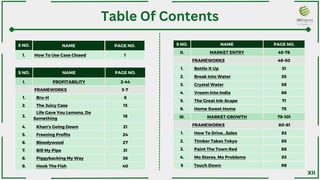
S NO.
1.
NAME PAGE NO.
How To Use Case Closed 1
S NO. NAME PAGE NO.
I. PROFITABILITY 2-44
FRAMEWORKS 3-7
1. Bru-H 8
2. The Juicy Case 13
3.
Life Gave You Lemons, Do
Something
18
4. Khan's Going Down 21
5. Freezing Profits 24
6. Bloodywood 27
7. Bill My Pipe 31
8. Piggybacking My Way 36
9. Hook The Fish 40
S NO. NAME PAGE NO.
II. MARKET ENTRY 45-78
FRAMEWORKS 46-50
1. Bottle It Up 51
2. Break Into Water 55
3. Crystal Water 59
4. Vroom Into India 66
5. The Great Ink-Scape 71
6. Home Sweet Home 75
III. MARKET GROWTH 79-101
FRAMEWORKS 80-81
1. How To Drive...Sales 82
2. Timber Takes Tokyo 85
3. Paint The Town Red 88
4. Mo Stores, Mo Problems 93
Table Of Contents
5 Touch Down 98
XII
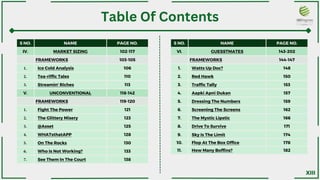
S NO. NAME PAGE NO.
IV. MARKET SIZING 102-117
FRAMEWORKS 103-105
106
110
1. Ice Cold Analysis
2. Tea-riffic Tales
3. Streamin' Riches 113
V. UNCONVENTIONAL 118-142
FRAMEWORKS 119-120
121
123
125
128
130
133
1. Fight The Power
2. The Glittery Misery
3. @Asset
4. WHATsthatAPP
5. On The Rocks
6. Who Is Not Working?
7. See Them In The Court 138
S NO. NAME PAGE NO.
VI. GUESSTMATES 143-202
FRAMEWORKS 144-147
1. Watts Up Doc? 148
2. Red Hawk 150
3. Traffic Tally 153
4. Aapki Apni Dukan 157
5. Dressing The Numbers 159
6. Screening The Screens 162
7. The Mystic Lipstic 166
8. Drive To Survive 171
9. Sky Is The Limit 174
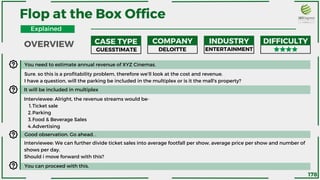
10. Flop At The Box Office 178
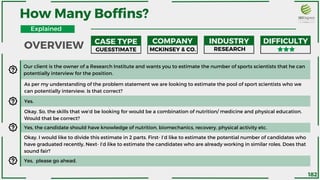
11. How Many Boffins? 182
Table Of Contents
XIII
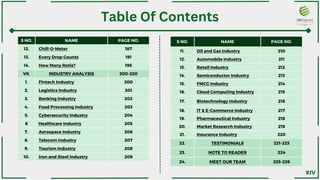
S NO. NAME PAGE NO.
12. Chill-O-Meter 187
13. Every Drop Counts 191
14. How Many Rotis? 195
VII. INDUSTRY ANALYSIS 200-220
1. Fintech Industry 200
2. Logistics Industry 201
3. Banking Industry 202
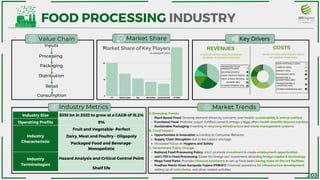
4. Food Processing Industry 203
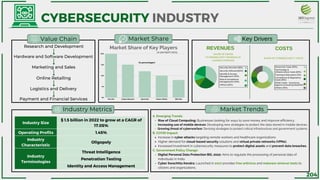
5. Cybersecurity Industry 204
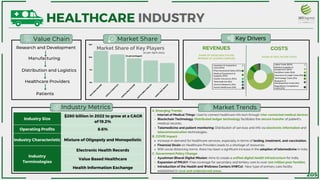
6 Healthcare Industry 205
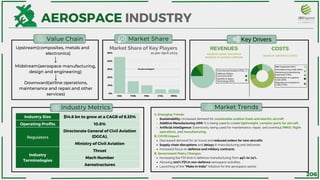
7. Aerospace Industry 206
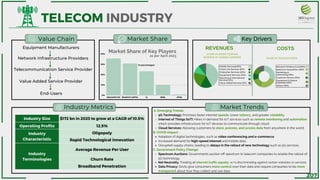
8. Telecom Industry 207
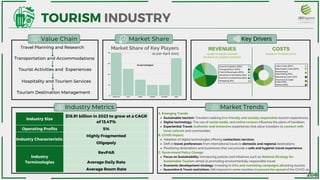
9. Tourism Industry 208
10. Iron and Steel Industry 209
S NO. NAME PAGE NO.
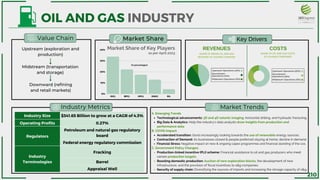
11. Oil and Gas Industry 210
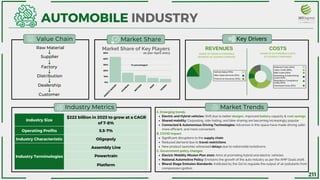
12. Automobile Industry 211
13. Retail Industry 212
14. Semiconductor Industry 213
15. FMCG Industry 214
16. Cloud Computing Industry 215
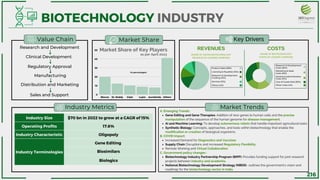
17. Biotechnology Industry 216
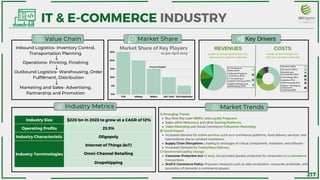
18. IT & E-Commerce Industry 217
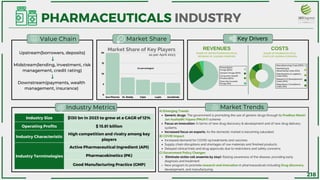
19. Pharmaceutical Industry 218
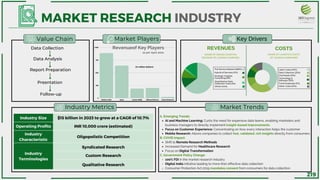
20. Market Research Industry 219
21. Insurance Industry 220
22. TESTIMONIALS 221-223
23. NOTE TO READER 224
24. MEET OUR TEAM 225-226
Table Of Contents
XIV
How to Use Case Closed
MAKE A CASE GROUP
In order to prepare for case interviews, candidates are recommended to form their own case groups, ideally with not
more than 4 people in the group. Do not make the mistake of reading the cases in the book on your own. Instead, solve
cases in pairs. One person usually takes on the role of the ‘interviewer’ and the other, the ‘interviewee’. Only the
interviewer must go through the case to understand the problem. After this, the ‘interviewer’ gives the case to the
‘interviewee’ who makes an attempt to solve the case. Other members of the case group can also be a part of the
process by observing the interview. Finally, the members can discuss the case and give their individual insights. The
interviewee’s solution can be compared to the one in the book to analyze things which could have been approached
differently. Form a case group of not more than 4 people.
Once the group is formed, then the roles of interviewer and interviewee can be decided and a role play can be done
with the third member as an observer if needed. Now, we can proceed further. Considering consulting is a collective
activity, therefore the need for a Case Group becomes paramount.
CORRECTIVE ACTION
It's crucial to have an environment where constructive feedback is valued if you want to enhance your case-solving
abilities. Remain receptive to feedback from your peers and seek guidance from a senior who has undergone the same
process if you need any clarifications. Make sure you incorporate the feedback going forward and read the overall
recommendations as provided.
1
PROFITABILITY
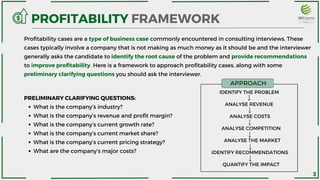
PROFITABILITY FRAMEWORK
Profitability cases are a type of business case commonly encountered in consulting interviews. These
cases typically involve a company that is not making as much money as it should be and the interviewer
generally asks the candidate to identify the root cause of the problem and provide recommendations
to improve profitability. Here is a framework to approach profitability cases, along with some
preliminary clarifying questions you should ask the interviewer.
What is the company’s industry?
What is the company’s revenue and profit margin?
What is the company’s current growth rate?
What is the company’s current market share?
What is the company’s current pricing strategy?
What are the company’s major costs?
PRELIMINARY CLARIFYING QUESTIONS:
IDENTIFY THE PROBLEM
ANALYSE REVENUE
ANALYSE COSTS
ANALYSE COMPETITION
ANALYSE THE MARKET
IDENTIFY RECOMMENDATIONS
QUANTIFY THE IMPACT
APPROACH
3
IDENTIFY THE PROBLEM
The first step in approaching a profitability case is to identify the problem that the company is facing. The
problem may be due to several reasons such as declining revenues, increasing costs, decreasing market share,
or a combination of these factors.
PROFITS
REVENUE COST
VARIABLE COST
NO. OF UNITS SOLD
PRODUCTION
VOLUME SOLD FIXED COST
COST PER UNIT
DEMAND
DISTRIBUTION
PRICE PER UNIT
4
FRAMEWORK TO APPROACH
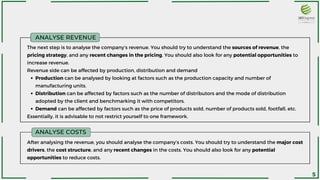
ANALYSE REVENUE
ANALYSE COSTS
After analysing the revenue, you should analyse the company’s costs. You should try to understand the major cost
drivers, the cost structure, and any recent changes in the costs. You should also look for any potential
opportunities to reduce costs.
Production can be analysed by looking at factors such as the production capacity and number of
manufacturing units.
Distribution can be affected by factors such as the number of distributors and the mode of distribution
adopted by the client and benchmarking it with competitors.
Demand can be affected by factors such as the price of products sold, number of products sold, footfall, etc.
The next step is to analyse the company’s revenue. You should try to understand the sources of revenue, the
pricing strategy, and any recent changes in the pricing. You should also look for any potential opportunities to
increase revenue.
Revenue side can be affected by production, distribution and demand
Essentially, it is advisable to not restrict yourself to one framework.
5
ANALYSE COMPETITION
You should also analyse the company’s competition. You should try to understand the major competitors, their
market share, their pricing strategy, and any recent changes in their strategy. You should also look for any
potential opportunities to gain market share.
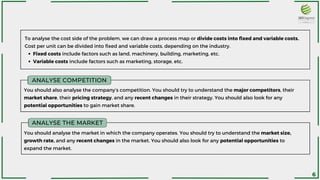
Fixed costs include factors such as land, machinery, building, marketing, etc.
Variable costs include factors such as marketing, storage, etc.
To analyse the cost side of the problem, we can draw a process map or divide costs into fixed and variable costs.
Cost per unit can be divided into fixed and variable costs, depending on the industry.
ANALYSE THE MARKET
You should analyse the market in which the company operates. You should try to understand the market size,
growth rate, and any recent changes in the market. You should also look for any potential opportunities to
expand the market.
6
IDENTIFY RECOMMENDATIONS
QUANTIFY THE IMPACT
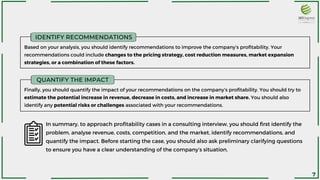
Finally, you should quantify the impact of your recommendations on the company’s profitability. You should try to
estimate the potential increase in revenue, decrease in costs, and increase in market share. You should also
identify any potential risks or challenges associated with your recommendations.
Based on your analysis, you should identify recommendations to improve the company’s profitability. Your
recommendations could include changes to the pricing strategy, cost reduction measures, market expansion
strategies, or a combination of these factors.
In summary, to approach profitability cases in a consulting interview, you should first identify the
problem, analyse revenue, costs, competition, and the market, identify recommendations, and
quantify the impact. Before starting the case, you should also ask preliminary clarifying questions
to ensure you have a clear understanding of the company’s situation.
7
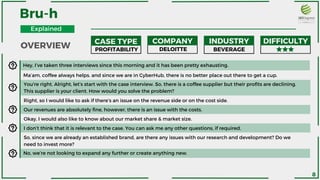
Hey, I’ve taken three interviews since this morning and it has been pretty exhausting.
Ma’am, coffee always helps. and since we are in CyberHub, there is no better place out there to get a cup.
You're right. Alright, let’s start with the case interview. So, there is a coffee supplier but their profits are declining.
This supplier is your client. How would you solve the problem?
Right, so I would like to ask if there’s an issue on the revenue side or on the cost side.
Our revenues are absolutely fine, however, there is an issue with the costs.
Okay, I would also like to know about our market share & market size.
I don’t think that it is relevant to the case. You can ask me any other questions, if required.
So, since we are already an established brand, are there any issues with our research and development? Do we
need to invest more?
No, we’re not looking to expand any further or create anything new.
OVERVIEW
Bru-h
CASE TYPE COMPANY INDUSTRY DIFFICULTY
PROFITABILITY DELOITTE BEVERAGE
8
Explained
Is our raw material accessibility or supply chain being hampered in any other way and is it in any way related to the
global tensions persisting in the present period?
That’s a good point but that is not the issue because all our raw material is sourced domestically.
Okay, I’ll try to be precise, as per the information received, Is there any increase in transportation, warehousing,
production, sales & customer service costs?.
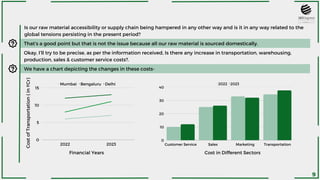
We have a chart depicting the changes in these costs-
Mumbai Bengaluru Delhi
2022 2023
15
10
5
0
2022 2023
Customer Service Sales Marketing Transportation
40
30
20
10
0
Financial Years Cost in Different Sectors
Cost
of
Transportation
(
in
₹Cr)
9
Are we seeing a further increase in cost due to these distributors?
No, we are just facing an increase in transportation costs because sometimes, we have to travel double routes due to
which our bottles are breaking.
I believe the transportation quality is not good. Can I get to know how the bottles are actually kept inside the
truck during the transportation?
Normally, our trucks are padded with foam or else there are crates. We package the jars in boxes which are loaded
in the trucks and usually, these are covered with cellophanes.
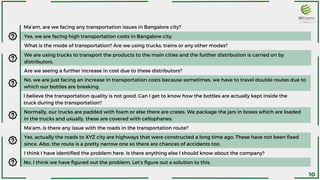
Ma’am, is there any issue with the roads in the transportation route?
Yes, actually the roads to XYZ city are highways that were constructed a long time ago. These have not been fixed
since. Also, the route is a pretty narrow one so there are chances of accidents too.
I think I have identified the problem here. Is there anything else I should know about the company?
No, I think we have figured out the problem. Let’s figure out a solution to this.
We are using trucks to transport the products to the main cities and the further distribution is carried on by
distributors.
Ma’am, are we facing any transportation issues in Bangalore city?
Yes, we are facing high transportation costs in Bangalore city.
What is the mode of transportation? Are we using trucks, trains or any other modes?
10
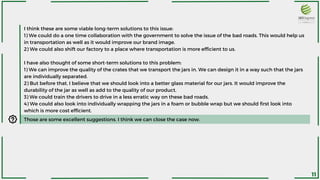
I think these are some viable long-term solutions to this issue:
1) We could do a one time collaboration with the government to solve the issue of the bad roads. This would help us
in transportation as well as it would improve our brand image.
2) We could also shift our factory to a place where transportation is more efficient to us.
I have also thought of some short-term solutions to this problem:
1) We can improve the quality of the crates that we transport the jars in. We can design it in a way such that the jars
are individually separated.
2) But before that, I believe that we should look into a better glass material for our jars. It would improve the
durability of the jar as well as add to the quality of our product.
3) We could train the drivers to drive in a less erratic way on these bad roads.
4) We could also look into individually wrapping the jars in a foam or bubble wrap but we should first look into
which is more cost efficient.
Those are some excellent suggestions. I think we can close the case now.
11
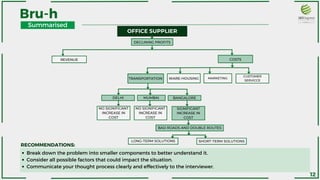
Bru-h
Summarised
OFFICE SUPPLIER
REVENUE COSTS
WARE-HOUSING MARKETING
TRANSPORTATION
DECLINING PROFITS
CUSTOMER
SERVICCE
DELHI MUMBAI BANGALORE
NO SIGNIFICANT
INCREASE IN
COST
NO SIGNIFICANT
INCREASE IN
COST
SIGNIFICANT
INCREASE IN
COST
BAD ROADS AND DOUBLE ROUTES
SHORT-TERM SOLUTIONS
LONG-TERM SOLUTIONS
Break down the problem into smaller components to better understand it.
Consider all possible factors that could impact the situation.
Communicate your thought process clearly and effectively to the interviewer.
RECOMMENDATIONS:
12
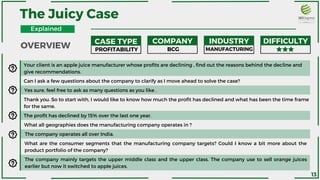
Your client is an apple juice manufacturer whose profits are declining , find out the reasons behind the decline and
give recommendations.
Can I ask a few questions about the company to clarify as I move ahead to solve the case?
Yes sure, feel free to ask as many questions as you like .
Thank you. So to start with, I would like to know how much the profit has declined and what has been the time frame
for the same.
The profit has declined by 15% over the last one year.
What all geographies does the manufacturing company operates in ?
The company operates all over India.
What are the consumer segments that the manufacturing company targets? Could I know a bit more about the
product portfolio of the company?
The company mainly targets the upper middle class and the upper class. The company use to sell orange juices
earlier but now it switched to apple juices.
OVERVIEW
The Juicy Case
CASE TYPE COMPANY INDUSTRY DIFFICULTY
PROFITABILITY BCG MANUFACTURING
13
Explained
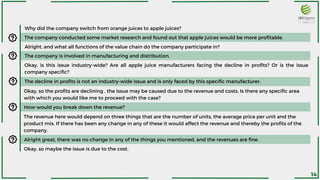
Why did the company switch from orange juices to apple juices?
The company conducted some market research and found out that apple juices would be more profitable.
Alright, and what all functions of the value chain do the company participate in?
The company is involved in manufacturing and distribution.
Okay, is this issue industry-wide? Are all apple juice manufacturers facing the decline in profits? Or is the issue
company specific?
The decline in profits is not an industry-wide issue and is only faced by this specific manufacturer.
Okay, so the profits are declining , the issue may be caused due to the revenue and costs. Is there any specific area
with which you would like me to proceed with the case?
How would you break down the revenue?
The revenue here would depend on three things that are the number of units, the average price per unit and the
product mix. If there has been any change in any of these it would affect the revenue and thereby the profits of the
company.
Alright great, there was no change in any of the things you mentioned, and the revenues are fine.
Okay, so maybe the issue is due to the cost.
14
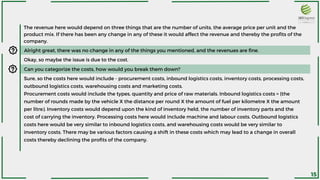
The revenue here would depend on three things that are the number of units, the average price per unit and the
product mix. If there has been any change in any of these it would affect the revenue and thereby the profits of the
company.
Alright great, there was no change in any of the things you mentioned, and the revenues are fine.
Okay, so maybe the issue is due to the cost.
Can you categorize the costs, how would you break them down?
Sure, so the costs here would include - procurement costs, inbound logistics costs, inventory costs, processing costs,
outbound logistics costs, warehousing costs and marketing costs.
Procurement costs would include the types, quantity and price of raw materials. Inbound logistics costs = (the
number of rounds made by the vehicle X the distance per round X the amount of fuel per kilometre X the amount
per litre). Inventory costs would depend upon the kind of inventory held, the number of inventory parts and the
cost of carrying the inventory. Processing costs here would include machine and labour costs. Outbound logistics
costs here would be very similar to inbound logistics costs, and warehousing costs would be very similar to
inventory costs. There may be various factors causing a shift in these costs which may lead to a change in overall
costs thereby declining the profits of the company.
15
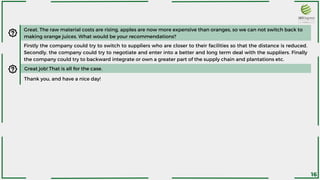
Great. The raw material costs are rising, apples are now more expensive than oranges, so we can not switch back to
making orange juices. What would be your recommendations?
Firstly the company could try to switch to suppliers who are closer to their facilities so that the distance is reduced.
Secondly, the company could try to negotiate and enter into a better and long term deal with the suppliers. Finally
the company could try to backward integrate or own a greater part of the supply chain and plantations etc.
Great job! That is all for the case.
Thank you, and have a nice day!
16
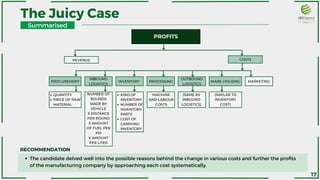
The Juicy Case
Summarised
PROFITS
REVENUE COSTS
WARE-HOUSING MARKETING
OUTBOUND
LOGISTICS
PROCESSING
INVENTORY
INBOUND
LOGISTICS
PROCUREMENT
(SIMILAR TO
INVENTORY
COST)
(SAME AS
INBOUND
LOGISTICS)
MACHINE
AND LABOUR
COSTS
KIND OF
INVENTORY
NUMBER OF
INVENTORY
PARTS
COST OF
CARRYING
INVENTORY
NUMBER OF
ROUNDS
MADE BY
VEHICLE
X DISTANCE
PER ROUND
X AMOUNT
OF FUEL PER
KM
X AMOUNT
PER LITER
QUANTITY
PRICE OF RAW
MATERIAL
The candidate delved well into the possible reasons behind the change in various costs and further the profits
of the manufacturing company by approaching each cost systematically.
RECOMMENDATION
17
OVERVIEW
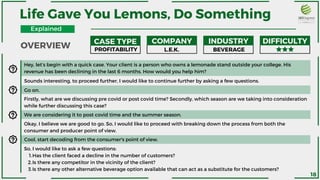
Life Gave You Lemons, Do Something
CASE TYPE COMPANY INDUSTRY DIFFICULTY
Hey, let’s begin with a quick case. Your client is a person who owns a lemonade stand outside your college. His
revenue has been declining in the last 6 months. How would you help him?
Sounds interesting, to proceed further, I would like to continue further by asking a few questions.
PROFITABILITY
Go on.
Firstly, what are we discussing pre covid or post covid time? Secondly, which season are we taking into consideration
while further discussing this case?
We are considering it to post covid time and the summer season.
Okay, I believe we are good to go. So, I would like to proceed with breaking down the process from both the
consumer and producer point of view.
Cool, start decoding from the consumer's point of view.
Has the client faced a decline in the number of customers?
Is there any competitor in the vicinity of the client?
Is there any other alternative beverage option available that can act as a substitute for the customers?
So, I would like to ask a few questions:
1.
2.
3.
L.E.K. BEVERAGE
18
Explained
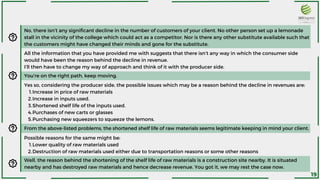
No, there isn’t any significant decline in the number of customers of your client. No other person set up a lemonade
stall in the vicinity of the college which could act as a competitor. Nor is there any other substitute available such that
the customers might have changed their minds and gone for the substitute.
All the information that you have provided me with suggests that there isn’t any way in which the consumer side
would have been the reason behind the decline in revenue.
I’ll then have to change my way of approach and think of it with the producer side.
You’re on the right path, keep moving.
Increase in price of raw materials
Increase in inputs used.
Shortened shelf life of the inputs used.
Purchases of new carts or glasses
Purchasing new squeezers to squeeze the lemons.
Yes so, considering the producer side, the possible issues which may be a reason behind the decline in revenues are:
1.
2.
3.
4.
5.
From the above-listed problems, the shortened shelf life of raw materials seems legitimate keeping in mind your client.
Lower quality of raw materials used
Destruction of raw materials used either due to transportation reasons or some other reasons
Possible reasons for the same might be:
1.
2.
Well, the reason behind the shortening of the shelf life of raw materials is a construction site nearby. It is situated
nearby and has destroyed raw materials and hence decrease revenue. You got it, we may rest the case now.
19
Summarised
Always structure your answer.
Always pause to clarify.
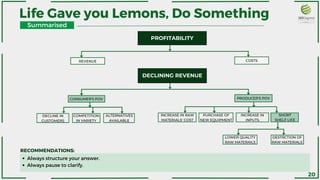
Life Gave you Lemons, Do Something
PROFITABILITY
REVENUE COSTS
INCREASE IN
INPUTS
SHORT
SHELF LIFE
PURCHASE OF
NEW EQUIPMENT
INCREASE IN RAW
MATERIALS' COST
ALTERNATIVES
AVAILABLE
COMPETITION
IN VARIETY
DECLINE IN
CUSTOMERS
DECLINING REVENUE
CONSUMER'S POV PRODUCER'S POV
DESTRCTION OF
RAW MATERIALS
LOWER QUALITY
RAW MATERAILS
RECOMMENDATIONS:
20
21
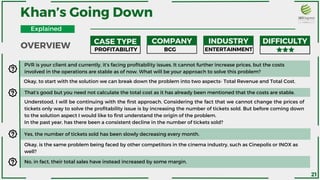
PVR is your client and currently, it’s facing profitability issues. It cannot further increase prices, but the costs
involved in the operations are stable as of now. What will be your approach to solve this problem?
Khan’s Going Down
BCG ENTERTAINMENT
Okay, to start with the solution we can break down the problem into two aspects- Total Revenue and Total Cost.
That’s good but you need not calculate the total cost as it has already been mentioned that the costs are stable.
Understood, I will be continuing with the first approach. Considering the fact that we cannot change the prices of
tickets only way to solve the profitability issue is by increasing the number of tickets sold. But before coming down
to the solution aspect I would like to first understand the origin of the problem.
In the past year, has there been a consistent decline in the number of tickets sold?
Yes, the number of tickets sold has been slowly decreasing every month.
Okay, is the same problem being faced by other competitors in the cinema industry, such as Cinepolis or INOX as
well?
Explained
OVERVIEW
CASE TYPE COMPANY INDUSTRY DIFFICULTY
PROFITABILITY
No, in fact, their total sales have instead increased by some margin.
Interesting, we can therefore rule out that this is an industry-wide problem. From the above statements we can also
understand that consumers prefer to go to INOX or Cinepolis instead of PVR. The most logical reason behind this is
that the quality of the service and the theatre condition is not up to the mark and that’s why people prefer its
competitors over PVR.
That is correct. You have identified the problem. What would be your approach to solving this issue?
Firstly, PVR can renovate the theatre, and make sure that the standards of screening and seating are equivalent to
that of its competitors.
Secondly, it can provide certain discount options for food. For example, if a consumer is purchasing a recliner ticket,
then they will get their food and drinks at a cheaper rate as compared to others. This way we can increase the
number of tickets sold and also induce more people to purchase the gold standard tickets instead of the silver
ticket, whilst keeping the cost at a similar level.
Another initiative that PVR can take is to add arcade games to its main waiting area. This way customers who are
waiting for their movies can keep themselves entertained. Not only can this be a differentiating factor but in the
long term it can lead to better profits as some customers might come in earlier and spend more time inside the
theatre.
Lastly, we can also make contracts with each and every production house so that all the newly-released movies are
being screened.
That’s perfect. No need to go any further, we can conclude the case.
22
Summarised
Khan's Going Down
Explore new revenue streams, such as alternative programming, partnerships with local businesses, or
private event rentals.
Review the cinema's pricing and revenue strategies, including ticket prices, concessions, and advertising
revenue. Identify areas where pricing could be adjusted or revenue streams could be increased to improve
profitability.
RECOMMENDATIONS:
23
PROFITABILITY ISSUES
REVENUE COSTS
PROBLEMS
NO. OF TICKETS
SOLD / MONTH IS
DECREASING
CUSTOMERS
PREFER TO GO TO
OTHER CINEPLEXES
QUALITY OF THE SERVICE
IS NOT UPTO THE MARK
SOLUTIONS
RENOVATION OF
THEATRES
DISCOUNT OPTION
ON FOODS
ENTERTAINMENT OPTIONS
AT THE WAITING AREA
STABLE
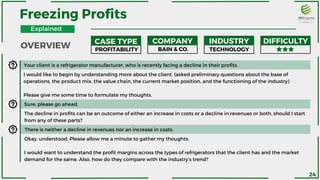
I would like to begin by understanding more about the client. (asked preliminary questions about the base of
operations, the product mix, the value chain, the current market position, and the functioning of the industry)
Please give me some time to formulate my thoughts.
The decline in profits can be an outcome of either an increase in costs or a decline in revenues or both, should I start
from any of these parts?
There is neither a decline in revenues nor an increase in costs.
Okay, understood. Please allow me a minute to gather my thoughts.
I would want to understand the profit margins across the types of refrigerators that the client has and the market
demand for the same. Also, how do they compare with the industry’s trend?
Your client is a refrigerator manufacturer, who is recently facing a decline in their profits.
Sure, please go ahead.
Explained
OVERVIEW
Freezing Profits
CASE TYPE COMPANY INDUSTRY DIFFICULTY
PROFITABILITY BAIN & CO. TECHNOLOGY
24
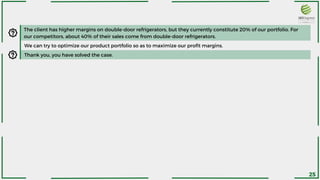
The client has higher margins on double-door refrigerators, but they currently constitute 20% of our portfolio. For
our competitors, about 40% of their sales come from double-door refrigerators.
We can try to optimize our product portfolio so as to maximize our profit margins.
Thank you, you have solved the case.
25
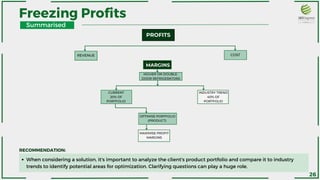
PROFITS
REVENUE COST
Freezing Profits
When considering a solution, it's important to analyze the client's product portfolio and compare it to industry
trends to identify potential areas for optimization. Clarifying questions can play a huge role.
RECOMMENDATION:
26
Summarised
HIGHER ON DOUBLE-
DOOR REFRIGERATORS
MARGINS
INDUSTRY TREND
40% OF
PORTFOLIO
OPTIMISE PORTFOLIO
(PRODUCT)
MAXIMISE PROFIT
MARGINS
CURRENT
20% OF
PORTFOLIO
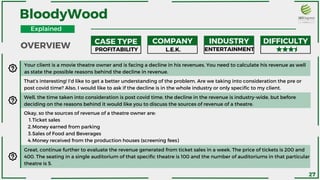
Your client is a movie theatre owner and is facing a decline in his revenues. You need to calculate his revenue as well
as state the possible reasons behind the decline in revenue.
That’s interesting! I’d like to get a better understanding of the problem. Are we taking into consideration the pre or
post covid time? Also, I would like to ask if the decline is in the whole industry or only specific to my client.
Well, the time taken into consideration is post covid time, the decline in the revenue is industry-wide, but before
deciding on the reasons behind it would like you to discuss the sources of revenue of a theatre.
Ticket sales
Money earned from parking
Sales of Food and Beverages
Money received from the production houses (screening fees)
Okay, so the sources of revenue of a theatre owner are:
1.
2.
3.
4.
Great, continue further to evaluate the revenue generated from ticket sales in a week. The price of tickets is 200 and
400. The seating in a single auditorium of that specific theatre is 100 and the number of auditoriums in that particular
theatre is 5.
OVERVIEW
BloodyWood
CASE TYPE COMPANY INDUSTRY DIFFICULTY
PROFITABILITY L.E.K. ENTERTAINMENT
27
Explained
Cool. So I will consider Monday, Tuesday, Wednesday, and Thursday to be non-peak days and Friday, Saturday, and
Sunday as peak days.
The total seating in the theatre is 500, and the average ticket price is 300 [(200 + 400)/ 2]
As per my belief, during non-peak days, the theatre would occupy 50% occupancy and during peak days, it will
occupy 80% occupancy.
Number of tickets sold in non peak days = 50 * 500 / 100 = 250 * 4 = 1,000
Number of tickets sold in peak days = 80 * 500 / 100 = 400 * 3 = 1,200
Total tickets sold in a week for a show= 1,200
Revenue from ticket sales for a show = 1,200 * ₹300 = ₹3,60,000
Considering the average number of shows to be 5, the average sales would be = 3,60,000 * 5 = ₹18,00,000
Well, you have quite accurately decoded the revenue from ticket sales. Since the time we are considering is post covid,
what could be the possible reasons for the same?
As the time is post covid, the reason behind the fall would be a decline in ticket sales due to covid concerns. Also, just
after the covid, the movies weren’t ready to be played at the theatres so that is also an issue. A lot of people have
shifted to OTT platforms to watch movies, this is also a reason behind the decline in sales.
A part of the revenue of theatre comes from production houses as well, as the production houses have chosen OTT
platforms to air their movies, the have stopped paying the theatre broadcasting fees, this again is a reason for the
decline in the revenues.
Another reason for the same could be that the pockets of people have been pinched up as well as a decline in the
popularity of movies, so people don’t prefer going to theatres now.
28
Great, seems like you have covered all the possible reasons behind the decline in revenues. Now, suggest some ways
to increase the revenues of this particular theatre.
The theatres can run advertisements to make people aware of the safety measures the theatres have made. This
way people can realize that the safety measures are in place and would prefer to come to theatres.
Another suggestion is to play the shows of OTT exclusive content as that is more liked by people these days.
New movies can pull people to the theatres, so the theatres can play shows of cult classic movies which were a
big crowd puller.
Theatres can also provide discounts to people showing up in groups, this way they can also start private
screening for friends and families.
So, the ways to increase revenues are:
1.
2.
3.
4.
Great, we can wind this case up
now.
29
BloodyWood
Summarised
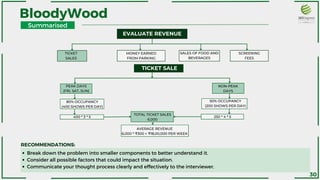
EVALUATE REVENUE
TICKET
SALES
MONEY EARNED
FROM PARKING
SALES OF FOOD AND
BEVERAGES
SCREENING
FEES
PEAK DAYS
(FRI, SAT, SUN)
NON-PEAK
DAYS
TICKET SALE
80% OCCUPANCY
(400 SHOWS PER DAY)
50% OCCUPANCY
(200 SHOWS PER DAY)
TOTAL TICKET SALES
6,000
400 * 3 * 5 250 * 4 * 5
AVERAGE REVENUE
6,000 * ₹300 = ₹18,00,000 PER WEEK
Break down the problem into smaller components to better understand it.
Consider all possible factors that could impact the situation.
Communicate your thought process clearly and effectively to the interviewer.
RECOMMENDATIONS:
30
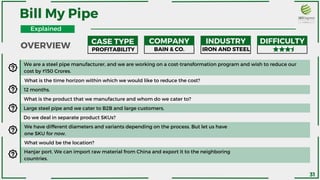
We are a steel pipe manufacturer, and we are working on a cost-transformation program and wish to reduce our
cost by ₹150 Crores.
12 months.
What is the time horizon within which we would like to reduce the cost?
What is the product that we manufacture and whom do we cater to?
Do we deal in separate product SKUs?
Large steel pipe and we cater to B2B and large customers.
We have different diameters and variants depending on the process. But let us have
one SKU for now.
What would be the location?
Hanjar port. We can import raw material from China and export it to the neighboring
countries.
OVERVIEW
Bill My Pipe
CASE TYPE COMPANY INDUSTRY DIFFICULTY
PROFITABILITY BAIN & CO. IRON AND STEEL
31
Explained
₹6000 Cr. What are the various costs that I incur?
Yes, RM is my major cost, and it accounts for 60% of the overall cost.
Raw Material (RM), production, distribution, marketing, and support. And considering the
Heavy Goods Industry, most of the cost should come from Raw Material Purchase and
Inbound Logistics.
Given we are looking at reducing costs, what would our total current cost be?
How much of that is Steel Pipes?
Steel which we bend and make the rolls for our pipe is 95% of our raw material.
Great, we can look at cost for Raw material in terms of the price/tonne*quantity.
How would you look at the price?
I will start looking at the procurement process currently and try to find potential
optimization methods.
We procure for the entire year in one shipment currently.
As we might be saving on inventory costs, do we have any possibility to alter this?
Inventory is not a problem. But we can break the total order into multiple orders. Efficiency and utilization are both
issues. But if we have the liberty to order as many times as possible we like, what should be the number according to
you? One, two, three, four or maybe even more?
32
Sure. By doing this, we can reduce the steel cost by 2%. Can you arrive at a number?
Great. Should I order 80% in the first or 20% in the first?
I would go with two as we can assess efficiency from the first order, order accordingly
and save on transportation.
Should be 80% as we would have safety margins. Moreover, reduced stock-out costs might disrupt the entire
process.
Sure. 60% of 6,000 would be the cost of raw material, which is 3600 and since we use 95%
of RM for steel, the number comes to around 3,420. 2% of which is around ₹68 Cr.
Great, are we able to reach the goal through this?
No, let's wrap up the case. Thanks for your analysis.
No, we are only able to reach less than 50% of the goal. Should I scope further for other
means of optimization.
33
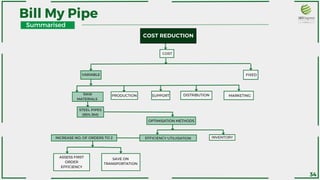
COST REDUCTION
STEEL PIPES
(95% RM)
INVENTORY
COST
VARIABLE FIXED
RAW
MATERIALS
PRODUCTION SUPPORT DISTRIBUTION MARKETING
OPTIMISATION METHODS
INCREASE NO. OF ORDERS TO 2
ASSESS FIRST
ORDER
EFFICIENCY
SAVE ON
TRANSPORTATION
EFFICIENCY UTILIISATION
Bill My Pipe
34
Summarised
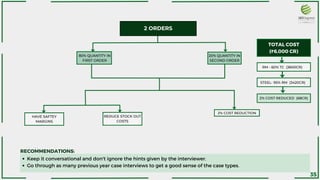
2 ORDERS
80% QUANTITY IN
FIRST ORDER
20% QUANTITY IN
SECOND ORDER
2% COST REDUCTION
HAVE SAFTEY
MARGINS
REDUCE STOCK OUT
COSTS
TOTAL COST
(₹6,000 CR)
RM - 60% TC (3600CR)
STEEL- 95% RM (3420CR)
2% COST REDUCED (68CR)
Keep it conversational and don't ignore the hints given by the interviewer.
Go through as many previous year case interviews to get a good sense of the case types.
RECOMMENDATIONS:
35
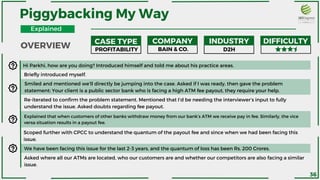
Hi Parkhi, how are you doing? Introduced himself and told me about his practice areas.
Briefly introduced myself.
Smiled and mentioned we’ll directly be jumping into the case. Asked if I was ready, then gave the problem
statement: Your client is a public sector bank who is facing a high ATM fee payout, they require your help.
Explained that when customers of other banks withdraw money from our bank’s ATM we receive pay in fee. Similarly, the vice
versa situation results in a payout fee.
Re-iterated to confirm the problem statement. Mentioned that I’d be needing the interviewer’s input to fully
understand the issue. Asked doubts regarding fee payout.
Scoped further with CPCC to understand the quantum of the payout fee and since when we had been facing this
issue.
We have been facing this issue for the last 2-3 years, and the quantum of loss has been Rs. 200 Crores.
Asked where all our ATMs are located, who our customers are and whether our competitors are also facing a similar
issue.
OVERVIEW
Piggybacking My Way
CASE TYPE COMPANY INDUSTRY DIFFICULTY
PROFITABILITY BAIN & CO. D2H
36
Explained
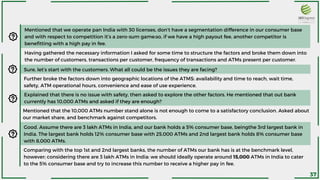
Mentioned that we operate pan India with 30 licenses, don’t have a segmentation difference in our consumer base
and with respect to competition it’s a zero-sum game:so, if we have a high payout fee, another competitor is
benefitting with a high pay in fee.
Sure, let’s start with the customers. What all could be the issues they are facing?
Further broke the factors down into geographic locations of the ATMS: availability and time to reach, wait time,
safety, ATM operational hours, convenience and ease of use experience.
Having gathered the necessary information I asked for some time to structure the factors and broke them down into
the number of customers, transactions per customer, frequency of transactions and ATMs present per customer.
Explained that there is no issue with safety, then asked to explore the other factors. He mentioned that out bank
currently has 10,000 ATMs and asked if they are enough?
Mentioned that the 10,000 ATMs number stand alone is not enough to come to a satisfactory conclusion. Asked about
our market share, and benchmark against competitors.
Good. Assume there are 3 lakh ATMs in India, and our bank holds a 5% consumer base, beingthe 3rd largest bank in
India. The largest bank holds 12% consumer base with 25,000 ATMs and 2nd largest bank holds 8% consumer base
with 8,000 ATMs.
Comparing with the top 1st and 2nd largest banks, the number of ATMs our bank has is at the benchmark level,
however; considering there are 3 lakh ATMs in India: we should ideally operate around 15,000 ATMs in India to cater
to the 5% consumer base and try to increase this number to receive a higher pay in fee.
37
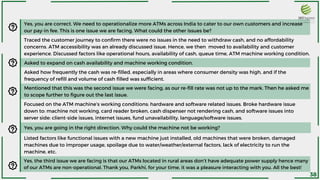
Yes, you are correct. We need to operationalize more ATMs across India to cater to our own customers and increase
our pay-in fee. This is one issue we are facing. What could the other issues be?
Asked to expand on cash availability and machine working condition.
Mentioned that this was the second issue we were facing, as our re-fill rate was not up to the mark. Then he asked me
to scope further to figure out the last issue.
Traced the customer journey to confirm there were no issues in the need to withdraw cash, and no affordability
concerns. ATM accessibility was an already discussed issue. Hence, we then moved to availability and customer
experience. Discussed factors like operational hours, availability of cash, queue time, ATM machine working condition.
Asked how frequently the cash was re-filled, especially in areas where consumer density was high, and if the
frequency of refill and volume of cash filled was sufficient.
Yes, you are going in the right direction. Why could the machine not be working?
Focused on the ATM machine’s working conditions: hardware and software related issues. Broke hardware issue
down to: machine not working, card reader broken, cash dispenser not rendering cash, and software issues into
server side: client-side issues, internet issues, fund unavailability, language/software issues.
Listed factors like functional issues with a new machine just installed, old machines that were broken, damaged
machines due to improper usage, spoilage due to water/weather/external factors, lack of electricity to run the
machine, etc.
Yes, the third issue we are facing is that our ATMs located in rural areas don’t have adequate power supply hence many
of our ATMs are non-operational. Thank you, Parkhi, for your time, it was a pleasure interacting with you. All the best!
38
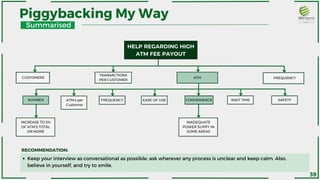
Piggybacking My Way
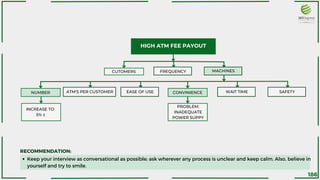
CUSTOMERS
TRANSACTIONS
PER CUSTOMER
FREQUENCY
ATM
HELP REGARDING HIGH
ATM FEE PAYOUT
NUMBER ATM's per
Customer
FREQUENCY EASE OF USE CONVENIENCE WAIT TIME SAFETY
INCREASE TO 5%
OF ATM'S TOTAL
OR MORE
INADEQUATE
POWER SUPPY IN
SOME AREAS
Keep your interview as conversational as possible; ask wherever any process is unclear and keep calm. Also,
believe in yourself, and try to smile.
RECOMMENDATION:
39
Summarised
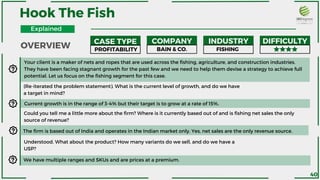
Your client is a maker of nets and ropes that are used across the fishing, agriculture, and construction industries.
They have been facing stagnant growth for the past few and we need to help them devise a strategy to achieve full
potential. Let us focus on the fishing segment for this case.
Current growth is in the range of 3-4% but their target is to grow at a rate of 15%.
Could you tell me a little more about the firm? Where is it currently based out of and is fishing net sales the only
source of revenue?
FISHING
(Re-iterated the problem statement). What is the current level of growth, and do we have
a target in mind?
The firm is based out of India and operates in the Indian market only. Yes, net sales are the only revenue source.
Understood. What about the product? How many variants do we sell, and do we have a
USP?
We have multiple ranges and SKUs and are prices at a premium.
Explained
OVERVIEW
CASE TYPE COMPANY INDUSTRY DIFFICULTY
PROFITABILITY BAIN & CO.
40
Hook The Fish
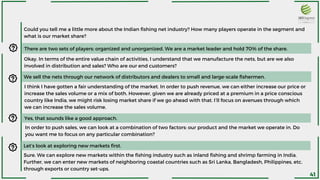
Could you tell me a little more about the Indian fishing net industry? How many players operate in the segment and
what is our market share?
Okay. In terms of the entire value chain of activities, I understand that we manufacture the nets, but are we also
involved in distribution and sales? Who are our end customers?
There are two sets of players: organized and unorganized. We are a market leader and hold 70% of the share.
We sell the nets through our network of distributors and dealers to small and large-scale fishermen.
I think I have gotten a fair understanding of the market. In order to push revenue, we can either increase our price or
increase the sales volume or a mix of both. However, given we are already priced at a premium in a price conscious
country like India, we might risk losing market share if we go ahead with that. I’ll focus on avenues through which
we can increase the sales volume.
In order to push sales, we can look at a combination of two factors: our product and the market we operate in. Do
you want me to focus on any particular combination?
Yes, that sounds like a good approach.
Let’s look at exploring new markets first.
Sure. We can explore new markets within the fishing industry such as inland fishing and shrimp farming in India.
Further, we can enter new markets of neighboring coastal countries such as Sri Lanka, Bangladesh, Philippines, etc.
through exports or country set-ups.
41
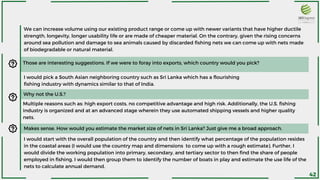
We can increase volume using our existing product range or come up with newer variants that have higher ductile
strength, longevity, longer usability life or are made of cheaper material. On the contrary, given the rising concerns
around sea pollution and damage to sea animals caused by discarded fishing nets we can come up with nets made
of biodegradable or natural material.
I would pick a South Asian neighboring country such as Sri Lanka which has a flourishing
fishing industry with dynamics similar to that of India.
Those are interesting suggestions. If we were to foray into exports, which country would you pick?
Why not the U.S.?
Multiple reasons such as: high export costs, no competitive advantage and high risk. Additionally, the U.S. fishing
industry is organized and at an advanced stage wherein they use automated shipping vessels and higher quality
nets.
Makes sense. How would you estimate the market size of nets in Sri Lanka? Just give me a broad approach.
I would start with the overall population of the country and then identify what percentage of the population resides
in the coastal areas (I would use the country map and dimensions to come up with a rough estimate). Further, I
would divide the working population into primary, secondary, and tertiary sector to then find the share of people
employed in fishing. I would then group them to identify the number of boats in play and estimate the use life of the
nets to calculate annual demand.
42
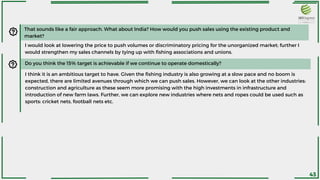
That sounds like a fair approach. What about India? How would you push sales using the existing product and
market?
I would look at lowering the price to push volumes or discriminatory pricing for the unorganized market; further I
would strengthen my sales channels by tying up with fishing associations and unions.
I think it is an ambitious target to have. Given the fishing industry is also growing at a slow pace and no boom is
expected, there are limited avenues through which we can push sales. However, we can look at the other industries:
construction and agriculture as these seem more promising with the high investments in infrastructure and
introduction of new farm laws. Further, we can explore new industries where nets and ropes could be used such as
sports: cricket nets, football nets etc.
Do you think the 15% target is achievable if we continue to operate domestically?
43
Hook The Fish
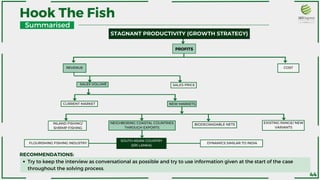
Summarised
STAGNANT PRODUCTIVITY (GROWTH STRATEGY)
PROFITS
REVENUE COST
SALES VOLUME SALES PRICE
CURRENT MARKET NEW MARKETS
INLAND FISHING/
SHRIMP FISHING
NEIGHBORING COASTAL COUNTRIES
THROUGH EXPORTS
BIODEGRADABLE NETS
EXISTING RANGE/ NEW
VARIANTS
SOUTH ASIAN COUNTRY
(SRI LANKA)
FLOURISHING FISHING INDUSTRY DYNAMICS SIMILAR TO INDIA
Try to keep the interview as conversational as possible and try to use information given at the start of the case
throughout the solving process.
RECOMMENDATIONS:
44
MARKET ENTRY
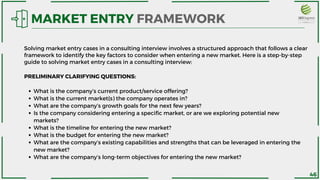
What is the company’s current product/service offering?
What is the current market(s) the company operates in?
What are the company’s growth goals for the next few years?
Is the company considering entering a specific market, or are we exploring potential new
markets?
What is the timeline for entering the new market?
What is the budget for entering the new market?
What are the company’s existing capabilities and strengths that can be leveraged in entering the
new market?
What are the company’s long-term objectives for entering the new market?
PRELIMINARY CLARIFYING QUESTIONS:
MARKET ENTRY FRAMEWORK
Solving market entry cases in a consulting interview involves a structured approach that follows a clear
framework to identify the key factors to consider when entering a new market. Here is a step-by-step
guide to solving market entry cases in a consulting interview:
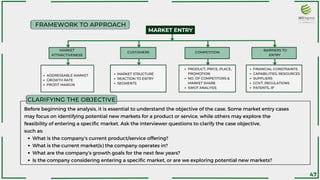
46
MARKET ENTRY
MARKET
ATTRACTIVENESS
CUSTOMERS
MARKET STRUCTURE
REACTION TO ENTRY
SEGMENTS
ADDRESSABLE MARKET
GROWTH RATE
PROFIT MARGIN
PRODUCT, PRICE, PLACE,
PROMOTION
NO. OF COMPETITORS &
MARKET SHARE
SWOT ANALYSIS
FINANCIAL CONSTRAINTS
CAPABILITIES, RESOURCES
SUPPLIERS
GOVT. REGULATIONS
PATENTS, IP
COMPETITION
BARRIERS TO
ENTRY
CLARIFYING THE OBJECTIVE
What is the company’s current product/service offering?
What is the current market(s) the company operates in?
What are the company’s growth goals for the next few years?
Is the company considering entering a specific market, or are we exploring potential new markets?
Before beginning the analysis, it is essential to understand the objective of the case. Some market entry cases
may focus on identifying potential new markets for a product or service, while others may explore the
feasibility of entering a specific market. Ask the interviewer questions to clarify the case objective,
such as:
FRAMEWORK TO APPROACH
47
DEFINING THE MARKET:
ANALYSING THE MARKET
What is the size of the market?
Who are the major players in the market?
What are the market growth rates?
What are the market trends?
Define the market that you are analysing. Depending on the case, this may involve identifying a new market
for the company or assessing the feasibility of entering an existing market. Clarify the market definition with
the interviewer, such as:
Market demand: What is the potential demand for the product/service in the market? What is the target
market’s size and growth potential? What are the trends and drivers of demand in the market?
Competition: Who are the major players in the market? What is their market share? What are their
strengths and weaknesses? What is the competitive landscape like?
Once you have defined the market, analyse it in detail. This will involve researching and assessing the following
factors:
48
DEVELOPING A MARKET ENTRY STRATEGY
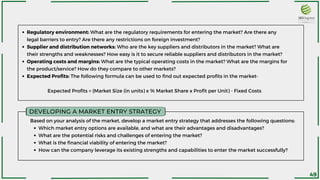
Regulatory environment: What are the regulatory requirements for entering the market? Are there any
legal barriers to entry? Are there any restrictions on foreign investment?
Supplier and distribution networks: Who are the key suppliers and distributors in the market? What are
their strengths and weaknesses? How easy is it to secure reliable suppliers and distributors in the market?
Operating costs and margins: What are the typical operating costs in the market? What are the margins for
the product/service? How do they compare to other markets?
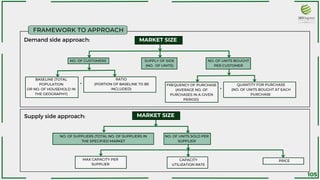
Expected Profits: The following formula can be used to find out expected profits in the market-
Expected Profits = (Market Size (in units) x % Market Share x Profit per Unit) - Fixed Costs
Which market entry options are available, and what are their advantages and disadvantages?
What are the potential risks and challenges of entering the market?
What is the financial viability of entering the market?
How can the company leverage its existing strengths and capabilities to enter the market successfully?
Based on your analysis of the market, develop a market entry strategy that addresses the following questions:
49
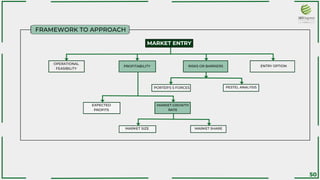
MARKET ENTRY
PROFITABILITY
OPERATIONAL
FEASIBILITY
RISKS OR BARRIERS ENTRY OPTION
EXPECTED
PROFITS
MARKET SIZE
PORTER'S 5 FORCES
MARKET GROWTH
RATE
MARKET SHARE
PESTEL ANALYSIS
FRAMEWORK TO APPROACH
50
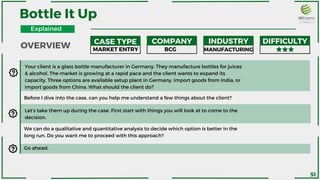
Bottle It Up
Before I dive into the case, can you help me understand a few things about the client?
We can do a qualitative and quantitative analysis to decide which option is better in the
long run. Do you want me to proceed with this approach?
Your client is a glass bottle manufacturer in Germany. They manufacture bottles for juices
& alcohol. The market is growing at a rapid pace and the client wants to expand its
capacity. Three options are available setup plant in Germany, import goods from India, or
import goods from China. What should the client do?
Let’s take them up during the case. First start with things you will look at to come to the
decision.
OVERVIEW CASE TYPE COMPANY INDUSTRY DIFFICULTY
MARKET ENTRY BCG MANUFACTURING
Go ahead.
Explained
51
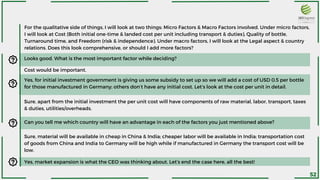
For the qualitative side of things, I will look at two things: Micro Factors & Macro Factors involved. Under micro factors,
I will look at Cost (Both initial one-time & landed cost per unit including transport & duties), Quality of bottle,
Turnaround time, and Freedom (risk & independence). Under macro factors, I will look at the Legal aspect & country
relations. Does this look comprehensive, or should I add more factors?
Cost would be important.
Looks good. What is the most important factor while deciding?
Yes, for initial investment government is giving us some subsidy to set up so we will add a cost of USD 0.5 per bottle
for those manufactured in Germany; others don’t have any initial cost. Let’s look at the cost per unit in detail.
Sure, apart from the initial investment the per unit cost will have components of raw material, labor, transport, taxes
& duties, utilities/overheads.
Sure, material will be available in cheap in China & India; cheaper labor will be available in India; transportation cost
of goods from China and India to Germany will be high while if manufactured in Germany the transport cost will be
low.
Can you tell me which country will have an advantage in each of the factors you just mentioned above?
Yes, market expansion is what the CEO was thinking about. Let’s end the case here, all the best!
52
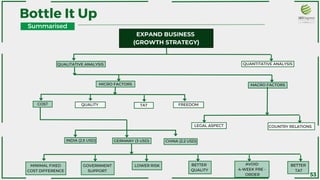
EXPAND BUSINESS
(GROWTH STRATEGY)
QUALITATIVE ANALYSIS QUANTITATIVE ANALYSIS
MICRO FACTORS MACRO FACTORS
COST QUALITY TAT FREEDOM
LEGAL ASPECT COUNTRY RELATIONS
GERMANY (3 USD)
INDIA (2.5 USD) CHINA (2.2 USD)
MINIMAL FIXED
COST DIFFERENCE
GOVERNMENT
SUPPORT
LOWER RISK BETTER
QUALITY
BETTER
TAT
AVOID
4-WEEK PRE -
ORDER
Summarised
Bottle It Up
53
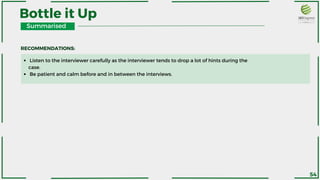
Summarised
Bottle it Up
Listen to the interviewer carefully as the interviewer tends to drop a lot of hints during the
case.
Be patient and calm before and in between the interviews.
RECOMMENDATIONS:
54
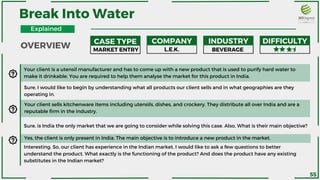
CASE TYPE COMPANY INDUSTRY DIFFICULTY
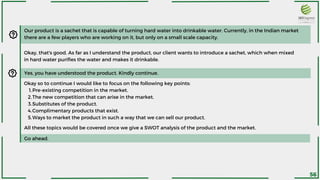
Your client is a utensil manufacturer and has to come up with a new product that is used to purify hard water to
make it drinkable. You are required to help them analyse the market for this product in India.
Sure, I would like to begin by understanding what all products our client sells and in what geographies are they
operating in.
MARKET ENTRY L.E.K. BEVERAGE
Your client sells kitchenware items including utensils, dishes, and crockery. They distribute all over India and are a
reputable firm in the industry.
Sure, is India the only market that we are going to consider while solving this case. Also, What is their main objective?
Yes, the client is only present in India. The main objective is to introduce a new product in the market.
Interesting. So, our client has experience in the Indian market. I would like to ask a few questions to better
understand the product. What exactly is the functioning of the product? And does the product have any existing
substitutes in the Indian market?
Break Into Water
OVERVIEW
Explained
55
Yes, you have understood the product. Kindly continue.
Pre-existing competition in the market.
The new competition that can arise in the market.
Substitutes of the product.
Complimentary products that exist.
Ways to market the product in such a way that we can sell our product.
Okay so to continue I would like to focus on the following key points:
1.
2.
3.
4.
5.
Our product is a sachet that is capable of turning hard water into drinkable water. Currently, in the Indian market
there are a few players who are working on it, but only on a small scale capacity.
Okay, that's good. As far as I understand the product, our client wants to introduce a sachet, which when mixed
in hard water purifies the water and makes it drinkable.
Go ahead.
All these topics would be covered once we give a SWOT analysis of the product and the market.
56
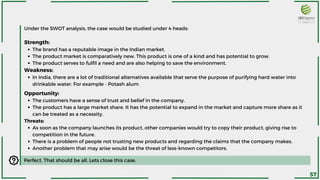
The brand has a reputable image in the Indian market.
The product market is comparatively new. This product is one of a kind and has potential to grow.
The product serves to fulfil a need and are also helping to save the environment.
In India, there are a lot of traditional alternatives available that serve the purpose of purifying hard water into
drinkable water. For example - Potash alum
Under the SWOT analysis, the case would be studied under 4 heads:
Strength:
Weakness:
Perfect. That should be all. Lets close this case.
The customers have a sense of trust and belief in the company.
The product has a large market share. It has the potential to expand in the market and capture more share as it
can be treated as a necessity.
As soon as the company launches its product, other companies would try to copy their product, giving rise to
competition in the future.
There is a problem of people not trusting new products and regarding the claims that the company makes.
Another problem that may arise would be the threat of less-known competitors.
Opportunity:
Threats:
57
Take up to 3-4 questions to clarify the product and then proceed to comment.
Always use market analysis frameworks.
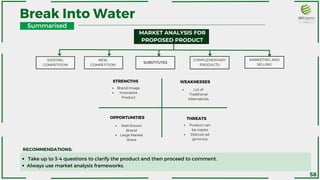
Break Into Water
Summarised
MARKET ANALYSIS FOR
PROPOSED PRODUCT
EXISTING
COMPETITION
NEW
COMPETITION
SUBSTITUTES
MARKETING AND
SELLING
COMPLEMENTARY
PRODUCTS
STRENGTHS WEAKNESSES
OPPORTUNITIES THREATS
Brand Image
Innovative
Product
Lot of
Traditional
Alternatives
Well Known
Brand
Large Market
Share
Product can
be copies
Distrust ad
gimmick
RECOMMENDATIONS:
58
CASE TYPE COMPANY INDUSTRY DIFFICULTY
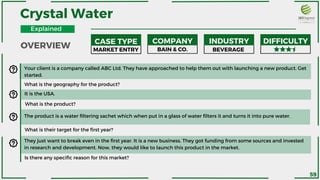
Your client is a company called ABC Ltd. They have approached to help them out with launching a new product. Get
started.
What is the geography for the product?
It is the USA.
What is the product?
The product is a water filtering sachet which when put in a glass of water filters it and turns it into pure water.
What is their target for the first year?
They just want to break even in the first year. It is a new business. They got funding from some sources and invested
in research and development. Now, they would like to launch this product in the market.
Is there any specific reason for this market?
MARKET ENTRY BAIN & CO. BEVERAGE
Crystal Water
OVERVIEW
Explained
59
Sure, it could be. If you think that, please go ahead with providing a rationale.
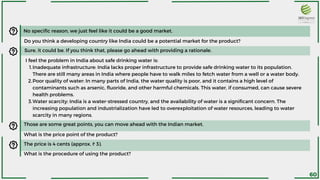
Inadequate infrastructure: India lacks proper infrastructure to provide safe drinking water to its population.
There are still many areas in India where people have to walk miles to fetch water from a well or a water body.
Poor quality of water: In many parts of India, the water quality is poor, and it contains a high level of
contaminants such as arsenic, fluoride, and other harmful chemicals. This water, if consumed, can cause severe
health problems.
Water scarcity: India is a water-stressed country, and the availability of water is a significant concern. The
increasing population and industrialization have led to overexploitation of water resources, leading to water
scarcity in many regions.
I feel the problem in India about safe drinking water is:
1.
2.
3.
No specific reason, we just feel like it could be a good market.
Do you think a developing country like India could be a potential market for the product?
Those are some great points, you can move ahead with the Indian market.
What is the price point of the product?
The price is 4 cents (approx. ₹ 3).
What is the procedure of using the product?
60
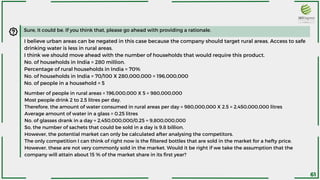
Sure, it could be. If you think that, please go ahead with providing a rationale.
I believe urban areas can be negated in this case because the company should target rural areas. Access to safe
drinking water is less in rural areas.
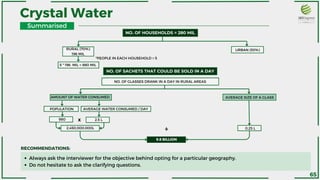
I think we should move ahead with the number of households that would require this product.
No. of households in India = 280 million.
Percentage of rural households in India = 70%
No. of households in India = 70/100 X 280,000,000 = 196,000,000
No. of people in a household = 5
Number of people in rural areas = 196,000,000 X 5 = 980,000,000
Most people drink 2 to 2.5 litres per day.
Therefore, the amount of water consumed in rural areas per day = 980,000,000 X 2.5 = 2,450,000,000 litres
Average amount of water in a glass = 0.25 litres
No. of glasses drank in a day = 2,450,000,000/0.25 = 9,800,000,000
So, the number of sachets that could be sold in a day is 9.8 billion.
However, the potential market can only be calculated after analysing the competitors.
The only competition I can think of right now is the filtered bottles that are sold in the market for a hefty price.
However, these are not very commonly sold in the market. Would it be right if we take the assumption that the
company will attain about 15 % of the market share in its first year?
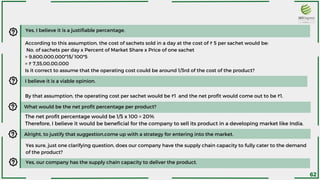
61
Yes, I believe it is a justifiable percentage.
According to this assumption, the cost of sachets sold in a day at the cost of ₹ 5 per sachet would be:
No. of sachets per day x Percent of Market Share x Price of one sachet
= 9,800,000,000*15/ 100*5
= ₹ 7,35,00,00,000
Is it correct to assume that the operating cost could be around 1/3rd of the cost of the product?
By that assumption, the operating cost per sachet would be ₹1 and the net profit would come out to be ₹1.
What would be the net profit percentage per product?
The net profit percentage would be 1/5 x 100 = 20%
Therefore, I believe it would be beneficial for the company to sell its product in a developing market like India.
Alright, to justify that suggestion,come up with a strategy for entering into the market.
I believe it is a viable opinion.
Yes sure, just one clarifying question, does our company have the supply chain capacity to fully cater to the demand
of the product?
Yes, our company has the supply chain capacity to deliver the product.
62
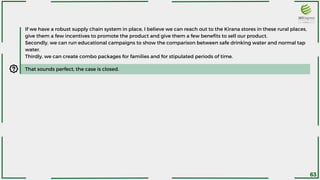
That sounds perfect, the case is closed.
If we have a robust supply chain system in place, I believe we can reach out to the Kirana stores in these rural places,
give them a few incentives to promote the product and give them a few benefits to sell our product.
Secondly, we can run educational campaigns to show the comparison between safe drinking water and normal tap
water.
Thirdly, we can create combo packages for families and for stipulated periods of time.
63
Crystal Water
Always ask the interviewer for the objective behind opting for a particular geography.
Do not hesitate to ask the clarifying questions.
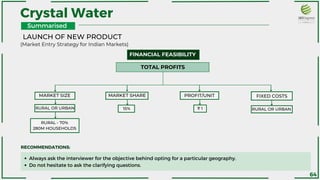
MARKET SIZE MARKET SHARE
TOTAL PROFITS
LAUNCH OF NEW PRODUCT
(Market Entry Strategy for Indian Markets)
FINANCIAL FEASIBILITY
PROFIT/UNIT FIXED COSTS
RURAL OR URBAN
RURAL - 70%
280M HOUSEHOLDS
15% ₹ 1 RURAL OR URBAN
Summarised
RECOMMENDATIONS:
64
Crystal Water
Always ask the interviewer for the objective behind opting for a particular geography.
Do not hesitate to ask the clarifying questions.
Summarised
RECOMMENDATIONS:
NO. OF HOUSEHOLDS = 280 MIL
RURAL (70%)
196 MIL
URBAN (30%)
5 * 196 MIL = 980 MIL
*PEOPLE IN EACH HOUSEHOLD = 5
NO. OF SACHETS THAT COULD BE SOLD IN A DAY
AMOUNT OF WATER CONSUMED AVERAGE SIZE OF A GLASS
NO. OF GLASSES DRANK IN A DAY IN RURAL AREAS
POPULATION AVERAGE WATER CONSUMED / DAY
980 2.5 L
X
2,450,000,000L 0.25 L
÷
9.8 BILLION
65
BCG
Hey there. Your client is a foreign automobile player based in Japan and is now planning to enter India. How will you
go about it?
Interesting! Firstly, I would like to ask some questions, if that’s okay.
Absolutely.
Okay. Does the company have prior experience in venturing into new markets? What is their product line?
They have ventured into Europe before. They sell service passenger vehicles and commission vehicles.
What is the USP?
This company offers cheaper vehicles and is an EV-based player.
What is the time frame the company wishes to adopt?
Vrooom Into India
MARKET ENTRY AUTOMOBILE
OVERVIEW
CASE TYPE COMPANY INDUSTRY DIFFICULTY
The company is looking to expand in India in the next 1 year.
What is their objective to expand in India?
Explained
66
To make profits.
I would divide my approach into 3-
Market Attractiveness- Here, we would ascertain if the company is profitable or not. Also, we would find the
market share.
Set Up- How exactly do we go about setting up the business
Risks- It is important to be abreast with the risks our client can face in this endeavour
Go ahead.
We would have to undertake a Pestel analysis:
To estimate the scope of this industry, we would have to take a guesstimate.
Sir, would you like me to find the number of potential car owners in India and how much market share can our client
capture?
We take the population of India to be 1.4 billion. We also assume that every household has an average of 4
members, where 1.5 members per household know how to drive. Is it safe to assume so?
You may.
Yes, no problem.
67
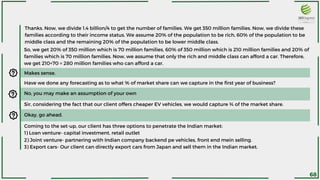
Thanks. Now, we divide 1.4 billion/4 to get the number of families. We get 350 million families. Now, we divide these
families according to their income status. We assume 20% of the population to be rich, 60% of the population to be
middle class and the remaining 20% of the population to be lower middle class.
So, we get 20% of 350 million which is 70 million families, 60% of 350 million which is 210 million families and 20% of
families which is 70 million families. Now, we assume that only the rich and middle class can afford a car. Therefore,
we get 210+70 = 280 million families who can afford a car.
Makes sense.
Have we done any forecasting as to what % of market share can we capture in the first year of business?
No, you may make an assumption of your own
Sir, considering the fact that our client offers cheaper EV vehicles, we would capture ¾ of the market share.
Okay, go ahead.
2) Joint venture- partnering with Indian company backend pe vehicles, front end mein selling.
3) Export cars- Our client can directly export cars from Japan and sell them in the Indian market.
Coming to the set-up, our client has three options to penetrate the Indian market:
1) Loan venture- capital investment, retail outlet
68
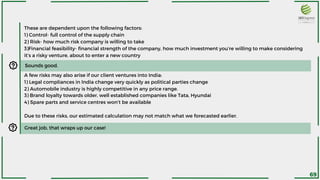
These are dependent upon the following factors:
1) Control- full control of the supply chain
2) Risk- how much risk company is willing to take
3)Financial feasibility- financial strength of the company, how much investment you’re willing to make considering
it’s a risky venture, about to enter a new country
Sounds good.
A few risks may also arise if our client ventures into India:
1) Legal compliances in India change very quickly as political parties change
2) Automobile industry is highly competitive in any price range.
3) Brand loyalty towards older, well established companies like Tata, Hyundai
4) Spare parts and service centres won’t be available
Due to these risks, our estimated calculation may not match what we forecasted earlier.
Great job, that wraps up our case!
69
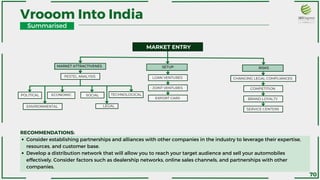
MARKET ENTRY
MARKET ATTRACTIVENES
PESTEL ANALYSIS LOAN VENTURES
SETUP RISKS
Vrooom Into India
Consider establishing partnerships and alliances with other companies in the industry to leverage their expertise,
resources, and customer base.
Develop a distribution network that will allow you to reach your target audience and sell your automobiles
effectively. Consider factors such as dealership networks, online sales channels, and partnerships with other
companies.
RECOMMENDATIONS:
CHANGING LEGAL COMPLIANCES
JOINT VENTURES COMPETITION
EXPORT CARS BRAND LOYALTY
SERVICE CENTERS
Summarised
70
POLITICAL SOCIAL TECHNOLOGICAL
LEGAL
ENVIRONMENTAL
ECONOMIC
Let’s begin with your case. Our client is a well-established and known electronic company which is coming up with
a new modern and innovative ink cartridge used for printing. They would like to know if it would be profitable for
them to launch this in the Indian market or not.
Alright, what are the new innovations in the ink cartridge?
The ink cartridge is 10 times better at printing on paper than a regular ink cartridge which is present in the market
right now. The ink is darker and does not easily fade away.
What is the motive of this market entry?
What is the time that the company is targeting to launch the product?
The motive of the company is to make profits.
The company plans to launch the cartridges as soon as possible.
Is there any component of fixed costs that the client is specifically targeting to cover up in any particular number of
units or any particular time frame?
The Great Ink-Scape
CASE TYPE COMPANY INDUSTRY DIFFICULTY
MARKET ENTRY BAIN & CO. PRINT
OVERVIEW
Explained
71
No, the fixed costs are not an issue.
Can I get to know the market size of ink cartridges in India?
Yes sure, the market size of ink cartridges in India is about 10 million dollars.
Is there any data on the cost structure of the regular ink cartridges in the market and what percentage of profit is our
specific company targeting?
Yes, so the cost structure of the ink cartridge can be explained using the following equation.
Manufacturing Cost (70%) + Distribution Cost (15%) +Marketing Cost (15%) + Retail Markup (5%) = Market Price of
the ink cartridge (105%).
A regular ink cartridge used for printing is available in the market for around ₹1500-2000. However, because our ink
cartridge is much superior to the regular ink, it costs 3 times higher than the regular ones.
I think it would be safe to assume our cost to be around 4500 without the retail markup. Therefore, the potential
profit on each unit sold is around 225 rupees. Do we have data on the estimated market share that the company will
achieve?
Yes, our company is aiming for one-third of the share of the current market.
So, around 3.34 million dollars right?
Yes that is correct.
72
Now, we can calculate the expected profits that can be achieved by using the following formula.
Expected profits = (Market Size/Cost of each Unit) x Market Share (in % age) x (Profit/Unit)
Now, the cost of the product is ₹4500 which equals around $55. And the profit on each unit is 5% of $55 = $2.75 a unit.
Now, Expected profits = (10,000,000/55) X (1/3) X 2.75
= $166,500
This profit would be recurring because there would be a continued demand for ink cartridges.
That seems appropriate, are there any suggestions for the company to improve profitability in the long run.
Some suggestions for the company could be:
1) The company should look towards optimising the cost structure, it should be aiming to source the chemicals
required to produce these ink cartridges indigenously and also look towards better distributors.
2) The company should also look towards diversifying its ink business. That would include getting into the market of
ink printers and developing ink printers which could enhance the effect of these ink cartridges to a further extent.
3) The company should also look towards building a stronger brand image because ink printing in India is majorly
occupied by top brands like Epson, HP, Canon and Brother. Therefore, it should focus on stronger marketing
campaigns and alliances
Excellent, those are some great suggestions. Thank you for your analysis. That concludes our case interview.
73
The Great Ink-Scape
Summarised
PRODUCT: 10X BEETER
PRINTING INK
FINANCIAL ATTRACTIVENESS
EXPECTED PROFITS MARKET GROWTH COMPETITIVE
LANDSCAPE
MARKET LINE/COST PER UNIT *
MARKET SHARE * PROFIT PER UNIT
10000000/55 * 1/3 * 2.75 = $1,66,500
MARKET PRICE
MANUFACTURING COSTS (70%) DISTRIBUTION COSTS (15%) MARKETING COSTS (15%) RETAIL MARKUP (5%)
MARKET PRICE OF CARTRIDGE
(10.5%)
RECOMMENDATIONS:
Be clear about the assumptions you make and clearly communicate them to the interviewer.
Another small thing to keep in mind is to consider any potential risks or challenges that may arise during the launch
of the ink cartridge in the Indian market.
74
A company wants to enter the housing finance sector in India via a universal bank like ICICI. Can you please tell me
how you would approach this case?
Home Sweet Home
MARKET ENTRY MCKINSEY & CO. HOUSING & FINANCE
Sure, let me first consider the scope, factors, regulations/restrictions for the same.
The scope for a company entering the housing finance sector in India is huge. With the growing demand for housing
and the government’s push for affordable housing, the market has a lot of potential. However, the factors and
regulations/restrictions must be taken into account before entering the market.
In terms of factors, setting up the right people team, necessary infrastructure, and creating a strong brand identity
are important. Additionally, understanding the customer requirements, the economic environment, and the
competition will help in making informed decisions. As for regulations, the Reserve Bank of India (RBI) has set
certain guidelines that must be followed by all banks and housing finance companies.
Okay, that sounds good. You may proceed.
OVERVIEW
CASE TYPE COMPANY INDUSTRY DIFFICULTY
Explained
75
Alright, I would then structure the case by dividing it into organic and inorganic sides. In terms of the organic side,
we would need to focus on setting up the right team, infrastructure, and creating a strong brand identity. We would
also need to focus on two key sectors under this: retail and commercial. The retail sector would consist of individual
home owners who purchase flats, and so on. The commercial sector would consist of real estate players, builders,
etc. These players have good relationships with banks/bankers and understand the financing process.
That sounds great. Can you now focus on the organic side only?
Sure. To approach the retail sector, I would consider that there would be 80% urban and 20% rural. Therefore, our
focus would be on building a strong presence in the urban areas. We could set up branches in strategic locations
and hire a team of experts who can provide personalized guidance to customers looking for home loans. This
would help build trust with our customers and ensure that we are providing them with the best possible solutions.
Apart from setting up physical branches, we could also leverage technology to reach out to customers. For
example, we could create a mobile app or website that would allow customers to apply for home loans from the
comfort of their homes.
This would help us reach a larger audience and provide them with a hassle-free experience.
We could also offer attractive interest rates and flexible repayment options to customers to make our products more
appealing. This would help us compete with other players in the market and attract customers who are looking for
affordable and flexible home loan options.
In addition, we could partner with real estate agents to refer customers to us. Real estate agents have a deep
understanding of the local real estate market and can provide valuable insights to customers. By partnering with
them, we can increase our reach and build a strong referral network.
76
Great. Can you please give me some ideas on how you would approach the commercial sector?
When it comes to the commercial sector, we need to understand that builders and real estate players have a good
relationship with banks and bankers. Therefore, we need to approach them with customized solutions that meet their
specific needs. This could include creating specific products tailored to the real estate sector, like construction loans, loans
for commercial property purchase, etc.
We could also offer them attractive interest rates and fees, which would make our products more appealing to them. By
doing so, we can build a strong relationship with them and ensure that they refer their customers to us.
Finally, we could partner with builders and real estate players who do not offer home loans to their customers. By doing so,
we can offer home loans to their customers and increase our customer base.
That sounds very comprehensive. Do you have any final reasons why this market entry would be successful?
Yes. India’s growing economy and the increasing disposable income of its population make it an attractive market for
housing finance companies. Also, the government’s initiatives, like the affordable housing scheme, will help the sector
grow. However, to be successful in this market, we need to build a strong presence in the urban areas and offer
personalized solutions to our customers. We also need to build strong relationships with builders and real estate players to
increase our customer base. By doing so, we can tap into the significant opportunity that exists in this sector and grow our
business.
Finally, the high demand for housing and the lack of affordable housing options create a significant opportunity for us to
enter this sector.
That will suffice. We can close the case now.
Thank you. Have a nice day!
77
Home Sweet Home
Summarised
Highlight the potential for success in the housing finance sector in India due to a growing economy, increasing
disposable income, and government initiatives.
ORGANIC INORGANIC
HOUSING & FINANCE SECTOR
INFRASTRUCTURE,
BRAND IDENTITY
PARTNERSHIP WITH
FINTECH FIRMS
RETAIL COMMERCIAL
INDIVIDUAL
HOME OWNERS
REAL ESTATE
BUILDERS
RECOMMENDATION:
78
MARKET GROWTH
What is the specific problem or challenge that the client is facing?
What are the client's goals and objectives for growth?
What are the client's target market and customer segments?
What are the client's unique value propositions and competitive advantages?
What are the key metrics and performance indicators that will be used to measure success?
What are the potential risks and obstacles that could impede growth?
What are the best practices and success stories in the industry that can be used as benchmarks?
What are the available resources and budget for implementing growth strategies?
Who are the key stakeholders and decision-makers that need to be involved in the process?
Are there any budgetary limitations that need to be considered when forming a solution to the case?
What is the current growth rate of the company and the industry it is operating in?
PRELIMINARY CLARIFYING QUESTIONS:
MARKET GROWTH FRAMEWORK
A typical problem related to market growth would take the form of "To achieve market growth, your
client's revenue must increase by x% within y years." or "Your client seeks to maintain their current
growth trajectory and requires strategies to sustain this momentum."
80
GROWTH
INTERNAL
EXTERNAL
APPROACH
GROWTH
INTERNAL
JOINT
VENTURE
NEW REVENUE
STREAMS
SUPPLY
VARIETY/
PRODUCT MIX
PRODUCTION
EXTERNAL
MERGER &
ACQUISITION
EXISTING REVENUE
STREAM
DEMAND
VOLUME
DISTRIBUTION
VALUE
RETAIL
Internal growth includes:
Either introducing new revenue
streams which means trying new
sources of revenue or new product
or service.
Working on existing revenue streams
which means improving current
goods/services or increasing the
volume of units or increasing the
value of units
Further volume is increased by working
on the supply side which includes
production, distribution and retail.
External growth is the growth achieved through joint ventures and merger acquisitions
FRAMEWORK TO APPROACH
81
How To Drive.. Sales
CASE TYPE COMPANY INDUSTRY DIFFICULTY
Let’s dive into the case simulation. A car manufacturer wants to increase their sales in India. They have two options:
either explore a new market or continue with a market where they have a 30% market share. What strategies
would you propose?
MARKET GROWTH BCG AUTOMOBILE
Okay, before proposing any strategies, I would like to gather some more information. Can you tell me more about the
current market and the competition?
Sure, the current market is quite competitive with multiple players. The market size is growing, and the purchasing
power of consumers is increasing. In terms of competition, there are several established players with a significant
market share, including some global brands.
Thank you for the information. Based on what you’ve told me, I would suggest that the car manufacturer continues to
focus on the market where they have a 30% market share. However, they need to implement strategies to increase
their market share.
OVERVIEW
Explained
82
One approach could be to identify the factors that drive customer preferences and tailor their product offerings
accordingly. For example, Indian consumers may prefer cars with good fuel efficiency, low maintenance costs, and
high resale value. The car manufacturer can focus on developing models that meet these requirements. Another
strategy could be to increase brand awareness through targeted marketing campaigns. They can use various
channels such as television, social media, and print media to reach their target audience. Additionally, they can
collaborate with influencers and celebrities to increase their brand visibility.
Those are interesting strategies. What about exploring new markets?
Exploring new markets can be a good long-term strategy, but it can also be risky. Entering a new market requires a
significant investment in research, product development, marketing, and distribution. Moreover, there may be
cultural and regulatory differences that the car manufacturer needs to consider.
If they decide to explore a new market, I would recommend that they conduct thorough market research to identify
the most promising opportunities. They should also consider forming partnerships with local players to gain better
insights into the market and leverage existing distribution networks. Overall, I would suggest that the car
manufacturer focus on their existing market while implementing strategies to increase their market share. This
approach is likely to yield faster and more reliable results than exploring new markets.
Thank you for your insights. We can close the case now.
Thank you for the opportunity to discuss this case simulation.
83
Summarised
How To Drive...Sales
Before attempting to grow a market, it is important to understand the current market dynamics and potential
opportunities. Conducting market research will help you identify trends, customer needs, and gaps in the market that
can be exploited.
Identify who your competitors are, their strengths and weaknesses, and the strategies they are using to grow their market
share.
INCREASE SALES
(GROWTH STRATEGY)
EXPLORE NEW
MARKET
CONTINUE WITH 30%
MARKET SHARE
TAILOR
PRODUCTS
TELEVISION
INCREASE BRAND
AWARENESS
SOCIAL MEDIA
COLLABORATING
WITH INFLUENCERS
PRINT MEDIA
GOOD FUEL
EFFICIENCY
LOW
MAINTENANCE
COST
HIGH RISK
VALUE
DEVELOPING
NEW MODELS
RECOMMENDATIONS:
84
Timber Takes Tokyo
Let’s begin with the case. A well-established Japanese wooden company wants to expand its business. Which path
should it choose for the expansion and state reasons for the same: 1) Continue at the same capacity within a
Japanese City where it manufactures within a demand of 10,000 wood pieces where they would be able to expand
by getting acquired by another company. 2) Try expanding the business by starting in America with demand of
around 20,000 wood pieces where the profits would be doubled.
MARKET GROWTH EXL FURNITURE
Sure. I think the company should continue manufacturing within Japan and focus on expanding its capacity by
acquiring another company.
Can you elaborate on why you believe that continuing to manufacture within Japan is the best path?
Firstly, the government restrictions and politics in America can make it difficult for the company to establish itself
and run its operations smoothly.
Secondly, the company may not be able to fulfil the demand of 20,000 wood pieces without significantly increasing
its production capacity, which can be costly and risky.
OVERVIEW
CASE TYPE COMPANY INDUSTRY DIFFICULTY
Explained
85
Thirdly, expanding into a foreign market involves a lot of risk and unknown variables, including language barriers,
cultural differences, and legal complexities.
On the other hand, expanding within Japan can be less risky since the company is already established and familiar
with the market. Acquiring another company can also help the company increase its production capacity and fulfil
the current demand of 10,000 wood pieces.
Can you explain how acquiring another company would help the company expand its production capacity?
Acquiring another company can provide the company with additional manufacturing facilities, staff, and resources. It
can also help the company expand its reach and increase its customer base. Additionally, it can provide the company
with access to new technologies and processes, which can improve its efficiency and reduce production costs.
That makes sense. Are there any other reasons why you think the company should choose this path?
Yes, continuing to manufacture within Japan can also help the company maintain its reputation and quality
standards, which can be challenging to maintain when expanding into a foreign market. The company has already
established a reputation for quality within Japan, and expanding overseas may jeopardize this reputation if quality
standards are not met. By expanding within Japan, the company can continue to focus on maintaining its quality
standards and reputation.
Thank you for your insights. It’s been a pleasure talking with you.
Thank you for having me.
86
EXPAND BUSINESS
(GROWTH STRATEGY)
EXPAND BUSINESS
IN AMERICA (NEW
MARKET, DOUBLE
PROFIT)
CONTINUING IN
JAPAN & GETTING
AQUIRED (EXISTING
MARKET)
GETTING ACQUIRED
ADDITIONAL RESOURCES
INCREASE CUSTOMER BASE
NEWER TECHNOLOGY
INCREASED EFFICIENCY
REDUCE COSTS
GOVERNMENT RESTRICTIONS IN
AMERICA
UNABLE TO FULFILL DEMAND
RISK & UNKNOWN VARIABLES OF
NEW MARKET
MAINTAIN REPUTATION &
STANDARDS, WHICH MIGHT NOT
BE POSSIBLE IN A NEW MARKET.
Analyze all the factors involved in both options before coming to a conclusion.
There is no one correct answer. The answer is correct as long as you're able to provide valid points for your argument.
Timber Takes Tokyo
Summarised
RECOMMENDATIONS:
87
MARKET GROWTH MCKINSEY & CO. PAINTS
Our client is a wall paints manufacturer. They have a 12% market share (by volume) and want to achieve a 20%
market share over the next 5 years. They want to grow organically; M&A is not an option. Advise the client.
The company manufactures and has a sales footprint all over India.
Where does the company operate?
How old is the company? Is Asian paints a good proxy?
What kind of paints does the company manufacture?
The company manufactures different varieties of decorative wall paints for residential use.
Yes, you can assume it to be of similar size.
OVERVIEW
CASE TYPE COMPANY INDUSTRY DIFFICULTY
How does the competitive landscape look like?
Explained
Paint the Town Red
88
A B C D Others
40% 17% 12% 7% 24%
There are 4 main players including us with the following market shares:
What are the channels of distribution?
What is our USP?
Quality of paints.
We typically distribute through a network of over 25K multi-brand retailers.
(Took a minute to lay down a structure to evaluate different growth alternatives)
In order to grow its market share, the client can explore the following options:
1. Market penetration through improvements in product, change in price or distribution channels.
2. Expansion into new market (geography/customer segment)
3. New product development
89
This is an exhaustive list. We have the following data about the market size and respective market shares of each
player in each category:
Paint Segment Market Size Market Share
Premium 20% A 40%, B 5%, C(us) 40%, D 5-8%
Mid 40% A 40%, B 30%, C(us) 10%, D 7%
Economy 40% A 40%, B 20%, C(us) 0%, D 0%
From the data it is evident that top 2 players in the market, A & B are penetrated into the market for economy range
of paints, and we are absent in this category.
Yes, there is no scope for expanding the product portfolio, but the company can penetrate into the economy
segment. We have two options:
1. Plan A: Enter the economy segment while retaining market share in existing segments
2. Plan B: Increase market share in the premium and mid-range segment
Why don't you run some quick calculations to decipher how much expansion would be necessary?
90
In order to increase market share by going into the economy segment, the company will have to capture 20% of the
market. Alternately, it can increase market share in premium and mid- range paints by 50% and 25% respectively.
Good. What do you think are the challenges that the company will face if it goes ahead with plan A (expansion into
the economy)?
Since A & B have reasonable market share in the economy category, they have a strong hold
over the distribution. We can expect the company to experience a challenge in establishing its
distribution network in this category.
That is a good insight, distribution indeed is a challenge in the paints industry. I think this is
good, let us end the case here.
91
ORGANIC GROWTH
STRATEGIES
MARKET
PENETRATION
EXPANISON INTO
MARKET
NEW PRODUCT
DEVELOPMENT
ENTER ECONOMY
SEGMENT
INCREASE SHARE IN
PREMIUM AND MID
RANGE
CAPTURE 20% OF
ECONOMYSEGMENT INCREASE SHARE IN
PREMIUM TO 50% AND
MID RANGE TO 25%
Paint the Town Red
Summarised
Some cases require thoroughly following the MECE Structure to get to the bottom of it.
Ask clarifying questions in a way which solves the doubt pertaining and also makes the interviewer feel involved.
RECOMMENDATIONS:
92
Mo Stores, Mo Problems
CASE TYPE COMPANY INDUSTRY DIFFICULTY
There is a brand that is focusing on expanding from 100 to 200 stores. They have to improve their logistics and
marketing techniques to decrease their lead time as they expand. Explain the approach you will recommend to
them.
MARKET GROWTH DELOITTE E-COMMERCE
Okay. What will be this unique specialty?
There is no such brand as of now which is selling the products in the manner that the product will reach the
consumer in a given set of hours or by this day and time. So my suggestion to the brand would be for them to sell
using this approach and make it their unique specialty. Meaning that Amazon also provides the additional benefit
that if you buy that specific product it would be delivered in these many days, but that is not their main criteria for
selling. Thus, this opportunity remains open and can be utilized to distinguish itself from its competitors.
Firstly, we would have to identify the target market, and the approach that will be taken to expand needs to be
altered accordingly. We should focus on identifying the unique specialty that the business provides to the customers.
All right, understood continue with your approach.
OVERVIEW
Explained
93
All right, understood continue with your approach.
Secondly, we should focus on identifying the target market and accordingly understand the amount of time that
they can wait for their order to be delivered. By using this approach we can understand the dynamics of different
age groups in relation to their patience levels.
For example, we can categorize into:
1. Children
2. Working Generation
3. Elderly
And according to their needs, understanding the suitable time periods for delivery. Meaning that in the case of
elderly people, we can take the fair assumption that their patience levels are a little lower compared to young adults,
and therefore, we can prioritize quicker deliveries to them.
Very Interesting. How would you go about segregating the target market?
94
We will take the population as the base and then according to their family income segregate them into groups as
followed:
Income per month
(₹)
Probability of affording faster
deliveries
<15,000 Very Low
15000-25,000 Very Low
25,000-50,000 Low
50,000-1,00,000 Medium
1,00,000-3,00,000 High
3,00,000+ Very High
Okay, any other ideas?
Along with income, we can also take into account their educational background as criteria.
95
Yes, while delivering the products to our customer’s addresses via any means of transport, the business should make
sure that their brand name or logo is present on each of the vehicles. This will supplement the market strategy as
more and more people would recognize it and after a point of time become comfortable with using the service. It
will Increase brand trust. One important suggestion to them would be to focus on opening more warehouse
locations instead of stores as nowadays more people want goods delivered to their homes and not go outside to
purchase them. Thus, an early focus on implementing this strategy can be extremely beneficial in the longer run.
Great. If the business wants to expand globally, then what would you suggest to them?
In terms of global expansion, the main strategy should remain the same and the idea of expanding warehouses over
stores should also be taken into consideration. Additionally, two key points also come into play 1. Duties and Taxes, 2.
Key contacts available in the foreign country to make expansion simpler. Thus networking becomes integral in such
a scenario.
Perfect. We can now close the case.
Thank you!
96
EXPANSION
BUILD USP BRAND NAME
PRINTED ON
DELIVERY
CARRIERS
EXPANDING
WAREHOUSES
GLOBAL
WAREHOUSES
TWO KEY
FACTORS
DUTIES AND
TAXES
KEY FOREIGN
CONTACTS
Always make sure to tie your suggestions back to the goals and objectives of the business.
Be prepared to provide specific examples and data to support your recommendations..
Mo Stores, Mo Problems
Summarised
RECOMMENDATIONS:
97
Touchdown
The CEO of a Sports League OTT Platform based in the US has been onboarded as a new client. The company
wishes to expand to Latin America (South America) with its flagship sport being American Football. It would like to
broadcast and stream AFL, NFL and other leagues like college football which it has rights of. You need to access the
market and calculate the demand of American Football in these regions.
MARKET GROWTH L.E.K OTT
So, we need to check if entering these markets would be beneficial to the OTT Platform. We know that these leagues
are already established in North American Countries. Also, it is general knowledge that soccer or European Football
is predominantly popular in South American Countries due to colonialism. Therefore, the company would need to
find a way to make football coexist with soccer in South America just like hockey coexists with football in North
America. Do we have any other streaming platform which is broadcasting American football in Southern America?
No, there isn’t a streaming platform for American football in Latin America. This concept will be freshly introduced
there.
Are there any micro and macro factors affecting the entry of our company? And do we have any data on the
demographics of these countries and which specific countries are we targeting?
OVERVIEW .
CASE TYPE COMPANY INDUSTRY DIFFICULTY
Explained
98
We will not be looking at economic factors currently. Although, we do have data on these countries. The six countries
the company is primarily focussing on are the most densely populated countries of South America which are: Brazil,
Argentina, Chile, Columbia, Peru and Venezuela.
Countries
Population (in
millions)
Female-Male
Ratio
Population < 25
Brazil 216,090,167 101.78 45%
Colombia 52,021,926 101.8 49%
Argentina 45,694,893 102.4 53%
Peru 34,261,772 100.66 41%
Venezuela 28,676,885 101.68 49%
Chile 19,621,853 101.36 37%
Yes, it is absolutely alright to use approximations as long as we reach the final answer.
I hope it is alright if I use approximations in these numbers.
99
Is there any other data that we have?
We do have the percentage of the population which has shown interest in watching the sport considering the
following dynamics.
Countries Interest Percentage
Brazil 12.0912
Chile 8.8769
Argentina 6.4583
Colombia 5.9002
Peru 7.4949
Venezuela 3.3872
Countries Population(Approx) Interest Percentage(Approx.) People Interested
Brazil 216,100,000 12.1 26148100
Argentina 52,000,000 8.9 4628000
Chile 45,700,000 6.5 2970500
Peru 34,300,000 6.0 2058000
Venezuela 28,700,000 7.5 2152500
Colombia 19,600,000 3.4 666400
Total 38,623,500
According to these figures,the demand for American football in Latin America should be around 38.6 million people.
Great approach! With that, we conclude our case.
100
Touchdown
Summarised
TOTAL DEMAND OF AMERICAN FOOTBALL IN
LATIN AMERICA
POPULATION OF
THE COUNTRY
INTEREST
PERCENTAGE
TOTAL PEOPLE WHO ARE INTERESTED
MINUS
PEOPLE UNABLE OR NOT WILLING
LOWER CLASS
(20%)
LOWER MIDDLE
CLASS
TOTAL DEMAND
General Knowledge of the demographics of world countries comes into play in these kinds of cases.
Always use approximations in large numbers.
RECOMMENDATIONS:
101
MARKET SIZING
What is the geography of the market?
What is the target customer segment?
What is the product or service category?
What is the time frame for the market sizing exercise?
What is the purpose of the market sizing exercise?
Are there any industry or market trends that may impact the market size or growth?
Are there any regulatory or legal factors that may impact the market size or growth?
Are there any major competitors in the market that may impact the market size or growth?
PRELIMINARY CLARIFYING QUESTIONS:
MARKET SIZING FRAMEWORK
Market sizing framework refers to a structured approach used to estimate the size of a market, which
can help businesses understand the potential demand for their products or services. It typically involves
analyzing various factors such as the total number of potential customers, demographics, purchasing
habits and competitive landscape. The aim of market sizing is to provide businesses with a better
understanding of the market they are operating in and to help them make informed decisions about
their product development, pricing and marketing strategies.
103
NO. OF UNITS
AVERAGE PRICE PER UNIT
APPROACH
MARKET SIZE
NUMBER OF UNITS * AVERAGE PRICE PER UNIT
DEMAND SIDE
(NO. OF UNIST)
NO. OF CUSTOMERS
* *
NO. OF CUSTOMERS
SUPPLY OF SIDE
(NO. OF UNITS)
NO. OF UNITS BOUGHT PER CUSTOMER NO. OF UNITS BOUGHT PER CUSTOMER
80% of the time demand side approach is considered to be best option to solve market sizing questions
FRAMEWORK TO APPROACH
104
){{
MARKET SIZE
MARKET SIZE
NO. OF CUSTOMERS SUPPLY OF SIDE
(NO. OF UNITS)
NO. OF SUPPLIERS (TOTAL NO. OF SUPPLIERS IN
THE SPECIFIED MARKET
NO. OF UNITS BOUGHT
PER CUSTOMER
NO. OF UNITS SOLD PER
SUPPLIER
BASELINE (TOTAL
POPULATION
OR NO. OF HOUSEHOLD IN
THE GEOGRAPHY)
FREQUENCY OF PURCHASE
(AVERAGE NO. OF
PURCHASES IN A GIVEN
PERIOD)
*
*
RATIO
(PORTION OF BASELINE TO BE
INCLUDED)
QUANTITY FOR PURCHASE
(NO. OF UNITS BOUGHT AT EACH
PURCHASE
Demand side approach:
MAX CAPACITY PER
SUPPLIER
CAPACITY
UTILIZATION RATE
PRICE
Supply side approach:
FRAMEWORK TO APPROACH
105
CASE TYPE COMPANY INDUSTRY DIFFICULTY
BCG
Can you estimate the market size of the refrigerator industry in India?
To estimate the market size, I’ll need to break it down into a few steps. First, I’ll estimate the total population of India,
and then calculate the number of households. Then, I’ll estimate the percentage of households that own a
refrigerator and the average cost of a refrigerator.
That sounds like a good approach. Please proceed.
I’ll consider the current population of India to be around 1.35 billion. Next, I’ll estimate the number of households.
The average household size in India is 4 people. So, by dividing the total population by the average household size,
we get around 337 million households.
Okay, go on.
I’ll assume that around 30% of households in India own a refrigerator. So, that gives us a total of 101.1 million
households that own a refrigerator. Now, the average cost of a refrigerator can vary widely depending on the brand
and size, but I’ll assume that the price of a refrigerator in India is around ₹ 20,000.
MARKET SIZING HOMEAPPLIANCES
OVERVIEW
Ice Cold Analysis
Alright, you may proceed.
Explained
106
So, we will multiply the number of households that own a refrigerator by the average cost of a refrigerator, we get the
total market size. So, 101.1 million households multiplied by ₹ 20,000 gives us a market size of around
₹2,02,20,00,00,000 (2.02 trillion) for the home appliances industry in India.
That seems like a good estimate. Thank you.
107
Summarised
MARKET SIZING
(HOME APPLIANCES INDUSTRY)
TOTAL POPULATION
AVERAGE FAMILY SIZE
OWN
HOUSEHOLDS
AVERAGE REFRIGERATOR PRICE
TOTAL
DON'T OWN
Ice Cold Analysis
Identify the key variables that will impact the guesstimate. Consider factors such as market size, population, growth
rates, and market share.
Break down the problem into smaller, more manageable components. This will help you identify potential sources
of error and improve the accuracy of your guesstimate.
RECOMMENDATIONS:
108
MARKET SIZE OF HOME REFRIGERATORS
INDUSTRY IN INDIA
NO. OF HOUSEHOLDS AVG PRICE
X
101.1 M
₹20,000
X
=
2,02,20,00,00,000
(2.-2 TRILLION)
Summarised
Ice Cold Analysis
109
101.1 M
NO. OF REFRIGERATORS IN INDIA
POPULATION AVG HOUSEHOLD SIZE
1.35B 4
÷
÷
=
337M
HAVES HAVE NOTS
30% 70%
CASE TYPE COMPANY INDUSTRY DIFFICULTY
MARKET SIZING EY BEVERAGE
Can you estimate the market size (revenue) of a tea manufacturer in the UK in a year? Assume the population of the
UK to be around 68 million people.
Sure, I can give it a shot.
Firstly, I would like to divide the population into age groups to get a better understanding of the potential tea-
drinking market. Let’s assume that people aged 0-18 (50%) do not drink tea at all. For people aged 18-45 (25%), I will
estimate that they drink 3-4 cups of tea per day.
Finally, for people aged 45-60 and 60+ (25% collectively), let’s assume they drink 2-3 cups per day.
That sounds reasonable. What’s next?
We need to estimate the average price of a cup of tea. According to my assumption, the average price of a cup of tea
in the UK is around £1.50.
To estimate the revenue of a single day, we can use the following formula:
[(68 million x 50%) x 0 cups) + (68 million x 25% x 3.5 cups x £1.50) + (68 million x 25% x 2.5 cups x £1.50)] =
£70,875,000.
Tea-riffic Tales
OVERVIEW
Explained
110
To estimate the yearly revenue, we can simply multiply this figure by 365 days, which gives us approximately £25.9
billion.
That would do, thank you. One last question- Do you think the income of an individual affects their tea
consumption?
That’s an interesting question. To answer that, we first need to consider the fact that tea is a widely consumed
beverage around the world. In many countries, tea is not only a preferred beverage but a cultural icon, and its
consumption is not limited to a particular income bracket.
Okay, but wouldn’t it be fair to assume that people with higher incomes have more access to tea and can afford to
consume it more frequently than those with lower incomes?
While that might be true to some extent, it’s important to remember that tea is not a luxury item that only the
wealthy can afford. In many countries, tea is a staple beverage that is consumed by people from all socioeconomic
backgrounds. Additionally, tea is widely available in grocery stores, supermarkets, and online, which makes it
accessible to people across income levels
Thank you for having me.
That would be all for today.
111
Tea-riffic Tales
Summarised
MARKET SIZE OF TEA INDUSTRY (UK)
POPULATION OF UK ( 68 MILLION)
0 - 18 YEARS 18 - 45 YEARS 45 - 60 YEARS 60+ YEARS
(50%) (25%) (25%)
£25.9 BILLION TOTAL YEARLY REVENUE (£70,875,000 * 365 DAYS)
TOTAL REVENUE OF TEA SOLD IN A DAY = £70,875,000
AVERAGE PRICE OF A CUP OF
TEA = £1.50
(68M * 25% * 2.5 CUPS * £1.50)
(68M * 25% * 3.5 CUPS * £1.50)
0 CUPS 3 - 4 CUPS 2 - 3 CUPS
RECOMMENDATIONS:
Factors such as geographic region, cultural background, and lifestyle habits could also have an impact on how much
tea people drink and can be included in solving the case.
Additionally, external factors such as seasonal variations in tea consumption, the impact of advertising and
promotional activities, and the competition from other beverages such as coffee, soft drinks, and energy drinks can
also be considered.
112
MARKET SIZING
OVERVIEW
Streamin’ Riches
CASE TYPE COMPANY INDUSTRY DIFFICULTY
BAIN & CO. OTT
Estimate the revenue of Amazon in the past 5 years in India.
Sure, can you please clarify if we’re considering only the OTT platform of Amazon?
Yes, you should consider only the revenue earned by Amazon Prime Video in the past 5 years.
Should I take these years to be normal years or COVID-19-affected years?
You can consider them to be either of them as per your convenience.
Alright, so I will take 2 of these years to be COVID-19-affected years and the rest 3 years to be normal years.
Considering the demand-side approach, I will try to find how many people are users of Amazon Prime Video.
Okay, go on.
So, using the urban-rural split, I will assume 70% of the population to be rural and 30% to be urban. So, considering
the fact that almost none of the people located in rural areas have access to Amazon Prime Video or pay for it, I will
take only 30% of the urban population into consideration.
Explained
113
Sure, go ahead.
Middle Class- 70%
Rich- 20%
Ultra Rich- 10%
Using the income split, I will divide this 30% urban population (30% of 1.3 billion= 390 million) into 3 tiers namely:
1.
2.
3.
Now, I will be considering that very less or none of the rich and ultra-rich use Amazon Prime Video as they have
access to other expensive and premium OTT platforms like Netflix, etc. Also, from personal experience, I can tell that
they prefer cinema halls and in-flight entertainment services for which they do not usually have to pay separately.
Out of the 70% middle-class population (70% of 390 million= 273 million), only one-third, i.e., about 33.3% pay for
Amazon Prime Video as the other two-thirds population is content with the free version and if not, they use illegal
methods of downloading and watching the OTT platform series and movies such as pirating, etc. So, we are left with
33.3% of the middle-class population, i.e., 33.3% of 273 million= 90.9 million.
Also, since the average family size in India is 4 and a family would not pay for an Amazon Prime Video subscription
more than once, we have the final population as 90.9/4= 22.725 million.
114
Sounds fair. You may continue.
Rs 100
Rs 200
Rs 300
Now, I will assume that Amazon Prime Video offers 3 types of subscription plans, ranging from basic to premium:
Should I go ahead with considering the average mean or weighted mean?
You may go on and consider the average mean only.
Alright. So, using the average mean, we have ₹ 200 as the price for an Amazon Prime Video subscription.
Hence, the revenue earned in the 3 normal/non-COVID-19 years:
= 3 * 200 (Average price) * 12 (number of months in a year) * 22.725 million (final population)
= ₹ 1,63,62,00,00,000
Now, we will calculate the revenue earned in the 2 COVID-19-affected years. For this, we will assume that
consumption/revenue earned increased by 20% in these 2 years as obviously, people had more time to spend on OTT
platforms.
So, the revenue earned:
= 1.2 (20% increase) * 2 * 200 (Average price) * 12 (number of months in a year) * 22.725 million (final population)
= ₹ 1,30,89,60,00,000
Finally, adding these 2 values can help us estimate the revenue earned by Amazon Prime Video in India in the past 5
years, i.e., ₹ 2,94,51,60,00,000.
115
It was a great approach. That would be all for the interview.
Thank you! Have a nice day ahead.
116
Amazon Prime Video Revenue (5 Years)
Ultra-Rich (10%)
Streamin' Riches
Summarised
There is no one correct approach while solving a case problem, multiple approaches exist.
Rural (70%)
Urban
(30%)
(390mn)
Middle Class
(70%)
(273mn)
Rich (20%)
One- Thirds
(33.3%)
(90.9mn)
Two-Thirds (66.7%)
Final Population
(90.9mn/4= 22.725mn)
5 YEARS
2 COVID-19 Years 3 Normal Years
Amazon Prime Video Subscriptions
Rs 100 Rs 200 Rs 300
Rs 200
(AVERAGE)
Revenue Earned (5 Years)
2 COVID-19 Years
(Consumption
increased by 20%)
3 Normal Years
1.2(20% increase) x 2 years x Rs 200 (Avg Price) x 12(No.
of months) x 22.75mn (Final population)
*1 Household = 4 Members
Rs. 130,896,000,000
3 Years x Rs 200 (Avg Price) x 12 (No. of months)
x 22.75mn (Final population)
Rs. 163,620,000,000
FINAL REVENUE
Rs. 294,516,000,000
*Total Population= 1.38bn
RECOMMENDATION:
117
UNCONVENTIONAL
An unconventional framework is an alternative or non-traditional approach to solving a problem or
organizing something that is different from the usual or expected way of doing things.
Unconventional cases are generally open-ended and have multiple ways of being structured. It's a
creative and innovative way of thinking that challenges the established or mainstream methods and
frameworks.
For example, your client is an Indian airline company and is facing delays in flight timings. Instead of
following a rigid and fixed process for problem-solving, an unconventional framework may involve a
more flexible and iterative approach that allows for experimentation and adaptation. It may also
involve incorporating ideas and concepts from other fields or disciplines to come up with novel
solutions.
UNCONVENTIONAL FRAMEWORK
PRELIMINARY CLARIFYING QUESTIONS:
The preliminary questions can be modified according to the given case statement as unconventional
cases are mostly open-ended and can be structured in various ways.
119
MAKE SURE YOU ARE WORKING TOWARDS THE RIGHT END OBJECTIVES
ATTEMPT TO EXPRESS PROBLEMS OR CONCEPTS USING MATHEMATICAL EQUATIONS.
USE BUCKETING TO MAKE THINGS EASIER
AVOID AMBIGUITY, ENSURE YOU ARE FAMILIAR WITH INDUSTRY, PROBLEM.
TRY TO CLARIFY WHAT ALL ASPECTS ARE COVERED IN THE CASE
UNDERSTAND THE WORKING MODEL PROPERLY SO THAT YOUR CASE STRUCTURE IS RELEVANT
TRY GATHERING DETAILS ABOUT THE SPACE/ INDUSTRY YOU ARE DEALING WITH
APPROACH
THINGS TO KEEP IN MIND
120
OVERVIEW
Fight The Power
CASE TYPE COMPANY INDUSTRY DIFFICULTY
UNCONVENTIONAL BCG HR
Lets say you are in a conflict with your direct supervisor and you are not able to come to a middle ground. How will
you deal with it?
First of all, I would try to understand what the issue is and what are the perspectives on both ends. Because if there’s
a difference in opinion then we can collaborate in a manner that is the best way forward for the particular problem.
No, this is not solving the whole problem. How do you want to go ahead now?
Now that it is out of our hands and as it is impacting my professional development and their working experience
with me, I would try to escalate the issue to the direct supervisor of that person. By doing so, we can ask an unbiased
third-party person to understand the whole situation and give the best possible solution for the problem.
Okay, that’s all we want to ask you. Thank you!
Thank you so much!
Explained
121
Summarised
Always take a structured approach in emotion based cases.
RECOMMENDATION:
Fight The Power
CONFLICT RESOLUTION
IDENTIFY THE ISSUE AND
UNDERSTAND THE PERSPECTIVE
COLLABORATE TO FIND
SOLUTIONS
CONTACT SUPERVISOR
OF THAT PARTY
SEEK AN UNBIASED 3RD
PARTY OPINION
DEFINE APPROACH
122
The Glittery Misery
Hey, now that you have entered and seen the office. What are the areas that we can work on in terms of reducing
the cost of day-to-day operations of this office?
Okay. I can see that there is some free space in the office. We can have a hybrid model where the employees can
work from home on certain given days. At the same time, we can sub-let some parts of this office as there is a lot of
unoccupied space. This would generate additional revenue which can be used for minimizing costs.
Okay. Any other ideas?
Another idea to reduce the administrative cost is to adopt solar power and thereby try to save on the cost on a daily
basis. Over time this would allow a reduction in day-to-day costs due to a decrease in the electricity expense,
eventually impacting the overall rent and the lease that is being paid for the office.
Okay, great. That works.
Thank you so much!
OVERVIEW
CASE TYPE COMPANY INDUSTRY DIFFICULTY
UNCONVENTIONAL BCG OPERATIONS
Explained
123
It's important to consider the potential impact of these cost-reduction strategies on the overall productivity and
effectiveness of the office, as well as the satisfaction and well-being of the employees.
RECOMMENDATION:
The Glittery Misery
REDUCING THE COST OF DAY TO
DAY OPERATIONS
INDENTIFY AREAS
HYBRID WORK MODEL
SUBLET UNOCCUPIED
SPACES
MONITOR AND ADJUST
UNIMPLEMENTED
SOLUTIONS
SOLAR POWER
ADOPTION
Summarised
124
OVERVIEW
@Asset
CASE TYPE COMPANY INDUSTRY DIFFICULTY
UNCONVENTIONAL BCG ACCOUNTING
Your client is an organization that consists of a lot of assets. They don’t have any asset tagging, meaning that the
assets are not tagged to a unique code, which should have been done in an ideal scenario. How would you identify
this and how would you mitigate this risk?
All right. So in order to tackle the problem, I would begin by creating a specific tagging system for all the assets. This
would allow maximum efficiency of equipment and personnel, reduction in downtime due to better planning, and
also help in theft prevention with increased security of assets.
Okay. How would you go about this?
For this, I will create an ERP (Enterprise Resource Planning) software that will consist of all the asset tagging. This
will also allow the organization to track the purchases and disposition of assets, plan and track scheduled and
preventive maintenance activities, and also monitor asset costs and depreciation. at the same time reporting all
these assets in the balance sheet.
Yes, the software will also allow reporting of all the assets to the required financial statements such as the balance
sheet on a timely basis.
Great! Are there any other functions that the software can help with?
Explained
125
Okay, well done. That would be all for now.
Thank you so much!
126
O
ne small point the interviewee should keep in mind is to consider the budget and resources needed to implement
the ERP software and asset tagging system.
Another small point is to discuss potential challenges and risks associated with the implementation and how they
can be mitigated.
RECOMMENDATIONS:
@Asset
ASSET TAGGING
SOLUTIONS
INDENTIFY THE LACK OF
ASSET TAGGING
DEVELOP A SPECIFIC
TAGGING SYSTEM
CREATE AN ERP
Summarised
127
WHATSthatAPP
OVERVIEW
CASE TYPE COMPANY INDUSTRY DIFFICULTY
UNCONVENTIONAL BCG FINTECH
(I touched upon the basic and advanced features that have been introduced to the LinkedIn app, comparison with
respect to its previous versions and after its acquisition by Microsoft. I outlined the metrics that I as a Product
Manager would want to keep a track of, while parallelly going through the user’s perspective and how the features
suffice their requirements. The focus was towards achieving a balance between improving user experience, creating
user delight as well as maintaining the user engagement metrics on the platform. This was a 5-minute conversation
that stemmed out from my previous experience as a Product Manager).
Based on your experience as a Product Manager, I want you to consider any app that you use frequently. What,
according to you, are some of the major pain-points and what would you have done differently?
Since you have worked and built fintech products, lets discuss about an initiative that I am working on, I am
currently working on building a digital bank from the ground up in India.
Thank you, it was a good discussion.
Sure. (This was not a case discussion and the conversation revolved around the different aspects of the bank and how a
digital setup would look like. The partner mentioned the different initiatives he had planned for setting up the bank).
Explained
128
WHATSthatAPP
PRODUCT MANAGEMENT
LINKEDIN
USER SIDE
REQUIREMENTS
SUFFICING FEATURES
PERSPECTIVE
FOCUS
DEFINE APPROACH
COMPARISON
FEATURES
BASIC ADVANCED
BEFORE
MICROSOFT AQSN
AFTER
MICROSOFT AQSN
UX
USER
DESIGN
USER
ENGAGAMENT
It's important to consider both the user's perspective and the business metrics that the product is expected to
deliver.
Be prepared to ask questions and actively engage in a conversation with the interviewer to understand their vision
and goals for the project.
RECOMMENDATIONS:
Summarised
129
The Government of Hong Kong wants to implement a scheme. The problem that they are tackling is that there is a
lot of NEAT (Not in Education, Employment, or Training) in Hong Kong, so the youth are not getting employed,
despite getting educated. Create a 5 year strategy to address this issue.
Interesting! First I would like to identify the stakeholders involved in such a scheme. Is that okay?
Yes, that’s fine.
Great! Primary stakeholders could be the students, teachers, and training institutes. Secondary stakeholders could be
the parents of students and the government at all levels. Tertiary stakeholders could be the trainers for teachers and
the companies who would employ such students.
What are the potential drivers for the youth to be classified as NEAT?
Political, Social, Economic, Health, 5A’s framework and Affordability
On The Rocks
CASE TYPE COMPANY INDUSTRY DIFFICULTY
UNCONVENTIONAL DALBERG EDUCATION
OVERVIEW
Explained
130
Give 3 recommendations of where precisely we should target our efforts
We should introduce a nationalised policy at all levels, this would be a standardised system of credentials for
verification by employers.
Modifying the pedagogy of academic institutions as per the latest industry standards by consulting with
companies. Focus on a demand-led approach versus a supply-led approach.
It is important for parents to not burden their children with unnecessary expectations, and for the child to find the
right kind of job that reduces dropout and increases motivation since their goals would be aligned .
1.
2.
3.
Great, that wraps up our case!
131
On The Rocks
STAKEHOLDERS
GOVERNMENT
SECONDARY
PARENTS
TERTIARY
The interviewee should consider both short-term and long-term solutions while creating the 5-year strategy.
The interviewee should consider the current socio-economic and political factors in Hong Kong that could impact
the success of the scheme.
RECOMMENDATIONS:
COMPANIES
TRAINERS
TEACHERS
PRIMARY
STUDENTS
TRAINING
INSTITUTIONS
Summarised
132
Who Is Not Working?
Lets quickly start with the case (the partner had joined the call 15 mins late due to some technical glitch on his end:
key is to keep calm and not think about anything else).
Our client is a big FMCG player. Their sales force productivity has been stagnant. The client has come to us to
understand if this is good or bad?
No, we are only able to reach less than 50% of the goal. Should I scope further for other means of optimization.
Can you please help me understand what the client means when it says salesforce productivity. Is it Sales/Number of
people in sales force?
You can take it to be Sales/ Cost of the sales force.
(Repeated the question to make sure I understood it correctly) Before I dive into the case, can you help me
understand a few things about the client?
Ask what you need but let’s get quickly into the case, rest can be answered during the case solving.
CASE TYPE COMPANY INDUSTRY DIFFICULTY
UNCONVENTIONAL BCG FMCG
OVERVIEW
Since last year. We don’t know about competitors.
Okay. Since when has productivity been stagnant? Also, have competitors also seen this?
Explained
133
Can you tell me a little more about the company? How old are we? How do we sell our products and to whom?
We are a very old company; the largest player in the market. We sell our products directly to retailers in the market
who sell them to end consumers.
What is the work of the people we employ in the salesforce? Visit stores or calls or...?
The work of the sales force is to visit stores and get orders from the retailers. I think you have got all the right
questions. Let’s get into the case now.
Sure. Just give me a minute to structure my thoughts and then we can dive to find if it's good or bad for the
company.
I would like to look at two things here: total sales and cost of the sales force. Do we have something specific in mind
to start with or can we go one by one through both?
Sure, take your time.
In the interest of time let us look at the cost of sales force only. We can assume that the total sales and number of
retailers have increased over the years.
Sure. Since the total sales have increased and productivity has remained stagnant, the cost of the sales force must
also have increased. We can look at the number of people in our sales force and how much we pay each employee.
Correct. Let’s assume that the number of people has remained the same.
Sure, take your time.
134
Okay. So, are we spending more per employee now?
I would break down how much we spend on a person into Salary, Extras, Commissions & Training Cost.
In the interest of time let us look at the cost of sales force only. We can assume that the total sales and number of
retailers have increased over the years.
Yes exactly.
With time the cost we must spend on employees might have increased. What we can do is increase our sales.
That is fine. Tell me if the increase is a good or bad thing?
Why do you think our costs increased per employee?
Promotion of existing employees, people becoming expert in understanding the compensation scheme and earning
more, training cost increases, market correction (Based
on competitors & inflation rate).
What can you compare the increase to in order to check if the increase is justified?
Competitor compensation, Inflation Rate, Wage rate in the country, and Index representing the amount required to
lead a life with a good standard of living.
Okay, sounds good. We can end this case now.
135
STAGNANT PRODUCTIVITY (SALES FORCE)
TOTAL SALES
REVENUE
COST OF
SALESFORCE
PROMOTION
OF EMPLOYEE
MARKET
CORRECTION
TRAINING
COST
INCREASE
USE OF COMPENSATION
SCHEME TO EARN MORE
NO. OF PEOPLE IN
SALESFORCE
COST PER EMPLOYEE
Who Is Not Working?
Summarised
More factors could have been told when the partner asked what you can compare the Increase to in order to check
if the increase is justified.
RECOMMENDATION:
136
INCREASE IN COST PER
EMPLOYEE
AMOUNT REQUIRED
FOR GOOD STANDARD
OF LIVING
WAGE
RATE
INFLATION
RATE
COMPETITOR
COMPENSATION
137
A family has lost a member to Covid-19. They are suing the hospital where the patient was admitted on the grounds
of malpractice.
Two questions:
(i) From the point of view of the hospital management, how much should they pay as lawsuit amount in this case?
(ii) (Would it be better for the hospital to improve their processes instead of risking being sued repeatedly? Give me a
cost-benefit analysis.
(Repeated case statement & clarified basic case facts like type of hospital, type of patient etc.)
Consider it a premium private hospital situated in Delhi. Patient was a 50-year-old male who was the head of the
family.
The whole interview was very conversational, with the interviewer giving cues based on the different heads
mentioned on his screen: revenue and COGS were calculated to find the current state of the company for each
product line. Based on the individual analysis of each product line, the fate of the company was decided.
See Them In The Court
CASE TYPE COMPANY INDUSTRY DIFFICULTY
UNCONVENTIONAL BCG MEDICAL
OVERVIEW
Explained
138
The whole interview was very conversational, with the interviewer giving cues based on the different heads
mentioned on his screen: revenue and COGS were calculated to find the current state of the company for each
product line. Based on the individual analysis of each product line, the fate of the company was decided.
The whole interview was very conversational, with the interviewer giving cues based on the different heads
mentioned on his screen: revenue and COGS were calculated to find the current state of the company for each
product line. Based on the individual analysis of each product line,the fate of the company was decided.
Sure, go ahead.
Makes sense. Consider that the retirement age is 62 years, and the net income is 1.5 Lakh per month.
So, the direct monetary value lost is relatively easy to measure. We can calculate it as: (Average Annual Income) x
(No. of working years left) Within this we can also account for annual income growth rate, and any other
investments /indirect income sources that may now cease to exist.
Okay, that gives me the remaining 12 years of earning lost. <Performed the calculation>1.5 L x 12 months x 12 years ≈
Rs. 2.2 Cr of direct monetary impact on the family.(Realized I did not account for medical expenses) Should I also
account for the hospital fee and medical expenses that went into the treatment of the individual?
No, that will have a negligible impact. Can you tell me how you will value the time that the family has lost with
their loved one?
139
(Asked for some time to delve further) Objectively, I can break down the time spent into smaller activities and value
their replacement costs. For example, I can break down the daily activities that the person used to do like household
chores, driving around the family, taking family members for outings, buying things for the family, contributing to
the children’s education and so on. These respective activities will have to be replaced by alternatives (like house
help for chores, tutors for education, drivers for driving etc.) or will have to be borne by another family member. It
would be simple to calculate these replacement costs. May I proceed with this approach to value the time lost with
the family member?
Fair enough, I like the thought process. Assume that you know each of these replacement costs, how will you arrive
at the final figure?
Sure, consider 3 other family members and annual replacement cost of 5 Lakhs per member.
(Performed calculation)
Year left to live = 70: 50 = 20 years (life expectancy in India = 70 years)
Value of time lost = (20 years) x (3 family members) x (5 lakhs p.a. replacement cost) = 3 Crores
So, we arrive at the total settlement amount = direct monetary loss of family + replacement costs
= 2.2 Cr + 3Cr = 5.2 Cr
Considering that the person would have lived to the full life expectancy age if the mishap had not happened, I
could break down the cost as follows: (Years left to live) x (Number of family members) x (Annual replacement cost
per member) While determining the replacement costs, we can also account for the ages/stage of life of the family
members, i.e., if the father has died while his children are very young,replacement costs will be relatively higher.
Should I delve into the calculations?
140
Fair enough. Now quickly tell me if it would be better for the hospital to improve their processes instead of risking
being sued again.
Alright, consider that we admit 100 Covid patients on the daily, out of which patient deaths are 1%. Out of these
deaths, 10% of the families file a lawsuit against us for malpractice.
How would you do that?
I think we can answer that by comparing the cost of process improvement to the annual cost of lawsuits.
For the cost analysis, I would break down the net annual cost for lawsuits such as (Annual Volume of Lawsuits) x
(Settlement Cost per lawsuit) Further, I will break down the Annual Volume of Lawsuits as (Average number of Covid
Patients admitted per day) x (365 days)) x (% of patient deaths) x (% of patient families filing a lawsuit).
Good case. Let’s close it here.
(Performed the calculation: 100 x 365 x 0.01 x 0.1) As per this data, we will have nearly 37 lawsuits to deal with every
year. Moreover, settlement amount for each lawsuit can be benchmarked to around 5.2 crores, as calculated.
Therefore: Annual Cost for Lawsuits = 37 x 5.2 ≈ 190 Crores So, if the process improvement costs are less than 190
Crores, we should go with that. Otherwise, it is cheaper to pay for lawsuits.
141
SETTLEMENT COST
DIRECT MONETARY
VALUE
AVERAGE ANNUAL INCOME X NO.
OF WORKING YEARS LEFT
TIME SPENT WITH
FAMILY
REPLACED BY FAMILY
MEMBER
REPLACED BY
ALTERNATIVE
See Them In The Court
Apart from the general case solving, make sure you come across as an amiable person.
RECOMMENDATION:
Summarised
142
GUESSTIMATES
143
Guesstimates are often used in consulting interviews and require candidates to make reasonable
estimates about the number of people who would purchase a product or service, as well as the foot
traffic in particular locations or events.
To excel in guesstimates, candidates need to be analytical, logical, and concise in their approach. These
types of questions not only feature in case interviews but also in other types of interviews, as they serve
as an indicator of a candidate's creativity and problem-solving ability.
Consulting firms rely on guesstimates and other questions to evaluate a candidate's quantitative
abilities, numerical thinking skills, and judgment in arriving at reasonable solutions.
An example of a guesstimate would be – ”Estimate the number of cars sold in a year in India.”
GUESSTIMATE FRAMEWORK
What is the product or service that I am estimating?
Who is the target market for this product or service?
What is the size of the target market?
What is the market share of the company or product that I am estimating?
How many units of the product or service are sold in a given time period?
What is the price per unit of the product or service?
PRELIMINARY CLARIFYING QUESTIONS:
144
Assuming there are no supply-side restrictions, the goal of the demand-side approach is to estimate
the overall demand for the good or service. The entire population with access to the good or service
serves as the starting point for the majority of demand-side strategies. The population is then partially
eliminated using a variety of factors, leading to the final estimate. This method might be useful for
determining the size of the prospective market for a new good or service.
When using the supply-side strategy, you first estimate the total output based on the capacity or
supply constraint. This entails dissecting the limitation into pertinent sub-components.
DEMAND SIDE
SUPPLY SIDE
Are there any seasonal or cyclical factors that may impact the estimate?
What is the distribution strategy for the product or service?
What is the average lifespan or usage period of the product or service?
APPROACH
145
There are several strategies or approaches you can use to solve case studies and guesstimates more
quickly and easily. These include:
TOP DOWN METHOD
BOTTOM UP METHOD
PARETO PRINCIPLE
MECE (MUTUALLY EXCLUSIVE, COLLECTIVELY EXHAUSITVE
Start with the largest universe possible, which the guesstimate is a part of, and then break it down using
relevant sets of conditions and filters to arrive at the answer.
Begin with a low-level statistic and build your way up to an answer. This approach can be helpful when you
have limited information about the overall market or situation.
This principle suggests that usually, 20% of the inputs or causes are responsible for 80% of the problems or
conclusions. You can use this principle to focus on the most significant factors affecting the situation at hand.
This approach involves breaking a problem down into mutually exclusive and collectively exhaustive
categories or buckets, ensuring that they are comprehensive and do not overlap with each other.
146
FORMULA APPROACH
This approach involves using a formula or equation to arrive at an approximate answer closest to the actual one
in the fastest way possible. This can be particularly helpful when you have numerical data available.
147
Hi there, can you please tell me how many tube lights you think a hospital would have?
Sure, I can try to make an estimate assuming that the hospital has 100 rooms and each room has an average of 4 tube lights.
Also, there are 10 hallways in the hospital, each with 10 tube lights, and the reception area has 20 tube lights. So, we have
100 rooms with an average of 4 tube lights each, which gives us 400 tube lights.
Additionally, we have 10 hallways with 10 tube lights each, which gives us 100 tube lights. Finally, we have 20 tube lights in
the reception area. So, in total, we have 400 + 100 + 20 = 520 tube lights in the hospital.
That’s a good estimate. But let’s assume that the hospital has multiple floors. How would that change your estimate?
Okay, if we assume that the hospital has 5 floors and each floor has the same number of rooms, hallways, and
reception areas, then we can simply multiply our previous estimate by 5. So, we would have 520 x 5 = 2600 tube lights
in the hospital.
Watts Up Doc?
GUESSTIMATE EY ELECTRONICS
Lower quality of raw materials used
Destruction of raw materials used either due to transportation reasons or some other reasons
Possible reasons for the same might be :
1.
2.
CASE TYPE COMPANY INDUSTRY DIFFICULTY
OVERVIEW
Explained
That would do. Thank you.
Thanks a lot for having me.
148
TUBELIGHTS IN A
HOSPITAL
ROOMS HALLWAYS RECEPTION AREA SPECIALISED AREAS
5 FLOORS
FINAL NUMBER
Watts Up Doc?
RECOMMENDATIONS:
Assumptions based on prior experience or knowledge of similar hospitals can be used.Always use
approximations in large numbers.
The interviewee should keep in mind to verify their assumptions with the interviewer and make adjustments if
needed without fail.
RECOMMENDATIONS:
Summarised
149
Estimate the number of movie tickets sold for Spiderman: No Way Home on the launch day in India.
Thank you for the question, I would like to clarify a few points while going about solving the question.
Sure, go ahead.
Are we looking at specific theaters like single screen, double screen, or is it all theaters?
Yes, it is all theaters.
Okay, let’s assume the total number of theatres in India to be 5000 divided as 3000 in metropolitan cities and 2000
in rural areas, the average number of screens in each theatre to be 4 and the average number of seats for each screen
to be 200. Also, let’s take the number of show screenings on each screen in a day to be 3.
Considering theatres in metropolitan cities of India would be having a greater number of screens, let's take an
average of 2 extra screens for them and one extra show screening on each screen in a day.
Red Hawk
CASE TYPE COMPANY INDUSTRY DIFFICULTY
GUESSTIMATE BAIN & CO. ENTERTAINMENT
I’ll consider the movie a big hit as the trend states for the rest of the Marvel movies. Also, this movie specifically stars
three superheroes from different decades which add on to the popularity. So, we can safely assume 100% occupancy
rate in all theaters.
OVERVIEW
Explained
150
Great, go ahead.
After keeping in mind the above assumptions the number of tickets sold for Spiderman: No Way Home could be
calculated as:
2000 x 4 x 200 x 3 + 3000 x 6 x 200 x 4 = 1,92,00,000
Therefore, the number of tickets sold would be (one crore ninety lakhs) 1,92,00,000.
Great job, that would be all.
Thank you.
151
Red Hawk
1
TOTAL NUMBER OF
THEATRES IN INDIA (5,000)
METROPOLITAN
CITIES (3,000)
RURAL AREAS
(2,000)
3,000 * 6 * 200 *4 2,000 * 4 * 200 * 3
1,92,00,000
AVERAGE NUMBER OF SCREENS = 4
AVERAGE NUMBER OF SEATS = 200
NUMBER OF SCREENINGS = 3
Summarised
RECOMMENDATIONS:
Clarify any necessary assumptions or information before starting to solve the problem.
Break down the problem into smaller parts to make the calculation easier and more manageable.
152
Traffic Tally
Okay, First of all, I would like to ask if there’s an odd and even policy that is being carried out or any other such policy
that may affect the number of cars being used. Secondly, do we also include the number of taxi cars being used?
Good Observations. Currently, no such policy is in effect. You may avoid the number of taxi cars present on the road
while calculating your answer. Please continue
Let's start with taking the population of Delhi as 30 million and the average size of a family as 5. Accordingly, we
come to the number 6 million families. Further, these families can be divided into three categories as given below.
25% of the total families belong to the Low-income category, 65% to the Middle-Income Category, and 10% to the
Rich-income category.
Estimate the number of cars on road in Delhi at a given point in time.
CASE TYPE COMPANY INDUSTRY DIFFICULTY
DELOITTE
GUESSTIMATE AUTOMOBILE
Income Category Percentage of People owning Cars (%)
Percentage of People not owning Cars
(%)
Low 5 95
Medium 20 80
High 95 5
OVERVIEW
Explained
153
1.5 Million families belong to the lower category of income households. Thus, 5% of 1.5 million families own 1 car this
number comes out to 75,000. In the middle-income category, 4 million (Approx) families are present. Out of these
approximately 800,000 families own cars. 50% of the people own 2 cars and 50% own a single car thus this number
comes out to 1.2 million cars. Now in the rich Category, 60% of people own 3 Cars while the others have 2 Cars. Out of
the 500,000 families who do purchase cars, close to 300,000 purchase 3 cars while others purchase 2 cars. From this,
we get approximately 1.5 million cars.
Thus the total number of cars in Delhi comes out to 2,510,000.
Another important thing to note here is that business institutions, certain private cab businesses, and individual car
owners may also be present and that is why we should also take the assumption of 300,000 more cars to be on the
safer side.
Interesting, I like this approach let's now come to the conclusion.
That seems fair. You can now start with your calculations.
Okay, go ahead.
Further, we take the assumption that 100% of the families that own a car in the low-income category purchase 1 Car,
50% of the families in the Middle-income category who purchase cars buy 2 Cars, and 60% of the families in the Rich-
income category purchase 3 cars, with 40% of the people owning 2 Cars. Here the assumption is also taken that some
people may be living alone who are not part of a family and may still own cars. That's why an optimistic approach is
being taken to calculate the answer.
So in totality, we have 2,810,000 Cars. But this is the number of cars owned and not the number of cars present on
154
on road at a given point in time. We have to understand the existence of public transport like Metro and buses, the
presence of uber and ola means that a lot of people choose to use these alternatives for traveling instead of using
their own cars. Thus the number of Cars on road on a given day significantly reduces. We can take the assumption
that at a point in time, only 33.33% of the total number of cars are used on a daily basis. Thus, with that approach, we
come to the final number of 927,300 cars on Delhi roads every day.
Well done. We can now close the case.
Thank You !
155
Traffic Tally
Summarised
RECOMMENDATION:
Talk about Traffic conditions, conditions of roads, prices of petrol, weekend weekdays.
LOW INCOME (25%) (1.5 MN)
POPULATION = 30 MILLION
NO. OF CARS IN DELHI
FAMILIES = 6 MILLION
95% NO CAR
5% CAR 95% NO CAR
5% CAR 95% NO CAR
5% CAR 80% NO CAR
20% CAR 95% NO CAR
5% CAR 5% NO CAR
95% CAR
5% CAR
5% CAR
5% CAR
1 CAR
(75,000)
95% NO CAR
5% CAR 50% - 2 CARS
(8,00,000)
50% - 1 CAR
(4,00,000)
95% NO CAR
5% CAR 40% - 2 CARS
(3,80,000)
60% - 3 CARS
(8,55,000)
75,000 CARS 1.2 MN CARS 1.235 MN CARS
2.51 MN CARS 0.3 MN CABS
+
2.81 MN
MIDDLE CLASS (40%) (4 MN) RICH (10%) (0.5 MN)
9,27,300 CARS
33% AT ONE TIME
156
Estimate the number of Amazon deliveries in Chandigarh.
Sir, Chandigarh is spread across around 150 sq km.
Amazon being such a big company, would try to optimize the area and not buffer the delivery boys i.e. if a certain
delivery boy covers a 1 km radius, then no other delivery boy would deliver in that area.
So, I would like to assume that on average, one delivery boy covers a radius of 1.5 kms.
By this, we will get the total number of delivery boys in Chandigarh.
Total no. of delivery boys = Total area of Chandigarh/ Avg. area covered by 1 delivery boy
= 150/1.5 = 100 delivery boys
Makes sense, go ahead.
Next, we can see how many deliveries 1 delivery boy can make in a day.
As we have taken 1.5 km/ delivery boy (which is a small distance to cover), we can assume each can deliver around 25-
30 orders per day
Therefore, delivery made by all the delivery boys in a week are = 100 * 25 * 7 = 17,500
Therefore, the total number of deliveries in a month = 17,500 * 4 = 70,000
Sounds good, thanks for your time!
Aapki Apni Dukan
CASE TYPE COMPANY INDUSTRY DIFFICULTY
GUESSTIMATE BAIN & CO. E-COMMERCE
OVERVIEW
Explained
157
Aapki Apni Dukaan
AMAZON DELIVERIES IN CHANDIGARH
AREA OF CHANDIGARH
NO. OF DELIVERY =
BOYS
AREA OF CHANDIGARH
AREA COVERED BY 1 DELIVERY BOY
150
1.5
= = 100
DELIVERY MADE BY EVERY =
DELIVERY BOY IN 1 WEEK =
NO. OF ORDERS X 7 X NO. OF DELIVERY BOYS
25 X 7 X 100 = 17,500
DELIVERY MADE BY EVERY
DELIVERY BOY IN 1 MONTH
= 17,500 X 4 WEEKS = 70,000
Focus on the supply angle for estimating the number of products sold on Amazon. It's simpler than trying to
estimate the number of households and further drill down to find the number of customers using Amazon.
RECOMMENDATION:
Summarised
158
CASE TYPE COMPANY INDUSTRY DIFFICULTY
Hello, let's start with the case. You have to find out the number of white wedding dresses sold in India every year.
Ok. I would like to begin with asking a few preliminary questions before I go on to the solution.
L.E.K.
Sure. Go ahead.
Are we talking about just specific wedding gowns or such dressed which can be sold/used for other purposes as well?
No, the dresses are to be used for only wedding purposes.
Understood and do we need to take into account the wedding dresses which are either inherited or purchased on a
hire basis?
No need. Only fresh purchases are to be included.
Okay. To begin with the solution I would first start with the population divide, followed by the religion and gender
divide to accurately find out the number of white wedding dresses sold in India per year.
Dressing The Numbers
GUESSTIMATE CLOTHING
Cool, seems alright. Continue.
OVERVIEW
Explained
159
Assuming that of the total population in India, 2% of the population belongs to the Christian religion and follows the
traditions of their culture. With this, we get 2% of 1.3 billion which is equivalent to 26 million people. Considering the
fact that a certain proportion of these people would not purchase the white wedding gown due to reasons like
poverty, not having a traditional marriage, not wanting to marry, or having inherited dresses, we can take the
assumption that only 70% of these people will have the necessary resources and conditions to go ahead with a
traditional Christian wedding. Through this, we come to approximately 18.2 million people. Now taking into account
that the majority of the people who would be getting married will fall in the age bracket of 20-30. So we can get 25%
of 18.2 million people which will roughly come out to be 4.55 million. Now marriage is dependent on the female
population and India has an average sex ratio of 950 in 1000 males. Calculating by this approach [0.95/ ( 1+0.95 )] * 4.55
million, we get 2.21 million.
160
Dressing The Numbers
Summarised
RECOMMENDATION:
It is important to take into external factors like poverty, marital issues while solving a case problem.
WHITE WEDDING DRESS
CHRISTIAN (2%)
26 MILLION
70% PURCHASES
18.2 MN
25% ELIGIBLE TO MARRY (25-30AGE)
4.55 MN
30% INTERESTED
75% NOT ELIGIBLE
FEMALE (2.21 MN)
2.21 MN WEDDING DRESSES
MALE (2.34 MN)
161
Estimate the number of televisions sold in India every year.
Alright! I would like to pose some clarifying questions. Is there any specific television that I should be focusing on -as
in flat screens like LEDs, LCDs or CRTs?
It would be preferred if you take them as a whole.
Okay. Are these televisions sold only in domestic markets or are we taking into account the televisions sold to the
hypermarkets, advertisers and for other commercial purposes.
Yes, do consider the basic commercial side of televisions.
Within India, do we need to focus on any specific geography?
What do you think the approach should be while taking the geographies?
I believe that in rural areas, there would be a lesser number of televisions per household than in urban areas. The
formula that should be applied here would be:
Total number of TVs = Number of TVs per household X Number of households
Screening the Screens
CASE TYPE COMPANY INDUSTRY DIFFICULTY
GUESSTIMATE BAIN & CO. ELECTRONICS
OVERVIEW
Explained
162
An upper-class household would be having at least 3 televisions (1 in the living room and 2 in the bedrooms)
An upper-middle-class household would be having at least 2 televisions
A lower middle-class household would be having at least 1 television
A lower-class household would not be having any television
Firstly, we would divide the population into various income groups considering the following assumptions:
Now, we’ll consider the percentage of people in different income groups:
Upper class: 10%
Upper middle class: 25%
Lower middle class: 40%
Lower class: 25%
Let’s consider the population of India to be 1.4 billion people.
Is it safe to assume each household has 5 people on average?
Yes, you can go ahead with that.
163
So, considering that assumption there will be an estimated 280 million households in India.
Now, we will divide these households on the basis of income segments.
Assuming the considered income segmentations:
Number of upper class households = 10% of 280 million = 28 million
Number of upper middle class households = 25% of 280 million = 70 million
Number of lower middle class households = 40% of 280 million = 112 million
Number of lower class households = 25% of 280 million = 70 million
Now, we will calculate the number of televisions per household.
Total televisions in the domestic front = Sum of each category of households X Number of televisions in that
household
= 28 million x 3 + 70 million x 2 + 112 million x 1 + 70 million x 0
= 84 million + 140 million + 112 million
= 336 million televisions
So, according to the calculations, domestic households have 336 million television sets. Now, we will add a 20%
markup to consider that every 6 households will have one television.
Therefore, 120/100 x 336 million = 403.2 million
Finally, I believe there are 403.2 million televisions in India.
Good job! You may close the guesstimate.
164
Screening the Screens
NO. OF TELEVISIONS SOLD IN INDIA
NO. OF HOUSELHOLDS X NO. OF TV'S PER HOUSEHOLD
POPULATION (1.4 BILLION)
LOWER MIDDLE CLASS (40%)
UPPER CLASS (10%) UPPER MIDDLE CLASS (25%)
3 TVs 2 TVs 1 TV
LOWER MIDDLE CLASS
= 112M x 1
UPPER CLASS
= 28M X 3
UPPER MIDDLE CLASS
= 70M x 2
LOWER CLASS
= 70M x 0
280M HOUSEHOLDS (1.4B/5) *1 Household = 5 Members
336M
Always use income segmentation when guesstimating a problem related to a region.
If there is a slight chance that you are excluding a group of individuals from a guesstimate, use a markup to fill
in the gap.
RECOMMENDATIONS:
LOWER CLASS (25%)
0 TV
Summarised
165
Hi sir, I belong to Uttar Pradesh.
Great, so, estimate the market size of lipsticks in uttar pradesh.
The Mystic Lipstick
MARKET SIZING BAIN & CO. COSMETICS
CASE TYPE COMPANY INDUSTRY DIFFICULTY
Sure sir.
Assume the population of the city as 1 crore
Okay, So the first filter I would want to use is gender divide. Assuming 50% males and 50% females, therefore giving
us 50 lakhs females whom we should consider.
Second filter I would want to use is affordability i.e income split.
Assuming, upper class 20%, upper middle class 25%, lower middle class 25% and below poverty line 30%.
I think we can ignore BPL here because lipstick is not a necessity, it’s a luxury for them.
Am I right with this assumption?
Yes. You can continue.
OVERVIEW
Explained
166
So,
INCOME DIVIDE FEMALE POPULATION
UPPER CLASS 10,00,000
UPPER MIDDLE CLASS 12,50,000
LOWER MIDDLE CLASS 12,50,000
Next filter I would want to use is Age divide.
Assuming, 0-18 30%, 18-35 40%, 35-60 20% and 60+ 10%.
We’ll ignore the age brackets of 0-18 & 60+
167
So , now we’ll work with these percentages with income divide.
INCOME DIVIDE
FEMALE
POPULATION
AGE TOTAL
UPPER CLASS 10,00,000
18-35 40%, 35-60
20%
6,00,000
UPPER MIDDLE
CLASS
12,50,000
18-35 40%, 35-60
20%
7,50,000
LOWER MIDDLE
CLASS
12,50,000
18-35 40%, 35-60
20%
7,50,000
Market size of lipsticks in Uttar Pradesh = total no. females* avg price = 21,00,000* 250 = 52,50,00,000
Brilliant. Seems like you’ve covered it all. We can end the case here
168
POPULATION
UC UMC LMC BPL
20% 25% 25% 30%
10,00,000
12,50,000 12,50,000
AGE DIVIDE
0-18 18-35 35-60 60 +
20% 10%
40%
30%
The Mystic Lipstick
Summarised
169
TOTAL FIGURE
UC
10,00,000
UMC
12,50,000
LMC
12,50,000
18-35 18-35 18-35
35-60 35-60 35-60
40% 20% 40%
40% 20%
20%
60% 60%
60%
7,50,000
6,00,000 7,50,000
+ +
21,00,000* 250 = 52,50,00,000
Ensure that the assumptions you make are reasonable and logical. Avoid making assumptions that are too far-
fetched or unrealistic.
If you don't have access to accurate data, make sure you clearly state your assumptions and limitations to the
interviewer.
RECOMMENDATIONS:
170
Drive To Survive
CASE TYPE COMPANY INDUSTRY DIFFICULTY
GUESSTIMATE ACCENTURE AUTOMOBILE
You have to calculate the number of white coloured Wagon-Rs on Delhi roads.
We take the population of Delhi to be 2 crores. We also assume that every household has an average of 4 members. Is
it safe to assume so?
Yes, go ahead
Thanks. Now, we divide 2 crore/4 to get the number of families. We get 50 lakh families. Now, we divide these
families according to their income status. We assume 20% of the population to be rich, 60% of the population to be
middle class and the remaining 20% of the population to be lower middle class.
Makes sense.
So, we get 20% of 50 lakh which is 10 lakh families, 60% of 50 lakh which is 30 lakh families and 20% of 50 lakh
which is 10 lakh families. Now, we assume that only the rich and middle class can afford a car. Therefore, we get
10+30 = 40 lakh families who can afford a car.
Go on.
OVERVIEW
Explained
171
But, we assume that the rich class can afford and also prefer 2 cars. Therefore, the number of cars on Delhi roads is
(10*2) + (30*1), which is 50 lakh cars. Now, we take the market share of Maruti to be 50%. Therefore, the number of
Maruti cars on Delhi roads is 25 lakh.
Yes, you are in the right direction.
Thank you. We also assume that Wagon R is among the top 4 selling models of Maruti, with the others being Swift,
Alto, Baleno and the remaining constituting under Miscellaneous. Therefore, Wagon R has a 20% market share. This
means 20% of 25 lakh, which is 5 lakh.
Great job, is there anything you would like to add?
So far, so good.
Considering Delhi to be a metropolitan city and the capital of India, we assume that there will always be more
people incoming from different states than outgoing from Delhi. Thus, we assume 0.5% of total white-coloured
Wagon-Rs, more on Delhi roads. The answer comes out to be 2.5 lakh + (0.5/100*2.5 lakh)=2,51,250 cars, however, at
an instant, there would only be 50% on roads, therefore, the final answercomes out to be 1,25,625 cars.
Thanks, now to simplify things, we take white to be the best-selling colour. We assume white to have a 50% market
share, followed by grey and black at 25% each. Therefore, the number of white coloured Wagon R’s on Delhi roads
is 50% of 5 lakh, which is 2.5 lakh.
Great, that wraps up our case! Thanks for your time.
172
ONLY WHITE WAGON-RS
POPULATION (2CR)
Drive To Survive
N0. OF FAMILIES (50L)
Summarised
UPPER CLASS (10L)
BLACK 25%
20L CARS
MARUTI (50%)
WAGON-R (50%)
OTHERS (50%)
OTHERS (50%)
50% ON ROAD (125625)
30L CARS
X1
X2
+
LOWER CLASS (10L)
WHITE 50%
25L + 1250 = 251250
MIDDLE CLASS (30L)
GREEN 25%
The interviewee can use available data, such as the number of registered Wagon-Rs in Delhi or India. They can
extrapolate this data based on their assumptions about the proportion of white-colored Wagon-Rs.
Consider factors that may affect car color preference, such as weather, culture, and personal taste.
RECOMMENDATIONS:
173
CASE TYPE COMPANY INDUSTRY DIFFICULTY
GUESSTIMATE BCG HOME APPLIANCES
If you see India from a satellite, how many Tata Play antennas will you be able to see?
Okay, I would like to take two approaches in calculating the total number of antennas - Consumer and Commercial.
Firstly, taking the total population of India as 1.3 billion people, I would further like to divide it by the average family size.
After assuming that in rural areas, a family will consist of 6 members while in urban areas, 4 members are present on
average, we get the average family size to be 5 members. By doing so, we get (1.3 billion/5) = 260 million families, who are
currently residing in India. Now, we further divide this number as per the rural and urban area concentration. We assume
60% of the families reside in rural areas which comes out to approximately 156 million families, and the rest 104 million
families in urban areas. I would further divide these families into 6 categories based on their income groups as followed:
Sky Is The Limit
Income Category Rural Urban
Poor 30% 30%
Middle 50% 40%
Rich 20% 40%
OVERVIEW
Explained
174
Why have you taken the Rich percentage in Rural areas lesser as compared to the Urban population?
Company Tata Play Airtel Dish TV Videocon Others
Market Share % 30 25 20 10 15
The main reasoning behind this is that only the rich farmers have the minimum resources that are required to
fall into this category as against the urban population where many different occupations are present.
Taking into consideration that the percentage of the population belonging to the poor income category in
both, Rural and Urban areas would prefer opting for a free dish service as opposed to Tata Sky. Hence, 78
million families (47 and 31 respectively), will not be included in further calculations.
The rest 182 million families will now be segregated in terms of the market share that Tata Sky currently has as
opposed to other companies operating in the same industry. This can be seen in the table below;
By calculating 30% of 182 million families, we get 55 million families (approx.) which would be using Tata Play dish
satellites. But before coming to the final number, I would remove 10% of the families from this number. The main
reason behind this is that a certain percentage of people in India prefer using OTTs (Over The Top) over normal
Dish TVs. So, the final number would come out to be 49.5 million families.
For the second one, I don’t require you to narrow it down to a specific number. I just need you to explain your
approach.
175
Okay, great. For the commercial side, we can segregate the total number into 4 key categories - HoReCa industries,
normal shops, corporates, and electric shops. The HoReCa industry contributes to the major share of Dish TV
antennas. By taking the assumption that one Dish TV antenna supports 4 televisions, a hotel consisting of 1600
television will have 400 Dish TVs.
For cafes and restaurants, this number will be significantly less as most cafes do not have more than 2 or 3
televisions per shop. The same logic can be applied to normal shops and corporates. Also, the electric shops which
would be displaying televisions for sale would have more requirements as compared to a cafe, but still
significantly lesser than a hotel.
How would you be dividing the market share?
For cafes and restaurants, this number will be significantly less as most cafes do not have more than 2 or 3
televisions per shop. The same logic can be applied to normal shops and corporates. Also, the electric shops which
would be displaying televisions for sale would have more requirements as compared to a cafe, but still
significantly lesser than a hotel.
How would you be dividing the market share?
After understanding the total need in all the industries, we can divide the total number by the market share of
existing companies in the sector. Tata Play will again have the highest market share with 30%, followed by others.
Perfect. No need to go further. We can now close the case.
Thank you.
176
TATA PLAY
CONSUMER COMMERCIAL
POOR (30%)
TATA PLAY (30% OF THE TOTAL
POOR (30%)
RURAL
MIDDLE(50%)
MIDDLE(30%)
URBAN
RICH (20%)
RICH (40%)
HORECA
NORMAL SHOPS
Sky Is The Limit
CORPORATES
ELECTRICAL SHOPS
TATA PLAY (30% MARKET SHARE)
Summarised
RECOMMENDATION:
Multiply the estimated number of households by the TV penetration rate and the average number of TV antennas
per household to estimate the total number of TV antennas in the area.
177
ENENTERNTER
CASE TYPE COMPANY INDUSTRY DIFFICULTY
DELOITTE
You need to estimate annual revenue of XYZ Cinemas.
Sure. so this is a profitability problem, therefore we’ll look at the cost and revenue.
I have a question, will the parking be included in the multiplex or is it the mall's property?
It will be included in multiplex
Ticket sale
Parking
Food & Beverage Sales
Advertising
Interviewee: Alright, the revenue streams would be-
1.
2.
3.
4.
Good observation. Go ahead. .
You can proceed with this.
Interviewee: We can further divide ticket sales into average footfall per show, average price per show and number of
shows per day.
Should i move forward with this?
Flop at the Box Office
GUESSTIMATE ENTERTAINMENT
OVERVIEW
Explained
178
Sure. Now we’ll consider the days. Monday - Friday is weekdays so there would be lesser crowds as compared to
Saturday and Sunday.
But don’t you think Friday is the day of releasing a movie?
Oh yes, indeed. So we’ll take Monday to Thursday as weekdays and weekends from Friday to Sunday. Also, ma’am
assuming from my understanding, 2-5% of total revenue will be from advertisement. Am I right to use that?
Yes.
1) Ticket sale
The seating capacity of the cinema is 200. On weekdays, the average occupancy rate is 40% and on weekends it is
80%. Number of screens is 4. So, the total number of seats is 800.
Average footfall per show becomes 80 (weekday) and 160 (weekend)
The number of shows in a day is 12 i.e. 3 per screen.
The average price of the ticket is Rs. 225 and the range of ticket prices is from Rs. 150-300.
On a weekday:
80 * 225 * 12 = Rs. 2,16,000
On a weekend:
160 * 225 * 12 = Rs. 4,32,000
Total revenue for the week = 2,16,000*4 + 4,32,000 * 3 = Rs. 21,60,000
Total revenue for a year from ticket sales = 21,60,000* 52 = Rs. 11,23,20,000
179
Good job. We can close the case now.
2) Parking- Total parking spots = 200 (cars = 150 and two wheelers = 50), Parking cost per
hour = Rs. 20, Occupancy on weekdays is 40% and on weekends it is 80%.
Revenue per hour on a weekday = 40% * 200 * 20 = Rs. 1600
Functioning hours = 12.
Therefore, weekday revenue = 1600 * 12 * 4 = Rs. 76,800
Revenue per hour on a weekend = 80% * 200 * 20 = Rs. 3,200
Total revenue on weekends = 3200 * 12 * 3 = Rs. 1,15,200
Total parking revenue per week = 76,800 + 1,15,200 = Rs. 192,000
Annual revenue from parking = 1,92,000 * 52 = Rs. 99,84,000
3) Food and Beverage Sale- Average order value is 300. Assuming 70% of the people order
So sales from food and beverage on a weekday = 70%*80* 300* 12= Rs. 2,01,600Total revenue for a week = 2,01,600 * 4 +
4,03,200 * 3 = Rs. 20,16,000
Annual revenue from the sale of food and beverage = 20,16,000 * 52= Rs. 10,48,32,000
On a weekend= 70% * 160 * 300 * 12 = Rs. 4,03,200
4) Advertisement - 3% of the total annual revenue
So the annual revenue from advertisement is = Rs. 23,00,00,000 approx
The final total of the cinema revenue is Rs. 45,80,00,000 approx
180
Flop At The Box Office
1
REVENUE STREAMS
TICKET SALE PARKING
TOTAL PARKING
SPOTS
AVERAGE ORDER VALUE *
% OF ORDER
(WEEKDAYS/WEEKEND
3% OF TOTAL REVENUE
TOTAL REVENUE FOR THE
WEEK
TICKET + PARKING + SALE
+ FOOD AND BEVERAGES
+ 3% OF TR < TR
X52
23,00,00,000 APPROX.
ANNUAL
FOOD AND BEVERAGES ADVERSTISEMENT
WEEKDAYS
80*225*12
216000
WEEKEND
160*225*12
432000
AVG FOOTFALL * AVG PRICE * NO. OF SHOWS
PARKING COST PER HOUR * OCCUPANCY
WEEKDAYS
40%
WEEKEND
60%
Summarised
RECOMMENDATIONS:
Make reasonable assumptions about the variables that you cannot accurately determine. For example, you might
assume an average ticket price based on the current market rate or assume an average attendance per screening
based on historical data.
Identify the key variables that will impact cinema revenue. These might include factors such as the number of screens,
the ticket price, the average attendance per screening, the number of showtimes per day, and the concession sales.
181
As per my understanding of the problem statement we are looking to estimate the pool of sport scientists who we
can potentially interview. Is that correct?
Okay. So, the skills that we’d be looking for would be a combination of nutrition/ medicine and physical education.
Would that be correct?
Yes.
Yes, the candidate should have knowledge of nutrition, biomechanics, recovery, physical activity etc.
Okay. I would like to divide this estimate in 2 parts. First- I’d like to estimate the potential number of candidates who
have graduated recently, Next- I’d like to estimate the candidates who are already working in similar roles. Does that
sound fair?
CASE TYPE COMPANY INDUSTRY DIFFICULTY
MCKINSEY & CO.
GUESSTIMATE RESEARCH
Yes, please go ahead.
How Many Boffins?
OVERVIEW
Explained
182
Our client is the owner of a Research Institute and wants you to estimate the number of sports scientists that he can
potentially interview for the position.
Here he interrupted me to tell me that this approach is very broad, and we can’t possibly reach the solution this way.
For estimating the number of recent graduates who can be our potential candidates, I’d like to first estimate the
number of people who would have taken Biology and Physical Education as their subjects in class 12. For reaching
this number, I’d like to start with the total population of the country divide it into rural and urban. I would ignore the
rural population as this is a relatively niche field.
Got it! So, if we know that approximately 10 lakh people sit for engineering entrance exams each year, we can take a
factor of double that i.e., each year ~20 lakh people are looking to join graduate colleges.
Okay, we can try and estimate the number of colleges in the country and see the colleges that would have these
subjects e.g., medical/ home science colleges.
This is fine. But this approach is similar to the one you used before. (This gave me the clue that he wants me to use
the supply side approach).
Yes, Good. How would you estimate that?
We know in India there are state universities and central universities so we can proceed with that.
There are 30 states in India. We can assume that each state has at least 10 medical colleges. So, we get 300 medical
colleges. We can multiply this by a factor of 1.5 to incorporate other home science and colleges of the related field.
Sure.
Okay.
183
Now, in these 450 colleges we can assume that there are 1500 students on average. This gives us a pool of ~650000
students. Of these 650000 students, we can assume that 50% go into pure sciences (medicine) 30% go for PHD/
other higher education and 20% want to change their field. This gives us 130000 students. Out of these we need
students who have the combination of skill set that we are looking for (knowledge of nutrition and body mechanics).
Since these are niche subjects, we can take a factor of 0.2 to get to our potential pool of graduate candidates which
is 26000 candidates. Now we can move to the second part of the guesstimate which is number of people who are
already working in some related vocation.
By this time, the interviewer was getting late and asked me to rush a little.
(Since there was a shortage of time, I started by laying down the approach first) For estimating the number of people
who are in a similar vocation, I would first define the type of vocations. So, we can have people who are currently in
the sports industry working as physiotherapists etc. We can have dance trainers and gym enthusiasts as one
category, The next category would be freelancers like dietitians etc. The last category would be ‘others’ primarily
comprising of those graduates who had opted for research roles after their graduation and now want to return to
the industry.
(After I laid down this framework the interviewer seemed satisfied. I continued with the calculation) First we
estimate the number of potential candidates in the sporting industry. Let’s assume there are 16 IPL teams, each of
these teams would have 10 people with the required skillset. Let’s say there are 20 such sports and leagues. We get a
pool of 3200.
Thank you we can end the case here.
184
INTERVIEWING SPORTS
SCIENTISTS
RECENT
GRADUATES
ALREADY
WORKING
INTO PURE SCIENCES GO FOR PHD LOOKING TO
CHANGE FIELD
HAVE REQUIRED
SKILLSET
DON'T HAVE
IT
NO.OF LEAGUES X WITH REQUIRED SKILLSETS X NO.
OF TEAMS
Summarised
How Many Boffins?
RECOMMENDATION:
Don't lose your cool, even when the problem statement is not entirely clear. State your understanding and validate it
with the interviewer.
185
Keep your interview as conversational as possible; ask wherever any process is unclear and keep calm. Also, believe in
yourself and try to smile.
HIGH ATM FEE PAYOUT
CUTOMERS MACHINES
FREQUENCY
RECOMMENDATION:
NUMBER CONVINIENCE
PROBLEM:
INADEQUATE
POWER SUPPY
INCREASE TO
5% ≤
EASE OF USE SAFETY
ATM'S PER CUSTOMER WAIT TIME
186
Hello! Let’s get started with the interview. Kindly estimate the number of ACs sold in Shimla, India in a year.
Sure, I can try. To begin with, I would like to divide the problem into two parts – the consumer side and the supplier
side. However, since we are looking at a yearly estimate, I will focus only on the supplier side.
You can assume the land area of Shimla to be around 25 km sq.
Thank you! Let’s assume that on average, one shop owner caters to an area of 1 km sq. So, considering that Shimla
has a land area of about 25 km sq, we can estimate that there would be around 25 shops selling ACs in Shimla.
Chill-O-Meter
GUESSTIMATE BAIN & CO HOME APPLIANCES
Alright, go on.
I would like to know an estimate of Shimla’s land area so I can proceed.
Now, let’s consider how many customers would visit each shop in a day. ACs are not a frequently purchased item, so
I would assume that on a normal day, each shop would have around 5 customers. However, during peak hours or
days, such as in the summer months or during a heatwave, this number might go up to 20 customers per day. Also, I
would like to assume that there would be around 300 normal days and the rest 65 days would be peak days. May I
proceed with these assumptions?
CASE TYPE COMPANY INDUSTRY DIFFICULTY
OVERVIEW
Explained
187
Yes, go ahead.
Thank you! Now, assuming that there are 300 normal business days in a year, each shop would sell around 1500
ACs (300 x 5 customers per day) on these days. On the remaining days which are peak days, each shop might sell
up to 1300 ACs (65 × 20 customers per day). So, we get a total of 2800 ACs per shop in a year.
Seems fair. Go on.
To estimate the number of ACs sold in Shimla in a year, we need to multiply the number of shops by the average
number of ACs sold by each shop in a year. Hence, we have the final value of ACs sold in Shimla in a year as 70,000
ACs (2800 × 25 shops in Shimla).
Okay, is there anything else that you would like to consider?
Yes, we might also need to consider that only 10% of people in Shimla own an AC because ACs are not
necessarily required there as it’s a cold place. This would bring down the total number of ACs sold in a year to
around 7,000 ACs, which is my final estimate.
That seems like a good estimate. One last question- How much will this final estimated number change in the case of
another city, let’s say Delhi.
The final number for Delhi would be significantly higher than Shimla due to the difference in climate and population.
Delhi experiences extremely hot summers, and ACs are a necessity for many people. Moreover, Delhi has a much
larger population than Shimla.
188
That seems like a good estimate. One last question- How much will this final estimated number change in the case of
another city, let’s say Delhi.
The final number for Delhi would be significantly higher than Shimla due to the difference in climate and population.
Delhi experiences extremely hot summers, and ACs are a necessity for many people. Moreover, Delhi has a much
larger population than Shimla.
To estimate the number of ACs sold in Delhi, we could follow a similar approach as before. We would need to
estimate the number of shops selling ACs and the number of customers visiting each shop. However, we would need
to make different assumptions about these numbers based on the population density and purchasing power of the
people in Delhi. Additionally, we would need to consider the market competition as Delhi has a large number of
suppliers for ACs compared to Shimla. We would also need to factor in the affordability and income level of people in
Delhi, which could impact their ability to buy an AC. Therefore, the final number of ACs sold in Delhi would be
significantly higher than Shimla, but it would require a separate guesstimate to provide a specific number.
Good job! Thank you for your insights.
Thank you! Have a nice day!
189
PEAK DAYS IN A YEAR (65 DAYS)
(20 CUSTOMERS/DAY)
NORMAL DAYS IN A YEAR(300)
(5 CUSTOMERS/DAY)
LAND AREA OF SHIMLA (25KM SQ,)
1 SHOP/ KM SQ.
SO, NO. OF SHOPS = 25
NO OF AC’S SOLD IN SHIMLA IN A YEAR
65*20 = 1300ACS SOLD 300*5 = 1500ACS SOLD
2800AC * 25(NO. SHOPS)
10% OF 70,000 (ONLY 10% MIGHTOWN
ACS IN A COLD PLACE LIKE SHIMLA)
70000
7000
It would be helpful to summarize the key assumptions made during the estimation process.
The interviewee could also briefly discuss the potential limitations or sources of error in the estimation, such as
the accuracy of the assumptions or data used.
RECOMMENDATIONS:
Chill-O-Meter
Summarised
190
Every Drop Counts
CASE TYPE COMPANY INDUSTRY DIFFICULTY
You need to calculate how many litres of petrol are sold in Delhi on an average day.
Okay, to begin with, the answer, I would like to divide Delhi into 5 major regions namely North, South, East, West and
Central Delhi.
GUESSTIMATE BAIN & CO. OIL
Sounds good enough. Proceed.
To proceed, I would like to divide the petrol pumps into these regions high, medium and low based on the demand
for petrol in that particular pump. According to my calculations in a region of high demand, there must be a sale of
around 9,000 litres in a day. Further, a pump with medium demand would make a sale of approximately 4,000 litres
a day. On similar lines, it'll be 2,000 litres a day for a pump with low demand.
We are good to go. Go on.
Okay so, let’s assume the number of petrol pumps in each region:
South Delhi: 60
North Delhi: 70
East Delhi: 40
West Delhi: 80
Central Delhi: 10
OVERVIEW
Explained
191
The area covering South Delhi is 300 sq km and is considered to be a posh area. So, it is fair to assume that there
would be a petrol pump located after every 5 km in the region. This brings the number of petrol pumps in South
Delhi to around 60.
Similarly, the area covering North Delhi is 200 sq. km and is a busy region which is comparatively congested. So,
there would be a petrol pump present every 3 km in the region. This brings the number of petrol pumps in South
Delhi to around 70.
East Delhi also has an area of around 200 sq. km, so we will consider it to have a large number of petrol pumps.
Let’s assume the number to be 40.
West Delhi has an area of 300 sq. km and has a good amount of petrol pumps, say there’s a petrol pump in every 3
km. This brings the number to 80.
Central Delhi has an area of about 30 sq. km and is in the administrative block of Delhi, so it must be having a
petrol pump every 3 km. This brings the number to 10.
I would further like to divide the petrol pumps into these regions into high, medium and low as discussed earlier.
Starting with the same.
South Delhi covers a major part of Delhi and is considered to be a rich district as compared to the rest of Delhi.
Almost all the residents here own at least one car, and so the demand considered for petrol pumps is set to be 60%.
Whereas in some places of South Delhi, the population density is low and most of the necessities are available in the
vicinity, so their fuel consumption is low. Thus, the number of medium-demand petrol pumps should be 30% and
that of low demand be 10%.
Makes sense. Continue.
192
In North Delhi, the population density is quite high. So, this brings in heavy demand for petrol and therefore we are
considering the share of high demand pumps to be 60%. Again there are some places where places that can fulfil
necessities are in the vicinity, this again helps in deciding the number of medium and low-demand pumps to be
20-20% each.
You seem to be going down the correct path. Please go ahead.
So according to my calculations in a region of high demand, medium demand, and low demand as given above, we
can come to the final conclusion.
This brings the final answer to be:
= 9000 * 150 + 4000 * 50 + 2000 * 30
= 13,50,000 + 2,00,000 + 60,000
= 16,10,000
So, on an average day, around 16 lakh litres of petrol are sold in Delhi.
Great. We can close the case now.
193
Every Drop Counts
RECOMMENDATION:
Take up to 3-4 questions to clarify the product and then proceed to comment. Always use market analysis frameworks.
NORTH
300KM/5 = 60KM
WEST
EAST
SOUTH
200KM/3 = 70KM 200KM/5 = 40KM 300KM/4 = 80KM
CENTRAL
30KM/3 = 10KM
PETROL PUMPS IN DELHI
NORTH
HIGH (70%)
MID (20%)
LOW(10%)
WEST EAST
HIGH (60%)
MID (20%)
LOW(20%)
SOUTH CENTRAL
DISTRIBUTION ON THE BASIS OF DEMAND
HIGH (60%)
MID (20%)
LOW(10%)
HIGH (60%) HIGH (60%)
MID (30%) MID (30%)
LOW(10%) LOW(10%)
NO. OF PETROL PUMPS IN REGION
SUMMATION OF
PERCENTAGE OF PETROL PUMPS IN
HIGH/MED/LOW DEMAND REGION
NO. OF TOTAL PETROL PUMPS IN THAT
REGION
Summarised
194
Yes, these sound good to go, you may proceed.
CASE TYPE COMPANY INDUSTRY DIFFICULTY
GUESSTIMATE BCG FOOD PROCESSING
For this case you need to estimate the demand for wheat in India.
I would like to clarify if it is to be estimated in terms of units sold or revenue generated.
It has to be estimated in terms of revenue generated.
I believe that the demand for wheat can be derived by using the formula of
Number multiplied by price.
So, we’ll take the total number of households in India that consume wheat and then multiply it to the average
price of wheat.
The population of India currently stands at 1.4 Billion people. I think it is safe to assume that each household in
India consists of 4 people on an average
Therefore, 1.4 Billion/4 would give us 350 million households.
I hope these assumptions are fine?
Now, to find accurately how much wheat is actually consumed we will proceed with income segmentation. We will
divide the population into 4 categories:
How Many Rotis?
OVERVIEW
Explained
195
Seems pretty appropriate. That would adjust the BPL demand so please move ahead
Below Poverty Line, Lower Middle Class, Middle Class and the Upper Middle Class Now, to make our guesstimate
a bit smoother and also accurate, assuming the Law of Averages, we will take the Below Poverty Line population
to be 20% and because they would be availing the facilities of ration shops and government schemes making
the price of wheat to be almost negligible and adjustable within the remaining three categories.
Assuming the following:
Upper Class: 10%
Middle Class: 30%
Lower Middle Class: 40%; we will proceed.
We will take the average price of one kg of wheat in India to be Rs. 40 per kg. Does that seem fine?
Now let’s suppose in a family of four, a person would be consuming around 9-10 chappatis a day. We’ll take the
higher range to adjust the effect of the age difference between the family members.
Let the weight of one chapati be 50 gm out of which 20 gm would be the water content of the kneaded flour. So,
now we’re left with 30 gm of wheat flour.
The quantity of wheat consumed by a person in a day would be 30 grams multiplied by 10 which would give us 0.3
kilograms. Therefore, the average quantity of wheat consumed by a household in a day would be 1.2 kgs and in a
month, assuming the month to be around 30 days, would be 1.2 kgs multiplied to 30, which would give us 36
kgs/month.
Now we will calculate the number of households left demanding wheat.
196
(80/100) X 350 million = 280 million households
We can now conclude that 280 million X 36kgs = 10.08 billion kgs of wheat is consumed by the whole of India in a
month. Taking this figure in metric tonnes, we get 10.08 million metric tonnes of wheat consumed in a month.
That was a great approach and it was pretty close to the actual number. Thank you very much!
The price of one kg of wheat is 40 rupees, therefore, the demand for wheat in India for one month comes out to
be:
10,080,000,000 X 40 = 4,03,20,00,00,000 rupees.
197
How Many Rotis?
RECOMMENDATIONS:
Breaking down the population into different segments based on income, demographics, or other relevant factors
can help refine the estimate and make it more accurate.
It is important to clearly state and justify all assumptions made in the estimation process.
RECOMMENDATIONS:
WHEAT DEMAND IN INDIA
POPULATION
1.4 BILLION
LMC 40%
AVG HOUSEHOLD
350 MILLION HOUSEHOLDS
MC 30% BPL 20%
UC 10 %
IGNORING THIS
DUE TO GOVT
ASSISTANCE
(30*0.1*4) x 30 = 36*280=10.08 Billion Kg
Summarised
198
*1 Household = 4 Members
INDUSTRY ANALYSIS
«
Marketing and Distribution
Underwriting and Risk Management
Paytm PhonePe MobiKwik Amazon Pay Google Pay Others
40
30
20
10
0
Industry Size
$65 billion in 2023 and is expected to
grow at a CAGR of over 21.1%
Operating Profits 23.58%
Industry
Characteristic
Digital Payments- Perfect Competition
Online Lending- Oligopoly
Insurtech - Oligopoly
Industry
Terminologies
Blockchain
Open Banking
Regtech
Product Development
Transaction Processing
Customer Service
«
PAYMENTS &
REMITTANCES (40%)
DIGITAL LENDING
AND FINANCING (25%)
PERSONAL FINANCE &
WEALTH
MANAGEMENT (15%)
DIGITAL BANKING (10%)
INSURTECH (10%)
OTHERS (5%)
«
TECHNOLOGY
DEVELOPMENT &
MAINTENANCE (50%)
MARKETING & CUSTOMER
ACQUISITION (20%)
REGULATORY &
COMPLIANCE (15%)
TALENT ACQUISITION &
RETENTION (5%)
INFRASTRUCTUTAL &
OPERATIONAL (10%)
FINTECH INDUSTRY
Market Share
Value Chain Key Drivers
Industry Metrics Market Trends
REVENUES COSTS
Market Share of Key Players
SHARE OF FINTECH COSTS
OF LEADING COMPANIES
SHARE OF GROSS FINTECH
REVENUE OF LEADING COMPANIES
Artificial Intelligence and Machine Learning: AI-powered chatbots provide customer support while
ML analyzes customer data & personalizes product offerings.
Digital Currencies and Blockchain: Explored for cross-border payments, & microtransactions.
Open Banking and API Integration: Helps in leveraging customer banking data.
Increase Demand for Contactless Payments
Challenges in Funding and Investment
Acceleration of Digital Adoption
Digital India Initiative: Launched in 2015, promoting the adoption of digital financial services.
Regulatory Sandbox: Introduced by RBI in 2019, promoting innovation in the fintech industry.
Unified Payments Interface: Launched by NPCI in 2016, enabling instant and seamless payments
Payment and Settlement Systems Act, 2007: Ensures the safety and security of digital payments
A. Emerging Trends:
B. COVID Impact:
C. Government Policy Change:
as per April 2023
(In percentages)
200
«
Transportation
Warehousing and Inventory
Management
DELHIVERY BLUE DART DTDC FEDEX UPS
20
15
10
5
0
Industry Size
USD 435.43 billion in 2023 to grow at a
CAGR of 8.36%
Operating Profits 8.8%
Industry Characteristic Oligopolistic Competition
Industry Terminologies
Lead Time
Order Fulfilment
Cross- Docking
Digitalization: Blockchain, artificial intelligence, and IoT improves efficiency & visibility.
Sustainability: Adoption of eco-friendly practices, reducing emissions, and exploiting alternative
fuels.
Last-Mile Delivery: To enhance CX by executing faster and more convenient delivery options.
Disrupted global supply chains
Leading to a shortage of raw materials, production delays
Aided in the delivery of essential goods
National Logistics Policy: Launched in 2019, to create a single-window e-logistics market and
reduce logistics costs to 10% of GDP by 2022.
Dedicated Freight Corridors: By constructing DFCs, reducing transit time and increasing
efficiency in freight transportation.
A. Emerging Trends
B. COVID Impact:
C. Government Policies:
LOGISTICS INDUSTRY
Planning and Procurement
Market Share Key Drivers
Industry Metrics Market Trends
REVENUES COSTS
Order Processing and Fulfilment
Delivery and Returns
Market Share of Key Players
(In percentages)
SHARE OF LOGISTICS COSTS
OF LEADING COMPANIES
SHARE OF GROSS LOGISTICS
REVENUE OF LEADING COMPAIES
«
CRM SYSTEMS (20.7%)
USER EXPERIENCE (14.2%)
AUDIENCE
RESEARCH (13.4%)
MARKET MEASUREMENT
(11.6%)
USAGE & BEHAVIORAL
STUDIES (11.7%)
OTHERS (28.4%)
«
TRANSPORTATION (60%)
INVENTORY CARRYING
COSTS (20%)
WAREHOUSING (10%)
ADMINISTRATION (4%)
PACKAGING (5%)
Value Chain
OTHER COSTS (1%)
as per April 2023
201
SBI HDFC ICICI PNB BoB
25%
20%
15%
10%
5%
0%
«
Trading Income (10%)
Technology &
Infrastructure Costs (20%)
Increased focus on digital banking: Demand for more convenient and efficient ways to manage
finances.
Growth of FinTech: Developing Innovative solutions that are disrupting the traditional banking industry.
Rise of the neo-banks: Digital-only banks that offer a variety of banking services without any physical
branches.
Decreased demand for loans and increased loan defaults
Increased focus on digital banking and contactless payments
Regulatory measures to ensure liquidity and financial stability
UPI (Unified Payments Interface): Introduction of a new digital payments platform
CIBIL (Credit Information Bureau India Limited): Collects and maintains credit-related information of
individuals and corporates, including loans and credit cards.
Insolvency and Bankruptcy Code, 2016: Makes it easier for banks to recover loans from defaulting borrowers.
A) Emerging Trends
B) COVID Impact
C) Government Policy Changes
BANKING INDUSTRY
Market Share
Value Chain
Market Trends
Market Share of Key Players
Upstream(borrowers, deposits)
Downstream(payments, wealth
management, insurance)
Midstream(lending, investment, risk
management, credit rating)
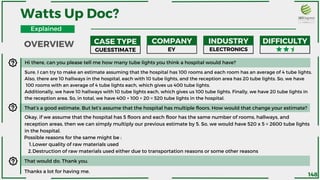
as per April 2023
(In percentages)
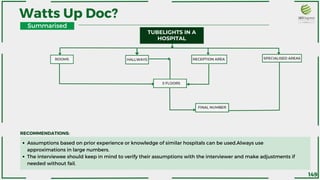
Key Drivers
COSTS
REVENUES
SHARE OF GROSS BANKING REVENUE
OF LEADING COMPAIES
SHARE OF BANKING COSTS OF
LEADING COMPAIES
Interest Income
(75%)
Fee Income (15%)
Interest Expense (45%)
Employee Costs (25%)
Regulatory Compliance
Costs (10%)
«
Industry Size
$110 billion in 2022 to grow at a CAGR
of 14.9%
Operating Profits $5.6Bn
Industry Characteristic Monopolistic Competition
Industry Terminologies
Regulatory compliance
Credit Quality
Risk Management
Industry Metrics
202
«
«
PACKAGED FOOD
PRODUCTS (35%)
BEVERAGES(25%)
DAIRY PRODUCTS(15%)
BAKERY (8%)
MEAT & POULTRY(10%)
CONFECTIONERY (7%)
Processing
Packaging
ITC NESTLE INDIA HUL BRITANNIA ADANI WILMAR OTHERS
30
20
10
0
Industry Size $535 bn in 2023 to grow at a CAGR of 15.2%
Operating Profits 9%
Industry
Characteristic
Fruit and Vegetable- Perfect
Dairy, Meat and Poultry - Oligopoly
Packaged Food and Beverage-
Monopolistic
Industry
Terminologies
Hazard Analysis and Critical Control Point
Shelf life
Inputs
Distribution
Retail
Consumption
FOOD PROCESSING INDUSTRY
Market Share
Value Chain Key Drivers
Industry Metrics Market Trends
REVENUES COSTS
Market Share of Key Players
SHARE OF FOOD PROCESSING COSTS
OF LEADING COMPANIES
SHARE OF GROSS FOOD PROCESSING
REVENUE OF LEADING COMPAIES
Plant Based Food: Growing demand driven by concerns over health, sustainability & animal welfare.
Functional Food: Probiotic yogurt, fortified cereal & omega-3 eggs offers health benefits beyond nutrition.
Sustainable Packaging: Investing in recycling infrastructure and waste management systems.
Opportunities in Innovation according to Consumer Behavior.
Supply Chain Disruption due to the Labour shortage
Increased Focus on Hygiene and Safety
National Food Processing Policy: 2017, promote investment & create employment opportunities.
100% FDI in Food Processing: Easier for foreign cos' investment attracting foreign capital & technology.
Mega Food Parks: Provides financial assistance to set up food parks having state-of-the-art facilities.
Pradhan Mantri Kisan Sampada Yojana (PMKSY): Financial assistance for infrastructure development,
setting up of cold chains, and other related activities.
A. Emerging Trends:
B. Covid Impact:
C. Government Policy Change:
«
RAW MATERIALS (40%)
LABOUR (20%)
ENERGY (15%)
MARKETING &
ADVERTISING (8%)
PACKAGING (10%)
TRANSPORTING &
LOGISTICS (5%)
OTHER OVERHEADS (2%)
as perApril 2023
203
Palo Alto Juniper Networks Quick Heal Norton Lifelock IBM India
20%
15%
10%
5%
0%
Market Share of Key Players
as perApril 2023
«
Hardware and Software Development
Marketing and Sales
Industry Size
$ 1.5 billion in 2022 to grow at a CAGR of
17.05%
Operating Profits 1.45%
Industry
Characteristic
Oligopoly
Industry
Terminologies
Threat Intelligence
Penetration Testing
Identity and Access Management
Research and Development
Online Retailing
Logistics and Delivery
Payment and Financial Services
CYBERSECURITY INDUSTRY
Market Share
Value Chain
Industry Metrics Market Trends
REVENUES COSTS
SHARE OF CYBERSECURITY COSTS
SHARE OF GROSS
FCYBERSECURITY REVENUE OF
LEADING COMPAIES
Rise of Cloud Computing: Businesses looking for ways to save money and improve efficiency.
Increasing use of mobile devices: Developing new strategies to protect the data stored in mobile devices.
Growing threat of cyberwarfare: Devising strategies to protect critical infrastructure and government systems.
Increase in cyber attacks targeting remote workers and healthcare organizations
Higher demand for cloud-based security solutions and virtual private networks (VPNs).
Increased investment in cybersecurity measures to protect digital assets and prevent data breaches.
Digital Personal Data Protection Bill, 2022: Aims to regulate the processing of personal data of
individuals in India.
Cyber Swachhta Kendra: Launched in 2017 provides free antivirus and malware removal tools to
citizens and organizations.
A. Emerging Trends:
B. COVID Impact:
C. Government Policy Change:
(In percentages)
«
Security Services (35%)
Security Software(25%)
Identify & Access
Management (10%)
Others (20%)
Risk & Compliance
Management (10%)
Personnel Costs (35%)
Technology &
Infrastructure Costs (25%)
Training & Education (5%)
Compliance & Regulatory
Costs (10%)
Others (15%)
Other Costs- Insurance,
legal & Consulting fees(10%)
Key Drivers
204
«
Manufacturing
Distribution and Logistics
M
A
X
H
E
A
L
T
H
C
A
R
E
A
P
O
L
L
O
H
O
S
P
I
T
A
L
S
F
O
R
T
I
S
H
E
A
L
T
H
C
A
R
E
A
D
I
T
Y
A
B
I
R
L
A
H
E
A
L
T
H
N
A
R
A
Y
A
N
A
H
E
A
L
T
H
15%
10%
5%
0%
Industry Size
$280 billion in 2022 to grow at a CAGR
of 19.2%
Operating Profits 8.6%
Industry Characteristic Mixture of Oligopoly and Monopolistic
Industry
Terminologies
Electronic Health Records
Value Based Healthcare
Health Information Exchange
Healthcare Providers
HEALTHCARE INDUSTRY
Research and Development
Market Share
Value Chain Key Drivers
Industry Metrics Market Trends
REVENUES COSTS
Patients
Market Share of Key Players
SHARE OF HEALTHCARE COSTS
SHARE OF GROSS HEALTHCARE
REVENUE OF LEADING COMPAIES
Internet of Medical Things: Used to connect healthcare info tech through inter-connected medical devices
Blockchain Technology: Distributed ledger technology facilitates the secure transfer of patient's
medical records,
Telemedicine and patient monitoring: Distribution of services and info via electronic information and
telecommunication technologies..
Increase in demand for healthcare services, especially in terms of testing, treatment, and vaccination.
Financial Strain on Healthcare Providers leads to a shortage of resources.
With social distancing norms, there has been a significant increase in the adoption of telemedicine in India.
Ayushman Bharat Digital Mission: Aims to create a unified digital health infrastructure for India.
Expansion of PMJAY: Free coverage for secondary and tertiary care to over 100 million poor families.
Introduction of the Health and Wellness Centers (HWCs): New type of primary care facility
established in rural and underserved areas.
A. Emerging Trends:
B. COVID Impact:
C. Government Policy Change:
(In percentages)
as per April 2023
«
Inpatient & Outpatient
Care (40%)
Pharmaceutical Sales (25%)
Health Insurance (10%)
Medical Equipment &
Supplies (15%)
Telemedicine (5%)
Clinical Research (3%)
Home Healthcare (2%)
Labor Costs (50%)
Medical supplies &
Equipment (20%)
Facilities Costs (15%)
Insurance & Legal Costs (5%)
Research &
Development Costs (3%)
Technology Costs (5%)
Regulatory Compliance
Costs (2%)
205
«
Midstream(aerospace manufacturing,
design and engineering)
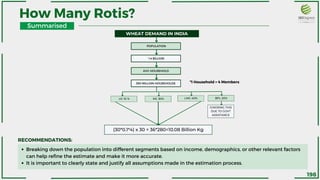
HAL TASL MAL LTAL DRAL
50%
40%
30%
20%
10%
0%
Industry Size $14.6 bn to grow at a CAGR of 8.33%
Operating Profits 10.8%
Regulators
Directorate General of Civil Aviation
(DGCA),
Ministry of Civil Aviation
Industry
Terminologies
Thrust
Mach Number
Aerostructures
Downward(airline operations,
maintenance and repair.and other
services)

AEROSPACE INDUSTRY
Upstream(composites, metals and
electronics)
Market Share
Value Chain Key Drivers
Industry Metrics Market Trends
REVENUES COSTS
Market Share of Key Players
SHARE OF AEROSPACE COSTS
SHARE OF GROSS AEROSPACE
REVENUE OF LEADING COMPAIES
Sustainability: Increased demand for sustainable aviation fuels and electric aircraft.
Additive Manufacturing (AM): It is being used to create lightweight, complex parts for aircraft.
Artificial intelligence: Extensively being used for maintenance, repair, and overhaul (MRO), flight
operations, and manufacturing.
Decreased demand for air travel and reduced orders for new aircrafts
Supply chain disruptions and delays in manufacturing and deliveries
Increased focus on defence and military contracts
Increasing the FDI limit in defence manufacturing from 49% to 74%.
Allowing 100% FDI in non-defence aerospace activities.
Launching of the "Make in India" initiative for the aerospace sector.
A. Emerging Trends:
B. COVID Impact:
B. Government Policy Changes:
(In percentages)
as per April 2023
«
Commercial Aviation (75%)
Defense Military
Contracts (15%)
Satellite & Space
Technology (10%)
R&D Expenses (15%)
Manufacturing Costs (55%)
Marketing & Advertising
Expenses (7.5%)
Distribution & Logistics
Costs (15%)
Regulatory Compliance
Costs (7.5%)
206
«
Network Infrastructure Providers
RELIANCE JIO BHARATI AIRTEL VI BSNL MTNL
40%
30%
20%
10%
0%
Industry Size $172 bn in 2023 to grow at a CAGR of 10.5%
Operating Profits 12.5%
Industry
Characteristic
Oligopoly
Rapid Technological innovation
Industry
Terminologies
Average Revenue Per User
Churn Rate
Broadband Penetration
Telecommunication Service Provider
TELECOM INDUSTRY
Equipment Manufacturers
Market Share
Value Chain Key Drivers
Industry Metrics Market Trends
REVENUES COSTS
Value Added Service Provider
End-Users
Market Share of Key Players
SHARE OF TELECOM COSTS
SHARE OF GROSS TELECOM
REVENUE OF LEADING COMPAIES
5G Technology: Promises faster internet speeds, lower latency, and greater reliability.
Internet of Things (loT): Hikes in demand for IoT services such as remote monitoring and automation
which provides infrastructure for IoT devices to communicate through cloud
Cloud Services: Allowing customers to store, process, and access data from anywhere in the world.
Adoption of digital technologies, such as video conferencing and e-commerce
Increased demand for high-speed internet and mobile data
Disrupted supply chains, leading to delays in the rollout of new technology such as 5G services.
Spectrum Auctions: Governments auction off spectrum to telecom companies to enable the rollout of
5G technology.
Net Neutrality: Treating all internet traffic equally, w/o discriminating against certain websites or services
Data Privacy: Govts give consumers more control over their data and require companies to be more
transparent about how they collect and use data.
A. Emerging Trends:
B. COVID Impact:
C. Government Policy Change:
«
Mobile Services(40%)
Fixed Line Services (15%)
Equipment Services (10%)
Enterprise Services (20%)
Roaming & International
Services (5%)
Value Added Services (5%)
Network Infrastructure(30%)
Spectrum Acquisition (25%)
Marketing &
Advertising (15%)
Customer Service (10%)
Equipment & Device
Subsidies (10%)
Others (10%)
(In percentages)
as per April 2023
207
«
Transportation and Accommodations
MAKEMY TRIP YATRA GOIBIBO CLEARTRIP OYO ROOMS OHERS
40%
30%
20%
10%
0%
Industry Size
$18.91 billion in 2023 to grow at a CAGR
of 13.47%
Operating Profits 5%
Industry Characteristic
Highly Fragmented
Oligopoly
Industry
Terminologies
RevPAR
Average Daily Rate
Average Room Rate
Tourist Activities and Experiences
TOURISM INDUSTRY
Travel Planning and Research
Market Share
Value Chain Key Drivers
Industry Metrics Market Trends
REVENUES COSTS
Hospitality and Tourism Services
Tourism Destination Management
Market Share of Key Players
SHARE OF TOURISM COSTS
SHARE OF GROSS TOURISM
REVENUE OF LEADING COMPAIES
Sustainable tourism: Travelers seeking Eco-friendly and socially responsible tourism experiences.
Digital technology: The use of social media, and online reviews influence the plans of travellers.
Experiential Travel: Authentic and immersive experiences that allow travellers to connect with
local cultures and communities.
Adoption of digital technologies offering contactless services.
Shift in travel preferences from international travel to domestic and regional destinations.
Prioritizing destinations and businesses that can provide a safe and hygienic travel experience.
Focus on Sustainability: Introducing policies and initiatives such as National Strategy for
Sustainable Tourism aimed at promoting environmentally responsible travel.
Economic development strategy: Investing in infra and marketing campaigns attracting tourists.
Quarantine & Travel restrictions: Still imposed in some countries to prevent the spread of the COVID-19
A. Emerging Trends:
B. COVID Impact:
C. Government Policy Change:
as per April 2023
«
Accommodation (25%)
Transportation (20%)
Attraction & Activities (15%)
Food & Beverages (20%)
Events & Conferences (10%)
Shopping (5%)
Labor Costs (30%)
Real Estate Costs (20%)
Marketing &
Advertising (15%)
Operating Costs (15%)
Insurance & Legal
Costs (10%)
Others (10%)
(In percentages)
208
TATA STEEL JSW STEEL STEEL SAIL RINL
75%
50%
25%
0%
Industry Size
$120 billion in 2022 to grow at CAGR
of 6.7%
Operating Profits 11.85%
Regulators
Ministry of Steel
Steel Authority of India
Industry
Terminologies
Black Furnace
Rolling Mill
Midstream (carbon
steel industry)
Downward (screw,
nuts, molds)
IRON AND STEEL INDUSTRY
Upstream (steel billets
and stainless steel)
Market Share
Value Chain Key Drivers
Industry Metrics Market Trends
REVENUES COSTS
Market Share of Key Players
SHARE OF COSTS OF LEADING
IRON AND STEEL COMPANIES
SHARE OF GROSS IRON AND STEEL
REVENUE OF LEADING COMPAIES
Construction Sector: Boost in demand for steel in the coming years. due to increased investment in infra
Manufacturing Sector: An increase in disposable incomes and urbanization, is expected to boost the
demand for steel
Environmental regulations: GoI Introducing stricter environmental regulations increasing the CoP.
Global crude steel production fell by 1.4% in the first three months of 2020
Declared essential industry in several countries and allowed to function
One of the largest consumers of steel that is automobile industry had been curtailed
Production-linked incentive (PLI) scheme: Financial assistance to steel producers who meet certain
production targets.
Use of recycled steel: Financial incentives for their use in construction and other applications.
Improving environmental performance: Promoting the use of cleaner technologies and improving
energy efficiency.
A. Emerging Trends
B. COVID Impact:
C. Government Policy Changes:
as per April 2023
(In percentages)
«
Flat Products (40%)
Long Products (30%)
Steel Wires (5%)
Steel Pipes & Tubes (15%)
Other Steel Products (10%)
«
Raw Material Costs (50%)
Energy Costs (15%)
Maintenance & Repair
Costs (15%)
Labor Costs (15%)
Other Costs- Logistics,
transportation & taxes (10%)
209
IOCL BPCL HPCL ONGC RIL
40%
30%
20%
10%
0%
Industry Size $341.65 Billion to grow at a CAGR of 4.3%
Operating Profits 0.27%
Regulators
Petroleum and natural gas regulatory
board
Federal energy regulatory commission
Industry
Terminologies
Fracking
Barrel
Appraisal Well
Midstream (transportation
and storage)
Downward (refining
and retail markets)
OIL AND GAS INDUSTRY
Upstream (exploration and
production)
Market Share
Value Chain Key Drivers
Industry Metrics Market Trends
REVENUES COSTS
Market Share of Key Players
SHARE OF OIL AND GAS COSTS
OF LEADING COMPANIES
SHARE OF GROSS OIL AND GAS
REVENUE OF LEADING COMPAIES
Technological advancements: 3D and 4D seismic imaging, horizontal drilling, and hydraulic fracturing.
Big Data & Analytics: Help the industry’s data analysts draw insights from production and
performance data
Accelerated transition: Govts increasingly looking towards the use of renewable energy sources.
Contraction of Demand: As businesses closed & people preferred staying at home; decline in demand.
Financial Stress: Negative impact on new & ongoing capex programmes and financial standing of the cos.
Production-linked incentive (PLI) scheme: Financial assistance to oil and gas producers who meet
certain production targets.
Boosting domestic production: Auction of new exploration blocks, the development of new
infrastructure, and the provision of fiscal incentives to o&g companies.
Security of supply chain: Diversifying the sources of imports and increasing the storage capacity of o&g..
A. Emerging Trends
B. COVID Impact:
C. Government Policy Changes:
as per April 2023
(In percentages)
«
Upstream Operations (45%)
Downstream
Operations (45%)
Midstream Operations (10%)
«
Upstream Operations (60%)
Downstream
Operations (25%)
Midstream Operations (15%)
210
M
A
R
U
T
I
S
U
Z
U
K
I
H
Y
U
N
D
A
I
M
O
T
O
R
S
M
&
M
H
O
N
D
A
50%
40%
30%
20%
10%
0%
Industry Size
$222 billion in 2023 to grow at a CAGR
of 7-8%
Operating Profits 5.5-7%
Industry Characteristic Oligopoly
Industry Terminologies
Assembly Line
Powertrain
Platform
Raw Material
Factory
Distribution
Dealership
« «
Electric and Hybrid vehicles: Shift due to better designs, improved battery capacity & cost savings.
Shared mobility: Carpooling, ride-hailing, and bike-sharing are becoming increasingly popular
Connected & Autonomous Driving Technologies: Advances in this space have made driving safer,
more efficient, and more convenient.
Significant disruptions to the supply chain
Reduced demand due to travel restrictions
New product launches witnessed delays due to nationwide lockdowns.
Electric Mobility Mission Plan 2020: Aims at promoting hybrid and electric vehicles
National Automotive Policy: Envisions the growth of the auto industry as per the AMP Goals 2026.
Bharat Stage Emission Standards: Instituted by the GoI to regulate the output of air pollutants from
compression ignition.
A. Emerging trends
B. COVID Impact
C. Government policy changes
AUTOMOBILE INDUSTRY
Market Share
Value Chain Key Drivers
Industry Metrics Market Trends
COSTS
Market Share of Key Players
Supplier
REVENUES
Customer
as per April 2023
(In percentages)
SHARE OF AUTOMOBILE COSTS
OF LEADING COMPANIES
SHARE OF GROSS AUTOMOBILE
REVENUE OF LEADING COMPAIES
Vehicle Sales (75%)
After-Sales Services (15%)
Finance & Insurance (10%)
Material Costs (40%)
Labor Costs (30%)
Marketing & Advertising
Costs (10%)
R&D Costs (20%)
Regulatory Compliance
Costs (10%)
Overhead Costs (15%)
211
R
e
l
i
a
n
c
e
F
u
t
u
r
e
A
v
e
n
u
e
A
d
i
t
y
a
B
i
r
l
a
S
h
o
p
p
e
r
s
S
t
o
p
O
t
h
e
r
s
40%
30%
20%
10%
0%
Industry Size $148.32 bn in 2023 to grow at a CAGR of 10.3%
Operating Profits
Organized retail- 4-6%, Unorganized retail-
20-25%
Industry Characteristic Highly Fragmented
Industry Terminologies
Same-store Sales
Inventory Turnover
Gross Margin
Transportation Planning Operations-
Printing
Finishing Outbound Logistics- Warehousing
Order Fulfillment
Technology &
Infrastructure (15%)
Marketing &
Advertising (10%)
Rise of e-commerce- Increasing availability of broadband internet, the growing use of smartphones,
and the increasing affordability of online shopping.
Growth of social media- To connect with customers, promote products and services, and drive sales.
Growth of omnichannel retail- Integrating online and offline channels to create a seamless
shopping experience for customers.
Reduced foot traffic- People have been hesitant to go out and shop due to the risk of infection.
Supply chain disruptions- Difficult for retailers to get the products they need.
Increased costs- Cost of cleaning and disinfecting stores, and the cost of providing personal
protective equipment for employees.
Rationalization of GST rates- To boost demand and investment.
Promoting ease of doing business- To make it easier for retailers to operate and grow their businesses.
A. Emerging Trends
B. COVID Impact
C. Government Policy Changes
RETAIL INDUSTRY
Market Share
Value Chain Key Drivers
Industry Metrics Market Trends
COSTS
Market Share of Key Players
Inbound Logistics- Inventory Control REVENUES
Distribution Marketing and Sales-
Partnership, Advertising and Promotion
as per April 2023
(In percentages)
Customer
Retention (40%)
Customer
Acquisition(35%)
Product
Innovation (25%)
Labor Costs (30%)
Inventory
Management (20%)
Real Estate
Costs (15%)
Regulatory &
Compliance Costs (5%)
Supply Chain Costs (5%)
SHARE OF COSTS OF LEADING
RETAIL COMPANIES
SHARE OF GROSS REVENUE OF
LEADING RETAIL COMPAIES
212
I
n
t
e
l
S
a
m
s
u
n
g
F
o
u
n
d
r
i
e
s
T
e
x
a
s
I
n
s
t
r
u
m
e
n
t
s
S
T
M
i
c
r
o
e
l
e
c
t
r
o
n
i
c
s
O
t
h
e
r
s
40%
30%
20%
10%
0%
Industry Size $450 billion growing at a CAGR of 8%
Operating Profits 23%
Industry Characteristic
High competition and rivalry among key
players
Industry Terminologies
Wafer
Foundry
Yield
« «
Overheads (15%)
Other (5%)
Internet of Things (loT): It will offer a myriad of opportunities to the semiconductor companies.
Growth of the domestic market: Driven by the government's Make in India initiative
Increased focus on design and innovation: Driven by the availability of government support & increased
availability of skilled talent.
Significant disruptions to global supply chains: Affecting the availability of raw materials, components,
and equipment needed for semiconductor manufacturing.
Labor shortages and production shutdowns: Due to lockdowns and social distancing measures,
affecting the production capacity of semiconductor companies
Accelerated the shift to online learning and working: Increase in demand for semiconductors.
Establishment of a semiconductor research and development center: To be funded by the government
and will be located in Bengaluru, Karnataka.
Creation of a semiconductor manufacturing ecosystem: Development of a supply chain for
semiconductors, as well as the training of engineers and technicians.
A. Emerging trends
B. COVID Impacts
C. Government Policy Changes:
SEMICONDUCTOR INDUSTRY
Market Share
Value Chain Key Drivers
Industry Metrics Market Trends
COSTS
Market Share of Key Players
Semiconductor design
Testing
Wafer fabrication
REVENUES
Assembly and Packaging
Distribution Marketing and Sales
as per April 2023
(In percentages)
Consumer Electronics (33%)
Industrial (20%)
Communication (15%)
Data Center (18%)
Automotive (8%)
Other (6%)
Material Costs (40%)
Labor Costs (20%)
Equipment (20%)
SHARE OF COSTS OF LEADING
SEMICONDUCTOR COMPANIES
SHARE OF GROSS REVENUE OF LEADING
SEMICONDUCTOR COMPAIES
213
««
Manufacturing and Production
Distribution and Logistics
HUL NESTLE P&G BRITANNIA DABUR GODREJ OTHERS
50%
40%
30%
20%
10%
0%
Industry Size
$110 billion in 2022 to grow at a CAGR
of 14.9%
Operating Profits 10%
Industry Characteristic Monopolistic
Industry Terminologies
Stock Keeping Unit
Supply Chain Management
Brand Equity
FMCG INDUSTRY
Raw materials and
packaging procurement
Market Share
Value Chain Key Drivers
Industry Metrics Market Trends
REVENUES COSTS
Marketing and Sales
Consumer Engagement and
After-sales service
Market Share of Key Players
SHARE OF FMCG COSTS
OF LEADING COMPANIES
SHARE OF GROSS FMCG
REVENUE OF LEADING COMPAIES
E-commerce and digitalization: The rise of e-commerce platforms and online marketplaces
enhances the supply chain, marketing, and distribution strategies of companies.
Sustainability: Implementing sustainable packaging solutions, reducing waste, & using green energy.
Personalization: Offering customized products and services. for ex: Personalizes nutrition plans
based on customer's DNA or health goals.
Supply Chain Disruption
Changes in Consumer Behaviour
Shift towards E-Commerce
Trade Policies: Changes in trade policies impacting the import and export of FMCG products..
Tax Policies: Changes in tax policies impacting the cost of prod. & distribution.
Regulatory policies: Changes in regulatory policies impact marketing and distribution.
A. Emerging Trends:
C. COVID Impact:
C. Government Policy Change:
«
Rural Market & Youth (35%)
Branded Products (25%)
E- Commerce
Platforms (20%)
Others (20%)
as per April 2023
(In percentages)
Raw Materials (40%)
Packaging (15%)
Advertising &
Promotions (15%)
Distributions &
Logistics(10%)
Labour (10%)
Research &
Development (5%)
Energy & Utilities (5%)
214
AWS Azure Google (GCP) IBM Oracle OTHERS
40
30
20
10
0
Industry Size $5.96 bn in 2023, growing at a CAGR of 23.1%
Operating Profits $31.4 billion in 2020
Industry Characteristic Oligopoly
Industry Terminologies
Infrastructure as a Service (IaaS)
Platform as a Service (PaaS)
Software as a Service (SaaS)
«
SaaS- Software as a
Service (30%)
Multi-cloud adoption: Using multiple cloud providers for different workloads.
Edge computing: A distributed computing paradigm bringing computation and data storage closer
to the end user.
Artificial intelligence (AI): Used to automate a wide range of tasks in the cloud computing industry.
Increased demand due to remote working and online education
Accelerated investments from the public sector
Accelerated digital transformation
Data localization: In 2018, the Indian government implemented a policy requiring companies to
store all personal data of Indian citizens on servers located within the country.
Personal Data Protection Bill: In 2019, this bill proposes comprehensive data protection regulations
Promoting digital sovereignty: Launched in 2020, aims to establish Indian control over data
generated within the country.
A) Emerging Trends
B) COVID Impact
C) Government regulations
CLOUD COMPUTING INDUSTRY
Market Share
Value Chain Key Drivers
Industry Metrics Market Trends
COSTS
Market Share of Key Players
IT Infrastructure
Application Development
Facility
REVENUES
Systems Infrastructure Software
Application
Access
as per April 2023
(In percentages)
IaaS- Infrastructure as a
Service (35%)
Cloud Advertising (5%)
PaaS- Platform as a
Service (15%)
Other Cloud Services (10%)
Others (5%)
SHARE OF GROSS CLOUD COMPUTING
REVENUE OF LEADING COMPAIES
SHARE OF CLOUD COMPUTING
COSTS OF LEADING COMPAIES
IT/ITES (24%)
Manufacturing (19%)
Government (13%)
Communication
& Media (9%)
Telecom (8%)
E-Commerce (5%)
Others- Transport &
Logistics, Retail,
BFSI (22%)
215
Biocon Dr. Reddy Cipla Lupin Aurobindo Others
50
40
30
20
10
0
Industry Size $70 bn in 2022 to grow at a CAGR of 15%
Operating Profits 17.6%
Industry Characteristic Oligopoly
Industry Terminologies
Gene Editing
Biosimilars
Biologics
« «
Gene Editing and Gene Therapies: Addition of new genes to human cells and the precise
manipulation of the sequence of the human genome for disease management.
AI and Machine Learning: To develop autonomous robots that handle important agricultural tasks
Synthetic Biology: Concepts, approaches, and tools within biotechnology that enable the
modification or creation of biological organisms.
Increased Demand for Diagnostics and Vaccines
Supply Chain Disruptions and increased Regulatory Flexibility
Remote Working and Virtual Collaboration
Biotechnology Industry Partnership Program (BIPP): Provides funding support for joint research
projects between industry and academia.
National Biotechnology Development Strategy (NBDS)- outlines the government's vision and
roadmap for the biotechnology sector in India.
A. Emerging Trends:
B. COVID Impact:
C. Government policy changes :
BIOTECHNOLOGY INDUSTRY
Market Share
Value Chain Key Drivers
Industry Metrics Market Trends
COSTS
Market Share of Key Players
Research and Development
Manufacturing
Clinical Development
REVENUES
Regulatory Approval
Distribution and Marketing
Sales and Support
as per April 2023
(In percentages)
SHARE OF GROSS BIOTECHNOLOGY
REVENUE OF LEADING COMPAIES
SHARE OF BIOTECHNOLOGY
COSTS OF LEADING COMPAIES
Product Sales (59%)
Licensing & Royalties (15%)
Services (12%)
Research & Development
Funding (12%)
Others (4%)
Research & Development
Costs (36%)
Marketing & Sales
Costs (16%)
General & Administrative
Costs (15%)
Cost of Goods Sold (29%)
Other Costs (4%)
216
TCS Infosys Wipro HCL Tech Tech Mahindra
25%
20%
15%
10%
5%
0%
Industry Size $220 bn in 2023 to grow at a CAGR of 12%
Operating Profits 23.3%
Industry Characteristic Oligopoly
Industry Terminologies
Internet of Things (IoT)
Omni-Channel Retailing
Dropshipping
Buy Now Pay Later (BNPL) and Loyalty Programs
Sales within Metaverse and other Gaming Platforms
Video Marketing and Social Commerce/Influencer Marketing
Increased demand for online services such as e-commerce platforms, food delivery services, and
telemedicine due to constant lockdowns.
Supply Chain Disruptions: Leading to shortages of critical components, hardware, and software
Increased Demand for Contactless Delivery.
Consumer Protection Act: In 2019, GoI provided greater protection for consumers in e-commerce
transactions.
Draft E-Commerce Policy: Proposes measures such as data localization, consumer protection, and
promotion of domestic e-commerce players.
A) Emerging Trends
B) Covid Impact
C) Government policy change
Inbound Logistics- Inventory Control,
Transportation Planning
«
IT & E-COMMERCE INDUSTRY
Market Share
Value Chain Key Drivers
Industry Metrics Market Trends
COSTS
Market Share of Key Players
Outbound Logistics- Warehousing, Order
Fulfillment, Distribution
REVENUES
Operations- Printing, Finishing
Marketing and Sales- Advertising,
Partnership and Promotion
SHARE OF GROSS BIOTECHNOLOGY
REVENUE OF LEADING COMPAIES
SHARE OF BIOTECHNOLOGY
COSTS OF LEADING COMPAIES
E-Commerce
Sales (45%)
Software Products
& Services (30%)
IT Consulting &
Support Services (15%)
Digital Marketing &
Advertising (10%)
Vendors (45%)
Discounts (30%)
Marketing &
Promotions (12%)
Technology (8%)
Logistics (7%)
Warehousing (5%)
Others- Packaging
& Payment
Gateways (8%)
as per April 2023
(In percentages)
217
Generic drugs: The government is promoting the use of generic drugs through its Pradhan Mantri
Jan Aushadhi Yojana (PMJAY) scheme
Focus on innovation: In terms of new drug discovery & development and of new drug delivery
systems.
Increased focus on exports: As the domestic market is becoming saturated.
Increased demand for COVID-19 treatments and vaccines
Supply chain disruptions and shortages of raw materials and finished products
Delayed clinical trials and drug approvals due to restrictions and safety concerns
Eliminate sickle cell anaemia by 2047: Raising awareness of the disease, providing early
diagnosis and treatment
New program to promote research and innovation in pharmaceuticals including Drug discovery,
development, and manufacturing.
A) Emerging Trends
B) COVID Impact
C) Government Policy Changes
Market Share of Key Players
Sun Pharma Dr. Reddy Cipla Lupin Aurobindo
20
15
10
5
0
« «
PHARMACEUTICALS INDUSTRY
Market Share
Value Chain Key Drivers
Industry Metrics Market Trends
COSTS
Upstream(borrowers, deposits)
Downstream(payments, wealth
management, insurance)
REVENUES
Midstream(lending, investment, risk
management, credit rating)
as per April 2023
(In percentages) Prescription
Drugs (65%)
Generic Drugs (25%)
Consumer Health
Products(5%)
Over the Counter
Drugs (5%)
Manufacturing Costs (55%)
Marketing &
Advertising Costs (15%)
Distributions & Logistics
Costs (15%)
Research & Development
Costs (10%)
Regulatory Compliance
Costs (5%)
SHARE OF GROSS PHARMACEUTICAL
REVENUE OF LEADING COMPAIES
SHARE OF PHARMACEUTICAL
COSTS OF LEADING COMPAIES
Industry Size $130 bn in 2023 to grow at a CAGR of 12%
Operating Profits $ 15.81 billion
Industry Characteristic
High competition and rivalry among key
players
Industry Terminologies
Active Pharmaceutical Ingredient (API)
Pharmacokinetics (PK)
Good Manufacturing Practice (GMP)
218
«
«
Data Analysis
Nielsen India Ipsos Kantar IMRB Millward Brown Hansa Research
1,000
750
500
250
0
Industry Size $15 billion in 2023 to grow at a CAGR of 10.7%
Operating Profits INR 10,000 crore (estimated)
Industry
Characteristic
Oligopolistic Competition
Industry
Terminologies
Syndicated Research
Custom Research
Qualitative Research
« «
Report Preparation
AI and Machine Learning: Curbs the need for expensive data teams, enabling marketers and
business managers to directly implement insight-based improvements.
Focus on Customer Experience: Concentrating on how every interaction helps the customer
Mobile Research: Allows companies to collect fast, validated, rich insights directly from consumers.
Shift to Remote Research Methods
Increased Demand for Healthcare Research
Focus on Digital Transformation
100% FDI in the market research industry
Digital India initiative leading to more than effective data collection
Consumer Protection Act 2019 mandates consent from consumers for data collection
A. Emerging Trends:
B. COVID Impact:
C. Government Policy Change:
MARKET RESEARCH INDUSTRY
Data Collection
Market Players Key Drivers
Industry Metrics Market Trends
REVENUES COSTS
Presntation
Follow-up
Revenueof Key Players
(in million dollars)
SHARE OF LOGISTICS COSTS
OF LEADING COMPANIES
SHARE OF GROSS LOGISTICS
REVENUE OF LEADING COMPAIES
Full Service Research(66%)
Hybrid of Services (11%)
Strategic Insights
Consulting (9%)
Others (14%)
Quantitative Data
Collection Tools (2%)
Labor Costs (40%)
Data Collection (25%)
Overheads (10%)
Travel Expenses (5%)
Technology &
Software (10%)
Value Chain
Other Costs (10%)
as per April 2022
219
«
««
Underwriting
Distribution
LIC HDFC SBI ICICI Prudential Others
75%
50%
25%
0%
Industry Size 131 bn USD in 2023 to grow at CAGR: 17%
Operating Profits 2-3%
Industry Characteristic Oligopolistic Competition
Industry Terminologies
Loss Ratio
Combined Ratio
Reinsurance
« «
Insurtech: Disrupting traditional insurance business models by offering innovative products and services
Cybersecurity: Insurers are offering new products and services to their clients to protect themselves
against cyber attacks.
ESG Investing: Growing interest among investors in environmental, social, and governance (ESG)
investing and insurers incorporating ESG factors into their investment strategies
Increased demand for insurance products such as life and health insurance
Surge in business interruption claims, as companies seek compensation for losses during the COVID period.
Significant losses in insurers' investment portfolios.
FDI Policy: GoI has increased the FDI limit in the insurance sector from 49% to 74%.
IRDAI Regulations: Helps to improve the functioning of the insurance industry for instance: IRDAI
(Payment of Commission) Regulations, 2023 which give insurers more flexibility to manage their expenses.
A. Emerging Trends
B. COVID Impact:
C. Government Policies:
INSURANCE INDUSTRY
Product Development
Market Share Key Drivers
Industry Metrics Market Trends
REVENUES COSTS
Policy Administration
Reinsurance
Market Share of Key Players
(In percentages)
SHARE OF LOGISTICS COSTS
OF LEADING COMPANIES
SHARE OF GROSS LOGISTICS
REVENUE OF LEADING COMPAIES
Life Insurance (61%)
General
Insurance (39%)
Claims (55%)
Commissions (20%)
Administration(15%)
Investment
Expenses (10%)
Value Chain
as per April 2023
220
First Editions are always special. It was a great experience working with Ansh
and the whole 180 DC Team on the Casebook. The passion they displayed in
learning more about consulting and understanding the nuances of building a
Casebook was commendable.
Case Closed definitely serves as a strong testament to the growth that this
college and 180 DC SGGSCCs industries. Not only is it valuable for interviews, but
it is also essential for real-world problem-solving.
This Casebook is an excellent resource that covers a range of industries and
different types of problems. The solutions provided are well-structured and
accompanied by proper frameworks, making it easy for students to understand
and apply the concepts to their own problem-solving approach. Whether you
are a beginner or an advanced learner, this Casebook has something for
everyone. have seen over the years due to its students. The future only seems
brighter for both organisations.
I am glad to have played my role as a mentor for the same. With all that is yet to
come, upwards and onwards to the team!
(Inc. Junior Consultant,
Bain & Co.,
IIM Lucknow)
Testimonials
221
Yash Rathi
Testimonials
(Product Lead, Accenture, ISB,
NUS)
222
Case Closed provides a comprehensive and well-structured guide for students to prepare for case interviews,
covering topics such as problem-solving frameworks, industry analysis, and communication skills. The project
team has done an excellent job in ensuring that the content is practical, up-to-date, and easy to understand.
It is clear that the team behind this Casebook has put in a lot of effort and dedication to make this project a
success, and it is exciting to see how it has helped many students achieve their dream of working in top
consulting firms.
Overall, I would highly recommend Case Closed to any undergraduate student looking to succeed in case
interviews and land a career in consulting.
The case methodology is a great way to improve one's problem-solving skills, something that all recruiters are
seeking currently. It's a good idea to solve cases not only for interviews but in a broader sense to learn how to
structure your thoughts and think through to reach solutions.
This Casebook developed by SGGSCC is a great resource for any and all students working on learning how to
solve cases well. They have covered a range of industries and different types of problems in a very easy-to-
understand manner. Very well-structured solutions provided with proper frameworks! I would recommend all
students include this resource in their prep journey.
(Summer Associate, Bain & Co.,
ex BCG, IIM Bangalore)
Priyank Ahuja
Sanya Monga
Testimonials
(Senior Analyst, Mckinsey & Co.)
223
The first edition is always special and requires a lot of hard work. The team has done an exceptional job in
creating a comprehensive resource for all the students aspiring for consulting. The case studies provided are
well-researched and cover a wide range of industries, which can help anyone to broaden their perspective on
different business problems.
(Inc. Junior Consultant, Bain &
Co., IIM Kozhikode, CA)
Bandana Kochhar
Mayank Jain
I had the privilege of serving as a mentor for the maiden edition of the college’s Casebook, and it was an
incredibly rewarding experience. This Casebook presents a great opportunity for students interested in
pursuing a career in Consulting to hone their problem-solving and top-down communication skills by solving
complex, real-world business problems.
As a mentor, I was particularly impressed by the level of commitment and enthusiasm demonstrated by the
authors. The cases have been well-crafted with a view to giving a flavour of how Consulting works. As
Consultants, we oftentimes resort to the principles laid out in the casebook.
Going forward, I would expect this Casebook to serve as a phenomenal resource for students to hone their skills
and crack case interviews. Kudos to the team for pulling this together.
Note to Reader
Dear Reader,
We sincerely hope you have had a steep learning curve after going through “Case Closed”. We are sure that the valuable
collection of case studies, guesstimates and industry analysis will help you in cracking consulting interviews. The book
will help you develop your problem-solving skills and enhance your understanding of various business and
management concepts.
Each framework is thoroughly explained, and subsequent case transcripts are presented in a structured format, which
includes a problem statement & a detailed solution along with flowcharts & recommendations for summarisation of the
approach used in solving the case. Please note that the solutions to these case studies and guesstimates are not
necessarily definitive, and there may be multiple ways to approach and solve each problem. Therefore, we encourage
you to think creatively and outside the box when going through the Casebook.
We hope this Casebook proves to be an invaluable resource for you in your consulting career. If you have any feedback or
questions, please feel free to contact us at 180 Degrees Consulting SGGSCC. You can reach us via email at
sggscc@180dc.org We wish you all the best for your career. Happy learning!
Sincerely,
Team - “Case Closed”
180 Degrees Consulting, SGGSCC
224
225
Meet The Team
From Left to Right: Raj Chhabra, Adammya Kulshrestha, Chanpreet Singh Gujral, Khushal Madan, Vibhat Chabra, Vibhav Anand
Naman Sehgal, Shubham Raj, Gobindbir Singh Baveja, Brahmjyot Singh, Ansh Bajaj, Dr. Jatinder Bir Singh (Principal), Prof. (Dr.)
Kawal Gill (Convener), Vidhi Gaur (President), Harnoor Kochhar, Ishika Singh, Rasmeet Kaur, Rashi Naudiyal, Vanya Taneja, Hargun
Kaur
226
PROJECT LEADS
Ansh Bajaj
Gobindbir Singh Baveja
Harnoor Kochhar
Shubham Raj
Adammya Kulshrestha
TECH CONSULTANTS
Chanpreet Singh Gujral
Hargun Kaur
Rasmeet Kaur
Ishika Singh
Meet The Team
PROJECT CONSULTANTS
Khushal Madan
Naman Sehgal
Vibhav Anand
Brahmjyot Singh
Raj Chhabra
Vanya Taneja
Rashi Naudiyal
Vibhat Chabra

180DCSGGSCC_CaseClosed (1)-combined_organized-v2-finalised.pdf

  • 2.
    © 2023 by180 Degrees Consulting - Sri Guru Gobind Singh College of Commerce All Rights Reserved. The Casebook is for personal use and educational purposes only. The team's permission is required before reproducing or transmitting any part of this publication in any form, including electronic, recording, or photocopying. It is strictly prohibited to sell or use this Casebook for monetary gains. First Edition: May 2023 Disclaimer I
  • 3.
    Acknowledgements We are gratefulto thank our contributors whose precious experiences allowed us to complete this project. We would like to thank our mentors Yash Rathi, Bandana Kochhar, Priyank Ahuja, Sanya Monga and Mayank Jain for guiding us throughout this endeavour. Their advice, method, and insights have helped us create a thorough resource for college students hoping to work in the field of Consulting. We would like to thank Ansh Bajaj, Gobindbir Singh Baveja and Harnoor Kochhar for directly leading this initiative. We would also like to thank our team of consultants who were meticulously involved in making this a success. A special thanks to The Consulting And Strategy Club, IIM Lucknow for guiding us throughout. Their encouragement and words of strength have been essential to our achievement. We would like to thank Vidhi Gaur (President), Pavni Arora (Vice President) and Anjan Banga (Secretary) for their continuous support and guidance. Furthermore, this wouldn’t have been possible without the extended support of our directors and senior consultants. We would also like to express our heartfelt gratitude to our convener Prof. (Dr.) Kawal Gill for generously letting us work on the first edition of Case Closed. Lastly, we’d like to express our gratitude to Sri Guru Gobind Singh College of Commerce for their unwavering support and guidance in the making of this Casebook. We are deeply sorry if we have missed mentioning any of you who have embarked on this creative endeavour with us. II
  • 4.
    10,00,000 Lives Impacted 150+ Consultants Trained 45+ Deliverables 21 ProjectsCompleted Rwenzori Community Development Network About 180 DC SGGSCC 21 projects completed, 150+ consultants trained, 45+ deliverables completed, 10,00,000 lives impacted. Founded in 2019, we, at 180 DC SGGSCC, offer a broad range of consulting services, including strategic planning, financial management, communications, and social impact analysis. We are known for our regional expertise, connections to the non-profit and development sectors, as well as an impact-driven and socially conscious student body. Some of our past clients include: Muskurahat Foundation Pestalozzi World SKF Desklamp Niveda Foundation III
  • 5.
    About Case Closed CaseClosed is a comprehensive collection of case studies and guesstimates based on real-life problems and analysis. It has been compiled by reaching out to consultants and analysts in the top consulting firms of the world, who have generously shared their insights and experiences. Each case study is presented in a structured format, which includes a problem statement, a framework for analysis, flowcharts, brownie points, and an approach used in solving the case. In addition to the case studies and guesstimates, the Casebook also includes an industry analysis section that provides an overview of various industries, their trends, and key players. This Casebook Is an invaluable resource for students and professionals interested in consulting and business analysis. The case studies will provide a hands-on learning experience and help develop critical thinking and problem-solving skills. The guesstimates will help candidates prepare for the quantitative reasoning tests used by top consulting firms, while the industry analysis will provide insights into the latest trends and developments in various industries. IV
  • 6.
    I am pleasedto introduce, “Case Closed”, the First edition of the consulting casebook curated by 180DC SGGSCC. This casebook is a valuable resource for all of our students, and it has been carefully created to provide students with real-world case studies that corporates ask for in consulting interviews. As you walk through this Casebook, I encourage students to approach each case with an open mind and a willingness to learn. These cases are designed to challenge them and help them to develop the critical thinking skills essential for their success in interviews with corporates and get a taste of how the consulting world functions. I hope that students will find this Casebook a useful tool in their consulting journey and I look forward to the insights and ideas they will generate after developing an analytical perspective. I congratulate the team, 180 DC SGGSCC that has worked tirelessly to develop this Casebook. Principal's Note Dr. Jatinder Bir Singh (Principal, Sri Guru Gobind Singh College of Commerce.) V
  • 7.
    Convener's Note I amthrilled by the launch of our upcoming casebook, ‘Case Closed.’ This Casebook has been designed to give students an in- depth understanding of the consulting world and facilitate an experiential learning process. Case Closed is a compilation of well-structured frameworks, 50+ interview transcripts and a comprehensive analysis of 20+ industries that aims to make students well-versed in the selection process. I hope that this Casebook will be resourceful and will help students to sharpen their critical thinking and enhance their problem-solving and communication skills essential to success in consulting. Prof. (Dr.) Kawal Gill (Department of Commerce) VI
  • 8.
    Meet Our Contributors ArihantJain (Inc. Senior Associate, BCG) (CSC, IIM Lucknow) Bhavyaa Kukreti (Inc. Junior Consultant, Bain & Co.) (CSC, IIM Lucknow) Arpita Agarwal (Inc. Analyst, Bain & Co.) Chekshu Puri (Junior Analyst, BCG) Aseem Jain (Associate, BCG) Debjit Dutta (Inc. Senior Associate, BCG) (CSC, IIM Lucknow) Aseem Oberoi (Research Associate, BCG) VII
  • 9.
    Dimple Agarwal (Aud. &Assurance Assistant, Deloitte) Irsheen Baveja (Consulting Associate, Accenture) Divyangi Singh (Analyst, Dalberg) Jagriti Gambhir (Summer Associate, BCG) Erica Gulati (Inc. Junior Associate, McKinsey & Co.) (CSC, IIM Lucknow) Japsharan Singh Kohli (Inc. Associate Consultant, EXL) Harivansh Gahlot (Analyst, Bain & Co.) Meet Our Contributors VIII
  • 10.
    Lakshita Chadha (Analyst, EY) NipunChadha (Associate, Bain & Co.) Madhav S. Goel (IIM Lucknow) Paridhi Sharma (Inc. Analyst, L.E.K.) Mehak Surana (Summer Associate, L.E.K.) Parkhi Mohan (Inc. Senior Associate, BCG) (CSC, IIM Lucknow) Navneet Arora (Inc. Junior Associate, Bain & Co.) Meet Our Contributors IX
  • 11.
    Rajshree Chandel (Inc. SeniorAssociate, BCG) (CSC, IIM Lucknow) Shreya Aggarwal (Inc. Junior Associate, McKinsey & Co.) (CSC, IIM Lucknow) Ramya Srinivasan (Senior Analyst, L.E.K.) Sidhant Mathur (Associate, Strategy&) Rishu Goyal (Associate, Bain & Co.) Tanya Agarwal (Junior Associate, McKinsey & Co.) Satviek Goel (Junior Associate, McKinsey & Co.)  Meet Our Contributors X
  • 12.
    Vrinda Aggarwal (Associate, Bain& Co.) Meet Our Contributors XI Yash Rathi (Inc. Junior Consultant, Bain & Co.) (CSC, IIM Lucknow)
  • 13.
    S NO. 1. NAME PAGENO. How To Use Case Closed 1 S NO. NAME PAGE NO. I. PROFITABILITY 2-44 FRAMEWORKS 3-7 1. Bru-H 8 2. The Juicy Case 13 3. Life Gave You Lemons, Do Something 18 4. Khan's Going Down 21 5. Freezing Profits 24 6. Bloodywood 27 7. Bill My Pipe 31 8. Piggybacking My Way 36 9. Hook The Fish 40 S NO. NAME PAGE NO. II. MARKET ENTRY 45-78 FRAMEWORKS 46-50 1. Bottle It Up 51 2. Break Into Water 55 3. Crystal Water 59 4. Vroom Into India 66 5. The Great Ink-Scape 71 6. Home Sweet Home 75 III. MARKET GROWTH 79-101 FRAMEWORKS 80-81 1. How To Drive...Sales 82 2. Timber Takes Tokyo 85 3. Paint The Town Red 88 4. Mo Stores, Mo Problems 93 Table Of Contents 5 Touch Down 98 XII
  • 14.
    S NO. NAMEPAGE NO. IV. MARKET SIZING 102-117 FRAMEWORKS 103-105 106 110 1. Ice Cold Analysis 2. Tea-riffic Tales 3. Streamin' Riches 113 V. UNCONVENTIONAL 118-142 FRAMEWORKS 119-120 121 123 125 128 130 133 1. Fight The Power 2. The Glittery Misery 3. @Asset 4. WHATsthatAPP 5. On The Rocks 6. Who Is Not Working? 7. See Them In The Court 138 S NO. NAME PAGE NO. VI. GUESSTMATES 143-202 FRAMEWORKS 144-147 1. Watts Up Doc? 148 2. Red Hawk 150 3. Traffic Tally 153 4. Aapki Apni Dukan 157 5. Dressing The Numbers 159 6. Screening The Screens 162 7. The Mystic Lipstic 166 8. Drive To Survive 171 9. Sky Is The Limit 174 10. Flop At The Box Office 178 11. How Many Boffins? 182 Table Of Contents XIII
  • 15.
    S NO. NAMEPAGE NO. 12. Chill-O-Meter 187 13. Every Drop Counts 191 14. How Many Rotis? 195 VII. INDUSTRY ANALYSIS 200-220 1. Fintech Industry 200 2. Logistics Industry 201 3. Banking Industry 202 4. Food Processing Industry 203 5. Cybersecurity Industry 204 6 Healthcare Industry 205 7. Aerospace Industry 206 8. Telecom Industry 207 9. Tourism Industry 208 10. Iron and Steel Industry 209 S NO. NAME PAGE NO. 11. Oil and Gas Industry 210 12. Automobile Industry 211 13. Retail Industry 212 14. Semiconductor Industry 213 15. FMCG Industry 214 16. Cloud Computing Industry 215 17. Biotechnology Industry 216 18. IT & E-Commerce Industry 217 19. Pharmaceutical Industry 218 20. Market Research Industry 219 21. Insurance Industry 220 22. TESTIMONIALS 221-223 23. NOTE TO READER 224 24. MEET OUR TEAM 225-226 Table Of Contents XIV
  • 16.
    How to UseCase Closed MAKE A CASE GROUP In order to prepare for case interviews, candidates are recommended to form their own case groups, ideally with not more than 4 people in the group. Do not make the mistake of reading the cases in the book on your own. Instead, solve cases in pairs. One person usually takes on the role of the ‘interviewer’ and the other, the ‘interviewee’. Only the interviewer must go through the case to understand the problem. After this, the ‘interviewer’ gives the case to the ‘interviewee’ who makes an attempt to solve the case. Other members of the case group can also be a part of the process by observing the interview. Finally, the members can discuss the case and give their individual insights. The interviewee’s solution can be compared to the one in the book to analyze things which could have been approached differently. Form a case group of not more than 4 people. Once the group is formed, then the roles of interviewer and interviewee can be decided and a role play can be done with the third member as an observer if needed. Now, we can proceed further. Considering consulting is a collective activity, therefore the need for a Case Group becomes paramount. CORRECTIVE ACTION It's crucial to have an environment where constructive feedback is valued if you want to enhance your case-solving abilities. Remain receptive to feedback from your peers and seek guidance from a senior who has undergone the same process if you need any clarifications. Make sure you incorporate the feedback going forward and read the overall recommendations as provided. 1
  • 17.
  • 18.
    PROFITABILITY FRAMEWORK Profitability casesare a type of business case commonly encountered in consulting interviews. These cases typically involve a company that is not making as much money as it should be and the interviewer generally asks the candidate to identify the root cause of the problem and provide recommendations to improve profitability. Here is a framework to approach profitability cases, along with some preliminary clarifying questions you should ask the interviewer. What is the company’s industry? What is the company’s revenue and profit margin? What is the company’s current growth rate? What is the company’s current market share? What is the company’s current pricing strategy? What are the company’s major costs? PRELIMINARY CLARIFYING QUESTIONS: IDENTIFY THE PROBLEM ANALYSE REVENUE ANALYSE COSTS ANALYSE COMPETITION ANALYSE THE MARKET IDENTIFY RECOMMENDATIONS QUANTIFY THE IMPACT APPROACH 3
  • 19.
    IDENTIFY THE PROBLEM Thefirst step in approaching a profitability case is to identify the problem that the company is facing. The problem may be due to several reasons such as declining revenues, increasing costs, decreasing market share, or a combination of these factors. PROFITS REVENUE COST VARIABLE COST NO. OF UNITS SOLD PRODUCTION VOLUME SOLD FIXED COST COST PER UNIT DEMAND DISTRIBUTION PRICE PER UNIT 4 FRAMEWORK TO APPROACH
  • 20.
    ANALYSE REVENUE ANALYSE COSTS Afteranalysing the revenue, you should analyse the company’s costs. You should try to understand the major cost drivers, the cost structure, and any recent changes in the costs. You should also look for any potential opportunities to reduce costs. Production can be analysed by looking at factors such as the production capacity and number of manufacturing units. Distribution can be affected by factors such as the number of distributors and the mode of distribution adopted by the client and benchmarking it with competitors. Demand can be affected by factors such as the price of products sold, number of products sold, footfall, etc. The next step is to analyse the company’s revenue. You should try to understand the sources of revenue, the pricing strategy, and any recent changes in the pricing. You should also look for any potential opportunities to increase revenue. Revenue side can be affected by production, distribution and demand Essentially, it is advisable to not restrict yourself to one framework. 5
  • 21.
    ANALYSE COMPETITION You shouldalso analyse the company’s competition. You should try to understand the major competitors, their market share, their pricing strategy, and any recent changes in their strategy. You should also look for any potential opportunities to gain market share. Fixed costs include factors such as land, machinery, building, marketing, etc. Variable costs include factors such as marketing, storage, etc. To analyse the cost side of the problem, we can draw a process map or divide costs into fixed and variable costs. Cost per unit can be divided into fixed and variable costs, depending on the industry. ANALYSE THE MARKET You should analyse the market in which the company operates. You should try to understand the market size, growth rate, and any recent changes in the market. You should also look for any potential opportunities to expand the market. 6
  • 22.
    IDENTIFY RECOMMENDATIONS QUANTIFY THEIMPACT Finally, you should quantify the impact of your recommendations on the company’s profitability. You should try to estimate the potential increase in revenue, decrease in costs, and increase in market share. You should also identify any potential risks or challenges associated with your recommendations. Based on your analysis, you should identify recommendations to improve the company’s profitability. Your recommendations could include changes to the pricing strategy, cost reduction measures, market expansion strategies, or a combination of these factors. In summary, to approach profitability cases in a consulting interview, you should first identify the problem, analyse revenue, costs, competition, and the market, identify recommendations, and quantify the impact. Before starting the case, you should also ask preliminary clarifying questions to ensure you have a clear understanding of the company’s situation. 7
  • 23.
    Hey, I’ve takenthree interviews since this morning and it has been pretty exhausting. Ma’am, coffee always helps. and since we are in CyberHub, there is no better place out there to get a cup. You're right. Alright, let’s start with the case interview. So, there is a coffee supplier but their profits are declining. This supplier is your client. How would you solve the problem? Right, so I would like to ask if there’s an issue on the revenue side or on the cost side. Our revenues are absolutely fine, however, there is an issue with the costs. Okay, I would also like to know about our market share & market size. I don’t think that it is relevant to the case. You can ask me any other questions, if required. So, since we are already an established brand, are there any issues with our research and development? Do we need to invest more? No, we’re not looking to expand any further or create anything new. OVERVIEW Bru-h CASE TYPE COMPANY INDUSTRY DIFFICULTY PROFITABILITY DELOITTE BEVERAGE 8 Explained
  • 24.
    Is our rawmaterial accessibility or supply chain being hampered in any other way and is it in any way related to the global tensions persisting in the present period? That’s a good point but that is not the issue because all our raw material is sourced domestically. Okay, I’ll try to be precise, as per the information received, Is there any increase in transportation, warehousing, production, sales & customer service costs?. We have a chart depicting the changes in these costs- Mumbai Bengaluru Delhi 2022 2023 15 10 5 0 2022 2023 Customer Service Sales Marketing Transportation 40 30 20 10 0 Financial Years Cost in Different Sectors Cost of Transportation ( in ₹Cr) 9
  • 25.
    Are we seeinga further increase in cost due to these distributors? No, we are just facing an increase in transportation costs because sometimes, we have to travel double routes due to which our bottles are breaking. I believe the transportation quality is not good. Can I get to know how the bottles are actually kept inside the truck during the transportation? Normally, our trucks are padded with foam or else there are crates. We package the jars in boxes which are loaded in the trucks and usually, these are covered with cellophanes. Ma’am, is there any issue with the roads in the transportation route? Yes, actually the roads to XYZ city are highways that were constructed a long time ago. These have not been fixed since. Also, the route is a pretty narrow one so there are chances of accidents too. I think I have identified the problem here. Is there anything else I should know about the company? No, I think we have figured out the problem. Let’s figure out a solution to this. We are using trucks to transport the products to the main cities and the further distribution is carried on by distributors. Ma’am, are we facing any transportation issues in Bangalore city? Yes, we are facing high transportation costs in Bangalore city. What is the mode of transportation? Are we using trucks, trains or any other modes? 10
  • 26.
    I think theseare some viable long-term solutions to this issue: 1) We could do a one time collaboration with the government to solve the issue of the bad roads. This would help us in transportation as well as it would improve our brand image. 2) We could also shift our factory to a place where transportation is more efficient to us. I have also thought of some short-term solutions to this problem: 1) We can improve the quality of the crates that we transport the jars in. We can design it in a way such that the jars are individually separated. 2) But before that, I believe that we should look into a better glass material for our jars. It would improve the durability of the jar as well as add to the quality of our product. 3) We could train the drivers to drive in a less erratic way on these bad roads. 4) We could also look into individually wrapping the jars in a foam or bubble wrap but we should first look into which is more cost efficient. Those are some excellent suggestions. I think we can close the case now. 11
  • 27.
    Bru-h Summarised OFFICE SUPPLIER REVENUE COSTS WARE-HOUSINGMARKETING TRANSPORTATION DECLINING PROFITS CUSTOMER SERVICCE DELHI MUMBAI BANGALORE NO SIGNIFICANT INCREASE IN COST NO SIGNIFICANT INCREASE IN COST SIGNIFICANT INCREASE IN COST BAD ROADS AND DOUBLE ROUTES SHORT-TERM SOLUTIONS LONG-TERM SOLUTIONS Break down the problem into smaller components to better understand it. Consider all possible factors that could impact the situation. Communicate your thought process clearly and effectively to the interviewer. RECOMMENDATIONS: 12
  • 28.
    Your client isan apple juice manufacturer whose profits are declining , find out the reasons behind the decline and give recommendations. Can I ask a few questions about the company to clarify as I move ahead to solve the case? Yes sure, feel free to ask as many questions as you like . Thank you. So to start with, I would like to know how much the profit has declined and what has been the time frame for the same. The profit has declined by 15% over the last one year. What all geographies does the manufacturing company operates in ? The company operates all over India. What are the consumer segments that the manufacturing company targets? Could I know a bit more about the product portfolio of the company? The company mainly targets the upper middle class and the upper class. The company use to sell orange juices earlier but now it switched to apple juices. OVERVIEW The Juicy Case CASE TYPE COMPANY INDUSTRY DIFFICULTY PROFITABILITY BCG MANUFACTURING 13 Explained
  • 29.
    Why did thecompany switch from orange juices to apple juices? The company conducted some market research and found out that apple juices would be more profitable. Alright, and what all functions of the value chain do the company participate in? The company is involved in manufacturing and distribution. Okay, is this issue industry-wide? Are all apple juice manufacturers facing the decline in profits? Or is the issue company specific? The decline in profits is not an industry-wide issue and is only faced by this specific manufacturer. Okay, so the profits are declining , the issue may be caused due to the revenue and costs. Is there any specific area with which you would like me to proceed with the case? How would you break down the revenue? The revenue here would depend on three things that are the number of units, the average price per unit and the product mix. If there has been any change in any of these it would affect the revenue and thereby the profits of the company. Alright great, there was no change in any of the things you mentioned, and the revenues are fine. Okay, so maybe the issue is due to the cost. 14
  • 30.
    The revenue herewould depend on three things that are the number of units, the average price per unit and the product mix. If there has been any change in any of these it would affect the revenue and thereby the profits of the company. Alright great, there was no change in any of the things you mentioned, and the revenues are fine. Okay, so maybe the issue is due to the cost. Can you categorize the costs, how would you break them down? Sure, so the costs here would include - procurement costs, inbound logistics costs, inventory costs, processing costs, outbound logistics costs, warehousing costs and marketing costs. Procurement costs would include the types, quantity and price of raw materials. Inbound logistics costs = (the number of rounds made by the vehicle X the distance per round X the amount of fuel per kilometre X the amount per litre). Inventory costs would depend upon the kind of inventory held, the number of inventory parts and the cost of carrying the inventory. Processing costs here would include machine and labour costs. Outbound logistics costs here would be very similar to inbound logistics costs, and warehousing costs would be very similar to inventory costs. There may be various factors causing a shift in these costs which may lead to a change in overall costs thereby declining the profits of the company. 15
  • 31.
    Great. The rawmaterial costs are rising, apples are now more expensive than oranges, so we can not switch back to making orange juices. What would be your recommendations? Firstly the company could try to switch to suppliers who are closer to their facilities so that the distance is reduced. Secondly, the company could try to negotiate and enter into a better and long term deal with the suppliers. Finally the company could try to backward integrate or own a greater part of the supply chain and plantations etc. Great job! That is all for the case. Thank you, and have a nice day! 16
  • 32.
    The Juicy Case Summarised PROFITS REVENUECOSTS WARE-HOUSING MARKETING OUTBOUND LOGISTICS PROCESSING INVENTORY INBOUND LOGISTICS PROCUREMENT (SIMILAR TO INVENTORY COST) (SAME AS INBOUND LOGISTICS) MACHINE AND LABOUR COSTS KIND OF INVENTORY NUMBER OF INVENTORY PARTS COST OF CARRYING INVENTORY NUMBER OF ROUNDS MADE BY VEHICLE X DISTANCE PER ROUND X AMOUNT OF FUEL PER KM X AMOUNT PER LITER QUANTITY PRICE OF RAW MATERIAL The candidate delved well into the possible reasons behind the change in various costs and further the profits of the manufacturing company by approaching each cost systematically. RECOMMENDATION 17
  • 33.
    OVERVIEW Life Gave YouLemons, Do Something CASE TYPE COMPANY INDUSTRY DIFFICULTY Hey, let’s begin with a quick case. Your client is a person who owns a lemonade stand outside your college. His revenue has been declining in the last 6 months. How would you help him? Sounds interesting, to proceed further, I would like to continue further by asking a few questions. PROFITABILITY Go on. Firstly, what are we discussing pre covid or post covid time? Secondly, which season are we taking into consideration while further discussing this case? We are considering it to post covid time and the summer season. Okay, I believe we are good to go. So, I would like to proceed with breaking down the process from both the consumer and producer point of view. Cool, start decoding from the consumer's point of view. Has the client faced a decline in the number of customers? Is there any competitor in the vicinity of the client? Is there any other alternative beverage option available that can act as a substitute for the customers? So, I would like to ask a few questions: 1. 2. 3. L.E.K. BEVERAGE 18 Explained
  • 34.
    No, there isn’tany significant decline in the number of customers of your client. No other person set up a lemonade stall in the vicinity of the college which could act as a competitor. Nor is there any other substitute available such that the customers might have changed their minds and gone for the substitute. All the information that you have provided me with suggests that there isn’t any way in which the consumer side would have been the reason behind the decline in revenue. I’ll then have to change my way of approach and think of it with the producer side. You’re on the right path, keep moving. Increase in price of raw materials Increase in inputs used. Shortened shelf life of the inputs used. Purchases of new carts or glasses Purchasing new squeezers to squeeze the lemons. Yes so, considering the producer side, the possible issues which may be a reason behind the decline in revenues are: 1. 2. 3. 4. 5. From the above-listed problems, the shortened shelf life of raw materials seems legitimate keeping in mind your client. Lower quality of raw materials used Destruction of raw materials used either due to transportation reasons or some other reasons Possible reasons for the same might be: 1. 2. Well, the reason behind the shortening of the shelf life of raw materials is a construction site nearby. It is situated nearby and has destroyed raw materials and hence decrease revenue. You got it, we may rest the case now. 19
  • 35.
    Summarised Always structure youranswer. Always pause to clarify. Life Gave you Lemons, Do Something PROFITABILITY REVENUE COSTS INCREASE IN INPUTS SHORT SHELF LIFE PURCHASE OF NEW EQUIPMENT INCREASE IN RAW MATERIALS' COST ALTERNATIVES AVAILABLE COMPETITION IN VARIETY DECLINE IN CUSTOMERS DECLINING REVENUE CONSUMER'S POV PRODUCER'S POV DESTRCTION OF RAW MATERIALS LOWER QUALITY RAW MATERAILS RECOMMENDATIONS: 20
  • 36.
    21 PVR is yourclient and currently, it’s facing profitability issues. It cannot further increase prices, but the costs involved in the operations are stable as of now. What will be your approach to solve this problem? Khan’s Going Down BCG ENTERTAINMENT Okay, to start with the solution we can break down the problem into two aspects- Total Revenue and Total Cost. That’s good but you need not calculate the total cost as it has already been mentioned that the costs are stable. Understood, I will be continuing with the first approach. Considering the fact that we cannot change the prices of tickets only way to solve the profitability issue is by increasing the number of tickets sold. But before coming down to the solution aspect I would like to first understand the origin of the problem. In the past year, has there been a consistent decline in the number of tickets sold? Yes, the number of tickets sold has been slowly decreasing every month. Okay, is the same problem being faced by other competitors in the cinema industry, such as Cinepolis or INOX as well? Explained OVERVIEW CASE TYPE COMPANY INDUSTRY DIFFICULTY PROFITABILITY No, in fact, their total sales have instead increased by some margin.
  • 37.
    Interesting, we cantherefore rule out that this is an industry-wide problem. From the above statements we can also understand that consumers prefer to go to INOX or Cinepolis instead of PVR. The most logical reason behind this is that the quality of the service and the theatre condition is not up to the mark and that’s why people prefer its competitors over PVR. That is correct. You have identified the problem. What would be your approach to solving this issue? Firstly, PVR can renovate the theatre, and make sure that the standards of screening and seating are equivalent to that of its competitors. Secondly, it can provide certain discount options for food. For example, if a consumer is purchasing a recliner ticket, then they will get their food and drinks at a cheaper rate as compared to others. This way we can increase the number of tickets sold and also induce more people to purchase the gold standard tickets instead of the silver ticket, whilst keeping the cost at a similar level. Another initiative that PVR can take is to add arcade games to its main waiting area. This way customers who are waiting for their movies can keep themselves entertained. Not only can this be a differentiating factor but in the long term it can lead to better profits as some customers might come in earlier and spend more time inside the theatre. Lastly, we can also make contracts with each and every production house so that all the newly-released movies are being screened. That’s perfect. No need to go any further, we can conclude the case. 22
  • 38.
    Summarised Khan's Going Down Explorenew revenue streams, such as alternative programming, partnerships with local businesses, or private event rentals. Review the cinema's pricing and revenue strategies, including ticket prices, concessions, and advertising revenue. Identify areas where pricing could be adjusted or revenue streams could be increased to improve profitability. RECOMMENDATIONS: 23 PROFITABILITY ISSUES REVENUE COSTS PROBLEMS NO. OF TICKETS SOLD / MONTH IS DECREASING CUSTOMERS PREFER TO GO TO OTHER CINEPLEXES QUALITY OF THE SERVICE IS NOT UPTO THE MARK SOLUTIONS RENOVATION OF THEATRES DISCOUNT OPTION ON FOODS ENTERTAINMENT OPTIONS AT THE WAITING AREA STABLE
  • 39.
    I would liketo begin by understanding more about the client. (asked preliminary questions about the base of operations, the product mix, the value chain, the current market position, and the functioning of the industry) Please give me some time to formulate my thoughts. The decline in profits can be an outcome of either an increase in costs or a decline in revenues or both, should I start from any of these parts? There is neither a decline in revenues nor an increase in costs. Okay, understood. Please allow me a minute to gather my thoughts. I would want to understand the profit margins across the types of refrigerators that the client has and the market demand for the same. Also, how do they compare with the industry’s trend? Your client is a refrigerator manufacturer, who is recently facing a decline in their profits. Sure, please go ahead. Explained OVERVIEW Freezing Profits CASE TYPE COMPANY INDUSTRY DIFFICULTY PROFITABILITY BAIN & CO. TECHNOLOGY 24
  • 40.
    The client hashigher margins on double-door refrigerators, but they currently constitute 20% of our portfolio. For our competitors, about 40% of their sales come from double-door refrigerators. We can try to optimize our product portfolio so as to maximize our profit margins. Thank you, you have solved the case. 25
  • 41.
    PROFITS REVENUE COST Freezing Profits Whenconsidering a solution, it's important to analyze the client's product portfolio and compare it to industry trends to identify potential areas for optimization. Clarifying questions can play a huge role. RECOMMENDATION: 26 Summarised HIGHER ON DOUBLE- DOOR REFRIGERATORS MARGINS INDUSTRY TREND 40% OF PORTFOLIO OPTIMISE PORTFOLIO (PRODUCT) MAXIMISE PROFIT MARGINS CURRENT 20% OF PORTFOLIO
  • 42.
    Your client isa movie theatre owner and is facing a decline in his revenues. You need to calculate his revenue as well as state the possible reasons behind the decline in revenue. That’s interesting! I’d like to get a better understanding of the problem. Are we taking into consideration the pre or post covid time? Also, I would like to ask if the decline is in the whole industry or only specific to my client. Well, the time taken into consideration is post covid time, the decline in the revenue is industry-wide, but before deciding on the reasons behind it would like you to discuss the sources of revenue of a theatre. Ticket sales Money earned from parking Sales of Food and Beverages Money received from the production houses (screening fees) Okay, so the sources of revenue of a theatre owner are: 1. 2. 3. 4. Great, continue further to evaluate the revenue generated from ticket sales in a week. The price of tickets is 200 and 400. The seating in a single auditorium of that specific theatre is 100 and the number of auditoriums in that particular theatre is 5. OVERVIEW BloodyWood CASE TYPE COMPANY INDUSTRY DIFFICULTY PROFITABILITY L.E.K. ENTERTAINMENT 27 Explained
  • 43.
    Cool. So Iwill consider Monday, Tuesday, Wednesday, and Thursday to be non-peak days and Friday, Saturday, and Sunday as peak days. The total seating in the theatre is 500, and the average ticket price is 300 [(200 + 400)/ 2] As per my belief, during non-peak days, the theatre would occupy 50% occupancy and during peak days, it will occupy 80% occupancy. Number of tickets sold in non peak days = 50 * 500 / 100 = 250 * 4 = 1,000 Number of tickets sold in peak days = 80 * 500 / 100 = 400 * 3 = 1,200 Total tickets sold in a week for a show= 1,200 Revenue from ticket sales for a show = 1,200 * ₹300 = ₹3,60,000 Considering the average number of shows to be 5, the average sales would be = 3,60,000 * 5 = ₹18,00,000 Well, you have quite accurately decoded the revenue from ticket sales. Since the time we are considering is post covid, what could be the possible reasons for the same? As the time is post covid, the reason behind the fall would be a decline in ticket sales due to covid concerns. Also, just after the covid, the movies weren’t ready to be played at the theatres so that is also an issue. A lot of people have shifted to OTT platforms to watch movies, this is also a reason behind the decline in sales. A part of the revenue of theatre comes from production houses as well, as the production houses have chosen OTT platforms to air their movies, the have stopped paying the theatre broadcasting fees, this again is a reason for the decline in the revenues. Another reason for the same could be that the pockets of people have been pinched up as well as a decline in the popularity of movies, so people don’t prefer going to theatres now. 28
  • 44.
    Great, seems likeyou have covered all the possible reasons behind the decline in revenues. Now, suggest some ways to increase the revenues of this particular theatre. The theatres can run advertisements to make people aware of the safety measures the theatres have made. This way people can realize that the safety measures are in place and would prefer to come to theatres. Another suggestion is to play the shows of OTT exclusive content as that is more liked by people these days. New movies can pull people to the theatres, so the theatres can play shows of cult classic movies which were a big crowd puller. Theatres can also provide discounts to people showing up in groups, this way they can also start private screening for friends and families. So, the ways to increase revenues are: 1. 2. 3. 4. Great, we can wind this case up now. 29
  • 45.
    BloodyWood Summarised EVALUATE REVENUE TICKET SALES MONEY EARNED FROMPARKING SALES OF FOOD AND BEVERAGES SCREENING FEES PEAK DAYS (FRI, SAT, SUN) NON-PEAK DAYS TICKET SALE 80% OCCUPANCY (400 SHOWS PER DAY) 50% OCCUPANCY (200 SHOWS PER DAY) TOTAL TICKET SALES 6,000 400 * 3 * 5 250 * 4 * 5 AVERAGE REVENUE 6,000 * ₹300 = ₹18,00,000 PER WEEK Break down the problem into smaller components to better understand it. Consider all possible factors that could impact the situation. Communicate your thought process clearly and effectively to the interviewer. RECOMMENDATIONS: 30
  • 46.
    We are asteel pipe manufacturer, and we are working on a cost-transformation program and wish to reduce our cost by ₹150 Crores. 12 months. What is the time horizon within which we would like to reduce the cost? What is the product that we manufacture and whom do we cater to? Do we deal in separate product SKUs? Large steel pipe and we cater to B2B and large customers. We have different diameters and variants depending on the process. But let us have one SKU for now. What would be the location? Hanjar port. We can import raw material from China and export it to the neighboring countries. OVERVIEW Bill My Pipe CASE TYPE COMPANY INDUSTRY DIFFICULTY PROFITABILITY BAIN & CO. IRON AND STEEL 31 Explained
  • 47.
    ₹6000 Cr. Whatare the various costs that I incur? Yes, RM is my major cost, and it accounts for 60% of the overall cost. Raw Material (RM), production, distribution, marketing, and support. And considering the Heavy Goods Industry, most of the cost should come from Raw Material Purchase and Inbound Logistics. Given we are looking at reducing costs, what would our total current cost be? How much of that is Steel Pipes? Steel which we bend and make the rolls for our pipe is 95% of our raw material. Great, we can look at cost for Raw material in terms of the price/tonne*quantity. How would you look at the price? I will start looking at the procurement process currently and try to find potential optimization methods. We procure for the entire year in one shipment currently. As we might be saving on inventory costs, do we have any possibility to alter this? Inventory is not a problem. But we can break the total order into multiple orders. Efficiency and utilization are both issues. But if we have the liberty to order as many times as possible we like, what should be the number according to you? One, two, three, four or maybe even more? 32
  • 48.
    Sure. By doingthis, we can reduce the steel cost by 2%. Can you arrive at a number? Great. Should I order 80% in the first or 20% in the first? I would go with two as we can assess efficiency from the first order, order accordingly and save on transportation. Should be 80% as we would have safety margins. Moreover, reduced stock-out costs might disrupt the entire process. Sure. 60% of 6,000 would be the cost of raw material, which is 3600 and since we use 95% of RM for steel, the number comes to around 3,420. 2% of which is around ₹68 Cr. Great, are we able to reach the goal through this? No, let's wrap up the case. Thanks for your analysis. No, we are only able to reach less than 50% of the goal. Should I scope further for other means of optimization. 33
  • 49.
    COST REDUCTION STEEL PIPES (95%RM) INVENTORY COST VARIABLE FIXED RAW MATERIALS PRODUCTION SUPPORT DISTRIBUTION MARKETING OPTIMISATION METHODS INCREASE NO. OF ORDERS TO 2 ASSESS FIRST ORDER EFFICIENCY SAVE ON TRANSPORTATION EFFICIENCY UTILIISATION Bill My Pipe 34 Summarised
  • 50.
    2 ORDERS 80% QUANTITYIN FIRST ORDER 20% QUANTITY IN SECOND ORDER 2% COST REDUCTION HAVE SAFTEY MARGINS REDUCE STOCK OUT COSTS TOTAL COST (₹6,000 CR) RM - 60% TC (3600CR) STEEL- 95% RM (3420CR) 2% COST REDUCED (68CR) Keep it conversational and don't ignore the hints given by the interviewer. Go through as many previous year case interviews to get a good sense of the case types. RECOMMENDATIONS: 35
  • 51.
    Hi Parkhi, howare you doing? Introduced himself and told me about his practice areas. Briefly introduced myself. Smiled and mentioned we’ll directly be jumping into the case. Asked if I was ready, then gave the problem statement: Your client is a public sector bank who is facing a high ATM fee payout, they require your help. Explained that when customers of other banks withdraw money from our bank’s ATM we receive pay in fee. Similarly, the vice versa situation results in a payout fee. Re-iterated to confirm the problem statement. Mentioned that I’d be needing the interviewer’s input to fully understand the issue. Asked doubts regarding fee payout. Scoped further with CPCC to understand the quantum of the payout fee and since when we had been facing this issue. We have been facing this issue for the last 2-3 years, and the quantum of loss has been Rs. 200 Crores. Asked where all our ATMs are located, who our customers are and whether our competitors are also facing a similar issue. OVERVIEW Piggybacking My Way CASE TYPE COMPANY INDUSTRY DIFFICULTY PROFITABILITY BAIN & CO. D2H 36 Explained
  • 52.
    Mentioned that weoperate pan India with 30 licenses, don’t have a segmentation difference in our consumer base and with respect to competition it’s a zero-sum game:so, if we have a high payout fee, another competitor is benefitting with a high pay in fee. Sure, let’s start with the customers. What all could be the issues they are facing? Further broke the factors down into geographic locations of the ATMS: availability and time to reach, wait time, safety, ATM operational hours, convenience and ease of use experience. Having gathered the necessary information I asked for some time to structure the factors and broke them down into the number of customers, transactions per customer, frequency of transactions and ATMs present per customer. Explained that there is no issue with safety, then asked to explore the other factors. He mentioned that out bank currently has 10,000 ATMs and asked if they are enough? Mentioned that the 10,000 ATMs number stand alone is not enough to come to a satisfactory conclusion. Asked about our market share, and benchmark against competitors. Good. Assume there are 3 lakh ATMs in India, and our bank holds a 5% consumer base, beingthe 3rd largest bank in India. The largest bank holds 12% consumer base with 25,000 ATMs and 2nd largest bank holds 8% consumer base with 8,000 ATMs. Comparing with the top 1st and 2nd largest banks, the number of ATMs our bank has is at the benchmark level, however; considering there are 3 lakh ATMs in India: we should ideally operate around 15,000 ATMs in India to cater to the 5% consumer base and try to increase this number to receive a higher pay in fee. 37
  • 53.
    Yes, you arecorrect. We need to operationalize more ATMs across India to cater to our own customers and increase our pay-in fee. This is one issue we are facing. What could the other issues be? Asked to expand on cash availability and machine working condition. Mentioned that this was the second issue we were facing, as our re-fill rate was not up to the mark. Then he asked me to scope further to figure out the last issue. Traced the customer journey to confirm there were no issues in the need to withdraw cash, and no affordability concerns. ATM accessibility was an already discussed issue. Hence, we then moved to availability and customer experience. Discussed factors like operational hours, availability of cash, queue time, ATM machine working condition. Asked how frequently the cash was re-filled, especially in areas where consumer density was high, and if the frequency of refill and volume of cash filled was sufficient. Yes, you are going in the right direction. Why could the machine not be working? Focused on the ATM machine’s working conditions: hardware and software related issues. Broke hardware issue down to: machine not working, card reader broken, cash dispenser not rendering cash, and software issues into server side: client-side issues, internet issues, fund unavailability, language/software issues. Listed factors like functional issues with a new machine just installed, old machines that were broken, damaged machines due to improper usage, spoilage due to water/weather/external factors, lack of electricity to run the machine, etc. Yes, the third issue we are facing is that our ATMs located in rural areas don’t have adequate power supply hence many of our ATMs are non-operational. Thank you, Parkhi, for your time, it was a pleasure interacting with you. All the best! 38
  • 54.
    Piggybacking My Way CUSTOMERS TRANSACTIONS PERCUSTOMER FREQUENCY ATM HELP REGARDING HIGH ATM FEE PAYOUT NUMBER ATM's per Customer FREQUENCY EASE OF USE CONVENIENCE WAIT TIME SAFETY INCREASE TO 5% OF ATM'S TOTAL OR MORE INADEQUATE POWER SUPPY IN SOME AREAS Keep your interview as conversational as possible; ask wherever any process is unclear and keep calm. Also, believe in yourself, and try to smile. RECOMMENDATION: 39 Summarised
  • 55.
    Your client isa maker of nets and ropes that are used across the fishing, agriculture, and construction industries. They have been facing stagnant growth for the past few and we need to help them devise a strategy to achieve full potential. Let us focus on the fishing segment for this case. Current growth is in the range of 3-4% but their target is to grow at a rate of 15%. Could you tell me a little more about the firm? Where is it currently based out of and is fishing net sales the only source of revenue? FISHING (Re-iterated the problem statement). What is the current level of growth, and do we have a target in mind? The firm is based out of India and operates in the Indian market only. Yes, net sales are the only revenue source. Understood. What about the product? How many variants do we sell, and do we have a USP? We have multiple ranges and SKUs and are prices at a premium. Explained OVERVIEW CASE TYPE COMPANY INDUSTRY DIFFICULTY PROFITABILITY BAIN & CO. 40 Hook The Fish
  • 56.
    Could you tellme a little more about the Indian fishing net industry? How many players operate in the segment and what is our market share? Okay. In terms of the entire value chain of activities, I understand that we manufacture the nets, but are we also involved in distribution and sales? Who are our end customers? There are two sets of players: organized and unorganized. We are a market leader and hold 70% of the share. We sell the nets through our network of distributors and dealers to small and large-scale fishermen. I think I have gotten a fair understanding of the market. In order to push revenue, we can either increase our price or increase the sales volume or a mix of both. However, given we are already priced at a premium in a price conscious country like India, we might risk losing market share if we go ahead with that. I’ll focus on avenues through which we can increase the sales volume. In order to push sales, we can look at a combination of two factors: our product and the market we operate in. Do you want me to focus on any particular combination? Yes, that sounds like a good approach. Let’s look at exploring new markets first. Sure. We can explore new markets within the fishing industry such as inland fishing and shrimp farming in India. Further, we can enter new markets of neighboring coastal countries such as Sri Lanka, Bangladesh, Philippines, etc. through exports or country set-ups. 41
  • 57.
    We can increasevolume using our existing product range or come up with newer variants that have higher ductile strength, longevity, longer usability life or are made of cheaper material. On the contrary, given the rising concerns around sea pollution and damage to sea animals caused by discarded fishing nets we can come up with nets made of biodegradable or natural material. I would pick a South Asian neighboring country such as Sri Lanka which has a flourishing fishing industry with dynamics similar to that of India. Those are interesting suggestions. If we were to foray into exports, which country would you pick? Why not the U.S.? Multiple reasons such as: high export costs, no competitive advantage and high risk. Additionally, the U.S. fishing industry is organized and at an advanced stage wherein they use automated shipping vessels and higher quality nets. Makes sense. How would you estimate the market size of nets in Sri Lanka? Just give me a broad approach. I would start with the overall population of the country and then identify what percentage of the population resides in the coastal areas (I would use the country map and dimensions to come up with a rough estimate). Further, I would divide the working population into primary, secondary, and tertiary sector to then find the share of people employed in fishing. I would then group them to identify the number of boats in play and estimate the use life of the nets to calculate annual demand. 42
  • 58.
    That sounds likea fair approach. What about India? How would you push sales using the existing product and market? I would look at lowering the price to push volumes or discriminatory pricing for the unorganized market; further I would strengthen my sales channels by tying up with fishing associations and unions. I think it is an ambitious target to have. Given the fishing industry is also growing at a slow pace and no boom is expected, there are limited avenues through which we can push sales. However, we can look at the other industries: construction and agriculture as these seem more promising with the high investments in infrastructure and introduction of new farm laws. Further, we can explore new industries where nets and ropes could be used such as sports: cricket nets, football nets etc. Do you think the 15% target is achievable if we continue to operate domestically? 43
  • 59.
    Hook The Fish Summarised STAGNANTPRODUCTIVITY (GROWTH STRATEGY) PROFITS REVENUE COST SALES VOLUME SALES PRICE CURRENT MARKET NEW MARKETS INLAND FISHING/ SHRIMP FISHING NEIGHBORING COASTAL COUNTRIES THROUGH EXPORTS BIODEGRADABLE NETS EXISTING RANGE/ NEW VARIANTS SOUTH ASIAN COUNTRY (SRI LANKA) FLOURISHING FISHING INDUSTRY DYNAMICS SIMILAR TO INDIA Try to keep the interview as conversational as possible and try to use information given at the start of the case throughout the solving process. RECOMMENDATIONS: 44
  • 60.
  • 61.
    What is thecompany’s current product/service offering? What is the current market(s) the company operates in? What are the company’s growth goals for the next few years? Is the company considering entering a specific market, or are we exploring potential new markets? What is the timeline for entering the new market? What is the budget for entering the new market? What are the company’s existing capabilities and strengths that can be leveraged in entering the new market? What are the company’s long-term objectives for entering the new market? PRELIMINARY CLARIFYING QUESTIONS: MARKET ENTRY FRAMEWORK Solving market entry cases in a consulting interview involves a structured approach that follows a clear framework to identify the key factors to consider when entering a new market. Here is a step-by-step guide to solving market entry cases in a consulting interview: 46
  • 62.
    MARKET ENTRY MARKET ATTRACTIVENESS CUSTOMERS MARKET STRUCTURE REACTIONTO ENTRY SEGMENTS ADDRESSABLE MARKET GROWTH RATE PROFIT MARGIN PRODUCT, PRICE, PLACE, PROMOTION NO. OF COMPETITORS & MARKET SHARE SWOT ANALYSIS FINANCIAL CONSTRAINTS CAPABILITIES, RESOURCES SUPPLIERS GOVT. REGULATIONS PATENTS, IP COMPETITION BARRIERS TO ENTRY CLARIFYING THE OBJECTIVE What is the company’s current product/service offering? What is the current market(s) the company operates in? What are the company’s growth goals for the next few years? Is the company considering entering a specific market, or are we exploring potential new markets? Before beginning the analysis, it is essential to understand the objective of the case. Some market entry cases may focus on identifying potential new markets for a product or service, while others may explore the feasibility of entering a specific market. Ask the interviewer questions to clarify the case objective, such as: FRAMEWORK TO APPROACH 47
  • 63.
    DEFINING THE MARKET: ANALYSINGTHE MARKET What is the size of the market? Who are the major players in the market? What are the market growth rates? What are the market trends? Define the market that you are analysing. Depending on the case, this may involve identifying a new market for the company or assessing the feasibility of entering an existing market. Clarify the market definition with the interviewer, such as: Market demand: What is the potential demand for the product/service in the market? What is the target market’s size and growth potential? What are the trends and drivers of demand in the market? Competition: Who are the major players in the market? What is their market share? What are their strengths and weaknesses? What is the competitive landscape like? Once you have defined the market, analyse it in detail. This will involve researching and assessing the following factors: 48
  • 64.
    DEVELOPING A MARKETENTRY STRATEGY Regulatory environment: What are the regulatory requirements for entering the market? Are there any legal barriers to entry? Are there any restrictions on foreign investment? Supplier and distribution networks: Who are the key suppliers and distributors in the market? What are their strengths and weaknesses? How easy is it to secure reliable suppliers and distributors in the market? Operating costs and margins: What are the typical operating costs in the market? What are the margins for the product/service? How do they compare to other markets? Expected Profits: The following formula can be used to find out expected profits in the market- Expected Profits = (Market Size (in units) x % Market Share x Profit per Unit) - Fixed Costs Which market entry options are available, and what are their advantages and disadvantages? What are the potential risks and challenges of entering the market? What is the financial viability of entering the market? How can the company leverage its existing strengths and capabilities to enter the market successfully? Based on your analysis of the market, develop a market entry strategy that addresses the following questions: 49
  • 65.
    MARKET ENTRY PROFITABILITY OPERATIONAL FEASIBILITY RISKS ORBARRIERS ENTRY OPTION EXPECTED PROFITS MARKET SIZE PORTER'S 5 FORCES MARKET GROWTH RATE MARKET SHARE PESTEL ANALYSIS FRAMEWORK TO APPROACH 50
  • 66.
    Bottle It Up BeforeI dive into the case, can you help me understand a few things about the client? We can do a qualitative and quantitative analysis to decide which option is better in the long run. Do you want me to proceed with this approach? Your client is a glass bottle manufacturer in Germany. They manufacture bottles for juices & alcohol. The market is growing at a rapid pace and the client wants to expand its capacity. Three options are available setup plant in Germany, import goods from India, or import goods from China. What should the client do? Let’s take them up during the case. First start with things you will look at to come to the decision. OVERVIEW CASE TYPE COMPANY INDUSTRY DIFFICULTY MARKET ENTRY BCG MANUFACTURING Go ahead. Explained 51
  • 67.
    For the qualitativeside of things, I will look at two things: Micro Factors & Macro Factors involved. Under micro factors, I will look at Cost (Both initial one-time & landed cost per unit including transport & duties), Quality of bottle, Turnaround time, and Freedom (risk & independence). Under macro factors, I will look at the Legal aspect & country relations. Does this look comprehensive, or should I add more factors? Cost would be important. Looks good. What is the most important factor while deciding? Yes, for initial investment government is giving us some subsidy to set up so we will add a cost of USD 0.5 per bottle for those manufactured in Germany; others don’t have any initial cost. Let’s look at the cost per unit in detail. Sure, apart from the initial investment the per unit cost will have components of raw material, labor, transport, taxes & duties, utilities/overheads. Sure, material will be available in cheap in China & India; cheaper labor will be available in India; transportation cost of goods from China and India to Germany will be high while if manufactured in Germany the transport cost will be low. Can you tell me which country will have an advantage in each of the factors you just mentioned above? Yes, market expansion is what the CEO was thinking about. Let’s end the case here, all the best! 52
  • 68.
    EXPAND BUSINESS (GROWTH STRATEGY) QUALITATIVEANALYSIS QUANTITATIVE ANALYSIS MICRO FACTORS MACRO FACTORS COST QUALITY TAT FREEDOM LEGAL ASPECT COUNTRY RELATIONS GERMANY (3 USD) INDIA (2.5 USD) CHINA (2.2 USD) MINIMAL FIXED COST DIFFERENCE GOVERNMENT SUPPORT LOWER RISK BETTER QUALITY BETTER TAT AVOID 4-WEEK PRE - ORDER Summarised Bottle It Up 53
  • 69.
    Summarised Bottle it Up Listento the interviewer carefully as the interviewer tends to drop a lot of hints during the case. Be patient and calm before and in between the interviews. RECOMMENDATIONS: 54
  • 70.
    CASE TYPE COMPANYINDUSTRY DIFFICULTY Your client is a utensil manufacturer and has to come up with a new product that is used to purify hard water to make it drinkable. You are required to help them analyse the market for this product in India. Sure, I would like to begin by understanding what all products our client sells and in what geographies are they operating in. MARKET ENTRY L.E.K. BEVERAGE Your client sells kitchenware items including utensils, dishes, and crockery. They distribute all over India and are a reputable firm in the industry. Sure, is India the only market that we are going to consider while solving this case. Also, What is their main objective? Yes, the client is only present in India. The main objective is to introduce a new product in the market. Interesting. So, our client has experience in the Indian market. I would like to ask a few questions to better understand the product. What exactly is the functioning of the product? And does the product have any existing substitutes in the Indian market? Break Into Water OVERVIEW Explained 55
  • 71.
    Yes, you haveunderstood the product. Kindly continue. Pre-existing competition in the market. The new competition that can arise in the market. Substitutes of the product. Complimentary products that exist. Ways to market the product in such a way that we can sell our product. Okay so to continue I would like to focus on the following key points: 1. 2. 3. 4. 5. Our product is a sachet that is capable of turning hard water into drinkable water. Currently, in the Indian market there are a few players who are working on it, but only on a small scale capacity. Okay, that's good. As far as I understand the product, our client wants to introduce a sachet, which when mixed in hard water purifies the water and makes it drinkable. Go ahead. All these topics would be covered once we give a SWOT analysis of the product and the market. 56
  • 72.
    The brand hasa reputable image in the Indian market. The product market is comparatively new. This product is one of a kind and has potential to grow. The product serves to fulfil a need and are also helping to save the environment. In India, there are a lot of traditional alternatives available that serve the purpose of purifying hard water into drinkable water. For example - Potash alum Under the SWOT analysis, the case would be studied under 4 heads: Strength: Weakness: Perfect. That should be all. Lets close this case. The customers have a sense of trust and belief in the company. The product has a large market share. It has the potential to expand in the market and capture more share as it can be treated as a necessity. As soon as the company launches its product, other companies would try to copy their product, giving rise to competition in the future. There is a problem of people not trusting new products and regarding the claims that the company makes. Another problem that may arise would be the threat of less-known competitors. Opportunity: Threats: 57
  • 73.
    Take up to3-4 questions to clarify the product and then proceed to comment. Always use market analysis frameworks. Break Into Water Summarised MARKET ANALYSIS FOR PROPOSED PRODUCT EXISTING COMPETITION NEW COMPETITION SUBSTITUTES MARKETING AND SELLING COMPLEMENTARY PRODUCTS STRENGTHS WEAKNESSES OPPORTUNITIES THREATS Brand Image Innovative Product Lot of Traditional Alternatives Well Known Brand Large Market Share Product can be copies Distrust ad gimmick RECOMMENDATIONS: 58
  • 74.
    CASE TYPE COMPANYINDUSTRY DIFFICULTY Your client is a company called ABC Ltd. They have approached to help them out with launching a new product. Get started. What is the geography for the product? It is the USA. What is the product? The product is a water filtering sachet which when put in a glass of water filters it and turns it into pure water. What is their target for the first year? They just want to break even in the first year. It is a new business. They got funding from some sources and invested in research and development. Now, they would like to launch this product in the market. Is there any specific reason for this market? MARKET ENTRY BAIN & CO. BEVERAGE Crystal Water OVERVIEW Explained 59
  • 75.
    Sure, it couldbe. If you think that, please go ahead with providing a rationale. Inadequate infrastructure: India lacks proper infrastructure to provide safe drinking water to its population. There are still many areas in India where people have to walk miles to fetch water from a well or a water body. Poor quality of water: In many parts of India, the water quality is poor, and it contains a high level of contaminants such as arsenic, fluoride, and other harmful chemicals. This water, if consumed, can cause severe health problems. Water scarcity: India is a water-stressed country, and the availability of water is a significant concern. The increasing population and industrialization have led to overexploitation of water resources, leading to water scarcity in many regions. I feel the problem in India about safe drinking water is: 1. 2. 3. No specific reason, we just feel like it could be a good market. Do you think a developing country like India could be a potential market for the product? Those are some great points, you can move ahead with the Indian market. What is the price point of the product? The price is 4 cents (approx. ₹ 3). What is the procedure of using the product? 60
  • 76.
    Sure, it couldbe. If you think that, please go ahead with providing a rationale. I believe urban areas can be negated in this case because the company should target rural areas. Access to safe drinking water is less in rural areas. I think we should move ahead with the number of households that would require this product. No. of households in India = 280 million. Percentage of rural households in India = 70% No. of households in India = 70/100 X 280,000,000 = 196,000,000 No. of people in a household = 5 Number of people in rural areas = 196,000,000 X 5 = 980,000,000 Most people drink 2 to 2.5 litres per day. Therefore, the amount of water consumed in rural areas per day = 980,000,000 X 2.5 = 2,450,000,000 litres Average amount of water in a glass = 0.25 litres No. of glasses drank in a day = 2,450,000,000/0.25 = 9,800,000,000 So, the number of sachets that could be sold in a day is 9.8 billion. However, the potential market can only be calculated after analysing the competitors. The only competition I can think of right now is the filtered bottles that are sold in the market for a hefty price. However, these are not very commonly sold in the market. Would it be right if we take the assumption that the company will attain about 15 % of the market share in its first year? 61
  • 77.
    Yes, I believeit is a justifiable percentage. According to this assumption, the cost of sachets sold in a day at the cost of ₹ 5 per sachet would be: No. of sachets per day x Percent of Market Share x Price of one sachet = 9,800,000,000*15/ 100*5 = ₹ 7,35,00,00,000 Is it correct to assume that the operating cost could be around 1/3rd of the cost of the product? By that assumption, the operating cost per sachet would be ₹1 and the net profit would come out to be ₹1. What would be the net profit percentage per product? The net profit percentage would be 1/5 x 100 = 20% Therefore, I believe it would be beneficial for the company to sell its product in a developing market like India. Alright, to justify that suggestion,come up with a strategy for entering into the market. I believe it is a viable opinion. Yes sure, just one clarifying question, does our company have the supply chain capacity to fully cater to the demand of the product? Yes, our company has the supply chain capacity to deliver the product. 62
  • 78.
    That sounds perfect,the case is closed. If we have a robust supply chain system in place, I believe we can reach out to the Kirana stores in these rural places, give them a few incentives to promote the product and give them a few benefits to sell our product. Secondly, we can run educational campaigns to show the comparison between safe drinking water and normal tap water. Thirdly, we can create combo packages for families and for stipulated periods of time. 63
  • 79.
    Crystal Water Always askthe interviewer for the objective behind opting for a particular geography. Do not hesitate to ask the clarifying questions. MARKET SIZE MARKET SHARE TOTAL PROFITS LAUNCH OF NEW PRODUCT (Market Entry Strategy for Indian Markets) FINANCIAL FEASIBILITY PROFIT/UNIT FIXED COSTS RURAL OR URBAN RURAL - 70% 280M HOUSEHOLDS 15% ₹ 1 RURAL OR URBAN Summarised RECOMMENDATIONS: 64
  • 80.
    Crystal Water Always askthe interviewer for the objective behind opting for a particular geography. Do not hesitate to ask the clarifying questions. Summarised RECOMMENDATIONS: NO. OF HOUSEHOLDS = 280 MIL RURAL (70%) 196 MIL URBAN (30%) 5 * 196 MIL = 980 MIL *PEOPLE IN EACH HOUSEHOLD = 5 NO. OF SACHETS THAT COULD BE SOLD IN A DAY AMOUNT OF WATER CONSUMED AVERAGE SIZE OF A GLASS NO. OF GLASSES DRANK IN A DAY IN RURAL AREAS POPULATION AVERAGE WATER CONSUMED / DAY 980 2.5 L X 2,450,000,000L 0.25 L ÷ 9.8 BILLION 65
  • 81.
    BCG Hey there. Yourclient is a foreign automobile player based in Japan and is now planning to enter India. How will you go about it? Interesting! Firstly, I would like to ask some questions, if that’s okay. Absolutely. Okay. Does the company have prior experience in venturing into new markets? What is their product line? They have ventured into Europe before. They sell service passenger vehicles and commission vehicles. What is the USP? This company offers cheaper vehicles and is an EV-based player. What is the time frame the company wishes to adopt? Vrooom Into India MARKET ENTRY AUTOMOBILE OVERVIEW CASE TYPE COMPANY INDUSTRY DIFFICULTY The company is looking to expand in India in the next 1 year. What is their objective to expand in India? Explained 66
  • 82.
    To make profits. Iwould divide my approach into 3- Market Attractiveness- Here, we would ascertain if the company is profitable or not. Also, we would find the market share. Set Up- How exactly do we go about setting up the business Risks- It is important to be abreast with the risks our client can face in this endeavour Go ahead. We would have to undertake a Pestel analysis: To estimate the scope of this industry, we would have to take a guesstimate. Sir, would you like me to find the number of potential car owners in India and how much market share can our client capture? We take the population of India to be 1.4 billion. We also assume that every household has an average of 4 members, where 1.5 members per household know how to drive. Is it safe to assume so? You may. Yes, no problem. 67
  • 83.
    Thanks. Now, wedivide 1.4 billion/4 to get the number of families. We get 350 million families. Now, we divide these families according to their income status. We assume 20% of the population to be rich, 60% of the population to be middle class and the remaining 20% of the population to be lower middle class. So, we get 20% of 350 million which is 70 million families, 60% of 350 million which is 210 million families and 20% of families which is 70 million families. Now, we assume that only the rich and middle class can afford a car. Therefore, we get 210+70 = 280 million families who can afford a car. Makes sense. Have we done any forecasting as to what % of market share can we capture in the first year of business? No, you may make an assumption of your own Sir, considering the fact that our client offers cheaper EV vehicles, we would capture ¾ of the market share. Okay, go ahead. 2) Joint venture- partnering with Indian company backend pe vehicles, front end mein selling. 3) Export cars- Our client can directly export cars from Japan and sell them in the Indian market. Coming to the set-up, our client has three options to penetrate the Indian market: 1) Loan venture- capital investment, retail outlet 68
  • 84.
    These are dependentupon the following factors: 1) Control- full control of the supply chain 2) Risk- how much risk company is willing to take 3)Financial feasibility- financial strength of the company, how much investment you’re willing to make considering it’s a risky venture, about to enter a new country Sounds good. A few risks may also arise if our client ventures into India: 1) Legal compliances in India change very quickly as political parties change 2) Automobile industry is highly competitive in any price range. 3) Brand loyalty towards older, well established companies like Tata, Hyundai 4) Spare parts and service centres won’t be available Due to these risks, our estimated calculation may not match what we forecasted earlier. Great job, that wraps up our case! 69
  • 85.
    MARKET ENTRY MARKET ATTRACTIVENES PESTELANALYSIS LOAN VENTURES SETUP RISKS Vrooom Into India Consider establishing partnerships and alliances with other companies in the industry to leverage their expertise, resources, and customer base. Develop a distribution network that will allow you to reach your target audience and sell your automobiles effectively. Consider factors such as dealership networks, online sales channels, and partnerships with other companies. RECOMMENDATIONS: CHANGING LEGAL COMPLIANCES JOINT VENTURES COMPETITION EXPORT CARS BRAND LOYALTY SERVICE CENTERS Summarised 70 POLITICAL SOCIAL TECHNOLOGICAL LEGAL ENVIRONMENTAL ECONOMIC
  • 86.
    Let’s begin withyour case. Our client is a well-established and known electronic company which is coming up with a new modern and innovative ink cartridge used for printing. They would like to know if it would be profitable for them to launch this in the Indian market or not. Alright, what are the new innovations in the ink cartridge? The ink cartridge is 10 times better at printing on paper than a regular ink cartridge which is present in the market right now. The ink is darker and does not easily fade away. What is the motive of this market entry? What is the time that the company is targeting to launch the product? The motive of the company is to make profits. The company plans to launch the cartridges as soon as possible. Is there any component of fixed costs that the client is specifically targeting to cover up in any particular number of units or any particular time frame? The Great Ink-Scape CASE TYPE COMPANY INDUSTRY DIFFICULTY MARKET ENTRY BAIN & CO. PRINT OVERVIEW Explained 71
  • 87.
    No, the fixedcosts are not an issue. Can I get to know the market size of ink cartridges in India? Yes sure, the market size of ink cartridges in India is about 10 million dollars. Is there any data on the cost structure of the regular ink cartridges in the market and what percentage of profit is our specific company targeting? Yes, so the cost structure of the ink cartridge can be explained using the following equation. Manufacturing Cost (70%) + Distribution Cost (15%) +Marketing Cost (15%) + Retail Markup (5%) = Market Price of the ink cartridge (105%). A regular ink cartridge used for printing is available in the market for around ₹1500-2000. However, because our ink cartridge is much superior to the regular ink, it costs 3 times higher than the regular ones. I think it would be safe to assume our cost to be around 4500 without the retail markup. Therefore, the potential profit on each unit sold is around 225 rupees. Do we have data on the estimated market share that the company will achieve? Yes, our company is aiming for one-third of the share of the current market. So, around 3.34 million dollars right? Yes that is correct. 72
  • 88.
    Now, we cancalculate the expected profits that can be achieved by using the following formula. Expected profits = (Market Size/Cost of each Unit) x Market Share (in % age) x (Profit/Unit) Now, the cost of the product is ₹4500 which equals around $55. And the profit on each unit is 5% of $55 = $2.75 a unit. Now, Expected profits = (10,000,000/55) X (1/3) X 2.75 = $166,500 This profit would be recurring because there would be a continued demand for ink cartridges. That seems appropriate, are there any suggestions for the company to improve profitability in the long run. That seems appropriate, are there any suggestions for the company to improve profitability in the long run. Some suggestions for the company could be: 1) The company should look towards optimising the cost structure, it should be aiming to source the chemicals required to produce these ink cartridges indigenously and also look towards better distributors. 2) The company should also look towards diversifying its ink business. That would include getting into the market of ink printers and developing ink printers which could enhance the effect of these ink cartridges to a further extent. 3) The company should also look towards building a stronger brand image because ink printing in India is majorly occupied by top brands like Epson, HP, Canon and Brother. Therefore, it should focus on stronger marketing campaigns and alliances Excellent, those are some great suggestions. Thank you for your analysis. That concludes our case interview. 73
  • 89.
    The Great Ink-Scape Summarised PRODUCT:10X BEETER PRINTING INK FINANCIAL ATTRACTIVENESS EXPECTED PROFITS MARKET GROWTH COMPETITIVE LANDSCAPE MARKET LINE/COST PER UNIT * MARKET SHARE * PROFIT PER UNIT 10000000/55 * 1/3 * 2.75 = $1,66,500 MARKET PRICE MANUFACTURING COSTS (70%) DISTRIBUTION COSTS (15%) MARKETING COSTS (15%) RETAIL MARKUP (5%) MARKET PRICE OF CARTRIDGE (10.5%) RECOMMENDATIONS: Be clear about the assumptions you make and clearly communicate them to the interviewer. Another small thing to keep in mind is to consider any potential risks or challenges that may arise during the launch of the ink cartridge in the Indian market. 74
  • 90.
    A company wantsto enter the housing finance sector in India via a universal bank like ICICI. Can you please tell me how you would approach this case? Home Sweet Home MARKET ENTRY MCKINSEY & CO. HOUSING & FINANCE Sure, let me first consider the scope, factors, regulations/restrictions for the same. The scope for a company entering the housing finance sector in India is huge. With the growing demand for housing and the government’s push for affordable housing, the market has a lot of potential. However, the factors and regulations/restrictions must be taken into account before entering the market. In terms of factors, setting up the right people team, necessary infrastructure, and creating a strong brand identity are important. Additionally, understanding the customer requirements, the economic environment, and the competition will help in making informed decisions. As for regulations, the Reserve Bank of India (RBI) has set certain guidelines that must be followed by all banks and housing finance companies. Okay, that sounds good. You may proceed. OVERVIEW CASE TYPE COMPANY INDUSTRY DIFFICULTY Explained 75
  • 91.
    Alright, I wouldthen structure the case by dividing it into organic and inorganic sides. In terms of the organic side, we would need to focus on setting up the right team, infrastructure, and creating a strong brand identity. We would also need to focus on two key sectors under this: retail and commercial. The retail sector would consist of individual home owners who purchase flats, and so on. The commercial sector would consist of real estate players, builders, etc. These players have good relationships with banks/bankers and understand the financing process. That sounds great. Can you now focus on the organic side only? Sure. To approach the retail sector, I would consider that there would be 80% urban and 20% rural. Therefore, our focus would be on building a strong presence in the urban areas. We could set up branches in strategic locations and hire a team of experts who can provide personalized guidance to customers looking for home loans. This would help build trust with our customers and ensure that we are providing them with the best possible solutions. Apart from setting up physical branches, we could also leverage technology to reach out to customers. For example, we could create a mobile app or website that would allow customers to apply for home loans from the comfort of their homes. This would help us reach a larger audience and provide them with a hassle-free experience. We could also offer attractive interest rates and flexible repayment options to customers to make our products more appealing. This would help us compete with other players in the market and attract customers who are looking for affordable and flexible home loan options. In addition, we could partner with real estate agents to refer customers to us. Real estate agents have a deep understanding of the local real estate market and can provide valuable insights to customers. By partnering with them, we can increase our reach and build a strong referral network. 76
  • 92.
    Great. Can youplease give me some ideas on how you would approach the commercial sector? When it comes to the commercial sector, we need to understand that builders and real estate players have a good relationship with banks and bankers. Therefore, we need to approach them with customized solutions that meet their specific needs. This could include creating specific products tailored to the real estate sector, like construction loans, loans for commercial property purchase, etc. We could also offer them attractive interest rates and fees, which would make our products more appealing to them. By doing so, we can build a strong relationship with them and ensure that they refer their customers to us. Finally, we could partner with builders and real estate players who do not offer home loans to their customers. By doing so, we can offer home loans to their customers and increase our customer base. That sounds very comprehensive. Do you have any final reasons why this market entry would be successful? Yes. India’s growing economy and the increasing disposable income of its population make it an attractive market for housing finance companies. Also, the government’s initiatives, like the affordable housing scheme, will help the sector grow. However, to be successful in this market, we need to build a strong presence in the urban areas and offer personalized solutions to our customers. We also need to build strong relationships with builders and real estate players to increase our customer base. By doing so, we can tap into the significant opportunity that exists in this sector and grow our business. Finally, the high demand for housing and the lack of affordable housing options create a significant opportunity for us to enter this sector. That will suffice. We can close the case now. Thank you. Have a nice day! 77
  • 93.
    Home Sweet Home Summarised Highlightthe potential for success in the housing finance sector in India due to a growing economy, increasing disposable income, and government initiatives. ORGANIC INORGANIC HOUSING & FINANCE SECTOR INFRASTRUCTURE, BRAND IDENTITY PARTNERSHIP WITH FINTECH FIRMS RETAIL COMMERCIAL INDIVIDUAL HOME OWNERS REAL ESTATE BUILDERS RECOMMENDATION: 78
  • 94.
  • 95.
    What is thespecific problem or challenge that the client is facing? What are the client's goals and objectives for growth? What are the client's target market and customer segments? What are the client's unique value propositions and competitive advantages? What are the key metrics and performance indicators that will be used to measure success? What are the potential risks and obstacles that could impede growth? What are the best practices and success stories in the industry that can be used as benchmarks? What are the available resources and budget for implementing growth strategies? Who are the key stakeholders and decision-makers that need to be involved in the process? Are there any budgetary limitations that need to be considered when forming a solution to the case? What is the current growth rate of the company and the industry it is operating in? PRELIMINARY CLARIFYING QUESTIONS: MARKET GROWTH FRAMEWORK A typical problem related to market growth would take the form of "To achieve market growth, your client's revenue must increase by x% within y years." or "Your client seeks to maintain their current growth trajectory and requires strategies to sustain this momentum." 80
  • 96.
    GROWTH INTERNAL EXTERNAL APPROACH GROWTH INTERNAL JOINT VENTURE NEW REVENUE STREAMS SUPPLY VARIETY/ PRODUCT MIX PRODUCTION EXTERNAL MERGER& ACQUISITION EXISTING REVENUE STREAM DEMAND VOLUME DISTRIBUTION VALUE RETAIL Internal growth includes: Either introducing new revenue streams which means trying new sources of revenue or new product or service. Working on existing revenue streams which means improving current goods/services or increasing the volume of units or increasing the value of units Further volume is increased by working on the supply side which includes production, distribution and retail. External growth is the growth achieved through joint ventures and merger acquisitions FRAMEWORK TO APPROACH 81
  • 97.
    How To Drive..Sales CASE TYPE COMPANY INDUSTRY DIFFICULTY Let’s dive into the case simulation. A car manufacturer wants to increase their sales in India. They have two options: either explore a new market or continue with a market where they have a 30% market share. What strategies would you propose? MARKET GROWTH BCG AUTOMOBILE Okay, before proposing any strategies, I would like to gather some more information. Can you tell me more about the current market and the competition? Sure, the current market is quite competitive with multiple players. The market size is growing, and the purchasing power of consumers is increasing. In terms of competition, there are several established players with a significant market share, including some global brands. Thank you for the information. Based on what you’ve told me, I would suggest that the car manufacturer continues to focus on the market where they have a 30% market share. However, they need to implement strategies to increase their market share. OVERVIEW Explained 82
  • 98.
    One approach couldbe to identify the factors that drive customer preferences and tailor their product offerings accordingly. For example, Indian consumers may prefer cars with good fuel efficiency, low maintenance costs, and high resale value. The car manufacturer can focus on developing models that meet these requirements. Another strategy could be to increase brand awareness through targeted marketing campaigns. They can use various channels such as television, social media, and print media to reach their target audience. Additionally, they can collaborate with influencers and celebrities to increase their brand visibility. Those are interesting strategies. What about exploring new markets? Exploring new markets can be a good long-term strategy, but it can also be risky. Entering a new market requires a significant investment in research, product development, marketing, and distribution. Moreover, there may be cultural and regulatory differences that the car manufacturer needs to consider. If they decide to explore a new market, I would recommend that they conduct thorough market research to identify the most promising opportunities. They should also consider forming partnerships with local players to gain better insights into the market and leverage existing distribution networks. Overall, I would suggest that the car manufacturer focus on their existing market while implementing strategies to increase their market share. This approach is likely to yield faster and more reliable results than exploring new markets. Thank you for your insights. We can close the case now. Thank you for the opportunity to discuss this case simulation. 83
  • 99.
    Summarised How To Drive...Sales Beforeattempting to grow a market, it is important to understand the current market dynamics and potential opportunities. Conducting market research will help you identify trends, customer needs, and gaps in the market that can be exploited. Identify who your competitors are, their strengths and weaknesses, and the strategies they are using to grow their market share. INCREASE SALES (GROWTH STRATEGY) EXPLORE NEW MARKET CONTINUE WITH 30% MARKET SHARE TAILOR PRODUCTS TELEVISION INCREASE BRAND AWARENESS SOCIAL MEDIA COLLABORATING WITH INFLUENCERS PRINT MEDIA GOOD FUEL EFFICIENCY LOW MAINTENANCE COST HIGH RISK VALUE DEVELOPING NEW MODELS RECOMMENDATIONS: 84
  • 100.
    Timber Takes Tokyo Let’sbegin with the case. A well-established Japanese wooden company wants to expand its business. Which path should it choose for the expansion and state reasons for the same: 1) Continue at the same capacity within a Japanese City where it manufactures within a demand of 10,000 wood pieces where they would be able to expand by getting acquired by another company. 2) Try expanding the business by starting in America with demand of around 20,000 wood pieces where the profits would be doubled. MARKET GROWTH EXL FURNITURE Sure. I think the company should continue manufacturing within Japan and focus on expanding its capacity by acquiring another company. Can you elaborate on why you believe that continuing to manufacture within Japan is the best path? Firstly, the government restrictions and politics in America can make it difficult for the company to establish itself and run its operations smoothly. Secondly, the company may not be able to fulfil the demand of 20,000 wood pieces without significantly increasing its production capacity, which can be costly and risky. OVERVIEW CASE TYPE COMPANY INDUSTRY DIFFICULTY Explained 85
  • 101.
    Thirdly, expanding intoa foreign market involves a lot of risk and unknown variables, including language barriers, cultural differences, and legal complexities. On the other hand, expanding within Japan can be less risky since the company is already established and familiar with the market. Acquiring another company can also help the company increase its production capacity and fulfil the current demand of 10,000 wood pieces. Can you explain how acquiring another company would help the company expand its production capacity? Acquiring another company can provide the company with additional manufacturing facilities, staff, and resources. It can also help the company expand its reach and increase its customer base. Additionally, it can provide the company with access to new technologies and processes, which can improve its efficiency and reduce production costs. That makes sense. Are there any other reasons why you think the company should choose this path? Yes, continuing to manufacture within Japan can also help the company maintain its reputation and quality standards, which can be challenging to maintain when expanding into a foreign market. The company has already established a reputation for quality within Japan, and expanding overseas may jeopardize this reputation if quality standards are not met. By expanding within Japan, the company can continue to focus on maintaining its quality standards and reputation. Thank you for your insights. It’s been a pleasure talking with you. Thank you for having me. 86
  • 102.
    EXPAND BUSINESS (GROWTH STRATEGY) EXPANDBUSINESS IN AMERICA (NEW MARKET, DOUBLE PROFIT) CONTINUING IN JAPAN & GETTING AQUIRED (EXISTING MARKET) GETTING ACQUIRED ADDITIONAL RESOURCES INCREASE CUSTOMER BASE NEWER TECHNOLOGY INCREASED EFFICIENCY REDUCE COSTS GOVERNMENT RESTRICTIONS IN AMERICA UNABLE TO FULFILL DEMAND RISK & UNKNOWN VARIABLES OF NEW MARKET MAINTAIN REPUTATION & STANDARDS, WHICH MIGHT NOT BE POSSIBLE IN A NEW MARKET. Analyze all the factors involved in both options before coming to a conclusion. There is no one correct answer. The answer is correct as long as you're able to provide valid points for your argument. Timber Takes Tokyo Summarised RECOMMENDATIONS: 87
  • 103.
    MARKET GROWTH MCKINSEY& CO. PAINTS Our client is a wall paints manufacturer. They have a 12% market share (by volume) and want to achieve a 20% market share over the next 5 years. They want to grow organically; M&A is not an option. Advise the client. The company manufactures and has a sales footprint all over India. Where does the company operate? How old is the company? Is Asian paints a good proxy? What kind of paints does the company manufacture? The company manufactures different varieties of decorative wall paints for residential use. Yes, you can assume it to be of similar size. OVERVIEW CASE TYPE COMPANY INDUSTRY DIFFICULTY How does the competitive landscape look like? Explained Paint the Town Red 88
  • 104.
    A B CD Others 40% 17% 12% 7% 24% There are 4 main players including us with the following market shares: What are the channels of distribution? What is our USP? Quality of paints. We typically distribute through a network of over 25K multi-brand retailers. (Took a minute to lay down a structure to evaluate different growth alternatives) In order to grow its market share, the client can explore the following options: 1. Market penetration through improvements in product, change in price or distribution channels. 2. Expansion into new market (geography/customer segment) 3. New product development 89
  • 105.
    This is anexhaustive list. We have the following data about the market size and respective market shares of each player in each category: Paint Segment Market Size Market Share Premium 20% A 40%, B 5%, C(us) 40%, D 5-8% Mid 40% A 40%, B 30%, C(us) 10%, D 7% Economy 40% A 40%, B 20%, C(us) 0%, D 0% From the data it is evident that top 2 players in the market, A & B are penetrated into the market for economy range of paints, and we are absent in this category. Yes, there is no scope for expanding the product portfolio, but the company can penetrate into the economy segment. We have two options: 1. Plan A: Enter the economy segment while retaining market share in existing segments 2. Plan B: Increase market share in the premium and mid-range segment Why don't you run some quick calculations to decipher how much expansion would be necessary? 90
  • 106.
    In order toincrease market share by going into the economy segment, the company will have to capture 20% of the market. Alternately, it can increase market share in premium and mid- range paints by 50% and 25% respectively. Good. What do you think are the challenges that the company will face if it goes ahead with plan A (expansion into the economy)? Since A & B have reasonable market share in the economy category, they have a strong hold over the distribution. We can expect the company to experience a challenge in establishing its distribution network in this category. That is a good insight, distribution indeed is a challenge in the paints industry. I think this is good, let us end the case here. 91
  • 107.
    ORGANIC GROWTH STRATEGIES MARKET PENETRATION EXPANISON INTO MARKET NEWPRODUCT DEVELOPMENT ENTER ECONOMY SEGMENT INCREASE SHARE IN PREMIUM AND MID RANGE CAPTURE 20% OF ECONOMYSEGMENT INCREASE SHARE IN PREMIUM TO 50% AND MID RANGE TO 25% Paint the Town Red Summarised Some cases require thoroughly following the MECE Structure to get to the bottom of it. Ask clarifying questions in a way which solves the doubt pertaining and also makes the interviewer feel involved. RECOMMENDATIONS: 92
  • 108.
    Mo Stores, MoProblems CASE TYPE COMPANY INDUSTRY DIFFICULTY There is a brand that is focusing on expanding from 100 to 200 stores. They have to improve their logistics and marketing techniques to decrease their lead time as they expand. Explain the approach you will recommend to them. MARKET GROWTH DELOITTE E-COMMERCE Okay. What will be this unique specialty? There is no such brand as of now which is selling the products in the manner that the product will reach the consumer in a given set of hours or by this day and time. So my suggestion to the brand would be for them to sell using this approach and make it their unique specialty. Meaning that Amazon also provides the additional benefit that if you buy that specific product it would be delivered in these many days, but that is not their main criteria for selling. Thus, this opportunity remains open and can be utilized to distinguish itself from its competitors. Firstly, we would have to identify the target market, and the approach that will be taken to expand needs to be altered accordingly. We should focus on identifying the unique specialty that the business provides to the customers. All right, understood continue with your approach. OVERVIEW Explained 93
  • 109.
    All right, understoodcontinue with your approach. Secondly, we should focus on identifying the target market and accordingly understand the amount of time that they can wait for their order to be delivered. By using this approach we can understand the dynamics of different age groups in relation to their patience levels. For example, we can categorize into: 1. Children 2. Working Generation 3. Elderly And according to their needs, understanding the suitable time periods for delivery. Meaning that in the case of elderly people, we can take the fair assumption that their patience levels are a little lower compared to young adults, and therefore, we can prioritize quicker deliveries to them. Very Interesting. How would you go about segregating the target market? 94
  • 110.
    We will takethe population as the base and then according to their family income segregate them into groups as followed: Income per month (₹) Probability of affording faster deliveries <15,000 Very Low 15000-25,000 Very Low 25,000-50,000 Low 50,000-1,00,000 Medium 1,00,000-3,00,000 High 3,00,000+ Very High Okay, any other ideas? Along with income, we can also take into account their educational background as criteria. 95
  • 111.
    Yes, while deliveringthe products to our customer’s addresses via any means of transport, the business should make sure that their brand name or logo is present on each of the vehicles. This will supplement the market strategy as more and more people would recognize it and after a point of time become comfortable with using the service. It will Increase brand trust. One important suggestion to them would be to focus on opening more warehouse locations instead of stores as nowadays more people want goods delivered to their homes and not go outside to purchase them. Thus, an early focus on implementing this strategy can be extremely beneficial in the longer run. Great. If the business wants to expand globally, then what would you suggest to them? In terms of global expansion, the main strategy should remain the same and the idea of expanding warehouses over stores should also be taken into consideration. Additionally, two key points also come into play 1. Duties and Taxes, 2. Key contacts available in the foreign country to make expansion simpler. Thus networking becomes integral in such a scenario. Perfect. We can now close the case. Thank you! 96
  • 112.
    EXPANSION BUILD USP BRANDNAME PRINTED ON DELIVERY CARRIERS EXPANDING WAREHOUSES GLOBAL WAREHOUSES TWO KEY FACTORS DUTIES AND TAXES KEY FOREIGN CONTACTS Always make sure to tie your suggestions back to the goals and objectives of the business. Be prepared to provide specific examples and data to support your recommendations.. Mo Stores, Mo Problems Summarised RECOMMENDATIONS: 97
  • 113.
    Touchdown The CEO ofa Sports League OTT Platform based in the US has been onboarded as a new client. The company wishes to expand to Latin America (South America) with its flagship sport being American Football. It would like to broadcast and stream AFL, NFL and other leagues like college football which it has rights of. You need to access the market and calculate the demand of American Football in these regions. MARKET GROWTH L.E.K OTT So, we need to check if entering these markets would be beneficial to the OTT Platform. We know that these leagues are already established in North American Countries. Also, it is general knowledge that soccer or European Football is predominantly popular in South American Countries due to colonialism. Therefore, the company would need to find a way to make football coexist with soccer in South America just like hockey coexists with football in North America. Do we have any other streaming platform which is broadcasting American football in Southern America? No, there isn’t a streaming platform for American football in Latin America. This concept will be freshly introduced there. Are there any micro and macro factors affecting the entry of our company? And do we have any data on the demographics of these countries and which specific countries are we targeting? OVERVIEW . CASE TYPE COMPANY INDUSTRY DIFFICULTY Explained 98
  • 114.
    We will notbe looking at economic factors currently. Although, we do have data on these countries. The six countries the company is primarily focussing on are the most densely populated countries of South America which are: Brazil, Argentina, Chile, Columbia, Peru and Venezuela. Countries Population (in millions) Female-Male Ratio Population < 25 Brazil 216,090,167 101.78 45% Colombia 52,021,926 101.8 49% Argentina 45,694,893 102.4 53% Peru 34,261,772 100.66 41% Venezuela 28,676,885 101.68 49% Chile 19,621,853 101.36 37% Yes, it is absolutely alright to use approximations as long as we reach the final answer. I hope it is alright if I use approximations in these numbers. 99
  • 115.
    Is there anyother data that we have? We do have the percentage of the population which has shown interest in watching the sport considering the following dynamics. Countries Interest Percentage Brazil 12.0912 Chile 8.8769 Argentina 6.4583 Colombia 5.9002 Peru 7.4949 Venezuela 3.3872 Countries Population(Approx) Interest Percentage(Approx.) People Interested Brazil 216,100,000 12.1 26148100 Argentina 52,000,000 8.9 4628000 Chile 45,700,000 6.5 2970500 Peru 34,300,000 6.0 2058000 Venezuela 28,700,000 7.5 2152500 Colombia 19,600,000 3.4 666400 Total 38,623,500 According to these figures,the demand for American football in Latin America should be around 38.6 million people. Great approach! With that, we conclude our case. 100
  • 116.
    Touchdown Summarised TOTAL DEMAND OFAMERICAN FOOTBALL IN LATIN AMERICA POPULATION OF THE COUNTRY INTEREST PERCENTAGE TOTAL PEOPLE WHO ARE INTERESTED MINUS PEOPLE UNABLE OR NOT WILLING LOWER CLASS (20%) LOWER MIDDLE CLASS TOTAL DEMAND General Knowledge of the demographics of world countries comes into play in these kinds of cases. Always use approximations in large numbers. RECOMMENDATIONS: 101
  • 117.
  • 118.
    What is thegeography of the market? What is the target customer segment? What is the product or service category? What is the time frame for the market sizing exercise? What is the purpose of the market sizing exercise? Are there any industry or market trends that may impact the market size or growth? Are there any regulatory or legal factors that may impact the market size or growth? Are there any major competitors in the market that may impact the market size or growth? PRELIMINARY CLARIFYING QUESTIONS: MARKET SIZING FRAMEWORK Market sizing framework refers to a structured approach used to estimate the size of a market, which can help businesses understand the potential demand for their products or services. It typically involves analyzing various factors such as the total number of potential customers, demographics, purchasing habits and competitive landscape. The aim of market sizing is to provide businesses with a better understanding of the market they are operating in and to help them make informed decisions about their product development, pricing and marketing strategies. 103
  • 119.
    NO. OF UNITS AVERAGEPRICE PER UNIT APPROACH MARKET SIZE NUMBER OF UNITS * AVERAGE PRICE PER UNIT DEMAND SIDE (NO. OF UNIST) NO. OF CUSTOMERS * * NO. OF CUSTOMERS SUPPLY OF SIDE (NO. OF UNITS) NO. OF UNITS BOUGHT PER CUSTOMER NO. OF UNITS BOUGHT PER CUSTOMER 80% of the time demand side approach is considered to be best option to solve market sizing questions FRAMEWORK TO APPROACH 104
  • 120.
    ){{ MARKET SIZE MARKET SIZE NO.OF CUSTOMERS SUPPLY OF SIDE (NO. OF UNITS) NO. OF SUPPLIERS (TOTAL NO. OF SUPPLIERS IN THE SPECIFIED MARKET NO. OF UNITS BOUGHT PER CUSTOMER NO. OF UNITS SOLD PER SUPPLIER BASELINE (TOTAL POPULATION OR NO. OF HOUSEHOLD IN THE GEOGRAPHY) FREQUENCY OF PURCHASE (AVERAGE NO. OF PURCHASES IN A GIVEN PERIOD) * * RATIO (PORTION OF BASELINE TO BE INCLUDED) QUANTITY FOR PURCHASE (NO. OF UNITS BOUGHT AT EACH PURCHASE Demand side approach: MAX CAPACITY PER SUPPLIER CAPACITY UTILIZATION RATE PRICE Supply side approach: FRAMEWORK TO APPROACH 105
  • 121.
    CASE TYPE COMPANYINDUSTRY DIFFICULTY BCG Can you estimate the market size of the refrigerator industry in India? To estimate the market size, I’ll need to break it down into a few steps. First, I’ll estimate the total population of India, and then calculate the number of households. Then, I’ll estimate the percentage of households that own a refrigerator and the average cost of a refrigerator. That sounds like a good approach. Please proceed. I’ll consider the current population of India to be around 1.35 billion. Next, I’ll estimate the number of households. The average household size in India is 4 people. So, by dividing the total population by the average household size, we get around 337 million households. Okay, go on. I’ll assume that around 30% of households in India own a refrigerator. So, that gives us a total of 101.1 million households that own a refrigerator. Now, the average cost of a refrigerator can vary widely depending on the brand and size, but I’ll assume that the price of a refrigerator in India is around ₹ 20,000. MARKET SIZING HOMEAPPLIANCES OVERVIEW Ice Cold Analysis Alright, you may proceed. Explained 106
  • 122.
    So, we willmultiply the number of households that own a refrigerator by the average cost of a refrigerator, we get the total market size. So, 101.1 million households multiplied by ₹ 20,000 gives us a market size of around ₹2,02,20,00,00,000 (2.02 trillion) for the home appliances industry in India. That seems like a good estimate. Thank you. 107
  • 123.
    Summarised MARKET SIZING (HOME APPLIANCESINDUSTRY) TOTAL POPULATION AVERAGE FAMILY SIZE OWN HOUSEHOLDS AVERAGE REFRIGERATOR PRICE TOTAL DON'T OWN Ice Cold Analysis Identify the key variables that will impact the guesstimate. Consider factors such as market size, population, growth rates, and market share. Break down the problem into smaller, more manageable components. This will help you identify potential sources of error and improve the accuracy of your guesstimate. RECOMMENDATIONS: 108 MARKET SIZE OF HOME REFRIGERATORS INDUSTRY IN INDIA NO. OF HOUSEHOLDS AVG PRICE X 101.1 M ₹20,000 X = 2,02,20,00,00,000 (2.-2 TRILLION)
  • 124.
    Summarised Ice Cold Analysis 109 101.1M NO. OF REFRIGERATORS IN INDIA POPULATION AVG HOUSEHOLD SIZE 1.35B 4 ÷ ÷ = 337M HAVES HAVE NOTS 30% 70%
  • 125.
    CASE TYPE COMPANYINDUSTRY DIFFICULTY MARKET SIZING EY BEVERAGE Can you estimate the market size (revenue) of a tea manufacturer in the UK in a year? Assume the population of the UK to be around 68 million people. Sure, I can give it a shot. Firstly, I would like to divide the population into age groups to get a better understanding of the potential tea- drinking market. Let’s assume that people aged 0-18 (50%) do not drink tea at all. For people aged 18-45 (25%), I will estimate that they drink 3-4 cups of tea per day. Finally, for people aged 45-60 and 60+ (25% collectively), let’s assume they drink 2-3 cups per day. That sounds reasonable. What’s next? We need to estimate the average price of a cup of tea. According to my assumption, the average price of a cup of tea in the UK is around £1.50. To estimate the revenue of a single day, we can use the following formula: [(68 million x 50%) x 0 cups) + (68 million x 25% x 3.5 cups x £1.50) + (68 million x 25% x 2.5 cups x £1.50)] = £70,875,000. Tea-riffic Tales OVERVIEW Explained 110
  • 126.
    To estimate theyearly revenue, we can simply multiply this figure by 365 days, which gives us approximately £25.9 billion. That would do, thank you. One last question- Do you think the income of an individual affects their tea consumption? That’s an interesting question. To answer that, we first need to consider the fact that tea is a widely consumed beverage around the world. In many countries, tea is not only a preferred beverage but a cultural icon, and its consumption is not limited to a particular income bracket. Okay, but wouldn’t it be fair to assume that people with higher incomes have more access to tea and can afford to consume it more frequently than those with lower incomes? While that might be true to some extent, it’s important to remember that tea is not a luxury item that only the wealthy can afford. In many countries, tea is a staple beverage that is consumed by people from all socioeconomic backgrounds. Additionally, tea is widely available in grocery stores, supermarkets, and online, which makes it accessible to people across income levels Thank you for having me. That would be all for today. 111
  • 127.
    Tea-riffic Tales Summarised MARKET SIZEOF TEA INDUSTRY (UK) POPULATION OF UK ( 68 MILLION) 0 - 18 YEARS 18 - 45 YEARS 45 - 60 YEARS 60+ YEARS (50%) (25%) (25%) £25.9 BILLION TOTAL YEARLY REVENUE (£70,875,000 * 365 DAYS) TOTAL REVENUE OF TEA SOLD IN A DAY = £70,875,000 AVERAGE PRICE OF A CUP OF TEA = £1.50 (68M * 25% * 2.5 CUPS * £1.50) (68M * 25% * 3.5 CUPS * £1.50) 0 CUPS 3 - 4 CUPS 2 - 3 CUPS RECOMMENDATIONS: Factors such as geographic region, cultural background, and lifestyle habits could also have an impact on how much tea people drink and can be included in solving the case. Additionally, external factors such as seasonal variations in tea consumption, the impact of advertising and promotional activities, and the competition from other beverages such as coffee, soft drinks, and energy drinks can also be considered. 112
  • 128.
    MARKET SIZING OVERVIEW Streamin’ Riches CASETYPE COMPANY INDUSTRY DIFFICULTY BAIN & CO. OTT Estimate the revenue of Amazon in the past 5 years in India. Sure, can you please clarify if we’re considering only the OTT platform of Amazon? Yes, you should consider only the revenue earned by Amazon Prime Video in the past 5 years. Should I take these years to be normal years or COVID-19-affected years? You can consider them to be either of them as per your convenience. Alright, so I will take 2 of these years to be COVID-19-affected years and the rest 3 years to be normal years. Considering the demand-side approach, I will try to find how many people are users of Amazon Prime Video. Okay, go on. So, using the urban-rural split, I will assume 70% of the population to be rural and 30% to be urban. So, considering the fact that almost none of the people located in rural areas have access to Amazon Prime Video or pay for it, I will take only 30% of the urban population into consideration. Explained 113
  • 129.
    Sure, go ahead. MiddleClass- 70% Rich- 20% Ultra Rich- 10% Using the income split, I will divide this 30% urban population (30% of 1.3 billion= 390 million) into 3 tiers namely: 1. 2. 3. Now, I will be considering that very less or none of the rich and ultra-rich use Amazon Prime Video as they have access to other expensive and premium OTT platforms like Netflix, etc. Also, from personal experience, I can tell that they prefer cinema halls and in-flight entertainment services for which they do not usually have to pay separately. Out of the 70% middle-class population (70% of 390 million= 273 million), only one-third, i.e., about 33.3% pay for Amazon Prime Video as the other two-thirds population is content with the free version and if not, they use illegal methods of downloading and watching the OTT platform series and movies such as pirating, etc. So, we are left with 33.3% of the middle-class population, i.e., 33.3% of 273 million= 90.9 million. Also, since the average family size in India is 4 and a family would not pay for an Amazon Prime Video subscription more than once, we have the final population as 90.9/4= 22.725 million. 114
  • 130.
    Sounds fair. Youmay continue. Rs 100 Rs 200 Rs 300 Now, I will assume that Amazon Prime Video offers 3 types of subscription plans, ranging from basic to premium: Should I go ahead with considering the average mean or weighted mean? You may go on and consider the average mean only. Alright. So, using the average mean, we have ₹ 200 as the price for an Amazon Prime Video subscription. Hence, the revenue earned in the 3 normal/non-COVID-19 years: = 3 * 200 (Average price) * 12 (number of months in a year) * 22.725 million (final population) = ₹ 1,63,62,00,00,000 Now, we will calculate the revenue earned in the 2 COVID-19-affected years. For this, we will assume that consumption/revenue earned increased by 20% in these 2 years as obviously, people had more time to spend on OTT platforms. So, the revenue earned: = 1.2 (20% increase) * 2 * 200 (Average price) * 12 (number of months in a year) * 22.725 million (final population) = ₹ 1,30,89,60,00,000 Finally, adding these 2 values can help us estimate the revenue earned by Amazon Prime Video in India in the past 5 years, i.e., ₹ 2,94,51,60,00,000. 115
  • 131.
    It was agreat approach. That would be all for the interview. Thank you! Have a nice day ahead. 116
  • 132.
    Amazon Prime VideoRevenue (5 Years) Ultra-Rich (10%) Streamin' Riches Summarised There is no one correct approach while solving a case problem, multiple approaches exist. Rural (70%) Urban (30%) (390mn) Middle Class (70%) (273mn) Rich (20%) One- Thirds (33.3%) (90.9mn) Two-Thirds (66.7%) Final Population (90.9mn/4= 22.725mn) 5 YEARS 2 COVID-19 Years 3 Normal Years Amazon Prime Video Subscriptions Rs 100 Rs 200 Rs 300 Rs 200 (AVERAGE) Revenue Earned (5 Years) 2 COVID-19 Years (Consumption increased by 20%) 3 Normal Years 1.2(20% increase) x 2 years x Rs 200 (Avg Price) x 12(No. of months) x 22.75mn (Final population) *1 Household = 4 Members Rs. 130,896,000,000 3 Years x Rs 200 (Avg Price) x 12 (No. of months) x 22.75mn (Final population) Rs. 163,620,000,000 FINAL REVENUE Rs. 294,516,000,000 *Total Population= 1.38bn RECOMMENDATION: 117
  • 133.
  • 134.
    An unconventional frameworkis an alternative or non-traditional approach to solving a problem or organizing something that is different from the usual or expected way of doing things. Unconventional cases are generally open-ended and have multiple ways of being structured. It's a creative and innovative way of thinking that challenges the established or mainstream methods and frameworks. For example, your client is an Indian airline company and is facing delays in flight timings. Instead of following a rigid and fixed process for problem-solving, an unconventional framework may involve a more flexible and iterative approach that allows for experimentation and adaptation. It may also involve incorporating ideas and concepts from other fields or disciplines to come up with novel solutions. UNCONVENTIONAL FRAMEWORK PRELIMINARY CLARIFYING QUESTIONS: The preliminary questions can be modified according to the given case statement as unconventional cases are mostly open-ended and can be structured in various ways. 119
  • 135.
    MAKE SURE YOUARE WORKING TOWARDS THE RIGHT END OBJECTIVES ATTEMPT TO EXPRESS PROBLEMS OR CONCEPTS USING MATHEMATICAL EQUATIONS. USE BUCKETING TO MAKE THINGS EASIER AVOID AMBIGUITY, ENSURE YOU ARE FAMILIAR WITH INDUSTRY, PROBLEM. TRY TO CLARIFY WHAT ALL ASPECTS ARE COVERED IN THE CASE UNDERSTAND THE WORKING MODEL PROPERLY SO THAT YOUR CASE STRUCTURE IS RELEVANT TRY GATHERING DETAILS ABOUT THE SPACE/ INDUSTRY YOU ARE DEALING WITH APPROACH THINGS TO KEEP IN MIND 120
  • 136.
    OVERVIEW Fight The Power CASETYPE COMPANY INDUSTRY DIFFICULTY UNCONVENTIONAL BCG HR Lets say you are in a conflict with your direct supervisor and you are not able to come to a middle ground. How will you deal with it? First of all, I would try to understand what the issue is and what are the perspectives on both ends. Because if there’s a difference in opinion then we can collaborate in a manner that is the best way forward for the particular problem. No, this is not solving the whole problem. How do you want to go ahead now? Now that it is out of our hands and as it is impacting my professional development and their working experience with me, I would try to escalate the issue to the direct supervisor of that person. By doing so, we can ask an unbiased third-party person to understand the whole situation and give the best possible solution for the problem. Okay, that’s all we want to ask you. Thank you! Thank you so much! Explained 121
  • 137.
    Summarised Always take astructured approach in emotion based cases. RECOMMENDATION: Fight The Power CONFLICT RESOLUTION IDENTIFY THE ISSUE AND UNDERSTAND THE PERSPECTIVE COLLABORATE TO FIND SOLUTIONS CONTACT SUPERVISOR OF THAT PARTY SEEK AN UNBIASED 3RD PARTY OPINION DEFINE APPROACH 122
  • 138.
    The Glittery Misery Hey,now that you have entered and seen the office. What are the areas that we can work on in terms of reducing the cost of day-to-day operations of this office? Okay. I can see that there is some free space in the office. We can have a hybrid model where the employees can work from home on certain given days. At the same time, we can sub-let some parts of this office as there is a lot of unoccupied space. This would generate additional revenue which can be used for minimizing costs. Okay. Any other ideas? Another idea to reduce the administrative cost is to adopt solar power and thereby try to save on the cost on a daily basis. Over time this would allow a reduction in day-to-day costs due to a decrease in the electricity expense, eventually impacting the overall rent and the lease that is being paid for the office. Okay, great. That works. Thank you so much! OVERVIEW CASE TYPE COMPANY INDUSTRY DIFFICULTY UNCONVENTIONAL BCG OPERATIONS Explained 123
  • 139.
    It's important toconsider the potential impact of these cost-reduction strategies on the overall productivity and effectiveness of the office, as well as the satisfaction and well-being of the employees. RECOMMENDATION: The Glittery Misery REDUCING THE COST OF DAY TO DAY OPERATIONS INDENTIFY AREAS HYBRID WORK MODEL SUBLET UNOCCUPIED SPACES MONITOR AND ADJUST UNIMPLEMENTED SOLUTIONS SOLAR POWER ADOPTION Summarised 124
  • 140.
    OVERVIEW @Asset CASE TYPE COMPANYINDUSTRY DIFFICULTY UNCONVENTIONAL BCG ACCOUNTING Your client is an organization that consists of a lot of assets. They don’t have any asset tagging, meaning that the assets are not tagged to a unique code, which should have been done in an ideal scenario. How would you identify this and how would you mitigate this risk? All right. So in order to tackle the problem, I would begin by creating a specific tagging system for all the assets. This would allow maximum efficiency of equipment and personnel, reduction in downtime due to better planning, and also help in theft prevention with increased security of assets. Okay. How would you go about this? For this, I will create an ERP (Enterprise Resource Planning) software that will consist of all the asset tagging. This will also allow the organization to track the purchases and disposition of assets, plan and track scheduled and preventive maintenance activities, and also monitor asset costs and depreciation. at the same time reporting all these assets in the balance sheet. Yes, the software will also allow reporting of all the assets to the required financial statements such as the balance sheet on a timely basis. Great! Are there any other functions that the software can help with? Explained 125
  • 141.
    Okay, well done.That would be all for now. Thank you so much! 126
  • 142.
    O ne small pointthe interviewee should keep in mind is to consider the budget and resources needed to implement the ERP software and asset tagging system. Another small point is to discuss potential challenges and risks associated with the implementation and how they can be mitigated. RECOMMENDATIONS: @Asset ASSET TAGGING SOLUTIONS INDENTIFY THE LACK OF ASSET TAGGING DEVELOP A SPECIFIC TAGGING SYSTEM CREATE AN ERP Summarised 127
  • 143.
    WHATSthatAPP OVERVIEW CASE TYPE COMPANYINDUSTRY DIFFICULTY UNCONVENTIONAL BCG FINTECH (I touched upon the basic and advanced features that have been introduced to the LinkedIn app, comparison with respect to its previous versions and after its acquisition by Microsoft. I outlined the metrics that I as a Product Manager would want to keep a track of, while parallelly going through the user’s perspective and how the features suffice their requirements. The focus was towards achieving a balance between improving user experience, creating user delight as well as maintaining the user engagement metrics on the platform. This was a 5-minute conversation that stemmed out from my previous experience as a Product Manager). Based on your experience as a Product Manager, I want you to consider any app that you use frequently. What, according to you, are some of the major pain-points and what would you have done differently? Since you have worked and built fintech products, lets discuss about an initiative that I am working on, I am currently working on building a digital bank from the ground up in India. Thank you, it was a good discussion. Sure. (This was not a case discussion and the conversation revolved around the different aspects of the bank and how a digital setup would look like. The partner mentioned the different initiatives he had planned for setting up the bank). Explained 128
  • 144.
    WHATSthatAPP PRODUCT MANAGEMENT LINKEDIN USER SIDE REQUIREMENTS SUFFICINGFEATURES PERSPECTIVE FOCUS DEFINE APPROACH COMPARISON FEATURES BASIC ADVANCED BEFORE MICROSOFT AQSN AFTER MICROSOFT AQSN UX USER DESIGN USER ENGAGAMENT It's important to consider both the user's perspective and the business metrics that the product is expected to deliver. Be prepared to ask questions and actively engage in a conversation with the interviewer to understand their vision and goals for the project. RECOMMENDATIONS: Summarised 129
  • 145.
    The Government ofHong Kong wants to implement a scheme. The problem that they are tackling is that there is a lot of NEAT (Not in Education, Employment, or Training) in Hong Kong, so the youth are not getting employed, despite getting educated. Create a 5 year strategy to address this issue. Interesting! First I would like to identify the stakeholders involved in such a scheme. Is that okay? Yes, that’s fine. Great! Primary stakeholders could be the students, teachers, and training institutes. Secondary stakeholders could be the parents of students and the government at all levels. Tertiary stakeholders could be the trainers for teachers and the companies who would employ such students. What are the potential drivers for the youth to be classified as NEAT? Political, Social, Economic, Health, 5A’s framework and Affordability On The Rocks CASE TYPE COMPANY INDUSTRY DIFFICULTY UNCONVENTIONAL DALBERG EDUCATION OVERVIEW Explained 130
  • 146.
    Give 3 recommendationsof where precisely we should target our efforts We should introduce a nationalised policy at all levels, this would be a standardised system of credentials for verification by employers. Modifying the pedagogy of academic institutions as per the latest industry standards by consulting with companies. Focus on a demand-led approach versus a supply-led approach. It is important for parents to not burden their children with unnecessary expectations, and for the child to find the right kind of job that reduces dropout and increases motivation since their goals would be aligned . 1. 2. 3. Great, that wraps up our case! 131
  • 147.
    On The Rocks STAKEHOLDERS GOVERNMENT SECONDARY PARENTS TERTIARY Theinterviewee should consider both short-term and long-term solutions while creating the 5-year strategy. The interviewee should consider the current socio-economic and political factors in Hong Kong that could impact the success of the scheme. RECOMMENDATIONS: COMPANIES TRAINERS TEACHERS PRIMARY STUDENTS TRAINING INSTITUTIONS Summarised 132
  • 148.
    Who Is NotWorking? Lets quickly start with the case (the partner had joined the call 15 mins late due to some technical glitch on his end: key is to keep calm and not think about anything else). Our client is a big FMCG player. Their sales force productivity has been stagnant. The client has come to us to understand if this is good or bad? No, we are only able to reach less than 50% of the goal. Should I scope further for other means of optimization. Can you please help me understand what the client means when it says salesforce productivity. Is it Sales/Number of people in sales force? You can take it to be Sales/ Cost of the sales force. (Repeated the question to make sure I understood it correctly) Before I dive into the case, can you help me understand a few things about the client? Ask what you need but let’s get quickly into the case, rest can be answered during the case solving. CASE TYPE COMPANY INDUSTRY DIFFICULTY UNCONVENTIONAL BCG FMCG OVERVIEW Since last year. We don’t know about competitors. Okay. Since when has productivity been stagnant? Also, have competitors also seen this? Explained 133
  • 149.
    Can you tellme a little more about the company? How old are we? How do we sell our products and to whom? We are a very old company; the largest player in the market. We sell our products directly to retailers in the market who sell them to end consumers. What is the work of the people we employ in the salesforce? Visit stores or calls or...? The work of the sales force is to visit stores and get orders from the retailers. I think you have got all the right questions. Let’s get into the case now. Sure. Just give me a minute to structure my thoughts and then we can dive to find if it's good or bad for the company. I would like to look at two things here: total sales and cost of the sales force. Do we have something specific in mind to start with or can we go one by one through both? Sure, take your time. In the interest of time let us look at the cost of sales force only. We can assume that the total sales and number of retailers have increased over the years. Sure. Since the total sales have increased and productivity has remained stagnant, the cost of the sales force must also have increased. We can look at the number of people in our sales force and how much we pay each employee. Correct. Let’s assume that the number of people has remained the same. Sure, take your time. 134
  • 150.
    Okay. So, arewe spending more per employee now? I would break down how much we spend on a person into Salary, Extras, Commissions & Training Cost. In the interest of time let us look at the cost of sales force only. We can assume that the total sales and number of retailers have increased over the years. Yes exactly. With time the cost we must spend on employees might have increased. What we can do is increase our sales. That is fine. Tell me if the increase is a good or bad thing? Why do you think our costs increased per employee? Promotion of existing employees, people becoming expert in understanding the compensation scheme and earning more, training cost increases, market correction (Based on competitors & inflation rate). What can you compare the increase to in order to check if the increase is justified? Competitor compensation, Inflation Rate, Wage rate in the country, and Index representing the amount required to lead a life with a good standard of living. Okay, sounds good. We can end this case now. 135
  • 151.
    STAGNANT PRODUCTIVITY (SALESFORCE) TOTAL SALES REVENUE COST OF SALESFORCE PROMOTION OF EMPLOYEE MARKET CORRECTION TRAINING COST INCREASE USE OF COMPENSATION SCHEME TO EARN MORE NO. OF PEOPLE IN SALESFORCE COST PER EMPLOYEE Who Is Not Working? Summarised More factors could have been told when the partner asked what you can compare the Increase to in order to check if the increase is justified. RECOMMENDATION: 136
  • 152.
    INCREASE IN COSTPER EMPLOYEE AMOUNT REQUIRED FOR GOOD STANDARD OF LIVING WAGE RATE INFLATION RATE COMPETITOR COMPENSATION 137
  • 153.
    A family haslost a member to Covid-19. They are suing the hospital where the patient was admitted on the grounds of malpractice. Two questions: (i) From the point of view of the hospital management, how much should they pay as lawsuit amount in this case? (ii) (Would it be better for the hospital to improve their processes instead of risking being sued repeatedly? Give me a cost-benefit analysis. (Repeated case statement & clarified basic case facts like type of hospital, type of patient etc.) Consider it a premium private hospital situated in Delhi. Patient was a 50-year-old male who was the head of the family. The whole interview was very conversational, with the interviewer giving cues based on the different heads mentioned on his screen: revenue and COGS were calculated to find the current state of the company for each product line. Based on the individual analysis of each product line, the fate of the company was decided. See Them In The Court CASE TYPE COMPANY INDUSTRY DIFFICULTY UNCONVENTIONAL BCG MEDICAL OVERVIEW Explained 138
  • 154.
    The whole interviewwas very conversational, with the interviewer giving cues based on the different heads mentioned on his screen: revenue and COGS were calculated to find the current state of the company for each product line. Based on the individual analysis of each product line, the fate of the company was decided. The whole interview was very conversational, with the interviewer giving cues based on the different heads mentioned on his screen: revenue and COGS were calculated to find the current state of the company for each product line. Based on the individual analysis of each product line,the fate of the company was decided. Sure, go ahead. Makes sense. Consider that the retirement age is 62 years, and the net income is 1.5 Lakh per month. So, the direct monetary value lost is relatively easy to measure. We can calculate it as: (Average Annual Income) x (No. of working years left) Within this we can also account for annual income growth rate, and any other investments /indirect income sources that may now cease to exist. Okay, that gives me the remaining 12 years of earning lost. <Performed the calculation>1.5 L x 12 months x 12 years ≈ Rs. 2.2 Cr of direct monetary impact on the family.(Realized I did not account for medical expenses) Should I also account for the hospital fee and medical expenses that went into the treatment of the individual? No, that will have a negligible impact. Can you tell me how you will value the time that the family has lost with their loved one? 139
  • 155.
    (Asked for sometime to delve further) Objectively, I can break down the time spent into smaller activities and value their replacement costs. For example, I can break down the daily activities that the person used to do like household chores, driving around the family, taking family members for outings, buying things for the family, contributing to the children’s education and so on. These respective activities will have to be replaced by alternatives (like house help for chores, tutors for education, drivers for driving etc.) or will have to be borne by another family member. It would be simple to calculate these replacement costs. May I proceed with this approach to value the time lost with the family member? Fair enough, I like the thought process. Assume that you know each of these replacement costs, how will you arrive at the final figure? Sure, consider 3 other family members and annual replacement cost of 5 Lakhs per member. (Performed calculation) Year left to live = 70: 50 = 20 years (life expectancy in India = 70 years) Value of time lost = (20 years) x (3 family members) x (5 lakhs p.a. replacement cost) = 3 Crores So, we arrive at the total settlement amount = direct monetary loss of family + replacement costs = 2.2 Cr + 3Cr = 5.2 Cr Considering that the person would have lived to the full life expectancy age if the mishap had not happened, I could break down the cost as follows: (Years left to live) x (Number of family members) x (Annual replacement cost per member) While determining the replacement costs, we can also account for the ages/stage of life of the family members, i.e., if the father has died while his children are very young,replacement costs will be relatively higher. Should I delve into the calculations? 140
  • 156.
    Fair enough. Nowquickly tell me if it would be better for the hospital to improve their processes instead of risking being sued again. Alright, consider that we admit 100 Covid patients on the daily, out of which patient deaths are 1%. Out of these deaths, 10% of the families file a lawsuit against us for malpractice. How would you do that? I think we can answer that by comparing the cost of process improvement to the annual cost of lawsuits. For the cost analysis, I would break down the net annual cost for lawsuits such as (Annual Volume of Lawsuits) x (Settlement Cost per lawsuit) Further, I will break down the Annual Volume of Lawsuits as (Average number of Covid Patients admitted per day) x (365 days)) x (% of patient deaths) x (% of patient families filing a lawsuit). Good case. Let’s close it here. (Performed the calculation: 100 x 365 x 0.01 x 0.1) As per this data, we will have nearly 37 lawsuits to deal with every year. Moreover, settlement amount for each lawsuit can be benchmarked to around 5.2 crores, as calculated. Therefore: Annual Cost for Lawsuits = 37 x 5.2 ≈ 190 Crores So, if the process improvement costs are less than 190 Crores, we should go with that. Otherwise, it is cheaper to pay for lawsuits. 141
  • 157.
    SETTLEMENT COST DIRECT MONETARY VALUE AVERAGEANNUAL INCOME X NO. OF WORKING YEARS LEFT TIME SPENT WITH FAMILY REPLACED BY FAMILY MEMBER REPLACED BY ALTERNATIVE See Them In The Court Apart from the general case solving, make sure you come across as an amiable person. RECOMMENDATION: Summarised 142
  • 158.
  • 159.
    Guesstimates are oftenused in consulting interviews and require candidates to make reasonable estimates about the number of people who would purchase a product or service, as well as the foot traffic in particular locations or events. To excel in guesstimates, candidates need to be analytical, logical, and concise in their approach. These types of questions not only feature in case interviews but also in other types of interviews, as they serve as an indicator of a candidate's creativity and problem-solving ability. Consulting firms rely on guesstimates and other questions to evaluate a candidate's quantitative abilities, numerical thinking skills, and judgment in arriving at reasonable solutions. An example of a guesstimate would be – ”Estimate the number of cars sold in a year in India.” GUESSTIMATE FRAMEWORK What is the product or service that I am estimating? Who is the target market for this product or service? What is the size of the target market? What is the market share of the company or product that I am estimating? How many units of the product or service are sold in a given time period? What is the price per unit of the product or service? PRELIMINARY CLARIFYING QUESTIONS: 144
  • 160.
    Assuming there areno supply-side restrictions, the goal of the demand-side approach is to estimate the overall demand for the good or service. The entire population with access to the good or service serves as the starting point for the majority of demand-side strategies. The population is then partially eliminated using a variety of factors, leading to the final estimate. This method might be useful for determining the size of the prospective market for a new good or service. When using the supply-side strategy, you first estimate the total output based on the capacity or supply constraint. This entails dissecting the limitation into pertinent sub-components. DEMAND SIDE SUPPLY SIDE Are there any seasonal or cyclical factors that may impact the estimate? What is the distribution strategy for the product or service? What is the average lifespan or usage period of the product or service? APPROACH 145
  • 161.
    There are severalstrategies or approaches you can use to solve case studies and guesstimates more quickly and easily. These include: TOP DOWN METHOD BOTTOM UP METHOD PARETO PRINCIPLE MECE (MUTUALLY EXCLUSIVE, COLLECTIVELY EXHAUSITVE Start with the largest universe possible, which the guesstimate is a part of, and then break it down using relevant sets of conditions and filters to arrive at the answer. Begin with a low-level statistic and build your way up to an answer. This approach can be helpful when you have limited information about the overall market or situation. This principle suggests that usually, 20% of the inputs or causes are responsible for 80% of the problems or conclusions. You can use this principle to focus on the most significant factors affecting the situation at hand. This approach involves breaking a problem down into mutually exclusive and collectively exhaustive categories or buckets, ensuring that they are comprehensive and do not overlap with each other. 146
  • 162.
    FORMULA APPROACH This approachinvolves using a formula or equation to arrive at an approximate answer closest to the actual one in the fastest way possible. This can be particularly helpful when you have numerical data available. 147
  • 163.
    Hi there, canyou please tell me how many tube lights you think a hospital would have? Sure, I can try to make an estimate assuming that the hospital has 100 rooms and each room has an average of 4 tube lights. Also, there are 10 hallways in the hospital, each with 10 tube lights, and the reception area has 20 tube lights. So, we have 100 rooms with an average of 4 tube lights each, which gives us 400 tube lights. Additionally, we have 10 hallways with 10 tube lights each, which gives us 100 tube lights. Finally, we have 20 tube lights in the reception area. So, in total, we have 400 + 100 + 20 = 520 tube lights in the hospital. That’s a good estimate. But let’s assume that the hospital has multiple floors. How would that change your estimate? Okay, if we assume that the hospital has 5 floors and each floor has the same number of rooms, hallways, and reception areas, then we can simply multiply our previous estimate by 5. So, we would have 520 x 5 = 2600 tube lights in the hospital. Watts Up Doc? GUESSTIMATE EY ELECTRONICS Lower quality of raw materials used Destruction of raw materials used either due to transportation reasons or some other reasons Possible reasons for the same might be : 1. 2. CASE TYPE COMPANY INDUSTRY DIFFICULTY OVERVIEW Explained That would do. Thank you. Thanks a lot for having me. 148
  • 164.
    TUBELIGHTS IN A HOSPITAL ROOMSHALLWAYS RECEPTION AREA SPECIALISED AREAS 5 FLOORS FINAL NUMBER Watts Up Doc? RECOMMENDATIONS: Assumptions based on prior experience or knowledge of similar hospitals can be used.Always use approximations in large numbers. The interviewee should keep in mind to verify their assumptions with the interviewer and make adjustments if needed without fail. RECOMMENDATIONS: Summarised 149
  • 165.
    Estimate the numberof movie tickets sold for Spiderman: No Way Home on the launch day in India. Thank you for the question, I would like to clarify a few points while going about solving the question. Sure, go ahead. Are we looking at specific theaters like single screen, double screen, or is it all theaters? Yes, it is all theaters. Okay, let’s assume the total number of theatres in India to be 5000 divided as 3000 in metropolitan cities and 2000 in rural areas, the average number of screens in each theatre to be 4 and the average number of seats for each screen to be 200. Also, let’s take the number of show screenings on each screen in a day to be 3. Considering theatres in metropolitan cities of India would be having a greater number of screens, let's take an average of 2 extra screens for them and one extra show screening on each screen in a day. Red Hawk CASE TYPE COMPANY INDUSTRY DIFFICULTY GUESSTIMATE BAIN & CO. ENTERTAINMENT I’ll consider the movie a big hit as the trend states for the rest of the Marvel movies. Also, this movie specifically stars three superheroes from different decades which add on to the popularity. So, we can safely assume 100% occupancy rate in all theaters. OVERVIEW Explained 150
  • 166.
    Great, go ahead. Afterkeeping in mind the above assumptions the number of tickets sold for Spiderman: No Way Home could be calculated as: 2000 x 4 x 200 x 3 + 3000 x 6 x 200 x 4 = 1,92,00,000 Therefore, the number of tickets sold would be (one crore ninety lakhs) 1,92,00,000. Great job, that would be all. Thank you. 151
  • 167.
    Red Hawk 1 TOTAL NUMBEROF THEATRES IN INDIA (5,000) METROPOLITAN CITIES (3,000) RURAL AREAS (2,000) 3,000 * 6 * 200 *4 2,000 * 4 * 200 * 3 1,92,00,000 AVERAGE NUMBER OF SCREENS = 4 AVERAGE NUMBER OF SEATS = 200 NUMBER OF SCREENINGS = 3 Summarised RECOMMENDATIONS: Clarify any necessary assumptions or information before starting to solve the problem. Break down the problem into smaller parts to make the calculation easier and more manageable. 152
  • 168.
    Traffic Tally Okay, Firstof all, I would like to ask if there’s an odd and even policy that is being carried out or any other such policy that may affect the number of cars being used. Secondly, do we also include the number of taxi cars being used? Good Observations. Currently, no such policy is in effect. You may avoid the number of taxi cars present on the road while calculating your answer. Please continue Let's start with taking the population of Delhi as 30 million and the average size of a family as 5. Accordingly, we come to the number 6 million families. Further, these families can be divided into three categories as given below. 25% of the total families belong to the Low-income category, 65% to the Middle-Income Category, and 10% to the Rich-income category. Estimate the number of cars on road in Delhi at a given point in time. CASE TYPE COMPANY INDUSTRY DIFFICULTY DELOITTE GUESSTIMATE AUTOMOBILE Income Category Percentage of People owning Cars (%) Percentage of People not owning Cars (%) Low 5 95 Medium 20 80 High 95 5 OVERVIEW Explained 153
  • 169.
    1.5 Million familiesbelong to the lower category of income households. Thus, 5% of 1.5 million families own 1 car this number comes out to 75,000. In the middle-income category, 4 million (Approx) families are present. Out of these approximately 800,000 families own cars. 50% of the people own 2 cars and 50% own a single car thus this number comes out to 1.2 million cars. Now in the rich Category, 60% of people own 3 Cars while the others have 2 Cars. Out of the 500,000 families who do purchase cars, close to 300,000 purchase 3 cars while others purchase 2 cars. From this, we get approximately 1.5 million cars. Thus the total number of cars in Delhi comes out to 2,510,000. Another important thing to note here is that business institutions, certain private cab businesses, and individual car owners may also be present and that is why we should also take the assumption of 300,000 more cars to be on the safer side. Interesting, I like this approach let's now come to the conclusion. That seems fair. You can now start with your calculations. Okay, go ahead. Further, we take the assumption that 100% of the families that own a car in the low-income category purchase 1 Car, 50% of the families in the Middle-income category who purchase cars buy 2 Cars, and 60% of the families in the Rich- income category purchase 3 cars, with 40% of the people owning 2 Cars. Here the assumption is also taken that some people may be living alone who are not part of a family and may still own cars. That's why an optimistic approach is being taken to calculate the answer. So in totality, we have 2,810,000 Cars. But this is the number of cars owned and not the number of cars present on 154
  • 170.
    on road ata given point in time. We have to understand the existence of public transport like Metro and buses, the presence of uber and ola means that a lot of people choose to use these alternatives for traveling instead of using their own cars. Thus the number of Cars on road on a given day significantly reduces. We can take the assumption that at a point in time, only 33.33% of the total number of cars are used on a daily basis. Thus, with that approach, we come to the final number of 927,300 cars on Delhi roads every day. Well done. We can now close the case. Thank You ! 155
  • 171.
    Traffic Tally Summarised RECOMMENDATION: Talk aboutTraffic conditions, conditions of roads, prices of petrol, weekend weekdays. LOW INCOME (25%) (1.5 MN) POPULATION = 30 MILLION NO. OF CARS IN DELHI FAMILIES = 6 MILLION 95% NO CAR 5% CAR 95% NO CAR 5% CAR 95% NO CAR 5% CAR 80% NO CAR 20% CAR 95% NO CAR 5% CAR 5% NO CAR 95% CAR 5% CAR 5% CAR 5% CAR 1 CAR (75,000) 95% NO CAR 5% CAR 50% - 2 CARS (8,00,000) 50% - 1 CAR (4,00,000) 95% NO CAR 5% CAR 40% - 2 CARS (3,80,000) 60% - 3 CARS (8,55,000) 75,000 CARS 1.2 MN CARS 1.235 MN CARS 2.51 MN CARS 0.3 MN CABS + 2.81 MN MIDDLE CLASS (40%) (4 MN) RICH (10%) (0.5 MN) 9,27,300 CARS 33% AT ONE TIME 156
  • 172.
    Estimate the numberof Amazon deliveries in Chandigarh. Sir, Chandigarh is spread across around 150 sq km. Amazon being such a big company, would try to optimize the area and not buffer the delivery boys i.e. if a certain delivery boy covers a 1 km radius, then no other delivery boy would deliver in that area. So, I would like to assume that on average, one delivery boy covers a radius of 1.5 kms. By this, we will get the total number of delivery boys in Chandigarh. Total no. of delivery boys = Total area of Chandigarh/ Avg. area covered by 1 delivery boy = 150/1.5 = 100 delivery boys Makes sense, go ahead. Next, we can see how many deliveries 1 delivery boy can make in a day. As we have taken 1.5 km/ delivery boy (which is a small distance to cover), we can assume each can deliver around 25- 30 orders per day Therefore, delivery made by all the delivery boys in a week are = 100 * 25 * 7 = 17,500 Therefore, the total number of deliveries in a month = 17,500 * 4 = 70,000 Sounds good, thanks for your time! Aapki Apni Dukan CASE TYPE COMPANY INDUSTRY DIFFICULTY GUESSTIMATE BAIN & CO. E-COMMERCE OVERVIEW Explained 157
  • 173.
    Aapki Apni Dukaan AMAZONDELIVERIES IN CHANDIGARH AREA OF CHANDIGARH NO. OF DELIVERY = BOYS AREA OF CHANDIGARH AREA COVERED BY 1 DELIVERY BOY 150 1.5 = = 100 DELIVERY MADE BY EVERY = DELIVERY BOY IN 1 WEEK = NO. OF ORDERS X 7 X NO. OF DELIVERY BOYS 25 X 7 X 100 = 17,500 DELIVERY MADE BY EVERY DELIVERY BOY IN 1 MONTH = 17,500 X 4 WEEKS = 70,000 Focus on the supply angle for estimating the number of products sold on Amazon. It's simpler than trying to estimate the number of households and further drill down to find the number of customers using Amazon. RECOMMENDATION: Summarised 158
  • 174.
    CASE TYPE COMPANYINDUSTRY DIFFICULTY Hello, let's start with the case. You have to find out the number of white wedding dresses sold in India every year. Ok. I would like to begin with asking a few preliminary questions before I go on to the solution. L.E.K. Sure. Go ahead. Are we talking about just specific wedding gowns or such dressed which can be sold/used for other purposes as well? No, the dresses are to be used for only wedding purposes. Understood and do we need to take into account the wedding dresses which are either inherited or purchased on a hire basis? No need. Only fresh purchases are to be included. Okay. To begin with the solution I would first start with the population divide, followed by the religion and gender divide to accurately find out the number of white wedding dresses sold in India per year. Dressing The Numbers GUESSTIMATE CLOTHING Cool, seems alright. Continue. OVERVIEW Explained 159
  • 175.
    Assuming that ofthe total population in India, 2% of the population belongs to the Christian religion and follows the traditions of their culture. With this, we get 2% of 1.3 billion which is equivalent to 26 million people. Considering the fact that a certain proportion of these people would not purchase the white wedding gown due to reasons like poverty, not having a traditional marriage, not wanting to marry, or having inherited dresses, we can take the assumption that only 70% of these people will have the necessary resources and conditions to go ahead with a traditional Christian wedding. Through this, we come to approximately 18.2 million people. Now taking into account that the majority of the people who would be getting married will fall in the age bracket of 20-30. So we can get 25% of 18.2 million people which will roughly come out to be 4.55 million. Now marriage is dependent on the female population and India has an average sex ratio of 950 in 1000 males. Calculating by this approach [0.95/ ( 1+0.95 )] * 4.55 million, we get 2.21 million. 160
  • 176.
    Dressing The Numbers Summarised RECOMMENDATION: Itis important to take into external factors like poverty, marital issues while solving a case problem. WHITE WEDDING DRESS CHRISTIAN (2%) 26 MILLION 70% PURCHASES 18.2 MN 25% ELIGIBLE TO MARRY (25-30AGE) 4.55 MN 30% INTERESTED 75% NOT ELIGIBLE FEMALE (2.21 MN) 2.21 MN WEDDING DRESSES MALE (2.34 MN) 161
  • 177.
    Estimate the numberof televisions sold in India every year. Alright! I would like to pose some clarifying questions. Is there any specific television that I should be focusing on -as in flat screens like LEDs, LCDs or CRTs? It would be preferred if you take them as a whole. Okay. Are these televisions sold only in domestic markets or are we taking into account the televisions sold to the hypermarkets, advertisers and for other commercial purposes. Yes, do consider the basic commercial side of televisions. Within India, do we need to focus on any specific geography? What do you think the approach should be while taking the geographies? I believe that in rural areas, there would be a lesser number of televisions per household than in urban areas. The formula that should be applied here would be: Total number of TVs = Number of TVs per household X Number of households Screening the Screens CASE TYPE COMPANY INDUSTRY DIFFICULTY GUESSTIMATE BAIN & CO. ELECTRONICS OVERVIEW Explained 162
  • 178.
    An upper-class householdwould be having at least 3 televisions (1 in the living room and 2 in the bedrooms) An upper-middle-class household would be having at least 2 televisions A lower middle-class household would be having at least 1 television A lower-class household would not be having any television Firstly, we would divide the population into various income groups considering the following assumptions: Now, we’ll consider the percentage of people in different income groups: Upper class: 10% Upper middle class: 25% Lower middle class: 40% Lower class: 25% Let’s consider the population of India to be 1.4 billion people. Is it safe to assume each household has 5 people on average? Yes, you can go ahead with that. 163
  • 179.
    So, considering thatassumption there will be an estimated 280 million households in India. Now, we will divide these households on the basis of income segments. Assuming the considered income segmentations: Number of upper class households = 10% of 280 million = 28 million Number of upper middle class households = 25% of 280 million = 70 million Number of lower middle class households = 40% of 280 million = 112 million Number of lower class households = 25% of 280 million = 70 million Now, we will calculate the number of televisions per household. Total televisions in the domestic front = Sum of each category of households X Number of televisions in that household = 28 million x 3 + 70 million x 2 + 112 million x 1 + 70 million x 0 = 84 million + 140 million + 112 million = 336 million televisions So, according to the calculations, domestic households have 336 million television sets. Now, we will add a 20% markup to consider that every 6 households will have one television. Therefore, 120/100 x 336 million = 403.2 million Finally, I believe there are 403.2 million televisions in India. Good job! You may close the guesstimate. 164
  • 180.
    Screening the Screens NO.OF TELEVISIONS SOLD IN INDIA NO. OF HOUSELHOLDS X NO. OF TV'S PER HOUSEHOLD POPULATION (1.4 BILLION) LOWER MIDDLE CLASS (40%) UPPER CLASS (10%) UPPER MIDDLE CLASS (25%) 3 TVs 2 TVs 1 TV LOWER MIDDLE CLASS = 112M x 1 UPPER CLASS = 28M X 3 UPPER MIDDLE CLASS = 70M x 2 LOWER CLASS = 70M x 0 280M HOUSEHOLDS (1.4B/5) *1 Household = 5 Members 336M Always use income segmentation when guesstimating a problem related to a region. If there is a slight chance that you are excluding a group of individuals from a guesstimate, use a markup to fill in the gap. RECOMMENDATIONS: LOWER CLASS (25%) 0 TV Summarised 165
  • 181.
    Hi sir, Ibelong to Uttar Pradesh. Great, so, estimate the market size of lipsticks in uttar pradesh. The Mystic Lipstick MARKET SIZING BAIN & CO. COSMETICS CASE TYPE COMPANY INDUSTRY DIFFICULTY Sure sir. Assume the population of the city as 1 crore Okay, So the first filter I would want to use is gender divide. Assuming 50% males and 50% females, therefore giving us 50 lakhs females whom we should consider. Second filter I would want to use is affordability i.e income split. Assuming, upper class 20%, upper middle class 25%, lower middle class 25% and below poverty line 30%. I think we can ignore BPL here because lipstick is not a necessity, it’s a luxury for them. Am I right with this assumption? Yes. You can continue. OVERVIEW Explained 166
  • 182.
    So, INCOME DIVIDE FEMALEPOPULATION UPPER CLASS 10,00,000 UPPER MIDDLE CLASS 12,50,000 LOWER MIDDLE CLASS 12,50,000 Next filter I would want to use is Age divide. Assuming, 0-18 30%, 18-35 40%, 35-60 20% and 60+ 10%. We’ll ignore the age brackets of 0-18 & 60+ 167
  • 183.
    So , nowwe’ll work with these percentages with income divide. INCOME DIVIDE FEMALE POPULATION AGE TOTAL UPPER CLASS 10,00,000 18-35 40%, 35-60 20% 6,00,000 UPPER MIDDLE CLASS 12,50,000 18-35 40%, 35-60 20% 7,50,000 LOWER MIDDLE CLASS 12,50,000 18-35 40%, 35-60 20% 7,50,000 Market size of lipsticks in Uttar Pradesh = total no. females* avg price = 21,00,000* 250 = 52,50,00,000 Brilliant. Seems like you’ve covered it all. We can end the case here 168
  • 184.
    POPULATION UC UMC LMCBPL 20% 25% 25% 30% 10,00,000 12,50,000 12,50,000 AGE DIVIDE 0-18 18-35 35-60 60 + 20% 10% 40% 30% The Mystic Lipstick Summarised 169
  • 185.
    TOTAL FIGURE UC 10,00,000 UMC 12,50,000 LMC 12,50,000 18-35 18-3518-35 35-60 35-60 35-60 40% 20% 40% 40% 20% 20% 60% 60% 60% 7,50,000 6,00,000 7,50,000 + + 21,00,000* 250 = 52,50,00,000 Ensure that the assumptions you make are reasonable and logical. Avoid making assumptions that are too far- fetched or unrealistic. If you don't have access to accurate data, make sure you clearly state your assumptions and limitations to the interviewer. RECOMMENDATIONS: 170
  • 186.
    Drive To Survive CASETYPE COMPANY INDUSTRY DIFFICULTY GUESSTIMATE ACCENTURE AUTOMOBILE You have to calculate the number of white coloured Wagon-Rs on Delhi roads. We take the population of Delhi to be 2 crores. We also assume that every household has an average of 4 members. Is it safe to assume so? Yes, go ahead Thanks. Now, we divide 2 crore/4 to get the number of families. We get 50 lakh families. Now, we divide these families according to their income status. We assume 20% of the population to be rich, 60% of the population to be middle class and the remaining 20% of the population to be lower middle class. Makes sense. So, we get 20% of 50 lakh which is 10 lakh families, 60% of 50 lakh which is 30 lakh families and 20% of 50 lakh which is 10 lakh families. Now, we assume that only the rich and middle class can afford a car. Therefore, we get 10+30 = 40 lakh families who can afford a car. Go on. OVERVIEW Explained 171
  • 187.
    But, we assumethat the rich class can afford and also prefer 2 cars. Therefore, the number of cars on Delhi roads is (10*2) + (30*1), which is 50 lakh cars. Now, we take the market share of Maruti to be 50%. Therefore, the number of Maruti cars on Delhi roads is 25 lakh. Yes, you are in the right direction. Thank you. We also assume that Wagon R is among the top 4 selling models of Maruti, with the others being Swift, Alto, Baleno and the remaining constituting under Miscellaneous. Therefore, Wagon R has a 20% market share. This means 20% of 25 lakh, which is 5 lakh. Great job, is there anything you would like to add? So far, so good. Considering Delhi to be a metropolitan city and the capital of India, we assume that there will always be more people incoming from different states than outgoing from Delhi. Thus, we assume 0.5% of total white-coloured Wagon-Rs, more on Delhi roads. The answer comes out to be 2.5 lakh + (0.5/100*2.5 lakh)=2,51,250 cars, however, at an instant, there would only be 50% on roads, therefore, the final answercomes out to be 1,25,625 cars. Thanks, now to simplify things, we take white to be the best-selling colour. We assume white to have a 50% market share, followed by grey and black at 25% each. Therefore, the number of white coloured Wagon R’s on Delhi roads is 50% of 5 lakh, which is 2.5 lakh. Great, that wraps up our case! Thanks for your time. 172
  • 188.
    ONLY WHITE WAGON-RS POPULATION(2CR) Drive To Survive N0. OF FAMILIES (50L) Summarised UPPER CLASS (10L) BLACK 25% 20L CARS MARUTI (50%) WAGON-R (50%) OTHERS (50%) OTHERS (50%) 50% ON ROAD (125625) 30L CARS X1 X2 + LOWER CLASS (10L) WHITE 50% 25L + 1250 = 251250 MIDDLE CLASS (30L) GREEN 25% The interviewee can use available data, such as the number of registered Wagon-Rs in Delhi or India. They can extrapolate this data based on their assumptions about the proportion of white-colored Wagon-Rs. Consider factors that may affect car color preference, such as weather, culture, and personal taste. RECOMMENDATIONS: 173
  • 189.
    CASE TYPE COMPANYINDUSTRY DIFFICULTY GUESSTIMATE BCG HOME APPLIANCES If you see India from a satellite, how many Tata Play antennas will you be able to see? Okay, I would like to take two approaches in calculating the total number of antennas - Consumer and Commercial. Firstly, taking the total population of India as 1.3 billion people, I would further like to divide it by the average family size. After assuming that in rural areas, a family will consist of 6 members while in urban areas, 4 members are present on average, we get the average family size to be 5 members. By doing so, we get (1.3 billion/5) = 260 million families, who are currently residing in India. Now, we further divide this number as per the rural and urban area concentration. We assume 60% of the families reside in rural areas which comes out to approximately 156 million families, and the rest 104 million families in urban areas. I would further divide these families into 6 categories based on their income groups as followed: Sky Is The Limit Income Category Rural Urban Poor 30% 30% Middle 50% 40% Rich 20% 40% OVERVIEW Explained 174
  • 190.
    Why have youtaken the Rich percentage in Rural areas lesser as compared to the Urban population? Company Tata Play Airtel Dish TV Videocon Others Market Share % 30 25 20 10 15 The main reasoning behind this is that only the rich farmers have the minimum resources that are required to fall into this category as against the urban population where many different occupations are present. Taking into consideration that the percentage of the population belonging to the poor income category in both, Rural and Urban areas would prefer opting for a free dish service as opposed to Tata Sky. Hence, 78 million families (47 and 31 respectively), will not be included in further calculations. The rest 182 million families will now be segregated in terms of the market share that Tata Sky currently has as opposed to other companies operating in the same industry. This can be seen in the table below; By calculating 30% of 182 million families, we get 55 million families (approx.) which would be using Tata Play dish satellites. But before coming to the final number, I would remove 10% of the families from this number. The main reason behind this is that a certain percentage of people in India prefer using OTTs (Over The Top) over normal Dish TVs. So, the final number would come out to be 49.5 million families. For the second one, I don’t require you to narrow it down to a specific number. I just need you to explain your approach. 175
  • 191.
    Okay, great. Forthe commercial side, we can segregate the total number into 4 key categories - HoReCa industries, normal shops, corporates, and electric shops. The HoReCa industry contributes to the major share of Dish TV antennas. By taking the assumption that one Dish TV antenna supports 4 televisions, a hotel consisting of 1600 television will have 400 Dish TVs. For cafes and restaurants, this number will be significantly less as most cafes do not have more than 2 or 3 televisions per shop. The same logic can be applied to normal shops and corporates. Also, the electric shops which would be displaying televisions for sale would have more requirements as compared to a cafe, but still significantly lesser than a hotel. How would you be dividing the market share? For cafes and restaurants, this number will be significantly less as most cafes do not have more than 2 or 3 televisions per shop. The same logic can be applied to normal shops and corporates. Also, the electric shops which would be displaying televisions for sale would have more requirements as compared to a cafe, but still significantly lesser than a hotel. How would you be dividing the market share? After understanding the total need in all the industries, we can divide the total number by the market share of existing companies in the sector. Tata Play will again have the highest market share with 30%, followed by others. Perfect. No need to go further. We can now close the case. Thank you. 176
  • 192.
    TATA PLAY CONSUMER COMMERCIAL POOR(30%) TATA PLAY (30% OF THE TOTAL POOR (30%) RURAL MIDDLE(50%) MIDDLE(30%) URBAN RICH (20%) RICH (40%) HORECA NORMAL SHOPS Sky Is The Limit CORPORATES ELECTRICAL SHOPS TATA PLAY (30% MARKET SHARE) Summarised RECOMMENDATION: Multiply the estimated number of households by the TV penetration rate and the average number of TV antennas per household to estimate the total number of TV antennas in the area. 177
  • 193.
    ENENTERNTER CASE TYPE COMPANYINDUSTRY DIFFICULTY DELOITTE You need to estimate annual revenue of XYZ Cinemas. Sure. so this is a profitability problem, therefore we’ll look at the cost and revenue. I have a question, will the parking be included in the multiplex or is it the mall's property? It will be included in multiplex Ticket sale Parking Food & Beverage Sales Advertising Interviewee: Alright, the revenue streams would be- 1. 2. 3. 4. Good observation. Go ahead. . You can proceed with this. Interviewee: We can further divide ticket sales into average footfall per show, average price per show and number of shows per day. Should i move forward with this? Flop at the Box Office GUESSTIMATE ENTERTAINMENT OVERVIEW Explained 178
  • 194.
    Sure. Now we’llconsider the days. Monday - Friday is weekdays so there would be lesser crowds as compared to Saturday and Sunday. But don’t you think Friday is the day of releasing a movie? Oh yes, indeed. So we’ll take Monday to Thursday as weekdays and weekends from Friday to Sunday. Also, ma’am assuming from my understanding, 2-5% of total revenue will be from advertisement. Am I right to use that? Yes. 1) Ticket sale The seating capacity of the cinema is 200. On weekdays, the average occupancy rate is 40% and on weekends it is 80%. Number of screens is 4. So, the total number of seats is 800. Average footfall per show becomes 80 (weekday) and 160 (weekend) The number of shows in a day is 12 i.e. 3 per screen. The average price of the ticket is Rs. 225 and the range of ticket prices is from Rs. 150-300. On a weekday: 80 * 225 * 12 = Rs. 2,16,000 On a weekend: 160 * 225 * 12 = Rs. 4,32,000 Total revenue for the week = 2,16,000*4 + 4,32,000 * 3 = Rs. 21,60,000 Total revenue for a year from ticket sales = 21,60,000* 52 = Rs. 11,23,20,000 179
  • 195.
    Good job. Wecan close the case now. 2) Parking- Total parking spots = 200 (cars = 150 and two wheelers = 50), Parking cost per hour = Rs. 20, Occupancy on weekdays is 40% and on weekends it is 80%. Revenue per hour on a weekday = 40% * 200 * 20 = Rs. 1600 Functioning hours = 12. Therefore, weekday revenue = 1600 * 12 * 4 = Rs. 76,800 Revenue per hour on a weekend = 80% * 200 * 20 = Rs. 3,200 Total revenue on weekends = 3200 * 12 * 3 = Rs. 1,15,200 Total parking revenue per week = 76,800 + 1,15,200 = Rs. 192,000 Annual revenue from parking = 1,92,000 * 52 = Rs. 99,84,000 3) Food and Beverage Sale- Average order value is 300. Assuming 70% of the people order So sales from food and beverage on a weekday = 70%*80* 300* 12= Rs. 2,01,600Total revenue for a week = 2,01,600 * 4 + 4,03,200 * 3 = Rs. 20,16,000 Annual revenue from the sale of food and beverage = 20,16,000 * 52= Rs. 10,48,32,000 On a weekend= 70% * 160 * 300 * 12 = Rs. 4,03,200 4) Advertisement - 3% of the total annual revenue So the annual revenue from advertisement is = Rs. 23,00,00,000 approx The final total of the cinema revenue is Rs. 45,80,00,000 approx 180
  • 196.
    Flop At TheBox Office 1 REVENUE STREAMS TICKET SALE PARKING TOTAL PARKING SPOTS AVERAGE ORDER VALUE * % OF ORDER (WEEKDAYS/WEEKEND 3% OF TOTAL REVENUE TOTAL REVENUE FOR THE WEEK TICKET + PARKING + SALE + FOOD AND BEVERAGES + 3% OF TR < TR X52 23,00,00,000 APPROX. ANNUAL FOOD AND BEVERAGES ADVERSTISEMENT WEEKDAYS 80*225*12 216000 WEEKEND 160*225*12 432000 AVG FOOTFALL * AVG PRICE * NO. OF SHOWS PARKING COST PER HOUR * OCCUPANCY PARKING COST PER HOUR * OCCUPANCY WEEKDAYS 40% WEEKEND 60% Summarised RECOMMENDATIONS: Make reasonable assumptions about the variables that you cannot accurately determine. For example, you might assume an average ticket price based on the current market rate or assume an average attendance per screening based on historical data. Identify the key variables that will impact cinema revenue. These might include factors such as the number of screens, the ticket price, the average attendance per screening, the number of showtimes per day, and the concession sales. 181
  • 197.
    As per myunderstanding of the problem statement we are looking to estimate the pool of sport scientists who we can potentially interview. Is that correct? Okay. So, the skills that we’d be looking for would be a combination of nutrition/ medicine and physical education. Would that be correct? Yes. Yes, the candidate should have knowledge of nutrition, biomechanics, recovery, physical activity etc. Okay. I would like to divide this estimate in 2 parts. First- I’d like to estimate the potential number of candidates who have graduated recently, Next- I’d like to estimate the candidates who are already working in similar roles. Does that sound fair? CASE TYPE COMPANY INDUSTRY DIFFICULTY MCKINSEY & CO. GUESSTIMATE RESEARCH Yes, please go ahead. How Many Boffins? OVERVIEW Explained 182 Our client is the owner of a Research Institute and wants you to estimate the number of sports scientists that he can potentially interview for the position.
  • 198.
    Here he interruptedme to tell me that this approach is very broad, and we can’t possibly reach the solution this way. For estimating the number of recent graduates who can be our potential candidates, I’d like to first estimate the number of people who would have taken Biology and Physical Education as their subjects in class 12. For reaching this number, I’d like to start with the total population of the country divide it into rural and urban. I would ignore the rural population as this is a relatively niche field. Got it! So, if we know that approximately 10 lakh people sit for engineering entrance exams each year, we can take a factor of double that i.e., each year ~20 lakh people are looking to join graduate colleges. Okay, we can try and estimate the number of colleges in the country and see the colleges that would have these subjects e.g., medical/ home science colleges. This is fine. But this approach is similar to the one you used before. (This gave me the clue that he wants me to use the supply side approach). Yes, Good. How would you estimate that? We know in India there are state universities and central universities so we can proceed with that. There are 30 states in India. We can assume that each state has at least 10 medical colleges. So, we get 300 medical colleges. We can multiply this by a factor of 1.5 to incorporate other home science and colleges of the related field. Sure. Okay. 183
  • 199.
    Now, in these450 colleges we can assume that there are 1500 students on average. This gives us a pool of ~650000 students. Of these 650000 students, we can assume that 50% go into pure sciences (medicine) 30% go for PHD/ other higher education and 20% want to change their field. This gives us 130000 students. Out of these we need students who have the combination of skill set that we are looking for (knowledge of nutrition and body mechanics). Since these are niche subjects, we can take a factor of 0.2 to get to our potential pool of graduate candidates which is 26000 candidates. Now we can move to the second part of the guesstimate which is number of people who are already working in some related vocation. By this time, the interviewer was getting late and asked me to rush a little. (Since there was a shortage of time, I started by laying down the approach first) For estimating the number of people who are in a similar vocation, I would first define the type of vocations. So, we can have people who are currently in the sports industry working as physiotherapists etc. We can have dance trainers and gym enthusiasts as one category, The next category would be freelancers like dietitians etc. The last category would be ‘others’ primarily comprising of those graduates who had opted for research roles after their graduation and now want to return to the industry. (After I laid down this framework the interviewer seemed satisfied. I continued with the calculation) First we estimate the number of potential candidates in the sporting industry. Let’s assume there are 16 IPL teams, each of these teams would have 10 people with the required skillset. Let’s say there are 20 such sports and leagues. We get a pool of 3200. Thank you we can end the case here. 184
  • 200.
    INTERVIEWING SPORTS SCIENTISTS RECENT GRADUATES ALREADY WORKING INTO PURESCIENCES GO FOR PHD LOOKING TO CHANGE FIELD HAVE REQUIRED SKILLSET DON'T HAVE IT NO.OF LEAGUES X WITH REQUIRED SKILLSETS X NO. OF TEAMS Summarised How Many Boffins? RECOMMENDATION: Don't lose your cool, even when the problem statement is not entirely clear. State your understanding and validate it with the interviewer. 185
  • 201.
    Keep your interviewas conversational as possible; ask wherever any process is unclear and keep calm. Also, believe in yourself and try to smile. HIGH ATM FEE PAYOUT CUTOMERS MACHINES FREQUENCY RECOMMENDATION: NUMBER CONVINIENCE PROBLEM: INADEQUATE POWER SUPPY INCREASE TO 5% ≤ EASE OF USE SAFETY ATM'S PER CUSTOMER WAIT TIME 186
  • 202.
    Hello! Let’s getstarted with the interview. Kindly estimate the number of ACs sold in Shimla, India in a year. Sure, I can try. To begin with, I would like to divide the problem into two parts – the consumer side and the supplier side. However, since we are looking at a yearly estimate, I will focus only on the supplier side. You can assume the land area of Shimla to be around 25 km sq. Thank you! Let’s assume that on average, one shop owner caters to an area of 1 km sq. So, considering that Shimla has a land area of about 25 km sq, we can estimate that there would be around 25 shops selling ACs in Shimla. Chill-O-Meter GUESSTIMATE BAIN & CO HOME APPLIANCES Alright, go on. I would like to know an estimate of Shimla’s land area so I can proceed. Now, let’s consider how many customers would visit each shop in a day. ACs are not a frequently purchased item, so I would assume that on a normal day, each shop would have around 5 customers. However, during peak hours or days, such as in the summer months or during a heatwave, this number might go up to 20 customers per day. Also, I would like to assume that there would be around 300 normal days and the rest 65 days would be peak days. May I proceed with these assumptions? CASE TYPE COMPANY INDUSTRY DIFFICULTY OVERVIEW Explained 187
  • 203.
    Yes, go ahead. Thankyou! Now, assuming that there are 300 normal business days in a year, each shop would sell around 1500 ACs (300 x 5 customers per day) on these days. On the remaining days which are peak days, each shop might sell up to 1300 ACs (65 × 20 customers per day). So, we get a total of 2800 ACs per shop in a year. Seems fair. Go on. To estimate the number of ACs sold in Shimla in a year, we need to multiply the number of shops by the average number of ACs sold by each shop in a year. Hence, we have the final value of ACs sold in Shimla in a year as 70,000 ACs (2800 × 25 shops in Shimla). Okay, is there anything else that you would like to consider? Yes, we might also need to consider that only 10% of people in Shimla own an AC because ACs are not necessarily required there as it’s a cold place. This would bring down the total number of ACs sold in a year to around 7,000 ACs, which is my final estimate. That seems like a good estimate. One last question- How much will this final estimated number change in the case of another city, let’s say Delhi. The final number for Delhi would be significantly higher than Shimla due to the difference in climate and population. Delhi experiences extremely hot summers, and ACs are a necessity for many people. Moreover, Delhi has a much larger population than Shimla. 188
  • 204.
    That seems likea good estimate. One last question- How much will this final estimated number change in the case of another city, let’s say Delhi. The final number for Delhi would be significantly higher than Shimla due to the difference in climate and population. Delhi experiences extremely hot summers, and ACs are a necessity for many people. Moreover, Delhi has a much larger population than Shimla. To estimate the number of ACs sold in Delhi, we could follow a similar approach as before. We would need to estimate the number of shops selling ACs and the number of customers visiting each shop. However, we would need to make different assumptions about these numbers based on the population density and purchasing power of the people in Delhi. Additionally, we would need to consider the market competition as Delhi has a large number of suppliers for ACs compared to Shimla. We would also need to factor in the affordability and income level of people in Delhi, which could impact their ability to buy an AC. Therefore, the final number of ACs sold in Delhi would be significantly higher than Shimla, but it would require a separate guesstimate to provide a specific number. Good job! Thank you for your insights. Thank you! Have a nice day! 189
  • 205.
    PEAK DAYS INA YEAR (65 DAYS) (20 CUSTOMERS/DAY) NORMAL DAYS IN A YEAR(300) (5 CUSTOMERS/DAY) LAND AREA OF SHIMLA (25KM SQ,) 1 SHOP/ KM SQ. SO, NO. OF SHOPS = 25 NO OF AC’S SOLD IN SHIMLA IN A YEAR 65*20 = 1300ACS SOLD 300*5 = 1500ACS SOLD 2800AC * 25(NO. SHOPS) 10% OF 70,000 (ONLY 10% MIGHTOWN ACS IN A COLD PLACE LIKE SHIMLA) 70000 7000 It would be helpful to summarize the key assumptions made during the estimation process. The interviewee could also briefly discuss the potential limitations or sources of error in the estimation, such as the accuracy of the assumptions or data used. RECOMMENDATIONS: Chill-O-Meter Summarised 190
  • 206.
    Every Drop Counts CASETYPE COMPANY INDUSTRY DIFFICULTY You need to calculate how many litres of petrol are sold in Delhi on an average day. Okay, to begin with, the answer, I would like to divide Delhi into 5 major regions namely North, South, East, West and Central Delhi. GUESSTIMATE BAIN & CO. OIL Sounds good enough. Proceed. To proceed, I would like to divide the petrol pumps into these regions high, medium and low based on the demand for petrol in that particular pump. According to my calculations in a region of high demand, there must be a sale of around 9,000 litres in a day. Further, a pump with medium demand would make a sale of approximately 4,000 litres a day. On similar lines, it'll be 2,000 litres a day for a pump with low demand. We are good to go. Go on. Okay so, let’s assume the number of petrol pumps in each region: South Delhi: 60 North Delhi: 70 East Delhi: 40 West Delhi: 80 Central Delhi: 10 OVERVIEW Explained 191
  • 207.
    The area coveringSouth Delhi is 300 sq km and is considered to be a posh area. So, it is fair to assume that there would be a petrol pump located after every 5 km in the region. This brings the number of petrol pumps in South Delhi to around 60. Similarly, the area covering North Delhi is 200 sq. km and is a busy region which is comparatively congested. So, there would be a petrol pump present every 3 km in the region. This brings the number of petrol pumps in South Delhi to around 70. East Delhi also has an area of around 200 sq. km, so we will consider it to have a large number of petrol pumps. Let’s assume the number to be 40. West Delhi has an area of 300 sq. km and has a good amount of petrol pumps, say there’s a petrol pump in every 3 km. This brings the number to 80. Central Delhi has an area of about 30 sq. km and is in the administrative block of Delhi, so it must be having a petrol pump every 3 km. This brings the number to 10. I would further like to divide the petrol pumps into these regions into high, medium and low as discussed earlier. Starting with the same. South Delhi covers a major part of Delhi and is considered to be a rich district as compared to the rest of Delhi. Almost all the residents here own at least one car, and so the demand considered for petrol pumps is set to be 60%. Whereas in some places of South Delhi, the population density is low and most of the necessities are available in the vicinity, so their fuel consumption is low. Thus, the number of medium-demand petrol pumps should be 30% and that of low demand be 10%. Makes sense. Continue. 192
  • 208.
    In North Delhi,the population density is quite high. So, this brings in heavy demand for petrol and therefore we are considering the share of high demand pumps to be 60%. Again there are some places where places that can fulfil necessities are in the vicinity, this again helps in deciding the number of medium and low-demand pumps to be 20-20% each. You seem to be going down the correct path. Please go ahead. So according to my calculations in a region of high demand, medium demand, and low demand as given above, we can come to the final conclusion. This brings the final answer to be: = 9000 * 150 + 4000 * 50 + 2000 * 30 = 13,50,000 + 2,00,000 + 60,000 = 16,10,000 So, on an average day, around 16 lakh litres of petrol are sold in Delhi. Great. We can close the case now. 193
  • 209.
    Every Drop Counts RECOMMENDATION: Takeup to 3-4 questions to clarify the product and then proceed to comment. Always use market analysis frameworks. NORTH 300KM/5 = 60KM WEST EAST SOUTH 200KM/3 = 70KM 200KM/5 = 40KM 300KM/4 = 80KM CENTRAL 30KM/3 = 10KM PETROL PUMPS IN DELHI NORTH HIGH (70%) MID (20%) LOW(10%) WEST EAST HIGH (60%) MID (20%) LOW(20%) SOUTH CENTRAL DISTRIBUTION ON THE BASIS OF DEMAND HIGH (60%) MID (20%) LOW(10%) HIGH (60%) HIGH (60%) MID (30%) MID (30%) LOW(10%) LOW(10%) NO. OF PETROL PUMPS IN REGION SUMMATION OF PERCENTAGE OF PETROL PUMPS IN HIGH/MED/LOW DEMAND REGION NO. OF TOTAL PETROL PUMPS IN THAT REGION Summarised 194
  • 210.
    Yes, these soundgood to go, you may proceed. CASE TYPE COMPANY INDUSTRY DIFFICULTY GUESSTIMATE BCG FOOD PROCESSING For this case you need to estimate the demand for wheat in India. I would like to clarify if it is to be estimated in terms of units sold or revenue generated. It has to be estimated in terms of revenue generated. I believe that the demand for wheat can be derived by using the formula of Number multiplied by price. So, we’ll take the total number of households in India that consume wheat and then multiply it to the average price of wheat. The population of India currently stands at 1.4 Billion people. I think it is safe to assume that each household in India consists of 4 people on an average Therefore, 1.4 Billion/4 would give us 350 million households. I hope these assumptions are fine? Now, to find accurately how much wheat is actually consumed we will proceed with income segmentation. We will divide the population into 4 categories: How Many Rotis? OVERVIEW Explained 195
  • 211.
    Seems pretty appropriate.That would adjust the BPL demand so please move ahead Below Poverty Line, Lower Middle Class, Middle Class and the Upper Middle Class Now, to make our guesstimate a bit smoother and also accurate, assuming the Law of Averages, we will take the Below Poverty Line population to be 20% and because they would be availing the facilities of ration shops and government schemes making the price of wheat to be almost negligible and adjustable within the remaining three categories. Assuming the following: Upper Class: 10% Middle Class: 30% Lower Middle Class: 40%; we will proceed. We will take the average price of one kg of wheat in India to be Rs. 40 per kg. Does that seem fine? Now let’s suppose in a family of four, a person would be consuming around 9-10 chappatis a day. We’ll take the higher range to adjust the effect of the age difference between the family members. Let the weight of one chapati be 50 gm out of which 20 gm would be the water content of the kneaded flour. So, now we’re left with 30 gm of wheat flour. The quantity of wheat consumed by a person in a day would be 30 grams multiplied by 10 which would give us 0.3 kilograms. Therefore, the average quantity of wheat consumed by a household in a day would be 1.2 kgs and in a month, assuming the month to be around 30 days, would be 1.2 kgs multiplied to 30, which would give us 36 kgs/month. Now we will calculate the number of households left demanding wheat. 196
  • 212.
    (80/100) X 350million = 280 million households We can now conclude that 280 million X 36kgs = 10.08 billion kgs of wheat is consumed by the whole of India in a month. Taking this figure in metric tonnes, we get 10.08 million metric tonnes of wheat consumed in a month. That was a great approach and it was pretty close to the actual number. Thank you very much! The price of one kg of wheat is 40 rupees, therefore, the demand for wheat in India for one month comes out to be: 10,080,000,000 X 40 = 4,03,20,00,00,000 rupees. 197
  • 213.
    How Many Rotis? RECOMMENDATIONS: Breakingdown the population into different segments based on income, demographics, or other relevant factors can help refine the estimate and make it more accurate. It is important to clearly state and justify all assumptions made in the estimation process. RECOMMENDATIONS: WHEAT DEMAND IN INDIA POPULATION 1.4 BILLION LMC 40% AVG HOUSEHOLD 350 MILLION HOUSEHOLDS MC 30% BPL 20% UC 10 % IGNORING THIS DUE TO GOVT ASSISTANCE (30*0.1*4) x 30 = 36*280=10.08 Billion Kg Summarised 198 *1 Household = 4 Members
  • 214.
  • 215.
    « Marketing and Distribution Underwritingand Risk Management Paytm PhonePe MobiKwik Amazon Pay Google Pay Others 40 30 20 10 0 Industry Size $65 billion in 2023 and is expected to grow at a CAGR of over 21.1% Operating Profits 23.58% Industry Characteristic Digital Payments- Perfect Competition Online Lending- Oligopoly Insurtech - Oligopoly Industry Terminologies Blockchain Open Banking Regtech Product Development Transaction Processing Transaction Processing Customer Service « PAYMENTS & REMITTANCES (40%) DIGITAL LENDING AND FINANCING (25%) PERSONAL FINANCE & WEALTH MANAGEMENT (15%) DIGITAL BANKING (10%) INSURTECH (10%) OTHERS (5%) « TECHNOLOGY DEVELOPMENT & MAINTENANCE (50%) MARKETING & CUSTOMER ACQUISITION (20%) REGULATORY & COMPLIANCE (15%) TALENT ACQUISITION & RETENTION (5%) INFRASTRUCTUTAL & OPERATIONAL (10%) FINTECH INDUSTRY Market Share Value Chain Key Drivers Industry Metrics Market Trends REVENUES COSTS Market Share of Key Players SHARE OF FINTECH COSTS OF LEADING COMPANIES SHARE OF GROSS FINTECH REVENUE OF LEADING COMPANIES Artificial Intelligence and Machine Learning: AI-powered chatbots provide customer support while ML analyzes customer data & personalizes product offerings. Digital Currencies and Blockchain: Explored for cross-border payments, & microtransactions. Open Banking and API Integration: Helps in leveraging customer banking data. Increase Demand for Contactless Payments Challenges in Funding and Investment Acceleration of Digital Adoption Digital India Initiative: Launched in 2015, promoting the adoption of digital financial services. Regulatory Sandbox: Introduced by RBI in 2019, promoting innovation in the fintech industry. Unified Payments Interface: Launched by NPCI in 2016, enabling instant and seamless payments Payment and Settlement Systems Act, 2007: Ensures the safety and security of digital payments A. Emerging Trends: B. COVID Impact: C. Government Policy Change: as per April 2023 (In percentages) 200
  • 216.
    « Transportation Warehousing and Inventory Management DELHIVERYBLUE DART DTDC FEDEX UPS 20 15 10 5 0 Industry Size USD 435.43 billion in 2023 to grow at a CAGR of 8.36% Operating Profits 8.8% Industry Characteristic Oligopolistic Competition Industry Terminologies Lead Time Order Fulfilment Cross- Docking Digitalization: Blockchain, artificial intelligence, and IoT improves efficiency & visibility. Sustainability: Adoption of eco-friendly practices, reducing emissions, and exploiting alternative fuels. Last-Mile Delivery: To enhance CX by executing faster and more convenient delivery options. Disrupted global supply chains Leading to a shortage of raw materials, production delays Aided in the delivery of essential goods National Logistics Policy: Launched in 2019, to create a single-window e-logistics market and reduce logistics costs to 10% of GDP by 2022. Dedicated Freight Corridors: By constructing DFCs, reducing transit time and increasing efficiency in freight transportation. A. Emerging Trends B. COVID Impact: C. Government Policies: LOGISTICS INDUSTRY Planning and Procurement Market Share Key Drivers Industry Metrics Market Trends REVENUES COSTS Order Processing and Fulfilment Delivery and Returns Market Share of Key Players (In percentages) SHARE OF LOGISTICS COSTS OF LEADING COMPANIES SHARE OF GROSS LOGISTICS REVENUE OF LEADING COMPAIES « CRM SYSTEMS (20.7%) USER EXPERIENCE (14.2%) AUDIENCE RESEARCH (13.4%) MARKET MEASUREMENT (11.6%) USAGE & BEHAVIORAL STUDIES (11.7%) OTHERS (28.4%) « TRANSPORTATION (60%) INVENTORY CARRYING COSTS (20%) WAREHOUSING (10%) ADMINISTRATION (4%) PACKAGING (5%) Value Chain OTHER COSTS (1%) as per April 2023 201
  • 217.
    SBI HDFC ICICIPNB BoB 25% 20% 15% 10% 5% 0% « Trading Income (10%) Technology & Infrastructure Costs (20%) Increased focus on digital banking: Demand for more convenient and efficient ways to manage finances. Growth of FinTech: Developing Innovative solutions that are disrupting the traditional banking industry. Rise of the neo-banks: Digital-only banks that offer a variety of banking services without any physical branches. Decreased demand for loans and increased loan defaults Increased focus on digital banking and contactless payments Regulatory measures to ensure liquidity and financial stability UPI (Unified Payments Interface): Introduction of a new digital payments platform CIBIL (Credit Information Bureau India Limited): Collects and maintains credit-related information of individuals and corporates, including loans and credit cards. Insolvency and Bankruptcy Code, 2016: Makes it easier for banks to recover loans from defaulting borrowers. A) Emerging Trends B) COVID Impact C) Government Policy Changes BANKING INDUSTRY Market Share Value Chain Market Trends Market Share of Key Players Upstream(borrowers, deposits) Downstream(payments, wealth management, insurance) Midstream(lending, investment, risk management, credit rating) as per April 2023 (In percentages) Key Drivers COSTS REVENUES SHARE OF GROSS BANKING REVENUE OF LEADING COMPAIES SHARE OF BANKING COSTS OF LEADING COMPAIES Interest Income (75%) Fee Income (15%) Interest Expense (45%) Employee Costs (25%) Regulatory Compliance Costs (10%) « Industry Size $110 billion in 2022 to grow at a CAGR of 14.9% Operating Profits $5.6Bn Industry Characteristic Monopolistic Competition Industry Terminologies Regulatory compliance Credit Quality Risk Management Industry Metrics 202
  • 218.
    « « PACKAGED FOOD PRODUCTS (35%) BEVERAGES(25%) DAIRYPRODUCTS(15%) BAKERY (8%) MEAT & POULTRY(10%) CONFECTIONERY (7%) Processing Packaging ITC NESTLE INDIA HUL BRITANNIA ADANI WILMAR OTHERS 30 20 10 0 Industry Size $535 bn in 2023 to grow at a CAGR of 15.2% Operating Profits 9% Industry Characteristic Fruit and Vegetable- Perfect Dairy, Meat and Poultry - Oligopoly Packaged Food and Beverage- Monopolistic Industry Terminologies Hazard Analysis and Critical Control Point Shelf life Inputs Distribution Retail Consumption FOOD PROCESSING INDUSTRY Market Share Value Chain Key Drivers Industry Metrics Market Trends REVENUES COSTS Market Share of Key Players SHARE OF FOOD PROCESSING COSTS OF LEADING COMPANIES SHARE OF GROSS FOOD PROCESSING REVENUE OF LEADING COMPAIES Plant Based Food: Growing demand driven by concerns over health, sustainability & animal welfare. Functional Food: Probiotic yogurt, fortified cereal & omega-3 eggs offers health benefits beyond nutrition. Sustainable Packaging: Investing in recycling infrastructure and waste management systems. Opportunities in Innovation according to Consumer Behavior. Supply Chain Disruption due to the Labour shortage Increased Focus on Hygiene and Safety National Food Processing Policy: 2017, promote investment & create employment opportunities. 100% FDI in Food Processing: Easier for foreign cos' investment attracting foreign capital & technology. Mega Food Parks: Provides financial assistance to set up food parks having state-of-the-art facilities. Pradhan Mantri Kisan Sampada Yojana (PMKSY): Financial assistance for infrastructure development, setting up of cold chains, and other related activities. A. Emerging Trends: B. Covid Impact: C. Government Policy Change: « RAW MATERIALS (40%) LABOUR (20%) ENERGY (15%) MARKETING & ADVERTISING (8%) PACKAGING (10%) TRANSPORTING & LOGISTICS (5%) OTHER OVERHEADS (2%) as perApril 2023 203
  • 219.
    Palo Alto JuniperNetworks Quick Heal Norton Lifelock IBM India 20% 15% 10% 5% 0% Market Share of Key Players as perApril 2023 « Hardware and Software Development Marketing and Sales Industry Size $ 1.5 billion in 2022 to grow at a CAGR of 17.05% Operating Profits 1.45% Industry Characteristic Oligopoly Industry Terminologies Threat Intelligence Penetration Testing Identity and Access Management Research and Development Online Retailing Logistics and Delivery Payment and Financial Services CYBERSECURITY INDUSTRY Market Share Value Chain Industry Metrics Market Trends REVENUES COSTS SHARE OF CYBERSECURITY COSTS SHARE OF GROSS FCYBERSECURITY REVENUE OF LEADING COMPAIES Rise of Cloud Computing: Businesses looking for ways to save money and improve efficiency. Increasing use of mobile devices: Developing new strategies to protect the data stored in mobile devices. Growing threat of cyberwarfare: Devising strategies to protect critical infrastructure and government systems. Increase in cyber attacks targeting remote workers and healthcare organizations Higher demand for cloud-based security solutions and virtual private networks (VPNs). Increased investment in cybersecurity measures to protect digital assets and prevent data breaches. Digital Personal Data Protection Bill, 2022: Aims to regulate the processing of personal data of individuals in India. Cyber Swachhta Kendra: Launched in 2017 provides free antivirus and malware removal tools to citizens and organizations. A. Emerging Trends: B. COVID Impact: C. Government Policy Change: (In percentages) « Security Services (35%) Security Software(25%) Identify & Access Management (10%) Others (20%) Risk & Compliance Management (10%) Personnel Costs (35%) Technology & Infrastructure Costs (25%) Training & Education (5%) Compliance & Regulatory Costs (10%) Others (15%) Other Costs- Insurance, legal & Consulting fees(10%) Key Drivers 204
  • 220.
    « Manufacturing Distribution and Logistics M A X H E A L T H C A R E A P O L L O H O S P I T A L S F O R T I S H E A L T H C A R E A D I T Y A B I R L A H E A L T H N A R A Y A N A H E A L T H 15% 10% 5% 0% IndustrySize $280 billion in 2022 to grow at a CAGR of 19.2% Operating Profits 8.6% Industry Characteristic Mixture of Oligopoly and Monopolistic Industry Terminologies Electronic Health Records Value Based Healthcare Health Information Exchange Healthcare Providers HEALTHCARE INDUSTRY Research and Development Market Share Value Chain Key Drivers Industry Metrics Market Trends REVENUES COSTS Patients Market Share of Key Players SHARE OF HEALTHCARE COSTS SHARE OF GROSS HEALTHCARE REVENUE OF LEADING COMPAIES Internet of Medical Things: Used to connect healthcare info tech through inter-connected medical devices Blockchain Technology: Distributed ledger technology facilitates the secure transfer of patient's medical records, Telemedicine and patient monitoring: Distribution of services and info via electronic information and telecommunication technologies.. Increase in demand for healthcare services, especially in terms of testing, treatment, and vaccination. Financial Strain on Healthcare Providers leads to a shortage of resources. With social distancing norms, there has been a significant increase in the adoption of telemedicine in India. Ayushman Bharat Digital Mission: Aims to create a unified digital health infrastructure for India. Expansion of PMJAY: Free coverage for secondary and tertiary care to over 100 million poor families. Introduction of the Health and Wellness Centers (HWCs): New type of primary care facility established in rural and underserved areas. A. Emerging Trends: B. COVID Impact: C. Government Policy Change: (In percentages) as per April 2023 « Inpatient & Outpatient Care (40%) Pharmaceutical Sales (25%) Health Insurance (10%) Medical Equipment & Supplies (15%) Telemedicine (5%) Clinical Research (3%) Home Healthcare (2%) Labor Costs (50%) Medical supplies & Equipment (20%) Facilities Costs (15%) Insurance & Legal Costs (5%) Research & Development Costs (3%) Technology Costs (5%) Regulatory Compliance Costs (2%) 205
  • 221.
    « Midstream(aerospace manufacturing, design andengineering) HAL TASL MAL LTAL DRAL 50% 40% 30% 20% 10% 0% Industry Size $14.6 bn to grow at a CAGR of 8.33% Operating Profits 10.8% Regulators Directorate General of Civil Aviation (DGCA), Ministry of Civil Aviation Industry Terminologies Thrust Mach Number Aerostructures Downward(airline operations, maintenance and repair.and other services) AEROSPACE INDUSTRY Upstream(composites, metals and electronics) Market Share Value Chain Key Drivers Industry Metrics Market Trends REVENUES COSTS Market Share of Key Players SHARE OF AEROSPACE COSTS SHARE OF GROSS AEROSPACE REVENUE OF LEADING COMPAIES Sustainability: Increased demand for sustainable aviation fuels and electric aircraft. Additive Manufacturing (AM): It is being used to create lightweight, complex parts for aircraft. Artificial intelligence: Extensively being used for maintenance, repair, and overhaul (MRO), flight operations, and manufacturing. Decreased demand for air travel and reduced orders for new aircrafts Supply chain disruptions and delays in manufacturing and deliveries Increased focus on defence and military contracts Increasing the FDI limit in defence manufacturing from 49% to 74%. Allowing 100% FDI in non-defence aerospace activities. Launching of the "Make in India" initiative for the aerospace sector. A. Emerging Trends: B. COVID Impact: B. Government Policy Changes: (In percentages) as per April 2023 « Commercial Aviation (75%) Defense Military Contracts (15%) Satellite & Space Technology (10%) R&D Expenses (15%) Manufacturing Costs (55%) Marketing & Advertising Expenses (7.5%) Distribution & Logistics Costs (15%) Regulatory Compliance Costs (7.5%) 206
  • 222.
    « Network Infrastructure Providers RELIANCEJIO BHARATI AIRTEL VI BSNL MTNL 40% 30% 20% 10% 0% Industry Size $172 bn in 2023 to grow at a CAGR of 10.5% Operating Profits 12.5% Industry Characteristic Oligopoly Rapid Technological innovation Industry Terminologies Average Revenue Per User Churn Rate Broadband Penetration Telecommunication Service Provider TELECOM INDUSTRY Equipment Manufacturers Market Share Value Chain Key Drivers Industry Metrics Market Trends REVENUES COSTS Value Added Service Provider End-Users Market Share of Key Players SHARE OF TELECOM COSTS SHARE OF GROSS TELECOM REVENUE OF LEADING COMPAIES 5G Technology: Promises faster internet speeds, lower latency, and greater reliability. Internet of Things (loT): Hikes in demand for IoT services such as remote monitoring and automation which provides infrastructure for IoT devices to communicate through cloud Cloud Services: Allowing customers to store, process, and access data from anywhere in the world. Adoption of digital technologies, such as video conferencing and e-commerce Increased demand for high-speed internet and mobile data Disrupted supply chains, leading to delays in the rollout of new technology such as 5G services. Spectrum Auctions: Governments auction off spectrum to telecom companies to enable the rollout of 5G technology. Net Neutrality: Treating all internet traffic equally, w/o discriminating against certain websites or services Data Privacy: Govts give consumers more control over their data and require companies to be more transparent about how they collect and use data. A. Emerging Trends: B. COVID Impact: C. Government Policy Change: « Mobile Services(40%) Fixed Line Services (15%) Equipment Services (10%) Enterprise Services (20%) Roaming & International Services (5%) Value Added Services (5%) Network Infrastructure(30%) Spectrum Acquisition (25%) Marketing & Advertising (15%) Customer Service (10%) Equipment & Device Subsidies (10%) Others (10%) (In percentages) as per April 2023 207
  • 223.
    « Transportation and Accommodations MAKEMYTRIP YATRA GOIBIBO CLEARTRIP OYO ROOMS OHERS 40% 30% 20% 10% 0% Industry Size $18.91 billion in 2023 to grow at a CAGR of 13.47% Operating Profits 5% Industry Characteristic Highly Fragmented Oligopoly Industry Terminologies RevPAR Average Daily Rate Average Room Rate Tourist Activities and Experiences TOURISM INDUSTRY Travel Planning and Research Market Share Value Chain Key Drivers Industry Metrics Market Trends REVENUES COSTS Hospitality and Tourism Services Tourism Destination Management Market Share of Key Players SHARE OF TOURISM COSTS SHARE OF GROSS TOURISM REVENUE OF LEADING COMPAIES Sustainable tourism: Travelers seeking Eco-friendly and socially responsible tourism experiences. Digital technology: The use of social media, and online reviews influence the plans of travellers. Experiential Travel: Authentic and immersive experiences that allow travellers to connect with local cultures and communities. Adoption of digital technologies offering contactless services. Shift in travel preferences from international travel to domestic and regional destinations. Prioritizing destinations and businesses that can provide a safe and hygienic travel experience. Focus on Sustainability: Introducing policies and initiatives such as National Strategy for Sustainable Tourism aimed at promoting environmentally responsible travel. Economic development strategy: Investing in infra and marketing campaigns attracting tourists. Quarantine & Travel restrictions: Still imposed in some countries to prevent the spread of the COVID-19 A. Emerging Trends: B. COVID Impact: C. Government Policy Change: as per April 2023 « Accommodation (25%) Transportation (20%) Attraction & Activities (15%) Food & Beverages (20%) Events & Conferences (10%) Shopping (5%) Labor Costs (30%) Real Estate Costs (20%) Marketing & Advertising (15%) Operating Costs (15%) Insurance & Legal Costs (10%) Others (10%) (In percentages) 208
  • 224.
    TATA STEEL JSWSTEEL STEEL SAIL RINL 75% 50% 25% 0% Industry Size $120 billion in 2022 to grow at CAGR of 6.7% Operating Profits 11.85% Regulators Ministry of Steel Steel Authority of India Industry Terminologies Black Furnace Rolling Mill Midstream (carbon steel industry) Downward (screw, nuts, molds) IRON AND STEEL INDUSTRY Upstream (steel billets and stainless steel) Market Share Value Chain Key Drivers Industry Metrics Market Trends REVENUES COSTS Market Share of Key Players SHARE OF COSTS OF LEADING IRON AND STEEL COMPANIES SHARE OF GROSS IRON AND STEEL REVENUE OF LEADING COMPAIES Construction Sector: Boost in demand for steel in the coming years. due to increased investment in infra Manufacturing Sector: An increase in disposable incomes and urbanization, is expected to boost the demand for steel Environmental regulations: GoI Introducing stricter environmental regulations increasing the CoP. Global crude steel production fell by 1.4% in the first three months of 2020 Declared essential industry in several countries and allowed to function One of the largest consumers of steel that is automobile industry had been curtailed Production-linked incentive (PLI) scheme: Financial assistance to steel producers who meet certain production targets. Use of recycled steel: Financial incentives for their use in construction and other applications. Improving environmental performance: Promoting the use of cleaner technologies and improving energy efficiency. A. Emerging Trends B. COVID Impact: C. Government Policy Changes: as per April 2023 (In percentages) « Flat Products (40%) Long Products (30%) Steel Wires (5%) Steel Pipes & Tubes (15%) Other Steel Products (10%) « Raw Material Costs (50%) Energy Costs (15%) Maintenance & Repair Costs (15%) Labor Costs (15%) Other Costs- Logistics, transportation & taxes (10%) 209
  • 225.
    IOCL BPCL HPCLONGC RIL 40% 30% 20% 10% 0% Industry Size $341.65 Billion to grow at a CAGR of 4.3% Operating Profits 0.27% Regulators Petroleum and natural gas regulatory board Federal energy regulatory commission Industry Terminologies Fracking Barrel Appraisal Well Midstream (transportation and storage) Downward (refining and retail markets) OIL AND GAS INDUSTRY Upstream (exploration and production) Market Share Value Chain Key Drivers Industry Metrics Market Trends REVENUES COSTS Market Share of Key Players SHARE OF OIL AND GAS COSTS OF LEADING COMPANIES SHARE OF GROSS OIL AND GAS REVENUE OF LEADING COMPAIES Technological advancements: 3D and 4D seismic imaging, horizontal drilling, and hydraulic fracturing. Big Data & Analytics: Help the industry’s data analysts draw insights from production and performance data Accelerated transition: Govts increasingly looking towards the use of renewable energy sources. Contraction of Demand: As businesses closed & people preferred staying at home; decline in demand. Financial Stress: Negative impact on new & ongoing capex programmes and financial standing of the cos. Production-linked incentive (PLI) scheme: Financial assistance to oil and gas producers who meet certain production targets. Boosting domestic production: Auction of new exploration blocks, the development of new infrastructure, and the provision of fiscal incentives to o&g companies. Security of supply chain: Diversifying the sources of imports and increasing the storage capacity of o&g.. A. Emerging Trends B. COVID Impact: C. Government Policy Changes: as per April 2023 (In percentages) « Upstream Operations (45%) Downstream Operations (45%) Midstream Operations (10%) « Upstream Operations (60%) Downstream Operations (25%) Midstream Operations (15%) 210
  • 226.
    M A R U T I S U Z U K I H Y U N D A I M O T O R S M & M H O N D A 50% 40% 30% 20% 10% 0% Industry Size $222 billionin 2023 to grow at a CAGR of 7-8% Operating Profits 5.5-7% Industry Characteristic Oligopoly Industry Terminologies Assembly Line Powertrain Platform Raw Material Factory Distribution Dealership « « Electric and Hybrid vehicles: Shift due to better designs, improved battery capacity & cost savings. Shared mobility: Carpooling, ride-hailing, and bike-sharing are becoming increasingly popular Connected & Autonomous Driving Technologies: Advances in this space have made driving safer, more efficient, and more convenient. Significant disruptions to the supply chain Reduced demand due to travel restrictions New product launches witnessed delays due to nationwide lockdowns. Electric Mobility Mission Plan 2020: Aims at promoting hybrid and electric vehicles National Automotive Policy: Envisions the growth of the auto industry as per the AMP Goals 2026. Bharat Stage Emission Standards: Instituted by the GoI to regulate the output of air pollutants from compression ignition. A. Emerging trends B. COVID Impact C. Government policy changes AUTOMOBILE INDUSTRY Market Share Value Chain Key Drivers Industry Metrics Market Trends COSTS Market Share of Key Players Supplier REVENUES Customer as per April 2023 (In percentages) SHARE OF AUTOMOBILE COSTS OF LEADING COMPANIES SHARE OF GROSS AUTOMOBILE REVENUE OF LEADING COMPAIES Vehicle Sales (75%) After-Sales Services (15%) Finance & Insurance (10%) Material Costs (40%) Labor Costs (30%) Marketing & Advertising Costs (10%) R&D Costs (20%) Regulatory Compliance Costs (10%) Overhead Costs (15%) 211
  • 227.
    R e l i a n c e F u t u r e A v e n u e A d i t y a B i r l a S h o p p e r s S t o p O t h e r s 40% 30% 20% 10% 0% Industry Size $148.32bn in 2023 to grow at a CAGR of 10.3% Operating Profits Organized retail- 4-6%, Unorganized retail- 20-25% Industry Characteristic Highly Fragmented Industry Terminologies Same-store Sales Inventory Turnover Gross Margin Transportation Planning Operations- Printing Finishing Outbound Logistics- Warehousing Order Fulfillment Technology & Infrastructure (15%) Marketing & Advertising (10%) Rise of e-commerce- Increasing availability of broadband internet, the growing use of smartphones, and the increasing affordability of online shopping. Growth of social media- To connect with customers, promote products and services, and drive sales. Growth of omnichannel retail- Integrating online and offline channels to create a seamless shopping experience for customers. Reduced foot traffic- People have been hesitant to go out and shop due to the risk of infection. Supply chain disruptions- Difficult for retailers to get the products they need. Increased costs- Cost of cleaning and disinfecting stores, and the cost of providing personal protective equipment for employees. Rationalization of GST rates- To boost demand and investment. Promoting ease of doing business- To make it easier for retailers to operate and grow their businesses. A. Emerging Trends B. COVID Impact C. Government Policy Changes RETAIL INDUSTRY Market Share Value Chain Key Drivers Industry Metrics Market Trends COSTS Market Share of Key Players Inbound Logistics- Inventory Control REVENUES Distribution Marketing and Sales- Partnership, Advertising and Promotion as per April 2023 (In percentages) Customer Retention (40%) Customer Acquisition(35%) Product Innovation (25%) Labor Costs (30%) Inventory Management (20%) Real Estate Costs (15%) Regulatory & Compliance Costs (5%) Supply Chain Costs (5%) SHARE OF COSTS OF LEADING RETAIL COMPANIES SHARE OF GROSS REVENUE OF LEADING RETAIL COMPAIES 212
  • 228.
    I n t e l S a m s u n g F o u n d r i e s T e x a s I n s t r u m e n t s S T M i c r o e l e c t r o n i c s O t h e r s 40% 30% 20% 10% 0% Industry Size $450billion growing at a CAGR of 8% Operating Profits 23% Industry Characteristic High competition and rivalry among key players Industry Terminologies Wafer Foundry Yield « « Overheads (15%) Other (5%) Internet of Things (loT): It will offer a myriad of opportunities to the semiconductor companies. Growth of the domestic market: Driven by the government's Make in India initiative Increased focus on design and innovation: Driven by the availability of government support & increased availability of skilled talent. Significant disruptions to global supply chains: Affecting the availability of raw materials, components, and equipment needed for semiconductor manufacturing. Labor shortages and production shutdowns: Due to lockdowns and social distancing measures, affecting the production capacity of semiconductor companies Accelerated the shift to online learning and working: Increase in demand for semiconductors. Establishment of a semiconductor research and development center: To be funded by the government and will be located in Bengaluru, Karnataka. Creation of a semiconductor manufacturing ecosystem: Development of a supply chain for semiconductors, as well as the training of engineers and technicians. A. Emerging trends B. COVID Impacts C. Government Policy Changes: SEMICONDUCTOR INDUSTRY Market Share Value Chain Key Drivers Industry Metrics Market Trends COSTS Market Share of Key Players Semiconductor design Testing Wafer fabrication REVENUES Assembly and Packaging Distribution Marketing and Sales as per April 2023 (In percentages) Consumer Electronics (33%) Industrial (20%) Communication (15%) Data Center (18%) Automotive (8%) Other (6%) Material Costs (40%) Labor Costs (20%) Equipment (20%) SHARE OF COSTS OF LEADING SEMICONDUCTOR COMPANIES SHARE OF GROSS REVENUE OF LEADING SEMICONDUCTOR COMPAIES 213
  • 229.
    «« Manufacturing and Production Distributionand Logistics HUL NESTLE P&G BRITANNIA DABUR GODREJ OTHERS 50% 40% 30% 20% 10% 0% Industry Size $110 billion in 2022 to grow at a CAGR of 14.9% Operating Profits 10% Industry Characteristic Monopolistic Industry Terminologies Stock Keeping Unit Supply Chain Management Brand Equity FMCG INDUSTRY Raw materials and packaging procurement Market Share Value Chain Key Drivers Industry Metrics Market Trends REVENUES COSTS Marketing and Sales Consumer Engagement and After-sales service Market Share of Key Players SHARE OF FMCG COSTS OF LEADING COMPANIES SHARE OF GROSS FMCG REVENUE OF LEADING COMPAIES E-commerce and digitalization: The rise of e-commerce platforms and online marketplaces enhances the supply chain, marketing, and distribution strategies of companies. Sustainability: Implementing sustainable packaging solutions, reducing waste, & using green energy. Personalization: Offering customized products and services. for ex: Personalizes nutrition plans based on customer's DNA or health goals. Supply Chain Disruption Changes in Consumer Behaviour Shift towards E-Commerce Trade Policies: Changes in trade policies impacting the import and export of FMCG products.. Tax Policies: Changes in tax policies impacting the cost of prod. & distribution. Regulatory policies: Changes in regulatory policies impact marketing and distribution. A. Emerging Trends: C. COVID Impact: C. Government Policy Change: « Rural Market & Youth (35%) Branded Products (25%) E- Commerce Platforms (20%) Others (20%) as per April 2023 (In percentages) Raw Materials (40%) Packaging (15%) Advertising & Promotions (15%) Distributions & Logistics(10%) Labour (10%) Research & Development (5%) Energy & Utilities (5%) 214
  • 230.
    AWS Azure Google(GCP) IBM Oracle OTHERS 40 30 20 10 0 Industry Size $5.96 bn in 2023, growing at a CAGR of 23.1% Operating Profits $31.4 billion in 2020 Industry Characteristic Oligopoly Industry Terminologies Infrastructure as a Service (IaaS) Platform as a Service (PaaS) Software as a Service (SaaS) « SaaS- Software as a Service (30%) Multi-cloud adoption: Using multiple cloud providers for different workloads. Edge computing: A distributed computing paradigm bringing computation and data storage closer to the end user. Artificial intelligence (AI): Used to automate a wide range of tasks in the cloud computing industry. Increased demand due to remote working and online education Accelerated investments from the public sector Accelerated digital transformation Data localization: In 2018, the Indian government implemented a policy requiring companies to store all personal data of Indian citizens on servers located within the country. Personal Data Protection Bill: In 2019, this bill proposes comprehensive data protection regulations Promoting digital sovereignty: Launched in 2020, aims to establish Indian control over data generated within the country. A) Emerging Trends B) COVID Impact C) Government regulations CLOUD COMPUTING INDUSTRY Market Share Value Chain Key Drivers Industry Metrics Market Trends COSTS Market Share of Key Players IT Infrastructure Application Development Facility REVENUES Systems Infrastructure Software Application Access as per April 2023 (In percentages) IaaS- Infrastructure as a Service (35%) Cloud Advertising (5%) PaaS- Platform as a Service (15%) Other Cloud Services (10%) Others (5%) SHARE OF GROSS CLOUD COMPUTING REVENUE OF LEADING COMPAIES SHARE OF CLOUD COMPUTING COSTS OF LEADING COMPAIES IT/ITES (24%) Manufacturing (19%) Government (13%) Communication & Media (9%) Telecom (8%) E-Commerce (5%) Others- Transport & Logistics, Retail, BFSI (22%) 215
  • 231.
    Biocon Dr. ReddyCipla Lupin Aurobindo Others 50 40 30 20 10 0 Industry Size $70 bn in 2022 to grow at a CAGR of 15% Operating Profits 17.6% Industry Characteristic Oligopoly Industry Terminologies Gene Editing Biosimilars Biologics « « Gene Editing and Gene Therapies: Addition of new genes to human cells and the precise manipulation of the sequence of the human genome for disease management. AI and Machine Learning: To develop autonomous robots that handle important agricultural tasks Synthetic Biology: Concepts, approaches, and tools within biotechnology that enable the modification or creation of biological organisms. Increased Demand for Diagnostics and Vaccines Supply Chain Disruptions and increased Regulatory Flexibility Remote Working and Virtual Collaboration Biotechnology Industry Partnership Program (BIPP): Provides funding support for joint research projects between industry and academia. National Biotechnology Development Strategy (NBDS)- outlines the government's vision and roadmap for the biotechnology sector in India. A. Emerging Trends: B. COVID Impact: C. Government policy changes : BIOTECHNOLOGY INDUSTRY Market Share Value Chain Key Drivers Industry Metrics Market Trends COSTS Market Share of Key Players Research and Development Manufacturing Clinical Development REVENUES Regulatory Approval Distribution and Marketing Sales and Support as per April 2023 (In percentages) SHARE OF GROSS BIOTECHNOLOGY REVENUE OF LEADING COMPAIES SHARE OF BIOTECHNOLOGY COSTS OF LEADING COMPAIES Product Sales (59%) Licensing & Royalties (15%) Services (12%) Research & Development Funding (12%) Others (4%) Research & Development Costs (36%) Marketing & Sales Costs (16%) General & Administrative Costs (15%) Cost of Goods Sold (29%) Other Costs (4%) 216
  • 232.
    TCS Infosys WiproHCL Tech Tech Mahindra 25% 20% 15% 10% 5% 0% Industry Size $220 bn in 2023 to grow at a CAGR of 12% Operating Profits 23.3% Industry Characteristic Oligopoly Industry Terminologies Internet of Things (IoT) Omni-Channel Retailing Dropshipping Buy Now Pay Later (BNPL) and Loyalty Programs Sales within Metaverse and other Gaming Platforms Video Marketing and Social Commerce/Influencer Marketing Increased demand for online services such as e-commerce platforms, food delivery services, and telemedicine due to constant lockdowns. Supply Chain Disruptions: Leading to shortages of critical components, hardware, and software Increased Demand for Contactless Delivery. Consumer Protection Act: In 2019, GoI provided greater protection for consumers in e-commerce transactions. Draft E-Commerce Policy: Proposes measures such as data localization, consumer protection, and promotion of domestic e-commerce players. A) Emerging Trends B) Covid Impact C) Government policy change Inbound Logistics- Inventory Control, Transportation Planning « IT & E-COMMERCE INDUSTRY Market Share Value Chain Key Drivers Industry Metrics Market Trends COSTS Market Share of Key Players Outbound Logistics- Warehousing, Order Fulfillment, Distribution REVENUES Operations- Printing, Finishing Marketing and Sales- Advertising, Partnership and Promotion SHARE OF GROSS BIOTECHNOLOGY REVENUE OF LEADING COMPAIES SHARE OF BIOTECHNOLOGY COSTS OF LEADING COMPAIES E-Commerce Sales (45%) Software Products & Services (30%) IT Consulting & Support Services (15%) Digital Marketing & Advertising (10%) Vendors (45%) Discounts (30%) Marketing & Promotions (12%) Technology (8%) Logistics (7%) Warehousing (5%) Others- Packaging & Payment Gateways (8%) as per April 2023 (In percentages) 217
  • 233.
    Generic drugs: Thegovernment is promoting the use of generic drugs through its Pradhan Mantri Jan Aushadhi Yojana (PMJAY) scheme Focus on innovation: In terms of new drug discovery & development and of new drug delivery systems. Increased focus on exports: As the domestic market is becoming saturated. Increased demand for COVID-19 treatments and vaccines Supply chain disruptions and shortages of raw materials and finished products Delayed clinical trials and drug approvals due to restrictions and safety concerns Eliminate sickle cell anaemia by 2047: Raising awareness of the disease, providing early diagnosis and treatment New program to promote research and innovation in pharmaceuticals including Drug discovery, development, and manufacturing. A) Emerging Trends B) COVID Impact C) Government Policy Changes Market Share of Key Players Sun Pharma Dr. Reddy Cipla Lupin Aurobindo 20 15 10 5 0 « « PHARMACEUTICALS INDUSTRY Market Share Value Chain Key Drivers Industry Metrics Market Trends COSTS Upstream(borrowers, deposits) Downstream(payments, wealth management, insurance) REVENUES Midstream(lending, investment, risk management, credit rating) as per April 2023 (In percentages) Prescription Drugs (65%) Generic Drugs (25%) Consumer Health Products(5%) Over the Counter Drugs (5%) Manufacturing Costs (55%) Marketing & Advertising Costs (15%) Distributions & Logistics Costs (15%) Research & Development Costs (10%) Regulatory Compliance Costs (5%) SHARE OF GROSS PHARMACEUTICAL REVENUE OF LEADING COMPAIES SHARE OF PHARMACEUTICAL COSTS OF LEADING COMPAIES Industry Size $130 bn in 2023 to grow at a CAGR of 12% Operating Profits $ 15.81 billion Industry Characteristic High competition and rivalry among key players Industry Terminologies Active Pharmaceutical Ingredient (API) Pharmacokinetics (PK) Good Manufacturing Practice (GMP) 218
  • 234.
    « « Data Analysis Nielsen IndiaIpsos Kantar IMRB Millward Brown Hansa Research 1,000 750 500 250 0 Industry Size $15 billion in 2023 to grow at a CAGR of 10.7% Operating Profits INR 10,000 crore (estimated) Industry Characteristic Oligopolistic Competition Industry Terminologies Syndicated Research Custom Research Qualitative Research « « Report Preparation AI and Machine Learning: Curbs the need for expensive data teams, enabling marketers and business managers to directly implement insight-based improvements. Focus on Customer Experience: Concentrating on how every interaction helps the customer Mobile Research: Allows companies to collect fast, validated, rich insights directly from consumers. Shift to Remote Research Methods Increased Demand for Healthcare Research Focus on Digital Transformation 100% FDI in the market research industry Digital India initiative leading to more than effective data collection Consumer Protection Act 2019 mandates consent from consumers for data collection A. Emerging Trends: B. COVID Impact: C. Government Policy Change: MARKET RESEARCH INDUSTRY Data Collection Market Players Key Drivers Industry Metrics Market Trends REVENUES COSTS Presntation Follow-up Revenueof Key Players (in million dollars) SHARE OF LOGISTICS COSTS OF LEADING COMPANIES SHARE OF GROSS LOGISTICS REVENUE OF LEADING COMPAIES Full Service Research(66%) Hybrid of Services (11%) Strategic Insights Consulting (9%) Others (14%) Quantitative Data Collection Tools (2%) Labor Costs (40%) Data Collection (25%) Overheads (10%) Travel Expenses (5%) Technology & Software (10%) Value Chain Other Costs (10%) as per April 2022 219
  • 235.
    « «« Underwriting Distribution LIC HDFC SBIICICI Prudential Others 75% 50% 25% 0% Industry Size 131 bn USD in 2023 to grow at CAGR: 17% Operating Profits 2-3% Industry Characteristic Oligopolistic Competition Industry Terminologies Loss Ratio Combined Ratio Reinsurance « « Insurtech: Disrupting traditional insurance business models by offering innovative products and services Cybersecurity: Insurers are offering new products and services to their clients to protect themselves against cyber attacks. ESG Investing: Growing interest among investors in environmental, social, and governance (ESG) investing and insurers incorporating ESG factors into their investment strategies Increased demand for insurance products such as life and health insurance Surge in business interruption claims, as companies seek compensation for losses during the COVID period. Significant losses in insurers' investment portfolios. FDI Policy: GoI has increased the FDI limit in the insurance sector from 49% to 74%. IRDAI Regulations: Helps to improve the functioning of the insurance industry for instance: IRDAI (Payment of Commission) Regulations, 2023 which give insurers more flexibility to manage their expenses. A. Emerging Trends B. COVID Impact: C. Government Policies: INSURANCE INDUSTRY Product Development Market Share Key Drivers Industry Metrics Market Trends REVENUES COSTS Policy Administration Reinsurance Market Share of Key Players (In percentages) SHARE OF LOGISTICS COSTS OF LEADING COMPANIES SHARE OF GROSS LOGISTICS REVENUE OF LEADING COMPAIES Life Insurance (61%) General Insurance (39%) Claims (55%) Commissions (20%) Administration(15%) Investment Expenses (10%) Value Chain as per April 2023 220
  • 236.
    First Editions arealways special. It was a great experience working with Ansh and the whole 180 DC Team on the Casebook. The passion they displayed in learning more about consulting and understanding the nuances of building a Casebook was commendable. Case Closed definitely serves as a strong testament to the growth that this college and 180 DC SGGSCCs industries. Not only is it valuable for interviews, but it is also essential for real-world problem-solving. This Casebook is an excellent resource that covers a range of industries and different types of problems. The solutions provided are well-structured and accompanied by proper frameworks, making it easy for students to understand and apply the concepts to their own problem-solving approach. Whether you are a beginner or an advanced learner, this Casebook has something for everyone. have seen over the years due to its students. The future only seems brighter for both organisations. I am glad to have played my role as a mentor for the same. With all that is yet to come, upwards and onwards to the team! (Inc. Junior Consultant, Bain & Co., IIM Lucknow) Testimonials 221 Yash Rathi
  • 237.
    Testimonials (Product Lead, Accenture,ISB, NUS) 222 Case Closed provides a comprehensive and well-structured guide for students to prepare for case interviews, covering topics such as problem-solving frameworks, industry analysis, and communication skills. The project team has done an excellent job in ensuring that the content is practical, up-to-date, and easy to understand. It is clear that the team behind this Casebook has put in a lot of effort and dedication to make this project a success, and it is exciting to see how it has helped many students achieve their dream of working in top consulting firms. Overall, I would highly recommend Case Closed to any undergraduate student looking to succeed in case interviews and land a career in consulting. The case methodology is a great way to improve one's problem-solving skills, something that all recruiters are seeking currently. It's a good idea to solve cases not only for interviews but in a broader sense to learn how to structure your thoughts and think through to reach solutions. This Casebook developed by SGGSCC is a great resource for any and all students working on learning how to solve cases well. They have covered a range of industries and different types of problems in a very easy-to- understand manner. Very well-structured solutions provided with proper frameworks! I would recommend all students include this resource in their prep journey. (Summer Associate, Bain & Co., ex BCG, IIM Bangalore) Priyank Ahuja Sanya Monga
  • 238.
    Testimonials (Senior Analyst, Mckinsey& Co.) 223 The first edition is always special and requires a lot of hard work. The team has done an exceptional job in creating a comprehensive resource for all the students aspiring for consulting. The case studies provided are well-researched and cover a wide range of industries, which can help anyone to broaden their perspective on different business problems. (Inc. Junior Consultant, Bain & Co., IIM Kozhikode, CA) Bandana Kochhar Mayank Jain I had the privilege of serving as a mentor for the maiden edition of the college’s Casebook, and it was an incredibly rewarding experience. This Casebook presents a great opportunity for students interested in pursuing a career in Consulting to hone their problem-solving and top-down communication skills by solving complex, real-world business problems. As a mentor, I was particularly impressed by the level of commitment and enthusiasm demonstrated by the authors. The cases have been well-crafted with a view to giving a flavour of how Consulting works. As Consultants, we oftentimes resort to the principles laid out in the casebook. Going forward, I would expect this Casebook to serve as a phenomenal resource for students to hone their skills and crack case interviews. Kudos to the team for pulling this together.
  • 239.
    Note to Reader DearReader, We sincerely hope you have had a steep learning curve after going through “Case Closed”. We are sure that the valuable collection of case studies, guesstimates and industry analysis will help you in cracking consulting interviews. The book will help you develop your problem-solving skills and enhance your understanding of various business and management concepts. Each framework is thoroughly explained, and subsequent case transcripts are presented in a structured format, which includes a problem statement & a detailed solution along with flowcharts & recommendations for summarisation of the approach used in solving the case. Please note that the solutions to these case studies and guesstimates are not necessarily definitive, and there may be multiple ways to approach and solve each problem. Therefore, we encourage you to think creatively and outside the box when going through the Casebook. We hope this Casebook proves to be an invaluable resource for you in your consulting career. If you have any feedback or questions, please feel free to contact us at 180 Degrees Consulting SGGSCC. You can reach us via email at sggscc@180dc.org We wish you all the best for your career. Happy learning! Sincerely, Team - “Case Closed” 180 Degrees Consulting, SGGSCC 224
  • 240.
    225 Meet The Team FromLeft to Right: Raj Chhabra, Adammya Kulshrestha, Chanpreet Singh Gujral, Khushal Madan, Vibhat Chabra, Vibhav Anand Naman Sehgal, Shubham Raj, Gobindbir Singh Baveja, Brahmjyot Singh, Ansh Bajaj, Dr. Jatinder Bir Singh (Principal), Prof. (Dr.) Kawal Gill (Convener), Vidhi Gaur (President), Harnoor Kochhar, Ishika Singh, Rasmeet Kaur, Rashi Naudiyal, Vanya Taneja, Hargun Kaur
  • 241.
    226 PROJECT LEADS Ansh Bajaj GobindbirSingh Baveja Harnoor Kochhar Shubham Raj Adammya Kulshrestha TECH CONSULTANTS Chanpreet Singh Gujral Hargun Kaur Rasmeet Kaur Ishika Singh Meet The Team PROJECT CONSULTANTS Khushal Madan Naman Sehgal Vibhav Anand Brahmjyot Singh Raj Chhabra Vanya Taneja Rashi Naudiyal Vibhat Chabra