Functional Outcomes The Role and Importance of Functional Outcomes in the Individualized Family Service Plan (IFSP)
The Public Health Law for Functional Outcomes Title II-A of Article 25 of the  Public Health Law , § 2545.  Individualized family services plans  includes :  “ a statement of:  the major outcomes expected to be achieved for the child and the family, including timelines, and  the criteria and procedures that will be used to determine whether progress toward achieving the outcomes is being made and whether modifications or revisions of the outcomes or services are necessary.”
IDEA, “Part C - Infants and Toddlers With Disabilities SEC. 631” Services are: “ (G) to the maximum extent appropriate, are provided in natural environments, including the home, and community settings in which children without disabilities participate.”
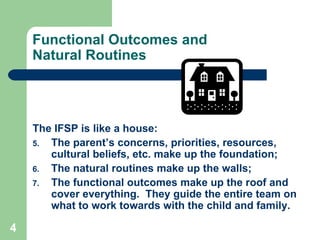
Functional Outcomes and  Natural Routines The IFSP is like a house: The parent’s concerns, priorities, resources, cultural beliefs, etc. make up the foundation; The natural routines make up the walls; The functional outcomes make up the roof and cover everything.  They guide the entire team on what to work towards with the child and family.
Natural Routines What is a “natural routine”? An activity that a family usually does: Eats meals; Takes baths; Takes a walk; Plays with toys; Changes diapers.
Functional Outcome What is a Functional Outcome? A Functional Outcome tells you  what  the child needs to accomplish in order to participate in a natural routine. Juanita will  hold one or more toys  at the same time when playing.
How do we create  Functional Outcomes? Create outcomes using  active  language:  What should the routine/activity/behavior look like?  Where/when/with whom it should occur.  “ When  his father   is reading a picture book , Danny will  point to  familiar animals or objects.”
How do we create  Functional Outcomes? Create outcomes using measurable language:  When  and  how  will we know that the outcome has been reached? Maria will eat dinner  every night  with the family  without getting out  of her chair.”
How do we create Short-Term Objectives? Break the functional outcome into small, easily reachable objectives: Johnny will be able to sit on the floor without much support so that he can play with toys by himself. Short Term Objectives :  Johnny will sit balanced on the floor using hands for support, (he won’t fall over); Johnny will sit balanced on the floor without using his hands; Johnny will regain balance after leaning over; Johnny will regain his balance after reaching to get a toy.
Outcomes/Objectives need to: Be important to the family (reflect their priorities and concerns); Be written so that parents can understand the objective when a therapist is not present (parent friendly); Be embedded within the activities in the child's and family's daily routines; Be observable; Be able to be reached within six months (measurable).

IFSP And Functional Outcomes instructions

  • 1.
    Functional Outcomes TheRole and Importance of Functional Outcomes in the Individualized Family Service Plan (IFSP)
  • 2.
    The Public HealthLaw for Functional Outcomes Title II-A of Article 25 of the Public Health Law , § 2545. Individualized family services plans includes : “ a statement of: the major outcomes expected to be achieved for the child and the family, including timelines, and the criteria and procedures that will be used to determine whether progress toward achieving the outcomes is being made and whether modifications or revisions of the outcomes or services are necessary.”
  • 3.
    IDEA, “Part C- Infants and Toddlers With Disabilities SEC. 631” Services are: “ (G) to the maximum extent appropriate, are provided in natural environments, including the home, and community settings in which children without disabilities participate.”
  • 4.
    Functional Outcomes and Natural Routines The IFSP is like a house: The parent’s concerns, priorities, resources, cultural beliefs, etc. make up the foundation; The natural routines make up the walls; The functional outcomes make up the roof and cover everything. They guide the entire team on what to work towards with the child and family.
  • 5.
    Natural Routines Whatis a “natural routine”? An activity that a family usually does: Eats meals; Takes baths; Takes a walk; Plays with toys; Changes diapers.
  • 6.
    Functional Outcome Whatis a Functional Outcome? A Functional Outcome tells you what the child needs to accomplish in order to participate in a natural routine. Juanita will hold one or more toys at the same time when playing.
  • 7.
    How do wecreate Functional Outcomes? Create outcomes using active language: What should the routine/activity/behavior look like? Where/when/with whom it should occur. “ When his father is reading a picture book , Danny will point to familiar animals or objects.”
  • 8.
    How do wecreate Functional Outcomes? Create outcomes using measurable language: When and how will we know that the outcome has been reached? Maria will eat dinner every night with the family without getting out of her chair.”
  • 9.
    How do wecreate Short-Term Objectives? Break the functional outcome into small, easily reachable objectives: Johnny will be able to sit on the floor without much support so that he can play with toys by himself. Short Term Objectives : Johnny will sit balanced on the floor using hands for support, (he won’t fall over); Johnny will sit balanced on the floor without using his hands; Johnny will regain balance after leaning over; Johnny will regain his balance after reaching to get a toy.
  • 10.
    Outcomes/Objectives need to:Be important to the family (reflect their priorities and concerns); Be written so that parents can understand the objective when a therapist is not present (parent friendly); Be embedded within the activities in the child's and family's daily routines; Be observable; Be able to be reached within six months (measurable).