Business combinationsare events or transactions in which
two or more business enterprises, or their net assets, are
brought under common control in a single accounting
entity.
Definition of BC
3.
A transaction orother event is a business combination if: The
assets acquired and liabilities assumed constitute a business.
If the asset acquired are not a business, it must be
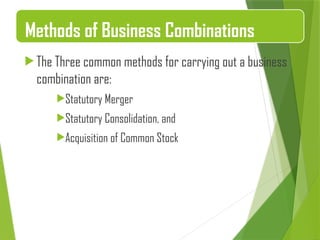
accounted for as an asset acquisition.
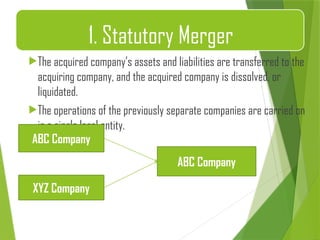
Identification of BC
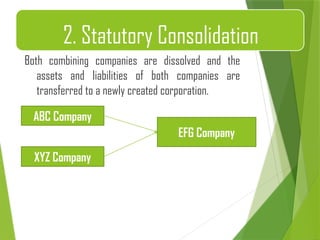
4.
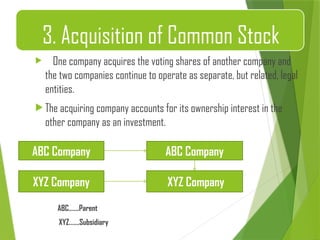
IFRS 3defines a business as ‘an integrated set of
activities and assets that is capable of being conducted
and managed for the purpose of providing a return in
the form of dividends, lower costs or other economic
benefits directly to investors or other owners,
members or participants.
Business consists of Input, process and output
Business
5.
E&P CoA (an oil and gas exploration and production company)
acquires a mineral interest from E&P Co B, on which it intends
to perform exploration activities to determine if reserves exist.
The mineral interest is an unproven property and there have
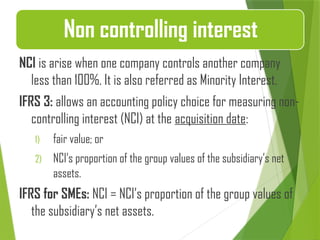
been no exploration activities performed on the property.
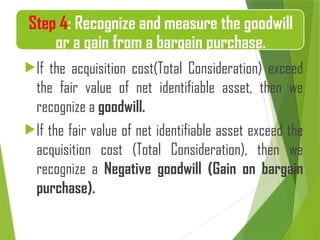
It is not a BC.
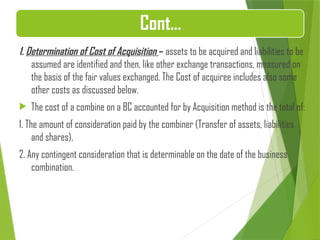
Example
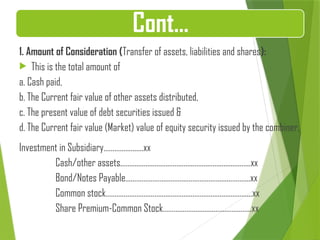
6.
• E&P CoA acquires a property similar to that in Example
above, except that oil and gas production activities are
in place. The target’s employees are not part of the
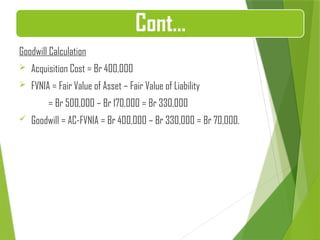
transferred set. E&P Co A will take over the operations
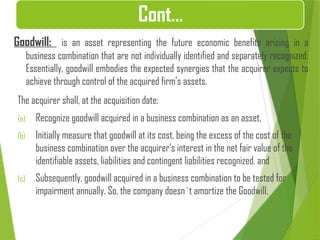
by using its own employees.
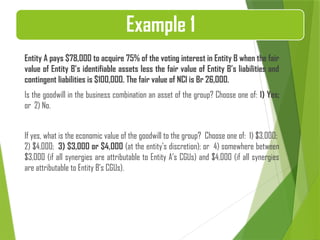
• It is a BC.
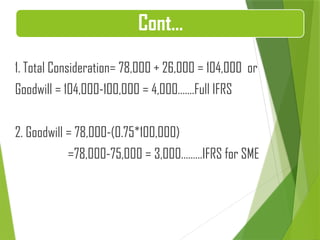
Cont…
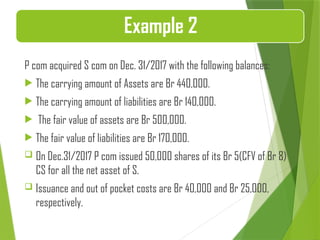
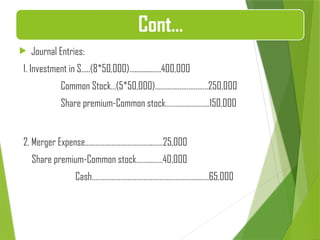
7.
Combined Enterprise: Theaccounting entity that results from a
business combination.
Constituent Companies: The business enterprises that enter into a
combination.
Combinor : A constituent company entering into a combination whose
owners as a group ends up with control of the ownership interests in
the combined enterprise. The term acquirer, parent and combinor can
be used interchangeably.
Combinee: a constituent company other than the combinor in a
business combination. The term acquired, acquiree, subsidiary and
combinee can be used interchangeably.
Definition of terms under BC
8.
There are threetypes of business combinations: Horizontal Combination, Vertical Combination,
and Conglomerate Combination:
1. Horizontal Combination: is a combination involving enterprises in the same industry. E.g.
assume combination of Ethio flour and Sun flour.
2. Vertical Combination: A Combination involving an enterprise and its customers or
suppliers. It is a combination involving companies engaged in different stages of production
or distribution. It is classified into two: Backward Vertical Combination – combination with
supplier and Forward Vertical Combination – combination with customers.
E.g.: A Tannery Company acquiring a Shoes Company - Forward
3. Conglomerate (Mixed) Combination: is a combination involving companies that are neither
horizontally nor vertically integrated. It is a combination between enterprises in unrelated
industries or markets.
Types of Business Combinations
9.
The Threecommon methods for carrying out a business
combination are:
Statutory Merger
Statutory Consolidation, and
Acquisition of Common Stock
Methods of Business Combinations
10.
The acquired company’sassets and liabilities are transferred to the
acquiring company, and the acquired company is dissolved, or
liquidated.
The operations of the previously separate companies are carried on
in a single legal entity.
1. Statutory Merger
ABC Company
ABC Company
XYZ Company
11.
Both combining companiesare dissolved and the
assets and liabilities of both companies are
transferred to a newly created corporation.
2. Statutory Consolidation
ABC Company
EFG Company
XYZ Company
12.
One companyacquires the voting shares of another company and
the two companies continue to operate as separate, but related, legal
entities.
The acquiring company accounts for its ownership interest in the
other company as an investment.
ABC…….Parent
XYZ…….Subsidiary
3. Acquisition of Common Stock
ABC Company ABC Company
XYZ Company XYZ Company
13.
1. Growth: Inrecent years Growth has been main reason for
business enterprises to enter into a business combination. Firms
can achieve growth through external and internal methods. The
external (e.g. business combination) method of achieving growth
is more rapid than growth through internal methods, as per
advocates of external method.
2. Economies of scale: The economies of scale will occur
as a result of more intensive utilization of production facilities,
distribution network, research and development facilities, etc. The
economies of scale will lead to financial synergies.
Reasons of Business combination
14.
Cont.…
3. Better management:Combinations results in better
management. Combinations result running the large scale enterprises. A
large enterprise can offer to use the service of expertise. Various
managerial functions can be efficiently managed by those persons who
are qualified for such jobs.
4. Monopolistic ambition: One of the important reasons
behind business combination is monopolistic ambitions. The combined
enterprises try to control more and more enterprises in the same line
so that they may be able to detect their terms (E.g. set their price). But,
the antitrust law is against such type of business combination.
15.
Cont.…
5. Diversification: Whenone company involves business
combination, it can diversify risks of operations. A Company involving
business combination can minimize risks as the enterprise is
diversifying operation or line of their activity. Since different companies
are already dealing in their respective lines, there will be risk
diversification.
6. Tax advantage: When an enterprise with accumulated losses
merges with a profit making enterprise, it is able to utilize tax shields
(benefits). An enterprise having losses will not be able to set-off losses
against future profits, because it is not a profit earning unit.
16.
This standardrequires to use the acquisition method to account
for a business combination transaction.
It involves four steps:
Acquisition Method
17.
The guidance inIFRS 10 shall be used to identify the acquirer—the
entity that obtains control of another entity, i.e. the acquiree.
In an asset acquisition, the company transferring cash or other
assets and/or assuming liabilities is the acquiring company. In a
stock acquisition, the acquirer is, in most cases, the company
transferring cash or other assets for a controlling interest in
the voting common stock of the acquiree (company being
acquired).
Step 1: Identify the acquirer
18.
Cont.…
When anacquisition is accomplished through an exchange of equity
interests, the factors considered in determining the acquirer firm include
the following:
1. Voting rights—The entity with the largest share of voting rights is
typically the acquirer.
2. Large minority interest—Where the company purchases only a large
minority interest (under 50%), but no other owner or group has a
significant voting interest, the company acquiring the large minority
interest is likely the acquirer.
3. Governing body of combined entity—The entity that has the ability to
elect or appoint a majority of the combined entity is likely the acquirer.
19.
In the absenceof evidence to the contrary:
Example 1: Companies A and B combine businesses by forming C. C issues
30 million and 20 million shares to A’s & B’s shareholders in exchange for
A’s and B’s businesses.
Example 2: same as Example 1, except: 20 million shares are issued to each
of A’s & B’s shareholders. C had 9 board members, 5 appointed by A’s
shareholders and 4 by B’s.
Example 3: on 31 December 2014 A has 100 million shares in issue. On 1
January 2015 A issued 200 million new A shares to the owners of B in
exchange for all of B’s shares.
Cont….
20.
Entity A intendsto acquire the voting shares (and
therefore obtain control) of Target Entity. Entity A
incorporates Newco and uses this entity to effect the
business combination. Entity A provides a loan at
commercial interest rates to Newco. The loan funds are
used by Newco to acquire 100% of the voting shares of
Target Entity in an arm’s length transaction.
Cont…..
21.
The date onwhich the acquirer obtains control of the
acquiree is generally the date on which the acquirer
legally transfers the consideration, acquires the
assets and assumes the liabilities of the acquiree—
the closing date
Step 2: Determine the acquisition date: date
on which the acquirer obtains control.
22.
Step 3: Recognizeand measure the identifiable assets
acquired, the liabilities assumed and any non
controlling interest in the acquiree;
The acquirer shall measure the identifiable assets acquired and the liabilities
assumed at their acquisition-date fair values. All other components of non-
controlling interests shall be measured at their acquisition-date fair values.
Fair value is the price that would be received to sell an asset or paid to transfer a
liability in an orderly transaction between market participants at the measurement
date.
1. Marketable Securities: Recorded at Fair value.
2. Receivables: are recorded at the discounted present value of amounts to be
received using current interest rates, less allowances for bad debts and
collection costs.
23.
3. Inventories:
I. Rawmaterials: Current Replacement cost
II. Work in Process: Net realizable value (Estimated selling
price/Fair value/Market value-cost to complete-cost to sale)
III. Finished Goods: Net realizable cost (Estimated selling price/Fair
value/Market value-cost to sale).
4. Intangible Assets: Recorded at Fair value.
5. PPE, IP and NR: Recorded at Fair value.
6. Long term investments: Recorded at Fair value.
7. Liabilities: Recorded at Fair value.
Cont…
24.
Cont.…
8. Research anddevelopment assets: The fair values of both tangible
and intangible research and development assets are recorded even
where the assets do not have alternative future uses (the usual criteria
for capitalization of R&D assets).
25.
NCI is arisewhen one company controls another company
less than 100%. It is also referred as Minority Interest.
IFRS 3: allows an accounting policy choice for measuring non-
controlling interest (NCI) at the acquisition date:
1) fair value; or
2) NCI’s proportion of the group values of the subsidiary’s net
assets.
IFRS for SMEs: NCI = NCI’s proportion of the group values of
the subsidiary’s net assets.
Non controlling interest
26.
If the acquisitioncost(Total Consideration) exceed
the fair value of net identifiable asset, then we
recognize a goodwill.
If the fair value of net identifiable asset exceed the
acquisition cost (Total Consideration), then we
recognize a Negative goodwill (Gain on bargain
purchase).
Step 4: Recognize and measure the goodwill
or a gain from a bargain purchase.
27.
Cont…
1. Determination ofCost of Acquisition – assets to be acquired and liabilities to be
assumed are identified and then, like other exchange transactions, measured on
the basis of the fair values exchanged. The Cost of acquiree includes also some
other costs as discussed below.
The cost of a combine on a BC accounted for by Acquisition method is the total of:
1. The amount of consideration paid by the combiner (Transfer of assets, liabilities
and shares),
2. Any contingent consideration that is determinable on the date of the business
combination.
28.
1. Amount ofConsideration (Transfer of assets, liabilities and shares):
This is the total amount of
a. Cash paid,
b. The Current fair value of other assets distributed,
c. The present value of debt securities issued &
d. The Current fair value (Market) value of equity security issued by the combiner.
Investment in Subsidiary………………….xx
Cash/other assets………………………………………………………………xx
Bond/Notes Payable….………………………………………………………..xx
Common stock……………………………………………………………………...xx
Share Premium-Common Stock……………………….…………………xx
Cont…
29.
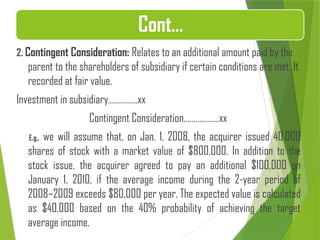
2. Contingent Consideration:Relates to an additional amount paid by the
parent to the shareholders of subsidiary if certain conditions are met. It
recorded at fair value.
Investment in subsidiary……………xx
Contingent Consideration………………xx
E.g. we will assume that, on Jan. 1, 2008, the acquirer issued 40,000
shares of stock with a market value of $800,000. In addition to the
stock issue, the acquirer agreed to pay an additional $100,000 on
January 1, 2010, if the average income during the 2-year period of
2008–2009 exceeds $80,000 per year. The expected value is calculated
as $40,000 based on the 40% probability of achieving the target
average income.
Cont…
30.
Cont.…
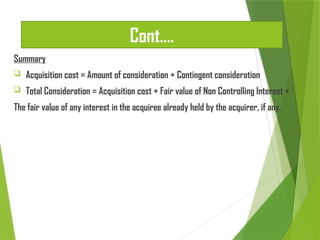
Summary
Acquisition cost= Amount of consideration + Contingent consideration
Total Consideration = Acquisition cost + Fair value of Non Controlling Interest +
The fair value of any interest in the acquiree already held by the acquirer, if any.
31.
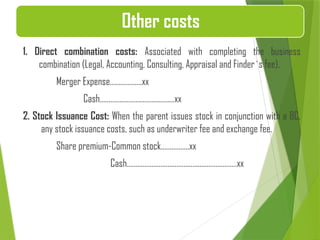
1. Direct combinationcosts: Associated with completing the business
combination (Legal, Accounting, Consulting, Appraisal and Finder`s fee).
Merger Expense………………xx
Cash……………………………………xx
2. Stock Issuance Cost: When the parent issues stock in conjunction with a BC,
any stock issuance costs, such as underwriter fee and exchange fee.
Share premium-Common stock…………….xx
Cash…………………………………..…………………xx
Other costs
32.
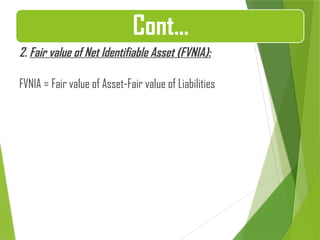
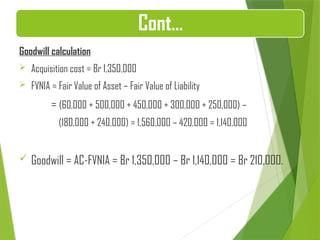
2. Fair valueof Net Identifiable Asset (FVNIA):
FVNIA = Fair value of Asset-Fair value of Liabilities
Cont…
33.
Goodwill: is anasset representing the future economic benefits arising in a
business combination that are not individually identified and separately recognized.
Essentially, goodwill embodies the expected synergies that the acquirer expects to
achieve through control of the acquired firm’s assets.
The acquirer shall, at the acquisition date:
(a) Recognize goodwill acquired in a business combination as an asset,
(b) Initially measure that goodwill at its cost, being the excess of the cost of the
business combination over the acquirer’s interest in the net fair value of the
identifiable assets, liabilities and contingent liabilities recognized. and
(c) Subsequently, goodwill acquired in a business combination to be tested for
impairment annually. So, the company doesn`t amortize the Goodwill.
Cont…
34.
Entity A pays$78,000 to acquire 75% of the voting interest in Entity B when the fair
value of Entity B’s identifiable assets less the fair value of Entity B’s liabilities and
contingent liabilities is $100,000. The fair value of NCI is Br 26,000.
Is the goodwill in the business combination an asset of the group? Choose one of: 1) Yes;
or 2) No.
If yes, what is the economic value of the goodwill to the group? Choose one of: 1) $3,000;
2) $4,000; 3) $3,000 or $4,000 (at the entity’s discretion); or 4) somewhere between
$3,000 (if all synergies are attributable to Entity A’s CGUs) and $4,000 (if all synergies
are attributable to Entity B’s CGUs).
Example 1
35.
1. Total Consideration=78,000 + 26,000 = 104,000 or
Goodwill = 104,000-100,000 = 4,000…….Full IFRS
2. Goodwill = 78,000-(0.75*100,000)
=78,000-75,000 = 3,000………IFRS for SME
Cont…
36.
P com acquiredS com on Dec. 31/2017 with the following balances:
The carrying amount of Assets are Br 440,000.
The carrying amount of liabilities are Br 140,000.
The fair value of assets are Br 500,000.
The fair value of liabilities are Br 170,000.
On Dec.31/2017 P com issued 50,000 shares of its Br 5(CFV of Br 8)
CS for all the net asset of S.
Issuance and out of pocket costs are Br 40,000 and Br 25,000,
respectively.
Example 2
37.
Journal Entries:
1.Investment in S…..(8*50,000)…...........….400,000
Common Stock…(5*50,000)…………………………250,000
Share premium-Common stock…………..………..150,000
2. Merger Expense………………………………..……25,000
Share premium-Common stock……..…….40,000
Cash……………………………………..………………….65,000
Cont…