The strategy of build for the programming language
Hiroshi SHIBATA / GMO Pepabo, Inc.


2021.09.03 Cloud Native Days CI/CD conference 2021
The details of CI/CD


environment for Ruby
Hiroshi SHIBATA @hsbt
https://www.hsbt.org
Executive Of
fi
cer VP of Engineering


Technical Director


at GMO Pepabo, Inc. @pepabo
Agenda
•What is Ruby Core team?


•The test strategy of the Ruby language


•CI environment for the Ruby language development
1. What’s Ruby?
Ruby is designed to make


programmers happy.
Yukihiro Matz Matsumoto
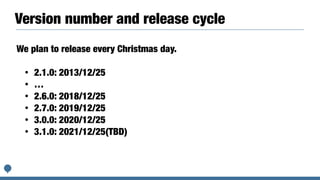
Version number and release cycle
We plan to release every Christmas day.


• 2.1.0: 2013/12/25


• …


• 2.6.0: 2018/12/25


• 2.7.0: 2019/12/25


• 3.0.0: 2020/12/25


• 3.1.0: 2021/12/25(TBD)
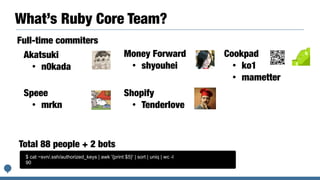
What’s Ruby Core Team?
Akatsuki


• n0kada
$ cat ~svn/.ssh/authorized_keys | awk '{print $5}' | sort | uniq | wc -l


90
Total 88 people + 2 bots
Money Forward


• shyouhei
Full-time commiters
Cookpad


• ko1


• mametter
Speee


• mrkn
Shopify


• Tenderlove
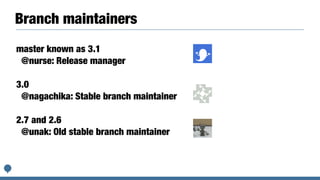
Branch maintainers
master known as 3.1


@nurse: Release manager


3.0


@nagachika: Stable branch maintainer


2.7 and 2.6


@unak: Old stable branch maintainer
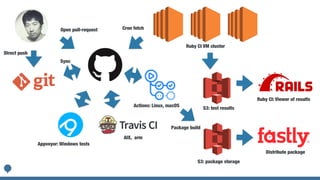
Direct push
Open pull-request
Ruby CI VM cluster
Appveyor: Windows tests
AIX, arm
Cron fetch
Actions: Linux, macOS
Package build
S3: package storage
S3: test results
Ruby CI: Viewer of results
Distribute package
Sync
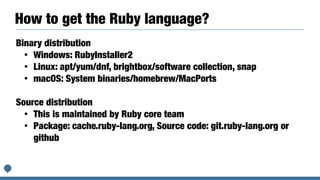
How to get the Ruby language?
Binary distribution


• Windows: RubyInstaller2


• Linux: apt/yum/dnf, brightbox/software collection, snap


• macOS: System binaries/homebrew/MacPorts


Source distribution


• This is maintained by Ruby core team


• Package: cache.ruby-lang.org, Source code: git.ruby-lang.org or
github
Of
fi
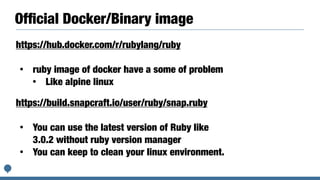
cial Docker/Binary image
https://hub.docker.com/r/rubylang/ruby


• ruby image of docker have a some of problem


• Like alpine linux
https://build.snapcraft.io/user/ruby/snap.ruby


• You can use the latest version of Ruby like
3.0.2 without ruby version manager


• You can keep to clean your linux environment.
The test strategy of the Ruby language
Start to test Ruby language
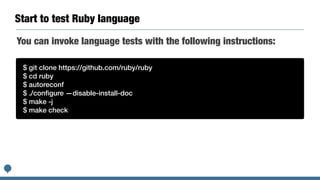
$ git clone https://github.com/ruby/ruby


$ cd ruby


$ autoreconf


$ ./con
fi
gure —disable-install-doc


$ make -j


$ make check
You can invoke language tests with the following instructions:
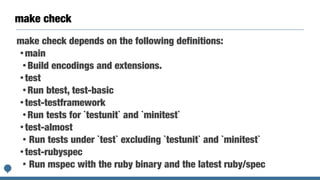
make check
make check depends on the following definitions:


• main


• Build encodings and extensions.


• test


• Run btest, test-basic


• test-testframework


• Run tests for `testunit` and `minitest`


• test-almost


• Run tests under `test` excluding `testunit` and `minitest`


• test-rubyspec


• Run mspec with the ruby binary and the latest ruby/spec
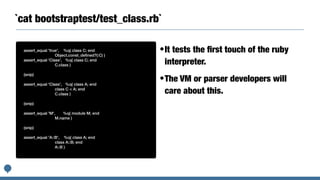
`cat bootstraptest/test_class.rb`
assert_equal 'true', %q( class C; end


Object.const_de
fi
ned?(:C) )


assert_equal 'Class', %q( class C; end


C.class )


(snip)


assert_equal 'Class', %q( class A; end


class C < A; end


C.class )


(snip)


assert_equal 'M', %q( module M; end


M.name )


(snip)


assert_equal 'A::B', %q( class A; end


class A::B; end


A::B )
•It tests the
fi
rst touch of the ruby
interpreter.


•The VM or parser developers will
care about this.
test-basic
a, = nil; test_ok(a == nil)


a, = 1; test_ok(a == 1)


a, = []; test_ok(a == nil)


(snip)


def r; return *[]; end; a = r(); test_ok(a == [])


def r; return *[1]; end; a = r(); test_ok(a == [1])


def r; return *[nil]; end; a = r(); test_ok(a == [nil])


(snip)


f = lambda { |a, b=42, *c| [a,b,c] }


test_ok(f.call(1 ) == [1,42,[ ]] )


test_ok(f.call(1,43 ) == [1,43,[ ]] )


test_ok(f.call(1,43,44) == [1,43,[44]] )


(snip)
•It tests the basic feature of Ruby
language.


•This test is 1
fi
le test. This is not
used test-framework.


•After that, We test test framework.
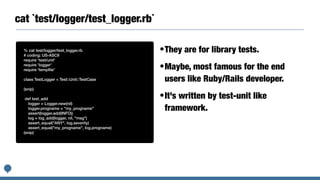
cat `test/logger/test_logger.rb`
% cat test/logger/test_logger.rb


# coding: US-ASCII


require 'test/unit'


require 'logger'


require 'temp
fi
le'


class TestLogger < Test::Unit::TestCase


(snip)


def test_add


logger = Logger.new(nil)


logger.progname = "my_progname"


assert(logger.add(INFO))


log = log_add(logger, nil, "msg")


assert_equal("ANY", log.severity)


assert_equal("my_progname", log.progname)


(snip)
•They are for library tests.


•Maybe, most famous for the end
users like Ruby/Rails developer.


•It’s written by test-unit like
framework.
cat `test/-ext-/array/test_resize.rb`
% cat ext/-test-/array/resize/resize.c


#include "ruby/ruby.h"


static VALUE


ary_resize(VALUE ary, VALUE len)


{


rb_ary_resize(ary, NUM2LONG(len));


return ary;


}


void


Init_resize(void)


{


rb_de
fi
ne_method(rb_cArray, "__resize__", ary_resize, 1);


}
require 'test/unit'


require '-test-/array/resize'


class TestArray < Test::Unit::TestCase


class TestResize < Test::Unit::TestCase


def test_expand


feature = '[ruby-dev:42912]'


ary = [*1..10]


ary.__resize__(10)


assert_equal(10, ary.size, feature)


assert_equal([*1..10], ary, feature)


ary.__resize__(100)


assert_equal(100, ary.size, feature)


(snip)
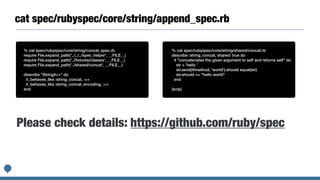
cat spec/rubyspec/core/string/append_spec.rb
% cat spec/rubyspec/core/string/concat_spec.rb


require File.expand_path('../../../spec_helper', __FILE__)


require File.expand_path('../
fi
xtures/classes', __FILE__)


require File.expand_path('../shared/concat', __FILE__)


describe "String#<<" do


it_behaves_like :string_concat, :<<


it_behaves_like :string_concat_encoding, :<<


end
% cat spec/rubyspec/core/string/shared/concat.rb


describe :string_concat, shared: true do


it "concatenates the given argument to self and returns self" do


str = 'hello '


str.send(@method, 'world').should equal(str)


str.should == "hello world"


end


(snip)
Please check details: https://github.com/ruby/spec
CI environments


for


the Ruby language development
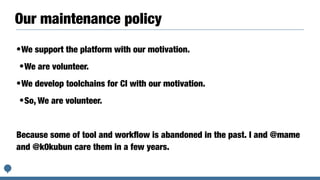
Our maintenance policy
•We support the platform with our motivation.


•We are volunteer.


•We develop toolchains for CI with our motivation.


•So, We are volunteer.


Because some of tool and work
fl
ow is abandoned in the past. I and @mame
and @k0kubun care them in a few years.
What’s target by CI of Ruby
•Not speed, We need wide range of platforms.


•Linux, macOS, Windows, others


•Compilers, System libraries


•Con
fi
guration options, executable options.


•etc.


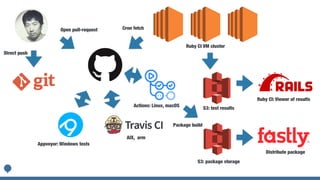
•We mixed these parameters about CI and test them.
Direct push
Open pull-request
Ruby CI VM cluster
Appveyor: Windows tests
AIX, arm
Cron fetch
Actions: Linux, macOS
Package build
S3: package storage
S3: test results
Ruby CI: Viewer of results
Distribute package
What’s Ruby CI
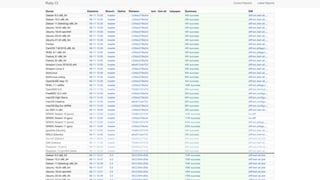
Ruby CI is a CI results collector for alternative
platforms


• https://rubyci.org


• https://github.com/ruby/rubyci


• https://github.com/ruby/chkbuild


• https://github.com/ruby/ruby-infra-recipe


Ruby CI goal is entirely supports all of Ruby platform.
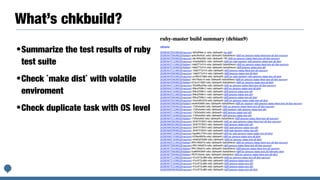
What’s chkbuild?
•Summarize the test results of ruby
test suite


•Check `make dist` with volatile
enviroment


•Check duplicate task with OS level
Ruby CI resources
Ruby CI goal is entirely supports all of Ruby platform. Ruby CI built by
a lot of cloud platforms (20-30 VMs)


• AWS


• on-premise servers(macOS)


We provision them with mitame and its recipe. And We have an
advantage for easily provides debug environment with ssh.
Sponsors of the Ruby language
• heroku:


Provide the free Enterprise account


• Fastly:


OSS plan of CDN for *.ruby-lang.org


• NaCl:


Network and Compute resources for website


• Ruby Association:


Grant of development for cloud resources


• Nihon Ruby no Kai:


Grant of development for hardware
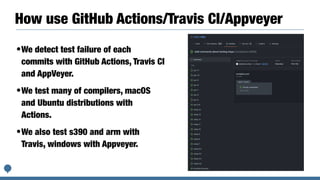
How use GitHub Actions/Travis CI/Appveyer
•We detect test failure of each
commits with GitHub Actions, Travis CI
and AppVeyer.


•We test many of compilers, macOS
and Ubuntu distributions with
Actions.


•We also test s390 and arm with
Travis, windows with Appveyer.
How use slack for Ruby development
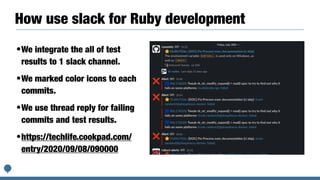
•We integrate the all of test
results to 1 slack channel.


•We marked color icons to each
commits.


•We use thread reply for failing
commits and test results.


•https://techlife.cookpad.com/
entry/2020/09/08/090000
How speed-up test suite


and


CI environment?
Delete code.
Standard


Libraries
Default


Gems
Bundled


Gems
Pure Ruby 3 46 14
C extensions 6 20 0
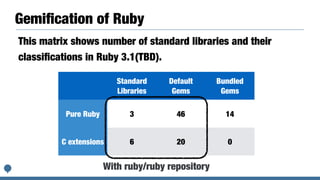
This matrix shows number of standard libraries and their
classi
fi
cations in Ruby 3.1(TBD).
Gemi
fi
cation of Ruby
With ruby/ruby repository
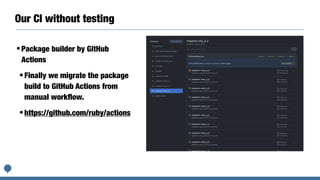
Our CI without testing
•Package builder by GitHub
Actions


•Finally we migrate the package
build to GitHub Actions from
manual work
fl
ow.


•https://github.com/ruby/actions
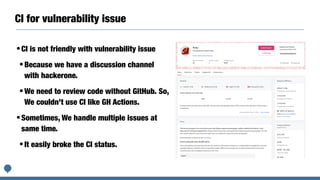
CI for vulnerability issue
•CI is not friendly with vulnerability issue


•Because we have a discussion channel
with hackerone.


•We need to review code without GitHub. So,
We couldn’t use CI like GH Actions.


•Sometimes, We handle multiple issues at
same time.


•It easily broke the CI status.
Conclusion
Conclusion
•I introduced Ruby Core team and their release work
fl
ow.


•The test strategy of the Ruby language is complex.


•CI environments for the Ruby language development are
also complex and have a bit of differences from Web
application.


Let’s join to #ci of ruby-jp slack and talk about them.

The details of CI/CD environment for Ruby

  • 1.
    The strategy ofbuild for the programming language Hiroshi SHIBATA / GMO Pepabo, Inc. 2021.09.03 Cloud Native Days CI/CD conference 2021 The details of CI/CD environment for Ruby
  • 2.
    Hiroshi SHIBATA @hsbt https://www.hsbt.org ExecutiveOf fi cer VP of Engineering Technical Director at GMO Pepabo, Inc. @pepabo
  • 3.
    Agenda •What is RubyCore team? •The test strategy of the Ruby language •CI environment for the Ruby language development
  • 4.
  • 5.
    Ruby is designedto make programmers happy. Yukihiro Matz Matsumoto
  • 6.
    Version number andrelease cycle We plan to release every Christmas day. • 2.1.0: 2013/12/25 • … • 2.6.0: 2018/12/25 • 2.7.0: 2019/12/25 • 3.0.0: 2020/12/25 • 3.1.0: 2021/12/25(TBD)
  • 7.
    What’s Ruby CoreTeam? Akatsuki • n0kada $ cat ~svn/.ssh/authorized_keys | awk '{print $5}' | sort | uniq | wc -l 90 Total 88 people + 2 bots Money Forward • shyouhei Full-time commiters Cookpad • ko1 • mametter Speee • mrkn Shopify • Tenderlove
  • 8.
    Branch maintainers master knownas 3.1 @nurse: Release manager 3.0 @nagachika: Stable branch maintainer 2.7 and 2.6 @unak: Old stable branch maintainer
  • 11.
    Direct push Open pull-request RubyCI VM cluster Appveyor: Windows tests AIX, arm Cron fetch Actions: Linux, macOS Package build S3: package storage S3: test results Ruby CI: Viewer of results Distribute package Sync
  • 12.
    How to getthe Ruby language? Binary distribution • Windows: RubyInstaller2 • Linux: apt/yum/dnf, brightbox/software collection, snap • macOS: System binaries/homebrew/MacPorts Source distribution • This is maintained by Ruby core team • Package: cache.ruby-lang.org, Source code: git.ruby-lang.org or github
  • 13.
    Of fi cial Docker/Binary image https://hub.docker.com/r/rubylang/ruby •ruby image of docker have a some of problem • Like alpine linux https://build.snapcraft.io/user/ruby/snap.ruby • You can use the latest version of Ruby like 3.0.2 without ruby version manager • You can keep to clean your linux environment.
  • 14.
    The test strategyof the Ruby language
  • 15.
    Start to testRuby language $ git clone https://github.com/ruby/ruby $ cd ruby $ autoreconf $ ./con fi gure —disable-install-doc $ make -j $ make check You can invoke language tests with the following instructions:
  • 16.
    make check make checkdepends on the following definitions: • main • Build encodings and extensions. • test • Run btest, test-basic • test-testframework • Run tests for `testunit` and `minitest` • test-almost • Run tests under `test` excluding `testunit` and `minitest` • test-rubyspec • Run mspec with the ruby binary and the latest ruby/spec
  • 17.
    `cat bootstraptest/test_class.rb` assert_equal 'true',%q( class C; end Object.const_de fi ned?(:C) ) assert_equal 'Class', %q( class C; end C.class ) (snip) assert_equal 'Class', %q( class A; end class C < A; end C.class ) (snip) assert_equal 'M', %q( module M; end M.name ) (snip) assert_equal 'A::B', %q( class A; end class A::B; end A::B ) •It tests the fi rst touch of the ruby interpreter. •The VM or parser developers will care about this.
  • 18.
    test-basic a, = nil;test_ok(a == nil) a, = 1; test_ok(a == 1) a, = []; test_ok(a == nil) (snip) def r; return *[]; end; a = r(); test_ok(a == []) def r; return *[1]; end; a = r(); test_ok(a == [1]) def r; return *[nil]; end; a = r(); test_ok(a == [nil]) (snip) f = lambda { |a, b=42, *c| [a,b,c] } test_ok(f.call(1 ) == [1,42,[ ]] ) test_ok(f.call(1,43 ) == [1,43,[ ]] ) test_ok(f.call(1,43,44) == [1,43,[44]] ) (snip) •It tests the basic feature of Ruby language. •This test is 1 fi le test. This is not used test-framework. •After that, We test test framework.
  • 19.
    cat `test/logger/test_logger.rb` % cattest/logger/test_logger.rb # coding: US-ASCII require 'test/unit' require 'logger' require 'temp fi le' class TestLogger < Test::Unit::TestCase (snip) def test_add logger = Logger.new(nil) logger.progname = "my_progname" assert(logger.add(INFO)) log = log_add(logger, nil, "msg") assert_equal("ANY", log.severity) assert_equal("my_progname", log.progname) (snip) •They are for library tests. •Maybe, most famous for the end users like Ruby/Rails developer. •It’s written by test-unit like framework.
  • 20.
    cat `test/-ext-/array/test_resize.rb` % catext/-test-/array/resize/resize.c #include "ruby/ruby.h" static VALUE ary_resize(VALUE ary, VALUE len) { rb_ary_resize(ary, NUM2LONG(len)); return ary; } void Init_resize(void) { rb_de fi ne_method(rb_cArray, "__resize__", ary_resize, 1); } require 'test/unit' require '-test-/array/resize' class TestArray < Test::Unit::TestCase class TestResize < Test::Unit::TestCase def test_expand feature = '[ruby-dev:42912]' ary = [*1..10] ary.__resize__(10) assert_equal(10, ary.size, feature) assert_equal([*1..10], ary, feature) ary.__resize__(100) assert_equal(100, ary.size, feature) (snip)
  • 21.
    cat spec/rubyspec/core/string/append_spec.rb % catspec/rubyspec/core/string/concat_spec.rb require File.expand_path('../../../spec_helper', __FILE__) require File.expand_path('../ fi xtures/classes', __FILE__) require File.expand_path('../shared/concat', __FILE__) describe "String#<<" do it_behaves_like :string_concat, :<< it_behaves_like :string_concat_encoding, :<< end % cat spec/rubyspec/core/string/shared/concat.rb describe :string_concat, shared: true do it "concatenates the given argument to self and returns self" do str = 'hello ' str.send(@method, 'world').should equal(str) str.should == "hello world" end (snip) Please check details: https://github.com/ruby/spec
  • 22.
    CI environments for the Rubylanguage development
  • 23.
    Our maintenance policy •Wesupport the platform with our motivation. •We are volunteer. •We develop toolchains for CI with our motivation. •So, We are volunteer. Because some of tool and work fl ow is abandoned in the past. I and @mame and @k0kubun care them in a few years.
  • 24.
    What’s target byCI of Ruby •Not speed, We need wide range of platforms. •Linux, macOS, Windows, others •Compilers, System libraries •Con fi guration options, executable options. •etc. •We mixed these parameters about CI and test them.
  • 25.
    Direct push Open pull-request RubyCI VM cluster Appveyor: Windows tests AIX, arm Cron fetch Actions: Linux, macOS Package build S3: package storage S3: test results Ruby CI: Viewer of results Distribute package
  • 26.
    What’s Ruby CI RubyCI is a CI results collector for alternative platforms • https://rubyci.org • https://github.com/ruby/rubyci • https://github.com/ruby/chkbuild • https://github.com/ruby/ruby-infra-recipe Ruby CI goal is entirely supports all of Ruby platform.
  • 28.
    What’s chkbuild? •Summarize thetest results of ruby test suite •Check `make dist` with volatile enviroment •Check duplicate task with OS level
  • 29.
    Ruby CI resources RubyCI goal is entirely supports all of Ruby platform. Ruby CI built by a lot of cloud platforms (20-30 VMs) • AWS • on-premise servers(macOS) We provision them with mitame and its recipe. And We have an advantage for easily provides debug environment with ssh.
  • 30.
    Sponsors of theRuby language • heroku: Provide the free Enterprise account • Fastly: OSS plan of CDN for *.ruby-lang.org • NaCl: Network and Compute resources for website • Ruby Association: Grant of development for cloud resources • Nihon Ruby no Kai: Grant of development for hardware
  • 31.
    How use GitHubActions/Travis CI/Appveyer •We detect test failure of each commits with GitHub Actions, Travis CI and AppVeyer. •We test many of compilers, macOS and Ubuntu distributions with Actions. •We also test s390 and arm with Travis, windows with Appveyer.
  • 32.
    How use slackfor Ruby development •We integrate the all of test results to 1 slack channel. •We marked color icons to each commits. •We use thread reply for failing commits and test results. •https://techlife.cookpad.com/ entry/2020/09/08/090000
  • 33.
    How speed-up testsuite and CI environment?
  • 34.
  • 35.
    Standard Libraries Default Gems Bundled Gems Pure Ruby 346 14 C extensions 6 20 0 This matrix shows number of standard libraries and their classi fi cations in Ruby 3.1(TBD). Gemi fi cation of Ruby With ruby/ruby repository
  • 36.
    Our CI withouttesting •Package builder by GitHub Actions •Finally we migrate the package build to GitHub Actions from manual work fl ow. •https://github.com/ruby/actions
  • 37.
    CI for vulnerabilityissue •CI is not friendly with vulnerability issue •Because we have a discussion channel with hackerone. •We need to review code without GitHub. So, We couldn’t use CI like GH Actions. •Sometimes, We handle multiple issues at same time. •It easily broke the CI status.
  • 38.
  • 39.
    Conclusion •I introduced RubyCore team and their release work fl ow. •The test strategy of the Ruby language is complex. •CI environments for the Ruby language development are also complex and have a bit of differences from Web application. Let’s join to #ci of ruby-jp slack and talk about them.