Identity Theft and Privacy
Charles Lee Mudd Jr.
Privacy Resolutions P.C.
November 20, 2002
Chicago Public Library
© 2002 Privacy Resolutions P.C.
Introduction
1997 Quinnipiac University School of Law
J.D., magna cum laude
2001, Adjunct Professor
University of Connecticut School of Law
2002, Adjunct Professor
John Marshall Law School
Introduction
2001 Founded Privacy Resolutions P.C.
President and Attorney
Privacy Resolutions P.C.
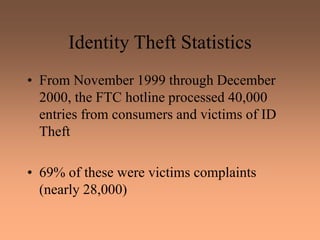
Identity Theft Statistics
• From November 1999 through December
2000, the FTC hotline processed 40,000
entries from consumers and victims of ID
Theft
• 69% of these were victims complaints
(nearly 28,000)
Identity Theft Statistics
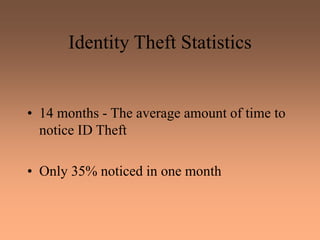
• 14 months - The average amount of time to
notice ID Theft
• Only 35% noticed in one month
What is Identity Theft?
• Privacy
• Criminal
• Financial
• Misappropriation
• Reputation
Privacy
• Personally Identifiable Information
• Opt-in versus Opt-out
• Privacy Policies
• Fair Information Practice Principles
• Notice
• Access
• Choice
• Security
Criminal Fraud
• Using identities to avoid criminal prosecution or
as identity when committing a crime and/or caught
• Can be used from traffic violations to felonies
• If they’re released from police custody, but don’t
appear, warrants issued
• It can happen to anyone
Financial Fraud
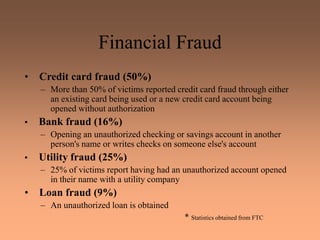
• Credit card fraud (50%)
– More than 50% of victims reported credit card fraud through either
an existing card being used or a new credit card account being
opened without authorization
• Bank fraud (16%)
– Opening an unauthorized checking or savings account in another
person's name or writes checks on someone else's account
• Utility fraud (25%)
– 25% of victims report having had an unauthorized account opened
in their name with a utility company
• Loan fraud (9%)
– An unauthorized loan is obtained
* Statistics obtained from FTC
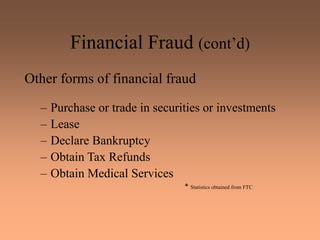
Financial Fraud (cont’d)
Other forms of financial fraud
– Purchase or trade in securities or investments
– Lease
– Declare Bankruptcy
– Obtain Tax Refunds
– Obtain Medical Services
* Statistics obtained from FTC
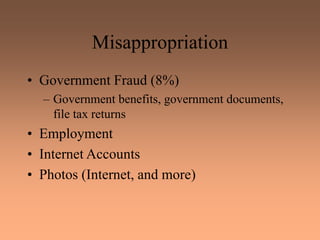
Misappropriation
• Government Fraud (8%)
– Government benefits, government documents,
file tax returns
• Employment
• Internet Accounts
• Photos (Internet, and more)
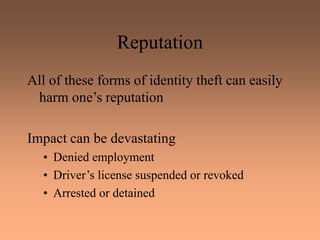
Reputation
All of these forms of identity theft can easily
harm one’s reputation
Impact can be devastating
• Denied employment
• Driver’s license suspended or revoked
• Arrested or detained
Statistics Revisited
More than 50% of the FTC entries by victims
had experienced one or more forms of
identity theft
Case Studies
• Financial - Western Union and Credit
• Criminal - Warrants out for arrest
• Misappropriation - Pictures
• Internet - Ebay
How Do They Do It?
• Very very easily
• All that is needed is SS#, DOB, and some other
information
• Can obtain false driver’s license or other ID
• Yes, can use different address - claim address
changed
How do they do it? (Part II)
Information can be accessed about you from
any number of sources…..
……Anywhere personally identifiable
information has been provided and/or
stored…..
How do they do it? (Part II)
Steal wallets/purses containing ID and cards
Steal your mail, statements, pre-approved
(remember opt-out), new checks, tax
information
Steal business records
How do they do it? (Part II)
Reroute mail by change of address forms
Rummage through trash (“dumpster diving”)
Recover personal information in your home
Personal Information shared on the Internet
Scams through email
Fraudulently obtain credit reports posing as
employer, landlord, etc.
Statutes
Illinois
United States
Illinois
FINANCIAL IDENTITY THEFT AND
ASSET FORFEITURE LAW
(720 ILCS 5/16G-1)
FINANCIAL IDENTITY THEFT AND ASSET
FORFEITURE LAW
"Personal identification document" means a birth certificate,
a drivers license, a State identification card, a public,
government, or private employment identification card, a
social security card, a firearm owner's identification
card, a credit card, a debit card, or a passport issued to or
on behalf of a person other than the offender, or any such
document made or altered in a manner that it purports to
have been made on behalf of or issued to another person or
by the authority of one who did not give that authority.
FINANCIAL IDENTITY THEFT AND ASSET
FORFEITURE LAW
"Personal identifying information" means any of the
following information:
(1) A person's name;
(2) A person's address;
(3) A person's telephone number;
(4) A person's drivers license number or State of
Illinois identification card as assigned by the Secretary
of State of the State of Illinois or a similar agency of
another state;
(5) A person's Social Security number;
FINANCIAL IDENTITY THEFT AND ASSET
FORFEITURE LAW
(6) A person's public, private, or government employer,
place of employment, or employment identification
number;
(7) The maiden name of a person's mother;
(8) The number assigned to a person's depository
account, savings account, or brokerage account;
FINANCIAL IDENTITY THEFT AND ASSET
FORFEITURE LAW
(9) The number assigned to a person's credit or debit
card, commonly known as a "Visa Card", "Master Card",
"American Express Card", "Discover Card", or other
similar cards whether issued by a financial institution,
corporation, or business entity;
(10) Personal identification numbers;
(11) Electronic identification numbers;
(12) Digital signals;
(13) Any other numbers or information which can be
used to access a person's financial resources.
FINANCIAL IDENTITY THEFT AND ASSET
FORFEITURE LAW
A person commits the offense of financial identity theft
when he or she knowingly uses any personal
identifying information or personal identification
document of another person to fraudulently obtain
credit, money, goods, services, or other property in the
name of the other person.
FINANCIAL IDENTITY THEFT AND ASSET
FORFEITURE LAW
Aggravated - to someone 60 years or older, or someone
disabled
FINANCIAL IDENTITY THEFT AND ASSET
FORFEITURE LAW
Criminal Penalties
No Private Right of Action
United States Code
Identity Theft and Assumption
Deterence Act
18 U.S.C. § 1028 (a) - (h)
United States Code
No Private Right of Action
Avoiding Identity Theft
• Identity Theft can happen to anyone
• Preventative steps can and should be taken
Preventative Measures
• INQUIRE about privacy policies - ask
how information will be used and/or be
shared
• ASK that information be kept
confidential
• KEEP information secure and in a safe
place
Preventative Measures
• SHRED all solicitations for credit cards, bank
accounts, insurance, etc.
• OPT-OUT of mailing lists
– 1-888-5-OPT-OUT (1-888-567-8688)
• DON’T DISPLAY personal identifying
information (ie SS#, DOB, Phone, CC#) to
merchants on checks
Preventative Measures
IF YOU lose your wallet or purse (or if it’s stolen),
request new account numbers for all of your cards
and accounts
Preventative Measures (cont’d)
MONITOR
– Mail
– Financial accounts
Monitor activity, if haven’t received call
– Credit Bureau Reports
Correct any and all inaccurate information, Check your report
once every year
Preventative Measures (cont’d)
REVIEW
– Information security procedures in workplace
– Locations of information in home (ie roommates,
employed help)
Preventative Measures (cont’d)
DISCLOSE INFORMATION
– Only when you initiated contact
– Organization has been confirmed
Preventative Measures (cont’d)
ELECTRONIC PRECAUTIONS
– Update Virus Protection Software regularly (automate)
– Don’t download or click anything from strange email
– Use a firewall (particularly cable and DSL)
– Use a secure browser
– Use very strong passwords (quotes from books or poems)
– Delete personal information before discarding
– Secure all PDAs
– Website Privacy Policies
Preventative Measures (cont’d)
Unofficial TIPS
Avoid non-Bank ATMs
Collect all receipts (ie gas stations)
Pay cash for small purchases (avoid electronic signatures)
Preventative Measures (cont’d)
THINK SMART!
ERTID
Emergency Response to Identity Theft
Begin a Log…
– Write all names and numbers of people contacted
– Write all information found and from where or whom
– Write all activities completed, organize
Collect evidence
– Letters, correspondence
– Files
– Reports
ERTID
Emergency Response to Identity Theft
Contact all creditors and….
– Explain what has happened
– Request new account numbers (DON’T CANCEL)
– Verify address on file, request that don’t change unless
verified
– Change verifiable information to something out of
ordinary
ERTID (cont’d)
Emergency Response to Identity Theft
Contact all credit reporting agencies….
– Experian 1-888-397-3742
– Equifax at 1-800-270-3435
– Trans Union at 1-800-680-7289
Inform them and request fraud alert placed on your record
(temporary 90 day or more permanent, depends on
circumstances, consult professional)
ERTID (cont’d)
Emergency Response to Identity Theft
REPORT the incidents to the police
You must obtain police report and may have to do some convincing
Provide documentation
Ask if others in area, have them check FTC database
If multiple states involved, contact Secret Service or local Federal Bureau
of Investigation Office
ERTID (cont’d)
Emergency Response to Identity Theft
• REPORT the incidents to all vendors involved
and attempt to cancel transactions
• REPORT the incidents to the Federal Trade
Commission
– 1-877-ID-THEFT (1-800-438-4338)
– www.consumer.gov/idtheft
ERTID (cont’d)
Emergency Response to Identity Theft
Checking (to stop any checks being used)
Telecheck 1-800-710-9898 or 927-0188
Certegy, Inc. 1-800-437-5120
International Check Services 1-800-631-9656
Checking (to see if bad checks using your name)
SCAN 1-800-262-7771
Why an Attorney?
Civil Remedies
Resolving Disputes
Civil Remedies
• Statutes discussed do not yet provide civil right of
action
• Prosecution may pursue Imposter if identity
obtained, but again no civil recovery
• There do exist certain traditional torts that can be
explored depending upon circumstances
Resolving Disputes
• Unfavorable responses from vendors, credit cards
• Hasten resolution of issues, return of money, or
provisional credit
• Cooperation
• Consultation
• Experience, save time and frustration
• All experiences unique
Other Issues
• Fair Credit Reporting Act
– Delineates when and how credit bureaus may
disclose credit reports
– A company may obtain report IF YOU APPLY
for credit, insurance, employment, or to rent an
apartment
– Number of times requested can hurt rating
Online Resources
• www.pirg.org
• www.gao.gov
• www.epic.org
• www.fraud.org
• www.consumer.gov/idtheft
Notice
This presentation has been provided for informational purposes only. All
circumstances and cases of identity theft will be unique to each
individual. While general precautions have been provided, no legal
advice has been rendered. This publication should not be considered
legal advice or representation. Should you become a victim of identity
theft or have further questions, please do not hesitate to contact me
directly on a personal basis.
Contact Information
Charles Lee Mudd Jr
President, Privacy Resolutions P.C.
4710 North Virginia Avenue
Chicago, Illinois 60613
773.271.7600 (telephone)
773.989.4441 (facsimile)
cmudd@privacyresolutions.com
www.privacyresolutions.com

2002 Identity Theft Chicago Public Library

  • 1.
    Identity Theft andPrivacy Charles Lee Mudd Jr. Privacy Resolutions P.C. November 20, 2002 Chicago Public Library © 2002 Privacy Resolutions P.C.
  • 2.
    Introduction 1997 Quinnipiac UniversitySchool of Law J.D., magna cum laude 2001, Adjunct Professor University of Connecticut School of Law 2002, Adjunct Professor John Marshall Law School
  • 3.
    Introduction 2001 Founded PrivacyResolutions P.C. President and Attorney Privacy Resolutions P.C.
  • 4.
    Identity Theft Statistics •From November 1999 through December 2000, the FTC hotline processed 40,000 entries from consumers and victims of ID Theft • 69% of these were victims complaints (nearly 28,000)
  • 5.
    Identity Theft Statistics •14 months - The average amount of time to notice ID Theft • Only 35% noticed in one month
  • 6.
    What is IdentityTheft? • Privacy • Criminal • Financial • Misappropriation • Reputation
  • 7.
    Privacy • Personally IdentifiableInformation • Opt-in versus Opt-out • Privacy Policies • Fair Information Practice Principles • Notice • Access • Choice • Security
  • 8.
    Criminal Fraud • Usingidentities to avoid criminal prosecution or as identity when committing a crime and/or caught • Can be used from traffic violations to felonies • If they’re released from police custody, but don’t appear, warrants issued • It can happen to anyone
  • 9.
    Financial Fraud • Creditcard fraud (50%) – More than 50% of victims reported credit card fraud through either an existing card being used or a new credit card account being opened without authorization • Bank fraud (16%) – Opening an unauthorized checking or savings account in another person's name or writes checks on someone else's account • Utility fraud (25%) – 25% of victims report having had an unauthorized account opened in their name with a utility company • Loan fraud (9%) – An unauthorized loan is obtained * Statistics obtained from FTC
  • 10.
    Financial Fraud (cont’d) Otherforms of financial fraud – Purchase or trade in securities or investments – Lease – Declare Bankruptcy – Obtain Tax Refunds – Obtain Medical Services * Statistics obtained from FTC
  • 11.
    Misappropriation • Government Fraud(8%) – Government benefits, government documents, file tax returns • Employment • Internet Accounts • Photos (Internet, and more)
  • 12.
    Reputation All of theseforms of identity theft can easily harm one’s reputation Impact can be devastating • Denied employment • Driver’s license suspended or revoked • Arrested or detained
  • 13.
    Statistics Revisited More than50% of the FTC entries by victims had experienced one or more forms of identity theft
  • 14.
    Case Studies • Financial- Western Union and Credit • Criminal - Warrants out for arrest • Misappropriation - Pictures • Internet - Ebay
  • 15.
    How Do TheyDo It? • Very very easily • All that is needed is SS#, DOB, and some other information • Can obtain false driver’s license or other ID • Yes, can use different address - claim address changed
  • 16.
    How do theydo it? (Part II) Information can be accessed about you from any number of sources….. ……Anywhere personally identifiable information has been provided and/or stored…..
  • 17.
    How do theydo it? (Part II) Steal wallets/purses containing ID and cards Steal your mail, statements, pre-approved (remember opt-out), new checks, tax information Steal business records
  • 18.
    How do theydo it? (Part II) Reroute mail by change of address forms Rummage through trash (“dumpster diving”) Recover personal information in your home Personal Information shared on the Internet Scams through email Fraudulently obtain credit reports posing as employer, landlord, etc.
  • 19.
  • 20.
    Illinois FINANCIAL IDENTITY THEFTAND ASSET FORFEITURE LAW (720 ILCS 5/16G-1)
  • 21.
    FINANCIAL IDENTITY THEFTAND ASSET FORFEITURE LAW "Personal identification document" means a birth certificate, a drivers license, a State identification card, a public, government, or private employment identification card, a social security card, a firearm owner's identification card, a credit card, a debit card, or a passport issued to or on behalf of a person other than the offender, or any such document made or altered in a manner that it purports to have been made on behalf of or issued to another person or by the authority of one who did not give that authority.
  • 22.
    FINANCIAL IDENTITY THEFTAND ASSET FORFEITURE LAW "Personal identifying information" means any of the following information: (1) A person's name; (2) A person's address; (3) A person's telephone number; (4) A person's drivers license number or State of Illinois identification card as assigned by the Secretary of State of the State of Illinois or a similar agency of another state; (5) A person's Social Security number;
  • 23.
    FINANCIAL IDENTITY THEFTAND ASSET FORFEITURE LAW (6) A person's public, private, or government employer, place of employment, or employment identification number; (7) The maiden name of a person's mother; (8) The number assigned to a person's depository account, savings account, or brokerage account;
  • 24.
    FINANCIAL IDENTITY THEFTAND ASSET FORFEITURE LAW (9) The number assigned to a person's credit or debit card, commonly known as a "Visa Card", "Master Card", "American Express Card", "Discover Card", or other similar cards whether issued by a financial institution, corporation, or business entity; (10) Personal identification numbers; (11) Electronic identification numbers; (12) Digital signals; (13) Any other numbers or information which can be used to access a person's financial resources.
  • 25.
    FINANCIAL IDENTITY THEFTAND ASSET FORFEITURE LAW A person commits the offense of financial identity theft when he or she knowingly uses any personal identifying information or personal identification document of another person to fraudulently obtain credit, money, goods, services, or other property in the name of the other person.
  • 26.
    FINANCIAL IDENTITY THEFTAND ASSET FORFEITURE LAW Aggravated - to someone 60 years or older, or someone disabled
  • 27.
    FINANCIAL IDENTITY THEFTAND ASSET FORFEITURE LAW Criminal Penalties No Private Right of Action
  • 28.
    United States Code IdentityTheft and Assumption Deterence Act 18 U.S.C. § 1028 (a) - (h)
  • 29.
    United States Code NoPrivate Right of Action
  • 30.
    Avoiding Identity Theft •Identity Theft can happen to anyone • Preventative steps can and should be taken
  • 31.
    Preventative Measures • INQUIREabout privacy policies - ask how information will be used and/or be shared • ASK that information be kept confidential • KEEP information secure and in a safe place
  • 32.
    Preventative Measures • SHREDall solicitations for credit cards, bank accounts, insurance, etc. • OPT-OUT of mailing lists – 1-888-5-OPT-OUT (1-888-567-8688) • DON’T DISPLAY personal identifying information (ie SS#, DOB, Phone, CC#) to merchants on checks
  • 33.
    Preventative Measures IF YOUlose your wallet or purse (or if it’s stolen), request new account numbers for all of your cards and accounts
  • 34.
    Preventative Measures (cont’d) MONITOR –Mail – Financial accounts Monitor activity, if haven’t received call – Credit Bureau Reports Correct any and all inaccurate information, Check your report once every year
  • 35.
    Preventative Measures (cont’d) REVIEW –Information security procedures in workplace – Locations of information in home (ie roommates, employed help)
  • 36.
    Preventative Measures (cont’d) DISCLOSEINFORMATION – Only when you initiated contact – Organization has been confirmed
  • 37.
    Preventative Measures (cont’d) ELECTRONICPRECAUTIONS – Update Virus Protection Software regularly (automate) – Don’t download or click anything from strange email – Use a firewall (particularly cable and DSL) – Use a secure browser – Use very strong passwords (quotes from books or poems) – Delete personal information before discarding – Secure all PDAs – Website Privacy Policies
  • 38.
    Preventative Measures (cont’d) UnofficialTIPS Avoid non-Bank ATMs Collect all receipts (ie gas stations) Pay cash for small purchases (avoid electronic signatures)
  • 39.
  • 40.
    ERTID Emergency Response toIdentity Theft Begin a Log… – Write all names and numbers of people contacted – Write all information found and from where or whom – Write all activities completed, organize Collect evidence – Letters, correspondence – Files – Reports
  • 41.
    ERTID Emergency Response toIdentity Theft Contact all creditors and…. – Explain what has happened – Request new account numbers (DON’T CANCEL) – Verify address on file, request that don’t change unless verified – Change verifiable information to something out of ordinary
  • 42.
    ERTID (cont’d) Emergency Responseto Identity Theft Contact all credit reporting agencies…. – Experian 1-888-397-3742 – Equifax at 1-800-270-3435 – Trans Union at 1-800-680-7289 Inform them and request fraud alert placed on your record (temporary 90 day or more permanent, depends on circumstances, consult professional)
  • 43.
    ERTID (cont’d) Emergency Responseto Identity Theft REPORT the incidents to the police You must obtain police report and may have to do some convincing Provide documentation Ask if others in area, have them check FTC database If multiple states involved, contact Secret Service or local Federal Bureau of Investigation Office
  • 44.
    ERTID (cont’d) Emergency Responseto Identity Theft • REPORT the incidents to all vendors involved and attempt to cancel transactions • REPORT the incidents to the Federal Trade Commission – 1-877-ID-THEFT (1-800-438-4338) – www.consumer.gov/idtheft
  • 45.
    ERTID (cont’d) Emergency Responseto Identity Theft Checking (to stop any checks being used) Telecheck 1-800-710-9898 or 927-0188 Certegy, Inc. 1-800-437-5120 International Check Services 1-800-631-9656 Checking (to see if bad checks using your name) SCAN 1-800-262-7771
  • 46.
    Why an Attorney? CivilRemedies Resolving Disputes
  • 47.
    Civil Remedies • Statutesdiscussed do not yet provide civil right of action • Prosecution may pursue Imposter if identity obtained, but again no civil recovery • There do exist certain traditional torts that can be explored depending upon circumstances
  • 48.
    Resolving Disputes • Unfavorableresponses from vendors, credit cards • Hasten resolution of issues, return of money, or provisional credit • Cooperation • Consultation • Experience, save time and frustration • All experiences unique
  • 49.
    Other Issues • FairCredit Reporting Act – Delineates when and how credit bureaus may disclose credit reports – A company may obtain report IF YOU APPLY for credit, insurance, employment, or to rent an apartment – Number of times requested can hurt rating
  • 50.
    Online Resources • www.pirg.org •www.gao.gov • www.epic.org • www.fraud.org • www.consumer.gov/idtheft
  • 51.
    Notice This presentation hasbeen provided for informational purposes only. All circumstances and cases of identity theft will be unique to each individual. While general precautions have been provided, no legal advice has been rendered. This publication should not be considered legal advice or representation. Should you become a victim of identity theft or have further questions, please do not hesitate to contact me directly on a personal basis.
  • 52.
    Contact Information Charles LeeMudd Jr President, Privacy Resolutions P.C. 4710 North Virginia Avenue Chicago, Illinois 60613 773.271.7600 (telephone) 773.989.4441 (facsimile) cmudd@privacyresolutions.com www.privacyresolutions.com