© 2008 Mudd Law Offices 1
Intellectual Property Issues
on the Internet
What Every Lawyer Should
Know
About Intellectual Property
May 5, 2008
© 2008 Mudd Law Offices 2
DMCA
Digital Millennium Copyright Act
Two Key Areas Enacted
Limitation on Liability (Safe Harbor) for Infringing Material
17 U.S.C. § 512
Anti-Circumvention Measures
17 U.S.C. § 1201
© 2008 Mudd Law Offices 3
DMCA
Focus of today’s discussion will be on
Safe Harbor under the DMCA
And conclude with brief reference to the
Safe Harbor under the § 230 of CDA
© 2008 Mudd Law Offices 4
DMCA - Title II
17 U.S.C. § 512
Provides safe harbor provisions
Title II enacted "to provide greater certainty to service
providers concerning their legal exposure for
infringements that may occur in the course of their
activities.”
Ellison v. Robertson, 357 F.3d 1072, 1076 (9th Cir. 2004).
© 2008 Mudd Law Offices 5
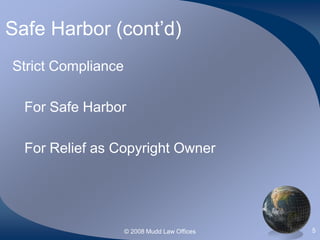
Safe Harbor (cont’d)
Strict Compliance
For Safe Harbor
For Relief as Copyright Owner
© 2008 Mudd Law Offices 6
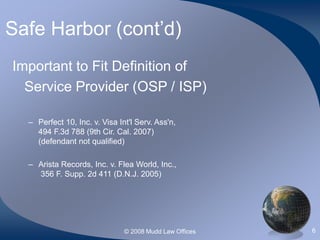
Safe Harbor (cont’d)
Important to Fit Definition of
Service Provider (OSP / ISP)
– Perfect 10, Inc. v. Visa Int'l Serv. Ass'n,
494 F.3d 788 (9th Cir. Cal. 2007)
(defendant not qualified)
– Arista Records, Inc. v. Flea World, Inc.,
356 F. Supp. 2d 411 (D.N.J. 2005)
© 2008 Mudd Law Offices 7
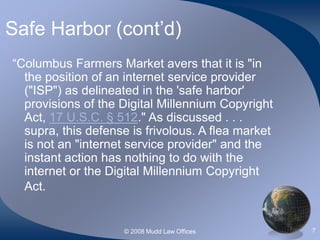
Safe Harbor (cont’d)
“Columbus Farmers Market avers that it is "in
the position of an internet service provider
("ISP") as delineated in the 'safe harbor'
provisions of the Digital Millennium Copyright
Act, 17 U.S.C. § 512." As discussed . . .
supra, this defense is frivolous. A flea market
is not an "internet service provider" and the
instant action has nothing to do with the
internet or the Digital Millennium Copyright
Act.
© 2008 Mudd Law Offices 8
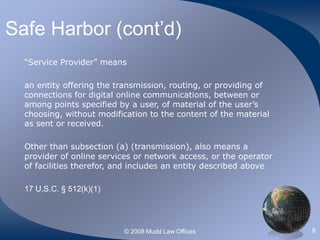
Safe Harbor (cont’d)
“Service Provider” means
an entity offering the transmission, routing, or providing of
connections for digital online communications, between or
among points specified by a user, of material of the user’s
choosing, without modification to the content of the material
as sent or received.
Other than subsection (a) (transmission), also means a
provider of online services or network access, or the operator
of facilities therefor, and includes an entity described above
17 U.S.C. § 512(k)(1)
© 2008 Mudd Law Offices 9
Safe Harbor (cont’d)
If you do qualify as OSP/ISP
DMCA provides certain immunities
subject to specific requirements
© 2008 Mudd Law Offices 10
Safe Harbor (cont’d)
Safe Harbor protects OSP from
Monetary Relief
“means damages, costs, attorneys’ fees, and any
other form of monetary payment.”
17 U.S.C. § 512(k)(2)
All but limited injunctive relief (§ 512(j))
© 2008 Mudd Law Offices 11
Safe Harbor (cont’d)
• DMCA provides safe harbor for
– Transmission of Alleged Infringing Material
(17 U.S.C. § 512(a))
– System Caching
(17 U.S.C. § 512(b))
– Information Residing on System
(17 U.S.C. § 512(c))
– Hyperlinks
(17 U.S.C. § 512(d))
© 2008 Mudd Law Offices 12
Safe Harbor - Transmission
17 U.S.C. § 512(a)
OSP Immune for Transmission, IF
• OSP did not initiate transmission;
• Automatic and without selection of material by OSP
• OSP does not select the recipients except as an automatic
response to the request of another person;
AND
© 2008 Mudd Law Offices 13
Safe Harbor - Transmission (cont’d)
OSP Immune for Transmission, IF (cont’d)
• no copy is maintained in a manner ordinarily accessible
to anyone other than anticipated recipients, AND
• no such copy is maintained longer than is reasonably
necessary
AND
© 2008 Mudd Law Offices 14
Safe Harbor - Transmission (cont’d)
OSP Immune for Transmission, IF (cont’d)
• OSP does not modify the content
(“the material is transmitted through the system or network
without modification of its content.”)
© 2008 Mudd Law Offices 15
Safe Harbor - Transmission (cont’d)
A note on 512(a) - as will see below
the subpoena process available under
512(h) does not apply to 512(a) entities
In other words….RIAA can’t use DMCA
© 2008 Mudd Law Offices 16
Safe Harbor - Caching
17 U.S.C. § 512(b)
OSP immune for
temporary storage of material WHERE
material made available online by Third Party (A)
who transmits material through system to Third Party
(B) at (B)’s direction
AND
© 2008 Mudd Law Offices 17
Safe Harbor - Caching (cont’d)
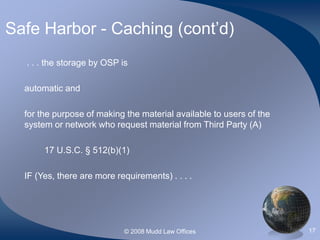
. . . the storage by OSP is
automatic and
for the purpose of making the material available to users of the
system or network who request material from Third Party (A)
17 U.S.C. § 512(b)(1)
IF (Yes, there are more requirements) . . . .
© 2008 Mudd Law Offices 18
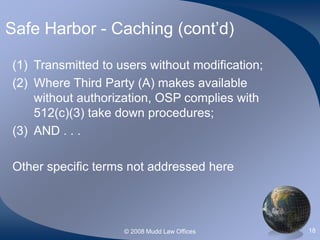
Safe Harbor - Caching (cont’d)
(1) Transmitted to users without modification;
(2) Where Third Party (A) makes available
without authorization, OSP complies with
512(c)(3) take down procedures;
(3) AND . . .
Other specific terms not addressed here
© 2008 Mudd Law Offices 19
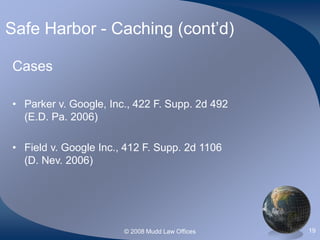
Safe Harbor - Caching (cont’d)
Cases
• Parker v. Google, Inc., 422 F. Supp. 2d 492
(E.D. Pa. 2006)
• Field v. Google Inc., 412 F. Supp. 2d 1106
(D. Nev. 2006)
© 2008 Mudd Law Offices 20
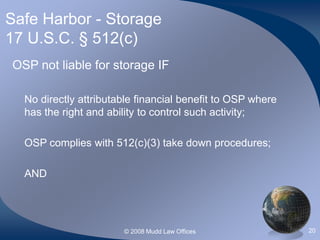
Safe Harbor - Storage
17 U.S.C. § 512(c)
OSP not liable for storage IF
No directly attributable financial benefit to OSP where
has the right and ability to control such activity;
OSP complies with 512(c)(3) take down procedures;
AND
© 2008 Mudd Law Offices 21
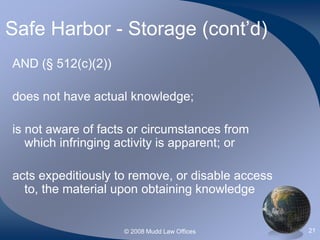
Safe Harbor - Storage (cont’d)
AND (§ 512(c)(2))
does not have actual knowledge;
is not aware of facts or circumstances from
which infringing activity is apparent; or
acts expeditiously to remove, or disable access
to, the material upon obtaining knowledge
© 2008 Mudd Law Offices 22
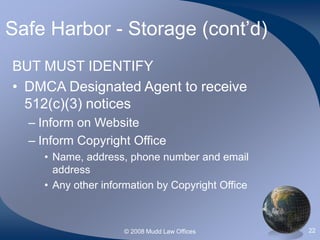
Safe Harbor - Storage (cont’d)
BUT MUST IDENTIFY
• DMCA Designated Agent to receive
512(c)(3) notices
– Inform on Website
– Inform Copyright Office
• Name, address, phone number and email
address
• Any other information by Copyright Office
© 2008 Mudd Law Offices 23
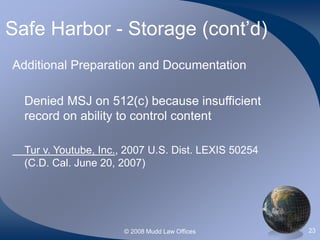
Safe Harbor - Storage (cont’d)
Additional Preparation and Documentation
Denied MSJ on 512(c) because insufficient
record on ability to control content
Tur v. Youtube, Inc., 2007 U.S. Dist. LEXIS 50254
(C.D. Cal. June 20, 2007)
© 2008 Mudd Law Offices 24
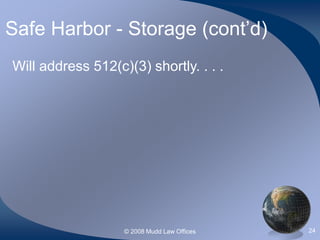
Safe Harbor - Storage (cont’d)
Will address 512(c)(3) shortly. . . .
© 2008 Mudd Law Offices 25
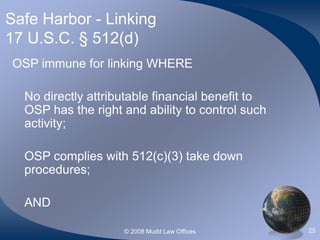
Safe Harbor - Linking
17 U.S.C. § 512(d)
OSP immune for linking WHERE
No directly attributable financial benefit to
OSP has the right and ability to control such
activity;
OSP complies with 512(c)(3) take down
procedures;
AND
© 2008 Mudd Law Offices 26
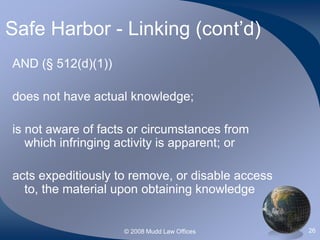
Safe Harbor - Linking (cont’d)
AND (§ 512(d)(1))
does not have actual knowledge;
is not aware of facts or circumstances from
which infringing activity is apparent; or
acts expeditiously to remove, or disable access
to, the material upon obtaining knowledge
© 2008 Mudd Law Offices 27
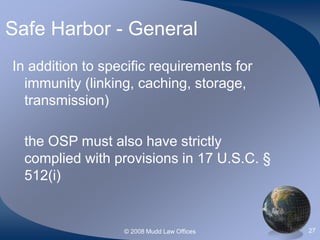
Safe Harbor - General
In addition to specific requirements for
immunity (linking, caching, storage,
transmission)
the OSP must also have strictly
complied with provisions in 17 U.S.C. §
512(i)
© 2008 Mudd Law Offices 28
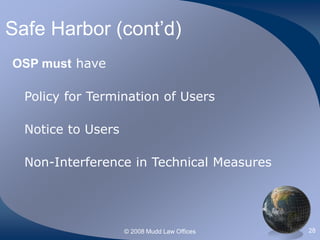
Safe Harbor (cont’d)
OSP must have
Policy for Termination of Users
Notice to Users
Non-Interference in Technical Measures
© 2008 Mudd Law Offices 29
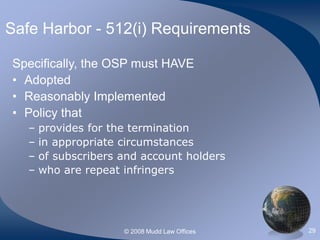
Safe Harbor - 512(i) Requirements
Specifically, the OSP must HAVE
• Adopted
• Reasonably Implemented
• Policy that
– provides for the termination
– in appropriate circumstances
– of subscribers and account holders
– who are repeat infringers
© 2008 Mudd Law Offices 30
Safe Harbor - 512(i) Requirements
Note: Though distinguished by other courts, at
least one court has required efforts to
discourage repeat infringers generally
In re Aimster, 334 F.3d 643, 655 (7th Cir. 2003)
“. . . [the] service provider must do what it can reasonably be asked to do
to prevent the use of its service by ‘repeat infringers.’ 17 U.S.C. §
512(i)(1)(A). Far from doing anything to discourage repeat infringers of
the plaintiffs' copyrights, Aimster invited them to do so, showed them
how they could do so with ease using its system, and by teaching its
users how to encrypt their unlawful distribution of copyrighted materials
disabled itself from doing anything to prevent infringement.”
© 2008 Mudd Law Offices 31
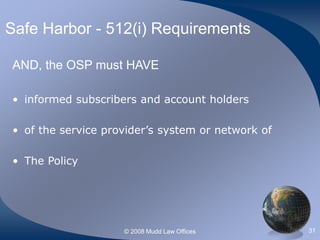
Safe Harbor - 512(i) Requirements
AND, the OSP must HAVE
• informed subscribers and account holders
• of the service provider’s system or network of
• The Policy
© 2008 Mudd Law Offices 32
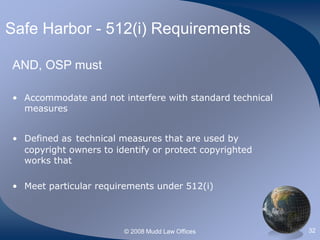
Safe Harbor - 512(i) Requirements
AND, OSP must
• Accommodate and not interfere with standard technical
measures
• Defined as technical measures that are used by
copyright owners to identify or protect copyrighted
works that
• Meet particular requirements under 512(i)
© 2008 Mudd Law Offices 33
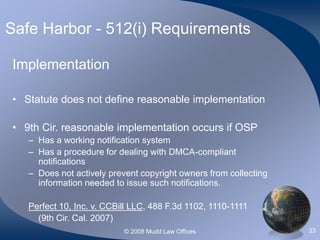
Safe Harbor - 512(i) Requirements
Implementation
• Statute does not define reasonable implementation
• 9th Cir. reasonable implementation occurs if OSP
– Has a working notification system
– Has a procedure for dealing with DMCA-compliant
notifications
– Does not actively prevent copyright owners from collecting
information needed to issue such notifications.
Perfect 10, Inc. v. CCBill LLC, 488 F.3d 1102, 1110-1111
(9th Cir. Cal. 2007)
© 2008 Mudd Law Offices 34
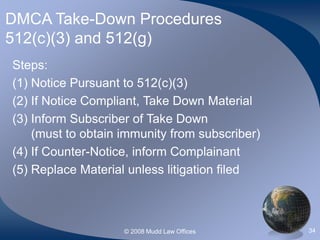
DMCA Take-Down Procedures
512(c)(3) and 512(g)
Steps:
(1) Notice Pursuant to 512(c)(3)
(2) If Notice Compliant, Take Down Material
(3) Inform Subscriber of Take Down
(must to obtain immunity from subscriber)
(4) If Counter-Notice, inform Complainant
(5) Replace Material unless litigation filed
© 2008 Mudd Law Offices 35
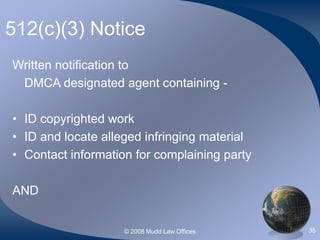
512(c)(3) Notice
Written notification to
DMCA designated agent containing -
• ID copyrighted work
• ID and locate alleged infringing material
• Contact information for complaining party
AND
© 2008 Mudd Law Offices 36
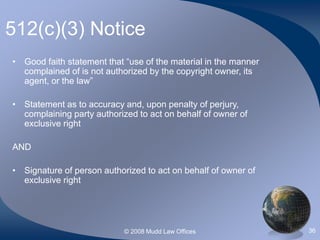
512(c)(3) Notice
• Good faith statement that “use of the material in the manner
complained of is not authorized by the copyright owner, its
agent, or the law”
• Statement as to accuracy and, upon penalty of perjury,
complaining party authorized to act on behalf of owner of
exclusive right
AND
• Signature of person authorized to act on behalf of owner of
exclusive right
© 2008 Mudd Law Offices 37
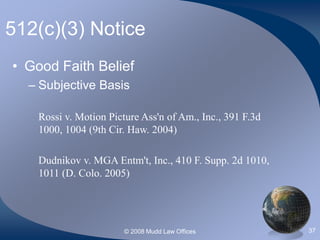
512(c)(3) Notice
• Good Faith Belief
– Subjective Basis
Rossi v. Motion Picture Ass'n of Am., Inc., 391 F.3d
1000, 1004 (9th Cir. Haw. 2004)
Dudnikov v. MGA Entm't, Inc., 410 F. Supp. 2d 1010,
1011 (D. Colo. 2005)
© 2008 Mudd Law Offices 38
Take Down Material
• If Compliant Notice, Must Take Down
• No liability for Take Down (512(g)(1)) IF
(1) Promptly Notifies Subscriber; and,
(2) Upon receipt of counter notification, conveys
copy of counter notice to complainant and
provides notice that it will replace content in 10
days
§ 512(g)(2)
© 2008 Mudd Law Offices 39
DMCA Counter-Notice
Must Provide:
• ID and Prior Location Material Removed
• Statement under penalty of perjury good faith
belief material removed by mistake or
misidentification
• Subscriber name, address, phone
• Consent to jurisdiction
• Accept Service Process
• Signature
© 2008 Mudd Law Offices 40
Replace Material
• Upon Counter Notice, replace material
(no liability - § 512(c)(4))
• Unless, after notice to Complainant,
received notice of
“action seeking a court order to restrain the
subscriber from engaging in infringing activity relating
to the material on the service provider’s system or
network.”
© 2008 Mudd Law Offices 41
Summary - Take Down
Steps:
(1) Notice Pursuant to 512(c)(3)
(2) If Notice Compliant, Take Down Material
(3) Inform Subscriber of Take Down
(must to obtain immunity from subscriber)
(4) If Counter-Notice, inform Complainant
(5) Replace Material unless litigation filed
© 2008 Mudd Law Offices 42
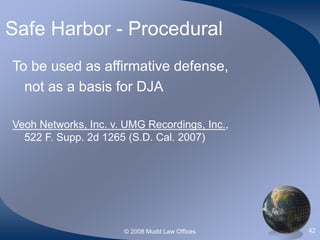
Safe Harbor - Procedural
To be used as affirmative defense,
not as a basis for DJA
Veoh Networks, Inc. v. UMG Recordings, Inc.,
522 F. Supp. 2d 1265 (S.D. Cal. 2007)
© 2008 Mudd Law Offices 43
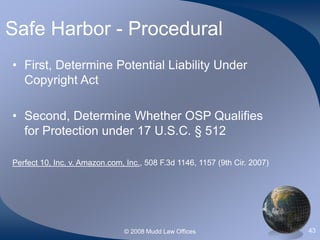
Safe Harbor - Procedural
• First, Determine Potential Liability Under
Copyright Act
• Second, Determine Whether OSP Qualifies
for Protection under 17 U.S.C. § 512
Perfect 10, Inc. v. Amazon.com, Inc., 508 F.3d 1146, 1157 (9th Cir. 2007)
© 2008 Mudd Law Offices 44
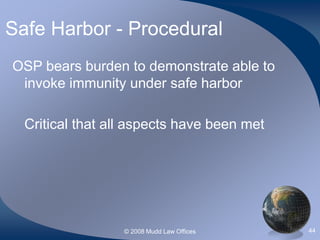
Safe Harbor - Procedural
OSP bears burden to demonstrate able to
invoke immunity under safe harbor
Critical that all aspects have been met
© 2008 Mudd Law Offices 45
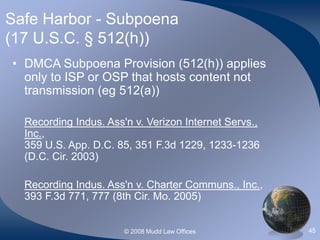
Safe Harbor - Subpoena
(17 U.S.C. § 512(h))
• DMCA Subpoena Provision (512(h)) applies
only to ISP or OSP that hosts content not
transmission (eg 512(a))
Recording Indus. Ass'n v. Verizon Internet Servs.,
Inc.,
359 U.S. App. D.C. 85, 351 F.3d 1229, 1233-1236
(D.C. Cir. 2003)
Recording Indus. Ass'n v. Charter Communs., Inc.,
393 F.3d 771, 777 (8th Cir. Mo. 2005)
© 2008 Mudd Law Offices 46
Misrepresentation - 512(f)
No injunctive relief
Biosafe-One, Inc. v. Hawks,
524 F. Supp. 2d 452, 469 (S.D.N.Y. 2007)
© 2008 Mudd Law Offices 47
Misrepresentation - 512(f)
• Interesting subject matter question
– Is a misrepresentation claim under 512(f)
copyright or tort?
Although not resolving issue, see:
Doe v. Geller,
533 F. Supp. 2d 996, 1004 (N.D. Cal. 2008)
© 2008 Mudd Law Offices 48
CDA § 230
OSP Safe Harbor for Content
No provider or user of an interactive computer
service shall be treated as the publisher or speaker of
any information provided by another information
content provider.
47 U.S.C. § 230(c)(1)
© 2008 Mudd Law Offices 49
CDA § 230 (cont’d)
OSP Safe Harbor for Voluntary Efforts (47 U.S.C. § 230(c)(2))
No provider or user of an interactive computer service shall be
held liable on account of
(A) any action voluntarily taken in good faith to restrict access to
or availability of material that the provider or user considers to
be obscene, lewd, lascivious, filthy, excessively violent,
harassing, or otherwise objectionable, whether or not such
material is constitutionally protected;
OR
© 2008 Mudd Law Offices 50
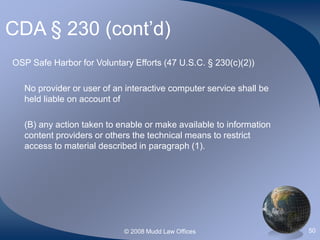
CDA § 230 (cont’d)
OSP Safe Harbor for Voluntary Efforts (47 U.S.C. § 230(c)(2))
No provider or user of an interactive computer service shall be
held liable on account of
(B) any action taken to enable or make available to information
content providers or others the technical means to restrict
access to material described in paragraph (1).
© 2008 Mudd Law Offices 51
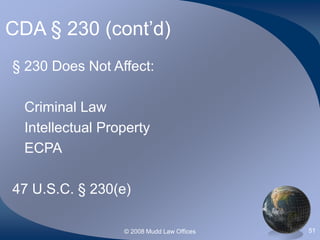
CDA § 230 (cont’d)
§ 230 Does Not Affect:
Criminal Law
Intellectual Property
ECPA
47 U.S.C. § 230(e)
© 2008 Mudd Law Offices 52
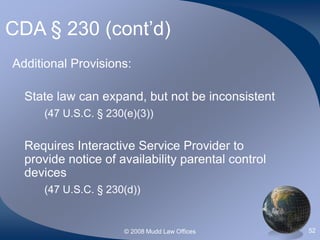
CDA § 230 (cont’d)
Additional Provisions:
State law can expand, but not be inconsistent
(47 U.S.C. § 230(e)(3))
Requires Interactive Service Provider to
provide notice of availability parental control
devices
(47 U.S.C. § 230(d))
© 2008 Mudd Law Offices 53
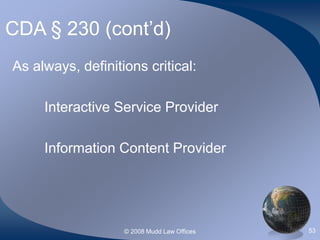
CDA § 230 (cont’d)
As always, definitions critical:
Interactive Service Provider
Information Content Provider
© 2008 Mudd Law Offices 54
CDA § 230 (cont’d)
Interactive Computer Service
means any information service, system, or access
software provider that provides or enables computer
access by multiple users to a computer server,
including specifically a service or system that
provides access to the Internet and such systems
operated or services offered by libraries or
educational institutions.
47 U.S.C. § 230 (f)(3)
© 2008 Mudd Law Offices 55
CDA § 230 (cont’d)
Information Content Provider
means any person or entity that is
responsible, in whole or in part, for the
creation or development of information
provided through the Internet or any other
interactive computer service.
47 U.S.C. § 230 (f)(3)
© 2008 Mudd Law Offices 56
CDA § 230 (cont’d)
Broad Protection
Recent Cases
Craigslist
Roommates.com
© 2008 Mudd Law Offices 57
CDA § 230 (cont’d)
Craigslist
Chicago Lawyers Cmte. v. Craigslist,
519 F.3d 666 (7th Cir. 2008)
March 14, 2008
© 2008 Mudd Law Offices 58
CDA § 230 (cont’d)
Roommates.com
Fair Housing Council v.
Roommates.com
Nos. 04-56916, 04-57173
2008 WL 879293
(9th Cir. 2008)
(April 3, 2008)
© 2008 Mudd Law Offices 59
Mudd Law Offices
• Litigation with DMCA and CDA
– Defense - Invoking and Defending Immunity
– Plaintiff - Utilizing DMCA Notice
– Plaintiff - Utilizing DMCA Subpoena
– Plaintiff - Addressing DMCA and CDA Defenses
• Transactional
– Drafting DMCA Policies
– Implementing DMCA Policies
– Advising on CDA compliant Policies and
Procedures
© 2008 Mudd Law Offices 60
Charles Lee Mudd Jr.
Mudd Law Offices
3114 West Irving Park Road
Chicago, Illinois 60618
773.588.5410 Telephone
773.588.5440 Facsimile
cmudd@muddlawoffices.com

2008 Digital Millennium Copyright Act and CDA

  • 1.
    © 2008 MuddLaw Offices 1 Intellectual Property Issues on the Internet What Every Lawyer Should Know About Intellectual Property May 5, 2008
  • 2.
    © 2008 MuddLaw Offices 2 DMCA Digital Millennium Copyright Act Two Key Areas Enacted Limitation on Liability (Safe Harbor) for Infringing Material 17 U.S.C. § 512 Anti-Circumvention Measures 17 U.S.C. § 1201
  • 3.
    © 2008 MuddLaw Offices 3 DMCA Focus of today’s discussion will be on Safe Harbor under the DMCA And conclude with brief reference to the Safe Harbor under the § 230 of CDA
  • 4.
    © 2008 MuddLaw Offices 4 DMCA - Title II 17 U.S.C. § 512 Provides safe harbor provisions Title II enacted "to provide greater certainty to service providers concerning their legal exposure for infringements that may occur in the course of their activities.” Ellison v. Robertson, 357 F.3d 1072, 1076 (9th Cir. 2004).
  • 5.
    © 2008 MuddLaw Offices 5 Safe Harbor (cont’d) Strict Compliance For Safe Harbor For Relief as Copyright Owner
  • 6.
    © 2008 MuddLaw Offices 6 Safe Harbor (cont’d) Important to Fit Definition of Service Provider (OSP / ISP) – Perfect 10, Inc. v. Visa Int'l Serv. Ass'n, 494 F.3d 788 (9th Cir. Cal. 2007) (defendant not qualified) – Arista Records, Inc. v. Flea World, Inc., 356 F. Supp. 2d 411 (D.N.J. 2005)
  • 7.
    © 2008 MuddLaw Offices 7 Safe Harbor (cont’d) “Columbus Farmers Market avers that it is "in the position of an internet service provider ("ISP") as delineated in the 'safe harbor' provisions of the Digital Millennium Copyright Act, 17 U.S.C. § 512." As discussed . . . supra, this defense is frivolous. A flea market is not an "internet service provider" and the instant action has nothing to do with the internet or the Digital Millennium Copyright Act.
  • 8.
    © 2008 MuddLaw Offices 8 Safe Harbor (cont’d) “Service Provider” means an entity offering the transmission, routing, or providing of connections for digital online communications, between or among points specified by a user, of material of the user’s choosing, without modification to the content of the material as sent or received. Other than subsection (a) (transmission), also means a provider of online services or network access, or the operator of facilities therefor, and includes an entity described above 17 U.S.C. § 512(k)(1)
  • 9.
    © 2008 MuddLaw Offices 9 Safe Harbor (cont’d) If you do qualify as OSP/ISP DMCA provides certain immunities subject to specific requirements
  • 10.
    © 2008 MuddLaw Offices 10 Safe Harbor (cont’d) Safe Harbor protects OSP from Monetary Relief “means damages, costs, attorneys’ fees, and any other form of monetary payment.” 17 U.S.C. § 512(k)(2) All but limited injunctive relief (§ 512(j))
  • 11.
    © 2008 MuddLaw Offices 11 Safe Harbor (cont’d) • DMCA provides safe harbor for – Transmission of Alleged Infringing Material (17 U.S.C. § 512(a)) – System Caching (17 U.S.C. § 512(b)) – Information Residing on System (17 U.S.C. § 512(c)) – Hyperlinks (17 U.S.C. § 512(d))
  • 12.
    © 2008 MuddLaw Offices 12 Safe Harbor - Transmission 17 U.S.C. § 512(a) OSP Immune for Transmission, IF • OSP did not initiate transmission; • Automatic and without selection of material by OSP • OSP does not select the recipients except as an automatic response to the request of another person; AND
  • 13.
    © 2008 MuddLaw Offices 13 Safe Harbor - Transmission (cont’d) OSP Immune for Transmission, IF (cont’d) • no copy is maintained in a manner ordinarily accessible to anyone other than anticipated recipients, AND • no such copy is maintained longer than is reasonably necessary AND
  • 14.
    © 2008 MuddLaw Offices 14 Safe Harbor - Transmission (cont’d) OSP Immune for Transmission, IF (cont’d) • OSP does not modify the content (“the material is transmitted through the system or network without modification of its content.”)
  • 15.
    © 2008 MuddLaw Offices 15 Safe Harbor - Transmission (cont’d) A note on 512(a) - as will see below the subpoena process available under 512(h) does not apply to 512(a) entities In other words….RIAA can’t use DMCA
  • 16.
    © 2008 MuddLaw Offices 16 Safe Harbor - Caching 17 U.S.C. § 512(b) OSP immune for temporary storage of material WHERE material made available online by Third Party (A) who transmits material through system to Third Party (B) at (B)’s direction AND
  • 17.
    © 2008 MuddLaw Offices 17 Safe Harbor - Caching (cont’d) . . . the storage by OSP is automatic and for the purpose of making the material available to users of the system or network who request material from Third Party (A) 17 U.S.C. § 512(b)(1) IF (Yes, there are more requirements) . . . .
  • 18.
    © 2008 MuddLaw Offices 18 Safe Harbor - Caching (cont’d) (1) Transmitted to users without modification; (2) Where Third Party (A) makes available without authorization, OSP complies with 512(c)(3) take down procedures; (3) AND . . . Other specific terms not addressed here
  • 19.
    © 2008 MuddLaw Offices 19 Safe Harbor - Caching (cont’d) Cases • Parker v. Google, Inc., 422 F. Supp. 2d 492 (E.D. Pa. 2006) • Field v. Google Inc., 412 F. Supp. 2d 1106 (D. Nev. 2006)
  • 20.
    © 2008 MuddLaw Offices 20 Safe Harbor - Storage 17 U.S.C. § 512(c) OSP not liable for storage IF No directly attributable financial benefit to OSP where has the right and ability to control such activity; OSP complies with 512(c)(3) take down procedures; AND
  • 21.
    © 2008 MuddLaw Offices 21 Safe Harbor - Storage (cont’d) AND (§ 512(c)(2)) does not have actual knowledge; is not aware of facts or circumstances from which infringing activity is apparent; or acts expeditiously to remove, or disable access to, the material upon obtaining knowledge
  • 22.
    © 2008 MuddLaw Offices 22 Safe Harbor - Storage (cont’d) BUT MUST IDENTIFY • DMCA Designated Agent to receive 512(c)(3) notices – Inform on Website – Inform Copyright Office • Name, address, phone number and email address • Any other information by Copyright Office
  • 23.
    © 2008 MuddLaw Offices 23 Safe Harbor - Storage (cont’d) Additional Preparation and Documentation Denied MSJ on 512(c) because insufficient record on ability to control content Tur v. Youtube, Inc., 2007 U.S. Dist. LEXIS 50254 (C.D. Cal. June 20, 2007)
  • 24.
    © 2008 MuddLaw Offices 24 Safe Harbor - Storage (cont’d) Will address 512(c)(3) shortly. . . .
  • 25.
    © 2008 MuddLaw Offices 25 Safe Harbor - Linking 17 U.S.C. § 512(d) OSP immune for linking WHERE No directly attributable financial benefit to OSP has the right and ability to control such activity; OSP complies with 512(c)(3) take down procedures; AND
  • 26.
    © 2008 MuddLaw Offices 26 Safe Harbor - Linking (cont’d) AND (§ 512(d)(1)) does not have actual knowledge; is not aware of facts or circumstances from which infringing activity is apparent; or acts expeditiously to remove, or disable access to, the material upon obtaining knowledge
  • 27.
    © 2008 MuddLaw Offices 27 Safe Harbor - General In addition to specific requirements for immunity (linking, caching, storage, transmission) the OSP must also have strictly complied with provisions in 17 U.S.C. § 512(i)
  • 28.
    © 2008 MuddLaw Offices 28 Safe Harbor (cont’d) OSP must have Policy for Termination of Users Notice to Users Non-Interference in Technical Measures
  • 29.
    © 2008 MuddLaw Offices 29 Safe Harbor - 512(i) Requirements Specifically, the OSP must HAVE • Adopted • Reasonably Implemented • Policy that – provides for the termination – in appropriate circumstances – of subscribers and account holders – who are repeat infringers
  • 30.
    © 2008 MuddLaw Offices 30 Safe Harbor - 512(i) Requirements Note: Though distinguished by other courts, at least one court has required efforts to discourage repeat infringers generally In re Aimster, 334 F.3d 643, 655 (7th Cir. 2003) “. . . [the] service provider must do what it can reasonably be asked to do to prevent the use of its service by ‘repeat infringers.’ 17 U.S.C. § 512(i)(1)(A). Far from doing anything to discourage repeat infringers of the plaintiffs' copyrights, Aimster invited them to do so, showed them how they could do so with ease using its system, and by teaching its users how to encrypt their unlawful distribution of copyrighted materials disabled itself from doing anything to prevent infringement.”
  • 31.
    © 2008 MuddLaw Offices 31 Safe Harbor - 512(i) Requirements AND, the OSP must HAVE • informed subscribers and account holders • of the service provider’s system or network of • The Policy
  • 32.
    © 2008 MuddLaw Offices 32 Safe Harbor - 512(i) Requirements AND, OSP must • Accommodate and not interfere with standard technical measures • Defined as technical measures that are used by copyright owners to identify or protect copyrighted works that • Meet particular requirements under 512(i)
  • 33.
    © 2008 MuddLaw Offices 33 Safe Harbor - 512(i) Requirements Implementation • Statute does not define reasonable implementation • 9th Cir. reasonable implementation occurs if OSP – Has a working notification system – Has a procedure for dealing with DMCA-compliant notifications – Does not actively prevent copyright owners from collecting information needed to issue such notifications. Perfect 10, Inc. v. CCBill LLC, 488 F.3d 1102, 1110-1111 (9th Cir. Cal. 2007)
  • 34.
    © 2008 MuddLaw Offices 34 DMCA Take-Down Procedures 512(c)(3) and 512(g) Steps: (1) Notice Pursuant to 512(c)(3) (2) If Notice Compliant, Take Down Material (3) Inform Subscriber of Take Down (must to obtain immunity from subscriber) (4) If Counter-Notice, inform Complainant (5) Replace Material unless litigation filed
  • 35.
    © 2008 MuddLaw Offices 35 512(c)(3) Notice Written notification to DMCA designated agent containing - • ID copyrighted work • ID and locate alleged infringing material • Contact information for complaining party AND
  • 36.
    © 2008 MuddLaw Offices 36 512(c)(3) Notice • Good faith statement that “use of the material in the manner complained of is not authorized by the copyright owner, its agent, or the law” • Statement as to accuracy and, upon penalty of perjury, complaining party authorized to act on behalf of owner of exclusive right AND • Signature of person authorized to act on behalf of owner of exclusive right
  • 37.
    © 2008 MuddLaw Offices 37 512(c)(3) Notice • Good Faith Belief – Subjective Basis Rossi v. Motion Picture Ass'n of Am., Inc., 391 F.3d 1000, 1004 (9th Cir. Haw. 2004) Dudnikov v. MGA Entm't, Inc., 410 F. Supp. 2d 1010, 1011 (D. Colo. 2005)
  • 38.
    © 2008 MuddLaw Offices 38 Take Down Material • If Compliant Notice, Must Take Down • No liability for Take Down (512(g)(1)) IF (1) Promptly Notifies Subscriber; and, (2) Upon receipt of counter notification, conveys copy of counter notice to complainant and provides notice that it will replace content in 10 days § 512(g)(2)
  • 39.
    © 2008 MuddLaw Offices 39 DMCA Counter-Notice Must Provide: • ID and Prior Location Material Removed • Statement under penalty of perjury good faith belief material removed by mistake or misidentification • Subscriber name, address, phone • Consent to jurisdiction • Accept Service Process • Signature
  • 40.
    © 2008 MuddLaw Offices 40 Replace Material • Upon Counter Notice, replace material (no liability - § 512(c)(4)) • Unless, after notice to Complainant, received notice of “action seeking a court order to restrain the subscriber from engaging in infringing activity relating to the material on the service provider’s system or network.”
  • 41.
    © 2008 MuddLaw Offices 41 Summary - Take Down Steps: (1) Notice Pursuant to 512(c)(3) (2) If Notice Compliant, Take Down Material (3) Inform Subscriber of Take Down (must to obtain immunity from subscriber) (4) If Counter-Notice, inform Complainant (5) Replace Material unless litigation filed
  • 42.
    © 2008 MuddLaw Offices 42 Safe Harbor - Procedural To be used as affirmative defense, not as a basis for DJA Veoh Networks, Inc. v. UMG Recordings, Inc., 522 F. Supp. 2d 1265 (S.D. Cal. 2007)
  • 43.
    © 2008 MuddLaw Offices 43 Safe Harbor - Procedural • First, Determine Potential Liability Under Copyright Act • Second, Determine Whether OSP Qualifies for Protection under 17 U.S.C. § 512 Perfect 10, Inc. v. Amazon.com, Inc., 508 F.3d 1146, 1157 (9th Cir. 2007)
  • 44.
    © 2008 MuddLaw Offices 44 Safe Harbor - Procedural OSP bears burden to demonstrate able to invoke immunity under safe harbor Critical that all aspects have been met
  • 45.
    © 2008 MuddLaw Offices 45 Safe Harbor - Subpoena (17 U.S.C. § 512(h)) • DMCA Subpoena Provision (512(h)) applies only to ISP or OSP that hosts content not transmission (eg 512(a)) Recording Indus. Ass'n v. Verizon Internet Servs., Inc., 359 U.S. App. D.C. 85, 351 F.3d 1229, 1233-1236 (D.C. Cir. 2003) Recording Indus. Ass'n v. Charter Communs., Inc., 393 F.3d 771, 777 (8th Cir. Mo. 2005)
  • 46.
    © 2008 MuddLaw Offices 46 Misrepresentation - 512(f) No injunctive relief Biosafe-One, Inc. v. Hawks, 524 F. Supp. 2d 452, 469 (S.D.N.Y. 2007)
  • 47.
    © 2008 MuddLaw Offices 47 Misrepresentation - 512(f) • Interesting subject matter question – Is a misrepresentation claim under 512(f) copyright or tort? Although not resolving issue, see: Doe v. Geller, 533 F. Supp. 2d 996, 1004 (N.D. Cal. 2008)
  • 48.
    © 2008 MuddLaw Offices 48 CDA § 230 OSP Safe Harbor for Content No provider or user of an interactive computer service shall be treated as the publisher or speaker of any information provided by another information content provider. 47 U.S.C. § 230(c)(1)
  • 49.
    © 2008 MuddLaw Offices 49 CDA § 230 (cont’d) OSP Safe Harbor for Voluntary Efforts (47 U.S.C. § 230(c)(2)) No provider or user of an interactive computer service shall be held liable on account of (A) any action voluntarily taken in good faith to restrict access to or availability of material that the provider or user considers to be obscene, lewd, lascivious, filthy, excessively violent, harassing, or otherwise objectionable, whether or not such material is constitutionally protected; OR
  • 50.
    © 2008 MuddLaw Offices 50 CDA § 230 (cont’d) OSP Safe Harbor for Voluntary Efforts (47 U.S.C. § 230(c)(2)) No provider or user of an interactive computer service shall be held liable on account of (B) any action taken to enable or make available to information content providers or others the technical means to restrict access to material described in paragraph (1).
  • 51.
    © 2008 MuddLaw Offices 51 CDA § 230 (cont’d) § 230 Does Not Affect: Criminal Law Intellectual Property ECPA 47 U.S.C. § 230(e)
  • 52.
    © 2008 MuddLaw Offices 52 CDA § 230 (cont’d) Additional Provisions: State law can expand, but not be inconsistent (47 U.S.C. § 230(e)(3)) Requires Interactive Service Provider to provide notice of availability parental control devices (47 U.S.C. § 230(d))
  • 53.
    © 2008 MuddLaw Offices 53 CDA § 230 (cont’d) As always, definitions critical: Interactive Service Provider Information Content Provider
  • 54.
    © 2008 MuddLaw Offices 54 CDA § 230 (cont’d) Interactive Computer Service means any information service, system, or access software provider that provides or enables computer access by multiple users to a computer server, including specifically a service or system that provides access to the Internet and such systems operated or services offered by libraries or educational institutions. 47 U.S.C. § 230 (f)(3)
  • 55.
    © 2008 MuddLaw Offices 55 CDA § 230 (cont’d) Information Content Provider means any person or entity that is responsible, in whole or in part, for the creation or development of information provided through the Internet or any other interactive computer service. 47 U.S.C. § 230 (f)(3)
  • 56.
    © 2008 MuddLaw Offices 56 CDA § 230 (cont’d) Broad Protection Recent Cases Craigslist Roommates.com
  • 57.
    © 2008 MuddLaw Offices 57 CDA § 230 (cont’d) Craigslist Chicago Lawyers Cmte. v. Craigslist, 519 F.3d 666 (7th Cir. 2008) March 14, 2008
  • 58.
    © 2008 MuddLaw Offices 58 CDA § 230 (cont’d) Roommates.com Fair Housing Council v. Roommates.com Nos. 04-56916, 04-57173 2008 WL 879293 (9th Cir. 2008) (April 3, 2008)
  • 59.
    © 2008 MuddLaw Offices 59 Mudd Law Offices • Litigation with DMCA and CDA – Defense - Invoking and Defending Immunity – Plaintiff - Utilizing DMCA Notice – Plaintiff - Utilizing DMCA Subpoena – Plaintiff - Addressing DMCA and CDA Defenses • Transactional – Drafting DMCA Policies – Implementing DMCA Policies – Advising on CDA compliant Policies and Procedures
  • 60.
    © 2008 MuddLaw Offices 60 Charles Lee Mudd Jr. Mudd Law Offices 3114 West Irving Park Road Chicago, Illinois 60618 773.588.5410 Telephone 773.588.5440 Facsimile cmudd@muddlawoffices.com

Editor's Notes

  • #13 © 2008 Mudd Law Offices
  • #14 © 2008 Mudd Law Offices
  • #19 © 2008 Mudd Law Offices
  • #26 © 2008 Mudd Law Offices
  • #27 © 2008 Mudd Law Offices
  • #33 © 2008 Mudd Law Offices
  • #34 © 2008 Mudd Law Offices
  • #40 © 2008 Mudd Law Offices
  • #46 © 2008 Mudd Law Offices