Danish experiences with Chromosomal Micro-Array
(CMA) in a prenatal setting
Ida Vogel
MD, PhD,
Clinical Genetics,
Aarhus University Hospital
Denmark
idavogel@rm.dk
Since 2004-
All Danish women are offered:
•  combined First Trimester Screening (93%)
•  Double test (PAPP-A/fβhCG)
•  NT scan
•  Age
•  Anomaly scan (96%)
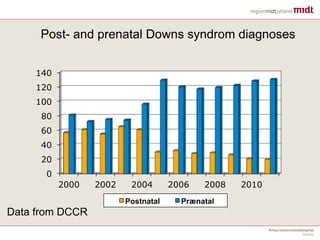
Post- and prenatal Downs syndrom diagnoses
0
20
40
60
80
100
120
140
2000 2002 2004 2006 2008 2010
Postnatal Prænatal
Data from DCCR
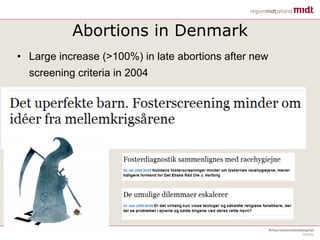
Abortions in Denmark
•  Large increase (>100%) in late abortions after new
screening criteria in 2004
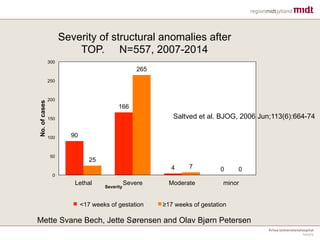
Mette Svane Bech, Jette Sørensen and Olav Bjørn Petersen
90
166
4 0
25
265
7 0
0
50
100
150
200
250
300
Lethal Severe Moderate minor
No.ofcases
Severity
Severity of structural anomalies after
TOP. N=557, 2007-2014
<17 weeks of gestation ≥17 weeks of gestation
Saltved et al. BJOG, 2006 Jun;113(6):664-74
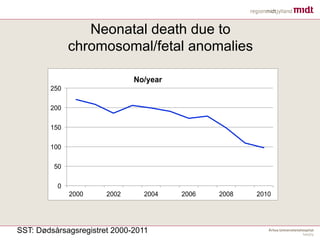
Neonatal death due to
chromosomal/fetal anomalies
0
50
100
150
200
250
2000 2002 2004 2006 2008 2010
No/year
SST: Dødsårsagsregistret 2000-2011
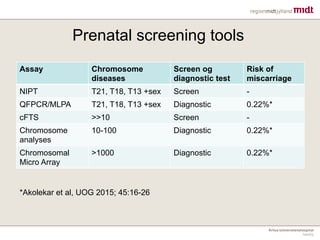
Prenatal screening tools
Assay Chromosome
diseases
Screen og
diagnostic test
Risk of
miscarriage
NIPT T21, T18, T13 +sex Screen -
QFPCR/MLPA T21, T18, T13 +sex Diagnostic 0.22%*
cFTS >>10 Screen -
Chromosome
analyses
10-100 Diagnostic 0.22%*
Chromosomal
Micro Array
>1000 Diagnostic 0.22%*
*Akolekar et al, UOG 2015; 45:16-26
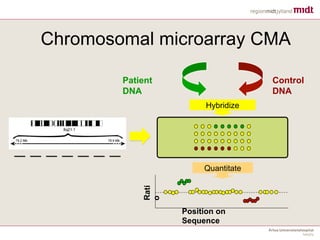
Chromosomal microarray CMA
Patient
DNA
Control
DNA
Rati
o
Position on
Sequence
Hybridize
Quantitate
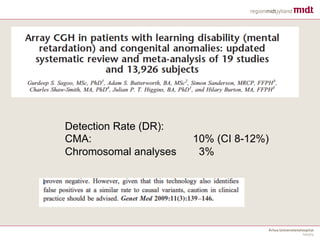
Detection Rate (DR):
CMA: 10% (CI 8-12%)
Chromosomal analyses 3%
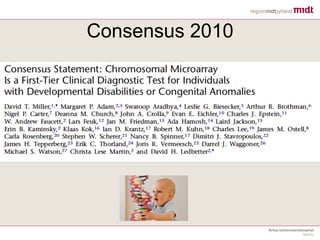
Consensus 2010
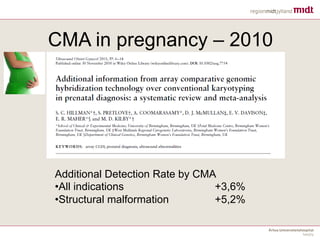
CMA in pregnancy – 2010
Additional Detection Rate by CMA
• All indications +3,6%
• Structural malformation +5,2%
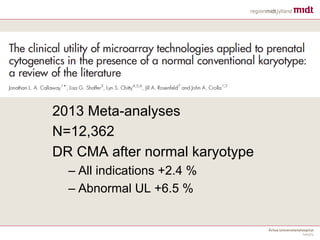
2013 Meta-analyses
N=12,362
DR CMA after normal karyotype
– All indications +2.4 %
– Abnormal UL +6.5 %
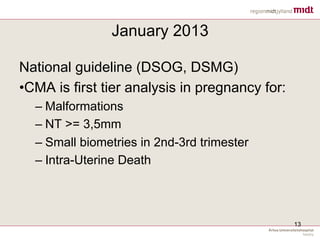
January 2013
National guideline (DSOG, DSMG)
• CMA is first tier analysis in pregnancy for:
– Malformations
– NT >= 3,5mm
– Small biometries in 2nd-3rd trimester
– Intra-Uterine Death
13
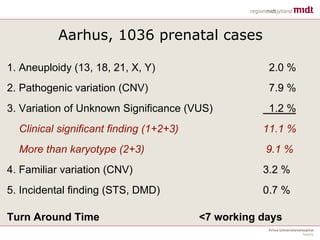
Aarhus, 1036 prenatal cases
1. Aneuploidy (13, 18, 21, X, Y) 2.0 %
2. Pathogenic variation (CNV) 7.9 %
3. Variation of Unknown Significance (VUS) 1.2 %
Clinical significant finding (1+2+3) 11.1 %
More than karyotype (2+3) 9.1 %
4. Familiar variation (CNV) 3.2 %
5. Incidental finding (STS, DMD) 0.7 %
Turn Around Time <7 working days
15
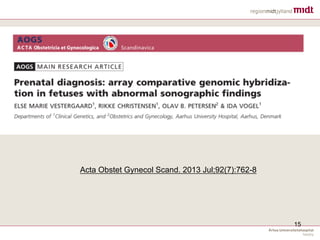
Acta Obstet Gynecol Scand. 2013 Jul;92(7):762-8
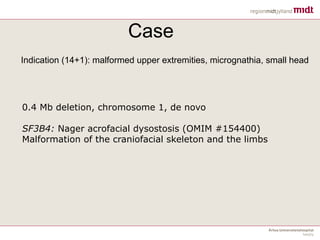
Case
Indication (14+1): malformed upper extremities, micrognathia, small head
0.4 Mb deletion, chromosome 1, de novo
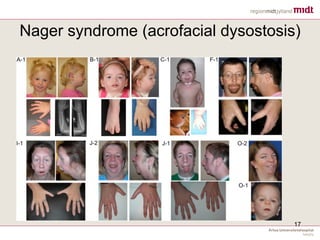
SF3B4: Nager acrofacial dysostosis (OMIM #154400)
Malformation of the craniofacial skeleton and the limbs
Nager syndrome (acrofacial dysostosis)
17
Case
•  Facial cleft w 19
•  No other malformations.
•  Tertiary scan by fetal
medicin expert
•  aCGH result after 4 days is
normal
•  MAJORITY of cases (85%)
”In the absence of associated anomalies, chromosomal
defects were found prenatally in CLP (3.9%)”
Maarse W et al. J Med Genet. 2012.
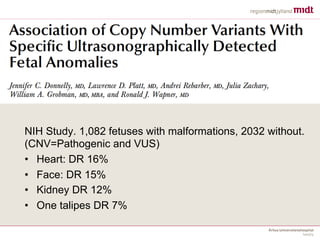
NIH Study. 1,082 fetuses with malformations, 2032 without.
(CNV=Pathogenic and VUS)
•  Heart: DR 16%
•  Face: DR 15%
•  Kidney DR 12%
•  One talipes DR 7%
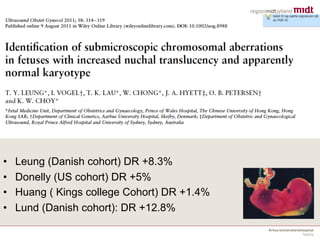
•  Leung (Danish cohort) DR +8.3%
•  Donelly (US cohort) DR +5%
•  Huang ( Kings college Cohort) DR +1.4%
•  Lund (Danish cohort): DR +12.8%
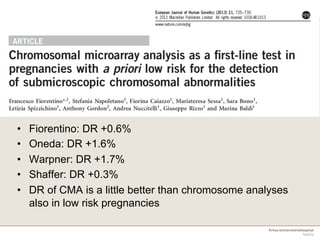
Low risk
•  Fiorentino: DR +0.6%
•  Oneda: DR +1.6%
•  Warpner: DR +1.7%
•  Shaffer: DR +0.3%
•  DR of CMA is a little better than chromosome analyses
also in low risk pregnancies
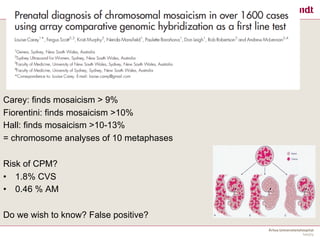
Carey: finds mosaicism > 9%
Fiorentini: finds mosaicism >10%
Hall: finds mosaicism >10-13%
= chromosome analyses of 10 metaphases
Risk of CPM?
•  1.8% CVS
•  0.46 % AM
Do we wish to know? False positive?
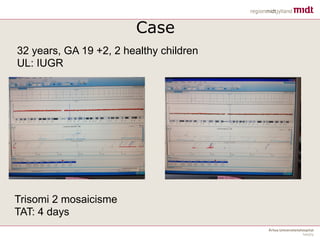
32 years, GA 19 +2, 2 healthy children
UL: IUGR
Trisomi 2 mosaicisme
TAT: 4 days
Case
”Gold standard” chromosomal
analyses
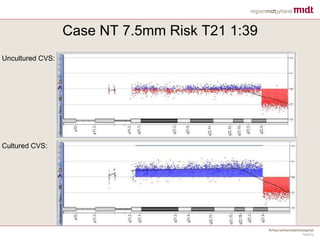
Case NT 7.5mm Risk T21 1:39
Uncultured CVS:
Cultured CVS:
26
Wobbly legs when conselling in difficult CMA
cases (VUS)?
27
•  Based on surveys completed by 193 prenatal genetic counselors, we
found that when there is an uncertain CMA result, only 59% would be
comfortable providing genetic counseling and only 43% would be
comfortable helping a patient make a decision about pregnancy
termination.
•  Being less comfortable was associated with seeing fewer patients having
prenatal CMA testing.
Blog By Dr Cohen after Warpner et al. N Engl J
Med 2012; 367;23:2175-2183
”One can only imagine the anxiety we would cause
in our patients undergoing relatively routine testing
when we informed them that their baby has a
chromosomal abnormality, but it may or may not be
normal.
I can just hear myself telling a healthy 37 year old
woman, “Your guess is as good as mine!”
Stina Lou, PhD 2014, AU, Denmark
Title: Exploring how clinicians, pregnant women, and their partners
manage and negotiate a high risk screening result for chromosomal
abnormality in the fetus
Conclusions:
•  Informed choice is insufficient
•  Care is necessary
•  Worry can be managed
•  Anxiety decrease
Stina continued
•  Sharing uncertainty democratizes the
relationship between patient and doctor
Is this the key to how we manage
variants of uncertain significance?
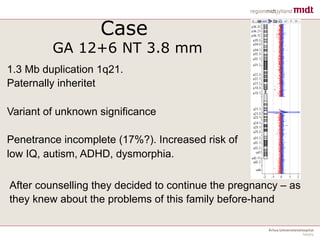
Case
GA 12+6 NT 3.8 mm
1.3 Mb duplication 1q21.
Paternally inheritet
Variant of unknown significance
Penetrance incomplete (17%?). Increased risk of
low IQ, autism, ADHD, dysmorphia.
After counselling they decided to continue the pregnancy – as
they knew about the problems of this family before-hand
!
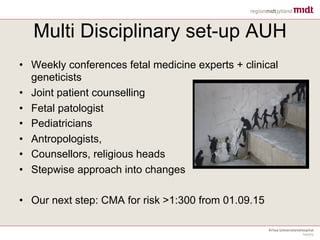
Multi Disciplinary set-up AUH
•  Weekly conferences fetal medicine experts + clinical
geneticists
•  Joint patient counselling
•  Fetal patologist
•  Pediatricians
•  Antropologists,
•  Counsellors, religious heads
•  Stepwise approach into changes
•  Our next step: CMA for risk >1:300 from 01.09.15
AUH Conclusions on CMA
•  CMA finds aneuploidy, microdeletions and
microduplications.
•  Detection rate for CMA>>>> chromosome analysis >> NIPT
•  CMA is THE analysis of choice for high risk individuals
•  Few incidental findings
•  Meaningful and manageable
•  Much shorter turn around time (<7 days, median 4 days)
•  Experience helps! Centralize to large tertiary centers
•  MUCH more important to implement CMA than NIPT - NOW
Dr Cohens blog revisited
It is easy to see that this is the beginning of a revolution in
Medicine. It is likely that within a few years, we will combine
NIPT with gene-sequencing to cause an explosion in the
world of prenatal diagnosis.
Here will lie the potential to prevent more disease than
vaccination and even the possibility of extending the average
human life span.
These are exciting times and maternal-fetal medicine
specialists would do well to hear the drums and to start
expanding their training in and knowledge of human genetics
in anticipation of this great medical revolution.
Comment on Warpner. N Engl J Med 2012; 367;23:2175-2183
Thanks!
•  Else Marie Vestergaard, Rikke
Christensen, Dept Clinical
genetics, AUH
•  Olav Bjørn Petersen,
Departments of OBGYN, AUH
+ Fetal medicine experts in
region
•  Mette Svane Bech, Medical
student
•  Helle Hørby, priest
•  Mette Ramsing, pathology
•  Stina Lou Fleron, and Morten
Deleuran Therkildsen,
antropologists,
•  Center of rare Diseases, AUH
•  Jon Hyett, Sydney
•  Cardiologists
•  Pediatricians
•  And more…

Ida vogel nnfm 150415

  • 1.
    Danish experiences withChromosomal Micro-Array (CMA) in a prenatal setting Ida Vogel MD, PhD, Clinical Genetics, Aarhus University Hospital Denmark idavogel@rm.dk
  • 2.
    Since 2004- All Danishwomen are offered: •  combined First Trimester Screening (93%) •  Double test (PAPP-A/fβhCG) •  NT scan •  Age •  Anomaly scan (96%)
  • 3.
    Post- and prenatalDowns syndrom diagnoses 0 20 40 60 80 100 120 140 2000 2002 2004 2006 2008 2010 Postnatal Prænatal Data from DCCR
  • 4.
    Abortions in Denmark • Large increase (>100%) in late abortions after new screening criteria in 2004
  • 5.
    Mette Svane Bech,Jette Sørensen and Olav Bjørn Petersen 90 166 4 0 25 265 7 0 0 50 100 150 200 250 300 Lethal Severe Moderate minor No.ofcases Severity Severity of structural anomalies after TOP. N=557, 2007-2014 <17 weeks of gestation ≥17 weeks of gestation Saltved et al. BJOG, 2006 Jun;113(6):664-74
  • 6.
    Neonatal death dueto chromosomal/fetal anomalies 0 50 100 150 200 250 2000 2002 2004 2006 2008 2010 No/year SST: Dødsårsagsregistret 2000-2011
  • 7.
    Prenatal screening tools AssayChromosome diseases Screen og diagnostic test Risk of miscarriage NIPT T21, T18, T13 +sex Screen - QFPCR/MLPA T21, T18, T13 +sex Diagnostic 0.22%* cFTS >>10 Screen - Chromosome analyses 10-100 Diagnostic 0.22%* Chromosomal Micro Array >1000 Diagnostic 0.22%* *Akolekar et al, UOG 2015; 45:16-26
  • 8.
  • 9.
    Detection Rate (DR): CMA:10% (CI 8-12%) Chromosomal analyses 3%
  • 10.
  • 11.
    CMA in pregnancy– 2010 Additional Detection Rate by CMA • All indications +3,6% • Structural malformation +5,2%
  • 12.
    2013 Meta-analyses N=12,362 DR CMAafter normal karyotype – All indications +2.4 % – Abnormal UL +6.5 %
  • 13.
    January 2013 National guideline(DSOG, DSMG) • CMA is first tier analysis in pregnancy for: – Malformations – NT >= 3,5mm – Small biometries in 2nd-3rd trimester – Intra-Uterine Death 13
  • 14.
    Aarhus, 1036 prenatalcases 1. Aneuploidy (13, 18, 21, X, Y) 2.0 % 2. Pathogenic variation (CNV) 7.9 % 3. Variation of Unknown Significance (VUS) 1.2 % Clinical significant finding (1+2+3) 11.1 % More than karyotype (2+3) 9.1 % 4. Familiar variation (CNV) 3.2 % 5. Incidental finding (STS, DMD) 0.7 % Turn Around Time <7 working days
  • 15.
    15 Acta Obstet GynecolScand. 2013 Jul;92(7):762-8
  • 16.
    Case Indication (14+1): malformedupper extremities, micrognathia, small head 0.4 Mb deletion, chromosome 1, de novo SF3B4: Nager acrofacial dysostosis (OMIM #154400) Malformation of the craniofacial skeleton and the limbs
  • 17.
  • 18.
    Case •  Facial cleftw 19 •  No other malformations. •  Tertiary scan by fetal medicin expert •  aCGH result after 4 days is normal •  MAJORITY of cases (85%) ”In the absence of associated anomalies, chromosomal defects were found prenatally in CLP (3.9%)” Maarse W et al. J Med Genet. 2012.
  • 19.
    NIH Study. 1,082fetuses with malformations, 2032 without. (CNV=Pathogenic and VUS) •  Heart: DR 16% •  Face: DR 15% •  Kidney DR 12% •  One talipes DR 7%
  • 20.
    •  Leung (Danishcohort) DR +8.3% •  Donelly (US cohort) DR +5% •  Huang ( Kings college Cohort) DR +1.4% •  Lund (Danish cohort): DR +12.8%
  • 21.
    Low risk •  Fiorentino:DR +0.6% •  Oneda: DR +1.6% •  Warpner: DR +1.7% •  Shaffer: DR +0.3% •  DR of CMA is a little better than chromosome analyses also in low risk pregnancies
  • 22.
    Carey: finds mosaicism> 9% Fiorentini: finds mosaicism >10% Hall: finds mosaicism >10-13% = chromosome analyses of 10 metaphases Risk of CPM? •  1.8% CVS •  0.46 % AM Do we wish to know? False positive?
  • 23.
    32 years, GA19 +2, 2 healthy children UL: IUGR Trisomi 2 mosaicisme TAT: 4 days Case
  • 24.
  • 25.
    Case NT 7.5mmRisk T21 1:39 Uncultured CVS: Cultured CVS:
  • 26.
  • 27.
    Wobbly legs whenconselling in difficult CMA cases (VUS)? 27 •  Based on surveys completed by 193 prenatal genetic counselors, we found that when there is an uncertain CMA result, only 59% would be comfortable providing genetic counseling and only 43% would be comfortable helping a patient make a decision about pregnancy termination. •  Being less comfortable was associated with seeing fewer patients having prenatal CMA testing.
  • 28.
    Blog By DrCohen after Warpner et al. N Engl J Med 2012; 367;23:2175-2183 ”One can only imagine the anxiety we would cause in our patients undergoing relatively routine testing when we informed them that their baby has a chromosomal abnormality, but it may or may not be normal. I can just hear myself telling a healthy 37 year old woman, “Your guess is as good as mine!”
  • 29.
    Stina Lou, PhD2014, AU, Denmark Title: Exploring how clinicians, pregnant women, and their partners manage and negotiate a high risk screening result for chromosomal abnormality in the fetus Conclusions: •  Informed choice is insufficient •  Care is necessary •  Worry can be managed •  Anxiety decrease
  • 30.
    Stina continued •  Sharinguncertainty democratizes the relationship between patient and doctor Is this the key to how we manage variants of uncertain significance?
  • 31.
    Case GA 12+6 NT3.8 mm 1.3 Mb duplication 1q21. Paternally inheritet Variant of unknown significance Penetrance incomplete (17%?). Increased risk of low IQ, autism, ADHD, dysmorphia. After counselling they decided to continue the pregnancy – as they knew about the problems of this family before-hand !
  • 32.
    Multi Disciplinary set-upAUH •  Weekly conferences fetal medicine experts + clinical geneticists •  Joint patient counselling •  Fetal patologist •  Pediatricians •  Antropologists, •  Counsellors, religious heads •  Stepwise approach into changes •  Our next step: CMA for risk >1:300 from 01.09.15
  • 33.
    AUH Conclusions onCMA •  CMA finds aneuploidy, microdeletions and microduplications. •  Detection rate for CMA>>>> chromosome analysis >> NIPT •  CMA is THE analysis of choice for high risk individuals •  Few incidental findings •  Meaningful and manageable •  Much shorter turn around time (<7 days, median 4 days) •  Experience helps! Centralize to large tertiary centers •  MUCH more important to implement CMA than NIPT - NOW
  • 34.
    Dr Cohens blogrevisited It is easy to see that this is the beginning of a revolution in Medicine. It is likely that within a few years, we will combine NIPT with gene-sequencing to cause an explosion in the world of prenatal diagnosis. Here will lie the potential to prevent more disease than vaccination and even the possibility of extending the average human life span. These are exciting times and maternal-fetal medicine specialists would do well to hear the drums and to start expanding their training in and knowledge of human genetics in anticipation of this great medical revolution. Comment on Warpner. N Engl J Med 2012; 367;23:2175-2183
  • 35.
    Thanks! •  Else MarieVestergaard, Rikke Christensen, Dept Clinical genetics, AUH •  Olav Bjørn Petersen, Departments of OBGYN, AUH + Fetal medicine experts in region •  Mette Svane Bech, Medical student •  Helle Hørby, priest •  Mette Ramsing, pathology •  Stina Lou Fleron, and Morten Deleuran Therkildsen, antropologists, •  Center of rare Diseases, AUH •  Jon Hyett, Sydney •  Cardiologists •  Pediatricians •  And more…