ICT Engineering Work Flow &
Scheduling
M Hafiz | July | 2024
The Vital Pulse
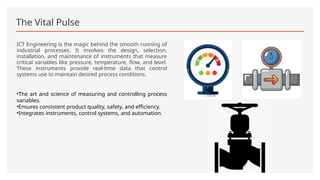
ICT Engineering is the magic behind the smooth running of
industrial processes. It involves the design, selection,
installation, and maintenance of instruments that measure
critical variables like pressure, temperature, flow, and level.
These instruments provide real-time data that control
systems use to maintain desired process conditions.
•The art and science of measuring and controlling process
variables.
•Ensures consistent product quality, safety, and efficiency.
•Integrates instruments, control systems, and automation.
The Work Flow - Overview
The I&C Engineering Section workflow follows a well-
defined process.
Key stages include:
•Project Initiation
•Design
•Procurement
•Construction
•Commissioning
Refer the handout given.
Project Initiation
The project initiation stage establishes the project
foundation.
Key activities include:
•Defining project scope and objectives
•Identifying stakeholders and their needs
•Developing a high-level project schedule
Design
The design stage translates project requirements into
technical specifications.
Key activities include:
•Developing detailed control system architecture
•Specifying instruments and control loops
•Creating control system logic and configuration
Procurement
The procurement stage focuses on acquiring the necessary
equipment and materials.
Key activities include:
•Developing bid packages and sending them to vendors
•Evaluating vendor proposals and selecting qualified
suppliers
•Placing purchase orders for equipment and materials
Construction
The construction stage involves physically installing the
control system.
Key activities include:
•Installing instruments and control panels in the field
•Running cables and wiring to connect instruments and
controllers
•Performing initial system checks and calibrations
Construction
The construction stage involves physically installing the
control system.
Key activities include:
•Installing instruments and control panels in the field
•Running cables and wiring to connect instruments and
controllers
•Performing initial system checks and calibrations
Commissioning
The commissioning stage verifies and validates the entire
control system.
Key activities include:
•Testing and tuning control loops for optimal performance
•Integrating the control system with the process plant
•Training operators on system operation and maintenance
Schedule
The schedule will outline key milestones for each stage of the
workflow (Project Initiation, Design, Procurement, Construction,
Commissioning).
Consider including the following elements:
•A timeline with a clear start and end date for the entire project.
•Specific deadlines for deliverables and milestones within each
workflow stage.
•Dependencies between stages (e.g., Design needs to be
completed before Procurement can begin).
•Resource allocation (indicating when specific personnel are
needed for each stage).
•For a high-level overview, highlight major milestones.
•For a more technical audience, include more granular details with
specific dates and durations.
Refer to the handout given
Short Quiz – 10 + 30 minutes
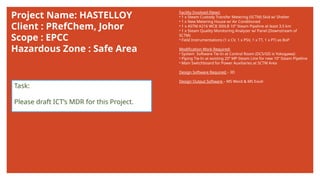
Project Name: HASTELLOY
Client : PRefChem, Johor
Scope : EPCC
Hazardous Zone : Safe Area
Facility Involved (New):
• 1 x Steam Custody Transfer Metering (SCTM) Skid w/ Shelter
• 1 x New Metering House w/ Air Conditioned
• 1 x ASTM A216 WCB 300LB 10” Steam Pipeline at least 3.5 km
• 1 x Steam Quality Monitoring Analyzer w/ Panel (Downstream of
SCTM)
• Field Instrumentations (1 x CV, 1 x PSV, 1 x TT, 1 x PT) as BoP
Modification Work Required:
• System Software Tie-In at Control Room (DCS/SIS is Yokogawa)
• Piping Tie-In at existing 20” MP Steam Line for new 10” Steam Pipeline
• Main Switchboard for Power Auxiliaries at SCTM Area
Design Software Required – 3D
Design Output Software – MS Word & MS Excel
Task:
Please draft ICT’s MDR for this Project.
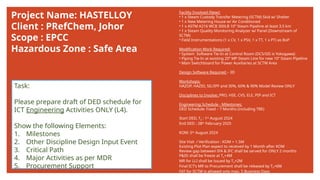
Project Name: HASTELLOY
Client : PRefChem, Johor
Scope : EPCC
Hazardous Zone : Safe Area
Facility Involved (New):
• 1 x Steam Custody Transfer Metering (SCTM) Skid w/ Shelter
• 1 x New Metering House w/ Air Conditioned
• 1 x ASTM A216 WCB 300LB 10” Steam Pipeline at least 3.5 km
• 1 x Steam Quality Monitoring Analyzer w/ Panel (Downstream of
SCTM)
• Field Instrumentations (1 x CV, 1 x PSV, 1 x TT, 1 x PT) as BoP
Modification Work Required:
• System Software Tie-In at Control Room (DCS/SIS is Yokogawa)
• Piping Tie-In at existing 20” MP Steam Line for new 10” Steam Pipeline
• Main Switchboard for Power Auxiliaries at SCTM Area
Design Software Required – 3D
Workshops:
HAZOP, HAZID, SIL/IPF and 30%, 60% & 90% Model Review ONLY
Disciplines to Involve: PRO, HSE, CVS, ELE, PIP and ICT
Engineering Schedule - Milestones:
DED Schedule: Fixed – 7 Months (including TBE)
Start DED, T0 : 1st
August 2024
End DED : 28th
February 2025
KOM: 5th
August 2024
Site Visit / Verification : KOM + 1.5M
Existing Plot Plan expect to received by 1 Month after KOM
Review gap between IFA & IFC shall be served for ONLY 2 months
P&ID shall be freeze at T0+4M
MR for LLI shall be issued by T0+2M
Final ICT’s MR to Procurement shall be released by T0+6M
FAT for SCTM is allowed only max. 5 Business Days
Task:
Please prepare draft of DED schedule for
ICT Engineering Activities ONLY (L4).
Show the following Elements:
1. Milestones
2. Other Discipline Design Input Event
3. Critical Path
4. Major Activities as per MDR
5. Procurement Support

ICT Engineering Work Process with Short Quiz.pptx

  • 1.
    ICT Engineering WorkFlow & Scheduling M Hafiz | July | 2024
  • 2.
    The Vital Pulse ICTEngineering is the magic behind the smooth running of industrial processes. It involves the design, selection, installation, and maintenance of instruments that measure critical variables like pressure, temperature, flow, and level. These instruments provide real-time data that control systems use to maintain desired process conditions. •The art and science of measuring and controlling process variables. •Ensures consistent product quality, safety, and efficiency. •Integrates instruments, control systems, and automation.
  • 3.
    The Work Flow- Overview The I&C Engineering Section workflow follows a well- defined process. Key stages include: •Project Initiation •Design •Procurement •Construction •Commissioning Refer the handout given.
  • 4.
    Project Initiation The projectinitiation stage establishes the project foundation. Key activities include: •Defining project scope and objectives •Identifying stakeholders and their needs •Developing a high-level project schedule
  • 5.
    Design The design stagetranslates project requirements into technical specifications. Key activities include: •Developing detailed control system architecture •Specifying instruments and control loops •Creating control system logic and configuration
  • 6.
    Procurement The procurement stagefocuses on acquiring the necessary equipment and materials. Key activities include: •Developing bid packages and sending them to vendors •Evaluating vendor proposals and selecting qualified suppliers •Placing purchase orders for equipment and materials
  • 7.
    Construction The construction stageinvolves physically installing the control system. Key activities include: •Installing instruments and control panels in the field •Running cables and wiring to connect instruments and controllers •Performing initial system checks and calibrations
  • 8.
    Construction The construction stageinvolves physically installing the control system. Key activities include: •Installing instruments and control panels in the field •Running cables and wiring to connect instruments and controllers •Performing initial system checks and calibrations
  • 9.
    Commissioning The commissioning stageverifies and validates the entire control system. Key activities include: •Testing and tuning control loops for optimal performance •Integrating the control system with the process plant •Training operators on system operation and maintenance
  • 10.
    Schedule The schedule willoutline key milestones for each stage of the workflow (Project Initiation, Design, Procurement, Construction, Commissioning). Consider including the following elements: •A timeline with a clear start and end date for the entire project. •Specific deadlines for deliverables and milestones within each workflow stage. •Dependencies between stages (e.g., Design needs to be completed before Procurement can begin). •Resource allocation (indicating when specific personnel are needed for each stage). •For a high-level overview, highlight major milestones. •For a more technical audience, include more granular details with specific dates and durations. Refer to the handout given
  • 11.
    Short Quiz –10 + 30 minutes
  • 12.
    Project Name: HASTELLOY Client: PRefChem, Johor Scope : EPCC Hazardous Zone : Safe Area Facility Involved (New): • 1 x Steam Custody Transfer Metering (SCTM) Skid w/ Shelter • 1 x New Metering House w/ Air Conditioned • 1 x ASTM A216 WCB 300LB 10” Steam Pipeline at least 3.5 km • 1 x Steam Quality Monitoring Analyzer w/ Panel (Downstream of SCTM) • Field Instrumentations (1 x CV, 1 x PSV, 1 x TT, 1 x PT) as BoP Modification Work Required: • System Software Tie-In at Control Room (DCS/SIS is Yokogawa) • Piping Tie-In at existing 20” MP Steam Line for new 10” Steam Pipeline • Main Switchboard for Power Auxiliaries at SCTM Area Design Software Required – 3D Design Output Software – MS Word & MS Excel Task: Please draft ICT’s MDR for this Project.
  • 13.
    Project Name: HASTELLOY Client: PRefChem, Johor Scope : EPCC Hazardous Zone : Safe Area Facility Involved (New): • 1 x Steam Custody Transfer Metering (SCTM) Skid w/ Shelter • 1 x New Metering House w/ Air Conditioned • 1 x ASTM A216 WCB 300LB 10” Steam Pipeline at least 3.5 km • 1 x Steam Quality Monitoring Analyzer w/ Panel (Downstream of SCTM) • Field Instrumentations (1 x CV, 1 x PSV, 1 x TT, 1 x PT) as BoP Modification Work Required: • System Software Tie-In at Control Room (DCS/SIS is Yokogawa) • Piping Tie-In at existing 20” MP Steam Line for new 10” Steam Pipeline • Main Switchboard for Power Auxiliaries at SCTM Area Design Software Required – 3D Workshops: HAZOP, HAZID, SIL/IPF and 30%, 60% & 90% Model Review ONLY Disciplines to Involve: PRO, HSE, CVS, ELE, PIP and ICT Engineering Schedule - Milestones: DED Schedule: Fixed – 7 Months (including TBE) Start DED, T0 : 1st August 2024 End DED : 28th February 2025 KOM: 5th August 2024 Site Visit / Verification : KOM + 1.5M Existing Plot Plan expect to received by 1 Month after KOM Review gap between IFA & IFC shall be served for ONLY 2 months P&ID shall be freeze at T0+4M MR for LLI shall be issued by T0+2M Final ICT’s MR to Procurement shall be released by T0+6M FAT for SCTM is allowed only max. 5 Business Days Task: Please prepare draft of DED schedule for ICT Engineering Activities ONLY (L4). Show the following Elements: 1. Milestones 2. Other Discipline Design Input Event 3. Critical Path 4. Major Activities as per MDR 5. Procurement Support

Editor's Notes

  • #2 In this presentation, we will delve into the Instrumentation and Control System Engineering Section's workflow and schedule. We'll explore the various stages involved in bringing an I&C system from conception to implementation, along with the typical timeframe associated with each phase. By understanding this process, we can ensure efficient project execution and successful system deployment.
  • #3 The I&C Engineering Section's workflow is a structured process that ensures a systematic approach to control system development. Each stage has its own deliverables and milestones, and successful completion of one stage paves the way for the next.
  • #4 Project initiation sets the stage for the entire I&C engineering effort. Here, we clearly define what the project aims to achieve, who the key players are, and a preliminary timeline for completion. This initial phase ensures everyone involved is on the same page.
  • #5 The design stage is where the project comes to life on paper, or more precisely, on computer screens. Here, engineers translate the needs identified during initiation into a detailed technical plan for the control system. This plan outlines the specific instruments, control loops, and logic required to achieve the desired process outcomes.
  • #6 Once the technical specifications are finalized, the procurement stage kicks in. Here, the I&C team identifies qualified vendors, solicits bids for equipment and materials, and selects the best options based on factors like price, quality, and delivery timeliness.
  • #7 Once the technical specifications are finalized, the procurement stage kicks in. Here, the I&C team identifies qualified vendors, solicits bids for equipment and materials, and selects the best options based on factors like price, quality, and delivery timeliness.
  • #8 The construction stage brings the designed control system to life in the physical plant. Here, technicians and engineers work together to install the instruments, control panels, and cabling as per the design specifications. They also perform preliminary checks and calibrations to ensure the system functions as intended.
  • #9 The commissioning stage is the final hurdle before the control system is handed over for plant operation. Here, engineers perform comprehensive testing to ensure all components function properly and the system integrates seamlessly with the process. Additionally, operators receive training to ensure they can effectively operate and maintain the control system.
  • #10 A well-defined schedule provides a roadmap for the entire I&C engineering effort. It ensures everyone involved understands the timeline, keeps the project on track, and facilitates resource allocation effectively. You can adjust the level of detail based on your audience's needs.