.
.
.
.
.
.
.
.
.
.
.
.
.
.
.
.
.
.
.
.
.
.
.
.
.
.
.
.
.
.
.
.
.
.
.
.
.
.
.
.
A Dimensional Model of Service Design
Toward Utilizing Public Transportation Open Data
ICSESS2017, Beijing, China
Toshihiko Yamakami
IoT Business Unit, ACCESS
Toshihiko.Yamakami@access-company.com
2017/11
Toshihiko Yamakami (ACCESS Confidential)A Dimensional Model of Service Design Toward Utilizing Public Transportation Open Data2017/11 1 / 18
.
.
.
.
.
.
.
.
.
.
.
.
.
.
.
.
.
.
.
.
.
.
.
.
.
.
.
.
.
.
.
.
.
.
.
.
.
.
.
.
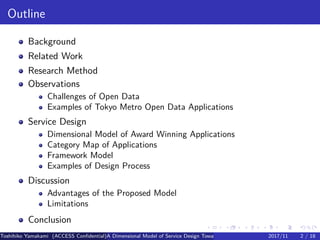
Outline
Background
Related Work
Research Method
Observations
Challenges of Open Data
Examples of Tokyo Metro Open Data Applications
Service Design
Dimensional Model of Award Winning Applications
Category Map of Applications
Framework Model
Examples of Design Process
Discussion
Advantages of the Proposed Model
Limitations
Conclusion
Toshihiko Yamakami (ACCESS Confidential)A Dimensional Model of Service Design Toward Utilizing Public Transportation Open Data2017/11 2 / 18
.
.
.
.
.
.
.
.
.
.
.
.
.
.
.
.
.
.
.
.
.
.
.
.
.
.
.
.
.
.
.
.
.
.
.
.
.
.
.
.
Background
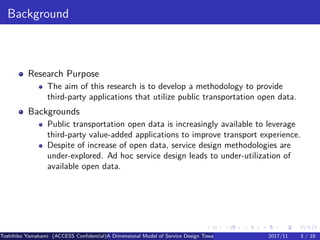
Research Purpose
The aim of this research is to develop a methodology to provide
third-party applications that utilize public transportation open data.
Backgrounds
Public transportation open data is increasingly available to leverage
third-party value-added applications to improve transport experience.
Despite of increase of open data, service design methodologies are
under-explored. Ad hoc service design leads to under-utilization of
available open data.
Toshihiko Yamakami (ACCESS Confidential)A Dimensional Model of Service Design Toward Utilizing Public Transportation Open Data2017/11 3 / 18
.
.
.
.
.
.
.
.
.
.
.
.
.
.
.
.
.
.
.
.
.
.
.
.
.
.
.
.
.
.
.
.
.
.
.
.
.
.
.
.
Related Work
a) open data in e-Government: provenance of government open data
[Zhai17], open government data in Mexico [Valle-Cruz16], open
government data in Shenzhen [Hu16]
b) utilization of transportation data: open data policies of US and EU
[Bourgois14]. open government data initiatives in northern and
southern Europe [Gomes14], urban structure analysis using smart card
data of public transportation [Maeda16], urban planning using phone
data and transportation open data [Holleczek14].
c) application software of transportation open data: a real-time high
volume transportation application in Dublin [Bouillet11], a route
planning application to show crowdedness in Belgium [Vandewiele17]
Past research did not address the lack of methodologies of open data
service design. The originality of this paper lies in its development of
a dimensional methodology for service design for public transportation
open data.
Toshihiko Yamakami (ACCESS Confidential)A Dimensional Model of Service Design Toward Utilizing Public Transportation Open Data2017/11 4 / 18
.
.
.
.
.
.
.
.
.
.
.
.
.
.
.
.
.
.
.
.
.
.
.
.
.
.
.
.
.
.
.
.
.
.
.
.
.
.
.
.
Research Method
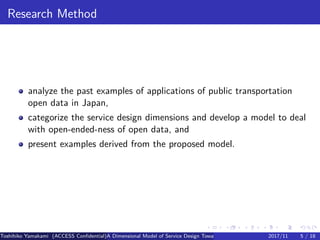
analyze the past examples of applications of public transportation
open data in Japan,
categorize the service design dimensions and develop a model to deal
with open-ended-ness of open data, and
present examples derived from the proposed model.
Toshihiko Yamakami (ACCESS Confidential)A Dimensional Model of Service Design Toward Utilizing Public Transportation Open Data2017/11 5 / 18
.
.
.
.
.
.
.
.
.
.
.
.
.
.
.
.
.
.
.
.
.
.
.
.
.
.
.
.
.
.
.
.
.
.
.
.
.
.
.
.
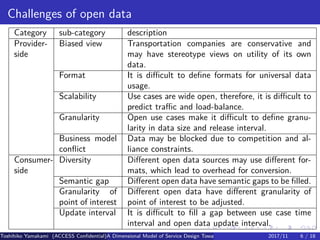
Challenges of open data
Category sub-category description
Provider-
side
Biased view Transportation companies are conservative and
may have stereotype views on utility of its own
data.
Format It is difficult to define formats for universal data
usage.
Scalability Use cases are wide open, therefore, it is difficult to
predict traffic and load-balance.
Granularity Open use cases make it difficult to define granu-
larity in data size and release interval.
Business model
conflict
Data may be blocked due to competition and al-
liance constraints.
Consumer-
side
Diversity Different open data sources may use different for-
mats, which lead to overhead for conversion.
Semantic gap Different open data have semantic gaps to be filled.
Granularity of
point of interest
Different open data have different granularity of
point of interest to be adjusted.
Update interval It is difficult to fill a gap between use case time
interval and open data update interval.
Toshihiko Yamakami (ACCESS Confidential)A Dimensional Model of Service Design Toward Utilizing Public Transportation Open Data2017/11 6 / 18
.
.
.
.
.
.
.
.
.
.
.
.
.
.
.
.
.
.
.
.
.
.
.
.
.
.
.
.
.
.
.
.
.
.
.
.
.
.
.
.
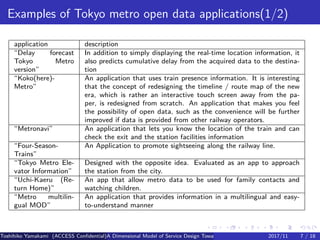
Examples of Tokyo metro open data applications(1/2)
application description
“Delay forecast
Tokyo Metro
version”
In addition to simply displaying the real-time location information, it
also predicts cumulative delay from the acquired data to the destina-
tion
“Koko(here)-
Metro”
An application that uses train presence information. It is interesting
that the concept of redesigning the timeline / route map of the new
era, which is rather an interactive touch screen away from the pa-
per, is redesigned from scratch. An application that makes you feel
the possibility of open data, such as the convenience will be further
improved if data is provided from other railway operators.
“Metronavi” An application that lets you know the location of the train and can
check the exit and the station facilities information
“Four-Season-
Trains”
An Application to promote sightseeing along the railway line.
“Tokyo Metro Ele-
vator Information”
Designed with the opposite idea. Evaluated as an app to approach
the station from the city.
“Uchi-Kaeru (Re-
turn Home)”
An app that allow metro data to be used for family contacts and
watching children.
“Metro multilin-
gual MOD”
An application that provides information in a multilingual and easy-
to-understand manner
Toshihiko Yamakami (ACCESS Confidential)A Dimensional Model of Service Design Toward Utilizing Public Transportation Open Data2017/11 7 / 18
.
.
.
.
.
.
.
.
.
.
.
.
.
.
.
.
.
.
.
.
.
.
.
.
.
.
.
.
.
.
.
.
.
.
.
.
.
.
.
.
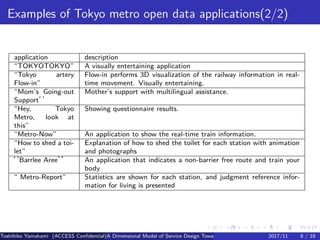
Examples of Tokyo metro open data applications(2/2)
application description
“TOKYOTOKYO” A visually entertaining application
“Tokyo artery
Flow-in”
Flow-in performs 3D visualization of the railway information in real-
time movement. Visually entertaining.
“Mom’s Going-out
Support’’
Mother’s support with multilingual assistance.
“Hey, Tokyo
Metro, look at
this”
Showing questionnaire results.
“Metro-Now” An application to show the real-time train information.
“How to shed a toi-
let”
Explanation of how to shed the toilet for each station with animation
and photographs
‘‘Barrlee Aree’’ An application that indicates a non-barrier free route and train your
body
“ Metro-Report” Statistics are shown for each station, and judgment reference infor-
mation for living is presented
Toshihiko Yamakami (ACCESS Confidential)A Dimensional Model of Service Design Toward Utilizing Public Transportation Open Data2017/11 8 / 18
.
.
.
.
.
.
.
.
.
.
.
.
.
.
.
.
.
.
.
.
.
.
.
.
.
.
.
.
.
.
.
.
.
.
.
.
.
.
.
.
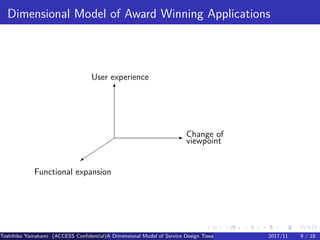
Dimensional Model of Award Winning Applications
-
6
+
Change of
viewpoint
User experience
Functional expansion
Toshihiko Yamakami (ACCESS Confidential)A Dimensional Model of Service Design Toward Utilizing Public Transportation Open Data2017/11 9 / 18
.
.
.
.
.
.
.
.
.
.
.
.
.
.
.
.
.
.
.
.
.
.
.
.
.
.
.
.
.
.
.
.
.
.
.
.
.
.
.
.
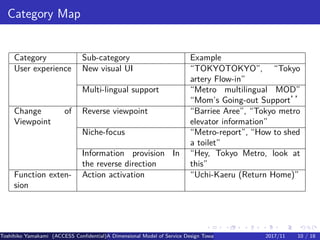
Category Map
Category Sub-category Example
User experience New visual UI “TOKYOTOKYO”, “Tokyo
artery Flow-in”
Multi-lingual support “Metro multilingual MOD”
“Mom’s Going-out Support’’
Change of
Viewpoint
Reverse viewpoint “Barriee Aree”, “Tokyo metro
elevator information”
Niche-focus “Metro-report”, “How to shed
a toilet”
Information provision In
the reverse direction
“Hey, Tokyo Metro, look at
this”
Function exten-
sion
Action activation “Uchi-Kaeru (Return Home)”
Toshihiko Yamakami (ACCESS Confidential)A Dimensional Model of Service Design Toward Utilizing Public Transportation Open Data2017/11 10 / 18
.
.
.
.
.
.
.
.
.
.
.
.
.
.
.
.
.
.
.
.
.
.
.
.
.
.
.
.
.
.
.
.
.
.
.
.
.
.
.
.
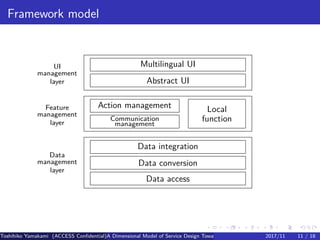
Framework model
Multilingual UI
Abstract UI
Action management
Communication
management
UI
management
layer
Feature
management
layer
Data
management
layer
Local
function
Data integration
Data conversion
Data access
Toshihiko Yamakami (ACCESS Confidential)A Dimensional Model of Service Design Toward Utilizing Public Transportation Open Data2017/11 11 / 18
.
.
.
.
.
.
.
.
.
.
.
.
.
.
.
.
.
.
.
.
.
.
.
.
.
.
.
.
.
.
.
.
.
.
.
.
.
.
.
.
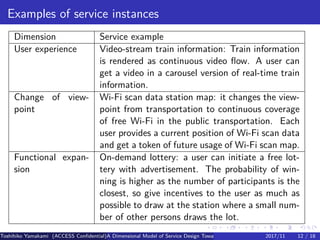
Examples of service instances
Dimension Service example
User experience Video-stream train information: Train information
is rendered as continuous video flow. A user can
get a video in a carousel version of real-time train
information.
Change of view-
point
Wi-Fi scan data station map: it changes the view-
point from transportation to continuous coverage
of free Wi-Fi in the public transportation. Each
user provides a current position of Wi-Fi scan data
and get a token of future usage of Wi-Fi scan map.
Functional expan-
sion
On-demand lottery: a user can initiate a free lot-
tery with advertisement. The probability of win-
ning is higher as the number of participants is the
closest, so give incentives to the user as much as
possible to draw at the station where a small num-
ber of other persons draws the lot.
Toshihiko Yamakami (ACCESS Confidential)A Dimensional Model of Service Design Toward Utilizing Public Transportation Open Data2017/11 12 / 18
.
.
.
.
.
.
.
.
.
.
.
.
.
.
.
.
.
.
.
.
.
.
.
.
.
.
.
.
.
.
.
.
.
.
.
.
.
.
.
.
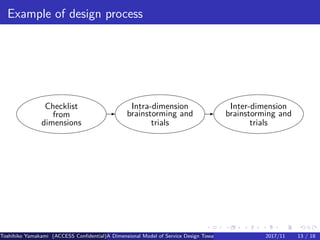
Example of design process
Checklist
from
dimensions
-
Intra-dimension
brainstorming and
trials
-
Inter-dimension
brainstorming and
trials
Toshihiko Yamakami (ACCESS Confidential)A Dimensional Model of Service Design Toward Utilizing Public Transportation Open Data2017/11 13 / 18
.
.
.
.
.
.
.
.
.
.
.
.
.
.
.
.
.
.
.
.
.
.
.
.
.
.
.
.
.
.
.
.
.
.
.
.
.
.
.
.
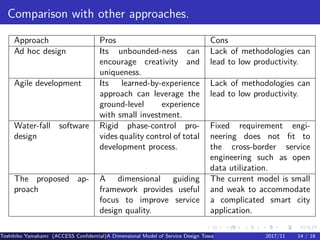
Comparison with other approaches.
Approach Pros Cons
Ad hoc design Its unbounded-ness can
encourage creativity and
uniqueness.
Lack of methodologies can
lead to low productivity.
Agile development Its learned-by-experience
approach can leverage the
ground-level experience
with small investment.
Lack of methodologies can
lead to low productivity.
Water-fall software
design
Rigid phase-control pro-
vides quality control of total
development process.
Fixed requirement engi-
neering does not fit to
the cross-border service
engineering such as open
data utilization.
The proposed ap-
proach
A dimensional guiding
framework provides useful
focus to improve service
design quality.
The current model is small
and weak to accommodate
a complicated smart city
application.
Toshihiko Yamakami (ACCESS Confidential)A Dimensional Model of Service Design Toward Utilizing Public Transportation Open Data2017/11 14 / 18
.
.
.
.
.
.
.
.
.
.
.
.
.
.
.
.
.
.
.
.
.
.
.
.
.
.
.
.
.
.
.
.
.
.
.
.
.
.
.
.
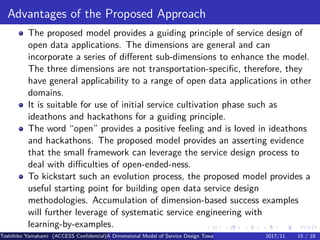
Advantages of the Proposed Approach
The proposed model provides a guiding principle of service design of
open data applications. The dimensions are general and can
incorporate a series of different sub-dimensions to enhance the model.
The three dimensions are not transportation-specific, therefore, they
have general applicability to a range of open data applications in other
domains.
It is suitable for use of initial service cultivation phase such as
ideathons and hackathons for a guiding principle.
The word “open” provides a positive feeling and is loved in ideathons
and hackathons. The proposed model provides an asserting evidence
that the small framework can leverage the service design process to
deal with difficulties of open-ended-ness.
To kickstart such an evolution process, the proposed model provides a
useful starting point for building open data service design
methodologies. Accumulation of dimension-based success examples
will further leverage of systematic service engineering with
learning-by-examples.
Toshihiko Yamakami (ACCESS Confidential)A Dimensional Model of Service Design Toward Utilizing Public Transportation Open Data2017/11 15 / 18
.
.
.
.
.
.
.
.
.
.
.
.
.
.
.
.
.
.
.
.
.
.
.
.
.
.
.
.
.
.
.
.
.
.
.
.
.
.
.
.
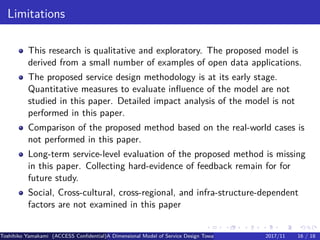
Limitations
This research is qualitative and exploratory. The proposed model is
derived from a small number of examples of open data applications.
The proposed service design methodology is at its early stage.
Quantitative measures to evaluate influence of the model are not
studied in this paper. Detailed impact analysis of the model is not
performed in this paper.
Comparison of the proposed method based on the real-world cases is
not performed in this paper.
Long-term service-level evaluation of the proposed method is missing
in this paper. Collecting hard-evidence of feedback remain for for
future study.
Social, Cross-cultural, cross-regional, and infra-structure-dependent
factors are not examined in this paper
Toshihiko Yamakami (ACCESS Confidential)A Dimensional Model of Service Design Toward Utilizing Public Transportation Open Data2017/11 16 / 18
.
.
.
.
.
.
.
.
.
.
.
.
.
.
.
.
.
.
.
.
.
.
.
.
.
.
.
.
.
.
.
.
.
.
.
.
.
.
.
.
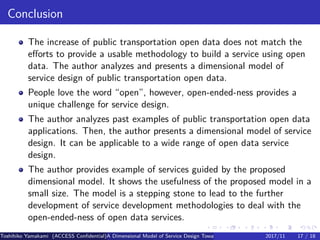
Conclusion
The increase of public transportation open data does not match the
efforts to provide a usable methodology to build a service using open
data. The author analyzes and presents a dimensional model of
service design of public transportation open data.
People love the word “open”, however, open-ended-ness provides a
unique challenge for service design.
The author analyzes past examples of public transportation open data
applications. Then, the author presents a dimensional model of service
design. It can be applicable to a wide range of open data service
design.
The author provides example of services guided by the proposed
dimensional model. It shows the usefulness of the proposed model in a
small size. The model is a stepping stone to lead to the further
development of service development methodologies to deal with the
open-ended-ness of open data services.
Toshihiko Yamakami (ACCESS Confidential)A Dimensional Model of Service Design Toward Utilizing Public Transportation Open Data2017/11 17 / 18
.
.
.
.
.
.
.
.
.
.
.
.
.
.
.
.
.
.
.
.
.
.
.
.
.
.
.
.
.
.
.
.
.
.
.
.
.
.
.
.
Thank You for Your Attention!
Questions?
Toshihiko Yamakami (ACCESS Confidential)A Dimensional Model of Service Design Toward Utilizing Public Transportation Open Data2017/11 18 / 18

A Dimensional Model of Service Design Toward Utilizing Public Transportation Open Data

  • 1.
    . . . . . . . . . . . . . . . . . . . . . . . . . . . . . . . . . . . . . . . . A Dimensional Modelof Service Design Toward Utilizing Public Transportation Open Data ICSESS2017, Beijing, China Toshihiko Yamakami IoT Business Unit, ACCESS Toshihiko.Yamakami@access-company.com 2017/11 Toshihiko Yamakami (ACCESS Confidential)A Dimensional Model of Service Design Toward Utilizing Public Transportation Open Data2017/11 1 / 18
  • 2.
    . . . . . . . . . . . . . . . . . . . . . . . . . . . . . . . . . . . . . . . . Outline Background Related Work Research Method Observations Challengesof Open Data Examples of Tokyo Metro Open Data Applications Service Design Dimensional Model of Award Winning Applications Category Map of Applications Framework Model Examples of Design Process Discussion Advantages of the Proposed Model Limitations Conclusion Toshihiko Yamakami (ACCESS Confidential)A Dimensional Model of Service Design Toward Utilizing Public Transportation Open Data2017/11 2 / 18
  • 3.
    . . . . . . . . . . . . . . . . . . . . . . . . . . . . . . . . . . . . . . . . Background Research Purpose The aimof this research is to develop a methodology to provide third-party applications that utilize public transportation open data. Backgrounds Public transportation open data is increasingly available to leverage third-party value-added applications to improve transport experience. Despite of increase of open data, service design methodologies are under-explored. Ad hoc service design leads to under-utilization of available open data. Toshihiko Yamakami (ACCESS Confidential)A Dimensional Model of Service Design Toward Utilizing Public Transportation Open Data2017/11 3 / 18
  • 4.
    . . . . . . . . . . . . . . . . . . . . . . . . . . . . . . . . . . . . . . . . Related Work a) opendata in e-Government: provenance of government open data [Zhai17], open government data in Mexico [Valle-Cruz16], open government data in Shenzhen [Hu16] b) utilization of transportation data: open data policies of US and EU [Bourgois14]. open government data initiatives in northern and southern Europe [Gomes14], urban structure analysis using smart card data of public transportation [Maeda16], urban planning using phone data and transportation open data [Holleczek14]. c) application software of transportation open data: a real-time high volume transportation application in Dublin [Bouillet11], a route planning application to show crowdedness in Belgium [Vandewiele17] Past research did not address the lack of methodologies of open data service design. The originality of this paper lies in its development of a dimensional methodology for service design for public transportation open data. Toshihiko Yamakami (ACCESS Confidential)A Dimensional Model of Service Design Toward Utilizing Public Transportation Open Data2017/11 4 / 18
  • 5.
    . . . . . . . . . . . . . . . . . . . . . . . . . . . . . . . . . . . . . . . . Research Method analyze thepast examples of applications of public transportation open data in Japan, categorize the service design dimensions and develop a model to deal with open-ended-ness of open data, and present examples derived from the proposed model. Toshihiko Yamakami (ACCESS Confidential)A Dimensional Model of Service Design Toward Utilizing Public Transportation Open Data2017/11 5 / 18
  • 6.
    . . . . . . . . . . . . . . . . . . . . . . . . . . . . . . . . . . . . . . . . Challenges of opendata Category sub-category description Provider- side Biased view Transportation companies are conservative and may have stereotype views on utility of its own data. Format It is difficult to define formats for universal data usage. Scalability Use cases are wide open, therefore, it is difficult to predict traffic and load-balance. Granularity Open use cases make it difficult to define granu- larity in data size and release interval. Business model conflict Data may be blocked due to competition and al- liance constraints. Consumer- side Diversity Different open data sources may use different for- mats, which lead to overhead for conversion. Semantic gap Different open data have semantic gaps to be filled. Granularity of point of interest Different open data have different granularity of point of interest to be adjusted. Update interval It is difficult to fill a gap between use case time interval and open data update interval. Toshihiko Yamakami (ACCESS Confidential)A Dimensional Model of Service Design Toward Utilizing Public Transportation Open Data2017/11 6 / 18
  • 7.
    . . . . . . . . . . . . . . . . . . . . . . . . . . . . . . . . . . . . . . . . Examples of Tokyometro open data applications(1/2) application description “Delay forecast Tokyo Metro version” In addition to simply displaying the real-time location information, it also predicts cumulative delay from the acquired data to the destina- tion “Koko(here)- Metro” An application that uses train presence information. It is interesting that the concept of redesigning the timeline / route map of the new era, which is rather an interactive touch screen away from the pa- per, is redesigned from scratch. An application that makes you feel the possibility of open data, such as the convenience will be further improved if data is provided from other railway operators. “Metronavi” An application that lets you know the location of the train and can check the exit and the station facilities information “Four-Season- Trains” An Application to promote sightseeing along the railway line. “Tokyo Metro Ele- vator Information” Designed with the opposite idea. Evaluated as an app to approach the station from the city. “Uchi-Kaeru (Re- turn Home)” An app that allow metro data to be used for family contacts and watching children. “Metro multilin- gual MOD” An application that provides information in a multilingual and easy- to-understand manner Toshihiko Yamakami (ACCESS Confidential)A Dimensional Model of Service Design Toward Utilizing Public Transportation Open Data2017/11 7 / 18
  • 8.
    . . . . . . . . . . . . . . . . . . . . . . . . . . . . . . . . . . . . . . . . Examples of Tokyometro open data applications(2/2) application description “TOKYOTOKYO” A visually entertaining application “Tokyo artery Flow-in” Flow-in performs 3D visualization of the railway information in real- time movement. Visually entertaining. “Mom’s Going-out Support’’ Mother’s support with multilingual assistance. “Hey, Tokyo Metro, look at this” Showing questionnaire results. “Metro-Now” An application to show the real-time train information. “How to shed a toi- let” Explanation of how to shed the toilet for each station with animation and photographs ‘‘Barrlee Aree’’ An application that indicates a non-barrier free route and train your body “ Metro-Report” Statistics are shown for each station, and judgment reference infor- mation for living is presented Toshihiko Yamakami (ACCESS Confidential)A Dimensional Model of Service Design Toward Utilizing Public Transportation Open Data2017/11 8 / 18
  • 9.
    . . . . . . . . . . . . . . . . . . . . . . . . . . . . . . . . . . . . . . . . Dimensional Model ofAward Winning Applications - 6 + Change of viewpoint User experience Functional expansion Toshihiko Yamakami (ACCESS Confidential)A Dimensional Model of Service Design Toward Utilizing Public Transportation Open Data2017/11 9 / 18
  • 10.
    . . . . . . . . . . . . . . . . . . . . . . . . . . . . . . . . . . . . . . . . Category Map Category Sub-categoryExample User experience New visual UI “TOKYOTOKYO”, “Tokyo artery Flow-in” Multi-lingual support “Metro multilingual MOD” “Mom’s Going-out Support’’ Change of Viewpoint Reverse viewpoint “Barriee Aree”, “Tokyo metro elevator information” Niche-focus “Metro-report”, “How to shed a toilet” Information provision In the reverse direction “Hey, Tokyo Metro, look at this” Function exten- sion Action activation “Uchi-Kaeru (Return Home)” Toshihiko Yamakami (ACCESS Confidential)A Dimensional Model of Service Design Toward Utilizing Public Transportation Open Data2017/11 10 / 18
  • 11.
    . . . . . . . . . . . . . . . . . . . . . . . . . . . . . . . . . . . . . . . . Framework model Multilingual UI AbstractUI Action management Communication management UI management layer Feature management layer Data management layer Local function Data integration Data conversion Data access Toshihiko Yamakami (ACCESS Confidential)A Dimensional Model of Service Design Toward Utilizing Public Transportation Open Data2017/11 11 / 18
  • 12.
    . . . . . . . . . . . . . . . . . . . . . . . . . . . . . . . . . . . . . . . . Examples of serviceinstances Dimension Service example User experience Video-stream train information: Train information is rendered as continuous video flow. A user can get a video in a carousel version of real-time train information. Change of view- point Wi-Fi scan data station map: it changes the view- point from transportation to continuous coverage of free Wi-Fi in the public transportation. Each user provides a current position of Wi-Fi scan data and get a token of future usage of Wi-Fi scan map. Functional expan- sion On-demand lottery: a user can initiate a free lot- tery with advertisement. The probability of win- ning is higher as the number of participants is the closest, so give incentives to the user as much as possible to draw at the station where a small num- ber of other persons draws the lot. Toshihiko Yamakami (ACCESS Confidential)A Dimensional Model of Service Design Toward Utilizing Public Transportation Open Data2017/11 12 / 18
  • 13.
    . . . . . . . . . . . . . . . . . . . . . . . . . . . . . . . . . . . . . . . . Example of designprocess Checklist from dimensions - Intra-dimension brainstorming and trials - Inter-dimension brainstorming and trials Toshihiko Yamakami (ACCESS Confidential)A Dimensional Model of Service Design Toward Utilizing Public Transportation Open Data2017/11 13 / 18
  • 14.
    . . . . . . . . . . . . . . . . . . . . . . . . . . . . . . . . . . . . . . . . Comparison with otherapproaches. Approach Pros Cons Ad hoc design Its unbounded-ness can encourage creativity and uniqueness. Lack of methodologies can lead to low productivity. Agile development Its learned-by-experience approach can leverage the ground-level experience with small investment. Lack of methodologies can lead to low productivity. Water-fall software design Rigid phase-control pro- vides quality control of total development process. Fixed requirement engi- neering does not fit to the cross-border service engineering such as open data utilization. The proposed ap- proach A dimensional guiding framework provides useful focus to improve service design quality. The current model is small and weak to accommodate a complicated smart city application. Toshihiko Yamakami (ACCESS Confidential)A Dimensional Model of Service Design Toward Utilizing Public Transportation Open Data2017/11 14 / 18
  • 15.
    . . . . . . . . . . . . . . . . . . . . . . . . . . . . . . . . . . . . . . . . Advantages of theProposed Approach The proposed model provides a guiding principle of service design of open data applications. The dimensions are general and can incorporate a series of different sub-dimensions to enhance the model. The three dimensions are not transportation-specific, therefore, they have general applicability to a range of open data applications in other domains. It is suitable for use of initial service cultivation phase such as ideathons and hackathons for a guiding principle. The word “open” provides a positive feeling and is loved in ideathons and hackathons. The proposed model provides an asserting evidence that the small framework can leverage the service design process to deal with difficulties of open-ended-ness. To kickstart such an evolution process, the proposed model provides a useful starting point for building open data service design methodologies. Accumulation of dimension-based success examples will further leverage of systematic service engineering with learning-by-examples. Toshihiko Yamakami (ACCESS Confidential)A Dimensional Model of Service Design Toward Utilizing Public Transportation Open Data2017/11 15 / 18
  • 16.
    . . . . . . . . . . . . . . . . . . . . . . . . . . . . . . . . . . . . . . . . Limitations This research isqualitative and exploratory. The proposed model is derived from a small number of examples of open data applications. The proposed service design methodology is at its early stage. Quantitative measures to evaluate influence of the model are not studied in this paper. Detailed impact analysis of the model is not performed in this paper. Comparison of the proposed method based on the real-world cases is not performed in this paper. Long-term service-level evaluation of the proposed method is missing in this paper. Collecting hard-evidence of feedback remain for for future study. Social, Cross-cultural, cross-regional, and infra-structure-dependent factors are not examined in this paper Toshihiko Yamakami (ACCESS Confidential)A Dimensional Model of Service Design Toward Utilizing Public Transportation Open Data2017/11 16 / 18
  • 17.
    . . . . . . . . . . . . . . . . . . . . . . . . . . . . . . . . . . . . . . . . Conclusion The increase ofpublic transportation open data does not match the efforts to provide a usable methodology to build a service using open data. The author analyzes and presents a dimensional model of service design of public transportation open data. People love the word “open”, however, open-ended-ness provides a unique challenge for service design. The author analyzes past examples of public transportation open data applications. Then, the author presents a dimensional model of service design. It can be applicable to a wide range of open data service design. The author provides example of services guided by the proposed dimensional model. It shows the usefulness of the proposed model in a small size. The model is a stepping stone to lead to the further development of service development methodologies to deal with the open-ended-ness of open data services. Toshihiko Yamakami (ACCESS Confidential)A Dimensional Model of Service Design Toward Utilizing Public Transportation Open Data2017/11 17 / 18
  • 18.
    . . . . . . . . . . . . . . . . . . . . . . . . . . . . . . . . . . . . . . . . Thank You forYour Attention! Questions? Toshihiko Yamakami (ACCESS Confidential)A Dimensional Model of Service Design Toward Utilizing Public Transportation Open Data2017/11 18 / 18