U.S. Smart Cities: Trends
and Opportunities
About ICMA
Smart Cities – SCC Definition
A city that uses information and communications
technology (ICT) to enhance its livability, workability
and sustainability.
Smart Cities - ISO Definition
A city that dramatically increases the pace at which it improves its
sustainability and resilience by fundamentally improving …
• (i) how it engages society,
• (ii) how it applies collaborative leadership methods,
• (iii) how it works across disciplines and city systems, and
• (iv) how it uses data and integrated technologies
… in order to transform services and quality of life to those in and
involved with the city (residents, businesses, visitors).
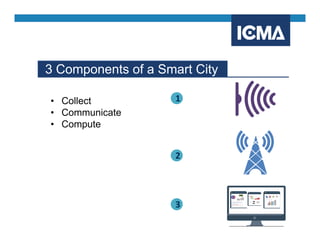
3 Components of a Smart City
• Collect
• Communicate
• Compute
Communicate
2Compute
z z
3
Collect
1
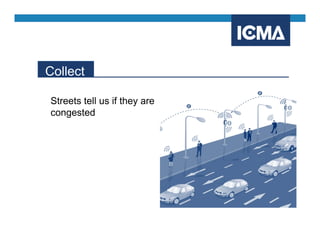
Collect
Streets tell us if they are
congested
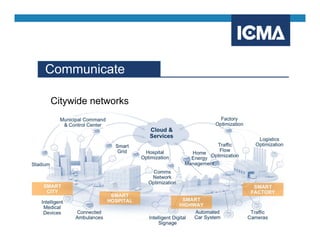
Communicate
Citywide networks
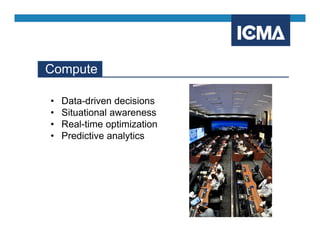
Compute
• Data-driven decisions
• Situational awareness
• Real-time optimization
• Predictive analytics
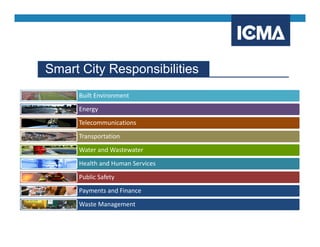
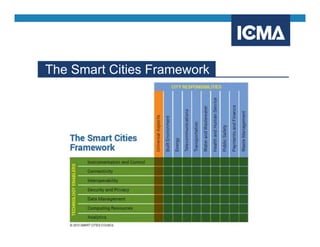
Smart City Responsibilities
Built Environment
Energy
Telecommunications
Transportation
Water and Wastewater
Health and Human Services
Public Safety
Payments and Finance
Waste Management
The Smart Cities Framework
Survey Overview
About ICMA
• The International City/County Management Association (ICMA)
creates excellence in local governance by developing and fostering
professional local government management worldwide.
• More than 11,000 members representing communities around the
world
• Core activities:
– Professional Development
– Technical Assistance
– Research
• High priority for ICMA
• Recent and ongoing activities
– Broadband guide and related research
– Local government cybersecurity survey
– Innovation survey
– Smart communities
• Partnership with Smart Cities Council established in 2016
Focus on Technology and Innovation
• Administered to all U.S. local governments with populations of
25,000 and higher
• Overall response rate of 14.4%, yielding 493 valid cases
• Topics covered included:
– Priorities related to smart city technologies
– Current activities
– Key motivators and barriers
– Technology budgeting and procurement practices
2016 Smart Cities Survey
• In general more interest among larger governments
• Public safety was rated as the highest priority area for smart city
technology
• Most active deployments were reported in the area of smart
payments and finance
• Economic and budgetary factors were the strongest motivators
and barriers
Key Takeaways
Survey Findings
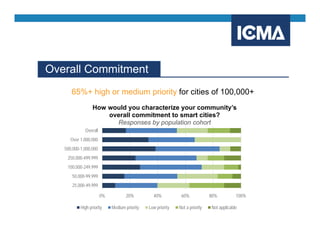
Overall Commitment
65%+ high or medium priority for cities of 100,000+
0% 20% 40% 60% 80% 100%
25,000-49,999
50,000-99,999
100,000-249,999
250,000-499,999
500,000-1,000,000
Over 1,000,000
Overall
How would you characterize your community’s
overall commitment to smart cities?
Responses by population cohort
High priority Medium priority Low priority Not a priority Not applicable
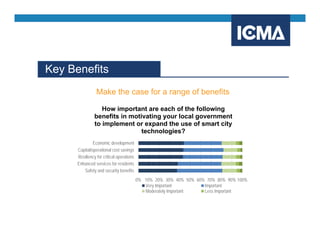
Key Benefits
Make the case for a range of benefits
0% 10% 20% 30% 40% 50% 60% 70% 80% 90% 100%
Safety and security benefits
Enhanced services for residents
Resiliency for critical operations
Capital/operational cost savings
Economic development
How important are each of the following
benefits in motivating your local government
to implement or expand the use of smart city
technologies?
Very Important Important
Moderately Important Less Important
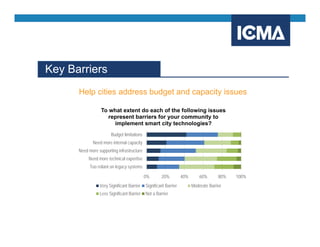
Key Barriers
Help cities address budget and capacity issues
0% 20% 40% 60% 80% 100%
Too reliant on legacy systems
Need more technical expertise
Need more supporting infrastructure
Need more internal capacity
Budget limitations
To what extent do each of the following issues
represent barriers for your community to
implement smart city technologies?
Very Significant Barrier Significant Barrier Moderate Barrier
Less Significant Barrier Not a Barrier
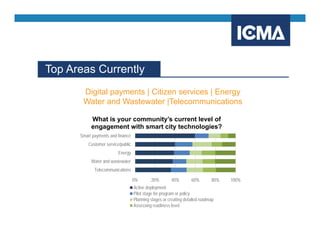
Top Areas Currently
Digital payments | Citizen services | Energy
Water and Wastewater |Telecommunications
0% 20% 40% 60% 80% 100%
Telecommunications
Water and wastewater
Energy
Customer service/public…
Smart payments and finance
What is your community’s current level of
engagement with smart city technologies?
Active deployment
Pilot stage for program or policy
Planning stages or creating detailed roadmap
Assessing readiness level
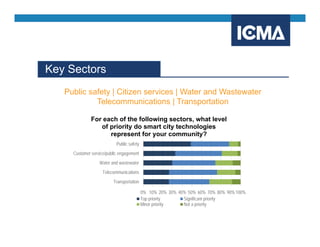
Key Sectors
Public safety | Citizen services | Water and Wastewater
Telecommunications | Transportation
0% 10% 20% 30% 40% 50% 60% 70% 80% 90%100%
Transportation
Telecommunications
Water and wastewater
Customer service/public engagement
Public safety
For each of the following sectors, what level
of priority do smart city technologies
represent for your community?
Top priority Significant priority
Minor priority Not a priority
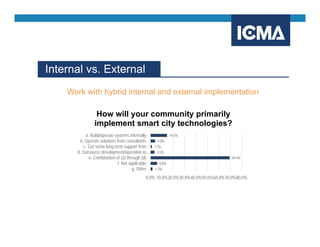
Internal vs. External
Work with hybrid internal and external implementation
1.7%
5.8%
69.4%
3.5%
1.2%
4.0%
14.5%
0.0% 10.0%20.0%30.0%40.0%50.0%60.0%70.0%80.0%
g. Other
f. Not applicable
e. Combination of (a) through (d)
d. Outsource development/operation to…
c. Get some long-term support from…
b. Operate solutions from consultants
a. Build/operate systems internally
How will your community primarily
implement smart city technologies?
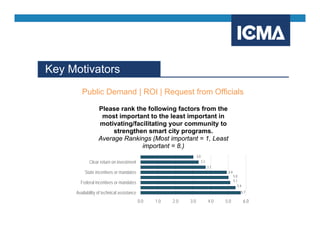
Key Motivators
Public Demand | ROI | Request from Officials
5.7
5.4
5.1
5.0
4.9
3.7
3.3
3.0
0.0 1.0 2.0 3.0 4.0 5.0 6.0
Availability of technical assistance
Federal incentives or mandates
State incentives or mandates
Clear return on investment
Please rank the following factors from the
most important to the least important in
motivating/facilitating your community to
strengthen smart city programs.
Average Rankings (Most important = 1, Least
important = 8.)
Tad McGalliard
ICMA Research and Policy Director
tmcgalliard@icma.org

ICMA Smart Cities Presentation

  • 1.
    U.S. Smart Cities:Trends and Opportunities
  • 2.
  • 3.
    Smart Cities –SCC Definition A city that uses information and communications technology (ICT) to enhance its livability, workability and sustainability.
  • 4.
    Smart Cities -ISO Definition A city that dramatically increases the pace at which it improves its sustainability and resilience by fundamentally improving … • (i) how it engages society, • (ii) how it applies collaborative leadership methods, • (iii) how it works across disciplines and city systems, and • (iv) how it uses data and integrated technologies … in order to transform services and quality of life to those in and involved with the city (residents, businesses, visitors).
  • 5.
    3 Components ofa Smart City • Collect • Communicate • Compute Communicate 2Compute z z 3 Collect 1
  • 6.
    Collect Streets tell usif they are congested
  • 7.
  • 8.
    Compute • Data-driven decisions •Situational awareness • Real-time optimization • Predictive analytics
  • 9.
  • 10.
  • 11.
  • 12.
    About ICMA • TheInternational City/County Management Association (ICMA) creates excellence in local governance by developing and fostering professional local government management worldwide. • More than 11,000 members representing communities around the world • Core activities: – Professional Development – Technical Assistance – Research
  • 13.
    • High priorityfor ICMA • Recent and ongoing activities – Broadband guide and related research – Local government cybersecurity survey – Innovation survey – Smart communities • Partnership with Smart Cities Council established in 2016 Focus on Technology and Innovation
  • 14.
    • Administered toall U.S. local governments with populations of 25,000 and higher • Overall response rate of 14.4%, yielding 493 valid cases • Topics covered included: – Priorities related to smart city technologies – Current activities – Key motivators and barriers – Technology budgeting and procurement practices 2016 Smart Cities Survey
  • 15.
    • In generalmore interest among larger governments • Public safety was rated as the highest priority area for smart city technology • Most active deployments were reported in the area of smart payments and finance • Economic and budgetary factors were the strongest motivators and barriers Key Takeaways
  • 16.
  • 17.
    Overall Commitment 65%+ highor medium priority for cities of 100,000+ 0% 20% 40% 60% 80% 100% 25,000-49,999 50,000-99,999 100,000-249,999 250,000-499,999 500,000-1,000,000 Over 1,000,000 Overall How would you characterize your community’s overall commitment to smart cities? Responses by population cohort High priority Medium priority Low priority Not a priority Not applicable
  • 18.
    Key Benefits Make thecase for a range of benefits 0% 10% 20% 30% 40% 50% 60% 70% 80% 90% 100% Safety and security benefits Enhanced services for residents Resiliency for critical operations Capital/operational cost savings Economic development How important are each of the following benefits in motivating your local government to implement or expand the use of smart city technologies? Very Important Important Moderately Important Less Important
  • 19.
    Key Barriers Help citiesaddress budget and capacity issues 0% 20% 40% 60% 80% 100% Too reliant on legacy systems Need more technical expertise Need more supporting infrastructure Need more internal capacity Budget limitations To what extent do each of the following issues represent barriers for your community to implement smart city technologies? Very Significant Barrier Significant Barrier Moderate Barrier Less Significant Barrier Not a Barrier
  • 20.
    Top Areas Currently Digitalpayments | Citizen services | Energy Water and Wastewater |Telecommunications 0% 20% 40% 60% 80% 100% Telecommunications Water and wastewater Energy Customer service/public… Smart payments and finance What is your community’s current level of engagement with smart city technologies? Active deployment Pilot stage for program or policy Planning stages or creating detailed roadmap Assessing readiness level
  • 21.
    Key Sectors Public safety| Citizen services | Water and Wastewater Telecommunications | Transportation 0% 10% 20% 30% 40% 50% 60% 70% 80% 90%100% Transportation Telecommunications Water and wastewater Customer service/public engagement Public safety For each of the following sectors, what level of priority do smart city technologies represent for your community? Top priority Significant priority Minor priority Not a priority
  • 22.
    Internal vs. External Workwith hybrid internal and external implementation 1.7% 5.8% 69.4% 3.5% 1.2% 4.0% 14.5% 0.0% 10.0%20.0%30.0%40.0%50.0%60.0%70.0%80.0% g. Other f. Not applicable e. Combination of (a) through (d) d. Outsource development/operation to… c. Get some long-term support from… b. Operate solutions from consultants a. Build/operate systems internally How will your community primarily implement smart city technologies?
  • 23.
    Key Motivators Public Demand| ROI | Request from Officials 5.7 5.4 5.1 5.0 4.9 3.7 3.3 3.0 0.0 1.0 2.0 3.0 4.0 5.0 6.0 Availability of technical assistance Federal incentives or mandates State incentives or mandates Clear return on investment Please rank the following factors from the most important to the least important in motivating/facilitating your community to strengthen smart city programs. Average Rankings (Most important = 1, Least important = 8.)
  • 24.
    Tad McGalliard ICMA Researchand Policy Director tmcgalliard@icma.org