This Project is funded by the

                Improved SME Competitiveness and   European Union


                        Innovation Project


  Session 5: Training Needs Assessment of
                    SMEs


2/10/2011
               Paul Moran & Gjorgji Mishkovski
This Project is funded by the EU


Content:

     Introduction: how to approach SMEs
     SME needs analysis – „how to‟
     Presentation of TNA questionnaire
     Proposed methodology
     Data analysis and reporting
     Discussion


2/10/2011                           Improved SME Competitiveness and Innovation Project   2
This Project is funded by the EU


Why the survey? (rationale):

• (from TOR Project Purpose): “Improve the quality, range,
  and availability of BSS in Serbia by creating a
  standardised model and strengthening the business
  support infrastructure”
• In order to do this, need to understand the existing
  structure (mapping and assessment) and identify exactly
  what SMEs need from such services (needs assessment)
• Survey will provide important and useful data on SME
  needs and provide a „replicable methodology‟ which
  BSO‟s can continue to use in future in order to design and
  improve services and build relationships with SMEs
2/10/2011                           Improved SME Competitiveness and Innovation Project   3
This Project is funded by the EU


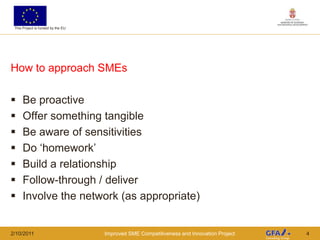
How to approach SMEs

     Be proactive
     Offer something tangible
     Be aware of sensitivities
     Do „homework‟
     Build a relationship
     Follow-through / deliver
     Involve the network (as appropriate)


2/10/2011                           Improved SME Competitiveness and Innovation Project   4
This Project is funded by the EU


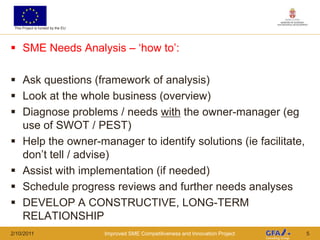
 SME Needs Analysis – „how to‟:

 Ask questions (framework of analysis)
 Look at the whole business (overview)
 Diagnose problems / needs with the owner-manager (eg
  use of SWOT / PEST)
 Help the owner-manager to identify solutions (ie facilitate,
  don‟t tell / advise)
 Assist with implementation (if needed)
 Schedule progress reviews and further needs analyses
 DEVELOP A CONSTRUCTIVE, LONG-TERM
  RELATIONSHIP
2/10/2011                           Improved SME Competitiveness and Innovation Project   5
This Project is funded by the EU


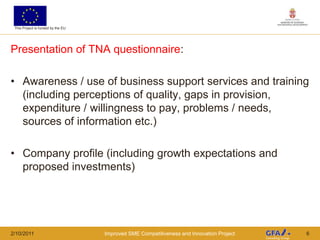
Presentation of TNA questionnaire:

• Awareness / use of business support services and training
  (including perceptions of quality, gaps in provision,
  expenditure / willingness to pay, problems / needs,
  sources of information etc.)

• Company profile (including growth expectations and
  proposed investments)


2/10/2011                           Improved SME Competitiveness and Innovation Project   6
This Project is funded by the EU


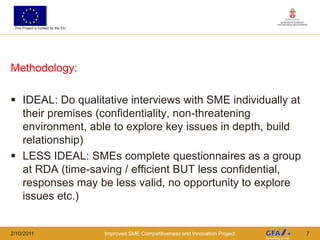
Methodology:

 IDEAL: Do qualitative interviews with SME individually at
  their premises (confidentiality, non-threatening
  environment, able to explore key issues in depth, build
  relationship)
 LESS IDEAL: SMEs complete questionnaires as a group
  at RDA (time-saving / efficient BUT less confidential,
  responses may be less valid, no opportunity to explore
  issues etc.)


2/10/2011                           Improved SME Competitiveness and Innovation Project   7
This Project is funded by the EU


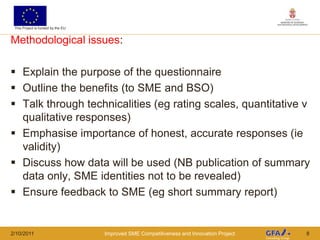
Methodological issues:

 Explain the purpose of the questionnaire
 Outline the benefits (to SME and BSO)
 Talk through technicalities (eg rating scales, quantitative v
  qualitative responses)
 Emphasise importance of honest, accurate responses (ie
  validity)
 Discuss how data will be used (NB publication of summary
  data only, SME identities not to be revealed)
 Ensure feedback to SME (eg short summary report)


2/10/2011                           Improved SME Competitiveness and Innovation Project   8
This Project is funded by the EU


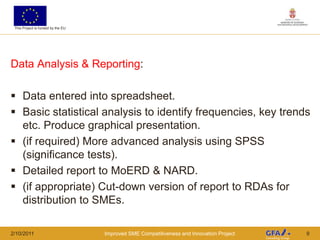
Data Analysis & Reporting:

 Data entered into spreadsheet.
 Basic statistical analysis to identify frequencies, key trends
  etc. Produce graphical presentation.
 (if required) More advanced analysis using SPSS
  (significance tests).
 Detailed report to MoERD & NARD.
 (if appropriate) Cut-down version of report to RDAs for
  distribution to SMEs.

2/10/2011                           Improved SME Competitiveness and Innovation Project   9

Icip workshop sme needs analysis

  • 1.
    This Project isfunded by the Improved SME Competitiveness and European Union Innovation Project Session 5: Training Needs Assessment of SMEs 2/10/2011 Paul Moran & Gjorgji Mishkovski
  • 2.
    This Project isfunded by the EU Content:  Introduction: how to approach SMEs  SME needs analysis – „how to‟  Presentation of TNA questionnaire  Proposed methodology  Data analysis and reporting  Discussion 2/10/2011 Improved SME Competitiveness and Innovation Project 2
  • 3.
    This Project isfunded by the EU Why the survey? (rationale): • (from TOR Project Purpose): “Improve the quality, range, and availability of BSS in Serbia by creating a standardised model and strengthening the business support infrastructure” • In order to do this, need to understand the existing structure (mapping and assessment) and identify exactly what SMEs need from such services (needs assessment) • Survey will provide important and useful data on SME needs and provide a „replicable methodology‟ which BSO‟s can continue to use in future in order to design and improve services and build relationships with SMEs 2/10/2011 Improved SME Competitiveness and Innovation Project 3
  • 4.
    This Project isfunded by the EU How to approach SMEs  Be proactive  Offer something tangible  Be aware of sensitivities  Do „homework‟  Build a relationship  Follow-through / deliver  Involve the network (as appropriate) 2/10/2011 Improved SME Competitiveness and Innovation Project 4
  • 5.
    This Project isfunded by the EU  SME Needs Analysis – „how to‟:  Ask questions (framework of analysis)  Look at the whole business (overview)  Diagnose problems / needs with the owner-manager (eg use of SWOT / PEST)  Help the owner-manager to identify solutions (ie facilitate, don‟t tell / advise)  Assist with implementation (if needed)  Schedule progress reviews and further needs analyses  DEVELOP A CONSTRUCTIVE, LONG-TERM RELATIONSHIP 2/10/2011 Improved SME Competitiveness and Innovation Project 5
  • 6.
    This Project isfunded by the EU Presentation of TNA questionnaire: • Awareness / use of business support services and training (including perceptions of quality, gaps in provision, expenditure / willingness to pay, problems / needs, sources of information etc.) • Company profile (including growth expectations and proposed investments) 2/10/2011 Improved SME Competitiveness and Innovation Project 6
  • 7.
    This Project isfunded by the EU Methodology:  IDEAL: Do qualitative interviews with SME individually at their premises (confidentiality, non-threatening environment, able to explore key issues in depth, build relationship)  LESS IDEAL: SMEs complete questionnaires as a group at RDA (time-saving / efficient BUT less confidential, responses may be less valid, no opportunity to explore issues etc.) 2/10/2011 Improved SME Competitiveness and Innovation Project 7
  • 8.
    This Project isfunded by the EU Methodological issues:  Explain the purpose of the questionnaire  Outline the benefits (to SME and BSO)  Talk through technicalities (eg rating scales, quantitative v qualitative responses)  Emphasise importance of honest, accurate responses (ie validity)  Discuss how data will be used (NB publication of summary data only, SME identities not to be revealed)  Ensure feedback to SME (eg short summary report) 2/10/2011 Improved SME Competitiveness and Innovation Project 8
  • 9.
    This Project isfunded by the EU Data Analysis & Reporting:  Data entered into spreadsheet.  Basic statistical analysis to identify frequencies, key trends etc. Produce graphical presentation.  (if required) More advanced analysis using SPSS (significance tests).  Detailed report to MoERD & NARD.  (if appropriate) Cut-down version of report to RDAs for distribution to SMEs. 2/10/2011 Improved SME Competitiveness and Innovation Project 9