Anvendelse, implementering og
operationalisering af ICF
Thomas Maribo
Klinisk Lektor, Aarhus Universitet
Seniorforsker, DEFACTUM Region
Midtjylland
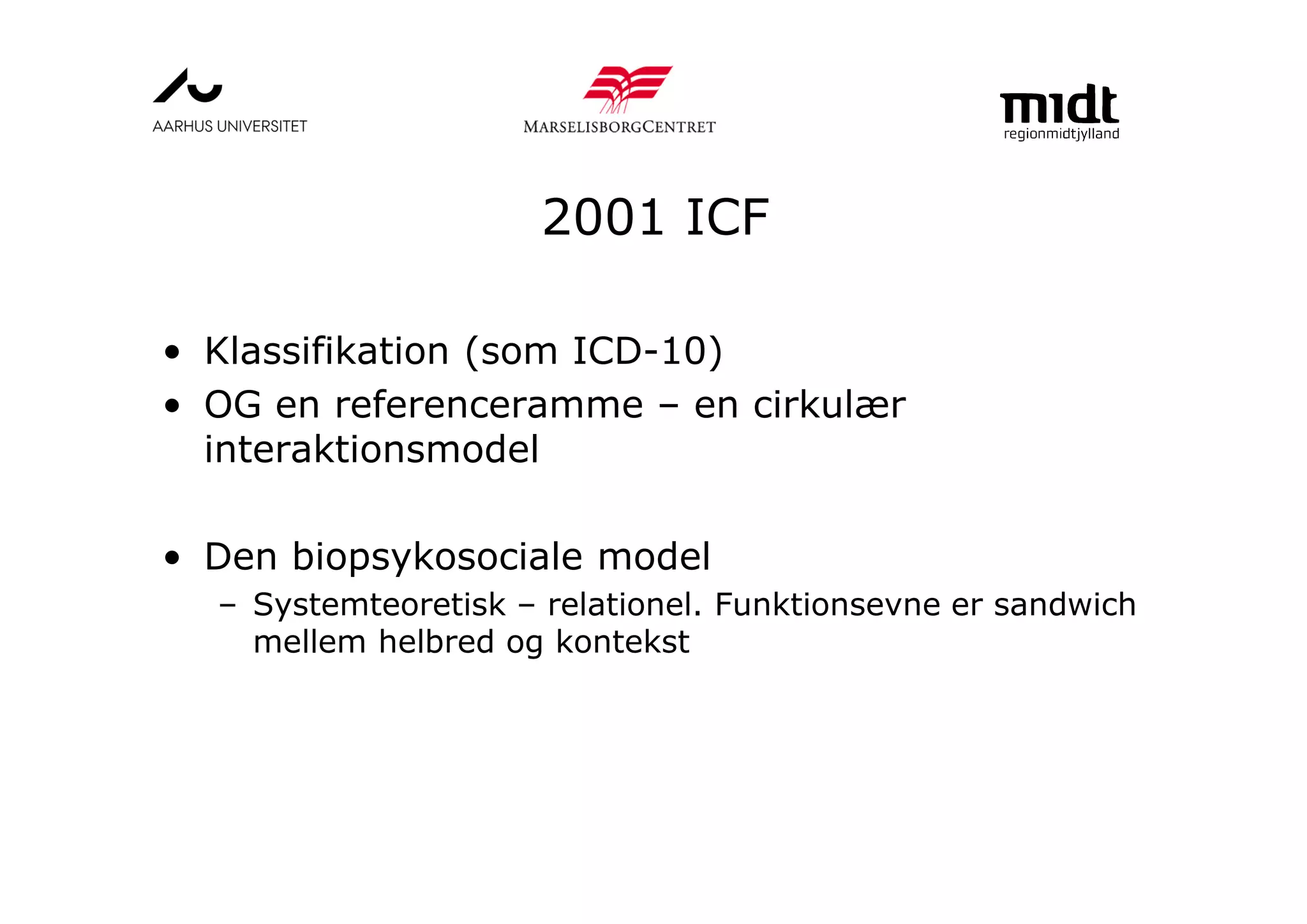
2001 ICF
• Klassifikation (som ICD-10)
• OG en referenceramme – en cirkulær
interaktionsmodel
• Den biopsykosociale model
– Systemteoretisk – relationel. Funktionsevne er sandwich
mellem helbred og kontekst
WHO’s Rationale for ICF
WHO has long collected information about ‘reasons for death’
Missing was information about functioning and disability
across all areas of life – the impact of health on living
“the lived experience of health”
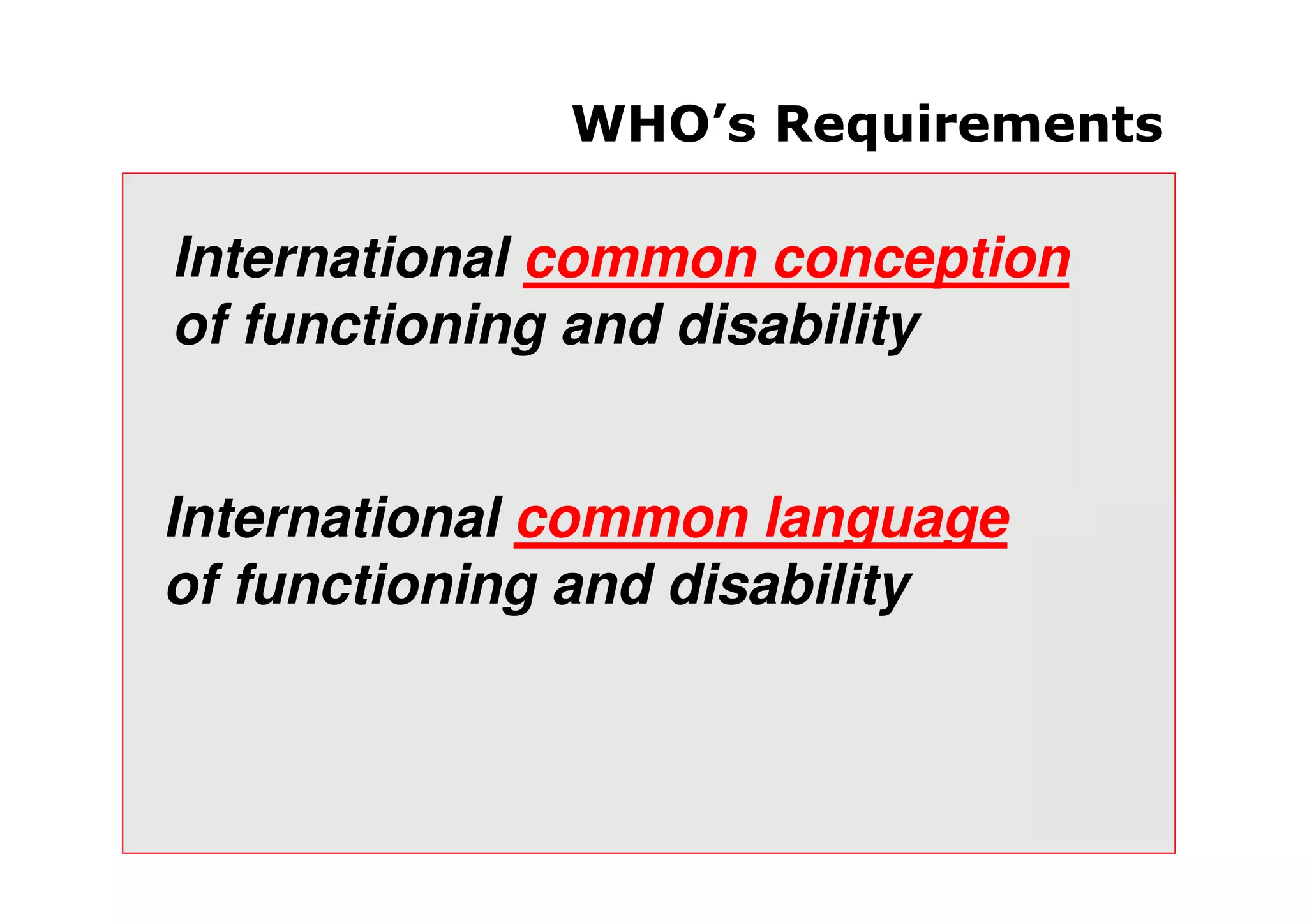
WHO’s Requirements
International common language
of functioning and disability
International common conception
of functioning and disability
ICF
Model of Disability
True to the complex character of the phenomena
and
Classification System
Operational, trans-cultural and multi-linguistic for valid
and reliable information
ICF
Functioning and Disability Contextual factors
Body functions and
Structures
Activities and
Participation
Environmental
factors
Personal
factors
Parts
Components
The structure and codes of the ICF
b3
b5
b8
b2
b4
b7
b6
b1
2. The structure and codes of the ICF
7
ICF
Functioning and Disability Contextual factors
Body functions and
Structures
Activities and
Participation
Environmental
factors
Personal
factors
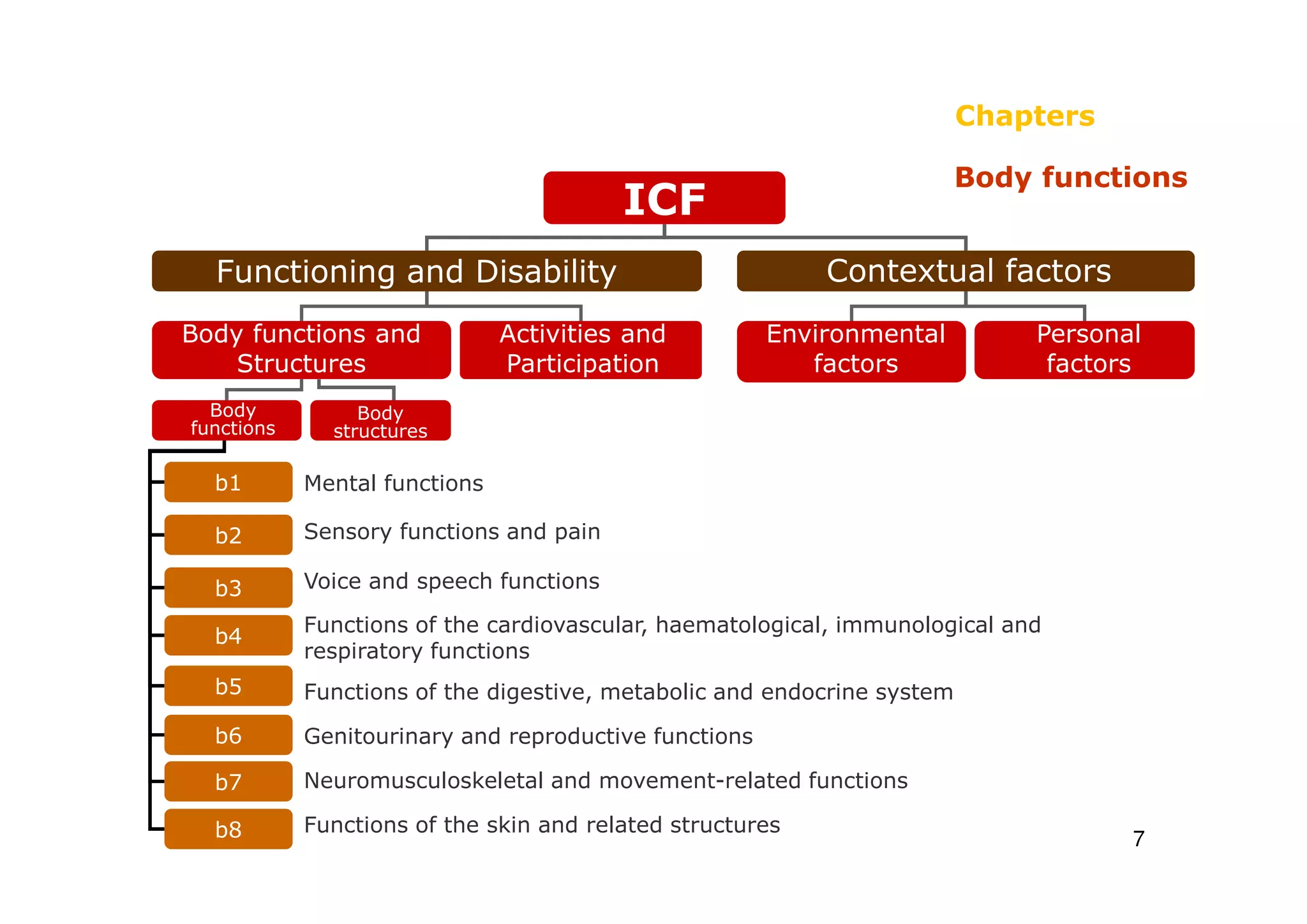
Body
functions
Body
structures
Chapters
Body functions
Mental functions
Sensory functions and pain
Voice and speech functions
Functions of the cardiovascular, haematological, immunological and
respiratory functions
Functions of the digestive, metabolic and endocrine system
Genitourinary and reproductive functions
Neuromusculoskeletal and movement-related functions
Functions of the skin and related structures
ICF
s2
s3
s4
s5
s6
s7
s8
s1
Functioning and Disability Contextual factors
Body functions and
Structures
Activities and
Participation
Environmental
factors
Personal
factors
Body
functions
Body
structures
Structures of the nervous system
The eye, ear and related structures
Structures involved in voice and speech
Structures of the cardiovascular, immunological and respiratory
system
Structures related to the digestive, metabolic and endocrine system
Structures related to the genitourinary and reproductive system
Structures related to movement
Skin and relates structures
Body structures
Chapters
2. The structure and codes of the ICF
9
ICF
Functioning and Disability Contextual factors
Body functions and
Structures
Activities and
Participation
Environmental
factors
Personal
factors
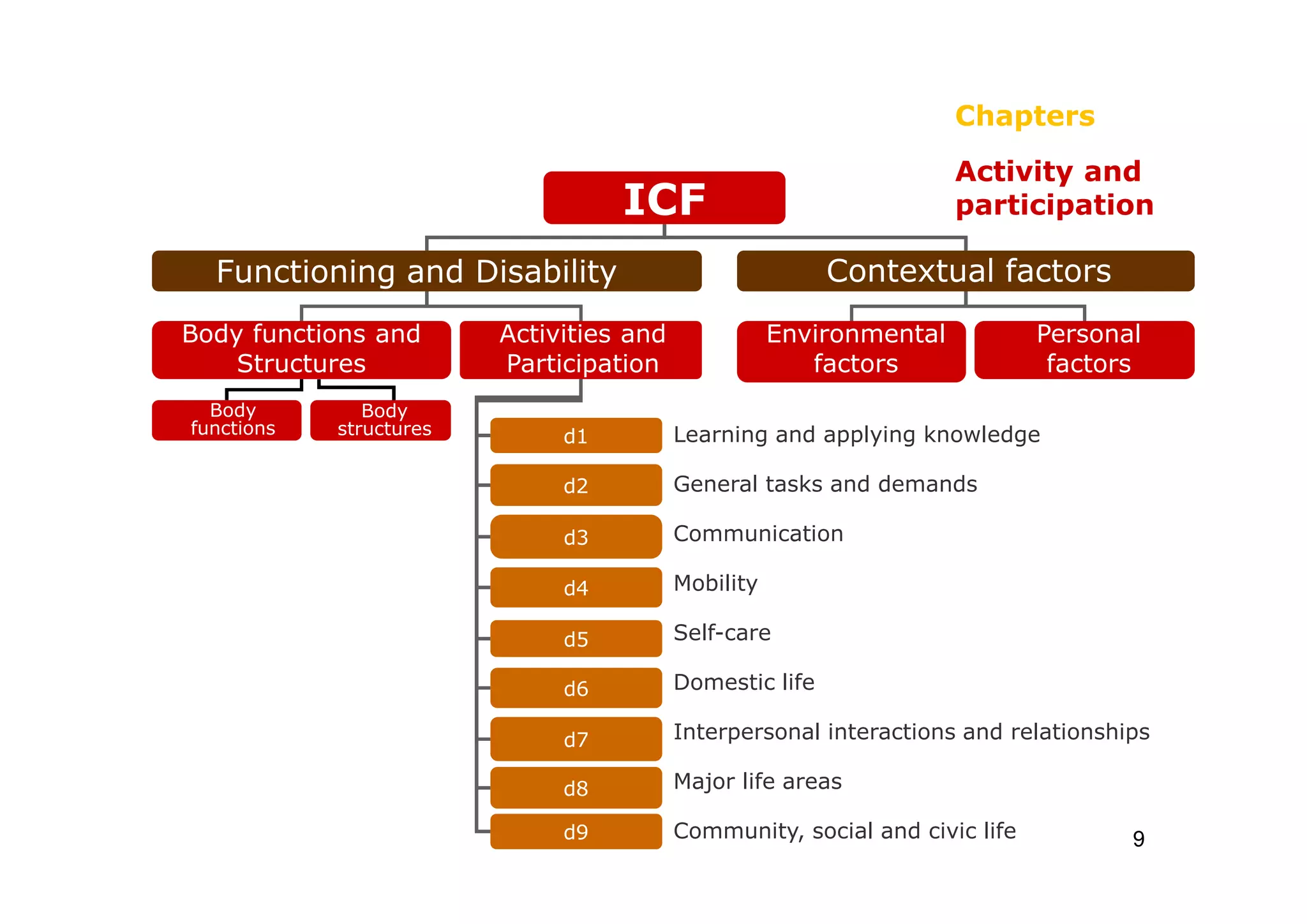
Body
functions
Body
structures d1
d2
d3
d4
d5
d6
d7
d8
d9
Learning and applying knowledge
General tasks and demands
Communication
Mobility
Self-care
Domestic life
Interpersonal interactions and relationships
Major life areas
Community, social and civic life
Activity and
participation
Chapters
2. The structure and codes of the ICF
10
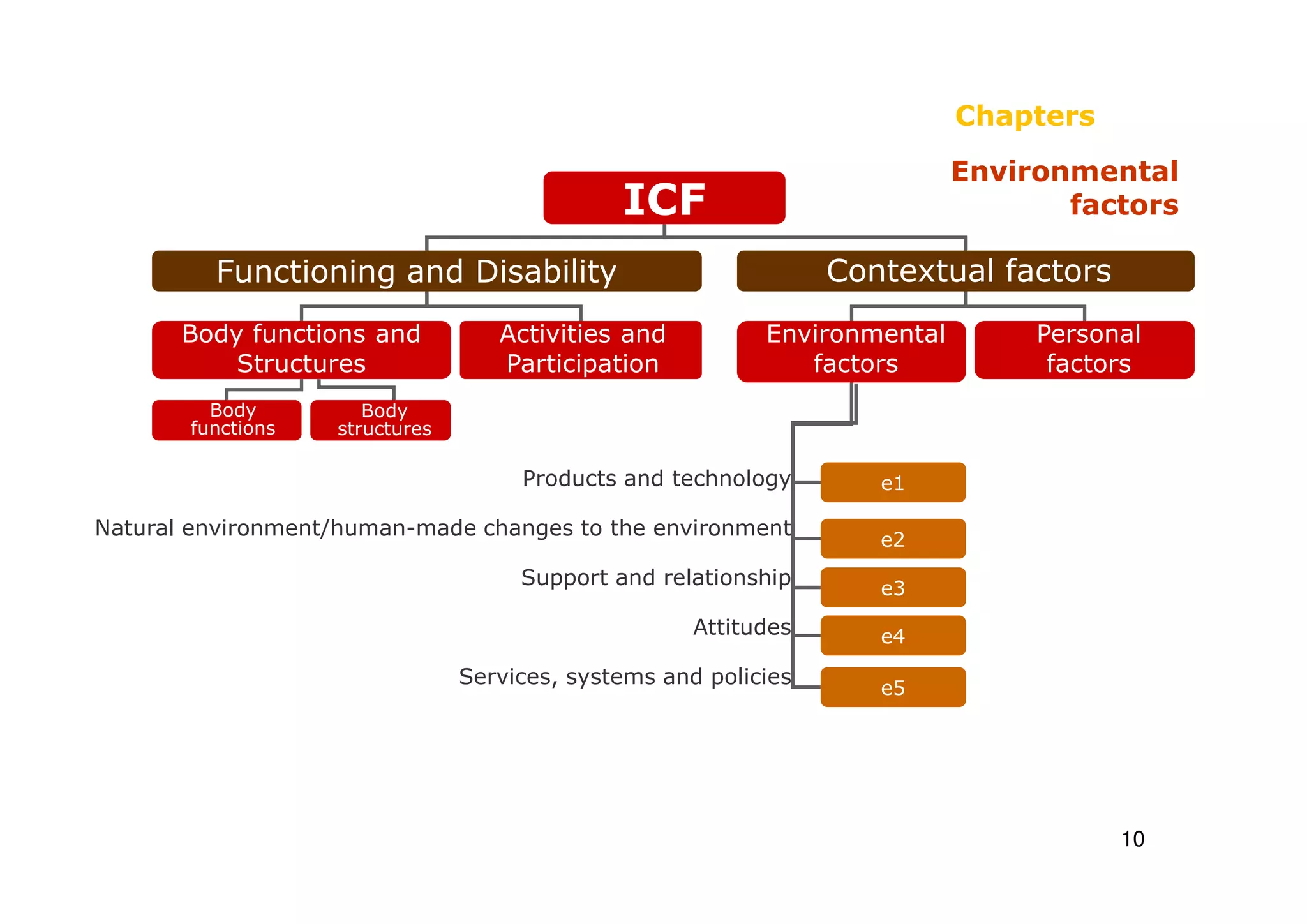
ICF
Functioning and Disability Contextual factors
Body functions and
Structures
Activities and
Participation
Environmental
factors
Personal
factors
Body
functions
Body
structures
e2
e1
e3
e4
e5
Products and technology
Natural environment/human-made changes to the environment
Support and relationship
Attitudes
Services, systems and policies
Environmental
factors
Chapters
Kapitler,
ICF
Se skema på BB
b3
b5
b8
b2
b4
b7
b6
b1
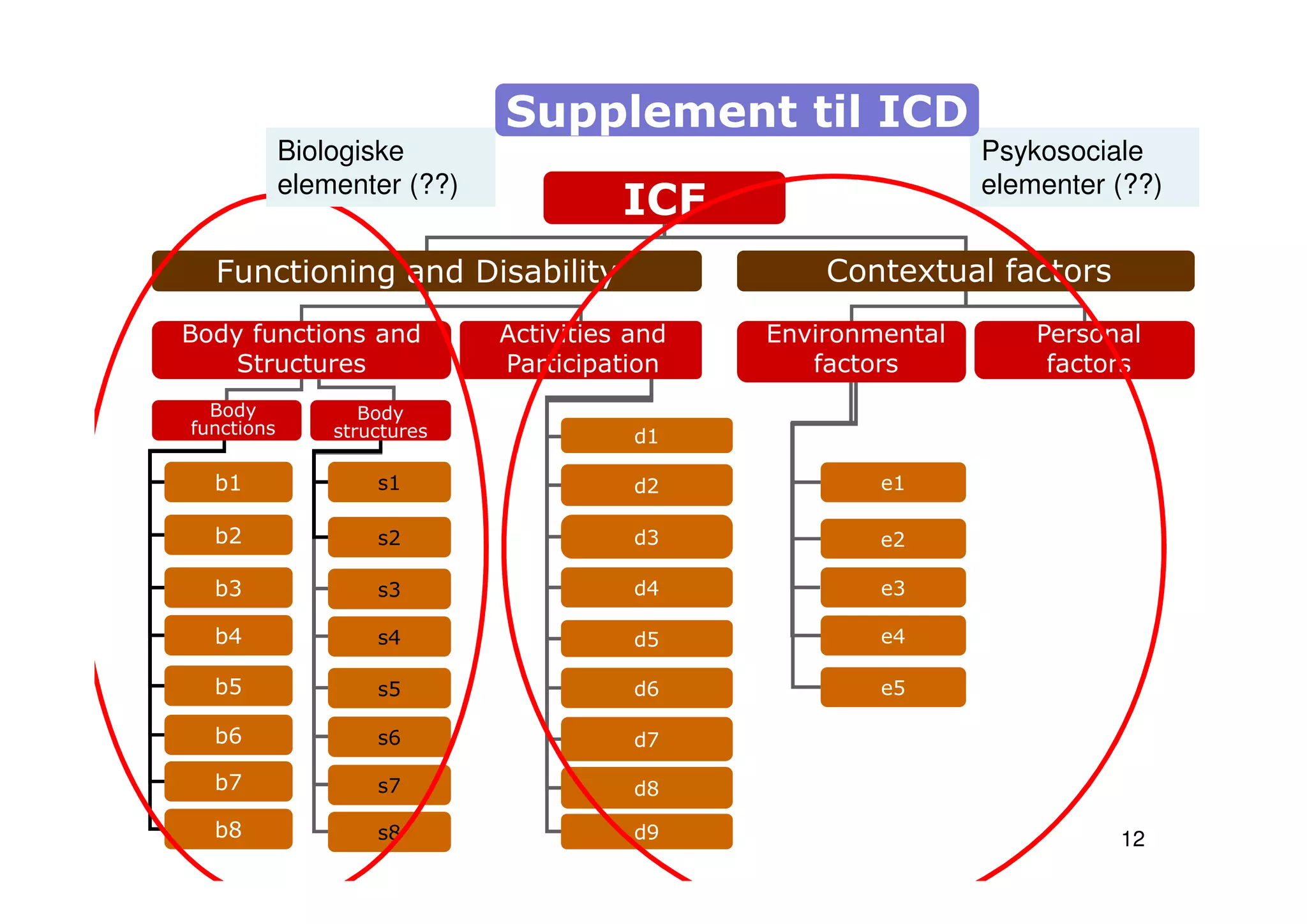
12
ICF
Functioning and Disability Contextual factors
Body functions and
Structures
Activities and
Participation
Environmental
factors
Personal
factors
Body
functions
Body
structures
s2
s3
s4
s5
s6
s7
s8
s1
d1
d2
d3
d4
d5
d6
d7
d8
d9
e2
e1
e3
e4
e5
Psykosociale
elementer (??)
Biologiske
elementer (??)
Supplement til ICD
Hensigten med ICF
• Fælles og ensartet klassifikation af
mennesker med funktionsevnenedsættelse
• Give fælles sprog om funktionsevne for at
bedre kommunikationen på tværs af
landegrænser, fag og sektorer
• Mulighed for at identificere og beskrive
konsekvenserne af funktionsevnenedsættelse
(WHO, Marselisborgcentret, Sundhedsstyrelsen)
ICF core set
• Udvalgt at tværfagligt ekspertteam i forhold til et
afgrænset område (eks diagnose)
• Reducerer antallet af ICF kategorier klinisk
anvendelig
• Siger hvad der skal vurderes men ikke hvordan
• http://www.icf-core-sets.org/en
Udvikling af core sets
1. Afdækning af litteraturen og indledende
undersøgelser: Hvilke områder synes
umiddelbart væsentlige for målgruppen
2. Konsensusmøder (delphiprocessen)
1. Comprehensive core set Hvad er typisk
2. Brief core set Hvad er vigtigt
3. Afprøvning
4. Core set vs code set
Beskrivelse af funktionsevne
• Se skema om funktionsevne på BB
• Case 2 side 14 Kirsten Dinesen (Rehabilitering –
en grundbog)
16
Case Kirsten Dinesen
• Beskriv helbredstilstand og de 5 ICF-
komponenter for Kirsten Dinesen
• Brug 10 minutter
• Hvis I er hurtigere færdige så drøft hvilket kapitel
området hører ind under – brug evt ICF browser
http://apps.who.int/classifications/icfbrowser/
Studiespørgsmål
• Diskuter og forklar: Kan ICF klassifikationen
bruges som måleredskab? Overvej 2-3
argumenter for dit svar.
• I klassifikationen er aktivitet og deltagelse slået
sammen. Diskuter nogle af årsagerne samt
ulemperne ved dette.
18
SÅ skal der knokles med WADE
19

Icf f2018 basis

  • 1.
    Anvendelse, implementering og operationaliseringaf ICF Thomas Maribo Klinisk Lektor, Aarhus Universitet Seniorforsker, DEFACTUM Region Midtjylland
  • 2.
    2001 ICF • Klassifikation(som ICD-10) • OG en referenceramme – en cirkulær interaktionsmodel • Den biopsykosociale model – Systemteoretisk – relationel. Funktionsevne er sandwich mellem helbred og kontekst
  • 3.
    WHO’s Rationale forICF WHO has long collected information about ‘reasons for death’ Missing was information about functioning and disability across all areas of life – the impact of health on living “the lived experience of health”
  • 4.
    WHO’s Requirements International commonlanguage of functioning and disability International common conception of functioning and disability
  • 5.
    ICF Model of Disability Trueto the complex character of the phenomena and Classification System Operational, trans-cultural and multi-linguistic for valid and reliable information
  • 6.
    ICF Functioning and DisabilityContextual factors Body functions and Structures Activities and Participation Environmental factors Personal factors Parts Components The structure and codes of the ICF
  • 7.
    b3 b5 b8 b2 b4 b7 b6 b1 2. The structureand codes of the ICF 7 ICF Functioning and Disability Contextual factors Body functions and Structures Activities and Participation Environmental factors Personal factors Body functions Body structures Chapters Body functions Mental functions Sensory functions and pain Voice and speech functions Functions of the cardiovascular, haematological, immunological and respiratory functions Functions of the digestive, metabolic and endocrine system Genitourinary and reproductive functions Neuromusculoskeletal and movement-related functions Functions of the skin and related structures
  • 8.
    ICF s2 s3 s4 s5 s6 s7 s8 s1 Functioning and DisabilityContextual factors Body functions and Structures Activities and Participation Environmental factors Personal factors Body functions Body structures Structures of the nervous system The eye, ear and related structures Structures involved in voice and speech Structures of the cardiovascular, immunological and respiratory system Structures related to the digestive, metabolic and endocrine system Structures related to the genitourinary and reproductive system Structures related to movement Skin and relates structures Body structures Chapters
  • 9.
    2. The structureand codes of the ICF 9 ICF Functioning and Disability Contextual factors Body functions and Structures Activities and Participation Environmental factors Personal factors Body functions Body structures d1 d2 d3 d4 d5 d6 d7 d8 d9 Learning and applying knowledge General tasks and demands Communication Mobility Self-care Domestic life Interpersonal interactions and relationships Major life areas Community, social and civic life Activity and participation Chapters
  • 10.
    2. The structureand codes of the ICF 10 ICF Functioning and Disability Contextual factors Body functions and Structures Activities and Participation Environmental factors Personal factors Body functions Body structures e2 e1 e3 e4 e5 Products and technology Natural environment/human-made changes to the environment Support and relationship Attitudes Services, systems and policies Environmental factors Chapters
  • 11.
  • 12.
    b3 b5 b8 b2 b4 b7 b6 b1 12 ICF Functioning and DisabilityContextual factors Body functions and Structures Activities and Participation Environmental factors Personal factors Body functions Body structures s2 s3 s4 s5 s6 s7 s8 s1 d1 d2 d3 d4 d5 d6 d7 d8 d9 e2 e1 e3 e4 e5 Psykosociale elementer (??) Biologiske elementer (??) Supplement til ICD
  • 13.
    Hensigten med ICF •Fælles og ensartet klassifikation af mennesker med funktionsevnenedsættelse • Give fælles sprog om funktionsevne for at bedre kommunikationen på tværs af landegrænser, fag og sektorer • Mulighed for at identificere og beskrive konsekvenserne af funktionsevnenedsættelse (WHO, Marselisborgcentret, Sundhedsstyrelsen)
  • 14.
    ICF core set •Udvalgt at tværfagligt ekspertteam i forhold til et afgrænset område (eks diagnose) • Reducerer antallet af ICF kategorier klinisk anvendelig • Siger hvad der skal vurderes men ikke hvordan • http://www.icf-core-sets.org/en
  • 15.
    Udvikling af coresets 1. Afdækning af litteraturen og indledende undersøgelser: Hvilke områder synes umiddelbart væsentlige for målgruppen 2. Konsensusmøder (delphiprocessen) 1. Comprehensive core set Hvad er typisk 2. Brief core set Hvad er vigtigt 3. Afprøvning 4. Core set vs code set
  • 16.
    Beskrivelse af funktionsevne •Se skema om funktionsevne på BB • Case 2 side 14 Kirsten Dinesen (Rehabilitering – en grundbog) 16
  • 17.
    Case Kirsten Dinesen •Beskriv helbredstilstand og de 5 ICF- komponenter for Kirsten Dinesen • Brug 10 minutter • Hvis I er hurtigere færdige så drøft hvilket kapitel området hører ind under – brug evt ICF browser http://apps.who.int/classifications/icfbrowser/
  • 18.
    Studiespørgsmål • Diskuter ogforklar: Kan ICF klassifikationen bruges som måleredskab? Overvej 2-3 argumenter for dit svar. • I klassifikationen er aktivitet og deltagelse slået sammen. Diskuter nogle af årsagerne samt ulemperne ved dette. 18
  • 19.
    SÅ skal derknokles med WADE 19