INVESTIGATING REPLACEMENT STRATEGIES
FOR THE
ADAPTIVE DISSORTATIVE MATING GENETIC
ALGORITHM
Carlos Fernandes1,2
J.J. Merelo1
Agostinho C. Rosa2
1
Department of Architecture and Computer Technology, University of Granada, Spain
2
L aSEEB-ISR-IST, Technical Univ. of Lisbon (IST), Portugal
SUMMARY
ADMGA
Non-Stationary Fitness Landscapes
Motivation
Replacement Strategies
Results
Conclusions and Future Work
Dissortative MatingDissortative Mating
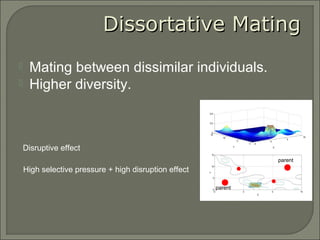
 Mating between dissimilar individuals.
 Higher diversity.
Disruptive effect
High selective pressure + high disruption effect
parent
parent
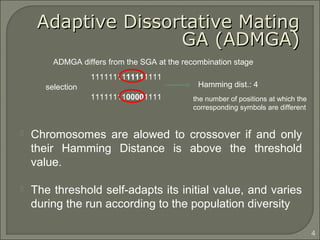
 Chromosomes are alowed to crossover if and only
their Hamming Distance is above the threshold
value.
 The threshold self-adapts its initial value, and varies
during the run according to the population diversity
1111111111111111
1111111100001111
Hamming dist.: 4selection
ADMGA differs from the SGA at the recombination stage
4
the number of positions at which the
corresponding symbols are different
Adaptive Dissortative MatingAdaptive Dissortative Mating
GA (ADMGA)GA (ADMGA)
ADMGAADMGA
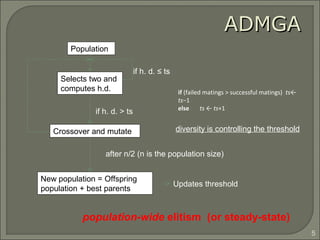
Population
New population = Offspring
population + best parents
Selects two and
computes h.d.
if h. d. > ts
if h. d. ≤ ts
Crossover and mutate
after n/2 (n is the population size)
Updates threshold
if (failed matings > successful matings) ts←
ts−1
else ts ← ts+1
5
diversity is controlling the threshold
population-wide elitism (or steady-state)
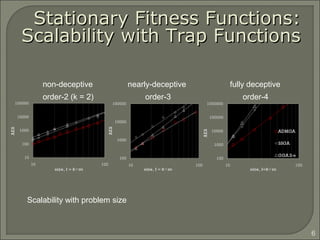
Stationary Fitness Functions:Stationary Fitness Functions:
Scalability with Trap FunctionsScalability with Trap Functions
order-2 (k = 2) order-3 order-4
6
non-deceptive nearly-deceptive fully deceptive
Scalability with problem size
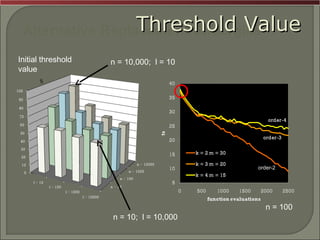
Alternative Replacement StrategiesThreshold ValueThreshold Value
Initial threshold
value
n = 10,000; l = 10
n = 10; l = 10,000
n = 100
order-2
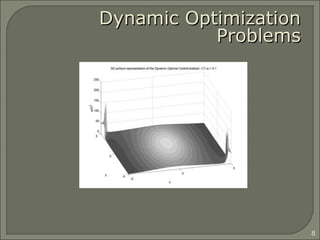
Dynamic OptimizationDynamic Optimization
ProblemsProblems
8
ADMGA: DynamicADMGA: Dynamic
Optimization ProblemsOptimization Problems
 Better performance on “slower”
dynamic problems
 The performance degrades as the
optimum moves faster
9
MotivationMotivation
 Improve ADMGA’s performance on
faster problems
 Is population-wide elitism a good or
bad strategy for fast dynamic
problems?
10
Replacement StrategiesReplacement Strategies
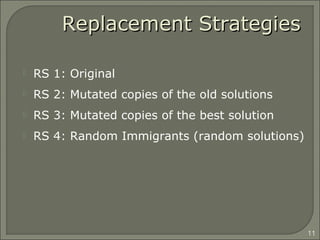
 RS 1: Original
 RS 2: Mutated copies of the old solutions
 RS 3: Mutated copies of the best solution
 RS 4: Random Immigrants (random solutions)
11
ADMGA: DynamicADMGA: Dynamic
Optimization ProblemsOptimization Problems
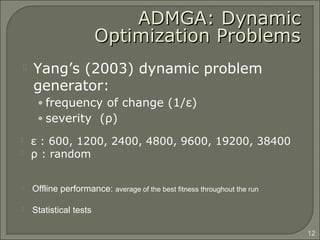
 Yang’s (2003) dynamic problem
generator:
• frequency of change (1/ε)
• severity (ρ)
12
 ε : 600, 1200, 2400, 4800, 9600, 19200, 38400
 ρ : random
 Offline performance: average of the best fitness throughout the run
 Statistical tests
TestsTests
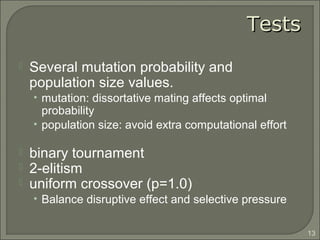
 Several mutation probability and
population size values.
• mutation: dissortative mating affects optimal
probability
• population size: avoid extra computational effort
 binary tournament
 2-elitism
 uniform crossover (p=1.0)
• Balance disruptive effect and selective pressure
13
Results TestsTests
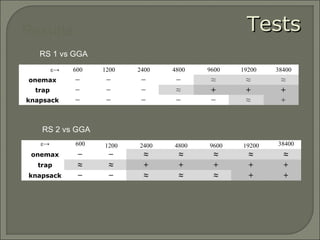
RS 1 vs GGA
RS 2 vs GGA
ε→ 600 1200 2400 4800 9600 19200 38400
onemax − − ≈ ≈ ≈ ≈ ≈
trap ≈ ≈ + + + + +
knapsack − − ≈ ≈ ≈ + +
ε→ 600 1200 2400 4800 9600 19200 38400
onemax − − − − ≈ ≈ ≈
trap − − − ≈ + + +
knapsack − − − − − ≈ +
Results TestsTests
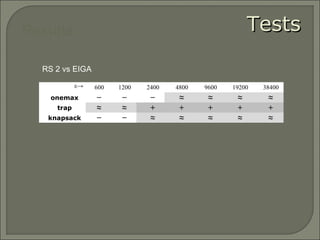
RS 2 vs EIGA
ε→ 600 1200 2400 4800 9600 19200 38400
onemax − − − ≈ ≈ ≈ ≈
trap ≈ ≈ + + + + +
knapsack − − ≈ ≈ ≈ ≈ ≈
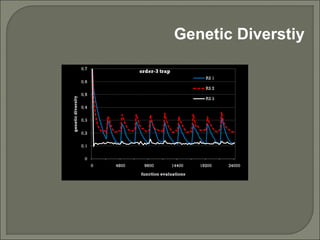
Genetic Diverstiy
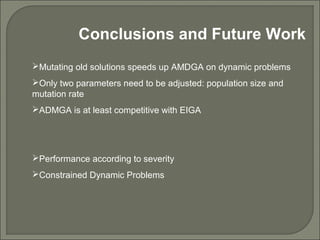
Conclusions and Future Work
Mutating old solutions speeds up AMDGA on dynamic problems
Only two parameters need to be adjusted: population size and
mutation rate
ADMGA is at least competitive with EIGA
Performance according to severity
Constrained Dynamic Problems

Icec2010 presentation

  • 1.
    INVESTIGATING REPLACEMENT STRATEGIES FORTHE ADAPTIVE DISSORTATIVE MATING GENETIC ALGORITHM Carlos Fernandes1,2 J.J. Merelo1 Agostinho C. Rosa2 1 Department of Architecture and Computer Technology, University of Granada, Spain 2 L aSEEB-ISR-IST, Technical Univ. of Lisbon (IST), Portugal
  • 2.
  • 3.
    Dissortative MatingDissortative Mating Mating between dissimilar individuals.  Higher diversity. Disruptive effect High selective pressure + high disruption effect parent parent
  • 4.
     Chromosomes arealowed to crossover if and only their Hamming Distance is above the threshold value.  The threshold self-adapts its initial value, and varies during the run according to the population diversity 1111111111111111 1111111100001111 Hamming dist.: 4selection ADMGA differs from the SGA at the recombination stage 4 the number of positions at which the corresponding symbols are different Adaptive Dissortative MatingAdaptive Dissortative Mating GA (ADMGA)GA (ADMGA)
  • 5.
    ADMGAADMGA Population New population =Offspring population + best parents Selects two and computes h.d. if h. d. > ts if h. d. ≤ ts Crossover and mutate after n/2 (n is the population size) Updates threshold if (failed matings > successful matings) ts← ts−1 else ts ← ts+1 5 diversity is controlling the threshold population-wide elitism (or steady-state)
  • 6.
    Stationary Fitness Functions:StationaryFitness Functions: Scalability with Trap FunctionsScalability with Trap Functions order-2 (k = 2) order-3 order-4 6 non-deceptive nearly-deceptive fully deceptive Scalability with problem size
  • 7.
    Alternative Replacement StrategiesThresholdValueThreshold Value Initial threshold value n = 10,000; l = 10 n = 10; l = 10,000 n = 100 order-2
  • 8.
  • 9.
    ADMGA: DynamicADMGA: Dynamic OptimizationProblemsOptimization Problems  Better performance on “slower” dynamic problems  The performance degrades as the optimum moves faster 9
  • 10.
    MotivationMotivation  Improve ADMGA’sperformance on faster problems  Is population-wide elitism a good or bad strategy for fast dynamic problems? 10
  • 11.
    Replacement StrategiesReplacement Strategies RS 1: Original  RS 2: Mutated copies of the old solutions  RS 3: Mutated copies of the best solution  RS 4: Random Immigrants (random solutions) 11
  • 12.
    ADMGA: DynamicADMGA: Dynamic OptimizationProblemsOptimization Problems  Yang’s (2003) dynamic problem generator: • frequency of change (1/ε) • severity (ρ) 12  ε : 600, 1200, 2400, 4800, 9600, 19200, 38400  ρ : random  Offline performance: average of the best fitness throughout the run  Statistical tests
  • 13.
    TestsTests  Several mutationprobability and population size values. • mutation: dissortative mating affects optimal probability • population size: avoid extra computational effort  binary tournament  2-elitism  uniform crossover (p=1.0) • Balance disruptive effect and selective pressure 13
  • 14.
    Results TestsTests RS 1vs GGA RS 2 vs GGA ε→ 600 1200 2400 4800 9600 19200 38400 onemax − − ≈ ≈ ≈ ≈ ≈ trap ≈ ≈ + + + + + knapsack − − ≈ ≈ ≈ + + ε→ 600 1200 2400 4800 9600 19200 38400 onemax − − − − ≈ ≈ ≈ trap − − − ≈ + + + knapsack − − − − − ≈ +
  • 15.
    Results TestsTests RS 2vs EIGA ε→ 600 1200 2400 4800 9600 19200 38400 onemax − − − ≈ ≈ ≈ ≈ trap ≈ ≈ + + + + + knapsack − − ≈ ≈ ≈ ≈ ≈
  • 16.
  • 17.
    Conclusions and FutureWork Mutating old solutions speeds up AMDGA on dynamic problems Only two parameters need to be adjusted: population size and mutation rate ADMGA is at least competitive with EIGA Performance according to severity Constrained Dynamic Problems