You, with IBM.
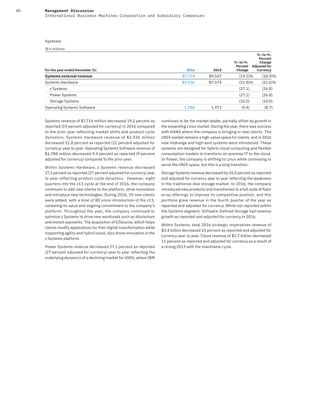
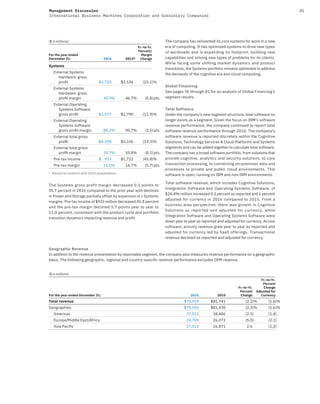
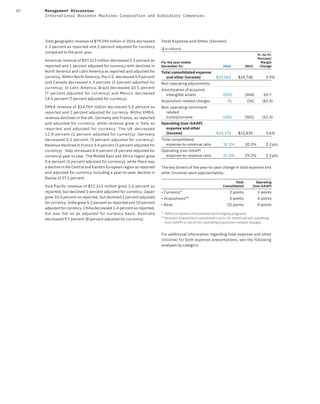
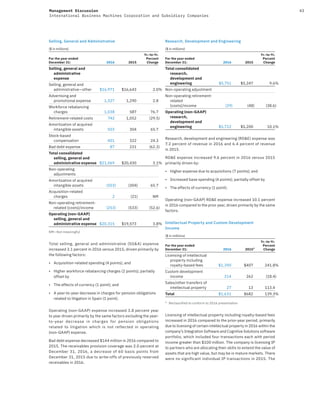
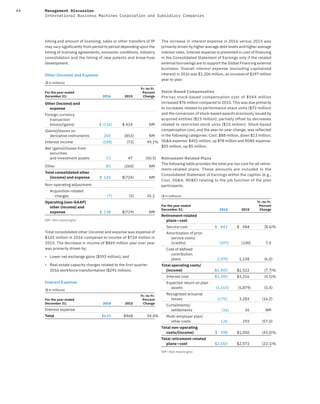
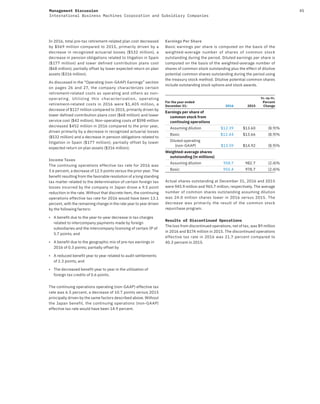
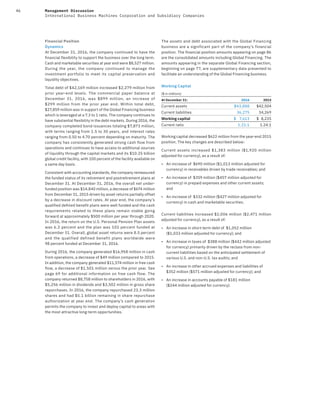
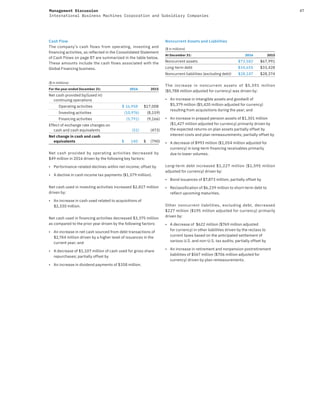
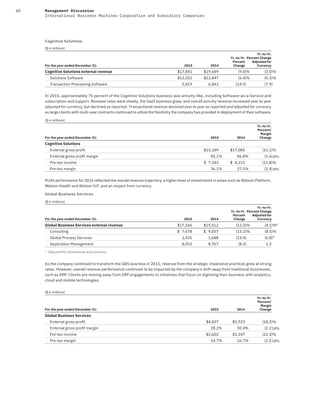
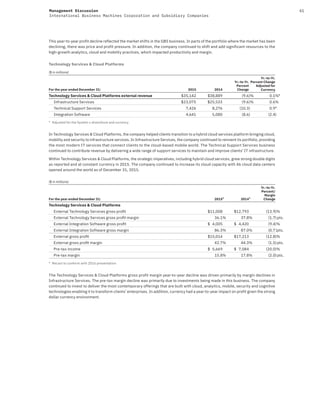
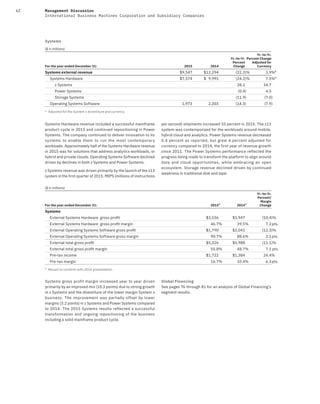
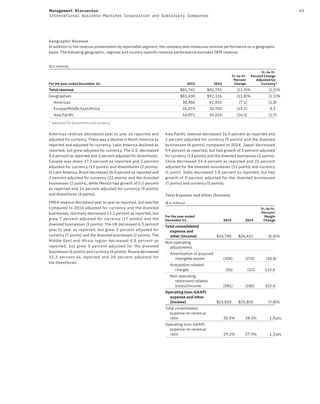
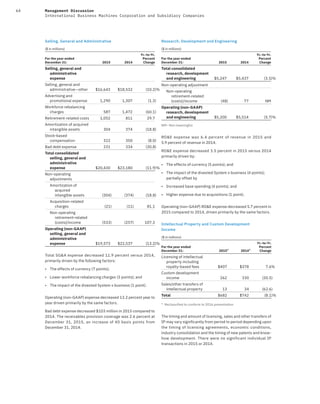
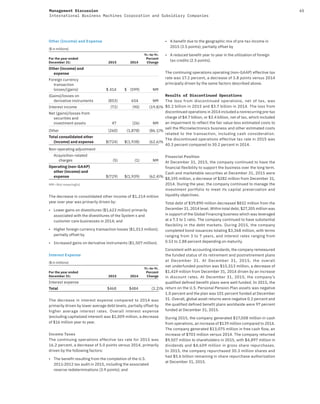
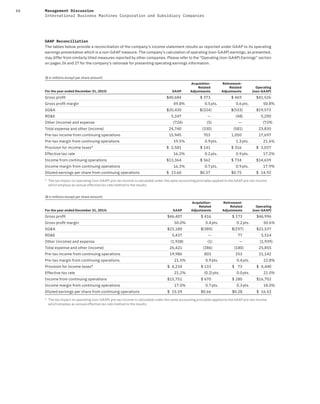
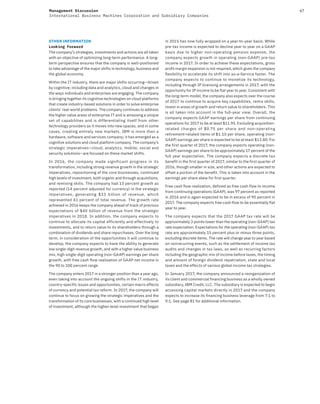
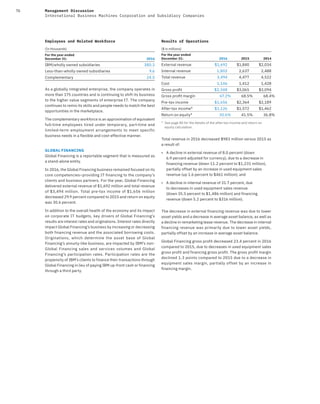
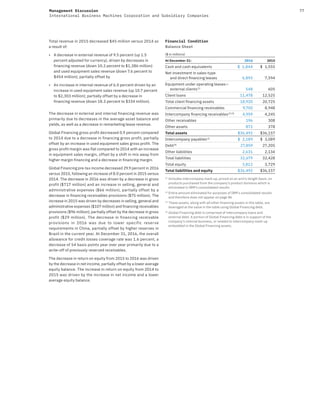
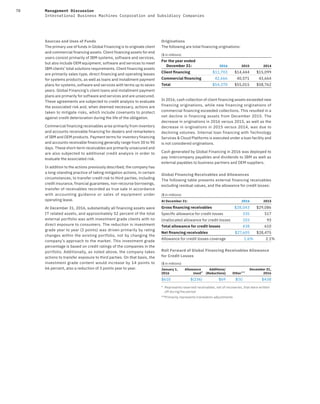
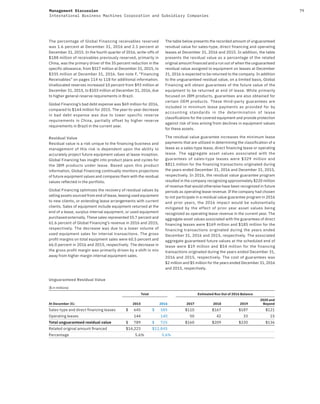
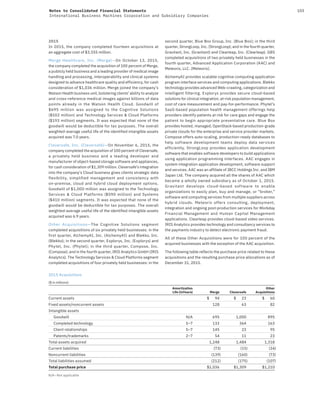
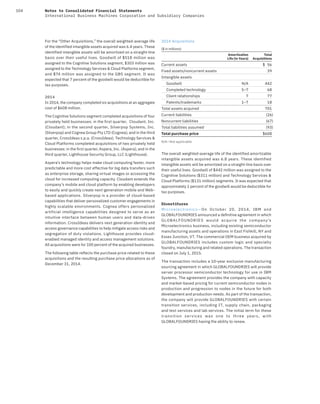
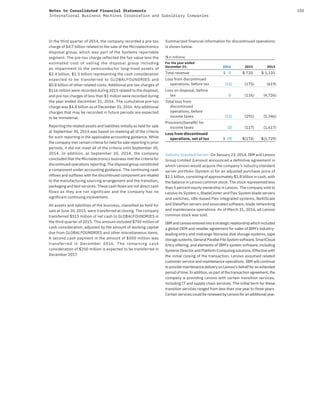
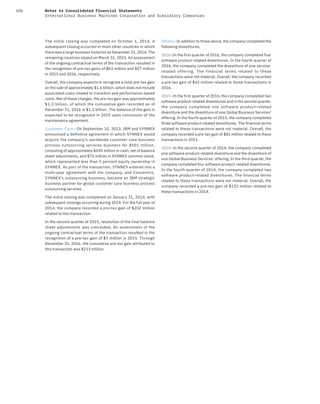
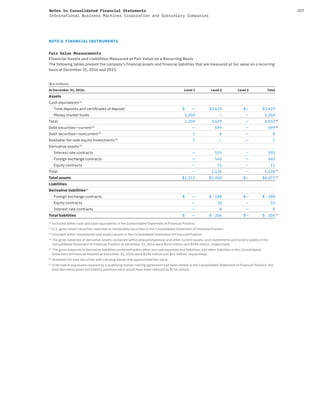
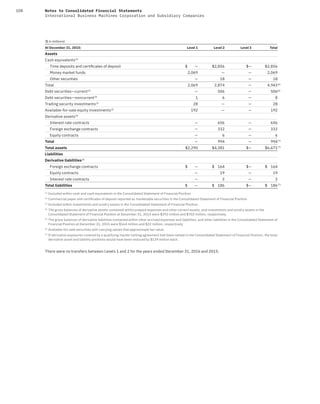
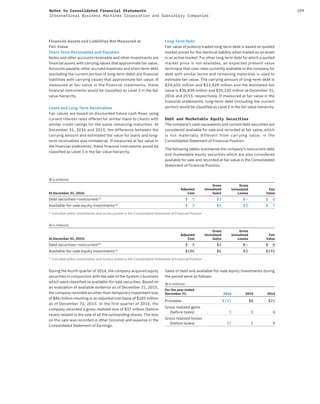
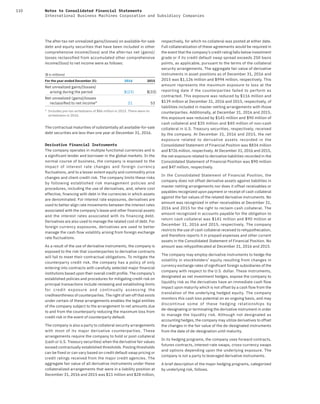
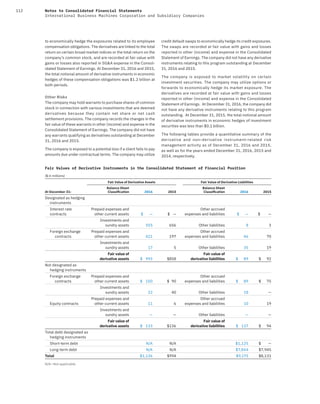
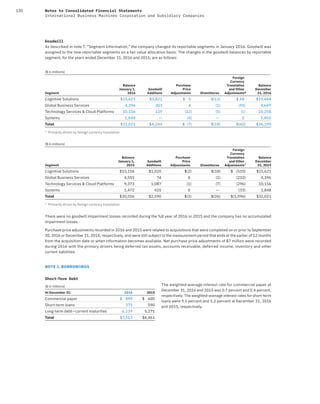
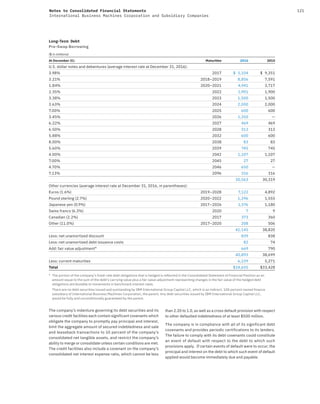
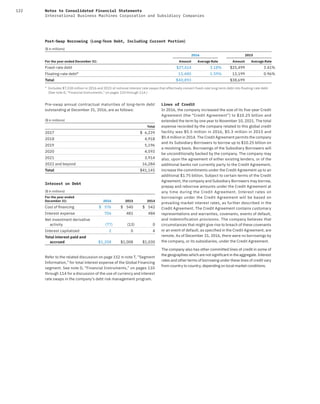
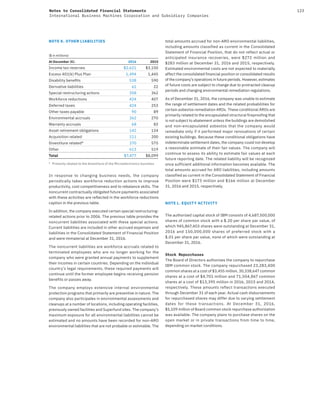
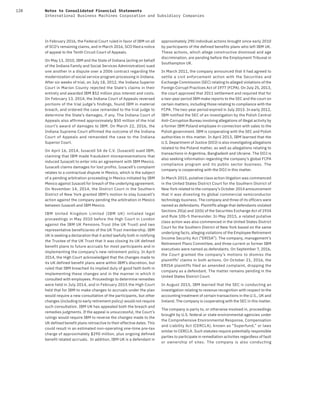
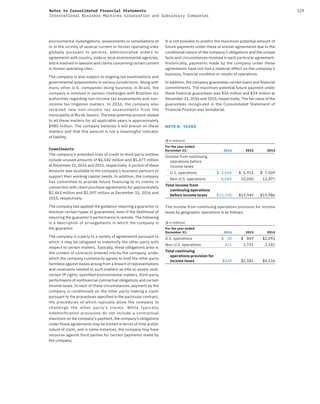
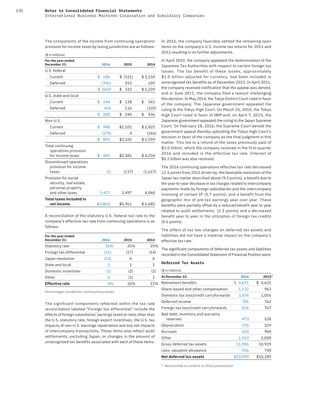
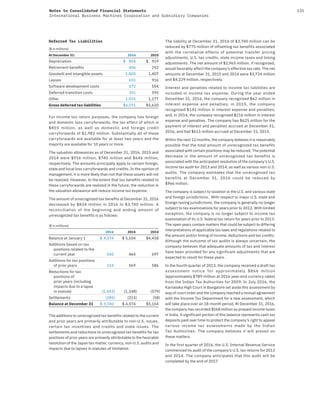
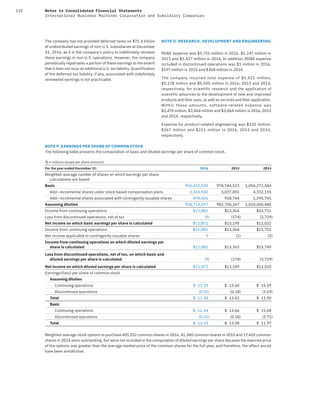
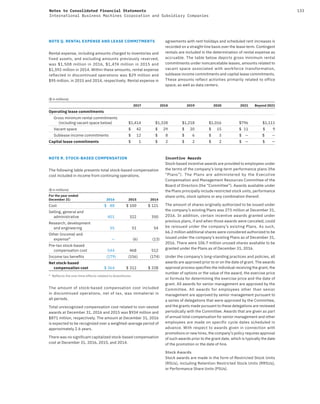
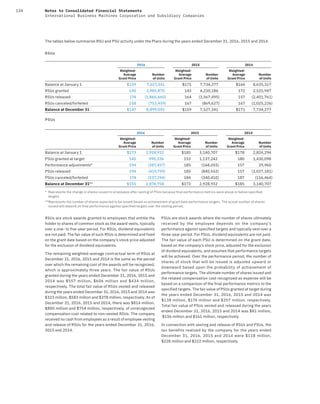
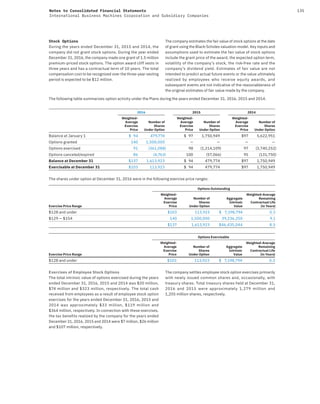
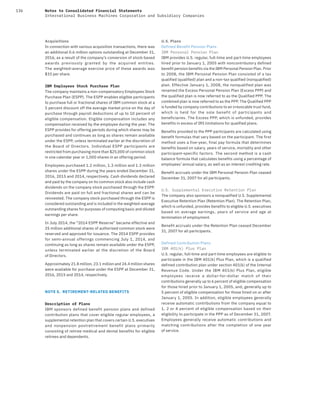
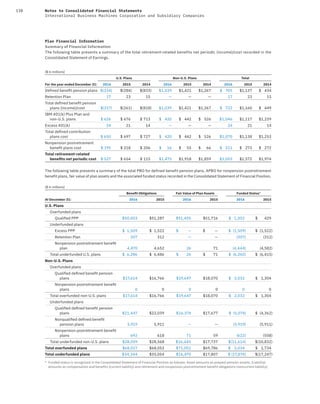
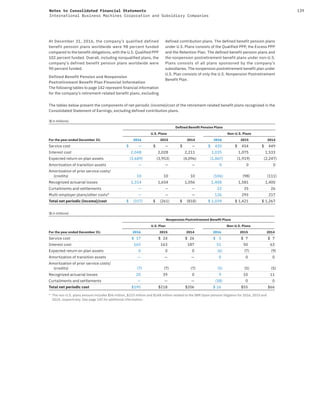
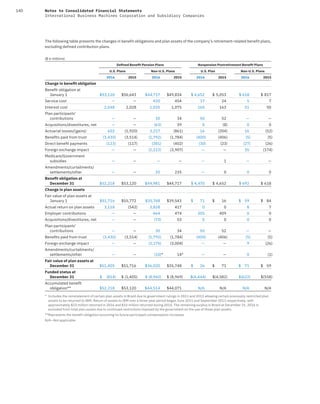
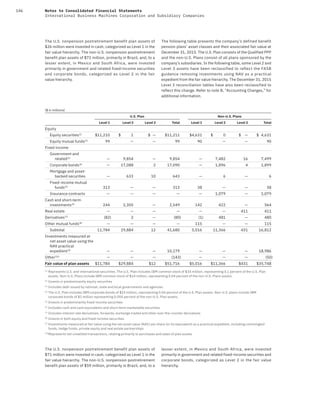
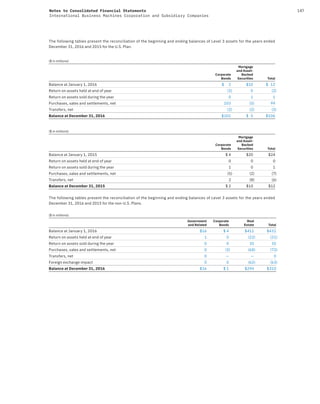
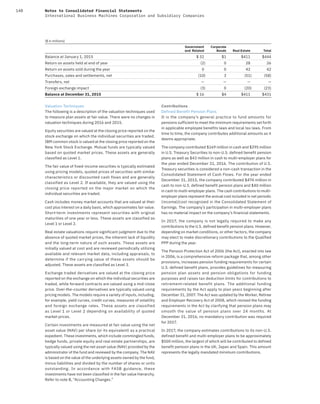
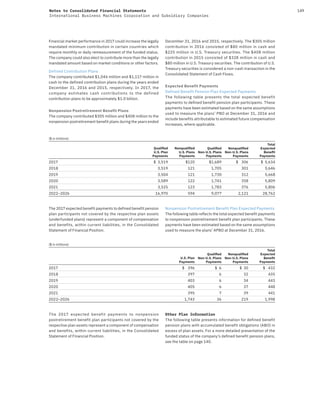
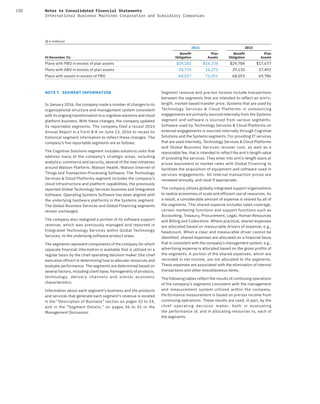
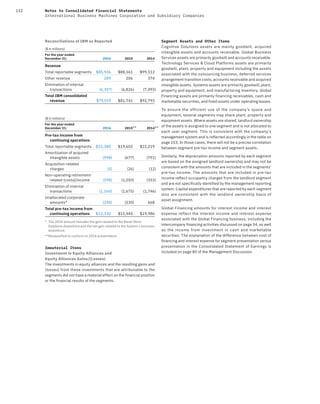
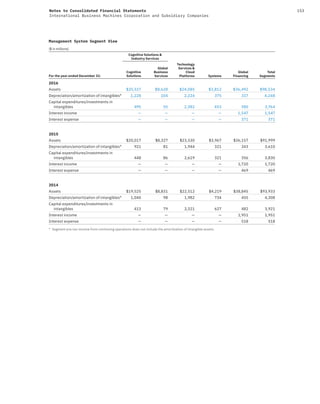
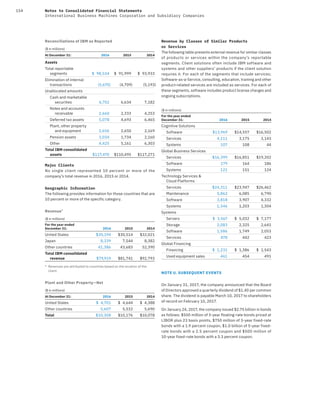
2016IBMAnnualReport
2016 IBM Annual Report
You who run our financial and energy systems; who design,
build and fly our planes, run our trains, manage our cities;
who cure us, feed us, clothe us, entertain us and keep us
safe; who teach our children.
As a professional, you are driven always to advance, and
to make a difference through your work. Which is why this
moment is so extraordinary for you.
Every profession in every industry in every part of the
world is changing, simultaneously. You are drawing on a
wealth of new data, knowledge, insights and tools. You are
being equipped to rethink your job, and freed to do your
life’s work.
We have reinvented IBM for this moment—to fuel your
dreams with Watson, with IBM Cloud, with deep expertise,
with trust. We believe in your ambition to be the best in your
profession. And we believe that you can make our world
healthier, safer, more productive, more creative, fairer.
That is a world we all want to live in. The world you’re
building, with IBM.
02
1.
Oncologists
can find more
targeted cancer
treatment options.
No doctor can keep up with the onrush of
oncology studies published every week,
much less determine which apply to each
patient. But Watson can. Trained for 15,000
hours by specialists at Memorial Sloan
Kettering Cancer Center in New York,
Watson has ingested nearly 15 million pages
from relevant journals and textbooks and
continues to expand its knowledge.
This expertise is now flowing around the
world and informs evidence-based treat-
ment options for clinicians serving patients
globally. Sites include six Manipal Hospitals
in India, Bumrungrad International
Hospital in Bangkok, Jupiter Medical
Center in Florida and Svet zdravia’s net-
work of 16 hospitals in Slovakia and Central
and Eastern Europe–and soon across China.
Elsewhere, in trials at the University
of North Carolina’s Lineberger
Comprehensive Cancer Center, Watson
suggested potential treatment options that
the tumor board hadn’t considered in one
third of cases.
In addition, doctors are better able to
understand their patients’ unique needs,
right down to the genetic level. Watson for
Genomics absorbs 10,000 new medical
articles and details from 100 clinical trials
every month. It applies what it learns to
suggest highly targeted therapies for each
patient’s individual cancer based on its
understanding of a tumor’s molecular
profile, allowing doctors to provide more
personalized treatment for their patients.
This powerful new tool is helping even
those patients who cannot travel to a
specialized medical center. Through Quest
Diagnostics, it is available to any oncolo-
gist in the United States, as an end-to-end
solution. Illumina plans to integrate it with
a tumor-sequencing workflow to provide
oncologists cognitive information on-site.
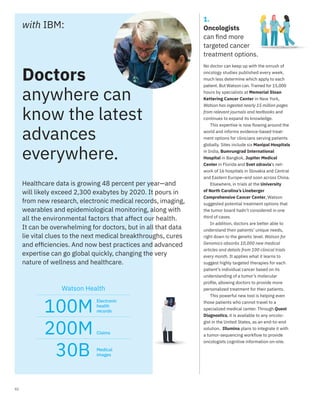
Doctors
anywhere can
know the latest
advances
everywhere.
with IBM:
Healthcare data is growing 48 percent per year—and
will likely exceed 2,300 exabytes by 2020. It pours in
from new research, electronic medical records, imaging,
wearables and epidemiological monitoring, along with
all the environmental factors that affect our health.
It can be overwhelming for doctors, but in all that data
lie vital clues to the next medical breakthroughs, cures
and efficiencies. And now best practices and advanced
expertise can go global quickly, changing the very
nature of wellness and healthcare.
Watson Health
100M
Electronic
health
records
200M Claims
30B Medical
images
032016 Annual Report
2.
Medical Researchers
can speed discovery of
genes that cause diseases.
3.
Radiologists
can find secrets hidden
in every image.
5.
Endocrinologists
will help people manage their
diabetes between visits.
4.
Hospital Administrators
can improve the health of
the health system.
6.
Veterinarians
can now be expert
on every breed.
The Central New York Care Collaborative
(CNYCC) is working with Watson Health to
create one of the first regional cognitive
population health platforms in the United
States. It will connect 2,000 care providers
in Upstate New York, integrating clinical,
social and behavioral data to produce
holistic views of patients—helping doctors
and clinicians make more-informed
decisions and promote healthier behavior.
CNYCC’s goal is value-based care that
reduces emergency room visits and
avoidable hospital stays by 25 percent over
five years—improving health while lowering
Medicaid costs.
Medical doctors treat one species:
humans. Veterinarians may treat dozens
of species and an even greater number
of cat and dog breeds. And their patients
can’t describe their symptoms. That’s
why IBM has worked with vets to build an
online tool that uses Watson. It can scan
hundreds of thousands of pages of med-
ical resources, helping vets customize
treatment options, stay current with best
practices and identify medical differences
among even very similar breeds.
↑
Watson can help
veterinarians treat
hundreds of dog
and cat breeds with
more confidence.
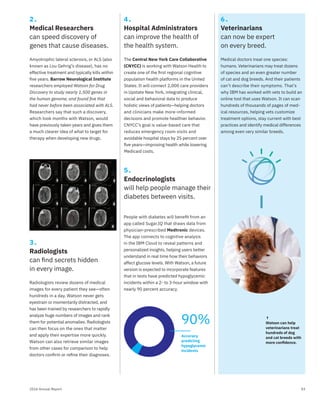
Amyotrophic lateral sclerosis, or ALS (also
known as Lou Gehrig’s disease), has no
effective treatment and typically kills within
five years. Barrow Neurological Institute
researchers employed Watson for Drug
Discovery to study nearly 1,500 genes in
the human genome, and found five that
had never before been associated with ALS.
Researchers say that such a discovery,
which took months with Watson, would
have previously taken years and gives them
a much clearer idea of what to target for
therapy when developing new drugs.
Radiologists review dozens of medical
images for every patient they see—often
hundreds in a day. Watson never gets
eyestrain or momentarily distracted, and
has been trained by researchers to rapidly
analyze huge numbers of images and rank
them for potential anomalies. Radiologists
can then focus on the ones that matter
and apply their expertise more quickly.
Watson can also retrieve similar images
from other cases for comparison to help
doctors confirm or refine their diagnoses.
People with diabetes will benefit from an
app called Sugar.IQ that draws data from
physician-prescribed Medtronic devices.
The app connects to cognitive analysis
in the IBM Cloud to reveal patterns and
personalized insights, helping users better
understand in real time how their behaviors
affect glucose levels. With Watson, a future
version is expected to incorporate features
that in tests have predicted hypoglycemic
incidents within a 2- to 3-hour window with
nearly 90 percent accuracy.
Accuracy
predicting
hypoglycemic
incidents
90%
04
9.
Chemical Engineers
turn social media activity
into a test lab.
8.
Stadium Architects
can create winning
experiences for every fan.
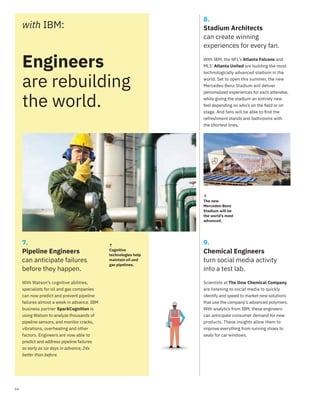
With IBM, the NFL’s Atlanta Falcons and
MLS’ Atlanta United are building the most
technologically advanced stadium in the
world. Set to open this summer, the new
Mercedes-Benz Stadium will deliver
personalized experiences for each attendee,
while giving the stadium an entirely new
feel depending on who’s on the field or on
stage. And fans will be able to find the
refreshment stands and bathrooms with
the shortest lines.
Engineers
are rebuilding
the world.
↑
The new
Mercedes-Benz
Stadium will be
the world’s most
advanced.
Scientists at The Dow Chemical Company
are listening to social media to quickly
identify and speed to market new solutions
that use the company’s advanced polymers.
With analytics from IBM, these engineers
can anticipate consumer demand for new
products. These insights allow them to
improve everything from running shoes to
seals for car windows.
with IBM:
7.
Pipeline Engineers
can anticipate failures
before they happen.
With Watson’s cognitive abilities,
specialists for oil and gas companies
can now predict and prevent pipeline
failures almost a week in advance. IBM
business partner SparkCognition is
using Watson to analyze thousands of
pipeline sensors, and monitor cracks,
vibrations, overheating and other
factors. Engineers are now able to
predict and address pipeline failures
as early as six days in advance, 24x
better than before.
↑
Cognitive
technologies help
maintain oil and
gas pipelines.
052016 Annual Report
13.
Railway Engineers
are going the extra 19,000
miles for commuters.
11.
Geoscientists
know where and
when to drill.
12.
Shipbuilders
can hit the water
more quickly.
Every day, 13.5 million passengers travel
with SNCF, France’s major railway system.
To improve efficiency and customer
satisfaction, railway engineers are equip-
ping 30,000 kilometers of track, 15,000
trains and 3,000 stations with sensors, all
connected to the Watson IoT Platform. By
monitoring data in real time, engineers and
operators can improve quality, security and
availability of trains.
Halliburton uses the IBM Cloud to run
sophisticated oil reservoir simulations that
help it better understand how complex oil
and gas fields might behave under different
development scenarios. With insights from
hundreds of models, petroleum engineers
and geoscientists can optimize drilling
decisions to reduce costs and increase
production—shaping how billions of dollars
may be spent on large oil fields.
Italy’s Fincantieri is speeding the creation
of new cruise ships and naval vessels with
a hybrid cloud solution from IBM. By con-
necting 13 private distributed data centers
with IBM’s Cloud Data Center in Milan,
Fincantieri now has an IT infrastructure that
supports a compute-intensive design and
manufacturing system, allowing designers
and engineers to more fluidly manage the
process from design to deployment.
10.
Automotive Engineers
are building cars
that converse with
drivers, passengers
and each other.
By 2020, an estimated 83 million cars
will connect to the Internet—each with
hundreds of sensors on board. With this
future in mind, General Motors, BMW
and Local Motors are now using Watson
to build the world’s first generation of
cognitive driving machines.
GM is expanding its OnStar AtYour-
Service offers and deals platform by
launching new capabilities supported
by OnStar Go with IBM Watson. With
customers’ consent, Watson will learn
drivers’ preferences, apply machine
learning and sift through data to
recognize patterns in their decisions
and habits to deliver individualized
location-based interactions. These ca-
pabilities are expected to be available in
millions of vehicles in the United States
by the end of 2017.
Olli, a self-driving electric shuttle
from Local Motors, holds natural language
conversations with passengers, provid-
ing a more engaging user experience.
Watson learns from more than 30 sensors
embedded throughout the vehicle to
enhance its understanding of passengers’
needs and preferences.
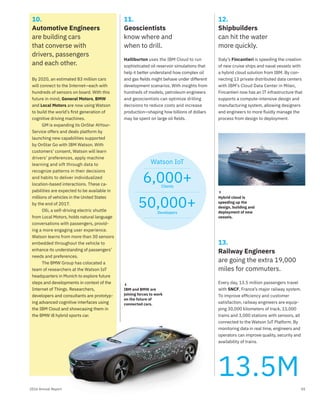
The BMW Group has colocated a
team of researchers at the Watson IoT
headquarters in Munich to explore future
steps and developments in context of the
Internet of Things. Researchers,
developers and consultants are prototyp-
ing advanced cognitive interfaces using
the IBM Cloud and showcasing them in
the BMW i8 hybrid sports car.
↑
Hybrid cloud is
speeding up the
design, building and
deployment of new
vessels.
↓
IBM and BMW are
joining forces to work
on the future of
connected cars.
13.5M
Watson IoT
50,000+
6,000+
Developers
Clients
2016 Annual Report
Every day, 13.5
with SNCF, France’s
To improve efficiency
satisfaction,
ping 30,000
trains and 3,000
connected to
monitoring datamonitoring datamonitoring
operators can
availability of
steps and developments in context of the
Internet of Things. Researchers,
developers and consultants are prototyp-
ing advanced cognitive interfaces using
the IBM Cloud and showcasing them in
the BMW i8 hybrid sports car.
↓
IBM and BMW are
joining forcesjoining forcesjoining to work
on the future of
connected cars.
13.5M
06
15.
Music Producers
compose songs in
the key of AI.
with IBM:
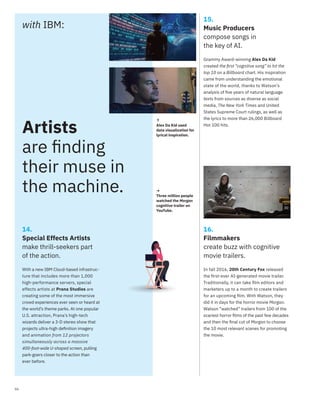
Grammy Award-winning Alex Da Kid
created the first “cognitive song” to hit the
top 10 on a Billboard chart. His inspiration
came from understanding the emotional
state of the world, thanks to Watson’s
analysis of five years of natural language
texts from sources as diverse as social
media, The New York Times and United
States Supreme Court rulings, as well as
the lyrics to more than 26,000 Billboard
Hot 100 hits.
Artists
are finding
their muse in
the machine. →
Three million people
watched the Morgan
cognitive trailer on
YouTube.
↑
Alex Da Kid used
data visualization for
lyrical inspiration.
16.
Filmmakers
create buzz with cognitive
movie trailers.
In fall 2016, 20th Century Fox released
the first-ever AI-generated movie trailer.
Traditionally, it can take film editors and
marketers up to a month to create trailers
for an upcoming film. With Watson, they
did it in days for the horror movie Morgan.
Watson “watched” trailers from 100 of the
scariest horror films of the past few decades
and then the final cut of Morgan to choose
the 10 most relevant scenes for promoting
the movie.
14.
Special Effects Artists
make thrill-seekers part
of the action.
With a new IBM Cloud-based infrastruc-
ture that includes more than 1,000
high-performance servers, special
effects artists at Prana Studios are
creating some of the most immersive
crowd experiences ever seen or heard at
the world’s theme parks. At one popular
U.S. attraction, Prana’s high-tech
wizards deliver a 3-D stereo show that
projects ultra-high definition imagery
and animation from 12 projectors
simultaneously across a massive
400-foot-wide U-shaped screen, pulling
park-goers closer to the action than
ever before.
072016 Annual Report
18.
Bartenders
can mix drinks with
a cognitive twist.
Virgin Holidays created a custom rum
blend designed to “taste like a vacation
feels.” With IBM Chef Watson Twist,
bartenders can bring together flavors
that complement one another at the
molecular level. Watson also analyzed
social posts from more than 15 million
people on holiday, helping a master
blender match their sentiments to
corresponding flavors.
19.
Fashion Designers
create dresses
with emotional
intelligence.
For the 2016 Met Gala in New York City,
high-fashion design house Marchesa
literally lit up the red carpet with a
cognitive dress that applied color
psychology to match emotions. The
resulting piece, created with Watson’s
Cognitive Color Tool and worn by
supermodel Karolína Kurková, had 150
connected LED flowers that lit up in
different colors based on real-time
sentiment in the room and on Twitter.
17.
Chefs
have a new recipe
for delighting diners.
Watson helps great chefs unleash their
creativity through its deep understanding
of the science of food chemistry and the
psychology of taste. Cognitive Cooking with
Chef Watson, written with the Institute of
Culinary Education, contains more than
65 recipes and was named by Gourmand
International as one of the “most innovative”
cookbooks in the United States.
→
Watson reviewed
images of 200
Marchesa dresses to
suggest materials and
colors for the world’s
first cognitive dress.
→
Watson revvieewedwed
20.
Astronauts
are sharing their
view of the world.
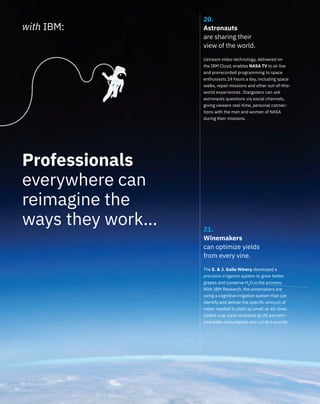
Ustream video technology, delivered on
the IBM Cloud, enables NASA TV to air live
and prerecorded programming to space
enthusiasts 24 hours a day, including space
walks, repair missions and other out-of-this-
world experiences. Stargazers can ask
astronauts questions via social channels,
giving viewers real-time, personal connec-
tions with the men and women of NASA
during their missions.
21.
Winemakers
can optimize yields
from every vine.
The E. & J. Gallo Winery developed a
precision irrigation system to grow better
grapes and conserve H2
O in the process.
With IBM Research, the winemakers are
using a cognitive irrigation system that can
identify and deliver the specific amount of
water needed to plots as small as 40 vines.
Gallo’s crop yield increased by 26 percent—
and water consumption was cut by a quarter.
with IBM:
Professionals
everywhere can
reimagine the
ways they work…
08
23.
Cyclists
can race faster—and rise
higher on the podium.
In competitive cycling, a tenth of a second is
everything. Ahead of the Rio Olympics, the
U.S. Women’s Cycling Team tapped IBM
Analytics and Watson IoT to study every
pedal stroke and heartbeat. By analyzing
data streaming in from sensors installed in
the bikes, IBM helped the team calculate
the optimal energy output of each rider at
certain points in the race. The team ended
up beating their own American record,
shaving two full seconds off their time from
the 2016 London World Championships and
ascending the podium in Rio with the 2016
silver medal.
25.
Steelworkers
balance safety
and efficiency.
24.
Store Managers
are fighting back against
online competitors.
26.
Flight Attendants
help passengers find their
connecting gates.
22.
Meteorologists
inform the world
from their backyards.
Israel’s North Star BlueScope Steel
recently partnered with Watson IoT on
wearable safety technology that helps
employees stay safe in dangerous environ-
ments. By analyzing data collected from IoT
sensors worn by users and embedded in
their personal protective equipment,
supervisors can continuously monitor
workers’ skin temperatures, heart rates
and levels of activity to correlate health
conditions with sensor data on ambient
temperature and humidity. The data can
then be used to provide personalized safety
guidelines, advising workers when to take a
break if temperatures rise to unsafe levels.
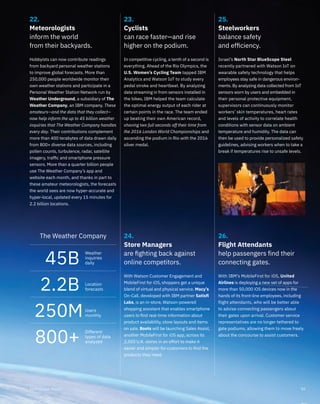
Hobbyists can now contribute readings
from backyard personal weather stations
to improve global forecasts. More than
250,000 people worldwide monitor their
own weather stations and participate in a
Personal Weather Station Network run by
Weather Underground, a subsidiary of The
Weather Company, an IBM company. These
amateurs—and the data that they collect—
now help inform the up to 45 billion weather
inquiries that The Weather Company handles
every day. Their contributions complement
more than 400 terabytes of data drawn daily
from 800+ diverse data sources, including
pollen counts, turbulence, radar, satellite
imagery, traffic and smartphone pressure
sensors. More than a quarter billion people
use The Weather Company’s app and
website each month, and thanks in part to
these amateur meteorologists, the forecasts
the world sees are now hyper-accurate and
hyper-local, updated every 15 minutes for
2.2 billion locations.
With Watson Customer Engagement and
MobileFirst for iOS, shoppers get a unique
blend of virtual and physical service. Macy’s
On-Call, developed with IBM partner Satisfi
Labs, is an in-store, Watson-powered
shopping assistant that enables smartphone
users to find real-time information about
product availability, store layouts and items
on sale. Boots will be launching Sales Assist,
another MobileFirst for iOS app, across its
2,500 U.K. stores in an effort to make it
easier and simpler for customers to find the
products they need.
With IBM’s MobileFirst for iOS, United
Airlines is deploying a new set of apps for
more than 50,000 iOS devices now in the
hands of its front-line employees, including
flight attendants, who will be better able
to advise connecting passengers about
their gates upon arrival. Customer service
representatives are no longer tethered to
gate podiums, allowing them to move freely
about the concourse to assist customers.
The Weather Company
45B
Weather
inquiries
daily
Location
forecasts2.2B
Users
monthly250M
Different
types of data
analyzed800+
092016 Annual Report
27.
Pilots
can outmaneuver
the wind.
Not only is turbulence unpleasant to
sit through, it costs airlines more than
$100 million every year due to crew and
passenger injuries, operational delays and
unscheduled aircraft maintenance. Now
American Airlines, Alaska Airlines, Cathay
Dragon and United Airlines are using Total
Turbulence from The Weather Company to
analyze sensor data from more than 3,000
flights daily. It identifies patches of rough
air and delivers real-time alerts to operation
centers and pilots, enabling them to react
quicker and take appropriate action to
minimize bumpy rides.
with IBM:
…and how they
make a difference
in the world.
10
32.
Lawyers
spend less time on research
and more time with clients.
One of the major impediments to affordable,
quality legal representation is the high cost
of legal research. A recent study found
that new associates spend a third of their
time poring over laws, prior cases and legal
journals to support arguments on behalf of
a plaintiff or defendant. ROSS Intelligence
is a digital research adviser that uses
Watson’s natural language query
capabilities to enable law firms to sift
through more than one million legal
documents per second and return relevant
passages and citations for a case.
28.
College Professors
can respond to students
24 hours a day.
The newest digital learning tools are
helping students and professors work
smarter in the classroom. One professor
at Georgia Tech deployed Jill Watson,
the world’s “first AI teaching assistant,”
to join 30 human teaching assistants
in answering questions and providing
guidance to nearly 1,000 graduate
students. Available at any hour of the day,
Jill was so good that students couldn’t tell
the difference between her counsel and
that of human counterparts. Students also
will be able to ask questions and engage in
dialogue about courses with Pearson’s new
digital learning products, just as they would
their professors. Instructors will receive
real-time insights on student progress,
allowing them to better manage courses
and flag students who need additional help.
1,000,000
legal documents
per second
29.
Digital Merchandisers
can satisfy the most
demanding shoppers.
With XPS and Watson Customer
Engagement, 1-800-Flowers.com built
GWYN (Gifts When You Need), a virtual
gift concierge that can look through
1-800-Flowers.com’s 75,000+ products
and find the best choices for each shopper.
Shoppers explain what they’re looking
for in their own words. GWYN then sifts
through structured and unstructured data
on product descriptions, prices, varieties,
categories, delivery options and more
to identify the most appropriate gifts to
feature. Eighty percent of the shoppers
who have used the service say they would
use it again, and 65 percent click through
to the products offered.
The world’s first cognitive ads listen
and react to individual consumer needs,
giving relevant, context-sensitive
responses tailored just for them. With
Watson machine learning and natural
language, the Campbell Soup Company
and Toyota are pioneering Watson
Ads on weather.com and The Weather
Channel apps.
31.
Copywriters
can turn advertising into
personal conversations.
30.
Farmers
are harvesting data
for bumper crops.
Farmers in established growing regions
have traditionally relied on static climate
datasets collected by existing government,
city or airport weather stations. Now, with
a global network of distributed weather
stations in the field, and with hyper-local
forecasts from The Weather Company,
Farmers Edge is providing real-time data
and highly precise predictive models that
enable growers to make more accurate
decisions on how to manage their time,
resources and costs.
33.
Sanitation Workers
can nearly double
their input.
In fast-growing Nairobi, potholes and traffic
jams hinder delivery of public services. IBM
researchers equipped the city’s fleet of
garbage trucks with mobile phone trackers
to monitor truck movements and allow fleet
supervisors to track data on location and
speed in real time. Department supervisors
could identify problems on roadways as
soon as drivers experienced them and
suggest more efficient routes on the spot.
As a result, garbage collection nearly doubled,
from 800 to 1,400 metric tons per day.
112016 Annual Report
12
IT Specialists
are embracing a
cognitive future.
with IBM:
132016 Annual Report
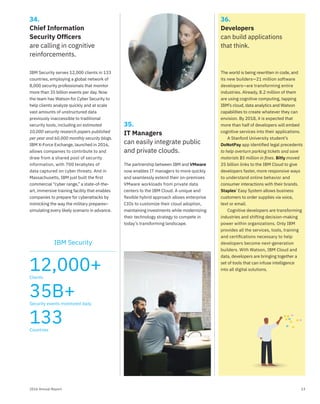
IBM Security
12,000+Clients
Countries
35B+
133
Security events monitored daily
34.
Chief Information
Security Officers
are calling in cognitive
reinforcements.
35.
IT Managers
can easily integrate public
and private clouds.
The partnership between IBM and VMware
now enables IT managers to more quickly
and seamlessly extend their on-premises
VMware workloads from private data
centers to the IBM Cloud. A unique and
flexible hybrid approach allows enterprise
CIOs to customize their cloud adoption,
maintaining investments while modernizing
their technology strategy to compete in
today’s transforming landscape.
36.
Developers
can build applications
that think.
The world is being rewritten in code, and
its new builders—21 million software
developers—are transforming entire
industries. Already, 8.2 million of them
are using cognitive computing, tapping
IBM’s cloud, data analytics and Watson
capabilities to create whatever they can
envision. By 2018, it is expected that
more than half of developers will embed
cognitive services into their applications.
A Stanford University student’s
DoNotPay app identified legal precedents
to help overturn parking tickets and save
motorists $5 million in fines. Bitly moved
25 billion links to the IBM Cloud to give
developers faster, more responsive ways
to understand online behavior and
consumer interactions with their brands.
Staples’ Easy System allows business
customers to order supplies via voice,
text or email.
Cognitive developers are transforming
industries and shifting decision-making
power within organizations. Only IBM
provides all the services, tools, training
and certifications necessary to help
developers become next-generation
builders. With Watson, IBM Cloud and
data, developers are bringing together a
set of tools that can infuse intelligence
into all digital solutions.
IBM Security serves 12,000 clients in 133
countries, employing a global network of
8,000 security professionals that monitor
more than 35 billion events per day. Now
the team has Watson for Cyber Security to
help clients analyze quickly and at scale
vast amounts of unstructured data
previously inaccessible to traditional
security tools, including an estimated
10,000 security research papers published
per year and 60,000 monthly security blogs.
IBM X-Force Exchange, launched in 2016,
allows companies to contribute to and
draw from a shared pool of security
information, with 700 terabytes of
data captured on cyber threats. And in
Massachusetts, IBM just built the first
commercial “cyber range,” a state-of-the-
art, immersive training facility that enables
companies to prepare for cyberattacks by
mimicking the way the military prepares–
simulating every likely scenario in advance.
39.
Insurers
can prevent damage
rather than pay for it.
38.
Compliance Officers
can save billions on
regulatory costs.
40.
Customer Service
Professionals
can handle more questions.
37.
Tax Preparers
can find hidden
credits.
Weighing in at 74,000 pages—with
thousands of new changes each year—
the United States tax code is complex
and voluminous, even for the savviest
tax preparer. With Watson, H&R Block’s
70,000 professionals can now draw
connections between tax laws, insights
from the company’s deep database of
720 million tax returns over the past 60
years, and personal financial documents
to maximize outcomes for customers.
More than 10 million tax filers are
expected to benefit this year.
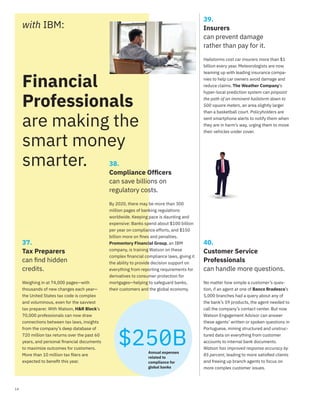
Hailstorms cost car insurers more than $1
billion every year. Meteorologists are now
teaming up with leading insurance compa-
nies to help car owners avoid damage and
reduce claims. The Weather Company’s
hyper-local prediction system can pinpoint
the path of an imminent hailstorm down to
500 square meters, an area slightly larger
than a basketball court. Policyholders are
sent smartphone alerts to notify them when
they are in harm’s way, urging them to move
their vehicles under cover.
By 2020, there may be more than 300
million pages of banking regulations
worldwide. Keeping pace is daunting and
expensive: Banks spend about $100 billion
per year on compliance efforts, and $150
billion more on fines and penalties.
Promontory Financial Group, an IBM
company, is training Watson on these
complex financial compliance laws, giving it
the ability to provide decision support on
everything from reporting requirements for
derivatives to consumer protection for
mortgages—helping to safeguard banks,
their customers and the global economy.
Financial
Professionals
are making the
smart money
smarter.
with IBM:
No matter how simple a customer’s ques-
tion, if an agent at one of Banco Bradesco’s
5,000 branches had a query about any of
the bank’s 59 products, the agent needed to
call the company’s contact center. But now
Watson Engagement Advisor can answer
these agents’ written or spoken questions in
Portuguese, mining structured and unstruc-
tured data on everything from customer
accounts to internal bank documents.
Watson has improved response accuracy by
85 percent, leading to more satisfied clients
and freeing up branch agents to focus on
more complex customer issues.
$250BAnnual expenses
related to
compliance for
global banks
14
41, 42, 43.
Bankers, Diamond
Brokers and Shippers
can transact with trust.
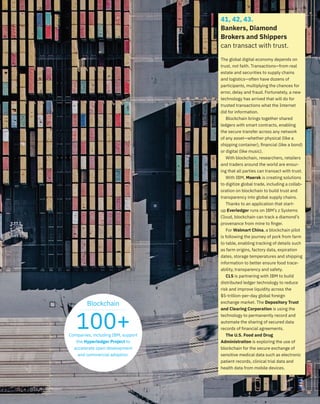
The global digital economy depends on
trust, not faith. Transactions—from real
estate and securities to supply chains
and logistics—often have dozens of
participants, multiplying the chances for
error, delay and fraud. Fortunately, a new
technology has arrived that will do for
trusted transactions what the Internet
did for information.
Blockchain brings together shared
ledgers with smart contracts, enabling
the secure transfer across any network
of any asset—whether physical (like a
shipping container), financial (like a bond)
or digital (like music).
With blockchain, researchers, retailers
and traders around the world are ensur-
ing that all parties can transact with trust.
With IBM, Maersk is creating solutions
to digitize global trade, including a collab-
oration on blockchain to build trust and
transparency into global supply chains.
Thanks to an application that start-
up Everledger runs on IBM’s z Systems
Cloud, blockchain can track a diamond’s
provenance from mine to finger.
For Walmart China, a blockchain pilot
is following the journey of pork from farm
to table, enabling tracking of details such
as farm origins, factory data, expiration
dates, storage temperatures and shipping
information to better ensure food trace-
ability, transparency and safety.
CLS is partnering with IBM to build
distributed ledger technology to reduce
risk and improve liquidity across the
$5-trillion-per-day global foreign
exchange market. The Depository Trust
and Clearing Corporation is using the
technology to permanently record and
automate the sharing of secured data
records of financial agreements.
The U.S. Food and Drug
Administration is exploring the use of
blockchain for the secure exchange of
sensitive medical data such as electronic
patient records, clinical trial data and
health data from mobile devices.
Companies, including IBM, support
the Hyperledger Project to
accelerate open development
and commercial adoption.
100+
Blockchain
152016 Annual Report
16
with IBM:
44.
Educators
can adapt to every
student’s learning
style and need.
↑
Sesame Workshop is
looking to once again
transform early
learning, this time
with Watson.
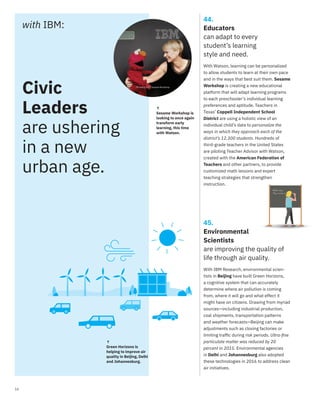
With Watson, learning can be personalized
to allow students to learn at their own pace
and in the ways that best suit them. Sesame
Workshop is creating a new educational
platform that will adapt learning programs
to each preschooler’s individual learning
preferences and aptitude. Teachers in
Texas’ Coppell Independent School
District are using a holistic view of an
individual child’s data to personalize the
ways in which they approach each of the
district’s 12,300 students. Hundreds of
third-grade teachers in the United States
are piloting Teacher Advisor with Watson,
created with the American Federation of
Teachers and other partners, to provide
customized math lessons and expert
teaching strategies that strengthen
instruction.
45.
Environmental
Scientists
are improving the quality of
life through air quality.
With IBM Research, environmental scien-
tists in Beijing have built Green Horizons,
a cognitive system that can accurately
determine where air pollution is coming
from, where it will go and what effect it
might have on citizens. Drawing from myriad
sources—including industrial production,
coal shipments, transportation patterns
and weather forecasts—Beijing can make
adjustments such as closing factories or
limiting traffic during risk periods. Ultra-fine
particulate matter was reduced by 20
percent in 2015. Environmental agencies
in Delhi and Johannesburg also adopted
these technologies in 2016 to address clean
air initiatives.
↑
Green Horizons is
helping to improve air
quality in Beijing, Delhi
and Johannesburg.
Civic
Leaders
are ushering
in a new
urban age.
TM and © 2017 Sesame Workshop
172016 Annual Report
49.
Police Officers
can stay one step
ahead of criminals.
50.
Food Inspectors
can thwart epidemics
using supermarket
scanners.
47.
Helpline Operators
can give answers in a
New York minute.
48.
Principals
are preparing “new
collar workers”
for high-tech jobs.
46.
Building Managers
are listening to their
structures—and saving
millions.
With Watson IoT, building managers and
operators can make smarter decisions.
Siemens Building Technologies
Division’s cloud-based solution captures
data generated by more than 70,000
connected buildings to spot energy usage
and equipment problems in advance, saving
millions of dollars and reducing carbon
emissions by two million tons every year.
KONE enables one billion people to
move on more than one million elevators
and escalators worldwide. The Watson IoT
Cloud lets KONE connect sensors in these
conveyances to improve people flow and
performance. With this data, KONE can pre-
dict potential outages, follow performance
in real time, run tests remotely and dispatch
technicians with better customer insight.
Clean, well-stocked restrooms make good
impressions with customers, employees and
tenants of any building. Delivered through the
IBM Cloud, new technology from Kimberly-
Clark Professional allows restroom
attendants to monitor conditions remotely
from any device or location, alerting them to
potential issues before complaints come in.
Sensors embedded into towel, tissue and
soap dispensers, as well as door counters,
send real-time alerts to managers regarding
supply usage levels, jams and overall traffic.
Cleaning staff can then be assigned to those
areas that most need service. Supplies are
better managed, costs are lowered and
tenants are happier.
Police work is shifting from reactive
crime-fighting to proactively managing
public safety—working across boundaries
to analyze data, spot patterns and avert
crimes before they happen. With IBM, 6,000
police departments around the world can
now access more than a billion shareable
documents from the cloud. They apply
intelligent analytics to predict and prevent
crime in ways never before possible,
leading to reductions in violent crime of up
to 40 percent in some U.S. cities.
From Salmonella to norovirus, foodborne
illnesses afflict almost 1 in 10 people every
year. The only way to prevent more from
getting sick is to trace the problem back to
the source of the contaminated food, which
normally can take months. With IBM
Research, public health officials can now
use the data from simple supermarket
scanners to analyze grocery receipts
connected with as few as 10 reported cases
of illness to find tainted sources within 12
hours or less.
With Watson, New York’s 311 citizen
helpline will use artificial intelligence
to help people navigate life in the city.
The system will help provide more
user-friendly, up-to-the-minute and
practical responses to 100,000 daily
complaints, inquiries and calls for
service–nearly 36 million a year.
A four-year college degree is no longer
the only route to a good job. High school
students from diverse backgrounds are
getting a great education, building their
skills and landing the “new collar” jobs
of the emerging cognitive era. Pathways
in Technology Early College High School
(P-TECH), created by IBM with leading
educational partners, offers a unique six-
year curriculum (grades 9–14) resulting in
an associate degree. Dozens have already
graduated ahead of schedule, prepared
for jobs in high demand at IBM and many
other companies. P-TECH will soon be
available in 100 schools across six U.S.
states and Australia.
18
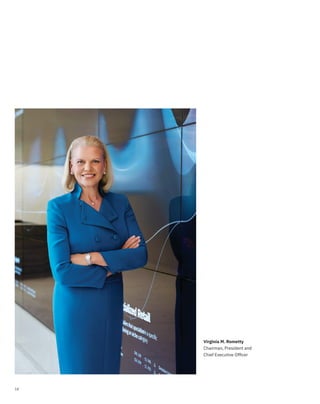
Virginia M. Rometty
Chairman, President and
Chief Executive Officer
192016 Annual Report
It can be hard to assess the progress of a
major transformation from a single year’s
results. And yet, when you look back after
a few years, it becomes clear just how much
has changed.
Before I offer a broader perspective, let
me describe how your company performed
in 2016. We made substantial progress
last year:
• We achieved operating earnings per
share of $13.59 and free cash flow of
$11.6 billion.
• We invested heavily for our long-term
competitiveness—nearly $6 billion in
research and development, nearly $4
billion in capital expenditures and nearly
$6 billion to make 15 acquisitions, adding
to our capabilities in the high-growth
areas of cognitive, cloud and security.
• We returned $8.8 billion to you, our
shareholders, including dividends of $5.3
billion and $3.5 billion in gross share
repurchases. We raised our dividend for
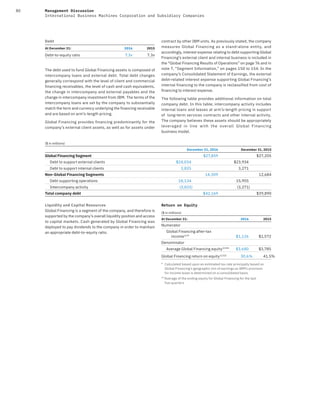
the 21st consecutive year—and it was
IBM’s 101st straight year of providing
one. We are proud of both milestones.
• IBM’s technical community outdid itself.
For the 24th year in a row, IBM led in
U.S. patents earned, becoming the first
company to break the 8,000 mark
in one year.
• All of this and more is due to the work
and passion of 380,000 IBMers. They are
our greatest competitive advantage and
the most important reason for confidence
in IBM’s prospects in the years ahead.
This is why it’s so encouraging that
employee engagement scores continue
to rise year after year.
But understanding IBM at the start of
2017 requires a longer view—in particular,
remembering why we embarked on this
journey of transformation. It had nothing
to do with economic downturn or fixing
something broken. Rather, our experience
over more than a century has trained us
to be vigilant. We began to see that the IT
industry would radically reorder, driven by
the phenomenon of data, the maturation of
cloud computing and the emergence of what
many call artificial intelligence or AI. We
were convinced that the source of value—
for our clients and for our owners—would
shift, and that the convergence of these
innovations would usher in a new era in
both technology and business.
We didn’t wait. We got out of commoditizing
businesses—trimming $8 billion from our
top line (and nothing from our bottom line)
over the past five years. We redoubled
our efforts to reinvent our core hardware,
software and services franchises, while
investing to create new ones—in cloud, data,
cognitive, security and the other businesses
that comprise our strategic imperatives. We
did this not simply to manage a portfolio
of businesses, but to build the integrated
capability that our clients would need for
the new era.
While our transformation continues, a strong
foundation is now in place.
Our strategic imperatives have reached
critical mass. At $33 billion, they now
contribute 41 percent of IBM’s revenue.
With double-digit growth, we’re on pace
to achieve our goal of growing these
businesses to $40 billion by 2018. Most
importantly, within these businesses we
have built unique and powerful platforms
with Watson and the IBM Cloud:
• Watson has become the AI platform
for business. I will have much more to
say about Watson, but just consider
that, through our clients and ecosystem
partners, we expect Watson to touch one
billion people this year.
• IBM is now the global leader in cloud
for the enterprise. In 2016, our cloud
business grew an outstanding 35 percent,
to $13.7 billion (adjusted for the effects
of currency, as are all revenue growth
numbers in this letter). Cloud by itself is
now more than 17 percent of our total
revenues. Our as-a-Service exit run rate
was $8.6 billion, up 63 percent.
I am so proud of the teams who have
incubated and scaled these businesses.
They are the IBM investor’s “unicorns.” At
the same time, we have transformed much
of IBM’s core—the other 59 percent of our
company.
Global Technology Services (GTS) is the
market leader in IT services. The next time
you use your credit or debit card, take
out an insurance policy, board a plane or
drive your car, chances are you are being
Dear
IBM Investor:
20
touched by GTS. Their services run the
infrastructure that powers 60 percent of the
banking industry’s daily card transactions,
61 percent of the automobile industry’s
production of passenger vehicles and nearly
half of mobile connections worldwide. And
while our GTS team is superb at managing
infrastructure, they are innovators at heart.
In recent years, they have built strong
capabilities in hybrid cloud and are applying
automation and Watson wherever and as
fast as they can. This unique combination
of innovation and trust enables GTS to grow
signings and revenue, and win new clients.
Global Business Services continues to
reinvent itself and is growing robustly where
we have created new practices. Last year,
our cloud practice was up more than 60
percent, mobile more than 40 percent and
analytics 10 percent. That’s good—though
not enough yet to offset declines in some
traditional practices, such as enterprise
resource planning. But I remain confident
in our ability to transform this business,
and we will continue to invest in these
new areas. For example, we created a new
Watson IoT (Internet of Things) consulting
practice that will include 1,500 consultants,
data scientists and security experts.
When it comes to our ability to reinvent
large, significant businesses, I must say
a word about the mainframe. Installed
mainframe capacity has increased 20-fold
in the past 20 years—and is still growing, as
you saw in our fourth-quarter 2016 results.
Why do clients love the mainframe? Because
no other system can do what it can do, and
because our mainframe team continues to
create new capabilities for new workloads.
Our latest mainframe runs Linux, processes
mobile payments instantly, supports hybrid
clouds and is becoming preferred as the
most secure platform for the important new
technology blockchain. This is why I call this
part of IBM our youngest oldest business.
Leading a new era
With Watson’s victory on Jeopardy! in 2011,
IBM ended the latest so-called “AI winter”
and led our industry and the world into the
cognitive era. Today, we’re no longer alone:
The land rush into AI is on—including a lot of
hype. But we expect to maintain and extend
our lead in cognitive business, because we
uniquely serve the needs of the enterprise.
Enterprises need cognitive solutions that
turn vast amounts of data into insights and
competitive advantage. They need access to
a cloud platform not only for IT capability,
but for speed and agility. Its architecture
must be hybrid, spanning both public and
private clouds, because businesses will
want to leverage their existing investments
in applications, IT infrastructure and, most
of all, their data. And they need a partner
they trust, who understands their industry
and process flows, and whose platform is
secure, scalable, global in scope and local
in presence.
IBM provides this powerful AI cloud
platform, and we are using it to build
industry-based solutions to real-world
problems. We are creating domain-specific
datasets that we either own or partner
to access, and we’re applying our deep
industry expertise to build vertical solutions
and to train Watson in specific professional
fields.
In short, to win in the cognitive era,
data matters. Client control of their data
and insights matters. Public, hybrid and
enterprise-strength cloud matters.
Industry expertise matters. Trust and
security matter. That is what sets apart
Watson on the IBM Cloud—and why
thousands of clients, partners and IBM
itself are building powerful solutions and
businesses on it:
• IBM Watson Health leverages broad
datasets, including 100 million electronic
health records, 200 million healthcare
claims records and millions of images.
You also need clinical data, payer data
and images, all of which are created
and owned by clients. (Consider that an
estimated 80 percent of the world’s data
cannot be accessed by search engines.)
We capture and integrate all this data,
because publicly available data alone is
not sufficient for work like transforming
healthcare or making advances in
cancer. What’s more, you need deep
domain expertise. Watson Health’s 7,000
employees include doctors, nurses,
health policy experts and data scientists.
Finally, we provide a quality management
system that is HIPAA-compliant. Only
IBM Watson Health offers all of this
capability.
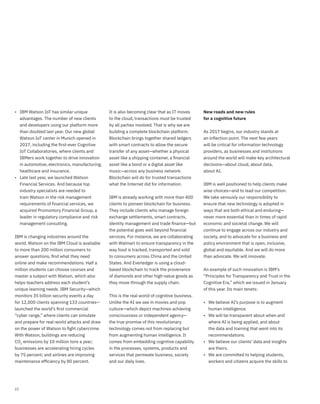
“ Watson has
become the AI
platform for
business.”
212016 Annual Report
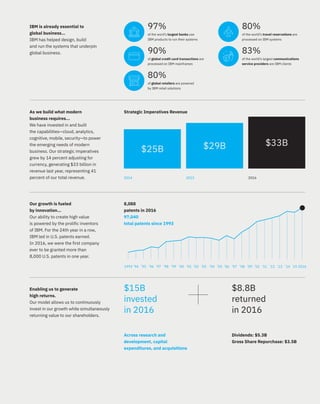
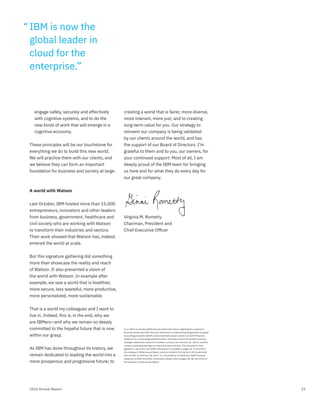
80%
of global retailers are powered
by IBM retail solutions
90%
of global credit card transactions are
processed on IBM mainframes
2014 2015 2016
IBM is already essential to
global business…
IBM has helped design, build
and run the systems that underpin
global business.
As we build what modern
business requires...
We have invested in and built
the capabilities—cloud, analytics,
cognitive, mobile, security—to power
the emerging needs of modern
business. Our strategic imperatives
grew by 14 percent adjusting for
currency, generating $33 billion in
revenue last year, representing 41
percent of our total revenue.
Our growth is fueled
by innovation...
Our ability to create high value
is powered by the prolific inventors
of IBM. For the 24th year in a row,
IBM led in U.S. patents earned.
In 2016, we were the first company
ever to be granted more than
8,000 U.S. patents in one year.
Enabling us to generate
high returns.
Our model allows us to continuously
invest in our growth while simultaneously
returning value to our shareholders.
8,088
patents in 2016
97,040
total patents since 1993
$15B
invested
in 2016
$8.8B
returned
in 2016
Strategic Imperatives Revenue
Across research and
development, capital
expenditures, and acquisitions
Dividends: $5.3B
Gross Share Repurchase: $3.5B
80%
of the world’s travel reservations are
processed on IBM systems
83%
of the world’s largest communications
service providers are IBM clients
1993 ’94 ’95 ’96 ’97 ’98 ’99 ’00 ’01 ’02 ’03 ’04 ’05 ’06 ’07 ’08 ’09 ’10 ’11 ’12 ’13 ’14 ’15 2016
$25B $29B $33B
97%
of the word’s largest banks use
IBM products to run their systems
22
• IBM Watson IoT has similar unique
advantages. The number of new clients
and developers using our platform more
than doubled last year. Our new global
Watson IoT center in Munich opened in
2017, including the first-ever Cognitive
IoT Collaboratories, where clients and
IBMers work together to drive innovation
in automotive, electronics, manufacturing,
healthcare and insurance.
• Late last year, we launched Watson
Financial Services. And because top
industry specialists are needed to
train Watson in the risk management
requirements of financial services, we
acquired Promontory Financial Group, a
leader in regulatory compliance and risk
management consulting.
IBM is changing industries around the
world. Watson on the IBM Cloud is available
to more than 200 million consumers to
answer questions, find what they need
online and make recommendations. Half a
million students can choose courses and
master a subject with Watson, which also
helps teachers address each student’s
unique learning needs. IBM Security—which
monitors 35 billion security events a day
for 12,000 clients spanning 133 countries—
launched the world’s first commercial
“cyber range,” where clients can simulate
and prepare for real-world attacks and draw
on the power of Watson to fight cybercrime.
With Watson, buildings are reducing
CO2
emissions by 10 million tons a year;
businesses are accelerating hiring cycles
by 75 percent; and airlines are improving
maintenance efficiency by 80 percent.
It is also becoming clear that as IT moves
to the cloud, transactions must be trusted
by all parties involved. That is why we are
building a complete blockchain platform.
Blockchain brings together shared ledgers
with smart contracts to allow the secure
transfer of any asset—whether a physical
asset like a shipping container, a financial
asset like a bond or a digital asset like
music—across any business network.
Blockchain will do for trusted transactions
what the Internet did for information.
IBM is already working with more than 400
clients to pioneer blockchain for business.
They include clients who manage foreign
exchange settlements, smart contracts,
identity management and trade finance—but
the potential goes well beyond financial
services. For instance, we are collaborating
with Walmart to ensure transparency in the
way food is tracked, transported and sold
to consumers across China and the United
States. And Everledger is using a cloud-
based blockchain to track the provenance
of diamonds and other high-value goods as
they move through the supply chain.
This is the real world of cognitive business.
Unlike the AI we see in movies and pop
culture—which depict machines achieving
consciousness or independent agency—
the true promise of this revolutionary
technology comes not from replacing but
from augmenting human intelligence. It
comes from embedding cognitive capability
in the processes, systems, products and
services that permeate business, society
and our daily lives.
New roads and new rules
for a cognitive future
As 2017 begins, our industry stands at
an inflection point. The next few years
will be critical for information technology
providers, as businesses and institutions
around the world will make key architectural
decisions—about cloud, about data,
about AI.
IBM is well positioned to help clients make
wise choices—and to lead our competition.
We take seriously our responsibility to
ensure that new technology is adopted in
ways that are both ethical and enduring—
never more essential than in times of rapid
economic and societal change. We will
continue to engage across our industry and
society, and to advocate for a business and
policy environment that is open, inclusive,
global and equitable. And we will do more
than advocate. We will innovate.
An example of such innovation is IBM’s
“Principles for Transparency and Trust in the
Cognitive Era,” which we issued in January
of this year. Its main tenets:
• We believe AI’s purpose is to augment
human intelligence.
• We will be transparent about when and
where AI is being applied, and about
the data and training that went into its
recommendations.
• We believe our clients’ data and insights
are theirs.
• We are committed to helping students,
workers and citizens acquire the skills to
232016 Annual Report
engage safely, securely and effectively
with cognitive systems, and to do the
new kinds of work that will emerge in a
cognitive economy.
These principles will be our touchstone for
everything we do to build this new world.
We will practice them with our clients, and
we believe they can form an important
foundation for business and society at large.
A world with Watson
Last October, IBM hosted more than 15,000
entrepreneurs, innovators and other leaders
from business, government, healthcare and
civil society who are working with Watson
to transform their industries and sectors.
Their work showed that Watson has, indeed,
entered the world at scale.
But this signature gathering did something
more than showcase the reality and reach
of Watson. It also presented a vision of
the world with Watson. In example after
example, we saw a world that is healthier,
more secure, less wasteful, more productive,
more personalized, more sustainable.
That is a world my colleagues and I want to
live in. Indeed, this is, in the end, why we
are IBMers—and why we remain so deeply
committed to the hopeful future that is now
within our grasp.
As IBM has done throughout its history, we
remain dedicated to leading the world into a
more prosperous and progressive future; to
creating a world that is fairer, more diverse,
more tolerant, more just; and to creating
long-term value for you. Our strategy to
reinvent our company is being validated
by our clients around the world, and has
the support of our Board of Directors. I’m
grateful to them and to you, our owners, for
your continued support. Most of all, I am
deeply proud of the IBM team for bringing
us here and for what they do every day for
our great company.
Virginia M. Rometty
Chairman, President and
Chief Executive Officer
In an effort to provide additional and useful information regarding the company’s
financial results and other financial information, as determined by generally accepted
accounting principles (GAAP), these materials contain certain non-GAAP financial
measures on a continuing operations basis, including revenue at constant currency,
strategic imperatives revenue at constant currency, as-a-Service run rate at constant
currency, operating earnings per share and free cash flow. The rationale for man-
agement’s use of this non-GAAP information is included on pages 26, 27 and 69 of
the company’s 2016 Annual Report, which is Exhibit 13 to the Form 10-K submitted
with the SEC on February 28, 2017. For reconciliation of these non-GAAP financial
measures to GAAP and other information, please refer to pages 28, 48, 50 and 69 of
the company’s 2016 Annual Report.
IBM is now the
global leader in
cloud for the
enterprise.”
“
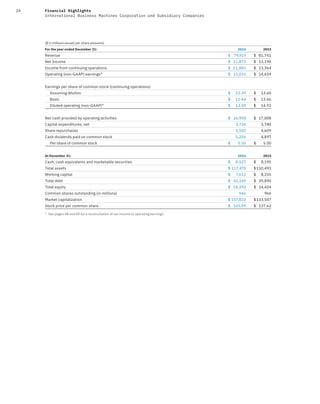
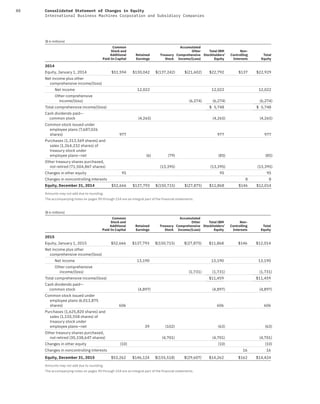
24 Financial Highlights
International Business Machines Corporation and Subsidiary Companies
($ in millions except per share amounts)
For the year ended December 31: 2016 2015
Revenue $ 79,919 $ 81,741
Net Income $ 11,872 $ 13,190
Income from continuing operations $ 11,881 $ 13,364
Operating (non-GAAP) earnings* $ 13,031 $ 14,659
Earnings per share of common stock (continuing operations)
Assuming dilution $ 12.39 $ 13.60
Basic $ 12.44 $ 13.66
Diluted operating (non-GAAP)* $ 13.59 $ 14.92
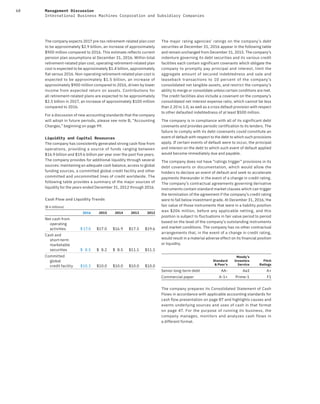
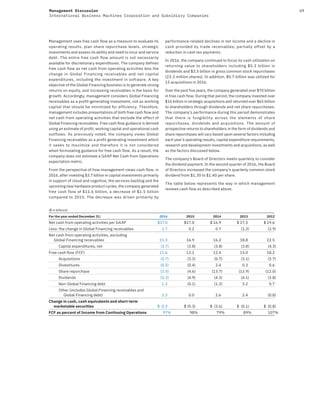
Net cash provided by operating activities $ 16,958 $ 17,008
Capital expenditures, net 3,726 3,780
Share repurchases 3,502 4,609
Cash dividends paid on common stock 5,256 4,897
Per share of common stock $ 5.50 $ 5.00
At December 31: 2016 2015
Cash, cash equivalents and marketable securities $ 8,527 $ 8,195
Total assets $ 117,470 $110,495
Working capital $ 7,613 $ 8,235
Total debt $ 42,169 $ 39,890
Total equity $ 18,392 $ 14,424
Common shares outstanding (in millions) 946 966
Market capitalization $ 157,832 $133,507
Stock price per common share $ 165.99 $ 137.62
* See pages 48 and 49 for a reconciliation of net income to operating earnings.
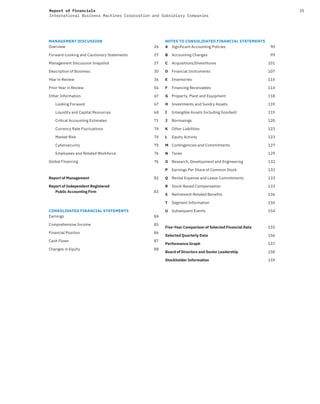
25Report of Financials
International Business Machines Corporation and Subsidiary Companies
MANAGEMENT DISCUSSION
Overview 26
Forward-Looking and Cautionary Statements 27
Management Discussion Snapshot 27
Description of Business 30
Year in Review 36
Prior Year in Review 56
Other Information 67
Looking Forward 67
Liquidity and Capital Resources 68
Critical Accounting Estimates 71
Currency Rate Fluctuations 74
Market Risk 74
Cybersecurity 75
Employees and Related Workforce 76
Global Financing 76
Report of Management 82
Report of Independent Registered
Public Accounting Firm 83
CONSOLIDATED FINANCIAL STATEMENTS
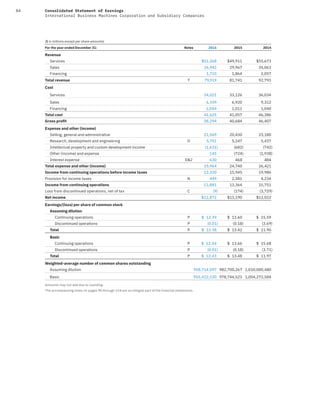
Earnings 84
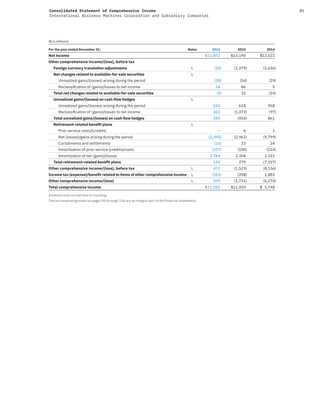
Comprehensive Income 85
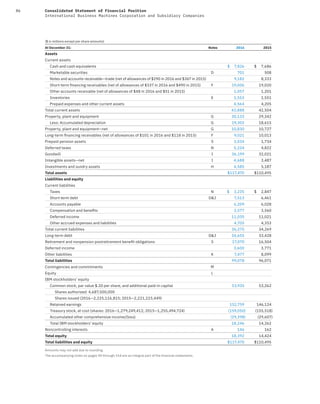
Financial Position 86
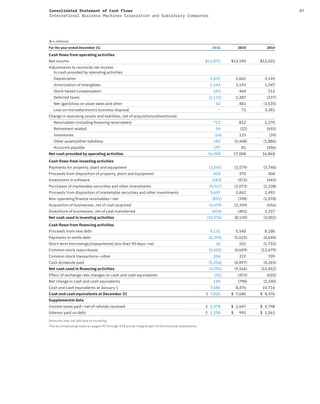
Cash Flows 87
Changes in Equity 88
NOTES TO CONSOLIDATED FINANCIAL STATEMENTS
A Significant Accounting Policies 90
B Accounting Changes 99
C Acquisitions/Divestitures 101
D Financial Instruments 107
E Inventories 114
F Financing Receivables 114
G Property, Plant and Equipment 118
H Investments and Sundry Assets 119
I Intangible Assets Including Goodwill 119
J Borrowings 120
K Other Liabilities 123
L Equity Activity 123
M Contingencies and Commitments 127
N Taxes 129
O Research, Development and Engineering 132
P Earnings Per Share of Common Stock 132
Q Rental Expense and Lease Commitments 133
R Stock-Based Compensation 133
S Retirement-Related Benefits 136
T Segment Information 150
U Subsequent Events 154
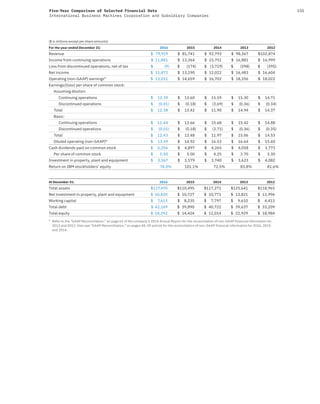
Five-Year Comparison of Selected Financial Data 155
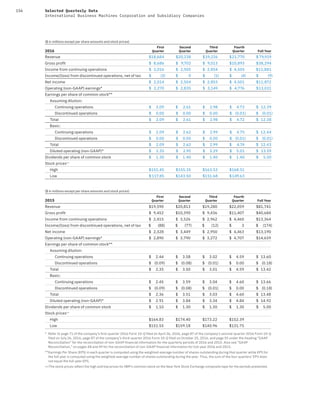
Selected Quarterly Data 156
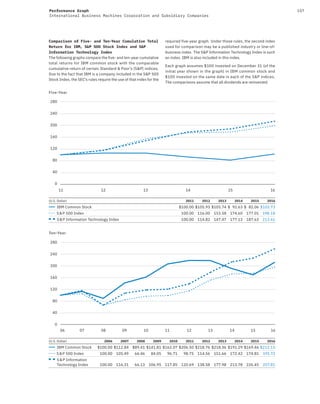
Performance Graph 157
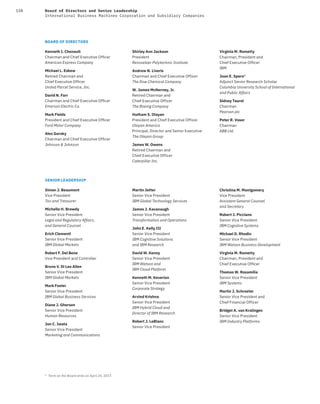
Board of Directors and Senior Leadership 158
Stockholder Information 159
26 Management Discussion
International Business Machines Corporation and Subsidiary Companies
OVERVIEW
The financial section of the International Business Machines
Corporation (IBM or the company) 2016 Annual Report includes
the Management Discussion, the Consolidated Financial
Statements and the Notes to Consolidated Financial Statements.
This Overview is designed to provide the reader with
some perspective regarding the information contained in the
financial section.
Organization of Information
• The Management Discussion is designed to provide readers
with an overview of the business and a narrative on the
company’s financial results and certain factors that may
affect its future prospects from the perspective of the
company’s management. The “Management Discussion
Snapshot,” beginning on page 27, presents an overview
of the key performance drivers in 2016.
• Beginning with the “Year in Review” on page 36,
the Management Discussion contains the results of
operations for each reportable segment of the business
and a discussion of the company’s financial position and
cash flows. Other key sections within the Management
Discussion include: “Looking Forward” on page 67, and
“Liquidity and Capital Resources” on page 68, which
includes a description of management’s definition and
use of free cash flow.
• Global Financing is a reportable segment that is
measured as a stand-alone entity. A separate “Global
Financing” section is included in the Management
Discussion beginning on page 76.
• The Consolidated Financial Statements are presented
on pages 84 through 89. These statements provide an
overview of the company’s income and cash flow
performance and its financial position.
• Subsequent to the company’s press release and Form
8-K filing on January 19, 2017, announcing 2016 fourth-
quarter and full-year financial results, the company revised
the classification of certain financing receivables on a full-
year basis increasing net cash provided by operating
activities and net cash used in investing activities in the
amount of $441 million. As adjusted, net cash provided
by operating activities for the three months and twelve
months ended December 31, 2016 is $3,968 million
and $16,958 million, respectively, and, net cash used in
investing activities is $3,687 million and $10,976 million
for the same periods. There was no impact to total GAAP
cash flows or free cash flow.
• The Notes follow the Consolidated Financial Statements.
Among other items, the Notes contain the company’s
accounting policies (pages 90 to 99), acquisitions and
divestitures (pages 101 to 106), detailed information on
specific items within the financial statements, certain
contingencies and commitments (pages 127 to 129) and
retirement-related plans information (pages 136 to 150).
• The Consolidated Financial Statements and the Notes
have been prepared in accordance with accounting
principles generally accepted in the United States (GAAP).
• In October 2014, the company announced a definitive
agreement to divest its Microelectronics business. The
assets and liabilities of the Microelectronics business
were reported as held for sale at December 31, 2014 and
the operating results of the Microelectronics business
have been reported as discontinued operations. The
transaction closed on July 1, 2015.
• In January 2016, the company made a number of
changes to its organizational structure and management
system. These changes impacted the company’s
reportable segments, but did not impact the company’s
Consolidated Financial Statements. Refer to Note T,
“Segment Information,” on pages 150 to 154 for additional
information on the changes in reportable segments. The
company’s reportable segments are: Cognitive Solutions,
Global Business Services, Technology Services & Cloud
Platforms, Systems, and Global Financing. The company
filed a recast 2015 Annual Report in a Form 8-K on June
13, 2016 to recast its historical segment information
to reflect these changes.
• The references to “adjusted for currency” or “at constant
currency” in the Management Discussion do not include
operational impacts that could result from fluctuations in
foreign currency rates. When the company refers to growth
rates at constant currency or adjusts such growth rates for
currency, it is done so that certain financial results can
be viewed without the impact of fluctuations in foreign
currency exchange rates, thereby facilitating period-to-
period comparisons of its business performance.
Financial results adjusted for currency are calculated by
translating current period activity in local currency using
the comparable prior year period’s currency conversion
rate. This approach is used for countries where the
functional currency is the local currency. Generally,
when the dollar either strengthens or weakens against
other currencies, the growth at constant currency rates
or adjusting for currency will be higher or lower than
growth reported at actual exchange rates. See “Currency
Rate Fluctuations” on page 74 for additional information.
• Within the financial statements and tables in this
Annual Report, certain columns and rows may not add
due to the use of rounded numbers for disclosure purposes.
Percentages reported are calculated from the underlying
whole-dollar numbers.
Operating (non-GAAP) Earnings
In an effort to provide better transparency into the operational
results of the business, the company separates business results
into operating and non-operating categories. Operating earnings
from continuing operations is a non-GAAP measure that
excludes the effects of certain acquisition-related charges,
retirement-related costs, discontinued operations and related
tax impacts. For acquisitions, operating earnings exclude the
amortization of purchased intangible assets and acquisition-
related charges such as in-process research and development,
transaction costs, applicable restructuring and related expenses
and tax charges related to acquisition integration. These charges
are excluded as they may be inconsistent in amount and timing
from period to period and are dependent on the size, type and
27Management Discussion
International Business Machines Corporation and Subsidiary Companies
frequency of the company’s acquisitions. For retirement-related
costs, the company characterizes certain items as operating and
others as non-operating. The company includes defined benefit
plan and nonpension postretirement benefit plan service cost,
amortization of prior service cost and the cost of defined
contribution plans in operating earnings. Non-operating
retirement-related cost includes defined benefit plan and
nonpension postretirement benefit plan interest cost, expected
return on plan assets, amortized actuarial gains/losses, the
impacts of any plan curtailments/settlements and multi-
employer plan costs, pension insolvency costs and other costs.
Non-operating retirement-related costs are primarily related
to changes in pension plan assets and liabilities which are tied
to financial market performance and the company considers
these costs to be outside of the operational performance of
the business.
Overall, the company believes that providing investors with a
view of operating earnings as described above provides
increased transparency and clarity into both the operational
results of the business and the performance of the company’s
pension plans; improves visibility to management decisions and
their impacts on operational performance; enables better
comparison to peer companies; and allows the company to
provide a long-term strategic view of the business going forward.
The company’s reportable segment financial results reflect
operating earnings from continuing operations, consistent with
the company’s management and measurement system.
FORWARD-LOOKING AND CAUTIONARY STATEMENTS
Certain statements contained in this Annual Report may
constitute forward-looking statements within the meaning of
the Private Securities Litigation Reform Act of 1995. Any
forward-looking statement in this Annual Report speaks only as
of the date on which it is made; the company assumes no
obligation to update or revise any such statements. Forward-
looking statements are based on the company’s current
assumptions regarding future business and financial
performance; these statements, by their nature, address
matters that are uncertain to different degrees. Forward-looking
statements involve a number of risks, uncertainties and other
factors that could cause actual results to be materially different,
as discussed more fully elsewhere in this Annual Report and in
the company’s filings with the Securities and Exchange
Commission (SEC), including the company’s 2016 Form 10-K
filed on February 28, 2017.
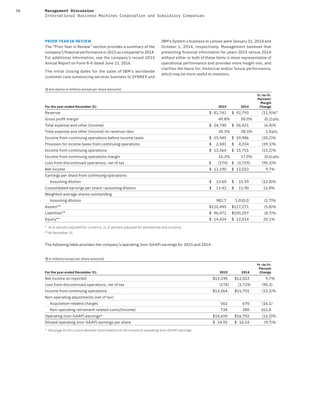
MANAGEMENT DISCUSSION SNAPSHOT
($ and shares in millions except per share amounts)
For the year ended December 31: 2016 2015
Yr.-to-Yr.
Percent/
Margin
Change
Revenue $ 79,919 $ 81,741 (2.2)%*
Gross profit margin 47.9% 49.8% (1.9)pts.
Total expense and other (income) $ 25,964 $ 24,740 4.9%
Total expense and other (income)-to-revenue ratio 32.5% 30.3% 2.2pts.
Income from continuing operations before income taxes $ 12,330 $ 15,945 (22.7)%
Provision for income taxes from continuing operations $ 449 $ 2,581 (82.6)%
Income from continuing operations $ 11,881 $ 13,364 (11.1)%
Income from continuing operations margin 14.9% 16.3% (1.5)pts.
Loss from discontinued operations, net of tax $ (9) $ (174) (95.1)%
Net income $ 11,872 $ 13,190 (10.0)%
Earnings per share from continuing operations:
Assuming dilution $ 12.39 $ 13.60 (8.9)%
Consolidated earnings per share—assuming dilution $ 12.38 $ 13.42 (7.7)%
Weighted-average shares outstanding
Assuming dilution 958.7 982.7 (2.4)%
Assets** $117,470 $110,495 6.3%
Liabilities** $ 99,078 $ 96,071 3.1%
Equity** $ 18,392 $ 14,424 27.5%
* (1.6) percent adjusted for currency
**At December 31
28 Management Discussion
International Business Machines Corporation and Subsidiary Companies
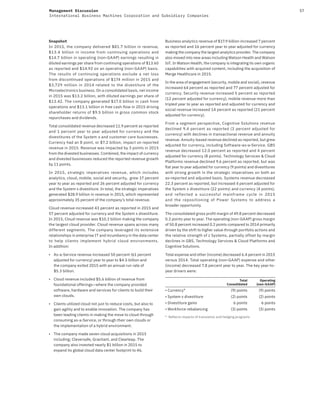
The following table provides the company’s (non-GAAP) operating earnings for 2016 and 2015
($ in millions except per share amounts)
For the year ended December 31: 2016 2015
Yr.-to-Yr.
Percent
Change
Net income as reported $11,872 $13,190 (10.0)%
Loss from discontinued operations, net of tax (9) (174) (95.1)
Income from continuing operations $11,881 $13,364 (11.1)%
Non-operating adjustments (net of tax)
Acquisition-related charges 735 562 30.9
Non-operating retirement-related costs/(income) 415 734 (43.5)
Operating (non-GAAP) earnings* $13,031 $14,659 (11.1)%
Diluted operating (non-GAAP) earnings per share $ 13.59 $ 14.92 (8.9)%
* See pages 48 and 49 for a more detailed reconciliation of net income to operating earnings.
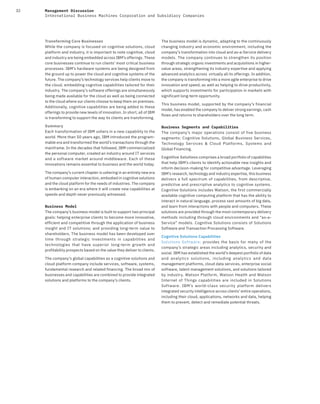
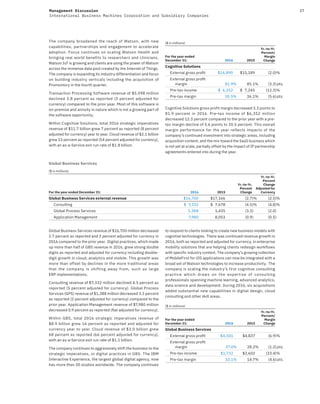
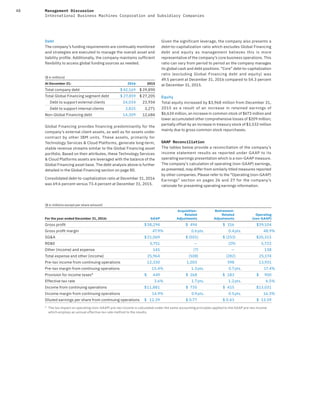
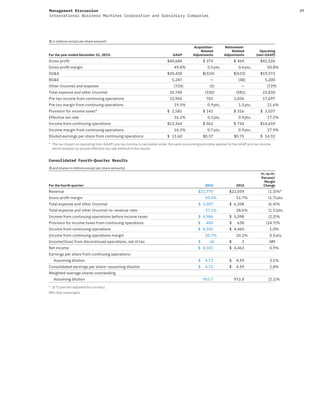
In 2016, the company reported $79.9 billion in revenue,
$11.9 billion in income from continuing operations and
$13.0 billion in operating (non-GAAP) earnings, resulting in
diluted earnings per share from continuing operations of $12.39
as reported and $13.59 on an operating (non-GAAP) basis. The
results of continuing operations exclude a net loss from
discontinued operations of $9 million in 2016 and $174 million
in 2015 related to the divestiture of the Microelectronics
business. On a consolidated basis, net income in 2016 was
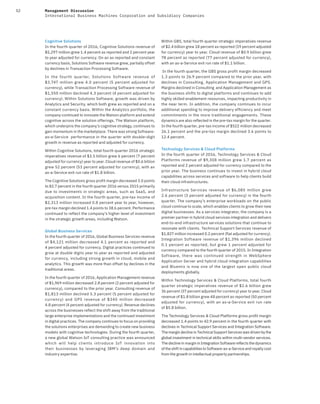
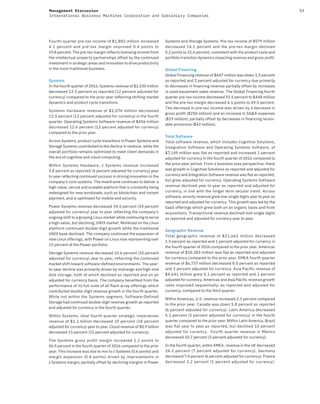
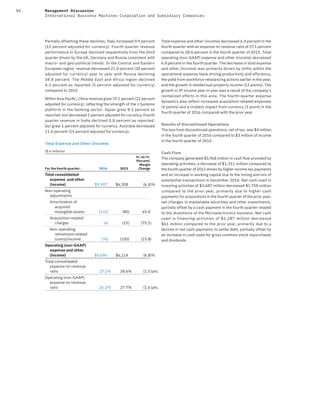
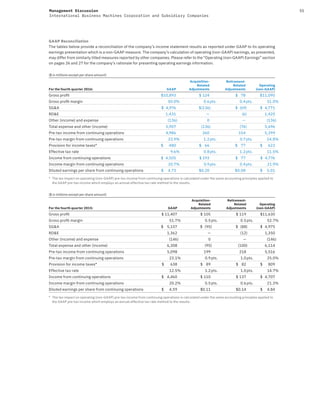
$11.9 billion, with diluted earnings per share of $12.38.
The company generated $17.0 billion in cash from operations
and $11.6 billion in free cash flow and shareholder returns of
$8.8 billion in gross common stock repurchases and dividends.
There are significant opportunities and shifts occurring in the IT
industry, and the company believes that to be successful with
enterprise clients, it needs to bring together cognitive
technologies on cloud platforms that create industry-based
solutions to solve real-world problems. In 2016, the company
continued to:
• Deliver strong results in the strategic imperatives;
• Make progress in building new businesses and creating
new markets;
• Deliver innovation in the more traditional businesses and
monetize core technologies; and
• Return capital to shareholders.
Total consolidated revenue in 2016 decreased 2.2 percent as
reported and 1.6 percent year to year adjusted for currency.
Annuity revenue increased as reported and adjusted for
currency while transactional revenue declined year to year.
In addition, acquisitions completed in the past 12 months
contributed to revenue growth.
The 2016 results reflect the success the company is having in
its strategic imperatives and the investments made to drive that
shift. The company had continued strong revenue growth
in cloud, analytics and engagement, which together grew
13 percent year to year as reported and 14 percent adjusted
for currency. In 2016, the strategic imperatives generated
$32.8 billion in revenue, which represented 41 percent of the
company’s revenue, an increase of 6 points from 2015. Total
Cloud revenue of $13.7 billion increased 35 percent both as
reported and adjusted for currency, with cloud as-a-Service
revenue up 55 percent as reported and 57 percent adjusted for
currency. The company exited 2016 with an annual run rate for
cloud as-a-Service revenue of $8.6 billion, up from $5.3 billion
at the end of 2015. Analytics revenue of $19.5 billion increased
9 percent as reported and adjusted for currency. Mobile revenue
increased 34 percent year to year as reported (35 percent
adjusted for currency) and Security revenue increased 13 percent
as reported (14 percent adjusted for currency).
From a segment perspective, Cognitive Solutions revenue
increased 1.9 percent as reported and 3 percent adjusted for
currency with growth in Solutions Software, led by an increase
in Analytics and Security revenue; partially offset by a decline
in Transaction Processing Software. Global Business Services
(GBS) revenue decreased 2.7 percent as reported and 3 percent
adjusted for currency primarily driven by a decline in Consulting
revenue. Revenue performance continued to be impacted by the
company’s shift away from traditional businesses, such as ERP
implementations. GBS strategic imperatives revenue had
double-digit growth year to year as reported and adjusted for
currency. Technology Services & Cloud Platforms revenue
increased 0.6 percent as reported and 1 percent adjusted for
currency led by growth in Infrastructure Services as the
company assists clients in modernizing and transforming their
infrastructures. Technology Services & Cloud Platforms strategic
imperatives revenue was up 39 percent (40 percent adjusted for
currency) year to year. Systems revenue decreased 19.2 percent
(19 percent adjusted for currency) with z Systems down
27.1 percent (27 percent adjusted for currency) and Power
Systems down 27.1 percent (27 percent adjusted for currency).
29Management Discussion
International Business Machines Corporation and Subsidiary Companies
From a geographic perspective, Americas revenue decreased
2.5 percent as reported (1 percent adjusted for currency) with
the U.S. down 0.9 percent. Europe/Middle East/Africa (EMEA)
revenue decreased 5.0 percent as reported (2 percent adjusted
for currency). Asia Pacific revenue increased 2.6 percent as
reported, but decreased 1 percent adjusted for currency with
Japan up 10.5 percent as reported, but down 1 percent adjusted
for currency.
The consolidated gross profit margin of 47.9 percent decreased
1.9 points year to year and reflects the impact of the company’s
investments, including acquisitions, and mix in as-a-Service
which is not yet at scale. The operating (non-GAAP) gross margin
of 48.9 percent decreased 1.9 points compared to 2015 driven
primarily by the same factors.
Total expense and other (income) increased 4.9 percent in 2016
compared to the prior year. Total operating (non-GAAP) expense
and other (income) increased 5.6 percent compared to 2015.
The key year-to-year drivers were:
Total
Consolidated
Operating
(non-GAAP)
• Currency* 2 points 2 points
• Acquisitions** 5 points 4 points
• Base (2) points 0 points
* Reflects impacts of translation and hedging programs
**Includes acquisitions completed in prior 12-month period; operating
(non-GAAP) is net of non-operating acquisition-related charges.
The increase in expense was driven primarily by the impact of
acquisitions completed in the prior 12 months and an impact
from currency. Base expense performance reflects a higher level
of intellectual property (IP) income ($950 million) year to year
driven primarily by the company’s software licensing
arrangements. Base expense also includes charges in 2016 for
actions taken to accelerate the transformation of the company’s
workforce and shift its skill base, as well as increased
investments in the strategic areas of cognitive, security and
cloud. This included a higher level of workforce rebalancing
charges ($451 million) year to year and real estate capacity
charges ($291 million) related to the workforce transformation.
The company continued to invest at a high level in 2016 and
remixed skills in support of the strategic imperatives.
Pre-tax income from continuing operations of $12.3 billion
decreased 22.7 percent year to year and the pre-tax margin
was 15.4 percent, a decrease of 4.1 points versus 2015.
The continuing operations effective tax rate for 2016 was
3.6 percent, a decrease of 12.5 points versus 2015. The tax rate
in 2016 was primarily the result of a refund ($1.0 billion) of
previously paid non-U.S. taxes plus interest in the first quarter
of 2016. Income from continuing operations of $11.9 billion
decreased 11.1 percent and the net income margin was
14.9 percent, a decrease of 1.5 points versus 2015. Losses from
discontinued operations, net of tax, were $9 million in 2016
compared to $174 million in 2015. Net income of $11.9 billion
decreased 10.0 percent year to year. Operating (non-GAAP)
pre-tax income from continuing operations of $13.9 billion
decreased 21.3 percent year to year and the operating (non-
GAAP) pre-tax margin from continuing operations decreased
4.2 points to 17.4 percent. Operating (non-GAAP) income from
continuing operations of $13.0 billion decreased 11.1 percent
and the operating (non-GAAP) income margin from continuing
operations of 16.3 percent decreased 1.6 points. The operating
(non-GAAP) effective tax rate from continuing operations in
2016 was 6.5 percent versus 17.2 percent in 2015.
Diluted earnings per share from continuing operations of
$12.39 in 2016 decreased 8.9 percent year to year. In 2016, the
company repurchased 23.3 million shares of its common stock
at a cost of $3.5 billion and had $5.1 billion remaining in
the share repurchase authorization at December 31, 2016.
Operating (non-GAAP) diluted earnings per share of $13.59
decreased 8.9 percent versus 2015. Diluted earnings per share
from discontinued operations was ($0.01) in 2016 compared to
($0.18) in 2015.
At December 31, 2016, the company continued to have the
financial flexibility to support the business over the long term.
Cash and marketable securities at December 31, 2016 were
$8.5 billion, an increase of $0.3 billion from December 31, 2015.
Key drivers in the balance sheet and total cash flows were:
Total assets increased $7.0 billion ($7.7 billion adjusted for
currency) from December 31, 2015 driven by:
• Increases in goodwill ($4.2 billion), retirement plan assets
($1.3 billion), net intangible assets ($1.2 billion), deferred
taxes ($0.4 billion) and cash and marketable securities
($0.3 billion).
Total liabilities increased $3.0 billion ($3.9 billion adjusted
for currency) from December 31, 2015 driven by:
• Increases in total debt ($2.3 billion), retirement-related
liabilities ($0.6 billion) and taxes ($0.4 billion).
Total equity of $18.4 billion increased $4.0 billion from
December 31, 2015 as a result of:
• Increases from net income ($11.9 billion) and stock-based
compensation ($0.5 billion); partially offset by
• Decreases from dividends ($5.3 billion) and share
repurchases ($3.5 billion).
The company generated $17.0 billion in cash flow provided by
operating activities, essentially flat compared to 2015, driven
primarily by operational performance; offset by lower income
tax payments. Net cash used in investing activities of
$11.0 billion was $2.8 billion higher than 2015, primarily driven
by an increase in cash used related to acquisitions ($2.3 billion).
Net cash used in financing activities of $5.8 billion decreased
$3.4 billion compared to the prior year, driven primarily by higher
net debt issuances ($2.7 billion) and a decline in cash used for
common share repurchases ($1.1 billion).
30 Management Discussion
International Business Machines Corporation and Subsidiary Companies
In January 2017, the company disclosed that it is expecting
GAAP earnings per share from continuing operations of at least
$11.95 and operating (non-GAAP) earnings of at least $13.80
per diluted share for 2017. The company expects 2017 free cash
flow realization to be in excess of 90 percent of GAAP net income
and free cash flow to be essentially flat year to year. Refer to
page 69 in the Liquidity and Capital Resources section for
additional information on this non-GAAP measure. Refer to the
Looking Forward section on pages 67 and 68 for additional
information on the company’s expectations.
DESCRIPTION OF BUSINESS
Please refer to IBM’s Annual Report on Form 10-K filed with the
SEC on February 28, 2017 for Item 1A. entitled “Risk Factors.”
The company creates value for clients through integrated
solutions and products that leverage: data, information
technology, deep expertise in industries and business
processes, and a broad ecosystem of partners and alliances.
IBM solutions typically create value by enabling new capabilities
for clients that transform their businesses and help them engage
with their customers and employees in new ways. These
solutions draw from an industry-leading portfolio of consulting
and IT implementation services, cloud and cognitive offerings,
and enterprise systems and software; all bolstered by one of the
world’s leading research organizations.
Strategy
IBM has a history of continuous re-invention, transforming itself
throughout its 100-plus year history. In the past five decades
alone, IBM has ushered in the eras of the mainframe, the
personal computer, IT services and enterprise software. In its
current transformation, IBM is once again leading the reordering
of the technology industry.
A number of years ago, the company declared its focus on the
strategic forces behind the “digital” revolution; data, cloud and
engagement, driven by mobile and social, and underpinned by
security. Since 2010, IBM has invested approximately $40 billion
in these areas, built out the IBM Cloud on a global scale and
extended cognitive systems to numerous enterprises and
industries. The company made 55 acquisitions and has formed
partnerships with organizations that are leading players in
key industries.
Because of this transformation, IBM today is much more than a
hardware, software and services company; IBM is a cognitive
solutions and cloud platform company, with a focus on industry
capabilities and expertise:
Cognitive Solutions: With the highest level of intelligence that
exists in technology systems, these solutions tackle challenges
ranging from answering client inquiries to helping physicians
fight cancer.
Cloud Platform: IBM Cloud is the leading cloud platform for the
enterprise, providing what enterprises need for speed, agility
and, combined with Watson, for cognitive capability.
Industry Focus: As IBM brings higher levels of value to its
clients, as its offerings are being built for the needs of individual
industries. Healthcare and Financial Services are two examples
of the company’s initial cognitive focus.
Cognitive Solutions
Since IBM’s Watson was introduced in 2011, the company has
been developing a new generation of cognitive systems that can
see and analyze the massive amounts of data that have
previously been invisible to computers and enterprises. IBM’s
cognitive systems have the capability to inject a kind of thinking
ability into every digitized object, process and service, and learn
from interactions. IBM is on the forefront of deploying these
systems and helping clients to embrace the cognitive era.
Cognitive systems are not programmed; like humans, they learn
from experts and from every interaction, and they are uniquely
able to find patterns in big data. They learn by using advanced
algorithms to sense, predict and infer. Doing so, they augment
human intelligence, allowing individuals to make faster and more
informed decisions.
Since Watson’s debut, many technologies have entered the
market under the banner of artificial intelligence. However,
IBM’s approach to cognitive systems is quite unique:
• Highly adaptable intelligence systems: Watson has broad
applicability and can help clients tackle challenges ranging
from oncology to customer support.
• Protect and respect client data: Watson learns through
data, both public data as well as clients’ private data.
Clients choose whether their data or insights are shared.
IBM respects the clients’ ownership and control of their
own data.
• Easy entry points: Watson’s open APIs offer easy on-ramps
to experiment with speech, vision and other data.
• Trained in domain depth: Watson is trained to be an
expert in industries and functional specialties. It augments
the knowledge of professionals, giving them access to
the insights of their best colleagues and the world’s
leading experts.
• Transformational services: IBM’s Cognitive Solutions and
Watson Internet of Things (IoT) practices help clients build
their cognitive strategies. GBS provides outcome-focused
methodologies, domain skills and deep industry expertise.
31Management Discussion
International Business Machines Corporation and Subsidiary Companies
Cloud Platform
Cloud represents more than a new architecture for delivering
infrastructure and applications as services; it is also a catalyst
for innovation, speed and agility. Cloud enables companies to
focus on differentiating their strategies, capabilities and
business models rather than on the underlying technology.
The IBM Cloud brings a unique set of characteristics to clients:
• It is a world-class cloud platform designed for enterprises,
where security, reliability, scalability and performance
are critical.
• It is the industry-leading hybrid cloud, enabling clients to
extend their existing IT investments, connecting valuable
data and applications across public and private clouds.
• It is a world-class cognitive cloud platform with
IBM Watson services that developers can embed into
their applications to create differentiating customer
experiences and powerful insights.
The IBM Cloud has a strong global presence, with more than
50 cloud data centers around the world giving clients the
flexibility to optimize the deployment of data and application,
for performance, security and compliance.
The IBM Cloud is also continually expanding its base of advanced
capabilities including cloud data services, cloud object storage,
cloud video services, as well as Internet of Things, blockchain
and analytics services. In 2016, IBM brought new cognitive
solutions to professionals in marketing, commerce, supply chain
and human resources, extending industry clouds to further
differentiate its cloud offerings.
Industry Focus
To bring higher value to clients, IBM is providing solutions that
are specific and tailored to challenges clients face in their
industry, using the power of IBM’s advanced cognitive computing
capabilities built on the IBM Cloud. In 2016, IBM deepened its
commitment to delivering higher value in several key ways:
• In the healthcare industry, IBM Watson Health combines
the power of cloud and cognitive with value-based
solutions to optimize performance, engage consumers,
enable effective care and manage population health.
Significant investment in the healthcare space, including
the acquisition of Merge and Truven, has enabled the
company to expand the scope of solutions aimed at solving
some of the most pressing health challenges.
• IBM continues to partner with financial services clients
to build a robust infrastructure addressing increasingly
complex and fast-changing demands. From preventing
fraud to supporting cybersecurity efforts, IBM is becoming
ever-more essential to the financial industry.
• IBM offers analytics to help clients assess their risk and
compliance against industry guidelines, and uses a
cognitive approach to provide deeper and faster findings.
In late 2016, the company acquired Promontory Financial
Group, LLC (Promontory), one of the world’s leading
regulatory consulting firms. Promontory is training Watson
to be a market-leading expert in the regulatory field, which
will allow the company to deliver services at new levels of
efficiency and transparency.
• IBM is committed to blockchain to provide a highly secure
method of facilitating multi-step transactions, reducing
the number of disputes and points of friction, including
its participation in the Hyperledger Project. This cross-
industry consortium is working to build the blockchain
network in the cloud, doing for trusted transactions
what the Internet did for information, and setting industry
standards for years to come. Blockchain will enable
financial institutions to settle securities in minutes instead
of days; manufacturers to reduce product recalls by sharing
production logs along their supply chain; and businesses of
all types to more closely manage the flow of goods and
payments. IBM is working with companies ranging from
retailers, banks and shippers to apply this technology to
transform their ecosystems through open standards and
open platforms.
• IBM’s Global Business Services consulting business,
with broad expertise across industries and a strong global
footprint and scale, provides a unique combination of
technologies and services to help clients achieve their
business outcomes.
32 Management Discussion
International Business Machines Corporation and Subsidiary Companies
Transforming Core Businesses
While the company is focused on cognitive solutions, cloud
platform and industry, it is important to note cognitive, cloud
and industry are being embedded across IBM’s offerings. These
core businesses continue to run clients’ most critical business
processes. IBM’s hardware systems are being designed from
the ground up to power the cloud and cognitive systems of the
future. The company’s technology services help clients move to
the cloud, embedding cognitive capabilities tailored for their
industry. The company’s software offerings are simultaneously
being made available for the cloud as well as being connected
to the cloud where our clients choose to keep them on premises.
Additionally, cognitive capabilities are being added to these
offerings to provide new levels of innovation. In short, all of IBM
is transforming to support the way its clients are transforming.
Summary
Each transformation of IBM ushers in a new capability to the
world. More than 50 years ago, IBM introduced the program-
mable era and transformed the world’s transactions through the
mainframe. In the decades that followed, IBM commercialized
the personal computer, created an industry around IT services
and a software market around middleware. Each of these
innovations remains essential to business and the world today.
The company’s current chapter is ushering in an entirely new era
of human-computer interaction, embodied in cognitive solutions
and the cloud platform for the needs of industries. The company
is embarking on an era where it will create new capabilities at
speeds and depth never previously witnessed.
Business Model
The company’s business model is built to support two principal
goals: helping enterprise clients to become more innovative,
efficient and competitive through the application of business
insight and IT solutions; and providing long-term value to
shareholders. The business model has been developed over
time through strategic investments in capabilities and
technologies that have superior long-term growth and
profitability prospects based on the value they deliver to clients.
The company’s global capabilities as a cognitive solutions and
cloud platform company include services, software, systems,
fundamental research and related financing. The broad mix of
businesses and capabilities are combined to provide integrated
solutions and platforms to the company’s clients.
The business model is dynamic, adapting to the continuously
changing industry and economic environment, including the
company’s transformation into cloud and as-a-Service delivery
models. The company continues to strengthen its position
through strategic organic investments and acquisitions in higher-
value areas, strengthening its industry expertise and applying
advanced analytics across virtually all its offerings. In addition,
the company is transforming into a more agile enterprise to drive
innovation and speed, as well as helping to drive productivity,
which supports investments for participation in markets with
significant long-term opportunity.
This business model, supported by the company’s financial
model, has enabled the company to deliver strong earnings, cash
flows and returns to shareholders over the long term.
Business Segments and Capabilities
The company’s major operations consist of five business
segments: Cognitive Solutions, Global Business Services,
Technology Services & Cloud Platforms, Systems and
Global Financing.
Cognitive Solutions comprises a broad portfolio of capabilities
that help IBM’s clients to identify actionable new insights and
inform decision-making for competitive advantage. Leveraging
IBM’s research, technology and industry expertise, this business
delivers a full spectrum of capabilities, from descriptive,
predictive and prescriptive analytics to cognitive systems.
Cognitive Solutions includes Watson, the first commercially
available cognitive computing platform that has the ability to
interact in natural language, process vast amounts of big data,
and learn from interactions with people and computers. These
solutions are provided through the most contemporary delivery
methods including through cloud environments and “as-a-
Service” models. Cognitive Solutions consists of Solutions
Software and Transaction Processing Software.
Cognitive Solutions Capabilities
Solutions Software: provides the basis for many of the
company’s strategic areas including analytics, security and
social. IBM has established the world’s deepest portfolio of data
and analytics solutions, including analytics and data
management platforms, cloud data services, enterprise social
software, talent management solutions, and solutions tailored
by industry. Watson Platform, Watson Health and Watson
Internet of Things capabilities are included in Solutions
Software. IBM’s world-class security platform delivers
integrated security intelligence across clients’ entire operations,
including their cloud, applications, networks and data, helping
them to prevent, detect and remediate potential threats.
33Management Discussion
International Business Machines Corporation and Subsidiary Companies
Transaction Processing Software: includes software that
primarily runs mission-critical systems in industries such as
banking, airlines and retail. Most of this software is on-premise
and annuity in nature.
Global Business Services (GBS) provides clients with
consulting, application management services and global process
services. These professional services deliver business value and
innovation to clients through solutions which leverage industry,
technology and business process expertise. GBS is the digital
reinvention partner for IBM clients, combining industry
knowledge, functional expertise, and applications with the
power of design, cognitive and cloud. The full portfolio of GBS
services is backed by its globally integrated delivery network
and integration with IBM solutions and services including
Watson, cloud, blockchain, and Technology Services. To deepen
its capabilities, in 2016 IBM acquired four consulting and design
firms to enhance the GBS global network of 35 digital experience
design studios. IBM also announced Watson IoT Consulting
Solutions, a new practice that brings together IBM’s industry
and technical expertise to help clients introduce IoT innovation
into their businesses.
GBS Capabilities
Consulting: provides business consulting services focused on
bringing to market solutions that help clients shape their digital
blueprints and customer experiences, define their cognitive
operating models, set their next-generation talent strategies
and create new technology visions and architectures in a cloud-
centric world.
Application Management: delivers system integration,
application management, maintenance and support services for
packaged software, as well as custom and legacy applications.
Value is delivered through advanced capabilities in areas such
as security and privacy, application testing and modernization,
cloud application migration and automation.
Global Process Services: GBS’ business process outsourcing
service line, delivers finance, procurement, HR, and industry-
specific business processes. These services deliver improved
business results to clients through the strategic change and/or
operation of the client’s business processes, applications and
infrastructure. GBS is redefining the efficiency and cost profiles
of clients’ core processes through the application of the power
of Watson, cognitive and deep analytics.
Technology Services & Cloud Platforms provides
comprehensive IT infrastructure services creating business
value for clients through integrated services that incorporate
unique intellectual property within its global delivery model. By
leveraging insights and experience drawn from IBM’s global
scale, skills and technology, with applied innovation from
IBM Research, clients gain access to leading edge, high-quality
services with improved productivity, flexibility, cost
and outcomes.
Technology Services & Cloud Platforms Capabilities
Infrastructure Services: delivers a portfolio of cloud, project-
based, outsourcing and other managed services focused on
clients’ enterprise IT infrastructure environments to enable
digital transformation and deliver improved quality, flexibility,
risk management and financial value. The portfolio includes a
comprehensive set of hybrid cloud services and solutions to
assist clients in building and running enterprise IT environments
that utilize public and private clouds and traditional IT. The IBM
Cloud Platform offers leading edge services to developers and
IBM’s Cloud Infrastructure-as-a-Service covers a wide variety
of workloads with unprecedented performance. These offerings
integrate long-standing expertise in service management and
technology with the ability to utilize the power of new
technologies, including those from other IBM business
segments. The portfolio is built around a key set of predictive
and proactive solutions addressing systems, mobility, resiliency,
networking, cloud and security. The company’s capabilities,
including IBM Cloud, cognitive computing and hybrid cloud
implementation, can help to deliver high-performance, end-to-
end innovation and an improved ability to achieve business
objectives.
Technical Support Services: delivers a comprehensive line of
support services to maintain and improve the availability of
clients’ IT infrastructures. These offerings include maintenance
for IBM products and other technology platforms, as well as
software and solution support.
Integration Software: delivers industry-leading hybrid cloud
solutions that empower clients to achieve rapid innovation,
hybrid integration, and process transformation with choice and
consistency across public, dedicated and local cloud
environments, leveraging IBM’s Bluemix Platform-as-a-Service
solution. Integration Software offerings and capabilities help
clients address the digital imperatives to create, connect and
optimize their applications, data and infrastructure on their
journey to become cognitive businesses.
34 Management Discussion
International Business Machines Corporation and Subsidiary Companies
Systems provides clients with innovative infrastructure
technologies to help meet the new requirements of hybrid cloud
and cognitive workloads—from deploying advanced analytics,
to moving to digital service delivery with the cloud, and securing
mobile transaction processing. Approximately half of Systems
Hardware’s server and storage sales transactions are through
the company’s business partners, with the balance direct to end-
user clients. IBM Systems also designs advanced semiconductor
and systems technology in collaboration with IBM Research,
primarily for use in the company’s systems.
Systems Capabilities
Servers: a range of high-performance systems designed to
address computing capacity, security and performance needs
of businesses, hyperscale cloud service providers and scientific
computing organizations. The portfolio includes z Systems,
a trusted enterprise platform for integrating data, transactions
and insight, and Power Systems, a system designed from
the ground up for big data and analytics, optimized for
scale-out cloud and Linux, and delivering open innovation
with OpenPOWER.
The company is a founding member of the OpenPOWER
foundation, a group of industry-leading companies developing
high-performance compute technologies and solutions based
on the IBM POWER architecture.
Storage: data storage products and solutions that allow clients
to retain and manage rapidly growing, complex volumes of digital
information and to fuel data-centric cognitive applications.
These solutions address critical client requirements for
information retention and archiving, security, compliance and
storage optimization including data deduplication, availability
and virtualization. The portfolio consists of a broad range of
software-defined storage solutions, flash storage, disk and tape
storage solutions.
Operating Systems Software: The company’s z/OS is a security-
rich, scalable, high-performance enterprise operating system
for z Systems. Power Systems offers a choice of AIX or Linux
operating systems. These operating systems leverage POWER
architecture to deliver secure, reliable and high- performing
enterprise-class workloads across a breadth of server offerings.
Global Financing facilitates IBM clients’ acquisition of
information technology systems, software and services by
providing financing solutions in the areas where the company
has the expertise. The financing arrangements are predom-
inantly for products or services that are critical to the end users’
business operations. These financing contracts are entered into
after a comprehensive credit evaluation and are secured by legal
contracts. As a captive financier, Global Financing has the
benefit of both deep knowledge of its client base and a clear
insight into the products and services financed. These factors
allow the business to effectively manage two of the major risks,
credit and residual value, associated with financing
while generating strong returns on equity. Global Financing
also maintains a long-term partnership with the companies’
clients through various stages of IT asset life cycle—from
initial purchase and technology upgrades to asset
disposition decisions.
Global Financing Capabilities
Client Financing: lease, installment payment plan and loan
financing to end users and internal clients for terms up to seven
years. Assets financed are primarily new and used IT hardware,
software and services where the company has expertise.
Internal financing is predominantly in support of Technology
Services & Cloud Platforms’ long-term client service contracts.
All internal financing arrangements are at arm’s-length rates
and are based upon market conditions.
Commercial Financing: short-term inventory and accounts
receivable financing to suppliers, distributors and remarketers
of IBM and OEM products. This includes internal activity where
Global Financing factors a selected portion of the company’s
accounts receivable primarily for cash management purposes,
at arm’s-length rates.
Remanufacturing and Remarketing: assets include used
equipment returned from lease transactions, or used and
surplus equipment acquired internally or externally. These
assets may be refurbished or upgraded and sold or leased to
new or existing clients both externally or internally. Externally
remarketed equipment revenue represents sales or leases to
clients and resellers. Internally remarketed equipment revenue
primarily represents used equipment that is sold internally to
Systems and Technology Services & Cloud Platforms. Systems
may also sell the equipment that it purchases from Global
Financing to external clients.
35Management Discussion
International Business Machines Corporation and Subsidiary Companies
IBM Worldwide Organizations
The following worldwide organizations play key roles in IBM’s
delivery of value to its clients:
• Global Markets (formerly Sales and Distribution)
• Research, Development and Intellectual Property
• Integrated Supply Chain
Global Markets
IBM has a global presence, operating in more than 175 countries
with a broad-based geographic distribution of revenue. The
company’s Global Markets organization manages IBM’s global
footprint, working closely with dedicated country-based
operating units to serve clients locally. These country teams
have client relationship managers who lead integrated teams of
consultants, solution specialists and delivery professionals to
enable clients’ growth and innovation. These local teams
develop deep relationships with their clients to bring together
capabilities from IBM and its network of Business Partners to
develop and implement solutions.
By complementing local expertise with global experience and
digital capabilities, IBM builds broad-based client relationships.
This local management focus fosters speed in addressing new
markets and making investments in emerging opportunities. The
Global Markets organization serves clients with expertise in their
industry as well as through the products and services that IBM
and partners supply. IBM is also expanding its reach to smaller
clients through digital marketing, digital marketplaces, inside
sales and local Business Partner resources.
IBM continues to invest to capture opportunities in key growth
markets around the world—India, China and Southeast Asia;
Eastern Europe; the Middle East and Africa; and Latin America.
Major IBM markets include the G7 countries of Canada, France,
Germany, Italy, Japan, the United States (U.S.) and the United
Kingdom (U.K.), as well as Austria, the Bahamas, Belgium, the
Caribbean, Cyprus, Denmark, Finland, Greece, Iceland, Ireland,
Israel, Malta, the Netherlands, Norway, Portugal, Spain, Sweden
and Switzerland.
Research, Development and Intellectual Property
IBM’s research and development (R&D) operations differentiate
the company from its competitors. IBM annually invests 6 to 7
percent of total revenue for R&D, focusing on high-growth, high-
value opportunities. IBM Research works with clients and the
company’s business units through global labs on near-term and
midterm innovations. It contributes many new technologies to
IBM’s portfolio every year and helps clients address their most
difficult challenges. IBM Research scientists are conducting
pioneering work in artificial intelligence, analytics, security,
nanotechnology, cloud computing, blockchain, quantum
computing, silicon and post-silicon computing architectures,
data-centric systems and more—applying these technologies
across industries including healthcare, Internet of Things,
education and financial services.
In 2016, IBM was awarded more U.S. patents than any other
company for the 24th consecutive year. IBM’s 8,088 patents
awarded in 2016 represent a diverse range of inventions in
artificial intelligence and cognitive computing, cognitive health,
cloud, cybersecurity and other strategic growth areas for
the company.
The company continues to actively seek intellectual property
(IP) protection for its innovations, while increasing emphasis on
other initiatives designed to leverage its IP leadership. Some of
IBM’s technological breakthroughs are used exclusively in IBM
products, while others are licensed and may be used in IBM
products and/or the products of the licensee. As part of its
business model, the company licenses certain of its intellectual
property, which is high-value technology, but may be in more
mature markets. The licensee drives the future development of
the IP and ultimately expands the customer base. This generates
IP income for the company both upon licensing, and with
ongoing royalty arrangements between it and the licensee. While
the company’s various proprietary IP rights are important to its
success, IBM believes its business as a whole is not materially
dependent on any particular patent or license, or any particular
group of patents or licenses. IBM owns or is licensed under a
number of patents, which vary in duration, relating to its
products.
Integrated Supply Chain
IBM has an extensive integrated supply chain, procuring
materials and services globally. Additionally, growth in client
spend managed by IBM’s procurement organization continues
to demonstrate clients’ faith that IBM can reduce clients’ cost
through the transformation of source-to-pay operations. The
supply, manufacturing and logistics operations are seamlessly
integrated and have optimized inventories over time. Simplifying
and streamlining internal processes has improved sales force
productivity and operational effectiveness and efficiency.
Supply chain resiliency enables IBM to reduce its risk during
marketplace changes.
The company continues to derive business value from its own
globally integrated supply chain providing a strategic advantage
for the company to create value for clients. IBM leverages its
supply chain expertise for clients through its supply chain
business transformation outsourcing service to optimize and
help operate clients’ end-to-end supply chain processes, from
procurement to logistics. Utilizing analytics, mobile, cloud and
social—with numerous projects, has allowed the integrated
supply chain to drive positive business outcomes for the
company and its clients.
36 Management Discussion
International Business Machines Corporation and Subsidiary Companies
YEAR IN REVIEW
Results of Continuing Operations
Segment Details
The following is an analysis of the 2016 versus 2015 reportable segment results. The table below presents each reportable segment’s
external revenue and gross margin results. Segment pre-tax income includes transactions between segments that are intended to
reflect an arm’s-length transfer price and excludes certain unallocated corporate items.
($ in millions)
For the year ended December 31: 2016 2015
Yr.-to-Yr.
Percent/
Margin
Change
Yr.-to-Yr.
Percent
Change
Adjusted for
Currency
Revenue
Cognitive Solutions $18,187 $ 17,841 1.9% 2.7%
Gross margin 81.9% 85.1% (3.3)pts.
Global Business Services 16,700 17,166 (2.7)% (2.5)%
Gross margin 27.0% 28.2% (1.2)pts.
Technology Services & Cloud Platforms 35,337 35,142 0.6% 1.4%
Gross margin 41.9% 42.7% (0.8)pts.
Systems 7,714 9,547 (19.2)% (18.9)%
Gross margin 55.7% 55.8% (0.1)pts.
Global Financing 1,692 1,840 (8.0)% (6.9)%
Gross margin 38.7% 45.6% (6.9)pts.
Other 289 206 40.4% 41.3%
Gross margin (293.9)% (253.0)% (41.0)pts.
Total consolidated revenue $ 79,919 $ 81,741 (2.2)% (1.6)%
Total consolidated gross profit $38,294 $ 40,684 (5.9)%
Total consolidated gross margin 47.9% 49.8% (1.9)pts.
Non-operating adjustments
Amortization of acquired intangible assets 494 373 32.6%
Retirement-related costs/(income) 316 469 (32.7)%
Operating (non-GAAP) gross profit $ 39,104 $ 41,526 (5.8)%
Operating (non-GAAP) gross margin 48.9% 50.8% (1.9)pts.
Cognitive Solutions
($ in millions)
For the year ended December 31: 2016 2015
Yr.-to-Yr.
Percent
Change
Yr.-to-Yr.
Percent
Change
Adjusted for
Currency
Cognitive Solutions external revenue $18,187 $ 17,841 1.9% 2.7%
Solutions Software $12,589 $ 12,021 4.7% 5.5%
Transaction Processing Software 5,598 5,819 (3.8) (3.1)
Cognitive Solutions revenue of $18,187 million grew 1.9 percent
as reported and 3 percent adjusted for currency in 2016
compared to the prior year. On an as reported and constant
currency basis, growth in Solutions Software, which addresses
many of the company’s strategic areas, was partially offset by
declines in Transaction Processing Software.
Solutions Software revenue of $12,589 million grew 4.7 percent
as reported (6 percent adjusted for currency) compared to the
prior year. This growth was led by analytics and security
offerings. Analytics, which is the largest portion of the Solutions
Software portfolio, continued to grow in key areas including
Watson offerings such as Watson Health. Security also
contributed to year-to-year growth, as the company continues
to invest to build its security platform. There was strong
Software-as-a-Service (SaaS) performance during the year with
double-digit growth in revenue as reported and adjusted for
currency. In 2016, five acquisitions, including The Weather
Company and Truven, added substantial new capabilities to the
Solutions Software portfolio.
Throughout the year, the Watson platform, which underpins the
company’s cognitive strategy, continued to gain momentum, as
the company expanded cognitive capabilities in the IBM Cloud.
37Management Discussion
International Business Machines Corporation and Subsidiary Companies
The company broadened the reach of Watson, with new
capabilities, partnerships and engagement to accelerate
adoption. Focus continues on scaling Watson Health and
bringing real world benefits to researchers and clinicians.
Watson IoT is growing and clients are using the power of Watson
across the immense data pool created by the Internet of Things.
The company is expanding its industry differentiation and focus
on building industry verticals including the acquisition of
Promontory in the fourth quarter.
Transaction Processing Software revenue of $5,598 million
declined 3.8 percent as reported (3 percent adjusted for
currency) compared to the prior year. Most of this software is
on-premise and annuity in nature which is not a growing part of
the software opportunity.
Within Cognitive Solutions, total 2016 strategic imperatives
revenue of $11.7 billion grew 7 percent as reported (8 percent
adjusted for currency) year to year. Cloud revenue of $2.1 billion
grew 53 percent as reported (54 percent adjusted for currency),
with an as-a-Service exit run rate of $1.8 billion.
($ in millions)
For the year ended
December 31: 2016 2015
Yr.-to-Yr.
Percent/
Margin
Change
Cognitive Solutions
External gross profit $14,890 $15,189 (2.0)%
External gross profit
margin 81.9% 85.1% (3.3)pts.
Pre-tax income $ 6,352 $ 7,245 (12.3)%
Pre-tax margin 30.5% 36.1% (5.6)pts.
Cognitive Solutions gross profit margin decreased 3.3 points to
81.9 percent in 2016. Pre-tax income of $6,352 million
decreased 12.3 percent compared to the prior year with a pre-
tax margin decline of 5.6 points to 30.5 percent. This overall
margin performance for the year reflects impacts of the
company’s continued investment into strategic areas, including
acquisition content, and the mix toward the SaaS business which
is not yet at scale, partially offset by the impact of IP partnership
agreements entered into during the year.
Global Business Services
($ in millions)
For the year ended December 31: 2016 2015
Yr.-to-Yr.
Percent
Change
Yr.-to-Yr.
Percent
Change
Adjusted for
Currency
Global Business Services external revenue $16,700 $17,166 (2.7)% (2.5)%
Consulting $ 7,332 $ 7,678 (4.5)% (4.8)%
Global Process Services 1,388 1,435 (3.3) (2.0)
Application Management 7,980 8,053 (0.9) (0.5)
Global Business Services revenue of $16,700 million decreased
2.7 percent as reported and 3 percent adjusted for currency in
2016 compared to the prior year. Digital practices, which made
up more than half of GBS revenue in 2016, grew strong double
digits as reported and adjusted for currency including double-
digit growth in cloud, analytics and mobile. This growth was
more than offset by declines in the more traditional areas
that the company is shifting away from, such as large
ERP implementations.
Consulting revenue of $7,332 million declined 4.5 percent as
reported (5 percent adjusted for currency). Global Process
Services (GPS) revenue of $1,388 million decreased 3.3 percent
as reported (2 percent adjusted for currency) compared to the
prior year. Application Management revenue of $7,980 million
decreased 0.9 percent as reported (flat adjusted for currency).
Within GBS, total 2016 strategic imperatives revenue of
$8.9 billion grew 16 percent as reported and adjusted for
currency year to year. Cloud revenue of $3.0 billion grew
68 percent as reported (66 percent adjusted for currency),
with an as-a-Service exit run rate of $1.1 billion.
The company continues to aggressively shift the business to the
strategic imperatives, or digital practices in GBS. The IBM
Interactive Experience, the largest global digital agency, now
has more than 30 studios worldwide. The company continues
to respond to clients looking to create new business models with
cognitive technologies. There was continued revenue growth in
2016, both as reported and adjusted for currency, in enterprise
mobility solutions that are helping clients redesign workflows
with specific industry content. The company’s growing collection
of MobileFirst for iOS applications can now be integrated with a
broad set of Watson technologies to increase productivity. The
company is scaling the industry’s first cognitive consulting
practice which draws on the expertise of consulting
professionals spanning machine learning, advanced analytics,
data science and development. During 2016, six acquisitions
added substantial new capabilities in digital design, cloud
consulting and other skill areas.
($ in millions)
For the year ended
December 31: 2016 2015
Yr.-to-Yr.
Percent/
Margin
Change
Global Business Services
External gross profit $4,501 $4,837 (6.9)%
External gross profit
margin 27.0% 28.2% (1.2)pts.
Pre-tax income $1,732 $2,602 (33.4)%
Pre-tax margin 10.1% 14.7% (4.6)pts.
38 Management Discussion
International Business Machines Corporation and Subsidiary Companies
GBS gross profit margin decreased 1.2 points to 27.0 percent
compared to the prior year, with declines in Consulting and GPS.
Overall, this reflects the company’s investments to grow the
digital practices, additional spending in certain accounts to
deliver on client commitments, and price and profit pressure in
more traditional engagements. These dynamics are also
reflected in the pre-tax margin for the year. In 2016, pre-tax
income of $1,732 million decreased 33.4 percent and the
pre-tax margin declined 4.6 points to 10.1 percent.
The company continues to invest and shift resources to higher
value services around digital and cognitive. The company is
investing in enablement, hiring top talent and bringing in new
skills through acquisitions and focusing on integrating and
scaling these new skills. While this impacts near-term profit, this
investment has added important capabilities as the company
continues to expand the digital practices.
Technology Services & Cloud Platforms
($ in millions)
For the year ended December 31: 2016 2015
Yr.-to-Yr.
Percent
Change
Yr.-to-Yr.
Percent
Change
Adjusted for
Currency
Technology Services & Cloud Platforms external revenue $35,337 $35,142 0.6% 1.4%
Infrastructure Services $23,543 $23,075 2.0% 2.7%
Technical Support Services 7,272 7,426 (2.1) (1.0)
Integration Software 4,521 4,641 (2.6) (1.5)
Technology Services & Cloud Platforms revenue of
$35,337 million grew 0.6 percent as reported and 1 percent
adjusted for currency in 2016 compared to the prior year. As the
business shifts from systems integration to services integration,
there is continuing momentum in new offerings. Infrastructure
Services revenue grew as reported and adjusted for currency,
partially offset by declines in Technical Support Services and
Integration Software. In 2016, four acquisitions have expanded
capabilities and strengthened the company’s portfolio.
Infrastructure Services revenue of $23,543 million grew
2.0 percent as reported (3 percent adjusted for currency)
compared to the prior year. Technical Support Services revenue
of $7,272 million decreased 2.1 percent as reported (1 percent
adjusted for currency). Integration Software revenue of
$4,521 million decreased 2.6 percent as reported (1 percent
adjusted for currency) in 2016 compared to the prior year.
In Infrastructure Services, clients continue to turn to the
company as the trusted partner to modernize and transform
their most critical IT systems and navigate the complexities of
the hybrid cloud environment. The company’s hybrid cloud
strategy is resonating with clients as they move to enterprise-
grade cloud solutions that are secure, agile and leverage
the data and investments in their core systems. Enterprise
workloads on the company’s public cloud continue to scale,
contributing to growth in as-a-Service content. The company
continues to expand its cloud infrastructure and now has
50 cloud centers around the world, enabling low latency
connectivity to cloud infrastructure.
Although revenue declined year to year, Technical Support
Services continues to generate substantial revenue and profit.
There was year-to-year revenue growth as reported and
adjusted for currency in multi-vendor services, which is
leveraging the company’s global scale and deep technical skills.
In Integration Software, there was revenue growth in Connect
products that integrate applications, data and processes for
on-premise and cloud environments. There was also a continued
shift of the portfolio to an as-a-Service model through IBM’s
Bluemix cloud platform which continues to scale across a broad
catalog of high value services.
Within Technology Services & Cloud Platforms, total 2016
strategic imperatives revenue of $8.7 billion grew 39 percent as
reported (40 percent adjusted for currency) year to year. Cloud
revenue of $5.9 billion grew 49 percent as reported (50 percent
adjusted for currency), with an as-a-Service exit run rate of
$5.8 billion.
39Management Discussion
International Business Machines Corporation and Subsidiary Companies
($ in millions)
For the year ended
December 31: 2016 2015*
Yr.-to-Yr.
Percent/
Margin
Change
Technology Services &
Cloud Platforms
External Technology
Services gross
profit $10,969 $11,008 (0.4)%
External Technology
Services gross
profit margin 35.6% 36.1% (0.5)pts.
External Integration
Software gross
profit $ 3,830 $ 4,005 (4.4)%
External Integration
Software gross
profit margin 84.7% 86.3% (1.6)pts.
External total gross
profit $14,800 $15,014 (1.4)%
External total gross
profit margin 41.9% 42.7% (0.8)pts.
Pre-tax income $ 4,707 $ 5,669 (17.0)%
Pre-tax margin 13.1% 15.8% (2.8)pts.
* Recast to conform with 2016 presentation
Technology Services & Cloud Platforms gross profit margin
decreased 0.8 points to 41.9 percent in 2016 compared to the
prior year. While partially due to mix within the segment, there
was improvement in the Infrastructure Services margin offset
by declines in Technical Support Services and Integration
Software. The margin improvement in Infrastructure Services
reflects the benefits from delivery transformation and ongoing
productivity actions related to automation, process optimization
and leveraging the company’s scale, technology and talent. The
company is investing in cognitive capabilities to further improve
its delivery model and drive efficiencies. The Technical Support
Services margin decline reflects the mix to multi-vendor support
offerings. The Integration Software margin declined as the shift
of the portfolio to an as-a-Service model continues.
Pre-tax income of $4,707 million decreased 17.0 percent and
pre-tax margin declined 2.8 points year to year to 13.1 percent.
The pre-tax margin reflects the dynamics impacting gross profit
and the continued investments to build out the cloud platform,
partially offset by the impact of IP partnership agreements
entered into during the year.
Services Backlog and Signings
($ in billions)
At December 31: 2016 2015
Yr.-to-Yr.
Percent
Change
Yr.-to-Yr.
Percent
Change
Adjusted for
Currency
Total backlog $118.7 $122.6 (3.2)% (1.8)%
The estimated total services backlog at December 31, 2016 was
$119 billion, a decrease of 3.2 percent as reported, and
2 percent adjusted for currency, with an increase in GTS more
than offset by a decline in GBS as reported and adjusted for
currency, compared to the December 31, 2015 balance.
Total services backlog includes Infrastructure Services,
Consulting, Global Process Services, Application Management
and Technical Support Services. Total backlog is intended to be
a statement of overall work under contract for these businesses
and therefore includes Technical Support Services. It does not
include as-a-Service offerings that have flexibility in contractual
commitment terms. Backlog estimates are subject to change
and are affected by several factors, including terminations,
changes in the scope of contracts, periodic revalidations,
adjustments for revenue not materialized and adjustments
for currency.
Services signings are management’s initial estimate of the value
of a client’s commitment under a services contract. There are
no third-party standards or requirements governing the
calculation of signings. The calculation used by management
involves estimates and judgments to gauge the extent of a
client’s commitment, including the type and duration of the
agreement, and the presence of termination charges or wind-
down costs.
Signings include Infrastructure Services, Consulting, Global
Process Services and Application Management contracts.
Contract extensions and increases in scope are treated as
signings only to the extent of the incremental new value.
Technical Support Services is not included in signings as the
maintenance contracts tend to be more steady state, where
revenues equal renewals.
Contract portfolios purchased in an acquisition are treated as
positive backlog adjustments provided those contracts meet the
company’s requirements for initial signings. A new signing will
be recognized if a new services agreement is signed incidental
or coincidental to an acquisition or divestiture.
($ in millions)
For the year ended December 31: 2016 2015
Yr.-to-Yr.
Percent
Change
Yr.-to-Yr.
Percent
Change
Adjusted for
Currency
Total signings $44,645 $46,432 (3.8)% (2.7)%
40 Management Discussion
International Business Machines Corporation and Subsidiary Companies
Systems
($ in millions)
For the year ended December 31: 2016 2015
Yr.-to-Yr.
Percent
Change
Yr.-to-Yr.
Percent
Change
Adjusted for
Currency
Systems external revenue $7,714 $9,547 (19.2)% (18.9)%
Systems Hardware $5,926 $7,574 (21.8)% (21.6)%
z Systems (27.1) (26.8)
Power Systems (27.1) (26.8)
Storage Systems (10.0) (10.0)
Operating Systems Software 1,788 1,973 (9.4) (8.7)
Systems revenue of $7,714 million decreased 19.2 percent as
reported (19 percent adjusted for currency) in 2016 compared
to the prior year reflecting market shifts and product cycle
dynamics. Systems Hardware revenue of $5,926 million
decreased 21.8 percent as reported (22 percent adjusted for
currency) year to year. Operating Systems Software revenue of
$1,788 million decreased 9.4 percent as reported (9 percent
adjusted for currency) compared to the prior year.
Within Systems Hardware, z Systems revenue decreased
27.1 percent as reported (27 percent adjusted for currency) year
to year reflecting product cycle dynamics. However, eight
quarters into the z13 cycle at the end of 2016, the company
continues to add new clients to the platform, drive innovation
and introduce new technologies. During 2016, 29 new clients
were added, with a total of 80 since introduction of the z13,
validating its value and ongoing commitment to the company’s
platform. Throughout the year, the company continued to
optimize z Systems to drive new workloads such as blockchain
and instant payments. The acquisition of EZSource, which helps
clients modify applications for their digital transformation while
supporting agility and hybrid cloud, also drove innovation in the
z Systems platform.
Power Systems revenue decreased 27.1 percent as reported
(27 percent adjusted for currency) year to year reflecting the
underlying dynamics of a declining market for UNIX, where IBM
continues to be the market leader, partially offset by growth in
the expanding Linux market. During the year, there was success
with HANA where the company is bringing in new clients. The
UNIX market remains a high-value space for clients, and in 2016
new midrange and high-end systems were introduced. These
systems are designed for hybrid cloud computing and flexible
consumption models to transform on-premise IT to the cloud.
In Power, the company is shifting to Linux while continuing to
serve the UNIX space, but this is a long transition.
Storage Systems revenue decreased by 10.0 percent as reported
and adjusted for currency year to year reflecting the weakness
in the traditional disk storage market. In 2016, the company
introduced new products and transitioned to a full suite of flash
array offerings to improve its competitive position, and this
portfolio grew revenue in the fourth quarter of the year as
reported and adjusted for currency. While not reported within
the Systems segment, Software-Defined Storage had revenue
growth as reported and adjusted for currency in 2016.
Within Systems, total 2016 strategic imperatives revenue of
$3.4 billion decreased 15 percent as reported and adjusted for
currency year to year. Cloud revenue of $2.7 billion decreased
11 percent as reported and adjusted for currency as a result of
a strong 2015 with the mainframe cycle.
41Management Discussion
International Business Machines Corporation and Subsidiary Companies
($ in millions)
For the year ended
December 31: 2016 2015*
Yr.-to-Yr.
Percent/
Margin
Change
Systems
External Systems
Hardware gross
profit $2,720 $3,536 (23.1)%
External Systems
Hardware gross
profit margin 45.9% 46.7% (0.8)pts.
External Operating
Systems Software
gross profit $1,577 $1,790 (11.9)%
External Operating
Systems Software
gross profit margin 88.2% 90.7% (2.5)pts.
External total gross
profit $4,298 $5,326 (19.3)%
External total gross
profit margin 55.7% 55.8% (0.1)pts.
Pre-tax income $ 933 $1,722 (45.8)%
Pre-tax margin 11.0% 16.7% (5.7)pts.
* Recast to conform with 2016 presentation
The Systems gross profit margin decreased 0.1 points to
55.7 percent in 2016 compared to the prior year with declines
in Power and Storage partially offset by expansion in z Systems
margins. Pre-tax income of $933 million decreased 45.8 percent
and the pre-tax margin declined 5.7 points year to year to
11.0 percent, consistent with the product cycle and portfolio
transition dynamics impacting revenue and profit.
The company has reinvented its core systems for work in a new
era of computing. It has optimized systems to drive new types
of workloads and is expanding its footprint, building new
capabilities and solving new types of problems for its clients.
While facing some shifting market dynamics and product
transitions, the Systems portfolio remains optimized to address
the demands of the cognitive era and cloud computing.
Global Financing
See pages 76 through 81 for an analysis of Global Financing’s
segment results.
Total Software
Under the company’s new segment structure, total software no
longer exists as a segment. Given the focus on IBM’s software
revenue performance, the company continued to report total
software revenue performance through 2016. The company’s
software revenue is reported discretely within the Cognitive
Solutions, Technology Services & Cloud Platforms and Systems
segments and can be added together to calculate total software.
The company has a broad software portfolio, from solutions that
provide cognitive, analytics and security solutions, to core
transaction processing, to connecting on-premises data and
processes to private and public cloud environments. This
software is open, running on IBM and non-IBM environments.
Total software revenue, which includes Cognitive Solutions,
Integration Software and Operating Systems Software, of
$24,496 million increased 0.2 percent as reported and 1 percent
adjusted for currency in 2016 compared to 2015. From a
business area perspective, there was growth in Cognitive
Solutions as reported and adjusted for currency, while
Integration Software and Operating Systems Software were
down year to year as reported and adjusted for currency. Across
software, annuity revenue grew year to year as reported and
adjusted for currency led by SaaS offerings. Transactional
revenue declined as reported and adjusted for currency.
Geographic Revenue
In addition to the revenue presentation by reportable segment, the company also measures revenue performance on a geographic
basis. The following geographic, regional and country-specific revenue performance excludes OEM revenue.
($ in millions)
For the year ended December 31: 2016 2015
Yr.-to-Yr.
Percent
Change
Yr.-to-Yr.
Percent
Change
Adjusted for
Currency
Total revenue $79,919 $81,741 (2.2)% (1.6)%
Geographies $79,594 $81,430 (2.3)% (1.6)%
Americas 37,513 38,486 (2.5) (1.4)
Europe/Middle East/Africa 24,769 26,073 (5.0) (2.1)
Asia Pacific 17,313 16,871 2.6 (1.2)
42 Management Discussion
International Business Machines Corporation and Subsidiary Companies
Total geographic revenue of $79,594 million in 2016 decreased
2.3 percent as reported and 2 percent adjusted for currency
compared to the prior year.
Americas revenue of $37,513 million decreased 2.5 percent as
reported and 1 percent adjusted for currency with declines in
North America and Latin America as reported and adjusted for
currency. Within North America, the U.S. decreased 0.9 percent
and Canada decreased 6.2 percent (3 percent adjusted for
currency). In Latin America, Brazil decreased 10.5 percent
(7 percent adjusted for currency) and Mexico decreased
14.5 percent (7 percent adjusted for currency).
EMEA revenue of $24,769 million decreased 5.0 percent as
reported and 2 percent adjusted for currency. Within EMEA,
revenue declined in the UK, Germany and France, as reported
and adjusted for currency, while revenue grew in Italy as
reported and adjusted for currency. The UK decreased
12.8 percent (1 percent adjusted for currency). Germany
decreased 5.1 percent (5 percent adjusted for currency).
Revenue declined in France 3.4 percent (3 percent adjusted for
currency). Italy increased 4.0 percent (4 percent adjusted for
currency) year to year. The Middle East and Africa region grew
0.6 percent (3 percent adjusted for currency), while there was
a decline in the Central and Eastern European region as reported
and adjusted for currency including a year-to-year decline in
Russia of 27.1 percent.
Asia Pacific revenue of $17,313 million grew 2.6 percent as
reported, but declined 1 percent adjusted for currency. Japan
grew 10.5 percent as reported, but declined 1 percent adjusted
for currency. India grew 5.2 percent as reported and 10 percent
adjusted for currency. China decreased 2.4 percent as reported,
but was flat on an adjusted for currency basis. Australia
decreased 9.7 percent (8 percent adjusted for currency).
Total Expense and Other (Income)
($ in millions)
For the year ended
December 31: 2016 2015
Yr.-to-Yr.
Percent/
Margin
Change
Total consolidated expense
and other (income) $25,964 $24,740 4.9%
Non-operating adjustments
Amortization of acquired
intangible assets (503) (304) 65.7
Acquisition-related charges (5) (26) (81.0)
Non-operating retirement-
related
(costs)/income (282) (581) (51.4)
Operating (non-GAAP)
expense and other
(income) $25,174 $23,830 5.6%
Total consolidated
expense-to-revenue ratio 32.5% 30.3% 2.2pts.
Operating (non-GAAP)
expense-to-revenue ratio 31.5% 29.2% 2.3pts.
The key drivers of the year-to-year change in total expense and
other (income) were approximately:
Total
Consolidated
Operating
(non-GAAP)
• Currency* 2 points 2 points
• Acquisitions** 5 points 4 points
• Base (2) points 0 points
* Reflects impacts of translation and hedging programs
**Includes acquisitions completed in prior 12-month period; operating
(non-GAAP) is net of non-operating acquisition-related charges.
For additional information regarding total expense and other
(income) for both expense presentations, see the following
analyses by category.
43Management Discussion
International Business Machines Corporation and Subsidiary Companies
Selling, General and Administrative
($ in millions)
For the year ended
December 31: 2016 2015
Yr.-to-Yr.
Percent
Change
Selling, general and
administrative
expense
Selling, general and
administrative—other $16,971 $16,643 2.0%
Advertising and
promotional expense 1,327 1,290 2.8
Workforce rebalancing
charges 1,038 587 76.7
Retirement-related costs 742 1,052 (29.5)
Amortization of acquired
intangible assets 503 304 65.7
Stock-based
compensation 401 322 24.3
Bad debt expense 87 231 (62.3)
Total consolidated
selling, general and
administrative expense $21,069 $20,430 3.1%
Non-operating
adjustments
Amortization of acquired
intangible assets (503) (304) 65.7
Acquisition-related
charges 2 (21) NM
Non-operating retirement-
related (costs)/income (253) (533) (52.6)
Operating (non-GAAP)
selling, general and
administrative expense $20,315 $19,573 3.8%
NM—Not meaningful
Total selling, general and administrative (SG&A) expense
increased 3.1 percent in 2016 versus 2015, driven primarily by
the following factors:
• Acquisition-related spending (4 points); and
• Higher workforce rebalancing charges (2 points); partially
offset by
• The effects of currency (1 point); and
• A year-to-year decrease in charges for pension obligations
related to litigation in Spain (1 point).
Operating (non-GAAP) expense increased 3.8 percent year
to year driven primarily by the same factors excluding the year-
to-year decrease in charges for pension obligations
related to litigation which is not reflected in operating
(non-GAAP) expense.
Bad debt expense decreased $144 million in 2016 compared to
2015. The receivables provision coverage was 2.0 percent at
December 31, 2016, a decrease of 60 basis points from
December 31, 2015 due to write-offs of previously reserved
receivables in 2016.
Research, Development and Engineering
($ in millions)
For the year ended
December 31: 2016 2015
Yr.-to-Yr.
Percent
Change
Total consolidated
research,
development and
engineering $5,751 $5,247 9.6%
Non-operating adjustment
Non-operating retirement-
related
(costs)/income (29) (48) (38.6)
Operating (non-GAAP)
research,
development and
engineering $5,722 $5,200 10.1%
Research, development and engineering (RD&E) expense was
7.2 percent of revenue in 2016 and 6.4 percent of revenue
in 2015.
RD&E expense increased 9.6 percent in 2016 versus 2015
primarily driven by:
• Higher expense due to acquisitions (7 points); and
• Increased base spending (4 points); partially offset by
• The effects of currency (1 point).
Operating (non-GAAP) RD&E expense increased 10.1 percent
in 2016 compared to the prior year, driven primarily by the same
factors.
Intellectual Property and Custom Development
Income
($ in millions)
For the year ended
December 31: 2016 2015*
Yr.-to-Yr.
Percent
Change
Licensing of intellectual
property including
royalty-based fees $1,390 $407 241.8%
Custom development
income 214 262 (18.4)
Sales/other transfers of
intellectual property 27 13 113.4
Total $1,631 $682 139.3%
* Reclassified to conform to 2016 presentation
Licensing of intellectual property including royalty-based fees
increased in 2016 compared to the prior-year period, primarily
due to licensing of certain intellectual property in 2016 within the
company’s Integration Software and Cognitive Solutions software
portfolio, which included four transactions each with period
income greater than $100 million. The company is licensing IP
to partners who are allocating their skills to extend the value of
assets that are high value, but may be in mature markets. There
were no significant individual IP transactions in 2015. The
44 Management Discussion
International Business Machines Corporation and Subsidiary Companies
timing and amount of licensing, sales or other transfers of IP
may vary significantly from period to period depending upon the
timing of licensing agreements, economic conditions, industry
consolidation and the timing of new patents and know-how
development.
Other (Income) and Expense
($ in millions)
For the year ended
December 31: 2016 2015
Yr.-to-Yr.
Percent
Change
Other (income) and
expense
Foreign currency
transaction
losses/(gains) $ (116) $ 414 NM
(Gains)/losses on
derivative instruments 260 (853) NM
Interest income (108) (72) 49.1%
Net (gains)/losses from
securities
and investment assets 23 47 (50.5)
Other 85 (260) NM
Total consolidated other
(income) and expense $ 145 $(724) NM
Non-operating adjustment
Acquisition-related
charges (7) (5) 35.2
Operating (non-GAAP)
other (income) and
expense $ 138 $(729) NM
NM—Not meaningful
Total consolidated other (income) and expense was expense of
$145 million in 2016 compared to income of $724 million in
2015. The decrease in income of $869 million year over year
was primarily driven by:
• Lower net exchange gains ($593 million); and
• Real estate capacity charges related to the first-quarter
2016 workforce transformation ($291 million).
Interest Expense
($ in millions)
For the year ended
December 31: 2016 2015
Yr.-to-Yr.
Percent
Change
Interest expense
Total $630 $468 34.4%
The increase in interest expense in 2016 versus 2015 was
primarily driven by higher average debt levels and higher average
interest rates. Interest expense is presented in cost of financing
in the Consolidated Statement of Earnings only if the related
external borrowings are to support the Global Financing external
business. Overall interest expense (excluding capitalized
interest) in 2016 was $1,206 million, an increase of $197 million
year to year.
Stock-Based Compensation
Pre-tax stock-based compensation cost of $544  million
increased $76 million compared to 2015. This was due primarily
to increases related to performance share units ($72 million)
and the conversion of stock-based awards previously issued by
acquired entities ($15 million); partially offset by decreases
related to restricted stock units ($15 million). Stock-based
compensation cost, and the year-to-year change, was reflected
in the following categories: Cost: $88 million, down $13 million;
SG&A expense: $401 million, up $78 million and RD&E expense:
$55 million, up $5 million.
Retirement-Related Plans
The following table provides the total pre-tax cost for all retire-
ment-related plans. These amounts are included in the
Consolidated Statement of Earnings within the caption (e.g.,
Cost, SG&A, RD&E) relating to the job function of the plan
participants.
($ in millions)
For the year ended
December 31: 2016 2015
Yr.-to-Yr.
Percent
Change
Retirement-related
plans—cost
Service cost $ 443 $ 484 (8.6)%
Amortization of prior
service costs/
(credits) (107) (100) 7.0
Cost of defined
contribution
plans 1,070 1,138 (6.0)
Total operating costs/
(income) $1,405 $1,522 (7.7)%
Interest cost $3,300 $3,316 (0.5)%
Expected return on plan
assets (5,563) (5,879) (5.4)
Recognized actuarial
losses 2,751 3,283 (16.2)
Curtailments/
settlements (16) 36 NM
Multi-employer plan/
other costs 126 293 (57.0)
Total non-operating
costs/(income) $ 598 $1,050 (43.0)%
Total retirement-related
plans—cost $2,003 $2,572 (22.1)%
NM—Not meaningful
45Management Discussion
International Business Machines Corporation and Subsidiary Companies
In 2016, total pre-tax retirement-related plan cost decreased
by $569 million compared to 2015, primarily driven by a
decrease in recognized actuarial losses ($532 million), a
decrease in pension obligations related to litigation in Spain
($177 million) and lower defined contribution plans cost
($68 million); partially offset by lower expected return on plan
assets ($316 million).
As discussed in the “Operating (non-GAAP) Earnings” section
on pages 26 and 27, the company characterizes certain
retirement-related costs as operating and others as non-
operating. Utilizing this characterization, operating
retirement-related costs in 2016 were $1,405 million, a
decrease of $117 million compared to 2015, primarily driven by
lower defined contribution plans cost ($68 million) and lower
service cost ($42 million). Non-operating costs of $598 million
decreased $452 million in 2016 compared to the prior year,
driven primarily by a decrease in recognized actuarial losses
($532 million) and a decrease in pension obligations related to
litigation in Spain ($177 million); partially offset by lower
expected return on plan assets ($316 million).
Income Taxes
The continuing operations effective tax rate for 2016 was
3.6 percent, a decrease of 12.5 points versus the prior year. The
benefit resulting from the favorable resolution of a long standing
tax matter related to the determination of certain foreign tax
losses incurred by the company in Japan drove a 9.5 point
reduction in the rate. Without that discrete item, the continuing
operations effective tax rate for 2016 would have been 13.1
percent, with the remaining change in the rate year to year driven
by the following factors:
• A benefit due to the year-to-year decrease in tax charges
related to intercompany payments made by foreign
subsidiaries and the intercompany licensing of certain IP of
5.7 points; and
• A benefit due to the geographic mix of pre-tax earnings in
2016 of 0.3 points; partially offset by
• A reduced benefit year to year related to audit settlements
of 2.3 points; and
• The decreased benefit year to year in the utilization of
foreign tax credits of 0.6 points.
The continuing operations operating (non-GAAP) effective tax
rate was 6.5 percent, a decrease of 10.7 points versus 2015
principally driven by the same factors described above. Without
the Japan benefit, the continuing operations (non-GAAP)
effective tax rate would have been 14.9 percent.
Earnings Per Share
Basic earnings per share is computed on the basis of the
weighted-average number of shares of common stock
outstanding during the period. Diluted earnings per share is
computed on the basis of the weighted-average number of
shares of common stock outstanding plus the effect of dilutive
potential common shares outstanding during the period using
the treasury stock method. Dilutive potential common shares
include outstanding stock options and stock awards.
For the year ended
December 31: 2016 2015
Yr.-to-Yr.
Percent
Change
Earnings per share of
common stock from
continuing operations
Assuming dilution $12.39 $13.60 (8.9)%
Basic $12.44 $13.66 (8.9)%
Diluted operating
(non-GAAP) $13.59 $14.92 (8.9)%
Weighted-average shares
outstanding (in millions)
Assuming dilution 958.7 982.7 (2.4)%
Basic 955.4 978.7 (2.4)%
Actual shares outstanding at December 31, 2016 and 2015
were 945.9 million and 965.7 million, respectively. The average
number of common shares outstanding assuming dilution
was 24.0 million shares lower in 2016 versus 2015. The
decrease was primarily the result of the common stock
repurchase program.
Results of Discontinued Operations
The loss from discontinued operations, net of tax, was $9 million
in 2016 and $174 million in 2015. The discontinued operations
effective tax rate in 2016 was 21.7 percent compared to
40.3 percent in 2015.
46 Management Discussion
International Business Machines Corporation and Subsidiary Companies
Financial Position
Dynamics
At December 31, 2016, the company continued to have the
financial flexibility to support the business over the long term.
Cash and marketable securities at year end were $8,527 million.
During the year, the company continued to manage the
investment portfolio to meet its capital preservation and
liquidity objectives.
Total debt of $42,169 million increased $2,279 million from
prior year-end levels. The commercial paper balance at
December 31, 2016, was $899 million, an increase of
$299 million from the prior year end. Within total debt,
$27,859 million was in support of the Global Financing business
which is leveraged at a 7.3 to 1 ratio. The company continues to
have substantial flexibility in the debt markets. During 2016, the
company completed bond issuances totaling $7,873 million,
with terms ranging from 1.5 to 30 years, and interest rates
ranging from 0.50 to 4.70 percent depending on maturity. The
company has consistently generated strong cash flow from
operations and continues to have access to additional sources
of liquidity through the capital markets and its $10.25 billion
global credit facility, with 100 percent of the facility available on
a same day basis.
Consistent with accounting standards, the company remeasured
the funded status of its retirement and postretirement plans at
December 31. At December 31, 2016, the overall net under-
funded position was $14,840 million, a decrease of $674 million
from December 31, 2015 driven by asset returns partially offset
by a decrease in discount rates. At year end, the company’s
qualified defined benefit plans were well funded and the cash
requirements related to these plans remain stable going
forward at approximately $500 million per year through 2020.
In 2016, the return on the U.S. Personal Pension Plan assets
was 6.2 percent and the plan was 102 percent funded at
December 31. Overall, global asset returns were 8.5 percent
and the qualified defined benefit plans worldwide were
98 percent funded at December 31, 2016.
During 2016, the company generated $16,958 million in cash
from operations, a decrease of $49 million compared to 2015.
In addition, the company generated $11,574 million in free cash
flow, a decrease of $1,501 million versus the prior year. See
page 69 for additional information on free cash flow. The
company returned $8,758 million to shareholders in 2016, with
$5,256 million in dividends and $3,502 million in gross share
repurchases. In 2016, the company repurchased 23.3 million
shares and had $5.1 billion remaining in share repurchase
authorization at year end. The company’s cash generation
permits the company to invest and deploy capital to areas with
the most attractive long-term opportunities.
The assets and debt associated with the Global Financing
business are a significant part of the company’s financial
position. The financial position amounts appearing on page 86
are the consolidated amounts including Global Financing. The
amounts appearing in the separate Global Financing section,
beginning on page 77, are supplementary data presented to
facilitate an understanding of the Global Financing business.
Working Capital
($ in millions)
At December 31: 2016 2015
Current assets $43,888 $42,504
Current liabilities 36,275 34,269
Working capital $ 7,613 $ 8,235
Current ratio 1.21:1 1.24:1
Working capital decreased $622 million from the year-end 2015
position. The key changes are described below:
Current assets increased $1,383 million ($1,920 million
adjusted for currency), as a result of:
• An increase of $690 million ($1,013 million adjusted for
currency) in receivables driven by trade receivables; and
• An increase of $359 million ($457 million adjusted for
currency) in prepaid expenses and other current assets;
and
• An increase of $332 million ($427 million adjusted for
currency) in cash and marketable securities.
Current liabilities increased $2,006 million ($2,471 million
adjusted for currency), as a result of:
• An increase in short-term debt of $1,052 million
($1,033 million adjusted for currency); and
• An increase in taxes of $388 million ($442 million adjusted
for currency) primarily driven by the reclass from non-
current liabilities based on the anticipated settlement of
various U.S. and non-U.S. tax audits; and
• An increase in other accrued expenses and liabilities of
$352 million ($571 million adjusted for currency); and
• An increase in accounts payable of $181 million
($244 million adjusted for currency).
47Management Discussion
International Business Machines Corporation and Subsidiary Companies
Cash Flow
The company’s cash flows from operating, investing and
financing activities, as reflected in the Consolidated Statement
of Cash Flows on page 87 are summarized in the table below.
These amounts include the cash flows associated with the
Global Financing business.
($ in millions)
For the year ended December 31: 2016 2015
Net cash provided by/(used in)
continuing operations
Operating activities $ 16,958 $17,008
Investing activities (10,976) (8,159)
Financing activities (5,791) (9,166)
Effect of exchange rate changes on
cash and cash equivalents (51) (473)
Net change in cash and cash
equivalents $ 140 $ (790)
Net cash provided by operating activities decreased by
$49 million in 2016 driven by the following key factors:
• Performance-related declines within net income; offset by
• A decline in cash income tax payments ($1,579 million).
Net cash used in investing activities increased $2,817 million
driven by:
• An increase in cash used related to acquisitions of
$2,330 million.
Net cash used in financing activities decreased $3,375 million
as compared to the prior year driven by the following factors:
• An increase in net cash sourced from debt transactions of
$2,744 million driven by a higher level of issuances in the
current year; and
• A decrease of $1,107 million of cash used for gross share
repurchases; partially offset by
• An increase in dividend payments of $358 million.
Noncurrent Assets and Liabilities
($ in millions)
At December 31: 2016 2015
Noncurrent assets $73,582 $67,991
Long-term debt $34,655 $33,428
Noncurrent liabilities (excluding debt) $28,147 $28,374
The increase in noncurrent assets of $5,591 million
($5,788 million adjusted for currency) was driven by:
• An increase in intangible assets and goodwill of
$5,379 million ($5,420 million adjusted for currency)
resulting from acquisitions during the year; and
• An increase in prepaid pension assets of $1,301 million
($1,427 million adjusted for currency) primarily driven by
the expected returns on plan assets partially offset by
interest costs and plan remeasurements; partially offset by
• A decrease of $993 million ($1,054 million adjusted for
currency) in long-term financing receivables primarily
due to lower volumes.
Long-term debt increased $1,227 million ($1,595 million
adjusted for currency) driven by:
• Bond issuances of $7,873 million; partially offset by
• Reclassification of $6,239 million to short-term debt to
reflect upcoming maturities.
Other noncurrent liabilities, excluding debt, decreased
$227 million ($195 million adjusted for currency) primarily
driven by:
• A decrease of $622 million ($769 million adjusted
for currency) in other liabilities driven by the reclass to
current taxes based on the anticipated settlement of
various U.S. and non-U.S. tax audits; partially offset by
• An increase in retirement and nonpension postretirement
liabilities of $567 million ($706 million adjusted for
currency) driven by plan remeasurements.
48 Management Discussion
International Business Machines Corporation and Subsidiary Companies
Debt
The company’s funding requirements are continually monitored
and strategies are executed to manage the overall asset and
liability profile. Additionally, the company maintains sufficient
flexibility to access global funding sources as needed.
($ in millions)
At December 31: 2016 2015
Total company debt $ 42,169 $ 39,890
Total Global Financing segment debt $ 27,859 $ 27,205
Debt to support external clients 24,034 23,934
Debt to support internal clients 3,825 3,271
Non-Global Financing debt 14,309 12,684
Global Financing provides financing predominantly for the
company’s external client assets, as well as for assets under
contract by other IBM units. These assets, primarily for
Technology Services & Cloud Platforms, generate long-term,
stable revenue streams similar to the Global Financing asset
portfolio. Based on their attributes, these Technology Services
& Cloud Platforms assets are leveraged with the balance of the
Global Financing asset base. The debt analysis above is further
detailed in the Global Financing section on page 80.
Consolidated debt-to-capitalization ratio at December 31, 2016
was 69.6 percent versus 73.4 percent at December 31, 2015.
Given the significant leverage, the company also presents a
debt-to-capitalization ratio which excludes Global Financing
debt and equity as management believes this is more
representative of the company’s core business operations. This
ratio can vary from period to period as the company manages
its global cash and debt positions. “Core” debt-to-capitalization
ratio (excluding Global Financing debt and equity) was
49.5 percent at December 31, 2016 compared to 54.3 percent
at December 31, 2015.
Equity
Total equity increased by $3,968 million from December 31,
2015 as a result of an increase in retained earnings of
$6,634 million, an increase in common stock of $673 million and
lower accumulated other comprehensive losses of $209 million;
partially offset by an increase in treasury stock of $3,532 million
mainly due to gross common stock repurchases.
GAAP Reconciliation
The tables below provide a reconciliation of the company’s
income statement results as reported under GAAP to its
operating earnings presentation which is a non-GAAP measure.
The company’s calculation of operating (non-GAAP) earnings,
as presented, may differ from similarly titled measures reported
by other companies. Please refer to the “Operating (non-GAAP)
Earnings” section on pages 26 and 27 for the company’s
rationale for presenting operating earnings information.
($ in millions except per share amount)
For the year ended December 31, 2016: GAAP
Acquisition-
Related
Adjustments
Retirement-
Related
Adjustments
Operating
(non-GAAP)
Gross profit $38,294 $ 494 $ 316 $39,104
Gross profit margin 47.9% 0.6pts. 0.4pts. 48.9%
SG&A $21,069 $ (501) $ (253) $20,315
RD&E 5,751 — (29) 5,722
Other (income) and expense 145 (7) — 138
Total expense and other (income) 25,964 (508) (282) 25,174
Pre-tax income from continuing operations 12,330 1,003 598 13,931
Pre-tax margin from continuing operations 15.4% 1.3pts. 0.7pts. 17.4%
Provision for income taxes* $ 449 $ 268 $ 183 $ 900
Effective tax rate 3.6% 1.7pts. 1.2pts. 6.5%
Income from continuing operations $11,881 $ 735 $ 415 $13,031
Income margin from continuing operations 14.9% 0.9pts. 0.5pts. 16.3%
Diluted earnings per share from continuing operations $ 12.39 $ 0.77 $ 0.43 $ 13.59
* The tax impact on operating (non-GAAP) pre-tax income is calculated under the same accounting principles applied to the GAAP pre-tax income
which employs an annual effective tax rate method to the results.
49Management Discussion
International Business Machines Corporation and Subsidiary Companies
($ in millions except per share amount)
For the year ended December 31, 2015: GAAP
Acquisition-
Related
Adjustments
Retirement-
Related
Adjustments
Operating
(non-GAAP)
Gross profit $40,684 $ 373 $ 469 $41,526
Gross profit margin 49.8% 0.5pts. 0.6pts. 50.8%
SG&A $20,430 $(324) $(533) $19,573
RD&E 5,247 — (48) 5,200
Other (income) and expense (724) (5) — (729)
Total expense and other (income) 24,740 (330) (581) 23,830
Pre-tax income from continuing operations 15,945 703 1,050 17,697
Pre-tax margin from continuing operations 19.5% 0.9pts. 1.3pts. 21.6%
Provision for income taxes* $ 2,581 $ 141 $ 316 $ 3,037
Effective tax rate 16.2% 0.2pts. 0.9pts. 17.2%
Income from continuing operations $13,364 $ 562 $ 734 $14,659
Income margin from continuing operations 16.3% 0.7pts. 0.9pts. 17.9%
Diluted earnings per share from continuing operations $ 13.60 $0.57 $0.75 $ 14.92
* The tax impact on operating (non-GAAP) pre-tax income is calculated under the same accounting principles applied to the GAAP pre-tax income
which employs an annual effective tax rate method to the results.
Consolidated Fourth-Quarter Results
($ and shares in millions except per share amounts)
For the fourth quarter: 2016 2015
Yr.-to-Yr.
Percent/
Margin
Change
Revenue $21,770 $22,059 (1.3)%*
Gross profit margin 50.0% 51.7% (1.7)pts.
Total expense and other (income) $ 5,907 $ 6,308 (6.4)%
Total expense and other (income)-to-revenue ratio 27.1% 28.6% (1.5)pts.
Income from continuing operations before income taxes $ 4,986 $ 5,098 (2.2)%
Provision for income taxes from continuing operations $ 480 $ 638 (24.7)%
Income from continuing operations $ 4,505 $ 4,460 1.0%
Income from continuing operations margin 20.7% 20.2% 0.5pts.
Income/(loss) from discontinued operations, net of tax $ (4) $ 3 NM
Net income $ 4,501 $ 4,463 0.9%
Earnings per share from continuing operations:
Assuming dilution $ 4.73 $ 4.59 3.1%
Consolidated earnings per share—assuming dilution $ 4.72 $ 4.59 2.8%
Weighted-average shares outstanding
Assuming dilution 952.7 972.8 (2.1)%
* (0.7) percent adjusted for currency
NM—Not meaningful
50 Management Discussion
International Business Machines Corporation and Subsidiary Companies
The following table provides the company’s operating (non-GAAP) earnings for the fourth quarter of 2016 and 2015.
($ in millions except per share amounts)
For the fourth quarter: 2016 2015
Yr.-to-Yr.
Percent
Change
Net income as reported $4,501 $4,463 0.9%
Income/(loss) from discontinued operations, net of tax (4) 3 NM
Income from continuing operations 4,505 4,460 1.0
Non-operating adjustments
(net of tax)
Acquisition-related charges 193 110 75.8
Non-operating retirement-related costs/(income) 77 137 (43.8)
Operating (non-GAAP) earnings* $4,776 $4,707 1.5%
Diluted operating (non-GAAP)
earnings per share $ 5.01 $ 4.84 3.5%
* See page 55 for a more detailed reconciliation of net income to operating (non-GAAP) earnings.
NM—Not meaningful
Snapshot
In the fourth quarter of 2016, the company delivered $21.8 billion
in revenue, $4.5 billion in income from continuing operations
and $4.8 billion in operating (non-GAAP) earnings, resulting
in diluted earnings per share from continuing operations of
$4.73 as reported and $5.01 on an operating (non-GAAP) basis.
The company generated $4.0 billion in cash from operations
and $4.7 billion in free cash flow in the fourth quarter of 2016
with shareholder returns of $2.2 billion in gross common
stock repurchases and dividends. In the quarter, the
company continued to deliver strong revenue growth in the
strategic imperatives.
Total consolidated revenue decreased 1.3 percent as reported
and 1 percent year to year adjusted for currency in the fourth
quarter of 2016, with a sequential decline of 1.0 point as
reported but flat adjusted for currency from the third quarter
growth rates. Clients are focused on becoming cloud-based,
cognitive and digital businesses which is reflected in the
company’s strong revenue growth in the strategic imperatives
across cloud, mobile, analytics and security in the fourth quarter
2016 versus 2015. Cloud as-a-Service continues to deliver
strong revenue growth across software and services. Annuity
revenue grew in the fourth quarter of 2016 compared to 2015.
In addition, acquisitions completed over the past 12 months
continued to contribute to revenue performance in the quarter.
The fourth quarter results reflect the success the company is
having in the strategic areas and the investments it has been
making to drive that shift. In the fourth quarter, the strategic
imperatives–cloud, analytics and engagement, grew
11.4 percent year to year as reported and 12 percent adjusted
for currency. Total Cloud revenue of $4.2 billion increased
33 percent as reported and adjusted for currency in the fourth
quarter, with cloud as-a-Service revenue up 61 percent
(63 percent adjusted for currency). The company exited the
fourth quarter of 2016 with an annual run rate for cloud as-a-
Service revenue of $8.6 billion, up from $7.5 billion in the third
quarter of 2016. Analytics revenue of $5.6 billion in the fourth
quarter increased 9 percent as reported and adjusted for
currency with contribution from the core analytics platform as
well as the cognitive offerings including Watson Health, Watson
Platform and Watson IoT. Mobile revenue increased 16 percent
as reported (17 percent adjusted for currency) compared to the
prior year. Security revenue increased 7 percent as reported
(8 percent adjusted for currency).
From a segment perspective, Cognitive Solutions revenue
increased 1.4 percent as reported and 2 percent adjusted for
currency led by growth in Solutions Software. Technology
Services & Cloud Platforms revenue increased 1.7 percent as
reported and 2 percent adjusted for currency with growth in
Infrastructure Services as clients focus on enabling their digital
businesses and building their hybrid cloud environments. Global
Business Services revenue decreased 4.1 percent as reported
and 4 percent adjusted for currency and continues to reflect a
shift in the segment’s business away from large ERP
implementations towards digital practices. Systems revenue
decreased 12.5 percent (12 percent adjusted for currency)
reflecting declines in Power Systems and Storage Systems
partially offset by growth in z Systems.
From a geographic perspective, Americas revenue was flat year
to year as reported and adjusted for currency. There was
sequential improvement compared with the third quarter of
2016 on both an as reported and adjusted for currency basis.
EMEA revenue decreased 8.0 percent as reported and 3 percent
adjusted for currency in the fourth quarter of 2016 compared to
2015. Asia Pacific revenue increased 5.1 percent as reported
and 1 percent adjusted for currency.
The consolidated gross profit margin of 50.0 percent decreased
1.7 points year to year. The decline was driven primarily by
continued investment in strategic areas, including acquisitions,
and the shift toward an as-a-Service business which is not yet
at scale. The operating (non-GAAP) gross margin of 51.0 percent
decreased 1.8 points compared to the prior year driven primarily
by the same factors.
Total expense and other (income) decreased 6.4 percent in the
fourth quarter of 2016 compared to the prior year. Total
operating (non-GAAP) expense and other (income) decreased
6.8 percent year to year.
51Management Discussion
International Business Machines Corporation and Subsidiary Companies
Results of Continuing Operations
Segment Details
The following is an analysis of the fourth quarter of 2016 versus the fourth quarter of 2015 reportable segment external revenue
and gross margin results. Segment pre-tax income includes transactions between the segments that are intended to reflect an
arm’s-length transfer price and excludes certain unallocated corporate items.
($ in millions)
For the fourth quarter: 2016 2015
Yr.-to-Yr.
Percent/
Margin
Change
Yr.-to-Yr.
Percent
Change
Adjusted for
Currency
Revenue
Cognitive Solutions $ 5,297 $ 5,225 1.4% 2.2%
Gross margin 82.7% 85.7% (3.0)pts.
Global Business Services 4,121 4,297 (4.1)% (3.6)%
Gross margin 26.9% 28.2% (1.3)pts.
Technology Services & Cloud Platforms 9,308 9,149 1.7% 2.4%
Gross margin 42.9% 44.3% (1.4)pts.
Systems 2,530 2,892 (12.5)% (12.1)%
Gross margin 56.9% 55.8% 1.1pts.
Global Financing 447 454 (1.5)% (2.1)%
Gross margin 36.2% 39.9% (3.6)pts.
Other 66 43 51.3% 52.0%
Gross margin (289.7)% (312.7)% 23.0pts.
Total consolidated revenue $21,770 $22,059 (1.3)% (0.7)%
Total consolidated gross profit $10,893 $11,407 (4.5)%
Total consolidated gross margin 50.0% 51.7% (1.7)pts.
Non-operating adjustments
Amortization of acquired intangible assets 124 105 18.3%
Retirement-related costs/(income) 78 119 (34.6)%
Operating (non-GAAP) gross profit $11,095 $11,630 (4.6)%
Operating (non-GAAP) gross margin 51.0% 52.7% (1.8)pts.
The key year-to-year drivers were approximately:
Total
Consolidation
Operating
(non-GAAP)
• Currency* 1 point 1 point
• Acquisitions** 5 points 4 points
• Base (12) points (12) points
* Reflects impacts of translation and hedging programs
**Includes acquisitions completed in prior 12-month period; operating
(non-GAAP) is net of non-operating acquisition-related charges.
Base expense performance reflects a higher level of IP income
(5 points) in the fourth quarter year to year consistent with the
company’s revitalized efforts in this area. The base expense
decline also reflected the yield from workforce rebalancing
actions occurring earlier in the year. The business continued to
invest in areas such as cognitive and cloud through acquisitions.
The decrease in operating (non-GAAP) expense was driven
primarily by the same factors.
Pre-tax income from continuing operations of $5.0 billion in the
fourth quarter of 2016 decreased 2.2 percent year to year and
the pre-tax margin was 22.9 percent, a decrease of 0.2 points.
The continuing operations effective tax rate for the fourth
quarter of 2016 was 9.6 percent compared to an effective tax
rate of 12.5 percent in the fourth quarter of 2015, down
2.9 points year to year. While the underlying effective tax rate
was approximately 16 percent, the fourth-quarter 2016 rate
reflected benefits from the year-to-year decrease in tax charges
related to intercompany payments and the intercompany
licensing of certain IP. Income from continuing operations of
$4.5 billion increased 1.0 percent and the net income margin
was 20.7 percent, an increase of 0.5 points versus the fourth
quarter of 2015. Losses from discontinued operations, net of
tax, were $4 million in the fourth quarter of 2016 compared to
$3 million of income in the fourth quarter of 2015. Net income
of $4.5 billion increased 0.9 percent year to year. Operating
(non-GAAP) pre-tax income from continuing operations of
$5.4 billion decreased 2.1 percent year to year and the operating
(non-GAAP) pre-tax margin from continuing operations of
24.8 percent was essentially flat year to year. Operating (non-
GAAP) income from continuing operations of $4.8 billion
increased 1.5 percent. The operating (non-GAAP) income
margin from continuing operations of 21.9 percent increased
0.6 points. The operating (non-GAAP) effective tax rate from
continuing operations in the fourth quarter of 2016 was
11.5 percent versus 14.7 percent in the prior year.
In the fourth quarter of 2016, the company repurchased
5.5 million shares of its common stock at a cost of $0.9 billion.
Diluted earnings per share from continuing operations of $4.73
in the fourth quarter of 2016 increased 3.1 percent year to year.
Operating (non-GAAP) diluted earnings per share of
$5.01 increased 3.5 percent versus the fourth quarter of 2015.
52 Management Discussion
International Business Machines Corporation and Subsidiary Companies
Cognitive Solutions
In the fourth quarter of 2016, Cognitive Solutions revenue of
$5,297 million grew 1.4 percent as reported and 2 percent year
to year adjusted for currency. On an as reported and constant
currency basis, Solutions Software revenue grew, partially offset
by declines in Transaction Processing Software.
In the fourth quarter, Solutions Software revenue of
$3,747 million grew 4.0 percent (5 percent adjusted for
currency), while Transaction Processing Software revenue of
$1,550 million declined 4.3 percent (4 percent adjusted for
currency). Within Solutions Software, growth was driven by
Analytics and Security, which both grew as reported and on a
constant currency basis. Within the Analytics portfolio, the
company continued to innovate the Watson platform and extend
cognitive across the solution offerings. The Watson platform,
which underpins the company’s cognitive strategy, continues to
gain momentum in the marketplace. There was strong Software-
as-a-Service performance in the quarter with double-digit
growth in revenue as reported and adjusted for currency.
Within Cognitive Solutions, total fourth quarter 2016 strategic
imperatives revenue of $3.5 billion grew 6 percent (7 percent
adjusted for currency) year to year. Cloud revenue of $0.6 billion
grew 52 percent (53 percent adjusted for currency), with an
as-a-Service exit run rate of $1.8 billion.
The Cognitive Solutions gross profit margin decreased 3.0 points
to 82.7 percent in the fourth quarter 2016 versus 2015 primarily
due to investments in strategic areas, such as SaaS, and
acquisition content. In the fourth quarter, pre-tax income of
$2,313 million increased 0.8 percent year to year, however,
pre-tax margin declined 1.4 points to 38.6 percent. Performance
continued to reflect the company’s higher level of investment
in the strategic growth areas, including Watson.
Global Business Services
In the fourth quarter of 2016, Global Business Services revenue
of $4,121 million decreased 4.1 percent as reported and
4 percent adjusted for currency. Digital practices continued to
grow at double digits year to year as reported and adjusted
for currency, including strong growth in cloud, mobile and
analytics. This growth was more than offset by declines in the
traditional areas.
In the fourth quarter of 2016, Application Management revenue
of $1,969 million decreased 2.8 percent (2 percent adjusted for
currency), compared to the prior year. Consulting revenue of
$1,813 million declined 5.3 percent (5 percent adjusted for
currency) and GPS revenue of $340 million decreased
4.8 percent (4 percent adjusted for currency). Revenue declines
across the businesses reflect the shift away from the traditional
large enterprise implementations and the continued investment
in digital practices. The company continues to focus on providing
the solutions enterprises are demanding to create new business
models with cognitive technologies. During the fourth quarter,
a new global Watson IoT consulting practice was announced
which will help clients introduce IoT innovation into
their businesses by leveraging IBM’s deep domain and
industry expertise.
Within GBS, total fourth quarter strategic imperatives revenue
of $2.4 billion grew 18 percent as reported (19 percent adjusted
for currency) year to year. Cloud revenue of $0.9 billion grew
78 percent as reported (77 percent adjusted for currency),
with an as-a-Service exit run rate of $1.1 billion.
In the fourth quarter, the GBS gross profit margin decreased
1.3 points to 26.9 percent compared to the prior year, with
declines in Consulting, Application Management and GPS.
Margins declined in Consulting and Application Management as
the business shifts to digital platforms and continues to add
highly skilled enablement resources, impacting productivity in
the near term. In addition, the company continues to incur
additional spending to improve delivery efficiency and meet
commitments in the more traditional engagements. These
dynamics are also reflected in the pre-tax margin for the quarter.
In the fourth quarter, pre-tax income of $522 million decreased
26.1 percent and the pre-tax margin declined 3.6 points to
12.4 percent.
Technology Services & Cloud Platforms
In the fourth quarter of 2016, Technology Services & Cloud
Platforms revenue of $9,308 million grew 1.7 percent as
reported and 2 percent adjusted for currency compared to the
prior year. The business continues to invest in hybrid cloud
capabilities across services and software to help clients build
their cloud infrastructures.
Infrastructure Services revenue of $6,085 million grew
2.6 percent (3 percent adjusted for currency) in the fourth
quarter. The company’s enterprise workloads on the public
cloud continue to scale, which enables clients to grow their new
digital businesses. As a services integrator, the company is a
premier partner in hybrid cloud services integration and delivers
end-to-end infrastructure services solutions that continue to
resonate with clients. Technical Support Services revenue of
$1,827 million increased 0.2 percent (flat adjusted for currency).
Integration Software revenue of $1,396 million declined
0.1 percent as reported, but grew 1 percent adjusted for
currency compared to the fourth quarter of 2015. In Integration
Software, there was continued strength in WebSphere
Application Server and hybrid cloud integration capabilities
and Bluemix is now one of the largest open public cloud
deployments globally.
Within Technology Services & Cloud Platforms, total fourth
quarter strategic imperatives revenue of $2.6 billion grew
36 percent (37 percent adjusted for currency) year to year. Cloud
revenue of $1.8 billion grew 48 percent as reported (50 percent
adjusted for currency), with an as-a-Service exit run rate
of $5.8 billion.
The Technology Services & Cloud Platforms gross profit margin
decreased 1.4 points to 42.9 percent in the fourth quarter with
declines in Technical Support Services and Integration Software.
The margin decline in Technical Support Services was driven by the
global investment in technical skills within multi-vendor services.
The decline in margin in Integration Software reflects the dynamics
of the shift in capabilities to Software-as-a-Service and royalty cost
from the growth in intellectual property partnerships.
53Management Discussion
International Business Machines Corporation and Subsidiary Companies
Fourth-quarter pre-tax income of $1,882 million increased
4.1 percent and pre-tax margin improved 0.4 points to
19.8 percent. The pre-tax margin reflects licensing income from
the intellectual property partnerships offset by the continued
investment in strategic areas and innovation to drive productivity
in the more traditional business.
Systems
In the fourth quarter of 2016, Systems revenue of $2,530 million
decreased 12.5 percent as reported (12 percent adjusted for
currency) compared to the prior year reflecting shifting market
dynamics and product cycle transitions.
Systems Hardware revenue of $2,074 million decreased
12.5 percent (12 percent adjusted for currency) in the fourth
quarter. Operating Systems Software revenue of $456 million
decreased 12.6 percent (12 percent adjusted for currency)
compared to the prior year.
Across Systems, product cycle transitions in Power Systems and
Storage Systems contributed to the decline in revenue, while the
overall portfolio remains optimized to meet client demands in
the era of cognitive and cloud computing.
Within Systems Hardware, z Systems revenue increased
3.8 percent as reported (4 percent adjusted for currency) year
to year reflecting continued success in driving innovation in the
company’s core systems. The mainframe continues to deliver a
high-value, secure and scalable platform that is constantly being
redesigned for new workloads, such as blockchain and instant
payment, and is optimized for mobile and security.
Power Systems revenue decreased 34.5 percent (34 percent
adjusted for currency) year to year reflecting the company’s
ongoing shift to a growing Linux market while continuing to serve
a high-value, but declining, UNIX market. Workload on the Linux
platform continued double-digit growth while the traditional
UNIX base declined. The company continued the expansion of
new Linux offerings, with Power on Linux now representing over
15 percent of the Power portfolio.
Storage Systems revenue decreased 10.6 percent (10 percent
adjusted for currency) year to year, reflecting the continued
market shift toward software-defined environments. The year-
to-year decline was primarily driven by midrange and high-end
disk storage, both of which declined as reported and on an
adjusted for currency basis. The company benefited from the
performance of its full suite of all flash array offerings which
contributed double-digit revenue growth in the fourth quarter.
While not within the Systems segment, Software-Defined
Storage had continued double-digit revenue growth as reported
and adjusted for currency in the fourth quarter.
Within Systems, total fourth quarter strategic imperatives
revenue of $1.1 billion decreased 19 percent (18 percent
adjusted for currency) year to year. Cloud revenue of $0.9 billion
decreased 15 percent (15 percent adjusted for currency).
The Systems gross profit margin increased 1.1 points to
56.9 percent in the fourth quarter of 2016 compared to the prior
year. This increase was due to mix to z Systems (0.6 points) and
margin expansion (0.4 points) driven by improvements in
z Systems margin; partially offset by declining margins in Power
Systems and Storage Systems. Pre-tax income of $579 million
decreased 14.1 percent and the pre-tax margin declined
0.2 points to 21.6 percent, consistent with the product cycle and
portfolio transition dynamics impacting revenue and gross profit.
Global Financing
Global Financing revenue of $447 million was down 1.5 percent
as reported and 2 percent adjusted for currency due primarily
to decreases in financing revenue partially offset by increases
in used equipment sales revenue. The Global Financing fourth
quarter pre-tax income decreased 33.5 percent to $448 million
and the pre-tax margin decreased 6.1 points to 49.3 percent.
The decrease in pre-tax income was driven by a decrease in
gross profit ($250 million) and an increase in SG&A expenses
($19 million); partially offset by decreases in financing receiv-
able provisions ($42 million).
Total Software
Total software revenue, which includes Cognitive Solutions,
Integration Software and Operating Systems Software, of
$7,149 million was flat as reported and increased 1 percent
adjusted for currency in the fourth quarter of 2016 compared to
the prior-year period. From a business area perspective, there
was growth in Cognitive Solutions as reported and adjusted for
currency and Integration Software revenue was flat as reported,
but grew adjusted for currency. Operating Systems Software
revenue declined year to year as reported and adjusted for
currency, in line with the longer term secular trend. Across
software, annuity revenue grew low-single digits year to year as
reported and adjusted for currency. This growth was led by the
SaaS offerings which grew both on an organic basis and from
acquisitions. Transactional revenue declined mid-single digits
as reported and adjusted for currency year to year.
Geographic Revenue
Total geographic revenue of $21,662 million decreased
1.5 percent as reported and 1 percent adjusted for currency in
the fourth quarter of 2016 compared to the prior year. Americas
revenue of $10,283 million was flat as reported and adjusted
for currency compared to the prior year. EMEA fourth quarter
revenue of $6,737 million decreased 8.0 percent as reported
and 3 percent adjusted for currency. Asia Pacific revenue of
$4,641 million grew 5.1 percent as reported and 1 percent
adjusted for currency. Americas and Asia Pacific revenue growth
rates improved sequentially, as reported and adjusted for
currency, compared to the third quarter.
Within Americas, U.S. revenue increased 2.1 percent compared
to the prior year. Canada was down 5.8 percent as reported
(6 percent adjusted for currency). Latin America decreased
5.1 percent (5 percent adjusted for currency) in the fourth
quarter compared to the prior year. Within Latin America, Brazil
was flat year to year as reported, but declined 10 percent
adjusted for currency. Fourth quarter revenue in Mexico
decreased 10.7 percent (3 percent adjusted for currency).
In the fourth quarter, within EMEA, revenue in the UK decreased
24.2 percent (7 percent adjusted for currency). Germany
decreased 7.4 percent (6 percent adjusted for currency). France
decreased 3.2 percent (1 percent adjusted for currency).
54 Management Discussion
International Business Machines Corporation and Subsidiary Companies
Partially offsetting these declines, Italy increased 9.9 percent
(12 percent adjusted for currency). Fourth quarter revenue
performance in Europe declined sequentially from the third
quarter driven by the UK, Germany and Russia consistent with
macro- and geo-political trends. In the Central and Eastern
European region, revenue decreased 21.0 percent (20 percent
adjusted for currency) year to year with Russia declining
38.8 percent. The Middle East and Africa region declined
4.3 percent as reported (5 percent adjusted for currency)
compared to 2015.
Within Asia Pacific, China revenue grew 19.1 percent (22 percent
adjusted for currency), reflecting the strength of the z Systems
platform in the banking sector. Japan grew 8.1 percent as
reported, but decreased 2 percent adjusted for currency. Fourth
quarter revenue in India declined 0.8 percent as reported,
but grew 1 percent adjusted for currency. Australia decreased
11.6 percent (15 percent adjusted for currency).
Total Expense and Other (Income)
($ in millions)
For the fourth quarter: 2016 2015
Yr.-to-Yr.
Percent/
Margin
Change
Total consolidated
expense and other
(income) $5,907 $6,308 (6.4)%
Non-operating
adjustments
Amortization of
acquired
intangible assets (132) (80) 65.4
Acquisition-related
charges (4) (15) (75.1)
Non-operating
retirement-related
(costs)/income (76) (100) (23.8)
Operating (non-GAAP)
expense and other
(income) $5,696 $6,114 (6.8)%
Total consolidated
expense-to-revenue
ratio 27.1% 28.6% (1.5)pts.
Operating (non-GAAP)
expense-to-revenue
ratio 26.2% 27.7% (1.6)pts.
Total expense and other (income) decreased 6.4 percent in the
fourth quarter with an expense-to-revenue ratio of 27.1 percent
compared to 28.6 percent in the fourth quarter of 2015. Total
operating (non-GAAP) expense and other (income) decreased
6.8 percent in the fourth quarter. The decrease in total expense
and other (income) was primarily driven by shifts within the
operational expense base driving productivity and efficiency,
the yield from workforce rebalancing actions earlier in the year,
and the growth in intellectual property income (12 points). The
growth in IP income year to year was a result of the company’s
revitalized efforts in this area. The fourth-quarter expense
dynamics also reflect increased acquisition-related expenses
(4 points) and a modest impact from currency (1 point) in the
fourth quarter of 2016 compared with the prior year.
Results of Discontinued Operations
The loss from discontinued operations, net of tax, was $4 million
in the fourth quarter of 2016 compared to $3 million of income
in the fourth quarter of 2015.
Cash Flow
The company generated $3,968 million in cash flow provided by
operating activities, a decrease of $1,311 million compared to
the fourth quarter of 2015 driven by higher income tax payments
and an increase in working capital due to the timing and mix of
substantial transactions in December 2016. Net cash used in
investing activities of $3,687 million decreased $1,758 million
compared to the prior year, primarily due to higher cash
payments for acquisitions in the fourth quarter of the prior year,
net changes in marketable securities and other investments,
partially offset by a cash payment in the fourth quarter related
to the divestiture of the Microelectronics business. Net cash
used in financing activities of $1,287 million decreased
$61 million compared to the prior year, primarily due to a
decline in net cash payments to settle debt, partially offset by
an increase in cash used for gross common stock repurchases
and dividends.
55Management Discussion
International Business Machines Corporation and Subsidiary Companies
GAAP Reconciliation
The tables below provide a reconciliation of the company’s income statement results as reported under GAAP to its operating
earnings presentation which is a non-GAAP measure. The company’s calculation of operating (non-GAAP) earnings, as presented,
may differ from similarly titled measures reported by other companies. Please refer to the “Operating (non-GAAP) Earnings” section
on pages 26 and 27 for the company’s rationale for presenting operating earnings information.
($ in millions except per share amount)
For the fourth quarter 2016: GAAP
Acquisition-
Related
Adjustments
Retirement-
Related
Adjustments
Operating
(non-GAAP)
Gross profit $10,893 $ 124 $ 78 $11,095
Gross profit margin 50.0% 0.6pts. 0.4pts. 51.0%
SG&A $ 4,976 $(136) $ (69) $ 4,771
RD&E 1,431 — (6) 1,425
Other (income) and expense (136) 0 — (136)
Total expense and other (income) 5,907 (136) (76) 5,696
Pre-tax income from continuing operations 4,986 260 154 5,399
Pre-tax margin from continuing operations 22.9% 1.2pts. 0.7pts. 24.8%
Provision for income taxes* $ 480 $ 66 $ 77 $ 623
Effective tax rate 9.6% 0.8pts. 1.2pts. 11.5%
Income from continuing operations $ 4,505 $ 193 $ 77 $ 4,776
Income margin from continuing operations 20.7% 0.9pts. 0.4pts. 21.9%
Diluted earnings per share from continuing operations $ 4.73 $0.20 $0.08 $ 5.01
* The tax impact on operating (non-GAAP) pre-tax income from continuing operations is calculated under the same accounting principles applied to
the GAAP pre-tax income which employs an annual effective tax rate method to the results.
($ in millions except per share amount)
For the fourth quarter 2015: GAAP
Acquisition-
Related
Adjustments
Retirement-
Related
Adjustments
Operating
(non-GAAP)
Gross profit $ 11,407 $ 105 $ 119 $11,630
Gross profit margin 51.7% 0.5pts. 0.5pts. 52.7%
SG&A $ 5,157 $ (95) $ (88) $ 4,975
RD&E 1,362 — (12) 1,350
Other (income) and expense (146) 0 — (146)
Total expense and other (income) 6,308 (95) (100) 6,114
Pre-tax income from continuing operations 5,098 199 218 5,516
Pre-tax margin from continuing operations 23.1% 0.9pts. 1.0pts. 25.0%
Provision for income taxes* $ 638 $ 89 $ 82 $ 809
Effective tax rate 12.5% 1.2pts. 1.0pts. 14.7%
Income from continuing operations $ 4,460 $ 110 $ 137 $ 4,707
Income margin from continuing operations 20.2% 0.5pts. 0.6pts. 21.3%
Diluted earnings per share from continuing operations $ 4.59 $0.11 $0.14 $ 4.84
* The tax impact on operating (non-GAAP) pre-tax income from continuing operations is calculated under the same accounting principles applied to
the GAAP pre-tax income which employs an annual effective tax rate method to the results.
56 Management Discussion
International Business Machines Corporation and Subsidiary Companies
($ and shares in millions except per share amounts)
For the year ended December 31: 2015 2014
Yr.-to-Yr.
Percent/
Margin
Change
Revenue $ 81,741 $ 92,793 (11.9)%*
Gross profit margin 49.8% 50.0% (0.2)pts.
Total expense and other (income) $ 24,740 $ 26,421 (6.4)%
Total expense and other (income)-to-revenue ratio 30.3% 28.5% 1.8pts.
Income from continuing operations before income taxes $ 15,945 $ 19,986 (20.2)%
Provision for income taxes from continuing operations $ 2,581 $ 4,234 (39.1)%
Income from continuing operations $ 13,364 $ 15,751 (15.2)%
Income from continuing operations margin 16.3% 17.0% (0.6)pts.
Loss from discontinued operations, net of tax $ (174) $ (3,729) (95.3)%
Net income $ 13,190 $ 12,022 9.7%
Earnings per share from continuing operations:
Assuming dilution $ 13.60 $ 15.59 (12.8)%
Consolidated earnings per share—assuming dilution $ 13.42 $ 11.90 12.8%
Weighted-average shares outstanding
Assuming dilution 982.7 1,010.0 (2.7)%
Assets** $110,495 $117,271 (5.8)%
Liabilities** $ 96,071 $105,257 (8.7)%
Equity** $ 14,424 $ 12,014 20.1%
* (4.1) percent adjusted for currency; (1.2) percent adjusted for divestitures and currency
**At December 31
The following table provides the company’s operating (non-GAAP) earnings for 2015 and 2014.
($ in millions except per share amounts)
For the year ended December 31: 2015 2014
Yr.-to-Yr.
Percent
Change
Net income as reported $13,190 $12,022 9.7%
Loss from discontinued operations, net of tax (174) (3,729) (95.3)
Income from continuing operations $13,364 $15,751 (15.2)%
Non-operating adjustments (net of tax)
Acquisition-related charges 562 670 (16.1)
Non-operating retirement-related costs/(income) 734 280 161.8
Operating (non-GAAP) earnings* $14,659 $16,702 (12.2)%
Diluted operating (non-GAAP) earnings per share $ 14.92 $ 16.53 (9.7)%
* See page 66 for a more detailed reconciliation of net income to operating (non-GAAP) earnings.
PRIOR YEAR IN REVIEW
The “Prior Year in Review” section provides a summary of the
company’s financial performance in 2015 as compared to 2014.
For additional information, see the company’s recast 2015
Annual Report on Form 8-K dated June 13, 2016.
The initial closing dates for the sales of IBM’s worldwide
customer care outsourcing services business to SYNNEX and
IBM’s System x business to Lenovo were January 31, 2014 and
October 1, 2014, respectively. Management believes that
presenting financial information for years 2015 versus 2014
without either or both of these items is more representative of
operational performance and provides more insight into, and
clarifies the basis for, historical and/or future performance,
which may be more useful to investors.
57Management Discussion
International Business Machines Corporation and Subsidiary Companies
Snapshot
In 2015, the company delivered $81.7 billion in revenue,
$13.4 billion in income from continuing operations and
$14.7 billion in operating (non-GAAP) earnings resulting in
diluted earnings per share from continuing operations of $13.60
as reported and $14.92 on an operating (non-GAAP) basis.
The results of continuing operations exclude a net loss
from discontinued operations of $174 million in 2015 and
$3,729 million in 2014 related to the divestiture of the
Microelectronics business. On a consolidated basis, net income
in 2015 was $13.2 billion, with diluted earnings per share of
$13.42. The company generated $17.0 billion in cash from
operations and $13.1 billion in free cash flow in 2015 driving
shareholder returns of $9.5 billion in gross common stock
repurchases and dividends.
Total consolidated revenue decreased 11.9 percent as reported
and 1 percent year to year adjusted for currency and the
divestitures of the System x and customer care businesses.
Currency had an 8 point, or $7.2 billion, impact on reported
revenue in 2015. Revenue was impacted by 3 points in 2015
from the divested businesses. Combined, the impact of currency
and divested businesses reduced the reported revenue growth
by 11 points.
In 2015, strategic imperatives revenue, which includes
analytics, cloud, mobile, social and security, grew 17 percent
year to year as reported and 26 percent adjusted for currency
and the System x divestiture. In total, the strategic imperatives
generated $28.9 billion in revenue in 2015, which represented
approximately 35 percent of the company’s total revenue.
Cloud revenue increased 43 percent as reported in 2015 and
57 percent adjusted for currency and the System x divestiture.
In 2015, Cloud revenue was $10.2 billion making the company
the largest cloud provider. Cloud revenue spans across many
different segments. The company leveraged its extensive
relationships in enterprise IT and incumbency in the data center
to help clients implement hybrid cloud environments.
In addition:
• As-a-Service revenue increased 50 percent (61 percent
adjusted for currency) year to year to $4.5 billion and
the company exited 2015 with an annual run rate of
$5.3 billion.
• Cloud revenue included $5.6 billion of revenue from
foundational offerings—where the company provided
software, hardware and services for clients to build their
own clouds.
• Clients utilized cloud not just to reduce costs, but also to
gain agility and to enable innovation. The company has
been leading clients in making the move to cloud through
consuming as-a-Service, or through their own clouds or
the implementation of a hybrid environment.
• The company made seven cloud acquisitions in 2015
including; Cleversafe, Gravitant, and Clearleap. The
company also invested nearly $1 billion in 2015 to
expand its global cloud data center footprint to 46.
Business analytics revenue of $17.9 billion increased 7 percent
as reported and 16 percent year to year adjusted for currency
making the company the largest analytics provider. The company
also moved into new areas including Watson Health and Watson
IoT. In Watson Health, the company is integrating its own organic
capabilities with acquired content, including the acquisition of
Merge Healthcare in 2015.
In the area of engagement (security, mobile and social), revenue
increased 64 percent as reported and 77 percent adjusted for
currency. Security revenue increased 5 percent as reported
(12 percent adjusted for currency), mobile revenue more than
tripled year to year as reported and adjusted for currency and
social revenue increased 14 percent as reported (21 percent
adjusted for currency).
From a segment perspective, Cognitive Solutions revenue
declined 9.4 percent as reported (3 percent adjusted for
currency) with declines in transactional revenue and annuity
revenue. Annuity-based revenue declined as reported, but grew
adjusted for currency, including Software-as-a-Service. GBS
revenue decreased 12.0 percent as reported and 4 percent
adjusted for currency (8 points). Technology Services & Cloud
Platforms revenue declined 9.6 percent as reported, but was
flat year to year adjusted for currency (9 points) and divestitures
with strong growth in the strategic imperatives on both an
as-reported and adjusted basis. Systems revenue decreased
22.3 percent as reported, but increased 4 percent adjusted for
the System x divestiture (22 points) and currency (4 points),
and reflected a successful mainframe cycle in 2015
and the repositioning of Power Systems to address a
broader opportunity.
The consolidated gross profit margin of 49.8 percent decreased
0.2 points year to year. The operating (non-GAAP) gross margin
of 50.8 percent increased 0.2 points compared to 2014 primarily
driven by the shift to higher value through portfolio actions and
the relative strength of z Systems, partially offset by margin
declines in GBS, Technology Services & Cloud Platforms and
Cognitive Solutions.
Total expense and other (income) decreased 6.4 percent in 2015
versus 2014. Total operating (non-GAAP) expense and other
(income) decreased 7.8 percent year to year. The key year-to-
year drivers were:
Total
Consolidated
Operating
(non-GAAP)
• Currency* (9) points (9) points
• System x divestiture (2) points (2) points
• Divestiture gains 6 points 6 points
• Workforce rebalancing (3) points (3) points
* Reflects impacts of translation and hedging programs
58 Management Discussion
International Business Machines Corporation and Subsidiary Companies
The reduction in expense was driven primarily by currency
impacts, a lower level of workforce rebalancing charges and
the impact of the divested System x business. These benefits
were partially offset by the impact of lower divestiture gains
($1.6 billion) year to year. The reduction in operating (non-GAAP)
expense was driven primarily by the same factors. The company
continued to shift resources and spending within its operational
expense base—driving productivity and efficiency in some areas
with increased investment in support of the strategic
imperatives. In 2015, the company shifted over $5 billion of
spending across cost, expense and capital expenditures, to the
strategic imperatives.
Pre-tax income from continuing operations of $15.9 billion
decreased 20.2 percent year to year and the pre-tax margin was
19.5 percent, a decrease of 2.0 points. The continuing operations
effective tax rate for 2015 was 16.2 percent, a decrease of
5.0 points versus 2014, primarily driven by benefits from the
settlement of the U.S. tax audit and geographic mix of pre-tax
profits; partially offset by less utilization of foreign tax credits.
Income from continuing operations of $13.4 billion decreased
15.2 percent and the net income margin was 16.3 percent, a
decrease of 0.6 points versus 2014. Losses from discontinued
operations, net of tax, were $174 million compared to
$3,729 million in 2014. Net income of $13.2 billion increased
9.7 percent year to year. Operating (non-GAAP) pre-tax income
from continuing operations decreased 16.3 percent year to year
and the operating (non-GAAP) pre-tax margin from continuing
operations decreased 1.1 points to 21.6 percent. Operating
(non-GAAP) income from continuing operations of $14.7 billion
decreased 12.2 percent including an impact of 7 points from the
2014 gains from the System x and customer care divestitures.
The operating (non-GAAP) income margin from continuing
operations of 17.9 percent decreased 0.1 points. The operating
(non-GAAP) effective tax rate from continuing operations was
17.2 percent versus 21.0 percent in 2014. The 2015 profit and
margin performance reflected portfolio actions taken as the
company continued to shift to higher value, as well as
investments made to add capabilities to drive the transformation.
Diluted earnings per share from continuing operations of $13.60
in 2015 decreased 12.8 percent year to year. In 2015, the
company repurchased 30.3 million shares of its common stock
at a cost of $4.7 billion. Operating (non-GAAP) diluted earnings
per share of $14.92 decreased 9.7 percent versus 2014
including an impact of 7 points from the 2014 gains from the
System x and customer care divestitures. Diluted earnings per
share from discontinued operations was ($0.18) in 2015
compared to ($3.69) in 2014.
At December 31, 2015, the company continued to have the
financial flexibility to support the business over the long term.
Cash and marketable securities at year end were $8.2 billion, a
decrease of $0.3 billion from December 31, 2014. Key drivers
in the balance sheet and total cash flows were:
Total assets decreased $6.8 billion ($0.3 billion adjusted for
currency) from December 31, 2014 driven by:
• Decreases in total receivables ($4.4 billion), deferred taxes
($1.9 billion) and prepaid expenses and sundry assets
($1.1 billion); partially offset by
• Increased goodwill ($1.5 billion).
Total liabilities decreased $9.2 billion ($4.7 billion adjusted for
currency) from December 31, 2014 driven by:
• Decreases in other liabilities ($2.3 billion), taxes
($2.2 billion), retirement-related liabilities ($1.8 billion),
deferred income ($0.8 billion), total debt ($0.8 billion) and
accounts payable ($0.8 billion).
Total equity of $14.4  billion increased $2.4  billion from
December 31, 2014 as a result of:
• Higher retained earnings ($8.3 billion) and higher common
stock ($0.6 billion); partially offset by
• Increased treasury stock ($4.8 billion) and increased
accumulated other comprehensive losses ($1.7 billion).
The company generated $17.0 billion in cash flow provided by
operating activities, an increase of $0.1 billion when compared
to 2014, driven primarily by lower income tax payments, offset
by net income performance. Net cash used in investing activities
of $8.2 billion was $5.2 billion higher than 2014, primarily due
to a decrease in cash provided from divestitures ($2.8 billion)
and an increase in net cash used for acquisitions ($2.7 billion).
Net cash used in financing activities of $9.2 billion decreased
$6.3 billion compared to 2014, driven primarily by a decrease
in cash used for gross common stock repurchases ($9.1 billion),
partially offset by lower net debt issuances ($1.8 billion) and
higher dividend payments ($0.6 billion).
59Management Discussion
International Business Machines Corporation and Subsidiary Companies
Results of Continuing Operations
Segment Details
The following is an analysis of the 2015 versus 2014 reportable segment results. The table below presents each reportable segment’s
external revenue and gross margin results. Segment pre-tax income includes transactions between segments that are intended to
reflect an arm’s-length transfer price and excludes certain unallocated corporate items.
($ in millions)
For the year ended December 31: 2015 2014
Yr.-to-Yr.
Percent/
Margin
Change
Yr.-to-Yr.
Percent
Change
Adjusted for
Currency
Revenue
Cognitive Solutions $17,841 $19,689 (9.4)% (3.0)%
Gross margin 85.1% 86.8% (1.6)pts.
Global Business Services 17,166 19,512 (12.0)% (4.1)%*
Gross margin 28.2% 30.4% (2.2)pts.
Technology Services & Cloud Platforms 35,142 38,889 (9.6)% 0.1%*
Gross margin 42.7% 44.3% (1.5)pts.
Systems 9,547 12,294 (22.3)% 3.9%*
Gross margin 55.8% 48.7% 7.1pts.
Global Financing 1,840 2,034 (9.5)% 1.5%
Gross margin 45.6% 49.4% (3.7)pts.
Other 206 374 (45.0)% (39.1)%
Gross margin (253.0)% (215.0)% (38.0)pts.
Total consolidated revenue $81,741 $92,793 (11.9)% (1.2)%*
Total consolidated gross profit $40,684 $46,407 (12.3)%
Total consolidated gross margin 49.8% 50.0% (0.2)pts.
Non-operating adjustments
Amortization of acquired intangible assets 373 416 (10.5)%
Retirement-related costs/(income) 469 173 170.7%
Operating (non-GAAP) gross profit $41,526 $46,996 (11.6)%
Operating (non-GAAP) gross margin 50.8% 50.6% 0.2pts.
* Adjusted for divestitures and currency
60 Management Discussion
International Business Machines Corporation and Subsidiary Companies
Cognitive Solutions
($ in millions)
For the year ended December 31: 2015 2014
Yr.-to-Yr.
Percent
Change
Yr.-to-Yr.
Percent Change
Adjusted for
Currency
Cognitive Solutions external revenue $17,841 $19,689 (9.4)% (3.0)%
Solutions Software $12,021 $12,847 (6.4)% (0.3)%
Transaction Processing Software 5,819 6,842 (14.9) (7.9)
In 2015, approximately 75 percent of the Cognitive Solutions business was annuity-like, including Software-as-a-Service and
subscription and support. Renewal rates were steady, the SaaS business grew, and overall annuity revenue increased year to year
adjusted for currency, but declined as reported. Transactional revenue declined year to year as reported and adjusted for currency
as large clients with multi-year contracts continued to utilize the flexibility the company has provided in deployment of their software.
($ in millions)
For the year ended December 31: 2015 2014
Yr.-to-Yr.
Percent/
Margin
Change
Cognitive Solutions
External gross profit $15,189 $17,085 (11.1)%
External gross profit margin 85.1% 86.8% (1.6)pts.
Pre-tax income $ 7,245 $ 8,215 (11.8)%
Pre-tax margin 36.1% 37.5% (1.4)pts.
Profit performance for 2015 reflected the overall revenue trajectory, a higher level of investments in areas such as Watson Platform,
Watson Health and Watson IoT, and an impact from currency.
Global Business Services
($ in millions)
For the year ended December 31: 2015 2014
Yr.-to-Yr.
Percent
Change
Yr.-to-Yr.
Percent Change
Adjusted for
Currency
Global Business Services external revenue $17,166 $19,512 (12.0)% (4.1)%*
Consulting $ 7,678 $ 9,057 (15.2)% (8.5)%
Global Process Services 1,435 1,688 (15.0) (6.8)*
Application Management 8,053 8,767 (8.2) 1.3
* Adjusted for divestitures and currency
As the company continued to transform the GBS business in 2015, revenue from the strategic imperative practices grew at strong
rates. However, overall revenue performance continued to be impacted by the company’s shift away from traditional businesses,
such as ERP. Clients are moving away from ERP engagements to initiatives that focus on digitizing their business with analytics,
cloud and mobile technologies.
($ in millions)
For the year ended December 31: 2015 2014
Yr.-to-Yr.
Percent/
Margin
Change
Global Business Services
External gross profit $4,837 $5,923 (18.3)%
External gross profit margin 28.2% 30.4% (2.2)pts.
Pre-tax income $2,602 $3,347 (22.3)%
Pre-tax margin 14.7% 16.7% (2.0)pts.
61Management Discussion
International Business Machines Corporation and Subsidiary Companies
This year-to-year profit decline reflected the market shifts in the GBS business. In parts of the portfolio where the market has been
declining, there was price and profit pressure. In addition, the company continued to shift and add significant resources to the
high-growth analytics, cloud and mobility practices, which impacted productivity and margin.
Technology Services & Cloud Platforms
($ in millions)
For the year ended December 31: 2015 2014
Yr.-to-Yr.
Percent
Change
Yr.-to-Yr.
Percent Change
Adjusted for
Currency
Technology Services & Cloud Platforms external revenue $35,142 $38,889 (9.6)% 0.1%*
Infrastructure Services $23,075 $25,533 (9.6)% 0.6%
Technical Support Services 7,426 8,276 (10.3) 0.9*
Integration Software  4,641 5,080 (8.6) (2.4)
* Adjusted for the System x divestiture and currency
In Technology Services & Cloud Platforms, the company helped clients transition to a hybrid cloud services platform bringing cloud,
mobility and security to infrastructure services. In Infrastructure Services, the company continued to reinvent its portfolio, providing
the most modern IT services that connect clients to the cloud-based mobile world. The Technical Support Services business
continued to contribute revenue by delivering a wide range of support services to maintain and improve clients’ IT infrastructure.
Within Technology Services & Cloud Platforms, the strategic imperatives, including hybrid cloud services, grew strong double digits
as reported and at constant currency in 2015. The company continued to increase its cloud capacity with 46 cloud data centers
opened around the world as of December 31, 2015.
($ in millions)
For the year ended December 31: 2015* 2014*
Yr.-to-Yr.
Percent/
Margin
Change
Technology Services & Cloud Platforms
External Technology Services gross profit $11,008 $12,793 (13.9)%
External Technology Services gross profit margin 36.1% 37.8% (1.7)pts.
External Integration Software gross profit $ 4,005 $ 4,420 (9.4)%
External Integration Software gross margin 86.3% 87.0% (0.7)pts.
External gross profit $15,014 $17,213 (12.8)%
External gross profit margin 42.7% 44.3% (1.5)pts.
Pre-tax income $ 5,669 $ 7,084 (20.0)%
Pre-tax margin 15.8% 17.8% (2.0)pts.
* Recast to conform with 2016 presentation
The Technology Services & Cloud Platforms gross profit margin year-to-year decline was driven primarily by margin declines in
Infrastructure Services. The pre-tax margin decline was primarily due to investments being made in this business. The company
continued to invest to deliver the most contemporary offerings that are built with cloud, analytics, mobile, security and cognitive
technologies enabling it to transform clients’ enterprises. In addition, currency had a year-to-year impact on profit given the strong
dollar currency environment.
62 Management Discussion
International Business Machines Corporation and Subsidiary Companies
Systems
($ in millions)
For the year ended December 31: 2015 2014
Yr.-to-Yr.
Percent
Change
Yr.-to-Yr.
Percent Change
Adjusted for
Currency
Systems external revenue $9,547 $12,294 (22.3)% 3.9%*
Systems Hardware $7,574 $ 9,991 (24.2)% 7.5%*
z Systems 28.1 34.7
Power Systems (0.4) 4.5
Storage Systems (11.9) (7.0)
Operating Systems Software 1,973 2,303 (14.3) (7.9)
* Adjusted for the System x divestiture and currency
Systems Hardware revenue included a successful mainframe
product cycle in 2015 and continued repositioning in Power
Systems. The company continued to deliver innovation to its
systems to enable them to run the most contemporary
workloads. Approximately half of the Systems Hardware revenue
in 2015 was for solutions that address analytics workloads, or
hybrid and private clouds. Operating Systems Software declined
driven by declines in both z Systems and Power Systems.
z Systems revenue was driven primarily by the launch of the z13
system in the first quarter of 2015. MIPS (millions of instructions
per second) shipments increased 33 percent in 2015. The z13
system was contemporized for the workloads around mobile,
hybrid cloud and analytics. Power Systems revenue decreased
0.4 percent as reported, but grew 4 percent adjusted for
currency compared to 2014, the first year of revenue growth
since 2011. The Power Systems performance reflected the
progress being made to transform the platform to align around
data and cloud opportunities, while embracing an open
ecosystem. Storage revenue declined driven by continued
weakness in traditional disk and tape.
($ in millions)
For the year ended December 31: 2015* 2014*
Yr.-to-Yr.
Percent/
Margin
Change
Systems
External Systems Hardware gross profit $3,536 $3,947 (10.4)%
External Systems Hardware gross profit margin 46.7% 39.5% 7.2pts.
External Operating Systems Software gross profit $1,790 $2,041 (12.3)%
External Operating Systems Software gross margin 90.7% 88.6% 2.1pts.
External total gross profit $5,326 $5,988 (11.1)%
External total gross profit margin 55.8% 48.7% 7.1 pts.
Pre-tax income $1,722 $1,384 24.4%
Pre-tax margin 16.7% 10.4% 6.3pts.
* Recast to conform with 2016 presentation
Systems gross profit margin increased year to year driven
primarily by an improved mix (10.3 points) due to strong growth
in z Systems and the divestiture of the lower margin System x
business. The improvement was partially offset by lower
margins (3.2 points) in z Systems and Power Systems compared
to 2014. The 2015 Systems results reflected a successful
transformation and ongoing repositioning of the business
including a solid mainframe product cycle.
Global Financing
See pages 76 through 81 for an analysis of Global Financing’s
segment results.
63Management Discussion
International Business Machines Corporation and Subsidiary Companies
Geographic Revenue
In addition to the revenue presentation by reportable segment, the company also measures revenue performance on a geographic
basis. The following geographic, regional and country-specific revenue performance excludes OEM revenue.
($ in millions)
For the year ended December 31: 2015 2014
Yr.-to-Yr.
Percent
Change
Yr.-to-Yr.
Percent Change
Adjusted for
Currency*
Total revenue $81,741 $92,793 (11.9)% (1.2)%
Geographies $81,430 $92,326 (11.8)% (1.1)%
Americas 38,486 41,410 (7.1) (1.8)
Europe/Middle East/Africa 26,073 30,700 (15.1) 0.3
Asia Pacific 16,871 20,216 (16.5) (1.7)
* Adjusted for divestitures and currency
Americas revenue decreased year to year as reported and
adjusted for currency. There was a decline in North America as
reported and adjusted for currency. Latin America declined as
reported, but grew adjusted for currency. The U.S. decreased
4.4 percent as reported and 3 percent adjusted for divestitures.
Canada was down 17.2 percent as reported and 2 percent
adjusted for currency (13 points) and divestitures (2 points).
In Latin America, Brazil decreased 26.0 percent as reported and
2 percent adjusted for currency (22 points) and the divested
businesses (2 points), while Mexico had growth of 0.5 percent
as reported and 14 percent adjusted for currency (9 points)
and divestitures (4 points).
EMEA revenue decreased year to year as reported, but was flat
compared to 2014 adjusted for currency and the divested
businesses. Germany decreased 13.2 percent as reported, but
grew 7 percent adjusted for currency (17 points) and the
divested businesses (3 points). The UK decreased 6.3 percent
year to year as reported, but grew 3 percent adjusted for
currency (7 points) and the divested businesses (2 points). The
Middle East and Africa region decreased 4.8 percent as
reported, but grew 5 percent adjusted for the divested
businesses (6 points) and currency (4 points). Russia decreased
32.2 percent as reported and 24 percent adjusted for
the divestitures.
Asia Pacific revenue decreased 16.5 percent as reported and
2 percent adjusted for currency (9 points) and the divested
businesses (6 points) compared to 2014. Japan decreased
9.9 percent as reported, but had growth of 5 percent adjusted
for currency (13 points) and the divested businesses (2 points).
China decreased 34.4 percent as reported and 21 percent
adjusted for the divested businesses (12 points) and currency
(1 point). India decreased 3.8 percent as reported, but had
growth of 8 percent adjusted for the divested businesses
(7 points) and currency (5 points).
Total Expense and Other (Income)
($ in millions)
For the year ended
December 31: 2015 2014
Yr.-to-Yr.
Percent/
Margin
Change
Total consolidated
expense and
other (income) $24,740 $26,421 (6.4)%
Non-operating
adjustments
Amortization of acquired
intangible assets (304) (374) (18.8)
Acquisition-related
charges (26) (12) 112.6
Non-operating
retirement-related
(costs)/income (581) (180) 222.4
Operating (non-GAAP)
expense and other
(income) $23,830 $25,855 (7.8)%
Total consolidated
expense-to-revenue
ratio 30.3% 28.5% 1.8pts.
Operating (non-GAAP)
expense-to-revenue
ratio 29.2% 27.9% 1.3pts.
64 Management Discussion
International Business Machines Corporation and Subsidiary Companies
Selling, General and Administrative
($ in millions)
For the year ended
December 31: 2015 2014
Yr.-to-Yr.
Percent
Change
Selling, general and
administrative
expense
Selling, general and
administrative—other $16,643 $18,532 (10.2)%
Advertising and
promotional expense 1,290 1,307 (1.3)
Workforce rebalancing
charges 587 1,472 (60.1)
Retirement-related costs 1,052 811 29.7
Amortization of acquired
intangible assets 304 374 (18.8)
Stock-based
compensation 322 350 (8.0)
Bad debt expense 231 334 (30.8)
Total consolidated
selling, general and
administrative
expense $20,430 $23,180 (11.9)%
Non-operating
adjustments
Amortization of
acquired
intangible assets (304) (374) (18.8)
Acquisition-related
charges (21) (11) 81.1
Non-operating
retirement-related
(costs)/income (533) (257) 107.3
Operating (non-GAAP)
selling, general and
administrative
expense $19,573 $22,537 (13.2)%
Total SG&A expense decreased 11.9 percent versus 2014,
primarily driven by the following factors:
• The effects of currency (7 points);
• Lower workforce rebalancing charges (3 points); and
• The impact of the divested System x business (1 point).
Operating (non-GAAP) expense decreased 13.2 percent year to
year driven primarily by the same factors.
Bad debt expense decreased $103 million in 2015 compared to
2014. The receivables provision coverage was 2.6 percent at
December 31, 2015, an increase of 40 basis points from
December 31, 2014.
Research, Development and Engineering
($ in millions)
For the year ended
December 31: 2015 2014
Yr.-to-Yr.
Percent
Change
Total consolidated
research, development
and engineering $5,247 $5,437 (3.5)%
Non-operating adjustment
Non-operating
retirement-related
(costs)/income (48) 77 NM
Operating (non-GAAP)
research, development
and engineering $5,200 $5,514 (5.7)%
NM—Not meaningful
RD&E expense was 6.4 percent of revenue in 2015 and
5.9 percent of revenue in 2014.
RD&E expense decreased 3.5 percent in 2015 versus 2014
primarily driven by:
• The effects of currency (5 points); and
• The impact of the divested System x business (4 points);
partially offset by
• Increased base spending (4 points); and
• Higher expense due to acquisitions (1 point).
Operating (non-GAAP) RD&E expense decreased 5.7 percent in
2015 compared to 2014, driven primarily by the same factors.
Intellectual Property and Custom Development
Income
($ in millions)
For the year ended
December 31: 2015* 2014*
Yr.-to-Yr.
Percent
Change
Licensing of intellectual
property including
royalty-based fees $407 $378 7.6%
Custom development
income 262 330 (20.5)
Sales/other transfers of
intellectual property 13 34 (62.6)
Total $682 $742 (8.1)%
* Reclassified to conform to 2016 presentation
The timing and amount of licensing, sales and other transfers of
IP may vary significantly from period to period depending upon
the timing of licensing agreements, economic conditions,
industry consolidation and the timing of new patents and know-
how development. There were no significant individual IP
transactions in 2015 or 2014.
65Management Discussion
International Business Machines Corporation and Subsidiary Companies
Other (Income) and Expense
($ in millions)
For the year ended
December 31: 2015 2014
Yr.-to-Yr.
Percent
Change
Other (income) and
expense
Foreign currency
transaction
losses/(gains) $ 414 $ (599) NM
(Gains)/losses on
derivative instruments (853) 654 NM
Interest income (72) (90) (19.8)%
Net (gains)/losses from
securities and
investment assets 47 (26) NM
Other (260) (1,878) (86.1)%
Total consolidated other
(income) and expense $(724) $(1,938) (62.6)%
Non-operating adjustment
Acquisition-related
charges (5) (1) NM
Operating (non-GAAP)
other (income) and
expense $(729) $(1,939) (62.4)%
NM—Not meaningful
The decrease in consolidated other income of $1,214 million
year over year was primarily driven by:
• Lower gains on divestitures ($1,623 million) primarily
associated with the divestitures of the System x and
customer care businesses in 2014; and
• Higher foreign currency transaction losses ($1,013 million);
partially offset by
• Increased gains on derivative instruments ($1,507 million).
Interest Expense
($ in millions)
For the year ended
December 31: 2015 2014
Yr.-to-Yr.
Percent
Change
Interest expense
Total $468 $484 (3.2)%
The decrease in interest expense compared to 2014 was
primarily driven by lower average debt levels, partially offset by
higher average interest rates. Overall interest expense
(excluding capitalized interest) was $1,009 million, a decrease
of $16 million year to year.
Income Taxes
The continuing operations effective tax rate for 2015 was
16.2 percent, a decrease of 5.0 points versus 2014, primarily
driven by the following factors:
• The benefit resulting from the completion of the U.S.
2011-2012 tax audit in 2015, including the associated
reserve redeterminations (3.9 points); and
• A benefit due to the geographic mix of pre-tax income in
2015 (3.5 points); partially offset by
• A reduced benefit year to year in the utilization of foreign
tax credits (2.5 points).
The continuing operations operating (non-GAAP) effective tax
rate was 17.2 percent, a decrease of 3.8 points versus 2014
principally driven by the same factors described above.
Results of Discontinued Operations
The loss from discontinued operations, net of tax, was
$0.2 billion in 2015 and $3.7 billion in 2014. The loss from
discontinued operations in 2014 included a nonrecurring pre-tax
charge of $4.7 billion, or $3.4 billion, net of tax, which included
an impairment to reflect the fair value less estimated costs to
sell the Microelectronics business and other estimated costs
related to the transaction, including cash consideration.
The discontinued operations effective tax rate in 2015 was
40.3 percent compared to 30.2 percent in 2014.
Financial Position
At December 31, 2015, the company continued to have the
financial flexibility to support the business over the long term.
Cash and marketable securities at December 31, 2015 were
$8,195 million, a decrease of $282 million from December 31,
2014. During the year, the company continued to manage the
investment portfolio to meet its capital preservation and
liquidity objectives.
Total debt of $39,890 million decreased $832 million from the
December 31, 2014 level. Within total debt, $27,205 million was
in support of the Global Financing business which was leveraged
at a 7.3 to 1 ratio. The company continued to have substantial
flexibility in the debt markets. During 2015, the company
completed bond issuances totaling $3,368 million, with terms
ranging from 3 to 7 years, and interest rates ranging from
0.53 to 2.88 percent depending on maturity.
Consistent with accounting standards, the company remeasured
the funded status of its retirement and postretirement plans
at December 31. At December 31, 2015, the overall
net underfunded position was $15,513 million, a decrease of
$1,419 million from December 31, 2014 driven by an increase
in discount rates. At December 31, 2015, the company’s
qualified defined benefit plans were well funded. In 2015, the
return on the U.S. Personal Pension Plan assets was negative
1.0 percent and the plan was 101 percent funded at December
31. Overall, global asset returns were negative 0.2 percent and
the qualified defined benefit plans worldwide were 97 percent
funded at December 31, 2015.
During 2015, the company generated $17,008 million in cash
from operations, an increase of $139 million compared to 2014.
The company generated $13,075 million in free cash flow, an
increase of $703 million versus 2014. The company returned
$9,507 million to shareholders in 2015, with $4,897 million in
dividends and $4,609 million in gross share repurchases.
In 2015, the company repurchased 30.3 million shares and
had $5.6 billion remaining in share repurchase authorization
at December 31, 2015.
66 Management Discussion
International Business Machines Corporation and Subsidiary Companies
GAAP Reconciliation
The tables below provide a reconciliation of the company’s income statement results as reported under GAAP to its operating
earnings presentation which is a non-GAAP measure. The company’s calculation of operating (non-GAAP) earnings, as presented,
may differ from similarly titled measures reported by other companies. Please refer to the “Operating (non-GAAP) Earnings” section
on pages 26 and 27 for the company’s rationale for presenting operating earnings information.
($ in millions except per share amount)
For the year ended December 31, 2015: GAAP
Acquisition-
Related
Adjustments
Retirement-
Related
Adjustments
Operating
(non-GAAP)
Gross profit $40,684 $ 373 $ 469 $41,526
Gross profit margin 49.8% 0.5pts. 0.6pts. 50.8%
SG&A $20,430 $(324) $(533) $19,573
RD&E 5,247 — (48) 5,200
Other (income) and expense (724) (5) — (729)
Total expense and other (income) 24,740 (330) (581) 23,830
Pre-tax income from continuing operations 15,945 703 1,050 17,697
Pre-tax margin from continuing operations 19.5% 0.9pts. 1.3pts. 21.6%
Provision for income taxes* $ 2,581 $ 141 $ 316 $ 3,037
Effective tax rate 16.2% 0.2pts. 0.9pts. 17.2%
Income from continuing operations $13,364 $ 562 $ 734 $14,659
Income margin from continuing operations 16.3% 0.7pts. 0.9pts. 17.9%
Diluted earnings per share from continuing operations $ 13.60 $0.57 $0.75 $ 14.92
* The tax impact on operating (non-GAAP) pre-tax income is calculated under the same accounting principles applied to the GAAP pre-tax income
which employs an annual effective tax rate method to the results.
($ in millions except per share amount)
For the year ended December 31, 2014: GAAP
Acquisition-
Related
Adjustments
Retirement-
Related
Adjustments
Operating
(non-GAAP)
Gross profit $46,407 $ 416 $ 173 $46,996
Gross profit margin 50.0% 0.4pts. 0.2pts. 50.6%
SG&A $23,180 $(385) $(257) $22,537
RD&E 5,437 — 77 5,514
Other (income) and expense (1,938) (1) — (1,939)
Total expense and other (income) 26,421 (386) (180) 25,855
Pre-tax income from continuing operations 19,986 803 353 21,142
Pre-tax margin from continuing operations 21.5% 0.9pts. 0.4pts. 22.8%
Provision for income taxes* $ 4,234 $ 133 $ 73 $ 4,440
Effective tax rate 21.2% (0.2)pts. 0.0pts. 21.0%
Income from continuing operations $15,751 $ 670 $ 280 $16,702
Income margin from continuing operations 17.0% 0.7pts. 0.3pts. 18.0%
Diluted earnings per share from continuing operations $ 15.59 $0.66 $0.28 $ 16.53
* The tax impact on operating (non-GAAP) pre-tax income is calculated under the same accounting principles applied to the GAAP pre-tax income
which employs an annual effective tax rate method to the results.
67Management Discussion
International Business Machines Corporation and Subsidiary Companies
OTHER INFORMATION
Looking Forward
The company’s strategies, investments and actions are all taken
with an objective of optimizing long-term performance. A long-
term perspective ensures that the company is well-positioned
to take advantage of the major shifts in technology, business and
the global economy.
Within the IT industry, there are major shifts occurring—driven
by cognitive; including data and analytics, cloud and changes in
the ways individuals and enterprises are engaging. The company
is bringing together its cognitive technologies on cloud platforms
that create industry-based solutions in order to solve enterprise
clients’ real-world problems. The company continues to address
the higher value areas of enterprise IT and is amassing a unique
set of capabilities and is differentiating itself from other
technology providers as it moves into new spaces, and in some
cases, creating entirely new markets. IBM is more than a
hardware, software and services company; it has emerged as a
cognitive solutions and cloud platform company. The company’s
strategic imperatives—cloud, analytics, mobile, social and
security solutions—are focused on these market shifts.
In 2016, the company made significant progress in its
transformation, including strong revenue growth in the strategic
imperatives, repositioning of the core businesses, continued
high levels of investment, both organic and through acquisitions,
and remixing skills. The company had 13 percent growth as
reported (14 percent adjusted for currency) in the strategic
imperatives, generating $33 billion of revenue, which
represented 41 percent of total revenue. The growth rate
achieved in 2016 keeps the company ahead of track of previous
expectations of $40 billion of revenue from the strategic
imperatives in 2018. In addition, the company expects to
continue to allocate its capital efficiently and effectively to
investments, and to return value to its shareholders through a
combination of dividends and share repurchases. Over the long
term, in consideration of the opportunities it will continue to
develop, the company expects to have the ability to generate
low single-digit revenue growth, and with a higher value business
mix, high single-digit operating (non-GAAP) earnings per share
growth, with free cash flow realization of GAAP net income in
the 90 to 100 percent range.
The company enters 2017 in a stronger position than a year ago,
even taking into account the ongoing shifts in the IT industry,
country-specific issues and opportunities, certain macro effects
of currency and potential tax reform. In 2017, the company will
continue to focus on growing the strategic imperatives and the
transformation of its core businesses, with a continued high level
of investment, although the higher-level investment that began
in 2015 has now fully wrapped on a year-to-year basis. While
pre-tax income is expected to decline year to year on a GAAP
basis due to higher non-operating pension expense, the
company expects growth in operating (non-GAAP) pre-tax
income in 2017. In order to achieve these expectations, gross
profit margin expansion is not required, which gives the company
flexibility to accelerate its shift into as-a-Service faster. The
company expects to continue to monetize its technology,
including through IP licensing arrangements in 2017, with the
opportunity for IP income to be flat year to year. Consistent with
the long-term model, the company also expects over the course
of 2017 to continue to acquire key capabilities, remix skills,
invest in areas of growth and return value to shareholders. This
is all taken into account in the full-year view. Overall, the
company expects GAAP earnings per share from continuing
operations for 2017 to be at least $11.95. Excluding acquisition-
related charges of $0.75 per share and non-operating
retirement-related items of $1.10 per share, operating (non-
GAAP) earnings per share is expected to be at least $13.80. For
the first quarter of 2017, the company expects operating (non-
GAAP) earnings per share to be approximately 17 percent of the
full year expectation. The company expects a discrete tax
benefit in the first quarter of 2017, similar to the first quarter of
2016, though smaller in size, and other actions are expected to
offset a portion of the benefit. This is taken into account in the
earnings per share skew for first quarter.
Free cash flow realization, defined as free cash flow to income
from continuing operations (GAAP), was 97 percent as reported
in 2016 and is again expected to be in excess of 90 percent in
2017. The company expects free cash flow to be essentially flat
year to year.
The company expects that the 2017 GAAP tax rate will be
approximately 3 points lower than the operating (non-GAAP) tax
rate expectation. Expectations for the operating (non-GAAP) tax
rate are approximately 15 percent plus or minus three points,
excluding discrete items. The rate will change year to year based
on nonrecurring events, such as the settlement of income tax
audits and changes in tax laws, as well as recurring factors
including the geographic mix of income before taxes, the timing
and amount of foreign dividend repatriation, state and local
taxes and the effects of various global income tax strategies.
In January 2017, the company announced a reorganization of
its client and commercial financing business as a wholly owned
subsidiary, IBM Credit, LLC. The subsidiary is expected to begin
accessing capital markets directly in 2017 and the company
expects to increase its financing business leverage from 7:1 to
9:1. See page 81 for additional information.
68 Management Discussion
International Business Machines Corporation and Subsidiary Companies
The company expects 2017 pre-tax retirement-related plan cost
to be approximately $2.9 billion, an increase of approximately
$900 million compared to 2016. This estimate reflects current
pension plan assumptions at December 31, 2016. Within total
retirement-related plan cost, operating retirement-related plan
cost is expected to be approximately $1.4 billion, approximately
flat versus 2016. Non-operating retirement-related plan cost is
expected to be approximately $1.5 billion, an increase of
approximately $900 million compared to 2016, driven by lower
income from expected return on assets. Contributions for
all retirement-related plans are expected to be approximately
$2.5 billion in 2017, an increase of approximately $100 million
compared to 2016.
For a discussion of new accounting standards that the company
will adopt in future periods, please see note B, “Accounting
Changes,” beginning on page 99.
Liquidity and Capital Resources
The company has consistently generated strong cash flow from
operations, providing a source of funds ranging between
$16.9 billion and $19.6 billion per year over the past five years.
The company provides for additional liquidity through several
sources: maintaining an adequate cash balance, access to global
funding sources, a committed global credit facility and other
committed and uncommitted lines of credit worldwide. The
following table provides a summary of the major sources of
liquidity for the years ended December 31, 2012 through 2016.
Cash Flow and Liquidity Trends
($ in billions)
2016 2015 2014 2013 2012
Net cash from
operating
activities $ 17.0 $17.0 $16.9 $17.5 $19.6
Cash and
short-term
marketable
securities $ 8.5 $ 8.2 $ 8.5 $11.1 $11.1
Committed
global
credit facility $10.3 $10.0 $10.0 $10.0 $10.0
The major rating agencies’ ratings on the company’s debt
securities at December 31, 2016 appear in the following table
and remain unchanged from December 31, 2015. The company’s
indenture governing its debt securities and its various credit
facilities each contain significant covenants which obligate the
company to promptly pay principal and interest, limit the
aggregate amount of secured indebtedness and sale and
leaseback transactions to 10  percent of the company’s
consolidated net tangible assets, and restrict the company’s
ability to merge or consolidate unless certain conditions are met.
The credit facilities also include a covenant on the company’s
consolidated net interest expense ratio, which cannot be less
than 2.20 to 1.0, as well as a cross default provision with respect
to other defaulted indebtedness of at least $500 million.
The company is in compliance with all of its significant debt
covenants and provides periodic certification to its lenders. The
failure to comply with its debt covenants could constitute an
event of default with respect to the debt to which such provisions
apply. If certain events of default were to occur, the principal
and interest on the debt to which such event of default applied
would become immediately due and payable.
The company does not have “ratings trigger” provisions in its
debt covenants or documentation, which would allow the
holders to declare an event of default and seek to accelerate
payments thereunder in the event of a change in credit rating.
The company’s contractual agreements governing derivative
instruments contain standard market clauses which can trigger
the termination of the agreement if the company’s credit rating
were to fall below investment grade. At December 31, 2016, the
fair value of those instruments that were in a liability position
was $206 million, before any applicable netting, and this
position is subject to fluctuations in fair value period to period
based on the level of the company’s outstanding instruments
and market conditions. The company has no other contractual
arrangements that, in the event of a change in credit rating,
would result in a material adverse effect on its financial position
or liquidity.
Standard
& Poor’s
Moody’s
Investors
Service
Fitch
Ratings
Senior long-term debt AA- Aa3 A+
Commercial paper A-1+ Prime-1 F1
The company prepares its Consolidated Statement of Cash
Flows in accordance with applicable accounting standards for
cash flow presentation on page 87 and highlights causes and
events underlying sources and uses of cash in that format
on page  47. For the purpose of running its business, the
company manages, monitors and analyzes cash flows in
a different format.
69Management Discussion
International Business Machines Corporation and Subsidiary Companies
Management uses free cash flow as a measure to evaluate its
operating results, plan share repurchase levels, strategic
investments and assess its ability and need to incur and service
debt. The entire free cash flow amount is not necessarily
available for discretionary expenditures. The company defines
free cash flow as net cash from operating activities less the
change in Global Financing receivables and net capital
expenditures, including the investment in software. A key
objective of the Global Financing business is to generate strong
returns on equity, and increasing receivables is the basis for
growth. Accordingly, management considers Global Financing
receivables as a profit-generating investment, not as working
capital that should be minimized for efficiency. Therefore,
management includes presentations of both free cash flow and
net cash from operating activities that exclude the effect of
Global Financing receivables. Free cash flow guidance is derived
using an estimate of profit, working capital and operational cash
outflows. As previously noted, the company views Global
Financing receivables as a profit generating investment which
it seeks to maximize and therefore it is not considered
when formulating guidance for free cash flow. As a result, the
company does not estimate a GAAP Net Cash from Operations
expectation metric.
From the perspective of how management views cash flow, in
2016, after investing $3.7 billion in capital investments primarily
in support of cloud and cognitive, the services backlog and the
upcoming new hardware product cycles, the company generated
free cash flow of $11.6 billion, a decrease of $1.5 billion
compared to 2015. The decrease was driven primarily by
performance-related declines in net income and a decline in
cash provided by trade receivables; partially offset by a
reduction in cash tax payments.
In 2016, the company continued to focus its cash utilization on
returning value to shareholders including $5.3  billion in
dividends and $3.5 billion in gross common stock repurchases
(23.3 million shares). In addition, $5.7 billion was utilized for
15 acquisitions in 2016.
Over the past five years, the company generated over $70 billion
in free cash flow. During that period, the company invested over
$16 billion in strategic acquisitions and returned over $65 billion
to shareholders through dividends and net share repurchases.
The company’s performance during this period demonstrates
that there is fungibility across the elements of share
repurchases, dividends and acquisitions. The amount of
prospective returns to shareholders in the form of dividends and
share repurchases will vary based upon several factors including
each year’s operating results, capital expenditure requirements,
research and development investments and acquisitions, as well
as the factors discussed below.
The company’s Board of Directors meets quarterly to consider
the dividend payment. In the second quarter of 2016, the Board
of Directors increased the company’s quarterly common stock
dividend from $1.30 to $1.40 per share.
The table below represents the way in which management
reviews cash flow as described above.
($ in billions)
For the year ended December 31: 2016 2015 2014 2013 2012
Net cash from operating activities per GAAP $17.0 $17.0 $ 16.9 $ 17.5 $ 19.6
Less: the change in Global Financing receivables 1.7 0.2 0.7 (1.3) (2.9)
Net cash from operating activities, excluding
Global Financing receivables 15.3 16.9 16.2 18.8 22.5
Capital expenditures, net (3.7) (3.8) (3.8) (3.8) (4.3)
Free cash flow (FCF) 11.6 13.1 12.4 15.0 18.2
Acquisitions (5.7) (3.3) (0.7) (3.1) (3.7)
Divestitures (0.5) (0.4) 2.4 0.3 0.6
Share repurchase (3.5) (4.6) (13.7) (13.9) (12.0)
Dividends (5.3) (4.9) (4.3) (4.1) (3.8)
Non-Global Financing debt 1.3 (0.1) (1.3) 3.2 0.7
Other (includes Global Financing receivables and
Global Financing debt) 2.3 0.0 2.6 2.4 (0.8)
Change in cash, cash equivalents and short-term
marketable securities $ 0.3 $ (0.3) $ (2.6) $ (0.1) $ (0.8)
FCF as percent of Income from Continuing Operations 97% 98% 79% 89% 107%
70 Management Discussion
International Business Machines Corporation and Subsidiary Companies
Events that could temporarily change the historical cash flow
dynamics discussed previously include significant changes in
operating results, material changes in geographic sources of
cash, unexpected adverse impacts from litigation, future
pension funding requirements during periods of severe downturn
in the capital markets or the timing of tax payments. Whether
any litigation has such an adverse impact will depend on a
number of variables, which are more completely described in
note M, “Contingencies and Commitments,” on pages 127 to
129. With respect to pension funding, in 2016, the company
contributed $507 million to its non-U.S. defined benefit plans
compared to $514  million in 2015. As highlighted in the
Contractual Obligations table, the company expects to make
legally mandated pension plan contributions to certain non-U.S.
plans of approximately $2.3 billion in the next five years. The
2017 contributions are currently expected to be approximately
$500 million. Contributions related to all retirement-related
plans is expected to be approximately $2.5 billion in 2017, an
increase of approximately $100 million compared to 2016.
Financial market performance could increase the legally
mandated minimum contributions in certain non-U.S. countries
that require more frequent remeasurement of the funded status.
The company is not quantifying any further impact from pension
funding because it is not possible to predict future movements
in the capital markets or pension plan funding regulations.
The Pension Protection Act of 2006 was enacted into law
in 2006, and, among other things, increased the funding
requirements for certain U.S. defined benefit plans beginning
after December 31, 2007. No mandatory contribution is required
for the U.S. defined benefit plan in 2017 as of December 
31, 2016.
The company’s U.S. cash flows continue to be sufficient to fund
its current domestic operations and obligations, including
investing and financing activities such as dividends and debt
service. The company’s U.S. operations generate substantial
cash flows, and, in those circumstances where the company has
additional cash requirements in the U.S., the company has
several liquidity options available. These options may include
the ability to borrow additional funds at reasonable interest
rates, utilizing its committed global credit facility, repatriating
certain foreign earnings and utilizing intercompany loans with
certain foreign subsidiaries.
The company does earn a significant amount of its pre-tax
income outside the U.S. The company’s policy is to indefinitely
reinvest the undistributed earnings of its foreign subsidiaries,
and accordingly, no provision for federal income taxes has been
made on accumulated earnings of foreign subsidiaries. The
company periodically repatriates a portion of these earnings to
the extent that it does not incur an additional U.S. tax liability.
Quantification of the deferred tax liability, if any, associated with
indefinitely reinvested earnings is not practicable. While the
company currently does not have a need to repatriate funds held
by its foreign subsidiaries, if these funds are needed for
operations and obligations in the U.S., the company could elect
to repatriate these funds which could result in a reassessment
of the company’s policy and increased tax expense.
Contractual Obligations
($ in millions)
Total Contractual
Payment Stream
Payments Due In
2017 2018–19 2020–21 After 2021
Long-term debt obligations $41,138 $ 6,238 $10,109 $ 8,506 $16,284
Interest on long-term debt obligations 10,372 1,240 1,843 1,329 5,960
Capital (finance) lease obligations 7 1 4 2 —
Operating lease obligations 6,883 1,414 2,546 1,812 1,111
Purchase obligations 3,334 799 1,211 783 541
Other long-term liabilities:
Minimum defined benefit plan pension funding
(mandated)* 2,300 500 1,000 800 —
Excess 401(k) Plus Plan 1,675 181 402 456 636
Long-term termination benefits 1,322 428 183 117 595
Tax reserves** 3,066 966
Divestiture related 488 302 167 18 —
Other 1,117 91 142 99 785
Total $71,702 $12,160 $17,607 $13,921 $25,913
* As funded status on plans will vary, obligations for mandated minimum pension payments after 2021 could not be reasonably estimated.
**These amounts represent the liability for unrecognized tax benefits. The company estimates that approximately $966 million of the liability is
expected to be settled within the next 12 months. The settlement period for the noncurrent portion of our income tax liability cannot be reasonably
estimated as the timing of the payments will depend on the progress of tax examinations with the various tax authorities; however, it is not
expected to be due within the next 12 months.
71Management Discussion
International Business Machines Corporation and Subsidiary Companies
Total contractual obligations are reported in the previous table
excluding the effects of time value, and therefore, may not equal
the amounts reported in the Consolidated Statement of Financial
Position. Certain noncurrent liabilities are excluded from the
previous table as their future cash outflows are uncertain. This
includes deferred taxes, derivatives, deferred income, disability
benefits and other sundry items. Certain obligations related to
the company’s divestitures are included.
Purchase obligations include all commitments to purchase
goods or services of either a fixed or minimum quantity that meet
any of the following criteria: (1) they are noncancelable, (2) the
company would incur a penalty if the agreement was canceled,
or (3) the company must make specified minimum payments
even if it does not take delivery of the contracted products or
services (take-or-pay). If the obligation to purchase goods or
services is noncancelable, the entire value of the contract is
included in the previous table. If the obligation is cancelable,
but the company would incur a penalty if canceled, the dollar
amount of the penalty is included as a purchase obligation.
Contracted minimum amounts specified in take-or-pay contracts
are also included in the table as they represent the portion of
each contract that is a firm commitment.
In the ordinary course of business, the company enters into
contracts that specify that the company will purchase all or a
portion of its requirements of a specific product, commodity or
service from a supplier or vendor. These contracts are generally
entered into in order to secure pricing or other negotiated terms.
They do not specify fixed or minimum quantities to be purchased
and, therefore, the company does not consider them to be
purchase obligations.
Interest on floating-rate debt obligations is calculated using the
effective interest rate at December 31, 2016, plus the interest
rate spread associated with that debt, if any.
Off-Balance Sheet Arrangements
From time to time, the company may enter into off-balance sheet
arrangements as defined by SEC Financial Reporting Release 67
(FRR-67), “Disclosure in Management’s Discussion and Analysis
about Off-Balance Sheet Arrangements and Aggregate Con-
tractual Obligations.”
At December 31, 2016, the company had no off-balance sheet
arrangements that have, or are reasonably likely to have, a
material current or future effect on financial condition, changes
in financial condition, revenues or expenses, results of
operations, liquidity, capital expenditures or capital resources.
See the table on page  70 for the company’s contractual
obligations and note M, “Contingencies and Commitments,” on
page  129 for detailed information about the company’s
guarantees, financial commitments and indemnification
arrangements. The company does not have retained interests
in assets transferred to unconsolidated entities or other material
off-balance sheet interests or instruments.
Critical Accounting Estimates
The application of GAAP requires the company to make
estimates and assumptions about certain items and future
events that directly affect its reported financial condition. The
accounting estimates and assumptions discussed in this section
are those that the company considers to be the most critical to
its financial statements. An accounting estimate is considered
critical if both (a) the nature of the estimate or assumption is
material due to the levels of subjectivity and judgment involved,
and (b) the impact within a reasonable range of outcomes of the
estimate and assumption is material to the company’s financial
condition. Senior management has discussed the development,
selection and disclosure of these estimates with the Audit
Committee of the company’s Board of Directors. The company’s
significant accounting policies are described in note  A,
“Significant Accounting Policies,” on pages 90 to 99.
A quantitative sensitivity analysis is provided where that
information is reasonably available, can be reliably estimated
and provides material information to investors. The amounts
used to assess sensitivity (e.g., 1 percent, 10 percent, etc.) are
included to allow users of the Annual Report to understand a
general direction cause and effect of changes in the estimates
and do not represent management’s predictions of variability.
For all of these estimates, it should be noted that future events
rarely develop exactly as forecasted, and estimates require
regular review and adjustment.
Pension Assumptions
For the company’s defined benefit pension plans, the
measurement of the benefit obligation to employees and net
periodic pension (income)/cost requires the use of certain
assumptions, including, among others, estimates of discount
rates and expected return on plan assets.
Changes in the discount rate assumptions would impact the
(gain)/loss amortization and interest cost components of the net
periodic pension (income)/cost calculation and the projected
benefit obligation (PBO). The company decreased the discount
rate assumption for the IBM Personal Pension Plan (PPP), a U.S.-
based defined benefit plan, by 20 basis points to 3.80 percent
on December 31, 2016. This change will increase pre-tax cost
and expense recognized in 2017 by an estimated $61 million.
If the discount rate assumption for the PPP had increased by
20 basis points on December 31, 2016, pre-tax cost and
expense recognized in 2017 would have decreased by an
estimated $63 million. Changes in the discount rate assumptions
would impact the PBO which, in turn, may impact the company’s
funding decisions if the PBO exceeds plan assets. A 25 basis
point increase or decrease in the discount rate would cause a
corresponding decrease or increase, respectively, in the PPP’s
PBO of an estimated $1.2 billion based upon December 31,
2016 data.
72 Management Discussion
International Business Machines Corporation and Subsidiary Companies
The expected long-term return on plan assets assumption is
used in calculating the net periodic pension (income)/cost.
Expected returns on plan assets are calculated based on the
market-related value of plan assets, which recognizes changes
in the fair value of plan assets systematically over a five-year
period in the expected return on plan assets line in net periodic
pension (income)/cost. The differences between the actual
return on plan assets and the expected long-term return on plan
assets are recognized over five years in the expected return on
plan assets line in net periodic pension (income)/cost and also
as a component of actuarial (gains)/losses, which are recognized
over the service lives or life expectancy of the participants,
depending on the plan, provided such amounts exceed
thresholds which are based upon the benefit obligation or the
value of plan assets, as provided by accounting standards.
To the extent the outlook for long-term returns changes such
that management changes its expected long-term return on plan
assets assumption, each 50 basis point increase or decrease in
the expected long-term return on PPP plan assets assumption
would have an estimated decrease or increase, respectively, of
$263 million on the following year’s pre-tax net periodic
pension (income)/cost (based upon the PPP’s plan assets at
December 31, 2016 and assuming no contributions are made in
2017).
The company may voluntarily make contributions or be required,
by law, to make contributions to its pension plans. Actual results
that differ from the estimates may result in more or less future
company funding into the pension plans than is planned by
management. Impacts of these types of changes on the
company’s pension plans in other countries worldwide would
vary depending upon the status of each respective plan.
In addition to the above, the company evaluates other pension
assumptions involving demographic factors, such as retirement
age and mortality, and updates these assumptions to reflect
experience and expectations for the future. Actual results in any
given year can differ from actuarial assumptions because of
economic and other factors.
For additional information on the company’s pension plans and
the development of these assumptions, see Note S, “Retirement-
Related Benefits,” on pages 143 and 144.
Revenue Recognition
Application of the various accounting principles in GAAP related
to the measurement and recognition of revenue requires the
company to make judgments and estimates. Specifically,
complex arrangements with nonstandard terms and conditions
may require significant contract interpretation to determine the
appropriate accounting, including whether the deliverables
specified in a multiple-deliverable arrangement should be
treated as separate units of accounting. Other significant
judgments include determining whether IBM or a reseller is
acting as the principal in a transaction and whether separate
contracts are considered part of one arrangement.
Revenue recognition is also impacted by the company’s ability
to estimate sales incentives, expected returns and collectibility.
The company considers various factors, including a review of
specific transactions, the creditworthiness of the customers,
historical experience and market and economic conditions when
calculating these provisions and allowances. Evaluations are
conducted each quarter to assess the adequacy of the estimates.
If these estimates were changed by 10 percent in 2016, net
income would have been impacted by $79 million (excluding
Global Financing receivables).
Costs to Complete Service Contracts
The company enters into numerous service contracts through
its services businesses. During the contractual period, revenue,
cost and profits may be impacted by estimates of the ultimate
profitability of each contract, especially contracts for which the
company uses the percentage-of-completion (POC) method of
accounting. If at any time these estimates indicate the POC
contract will be unprofitable, the entire estimated loss for the
remainder of the contract is recorded immediately in cost. The
company performs ongoing profitability analyses of its POC-
based services contracts in order to determine whether the
latest estimates require updating. Key factors reviewed by the
company to estimate the future costs to complete each contract
are future labor costs, future product costs and expected
productivity efficiencies. Contract loss provisions recorded
as a component of other accrued expenses and liabilities
were $13 million and $12 million at December 31, 2016 and
2015, respectively.
Income Taxes
The company is subject to income taxes in the U.S. and
numerous foreign jurisdictions. Significant judgments
are required in determining the consolidated provision for
income taxes.
During the ordinary course of business, there are many
transactions and calculations for which the ultimate tax
determination is uncertain. As a result, the company recognizes
tax liabilities based on estimates of whether additional taxes
and interest will be due. These tax liabilities are recognized
when, despite the company’s belief that its tax return positions
are supportable, the company believes that certain positions
may not be fully sustained upon review by tax authorities. The
company believes that its accruals for tax liabilities are adequate
for all open audit years based on its assessment of many factors,
including past experience and interpretations of tax law. This
assessment relies on estimates and assumptions, and may
involve a series of complex judgments about future events. To
the extent that new information becomes available which causes
the company to change its judgment regarding the adequacy of
existing tax liabilities, such changes to tax liabilities will impact
income tax expense in the period in which such determination
is made.
Significant judgment is also required in determining any
valuation allowance recorded against deferred tax assets. In
assessing the need for a valuation allowance, management
considers all available evidence for each jurisdiction including
past operating results, estimates of future taxable income and
the feasibility of ongoing tax planning strategies. In the event
that the company changes its determination as to the amount of
deferred tax assets that can be realized, the company will adjust
its valuation allowance with a corresponding impact to income
tax expense in the period in which such determination is made.
73Management Discussion
International Business Machines Corporation and Subsidiary Companies
The consolidated provision for income taxes will change period
to period based on nonrecurring events, such as the settlement
of income tax audits and changes in tax laws, as well as recurring
factors including the geographic mix of income before taxes,
the timing and amount of foreign dividend repatriation, state
and local taxes and the effects of various global income
tax strategies.
To the extent that the provision for income taxes increases/
decreases by 1 percent of income from continuing operations
before income taxes, consolidated net income would have
decreased/improved by $123 million in 2016.
Valuation of Assets
The application of business combination and impairment
accounting requires the use of significant estimates and
assumptions. The acquisition method of accounting for business
combinations requires the company to estimate the fair value of
assets acquired, liabilities assumed, and any noncontrolling
interest in the acquiree to properly allocate purchase price
consideration between assets that are depreciated and
amortized from goodwill and indefinite-lived intangible assets.
Impairment testing for assets, other than goodwill and
indefinite-lived intangible assets, requires the allocation of cash
flows to those assets or group of assets and if required, an
estimate of fair value for the assets or group of assets. The
company’s estimates are based upon assumptions believed to
be reasonable, but which are inherently uncertain and
unpredictable. These valuations require the use of
management’s assumptions, which would not reflect
unanticipated events and circumstances that may occur.
Valuation of Goodwill
The company reviews goodwill for impairment annually and
whenever events or changes in circumstances indicate the
carrying value of goodwill may not be recoverable. In 2015, the
company elected to perform the first step of the quantitative
test to compare the fair value of each reporting unit to its
carrying value instead of first conducting a qualitative
assessment. In 2016, the company resumed the assessment
of qualitative risk factors to determine whether it is more likely
than not that the fair value of a reporting unit is less than its
carrying amount.
The company assesses qualitative factors in each of its reporting
units that carry goodwill including relevant events and
circumstances that affect the fair value of reporting units.
Examples include, but are not limited to, macroeconomic,
industry and market conditions; as well as other individual
factors such as:
• A loss of key personnel;
• A significant adverse shift in the operating environment of
the reporting unit such as unanticipated competition;
• A significant pending litigation;
• A more likely than not expectation that a reporting unit
or a significant portion of a reporting unit will be sold or
otherwise disposed of; and
• An adverse action or assessment by a regulator.
The company assesses these qualitative factors to determine
whether it is necessary to perform the two-step quantitative
goodwill impairment test. This quantitative test is required only
if the company concludes that it is more likely than not that
a reporting unit’s fair value is less than its carrying amount.
In the fourth quarter, the company performed its annual goodwill
impairment analysis. The qualitative assessment illustrated
evidence of a potential impairment triggering event as a result
of the financial performance of the Systems reporting unit. The
quantitative analysis resulted in no impairment as the reporting
unit’s estimated fair value exceeded the carrying amount by over
100 percent.
Loss Contingencies
The company is currently involved in various claims and legal
proceedings. At least quarterly, the company reviews the status
of each significant matter and assesses its potential financial
exposure. If the potential loss from any claim or legal proceeding
is considered probable and the amount can be reasonably
estimated, the company accrues a liability for the estimated
loss. Significant judgment is required in both the determination
of probability and the determination as to whether an exposure
is reasonably estimable. Because of uncertainties related to
these matters, accruals are based only on the best information
available at the time. As additional information becomes
available, the company reassesses the potential liability related
to its pending claims and litigation, and may revise its estimates.
These revisions in the estimates of the potential liabilities could
have a material impact on the company’s results of operations
and financial position.
Global Financing Receivables Allowance for
Credit Losses
The Global Financing business reviews its financing receivables
portfolio at least quarterly in order to assess collectibility. A
description of the methods used by management to estimate
the amount of uncollectible receivables is included in note A,
“Significant Accounting Policies,” on page 98. Factors that could
result in actual receivable losses that are materially different
from the estimated reserve include sharp changes in the
economy, or a significant change in the economic health of a
particular client that represents a concentration in Global
Financing’s receivables portfolio.
To the extent that actual collectibility differs from management’s
estimates currently provided for by 10  percent, Global
Financing’s segment pre-tax income and the company’s income
from continuing operations before income taxes would be higher
or lower by an estimated $44 million depending upon whether
the actual collectibility was better or worse, respectively, than
the estimates.
Residual Value
Residual value represents the estimated fair value of equipment
under lease as of the end of the lease. Residual value estimates
impact the determination of whether a lease is classified as
operating or capital. Global Financing estimates the future fair
value of leased equipment by using historical models, analyzing
the current market for new and used equipment, and obtaining
forward-looking product information such as marketing plans
74 Management Discussion
International Business Machines Corporation and Subsidiary Companies
and technological innovations. Residual value estimates are
periodically reviewed and “other than temporary” declines in
estimated future residual values are recognized upon
identification. Anticipated increases in future residual values are
not recognized until the equipment is remarketed.
Factors that could cause actual results to materially differ from
the estimates include significant changes in the used-equipment
market brought on by unforeseen changes in technology
innovations and any resulting changes in the useful lives of
used equipment.
To the extent that actual residual value recovery is lower than
management’s estimates by 10 percent, Global Financing’s
segment pre-tax income and the company’s income from
continuing operations before income taxes for 2016 would have
been lower by an estimated $72 million. If the actual residual
value recovery is higher than management’s estimates, the
increase in income will be realized at the end of lease when the
equipment is remarketed.
Currency Rate Fluctuations
Changes in the relative values of non-U.S. currencies to the U.S.
dollar affect the company’s financial results and financial
position. At December 31, 2016, currency changes resulted in
assets and liabilities denominated in local currencies being
translated into less dollars than at year-end 2015. The company
uses financial hedging instruments to limit specific currency
risks related to financing transactions and other foreign
currency-based transactions.
During periods of sustained movements in currency, the
marketplace and competition adjust to the changing rates. For
example, when pricing offerings in the marketplace, the
company may use some of the advantage from a weakening U.S.
dollar to improve its position competitively, and price more
aggressively to win the business, essentially passing on a portion
of the currency advantage to its customers. Competition will
frequently take the same action. Consequently, the company
believes that some of the currency-based changes in cost impact
the prices charged to clients. The company also maintains
currency hedging programs for cash management purposes
which temporarily mitigate, but do not eliminate, the volatility
of currency impacts on the company’s financial results.
The company translates revenue, cost and expense in its non-
U.S. operations at current exchange rates in the reported period.
References to “adjusted for currency” or “constant currency”
reflect adjustments based upon a simple mathematical formula.
However, this constant currency methodology that the company
utilizes to disclose this information does not incorporate any
operational actions that management may take in reaction to
fluctuating currency rates. Currency movements impacted the
company’s year-to-year revenue and earnings per share growth
in 2016. Based on the currency rate movements in 2016, total
revenue decreased 2.2 percent as reported and 1.6 percent at
constant currency versus 2015. On an income from continuing
operations before income taxes basis, these translation impacts
offset by the net impact of hedging activities resulted in a
theoretical maximum (assuming no pricing or sourcing actions)
increase of approximately $125  million in 2016, on an
as-reported basis and an increase of approximately $150 million
on an operating (non-GAAP) basis. The same mathematical
exercise resulted in a decrease of approximately $900 million
in 2015 on an as-reported basis and a decrease of approximately
$1,000 million on an operating (non-GAAP) basis. The company
views these amounts as a theoretical maximum impact to its
as-reported financial results. Considering the operational
responses mentioned above, movements of exchange rates, and
the nature and timing of hedging instruments, it is difficult to
predict future currency impacts on any particular period, but the
company believes it could be substantially less than
the theoretical maximum given the competitive pressure in
the marketplace.
For non-U.S. subsidiaries and branches that operate in U.S.
dollars or whose economic environment is highly inflationary,
translation adjustments are reflected in results of operations.
Generally, the company manages currency risk in these entities
by linking prices and contracts to U.S. dollars.
The company continues to monitor the economic conditions in
Venezuela. In mid-February 2016, changes to the currency
exchange systems were announced which eliminated the SICAD
exchange rate and replaced the SIMADI rate with DICOM, which
is expected to be a floating exchange rate. The company
recorded a pre-tax loss of $43 million in the first quarter of 2016
in other (income) and expense in the Consolidated Statement of
Earnings as a result of the elimination of SICAD and devaluation
of the new exchange. The system for currency exchange in
Venezuela has remained constant through the fourth quarter
and the company continued to use the SIMADI rate since the
DICOM rate had not been instrumented by the authorities. Total
pre-tax loss for 2016 was $48 million. The company’s net assets
denominated in local currency were $11 million at December
31, 2016. The company’s operations in Venezuela comprised
less than 1 percent of total 2016, 2015 and 2014 revenue,
respectively.
Market Risk
In the normal course of business, the financial position of the
company is routinely subject to a variety of risks. In addition to
the market risk associated with interest rate and currency
movements on outstanding debt and non-U.S. dollar
denominated assets and liabilities, other examples of risk
include collectibility of accounts receivable and recoverability
of residual values on leased assets.
The company regularly assesses these risks and has established
policies and business practices to protect against the adverse
effects of these and other potential exposures. As a result,
the company does not anticipate any material losses from
these risks.
The company’s debt, in support of the Global Financing business
and the geographic breadth of the company’s operations,
contains an element of market risk from changes in interest and
currency rates. The company manages this risk, in part, through
the use of a variety of financial instruments including derivatives,
as described in note D, “Financial Instruments—Derivative
Financial Instruments,” on pages 110 through 114.
75Management Discussion
International Business Machines Corporation and Subsidiary Companies
To meet disclosure requirements, the company performs
a sensitivity analysis to determine the effects that market risk
exposures may have on the fair values of the company’s debt
and other financial instruments.
The financial instruments that are included in the sensitivity
analysis are comprised of the company’s cash and cash
equivalents, marketable securities, short-term and long-term
loans, commercial financing and installment payment
receivables, investments, long-term and short-term debt and
derivative financial instruments. The company’s derivative
financial instruments generally include interest rate swaps,
foreign currency swaps and forward contracts.
To perform the sensitivity analysis, the company assesses the
risk of loss in fair values from the effect of hypothetical changes
in interest rates and foreign currency exchange rates on market-
sensitive instruments. The market values for interest and foreign
currency exchange risk are computed based on the present
value of future cash flows as affected by the changes in rates
that are attributable to the market risk being measured. The
discount rates used for the present value computations were
selected based on market interest and foreign currency
exchange rates in effect at December 31, 2016 and 2015. The
differences in this comparison are the hypothetical gains or
losses associated with each type of risk.
Information provided by the sensitivity analysis does not
necessarily represent the actual changes in fair value that the
company would incur under normal market conditions because,
due to practical limitations, all variables other than the specific
market risk factor are held constant. In addition, the results of
the model are constrained by the fact that certain items are
specifically excluded from the analysis, while the financial
instruments relating to the financing or hedging of those items
are included by definition. Excluded items include short-term
and long-term receivables from sales-type and direct financing
leases, forecasted foreign currency cash flows and the
company’s net investment in foreign operations. As a
consequence, reported changes in the values of some of the
financial instruments impacting the results of the sensitivity
analysis are not matched with the offsetting changes in the
values of the items that those instruments are designed to
finance or hedge.
The results of the sensitivity analysis at December 31, 2016 and
2015, are as follows:
Interest Rate Risk
At December 31, 2016, a 10 percent decrease in the levels of
interest rates with all other variables held constant would result
in a decrease in the fair value of the company’s financial
instruments of $147 million as compared with a decrease of
$69 million at December 31, 2015. A 10 percent increase in the
levels of interest rates with all other variables held constant
would result in an increase in the fair value of the company’s
financial instruments of $142 million as compared to an increase
of $66 million at December 31, 2015. Changes in the relative
sensitivity of the fair value of the company’s financial instrument
portfolio for these theoretical changes in the level of interest
rates are primarily driven by changes in the company’s debt
maturities, interest rate profile and amount.
Foreign Currency Exchange Rate Risk
At December 31, 2016, a 10 percent weaker U.S. dollar against
foreign currencies, with all other variables held constant, would
result in a decrease in the fair value of the company’s financial
instruments of $132 million as compared with a decrease of
$74 million at December 31, 2015. Conversely, a 10 percent
stronger U.S. dollar against foreign currencies, with all other
variables held constant, would result in an increase in the fair
value of the company’s financial instruments of $132 million
compared with an increase of $74 million at December 31, 2015.
Financing Risks
See the “Description of Business” on page 34 for a discussion
of the financing risks associated with the Global Financing
business and management’s actions to mitigate such risks.
Cybersecurity
The company’s approach to cybersecurity draws on the depth
and breadth of its global capabilities, both in terms of its
offerings to clients and its internal approaches to risk
management. The company has commercial solutions that
deliver identity and access management, data security,
application security, network security and endpoint security.
IBM’s solutions include security intelligence, analytics and
forensic tools that can collect information on customer IT
security events and vulnerabilities and provide detailed
information to customers about potential threats and security
posture. The company’s services businesses offer professional
solutions for security from assessment and incident response
to deployment and resource augmentation. In addition, the
company offers managed and outsourced security solutions
from multiple security operations centers around the world.
Finally, security is embedded in a multitude of IBM offerings
through secure engineering processes and by critical functions
(encryption, access control, etc.) in servers, storage, software,
service, and other solutions.
From an enterprise perspective, IBM implements a multi-
faceted risk-management approach to identify and address
cybersecurity risks. The company has established policies and
procedures that provide the foundation upon which IBM’s
infrastructure and data are managed. IBM performs ongoing
assessments regarding its technical controls and its methods
for identifying emerging risks related to cybersecurity. The
company uses a layered approach with overlapping controls to
defend against cybersecurity attacks and threats on networks,
end-user devices, servers, applications and cloud solutions. The
company also has a global incident response process to respond
to cybersecurity threats. In addition, the company utilizes a
combination of online training, educational tools, social media
and other awareness initiatives to foster a culture of security
awareness and responsibility among its workforce.
76 Management Discussion
International Business Machines Corporation and Subsidiary Companies
Employees and Related Workforce
(In thousands)
For the year ended
December 31: 2016
IBM/wholly owned subsidiaries 380.3
Less-than-wholly owned subsidiaries 9.6
Complementary 24.5
As a globally integrated enterprise, the company operates in
more than 175 countries and is continuing to shift its business
to the higher value segments of enterprise IT. The company
continues to remix its skills and people needs to match the best
opportunities in the marketplace.
The complementary workforce is an approximation of equivalent
full-time employees hired under temporary, part-time and
limited-term employment arrangements to meet specific
business needs in a flexible and cost-effective manner.
GLOBAL FINANCING
Global Financing is a reportable segment that is measured as
a stand-alone entity.
In 2016, the Global Financing business remained focused on its
core competencies–providing IT financing to the company’s
clients and business partners. For the year, Global Financing
delivered external revenue of $1,692 million and total revenue
of $3,494 million. Total pre-tax income of $1,656 million
decreased 29.9 percent compared to 2015 and return on equity
was 30.6 percent.
In addition to the overall health of the economy and its impact
on corporate IT budgets, key drivers of Global Financing’s
results are interest rates and originations. Interest rates directly
impact Global Financing’s business by increasing or decreasing
both financing revenue and the associated borrowing costs.
Originations, which determine the asset base of Global
Financing’s annuity-like business, are impacted by IBM’s non-
Global Financing sales and services volumes and Global
Financing’s participation rates. Participation rates are the
propensity of IBM’s clients to finance their transactions through
Global Financing in lieu of paying IBM up-front cash or financing
through a third party.
Results of Operations
($ in millions)
For the year ended
December 31: 2016 2015 2014
External revenue $1,692 $1,840 $2,034
Internal revenue 1,802 2,637 2,488
Total revenue 3,494 4,477 4,522
Cost 1,146 1,412 1,428
Gross profit $2,348 $3,065 $3,094
Gross profit margin 67.2% 68.5% 68.4%
Pre-tax income $1,656 $2,364 $2,189
After-tax income* $1,126 $1,572 $1,462
Return on equity* 30.6% 41.5% 36.8%
* See page 80 for the details of the after-tax income and return on
equity calculation.
Total revenue in 2016 decreased $983 million versus 2015 as
a result of:
• A decline in external revenue of 8.0 percent (down
6.9 percent adjusted for currency), due to a decrease in
financing revenue (down 11.2 percent to $1,231 million),
partially offset by an increase in used equipment sales
revenue (up 1.6 percent to $461 million); and
• A decline in internal revenue of 31.7 percent, due
to decreases in used equipment sales revenue
(down 35.5 percent to $1,486 million) and financing
revenue (down 5.2 percent to $316 million).
The decrease in external financing revenue was due to lower
asset yields and a decrease in average asset balance, as well as
a decline in remarketing lease revenue. The decrease in internal
financing revenue was primarily due to lower asset yields,
partially offset by an increase in average asset balance.
Global Financing gross profit decreased 23.4 percent in 2016
compared to 2015, due to decreases in used equipment sales
gross profit and financing gross profit. The gross profit margin
declined 1.3 points compared to 2015 due to a decrease in
equipment sales margin, partially offset by an increase in
financing margin.
77Management Discussion
International Business Machines Corporation and Subsidiary Companies
Total revenue in 2015 decreased $45 million versus 2014 as
a result of:
• A decrease in external revenue of 9.5 percent (up 1.5
percent adjusted for currency), driven by decreases in
financing revenue (down 10.2 percent to $1,386 million)
and used equipment sales revenue (down 7.6 percent to
$454 million); partially offset by
• An increase in internal revenue of 6.0 percent driven by an
increase in used equipment sales revenue (up 10.7 percent
to $2,303 million); partially offset by a decrease in
financing revenue (down 18.3 percent to $334 million).
The decrease in external and internal financing revenue was
primarily due to decreases in the average asset balance and
yields, as well as a decrease in remarketing lease revenue.
Global Financing gross profit decreased 0.9 percent compared
to 2014 due to a decrease in financing gross profit, partially
offset by an increase in used equipment sales gross profit. The
gross profit margin was flat compared to 2014 with an increase
in equipment sales margin, offset by a shift in mix away from
higher margin financing and a decrease in financing margin.
Global Financing pre-tax income decreased 29.9 percent in 2016
versus 2015, following an increase of 8.0 percent in 2015 versus
2014. The decrease in 2016 was driven by a decrease in gross
profit ($717 million) and an increase in selling, general and
administrative expenses ($66 million), partially offset by a
decrease in financing receivables provisions ($75 million). The
increase in 2015 was driven by decreases in selling, general and
administrative expenses ($107 million) and financing receivables
provisions ($96 million); partially offset by the decrease in gross
profit ($29 million). The decrease in financing receivable
provisions in 2016 was due to lower specific reserve
requirements in China, partially offset by higher reserves in
Brazil in the current year. At December 31, 2016, the overall
allowance for credit losses coverage rate was 1.6 percent, a
decrease of 54 basis points year over year primarily due to a
write-off of previously reserved receivables.
The decrease in return on equity from 2015 to 2016 was driven
by the decrease in net income, partially offset by a lower average
equity balance. The increase in return on equity from 2014 to
2015 was driven by the increase in net income and a lower
average equity balance.
Financial Condition
Balance Sheet
($ in millions)
At December 31: 2016 2015
Cash and cash equivalents $ 1,844 $ 1,555
Net investment in sales-type
and direct financing leases 6,893 7,594
Equipment under operating leases—
external clients(1)
548 605
Client loans 11,478 12,525
Total client financing assets 18,920 20,725
Commercial financing receivables 9,700 8,948
Intercompany financing receivables(2)(3)
4,959 4,245
Other receivables 196 308
Other assets 872 378
Total assets $36,492 $36,157
Intercompany payables(2)
$ 2,189 $ 3,089
Debt(4)
27,859 27,205
Other liabilities 2,631 2,134
Total liabilities 32,679 32,428
Total equity 3,812 3,729
Total liabilities and equity $36,492 $36,157
(1)
Includes intercompany mark-up, priced on an arm’s-length basis, on
products purchased from the company’s product divisions which is
eliminated in IBM’s consolidated results
(2)
Entire amount eliminated for purposes of IBM’s consolidated results
and therefore does not appear on page 86
(3)
These assets, along with all other financing assets in this table, are
leveraged at the value in the table using Global Financing debt.
(4)
Global Financing debt is comprised of intercompany loans and
external debt. A portion of Global Financing debt is in support of the
company’s internal business, or related to intercompany mark-up
embedded in the Global Financing assets.
78 Management Discussion
International Business Machines Corporation and Subsidiary Companies
Sources and Uses of Funds
The primary use of funds in Global Financing is to originate client
and commercial financing assets. Client financing assets for end
users consist primarily of IBM systems, software and services,
but also include OEM equipment, software and services to meet
IBM clients’ total solutions requirements. Client financing assets
are primarily sales-type, direct financing and operating leases
for systems products, as well as loans and installment payment
plans for systems, software and services with terms up to seven
years. Global Financing’s client loans and installment payment
plans are primarily for software and services and are unsecured.
These agreements are subjected to credit analysis to evaluate
the associated risk and, when deemed necessary, actions are
taken to mitigate risks, which include covenants to protect
against credit deterioration during the life of the obligation.
Commercial financing receivables arise primarily from inventory
and accounts receivable financing for dealers and remarketers
of IBM and OEM products. Payment terms for inventory financing
and accounts receivable financing generally range from 30 to 90
days. These short-term receivables are primarily unsecured and
are also subjected to additional credit analysis in order to
evaluate the associated risk.
In addition to the actions previously described, the company has
a long-standing practice of taking mitigation actions, in certain
circumstances, to transfer credit risk to third parties, including
credit insurance, financial guarantees, non-recourse borrowings,
transfer of receivables recorded as true sale in accordance
with accounting guidance or sales of equipment under
operating lease.
At December 31, 2016, substantially all financing assets were
IT related assets, and approximately 52 percent of the total
external portfolio was with investment grade clients with no
direct exposure to consumers. The reduction in investment
grade year to year (3 points) was driven primarily by rating
changes within the existing portfolio, not by changing the
company’s approach to the market. This investment grade
percentage is based on credit ratings of the companies in the
portfolio. Additionally, as noted above, the company takes
actions to transfer exposure to third parties. On that basis, the
investment grade content would increase by 14 points to
66 percent, also a reduction of 3 points year to year.
Originations
The following are total financing originations:
($ in millions)
For the year ended
December 31: 2016 2015 2014
Client financing $11,703 $14,444 $15,099
Commercial financing 42,666 40,571 43,664
Total $54,370 $55,015 $58,762
In 2016, cash collection of client financing assets exceeded new
financing originations, while new financing originations of
commercial financing exceeded collections. This resulted in a
net decline in financing assets from December 2015. The
decrease in originations in 2016 versus 2015, as well as the
decrease in originations in 2015 versus 2014, was due to
declining volumes. Internal loan financing with Technology
Services & Cloud Platforms is executed under a loan facility and
is not considered originations.
Cash generated by Global Financing in 2016 was deployed to
pay intercompany payables and dividends to IBM as well as
external payables to business partners and OEM suppliers.
Global Financing Receivables and Allowances
The following table presents external financing receivables
excluding residual values, and the allowance for credit losses:
($ in millions)
At December 31: 2016 2015
Gross financing receivables $28,043 $29,086
Specific allowance for credit losses 335 517
Unallocated allowance for credit losses 103 93
Total allowance for credit losses 438 610
Net financing receivables $27,605 $28,475
Allowance for credit losses coverage 1.6% 2.1%
Roll Forward of Global Financing Receivables Allowance
for Credit Losses
($ in millions)
January 1,
2016
Allowance
Used*
Additions/
(Reductions) Other**
December 31,
2016
$610 $(236) $69 $(5) $438
* Represents reserved receivables, net of recoveries, that were written
off during the period
**Primarily represents translation adjustments
79Management Discussion
International Business Machines Corporation and Subsidiary Companies
The percentage of Global Financing receivables reserved
was 1.6 percent at December 31, 2016 and 2.1 percent at
December 31, 2015. In the fourth quarter of 2016, write-offs of
$188 million of receivables previously reserved, primarily in
China, was the primary driver of the 35 percent reduction in the
specific allowance, from $517 million at December 31, 2015, to
$335 million at December 31, 2016. See note F, “Financing
Receivables” on pages 114 to 118 for additional information.
Unallocated reserves increased 10 percent from $93 million at
December 31, 2015, to $103 million at December 31, 2016, due
to higher general reserve requirements in Brazil.
Global Financing’s bad debt expense was $69 million for 2016,
compared to $144 million for 2015. The year-to-year decrease
in bad debt expense was due to lower specific reserve
requirements in China, partially offset by higher reserve
requirements in Brazil in the current year.
Residual Value
Residual value is a risk unique to the financing business and
management of this risk is dependent upon the ability to
accurately project future equipment values at lease inception.
Global Financing has insight into product plans and cycles for
the IBM products under lease. Based upon this product
information, Global Financing continually monitors projections
of future equipment values and compares them with the residual
values reflected in the portfolio.
Global Financing optimizes the recovery of residual values by
selling assets sourced from end of lease, leasing used equipment
to new clients, or extending lease arrangements with current
clients. Sales of equipment include equipment returned at the
end of a lease, surplus internal equipment, or used equipment
purchased externally. These sales represented 55.7 percent and
61.6 percent of Global Financing’s revenue in 2016 and 2015,
respectively. The decrease was due to a lower volume of
used equipment sales for internal transactions. The gross
profit margins on total equipment sales were 60.5 percent and
66.0 percent in 2016 and 2015, respectively. The decrease in
the gross profit margin was primarily driven by a shift in mix
away from higher margin internal equipment sales.
The table below presents the recorded amount of unguaranteed
residual value for sales-type, direct financing and operating
leases at December 31, 2016 and 2015. In addition, the table
presents the residual value as a percentage of the related
original amount financed and a run out of when the unguaranteed
residual value assigned to equipment on leases at December
31, 2016 is expected to be returned to the company. In addition
to the unguaranteed residual value, on a limited basis, Global
Financing will obtain guarantees of the future value of the
equipment to be returned at end of lease. While primarily
focused on IBM products, guarantees are also obtained for
certain OEM products. These third-party guarantees are
included in minimum lease payments as provided for by
accounting standards in the determination of lease
classifications for the covered equipment and provide protection
against risk of loss arising from declines in equipment values
for these assets.
The residual value guarantee increases the minimum lease
payments that are utilized in determining the classification of a
lease as a sales-type lease, direct financing lease or operating
lease. The aggregate asset values associated with the
guarantees of sales-type leases were $329 million and
$811 million for the financing transactions originated during
the years ended December 31, 2016 and December 31, 2015,
respectively. In 2016, the residual value guarantee program
resulted in the company recognizing approximately $220 million
of revenue that would otherwise have been recognized in future
periods as operating lease revenue. If the company had chosen
to not participate in a residual value guarantee program in 2016
and prior years, the 2016 impact would be substantially
mitigated by the effect of prior year asset values being
recognized as operating lease revenue in the current year. The
aggregate asset values associated with the guarantees of direct
financing leases were $169 million and $185 million for the
financing transactions originated during the years ended
December 31, 2016 and 2015, respectively. The associated
aggregate guaranteed future values at the scheduled end of
lease were $19 million and $54 million for the financing
transactions originated during the years ended December 31,
2016 and 2015, respectively. The cost of guarantees was
$2 million and $5 million for the years ended December 31, 2016
and 2015, respectively.
Unguaranteed Residual Value
($ in millions)
Total Estimated Run Out of 2016 Balance
At December 31: 2015 2016 2017 2018 2019
2020 and
Beyond
Sales-type and direct financing leases $ 645 $ 585 $110 $167 $187 $121
Operating leases 144 140 50 42 33 15
Total unguaranteed residual value $ 789 $ 725 $160 $209 $220 $136
Related original amount financed $14,223 $12,845
Percentage 5.6% 5.6%
80 Management Discussion
International Business Machines Corporation and Subsidiary Companies
Debt
At December 31: 2016 2015
Debt-to-equity ratio 7.3x 7.3x
The debt used to fund Global Financing assets is composed of
intercompany loans and external debt. Total debt changes
generally correspond with the level of client and commercial
financing receivables, the level of cash and cash equivalents,
the change in intercompany and external payables and the
change in intercompany investment from IBM. The terms of the
intercompany loans are set by the company to substantially
match the term and currency underlying the financing receivable
and are based on arm’s-length pricing.
Global Financing provides financing predominantly for the
company’s external client assets, as well as for assets under
contract by other IBM units. As previously stated, the company
measures Global Financing as a stand-alone entity, and
accordingly, interest expense relating to debt supporting Global
Financing’s external client and internal business is included in
the “Global Financing Results of Operations” on page 76 and in
note T, “Segment Information,” on pages 150 to 154. In the
company’s Consolidated Statement of Earnings, the external
debt-related interest expense supporting Global Financing’s
internal financing to the company is reclassified from cost of
financing to interest expense.
The following table provides additional information on total
company debt. In this table, intercompany activity includes
internal loans and leases at arm’s-length pricing in support
of long-term services contracts and other internal activity.
The company believes these assets should be appropriately
leveraged in line with the overall Global Financing
business model.
($ in millions)
December 31, 2016 December 31, 2015
Global Financing Segment $27,859 $27,205
Debt to support external clients $24,034 $23,934
Debt to support internal clients 3,825 3,271
Non-Global Financing Segments 14,309 12,684
Debt supporting operations 18,134 15,955
Intercompany activity (3,825) (3,271)
Total company debt $42,169 $39,890
Liquidity and Capital Resources
Global Financing is a segment of the company, and therefore is
supported by the company’s overall liquidity position and access
to capital markets. Cash generated by Global Financing was
deployed to pay dividends to the company in order to maintain
an appropriate debt-to-equity ratio.
Return on Equity
($ in millions)
At December 31: 2016 2015
Numerator
Global Financing after-tax
income(1)
* $1,126 $1,572
Denominator
Average Global Financing equity(2)
** $3,680 $3,785
Global Financing return on equity(1)/(2)
30.6% 41.5%
* Calculated based upon an estimated tax rate principally based on
Global Financing’s geographic mix of earnings as IBM’s provision
for income taxes is determined on a consolidated basis
**Average of the ending equity for Global Financing for the last
five quarters
81Management Discussion
International Business Machines Corporation and Subsidiary Companies
Looking Forward
Global Financing’s financial position provides flexibility and
funding capacity which enables the company to be well
positioned in the current environment. Global Financing’s assets
and new financing volumes are IBM and OEM products and
services financed to the company’s clients and business
partners, and substantially all financing assets are IT related
assets which provide a stable base of business for future growth.
Global Financing’s offerings are competitive and available to
clients as a result of the company’s borrowing cost and access
to the capital markets. Overall, Global Financing’s originations
will be dependent upon the demand for IT products and services
as well as client participation rates.
IBM continues to access both the short-term commercial paper
market and the medium- and long-term debt markets. A
protracted period where IBM could not access the capital
markets would likely lead to a slowdown in originations.
As part of its transformation, the company changed the structure
of its financing business in January 2017 to drive operational
benefits. The client and commercial financing businesses have
been reorganized as a wholly owned subsidiary, IBM Credit LLC.
This will drive operational benefits by consolidating the
operations of the financing business. Debt will be issued directly
out of the new entity, and the new entity is expected to be able
to access the capital markets later in 2017. The financing
business expects to increase its leverage from approximately
7:1 to 9:1, which represents an increase of approximately $600
million in Global Financing debt. The Global Financing segment
remains unchanged, and will continue to include the client and
commercial financing businesses, as well as the hardware
remanufacturing and remarketing business.
Interest rates and the overall economy (including currency
fluctuations) will have an effect on both revenue and gross profit.
The company’s interest rate risk management policy, however,
combined with the Global Financing pricing strategy should
mitigate gross margin erosion due to changes in interest rates.
The economy could impact the credit quality of the Global
Financing receivables portfolio and therefore the level of
provision for credit losses. Global Financing will continue to
apply rigorous credit policies in both the origination of new
business and the evaluation of the existing portfolio and will take
risk mitigation actions when necessary.
As previously discussed, Global Financing has historically
been able to manage residual value risk both through insight
into the company’s product cycles, as well as through its
remarketing business.
Global Financing has policies in place to manage each of the key
risks involved in financing. These policies, combined with
product and client knowledge, should allow for the prudent
management of the business going forward, even during periods
of uncertainty with respect to the global economy.
82 Report of Management
International Business Machines Corporation and Subsidiary Companies
Management Responsibility
for Financial Information
Responsibility for the integrity and objectivity of the financial
information presented in this Annual Report rests with IBM
management. The accompanying financial statements have
been prepared in accordance with accounting principles
generally accepted in the United States of America, applying
certain estimates and judgments as required.
IBM maintains an effective internal control structure. It consists,
in part, of organizational arrangements with clearly defined lines
of responsibility and delegation of authority, and comprehensive
systems and control procedures. An important element of the
control environment is an ongoing internal audit program. Our
system also contains self-monitoring mechanisms, and actions
are taken to correct deficiencies as they are identified.
To assure the effective administration of internal controls, we
carefully select and train our employees, develop and
disseminate written policies and procedures, provide
appropriate communication channels and foster an environment
conducive to the effective functioning of controls. We believe
that it is essential for the company to conduct its business affairs
in accordance with the highest ethical standards, as set forth in
the IBM Business Conduct Guidelines. These guidelines,
translated into numerous languages, are distributed to
employees throughout the world, and reemphasized through
internal programs to assure that they are understood
and followed.
The Audit Committee of the Board of Directors is composed
solely of independent, non-management directors, and is
responsible for recommending to the Board the independent
registered public accounting firm to be retained for the coming
year, subject to stockholder ratification. The Audit Committee
meets regularly and privately with the independent registered
public accounting firm, with the company’s internal auditors, as
well as with IBM management, to review accounting, auditing,
internal control structure and financial reporting matters.
Management’s Report on Internal Control
Over Financial Reporting
Management is responsible for establishing and maintaining
adequate internal control over financial reporting of the
company. Internal control over financial reporting is a process
designed to provide reasonable assurance regarding the
reliability of financial reporting and the preparation of financial
statements for external purposes in accordance with accounting
principles generally accepted in the United States of America.
The company’s internal control over financial reporting includes
those policies and procedures that (i) pertain to the maintenance
of records that, in reasonable detail, accurately and fairly reflect
the transactions and dispositions of the assets of the company;
(ii) provide reasonable assurance that transactions are recorded
as necessary to permit preparation of financial statements in
accordance with accounting principles generally accepted in the
United States of America, and that receipts and expenditures of
the company are being made only in accordance with
authorizations of management and directors of the company;
and (iii) provide reasonable assurance regarding prevention or
timely detection of unauthorized acquisition, use, or disposition
of the company’s assets that could have a material effect on the
financial statements.
Because of its inherent limitations, internal control over financial
reporting may not prevent or detect misstatements. Also,
projections of any evaluation of effectiveness to future periods
are subject to the risk that controls may become inadequate
because of changes in conditions, or that the degree of
compliance with the policies or procedures may deteriorate.
Management conducted an evaluation of the effectiveness of
internal control over financial reporting based on the criteria
established in Internal Control—Integrated Framework (2013)
issued by the Committee of Sponsoring Organizations of the
Treadway Commission (COSO). Based on this evaluation,
management concluded that the company’s internal control over
financial reporting was effective as of December 31, 2016.
PricewaterhouseCoopers LLP, an independent registered public
accounting firm, is retained to audit IBM’s Consolidated Financial
Statements and the effectiveness of the internal control over
financial reporting. Its accompanying report is based on audits
conducted in accordance with the standards of the Public
Company Accounting Oversight Board (United States).
Virginia M. Rometty
Chairman, President and
Chief Executive Officer
February 28, 2O17
Martin J. Schroeter
Senior Vice President and
Chief Financial Officer
February 28, 2O17
83Report of Independent Registered Public Accounting Firm
International Business Machines Corporation and Subsidiary Companies
To the Stockholders and Board of
Directors of International Business
Machines Corporation:
In our opinion, the accompanying consolidated statements of
Financial Position and the related consolidated statements of
Earnings, Comprehensive Income, Changes in Equity and Cash
Flows present fairly, in all material respects, the financial
position of International Business Machines Corporation and its
subsidiaries at December 31, 2016 and December 31, 2015 and
the results of their operations and their cash flows for each of
the three years in the period ended December 31, 2016 in
conformity with accounting principles generally accepted in the
United States of America. Also in our opinion, the Company
maintained, in all material respects, effective internal control
over financial reporting as of December 31, 2016, based on
criteria established in Internal Control—Integrated Framework
issued by the Committee of Sponsoring Organizations of the
Treadway Commission (COSO) (2013). The Company’s
management is responsible for these financial statements, for
maintaining effective internal control over financial reporting
and for its assessment of the effectiveness of internal control
over financial reporting, included in the accompanying
Management’s Report on Internal Control over Financial
Reporting appearing on page 82. Our responsibility is to express
opinions on these financial statements and on the Company’s
internal control over financial reporting based on our integrated
audits. We conducted our audits in accordance with the
standards of the Public Company Accounting Oversight Board
(United States). Those standards require that we plan and
perform the audits to obtain reasonable assurance about
whether the financial statements are free of material
misstatement and whether effective internal control over
financial reporting was maintained in all material respects. Our
audits of the financial statements included examining, on a test
basis, evidence supporting the amounts and disclosures in the
financial statements, assessing the accounting principles used
and significant estimates made by management, and evaluating
the overall financial statement presentation. Our audit of internal
control over financial reporting included obtaining an
understanding of internal control over financial reporting,
assessing the risk that a material weakness exists, and testing
and evaluating the design and operating effectiveness of internal
control based on the assessed risk. Our audits also included
performing such other procedures as we considered necessary
in the circumstances. We believe that our audits provide a
reasonable basis for our opinions.
A company’s internal control over financial reporting is a process
designed to provide reasonable assurance regarding the
reliability of financial reporting and the preparation of financial
statements for external purposes in accordance with generally
accepted accounting principles. A company’s internal control
over financial reporting includes those policies and procedures
that (i) pertain to the maintenance of records that, in reasonable
detail, accurately and fairly reflect the transactions and
dispositions of the assets of the company; (ii) provide reasonable
assurance that transactions are recorded as necessary to permit
preparation of financial statements in accordance with generally
accepted accounting principles, and that receipts and
expenditures of the company are being made only in accordance
with authorizations of management and directors of the
company; and (iii) provide reasonable assurance regarding
prevention or timely detection of unauthorized acquisition, use,
or disposition of the company’s assets that could have a material
effect on the financial statements.
Because of its inherent limitations, internal control over financial
reporting may not prevent or detect misstatements. Also,
projections of any evaluation of effectiveness to future periods
are subject to the risk that controls may become inadequate
because of changes in conditions, or that the degree of
compliance with the policies or procedures may deteriorate.
PricewaterhouseCoopers LLP
New York, New York
February 28, 2O17
84 Consolidated Statement of Earnings
International Business Machines Corporation and Subsidiary Companies
($ in millions except per share amounts)
For the year ended December 31: Notes 2016 2015 2014
Revenue
Services $51,268 $49,911 $55,673
Sales 26,942 29,967 35,063
Financing 1,710 1,864 2,057
Total revenue T 79,919 81,741 92,793
Cost
Services 34,021 33,126 36,034
Sales 6,559 6,920 9,312
Financing 1,044 1,011 1,040
Total cost 41,625 41,057 46,386
Gross profit 38,294 40,684 46,407
Expense and other (income)
Selling, general and administrative 21,069 20,430 23,180
Research, development and engineering O 5,751 5,247 5,437
Intellectual property and custom development income (1,631) (682) (742)
Other (income) and expense 145 (724) (1,938)
Interest expense D&J 630 468 484
Total expense and other (income) 25,964 24,740 26,421
Income from continuing operations before income taxes 12,330 15,945 19,986
Provision for income taxes N 449 2,581 4,234
Income from continuing operations 11,881 13,364 15,751
Loss from discontinued operations, net of tax C (9) (174) (3,729)
Net income $11,872 $13,190 $12,022
Earnings/(loss) per share of common stock
Assuming dilution
Continuing operations P $ 12.39 $ 13.60 $ 15.59
Discontinued operations P (0.01) (0.18) (3.69)
Total P $ 12.38 $ 13.42 $ 11.90
Basic
Continuing operations P $ 12.44 $ 13.66 $ 15.68
Discontinued operations P (0.01) (0.18) (3.71)
Total P $ 12.43 $ 13.48 $ 11.97
Weighted-average number of common shares outstanding
Assuming dilution 958,714,097 982,700,267 1,010,000,480
Basic 955,422,530 978,744,523 1,004,272,584
Amounts may not add due to rounding.
The accompanying notes on pages 90 through 154 are an integral part of the financial statements.
85Consolidated Statement of Comprehensive Income
International Business Machines Corporation and Subsidiary Companies
($ in millions)
For the year ended December 31: Notes 2016 2015 2014
Net income $11,872 $13,190 $12,022
Other comprehensive income/(loss), before tax
Foreign currency translation adjustments L (20) (1,379) (1,636)
Net changes related to available-for-sale securities L
Unrealized gains/(losses) arising during the period (38) (54) (29)
Reclassification of (gains)/losses to net income 34 86 5
Total net changes related to available-for-sale securities (3) 32 (24)
Unrealized gains/(losses) on cash flow hedges L
Unrealized gains/(losses) arising during the period 243 618 958
Reclassification of (gains)/losses to net income 102 (1,072) (97)
Total unrealized gains/(losses) on cash flow hedges 345 (454) 861
Retirement-related benefit plans L
Prior service costs/(credits) — 6 1
Net (losses)/gains arising during the period (2,490) (2,963) (9,799)
Curtailments and settlements (16) 33 24
Amortization of prior service (credits)/costs (107) (100) (114)
Amortization of net (gains)/losses 2,764 3,304 2,531
Total retirement-related benefit plans 150 279 (7,357)
Other comprehensive income/(loss), before tax L 472 (1,523) (8,156)
Income tax (expense)/benefit related to items of other comprehensive income L (263) (208) 1,883
Other comprehensive income/(loss) L 209 (1,731) (6,274)
Total comprehensive income $12,081 $11,459 $ 5,748
Amounts may not add due to rounding.
The accompanying notes on pages 90 through 154 are an integral part of the financial statements.
86 Consolidated Statement of Financial Position
International Business Machines Corporation and Subsidiary Companies
($ in millions except per share amounts)
At December 31: Notes 2016 2015
Assets
Current assets
Cash and cash equivalents $ 7,826 $ 7,686
Marketable securities D 701 508
Notes and accounts receivable—trade (net of allowances of $290 in 2016 and $367 in 2015) 9,182 8,333
Short-term financing receivables (net of allowances of $337 in 2016 and $490 in 2015) F 19,006 19,020
Other accounts receivable (net of allowances of $48 in 2016 and $51 in 2015) 1,057 1,201
Inventories E 1,553 1,551
Prepaid expenses and other current assets 4,564 4,205
Total current assets 43,888 42,504
Property, plant and equipment G 30,133 29,342
Less: Accumulated depreciation G 19,303 18,615
Property, plant and equipment—net G 10,830 10,727
Long-term financing receivables (net of allowances of $101 in 2016 and $118 in 2015) F 9,021 10,013
Prepaid pension assets S 3,034 1,734
Deferred taxes N 5,224 4,822
Goodwill I 36,199 32,021
Intangible assets—net I 4,688 3,487
Investments and sundry assets H 4,585 5,187
Total assets $117,470 $110,495
Liabilities and equity
Current liabilities
Taxes N $ 3,235 $ 2,847
Short-term debt D&J 7,513 6,461
Accounts payable 6,209 6,028
Compensation and benefits 3,577 3,560
Deferred income 11,035 11,021
Other accrued expenses and liabilities 4,705 4,353
Total current liabilities 36,275 34,269
Long-term debt D&J 34,655 33,428
Retirement and nonpension postretirement benefit obligations S 17,070 16,504
Deferred income 3,600 3,771
Other liabilities K 7,477 8,099
Total liabilities 99,078 96,071
Contingencies and commitments M
Equity L
IBM stockholders’ equity
Common stock, par value $.20 per share, and additional paid-in capital 53,935 53,262
Shares authorized: 4,687,500,000
Shares issued (2016—2,225,116,815; 2015—2,221,223,449)
Retained earnings 152,759 146,124
Treasury stock, at cost (shares: 2016—1,279,249,412; 2015—1,255,494,724) (159,050) (155,518)
Accumulated other comprehensive income/(loss) (29,398) (29,607)
Total IBM stockholders’ equity 18,246 14,262
Noncontrolling interests A 146 162
Total equity 18,392 14,424
Total liabilities and equity $117,470 $110,495
Amounts may not add due to rounding.
The accompanying notes on pages 90 through 154 are an integral part of the financial statements.
87Consolidated Statement of Cash Flows
International Business Machines Corporation and Subsidiary Companies
($ in millions)
For the year ended December 31: 2016 2015 2014
Cash flows from operating activities
Net income $11,872 $13,190 $12,022
Adjustments to reconcile net income
to cash provided by operating activities
Depreciation 2,837 2,662 3,145
Amortization of intangibles 1,544 1,193 1,347
Stock-based compensation 544 468 512
Deferred taxes (1,132) 1,387 (237)
Net (gain)/loss on asset sales and other 62 481 (1,535)
Loss on microelectronics business disposal — 71 3,381
Change in operating assets and liabilities, net of acquisitions/divestitures
Receivables (including financing receivables) 712 812 1,270
Retirement related 54 (22) (655)
Inventories (14) 133 (39)
Other assets/other liabilities 282 (3,448) (1,886)
Accounts payable 197 81 (456)
Net cash provided by operating activities 16,958 17,008 16,868
Cash flows from investing activities
Payments for property, plant and equipment (3,567) (3,579) (3,740)
Proceeds from disposition of property, plant and equipment 424 370 404
Investment in software (583) (572) (443)
Purchases of marketable securities and other investments (5,917) (3,073) (2,338)
Proceeds from disposition of marketable securities and other investments 5,692 2,842 2,493
Non-operating finance receivables—net (891) (398) (1,078)
Acquisition of businesses, net of cash acquired (5,679) (3,349) (656)
Divestiture of businesses, net of cash transferred (454) (401) 2,357
Net cash used in investing activities (10,976) (8,159) (3,001)
Cash flows from financing activities
Proceeds from new debt 9,132 5,540 8,180
Payments to settle debt (6,395) (5,622) (4,644)
Short-term borrowings/(repayments) less than 90 days—net 26 101 (1,753)
Common stock repurchases (3,502) (4,609) (13,679)
Common stock transactions—other 204 322 709
Cash dividends paid (5,256) (4,897) (4,265)
Net cash used in financing activities (5,791) (9,166) (15,452)
Effect of exchange rate changes on cash and cash equivalents (51) (473) (655)
Net change in cash and cash equivalents 140 (790) (2,240)
Cash and cash equivalents at January 1 7,686 8,476 10,716
Cash and cash equivalents at December 31 $ 7,826 $ 7,686 $ 8,476
Supplemental data
Income taxes paid—net of refunds received $ 1,078 $ 2,657 $ 5,748
Interest paid on debt $ 1,158 $ 995 $ 1,061
Amounts may not add due to rounding.
The accompanying notes on pages 90 through 154 are an integral part of the financial statements.
88 Consolidated Statement of Changes in Equity
International Business Machines Corporation and Subsidiary Companies
($ in millions)
Common
Stock and
Additional
Paid-In Capital
Retained
Earnings
Treasury
Stock
Accumulated
Other
Comprehensive
Income/(Loss)
Total IBM
Stockholders
Equity
’
Non-
Controlling
Interests
Total
Equity
2014
Equity, January 1, 2014 $51,594 $130,042 $(137,242) $(21,602) $22,792 $137 $22,929
Net income plus other
comprehensive income/(loss)
Net income 12,022 12,022 12,022
Other comprehensive
income/(loss) (6,274) (6,274) (6,274)
Total comprehensive income/(loss) $ 5,748 $ 5,748
Cash dividends paid—
common stock (4,265) (4,265) (4,265)
Common stock issued under
employee plans (7,687,026
shares) 977 977 977
Purchases (1,313,569 shares) and
sales (1,264,232 shares) of
treasury stock under
employee plans—net (6) (79) (85) (85)
Other treasury shares purchased,
not retired (71,504,867 shares) (13,395) (13,395) (13,395)
Changes in other equity 95 95 95
Changes in noncontrolling interests 8 8
Equity, December 31, 2014 $52,666 $137,793 $(150,715) $(27,875) $11,868 $146 $12,014
Amounts may not add due to rounding.
The accompanying notes on pages 90 through 154 are an integral part of the financial statements.
($ in millions)
Common
Stock and
Additional
Paid-In Capital
Retained
Earnings
Treasury
Stock
Accumulated
Other
Comprehensive
Income/(Loss)
Total IBM
Stockholders
Equity
’
Non-
Controlling
Interests
Total
Equity
2015
Equity, January 1, 2015 $52,666 $137,793 $(150,715) $(27,875) $11,868 $146 $12,014
Net income plus other
comprehensive income/(loss)
Net income 13,190 13,190 13,190
Other comprehensive
income/(loss) (1,731) (1,731) (1,731)
Total comprehensive income/(loss) $11,459 $11,459
Cash dividends paid—
common stock (4,897) (4,897) (4,897)
Common stock issued under
employee plans (6,013,875
shares) 606 606 606
Purchases (1,625,820 shares) and
sales (1,155,558 shares) of
treasury stock under
employee plans—net 39 (102) (63) (63)
Other treasury shares purchased,
not retired (30,338,647 shares) (4,701) (4,701) (4,701)
Changes in other equity (10) (10) (10)
Changes in noncontrolling interests 16 16
Equity, December 31, 2015 $53,262 $146,124 $(155,518) $(29,607) $14,262 $162 $14,424
Amounts may not add due to rounding.
The accompanying notes on pages 90 through 154 are an integral part of the financial statements.
89Consolidated Statement of Changes in Equity
International Business Machines Corporation and Subsidiary Companies
($ in millions)
Common
Stock and
Additional
Paid-In Capital
Retained
Earnings
Treasury
Stock
Accumulated
Other
Comprehensive
Income/(Loss)
Total IBM
Stockholders
Equity
’
Non-
Controlling
Interests
Total
Equity
2016
Equity, January 1, 2016 $53,262 $146,124 $(155,518) $(29,607) $14,262 $162 $14,424
Net income plus other
comprehensive income/(loss)
Net income 11,872 11,872 11,872
Other comprehensive
income/(loss) 209 209 209
Total comprehensive income/(loss) $12,081 $12,081
Cash dividends paid—
common stock (5,256) (5,256) (5,256)
Common stock issued under
employee plans (3,893,366
shares) 695 695 695
Purchases (854,365 shares) and
sales (383,077 shares) of
treasury stock under
employee plans—net 18 (77) (59) (59)
Other treasury shares purchased,
not retired (23,283,400 shares) (3,455) (3,455) (3,455)
Changes in other equity (22) 0 (22) (22)
Changes in noncontrolling interests (16) (16)
Equity, December 31, 2016 $53,935 $152,759 $(159,050) $(29,398) $18,246 $146 $18,392
Amounts may not add due to rounding.
The accompanying notes on pages 90 through 154 are an integral part of the financial statements.
90 Notes to Consolidated Financial Statements
International Business Machines Corporation and Subsidiary Companies
NOTE A. SIGNIFICANT ACCOUNTING POLICIES
Basis of Presentation
The accompanying Consolidated Financial Statements and
footnotes of the International Business Machines Corporation
(IBM or the company) have been prepared in accordance with
accounting principles generally accepted in the United States of
America (GAAP).
Within the financial statements and tables presented, certain
columns and rows may not add due to the use of rounded
numbers for disclosure purposes. Percentages presented are
calculated from the underlying whole-dollar amounts. Certain
prior year amounts have been reclassified to conform to the
current year presentation. This is annotated where applicable.
On October 20, 2014, the company announced a definitive
agreement to divest its Microelectronics business and
manufacturing operations to GLOBALFOUNDRIES. The
transaction closed on July  1, 2015. Refer to note  C,
“Acquisitions/Divestitures,” for additional information on the
transaction.
In January 2016, the company made a number of changes to its
organizational structure and management system. These
changes impacted the company’s reportable segments, but did
not impact the company’s Consolidated Financial Statements.
Refer to note T, “Segment Information,” on pages 150 to 154 for
additional information on the changes in reportable segments.
Noncontrolling interest amounts of $16 million, $8 million and
$6 million, net of tax, for the years ended December 31, 2016,
2015 and 2014, respectively, are included as a reduction within
other (income) and expense in the Consolidated Statement
of Earnings.
Principles of Consolidation
The Consolidated Financial Statements include the accounts of
IBM and its controlled subsidiaries, which are primarily majority
owned. Any noncontrolling interest in the equity of a subsidiary
is reported in Equity in the Consolidated Statement of Financial
Position. Net income and losses attributable to the
noncontrolling interest is reported as described above in the
Consolidated Statement of Earnings. The accounts of variable
interest entities (VIEs) are included in the Consolidated Financial
Statements, if required. Investments in business entities in
which the company does not have control, but has the ability to
exercise significant influence over operating and financial
policies, are accounted for using the equity method and the
company’s proportionate share of income or loss is recorded in
other (income) and expense. The accounting policy for other
investments in equity securities is on page 98 within “Marketable
Securities.” Equity investments in non-publicly traded entities
are primarily accounted for using the cost method. All
intercompany transactions and accounts have been eliminated
in consolidation.
Use of Estimates
The preparation of financial statements in conformity with GAAP
requires management to make estimates and assumptions that
affect the amounts of assets, liabilities, revenue, costs,
expenses and other comprehensive income/(loss) (OCI) that are
reported in the Consolidated Financial Statements and
accompanying disclosures. These estimates are based on
management’s best knowledge of current events, historical
experience, actions that the company may undertake in the
future and on various other assumptions that are believed to be
reasonable under the circumstances. As a result, actual results
may be different from these estimates. See “Critical Accounting
Estimates” on pages 71 to 74 for a discussion of the company’s
critical accounting estimates.
Revenue
The company recognizes revenue when it is realized or realizable
and earned. The company considers revenue realized or
realizable and earned when it has persuasive evidence of an
arrangement, delivery has occurred, the sales price is fixed or
determinable and collectibility is reasonably assured. Delivery
does not occur until products have been shipped or services
have been provided to the client, risk of loss has transferred to
the client, and either client acceptance has been obtained, client
acceptance provisions have lapsed, or the company has
objective evidence that the criteria specified in the client
acceptance provisions have been satisfied. The sales price is
not considered to be fixed or determinable until all contingencies
related to the sale have been resolved.
The company recognizes revenue on sales to solution providers,
resellers and distributors (herein referred to as “resellers”)
when the reseller has: economic substance apart from the
company, credit risk, risk of loss to the inventory; and, the fee
to the company is not contingent upon resale or payment by the
end user, the company has no further obligations related to
bringing about resale or delivery and all other revenue
recognition criteria have been met.
The company reduces revenue for estimated client returns,
stock rotation, price protection, rebates and other similar
allowances. (See Schedule II, “Valuation and Qualifying
Accounts and Reserves” included in the company’s Annual
Report on Form 10-K). Revenue is recognized only if these
estimates can be reasonably and reliably determined. The
company bases its estimates on historical results taking into
consideration the type of client, the type of transaction and the
specifics of each arrangement. Payments made under
cooperative marketing programs are recognized as an expense
only if the company receives from the client an identifiable
benefit sufficiently separable from the product sale whose fair
value can be reasonably and reliably estimated. If the company
does not receive an identifiable benefit sufficiently separable
from the product sale whose fair value can be reasonably
estimated, such payments are recorded as a reduction of
revenue.
Revenue from sales of third-party vendor products or services
is recorded net of costs when the company is acting as an agent
between the client and the vendor, and gross when the company
is a principal to the transaction. Several factors are considered
to determine whether the company is an agent or principal, most
notably whether the company is the primary obligor to the client,
or has inventory risk. Consideration is also given to whether the
company adds meaningful value to the vendor’s product or
service, was involved in the selection of the vendor’s product
or service, has latitude in establishing the sales price or has
credit risk.
The company reports revenue net of any revenue-based taxes
assessed by governmental authorities that are imposed on and
concurrent with specific revenue-producing transactions. In
addition to the aforementioned general policies, the following
91Notes to Consolidated Financial Statements
International Business Machines Corporation and Subsidiary Companies
are the specific revenue recognition policies for multiple-
deliverable arrangements and for each major category
of revenue.
Multiple-Deliverable Arrangements
The company enters into revenue arrangements that may consist
of multiple deliverables of its products and services based on
the needs of its clients. These arrangements may include any
combination of services, software, hardware and/or financing.
For example, a client may purchase a server that includes
operating system software. In addition, the arrangement may
include post-contract support for the software and a contract
for post-warranty maintenance service for the hardware. These
types of arrangements can also include financing provided by
the company. These arrangements consist of multiple
deliverables, with the hardware and software delivered in one
reporting period, and the software support and hardware
maintenance services delivered across multiple reporting
periods. In another example, a client may outsource the running
of its datacenter operations to the company on a long-term,
multiple-year basis and periodically purchase servers and/or
software products from the company to upgrade or expand its
facility. The outsourcing services are provided on a continuous
basis across multiple reporting periods, and the hardware and
software products are delivered in one reporting period. To the
extent that a deliverable in a multiple-deliverable arrangement
is subject to specific accounting guidance, that deliverable is
accounted for in accordance with such specific guidance.
Examples of such arrangements may include leased hardware
which is subject to specific leasing guidance or software which
is subject to specific software revenue recognition guidance on
whether and/or how to separate multiple-deliverable
arrangements into separate units of accounting (separability)
and how to allocate the arrangement consideration among those
separate units of accounting (allocation). For all other
deliverables in multiple-deliverable arrangements, the guidance
below is applied for separability and allocation. A multiple-
deliverable arrangement is separated into more than one unit of
accounting if the following criteria are met:
• The delivered item(s) has value to the client on a stand-
alone basis; and
• If the arrangement includes a general right of return
relative to the delivered item(s), delivery or performance
of the undelivered item(s) is considered probable and
substantially in the control of the company.
If these criteria are not met, the arrangement is accounted for
as one unit of accounting which would result in revenue being
recognized ratably over the contract term or being deferred until
the earlier of when such criteria are met or when the last
undelivered element is delivered. If these criteria are met for
each element and there is a relative selling price for all units of
accounting in an arrangement, the arrangement consideration
is allocated to the separate units of accounting based on each
unit’s relative selling price. The following revenue policies are
then applied to each unit of accounting, as applicable.
Revenue from the company’s cloud, analytics, mobile, security,
and cognitive offerings follow the specific revenue recognition
policies for multiple-deliverable arrangements and for each
major category of revenue depending on the type of offering
which can be comprised of services, hardware and/or software.
Services
The company’s primary services offerings include information
technology (IT) datacenter and business process outsourcing,
application management services, consulting and systems
integration, technology infrastructure and system maintenance,
hosting and the design and development of complex IT systems
to a client’s specifications (design and build). Many of these
services can be delivered entirely or partially through as-a-
Service or cloud delivery models. These services are provided
on a time-and-material basis, as a fixed-price contract or as a
fixed-price per measure of output contract and the contract
terms range from less than one year to over 10 years.
Revenue from IT datacenter and business process outsourcing
contracts is recognized in the period the services are provided
using either an objective measure of output or on a straight-line
basis over the term of the contract. Under the output method,
the amount of revenue recognized is based on the services
delivered in the period.
Revenue from application management services, technology
infrastructure, and system maintenance and hosting contracts
is recognized on a straight-line basis over the terms of the
contracts. Revenue from time-and-material contracts is
recognized as labor hours are delivered and direct expenses are
incurred. Revenue related to extended warranty and product
maintenance contracts is recognized on a straight-line basis over
the delivery period.
Revenue from fixed-price design and build contracts is
recognized under the percentage-of-completion (POC) method.
Under the POC method, revenue is recognized based on the
labor costs incurred to date as a percentage of the total
estimated labor costs to fulfill the contract. If circumstances
arise that change the original estimates of revenues, costs, or
extent of progress toward completion, revisions to the estimates
are made. These revisions may result in increases or decreases
in estimated revenues or costs, and such revisions are reflected
in income in the period in which the circumstances that gave rise
to the revision become known by the company.
The company performs ongoing profitability analyses of its
services contracts accounted for under the POC method in order
to determine whether the latest estimates of revenues, costs
and profits require updating. If at any time these estimates
indicate that the contract will be unprofitable, the entire
estimated loss for the remainder of the contract is recorded
immediately. For non-POC method services contracts, any
losses are recorded as incurred.
In some services contracts, the company bills the client prior to
recognizing revenue from performing the services. Deferred
income of $5,873 million and $6,039 million at December 31,
2016 and 2015, respectively, is included in the Consolidated
Statement of Financial Position. In other services contracts,
the company performs the services prior to billing the client.
Unbilled accounts receivable of $1,611 million and
$1,630 million at December 31, 2016 and 2015, respectively,
is included in notes and accounts receivable-trade in the
Consolidated Statement of Financial Position.
Billings usually occur in the month after the company performs
the services or in accordance with specific contractual
provisions. Unbilled receivables are expected to be billed within
four months.
92 Notes to Consolidated Financial Statements
International Business Machines Corporation and Subsidiary Companies
Hardware
The company’s hardware offerings include the sale or lease of
system servers and storage solutions. The company also offers
installation services for its more complex hardware products.
Revenue from hardware sales and sales-type leases is
recognized when risk of loss has transferred to the client and
there are no unfulfilled company obligations that affect the
client’s final acceptance of the arrangement. Any cost of
standard warranties and remaining obligations that are
inconsequential or perfunctory are accrued when the
corresponding revenue is recognized. Revenue from rentals and
operating leases is recognized on a straight-line basis over the
term of the rental or lease.
Software
Revenue from perpetual (one-time charge) license software is
recognized at the inception of the license term if all revenue
recognition criteria have been met. Revenue from post-contract
support, which may include unspecified upgrades on a when-
and-if-available basis, is recognized on a straight-line basis over
the period such items are delivered. Revenue from software
hosting or Software-as-a-Service arrangements is recognized
as the service is delivered. In software hosting arrangements,
the rights provided to the customer (e.g., ownership of a license,
contract termination provisions and the feasibility of the
customer to operate the software) are considered in determining
whether the arrangement includes a license. In arrangements
which include a software license, the associated revenue is
recognized according to whether the license is perpetual or
term. Revenue from term (recurring license charge) license
software is recognized on a straight-line basis over the period
that the client is entitled to use the license.
In multiple-deliverable arrangements that include software that
is more than incidental to the products or services as a whole
(software multiple-deliverable arrangements), software and
software-related elements are accounted for in accordance with
software revenue recognition guidance. Software-related
elements include software products and services for which a
software deliverable is essential to its functionality. Tangible
products containing software components and non-software
components that function together to deliver the tangible
product’s essential functionality are not within the scope of
software revenue recognition guidance and are accounted for
based on other applicable revenue recognition guidance.
A software multiple-deliverable arrangement is separated
into more than one unit of accounting if all of the following
criteria are met:
• The functionality of the delivered element(s) is not
dependent on the undelivered element(s);
• There is vendor-specific objective evidence (VSOE) of fair
value of the undelivered element(s). VSOE of fair value is
based on the price charged when the deliverable is sold
separately by the company on a regular basis and not as
part of the multiple-deliverable arrangement; and
• Delivery of the delivered element(s) represents the
culmination of the earnings process for that element(s).
If any one of these criteria is not met, the arrangement is
accounted for as one unit of accounting which would result in
revenue being recognized ratably over the contract term or being
deferred until the earlier of when such criteria are met or when
the last undelivered element is delivered. If these criteria are
met for each element and there is VSOE of fair value for all units
of accounting in an arrangement, the arrangement consideration
is allocated to the separate units of accounting based on each
unit’s relative VSOE of fair value. There may be cases, however,
in which there is VSOE of fair value of the undelivered item(s)
but no such evidence for the delivered item(s). In these cases,
the residual method is used to allocate the arrangement
consideration. Under the residual method, the amount of
consideration allocated to the delivered item(s) equals the total
arrangement consideration less the aggregate VSOE of fair value
of the undelivered elements.
The company’s multiple-deliverable arrangements may have a
stand-alone software deliverable that is subject to the existing
software revenue recognition guidance. The revenue for these
multiple-deliverable arrangements is allocated to the software
deliverable and the non-software deliverables based on the
relative selling prices of all of the deliverables in the arrangement
using the hierarchy: VSOE, third-party evidence (TPE) or best
estimate of selling price (BESP). In circumstances where the
company cannot determine VSOE or TPE of the selling price for
all of the deliverables in the arrangement, including the software
deliverable, BESP is used for the purpose of performing
this allocation.
Financing
Financing income attributable to sales-type leases, direct
financing leases and loans is recognized on the accrual basis
using the effective interest method. Operating lease income is
recognized on a straight-line basis over the term of the lease.
Best Estimate of Selling Price
In certain instances, the company is not able to establish VSOE
for all elements in a multiple-deliverable arrangement. When
VSOE cannot be established, the company attempts to establish
the selling price of each element based on TPE. TPE is
determined based on competitor prices for similar deliverables
when sold separately.
When the company is unable to establish selling price using VSOE
or TPE, the company uses BESP in its allocation of arrangement
consideration. The objective of BESP is to determine the price at
which the company would transact a sale if the product or service
were sold on a stand-alone basis. BESP may be used, for
example, if a product is not sold on a stand-alone basis or when
the company sells a new product, for which VSOE and TPE does
not yet exist, in a multiple-deliverable arrangement prior to
selling the new product on a stand-alone basis.
The company determines BESP by considering multiple factors
including, but not limited to, overall market conditions, including
geographic or regional specific factors, competitive positioning,
competitor actions, internal costs, profit objectives and pricing
practices. The determination of BESP is a formal process that
includes review and approval by the company’s management.
In addition, the company regularly reviews VSOE and TPE for its
products and services, in addition to BESP.
Services Costs
Recurring operating costs for services contracts, including costs
related to bid and proposal activities, are recognized as incurred.
For fixed-price design and build contracts, the costs of external
93Notes to Consolidated Financial Statements
International Business Machines Corporation and Subsidiary Companies
hardware and software accounted for under the POC method
are deferred and recognized based on the labor costs incurred
to date, as a percentage of the total estimated labor costs to
fulfill the contract. Certain eligible, nonrecurring costs incurred
in the initial phases of outsourcing contracts are deferred and
subsequently amortized. These costs consist of transition and
setup costs related to the installation of systems and processes
and are amortized on a straight-line basis over the expected
period of benefit, not to exceed the term of the contract.
Additionally, fixed assets associated with outsourcing contracts
are capitalized and depreciated on a straight-line basis over the
expected useful life of the asset. If an asset is contract specific,
then the depreciation period is the shorter of the useful life of
the asset or the contract term. Amounts paid to clients in excess
of the fair value of acquired assets used in outsourcing
arrangements are deferred and amortized on a straight-line
basis as a reduction of revenue over the expected period of
benefit not to exceed the term of the contract. The company
performs periodic reviews to assess the recoverability of
deferred contract transition and setup costs. This review is done
by comparing the estimated minimum remaining undiscounted
cash flows of a contract to the unamortized contract costs. If
such minimum undiscounted cash flows are not sufficient to
recover the unamortized costs, an impairment loss is recognized.
Deferred services transition and setup costs were $2,072 million
and $2,144 million at December  31, 2016 and 2015,
respectively. Amortization of deferred services transition and
setup costs was estimated at December  31, 2016 to be
$590 million in 2017, $515 million in 2018, $374 million in 2019,
$248 million in 2020 and $344 million thereafter.
Deferred amounts paid to clients in excess of the fair value of
acquired assets used in outsourcing arrangements were
$160 million and $184 million at December 31, 2016 and 2015,
respectively. Amortization of deferred amounts paid to clients
in excess of the fair value of acquired assets is recorded as an
offset of revenue and was estimated at December 31, 2016 to
be $53 million in 2017, $46 million in 2018, $28 million in 2019,
$20 million in 2020 and $13 million thereafter. In situations in
which an outsourcing contract is terminated, the terms of the
contract may require the client to reimburse the company for
the recovery of unbilled accounts receivable, unamortized
deferred costs incurred to purchase specific assets utilized in
the delivery of services and to pay any additional costs incurred
by the company to transition the services.
Software Costs
Costs that are related to the conceptual formulation and design
of licensed software programs are expensed as incurred to
research, development and engineering expense; costs that are
incurred to produce the finished product after technological
feasibility has been established are capitalized as an intangible
asset. Capitalized amounts are amortized on a straight-line basis
over periods ranging up to three years and are recorded in
software cost within cost of sales. The company performs
periodic reviews to ensure that unamortized program costs
remain recoverable from future revenue. Costs to support or
service licensed programs are charged to software cost within
cost of sales as incurred.
The company capitalizes certain costs that are incurred to
purchase or to create and implement internal-use software
programs, including software coding, installation, testing and
certain data conversions. These capitalized costs are amortized
on a straight-line basis over periods ranging up to three years
and are recorded in selling, general and administrative expense.
Product Warranties
The company offers warranties for its hardware products that
generally range up to three years, with the majority being either
one or three years. Estimated costs for warranty terms standard
to the deliverable are recognized when revenue is recorded for
the related deliverable. The company estimates its warranty
costs standard to the deliverable based on historical warranty
claim experience and estimates of future spending, and applies
this estimate to the revenue stream for products under warranty.
Estimated future costs for warranties applicable to revenue
recognized in the current period are charged to cost of sales.
The warranty liability is reviewed quarterly to verify that it
properly reflects the remaining obligation based on the
anticipated expenditures over the balance of the obligation
period. Adjustments are made when actual warranty claim
experience differs from estimates. Costs from fixed-price
support or maintenance contracts, including extended warranty
contracts, are recognized as incurred.
Revenue from extended warranty contracts is initially recorded as
deferred income and subsequently recognized on a straight-line
basis over the delivery period. Changes in deferred income for
extended warranty contracts, and in the warranty liability for
standard warranties, which are included in other accrued expenses
and liabilities and other liabilities in the Consolidated Statement of
Financial Position, are presented in the following tables:
Standard Warranty Liability
($ in millions)
2016 2015
Balance at January 1 $ 181 $ 197
Current period accruals 145 173
Accrual adjustments to reflect
experience (6) 7
Charges incurred (164) (196)
Balance at December 31 $ 156 $ 181
Extended Warranty Liability (Deferred Income)
($ in millions)
2016 2015
Balance at January 1 $ 538 $ 536
Revenue deferred for new extended
warranty contracts 263 286
Amortization of deferred revenue (267) (253)
Other* (4) (31)
Balance at December 31 $ 531 $ 538
Current portion $ 264 $ 238
Noncurrent portion $ 267 $ 300
* Other consists primarily of foreign currency translation adjustments.
Shipping and Handling
Costs related to shipping and handling are recognized
as incurred and included in cost in the Consolidated Statement
of Earnings.
94 Notes to Consolidated Financial Statements
International Business Machines Corporation and Subsidiary Companies
Expense and Other Income
Selling, General and Administrative
Selling, general and administrative (SG&A) expense is charged
to income as incurred. Expenses of promoting and selling
products and services are classified as selling expense and
include such items as compensation, advertising, sales
commissions and travel. General and administrative expense
includes such items as compensation, legal costs, office
supplies, non-income taxes, insurance and office rental. In
addition, general and administrative expense includes other
operating items such as an allowance for credit losses,
workforce rebalancing charges for contractually obligated
payments to employees terminated in the ongoing course of
business, acquisition costs related to business combinations,
amortization of certain intangible assets and environmental
remediation costs.
Advertising and Promotional Expense
The company expenses advertising and promotional costs as
incurred. Cooperative advertising reimbursements from vendors
are recorded net of advertising and promotional expense in
the period in which the related advertising and promotional
expense is incurred. Advertising and promotional expense,
which includes media, agency and promotional expense, was
$1,327 million, $1,290 million and $1,307 million in 2016, 2015
and 2014, respectively, and is recorded in SG&A expense in the
Consolidated Statement of Earnings.
Research, Development and Engineering
Research, development and engineering (RD&E) costs are
expensed as incurred. Software costs that are incurred to
produce the finished product after technological feasibility has
been established are capitalized as an intangible asset.
Intellectual Property and Custom Development Income
The company licenses and sells the rights to certain of its
intellectual property (IP) including internally developed patents,
trade secrets and technological know-how. Certain IP
transactions to third parties are licensing/royalty-based and
others are transaction-based sales/other transfers. Income from
licensing arrangements is recognized at the inception of the
perpetual license term if all revenue recognition criteria have
been met. Income from royalty-based fee arrangements is
recognized over time or as the licensee sells future related
products (i.e., variable royalty, based upon licensee’s revenue).
The company also enters into cross-licensing arrangements of
patents, and income from these arrangements is recognized
when earned. In addition, the company earns income from
certain custom development projects for strategic technology
partners and specific clients. The company records the income
from these projects if the fee is not refundable, is not dependent
upon the success of the project and when all revenue recognition
have been met.
Other (Income) and Expense
Other (income) and expense includes interest income (other
than from Global Financing external transactions), gains and
losses on certain derivative instruments, gains and losses from
securities and other investments, gains and losses from certain
real estate transactions, foreign currency transaction gains and
losses, gains and losses from the sale of businesses, other than
reported as discontinued operations, and amounts related to
accretion of asset retirement obligations.
Business Combinations and
Intangible Assets Including Goodwill
The company accounts for business combinations using the
acquisition method and accordingly, the identifiable assets
acquired, the liabilities assumed, and any noncontrolling interest
in the acquiree are recorded at their acquisition date fair values.
Goodwill represents the excess of the purchase price over the
fair value of net assets, including the amount assigned to
identifiable intangible assets. The primary drivers that generate
goodwill are the value of synergies between the acquired entities
and the company and the acquired assembled workforce,
neither of which qualifies as a separately identifiable intangible
asset. Goodwill recorded in an acquisition is assigned to
applicable reporting units based on expected revenues.
Identifiable intangible assets with finite lives are amortized over
their useful lives. Amortization of completed technology is
recorded in Cost, and amortization of all other intangible assets
is recorded in SG&A expense. Acquisition-related costs,
including advisory, legal, accounting, valuation and other costs,
are expensed in the periods in which the costs are incurred. The
results of operations of acquired businesses are included in the
Consolidated Financial Statements from the acquisition date.
Impairment
Long-lived assets, other than goodwill and indefinite-lived
intangible assets, are tested for impairment whenever events
or changes in circumstances indicate that the carrying amount
may not be recoverable. The impairment test is based on
undiscounted cash flows and, if impaired, the asset is written
down to fair value based on either discounted cash flows or
appraised values. Goodwill and indefinite-lived intangible assets
are tested at least annually, in the fourth quarter, for impairment
and whenever changes in circumstances indicate an impairment
may exist. Goodwill is tested at the reporting unit level which is
the operating segment, or a business, which is one level below
that operating segment (the “component” level) if discrete
financial information is prepared and regularly reviewed by
management at the segment level. Components are aggregated
as a single reporting unit if they have similar economic
characteristics.
Depreciation and Amortization
Property, plant and equipment are carried at cost and
depreciated over their estimated useful lives using the straight-
line method. The estimated useful lives of certain depreciable
assets are as follows: buildings, 30 to 50 years; building
equipment, 10 to 20 years; land improvements, 20 years; plant,
laboratory and office equipment, 2 to 20 years; and computer
equipment, 1.5 to 5  years. Leasehold improvements are
amortized over the shorter of their estimated useful lives or the
related lease term, rarely exceeding 25 years.
Capitalized software costs incurred or acquired after
technological feasibility has been established are amortized
over periods ranging up to 3 years. Capitalized costs for internal-
use software are amortized on a straight-line basis over periods
ranging up to 3 years. Other intangible assets are amortized over
periods between 1 and 7 years.
95Notes to Consolidated Financial Statements
International Business Machines Corporation and Subsidiary Companies
Environmental
The cost of internal environmental protection programs that are
preventative in nature are expensed as incurred. When a cleanup
program becomes likely, and it is probable that the company will
incur cleanup costs and those costs can be reasonably
estimated, the company accrues remediation costs for known
environmental liabilities. The company’s maximum exposure for
all environmental liabilities cannot be estimated and no amounts
are recorded for environmental liabilities that are not probable
or estimable.
Asset Retirement Obligations
Asset retirement obligations (ARO) are legal obligations
associated with the retirement of long-lived assets. These
liabilities are initially recorded at fair value and the related asset
retirement costs are capitalized by increasing the carrying
amount of the related assets by the same amount as the liability.
Asset retirement costs are subsequently depreciated over the
useful lives of the related assets. Subsequent to initial
recognition, the company records period-to-period changes in
the ARO liability resulting from the passage of time in interest
expense and revisions to either the timing or the amount of the
original expected cash flows to the related assets.
Defined Benefit Pension and
Nonpension Postretirement Benefit Plans
The funded status of the company’s defined benefit pension
plans and nonpension postretirement benefit plans (retirement-
related benefit plans) is recognized in the Consolidated
Statement of Financial Position. The funded status is measured
as the difference between the fair value of plan assets and the
benefit obligation at December 31, the measurement date. For
defined benefit pension plans, the benefit obligation is the
projected benefit obligation (PBO), which represents the
actuarial present value of benefits expected to be paid upon
retirement based on employee services already rendered and
estimated future compensation levels. For the nonpension
postretirement benefit plans, the benefit obligation is the
accumulated postretirement benefit obligation (APBO), which
represents the actuarial present value of postretirement
benefits attributed to employee services already rendered. The
fair value of plan assets represents the current market value of
assets held in an irrevocable trust fund, held for the sole benefit
of participants, which are invested by the trust fund. Overfunded
plans, with the fair value of plan assets exceeding the benefit
obligation, are aggregated and recorded as a prepaid pension
asset equal to this excess. Underfunded plans, with the benefit
obligation exceeding the fair value of plan assets, are aggregated
and recorded as a retirement and nonpension postretirement
benefit obligation equal to this excess.
The current portion of the retirement and nonpension
postretirement benefit obligations represents the actuarial
present value of benefits payable in the next 12 months
exceeding the fair value of plan assets, measured on a plan-by-
plan basis. This obligation is recorded in compensation and
benefits in the Consolidated Statement of Financial Position.
Net periodic pension and nonpension postretirement benefit
cost/(income) is recorded in the Consolidated Statement of
Earnings and includes service cost, interest cost, expected
return on plan assets, amortization of prior service costs/
(credits) and (gains)/losses previously recognized as a
component of OCI and amortization of the net transition asset
remaining in accumulated other comprehensive income/(loss)
(AOCI). Service cost represents the actuarial present value of
participant benefits earned in the current year. Interest cost
represents the time value of money cost associated with the
passage of time. Certain events, such as changes in the
employee base, plan amendments and changes in actuarial
assumptions, result in a change in the benefit obligation and the
corresponding change in OCI. The result of these events is
amortized as a component of net periodic cost/(income) over
the service lives or life expectancy of the participants, depending
on the plan, provided such amounts exceed thresholds which
are based upon the benefit obligation or the value of plan assets.
Net periodic cost/(income) is recorded in Cost, SG&A and RD&E
in the Consolidated Statement of Earnings based on the
employees’ respective functions.
(Gains)/losses and prior service costs/(credits) not recognized
as a component of net periodic cost/(income) in the Consolidated
Statement of Earnings as they arise are recognized as a
component of OCI in the Consolidated Statement of
Comprehensive Income. Those (gains)/losses and prior service
costs/(credits) are subsequently recognized as a component of
net periodic cost/(income) pursuant to the recognition and
amortization provisions of applicable accounting guidance.
(Gains)/losses arise as a result of differences between actual
experience and assumptions or as a result of changes in actuarial
assumptions. Prior service costs/(credits) represent the cost
of benefit changes attributable to prior service granted in
plan amendments.
The measurement of benefit obligations and net periodic cost/
(income) is based on estimates and assumptions approved by
the company’s management. These valuations reflect the terms
of the plans and use participant-specific information such as
compensation, age and years of service, as well as certain
assumptions, including estimates of discount rates, expected
return on plan assets, rate of compensation increases, interest
crediting rates and mortality rates.
Defined Contribution Plans
The company’s contribution for defined contribution plans is
recorded when the employee renders service to the company.
The charge is recorded in Cost, SG&A and RD&E in the
Consolidated Statement of Earnings based on the employees’
respective functions.
Stock-Based Compensation
Stock-based compensation represents the cost related to stock-
based awards granted to employees. The company measures
stock-based compensation cost at the grant date, based on the
estimated fair value of the award and recognizes the cost on a
straight-line basis (net of estimated forfeitures) over the
employee requisite service period. The company grants its
employees Restricted Stock Units (RSUs), including Retention
Restricted Stock Units (RRSUs) and Performance Share Units
(PSUs) and periodically grants stock options. RSUs are stock
awards granted to employees that entitle the holder to shares
of common stock as the award vests, typically over a one- to
five-year period. The fair value of the awards is determined and
fixed on the grant date based on the company’s stock price,
adjusted for the exclusion of dividend equivalents. The company
estimates the fair value of stock options using a Black-Scholes
96 Notes to Consolidated Financial Statements
International Business Machines Corporation and Subsidiary Companies
valuation model. Stock-based compensation cost is recorded in
Cost, SG&A, and RD&E in the Consolidated Statement of
Earnings based on the employees’ respective functions.
The company records deferred tax assets for awards that result
in deductions on the company’s income tax returns, based on
the amount of compensation cost recognized and the statutory
tax rate in the jurisdiction in which it will receive a deduction.
Differences between the deferred tax assets recognized for
financial reporting purposes and the actual tax deduction
reported on the income tax return are recorded in additional
paid-in capital (if the tax deduction exceeds the deferred tax
asset) or in the Consolidated Statement of Earnings (if the
deferred tax asset exceeds the tax deduction and no additional
paid-in capital exists from previous awards).
Income Taxes
Income tax expense is based on reported income before income
taxes. Deferred income taxes reflect the tax effect of temporary
differences between asset and liability amounts that are
recognized for financial reporting purposes and the amounts
that are recognized for income tax purposes. These deferred
taxes are measured by applying currently enacted tax laws.
Valuation allowances are recognized to reduce deferred tax
assets to the amount that will more likely than not be realized.
In assessing the need for a valuation allowance, management
considers all available evidence for each jurisdiction including
past operating results, estimates of future taxable income and
the feasibility of ongoing tax planning strategies. When the
company changes its determination as to the amount of deferred
tax assets that can be realized, the valuation allowance is
adjusted with a corresponding impact to income tax expense in
the period in which such determination is made.
The company recognizes tax liabilities when, despite the
company’s belief that its tax return positions are supportable,
the company believes that certain positions may not be fully
sustained upon review by tax authorities. Benefits from tax
positions are measured at the largest amount of benefit that is
greater than 50 percent likely of being realized upon settlement.
The current portion of tax liabilities is included in taxes and the
noncurrent portion of tax liabilities is included in other liabilities
in the Consolidated Statement of Financial Position. To the
extent that new information becomes available which causes
the company to change its judgment regarding the adequacy of
existing tax liabilities, such changes to tax liabilities will impact
income tax expense in the period in which such determination
is made. Interest and penalties, if any, related to accrued
liabilities for potential tax assessments are included in
income tax expense.
Translation of Non-U.S. Currency Amounts
Assets and liabilities of non-U.S. subsidiaries that have a local
functional currency are translated to United States (U.S.) dollars
at year-end exchange rates. Translation adjustments are
recorded in OCI. Income and expense items are translated at
weighted-average rates of exchange prevailing during the year.
Inventories, property, plant and equipment—net and other non-
monetary assets and liabilities of non-U.S. subsidiaries and
branches that operate in U.S. dollars are translated at the
approximate exchange rates prevailing when the company
acquired the assets or liabilities. All other assets and liabilities
denominated in a currency other than U.S. dollars are translated
at year-end exchange rates with the transaction gain or loss
recognized in other (income) and expense. Income and expense
items are translated at the weighted-average rates of exchange
prevailing during the year. These translation gains and losses
are included in net income for the period in which exchange
rates change.
Derivative Financial Instruments
Derivatives are recognized in the Consolidated Statement of
Financial Position at fair value and are reported in prepaid
expenses and other current assets, investments and sundry
assets, other accrued expenses and liabilities or other liabilities.
Classification of each derivative as current or noncurrent is
based upon whether the maturity of the instrument is less than
or greater than 12 months. To qualify for hedge accounting, the
company requires that the instruments be effective in reducing
the risk exposure that they are designated to hedge. For
instruments that hedge cash flows, hedge designation criteria
also require that it be probable that the underlying transaction
will occur. Instruments that meet established accounting criteria
are formally designated as hedges. These criteria demonstrate
that the derivative is expected to be highly effective at offsetting
changes in fair value or cash flows of the underlying exposure
both at inception of the hedging relationship and on an ongoing
basis. The method of assessing hedge effectiveness and
measuring hedge ineffectiveness is formally documented at
hedge inception. The company assesses hedge effectiveness
and measures hedge ineffectiveness at least quarterly
throughout the designated hedge period.
Where the company applies hedge accounting, the company
designates each derivative as a hedge of: (1) the fair value of a
recognized financial asset or liability, or of an unrecognized firm
commitment (fair value hedge attributable to interest rate or
foreign currency risk); (2) the variability of anticipated cash flows
of a forecasted transaction, or the cash flows to be received or
paid related to a recognized financial asset or liability (cash flow
hedge attributable to interest rate or foreign currency risk); or
(3) a hedge of a long-term investment (net investment hedge) in
a foreign operation. In addition, the company may enter into
derivative contracts that economically hedge certain of its risks,
even though hedge accounting does not apply or the company
elects not to apply hedge accounting. In these cases, there
exists a natural hedging relationship in which changes in the fair
value of the derivative, which are recognized currently in net
income, act as an economic offset to changes in the fair value of
the underlying hedged item(s).
Changes in the fair value of a derivative that is designated as a
fair value hedge, along with offsetting changes in the fair value
of the underlying hedged exposure, are recorded in earnings
each period. For hedges of interest rate risk, the fair value
adjustments are recorded as adjustments to interest expense
and cost of financing in the Consolidated Statement of Earnings.
For hedges of currency risk associated with recorded financial
assets or liabilities, derivative fair value adjustments are
recognized in other (income) and expense in the Consolidated
Statement of Earnings. Changes in the fair value of a derivative
that is designated as a cash flow hedge are recorded, net of
applicable taxes, in OCI, in the Consolidated Statement of
Comprehensive Income. When net income is affected by the
variability of the underlying cash flow, the applicable offsetting
amount of the gain or loss from the derivative that is deferred in
AOCI is released to net income and reported in interest expense,
cost, SG&A expense or other (income) and expense in the
97Notes to Consolidated Financial Statements
International Business Machines Corporation and Subsidiary Companies
Consolidated Statement of Earnings based on the nature of the
underlying cash flow hedged. Effectiveness for net investment
hedging derivatives is measured on a spot-to-spot basis. The
effective portion of changes in the fair value of net investment
hedging derivatives and other non-derivative financial
instruments designated as net investment hedges are recorded
as foreign currency translation adjustments in AOCI. Changes
in the fair value of the portion of a net investment hedging
derivative excluded from the effectiveness assessment are
recorded in interest expense. If the underlying hedged item in a
fair value hedge ceases to exist, all changes in the fair value of
the derivative are included in net income each period until the
instrument matures. When the derivative transaction ceases to
exist, a hedged asset or liability is no longer adjusted for changes
in its fair value except as required under other relevant
accounting standards.
Derivatives that are not designated as hedges, as well as
changes in the fair value of derivatives that do not effectively
offset changes in the fair value of the underlying hedged item
throughout the designated hedge period (collectively,
“ineffectiveness”), are recorded in earnings for each period and
are primarily reported in other (income) and expense. When a
cash flow hedging relationship is discontinued, the net gain or
loss in AOCI must generally remain in AOCI until the item that
was hedged affects earnings. However, when it is probable that
a forecasted transaction will not occur by the end of the
originally specified time period or within an additional two-
month period thereafter, the net gain or loss in AOCI must be
reclassified into earnings immediately.
The company reports cash flows arising from derivative financial
instruments designated as fair value or cash flow hedges
consistent with the classification of cash flows from the
underlying hedged items that these derivatives are hedging.
Accordingly, the cash flows associated with derivatives
designated as fair value or cash flow hedges are classified in
cash flows from operating activities in the Consolidated
Statement of Cash Flows. Cash flows from derivatives
designated as net investment hedges and derivatives that do not
qualify as hedges are reported in cash flows from investing
activities in the Consolidated Statement of Cash Flows. For
currency swaps designated as hedges of foreign currency
denominated debt (included in the company’s debt risk
management program as addressed in note D, “Financial
Instruments,” on pages 110 through 114), cash flows directly
associated with the settlement of the principal element of these
swaps are reported in payments to settle debt in cash flows from
financing activities in the Consolidated Statement of Cash Flows.
Financial Instruments
In determining the fair value of its financial instruments, the
company uses a variety of methods and assumptions that are
based on market conditions and risks existing at each balance
sheet date. See note D, “Financial Instruments,” on pages 109
to 110 for further information. All methods of assessing fair
value result in a general approximation of value, and such value
may never actually be realized.
Fair Value Measurement
Accounting guidance defines fair value as the price that would
be received to sell an asset or paid to transfer a liability in an
orderly transaction between market participants at the
measurement date. Under this guidance, the company is
required to classify certain assets and liabilities based on the
following fair value hierarchy:
• Level 1—Quoted prices (unadjusted) in active markets
for identical assets or liabilities that can be accessed at
the measurement date;
• Level 2—Inputs other than quoted prices included within
Level 1 that are observable for the asset or liability,
either directly or indirectly; and
• Level 3—Unobservable inputs for the asset or liability.
The guidance requires the use of observable market data if
such data is available without undue cost and effort.
When available, the company uses unadjusted quoted market
prices in active markets to measure the fair value and classifies
such items within Level 1. If quoted market prices are not
available, fair value is based upon internally developed models
that use current market-based or independently sourced market
parameters such as interest rates and currency rates. Items
valued using internally generated models are classified
according to the lowest level input or value driver that is
significant to the valuation.
The determination of fair value considers various factors
including interest rate yield curves and time value underlying
the financial instruments. For derivatives and debt securities,
the company uses a discounted cash flow analysis
using discount rates commensurate with the duration of the
instrument.
In determining the fair value of financial instruments, the
company considers certain market valuation adjustments to the
“base valuations” calculated using the methodologies described
below for several parameters that market participants would
consider in determining fair value:
• Counterparty credit risk adjustments are applied to
financial instruments, taking into account the actual
credit risk of a counterparty as observed in the credit
default swap market to determine the true fair value
of such an instrument.
• Credit risk adjustments are applied to reflect the company’s
own credit risk when valuing all liabilities measured at fair
value. The methodology is consistent with that applied in
developing counterparty credit risk adjustments, but
incorporates the company’s own credit risk as observed
in the credit default swap market.
As an example, the fair value of derivatives is derived utilizing a
discounted cash flow model that uses observable market inputs
such as known notional value amounts, yield curves, spot and
forward exchange rates as well as discount rates. These inputs
relate to liquid, heavily traded currencies with active markets
which are available for the full term of the derivative.
98 Notes to Consolidated Financial Statements
International Business Machines Corporation and Subsidiary Companies
Certain financial assets are measured at fair value on a
nonrecurring basis. These assets include equity method
investments that are recognized at fair value at the measurement
date to the extent that they are deemed to be other-than-
temporarily impaired. Certain assets that are measured at fair
value on a recurring basis can be subject to nonrecurring fair
value measurements. These assets include available-for-sale
equity investments that are deemed to be other-than-
temporarily impaired. In the event of an other-than-temporary
impairment of a financial instrument, fair value is measured
using a model described above.
Accounting guidance permits the measurement of eligible
financial assets, financial liabilities and firm commitments at
fair value, on an instrument-by-instrument basis, that are
otherwise not permitted to be accounted for at fair value under
other accounting standards. This election is irrevocable. The
company has not applied the fair value option to any eligible
assets or liabilities.
Cash Equivalents
All highly liquid investments with maturities of three months or
less at the date of purchase are considered to be cash
equivalents.
Marketable Securities
Debt securities included in current assets represent securities
that are expected to be realized in cash within one year of the
balance sheet date. Long-term debt securities that are not
expected to be realized in cash within one year and alliance
equity securities are included in investments and sundry assets.
Debt and marketable equity securities are considered available
for sale and are reported at fair value with unrealized gains and
losses, net of applicable taxes, in OCI. The realized gains and
losses for available-for-sale securities are included in other
(income) and expense in the Consolidated Statement of
Earnings. Realized gains and losses are calculated based on the
specific identification method.
In determining whether an other-than-temporary decline in
market value has occurred, the company considers the duration
that, and extent to which, the fair value of the investment is
below its cost, the financial condition and near-term prospects
of the issuer or underlying collateral of a security; and the
company’s intent and ability to retain the security in order to
allow for an anticipated recovery in fair value. Other-than-
temporary declines in fair value from amortized cost for
available-for-sale equity and debt securities that the company
intends to sell or would more likely than not be required to sell
before the expected recovery of the amortized cost basis are
charged to other (income) and expense in the period in which
the loss occurs. For debt securities that the company has no
intent to sell and believes that it more likely than not will not be
required to sell prior to recovery, only the credit loss component
of the impairment is recognized in other (income) and expense,
while the remaining loss is recognized in OCI. The credit loss
component recognized in other (income) and expense is
identified as the amount of the principal cash flows not expected
to be received over the remaining term of the debt security as
projected using the company’s cash flow projections.
Inventories
Raw materials, work in process and finished goods are stated at
the lower of average cost or market. Cash flows related to the
sale of inventories are reflected in net cash provided
by operating activities in the Consolidated Statement of
Cash Flows.
Allowance for Credit Losses
Receivables are recorded concurrent with billing and shipment
of a product and/or delivery of a service to customers. A
reasonable estimate of probable net losses on the value of
customer receivables is recognized by establishing an allowance
for credit losses.
Notes and Accounts Receivable—Trade
An allowance for uncollectible trade receivables is estimated
based on a combination of write-off history, aging analysis and
any specific, known troubled accounts.
Financing Receivables
Financing receivables include sales-type leases, direct financing
leases and loans. Leases are accounted for in accordance with
lease accounting standards. Loan receivables are financial
assets recorded at amortized cost which approximates fair
value. The company determines its allowances for credit losses
on financing receivables based on two portfolio segments: lease
receivables and loan receivables. The company further
segments the portfolio into two classes: major markets and
growth markets.
When calculating the allowances, the company considers its
ability to mitigate a potential loss by repossessing leased
equipment and by considering the current fair market value of
any other collateral. The value of the equipment is the net
realizable value. The allowance for credit losses for capital
leases, installment sales and customer loans includes an
assessment of the entire balance of the capital lease or loan,
including amounts not yet due. The methodologies that the
company uses to calculate its receivables reserves, which are
applied consistently to its different portfolios, are as follows:
Individually Evaluated—The company reviews all financing
receivables considered at risk on a quarterly basis. The review
primarily consists of an analysis based upon current information
available about the client, such as financial statements, news
reports, published credit ratings, current market-implied credit
analysis, as well as the current economic environment, collateral
net of repossession cost and prior collection history. For loans
that are collateral dependent, impairment is measured using the
fair value of the collateral when foreclosure is probable. Using
this information, the company determines the expected cash
flow for the receivable and calculates an estimate
of the potential loss and the probability of loss. For those
accounts in which the loss is probable, the company records a
specific reserve.
99Notes to Consolidated Financial Statements
International Business Machines Corporation and Subsidiary Companies
Collectively Evaluated—The company records an unallocated
reserve that is calculated by applying a reserve rate to its
different portfolios, excluding accounts that have been
specifically reserved. This reserve rate is based upon credit
rating, probability of default, term, characteristics (lease/loan)
and loss history. Factors that could result in actual receivable
losses that are materially different from the estimated reserve
include sharp changes in the economy, or a significant change
in the economic health of a particular client that represents
a concentration in the company’s receivables portfolio.
Other Credit-Related Policies
Past Due—The company views receivables as past due when
payment has not been received after 90 days, measured from
the original billing date.
Non-Accrual—Certain receivables for which the company has
recorded a specific reserve may also be placed on non-accrual
status. Non-accrual assets are those receivables (impaired loans
or nonperforming leases) with specific reserves and other
accounts for which it is likely that the company will be unable to
collect all amounts due according to original terms of the lease
or loan agreement. Income recognition is discontinued on these
receivables. Cash collections are first applied as a reduction to
principal outstanding. Any cash received in excess of principal
payments outstanding is recognized as interest income.
Receivables may be removed from non-accrual status,
if appropriate, based upon changes in client circumstances.
Impaired Loans—As stated above, the company evaluates all
financing receivables considered at-risk, including loans, for
impairment on a quarterly basis. The company considers any
loan with an individually evaluated reserve as an impaired loan.
Depending on the level of impairment, loans will also be placed
on non-accrual status as appropriate. Client loans are primarily
for software and services and are unsecured. These loans are
subjected to credit analysis to evaluate the associated risk and,
when deemed necessary, actions are taken to mitigate risks in
the loan agreements which include covenants to protect against
credit deterioration during the life of the obligation.
Write Off—Receivable losses are charged against the allowance
in the period in which the receivable is deemed uncollectible.
Subsequent recoveries, if any, are credited to the allowance.
Write-offs of receivables and associated reserves occur to the
extent that the customer is no longer in operation and/or, there
is no reasonable expectation of additional collections
or repossession. The company’s assessments factor in the
history of collections and write-offs in specific countries and
across the portfolio.
Estimated Residual Values of Lease Assets
The recorded residual values of lease assets are estimated at
the inception of the lease to be the expected fair value of the
assets at the end of the lease term. The company periodically
reassesses the realizable value of its lease residual values. Any
anticipated increases in specific future residual values are not
recognized before realization through remarketing efforts.
Anticipated decreases in specific future residual values that are
considered to be other-than-temporary are recognized
immediately upon identification and are recorded as an
adjustment to the residual value estimate. For sales-type and
direct-financing leases, this reduction lowers the recorded net
investment and is recognized as a loss charged to financing
income in the period in which the estimate is changed, as well
as an adjustment to unearned income to reduce future-period
financing income.
Common Stock
Common stock refers to the $.20 par value per share capital
stock as designated in the company’s Certificate of
Incorporation. Treasury stock is accounted for using the cost
method. When treasury stock is reissued, the value is computed
and recorded using a weighted-average basis.
Earnings Per Share of Common Stock
Earnings per share (EPS) is computed using the two-class
method. The two-class method determines EPS for each class
of common stock and participating securities according to
dividends and dividend equivalents and their respective
participation rights in undistributed earnings. Basic EPS of
common stock is computed by dividing net income by the
weighted-average number of common shares outstanding for
the period. Diluted EPS of common stock is computed on the
basis of the weighted-average number of shares of common
stock plus the effect of dilutive potential common shares
outstanding during the period using the treasury stock method.
Dilutive potential common shares include outstanding stock
awards, convertible notes and stock options.
NOTE B. ACCOUNTING CHANGES
New Standards to be Implemented
In January 2017, the Financial Accounting Standards Board
(FASB) issued guidance which clarifies the definition of a
business. The guidance provides a more robust framework to
use in determining when a set of assets and activities acquired
or sold is a business. The guidance is effective January 1, 2018
and early adoption is permitted. The guidance will be applied
prospectively to any transactions occurring within the period of
adoption. The company adopted the guidance effective January
1, 2017 and does not expect a material impact in the
consolidated financial statements.
In October 2016, the FASB issued guidance which requires an
entity to recognize the income tax consequences of intra-entity
transfers of assets, other than inventory, at the time of transfer.
Assets within the scope of the guidance include intellectual
property and property, plant and equipment. The guidance is
effective January 1, 2018 and early adoption is permitted. The
company adopted the guidance on January 1, 2017 using the
required modified retrospective method. At adoption, $95 million
and $47 million were reclassified from investments in sundry
assets and prepaid and other current assets, respectively into
retained earnings. Additionally, net deferred taxes of
$244 million were established in deferred taxes in the
Consolidated Statement of Financial Position, resulting in a
cumulative-effect net credit to retained earnings of $102 million.
In January 2017, the company had a transaction generating
approximately $400 million to $500 million benefit to income tax
expense, income from continuing operations and net income
for the three months ended March 31, 2017. The ongoing impact
of this guidance will be dependent on any transaction that is
within its scope.
100 Notes to Consolidated Financial Statements
International Business Machines Corporation and Subsidiary Companies
In June 2016, the FASB issued guidance for credit impairment
based on an expected loss model rather than an incurred loss
model. The guidance requires the consideration of all available
relevant information when estimating expected credit losses,
including past events, current conditions and forecasts and their
implications for expected credit losses. The guidance is effective
January 1, 2020 with a one-year early adoption permitted. The
company is evaluating the impact of the new guidance.
In March 2016, the FASB issued guidance which changes the
accounting for share-based payment transactions, including the
income tax consequences, classification of awards as either
equity or liabilities and classification in the Consolidated
Statement of Cash Flows. The guidance was effective January
1, 2017 and upon transition did not have a material impact in the
Consolidated Statement of Financial Position. The ongoing
impact of the guidance could result in increased volatility in the
provision for income taxes and earnings per share in the
Consolidated Statement of Earnings, depending on the
company’s share price at exercise or vesting of share-based
awards compared to grant date, however these impacts are not
expected to be material. The guidance also requires cash
payments on behalf of employees for shares directly withheld
for taxes to be presented as financing outflows in the
Consolidated Statement of Cash Flows. Prior to adoption, the
company reported this activity as an operating cash outflow. For
the years ended December 31, 2016 and 2015, respectively, the
amounts for this activity that were recorded as operating cash
outflows were $126 million and $248 million. This provision of
the guidance requires retrospective application upon adoption
on January 1, 2017.
In February 2016, the FASB issued guidance which changes the
accounting for leases. The guidance requires lessees to
recognize right-of-use assets and lease liabilities for most leases
in the Consolidated Statement of Financial Position. The
guidance makes some changes to lessor accounting, including
the elimination of the use of third-party residual value guarantee
insurance in the capital lease test, and overall aligns with the
new revenue recognition guidance. The guidance also requires
qualitative and quantitative disclosures to assess the amount,
timing and uncertainty of cash flows arising from leases. The
company will adopt the guidance as of the effective date of
January 1, 2019. The company is currently evaluating the impact
of the new guidance on its consolidated financial results and
expects it will have a material impact on the Consolidated
Statement of Financial Position. The company’s operating lease
commitments were $6.9 billion at December 31, 2016. In 2016,
the use of third-party residual value guarantee insurance
resulted in the company recognizing $220 million of sales-type
lease revenue that would otherwise have been recognized over
the lease period as operating lease revenue.
In January 2016, the FASB issued guidance which addresses
aspects of recognition, measurement, presentation and disclosure
of financial instruments. Certain equity investments will be
measured at fair value with changes recognized in net income. The
amendment also simplifies the impairment test of equity
investments that lack readily determinable fair value. The guidance
is effective January 1, 2018 and early adoption is not permitted
except for limited provisions. The guidance is not expected to have
a material impact in the consolidated financial results.
The FASB issued guidance on the recognition of revenue from
contracts with customers in May 2014 with amendments in 2015
and 2016. Revenue recognition will depict the transfer of
promised goods or services to customers in an amount that
reflects the consideration to which the entity expects to be
entitled in exchange for those goods or services. The guidance
also requires disclosures regarding the nature, amount, timing
and uncertainty of revenue and cash flows arising from contracts
with customers. The guidance permits two methods of adoption:
retrospectively to each prior reporting period presented, or
retrospectively with the cumulative effect of initially applying
the guidance recognized at the date of initial application (the
cumulative catch-up transition method). The guidance was
initially effective January 1, 2017 and early adoption was not
permitted. The amended guidance provides for a one-year
deferral of the effective date to January 1, 2018, with an option
of applying the standard on the original effective date. The
company will adopt the guidance on January 1, 2018 and apply
the cumulative catch-up transition method.
Given the scope of work required to implement the recognition
and disclosure requirements under the new standard, the
company began its assessment process in 2014 and has since
made significant progress, including identification of changes to
policy, processes, systems and controls.
The company expects revenue recognition for its broad portfolio
of hardware, software and services offerings to remain largely
unchanged. However, the guidance is expected to change the
timing of revenue recognition in certain areas, including
accounting for certain software licenses. These impacts are not
expected to be material. The company expects to continue to
recognize revenue for term license (recurring license charge)
software arrangements on a monthly basis over the period that
the client is entitled to use the license due to the contractual
terms in these arrangements.
Since the company currently expenses sales commissions as
incurred, the requirement in the new standard to capitalize
certain in-scope sales commissions is being evaluated to
determine its potential impact in the consolidated financial
statements in the year of adoption. There will be no impact to
cash flows.
The company continues to assess all potential impacts of the
guidance and given normal ongoing business dynamics,
preliminary conclusions are subject to change.
Standards Implemented
In November 2015, the FASB issued guidance which requires
deferred tax liabilities and assets be classified as noncurrent in
the statement of financial position. The guidance was effective
January 1, 2016 with early adoption permitted. The company
adopted the guidance in the fourth quarter of 2015 on a
retrospective basis. The guidance was a change in financial
presentation only.
101Notes to Consolidated Financial Statements
International Business Machines Corporation and Subsidiary Companies
In September 2015, the FASB issued guidance eliminating the
requirement that an acquirer in a business combination account
for a measurement-period adjustment retrospectively. Instead,
an acquirer will recognize a measurement-period adjustment
during the period in which the amount of the adjustment is
determined. In addition, the portion of the amount recorded in
current-period earnings by line item that would have been
recorded in previous reporting periods if the adjustment to the
provisional amounts had been recognized as of the acquisition
date should be presented separately on the face of the income
statement or disclosed in the notes. The guidance was effective
January 1, 2016 on a prospective basis. The guidance did not
have a material impact in the consolidated financial results.
In May 2015, the FASB issued guidance which removed the
requirement to categorize within the fair value hierarchy all
investments for which fair value is measured using the net asset
value per share practical expedient. The amendments also
removed the requirement to make certain disclosures for all
investments that are eligible to be measured at fair value using
the net asset value per share practical expedient. Rather, those
disclosures are limited to investments for which the entity has
elected to measure the fair value using that practical expedient.
The guidance was effective January 1, 2016. The guidance was
a change in disclosure only and did not have an impact in the
consolidated financial results.
In April 2015, the FASB issued guidance about whether a cloud
computing arrangement includes a software license. If the
arrangement includes a software license, then the customer
should account for the software license consistent with the
acquisition of other software licenses. If the arrangement does
not include a software license, the customer should account for
the arrangement as a services contract. All software licenses
recognized under this guidance will be accounted for consistent
with other licenses of intangible assets. The guidance was
effective January 1, 2016 and the company adopted it on a
prospective basis. The guidance did not have a material impact
in the consolidated financial results.
In April 2015, the FASB issued guidance which requires debt
issuance costs related to a recognized debt liability to be
presented in the balance sheet as a direct deduction from the
carrying amount of that debt liability, consistent with debt
discounts. The guidance was effective January 1, 2016 with
early adoption permitted. The company adopted the guidance
in the fourth quarter of 2015 on a retrospective basis. The
company had debt issuance costs of $82 million and $74 million
at December 31, 2016 and 2015, respectively. Debt issuance
costs were previously included in investments and sundry assets
in the Consolidated Statement of Financial Position.
NOTE C. ACQUISITIONS/DIVESTITURES
Acquisitions
Purchase price consideration for all acquisitions, as reflected in
the tables in this note, was paid primarily in cash. All acquisitions
are reported in the Consolidated Statement of Cash Flows net
of acquired cash and cash equivalents.
2016
In 2016, the company completed fifteen acquisitions at an
aggregate cost of $5,899 million.
The Weather Company (TWC)—On January 29, 2016, the
company completed the acquisition of TWC’s B2B, mobile and
cloud-based Web-properties, weather.com, Weather
Underground, The Weather Company brand and WSI, its
global business-to-business brand, for cash consideration of
$2,278 million. The cable television segment was not acquired
by IBM, but is licensing weather forecast data and analytics from
IBM under a long-term contract. TWC was a privately held
business. Goodwill of $1,717 million has been assigned to the
Cognitive Solutions segment. It is expected that none of the
goodwill will be deductible for tax purposes. The overall
weighted-average useful life of the identified intangible assets
acquired is 6.9 years.
Truven Health Analytics, Inc. (Truven)—On April 8, 2016, the
company completed the acquisition of 100 percent of Truven, a
leading provider of healthcare analytics solutions, for cash
consideration of $2,612 million, of which $200 million will be
paid in July 2017. Truven has developed proprietary analytic
methods and assembled analytic content assets, creating
extensive national healthcare utilization, performance, quality
and cost data. Truven was a privately held business. Goodwill
of $1,933 million has been assigned to the Cognitive Solutions
segment. It is expected that approximately 15 percent of the
goodwill will be deductible for tax purposes. The overall
weighted-average useful life of the identified intangible assets
acquired is 6.9 years.
Other Acquisitions—The Technology Services & Cloud Platforms
segment completed acquisitions of four businesses: in the first
quarter: Ustream, Inc. (Ustream), a privately held business, and
AT&T’s application and hosting services business; in the third
quarter, G4S’s cash solutions business; and in the fourth quarter,
Sanovi Technologies Private Limited (Sanovi), a privately held
business. Global Business Services (GBS) completed
acquisitions of six privately held businesses: in the first quarter,
Resource/Ammirati, ecx International AG (ecx.io) and Optevia
Limited (Optevia); in the second quarter, Aperto AG (Aperto) and
Bluewolf Group, LLC (Bluewolf); and in the fourth quarter, Fluid,
Inc.’s Expert Personal Shopper (XPS) business. The Cognitive
Solutions segment completed acquisitions of three privately held
businesses: in the second quarter, Resilient Systems, Inc.
(Resilient) and EZ Legacy, Ltd. (EZSource); and in the fourth
quarter, Promontory Financial Group, LLC (Promontory).
102 Notes to Consolidated Financial Statements
International Business Machines Corporation and Subsidiary Companies
Each acquisition is expected to enhance the company’s portfolio
of product and services capabilities. Ustream provides cloud-
based video streaming to enterprises and broadcasters. The
acquisition of AT&T’s application and hosting services business
strengthens the company’s cloud portfolio. The acquisition of
G4S’s cash solutions business brings together the engineering
skills of G4S with the company’s analytics and remote
technology capabilities to expand delivery solutions. Sanovi
provides hybrid cloud recovery, cloud migration and business
continuity software for enterprise data centers and cloud
infrastructure. Resource/Ammirati is a leading U.S.-based digital
marketing and creative agency, addressing the rising demand
from businesses seeking to reinvent themselves for the digital
economy. Ecx.io enhances GBS’ IBM Interactive Experience
(IBM iX) with new digital marketing, commerce and platform
skills to accelerate clients’ digital transformations. Optevia is a
Software-as-a Service systems integrator specializing in CRM
solutions for public sector organizations. Aperto also joined IBM
iX, supporting the company’s growth in Europe, with expertise
in digital strategy projects, including website and application
development. Bluewolf extends the company’s analytics,
experience design and industry consulting leadership with one
of the world’s leading Salesforce consulting practices to deliver
differentiated, consumer-grade experiences via the cloud. Fluid,
Inc.’s Expert Personal Shopper business extends the company’s
portfolio of SaaS offerings and services, helping clients conduct
commerce and engage with their customers. Resilient, a provider
of incident response solutions, automates and orchestrates the
many processes needed when dealing with cyber incidents from
breaches to lost devices. EZSource helps developers quickly and
easily understand and change mainframe code based on data
displayed through dashboards and other visualizations.
Promontory, a global market-leading risk management and
regulatory compliance consulting firm, helps address clients’
escalating regulations and risk management requirements.
All of these Other Acquisitions were for 100 percent of the
acquired businesses.
The following table reflects the purchase price related to these
acquisitions and the resulting purchase price allocations as of
December 31, 2016.
2016 Acquisitions
($ in millions)
Amortization
Life (in Years)
The
Weather
Company
Truven
Health
Analytics
Other
Acquisitions
Current assets $ 76 $ 171 $ 153
Fixed assets/noncurrent assets 123 127 110
Intangible assets
Goodwill N/A 1,717 1,933 593
Completed technology 1–7 160 338 96
Client relationships 3–7 313 516 226
Patents/trademarks 1–7 349 54 42
Total assets acquired 2,738 3,141 1,220
Current liabilities (88) (148) (96)
Noncurrent liabilities (372) (381) (76)
Total liabilities assumed (460) (529) (171)
Bargain purchase gain — — (40)*
Total purchase price $2,278 $2,612 $1,009
N/A—Not applicable.
* Bargain purchase gain relating to AT&T’s application and hosting services business was recognized in selling, general and administrative expense
in the Consolidated Statement of Earnings in the three months ended March 31, 2016.
The acquisitions were accounted for as business combinations
using the acquisition method, and accordingly, the identifiable
assets acquired, the liabilities assumed, and any noncontrolling
interest in the acquired entity were recorded at their estimated
fair values at the date of acquisition. The primary items
that generated the goodwill are the value of the synergies
between the acquired businesses and IBM and the acquired
assembled workforce, neither of which qualify as an amortizable
intangible asset.
For the Other Acquisitions, the overall weighted-average life
of the identified amortizable intangible assets acquired is
6.3 years. These identified intangible assets will be amortized
on a straight-line basis over their useful lives. Goodwill of
$119 million has been assigned to the Technology Services &
Cloud Platforms segment, goodwill of $303 million has been
assigned to the GBS segment and goodwill of $171 million has
been assigned to the Cognitive Solutions segment. It is expected
that approximately 55 percent of the goodwill will be deductible
for tax purposes.
On February 3, 2017, the company announced that it had
acquired Agile 3 Solutions, LLC (Agile 3 Solutions), a privately
held business based in San Francisco, California. Agile 3
Solutions is a developer of software used by the C-Suite and
senior executives to better visualize, understand and manage
risks associated with the protection of sensitive data. The
business will be integrated within the Technology Services &
Cloud Platforms segment. At the date of issuance of the financial
statements, the initial purchase accounting was not complete
for this acquisition.
103Notes to Consolidated Financial Statements
International Business Machines Corporation and Subsidiary Companies
2015
In 2015, the company completed fourteen acquisitions at
an aggregate cost of $3,555 million.
Merge Healthcare, Inc. (Merge)—On October 13, 2015,
the company completed the acquisition of 100 percent of Merge,
a publicly held business and a leading provider of medical image
handling and processing, interoperability and clinical systems
designed to advance healthcare quality and efficiency, for cash
consideration of $1,036 million. Merge joined the company’s
Watson Health business unit, bolstering clients’ ability to analyze
and cross-reference medical images against billions of data
points already in the Watson Health Cloud. Goodwill of
$695 million was assigned to the Cognitive Solutions
($502 million) and Technology Services & Cloud Platforms
($193 million) segments. It was expected that none of the
goodwill would be deductible for tax purposes. The overall
weighted-average useful life of the identified intangible assets
acquired was 7.0 years.
Cleversafe, Inc. (Cleversafe)—On November 6, 2015, the
company completed the acquisition of 100 percent of Cleversafe,
a privately held business and a leading developer and
manufacturer of object-based storage software and appliances,
for cash consideration of $1,309 million. Cleversafe’s integration
into the company’s Cloud business gives clients strategic data
flexibility, simplified management and consistency with
on-premise, cloud and hybrid cloud deployment options.
Goodwill of $1,000 million was assigned to the Technology
Services & Cloud Platforms ($590 million) and Systems
($410 million) segments. It was expected that none of the
goodwill would be deductible for tax purposes. The overall
weighted-average useful life of the identified intangible assets
acquired was 6.9 years.
Other Acquisitions—The Cognitive Solutions segment
completed acquisitions of six privately held businesses: in the
first quarter, AlchemyAI, Inc. (AlchemyAI) and Blekko, Inc.
(Blekko); in the second quarter, Explorys, Inc. (Explorys) and
Phytel, Inc. (Phytel); in the third quarter, Compose, Inc.
(Compose); and in the fourth quarter, IRIS Analytics GmbH (IRIS
Analytics). The Technology Services & Cloud Platforms segment
completed acquisitions of four privately held businesses: in the
second quarter, Blue Box Group, Inc. (Blue Box); in the third
quarter, StrongLoop, Inc. (StrongLoop); and in the fourth quarter,
Gravitant, Inc. (Gravitant) and Clearleap, Inc. (Clearleap). GBS
completed acquisitions of two privately held businesses in the
fourth quarter, Advanced Application Corporation (AAC) and
Meteorix, LLC. (Meteorix).
AlchemyAI provides scalable cognitive computing application
program interface services and computing applications. Blekko
technology provides advanced Web-crawling, categorization and
intelligent filtering. Explorys provides secure cloud-based
solutions for clinical integration, at-risk population management,
cost of care measurement and pay-for-performance. Phytel’s
SaaS-based population health management offerings help
providers identify patients at risk for care gaps and engage the
patient to begin appropriate preventative care. Blue Box
provides hosted, managed, OpenStack-based production-grade
private clouds for the enterprise and service provider markets.
Compose offers auto-scaling, production-ready databases to
help software development teams deploy data services
efficiently. StrongLoop provides application development
software that enables software developers to build applications
using application programming interfaces. AAC engages in
system integration application development, software support
and services. AAC was an affiliate of JBCC Holdings Inc. and IBM
Japan Ltd. The company acquired all the shares of AAC which
became a wholly owned subsidiary as of October 1, 2015.
Gravitant develops cloud-based software to enable
organizations to easily plan, buy and manage, or “broker,”
software and computing services from multiple suppliers across
hybrid clouds. Meteorix offers consulting, deployment,
integration and ongoing post-production services for Workday
Financial Management and Human Capital Management
applications. Clearleap provides cloud-based video services.
IRIS Analytics provides technology and consultancy services to
the payments industry to detect electronic payment fraud.
All of these Other Acquisitions were for 100 percent of the
acquired businesses with the exception of the AAC acquisition.
The following table reflects the purchase price related to these
acquisitions and the resulting purchase price allocations as of
December 31, 2015.
2015 Acquisitions
($ in millions)
Amortization
Life (inYears) Merge Cleversafe
Other
Acquisitions
Current assets $ 94 $ 23 $ 60
Fixed assets/noncurrent assets 128 63 82
Intangible assets
Goodwill N/A 695 1,000 895
Completed technology 5–7 133 364 163
Client relationships 5–7 145 23 95
Patents/trademarks 2–7 54 11 23
Total assets acquired 1,248 1,484 1,318
Current liabilities (73) (15) (34)
Noncurrent liabilities (139) (160) (73)
Total liabilities assumed (212) (175) (107)
Total purchase price $1,036 $1,309 $1,210
N/A—Not applicable
104 Notes to Consolidated Financial Statements
International Business Machines Corporation and Subsidiary Companies
For the “Other Acquisitions,” the overall weighted-average life
of the identified intangible assets acquired was 6.4 years. These
identified intangible assets will be amortized on a straight-line
basis over their useful lives. Goodwill of $518 million was
assigned to the Cognitive Solutions segment, $303 million was
assigned to the Technology Services & Cloud Platforms segment,
and $74 million was assigned to the GBS segment. It was
expected that 7 percent of the goodwill would be deductible for
tax purposes.
2014
In 2014, the company completed six acquisitions at an aggregate
cost of $608 million.
The Cognitive Solutions segment completed acquisitions of four
privately held businesses: in the first quarter, Cloudant, Inc.
(Cloudant); in the second quarter, Silverpop Systems, Inc.
(Silverpop) and Cognea Group Pty LTD (Cognea); and in the third
quarter, CrossIdeas s.p.a. (CrossIdeas). Technology Services &
Cloud Platforms completed acquisitions of two privately held
businesses: in the first quarter, Aspera, Inc. (Aspera); and in the
third quarter, Lighthouse Security Group, LLC (Lighthouse).
Aspera’s technology helps make cloud computing faster, more
predictable and more cost effective for big data transfers such
as enterprise storage, sharing virtual images or accessing the
cloud for increased computing capacity. Cloudant extends the
company’s mobile and cloud platform by enabling developers
to easily and quickly create next-generation mobile and Web-
based applications. Silverpop is a provider of cloud-based
capabilities that deliver personalized customer engagements in
highly scalable environments. Cognea offers personalized
artificial intelligence capabilities designed to serve as an
intuitive interface between human users and data-driven
information. CrossIdeas delivers next generation identity and
access governance capabilities to help mitigate access risks and
segregation of duty violations. Lighthouse provides cloud-
enabled managed identity and access management solutions.
All acquisitions were for 100 percent of the acquired businesses.
The following table reflects the purchase price related to these
acquisitions and the resulting purchase price allocations as of
December 31, 2014.
2014 Acquisitions
($ in millions)
Amortization
Life (in Years)
Total
Acquisitions
Current assets $ 56
Fixed assets/noncurrent assets 39
Intangible assets
Goodwill N/A 442
Completed technology 5–7 68
Client relationships 7 77
Patents/trademarks 1–7 18
Total assets acquired 701
Current liabilities (26)
Noncurrent liabilities (67)
Total liabilities assumed (93)
Total purchase price $608
N/A—Not applicable
The overall weighted-average life of the identified amortizable
intangible assets acquired was 6.8 years. These identified
intangible assets will be amortized on a straight-line basis over
their useful lives. Goodwill of $442 million was assigned to the
Cognitive Solutions ($311 million) and Technology Services &
Cloud Platforms ($131 million) segments. It was expected that
approximately 1 percent of the goodwill would be deductible for
tax purposes.
Divestitures
Microelectronics— On October  20, 2014, IBM and
GLOBALFOUNDRIES announced a definitive agreement in which
GLOBALFOUNDRIES would acquire the company’s
Microelectronics business, including existing semiconductor
manufacturing assets and operations in East Fishkill, NY and
Essex Junction, VT. The commercial OEM business acquired by
GLOBALFOUNDRIES includes custom logic and specialty
foundry, manufacturing and related operations. The transaction
closed on July 1, 2015.
The transaction includes a 10-year exclusive manufacturing
sourcing agreement in which GLOBALFOUNDRIES will provide
server processor semiconductor technology for use in IBM
Systems. The agreement provides the company with capacity
and market-based pricing for current semiconductor nodes in
production and progression to nodes in the future for both
development and production needs. As part of the transaction,
the company will provide GLOBALFOUNDRIES with certain
transition services, including IT, supply chain, packaging
and test services and lab services. The initial term for these
transition services was one to three years, with
GLOBALFOUNDRIES having the ability to renew.
105Notes to Consolidated Financial Statements
International Business Machines Corporation and Subsidiary Companies
In the third quarter of 2014, the company recorded a pre-tax
charge of $4.7 billion related to the sale of the Microelectronics
disposal group, which was part of the Systems reportable
segment. The pre-tax charge reflected the fair value less the
estimated cost of selling the disposal group including
an impairment to the semiconductor long-lived assets of
$2.4 billion, $1.5 billion representing the cash consideration
expected to be transferred to GLOBALFOUNDRIES and
$0.8 billion of other related costs. Additional pre-tax charges of
$116 million were recorded during 2015 related to the disposal,
and pre-tax charges of less than $1 million were recorded during
the year ended December 31, 2016. The cumulative pre-tax
charge was $4.8 billion as of December 31, 2016. Any additional
charges that may be recorded in future periods are expected
to be immaterial.
Reporting the related assets and liabilities initially as held for sale
at September 30, 2014 was based on meeting all of the criteria
for such reporting in the applicable accounting guidance. While
the company met certain criteria for held for sale reporting in prior
periods, it did not meet all of the criteria until September 30,
2014. In addition, at September 30, 2014, the company
concluded that the Microelectronics business met the criteria for
discontinued operations reporting. The disposal group constituted
a component under accounting guidance. The continuing cash
inflows and outflows with the discontinued component are related
to the manufacturing sourcing arrangement and the transition,
packaging and test services. These cash flows are not direct cash
flows as they are not significant and the company has no
significant continuing involvement.
All assets and liabilities of the business, classified as held for
sale at June 30, 2015, were transferred at closing. The company
transferred $515 million of net cash to GLOBALFOUNDRIES in
the third quarter of 2015. This amount included $750 million of
cash consideration, adjusted by the amount of working capital
due from GLOBALFOUNDRIES and other miscellaneous items.
A second cash payment in the amount of $500 million was
transferred in December 2016. The remaining cash
consideration of $250 million is expected to be transferred in
December 2017.
Summarized financial information for discontinued operations
is shown below.
($ in millions)
For the year ended
December 31: 2016 2015 2014
Total revenue $ 0 $ 720 $ 1,335
Loss from discontinued
operations, before tax (11) (175) (619)
Loss on disposal, before
tax 0 (116) (4,726)
Total loss from
discontinued
operations, before
income taxes (11) (291) (5,346)
Provision/(benefit) for
income taxes (2) (117) (1,617)
Loss from discontinued
operations, net of tax $ (9) $(174) $(3,729)
Industry Standard Server—On January 23, 2014, IBM and Lenovo
Group Limited (Lenovo) announced a definitive agreement in
which Lenovo would acquire the company’s industry standard
server portfolio (System x) for an adjusted purchase price of
$2.1 billion, consisting of approximately $1.8 billion in cash, with
the balance in Lenovo common stock. The stock represented less
than 5 percent equity ownership in Lenovo. The company sold to
Lenovo its System x, BladeCenter and Flex System blade servers
and switches, x86-based Flex integrated systems, NeXtScale
and iDataPlex servers and associated software, blade networking
and maintenance operations. As of March 31, 2016, all Lenovo
common stock was sold.
IBM and Lenovo entered into a strategic relationship which included
a global OEM and reseller agreement for sales of IBM’s industry-
leading entry and midrange Storwize disk storage systems, tape
storage systems, General Parallel File System software, SmartCloud
Entry offering, and elements of IBM’s system software, including
Systems Director and Platform Computing solutions. Effective with
the initial closing of the transaction, Lenovo assumed related
customer service and maintenance operations. IBM will continue
to provide maintenance delivery on Lenovo’s behalf for an extended
period of time. In addition, as part of the transaction agreement, the
company is providing Lenovo with certain transition services,
including IT and supply chain services. The initial term for these
transition services ranged from less than one year to three years.
Certain services could be renewed by Lenovo for an additional year.
106 Notes to Consolidated Financial Statements
International Business Machines Corporation and Subsidiary Companies
The initial closing was completed on October 1, 2014. A
subsequent closing occurred in most other countries in which
there was a large business footprint on December 31, 2014. The
remaining countries closed on March 31, 2015. An assessment
of the ongoing contractual terms of the transaction resulted in
the recognition of pre-tax gains of $63 million and $57 million
in 2015 and 2016, respectively.
Overall, the company expects to recognize a total pre-tax gain
on the sale of approximately $1.6 billion, which does not include
associated costs related to transition and performance-based
costs. Net of these charges, the pre-tax gain was approximately
$1.3 billion, of which the cumulative gain recorded as of
December 31, 2016 is $1.2 billion. The balance of the gain is
expected to be recognized in 2019 upon conclusion of the
maintenance agreement.
Customer Care—On September 10, 2013, IBM and SYNNEX
announced a definitive agreement in which SYNNEX would
acquire the company’s worldwide customer care business
process outsourcing services business for $501 million,
consisting of approximately $430 million in cash, net of balance
sheet adjustments, and $71 million in SYNNEX common stock,
which represented less than 5 percent equity ownership in
SYNNEX. As part of the transaction, SYNNEX entered into a
multi-year agreement with the company, and Concentrix,
SYNNEX’s outsourcing business, became an IBM strategic
business partner for global customer care business process
outsourcing services.
The initial closing was completed on January 31, 2014, with
subsequent closings occurring during 2014. For the full year of
2014, the company recorded a pre-tax gain of $202 million
related to this transaction.
In the second quarter of 2015, resolution of the final balance
sheet adjustments was concluded. An assessment of the
ongoing contractual terms of the transaction resulted in the
recognition of a pre-tax gain of $7 million in 2015. Through
December 31, 2016, the cumulative pre-tax gain attributed to
this transaction was $213 million.
Others—In addition to those above, the company completed the
following divestitures:
2O16—In the first quarter of 2016, the company completed four
software product-related divestitures. In the fourth quarter of
2016, the company completed the divestiture of one service-
related offering. The financial terms related to these
transactions were not material. Overall, the company recorded
a pre-tax gain of $42 million related to these transactions in
2016.
2O15—In the first quarter of 2015, the company completed two
software product-related divestitures and in the second quarter,
the company completed one software product-related
divestiture and the divestiture of one Global Business Services’
offering. In the fourth quarter of 2015, the company completed
three software product-related divestitures. The financial terms
related to these transactions were not material. Overall, the
company recorded a pre-tax gain of $81 million related to these
transactions in 2015.
2O14—In the second quarter of 2014, the company completed
one software product-related divestiture and the divestiture of
one Global Business Services’ offering. In the third quarter, the
company completed four software product-related divestitures.
In the fourth quarter of 2014, the company completed two
software product-related divestitures. The financial terms
related to these transactions were not material. Overall, the
company recorded a pre-tax gain of $132 million related to
these transactions in 2014.
107Notes to Consolidated Financial Statements
International Business Machines Corporation and Subsidiary Companies
NOTE D. FINANCIAL INSTRUMENTS
Fair Value Measurements
Financial Assets and Liabilities Measured at Fair Value on a Recurring Basis
The following tables present the company’s financial assets and financial liabilities that are measured at fair value on a recurring
basis at December 31, 2016 and 2015.
($ in millions)
At December 31, 2016: Level 1 Level 2 Level 3 Total
Assets
Cash equivalents(1)
Time deposits and certificates of deposit $ — $3,629 $— $3,629
Money market funds 1,204 — — 1,204
Total 1,204 3,629 — 4,832(6)
Debt securities—current(2)
— 699 — 699(6)
Debt securities—noncurrent(3)
1 6 — 8
Available-for-sale equity investments(3)
7 — — 7
Derivative assets(4)
Interest rate contracts — 555 — 555
Foreign exchange contracts — 560 — 560
Equity contracts — 11 — 11
Total — 1,126 — 1,126(7)
Total assets $1,212 $5,460 $— $6,672(7)
Liabilities
Derivative liabilities(5)
Foreign exchange contracts $ — $ 188 $— $ 188
Equity contracts — 10 — 10
Interest rate contracts — 8 — 8
Total liabilities $ — $ 206 $— $ 206(7)
(1)
Included within cash and cash equivalents in the Consolidated Statement of Financial Position
(2)
U.S. government securities reported as marketable securities in the Consolidated Statement of Financial Position
(3)
Included within investments and sundry assets in the Consolidated Statement of Financial Position
(4)
The gross balances of derivative assets contained within prepaid expenses and other current assets, and investments and sundry assets in the
Consolidated Statement of Financial Position at December 31, 2016 were $532 million and $594 million, respectively
(5)
The gross balances of derivative liabilities contained within other accrued expenses and liabilities, and other liabilities in the Consolidated
Statement of Financial Position at December 31, 2016 were $145 million and $61 million, respectively
(6)
Available-for-sale securities with carrying values that approximate fair value
(7)
If derivative exposures covered by a qualifying master netting agreement had been netted in the Consolidated Statement of Financial Position, the
total derivative asset and liability positions each would have been reduced by $116 million.
108 Notes to Consolidated Financial Statements
International Business Machines Corporation and Subsidiary Companies
($ in millions)
At December 31, 2015: Level 1 Level 2 Level 3 Total
Assets
Cash equivalents(1)
Time deposits and certificates of deposit $ — $2,856 $— $2,856
Money market funds 2,069 — — 2,069
Other securities — 18 — 18
Total 2,069 2,874 — 4,943(6)
Debt securities—current(2)
— 506 — 506(6)
Debt securities—noncurrent(3)
1 6 — 8
Trading security investments(3)
28 — — 28
Available-for-sale equity investments(3)
192 — — 192
Derivative assets(4)
Interest rate contracts — 656 — 656
Foreign exchange contracts — 332 — 332
Equity contracts — 6 — 6
Total — 994 — 994(7)
Total assets $2,290 $4,381 $— $6,671(7)
Liabilities
Derivative liabilities(5)
Foreign exchange contracts $ — $ 164 $— $ 164
Equity contracts — 19 — 19
Interest rate contracts — 3 — 3
Total liabilities $ — $ 186 $— $ 186(7)
(1)
Included within cash and cash equivalents in the Consolidated Statement of Financial Position
(2)
Commercial paper and certificates of deposit reported as marketable securities in the Consolidated Statement of Financial Position
(3)
Included within investments and sundry assets in the Consolidated Statement of Financial Position
(4)
The gross balances of derivative assets contained within prepaid expenses and other current assets, and investments and sundry assets in the
Consolidated Statement of Financial Position at December 31, 2015 were $292 million and $702 million, respectively
(5)
The gross balances of derivative liabilities contained within other accrued expenses and liabilities, and other liabilities in the Consolidated Statement of
Financial Position at December 31, 2015 were $164 million and $22 million, respectively
(6)
Available-for-sale securities with carrying values that approximate fair value
(7)
If derivative exposures covered by a qualifying master netting agreement had been netted in the Consolidated Statement of Financial Position, the total
derivative asset and liability positions would have been reduced by $139 million each.
There were no transfers between Levels 1 and 2 for the years ended December 31, 2016 and 2015.
109Notes to Consolidated Financial Statements
International Business Machines Corporation and Subsidiary Companies
Financial Assets and Liabilities Not Measured at
Fair Value
Short-Term Receivables and Payables
Notes and other accounts receivable and other investments are
financial assets with carrying values that approximate fair value.
Accounts payable, other accrued expenses and short-term debt
(excluding the current portion of long-term debt) are financial
liabilities with carrying values that approximate fair value. If
measured at fair value in the financial statements, these
financial instruments would be classified as Level 3 in the fair
value hierarchy.
Loans and Long-Term Receivables
Fair values are based on discounted future cash flows using
current interest rates offered for similar loans to clients with
similar credit ratings for the same remaining maturities. At
December 31, 2016 and 2015, the difference between the
carrying amount and estimated fair value for loans and long-
term receivables was immaterial. If measured at fair value in
the financial statements, these financial instruments would be
classified as Level 3 in the fair value hierarchy.
Long-Term Debt
Fair value of publicly traded long-term debt is based on quoted
market prices for the identical liability when traded as an asset
in an active market. For other long-term debt for which a quoted
market price is not available, an expected present value
technique that uses rates currently available to the company for
debt with similar terms and remaining maturities is used to
estimate fair value. The carrying amount of long-term debt is
$34,655 million and $33,428 million and the estimated fair
value is $36,838 million and $35,220 million at December 31,
2016 and 2015, respectively. If measured at fair value in the
financial statements, long-term debt (including the current
portion) would be classified as Level 2 in the fair value hierarchy.
Debt and Marketable Equity Securities
The company’s cash equivalents and current debt securities are
considered available for sale and recorded at fair value, which
is not materially different from carrying value, in the
Consolidated Statement of Financial Position.
The following tables summarize the company’s noncurrent debt
and marketable equity securities which are also considered
available for sale and recorded at fair value in the Consolidated
Statement of Financial Position.
($ in millions)
At December 31, 2016:
Adjusted
Cost
Gross
Unrealized
Gains
Gross
Unrealized
Losses
Fair
Value
Debt securities—noncurrent(1)
$ 5 $3 $— $ 8
Available-for-sale equity investments(1)
$ 3 $5 $0 $ 7
(1)
Included within investments and sundry assets in the Consolidated Statement of Financial Position
($ in millions)
At December 31, 2015:
Adjusted
Cost
Gross
Unrealized
Gains
Gross
Unrealized
Losses
Fair
Value
Debt securities—noncurrent(1)
$ 5 $3 $— $ 8
Available-for-sale equity investments(1)
$186 $6 $0 $192
(1)
Included within investments and sundry assets in the Consolidated Statement of Financial Position
During the fourth quarter of 2014, the company acquired equity
securities in conjunction with the sale of the System x business
which were classified as available-for-sale securities. Based on
an evaluation of available evidence as of December 31, 2015,
the company recorded an other-than-temporary impairment loss
of $86 million resulting in an adjusted cost basis of $185 million
as of December 31, 2015. In the first quarter of 2016, the
company recorded a gross realized loss of $37 million (before
taxes) related to the sale of all the outstanding shares. The loss
on this sale was recorded in other (income) and expense in the
Consolidated Statement of Earnings.
Sales of debt and available-for-sale equity investments during
the period were as follows:
($ in millions)
For the year ended
December 31: 2016 2015 2014
Proceeds $151 $8 $21
Gross realized gains
(before taxes) 3 1 0
Gross realized losses
(before taxes) 37 1 5
110 Notes to Consolidated Financial Statements
International Business Machines Corporation and Subsidiary Companies
The after-tax net unrealized gains/(losses) on available-for-sale
debt and equity securities that have been included in other
comprehensive income/(loss) and the after-tax net (gains)/
losses reclassified from accumulated other comprehensive
income/(loss) to net income were as follows:
($ in millions)
For the year ended December 31: 2016 2015
Net unrealized gains/(losses)
arising during the period $(23) $(33)
Net unrealized (gains)/losses
reclassified to net income* 21 53
* Includes pre-tax writedowns of $86 million in 2015. There were no
writedowns in 2016.
The contractual maturities of substantially all available-for-sale
debt securities are less than one year at December 31, 2016.
Derivative Financial Instruments
The company operates in multiple functional currencies and is
a significant lender and borrower in the global markets. In the
normal course of business, the company is exposed to the
impact of interest rate changes and foreign currency
fluctuations, and to a lesser extent equity and commodity price
changes and client credit risk. The company limits these risks
by following established risk management policies and
procedures, including the use of derivatives, and, where cost
effective, financing with debt in the currencies in which assets
are denominated. For interest rate exposures, derivatives are
used to better align rate movements between the interest rates
associated with the company’s lease and other financial assets
and the interest rates associated with its financing debt.
Derivatives are also used to manage the related cost of debt. For
foreign currency exposures, derivatives are used to better
manage the cash flow volatility arising from foreign exchange
rate fluctuations.
As a result of the use of derivative instruments, the company is
exposed to the risk that counterparties to derivative contracts
will fail to meet their contractual obligations. To mitigate the
counterparty credit risk, the company has a policy of only
entering into contracts with carefully selected major financial
institutions based upon their overall credit profile. The company’s
established policies and procedures for mitigating credit risk on
principal transactions include reviewing and establishing limits
for credit exposure and continually assessing the
creditworthiness of counterparties. The right of set-off that exists
under certain of these arrangements enables the legal entities
of the company subject to the arrangement to net amounts due
to and from the counterparty reducing the maximum loss from
credit risk in the event of counterparty default.
The company is also a party to collateral security arrangements
with most of its major derivative counterparties. These
arrangements require the company to hold or post collateral
(cash or U.S. Treasury securities) when the derivative fair values
exceed contractually established thresholds. Posting thresholds
can be fixed or can vary based on credit default swap pricing or
credit ratings received from the major credit agencies. The
aggregate fair value of all derivative instruments under these
collateralized arrangements that were in a liability position at
December 31, 2016 and 2015 was $11 million and $28 million,
respectively, for which no collateral was posted at either date.
Full collateralization of these agreements would be required in
the event that the company’s credit rating falls below investment
grade or if its credit default swap spread exceeds 250 basis
points, as applicable, pursuant to the terms of the collateral
security arrangements. The aggregate fair value of derivative
instruments in asset positions as of December 31, 2016 and
2015 was $1,126 million and $994 million, respectively. This
amount represents the maximum exposure to loss at the
reporting date if the counterparties failed to perform as
contracted. This exposure was reduced by $116 million and
$139 million at December 31, 2016 and 2015, respectively, of
liabilities included in master netting arrangements with those
counterparties. Additionally, at December 31, 2016 and 2015,
this exposure was reduced by $141 million and $90 million of
cash collateral and $35 million and $40 million of non-cash
collateral in U.S. Treasury securities, respectively, received
by the company. At December 31, 2016 and 2015, the net
exposure related to derivative assets recorded in the
Consolidated Statement of Financial Position was $834 million
and $726 million, respectively. At December 31, 2016 and 2015,
the net exposure related to derivative liabilities recorded in the
Consolidated Statement of Financial Position was $90 million
and $47 million, respectively.
In the Consolidated Statement of Financial Position, the
company does not offset derivative assets against liabilities in
master netting arrangements nor does it offset receivables or
payables recognized upon payment or receipt of cash collateral
against the fair values of the related derivative instruments. No
amount was recognized in other receivables at December 31,
2016 and 2015 for the right to reclaim cash collateral. The
amount recognized in accounts payable for the obligation to
return cash collateral was $141 million and $90 million at
December 31, 2016 and 2015, respectively. The company
restricts the use of cash collateral received to rehypothecation,
and therefore reports it in prepaid expenses and other current
assets in the Consolidated Statement of Financial Position. No
amount was rehypothecated at December 31, 2016 and 2015.
The company may employ derivative instruments to hedge the
volatility in stockholders’ equity resulting from changes in
currency exchange rates of significant foreign subsidiaries of the
company with respect to the U.S. dollar. These instruments,
designated as net investment hedges, expose the company to
liquidity risk as the derivatives have an immediate cash flow
impact upon maturity which is not offset by a cash flow from the
translation of the underlying hedged equity. The company
monitors this cash loss potential on an ongoing basis, and may
discontinue some of these hedging relationships by
de-designating or terminating the derivative instrument in order
to manage the liquidity risk. Although not designated as
accounting hedges, the company may utilize derivatives to offset
the changes in the fair value of the de-designated instruments
from the date of de-designation until maturity.
In its hedging programs, the company uses forward contracts,
futures contracts, interest-rate swaps, cross-currency swaps
and options depending upon the underlying exposure. The
company is not a party to leveraged derivative instruments.
A brief description of the major hedging programs, categorized
by underlying risk, follows.
111Notes to Consolidated Financial Statements
International Business Machines Corporation and Subsidiary Companies
Interest Rate Risk
Fixed and Variable Rate Borrowings
The company issues debt in the global capital markets to fund
its operations and financing business. Access to cost-effective
financing can result in interest-rate mismatches with the
underlying assets. To manage these mismatches and to reduce
overall interest cost, the company uses interest-rate swaps to
convert specific fixed-rate debt issuances into variable-rate debt
(i.e., fair value hedges) and to convert specific variable-rate debt
issuances into fixed-rate debt (i.e., cash flow hedges). At
December 31, 2016 and 2015, the total notional amount of the
company’s interest-rate swaps was $7.3 billion at both periods.
The weighted-average remaining maturity of these instruments
at December 31, 2016 and 2015 was approximately 6.2 years
and 7.2 years, respectively.
Forecasted Debt Issuance
The company is exposed to interest rate volatility on future debt
issuances. To manage this risk, the company may use forward-
starting interest-rate swaps to lock in the rate on the interest
payments related to the forecasted debt issuance. These swaps
are accounted for as cash flow hedges. The company did not
have any derivative instruments relating to this program
outstanding at December 31, 2016 and 2015.
At December 31, 2016 and 2015, net gains of less than
$1 million (before taxes), respectively, were recorded in
accumulated other comprehensive income/(loss) in connection
with cash flow hedges of the company’s borrowings. Within
these amounts, less than $1 million of gains, respectively, are
expected to be reclassified to net income within the next
12 months, providing an offsetting economic impact against the
underlying transactions.
Foreign Exchange Risk
Long-Term Investments in Foreign Subsidiaries
(Net Investment)
A large portion of the company’s foreign currency denominated
debt portfolio is designated as a hedge of net investment in
foreign subsidiaries to reduce the volatility in stockholders’
equity caused by changes in foreign currency exchange rates in
the functional currency of major foreign subsidiaries with
respect to the U.S. dollar. The company also uses cross-currency
swaps and foreign exchange forward contracts for this risk
management purpose. At December 31, 2016 and 2015, the
total notional amount of derivative instruments designated as
net investment hedges was $6.7 billion and $5.5 billion,
respectively. The weighted-average remaining maturity of these
instruments at December 31, 2016 and 2015 was approximately
0.2 years at both periods.
Anticipated Royalties and Cost Transactions
The company’s operations generate significant nonfunctional
currency, third-party vendor payments and intercompany
payments for royalties and goods and services among the
company’s non-U.S. subsidiaries and with the parent company.
In anticipation of these foreign currency cash flows and in view
of the volatility of the currency markets, the company selectively
employs foreign exchange forward contracts to manage its
currency risk. These forward contracts are accounted for as cash
flow hedges. The maximum length of time over which the
company has hedged its exposure to the variability in future cash
flows is four years. At December 31, 2016 and 2015, the total
notional amount of forward contracts designated as cash flow
hedges of forecasted royalty and cost transactions was
$8.3 billion and $8.2 billion, respectively, with a weighted-
average remaining maturity of 0.7 years at both periods.
At December 31, 2016 and 2015, in connection with cash flow
hedges of anticipated royalties and cost transactions, the
company recorded net gains of $462 million and net gains of
$147 million (before taxes), respectively, in accumulated other
comprehensive income/(loss). Within these amounts
$397 million of gains and $121 million of gains, respectively, are
expected to be reclassified to net income within the next
12 months, providing an offsetting economic impact against
the underlying anticipated transactions.
Foreign Currency Denominated Borrowings
The company is exposed to exchange rate volatility on foreign
currency denominated debt. To manage this risk, the company
employs cross-currency swaps to convert fixed-rate foreign
currency denominated debt to fixed-rate debt denominated in
the functional currency of the borrowing entity. These swaps are
accounted for as cash flow hedges. The maximum length of time
over which the company has hedged its exposure to the
variability in future cash flows is approximately nine years. At
December 31, 2016, the total notional amount of cross-currency
swaps designated as cash flow hedges of foreign currency
denominated debt was $1.4 billion. At December 31, 2015,
no amounts were outstanding under this program.
At December 31, 2016 and 2015, in connection with cash flow
hedges of foreign currency denominated borrowings, the
company recorded net gains of $29 million and net losses of
$2 million (before taxes), respectively, in accumulated other
comprehensive income/(loss). Within these amounts,
$27 million of gains and less than $1 million of losses,
respectively, are expected to be reclassified to net income
within the next 12 months, providing an offsetting economic
impact against the underlying exposure.
Subsidiary Cash and Foreign Currency
Asset/Liability Management
The company uses its Global Treasury Centers to manage the
cash of its subsidiaries. These centers principally use currency
swaps to convert cash flows in a cost-effective manner. In
addition, the company uses foreign exchange forward contracts
to economically hedge, on a net basis, the foreign currency
exposure of a portion of the company’s nonfunctional currency
assets and liabilities. The terms of these forward and swap
contracts are generally less than one year. The changes in the
fair values of these contracts and of the underlying hedged
exposures are generally offsetting and are recorded in other
(income) and expense in the Consolidated Statement of
Earnings. At December 31, 2016 and 2015, the total notional
amount of derivative instruments in economic hedges of foreign
currency exposure was $12.7 billion and $11.7 billion,
respectively.
Equity Risk Management
The company is exposed to market price changes in certain
broad market indices and in the company’s own stock primarily
related to certain obligations to employees. Changes in the
overall value of these employee compensation obligations are
recorded in SG&A expense in the Consolidated Statement of
Earnings. Although not designated as accounting hedges, the
company utilizes derivatives, including equity swaps and futures,
112 Notes to Consolidated Financial Statements
International Business Machines Corporation and Subsidiary Companies
to economically hedge the exposures related to its employee
compensation obligations. The derivatives are linked to the total
return on certain broad market indices or the total return on the
company’s common stock, and are recorded at fair value with
gains or losses also reported in SG&A expense in the Consol-
idated Statement of Earnings. At December 31, 2016 and 2015,
the total notional amount of derivative instruments in economic
hedges of these compensation obligations was $1.2 billion at
both periods.
Other Risks
The company may hold warrants to purchase shares of common
stock in connection with various investments that are deemed
derivatives because they contain net share or net cash
settlement provisions. The company records the changes in the
fair value of these warrants in other (income) and expense in the
Consolidated Statement of Earnings. The company did not have
any warrants qualifying as derivatives outstanding at December
31, 2016 and 2015.
The company is exposed to a potential loss if a client fails to pay
amounts due under contractual terms. The company may utilize
credit default swaps to economically hedge its credit exposures.
The swaps are recorded at fair value with gains and losses
reported in other (income) and expense in the Consolidated
Statement of Earnings. The company did not have any derivative
instruments relating to this program outstanding at December
31, 2016 and 2015.
The company is exposed to market volatility on certain
investment securities. The company may utilize options or
forwards to economically hedge its market exposure. The
derivatives are recorded at fair value with gains and losses
reported in other (income) and expense in the Consolidated
Statement of Earnings. At December 31, 2016, the company did
not have any derivative instruments relating to this program
outstanding. At December 31, 2015, the total notional amount
of derivative instruments in economic hedges of investment
securities was less than $0.1 billion.
The following tables provide a quantitative summary of the
derivative and non-derivative instrument-related risk
management activity as of December 31, 2016 and 2015,
as well as for the years ended December 31, 2016, 2015 and
2014, respectively.
Fair Values of Derivative Instruments in the Consolidated Statement of Financial Position
($ in millions)
Fair Value of Derivative Assets Fair Value of Derivative Liabilities
At December 31:
Balance Sheet
Classification 2016 2015
Balance Sheet
Classification 2016 2015
Designated as hedging
instruments
Interest rate
contracts
Prepaid expenses and
other current assets $ — $ —
Other accrued
expenses and liabilities $ — $ —
Investments and
sundry assets 555 656 Other liabilities 8 3
Foreign exchange
contracts
Prepaid expenses and
other current assets 421 197
Other accrued
expenses and liabilities 46 70
Investments and
sundry assets 17 5 Other liabilities 35 19
Fair value of
derivative assets $ 993 $858
Fair value of
derivative liabilities $ 89 $ 92
Not designated as
hedging instruments
Foreign exchange
contracts
Prepaid expenses and
other current assets $ 100 $ 90
Other accrued
expenses and liabilities $ 89 $ 75
Investments and
sundry assets 22 40 Other liabilities 18 —
Equity contracts
Prepaid expenses and
other current assets 11 6
Other accrued
expenses and liabilities 10 19
Investments and
sundry assets — — Other liabilities — —
Fair value of
derivative assets $ 133 $136
Fair value of
derivative liabilities $ 117 $ 94
Total debt designated as
hedging instruments
Short-term debt N/A N/A $1,125 $ —
Long-term debt N/A N/A $7,844 $7,945
Total $1,126 $994 $9,175 $8,131
N/A—Not applicable
113Notes to Consolidated Financial Statements
International Business Machines Corporation and Subsidiary Companies
The Effect of Derivative Instruments in the Consolidated Statement of Earnings
($ in millions)
Gain/(Loss) Recognized in Earnings
Consolidated
Statement of
Earnings Line
Item
Recognized on Derivatives
Attributable to Risk
Being Hedged(2)
For the year ended December 31: 2016 2015 2014 2016 2015 2014
Derivative instruments in fair value hedges(1)(5)
Interest rate contracts
Cost of
financing $ 28 $108 $ 231 $ 58 $(1) $(127)
Interest
expense 31 94 206 63 (1) (114)
Derivative instruments not designated
as hedging instruments
Foreign exchange contracts
Other (income)
and expense (189) 127 (776) N/A N/A N/A
Interest rate contracts
Other (income)
and expense 0 (1) 34 N/A N/A N/A
Equity contracts SG&A expense 112 (27) 51 N/A N/A N/A
Other (income)
and expense (1) (9) (9) N/A N/A N/A
Total $ (18) $291 $(263) $121 $(1) $(241)
($ in millions)
Gain/(Loss) Recognized in Earnings and Other Comprehensive Income
Effective Portion
Recognized in OCI
Consolidated
Statement of
Earnings Line
Item
Effective Portion
Reclassified from AOCI
Ineffectiveness and
Amounts Excluded from
Effectiveness Testing(3)
For the year ended
December 31: 2016 2015 2014 2016 2015 2014 2016 2015 2014
Derivative
instruments in
cash flow hedges
Interest rate
contracts $ — $ — $ —
Interest
expense $ (24) $ 0 $ (1) $ — $ — $ —
Foreign exchange
contracts 243 618 958
Other (income)
and expense (68) 731 98 (3) 5 (1)
Cost (13) 192 (15) — — —
SG&A expense 4 149 15 — — —
Instruments in net
investment
hedges(4)
Foreign exchange
contracts 311 889 1,136
Interest
expense — — — 77 13 0
Total $555 $1,507 $2,095 $(102) $1,072 $97 $74 $18 $(1)
(1)
The amount includes changes in clean fair values of the derivative instruments in fair value hedging relationships and the periodic accrual for
coupon payments required under these derivative contracts.
(2)
The amount includes basis adjustments to the carrying value of the hedged item recorded during the period and amortization of basis adjustments
recorded on de-designated hedging relationships during the period.
(3)
The amount of gain/(loss) recognized in income represents ineffectiveness on hedge relationships.
(4)
Instruments in net investment hedges include derivative and non-derivative instruments.
(5)
For the years ended December 31, 2016, 2015 and 2014, fair value hedges resulted in a loss of $4 million, a loss of $2 million and a gain of
$4 million in ineffectiveness, respectively.
N/A—Not applicable
114 Notes to Consolidated Financial Statements
International Business Machines Corporation and Subsidiary Companies
For the 12 months ending December 31, 2016, 2015 and 2014,
there were no significant gains or losses recognized in earnings
representing hedge ineffectiveness or excluded from the
assessment of hedge effectiveness (for fair value hedges), or
associated with an underlying exposure that did not or was not
expected to occur (for cash flow hedges); nor are there any
anticipated in the normal course of business.
NOTE E. INVENTORIES
($ in millions)
At December 31: 2016 2015
Finished goods $ 358 $ 352
Work in process and raw materials 1,195 1,199
Total $1,553 $1,551
NOTE F. FINANCING RECEIVABLES
The following table presents financing receivables, net of
allowances for credit losses, including residual values.
($ in millions)
At December 31: 2016 2015
Current
Net investment in sales-type
and direct financing leases $ 2,909 $ 3,057
Commercial financing receivables 9,706 8,948
Client loan and installment
payment receivables (loans) 6,390 7,015
Total $19,006 $19,020
Noncurrent
Net investment in sales-type
and direct financing leases $ 3,950 $ 4,501
Client loan and installment
payment receivables (loans) 5,071 5,512
Total $ 9,021 $10,013
Net investment in sales-type and direct financing leases relates
principally to the company’s systems products and are for terms
ranging generally from two to six years. Net investment in sales-
type and direct financing leases includes unguaranteed residual
values of $585 million and $645 million at December 31, 2016
and 2015, respectively, and is reflected net of unearned income
of $513 million and $536 million, and net of the allowance for
credit losses of $133 million and $213 million at those dates,
respectively. Scheduled maturities of minimum lease payments
outstanding at December 31, 2016, expressed as a percentage
of the total, are approximately: 2017, 46 percent; 2018,
29 percent; 2019, 16 percent; 2020, 6 percent; and 2021 and
beyond, 2 percent.
Commercial financing receivables, net of allowance for credit
losses of $28 million and $19 million at December 31, 2016 and
2015, respectively, relate primarily to inventory and accounts
receivable financing for dealers and remarketers of IBM and
OEM products. Payment terms for inventory and accounts
receivable financing generally range from 30 to 90 days.
Client loan and installment payment receivables (loans), net of
allowance for credit losses of $276 million and $377 million at
December 31, 2016 and 2015, respectively, are loans that are
provided primarily to clients to finance the purchase of
hardware, software and services. Payment terms on these
financing arrangements are generally for terms up to seven
years.
Client loan and installment payment financing contracts are
priced independently at competitive market rates. The company
has a history of enforcing these financing agreements.
The allowance for credit losses at December 31, 2016 reflects
a write-off in the fourth quarter of $188 million of previously
reserved customer accounts as a result of recent experience
and history across the portfolio, particularly in China. Of this
total, $41 million was in major markets and $147 million in
growth markets and $73 million and $115 million was in lease
receivables and loan receivables, respectively.
The company utilizes certain of its financing receivables as
collateral for nonrecourse borrowings. Financing receivables
pledged as collateral for borrowings were $689 million and
$545 million at December 31, 2016 and 2015, respectively.
These borrowings are included in note J, “Borrowings,” on
pages 120 to 122.
The company did not have any financing receivables held for sale
as of December 31, 2016 and 2015.
Financing Receivables by Portfolio Segment
The following tables present financing receivables on a gross
basis, excluding the allowance for credit losses and residual
value, by portfolio segment and by class, excluding current
commercial financing receivables and other miscellaneous
current financing receivables at December 31, 2016 and 2015.
The company determines its allowance for credit losses based
on two portfolio segments: lease receivables and loan
receivables, and further segments the portfolio into two classes:
major markets and growth markets.
115Notes to Consolidated Financial Statements
International Business Machines Corporation and Subsidiary Companies
($ in millions)
At December 31, 2016:
Major
Markets
Growth
Markets Total
Financing receivables
Lease receivables $ 5,013 $1,323 $ 6,336
Loan receivables 9,148 2,589 11,737
Ending balance $14,161 $3,912 $18,073
Collectively evaluated for impairment $14,119 $3,646 $ 17,765
Individually evaluated for impairment $ 43 $ 266 $ 309
Allowance for credit losses
Beginning balance at January 1, 2016
Lease receivables $ 25 $ 188 $ 213
Loan receivables 83 293 377
Total $ 109 $ 481 $ 590
Write-offs (59) (176) (235)
Provision 7 51 58
Other 0 (3) (3)
Ending balance at December 31, 2016 $ 57 $ 353 $ 410
Lease receivables $ 6 $ 127 $ 133
Loan receivables $ 51 $ 225 $ 276
Collectively evaluated for impairment $ 30 $ 98 $ 128
Individually evaluated for impairment $ 27 $ 255 $ 281
($ in millions)
At December 31, 2015:
Major
Markets
Growth
Markets Total
Financing receivables
Lease receivables $ 5,517 $1,524 $ 7,041
Loan receivables 9,739 3,165 12,904
Ending balance $15,256 $4,689 $19,945
Collectively evaluated for impairment $15,180 $4,227 $19,406
Individually evaluated for impairment $ 76 $ 462 $ 539
Allowance for credit losses
Beginning balance at January 1, 2015
Lease receivables $ 32 $ 133 $ 165
Loan receivables 79 317 396
Total $ 111 $ 450 $ 561
Write-offs (14) (48) (62)
Provision 20 122 141
Other (8) (43) (51)
Ending balance at December 31, 2015 $ 109 $ 481 $ 590
Lease receivables $ 25 $ 188 $ 213
Loan receivables $ 83 $ 293 $ 377
Collectively evaluated for impairment $ 43 $ 36 $ 79
Individually evaluated for impairment $ 65 $ 445 $ 511
When determining the allowances, financing receivables are evaluated either on an individual or a collective basis. For individually
evaluated receivables, the company determines the expected cash flow for the receivable and calculates an estimate of the potential
loss and the probability of loss. For those accounts in which the loss is probable, the company records a specific reserve. In addition,
the company records an unallocated reserve that is calculated by applying a reserve rate to its different portfolios, excluding
accounts that have been specifically reserved. This reserve rate is based upon credit rating, probability of default, term,
characteristics (lease/loan) and loss history.
116 Notes to Consolidated Financial Statements
International Business Machines Corporation and Subsidiary Companies
Financing Receivables on Non-Accrual Status
The following table presents the recorded investment in
financing receivables which were on non-accrual status at
December 31, 2016 and 2015.
($ in millions)
At December 31: 2016 2015
Major markets $ 2 $ 2
Growth markets 38 63
Total lease receivables $ 40 $ 65
Major markets $ 19 $ 13
Growth markets 127 91
Total loan receivables $145 $104
Total receivables $185 $168
Impaired Loans
The company considers any loan with an individually evaluated
reserve as an impaired loan. Depending on the level of
impairment, loans will also be placed on a non-accrual status.
The following tables present impaired client loan receivables at
December 31, 2016 and 2015.
($ in millions)
At December 31, 2016:
Recorded
Investment
Related
Allowance
Major markets $ 31 $ 28
Growth markets 191 185
Total $223 $213
($ in millions)
At December 31, 2015:
Recorded
Investment
Related
Allowance
Major markets $ 50 $ 47
Growth markets 297 284
Total $347 $331
($ in millions)
For the year ended
December 31, 2016:
Average
Recorded
Investment
Interest
Income
Recognized
Interest
Income
Recognized
on Cash
Basis
Major markets $ 55 $0 $—
Growth markets 284 0 —
Total $339 $0 $—
($ in millions)
For the year ended
December 31, 2015:
Average
Recorded
Investment
Interest
Income
Recognized
Interest
Income
Recognized
on Cash
Basis
Major markets $ 51 $0 $—
Growth markets 315 0 —
Total $367 $0 $—
Credit Quality Indicators
The company’s credit quality indicators, which are based on
rating agency data, publicly available information and
information provided by customers, are reviewed periodically
based on the relative level of risk. The resulting indicators are a
numerical rating system that maps to Moody’s Investors Service
credit ratings as shown below. The company uses information
provided by Moody’s, where available, as one of many inputs in
its determination of customer credit rating.
The tables present the net recorded investment for each class
of receivables, by credit quality indicator, at December 31, 2016
and 2015. Receivables with a credit quality indicator ranging
from Aaa to Baa3 are considered investment grade. All others
are considered non-investment grade. The credit quality
indicators do not reflect mitigation actions that the company
may take to transfer credit risk to third parties.
Lease Receivables
($ in millions)
At December 31, 2016:
Major
Markets
Growth
Markets
Credit rating
Aaa–Aa3 $ 496 $ 44
A1–A3 1,162 181
Baa1–Baa3 1,381 140
Ba1–Ba2 1,144 246
Ba3–B1 566 313
B2–B3 271 163
Caa–D 26 69
Total $5,047 $1,156
117Notes to Consolidated Financial Statements
International Business Machines Corporation and Subsidiary Companies
Loan Receivables
($ in millions)
At December 31, 2016:
Major
Markets
Growth
Markets
Credit rating
Aaa–Aa3 $ 904 $ 87
A1–A3 2,117 355
Baa1–Baa3 2,515 274
Ba1–Ba2 2,084 483
Ba3–B1 1,031 613
B2–B3 494 320
Caa–D 48 135
Total $9,193 $2,268
At December 31, 2016, the industries which made up Global
Financing’s receivables portfolio consisted of: Financial
(34 percent), Government (14 percent), Manufacturing
(13 percent), Services (12 percent), Retail (8 percent),
Communications (7 percent), Healthcare (6 percent) and
Other (6 percent).
Lease Receivables
($ in millions)
At December 31, 2015:*
Major
Markets
Growth
Markets
Credit rating
Aaa–Aa3 $ 535 $ 34
A1–A3 1,318 142
Baa1–Baa3 1,486 343
Ba1–Ba2 1,208 309
Ba3–B1 510 243
B2–B3 401 189
Caa–D 33 76
Total $5,492 $1,336
* Reclassified to conform to 2016 presentation
Loan Receivables
($ in millions)
At December 31, 2015:*
Major
Markets
Growth
Markets
Credit rating
Aaa–Aa3 $ 941 $ 73
A1–A3 2,318 305
Baa1–Baa3 2,613 738
Ba1–Ba2 2,125 664
Ba3–B1 897 522
B2–B3 705 406
Caa–D 58 164
Total $9,656 $2,872
* Reclassified to conform to 2016 presentation
At December 31, 2015, the industries which made up Global
Financing’s receivables portfolio consisted of: Financial
(36 percent), Manufacturing (14 percent), Government
(11 percent), Services (11 percent), Retail (9 percent),
Communications (7 percent), Healthcare (6 percent) and Other
(6 percent).
118 Notes to Consolidated Financial Statements
International Business Machines Corporation and Subsidiary Companies
Past Due Financing Receivables
($ in millions)
At December 31, 2016:
Total
Past Due
> 90 Days(1)
Fully
Reserved
Financing
Receivables
<90 Days
or Unbilled
Financing
Receivables
Total
Financing
Receivables
Recorded
Investment
>90 Days and
Accruing(2)
Major markets $ 8 $ 11 $ 4,994 $ 5,013 $ 34
Growth markets 23 78 1,222 1,323 77
Total lease receivables $31 $ 89 $ 6,216 $ 6,336 $111
Major markets $15 $ 5 $ 9,129 $ 9,148 $ 62
Growth markets 16 177 2,396 2,589 80
Total loan receivables $31 $182 $11,524 $11,737 $141
Total $62 $271 $17,740 $18,073 $253
(1)
Only the portion of a financing receivable which is greater than 90 days past due, excluding amounts that are fully reserved.
(2)
At a contract level, which includes total billed and unbilled amounts for aged financing receivables greater than 90 days
($ in millions)
At December 31, 2015:*
Total
Past Due
> 90 Days(1)
Fully
Reserved
Financing
Receivables
<90 Days
or Unbilled
Financing
Receivables
Total
Financing
Receivables
Recorded
Investment
>90 Days and
Accruing(2)
Major markets $ 5 $ 33 $ 5,479 $ 5,517 $108
Growth markets 30 140 1,355 1,524 60
Total lease receivables $35 $173 $ 6,834 $ 7,041 $168
Major markets $ 7 $ 35 $ 9,696 $ 9,739 $134
Growth markets 31 309 2,825 3,165 86
Total loan receivables $38 $344 $12,521 $12,904 $220
Total $73 $517 $19,355 $19,945 $388
(1)
Only the portion of a financing receivable which is greater than 90 days past due, excluding amounts that are fully reserved.
(2)
At a contract level, which includes total billed and unbilled amounts for aged financing receivables greater than 90 days
* Reclassified to conform to 2016 presentation
Troubled Debt Restructurings
The company assessed all restructurings that occurred on or
after January 1, 2015 and determined that there were no
significant troubled debt restructurings for the years ended
December 31, 2016 and 2015.
NOTE G. PROPERTY, PLANT AND EQUIPMENT
($ in millions)
At December 31: 2016 2015
Land and land improvements $ 506 $ 558
Buildings and building improvements 6,326 6,552
Plant, laboratory and office equipment 22,318 21,116
Plant and other property—gross 29,150 28,226
Less: Accumulated depreciation 18,842 18,051
Plant and other property—net 10,308 10,176
Rental machines 984 1,115
Less: Accumulated depreciation 461 565
Rental machines—net 523 551
Total—net $10,830 $10,727
In 2016, the company recorded a pre-tax impairment charge
related to certain property, plant and equipment of $215 million.
The remaining fair value of these assets is not material. There
were no material pre-tax impairment charges related to
property, plant and equipment in 2015.
119Notes to Consolidated Financial Statements
International Business Machines Corporation and Subsidiary Companies
NOTE H. INVESTMENTS AND SUNDRY ASSETS
($ in millions)
At December 31: 2016 2015
Deferred transition and setup costs
and other deferred arrangements* $1,497 $1,624
Derivatives—noncurrent 594 702
Alliance investments
Equity method 85 82
Non-equity method 19 393
Prepaid software 230 273
Long-term deposits 267 256
Other receivables 416 516
Employee benefit-related 272 273
Prepaid income taxes 477 496
Other assets 729 571
Total $4,585 $5,187
* Deferred transition and setup costs and other deferred arrangements
are related to services client arrangements. Refer to note A,
“Significant Accounting Policies,” on page 93 for additional
information.
NOTE I. INTANGIBLE ASSETS INCLUDING GOODWILL
Intangible Assets
The following table details the company’s intangible asset
balances by major asset class.
($ in millions)
At December 31, 2016:
Gross
Carrying
Amount
Accumulated
Amortization
Net
Carrying
Amount
Intangible asset class
Capitalized software $1,537 $ (661) $ 876
Client relationships 2,831 (1,228) 1,602
Completed technology 3,322 (1,668) 1,654
Patents/trademarks 730 (205) 525
Other* 46 (15) 31
Total $8,466 $(3,778) $4,688
* Other intangibles are primarily acquired proprietary and
nonproprietary business processes, methodologies and systems.
($ in millions)
At December 31, 2015:
Gross
Carrying
Amount
Accumulated
Amortization
Net
Carrying
Amount
Intangible asset class
Capitalized software $1,348 $ (581) $ 767
Client relationships 1,856 (927) 929
Completed technology 2,960 (1,397) 1,563
Patents/trademarks 335 (142) 193
Other* 44 (10) 35
Total $6,543 $(3,057) $3,487
* Other intangibles are primarily acquired proprietary and
nonproprietary business processes, methodologies and systems.
The net carrying amount of intangible assets increased
$1,201 million during the year ended December 31, 2016,
primarily due to intangible asset additions resulting from
acquisitions, partially offset by amortization. There was no
impairment of intangible assets recorded in 2016 and 2015. The
aggregate intangible amortization expense was $1,544 million
and $1,193 million for the years ended December 31, 2016 and
2015, respectively. In addition, in 2016 and 2015, respectively,
the company retired $817 million and $1,809 million of fully
amortized intangible assets, impacting both the gross carrying
amount and accumulated amortization by this amount.
The amortization expense for each of the five succeeding years
relating to intangible assets currently recorded in the
Consolidated Statement of Financial Position is estimated to be
the following at December 31, 2016:
($ in millions)
Capitalized
Software
Acquired
Intangibles Total
2017 $494 $957 $1,450
2018 300 809 1,109
2019 83 646 729
2020 — 547 547
2021 — 435 435
120 Notes to Consolidated Financial Statements
International Business Machines Corporation and Subsidiary Companies
Goodwill
As described in note T, “Segment Information,” the company changed its reportable segments in January 2016. Goodwill was
assigned to the new reportable segments on a fair value allocation basis. The changes in the goodwill balances by reportable
segment, for the years ended December 31, 2016 and 2015, are as follows:
($ in millions)
Segment
Balance
January 1,
2016
Goodwill
Additions
Purchase
Price
Adjustments Divestitures
Foreign
Currency
Translation
and Other
Adjustments*
Balance
December
31, 2016
Cognitive Solutions $15,621 $3,821 $ 5 $(12) $ 48 $19,484
Global Business Services 4,396 303 4 (1) (95) 4,607
Technology Services & Cloud Platforms 10,156 119 (12) (5) (1) 10,258
Systems 1,848 — (4) — 5 1,850
Total $32,021 $4,244 $ (7) $(18) $(42) $36,199
* Primarily driven by foreign currency translation
($ in millions)
Segment
Balance
January 1,
2015
Goodwill
Additions
Purchase
Price
Adjustments Divestitures
Foreign
Currency
Translation
and Other
Adjustments*
Balance
December
31, 2015
Cognitive Solutions $15,156 $1,020 $(2) $(18) $ (535) $15,621
Global Business Services 4,555 74 0 (1) (232) 4,396
Technology Services & Cloud Platforms 9,373 1,087 (1) (7) (296) 10,156
Systems 1,472 410 0 — (33) 1,848
Total $30,556 $2,590 $(3) $(26) $(1,096) $32,021
* Primarily driven by foreign currency translation
There were no goodwill impairment losses recorded during the full year of 2016 or 2015 and the company has no accumulated
impairment losses.
Purchase price adjustments recorded in 2016 and 2015 were related to acquisitions that were completed on or prior to September
30, 2016 or December 31, 2014, respectively, and were still subject to the measurement period that ends at the earlier of 12 months
from the acquisition date or when information becomes available. Net purchase price adjustments of $7 million were recorded
during 2016 with the primary drivers being deferred tax assets, accounts receivable, deferred income, inventory and other
current liabilities.
NOTE J. BORROWINGS
Short-Term Debt
($ in millions)
At December 31: 2016 2015
Commercial paper $ 899 $ 600
Short-term loans 375 590
Long-term debt—current maturities 6,239 5,271
Total $7,513 $6,461
The weighted-average interest rate for commercial paper at
December 31, 2016 and 2015 was 0.7 percent and 0.4 percent,
respectively. The weighted-average interest rates for short-term
loans were 9.5 percent and 5.2 percent at December 31, 2016
and 2015, respectively.
121Notes to Consolidated Financial Statements
International Business Machines Corporation and Subsidiary Companies
Long-Term Debt
Pre-Swap Borrowing
($ in millions)
At December 31: Maturities 2016 2015
U.S. dollar notes and debentures (average interest rate at December 31, 2016):
3.98% 2017 $ 5,104 $ 9,351
3.21% 2018–2019 8,856 7,591
1.84% 2020–2021 4,941 3,717
2.35% 2022 1,901 1,900
3.38% 2023 1,500 1,500
3.63% 2024 2,000 2,000
7.00% 2025 600 600
3.45% 2026 1,350 —
6.22% 2027 469 469
6.50% 2028 313 313
5.88% 2032 600 600
8.00% 2038 83 83
5.60% 2039 745 745
4.00% 2042 1,107 1,107
7.00% 2045 27 27
4.70% 2046 650 —
7.13% 2096 316 316
30,563 30,319
Other currencies (average interest rate at December 31, 2016, in parentheses):
Euros (1.6%) 2019–2028 7,122 4,892
Pound sterling (2.7%) 2020–2022 1,296 1,555
Japanese yen (0.9%) 2017–2026 1,576 1,180
Swiss francs (6.3%) 2020 7 9
Canadian (2.2%) 2017 373 360
Other (11.0%) 2017–2020 208 506
41,145 38,820
Less: net unamortized discount 839 838
Less: net unamortized debt issuance costs 82 74
Add: fair value adjustment* 669 790
40,893 38,699
Less: current maturities 6,239 5,271
Total $34,655 $33,428
* The portion of the company’s fixed-rate debt obligations that is hedged is reflected in the Consolidated Statement of Financial Position as an
amount equal to the sum of the debt’s carrying value plus a fair value adjustment representing changes in the fair value of the hedged debt
obligations attributable to movements in benchmark interest rates.
There are no debt securities issued and outstanding by IBM International Group Capital LLC, which is an indirect, 100 percent owned finance
subsidiary of International Business Machines Corporation, the parent. Any debt securities issued by IBM International Group Capital LLC,
would be fully and unconditionally guaranteed by the parent.
The company’s indenture governing its debt securities and its
various credit facilities each contain significant covenants which
obligate the company to promptly pay principal and interest,
limit the aggregate amount of secured indebtedness and sale
and leaseback transactions to 10 percent of the company’s
consolidated net tangible assets, and restrict the company’s
ability to merge or consolidate unless certain conditions are met.
The credit facilities also include a covenant on the company’s
consolidated net interest expense ratio, which cannot be less
than 2.20 to 1.0, as well as a cross default provision with respect
to other defaulted indebtedness of at least $500 million.
The company is in compliance with all of its significant debt
covenants and provides periodic certifications to its lenders.
The failure to comply with its debt covenants could constitute
an event of default with respect to the debt to which such
provisions apply. If certain events of default were to occur, the
principal and interest on the debt to which such event of default
applied would become immediately due and payable.
122 Notes to Consolidated Financial Statements
International Business Machines Corporation and Subsidiary Companies
Post-Swap Borrowing (Long-Term Debt, Including Current Portion)
($ in millions)
2016 2015
For the year ended December 31: Amount Average Rate Amount Average Rate
Fixed-rate debt $27,414 3.18% $25,499 3.41%
Floating-rate debt* 13,480 1.59% 13,199 0.96%
Total $40,893 $38,699
* Includes $7,338 million in 2016 and 2015 of notional interest rate swaps that effectively convert fixed-rate long-term debt into floating-rate debt
(See note D, “Financial Instruments,” on pages 110 through 114.)
Pre-swap annual contractual maturities of long-term debt
outstanding at December 31, 2016, are as follows:
($ in millions)
Total
2017 $ 6,239
2018 4,918
2019 5,196
2020 4,593
2021 3,914
2022 and beyond 16,284
Total $41,145
Interest on Debt
($ in millions)
For the year ended
December 31: 2016 2015 2014
Cost of financing $ 576 $ 540 $ 542
Interest expense 706 481 484
Net investment derivative
activity (77) (13) 0
Interest capitalized 2 0 4
Total interest paid and
accrued $1,208 $1,008 $1,030
Refer to the related discussion on page 152 in note T, “Segment
Information,” for total interest expense of the Global Financing
segment. See note D, “Financial Instruments,” on pages 110
through 114 for a discussion of the use of currency and interest
rate swaps in the company’s debt risk management program.
Lines of Credit
In 2016, the company increased the size of its five-year Credit
Agreement (the “Credit Agreement”) to $10.25 billion and
extended the term by one year to November 10, 2021. The total
expense recorded by the company related to this global credit
facility was $5.5 million in 2016, $5.3 million in 2015 and
$5.4 million in 2014. The Credit Agreement permits the company
and its Subsidiary Borrowers to borrow up to $10.25 billion on
a revolving basis. Borrowings of the Subsidiary Borrowers will
be unconditionally backed by the company. The company may
also, upon the agreement of either existing lenders, or of the
additional banks not currently party to the Credit Agreement,
increase the commitments under the Credit Agreement up to an
additional $1.75 billion. Subject to certain terms of the Credit
Agreement, the company and Subsidiary Borrowers may borrow,
prepay and reborrow amounts under the Credit Agreement at
any time during the Credit Agreement. Interest rates on
borrowings under the Credit Agreement will be based on
prevailing market interest rates, as further described in the
Credit Agreement. The Credit Agreement contains customary
representations and warranties, covenants, events of default,
and indemnification provisions. The company believes that
circumstances that might give rise to breach of these covenants
or an event of default, as specified in the Credit Agreement, are
remote. As of December 31, 2016, there were no borrowings by
the company, or its subsidiaries, under the Credit Agreement.
The company also has other committed lines of credit in some of
the geographies which are not significant in the aggregate. Interest
rates and other terms of borrowing under these lines of credit vary
from country to country, depending on local market conditions.
123Notes to Consolidated Financial Statements
International Business Machines Corporation and Subsidiary Companies
NOTE K. OTHER LIABILITIES
($ in millions)
At December 31: 2016 2015
Income tax reserves $2,621 $3,150
Excess 401(k) Plus Plan 1,494 1,445
Disability benefits 538 590
Derivative liabilities 61 22
Special restructuring actions 358 362
Workforce reductions 424 407
Deferred taxes 424 253
Other taxes payable 90 89
Environmental accruals 262 270
Warranty accruals 68 83
Asset retirement obligations 142 134
Acquisition related 111 200
Divestiture related* 270 575
Other 613 519
Total $7,477 $8,099
* Primarily related to the divestiture of the Microelectronics business
In response to changing business needs, the company
periodically takes workforce reduction actions to improve
productivity, cost competitiveness and to rebalance skills. The
noncurrent contractually obligated future payments associated
with these activities are reflected in the workforce reductions
caption in the previous table.
In addition, the company executed certain special restructuring-
related actions prior to 2006. The previous table provides the
noncurrent liabilities associated with these special actions.
Current liabilities are included in other accrued expenses and
liabilities in the Consolidated Statement of Financial Position
and were immaterial at December 31, 2016.
The noncurrent liabilities are workforce accruals related to
terminated employees who are no longer working for the
company who were granted annual payments to supplement
their incomes in certain countries. Depending on the individual
country’s legal requirements, these required payments will
continue until the former employee begins receiving pension
benefits or passes away.
The company employs extensive internal environmental
protection programs that primarily are preventive in nature. The
company also participates in environmental assessments and
cleanups at a number of locations, including operating facilities,
previously owned facilities and Superfund sites. The company’s
maximum exposure for all environmental liabilities cannot be
estimated and no amounts have been recorded for non-ARO
environmental liabilities that are not probable or estimable. The
total amounts accrued for non-ARO environmental liabilities,
including amounts classified as current in the Consolidated
Statement of Financial Position, that do not reflect actual or
anticipated insurance recoveries, were $272  million and
$283 million at December 31, 2016 and 2015, respectively.
Estimated environmental costs are not expected to materially
affect the consolidated financial position or consolidated results
of the company’s operations in future periods. However, estimates
of future costs are subject to change due to protracted cleanup
periods and changing environmental remediation regulations.
As of December 31, 2016, the company was unable to estimate
the range of settlement dates and the related probabilities for
certain asbestos remediation AROs. These conditional AROs are
primarily related to the encapsulated structural fireproofing that
is not subject to abatement unless the buildings are demolished
and non-encapsulated asbestos that the company would
remediate only if it performed major renovations of certain
existing buildings. Because these conditional obligations have
indeterminate settlement dates, the company could not develop
a reasonable estimate of their fair values. The company will
continue to assess its ability to estimate fair values at each
future reporting date. The related liability will be recognized
once sufficient additional information becomes available. The
total amounts accrued for ARO liabilities, including amounts
classified as current in the Consolidated Statement of Financial
Position were $173 million and $166 million at December 
31, 2016 and 2015, respectively.
NOTE L. EQUITY ACTIVITY
The authorized capital stock of IBM consists of 4,687,500,000
shares of common stock with a $.20 per share par value, of
which 945,867,403 shares were outstanding at December 31,
2016 and 150,000,000 shares of preferred stock with a
$.01 per share par value, none of which were outstanding at
December 31, 2016.
Stock Repurchases
The Board of Directors authorizes the company to repurchase
IBM common stock. The company repurchased 23,283,400
common shares at a cost of $3,455 million, 30,338,647 common
shares at a cost of $4,701 million and 71,504,867 common
shares at a cost of $13,395 million in 2016, 2015 and 2014,
respectively. These amounts reflect transactions executed
through December 31 of each year. Actual cash disbursements
for repurchased shares may differ due to varying settlement
dates for these transactions. At December 31, 2016,
$5,109 million of Board common stock repurchase authorization
was available. The company plans to purchase shares on the
open market or in private transactions from time to time,
depending on market conditions.
124 Notes to Consolidated Financial Statements
International Business Machines Corporation and Subsidiary Companies
Other Stock Transactions
The company issued the following shares of common stock as
part of its stock-based compensation plans and employees
stock purchase plan: 3,893,366 shares in 2016, 6,013,875
shares in 2015, and 7,687,026 shares in 2014. The company
issued 383,077 treasury shares in 2016, 1,155,558 treasury
shares in 2015 and 1,264,232 treasury shares in 2014, as a
result of restricted stock unit releases and exercises of
stock options by employees of certain acquired businesses
and by non-U.S. employees. Also, as part of the company’s
stock-based compensation plans, 854,365 common shares
at a cost of $126 million, 1,625,820 common shares at a cost
of $248 million, and 1,313,569 common shares at a cost
of $236 million in 2016, 2015 and 2014, respectively, were
remitted by employees to the company in order to satisfy
minimum statutory tax withholding requirements. These
amounts are included in the treasury stock balance in the
Consolidated Statement of Financial Position and the
Consolidated Statement of Changes in Equity.
Reclassifications and Taxes Related to Items of Other Comprehensive Income
($ in millions)
For the year ended December 31, 2016:
Before Tax
Amount
Tax (Expense)/
Benefit
Net of Tax
Amount
Other comprehensive income/(loss)
Foreign currency translation adjustments $ (20) $(120) $ (140)
Net changes related to available-for-sale securities
Unrealized gains/(losses) arising during the period $ (38) $ 14 $ (23)
Reclassification of (gains)/losses to other (income) and expense 34 (13) 21
Total net changes related to available-for-sale securities $ (3) $ 1 $ (2)
Unrealized gains/(losses) on cash flow hedges
Unrealized gains/(losses) arising during the period $ 243 $ (80) $ 163
Reclassification of (gains)/losses to:
Cost of sales 13 (8) 6
SG&A expense (4) (2) (7)
Other (income) and expense 68 (26) 42
Interest expense 24 (9) 15
Total unrealized gains/(losses) on cash flow hedges $ 345 $(126) $ 219
Retirement-related benefit plans(1)
Net (losses)/gains arising during the period $(2,490) $ 924 $(1,566)
Curtailments and settlements (16) 1 (15)
Amortization of prior service (credits)/costs (107) 34 (74)
Amortization of net (gains)/losses 2,764 (976) 1,788
Total retirement-related benefit plans $ 150 $ (19) $ 132
Other comprehensive income/(loss) $ 472 $(263) $ 209
(1)
These AOCI components are included in the computation of net periodic pension cost. (See note S, “Retirement-Related Benefits,” for additional
information.)
125Notes to Consolidated Financial Statements
International Business Machines Corporation and Subsidiary Companies
($ in millions)
For the year ended December 31, 2015:
Before Tax
Amount
Tax (Expense)/
Benefit
Net of Tax
Amount
Other comprehensive income/(loss)
Foreign currency translation adjustments $(1,379) $ (342) $(1,721)
Net changes related to available-for-sale securities
Unrealized gains/(losses) arising during the period $ (54) $ 21 $ (33)
Reclassification of (gains)/losses to other (income) and expense 86 (33) 53
Total net changes related to available-for-sale securities $ 32 $ (12) $ 20
Unrealized gains/(losses) on cash flow hedges
Unrealized gains/(losses) arising during the period $ 618 $ (218) $ 399
Reclassification of (gains)/losses to:
Cost of sales (192) 57 (135)
SG&A expense (149) 43 (105)
Other (income) and expense (731) 281 (451)
Interest expense 0 0 0
Total unrealized gains/(losses) on cash flow hedges $ (454) $ 162 $ (292)
Retirement-related benefit plans(1)
Prior service costs/(credits) $ 6 $ (2) $ 4
Net (losses)/gains arising during the period (2,963) 1,039 (1,925)
Curtailments and settlements 33 (9) 24
Amortization of prior service (credits)/costs (100) 36 (65)
Amortization of net (gains)/losses 3,304 (1,080) 2,223
Total retirement-related benefit plans $ 279 $ (17) $ 262
Other comprehensive income/(loss) $(1,523) $ (208) $(1,731)
(1)
These AOCI components are included in the computation of net periodic pension cost. (See note S, “Retirement-Related Benefits,” for additional
information.)
126 Notes to Consolidated Financial Statements
International Business Machines Corporation and Subsidiary Companies
($ in millions)
For the year ended December 31, 2014:
Before Tax
Amount
Tax (Expense)/
Benefit
Net of Tax
Amount
Other comprehensive income/(loss)
Foreign currency translation adjustments $(1,636) $ (438) $(2,074)
Net changes related to available-for-sale securities
Unrealized gains/(losses) arising during the period $ (29) $ 11 $ (18)
Reclassification of (gains)/losses to other (income) and expense 5 (2) 3
Total net changes related to available-for-sale securities $ (24) $ 9 $ (15)
Unrealized gains/(losses) on cash flow hedges
Unrealized gains/(losses) arising during the period $ 958 $ (341) $ 618
Reclassification of (gains)/losses to:
Cost of sales 15 (7) 9
SG&A expense (15) 6 (9)
Other (income) and expense (98) 38 (60)
Interest expense 1 0 0
Total unrealized gains/(losses) on cash flow hedges $ 861 $ (304) $ 557
Retirement-related benefit plans(1)
Prior service costs/(credits) $ 1 $ 0 $ 1
Net (losses)/gains arising during the period (9,799) 3,433 (6,366)
Curtailments and settlements 24 (7) 17
Amortization of prior service (credits)/costs (114) 41 (73)
Amortization of net (gains)/losses 2,531 (852) 1,678
Total retirement-related benefit plans $(7,357) $2,615 $(4,742)
Other comprehensive income/(loss) $(8,156) $1,883 $(6,274)
(1)
These AOCI components are included in the computation of net periodic pension cost. (See note S, “Retirement-Related Benefits,” for additional
information.)
Accumulated Other Comprehensive Income/(Loss) (net of tax)
($ in millions)
Net Unrealized
Gains/(Losses)
on Cash Flow
Hedges
Foreign
Currency
Translation
Adjustments*
Net Change
Retirement-
Related
Benefit
Plans
Net Unrealized
Gains/(Losses)
on Available-
For-Sale
Securities
Accumulated
Other
Comprehensive
Income/(Loss)
December 31, 2013 $(165) $ 332 $(21,767) $ (1) $(21,602)
Other comprehensive income before reclassifications 618 (2,074) (6,348) (18) (7,822)
Amount reclassified from accumulated other
comprehensive income (60) 0 1,605 3 1,548
Total change for the period 557 (2,074) (4,742) (15) (6,274)
December 31, 2014 392 (1,742) (26,509) (15) (27,875)
Other comprehensive income before reclassifications 399 (1,721) (1,897) (33) (3,252)
Amount reclassified from accumulated other
comprehensive income (691) 0 2,158 53 1,520
Total change for the period (292) (1,721) 262 20 (1,731)
December 31, 2015 100 (3,463) (26,248) 5 (29,607)
Other comprehensive income before reclassifications 163 (140) (1,581) (23) (1,581)
Amount reclassified from accumulated other
comprehensive income 56 0 1,714 21 1,791
Total change for the period 219 (140) 132 (2) 209
December 31, 2016 $ 319 $(3,603) $(26,116) $ 2 $(29,398)
* Foreign currency translation adjustments are presented gross except for any associated hedges which are presented net of tax.
127Notes to Consolidated Financial Statements
International Business Machines Corporation and Subsidiary Companies
NOTE M. CONTINGENCIES AND COMMITMENTS
Contingencies
As a company with a substantial employee population and with
clients in more than 175 countries, IBM is involved, either as
plaintiff or defendant, in a variety of ongoing claims, demands,
suits, investigations, tax matters and proceedings that arise from
time to time in the ordinary course of its business. The company
is a leader in the information technology industry and, as such,
has been and will continue to be subject to claims challenging
its IP rights and associated products and offerings, including
claims of copyright and patent infringement and violations of
trade secrets and other IP rights. In addition, the company
enforces its own IP against infringement, through license
negotiations, lawsuits or otherwise. Also, as is typical for
companies of IBM’s scope and scale, the company is party to
actions and proceedings in various jurisdictions involving a wide
range of labor and employment issues (including matters related
to contested employment decisions, country-specific labor and
employment laws, and the company’s pension, retirement and
other benefit plans), as well as actions with respect to contracts,
product liability, securities, foreign operations, competition law
and environmental matters. These actions may be commenced
by a number of different parties, including competitors, clients,
current or former employees, government and regulatory
agencies, stockholders and representatives of the locations in
which the company does business. Some of the actions to which
the company is party may involve particularly complex technical
issues, and some actions may raise novel questions under the
laws of the various jurisdictions in which these matters arise.
The company records a provision with respect to a claim, suit,
investigation or proceeding when it is probable that a liability has
been incurred and the amount of the loss can be reasonably
estimated. Any recorded liabilities, including any changes to such
liabilities for the years ended December 31, 2016, 2015 and
2014 were not material to the Consolidated Financial Statements.
In accordance with the relevant accounting guidance, the
company provides disclosures of matters for which the likelihood
of material loss is at least reasonably possible. In addition, the
company also discloses matters based on its consideration of
other matters and qualitative factors, including the experience
of other companies in the industry, and investor, customer and
employee relations considerations.
With respect to certain of the claims, suits, investigations and
proceedings discussed herein, the company believes at this time
that the likelihood of any material loss is remote, given, for
example, the procedural status, court rulings, and/or the
strength of the company’s defenses in those matters. With
respect to the remaining claims, suits, investigations and
proceedings discussed in this note, except as specifically
discussed herein, the company is unable to provide estimates
of reasonably possible losses or range of losses, including losses
in excess of amounts accrued, if any, for the following reasons.
Claims, suits, investigations and proceedings are inherently
uncertain, and it is not possible to predict the ultimate outcome
of these matters. It is the company’s experience that damage
amounts claimed in litigation against it are unreliable and
unrelated to possible outcomes, and as such are not meaningful
indicators of the company’s potential liability. Further, the
company is unable to provide such an estimate due to a number
of other factors with respect to these claims, suits, investigations
and proceedings, including considerations of the procedural
status of the matter in question, the presence of complex or
novel legal theories, and/or the ongoing discovery and
development of information important to the matters. The
company reviews claims, suits, investigations and proceedings
at least quarterly, and decisions are made with respect to
recording or adjusting provisions and disclosing reasonably
possible losses or range of losses (individually or in the
aggregate), to reflect the impact and status of settlement
discussions, discovery, procedural and substantive rulings,
reviews by counsel and other information pertinent to a
particular matter.
Whether any losses, damages or remedies finally determined in
any claim, suit, investigation or proceeding could reasonably
have a material effect on the company’s business, financial
condition, results of operations or cash flows will depend on a
number of variables, including: the timing and amount of such
losses or damages; the structure and type of any such remedies;
the significance of the impact any such losses, damages or
remedies may have in the Consolidated Financial Statements;
and the unique facts and circumstances of the particular matter
that may give rise to additional factors. While the company will
continue to defend itself vigorously, it is possible that the
company’s business, financial condition, results of operations
or cash flows could be affected in any particular period by the
resolution of one or more of these matters.
The following is a summary of the more significant legal matters
involving the company.
The company is a defendant in an action filed on March 6, 2003
in state court in Salt Lake City, Utah by the SCO Group (SCO v.
IBM). The company removed the case to Federal Court in Utah.
Plaintiff is an alleged successor in interest to some of AT&T’s
UNIX IP rights, and alleges copyright infringement, unfair
competition, interference with contract and breach of contract
with regard to the company’s distribution of AIX and Dynix and
contribution of code to Linux and the company has asserted
counterclaims. On September 14, 2007, plaintiff filed for
bankruptcy protection, and all proceedings in this case were
stayed. The court in another suit, the SCO Group, Inc. v. Novell,
Inc., held a trial in March 2010. The jury found that Novell is the
owner of UNIX and UnixWare copyrights; the judge subsequently
ruled that SCO is obligated to recognize Novell’s waiver of SCO’s
claims against IBM and Sequent for breach of UNIX license
agreements. On August 30, 2011, the Tenth Circuit Court of
Appeals affirmed the district court’s ruling and denied SCO’s
appeal of this matter. In June 2013, the Federal Court in Utah
granted SCO’s motion to reopen the SCO v. IBM case.
128 Notes to Consolidated Financial Statements
International Business Machines Corporation and Subsidiary Companies
In February 2016, the Federal Court ruled in favor of IBM on all
of SCO’s remaining claims, and in March 2016, SCO filed a notice
of appeal to the Tenth Circuit Court of Appeals.
On May 13, 2010, IBM and the State of Indiana (acting on behalf
of the Indiana Family and Social Services Administration) sued
one another in a dispute over a 2006 contract regarding the
modernization of social service program processing in Indiana.
After six weeks of trial, on July 18, 2012, the Indiana Superior
Court in Marion County rejected the State’s claims in their
entirety and awarded IBM $52 million plus interest and costs.
On February 13, 2014, the Indiana Court of Appeals reversed
portions of the trial judge’s findings, found IBM in material
breach, and ordered the case remanded to the trial judge to
determine the State’s damages, if any. The Indiana Court of
Appeals also affirmed approximately $50 million of the trial
court’s award of damages to IBM. On March 22, 2016, the
Indiana Supreme Court affirmed the outcome of the Indiana
Court of Appeals and remanded the case to the Indiana
Superior Court.
On April 16, 2014, Iusacell SA de C.V. (Iusacell) sued IBM,
claiming that IBM made fraudulent misrepresentations that
induced Iusacell to enter into an agreement with IBM Mexico.
Iusacell claims damages for lost profits. Iusacell’s complaint
relates to a contractual dispute in Mexico, which is the subject
of a pending arbitration proceeding in Mexico initiated by IBM
Mexico against Iusacell for breach of the underlying agreement.
On November 14, 2014, the District Court in the Southern
District of New York granted IBM’s motion to stay Iusacell’s
action against the company pending the arbitration in Mexico
between Iusacell and IBM Mexico.
IBM United Kingdom Limited (IBM UK) initiated legal
proceedings in May 2010 before the High Court in London
against the IBM UK Pensions Trust (the UK Trust) and two
representative beneficiaries of the UK Trust membership. IBM
UK is seeking a declaration that it acted lawfully both in notifying
the Trustee of the UK Trust that it was closing its UK defined
benefit plans to future accruals for most participants and in
implementing the company’s new retirement policy. In April
2014, the High Court acknowledged that the changes made to
its UK defined benefit plans were within IBM’s discretion, but
ruled that IBM breached its implied duty of good faith both in
implementing these changes and in the manner in which it
consulted with employees. Proceedings to determine remedies
were held in July 2014, and in February 2015 the High Court
held that for IBM to make changes to accruals under the plan
would require a new consultation of the participants, but other
changes (including to early retirement policy) would not require
such consultation. IBM UK has appealed both the breach and
remedies judgments. If the appeal is unsuccessful, the Court’s
rulings would require IBM to reverse the changes made to the
UK defined benefit plans retroactive to their effective dates. This
could result in an estimated non-operating one-time pre-tax
charge of approximately $290 million, plus ongoing defined
benefit related accruals. In addition, IBM UK is a defendant in
approximately 290 individual actions brought since early 2010
by participants of the defined benefits plans who left IBM UK.
These actions, which allege constructive dismissal and age
discrimination, are pending before the Employment Tribunal in
Southampton UK.
In March 2011, the company announced that it had agreed to
settle a civil enforcement action with the Securities and
Exchange Commission (SEC) relating to alleged violations of the
Foreign Corrupt Practices Act of 1977 (FCPA). On July 25, 2013,
the court approved that 2011 settlement and required that for
a two-year period IBM make reports to the SEC and the court on
certain matters, including those relating to compliance with the
FCPA. The two-year period expired in July 2015. In early 2012,
IBM notified the SEC of an investigation by the Polish Central
Anti-Corruption Bureau involving allegations of illegal activity by
a former IBM Poland employee in connection with sales to the
Polish government. IBM is cooperating with the SEC and Polish
authorities in this matter. In April 2013, IBM learned that the
U.S. Department of Justice (DOJ) is also investigating allegations
related to the Poland matter, as well as allegations relating to
transactions in Argentina, Bangladesh and Ukraine. The DOJ is
also seeking information regarding the company’s global FCPA
compliance program and its public sector business. The
company is cooperating with the DOJ in this matter.
In March 2015, putative class action litigation was commenced
in the United States District Court for the Southern District of
New York related to the company’s October 2014 announcement
that it was divesting its global commercial semiconductor
technology business. The company and three of its officers were
named as defendants. Plaintiffs allege that defendants violated
Sections 20(a) and 10(b) of the Securities Exchange Act of 1934
and Rule 10b-5 thereunder. In May 2015, a related putative
class action was also commenced in the United States District
Court for the Southern District of New York based on the same
underlying facts, alleging violations of the Employee Retirement
Income Security Act (“ERISA”). The company, management’s
Retirement Plans Committee, and three current or former IBM
executives were named as defendants. On September 7, 2016,
the Court granted the company’s motions to dismiss the
plaintiffs’ claims in both actions. On October 21, 2016, the
ERISA plaintiffs filed an amended complaint, dropping the
company as a defendant. The matter remains pending in the
United States District Court.
In August 2015, IBM learned that the SEC is conducting an
investigation relating to revenue recognition with respect to the
accounting treatment of certain transactions in the U.S., UK and
Ireland. The company is cooperating with the SEC in this matter.
The company is party to, or otherwise involved in, proceedings
brought by U.S. federal or state environmental agencies under
the Comprehensive Environmental Response, Compensation
and Liability Act (CERCLA), known as “Superfund,” or laws
similar to CERCLA. Such statutes require potentially responsible
parties to participate in remediation activities regardless of fault
or ownership of sites. The company is also conducting
129Notes to Consolidated Financial Statements
International Business Machines Corporation and Subsidiary Companies
environmental investigations, assessments or remediations at
or in the vicinity of several current or former operating sites
globally pursuant to permits, administrative orders or
agreements with country, state or local environmental agencies,
and is involved in lawsuits and claims concerning certain current
or former operating sites.
The company is also subject to ongoing tax examinations and
governmental assessments in various jurisdictions. Along with
many other U.S. companies doing business in Brazil, the
company is involved in various challenges with Brazilian tax
authorities regarding non-income tax assessments and non-
income tax litigation matters. In 2016, the company also
received new non-income tax assessments from the
municipality of Rio de Janeiro. The total potential amount related
to all these matters for all applicable years is approximately
$980 million. The company believes it will prevail on these
matters and that this amount is not a meaningful indicator
of liability.
Commitments
The company’s extended lines of credit to third-party entities
include unused amounts of $6,542 million and $5,477 million
at December 31, 2016 and 2015, respectively. A portion of these
amounts was available to the company’s business partners to
support their working capital needs. In addition, the company
has committed to provide future financing to its clients in
connection with client purchase agreements for approximately
$2,463 million and $2,097 million at December 31, 2016 and
2015, respectively.
The company has applied the guidance requiring a guarantor to
disclose certain types of guarantees, even if the likelihood of
requiring the guarantor’s performance is remote. The following
is a description of arrangements in which the company is
the guarantor.
The company is a party to a variety of agreements pursuant to
which it may be obligated to indemnify the other party with
respect to certain matters. Typically, these obligations arise in
the context of contracts entered into by the company, under
which the company customarily agrees to hold the other party
harmless against losses arising from a breach of representations
and covenants related to such matters as title to assets sold,
certain IP rights, specified environmental matters, third-party
performance of nonfinancial contractual obligations and certain
income taxes. In each of these circumstances, payment by the
company is conditioned on the other party making a claim
pursuant to the procedures specified in the particular contract,
the procedures of which typically allow the company to
challenge the other party’s claims. While typically
indemnification provisions do not include a contractual
maximum on the company’s payment, the company’s obligations
under these agreements may be limited in terms of time and/or
nature of claim, and in some instances, the company may have
recourse against third parties for certain payments made by
the company.
It is not possible to predict the maximum potential amount of
future payments under these or similar agreements due to the
conditional nature of the company’s obligations and the unique
facts and circumstances involved in each particular agreement.
Historically, payments made by the company under these
agreements have not had a material effect on the company’s
business, financial condition or results of operations.
In addition, the company guarantees certain loans and financial
commitments. The maximum potential future payment under
these financial guarantees was $34 million and $34 million at
December 31, 2016 and 2015, respectively. The fair value of the
guarantees recognized in the Consolidated Statement of
Financial Position was immaterial.
NOTE N. TAXES
($ in millions)
For the year ended
December 31: 2016 2015 2014
Income from continuing
operations before
income taxes
U.S. operations $ 3,650 $ 5,915 $ 7,509
Non-U.S. operations 8,680 10,030 12,477
Total income from
continuing operations
before income taxes $12,330 $15,945 $19,986
The income from continuing operations provision for income
taxes by geographic operations is as follows:
($ in millions)
For the year ended
December 31: 2016 2015 2014
U.S. operations $ 38 $ 849 $2,093
Non-U.S. operations 411 1,732 2,141
Total continuing
operations provision for
income taxes $449 $2,581 $4,234
130 Notes to Consolidated Financial Statements
International Business Machines Corporation and Subsidiary Companies
The components of the income from continuing operations
provision for income taxes by taxing jurisdiction are as follows:
($ in millions)
For the year ended
December 31: 2016 2015 2014
U.S. federal
Current $ 186 $ (321) $ 1,134
Deferred (746) 553 105
$ (560) $ 232 $ 1,239
U.S. state and local
Current $ 244 $ 128 $ 541
Deferred (44) 116 (105)
$ 200 $ 244 $ 436
Non-U.S.
Current $ 988 $2,101 $ 2,825
Deferred (179) 4 (266)
$ 809 $2,105 $ 2,559
Total continuing
operations provision
for income taxes $ 449 $2,581 $ 4,234
Discontinued operations
provision for income
taxes (2) (117) (1,617)
Provision for social
security, real estate,
personal property
and other taxes 3,417 3,497 4,068
Total taxes included in
net income $3,864 $5,961 $ 6,685
A reconciliation of the statutory U.S. federal tax rate to the
company’s effective tax rate from continuing operations is as
follows:
For the year ended
December 31: 2016 2015 2014
Statutory rate 35% 35% 35%
Foreign tax differential (21) (17) (14)
Japan resolution (10) 0 0
State and local 1 1 1
Domestic incentives (1) (2) (2)
Other 0 (1) 1
Effective rate 4% 16% 21%
Percentages rounded for disclosure purposes.
The significant components reflected within the tax rate
reconciliation labeled “Foreign tax differential” include the
effects of foreign subsidiaries’ earnings taxed at rates other than
the U.S. statutory rate, foreign export incentives, the U.S. tax
impacts of non-U.S. earnings repatriation and any net impacts
of intercompany transactions. These items also reflect audit
settlements, excluding Japan, or changes in the amount of
unrecognized tax benefits associated with each of these items.
In 2016, the company favorably settled the remaining open
items on the company’s U.S. income tax returns for 2011 and
2012 resulting in no further adjustments.
In April 2010, the company appealed the determination of the
Japanese Tax Authorities with respect to certain foreign tax
losses. The tax benefit of these losses, approximately
$1.0 billion adjusted for currency, had been included in
unrecognized tax benefits as of December 2015. In April 2011,
the company received notification that the appeal was denied,
and in June 2011, the company filed a lawsuit challenging
this decision. In May 2014, the Tokyo District Court ruled in favor
of the company. The Japanese government appealed the
ruling to the Tokyo High Court. On March 25, 2015, the Tokyo
High Court ruled in favor of IBM and, on April 7, 2015, the
Japanese government appealed the ruling to the Japan Supreme
Court. On February 18, 2016, the Supreme Court denied the
government appeal thereby upholding the Tokyo High Court’s
decision in favor of the company as the final judgment in this
matter. This led to a refund of the taxes previously paid of
$1.0 billion, which the company received in the first-quarter
2016 and included in the effective tax rate. Interest of
$0.2 billion was also received.
The 2016 continuing operations effective tax rate decreased
12.5 points from 2015 driven by: the favorable resolution of the
Japan tax matter described above (9.5 points), a benefit due to
the year-to-year decrease in tax charges related to intercompany
payments made by foreign subsidiaries and the intercompany
licensing of certain IP (5.7 points), and a benefit from the
geographic mix of pre-tax earnings year over year. These
benefits were partially offset by a reduced benefit year to year
related to audit settlements (2.3 points) and a decreased
benefit year to year in the utilization of foreign tax credits
(0.6 points).
The effect of tax law changes on deferred tax assets and
liabilities did not have a material impact on the company’s
effective tax rate.
The significant components of deferred tax assets and liabilities
recorded in the Consolidated Statement of Financial Position were:
Deferred Tax Assets
($ in millions)
At December 31: 2016 2015*
Retirement benefits $ 4,671 $ 4,621
Share-based and other compensation 1,132 963
Domestic tax loss/credit carryforwards 1,676 1,055
Deferred income 741 762
Foreign tax loss/credit carryforwards 816 767
Bad debt, inventory and warranty
reserves 473 528
Depreciation 270 329
Accruals 624 904
Other 1,503 1,000
Gross deferred tax assets 11,906 10,929
Less: valuation allowance 916 740
Net deferred tax assets $10,990 $10,189
* Reclassified to conform to 2016 presentation
131Notes to Consolidated Financial Statements
International Business Machines Corporation and Subsidiary Companies
Deferred Tax Liabilities
($ in millions)
At December 31: 2016 2015
Depreciation $ 856 $ 919
Retirement benefits 406 252
Goodwill and intangible assets 1,800 1,407
Leases 651 916
Software development costs 672 554
Deferred transition costs 351 395
Other 1,455 1,177
Gross deferred tax liabilities $6,191 $5,620
For income tax return purposes, the company has foreign
and domestic loss carryforwards, the tax effect of which is
$855 million, as well as domestic and foreign credit
carryforwards of $1,982 million. Substantially all of these
carryforwards are available for at least two years and the
majority are available for 10 years or more.
The valuation allowances as of December 31, 2016, 2015 and
2014 were $916 million, $740 million and $646 million,
respectively. The amounts principally apply to certain foreign,
state and local loss carryforwards and credits. In the opinion of
management, it is more likely than not that these assets will not
be realized. However, to the extent that tax benefits related to
these carryforwards are realized in the future, the reduction in
the valuation allowance will reduce income tax expense.
The amount of unrecognized tax benefits at December 31, 2016
decreased by $834 million in 2016 to $3,740 million. A
reconciliation of the beginning and ending amount of
unrecognized tax benefits is as follows:
($ in millions)
2016 2015 2014
Balance at January 1 $ 4,574 $ 5,104 $4,458
Additions based on tax
positions related to the
current year 560 464 697
Additions for tax positions
of prior years 334 569 586
Reductions for tax
positions of
prior years (including
impacts due to a lapse
in statute) (1,443) (1,348) (579)
Settlements (285) (215) (58)
Balance at December 31 $ 3,740 $ 4,574 $5,104
The additions to unrecognized tax benefits related to the current
and prior years are primarily attributable to non-U.S. issues,
certain tax incentives and credits and state issues. The
settlements and reductions to unrecognized tax benefits for tax
positions of prior years are primarily attributable to the favorable
resolution of the Japan tax matter, currency, non-U.S. audits and
impacts due to lapses in statutes of limitation.
The liability at December 31, 2016 of $3,740 million can be
reduced by $775 million of offsetting tax benefits associated
with the correlative effects of potential transfer pricing
adjustments, U.S. tax credits, state income taxes and timing
adjustments. The net amount of $2,965 million, if recognized,
would favorably affect the company’s effective tax rate. The net
amounts at December 31, 2015 and 2014 were $3,724 million
and $4,229 million, respectively.
Interest and penalties related to income tax liabilities are
included in income tax expense. During the year ended
December 31, 2016, the company recognized $62 million in
interest expense and penalties; in 2015, the company
recognized $141 million in interest expense and penalties;
and, in 2014, the company recognized $216 million in interest
expense and penalties. The company has $625 million for the
payment of interest and penalties accrued at December 31,
2016, and had $613 million accrued at December 31, 2015.
Within the next 12 months, the company believes it is reasonably
possible that the total amount of unrecognized tax benefits
associated with certain positions may be reduced. The potential
decrease in the amount of unrecognized tax benefits is
associated with the anticipated resolution of the company’s U.S.
income tax audit for 2013 and 2014, as well as various non-U.S.
audits. The company estimates that the unrecognized tax
benefits at December 31, 2016 could be reduced by
$966 million.
The company is subject to taxation in the U.S. and various state
and foreign jurisdictions. With respect to major U.S. state and
foreign taxing jurisdictions, the company is generally no longer
subject to tax examinations for years prior to 2012. With limited
exception, the company is no longer subject to income tax
examination of its U.S. federal tax return for years prior to 2013.
The open years contain matters that could be subject to differing
interpretations of applicable tax laws and regulations related to
the amount and/or timing of income, deductions and tax credits.
Although the outcome of tax audits is always uncertain, the
company believes that adequate amounts of tax and interest
have been provided for any significant adjustments that are
expected to result for these years.
In the fourth quarter of 2013, the company received a draft tax
assessment notice for approximately $866 million
(approximately $789 million at 2016 year-end currency rates)
from the Indian Tax Authorities for 2009. In July 2016, the
Karnataka High Court in Bangalore set aside this assessment by
way of court order and the company reached a mutual agreement
with the Income Tax Department for a new assessment, which
will take place over an 18-month period. At December 31, 2016,
the company has recorded $568 million as prepaid income taxes
in India. A significant portion of this balance represents cash tax
deposits paid over time to protect the company’s right to appeal
various income tax assessments made by the Indian
Tax Authorities. The company believes it will prevail on
these matters.
In the first quarter of 2016, the U.S. Internal Revenue Service
commenced its audit of the company’s U.S. tax returns for 2013
and 2014. The company anticipates that this audit will be
completed by the end of 2017.
132 Notes to Consolidated Financial Statements
International Business Machines Corporation and Subsidiary Companies
The company has not provided deferred taxes on $71.4 billion
of undistributed earnings of non-U.S. subsidiaries at December
31, 2016, as it is the company’s policy to indefinitely reinvest
these earnings in non-U.S. operations. However, the company
periodically repatriates a portion of these earnings to the extent
that it does not incur an additional U.S. tax liability. Quantification
of the deferred tax liability, if any, associated with indefinitely
reinvested earnings is not practicable.
NOTE O. RESEARCH, DEVELOPMENT AND ENGINEERING
RD&E expense was $5,751 million in 2016, $5,247 million in
2015 and $5,437 million in 2014. In addition, RD&E expense
included in discontinued operations was $1 million in 2016,
$197 million in 2015 and $368 million in 2014.
The company incurred total expense of $5,421 million,
$5,178 million and $5,595 million in 2016, 2015 and 2014,
respectively, for scientific research and the application of
scientific advances to the development of new and improved
products and their uses, as well as services and their application.
Within these amounts, software-related expense was
$3,470 million, $3,064 million and $3,064 million in 2016, 2015
and 2014, respectively.
Expense for product-related engineering was $332 million,
$267  million and $211  million in 2016, 2015 and 2014,
respectively.
NOTE P. EARNINGS PER SHARE OF COMMON STOCK
The following table presents the computation of basic and diluted earnings per share of common stock.
($ in millions except per share amounts)
For the year ended December 31: 2016 2015 2014
Weighted-average number of shares on which earnings per share
calculations are based
Basic 955,422,530 978,744,523 1,004,272,584
Add—incremental shares under stock-based compensation plans 2,416,940 3,037,001 4,332,155
Add—incremental shares associated with contingently issuable shares 874,626 918,744 1,395,741
Assuming dilution 958,714,097 982,700,267 1,010,000,480
Income from continuing operations $11,881 $13,364 $15,751
Loss from discontinued operations, net of tax (9) (174) (3,729)
Net income on which basic earnings per share is calculated $11,872 $13,190 $12,022
Income from continuing operations $11,881 $13,364 $15,751
Net income applicable to contingently issuable shares 0 (1) (3)
Income from continuing operations on which diluted earnings per
share is calculated $11,881 $13,363 $15,749
Loss from discontinued operations, net of tax, on which basic and
diluted earnings per share is calculated (9) (174) (3,729)
Net income on which diluted earnings per share is calculated $11,872 $13,189 $12,020
Earnings/(loss) per share of common stock
Assuming dilution
Continuing operations $ 12.39 $ 13.60 $ 15.59
Discontinued operations (0.01) (0.18) (3.69)
Total $ 12.38 $ 13.42 $ 11.90
Basic
Continuing operations $ 12.44 $ 13.66 $ 15.68
Discontinued operations (0.01) (0.18) (3.71)
Total $ 12.43 $ 13.48 $ 11.97
Weighted-average stock options to purchase 405,552 common shares in 2016, 41,380 common shares in 2015 and 17,420 common
shares in 2014 were outstanding, but were not included in the computation of diluted earnings per share because the exercise price
of the options was greater than the average market price of the common shares for the full year, and therefore, the effect would
have been antidilutive.
133Notes to Consolidated Financial Statements
International Business Machines Corporation and Subsidiary Companies
NOTE Q. RENTAL EXPENSE AND LEASE COMMITMENTS
Rental expense, including amounts charged to inventories and
fixed assets, and excluding amounts previously reserved,
was $1,508 million in 2016, $1,474 million in 2015 and
$1,592 million in 2014. Within these amounts, rental expense
reflected in discontinued operations was $29 million and
$95 million, in 2015 and 2014, respectively. Rental expense in
agreements with rent holidays and scheduled rent increases is
recorded on a straight-line basis over the lease term. Contingent
rentals are included in the determination of rental expense as
accruable. The table below depicts gross minimum rental
commitments under noncancelable leases, amounts related to
vacant space associated with workforce transformation,
sublease income commitments and capital lease commitments.
These amounts reflect activities primarily related to office
space, as well as data centers.
($ in millions)
2017 2018 2019 2020 2021 Beyond 2021
Operating lease commitments
Gross minimum rental commitments
(including vacant space below) $1,414 $1,328 $1,218 $1,016 $796 $1,111
Vacant space $ 42 $ 29 $ 20 $ 15 $ 11 $ 9
Sublease income commitments $ 12 $ 8 $ 6 $ 3 $ — $ —
Capital lease commitments $ 1 $ 2 $ 2 $ 2 $ — $ —
NOTE R. STOCK-BASED COMPENSATION
The following table presents total stock-based compensation
cost included in income from continuing operations.
($ in millions)
For the year ended
December 31: 2016 2015 2014
Cost $ 88 $ 100 $ 121
Selling, general and
administrative 401 322 350
Research, development
and engineering 55 51 54
Other (income) and
expense* — (6) (13)
Pre-tax stock-based
compensation cost 544 468 512
Income tax benefits (179) (156) (174)
Net stock-based
compensation cost $ 364 $ 312 $ 338
* Reflects the one-time effects related to divestitures
The amount of stock-based compensation cost included
in discontinued operations, net of tax, was immaterial in
all periods.
Total unrecognized compensation cost related to non-vested
awards at December 31, 2016 and 2015 was $934 million and
$871 million, respectively. The amount at December 31, 2016
is expected to be recognized over a weighted-average period of
approximately 2.6 years.
There was no significant capitalized stock-based compensation
cost at December 31, 2016, 2015, and 2014.
Incentive Awards
Stock-based incentive awards are provided to employees under
the terms of the company’s long-term performance plans (the
“Plans”). The Plans are administered by the Executive
Compensation and Management Resources Committee of the
Board of Directors (the “Committee”). Awards available under
the Plans principally include restricted stock units, performance
share units, stock options or any combination thereof.
The amount of shares originally authorized to be issued under
the company’s existing Plans was 273 million at December 31,
2016. In addition, certain incentive awards granted under
previous plans, if and when those awards were canceled, could
be reissued under the company’s existing Plans. As such,
66.2 million additional shares were considered authorized to be
issued under the company’s existing Plans as of December 31,
2016. There were 106.7 million unused shares available to be
granted under the Plans as of December 31, 2016.
Under the company’s long-standing practices and policies, all
awards are approved prior to or on the date of grant. The awards
approval process specifies the individual receiving the grant, the
number of options or the value of the award, the exercise price
or formula for determining the exercise price and the date of
grant. All awards for senior management are approved by the
Committee. All awards for employees other than senior
management are approved by senior management pursuant to
a series of delegations that were approved by the Committee,
and the grants made pursuant to these delegations are reviewed
periodically with the Committee. Awards that are given as part
of annual total compensation for senior management and other
employees are made on specific cycle dates scheduled in
advance. With respect to awards given in connection with
promotions or new hires, the company’s policy requires approval
of such awards prior to the grant date, which is typically the date
of the promotion or the date of hire.
Stock Awards
Stock awards are made in the form of Restricted Stock Units
(RSUs), including Retention Restricted Stock Units (RRSUs),
or Performance Share Units (PSUs).
134 Notes to Consolidated Financial Statements
International Business Machines Corporation and Subsidiary Companies
The tables below summarize RSU and PSU activity under the Plans during the years ended December 31, 2016, 2015 and 2014.
RSUs
2016 2015 2014
Weighted-
Average
Grant Price
Number
of Units
Weighted-
Average
Grant Price
Number
of Units
Weighted-
Average
Grant Price
Number
of Units
Balance at January 1 $159 7,527,341 $171 7,734,277 $166 8,635,317
RSUs granted 140 3,985,870 143 4,230,186 172 2,525,947
RSUs released 174 (1,860,660) 164 (3,567,495) 157 (2,401,761)
RSUs canceled/forfeited 158 (753,459) 167 (869,627) 167 (1,025,226)
Balance at December 31 $147 8,899,092 $159 7,527,341 $171 7,734,277
PSUs
2016 2015 2014
Weighted-
Average
Grant Price
Number
of Units
Weighted-
Average
Grant Price
Number
of Units
Weighted-
Average
Grant Price
Number
of Units
Balance at January 1 $173 2,928,932 $185 3,140,707 $178 2,824,294
PSUs granted at target 140 990,336 153 1,137,242 180 1,430,098
Performance adjustments* 194 (387,457) 185 (168,055) 157 29,960
PSUs released 194 (419,759) 185 (840,552) 157 (1,027,181)
PSUs canceled/forfeited 174 (237,294) 184 (340,410) 187 (116,464)
Balance at December 31** $155 2,874,758 $173 2,928,932 $185 3,140,707
* Represents the change in shares issued to employees after vesting of PSUs because final performance metrics were above or below specified
targets
**Represents the number of shares expected to be issued based on achievement of grant date performance targets. The actual number of shares
issued will depend on final performance against specified targets over the vesting period.
RSUs are stock awards granted to employees that entitle the
holder to shares of common stock as the award vests, typically
over a one- to five-year period. For RSUs, dividend equivalents
are not paid. The fair value of such RSUs is determined and fixed
on the grant date based on the company’s stock price adjusted
for the exclusion of dividend equivalents.
The remaining weighted-average contractual term of RSUs at
December 31, 2016, 2015 and 2014 is the same as the period
over which the remaining cost of the awards will be recognized,
which is approximately three years. The fair value of RSUs
granted during the years ended December 31, 2016, 2015 and
2014 was $557 million, $606 million and $434 million,
respectively. The total fair value of RSUs vested and released
during the years ended December 31, 2016, 2015 and 2014 was
$323 million, $583 million and $378 million, respectively. As of
December 31, 2016, 2015 and 2014, there was $814 million,
$800 million and $754 million, respectively, of unrecognized
compensation cost related to non-vested RSUs. The company
received no cash from employees as a result of employee vesting
and release of RSUs for the years ended December 31, 2016,
2015 and 2014.
PSUs are stock awards where the number of shares ultimately
received by the employee depends on the company’s
performance against specified targets and typically vest over a
three-year period. For PSUs, dividend equivalents are not paid.
The fair value of each PSU is determined on the grant date,
based on the company’s stock price, adjusted for the exclusion
of dividend equivalents, and assumes that performance targets
will be achieved. Over the performance period, the number of
shares of stock that will be issued is adjusted upward or
downward based upon the probability of achievement of
performance targets. The ultimate number of shares issued and
the related compensation cost recognized as expense will be
based on a comparison of the final performance metrics to the
specified targets. The fair value of PSUs granted at target during
the years ended December 31, 2016, 2015 and 2014 was
$138 million, $174 million and $257 million, respectively.
Total fair value of PSUs vested and released during the years
ended December 31, 2016, 2015 and 2014 was $81 million,
$156 million and $161 million, respectively.
In connection with vesting and release of RSUs and PSUs, the
tax benefits realized by the company for the years ended
December 31, 2016, 2015 and 2014 were $118 million,
$228 million and $222 million, respectively.
135Notes to Consolidated Financial Statements
International Business Machines Corporation and Subsidiary Companies
Stock Options
During the years ended December 31, 2015 and 2014, the
company did not grant stock options. During the year ended
December 31, 2016, the company made one grant of 1.5 million
premium-priced stock options. The option award cliff vests in
three years and has a contractual term of 10 years. The total
compensation cost to be recognized over the three-year vesting
period is expected to be $12 million.
The company estimates the fair value of stock options at the date
of grant using the Black-Scholes valuation model. Key inputs and
assumptions used to estimate the fair value of stock options
include the grant price of the award, the expected option term,
volatility of the company’s stock, the risk-free rate and the
company’s dividend yield. Estimates of fair value are not
intended to predict actual future events or the value ultimately
realized by employees who receive equity awards, and
subsequent events are not indicative of the reasonableness of
the original estimates of fair value made by the company.
The following table summarizes option activity under the Plans during the years ended December 31, 2016, 2015 and 2014.
2016 2015 2014
Weighted-
Average
Exercise
Price
Number of
Shares
Under Option
Weighted-
Average
Exercise
Price
Number of
Shares
Under Option
Weighted-
Average
Exercise
Price
Number of
Shares
Under Option
Balance at January 1 $ 94 479,774 $ 97 1,750,949 $97 5,622,951
Options granted 140 1,500,000 — — — —
Options exercised 91 (361,088) 98 (1,214,109) 97 (3,740,252)
Options canceled/expired 86 (4,763) 100 (57,066) 95 (131,750)
Balance at December 31 $137 1,613,923 $ 94 479,774 $97 1,750,949
Exercisable at December 31 $103 113,923 $ 94 479,774 $97 1,750,949
The shares under option at December 31, 2016 were in the following exercise price ranges:
Options Outstanding
Exercise Price Range
Weighted-
Average
Exercise
Price
Number of
Shares
Under Option
Aggregate
Intrinsic
Value
Weighted-Average
Remaining
Contractual Life
(in Years)
$128 and under $103 113,923 $ 7,198,794 0.3
$129 — $154 140 1,500,000 39,236,250 9.1
$137 1,613,923 $46,435,044 8.5
Options Exercisable
Exercise Price Range
Weighted-
Average
Exercise
Price
Number of
Shares
Under Option
Aggregate
Intrinsic
Value
Weighted-Average
Remaining
Contractual Life
(in Years)
$128 and under $103 113,923 $ 7,198,794 0.3
Exercises of Employee Stock Options
The total intrinsic value of options exercised during the years
ended December 31, 2016, 2015 and 2014 was $20 million,
$74 million and $323 million, respectively. The total cash
received from employees as a result of employee stock option
exercises for the years ended December 31, 2016, 2015 and
2014 was approximately $33 million, $119 million and
$364 million, respectively. In connection with these exercises,
the tax benefits realized by the company for the years ended
December 31, 2016, 2015 and 2014 were $7 million, $26 million
and $107 million, respectively.
The company settles employee stock option exercises primarily
with newly issued common shares and, occasionally, with
treasury shares. Total treasury shares held at December 31,
2016 and 2015 were approximately 1,279 million and
1,255 million shares, respectively.
136 Notes to Consolidated Financial Statements
International Business Machines Corporation and Subsidiary Companies
Acquisitions
In connection with various acquisition transactions, there was
an additional 0.6 million options outstanding at December 31,
2016, as a result of the company’s conversion of stock-based
awards previously granted by the acquired entities.
The weighted-average exercise price of these awards was
$33 per share.
IBM Employees Stock Purchase Plan
The company maintains a non-compensatory Employees Stock
Purchase Plan (ESPP). The ESPP enables eligible participants
to purchase full or fractional shares of IBM common stock at a
5 percent discount off the average market price on the day of
purchase through payroll deductions of up to 10 percent of
eligible compensation. Eligible compensation includes any
compensation received by the employee during the year. The
ESPP provides for offering periods during which shares may be
purchased and continues as long as shares remain available
under the ESPP, unless terminated earlier at the discretion of
the Board of Directors. Individual ESPP participants are
restricted from purchasing more than $25,000 of common stock
in one calendar year or 1,000 shares in an offering period.
Employees purchased 1.2 million, 1.3 million and 1.3 million
shares under the ESPP during the years ended December 31,
2016, 2015 and 2014, respectively. Cash dividends declared
and paid by the company on its common stock also include cash
dividends on the company stock purchased through the ESPP.
Dividends are paid on full and fractional shares and can be
reinvested. The company stock purchased through the ESPP is
considered outstanding and is included in the weighted-average
outstanding shares for purposes of computing basic and diluted
earnings per share.
In July 2014, the “2014 ESPP Reserve” became effective and
25 million additional shares of authorized common stock were
reserved and approved for issuance. The 2014 ESPP provides
for semi-annual offerings commencing July 1, 2014, and
continuing as long as shares remain available under the ESPP,
unless terminated earlier at the discretion of the Board
of Directors.
Approximately 21.8 million, 23.1 million and 24.4 million shares
were available for purchase under the ESPP at December 31,
2016, 2015 and 2014, respectively.
NOTE S. RETIREMENT-RELATED BENEFITS
Description of Plans
IBM sponsors defined benefit pension plans and defined
contribution plans that cover eligible regular employees, a
supplemental retention plan that covers certain U.S. executives
and nonpension postretirement benefit plans primarily
consisting of retiree medical and dental benefits for eligible
retirees and dependents.
U.S. Plans
Defined Benefit Pension Plans
IBM Personal Pension Plan
IBM provides U.S. regular, full-time and part-time employees
hired prior to January 1, 2005 with noncontributory defined
benefit pension benefits via the IBM Personal Pension Plan. Prior
to 2008, the IBM Personal Pension Plan consisted of a tax
qualified (qualified) plan and a non-tax qualified (nonqualified)
plan. Effective January 1, 2008, the nonqualified plan was
renamed the Excess Personal Pension Plan (Excess PPP) and
the qualified plan is now referred to as the Qualified PPP. The
combined plan is now referred to as the PPP. The Qualified PPP
is funded by company contributions to an irrevocable trust fund,
which is held for the sole benefit of participants and
beneficiaries. The Excess PPP, which is unfunded, provides
benefits in excess of IRS limitations for qualified plans.
Benefits provided to the PPP participants are calculated using
benefit formulas that vary based on the participant. The first
method uses a five-year, final pay formula that determines
benefits based on salary, years of service, mortality and other
participant-specific factors. The second method is a cash
balance formula that calculates benefits using a percentage of
employees’ annual salary, as well as an interest crediting rate.
Benefit accruals under the IBM Personal Pension Plan ceased
December 31, 2007 for all participants.
U.S. Supplemental Executive Retention Plan
The company also sponsors a nonqualified U.S. Supplemental
Executive Retention Plan (Retention Plan). The Retention Plan,
which is unfunded, provides benefits to eligible U.S. executives
based on average earnings, years of service and age at
termination of employment.
Benefit accruals under the Retention Plan ceased December 
31, 2007 for all participants.
Defined Contribution Plans
IBM 4O1(k) Plus Plan
U.S. regular, full-time and part-time employees are eligible to
participate in the IBM 401(k) Plus Plan, which is a qualified
defined contribution plan under section 401(k) of the Internal
Revenue Code. Under the IBM 401(k) Plus Plan, eligible
employees receive a dollar-for-dollar match of their
contributions generally up to 6 percent of eligible compensation
for those hired prior to January 1, 2005, and, generally up to
5 percent of eligible compensation for those hired on or after
January 1, 2005. In addition, eligible employees generally
receive automatic contributions from the company equal to
1, 2 or 4 percent of eligible compensation based on their
eligibility to participate in the PPP as of December 31, 2007.
Employees generally receive automatic contributions and
matching contributions after the completion of one year
of service.
137Notes to Consolidated Financial Statements
International Business Machines Corporation and Subsidiary Companies
All contributions, including the company match, are made in
cash and invested in accordance with participants’ investment
elections. There are no minimum amounts that must be invested
in company stock, and there are no restrictions on transferring
amounts out of company stock to another investment choice,
other than excessive trading rules applicable to such
investments. Matching and automatic contributions are made
once annually at the end of the year. In order to receive such
contributions each year, a participant must be employed on
December 15 of the plan year. However, matching and automatic
contributions can be made for certain types of separations that
occur prior to December 15, including, for example, if the
participant has completed certain service and/or age
requirements at separation. The company’s matching
contributions vest immediately and participants are always fully
vested in their own contributions.
IBM Excess 4O1(k) Plus Plan
The IBM Excess 401(k) Plus Plan (Excess 401(k)) is an unfunded,
nonqualified defined contribution plan. Employees whose
eligible compensation is expected to exceed the IRS
compensation limit for qualified plans are eligible to participate
in the Excess 401(k). The purpose of the Excess 401(k) is to
provide benefits that would be provided under the qualified IBM
401(k) Plus Plan if the compensation limits did not apply.
Amounts deferred into the Excess 401(k) are record-keeping
(notional) accounts and are not held in trust for the participants.
Participants in the Excess 401(k) may invest their notional
accounts in investments which mirror the primary investment
options available under the 401(k) Plus Plan. Participants in the
Excess 401(k) are also eligible to receive company match and
automatic contributions (at the same rate as under the 401(k)
Plus Plan) on eligible compensation deferred into the Excess
401(k) and on compensation earned in excess of the Internal
Revenue Code pay limit once they have completed one year of
service. Amounts deferred into the Excess 401(k), including
company contributions are recorded as liabilities in the
Consolidated Statement of Financial Position. Matching and
automatic contributions are made once annually at the end of
the year. In order to receive such contributions each year, a
participant must be employed on December 15 of the plan year.
However, matching and automatic contributions can be made
for certain types of separations that occur prior to December 15,
including, for example, if the participant has completed certain
service and/or age requirements at separation.
Nonpension Postretirement Benefit Plan
U.S. Nonpension Postretirement Plan
The company sponsors a defined benefit nonpension
postretirement benefit plan that provides medical and dental
benefits to eligible U.S. retirees and eligible dependents, as well
as life insurance for eligible U.S. retirees. Effective July 1, 1999,
the company established a Future Health Account (FHA) for
employees who were more than five years from retirement
eligibility. Employees who were within five years of retirement
eligibility are covered under the company’s prior retiree health
benefits arrangements. Under either the FHA or the prior retiree
health benefit arrangements, there is a maximum cost to the
company for retiree health benefits. Effective January 1, 2014,
the company amended the plan to establish a Health
Reimbursement Arrangement (HRA) for each Medicare-eligible
plan retiree, surviving spouse and long-term disability plan
participant who is eligible for company-subsidized coverage and
who enrolls in an individual plan under the Medicare Exchange.
The company also amended its life insurance plan. Employees
retiring on or after January  1, 2015 are not eligible for
life insurance.
Since January 1, 2004, new hires, as of that date or later,
are not eligible for company-subsidized nonpension
postretirement benefits.
Non-U.S. Plans
Certain subsidiaries and branches outside the United States
sponsor defined benefit and/or defined contribution plans that
cover eligible regular employees. The company deposits funds
under various fiduciary-type arrangements, purchases annuities
under group contracts or provides reserves for these plans.
Benefits under the defined benefit plans are typically based
either on years of service and the employee’s compensation
(generally during a fixed number of years immediately before
retirement) or on annual credits. The range of assumptions that
are used for the non-U.S. defined benefit plans reflect the
different economic environments within the various countries.
In addition, certain of the company’s non-U.S. subsidiaries
sponsor nonpension postretirement benefit plans that provide
medical and dental benefits to eligible non-U.S. retirees and
eligible dependents, as well as life insurance for certain eligible
non-U.S. retirees. However, most non-U.S. retirees are covered
by local government sponsored and administered programs.
138 Notes to Consolidated Financial Statements
International Business Machines Corporation and Subsidiary Companies
Plan Financial Information
Summary of Financial Information
The following table presents a summary of the total retirement-related benefits net periodic (income)/cost recorded in the
Consolidated Statement of Earnings.
($ in millions)
U.S. Plans Non-U.S. Plans Total
For the year ended December 31: 2016 2015 2014 2016 2015 2014 2016 2015 2014
Defined benefit pension plans $(334) $(284) $(833) $1,039 $1,421 $1,267 $ 705 $1,137 $ 434
Retention Plan 17 23 15 — — — 17 23 15
Total defined benefit pension
plans (income)/cost $(317) $(261) $(818) $1,039 $1,421 $1,267 $ 722 $1,160 $ 449
IBM 401(k) Plus Plan and
non-U.S. plans $ 626 $ 676 $ 713 $ 420 $ 442 $ 526 $1,046 $1,117 $1,239
Excess 401(k) 24 21 14 — — — 24 21 14
Total defined contribution
plans cost $ 650 $ 697 $ 727 $ 420 $ 442 $ 526 $1,070 $1,138 $1,253
Nonpension postretirement
benefit plans cost $ 195 $ 218 $ 206 $ 16 $ 55 $ 66 $ 211 $ 273 $ 272
Total retirement-related
benefits net periodic cost $ 527 $ 654 $ 115 $1,475 $1,918 $1,859 $2,003 $2,572 $1,974
The following table presents a summary of the total PBO for defined benefit pension plans, APBO for nonpension postretirement
benefit plans, fair value of plan assets and the associated funded status recorded in the Consolidated Statement of Financial Position.
($ in millions)
Benefit Obligations Fair Value of Plan Assets Funded Status*
At December 31: 2016 2015 2016 2015 2016 2015
U.S. Plans
Overfunded plans
Qualified PPP $50,403 $51,287 $51,405 $51,716 $ 1,002 $ 429
Underfunded plans
Excess PPP $ 1,509 $ 1,522 $ — $ — $ (1,509) $ (1,522)
Retention Plan 307 312 — — (307) (312)
Nonpension postretirement benefit
plan 4,470 4,652 26 71 (4,444) (4,582)
Total underfunded U.S. plans $ 6,286 $ 6,486 $ 26 $ 71 $ (6,260) $ (6,415)
Non-U.S. Plans
Overfunded plans
Qualified defined benefit pension
plans $17,614 $16,766 $19,647 $18,070 $ 2,032 $ 1,304
Nonpension postretirement benefit
plans 0 0 0 0 0 0
Total overfunded non-U.S. plans $17,614 $16,766 $19,647 $18,070 $ 2,032 $ 1,304
Underfunded plans
Qualified defined benefit pension
plans $21,447 $22,039 $16,374 $17,677 $ (5,074) $ (4,362)
Nonqualified defined benefit
pension plans 5,919 5,911 — — (5,919) (5,911)
Nonpension postretirement benefit
plans 692 618 71 59 (622) (558)
Total underfunded non-U.S. plans $28,059 $28,568 $16,445 $17,737 $(11,614) $(10,832)
Total overfunded plans $68,017 $68,053 $71,051 $69,786 $ 3,034 $ 1,734
Total underfunded plans $34,344 $35,054 $16,470 $17,807 $ (17,874) $(17,247)
* Funded status is recognized in the Consolidated Statement of Financial Position as follows: Asset amounts as prepaid pension assets; (Liability)
amounts as compensation and benefits (current liability) and retirement and nonpension postretirement benefit obligations (noncurrent liability).
139Notes to Consolidated Financial Statements
International Business Machines Corporation and Subsidiary Companies
At December  31, 2016, the company’s qualified defined
benefit pension plans worldwide were 98 percent funded
compared to the benefit obligations, with the U.S. Qualified PPP
102 percent funded. Overall, including nonqualified plans, the
company’s defined benefit pension plans worldwide were
90 percent funded.
Defined Benefit Pension and Nonpension
Postretirement Benefit Plan Financial Information
The following tables to page 142 represent financial information
for the company’s retirement-related benefit plans, excluding
defined contribution plans. The defined benefit pension plans
under U.S. Plans consists of the Qualified PPP, the Excess PPP
and the Retention Plan. The defined benefit pension plans and
the nonpension postretirement benefit plans under non-U.S.
Plans consists of all plans sponsored by the company’s
subsidiaries. The nonpension postretirement benefit plan under
U.S. Plan consists of only the U.S. Nonpension Postretirement
Benefit Plan.
The tables below present the components of net periodic (income)/cost of the retirement-related benefit plans recognized in the
Consolidated Statement of Earnings, excluding defined contribution plans.
($ in millions)
Defined Benefit Pension Plans
U.S. Plans Non-U.S. Plans
For the year ended December 31: 2016 2015 2014 2016 2015 2014
Service cost $ — $ — $ — $ 420 $ 454 $ 449
Interest cost 2,048 2,028 2,211 1,035 1,075 1,533
Expected return on plan assets (3,689) (3,953) (4,096) (1,867) (1,919) (2,247)
Amortization of transition assets — — — 0 0 0
Amortization of prior service costs/
(credits) 10 10 10 (106) (98) (111)
Recognized actuarial losses 1,314 1,654 1,056 1,408 1,581 1,400
Curtailments and settlements — — — 22 35 26
Multi-employer plans/other costs* — — — 126 293 217
Total net periodic (income)/cost $ (317) $ (261) $ (818) $ 1,039 $ 1,421 $ 1,267
($ in millions)
Nonpension Postretirement Benefit Plans
U.S. Plan Non-U.S. Plans
For the year ended December 31: 2016 2015 2014 2016 2015 2014
Service cost $ 17 $ 24 $ 26 $ 5 $ 7 $ 7
Interest cost 165 163 187 51 50 63
Expected return on plan assets 0 0 0 (6) (7) (9)
Amortization of transition assets — — — 0 0 0
Amortization of prior service costs/
(credits) (7) (7) (7) (5) (5) (5)
Recognized actuarial losses 20 39 0 9 10 11
Curtailments and settlements — — — (38) 0 0
Total net periodic cost $195 $218 $206 $ 16 $55 $66
* The non-U.S. plans amount includes $56 million, $233 million and $148 million related to the IBM Spain pension litigation for 2016, 2015 and
2014, respectively. See page 142 for additional information.
140 Notes to Consolidated Financial Statements
International Business Machines Corporation and Subsidiary Companies
The following table presents the changes in benefit obligations and plan assets of the company’s retirement-related benefit plans,
excluding defined contribution plans.
($ in millions)
Defined Benefit Pension Plans Nonpension Postretirement Benefit Plans
U.S. Plans Non-U.S. Plans U.S. Plan Non-U.S. Plans
2016 2015 2016 2015 2016 2015 2016 2015
Change in benefit obligation
Benefit obligation at
January 1 $53,120 $56,643 $44,717 $49,834 $ 4,652 $ 5,053 $ 618 $ 817
Service cost — — 420 454 17 24 5 7
Interest cost 2,048 2,028 1,035 1,075 165 163 51 50
Plan participants’
contributions — — 30 34 50 52 — —
Acquisitions/divestitures, net — — (63) 39 0 (8) 0 0
Actuarial losses/(gains) 602 (1,920) 3,217 (861) 16 (204) 16 (52)
Benefits paid from trust (3,430) (3,514) (1,792) (1,784) (400) (406) (5) (5)
Direct benefit payments (123) (117) (381) (402) (30) (23) (27) (26)
Foreign exchange impact — — (2,222) (3,907) — — 35 (174)
Medicare/Government
subsidies — — — — — 1 — —
Amendments/curtailments/
settlements/other — — 20 235 — 0 0 0
Benefit obligation at
December 31 $52,218 $53,120 $44,981 $44,717 $ 4,470 $ 4,652 $ 692 $ 618
Change in plan assets
Fair value of plan assets at
January 1 $51,716 $55,772 $35,748 $39,543 $ 71 $ 16 $ 59 $ 84
Actual return on plan assets 3,118 (542) 3,828 417 0 0 8 7
Employer contributions — — 464 474 305 409 0 0
Acquisitions/divestitures, net — — (73) 53 0 0 0 0
Plan participants’
contributions — — 30 34 50 52 — —
Benefits paid from trust (3,430) (3,514) (1,792) (1,784) (400) (406) (5) (5)
Foreign exchange impact — — (2,175) (3,004) — — 9 (26)
Amendments/curtailments/
settlements/other — — (10)* 14* — — 0 (1)
Fair value of plan assets at
December 31 $51,405 $51,716 $36,020 $35,748 $ 26 $ 71 $ 71 $ 59
Funded status at
December 31 $ (814) $ (1,405) $ (8,960) $ (8,969) $(4,444) $(4,582) $(622) $(558)
Accumulated benefit
obligation** $52,218 $53,120 $44,514 $44,071 N/A N/A N/A N/A
* Includes the reinstatement of certain plan assets in Brazil due to government rulings in 2011 and 2013 allowing certain previously restricted plan
assets to be returned to IBM. Return of assets to IBM over a three-year period began June 2011 and September 2013 respectively, with
approximately $23 million returned in 2016 and $33 million returned during 2015. The remaining surplus in Brazil at December 31, 2016 is
excluded from total plan assets due to continued restrictions imposed by the government on the use of those plan assets.
**Represents the benefit obligation assuming no future participant compensation increases
N/A—Not applicable
141Notes to Consolidated Financial Statements
International Business Machines Corporation and Subsidiary Companies
The following table presents the net funded status recognized in the Consolidated Statement of Financial Position.
($ in millions)
Defined Benefit Pension Plans Nonpension Postretirement Benefit Plans
U.S. Plans Non-U.S. Plans U.S. Plan Non-U.S. Plans
At December 31: 2016 2015 2016 2015 2016 2015 2016 2015
Prepaid pension assets $ 1,002 $ 429 $ 2,032 $ 1,304 $ 0 $ 0 $ 0 $ 0
Current liabilities—
compensation and benefits (118) (116) (303) (297) (368) (320) (15) (11)
Noncurrent liabilities—
retirement and nonpension
postretirement benefit
obligations (1,698) (1,718) (10,689) (9,976) (4,076) (4,262) (607) (547)
Funded status—net $ (814) $(1,405) $ (8,960) $(8,969) $(4,444) $(4,582) $(622) $(558)
The following table presents the pre-tax net loss and prior service costs/(credits) and transition (assets)/liabilities recognized in
OCI and the changes in the pre-tax net loss, prior service costs/(credits) and transition (assets)/liabilities recognized in AOCI for
the retirement-related benefit plans.
($ in millions)
Defined Benefit Pension Plans Nonpension Postretirement Benefit Plans
U.S. Plans Non-U.S. Plans U.S. Plan Non-U.S. Plans
2016 2015 2016 2015 2016 2015 2016 2015
Net loss at January 1 $19,363 $18,442 $20,724 $21,676 $609 $ 852 $128 $189
Current period loss/(gain) 1,173 2,576 1,251 661 16 (204) 14 (51)
Curtailments and
settlements — — (22) (33) — — 20 0
Amortization of net loss
included in net periodic
(income)/cost (1,314) (1,654) (1,408) (1,581) (20) (39) (9) (10)
Net loss at December 31 $19,222 $19,363 $20,544 $20,724 $605 $ 609 $154 $128
Prior service costs/(credits)
at January 1 $ 101 $ 110 $ (294) $ (386) $ 30 $ 23 $ (21) $ (26)
Current period prior service
costs/(credits) — — — (6) — — — 0
Curtailments and
Settlements — — 0 — — — 18 —
Amortization of prior service
(costs)/credits included in
net periodic (income)/cost (10) (10) 106 98 7 7 5 5
Prior service costs/(credits)
at December 31 $ 90 $ 101 $ (188) $ (294) $ 37 $ 30 $ 1 $ (21)
Transition (assets)/liabilities
at January 1 $ — $ — $ 0 $ 0 $ — $ — $ 0 $ 0
Amortization of transition
assets/(liabilities)
included in net periodic
(income)/cost — — 0 0 — — 0 0
Transition (assets)/
liabilities at
December 31 $ — $ — $ 0 $ 0 $ — $ — $ 0 $ 0
Total loss recognized in
accumulated other
comprehensive income/
(loss)* $19,313 $19,464 $20,356 $20,429 $642 $ 639 $154 $106
* See note L, “Equity Activity,” for the total change in AOCI, and the Consolidated Statement of Comprehensive Income for the components of net
periodic (income)/cost, including the related tax effects, recognized in OCI for the retirement-related benefit plans.
142 Notes to Consolidated Financial Statements
International Business Machines Corporation and Subsidiary Companies
The following table presents the pre-tax estimated net loss, estimated prior service costs/(credits) and estimated transition (assets)/
liabilities of the retirement-related benefit plans that will be amortized from AOCI into net periodic (income)/cost in 2017.
($ in millions)
Defined Benefit
Pension Plans
Nonpension Postretirement
Benefit Plans
U.S. Plans Non-U.S. Plans U.S. Plan Non-U.S. Plans
Net loss $1,348 $1,434 $21 $6
Prior service costs/(credits) 16 (93) (7) 0
Transition (assets)/liabilities — 0 — 0
On March 24, 2014, the Supreme Court of Spain issued a ruling
against IBM Spain in litigation involving its defined benefit and
defined contribution plans. During the fourth quarter of 2016,
an arbitration ruling related to the defined contribution plan
resulted in an additional charge of $56 million. For the years
ended December 31, 2016, 2015 and 2014, the company
recorded pre-tax retirement-related obligations of $56 million,
$233 million and $148 million, respectively, in selling, general
and administrative expense in the Consolidated Statement of
Earnings. These obligations are reflected in “Non-U.S. Plans—
Multi-employer plans/other costs” in the table on page 139.
Assumptions Used to Determine Plan Financial Information
Underlying both the measurement of benefit obligations and net
periodic (income)/cost are actuarial valuations. These valuations
use participant-specific information such as salary, age and
years of service, as well as certain assumptions, the most
significant of which include estimates of discount rates,
expected return on plan assets, rate of compensation increases,
interest crediting rates and mortality rates. The company
evaluates these assumptions, at a minimum, annually, and
makes changes as necessary.
The table below presents the assumptions used to measure the net periodic (income)/cost and the year-end benefit obligations for
retirement-related benefit plans.
Defined Benefit Pension Plans
U.S. Plans Non-U.S. Plans
2016 2015 2014 2016 2015 2014
Weighted-average assumptions used to
measure net periodic (income)/cost
for the year ended December 31
Discount rate 4.00% 3.70% 4.50% 2.40% 2.34% 3.32%
Expected long-term returns on plan
assets 7.00% 7.50% 8.00% 5.53% 5.67% 6.08%
Rate of compensation increase N/A N/A N/A 2.40% 2.49% 2.52%
Weighted-average assumptions used to
measure benefit obligations at
December 31
Discount rate 3.80% 4.00% 3.70% 1.80% 2.40% 2.34%
Rate of compensation increase N/A N/A N/A 2.45% 2.40% 2.49%
N/A—Not applicable
Nonpension Postretirement Benefit Plans
U.S. Plan Non-U.S. Plans
2016 2015 2014 2016 2015 2014
Weighted-average assumptions used to
measure net periodic cost for the
year ended December 31
Discount rate 3.70% 3.40% 4.10% 7.06% 7.51% 7.78%
Expected long-term returns on plan
assets N/A N/A N/A 9.95% 10.17% 10.22%
Weighted-average assumptions used to
measure benefit obligations at
December 31
Discount rate 3.60% 3.70% 3.40% 8.26% 7.06% 7.51%
N/A—Not applicable
143Notes to Consolidated Financial Statements
International Business Machines Corporation and Subsidiary Companies
Discount Rate
The discount rate assumptions used for retirement-related
benefit plans accounting reflect the yields available on high-
quality, fixed-income debt instruments at the measurement
date. For the U.S. and certain non-U.S. countries, a portfolio of
high-quality corporate bonds is used to construct a yield curve.
The cash flows from the company’s expected benefit obligation
payments are then matched to the yield curve to derive the
discount rates. In other non-U.S. countries, where the markets
for high-quality long-term bonds are not generally as well
developed, a portfolio of long-term government bonds is used
as a base, to which a credit spread is added to simulate
corporate bond yields at these maturities in the jurisdiction of
each plan, as the benchmark for developing the respective
discount rates.
For the U.S. defined benefit pension plans, the changes in the
discount rate assumptions impacted the net periodic (income)/
cost and the PBO. The changes in the discount rate assumptions
resulted in an increase in 2016 net periodic income of
$103 million, a decrease in 2015 net periodic income of
$286 million and an increase in 2014 net periodic income of
$275 million. The changes in the discount rate assumptions
resulted in an increase in the PBO of $998 million and a decrease
of $1,621 million at December 31, 2016 and 2015, respectively.
For the U.S. nonpension postretirement benefit plans, the
changes in the discount rate assumptions had no material
impact on net periodic cost for the years ended December 31,
2016, 2015 and 2014, and resulted in an increase in the APBO
of $33 million and a decrease of $109 million at December 31,
2016 and 2015, respectively.
For all of the company’s retirement-related benefit plans, the
change in the discount rate assumptions resulted in an increase
in the benefit obligation of approximately $4.8  billion at
December 31, 2016 and a decrease of approximately $2.4 billion
at December 31, 2015.
Expected Long-Term Returns on Plan Assets
Expected returns on plan assets, a component of net periodic
(income)/cost, represent the expected long-term returns on plan
assets based on the calculated market-related value of plan
assets. Expected long-term returns on plan assets take into
account long-term expectations for future returns and the
investment policies and strategies as described on page 144.
These rates of return are developed by the company and are
tested for reasonableness against historical returns. The use of
expected long-term returns on plan assets may result in
recognized pension income that is greater or less than the actual
returns of those plan assets in any given year. Over time,
however, the expected long-term returns are designed to
approximate the actual long-term returns, and therefore result
in a pattern of income and cost recognition that more closely
matches the pattern of the services provided by the employees.
Differences between actual and expected returns are recognized
as a component of net loss or gain in AOCI, which is amortized
as a component of net periodic (income)/cost over the service
lives or life expectancy of the plan participants, depending on
the plan, provided such amounts exceed certain thresholds
provided by accounting standards. The market-related value of
plan assets recognizes changes in the fair value of plan assets
systematically over a five-year period in the expected return on
plan assets line in net periodic (income)/cost.
For the U.S. defined benefit pension plan, the expected long-
term rate of return on plan assets for the years ended
December  31, 2016, 2015 and 2014 was 7.0  percent,
7.5 percent and 8 percent, respectively. The change in the rate
in 2016 resulted in a decrease in 2016 net periodic income of
$268 million. For the year ended December 31, 2015, the
change in the rate resulted in a decrease in net periodic income
of $264 million. There was no impact on net periodic income for
the year ended December 31, 2014 as the rate was flat at
8 percent compared to the prior year. For 2017, the projected
long-term rate of return on plan assets is 5.75 percent. The 125
basis point year-to-year decline is primarily driven by a change
in investment strategy.
For the U.S. nonpension postretirement benefit plans, the
company maintains a highly liquid trust fund balance to ensure
timely payments are made. As a result, for the years ended
December 31, 2016, 2015 and 2014, the expected long-term
return on plan assets and the actual return on those assets were
not material.
Rate of Compensation Increases and Mortality Rate
The rate of compensation increases is determined by the
company, based upon its long-term plans for such increases.
The rate of compensation increase is not applicable to the U.S.
defined benefit pension plans as benefit accruals ceased
December  31, 2007 for all participants. Mortality rate
assumptions are based on life expectancy and death rates for
different types of participants. Mortality rates are periodically
updated based on actual experience. In the U.S., the Society of
Actuaries released new mortality tables in 2014 and updated
them in 2015 and 2016. The company utilized these tables in
its plan remeasurements at December 31, 2016 and 2015. For
the U.S. retirement-related plans, the change in mortality
assumptions resulted in a decrease to the plan benefit
obligations of $0.6 billion and a decrease of $0.7 billion at
December 31, 2016 and 2015, respectively.
Interest Crediting Rate
Benefits for certain participants in the PPP are calculated using
a cash balance formula. An assumption underlying this formula
is an interest crediting rate, which impacts both net periodic
(income)/cost and the PBO. This assumption provides a basis
for projecting the expected interest rate that participants will
earn on the benefits that they are expected to receive in the
following year and is based on the average from August to
October of the one-year U.S. Treasury Constant Maturity yield
plus one percent.
For the PPP, the change in the interest crediting rate to
1.3 percent for the year ended December 31, 2016 from
1.1 percent for the year ended December 31, 2015 resulted in
a decrease in 2016 net periodic income of $7 million. The
interest crediting rate of 1.1  percent for the year ended
December 31, 2015, was unchanged from December 31, 2014
and therefore, had no impact on the decrease in 2015 net
periodic income. The change in the interest crediting rate to
1.1 percent for the year ended December 31, 2014, from
1.2 percent for the year ended December 31, 2013, resulted
in an increase in 2014 net periodic income of $8 million.
144 Notes to Consolidated Financial Statements
International Business Machines Corporation and Subsidiary Companies
Healthcare Cost Trend Rate
For nonpension postretirement benefit plan accounting, the
company reviews external data and its own historical trends for
healthcare costs to determine the healthcare cost trend rates.
However, the healthcare cost trend rate has an insignificant
effect on plan costs and obligations as a result of the terms of
the plan which limit the company’s obligation to the participants.
The company assumes that the healthcare cost trend rate for
2017 will be 6.75 percent. In addition, the company assumes
that the same trend rate will decrease to 5 percent over the next
seven years. A one percentage point increase or decrease in the
assumed healthcare cost trend rate would not have had a
material effect on 2016, 2015 and 2014 net periodic cost or the
benefit obligations as of December 31, 2016 and 2015.
Plan Assets
Retirement-related benefit plan assets are recognized
and measured at fair value. Because of the inherent uncertainty
of valuations, these fair value measurements may not
necessarily reflect the amounts the company could realize in
current market transactions.
Investment Policies and Strategies
The investment objectives of the Qualified PPP portfolio are
designed to generate returns that will enable the plan to meet
its future obligations. The precise amount for which these
obligations will be settled depends on future events, including
the retirement dates and life expectancy of the plans’
participants. The obligations are estimated using actuarial
assumptions, based on the current economic environment and
other pertinent factors described on pages 142 through 143.
The Qualified PPP portfolio’s investment strategy balances the
requirement to generate returns, using potentially higher
yielding assets such as equity securities, with the need to control
risk in the portfolio with less volatile assets, such as fixed-
income securities. Risks include, among others, inflation,
volatility in equity values and changes in interest rates that could
cause the plan to become underfunded, thereby increasing its
dependence on contributions from the company. To mitigate any
potential concentration risk, careful consideration is given to
balancing the portfolio among industry sectors, companies and
geographies, taking into account interest rate sensitivity,
dependence on economic growth, currency and other factors
that affect investment returns. In 2016, the company changed
its investment strategy, modifying the target asset allocation,
primarily by reducing equity securities and increasing debt
securities. This change was designed to reduce the potential
negative impact that equity markets might have on the
funded status of the plan. The Qualified PPP portfolio’s target
allocation is 70 percent fixed-income securities, 20 percent
equity securities, 5  percent real estate and 5  percent
other investments.
The assets are managed by professional investment firms and
investment professionals who are employees of the company.
They are bound by investment mandates determined by the
company’s management and are measured against specific
benchmarks. Among these managers, consideration is given,
but not limited to, balancing security concentration, issuer
concentration, investment style and reliance on particular active
and passive investment strategies.
Market liquidity risks are tightly controlled, with $5,010 million
of the Qualified PPP portfolio as of December 31, 2016 invested
in private market assets consisting of private equities and private
real estate investments, which are less liquid than publicly
traded securities. In addition, the Qualified PPP portfolio had
$2,142 million in commitments for future investments in private
markets to be made over a number of years. These commitments
are expected to be funded from plan assets.
Derivatives are used as an effective means to achieve investment
objectives and/or as a component of the plan’s risk management
strategy. The primary reasons for the use of derivatives are fixed
income management, including duration, interest rate
management and credit exposure, cash equitization and to
manage currency and commodity strategies.
Outside the U.S., the investment objectives are similar to those
described above, subject to local regulations. The weighted-
average target allocation for the non-U.S. plans is 25 percent
equity securities, 60 percent fixed-income securities, 3 percent
real estate and 12  percent other investments, which is
consistent with the allocation decisions made by the company’s
management. In some countries, a higher percentage allocation
to fixed income is required to manage solvency and funding
risks. In others, the responsibility for managing the investments
typically lies with a board that may include up to 50 percent of
members elected by employees and retirees. This can result in
slight differences compared with the strategies previously
described. Generally, these non-U.S. plans do not invest in
illiquid assets and their use of derivatives is consistent with the
U.S. plan and mainly for currency hedging, interest
rate risk management, credit exposure and alternative
investment strategies.
The company’s nonpension postretirement benefit plans are
underfunded or unfunded. For some plans, the company
maintains a nominal, highly liquid trust fund balance to ensure
timely benefit payments.
145Notes to Consolidated Financial Statements
International Business Machines Corporation and Subsidiary Companies
Defined Benefit Pension Plan Assets
The following table presents the company’s defined benefit pension plans’ asset classes and their associated fair value at
December 31, 2016. The U.S. Plan consists of the Qualified PPP and the non-U.S. Plans consist of all plans sponsored by the
company’s subsidiaries.
($ in millions)
U.S. Plan Non-U.S. Plans
Level 1 Level 2 Level 3 Total Level 1 Level 2 Level 3 Total
Equity
Equity securities(1)
$5,778 $ 1 $ — $ 5,779 $4,080 $ 0 $ — $ 4,080
Equity mutual funds(2)
93 — — 93 35 — — 35
Fixed income
Government and
related(3)
— 14,897 — 14,897 — 7,577 16 7,593
Corporate bonds(4)
— 18,063 101 18,164 — 2,045 1 2,045
Mortgage and asset-
backed securities — 652 5 656 — 4 — 4
Fixed-income mutual
funds(5)
359 — — 359 22 — — 22
Insurance contracts — — — — — 1,137 — 1,137
Cash and short-term
investments(6)
55 1,927 — 1,982 294 707 — 1,001
Real estate — — — — — — 294 294
Derivatives(7)
18 20 — 38 43 752 — 796
Other mutual funds(8)
— — — — 114 — — 114
Subtotal 6,303 35,560 106 41,969 4,589 12,223 310 17,122
Investments measured at
net asset value using the
NAV practical
expedient(9)
— — — 9,641 — — — 18,946
Other(10)
— — — (205) — — — (48)
Fair value of plan assets $6,303 $35,560 $106 $51,405 $4,589 $12,223 $310 $36,020
(1)
Represents U.S. and international securities. The U.S. Plan includes IBM common stock of $28 million, representing 0.1 percent of the U.S. Plan
assets. Non-U.S. Plans include IBM common stock of $15 million, representing 0.04 percent of the non-U.S. Plans assets.
(2)
Invests in predominantly equity securities
(3)
Includes debt issued by national, state and local governments and agencies
(4)
The U.S. Plan includes IBM corporate bonds of $4 million, representing 0.01 percent of the U.S. Plan assets. Non-U.S. plans include IBM
corporate bonds of $1 million representing 0.003 percent of the non-U.S. Plan assets.
(5)
Invests predominantly in fixed-income securities
(6)
Includes cash, cash equivalents and short-term marketable securities
(7)
Includes interest rate derivatives, forwards, exchange traded and other over-the-counter derivatives
(8)
Invests in both equity and fixed-income securities
(9)
Investments measured at fair value using the net asset value (NAV) per share (or its equivalent) as a practical expedient, including commingled
funds, hedge funds, private equity and real estate partnerships
(10)
Represents net unsettled transactions, relating primarily to purchases and sales of plan assets
146 Notes to Consolidated Financial Statements
International Business Machines Corporation and Subsidiary Companies
The U.S. nonpension postretirement benefit plan assets of
$26 million were invested in cash, categorized as Level 1 in the
fair value hierarchy. The non-U.S. nonpension postretirement
benefit plan assets of $71 million, primarily in Brazil, and, to a
lesser extent, in Mexico and South Africa, were invested
primarily in government and related fixed-income securities
and corporate bonds, categorized as Level  2 in the fair
value hierarchy.
The following table presents the company’s defined benefit
pension plans’ asset classes and their associated fair value at
December 31, 2015. The U.S. Plan consists of the Qualified PPP
and the non-U.S. Plans consist of all plans sponsored by the
company’s subsidiaries. In the following table, some Level 2 and
Level 3 assets have been reclassified to reflect the FASB
guidance removing investments using NAV as a practical
expedient from the fair value hierarchy. The December 31, 2015
Level 3 reconciliation tables have also been reclassified to
reflect this change. Refer to note B, “Accounting Changes,” for
additional information.
($ in millions)
U.S. Plan Non-U.S. Plans
Level 1 Level 2 Level 3 Total Level 1 Level 2 Level 3 Total
Equity
Equity securities(1)
$11,210 $ 1 $ — $11,211 $4,631 $ 0 $ — $ 4,631
Equity mutual funds(2)
99 — — 99 90 — — 90
Fixed income
Government and
related(3)
— 9,854 — 9,854 — 7,482 16 7,499
Corporate bonds(4)
— 17,088 2 17,090 — 1,896 4 1,899
Mortgage and asset-
backed securities — 633 10 643 — 6 — 6
Fixed-income mutual
funds(5)
313 — — 313 38 — — 38
Insurance contracts — — — — — 1,079 — 1,079
Cash and short-term
investments(6)
244 2,305 — 2,549 142 422 — 564
Real estate — — — — — — 411 411
Derivatives(7)
(82) 2 — (80) (1) 481 — 480
Other mutual funds(8)
— — — — 115 — — 115
Subtotal 11,784 29,884 12 41,680 5,016 11,366 431 16,812
Investments measured at
net asset value using the
NAV practical
expedient(9)
— — — 10,179 — — — 18,986
Other(10)
— — — (143) — — — (50)
Fair value of plan assets $11,784 $29,884 $12 $51,716 $5,016 $11,366 $431 $35,748
(1)
Represents U.S. and international securities. The U.S. Plan includes IBM common stock of $34 million, representing 0.1 percent of the U.S. Plan
assets. Non-U.S. Plans include IBM common stock of $14 million, representing 0.04 percent of the non-U.S. Plans assets.
(2)
Invests in predominantly equity securities
(3)
Includes debt issued by national, state and local governments and agencies
(4)
The U.S. Plan includes IBM corporate bonds of $23 million, representing 0.04 percent of the U.S. Plan assets. Non-U.S. plans include IBM
corporate bonds of $1 million representing 0.004 percent of the non-U.S. Plan assets.
(5)
Invests in predominantly fixed-income securities
(6)
Includes cash and cash equivalents and short-term marketable securities
(7)
Includes interest rate derivatives, forwards, exchange traded and other over-the-counter derivatives
(8)
Invests in both equity and fixed-income securities
(9)
Investments measured at fair value using the net asset value (NAV) per share (or its equivalent) as a practical expedient, including commingled
funds, hedge funds, private equity and real estate partnerships
(10)
Represents net unsettled transactions, relating primarily to purchases and sales of plan assets
The U.S. nonpension postretirement benefit plan assets of
$71 million were invested in cash, categorized as Level 1 in the
fair value hierarchy. The non-U.S. nonpension postretirement
benefit plan assets of $59 million, primarily in Brazil, and, to a
lesser extent, in Mexico and South Africa, were invested
primarily in government and related fixed-income securities and
corporate bonds, categorized as Level 2 in the fair value
hierarchy.
147Notes to Consolidated Financial Statements
International Business Machines Corporation and Subsidiary Companies
The following tables present the reconciliation of the beginning and ending balances of Level 3 assets for the years ended
December 31, 2016 and 2015 for the U.S. Plan.
($ in millions)
Corporate
Bonds
Mortgage
and Asset-
Backed
Securities Total
Balance at January 1, 2016 $ 2 $10 $ 12
Return on assets held at end of year (3) 0 (2)
Return on assets sold during the year 0 1 1
Purchases, sales and settlements, net 103 (5) 99
Transfers, net (2) (2) (3)
Balance at December 31, 2016 $101 $ 5 $106
($ in millions)
Corporate
Bonds
Mortgage
and Asset-
Backed
Securities Total
Balance at January 1, 2015 $ 4 $20 $24
Return on assets held at end of year 0 0 0
Return on assets sold during the year 1 0 1
Purchases, sales and settlements, net (5) (2) (7)
Transfers, net 2 (8) (6)
Balance at December 31, 2015 $ 2 $10 $12
The following tables present the reconciliation of the beginning and ending balances of Level 3 assets for the years ended
December 31, 2016 and 2015 for the non-U.S. Plans.
($ in millions)
Government
and Related
Corporate
Bonds
Real
Estate Total
Balance at January 1, 2016 $16 $ 4 $411 $431
Return on assets held at end of year 1 0 (22) (21)
Return on assets sold during the year 0 0 35 35
Purchases, sales and settlements, net 0 (3) (68) (72)
Transfers, net 0 — — 0
Foreign exchange impact 0 0 (62) (63)
Balance at December 31, 2016 $16 $ 1 $294 $310
148 Notes to Consolidated Financial Statements
International Business Machines Corporation and Subsidiary Companies
($ in millions)
Government
and Related
Corporate
Bonds Real Estate Total
Balance at January 1, 2015 $ 32 $1 $411 $444
Return on assets held at end of year (2) 0 28 26
Return on assets sold during the year 0 0 42 42
Purchases, sales and settlements, net (10) 3 (51) (58)
Transfers, net — — — —
Foreign exchange impact (3) 0 (20) (23)
Balance at December 31, 2015 $ 16 $4 $411 $431
Valuation Techniques
The following is a description of the valuation techniques used
to measure plan assets at fair value. There were no changes in
valuation techniques during 2016 and 2015.
Equity securities are valued at the closing price reported on the
stock exchange on which the individual securities are traded.
IBM common stock is valued at the closing price reported on the
New York Stock Exchange. Mutual funds are typically valued
based on quoted market prices. These assets are generally
classified as Level 1.
The fair value of fixed-income securities is typically estimated
using pricing models, quoted prices of securities with similar
characteristics or discounted cash flows and are generally
classified as Level 2. If available, they are valued using the
closing price reported on the major market on which the
individual securities are traded.
Cash includes money market accounts that are valued at their
cost plus interest on a daily basis, which approximates fair value.
Short-term investments represent securities with original
maturities of one year or less. These assets are classified as
Level 1 or Level 2.
Real estate valuations require significant judgment due to the
absence of quoted market prices, the inherent lack of liquidity
and the long-term nature of such assets. These assets are
initially valued at cost and are reviewed periodically utilizing
available and relevant market data, including appraisals, to
determine if the carrying value of these assets should be
adjusted. These assets are classified as Level 3.
Exchange traded derivatives are valued at the closing price
reported on the exchange on which the individual securities are
traded, while forward contracts are valued using a mid-close
price. Over-the-counter derivatives are typically valued using
pricing models. The models require a variety of inputs, including,
for example, yield curves, credit curves, measures of volatility
and foreign exchange rates. These assets are classified
as Level 1 or Level 2 depending on availability of quoted
market prices.
Certain investments are measured at fair value using the net
asset value (NAV) per share (or its equivalent) as a practical
expedient. These investments, which include commingled funds,
hedge funds, private equity and real estate partnerships, are
typically valued using the net asset value (NAV) provided by the
administrator of the fund and reviewed by the company. The NAV
is based on the value of the underlying assets owned by the fund,
minus liabilities and divided by the number of shares or units
outstanding. In accordance with FASB guidance, these
investments have not been classified in the fair value hierarchy.
Refer to note B, “Accounting Changes.”
Contributions
Defined Benefit Pension Plans
It is the company’s general practice to fund amounts for
pensions sufficient to meet the minimum requirements set forth
in applicable employee benefits laws and local tax laws. From
time to time, the company contributes additional amounts as it
deems appropriate.
The company contributed $169 million in cash and $295 million
in U.S. Treasury Securities to non-U.S. defined benefit pension
plans as well as $43 million in cash to multi-employer plans for
the year ended December 31, 2016. The contribution of U.S.
Treasury securities is considered a non-cash transaction in the
Consolidated Statement of Cash Flows. For the year ended
December 31, 2015, the company contributed $474 million in
cash to non-U.S. defined benefit pension plans and $40 million
in cash to multi-employer plans. The cash contributions to multi-
employer plans represent the annual cost included in net periodic
(income)/cost recognized in the Consolidated Statement of
Earnings. The company’s participation in multi-employer plans
has no material impact on the company’s financial statements.
In 2017, the company is not legally required to make any
contributions to the U.S. defined benefit pension plans. However,
depending on market conditions, or other factors, the company
may elect to make discretionary contributions to the Qualified
PPP during the year.
The Pension Protection Act of 2006 (the Act), enacted into law
in 2006, is a comprehensive reform package that, among other
provisions, increases pension funding requirements for certain
U.S. defined benefit plans, provides guidelines for measuring
pension plan assets and pension obligations for funding
purposes and raises tax deduction limits for contributions to
retirement-related benefit plans. The additional funding
requirements by the Act apply to plan years beginning after
December 31, 2007. The Act was updated by the Worker, Retiree
and Employer Recovery Act of 2008, which revised the funding
requirements in the Act by clarifying that pension plans may
smooth the value of pension plans over 24 months. At
December 31, 2016, no mandatory contribution was required
for 2017.
In 2017, the company estimates contributions to its non-U.S.
defined benefit and multi-employer plans to be approximately
$500 million, the largest of which will be contributed to defined
benefit pension plans in the UK, Japan and Spain. This amount
represents the legally mandated minimum contributions.
149Notes to Consolidated Financial Statements
International Business Machines Corporation and Subsidiary Companies
Financial market performance in 2017 could increase the legally
mandated minimum contribution in certain countries which
require monthly or daily remeasurement of the funded status.
The company could also elect to contribute more than the legally
mandated amount based on market conditions or other factors.
Defined Contribution Plans
The company contributed $1,046 million and $1,117 million in
cash to the defined contribution plans during the years ended
December 31, 2016 and 2015, respectively. In 2017, the
company estimates cash contributions to the defined
contribution plans to be approximately $1.0 billion.
Nonpension Postretirement Benefit Plans
The company contributed $305 million and $408 million to the
nonpension postretirement benefit plans during the years ended
December 31, 2016 and 2015, respectively. The $305 million
contribution in 2016 consisted of $80 million in cash and
$225 million in U.S. Treasury securities. The $408 million
contribution in 2015 consisted of $328 million in cash and
$80 million in U.S. Treasury securities. The contribution of U.S.
Treasury securities is considered a non-cash transaction in the
Consolidated Statement of Cash Flows.
Expected Benefit Payments
Defined Benefit Pension Plan Expected Payments
The following table presents the total expected benefit
payments to defined benefit pension plan participants. These
payments have been estimated based on the same assumptions
used to measure the plans’ PBO at December 31, 2016 and
include benefits attributable to estimated future compensation
increases, where applicable.
($ in millions)
Qualified
U.S. Plan
Payments
Nonqualified
U.S. Plans
Payments
Qualified
Non-U.S. Plans
Payments
Nonqualified
Non-U.S. Plans
Payments
Total
Expected
Benefit
Payments
2017 $ 3,519 $120 $1,689 $ 306 $ 5,634
2018 3,519 121 1,705 301 5,646
2019 3,504 121 1,730 312 5,668
2020 3,589 122 1,741 358 5,809
2021 3,525 123 1,783 376 5,806
2022–2026 16,970 594 9,077 2,121 28,762
The 2017 expected benefit payments to defined benefit pension
plan participants not covered by the respective plan assets
(underfunded plans) represent a component of compensation
and benefits, within current liabilities, in the Consolidated
Statement of Financial Position.
Nonpension Postretirement Benefit Plan Expected Payments
The following table reflects the total expected benefit payments
to nonpension postretirement benefit plan participants. These
payments have been estimated based on the same assumptions
used to measure the plans’ APBO at December 31, 2016.
($ in millions)
U.S. Plan
Payments
Qualified
Non-U.S. Plans
Payments
Nonqualified
Non-U.S. Plans
Payments
Total
Expected
Benefit
Payments
2017 $ 396 $ 6 $ 30 $ 432
2018 397 6 32 435
2019 403 6 34 443
2020 405 6 37 448
2021 395 7 39 441
2022–2026 1,743 36 219 1,998
The 2017 expected benefit payments to nonpension
postretirement benefit plan participants not covered by the
respective plan assets represent a component of compensation
and benefits, within current liabilities, in the Consolidated
Statement of Financial Position.
Other Plan Information
The following table presents information for defined benefit
pension plans with accumulated benefit obligations (ABO) in
excess of plan assets. For a more detailed presentation of the
funded status of the company’s defined benefit pension plans,
see the table on page 140.
150 Notes to Consolidated Financial Statements
International Business Machines Corporation and Subsidiary Companies
($ in millions)
2016 2015
At December 31:
Benefit
Obligation
Plan
Assets
Benefit
Obligation
Plan
Assets
Plans with PBO in excess of plan assets $29,182 $16,374 $29,784 $17,677
Plans with ABO in excess of plan assets 28,770 16,272 29,135 17,492
Plans with assets in excess of PBO 68,017 71,051 68,053 69,786
NOTE T. SEGMENT INFORMATION
In January 2016, the company made a number of changes to its
organizational structure and management system consistent
with its ongoing transformation to a cognitive solutions and cloud
platform business. With these changes, the company updated
its reportable segments. The company filed a recast 2015
Annual Report in a Form 8-K on June 13, 2016 to recast its
historical segment information to reflect these changes. The
company’s five reportable segments are as follows:
The Cognitive Solutions segment includes solutions units that
address many of the company’s strategic areas, including
analytics, commerce and security, several of the new initiatives
around Watson Platform, Watson Health, Watson Internet of
Things and Transaction Processing Software. The Technology
Services & Cloud Platforms segment includes the company’s
cloud infrastructure and platform capabilities, the previously
reported Global Technology Services business and Integration
Software. Operating Systems Software has been aligned with
the underlying hardware platforms in the Systems segment.
The Global Business Services and Global Financing segments
remain unchanged.
The company also realigned a portion of its software support
revenue, which was previously managed and reported in
Integrated Technology Services within Global Technology
Services, to the underlying software product areas.
The segments represent components of the company for which
separate financial information is available that is utilized on a
regular basis by the chief operating decision maker (the chief
executive officer) in determining how to allocate resources and
evaluate performance. The segments are determined based on
several factors, including client base, homogeneity of products,
technology, delivery channels and similar economic
characteristics.
Information about each segment’s business and the products
and services that generate each segment’s revenue is located
in the “Description of Business” section on pages 32 to 34,
and in the “Segment Details,” on pages 36 to 41 in the
Management Discussion.
Segment revenue and pre-tax income include transactions
between the segments that are intended to reflect an arm’s-
length, market-based transfer price. Systems that are used by
Technology Services & Cloud Platforms in outsourcing
engagements are primarily sourced internally from the Systems
segment and software is sourced from various segments.
Software used by Technology Services & Cloud Platforms on
external engagements is sourced internally through Cognitive
Solutions and the Systems segments. For providing IT services
that are used internally, Technology Services & Cloud Platforms
and Global Business Services recover cost, as well as a
reasonable fee, that is intended to reflect the arm’s-length value
of providing the services. They enter into arm’s-length loans at
prices equivalent to market rates with Global Financing to
facilitate the acquisition of equipment and software used in
services engagements. All internal transaction prices are
reviewed annually, and reset if appropriate.
The company utilizes globally integrated support organizations
to realize economies of scale and efficient use of resources. As
a result, a considerable amount of expense is shared by all of
the segments. This shared expense includes sales coverage,
certain marketing functions and support functions such as
Accounting, Treasury, Procurement, Legal, Human Resources
and Billing and Collections. Where practical, shared expenses
are allocated based on measurable drivers of expense, e.g.,
headcount. When a clear and measurable driver cannot be
identified, shared expenses are allocated on a financial basis
that is consistent with the company’s management system, e.g.,
advertising expense is allocated based on the gross profits of
the segments. A portion of the shared expenses, which are
recorded in net income, are not allocated to the segments.
These expenses are associated with the elimination of internal
transactions and other miscellaneous items.
The following tables reflect the results of continuing operations
of the company’s segments consistent with the management
and measurement system utilized within the company.
Performance measurement is based on pre-tax income from
continuing operations. These results are used, in part, by the
chief operating decision maker, both in evaluating
the performance of, and in allocating resources to, each of
the segments.
151Notes to Consolidated Financial Statements
International Business Machines Corporation and Subsidiary Companies
Management System Segment View
($ in millions)
Cognitive Solutions &
Industry Services
For the year ended December 31:
Cognitive
Solutions
Global
Business
Services
Technology
Services &
Cloud
Platforms Systems
Global
Financing
Total
Segments
2016
External revenue $18,187 $16,700 $35,337 $ 7,714 $1,692 $79,630
Internal revenue 2,630 409 715 750 1,802 6,307
Total revenue $20,817 $17,109 $36,052 $ 8,464 $3,494 $85,936
Pre-tax income from continuing
operations $ 6,352 $ 1,732 $ 4,707 $ 933 $1,656 $15,380
Revenue year-to-year change 3.8% (3.1)% 0.6% (18.0)% (22.0)% (2.7)%
Pre-tax income year-to-year change (12.3)% (33.4)% (17.0)% (45.8)% (29.9)% (21.5)%
Pre-tax income margin 30.5% 10.1% 13.1% 11.0% 47.4% 17.9%
2015
External revenue $17,841 $17,166 $35,142 $ 9,547 $1,840 $81,535
Internal revenue 2,215 499 698 778 2,637 6,826
Total revenue $20,055 $17,664 $35,840 $10,325 $4,477 $88,361
Pre-tax income from continuing
operations $ 7,245 $ 2,602 $ 5,669 $ 1,722 $2,364 $19,602
Revenue year-to-year change (8.4)% (11.9)% (9.8)% (22.4)% (1.0)% (11.2)%
Pre-tax income year-to-year change (11.8)% (22.3)% (20.0)% 24.4% 8.0% (11.8)%
Pre-tax income margin 36.1% 14.7% 15.8% 16.7% 52.8% 22.2%
2014
External revenue $19,689 $19,512 $38,889 $12,294 $2,034 $92,418
Internal revenue 2,216 543 840 1,006 2,488 7,093
Total revenue $21,906 $20,055 $39,729 $13,300 $4,522 $99,512
Pre-tax income from continuing
operations $ 8,215 $ 3,347 $ 7,084 $ 1,384 $2,189 $22,219
Revenue year-to-year change (0.1)% (8.5)% (0.9)% (19.8)% 5.1% (5.1)%
Pre-tax income year-to-year change (5.2)% (2.9)% (7.3)% (21.5)% 0.8% (6.2)%
Pre-tax income margin 37.5% 16.7% 17.8% 10.4% 48.4% 22.3%
152 Notes to Consolidated Financial Statements
International Business Machines Corporation and Subsidiary Companies
Reconciliations of IBM as Reported
($ in millions)
For the year ended
December 31: 2016 2015 2014
Revenue
Total reportable segments $85,936 $88,361 $99,512
Other revenue 289 206 374
Elimination of internal
transactions (6,307) (6,826) (7,093)
Total IBM consolidated
revenue $79,919 $81,741 $92,793
($ in millions)
For the year ended
December 31: 2016 2015** 2014**
Pre-tax income from
continuing operations
Total reportable segments $15,380 $19,602 $22,219
Amortization of acquired
intangible assets (998) (677) (791)
Acquisition-related
charges (5) (26) (12)
Non-operating retirement-
related (costs)/income (598) (1,050) (353)
Elimination of internal
transactions (1,160) (1,675) (1,746)
Unallocated corporate
amounts* (290) (230) 668
Total pre-tax income from
continuing operations $12,330 $15,945 $19,986
* The 2014 amount includes the gain related to the Retail Store
Solutions divestiture and the net gain related to the System x business
divestiture.
**Reclassified to conform to 2016 presentation
Immaterial Items
Investment in Equity Alliances and
Equity Alliances Gains/(Losses)
The investments in equity alliances and the resulting gains and
(losses) from these investments that are attributable to the
segments did not have a material effect on the financial position
or the financial results of the segments.
Segment Assets and Other Items
Cognitive Solutions assets are mainly goodwill, acquired
intangible assets and accounts receivable. Global Business
Services assets are primarily goodwill and accounts receivable.
Technology Services & Cloud Platforms assets are primarily
goodwill, plant, property and equipment including the assets
associated with the outsourcing business, deferred services
arrangement transition costs, accounts receivable and acquired
intangible assets. Systems assets are primarily goodwill, plant,
property and equipment, and manufacturing inventory. Global
Financing assets are primarily financing receivables, cash and
marketable securities, and fixed assets under operating leases.
To ensure the efficient use of the company’s space and
equipment, several segments may share plant, property and
equipment assets. Where assets are shared, landlord ownership
of the assets is assigned to one segment and is not allocated to
each user segment. This is consistent with the company’s
management system and is reflected accordingly in the table on
page 153. In those cases, there will not be a precise correlation
between segment pre-tax income and segment assets.
Similarly, the depreciation amounts reported by each segment
are based on the assigned landlord ownership and may not be
consistent with the amounts that are included in the segments’
pre-tax income. The amounts that are included in pre-tax
income reflect occupancy charges from the landlord segment
and are not specifically identified by the management reporting
system. Capital expenditures that are reported by each segment
also are consistent with the landlord ownership basis of
asset assignment.
Global Financing amounts for interest income and interest
expense reflect the interest income and interest expense
associated with the Global Financing business, including the
intercompany financing activities discussed on page 34, as well
as the income from investment in cash and marketable
securities. The explanation of the difference between cost of
financing and interest expense for segment presentation versus
presentation in the Consolidated Statement of Earnings is
included on page 80 of the Management Discussion.
153Notes to Consolidated Financial Statements
International Business Machines Corporation and Subsidiary Companies
Management System Segment View
($ in millions)
Cognitive Solutions &
Industry Services
For the year ended December 31:
Cognitive
Solutions
Global
Business
Services
Technology
Services &
Cloud
Platforms Systems
Global
Financing
Total
Segments
2016
Assets $25,517 $8,628 $24,085 $3,812 $36,492 $98,534
Depreciation/amortization of intangibles* 1,228 104 2,224 375 317 4,248
Capital expenditures/investments in
intangibles 495 55 2,382 453 380 3,764
Interest income — — — — 1,547 1,547
Interest expense — — — — 371 371
2015
Assets $20,017 $8,327 $23,530 $3,967 $36,157 $91,999
Depreciation/amortization of intangibles* 921 81 1,944 321 343 3,610
Capital expenditures/investments in
intangibles 448 86 2,619 321 356 3,830
Interest income — — — — 1,720 1,720
Interest expense — — — — 469 469
2014
Assets $19,525 $8,831 $22,512 $4,219 $38,845 $93,933
Depreciation/amortization of intangibles* 1,040 98 1,982 734 455 4,308
Capital expenditures/investments in
intangibles 413 79 2,321 627 482 3,921
Interest income — — — — 1,951 1,951
Interest expense — — — — 518 518
* Segment pre-tax income from continuing operations does not include the amortization of intangible assets.
154 Notes to Consolidated Financial Statements
International Business Machines Corporation and Subsidiary Companies
Reconciliations of IBM as Reported
($ in millions)
At December 31: 2016 2015 2014
Assets
Total reportable
segments $ 98,534 $ 91,999 $ 93,933
Elimination of internal
transactions (5,670) (4,709) (5,193)
Unallocated amounts
Cash and marketable
securities 6,752 6,634 7,182
Notes and accounts
receivable 2,660 2,333 4,253
Deferred tax assets 5,078 4,693 6,465
Plant, other property
and equipment 2,656 2,650 2,169
Pension assets 3,034 1,734 2,160
Other 4,425 5,161 6,303
Total IBM consolidated
assets $117,470 $110,495 $117,271
Major Clients
No single client represented 10  percent or more of the
company’s total revenue in 2016, 2015 or 2014.
Geographic Information
The following provides information for those countries that are
10 percent or more of the specific category.
Revenue*
($ in millions)
For the year ended
December 31: 2016 2015 2014
United States $30,194 $30,514 $32,021
Japan 8,339 7,544 8,382
Other countries 41,386 43,683 52,390
Total IBM consolidated
revenue $79,919 $81,741 $92,793
* Revenues are attributed to countries based on the location of the
client.
Plant and Other Property—Net
($ in millions)
At December 31: 2016 2015 2014
United States $ 4,701 $ 4,644 $ 4,388
Other countries 5,607 5,532 5,690
Total $10,308 $10,176 $10,078
Revenue by Classes of Similar Products
or Services
The following table presents external revenue for similar classes
of products or services within the company’s reportable
segments. Client solutions often include IBM software and
systems and other suppliers’ products if the client solution
requires it. For each of the segments that include services;
Software-as-a-Service, consulting, education, training and other
product-related services are included as services. For each of
these segments, software includes product license charges and
ongoing subscriptions.
($ in millions)
For the year ended
December 31: 2016 2015 2014
Cognitive Solutions
Software $13,969 $14,557 $16,502
Services 4,111 3,175 3,143
Systems 107 108 44
Global Business Services
Services $16,399 $16,851 $19,202
Software 179 164 186
Systems 121 151 124
Technology Services &
Cloud Platforms
Services $24,311 $23,947 $26,462
Maintenance 5,862 6,085 6,790
Software 3,818 3,907 4,332
Systems 1,346 1,203 1,304
Systems
Servers $ 3,567 $ 5,032 $ 7,177
Storage 2,083 2,325 2,641
Software 1,586 1,749 2,053
Services 478 442 423
Global Financing
Financing $ 1,231 $ 1,386 $ 1,543
Used equipment sales 461 454 491
NOTE U. SUBSEQUENT EVENTS
On January 31, 2017, the company announced that the Board
of Directors approved a quarterly dividend of $1.40 per common
share. The dividend is payable March 10, 2017 to shareholders
of record on February 10, 2017.
On January 24, 2017, the company issued $2.75 billion in bonds
as follows: $500 million of 3-year floating-rate bonds priced at
LIBOR plus 23 basis points, $750 million of 3-year fixed-rate
bonds with a 1.9 percent coupon, $1.0 billion of 5-year fixed-
rate bonds with a 2.5 percent coupon and $500 million of
10-year fixed-rate bonds with a 3.3 percent coupon.
155Five-Year Comparison of Selected Financial Data
International Business Machines Corporation and Subsidiary Companies
($ in millions except per share amounts)
For the year ended December 31: 2016 2015 2014 2013 2012
Revenue $ 79,919 $ 81,741 $ 92,793 $ 98,367 $102,874
Income from continuing operations $ 11,881 $ 13,364 $ 15,751 $ 16,881 $ 16,999
Loss from discontinued operations, net of tax $ (9) $ (174) $ (3,729) $ (398) $ (395)
Net income $ 11,872 $ 13,190 $ 12,022 $ 16,483 $ 16,604
Operating (non-GAAP) earnings* $ 13,031 $ 14,659 $ 16,702 $ 18,356 $ 18,022
Earnings/(loss) per share of common stock:
Assuming dilution:
Continuing operations $ 12.39 $ 13.60 $ 15.59 $ 15.30 $ 14.71
Discontinued operations $ (0.01) $ (0.18) $ (3.69) $ (0.36) $ (0.34)
Total $ 12.38 $ 13.42 $ 11.90 $ 14.94 $ 14.37
Basic:
Continuing operations $ 12.44 $ 13.66 $ 15.68 $ 15.42 $ 14.88
Discontinued operations $ (0.01) $ (0.18) $ (3.71) $ (0.36) $ (0.35)
Total $ 12.43 $ 13.48 $ 11.97 $ 15.06 $ 14.53
Diluted operating (non-GAAP)* $ 13.59 $ 14.92 $ 16.53 $ 16.64 $ 15.60
Cash dividends paid on common stock $ 5,256 $ 4,897 $ 4,265 $ 4,058 $ 3,773
Per share of common stock $ 5.50 $ 5.00 $ 4.25 $ 3.70 $ 3.30
Investment in property, plant and equipment $ 3,567 $ 3,579 $ 3,740 $ 3,623 $ 4,082
Return on IBM stockholders’ equity 74.0% 101.1% 72.5% 83.8% 81.6%
At December 31: 2016 2015 2014 2013 2012
Total assets $117,470 $110,495 $117,271 $125,641 $118,965
Net investment in property, plant and equipment $ 10,830 $ 10,727 $ 10,771 $ 13,821 $ 13,996
Working capital $ 7,613 $ 8,235 $ 7,797 $ 9,610 $ 4,413
Total debt $ 42,169 $ 39,890 $ 40,722 $ 39,637 $ 33,209
Total equity $ 18,392 $ 14,424 $ 12,014 $ 22,929 $ 18,984
* Refer to the “GAAP Reconciliation,” on page 63 of the company’s 2014 Annual Report for the reconciliation of non-GAAP financial information for
2013 and 2012. Also see “GAAP Reconciliation,” on pages 48, 49 and 66 for the reconciliation of non-GAAP financial information for 2016, 2015
and 2014.
156 Selected Quarterly Data
International Business Machines Corporation and Subsidiary Companies
($ in millions except per share amounts and stock prices)
2016
First
Quarter
Second
Quarter
Third
Quarter
Fourth
Quarter Full Year
Revenue $18,684 $20,238 $19,226 $21,770 $ 79,919
Gross profit $ 8,686 $ 9,702 $ 9,013 $10,893 $38,294
Income from continuing operations $ 2,016 $ 2,505 $ 2,854 $ 4,505 $11,881
Income/(loss) from discontinued operations, net of tax $ (3) $ 0 $ (1) $ (4) $ (9)
Net income $ 2,014 $ 2,504 $ 2,853 $ 4,501 $11,872
Operating (non-GAAP) earnings* $ 2,270 $ 2,835 $ 3,149 $ 4,776 $13,031
Earnings per share of common stock**
Assuming dilution:
Continuing operations $ 2.09 $ 2.61 $ 2.98 $ 4.73 $ 12.39
Discontinued operations $ 0.00 $ 0.00 $ 0.00 $ (0.01) $ (0.01)
Total $ 2.09 $ 2.61 $ 2.98 $ 4.72 $ 12.38
Basic:
Continuing operations $ 2.09 $ 2.62 $ 2.99 $ 4.75 $ 12.44
Discontinued operations $ 0.00 $ 0.00 $ 0.00 $ (0.01) $ (0.01)
Total $ 2.09 $ 2.62 $ 2.99 $ 4.74 $ 12.43
Diluted operating (non-GAAP)* $ 2.35 $ 2.95 $ 3.29 $ 5.01 $ 13.59
Dividends per share of common stock $ 1.30 $ 1.40 $ 1.40 $ 1.40 $ 5.50
Stock prices++
High $151.45 $155.35 $163.53 $168.51
Low $ 117.85 $143.50 $151.68 $149.63
($ in millions except per share amounts and stock prices)
2015
First
Quarter
Second
Quarter
Third
Quarter
Fourth
Quarter Full Year
Revenue $19,590 $20,813 $19,280 $22,059 $81,741
Gross profit $ 9,452 $10,390 $ 9,436 $11,407 $40,684
Income from continuing operations $ 2,415 $ 3,526 $ 2,962 $ 4,460 $13,364
Income/(loss) from discontinued operations, net of tax $ (88) $ (77) $ (12) $ 3 $ (174)
Net income $ 2,328 $ 3,449 $ 2,950 $ 4,463 $13,190
Operating (non-GAAP) earnings* $ 2,890 $ 3,790 $ 3,272 $ 4,707 $14,659
Earnings per share of common stock**
Assuming dilution:
Continuing operations $ 2.44 $ 3.58 $ 3.02 $ 4.59 $ 13.60
Discontinued operations $ (0.09) $ (0.08) $ (0.01) $ 0.00 $ (0.18)
Total $ 2.35 $ 3.50 $ 3.01 $ 4.59 $ 13.42
Basic:
Continuing operations $ 2.45 $ 3.59 $ 3.04 $ 4.60 $ 13.66
Discontinued operations $ (0.09) $ (0.08) $ (0.01) $ 0.00 $ (0.18)
Total $ 2.36 $ 3.51 $ 3.03 $ 4.60 $ 13.48
Diluted operating (non-GAAP)* $ 2.91 $ 3.84 $ 3.34 $ 4.84 $ 14.92
Dividends per share of common stock $ 1.10 $ 1.30 $ 1.30 $ 1.30 $ 5.00
Stock prices++
High $164.83 $174.40 $173.22 $152.39
Low $151.55 $159.18 $140.96 $131.75
* Refer to page 71 of the company’s first-quarter 2016 Form 10-Q filed on April 26, 2016, page 87 of the company’s second-quarter 2016 Form 10-Q
filed on July 26, 2016, page 87 of the company’s third-quarter 2016 Form 10-Q filed on October 25, 2016, and page 55 under the heading “GAAP
Reconciliation” for the reconciliation of non-GAAP financial information for the quarterly periods of 2016 and 2015. Also see “GAAP
Reconciliation,” on pages 48 and 49 for the reconciliation of non-GAAP financial information for full-year 2016 and 2015.
**Earnings Per Share (EPS) in each quarter is computed using the weighted-average number of shares outstanding during that quarter while EPS for
the full year is computed using the weighted-average number of shares outstanding during the year. Thus, the sum of the four quarters’ EPS does
not equal the full-year EPS.
++The stock prices reflect the high and low prices for IBM’s common stock on the New York Stock Exchange composite tape for the periods presented.
157Performance Graph
International Business Machines Corporation and Subsidiary Companies
Comparison of Five- and Ten-Year Cumulative Total
Return for IBM, S&P 5OO Stock Index and S&P
Information Technology Index
The following graphs compare the five- and ten-year cumulative
total returns for IBM common stock with the comparable
cumulative return of certain Standard & Poor’s (S&P) indices.
Due to the fact that IBM is a company included in the S&P 500
Stock Index, the SEC’s rules require the use of that index for the
required five-year graph. Under those rules, the second index
used for comparison may be a published industry or line-of-
business index. The S&P Information Technology Index is such
an index. IBM is also included in this index.
Each graph assumes $100 invested on December 31 (of the
initial year shown in the graph) in IBM common stock and
$100 invested on the same date in each of the S&P indices.
The comparisons assume that all dividends are reinvested.
(U.S. Dollar) 2011 2012 2013 2014 2015 2016
IBM Common Stock $100.00 $105.93 $105.74 $ 92.63 $ 82.06 $102.73
S&P 500 Index 100.00 116.00 153.58 174.60 177.01 198.18
S&P Information Technology Index 100.00 114.82 147.47 177.13 187.63 213.61
(U.S. Dollar) 2006 2007 2008 2009 2010 2011 2012 2013 2014 2015 2016
IBM Common Stock $100.00 $112.84 $89.41 $141.81 $162.07 $206.50 $218.76 $218.36 $191.29 $169.46 $212.15
S&P 500 Index 100.00 105.49 66.46 84.05 96.71 98.75 114.56 151.66 172.42 174.81 195.72
S&P Information
Technology Index 100.00 116.31 66.13 106.95 117.85 120.69 138.58 177.98 213.78 226.45 257.81
161514131211
0
40
80
120
160
200
240
280
1615141312111009080706
0
40
80
120
160
200
240
280
Five-Year
Ten-Year
158 Board of Directors and Senior Leadership
International Business Machines Corporation and Subsidiary Companies
SENIOR LEADERSHIP
Simon J. Beaumont
Vice President
Tax and Treasurer
Michelle H. Browdy
Senior Vice President
Legal and Regulatory Affairs,
and General Counsel
Erich Clementi
Senior Vice President
IBM Global Markets
Robert F. Del Bene
Vice President and Controller
Bruno V. Di Leo Allen
Senior Vice President
IBM Global Markets
Mark Foster
Senior Vice President
IBM Global Business Services
Diane J. Gherson
Senior Vice President
Human Resources
Jon C. Iwata
Senior Vice President
Marketing and Communications
Martin Jetter
Senior Vice President
IBM Global Technology Services
James J. Kavanaugh
Senior Vice President
Transformation and Operations
John E. Kelly III
Senior Vice President
IBM Cognitive Solutions
and IBM Research
David W. Kenny
Senior Vice President
IBM Watson and
IBM Cloud Platform
Kenneth M. Keverian
Senior Vice President
Corporate Strategy
Arvind Krishna
Senior Vice President
IBM Hybrid Cloud and
Director of IBM Research
Robert J. LeBlanc
Senior Vice President
Christina M. Montgomery
Vice President
Assistant General Counsel
and Secretary
Robert J. Picciano
Senior Vice President
IBM Cognitive Systems
Michael D. Rhodin
Senior Vice President
IBM Watson Business Development
Virginia M. Rometty
Chairman, President and
Chief Executive Officer
Thomas W. Rosamilia
Senior Vice President
IBM Systems
Martin J. Schroeter
Senior Vice President and
Chief Financial Officer
Bridget A. van Kralingen
Senior Vice President
IBM Industry Platforms
BOARD OF DIRECTORS
Kenneth I. Chenault
Chairman and Chief Executive Officer
American Express Company
Michael L. Eskew
Retired Chairman and
Chief Executive Officer
United Parcel Service, Inc.
David N. Farr
Chairman and Chief Executive Officer
Emerson Electric Co.
Mark Fields
President and Chief Executive Officer
Ford Motor Company
Alex Gorsky
Chairman and Chief Executive Officer
Johnson & Johnson
Shirley Ann Jackson
President
Rensselaer Polytechnic Institute
Andrew N. Liveris
Chairman and Chief Executive Officer
The Dow Chemical Company
W. James McNerney, Jr.
Retired Chairman and
Chief Executive Officer
The Boeing Company
Hutham S. Olayan
President and Chief Executive Officer
Olayan America
Principal, Director and Senior Executive
The Olayan Group
James W. Owens
Retired Chairman and
Chief Executive Officer
Caterpillar Inc.
Virginia M. Rometty
Chairman, President and
Chief Executive Officer
IBM
Joan E. Spero*
Adjunct Senior Research Scholar
Columbia University School of International
and Public Affairs
Sidney Taurel
Chairman
Pearson plc
Peter R. Voser
Chairman
ABB Ltd.
* Term on the Board ends on April 25, 2017.
159Stockholder Information
International Business Machines Corporation and Subsidiary Companies
IBM Stockholder Services
Stockholders with questions about their accounts should contact:
Computershare Trust Company, N.A., P.O. Box 43078,
Providence, Rhode Island 02940-3078 (888) IBM-6700
Investors residing outside the United States, Canada and Puerto
Rico should call (781) 575-2727.
Stockholders can also reach Computershare Trust Company,
N.A. via e-mail at: ibm@computershare.com
Hearing-impaired stockholders with access to a
telecommunications device (TDD) can communicate directly
with Computershare Trust Company, N.A., by calling (800) 490-
1493. Stockholders residing outside the United States, Canada
and Puerto Rico should call (781) 575-2694.
IBM on the Internet
Topics featured in this Annual Report can be found online at
www.ibm.com. Financial results, news on IBM products,
services and other activities can also be found at that website.
IBM files reports with the Securities and Exchange Commission
(SEC), including the annual report on Form 10-K, quarterly
reports on Form 10-Q, current reports on Form 8-K and any
other filings required by the SEC.
IBM’s website (www.ibm.com/investor) contains a significant
amount of information about IBM, including the company’s
annual report on Form 10-K, quarterly reports on Form 10-Q,
current reports on Form 8-K, and all amendments to those
reports as soon as reasonably practicable after such material is
electronically filed with or furnished to the SEC. These materials
are available free of charge on or through our website.
The public may read and copy any materials the company files
with the SEC at the SEC’s Public Reference Room at 100 F Street,
NE, Washington, DC 20549. The public may obtain information
on the operation of the Public Reference Room by calling the
SEC at (800) SEC-0330. The SEC maintains a website (www.sec.
gov) that contains reports, proxy and information statements,
and other information regarding issuers that file electronically
with the SEC.
Computershare Investment Plan
(formerly IBM Investor Services Program)
The Computershare Investment Plan brochure outlines a
number of services provided for IBM stockholders and potential
IBM investors, including the reinvestment of dividends, direct
purchase and the deposit of IBM stock certificates for
safekeeping. Call (888) IBM-6700 for a copy of the brochure.
Investors residing outside the United States, Canada and Puerto
Rico should call (781) 575-2727.
Investors with other requests may write to: IBM Stockholder
Relations, New Orchard Road, M/D 325, Armonk, New York 10504.
IBM Stock
IBM common stock is listed on the New York Stock Exchange,
the Chicago Stock Exchange, and outside the United States.
Stockholder Communications
Stockholders can get quarterly financial results, a summary of
the Annual Meeting remarks, and voting results from the
meeting by calling (914) 499-7777, by sending an e-mail to
infoibm@us.ibm.com, or by writing to IBM Stockholder Relations,
New Orchard Road, M/D 325, Armonk, New York 10504.
Annual Meeting
The IBM Annual Meeting of Stockholders will be held on Tuesday,
April 25, 2017, at 10 a.m. at the Tampa Marriott Waterside Hotel
& Marina, Tampa, Florida.
Literature for IBM Stockholders
The literature mentioned below on IBM is available without
charge from:
Computershare Trust Company, N.A., P.O. Box 43078,
Providence, Rhode Island 02940-3078 (888) IBM-6700.
Investors residing outside the United States, Canada and
Puerto Rico should call (781) 575-2727.
The company’s annual report on Form 10-K and the quarterly
reports on Form 10-Q provide additional information on IBM’s
business. The 10-K report is released by the end of February;
10-Q reports are released by early May, August and November.
An audio recording of the 2016 Annual Report will be available
for sight-impaired stockholders in June 2017.
The IBM Corporate Responsibility Report highlights IBM’s values
and its integrated approach to corporate responsibility, including
its innovative strategies to transform communities through
global citizenship. The full Corporate Responsibility Report is
available online at www.ibm.com/responsibility. It is also
available in printed form by downloading the report at www.ibm.
com/responsibility.
General Information
Stockholders of record can receive account information and
answers to frequently asked questions regarding stockholder
accounts online at www.ibm.com/investor. Stockholders of
record can also consent to receive future IBM Annual Reports
and Proxy Statements online through this site.
For answers to general questions about IBM from within
the continental United States, call (800) IBM-4YOU. From
outside the United States, Canada and Puerto Rico, call
(914) 499-1900.
International Business Machines Corporation
New Orchard Road, Armonk, New York 10504
(914) 499-1900
AIX, AlchemyAI, Aspera, Blekko, Blue Box, Bluemix,
Bluewolf, Clearleap, Cleversafe, Cloudant, Explorys, Gravitant,
IBM, IBM Flex Systems, IBM MobilFirst, IBM Watson, Kenexa, Merge
Healthcare, OpenPOWER, Phytel, POWER, Power Systems, Resilient,
The Weather Company, Silverpop, StrongLoop, Ustream, Watson,
Watson Health, Watson IoT, z/OS and z System are trademarks or
registered trademarks of International Business Machines Corporation
or its wholly owned subsidiaries. GLOBALFOUNDRIES is a registered
trademark of GLOBALFOUNDRIES Inc. Lenovo is a trademark of
Lenovo Group Limited in the United States, other countries, or both.
Linux is a registered trademark of Linus Torvalds in the United States,
other countries, or both. UNIX is a registered trademark of the Open
Group in the United States and other countries. Other company,
product and service names may be trademarks or service marks
of others.
The IBM Annual Report is printed on recycled paper and is recyclable.
Printed in the U.S.A. COL03002-USEN-16
Design: Havas Printing: RR Donnelley
You, with IBM.
2016IBMAnnualReport
2016 IBM Annual Report

Ibm annual-report-2016

  • 1.
  • 3.
    You who runour financial and energy systems; who design, build and fly our planes, run our trains, manage our cities; who cure us, feed us, clothe us, entertain us and keep us safe; who teach our children. As a professional, you are driven always to advance, and to make a difference through your work. Which is why this moment is so extraordinary for you. Every profession in every industry in every part of the world is changing, simultaneously. You are drawing on a wealth of new data, knowledge, insights and tools. You are being equipped to rethink your job, and freed to do your life’s work. We have reinvented IBM for this moment—to fuel your dreams with Watson, with IBM Cloud, with deep expertise, with trust. We believe in your ambition to be the best in your profession. And we believe that you can make our world healthier, safer, more productive, more creative, fairer. That is a world we all want to live in. The world you’re building, with IBM.
  • 4.
    02 1. Oncologists can find more targetedcancer treatment options. No doctor can keep up with the onrush of oncology studies published every week, much less determine which apply to each patient. But Watson can. Trained for 15,000 hours by specialists at Memorial Sloan Kettering Cancer Center in New York, Watson has ingested nearly 15 million pages from relevant journals and textbooks and continues to expand its knowledge. This expertise is now flowing around the world and informs evidence-based treat- ment options for clinicians serving patients globally. Sites include six Manipal Hospitals in India, Bumrungrad International Hospital in Bangkok, Jupiter Medical Center in Florida and Svet zdravia’s net- work of 16 hospitals in Slovakia and Central and Eastern Europe–and soon across China. Elsewhere, in trials at the University of North Carolina’s Lineberger Comprehensive Cancer Center, Watson suggested potential treatment options that the tumor board hadn’t considered in one third of cases. In addition, doctors are better able to understand their patients’ unique needs, right down to the genetic level. Watson for Genomics absorbs 10,000 new medical articles and details from 100 clinical trials every month. It applies what it learns to suggest highly targeted therapies for each patient’s individual cancer based on its understanding of a tumor’s molecular profile, allowing doctors to provide more personalized treatment for their patients. This powerful new tool is helping even those patients who cannot travel to a specialized medical center. Through Quest Diagnostics, it is available to any oncolo- gist in the United States, as an end-to-end solution. Illumina plans to integrate it with a tumor-sequencing workflow to provide oncologists cognitive information on-site. Doctors anywhere can know the latest advances everywhere. with IBM: Healthcare data is growing 48 percent per year—and will likely exceed 2,300 exabytes by 2020. It pours in from new research, electronic medical records, imaging, wearables and epidemiological monitoring, along with all the environmental factors that affect our health. It can be overwhelming for doctors, but in all that data lie vital clues to the next medical breakthroughs, cures and efficiencies. And now best practices and advanced expertise can go global quickly, changing the very nature of wellness and healthcare. Watson Health 100M Electronic health records 200M Claims 30B Medical images
  • 5.
    032016 Annual Report 2. MedicalResearchers can speed discovery of genes that cause diseases. 3. Radiologists can find secrets hidden in every image. 5. Endocrinologists will help people manage their diabetes between visits. 4. Hospital Administrators can improve the health of the health system. 6. Veterinarians can now be expert on every breed. The Central New York Care Collaborative (CNYCC) is working with Watson Health to create one of the first regional cognitive population health platforms in the United States. It will connect 2,000 care providers in Upstate New York, integrating clinical, social and behavioral data to produce holistic views of patients—helping doctors and clinicians make more-informed decisions and promote healthier behavior. CNYCC’s goal is value-based care that reduces emergency room visits and avoidable hospital stays by 25 percent over five years—improving health while lowering Medicaid costs. Medical doctors treat one species: humans. Veterinarians may treat dozens of species and an even greater number of cat and dog breeds. And their patients can’t describe their symptoms. That’s why IBM has worked with vets to build an online tool that uses Watson. It can scan hundreds of thousands of pages of med- ical resources, helping vets customize treatment options, stay current with best practices and identify medical differences among even very similar breeds. ↑ Watson can help veterinarians treat hundreds of dog and cat breeds with more confidence. Amyotrophic lateral sclerosis, or ALS (also known as Lou Gehrig’s disease), has no effective treatment and typically kills within five years. Barrow Neurological Institute researchers employed Watson for Drug Discovery to study nearly 1,500 genes in the human genome, and found five that had never before been associated with ALS. Researchers say that such a discovery, which took months with Watson, would have previously taken years and gives them a much clearer idea of what to target for therapy when developing new drugs. Radiologists review dozens of medical images for every patient they see—often hundreds in a day. Watson never gets eyestrain or momentarily distracted, and has been trained by researchers to rapidly analyze huge numbers of images and rank them for potential anomalies. Radiologists can then focus on the ones that matter and apply their expertise more quickly. Watson can also retrieve similar images from other cases for comparison to help doctors confirm or refine their diagnoses. People with diabetes will benefit from an app called Sugar.IQ that draws data from physician-prescribed Medtronic devices. The app connects to cognitive analysis in the IBM Cloud to reveal patterns and personalized insights, helping users better understand in real time how their behaviors affect glucose levels. With Watson, a future version is expected to incorporate features that in tests have predicted hypoglycemic incidents within a 2- to 3-hour window with nearly 90 percent accuracy. Accuracy predicting hypoglycemic incidents 90%
  • 6.
    04 9. Chemical Engineers turn socialmedia activity into a test lab. 8. Stadium Architects can create winning experiences for every fan. With IBM, the NFL’s Atlanta Falcons and MLS’ Atlanta United are building the most technologically advanced stadium in the world. Set to open this summer, the new Mercedes-Benz Stadium will deliver personalized experiences for each attendee, while giving the stadium an entirely new feel depending on who’s on the field or on stage. And fans will be able to find the refreshment stands and bathrooms with the shortest lines. Engineers are rebuilding the world. ↑ The new Mercedes-Benz Stadium will be the world’s most advanced. Scientists at The Dow Chemical Company are listening to social media to quickly identify and speed to market new solutions that use the company’s advanced polymers. With analytics from IBM, these engineers can anticipate consumer demand for new products. These insights allow them to improve everything from running shoes to seals for car windows. with IBM: 7. Pipeline Engineers can anticipate failures before they happen. With Watson’s cognitive abilities, specialists for oil and gas companies can now predict and prevent pipeline failures almost a week in advance. IBM business partner SparkCognition is using Watson to analyze thousands of pipeline sensors, and monitor cracks, vibrations, overheating and other factors. Engineers are now able to predict and address pipeline failures as early as six days in advance, 24x better than before. ↑ Cognitive technologies help maintain oil and gas pipelines.
  • 7.
    052016 Annual Report 13. RailwayEngineers are going the extra 19,000 miles for commuters. 11. Geoscientists know where and when to drill. 12. Shipbuilders can hit the water more quickly. Every day, 13.5 million passengers travel with SNCF, France’s major railway system. To improve efficiency and customer satisfaction, railway engineers are equip- ping 30,000 kilometers of track, 15,000 trains and 3,000 stations with sensors, all connected to the Watson IoT Platform. By monitoring data in real time, engineers and operators can improve quality, security and availability of trains. Halliburton uses the IBM Cloud to run sophisticated oil reservoir simulations that help it better understand how complex oil and gas fields might behave under different development scenarios. With insights from hundreds of models, petroleum engineers and geoscientists can optimize drilling decisions to reduce costs and increase production—shaping how billions of dollars may be spent on large oil fields. Italy’s Fincantieri is speeding the creation of new cruise ships and naval vessels with a hybrid cloud solution from IBM. By con- necting 13 private distributed data centers with IBM’s Cloud Data Center in Milan, Fincantieri now has an IT infrastructure that supports a compute-intensive design and manufacturing system, allowing designers and engineers to more fluidly manage the process from design to deployment. 10. Automotive Engineers are building cars that converse with drivers, passengers and each other. By 2020, an estimated 83 million cars will connect to the Internet—each with hundreds of sensors on board. With this future in mind, General Motors, BMW and Local Motors are now using Watson to build the world’s first generation of cognitive driving machines. GM is expanding its OnStar AtYour- Service offers and deals platform by launching new capabilities supported by OnStar Go with IBM Watson. With customers’ consent, Watson will learn drivers’ preferences, apply machine learning and sift through data to recognize patterns in their decisions and habits to deliver individualized location-based interactions. These ca- pabilities are expected to be available in millions of vehicles in the United States by the end of 2017. Olli, a self-driving electric shuttle from Local Motors, holds natural language conversations with passengers, provid- ing a more engaging user experience. Watson learns from more than 30 sensors embedded throughout the vehicle to enhance its understanding of passengers’ needs and preferences. The BMW Group has colocated a team of researchers at the Watson IoT headquarters in Munich to explore future steps and developments in context of the Internet of Things. Researchers, developers and consultants are prototyp- ing advanced cognitive interfaces using the IBM Cloud and showcasing them in the BMW i8 hybrid sports car. ↑ Hybrid cloud is speeding up the design, building and deployment of new vessels. ↓ IBM and BMW are joining forces to work on the future of connected cars. 13.5M Watson IoT 50,000+ 6,000+ Developers Clients 2016 Annual Report Every day, 13.5 with SNCF, France’s To improve efficiency satisfaction, ping 30,000 trains and 3,000 connected to monitoring datamonitoring datamonitoring operators can availability of steps and developments in context of the Internet of Things. Researchers, developers and consultants are prototyp- ing advanced cognitive interfaces using the IBM Cloud and showcasing them in the BMW i8 hybrid sports car. ↓ IBM and BMW are joining forcesjoining forcesjoining to work on the future of connected cars. 13.5M
  • 8.
    06 15. Music Producers compose songsin the key of AI. with IBM: Grammy Award-winning Alex Da Kid created the first “cognitive song” to hit the top 10 on a Billboard chart. His inspiration came from understanding the emotional state of the world, thanks to Watson’s analysis of five years of natural language texts from sources as diverse as social media, The New York Times and United States Supreme Court rulings, as well as the lyrics to more than 26,000 Billboard Hot 100 hits. Artists are finding their muse in the machine. → Three million people watched the Morgan cognitive trailer on YouTube. ↑ Alex Da Kid used data visualization for lyrical inspiration. 16. Filmmakers create buzz with cognitive movie trailers. In fall 2016, 20th Century Fox released the first-ever AI-generated movie trailer. Traditionally, it can take film editors and marketers up to a month to create trailers for an upcoming film. With Watson, they did it in days for the horror movie Morgan. Watson “watched” trailers from 100 of the scariest horror films of the past few decades and then the final cut of Morgan to choose the 10 most relevant scenes for promoting the movie. 14. Special Effects Artists make thrill-seekers part of the action. With a new IBM Cloud-based infrastruc- ture that includes more than 1,000 high-performance servers, special effects artists at Prana Studios are creating some of the most immersive crowd experiences ever seen or heard at the world’s theme parks. At one popular U.S. attraction, Prana’s high-tech wizards deliver a 3-D stereo show that projects ultra-high definition imagery and animation from 12 projectors simultaneously across a massive 400-foot-wide U-shaped screen, pulling park-goers closer to the action than ever before.
  • 9.
    072016 Annual Report 18. Bartenders canmix drinks with a cognitive twist. Virgin Holidays created a custom rum blend designed to “taste like a vacation feels.” With IBM Chef Watson Twist, bartenders can bring together flavors that complement one another at the molecular level. Watson also analyzed social posts from more than 15 million people on holiday, helping a master blender match their sentiments to corresponding flavors. 19. Fashion Designers create dresses with emotional intelligence. For the 2016 Met Gala in New York City, high-fashion design house Marchesa literally lit up the red carpet with a cognitive dress that applied color psychology to match emotions. The resulting piece, created with Watson’s Cognitive Color Tool and worn by supermodel Karolína Kurková, had 150 connected LED flowers that lit up in different colors based on real-time sentiment in the room and on Twitter. 17. Chefs have a new recipe for delighting diners. Watson helps great chefs unleash their creativity through its deep understanding of the science of food chemistry and the psychology of taste. Cognitive Cooking with Chef Watson, written with the Institute of Culinary Education, contains more than 65 recipes and was named by Gourmand International as one of the “most innovative” cookbooks in the United States. → Watson reviewed images of 200 Marchesa dresses to suggest materials and colors for the world’s first cognitive dress. → Watson revvieewedwed
  • 10.
    20. Astronauts are sharing their viewof the world. Ustream video technology, delivered on the IBM Cloud, enables NASA TV to air live and prerecorded programming to space enthusiasts 24 hours a day, including space walks, repair missions and other out-of-this- world experiences. Stargazers can ask astronauts questions via social channels, giving viewers real-time, personal connec- tions with the men and women of NASA during their missions. 21. Winemakers can optimize yields from every vine. The E. & J. Gallo Winery developed a precision irrigation system to grow better grapes and conserve H2 O in the process. With IBM Research, the winemakers are using a cognitive irrigation system that can identify and deliver the specific amount of water needed to plots as small as 40 vines. Gallo’s crop yield increased by 26 percent— and water consumption was cut by a quarter. with IBM: Professionals everywhere can reimagine the ways they work… 08
  • 11.
    23. Cyclists can race faster—andrise higher on the podium. In competitive cycling, a tenth of a second is everything. Ahead of the Rio Olympics, the U.S. Women’s Cycling Team tapped IBM Analytics and Watson IoT to study every pedal stroke and heartbeat. By analyzing data streaming in from sensors installed in the bikes, IBM helped the team calculate the optimal energy output of each rider at certain points in the race. The team ended up beating their own American record, shaving two full seconds off their time from the 2016 London World Championships and ascending the podium in Rio with the 2016 silver medal. 25. Steelworkers balance safety and efficiency. 24. Store Managers are fighting back against online competitors. 26. Flight Attendants help passengers find their connecting gates. 22. Meteorologists inform the world from their backyards. Israel’s North Star BlueScope Steel recently partnered with Watson IoT on wearable safety technology that helps employees stay safe in dangerous environ- ments. By analyzing data collected from IoT sensors worn by users and embedded in their personal protective equipment, supervisors can continuously monitor workers’ skin temperatures, heart rates and levels of activity to correlate health conditions with sensor data on ambient temperature and humidity. The data can then be used to provide personalized safety guidelines, advising workers when to take a break if temperatures rise to unsafe levels. Hobbyists can now contribute readings from backyard personal weather stations to improve global forecasts. More than 250,000 people worldwide monitor their own weather stations and participate in a Personal Weather Station Network run by Weather Underground, a subsidiary of The Weather Company, an IBM company. These amateurs—and the data that they collect— now help inform the up to 45 billion weather inquiries that The Weather Company handles every day. Their contributions complement more than 400 terabytes of data drawn daily from 800+ diverse data sources, including pollen counts, turbulence, radar, satellite imagery, traffic and smartphone pressure sensors. More than a quarter billion people use The Weather Company’s app and website each month, and thanks in part to these amateur meteorologists, the forecasts the world sees are now hyper-accurate and hyper-local, updated every 15 minutes for 2.2 billion locations. With Watson Customer Engagement and MobileFirst for iOS, shoppers get a unique blend of virtual and physical service. Macy’s On-Call, developed with IBM partner Satisfi Labs, is an in-store, Watson-powered shopping assistant that enables smartphone users to find real-time information about product availability, store layouts and items on sale. Boots will be launching Sales Assist, another MobileFirst for iOS app, across its 2,500 U.K. stores in an effort to make it easier and simpler for customers to find the products they need. With IBM’s MobileFirst for iOS, United Airlines is deploying a new set of apps for more than 50,000 iOS devices now in the hands of its front-line employees, including flight attendants, who will be better able to advise connecting passengers about their gates upon arrival. Customer service representatives are no longer tethered to gate podiums, allowing them to move freely about the concourse to assist customers. The Weather Company 45B Weather inquiries daily Location forecasts2.2B Users monthly250M Different types of data analyzed800+ 092016 Annual Report
  • 12.
    27. Pilots can outmaneuver the wind. Notonly is turbulence unpleasant to sit through, it costs airlines more than $100 million every year due to crew and passenger injuries, operational delays and unscheduled aircraft maintenance. Now American Airlines, Alaska Airlines, Cathay Dragon and United Airlines are using Total Turbulence from The Weather Company to analyze sensor data from more than 3,000 flights daily. It identifies patches of rough air and delivers real-time alerts to operation centers and pilots, enabling them to react quicker and take appropriate action to minimize bumpy rides. with IBM: …and how they make a difference in the world. 10
  • 13.
    32. Lawyers spend less timeon research and more time with clients. One of the major impediments to affordable, quality legal representation is the high cost of legal research. A recent study found that new associates spend a third of their time poring over laws, prior cases and legal journals to support arguments on behalf of a plaintiff or defendant. ROSS Intelligence is a digital research adviser that uses Watson’s natural language query capabilities to enable law firms to sift through more than one million legal documents per second and return relevant passages and citations for a case. 28. College Professors can respond to students 24 hours a day. The newest digital learning tools are helping students and professors work smarter in the classroom. One professor at Georgia Tech deployed Jill Watson, the world’s “first AI teaching assistant,” to join 30 human teaching assistants in answering questions and providing guidance to nearly 1,000 graduate students. Available at any hour of the day, Jill was so good that students couldn’t tell the difference between her counsel and that of human counterparts. Students also will be able to ask questions and engage in dialogue about courses with Pearson’s new digital learning products, just as they would their professors. Instructors will receive real-time insights on student progress, allowing them to better manage courses and flag students who need additional help. 1,000,000 legal documents per second 29. Digital Merchandisers can satisfy the most demanding shoppers. With XPS and Watson Customer Engagement, 1-800-Flowers.com built GWYN (Gifts When You Need), a virtual gift concierge that can look through 1-800-Flowers.com’s 75,000+ products and find the best choices for each shopper. Shoppers explain what they’re looking for in their own words. GWYN then sifts through structured and unstructured data on product descriptions, prices, varieties, categories, delivery options and more to identify the most appropriate gifts to feature. Eighty percent of the shoppers who have used the service say they would use it again, and 65 percent click through to the products offered. The world’s first cognitive ads listen and react to individual consumer needs, giving relevant, context-sensitive responses tailored just for them. With Watson machine learning and natural language, the Campbell Soup Company and Toyota are pioneering Watson Ads on weather.com and The Weather Channel apps. 31. Copywriters can turn advertising into personal conversations. 30. Farmers are harvesting data for bumper crops. Farmers in established growing regions have traditionally relied on static climate datasets collected by existing government, city or airport weather stations. Now, with a global network of distributed weather stations in the field, and with hyper-local forecasts from The Weather Company, Farmers Edge is providing real-time data and highly precise predictive models that enable growers to make more accurate decisions on how to manage their time, resources and costs. 33. Sanitation Workers can nearly double their input. In fast-growing Nairobi, potholes and traffic jams hinder delivery of public services. IBM researchers equipped the city’s fleet of garbage trucks with mobile phone trackers to monitor truck movements and allow fleet supervisors to track data on location and speed in real time. Department supervisors could identify problems on roadways as soon as drivers experienced them and suggest more efficient routes on the spot. As a result, garbage collection nearly doubled, from 800 to 1,400 metric tons per day. 112016 Annual Report
  • 14.
    12 IT Specialists are embracinga cognitive future. with IBM:
  • 15.
    132016 Annual Report IBMSecurity 12,000+Clients Countries 35B+ 133 Security events monitored daily 34. Chief Information Security Officers are calling in cognitive reinforcements. 35. IT Managers can easily integrate public and private clouds. The partnership between IBM and VMware now enables IT managers to more quickly and seamlessly extend their on-premises VMware workloads from private data centers to the IBM Cloud. A unique and flexible hybrid approach allows enterprise CIOs to customize their cloud adoption, maintaining investments while modernizing their technology strategy to compete in today’s transforming landscape. 36. Developers can build applications that think. The world is being rewritten in code, and its new builders—21 million software developers—are transforming entire industries. Already, 8.2 million of them are using cognitive computing, tapping IBM’s cloud, data analytics and Watson capabilities to create whatever they can envision. By 2018, it is expected that more than half of developers will embed cognitive services into their applications. A Stanford University student’s DoNotPay app identified legal precedents to help overturn parking tickets and save motorists $5 million in fines. Bitly moved 25 billion links to the IBM Cloud to give developers faster, more responsive ways to understand online behavior and consumer interactions with their brands. Staples’ Easy System allows business customers to order supplies via voice, text or email. Cognitive developers are transforming industries and shifting decision-making power within organizations. Only IBM provides all the services, tools, training and certifications necessary to help developers become next-generation builders. With Watson, IBM Cloud and data, developers are bringing together a set of tools that can infuse intelligence into all digital solutions. IBM Security serves 12,000 clients in 133 countries, employing a global network of 8,000 security professionals that monitor more than 35 billion events per day. Now the team has Watson for Cyber Security to help clients analyze quickly and at scale vast amounts of unstructured data previously inaccessible to traditional security tools, including an estimated 10,000 security research papers published per year and 60,000 monthly security blogs. IBM X-Force Exchange, launched in 2016, allows companies to contribute to and draw from a shared pool of security information, with 700 terabytes of data captured on cyber threats. And in Massachusetts, IBM just built the first commercial “cyber range,” a state-of-the- art, immersive training facility that enables companies to prepare for cyberattacks by mimicking the way the military prepares– simulating every likely scenario in advance.
  • 16.
    39. Insurers can prevent damage ratherthan pay for it. 38. Compliance Officers can save billions on regulatory costs. 40. Customer Service Professionals can handle more questions. 37. Tax Preparers can find hidden credits. Weighing in at 74,000 pages—with thousands of new changes each year— the United States tax code is complex and voluminous, even for the savviest tax preparer. With Watson, H&R Block’s 70,000 professionals can now draw connections between tax laws, insights from the company’s deep database of 720 million tax returns over the past 60 years, and personal financial documents to maximize outcomes for customers. More than 10 million tax filers are expected to benefit this year. Hailstorms cost car insurers more than $1 billion every year. Meteorologists are now teaming up with leading insurance compa- nies to help car owners avoid damage and reduce claims. The Weather Company’s hyper-local prediction system can pinpoint the path of an imminent hailstorm down to 500 square meters, an area slightly larger than a basketball court. Policyholders are sent smartphone alerts to notify them when they are in harm’s way, urging them to move their vehicles under cover. By 2020, there may be more than 300 million pages of banking regulations worldwide. Keeping pace is daunting and expensive: Banks spend about $100 billion per year on compliance efforts, and $150 billion more on fines and penalties. Promontory Financial Group, an IBM company, is training Watson on these complex financial compliance laws, giving it the ability to provide decision support on everything from reporting requirements for derivatives to consumer protection for mortgages—helping to safeguard banks, their customers and the global economy. Financial Professionals are making the smart money smarter. with IBM: No matter how simple a customer’s ques- tion, if an agent at one of Banco Bradesco’s 5,000 branches had a query about any of the bank’s 59 products, the agent needed to call the company’s contact center. But now Watson Engagement Advisor can answer these agents’ written or spoken questions in Portuguese, mining structured and unstruc- tured data on everything from customer accounts to internal bank documents. Watson has improved response accuracy by 85 percent, leading to more satisfied clients and freeing up branch agents to focus on more complex customer issues. $250BAnnual expenses related to compliance for global banks 14
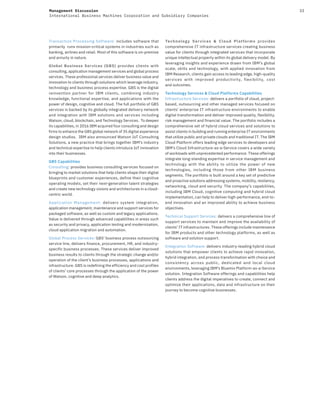
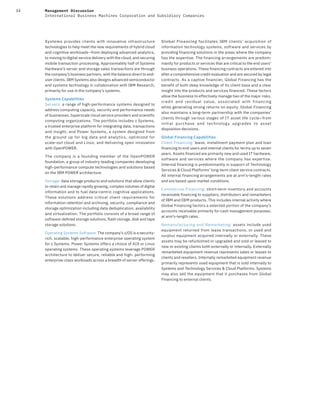
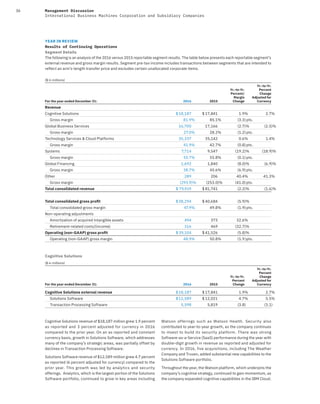
  • 17.
    41, 42, 43. Bankers,Diamond Brokers and Shippers can transact with trust. The global digital economy depends on trust, not faith. Transactions—from real estate and securities to supply chains and logistics—often have dozens of participants, multiplying the chances for error, delay and fraud. Fortunately, a new technology has arrived that will do for trusted transactions what the Internet did for information. Blockchain brings together shared ledgers with smart contracts, enabling the secure transfer across any network of any asset—whether physical (like a shipping container), financial (like a bond) or digital (like music). With blockchain, researchers, retailers and traders around the world are ensur- ing that all parties can transact with trust. With IBM, Maersk is creating solutions to digitize global trade, including a collab- oration on blockchain to build trust and transparency into global supply chains. Thanks to an application that start- up Everledger runs on IBM’s z Systems Cloud, blockchain can track a diamond’s provenance from mine to finger. For Walmart China, a blockchain pilot is following the journey of pork from farm to table, enabling tracking of details such as farm origins, factory data, expiration dates, storage temperatures and shipping information to better ensure food trace- ability, transparency and safety. CLS is partnering with IBM to build distributed ledger technology to reduce risk and improve liquidity across the $5-trillion-per-day global foreign exchange market. The Depository Trust and Clearing Corporation is using the technology to permanently record and automate the sharing of secured data records of financial agreements. The U.S. Food and Drug Administration is exploring the use of blockchain for the secure exchange of sensitive medical data such as electronic patient records, clinical trial data and health data from mobile devices. Companies, including IBM, support the Hyperledger Project to accelerate open development and commercial adoption. 100+ Blockchain 152016 Annual Report
  • 18.
    16 with IBM: 44. Educators can adaptto every student’s learning style and need. ↑ Sesame Workshop is looking to once again transform early learning, this time with Watson. With Watson, learning can be personalized to allow students to learn at their own pace and in the ways that best suit them. Sesame Workshop is creating a new educational platform that will adapt learning programs to each preschooler’s individual learning preferences and aptitude. Teachers in Texas’ Coppell Independent School District are using a holistic view of an individual child’s data to personalize the ways in which they approach each of the district’s 12,300 students. Hundreds of third-grade teachers in the United States are piloting Teacher Advisor with Watson, created with the American Federation of Teachers and other partners, to provide customized math lessons and expert teaching strategies that strengthen instruction. 45. Environmental Scientists are improving the quality of life through air quality. With IBM Research, environmental scien- tists in Beijing have built Green Horizons, a cognitive system that can accurately determine where air pollution is coming from, where it will go and what effect it might have on citizens. Drawing from myriad sources—including industrial production, coal shipments, transportation patterns and weather forecasts—Beijing can make adjustments such as closing factories or limiting traffic during risk periods. Ultra-fine particulate matter was reduced by 20 percent in 2015. Environmental agencies in Delhi and Johannesburg also adopted these technologies in 2016 to address clean air initiatives. ↑ Green Horizons is helping to improve air quality in Beijing, Delhi and Johannesburg. Civic Leaders are ushering in a new urban age. TM and © 2017 Sesame Workshop
  • 19.
    172016 Annual Report 49. PoliceOfficers can stay one step ahead of criminals. 50. Food Inspectors can thwart epidemics using supermarket scanners. 47. Helpline Operators can give answers in a New York minute. 48. Principals are preparing “new collar workers” for high-tech jobs. 46. Building Managers are listening to their structures—and saving millions. With Watson IoT, building managers and operators can make smarter decisions. Siemens Building Technologies Division’s cloud-based solution captures data generated by more than 70,000 connected buildings to spot energy usage and equipment problems in advance, saving millions of dollars and reducing carbon emissions by two million tons every year. KONE enables one billion people to move on more than one million elevators and escalators worldwide. The Watson IoT Cloud lets KONE connect sensors in these conveyances to improve people flow and performance. With this data, KONE can pre- dict potential outages, follow performance in real time, run tests remotely and dispatch technicians with better customer insight. Clean, well-stocked restrooms make good impressions with customers, employees and tenants of any building. Delivered through the IBM Cloud, new technology from Kimberly- Clark Professional allows restroom attendants to monitor conditions remotely from any device or location, alerting them to potential issues before complaints come in. Sensors embedded into towel, tissue and soap dispensers, as well as door counters, send real-time alerts to managers regarding supply usage levels, jams and overall traffic. Cleaning staff can then be assigned to those areas that most need service. Supplies are better managed, costs are lowered and tenants are happier. Police work is shifting from reactive crime-fighting to proactively managing public safety—working across boundaries to analyze data, spot patterns and avert crimes before they happen. With IBM, 6,000 police departments around the world can now access more than a billion shareable documents from the cloud. They apply intelligent analytics to predict and prevent crime in ways never before possible, leading to reductions in violent crime of up to 40 percent in some U.S. cities. From Salmonella to norovirus, foodborne illnesses afflict almost 1 in 10 people every year. The only way to prevent more from getting sick is to trace the problem back to the source of the contaminated food, which normally can take months. With IBM Research, public health officials can now use the data from simple supermarket scanners to analyze grocery receipts connected with as few as 10 reported cases of illness to find tainted sources within 12 hours or less. With Watson, New York’s 311 citizen helpline will use artificial intelligence to help people navigate life in the city. The system will help provide more user-friendly, up-to-the-minute and practical responses to 100,000 daily complaints, inquiries and calls for service–nearly 36 million a year. A four-year college degree is no longer the only route to a good job. High school students from diverse backgrounds are getting a great education, building their skills and landing the “new collar” jobs of the emerging cognitive era. Pathways in Technology Early College High School (P-TECH), created by IBM with leading educational partners, offers a unique six- year curriculum (grades 9–14) resulting in an associate degree. Dozens have already graduated ahead of schedule, prepared for jobs in high demand at IBM and many other companies. P-TECH will soon be available in 100 schools across six U.S. states and Australia.
  • 20.
    18 Virginia M. Rometty Chairman,President and Chief Executive Officer
  • 21.
    192016 Annual Report Itcan be hard to assess the progress of a major transformation from a single year’s results. And yet, when you look back after a few years, it becomes clear just how much has changed. Before I offer a broader perspective, let me describe how your company performed in 2016. We made substantial progress last year: • We achieved operating earnings per share of $13.59 and free cash flow of $11.6 billion. • We invested heavily for our long-term competitiveness—nearly $6 billion in research and development, nearly $4 billion in capital expenditures and nearly $6 billion to make 15 acquisitions, adding to our capabilities in the high-growth areas of cognitive, cloud and security. • We returned $8.8 billion to you, our shareholders, including dividends of $5.3 billion and $3.5 billion in gross share repurchases. We raised our dividend for the 21st consecutive year—and it was IBM’s 101st straight year of providing one. We are proud of both milestones. • IBM’s technical community outdid itself. For the 24th year in a row, IBM led in U.S. patents earned, becoming the first company to break the 8,000 mark in one year. • All of this and more is due to the work and passion of 380,000 IBMers. They are our greatest competitive advantage and the most important reason for confidence in IBM’s prospects in the years ahead. This is why it’s so encouraging that employee engagement scores continue to rise year after year. But understanding IBM at the start of 2017 requires a longer view—in particular, remembering why we embarked on this journey of transformation. It had nothing to do with economic downturn or fixing something broken. Rather, our experience over more than a century has trained us to be vigilant. We began to see that the IT industry would radically reorder, driven by the phenomenon of data, the maturation of cloud computing and the emergence of what many call artificial intelligence or AI. We were convinced that the source of value— for our clients and for our owners—would shift, and that the convergence of these innovations would usher in a new era in both technology and business. We didn’t wait. We got out of commoditizing businesses—trimming $8 billion from our top line (and nothing from our bottom line) over the past five years. We redoubled our efforts to reinvent our core hardware, software and services franchises, while investing to create new ones—in cloud, data, cognitive, security and the other businesses that comprise our strategic imperatives. We did this not simply to manage a portfolio of businesses, but to build the integrated capability that our clients would need for the new era. While our transformation continues, a strong foundation is now in place. Our strategic imperatives have reached critical mass. At $33 billion, they now contribute 41 percent of IBM’s revenue. With double-digit growth, we’re on pace to achieve our goal of growing these businesses to $40 billion by 2018. Most importantly, within these businesses we have built unique and powerful platforms with Watson and the IBM Cloud: • Watson has become the AI platform for business. I will have much more to say about Watson, but just consider that, through our clients and ecosystem partners, we expect Watson to touch one billion people this year. • IBM is now the global leader in cloud for the enterprise. In 2016, our cloud business grew an outstanding 35 percent, to $13.7 billion (adjusted for the effects of currency, as are all revenue growth numbers in this letter). Cloud by itself is now more than 17 percent of our total revenues. Our as-a-Service exit run rate was $8.6 billion, up 63 percent. I am so proud of the teams who have incubated and scaled these businesses. They are the IBM investor’s “unicorns.” At the same time, we have transformed much of IBM’s core—the other 59 percent of our company. Global Technology Services (GTS) is the market leader in IT services. The next time you use your credit or debit card, take out an insurance policy, board a plane or drive your car, chances are you are being Dear IBM Investor:
  • 22.
    20 touched by GTS.Their services run the infrastructure that powers 60 percent of the banking industry’s daily card transactions, 61 percent of the automobile industry’s production of passenger vehicles and nearly half of mobile connections worldwide. And while our GTS team is superb at managing infrastructure, they are innovators at heart. In recent years, they have built strong capabilities in hybrid cloud and are applying automation and Watson wherever and as fast as they can. This unique combination of innovation and trust enables GTS to grow signings and revenue, and win new clients. Global Business Services continues to reinvent itself and is growing robustly where we have created new practices. Last year, our cloud practice was up more than 60 percent, mobile more than 40 percent and analytics 10 percent. That’s good—though not enough yet to offset declines in some traditional practices, such as enterprise resource planning. But I remain confident in our ability to transform this business, and we will continue to invest in these new areas. For example, we created a new Watson IoT (Internet of Things) consulting practice that will include 1,500 consultants, data scientists and security experts. When it comes to our ability to reinvent large, significant businesses, I must say a word about the mainframe. Installed mainframe capacity has increased 20-fold in the past 20 years—and is still growing, as you saw in our fourth-quarter 2016 results. Why do clients love the mainframe? Because no other system can do what it can do, and because our mainframe team continues to create new capabilities for new workloads. Our latest mainframe runs Linux, processes mobile payments instantly, supports hybrid clouds and is becoming preferred as the most secure platform for the important new technology blockchain. This is why I call this part of IBM our youngest oldest business. Leading a new era With Watson’s victory on Jeopardy! in 2011, IBM ended the latest so-called “AI winter” and led our industry and the world into the cognitive era. Today, we’re no longer alone: The land rush into AI is on—including a lot of hype. But we expect to maintain and extend our lead in cognitive business, because we uniquely serve the needs of the enterprise. Enterprises need cognitive solutions that turn vast amounts of data into insights and competitive advantage. They need access to a cloud platform not only for IT capability, but for speed and agility. Its architecture must be hybrid, spanning both public and private clouds, because businesses will want to leverage their existing investments in applications, IT infrastructure and, most of all, their data. And they need a partner they trust, who understands their industry and process flows, and whose platform is secure, scalable, global in scope and local in presence. IBM provides this powerful AI cloud platform, and we are using it to build industry-based solutions to real-world problems. We are creating domain-specific datasets that we either own or partner to access, and we’re applying our deep industry expertise to build vertical solutions and to train Watson in specific professional fields. In short, to win in the cognitive era, data matters. Client control of their data and insights matters. Public, hybrid and enterprise-strength cloud matters. Industry expertise matters. Trust and security matter. That is what sets apart Watson on the IBM Cloud—and why thousands of clients, partners and IBM itself are building powerful solutions and businesses on it: • IBM Watson Health leverages broad datasets, including 100 million electronic health records, 200 million healthcare claims records and millions of images. You also need clinical data, payer data and images, all of which are created and owned by clients. (Consider that an estimated 80 percent of the world’s data cannot be accessed by search engines.) We capture and integrate all this data, because publicly available data alone is not sufficient for work like transforming healthcare or making advances in cancer. What’s more, you need deep domain expertise. Watson Health’s 7,000 employees include doctors, nurses, health policy experts and data scientists. Finally, we provide a quality management system that is HIPAA-compliant. Only IBM Watson Health offers all of this capability. “ Watson has become the AI platform for business.”
  • 23.
    212016 Annual Report 80% ofglobal retailers are powered by IBM retail solutions 90% of global credit card transactions are processed on IBM mainframes 2014 2015 2016 IBM is already essential to global business… IBM has helped design, build and run the systems that underpin global business. As we build what modern business requires... We have invested in and built the capabilities—cloud, analytics, cognitive, mobile, security—to power the emerging needs of modern business. Our strategic imperatives grew by 14 percent adjusting for currency, generating $33 billion in revenue last year, representing 41 percent of our total revenue. Our growth is fueled by innovation... Our ability to create high value is powered by the prolific inventors of IBM. For the 24th year in a row, IBM led in U.S. patents earned. In 2016, we were the first company ever to be granted more than 8,000 U.S. patents in one year. Enabling us to generate high returns. Our model allows us to continuously invest in our growth while simultaneously returning value to our shareholders. 8,088 patents in 2016 97,040 total patents since 1993 $15B invested in 2016 $8.8B returned in 2016 Strategic Imperatives Revenue Across research and development, capital expenditures, and acquisitions Dividends: $5.3B Gross Share Repurchase: $3.5B 80% of the world’s travel reservations are processed on IBM systems 83% of the world’s largest communications service providers are IBM clients 1993 ’94 ’95 ’96 ’97 ’98 ’99 ’00 ’01 ’02 ’03 ’04 ’05 ’06 ’07 ’08 ’09 ’10 ’11 ’12 ’13 ’14 ’15 2016 $25B $29B $33B 97% of the word’s largest banks use IBM products to run their systems
  • 24.
    22 • IBM WatsonIoT has similar unique advantages. The number of new clients and developers using our platform more than doubled last year. Our new global Watson IoT center in Munich opened in 2017, including the first-ever Cognitive IoT Collaboratories, where clients and IBMers work together to drive innovation in automotive, electronics, manufacturing, healthcare and insurance. • Late last year, we launched Watson Financial Services. And because top industry specialists are needed to train Watson in the risk management requirements of financial services, we acquired Promontory Financial Group, a leader in regulatory compliance and risk management consulting. IBM is changing industries around the world. Watson on the IBM Cloud is available to more than 200 million consumers to answer questions, find what they need online and make recommendations. Half a million students can choose courses and master a subject with Watson, which also helps teachers address each student’s unique learning needs. IBM Security—which monitors 35 billion security events a day for 12,000 clients spanning 133 countries— launched the world’s first commercial “cyber range,” where clients can simulate and prepare for real-world attacks and draw on the power of Watson to fight cybercrime. With Watson, buildings are reducing CO2 emissions by 10 million tons a year; businesses are accelerating hiring cycles by 75 percent; and airlines are improving maintenance efficiency by 80 percent. It is also becoming clear that as IT moves to the cloud, transactions must be trusted by all parties involved. That is why we are building a complete blockchain platform. Blockchain brings together shared ledgers with smart contracts to allow the secure transfer of any asset—whether a physical asset like a shipping container, a financial asset like a bond or a digital asset like music—across any business network. Blockchain will do for trusted transactions what the Internet did for information. IBM is already working with more than 400 clients to pioneer blockchain for business. They include clients who manage foreign exchange settlements, smart contracts, identity management and trade finance—but the potential goes well beyond financial services. For instance, we are collaborating with Walmart to ensure transparency in the way food is tracked, transported and sold to consumers across China and the United States. And Everledger is using a cloud- based blockchain to track the provenance of diamonds and other high-value goods as they move through the supply chain. This is the real world of cognitive business. Unlike the AI we see in movies and pop culture—which depict machines achieving consciousness or independent agency— the true promise of this revolutionary technology comes not from replacing but from augmenting human intelligence. It comes from embedding cognitive capability in the processes, systems, products and services that permeate business, society and our daily lives. New roads and new rules for a cognitive future As 2017 begins, our industry stands at an inflection point. The next few years will be critical for information technology providers, as businesses and institutions around the world will make key architectural decisions—about cloud, about data, about AI. IBM is well positioned to help clients make wise choices—and to lead our competition. We take seriously our responsibility to ensure that new technology is adopted in ways that are both ethical and enduring— never more essential than in times of rapid economic and societal change. We will continue to engage across our industry and society, and to advocate for a business and policy environment that is open, inclusive, global and equitable. And we will do more than advocate. We will innovate. An example of such innovation is IBM’s “Principles for Transparency and Trust in the Cognitive Era,” which we issued in January of this year. Its main tenets: • We believe AI’s purpose is to augment human intelligence. • We will be transparent about when and where AI is being applied, and about the data and training that went into its recommendations. • We believe our clients’ data and insights are theirs. • We are committed to helping students, workers and citizens acquire the skills to
  • 25.
    232016 Annual Report engagesafely, securely and effectively with cognitive systems, and to do the new kinds of work that will emerge in a cognitive economy. These principles will be our touchstone for everything we do to build this new world. We will practice them with our clients, and we believe they can form an important foundation for business and society at large. A world with Watson Last October, IBM hosted more than 15,000 entrepreneurs, innovators and other leaders from business, government, healthcare and civil society who are working with Watson to transform their industries and sectors. Their work showed that Watson has, indeed, entered the world at scale. But this signature gathering did something more than showcase the reality and reach of Watson. It also presented a vision of the world with Watson. In example after example, we saw a world that is healthier, more secure, less wasteful, more productive, more personalized, more sustainable. That is a world my colleagues and I want to live in. Indeed, this is, in the end, why we are IBMers—and why we remain so deeply committed to the hopeful future that is now within our grasp. As IBM has done throughout its history, we remain dedicated to leading the world into a more prosperous and progressive future; to creating a world that is fairer, more diverse, more tolerant, more just; and to creating long-term value for you. Our strategy to reinvent our company is being validated by our clients around the world, and has the support of our Board of Directors. I’m grateful to them and to you, our owners, for your continued support. Most of all, I am deeply proud of the IBM team for bringing us here and for what they do every day for our great company. Virginia M. Rometty Chairman, President and Chief Executive Officer In an effort to provide additional and useful information regarding the company’s financial results and other financial information, as determined by generally accepted accounting principles (GAAP), these materials contain certain non-GAAP financial measures on a continuing operations basis, including revenue at constant currency, strategic imperatives revenue at constant currency, as-a-Service run rate at constant currency, operating earnings per share and free cash flow. The rationale for man- agement’s use of this non-GAAP information is included on pages 26, 27 and 69 of the company’s 2016 Annual Report, which is Exhibit 13 to the Form 10-K submitted with the SEC on February 28, 2017. For reconciliation of these non-GAAP financial measures to GAAP and other information, please refer to pages 28, 48, 50 and 69 of the company’s 2016 Annual Report. IBM is now the global leader in cloud for the enterprise.” “
  • 26.
    24 Financial Highlights InternationalBusiness Machines Corporation and Subsidiary Companies ($ in millions except per share amounts) For the year ended December 31: 2016 2015 Revenue $ 79,919 $ 81,741 Net Income $ 11,872 $ 13,190 Income from continuing operations $ 11,881 $ 13,364 Operating (non-GAAP) earnings* $ 13,031 $ 14,659 Earnings per share of common stock (continuing operations) Assuming dilution $ 12.39 $ 13.60 Basic $ 12.44 $ 13.66 Diluted operating (non-GAAP)* $ 13.59 $ 14.92 Net cash provided by operating activities $ 16,958 $ 17,008 Capital expenditures, net 3,726 3,780 Share repurchases 3,502 4,609 Cash dividends paid on common stock 5,256 4,897 Per share of common stock $ 5.50 $ 5.00 At December 31: 2016 2015 Cash, cash equivalents and marketable securities $ 8,527 $ 8,195 Total assets $ 117,470 $110,495 Working capital $ 7,613 $ 8,235 Total debt $ 42,169 $ 39,890 Total equity $ 18,392 $ 14,424 Common shares outstanding (in millions) 946 966 Market capitalization $ 157,832 $133,507 Stock price per common share $ 165.99 $ 137.62 * See pages 48 and 49 for a reconciliation of net income to operating earnings.
  • 27.
    25Report of Financials InternationalBusiness Machines Corporation and Subsidiary Companies MANAGEMENT DISCUSSION Overview 26 Forward-Looking and Cautionary Statements 27 Management Discussion Snapshot 27 Description of Business 30 Year in Review 36 Prior Year in Review 56 Other Information 67 Looking Forward 67 Liquidity and Capital Resources 68 Critical Accounting Estimates 71 Currency Rate Fluctuations 74 Market Risk 74 Cybersecurity 75 Employees and Related Workforce 76 Global Financing 76 Report of Management 82 Report of Independent Registered Public Accounting Firm 83 CONSOLIDATED FINANCIAL STATEMENTS Earnings 84 Comprehensive Income 85 Financial Position 86 Cash Flows 87 Changes in Equity 88 NOTES TO CONSOLIDATED FINANCIAL STATEMENTS A Significant Accounting Policies 90 B Accounting Changes 99 C Acquisitions/Divestitures 101 D Financial Instruments 107 E Inventories 114 F Financing Receivables 114 G Property, Plant and Equipment 118 H Investments and Sundry Assets 119 I Intangible Assets Including Goodwill 119 J Borrowings 120 K Other Liabilities 123 L Equity Activity 123 M Contingencies and Commitments 127 N Taxes 129 O Research, Development and Engineering 132 P Earnings Per Share of Common Stock 132 Q Rental Expense and Lease Commitments 133 R Stock-Based Compensation 133 S Retirement-Related Benefits 136 T Segment Information 150 U Subsequent Events 154 Five-Year Comparison of Selected Financial Data 155 Selected Quarterly Data 156 Performance Graph 157 Board of Directors and Senior Leadership 158 Stockholder Information 159
  • 28.
    26 Management Discussion InternationalBusiness Machines Corporation and Subsidiary Companies OVERVIEW The financial section of the International Business Machines Corporation (IBM or the company) 2016 Annual Report includes the Management Discussion, the Consolidated Financial Statements and the Notes to Consolidated Financial Statements. This Overview is designed to provide the reader with some perspective regarding the information contained in the financial section. Organization of Information • The Management Discussion is designed to provide readers with an overview of the business and a narrative on the company’s financial results and certain factors that may affect its future prospects from the perspective of the company’s management. The “Management Discussion Snapshot,” beginning on page 27, presents an overview of the key performance drivers in 2016. • Beginning with the “Year in Review” on page 36, the Management Discussion contains the results of operations for each reportable segment of the business and a discussion of the company’s financial position and cash flows. Other key sections within the Management Discussion include: “Looking Forward” on page 67, and “Liquidity and Capital Resources” on page 68, which includes a description of management’s definition and use of free cash flow. • Global Financing is a reportable segment that is measured as a stand-alone entity. A separate “Global Financing” section is included in the Management Discussion beginning on page 76. • The Consolidated Financial Statements are presented on pages 84 through 89. These statements provide an overview of the company’s income and cash flow performance and its financial position. • Subsequent to the company’s press release and Form 8-K filing on January 19, 2017, announcing 2016 fourth- quarter and full-year financial results, the company revised the classification of certain financing receivables on a full- year basis increasing net cash provided by operating activities and net cash used in investing activities in the amount of $441 million. As adjusted, net cash provided by operating activities for the three months and twelve months ended December 31, 2016 is $3,968 million and $16,958 million, respectively, and, net cash used in investing activities is $3,687 million and $10,976 million for the same periods. There was no impact to total GAAP cash flows or free cash flow. • The Notes follow the Consolidated Financial Statements. Among other items, the Notes contain the company’s accounting policies (pages 90 to 99), acquisitions and divestitures (pages 101 to 106), detailed information on specific items within the financial statements, certain contingencies and commitments (pages 127 to 129) and retirement-related plans information (pages 136 to 150). • The Consolidated Financial Statements and the Notes have been prepared in accordance with accounting principles generally accepted in the United States (GAAP). • In October 2014, the company announced a definitive agreement to divest its Microelectronics business. The assets and liabilities of the Microelectronics business were reported as held for sale at December 31, 2014 and the operating results of the Microelectronics business have been reported as discontinued operations. The transaction closed on July 1, 2015. • In January 2016, the company made a number of changes to its organizational structure and management system. These changes impacted the company’s reportable segments, but did not impact the company’s Consolidated Financial Statements. Refer to Note T, “Segment Information,” on pages 150 to 154 for additional information on the changes in reportable segments. The company’s reportable segments are: Cognitive Solutions, Global Business Services, Technology Services & Cloud Platforms, Systems, and Global Financing. The company filed a recast 2015 Annual Report in a Form 8-K on June 13, 2016 to recast its historical segment information to reflect these changes. • The references to “adjusted for currency” or “at constant currency” in the Management Discussion do not include operational impacts that could result from fluctuations in foreign currency rates. When the company refers to growth rates at constant currency or adjusts such growth rates for currency, it is done so that certain financial results can be viewed without the impact of fluctuations in foreign currency exchange rates, thereby facilitating period-to- period comparisons of its business performance. Financial results adjusted for currency are calculated by translating current period activity in local currency using the comparable prior year period’s currency conversion rate. This approach is used for countries where the functional currency is the local currency. Generally, when the dollar either strengthens or weakens against other currencies, the growth at constant currency rates or adjusting for currency will be higher or lower than growth reported at actual exchange rates. See “Currency Rate Fluctuations” on page 74 for additional information. • Within the financial statements and tables in this Annual Report, certain columns and rows may not add due to the use of rounded numbers for disclosure purposes. Percentages reported are calculated from the underlying whole-dollar numbers. Operating (non-GAAP) Earnings In an effort to provide better transparency into the operational results of the business, the company separates business results into operating and non-operating categories. Operating earnings from continuing operations is a non-GAAP measure that excludes the effects of certain acquisition-related charges, retirement-related costs, discontinued operations and related tax impacts. For acquisitions, operating earnings exclude the amortization of purchased intangible assets and acquisition- related charges such as in-process research and development, transaction costs, applicable restructuring and related expenses and tax charges related to acquisition integration. These charges are excluded as they may be inconsistent in amount and timing from period to period and are dependent on the size, type and
  • 29.
    27Management Discussion International BusinessMachines Corporation and Subsidiary Companies frequency of the company’s acquisitions. For retirement-related costs, the company characterizes certain items as operating and others as non-operating. The company includes defined benefit plan and nonpension postretirement benefit plan service cost, amortization of prior service cost and the cost of defined contribution plans in operating earnings. Non-operating retirement-related cost includes defined benefit plan and nonpension postretirement benefit plan interest cost, expected return on plan assets, amortized actuarial gains/losses, the impacts of any plan curtailments/settlements and multi- employer plan costs, pension insolvency costs and other costs. Non-operating retirement-related costs are primarily related to changes in pension plan assets and liabilities which are tied to financial market performance and the company considers these costs to be outside of the operational performance of the business. Overall, the company believes that providing investors with a view of operating earnings as described above provides increased transparency and clarity into both the operational results of the business and the performance of the company’s pension plans; improves visibility to management decisions and their impacts on operational performance; enables better comparison to peer companies; and allows the company to provide a long-term strategic view of the business going forward. The company’s reportable segment financial results reflect operating earnings from continuing operations, consistent with the company’s management and measurement system. FORWARD-LOOKING AND CAUTIONARY STATEMENTS Certain statements contained in this Annual Report may constitute forward-looking statements within the meaning of the Private Securities Litigation Reform Act of 1995. Any forward-looking statement in this Annual Report speaks only as of the date on which it is made; the company assumes no obligation to update or revise any such statements. Forward- looking statements are based on the company’s current assumptions regarding future business and financial performance; these statements, by their nature, address matters that are uncertain to different degrees. Forward-looking statements involve a number of risks, uncertainties and other factors that could cause actual results to be materially different, as discussed more fully elsewhere in this Annual Report and in the company’s filings with the Securities and Exchange Commission (SEC), including the company’s 2016 Form 10-K filed on February 28, 2017. MANAGEMENT DISCUSSION SNAPSHOT ($ and shares in millions except per share amounts) For the year ended December 31: 2016 2015 Yr.-to-Yr. Percent/ Margin Change Revenue $ 79,919 $ 81,741 (2.2)%* Gross profit margin 47.9% 49.8% (1.9)pts. Total expense and other (income) $ 25,964 $ 24,740 4.9% Total expense and other (income)-to-revenue ratio 32.5% 30.3% 2.2pts. Income from continuing operations before income taxes $ 12,330 $ 15,945 (22.7)% Provision for income taxes from continuing operations $ 449 $ 2,581 (82.6)% Income from continuing operations $ 11,881 $ 13,364 (11.1)% Income from continuing operations margin 14.9% 16.3% (1.5)pts. Loss from discontinued operations, net of tax $ (9) $ (174) (95.1)% Net income $ 11,872 $ 13,190 (10.0)% Earnings per share from continuing operations: Assuming dilution $ 12.39 $ 13.60 (8.9)% Consolidated earnings per share—assuming dilution $ 12.38 $ 13.42 (7.7)% Weighted-average shares outstanding Assuming dilution 958.7 982.7 (2.4)% Assets** $117,470 $110,495 6.3% Liabilities** $ 99,078 $ 96,071 3.1% Equity** $ 18,392 $ 14,424 27.5% * (1.6) percent adjusted for currency **At December 31
  • 30.
    28 Management Discussion InternationalBusiness Machines Corporation and Subsidiary Companies The following table provides the company’s (non-GAAP) operating earnings for 2016 and 2015 ($ in millions except per share amounts) For the year ended December 31: 2016 2015 Yr.-to-Yr. Percent Change Net income as reported $11,872 $13,190 (10.0)% Loss from discontinued operations, net of tax (9) (174) (95.1) Income from continuing operations $11,881 $13,364 (11.1)% Non-operating adjustments (net of tax) Acquisition-related charges 735 562 30.9 Non-operating retirement-related costs/(income) 415 734 (43.5) Operating (non-GAAP) earnings* $13,031 $14,659 (11.1)% Diluted operating (non-GAAP) earnings per share $ 13.59 $ 14.92 (8.9)% * See pages 48 and 49 for a more detailed reconciliation of net income to operating earnings. In 2016, the company reported $79.9 billion in revenue, $11.9 billion in income from continuing operations and $13.0 billion in operating (non-GAAP) earnings, resulting in diluted earnings per share from continuing operations of $12.39 as reported and $13.59 on an operating (non-GAAP) basis. The results of continuing operations exclude a net loss from discontinued operations of $9 million in 2016 and $174 million in 2015 related to the divestiture of the Microelectronics business. On a consolidated basis, net income in 2016 was $11.9 billion, with diluted earnings per share of $12.38. The company generated $17.0 billion in cash from operations and $11.6 billion in free cash flow and shareholder returns of $8.8 billion in gross common stock repurchases and dividends. There are significant opportunities and shifts occurring in the IT industry, and the company believes that to be successful with enterprise clients, it needs to bring together cognitive technologies on cloud platforms that create industry-based solutions to solve real-world problems. In 2016, the company continued to: • Deliver strong results in the strategic imperatives; • Make progress in building new businesses and creating new markets; • Deliver innovation in the more traditional businesses and monetize core technologies; and • Return capital to shareholders. Total consolidated revenue in 2016 decreased 2.2 percent as reported and 1.6 percent year to year adjusted for currency. Annuity revenue increased as reported and adjusted for currency while transactional revenue declined year to year. In addition, acquisitions completed in the past 12 months contributed to revenue growth. The 2016 results reflect the success the company is having in its strategic imperatives and the investments made to drive that shift. The company had continued strong revenue growth in cloud, analytics and engagement, which together grew 13 percent year to year as reported and 14 percent adjusted for currency. In 2016, the strategic imperatives generated $32.8 billion in revenue, which represented 41 percent of the company’s revenue, an increase of 6 points from 2015. Total Cloud revenue of $13.7 billion increased 35 percent both as reported and adjusted for currency, with cloud as-a-Service revenue up 55 percent as reported and 57 percent adjusted for currency. The company exited 2016 with an annual run rate for cloud as-a-Service revenue of $8.6 billion, up from $5.3 billion at the end of 2015. Analytics revenue of $19.5 billion increased 9 percent as reported and adjusted for currency. Mobile revenue increased 34 percent year to year as reported (35 percent adjusted for currency) and Security revenue increased 13 percent as reported (14 percent adjusted for currency). From a segment perspective, Cognitive Solutions revenue increased 1.9 percent as reported and 3 percent adjusted for currency with growth in Solutions Software, led by an increase in Analytics and Security revenue; partially offset by a decline in Transaction Processing Software. Global Business Services (GBS) revenue decreased 2.7 percent as reported and 3 percent adjusted for currency primarily driven by a decline in Consulting revenue. Revenue performance continued to be impacted by the company’s shift away from traditional businesses, such as ERP implementations. GBS strategic imperatives revenue had double-digit growth year to year as reported and adjusted for currency. Technology Services & Cloud Platforms revenue increased 0.6 percent as reported and 1 percent adjusted for currency led by growth in Infrastructure Services as the company assists clients in modernizing and transforming their infrastructures. Technology Services & Cloud Platforms strategic imperatives revenue was up 39 percent (40 percent adjusted for currency) year to year. Systems revenue decreased 19.2 percent (19 percent adjusted for currency) with z Systems down 27.1 percent (27 percent adjusted for currency) and Power Systems down 27.1 percent (27 percent adjusted for currency).
  • 31.
    29Management Discussion International BusinessMachines Corporation and Subsidiary Companies From a geographic perspective, Americas revenue decreased 2.5 percent as reported (1 percent adjusted for currency) with the U.S. down 0.9 percent. Europe/Middle East/Africa (EMEA) revenue decreased 5.0 percent as reported (2 percent adjusted for currency). Asia Pacific revenue increased 2.6 percent as reported, but decreased 1 percent adjusted for currency with Japan up 10.5 percent as reported, but down 1 percent adjusted for currency. The consolidated gross profit margin of 47.9 percent decreased 1.9 points year to year and reflects the impact of the company’s investments, including acquisitions, and mix in as-a-Service which is not yet at scale. The operating (non-GAAP) gross margin of 48.9 percent decreased 1.9 points compared to 2015 driven primarily by the same factors. Total expense and other (income) increased 4.9 percent in 2016 compared to the prior year. Total operating (non-GAAP) expense and other (income) increased 5.6 percent compared to 2015. The key year-to-year drivers were: Total Consolidated Operating (non-GAAP) • Currency* 2 points 2 points • Acquisitions** 5 points 4 points • Base (2) points 0 points * Reflects impacts of translation and hedging programs **Includes acquisitions completed in prior 12-month period; operating (non-GAAP) is net of non-operating acquisition-related charges. The increase in expense was driven primarily by the impact of acquisitions completed in the prior 12 months and an impact from currency. Base expense performance reflects a higher level of intellectual property (IP) income ($950 million) year to year driven primarily by the company’s software licensing arrangements. Base expense also includes charges in 2016 for actions taken to accelerate the transformation of the company’s workforce and shift its skill base, as well as increased investments in the strategic areas of cognitive, security and cloud. This included a higher level of workforce rebalancing charges ($451 million) year to year and real estate capacity charges ($291 million) related to the workforce transformation. The company continued to invest at a high level in 2016 and remixed skills in support of the strategic imperatives. Pre-tax income from continuing operations of $12.3 billion decreased 22.7 percent year to year and the pre-tax margin was 15.4 percent, a decrease of 4.1 points versus 2015. The continuing operations effective tax rate for 2016 was 3.6 percent, a decrease of 12.5 points versus 2015. The tax rate in 2016 was primarily the result of a refund ($1.0 billion) of previously paid non-U.S. taxes plus interest in the first quarter of 2016. Income from continuing operations of $11.9 billion decreased 11.1 percent and the net income margin was 14.9 percent, a decrease of 1.5 points versus 2015. Losses from discontinued operations, net of tax, were $9 million in 2016 compared to $174 million in 2015. Net income of $11.9 billion decreased 10.0 percent year to year. Operating (non-GAAP) pre-tax income from continuing operations of $13.9 billion decreased 21.3 percent year to year and the operating (non- GAAP) pre-tax margin from continuing operations decreased 4.2 points to 17.4 percent. Operating (non-GAAP) income from continuing operations of $13.0 billion decreased 11.1 percent and the operating (non-GAAP) income margin from continuing operations of 16.3 percent decreased 1.6 points. The operating (non-GAAP) effective tax rate from continuing operations in 2016 was 6.5 percent versus 17.2 percent in 2015. Diluted earnings per share from continuing operations of $12.39 in 2016 decreased 8.9 percent year to year. In 2016, the company repurchased 23.3 million shares of its common stock at a cost of $3.5 billion and had $5.1 billion remaining in the share repurchase authorization at December 31, 2016. Operating (non-GAAP) diluted earnings per share of $13.59 decreased 8.9 percent versus 2015. Diluted earnings per share from discontinued operations was ($0.01) in 2016 compared to ($0.18) in 2015. At December 31, 2016, the company continued to have the financial flexibility to support the business over the long term. Cash and marketable securities at December 31, 2016 were $8.5 billion, an increase of $0.3 billion from December 31, 2015. Key drivers in the balance sheet and total cash flows were: Total assets increased $7.0 billion ($7.7 billion adjusted for currency) from December 31, 2015 driven by: • Increases in goodwill ($4.2 billion), retirement plan assets ($1.3 billion), net intangible assets ($1.2 billion), deferred taxes ($0.4 billion) and cash and marketable securities ($0.3 billion). Total liabilities increased $3.0 billion ($3.9 billion adjusted for currency) from December 31, 2015 driven by: • Increases in total debt ($2.3 billion), retirement-related liabilities ($0.6 billion) and taxes ($0.4 billion). Total equity of $18.4 billion increased $4.0 billion from December 31, 2015 as a result of: • Increases from net income ($11.9 billion) and stock-based compensation ($0.5 billion); partially offset by • Decreases from dividends ($5.3 billion) and share repurchases ($3.5 billion). The company generated $17.0 billion in cash flow provided by operating activities, essentially flat compared to 2015, driven primarily by operational performance; offset by lower income tax payments. Net cash used in investing activities of $11.0 billion was $2.8 billion higher than 2015, primarily driven by an increase in cash used related to acquisitions ($2.3 billion). Net cash used in financing activities of $5.8 billion decreased $3.4 billion compared to the prior year, driven primarily by higher net debt issuances ($2.7 billion) and a decline in cash used for common share repurchases ($1.1 billion).
  • 32.
    30 Management Discussion InternationalBusiness Machines Corporation and Subsidiary Companies In January 2017, the company disclosed that it is expecting GAAP earnings per share from continuing operations of at least $11.95 and operating (non-GAAP) earnings of at least $13.80 per diluted share for 2017. The company expects 2017 free cash flow realization to be in excess of 90 percent of GAAP net income and free cash flow to be essentially flat year to year. Refer to page 69 in the Liquidity and Capital Resources section for additional information on this non-GAAP measure. Refer to the Looking Forward section on pages 67 and 68 for additional information on the company’s expectations. DESCRIPTION OF BUSINESS Please refer to IBM’s Annual Report on Form 10-K filed with the SEC on February 28, 2017 for Item 1A. entitled “Risk Factors.” The company creates value for clients through integrated solutions and products that leverage: data, information technology, deep expertise in industries and business processes, and a broad ecosystem of partners and alliances. IBM solutions typically create value by enabling new capabilities for clients that transform their businesses and help them engage with their customers and employees in new ways. These solutions draw from an industry-leading portfolio of consulting and IT implementation services, cloud and cognitive offerings, and enterprise systems and software; all bolstered by one of the world’s leading research organizations. Strategy IBM has a history of continuous re-invention, transforming itself throughout its 100-plus year history. In the past five decades alone, IBM has ushered in the eras of the mainframe, the personal computer, IT services and enterprise software. In its current transformation, IBM is once again leading the reordering of the technology industry. A number of years ago, the company declared its focus on the strategic forces behind the “digital” revolution; data, cloud and engagement, driven by mobile and social, and underpinned by security. Since 2010, IBM has invested approximately $40 billion in these areas, built out the IBM Cloud on a global scale and extended cognitive systems to numerous enterprises and industries. The company made 55 acquisitions and has formed partnerships with organizations that are leading players in key industries. Because of this transformation, IBM today is much more than a hardware, software and services company; IBM is a cognitive solutions and cloud platform company, with a focus on industry capabilities and expertise: Cognitive Solutions: With the highest level of intelligence that exists in technology systems, these solutions tackle challenges ranging from answering client inquiries to helping physicians fight cancer. Cloud Platform: IBM Cloud is the leading cloud platform for the enterprise, providing what enterprises need for speed, agility and, combined with Watson, for cognitive capability. Industry Focus: As IBM brings higher levels of value to its clients, as its offerings are being built for the needs of individual industries. Healthcare and Financial Services are two examples of the company’s initial cognitive focus. Cognitive Solutions Since IBM’s Watson was introduced in 2011, the company has been developing a new generation of cognitive systems that can see and analyze the massive amounts of data that have previously been invisible to computers and enterprises. IBM’s cognitive systems have the capability to inject a kind of thinking ability into every digitized object, process and service, and learn from interactions. IBM is on the forefront of deploying these systems and helping clients to embrace the cognitive era. Cognitive systems are not programmed; like humans, they learn from experts and from every interaction, and they are uniquely able to find patterns in big data. They learn by using advanced algorithms to sense, predict and infer. Doing so, they augment human intelligence, allowing individuals to make faster and more informed decisions. Since Watson’s debut, many technologies have entered the market under the banner of artificial intelligence. However, IBM’s approach to cognitive systems is quite unique: • Highly adaptable intelligence systems: Watson has broad applicability and can help clients tackle challenges ranging from oncology to customer support. • Protect and respect client data: Watson learns through data, both public data as well as clients’ private data. Clients choose whether their data or insights are shared. IBM respects the clients’ ownership and control of their own data. • Easy entry points: Watson’s open APIs offer easy on-ramps to experiment with speech, vision and other data. • Trained in domain depth: Watson is trained to be an expert in industries and functional specialties. It augments the knowledge of professionals, giving them access to the insights of their best colleagues and the world’s leading experts. • Transformational services: IBM’s Cognitive Solutions and Watson Internet of Things (IoT) practices help clients build their cognitive strategies. GBS provides outcome-focused methodologies, domain skills and deep industry expertise.
  • 33.
    31Management Discussion International BusinessMachines Corporation and Subsidiary Companies Cloud Platform Cloud represents more than a new architecture for delivering infrastructure and applications as services; it is also a catalyst for innovation, speed and agility. Cloud enables companies to focus on differentiating their strategies, capabilities and business models rather than on the underlying technology. The IBM Cloud brings a unique set of characteristics to clients: • It is a world-class cloud platform designed for enterprises, where security, reliability, scalability and performance are critical. • It is the industry-leading hybrid cloud, enabling clients to extend their existing IT investments, connecting valuable data and applications across public and private clouds. • It is a world-class cognitive cloud platform with IBM Watson services that developers can embed into their applications to create differentiating customer experiences and powerful insights. The IBM Cloud has a strong global presence, with more than 50 cloud data centers around the world giving clients the flexibility to optimize the deployment of data and application, for performance, security and compliance. The IBM Cloud is also continually expanding its base of advanced capabilities including cloud data services, cloud object storage, cloud video services, as well as Internet of Things, blockchain and analytics services. In 2016, IBM brought new cognitive solutions to professionals in marketing, commerce, supply chain and human resources, extending industry clouds to further differentiate its cloud offerings. Industry Focus To bring higher value to clients, IBM is providing solutions that are specific and tailored to challenges clients face in their industry, using the power of IBM’s advanced cognitive computing capabilities built on the IBM Cloud. In 2016, IBM deepened its commitment to delivering higher value in several key ways: • In the healthcare industry, IBM Watson Health combines the power of cloud and cognitive with value-based solutions to optimize performance, engage consumers, enable effective care and manage population health. Significant investment in the healthcare space, including the acquisition of Merge and Truven, has enabled the company to expand the scope of solutions aimed at solving some of the most pressing health challenges. • IBM continues to partner with financial services clients to build a robust infrastructure addressing increasingly complex and fast-changing demands. From preventing fraud to supporting cybersecurity efforts, IBM is becoming ever-more essential to the financial industry. • IBM offers analytics to help clients assess their risk and compliance against industry guidelines, and uses a cognitive approach to provide deeper and faster findings. In late 2016, the company acquired Promontory Financial Group, LLC (Promontory), one of the world’s leading regulatory consulting firms. Promontory is training Watson to be a market-leading expert in the regulatory field, which will allow the company to deliver services at new levels of efficiency and transparency. • IBM is committed to blockchain to provide a highly secure method of facilitating multi-step transactions, reducing the number of disputes and points of friction, including its participation in the Hyperledger Project. This cross- industry consortium is working to build the blockchain network in the cloud, doing for trusted transactions what the Internet did for information, and setting industry standards for years to come. Blockchain will enable financial institutions to settle securities in minutes instead of days; manufacturers to reduce product recalls by sharing production logs along their supply chain; and businesses of all types to more closely manage the flow of goods and payments. IBM is working with companies ranging from retailers, banks and shippers to apply this technology to transform their ecosystems through open standards and open platforms. • IBM’s Global Business Services consulting business, with broad expertise across industries and a strong global footprint and scale, provides a unique combination of technologies and services to help clients achieve their business outcomes.
  • 34.
    32 Management Discussion InternationalBusiness Machines Corporation and Subsidiary Companies Transforming Core Businesses While the company is focused on cognitive solutions, cloud platform and industry, it is important to note cognitive, cloud and industry are being embedded across IBM’s offerings. These core businesses continue to run clients’ most critical business processes. IBM’s hardware systems are being designed from the ground up to power the cloud and cognitive systems of the future. The company’s technology services help clients move to the cloud, embedding cognitive capabilities tailored for their industry. The company’s software offerings are simultaneously being made available for the cloud as well as being connected to the cloud where our clients choose to keep them on premises. Additionally, cognitive capabilities are being added to these offerings to provide new levels of innovation. In short, all of IBM is transforming to support the way its clients are transforming. Summary Each transformation of IBM ushers in a new capability to the world. More than 50 years ago, IBM introduced the program- mable era and transformed the world’s transactions through the mainframe. In the decades that followed, IBM commercialized the personal computer, created an industry around IT services and a software market around middleware. Each of these innovations remains essential to business and the world today. The company’s current chapter is ushering in an entirely new era of human-computer interaction, embodied in cognitive solutions and the cloud platform for the needs of industries. The company is embarking on an era where it will create new capabilities at speeds and depth never previously witnessed. Business Model The company’s business model is built to support two principal goals: helping enterprise clients to become more innovative, efficient and competitive through the application of business insight and IT solutions; and providing long-term value to shareholders. The business model has been developed over time through strategic investments in capabilities and technologies that have superior long-term growth and profitability prospects based on the value they deliver to clients. The company’s global capabilities as a cognitive solutions and cloud platform company include services, software, systems, fundamental research and related financing. The broad mix of businesses and capabilities are combined to provide integrated solutions and platforms to the company’s clients. The business model is dynamic, adapting to the continuously changing industry and economic environment, including the company’s transformation into cloud and as-a-Service delivery models. The company continues to strengthen its position through strategic organic investments and acquisitions in higher- value areas, strengthening its industry expertise and applying advanced analytics across virtually all its offerings. In addition, the company is transforming into a more agile enterprise to drive innovation and speed, as well as helping to drive productivity, which supports investments for participation in markets with significant long-term opportunity. This business model, supported by the company’s financial model, has enabled the company to deliver strong earnings, cash flows and returns to shareholders over the long term. Business Segments and Capabilities The company’s major operations consist of five business segments: Cognitive Solutions, Global Business Services, Technology Services & Cloud Platforms, Systems and Global Financing. Cognitive Solutions comprises a broad portfolio of capabilities that help IBM’s clients to identify actionable new insights and inform decision-making for competitive advantage. Leveraging IBM’s research, technology and industry expertise, this business delivers a full spectrum of capabilities, from descriptive, predictive and prescriptive analytics to cognitive systems. Cognitive Solutions includes Watson, the first commercially available cognitive computing platform that has the ability to interact in natural language, process vast amounts of big data, and learn from interactions with people and computers. These solutions are provided through the most contemporary delivery methods including through cloud environments and “as-a- Service” models. Cognitive Solutions consists of Solutions Software and Transaction Processing Software. Cognitive Solutions Capabilities Solutions Software: provides the basis for many of the company’s strategic areas including analytics, security and social. IBM has established the world’s deepest portfolio of data and analytics solutions, including analytics and data management platforms, cloud data services, enterprise social software, talent management solutions, and solutions tailored by industry. Watson Platform, Watson Health and Watson Internet of Things capabilities are included in Solutions Software. IBM’s world-class security platform delivers integrated security intelligence across clients’ entire operations, including their cloud, applications, networks and data, helping them to prevent, detect and remediate potential threats.
  • 35.
    33Management Discussion International BusinessMachines Corporation and Subsidiary Companies Transaction Processing Software: includes software that primarily runs mission-critical systems in industries such as banking, airlines and retail. Most of this software is on-premise and annuity in nature. Global Business Services (GBS) provides clients with consulting, application management services and global process services. These professional services deliver business value and innovation to clients through solutions which leverage industry, technology and business process expertise. GBS is the digital reinvention partner for IBM clients, combining industry knowledge, functional expertise, and applications with the power of design, cognitive and cloud. The full portfolio of GBS services is backed by its globally integrated delivery network and integration with IBM solutions and services including Watson, cloud, blockchain, and Technology Services. To deepen its capabilities, in 2016 IBM acquired four consulting and design firms to enhance the GBS global network of 35 digital experience design studios. IBM also announced Watson IoT Consulting Solutions, a new practice that brings together IBM’s industry and technical expertise to help clients introduce IoT innovation into their businesses. GBS Capabilities Consulting: provides business consulting services focused on bringing to market solutions that help clients shape their digital blueprints and customer experiences, define their cognitive operating models, set their next-generation talent strategies and create new technology visions and architectures in a cloud- centric world. Application Management: delivers system integration, application management, maintenance and support services for packaged software, as well as custom and legacy applications. Value is delivered through advanced capabilities in areas such as security and privacy, application testing and modernization, cloud application migration and automation. Global Process Services: GBS’ business process outsourcing service line, delivers finance, procurement, HR, and industry- specific business processes. These services deliver improved business results to clients through the strategic change and/or operation of the client’s business processes, applications and infrastructure. GBS is redefining the efficiency and cost profiles of clients’ core processes through the application of the power of Watson, cognitive and deep analytics. Technology Services & Cloud Platforms provides comprehensive IT infrastructure services creating business value for clients through integrated services that incorporate unique intellectual property within its global delivery model. By leveraging insights and experience drawn from IBM’s global scale, skills and technology, with applied innovation from IBM Research, clients gain access to leading edge, high-quality services with improved productivity, flexibility, cost and outcomes. Technology Services & Cloud Platforms Capabilities Infrastructure Services: delivers a portfolio of cloud, project- based, outsourcing and other managed services focused on clients’ enterprise IT infrastructure environments to enable digital transformation and deliver improved quality, flexibility, risk management and financial value. The portfolio includes a comprehensive set of hybrid cloud services and solutions to assist clients in building and running enterprise IT environments that utilize public and private clouds and traditional IT. The IBM Cloud Platform offers leading edge services to developers and IBM’s Cloud Infrastructure-as-a-Service covers a wide variety of workloads with unprecedented performance. These offerings integrate long-standing expertise in service management and technology with the ability to utilize the power of new technologies, including those from other IBM business segments. The portfolio is built around a key set of predictive and proactive solutions addressing systems, mobility, resiliency, networking, cloud and security. The company’s capabilities, including IBM Cloud, cognitive computing and hybrid cloud implementation, can help to deliver high-performance, end-to- end innovation and an improved ability to achieve business objectives. Technical Support Services: delivers a comprehensive line of support services to maintain and improve the availability of clients’ IT infrastructures. These offerings include maintenance for IBM products and other technology platforms, as well as software and solution support. Integration Software: delivers industry-leading hybrid cloud solutions that empower clients to achieve rapid innovation, hybrid integration, and process transformation with choice and consistency across public, dedicated and local cloud environments, leveraging IBM’s Bluemix Platform-as-a-Service solution. Integration Software offerings and capabilities help clients address the digital imperatives to create, connect and optimize their applications, data and infrastructure on their journey to become cognitive businesses.
  • 36.
    34 Management Discussion InternationalBusiness Machines Corporation and Subsidiary Companies Systems provides clients with innovative infrastructure technologies to help meet the new requirements of hybrid cloud and cognitive workloads—from deploying advanced analytics, to moving to digital service delivery with the cloud, and securing mobile transaction processing. Approximately half of Systems Hardware’s server and storage sales transactions are through the company’s business partners, with the balance direct to end- user clients. IBM Systems also designs advanced semiconductor and systems technology in collaboration with IBM Research, primarily for use in the company’s systems. Systems Capabilities Servers: a range of high-performance systems designed to address computing capacity, security and performance needs of businesses, hyperscale cloud service providers and scientific computing organizations. The portfolio includes z Systems, a trusted enterprise platform for integrating data, transactions and insight, and Power Systems, a system designed from the ground up for big data and analytics, optimized for scale-out cloud and Linux, and delivering open innovation with OpenPOWER. The company is a founding member of the OpenPOWER foundation, a group of industry-leading companies developing high-performance compute technologies and solutions based on the IBM POWER architecture. Storage: data storage products and solutions that allow clients to retain and manage rapidly growing, complex volumes of digital information and to fuel data-centric cognitive applications. These solutions address critical client requirements for information retention and archiving, security, compliance and storage optimization including data deduplication, availability and virtualization. The portfolio consists of a broad range of software-defined storage solutions, flash storage, disk and tape storage solutions. Operating Systems Software: The company’s z/OS is a security- rich, scalable, high-performance enterprise operating system for z Systems. Power Systems offers a choice of AIX or Linux operating systems. These operating systems leverage POWER architecture to deliver secure, reliable and high- performing enterprise-class workloads across a breadth of server offerings. Global Financing facilitates IBM clients’ acquisition of information technology systems, software and services by providing financing solutions in the areas where the company has the expertise. The financing arrangements are predom- inantly for products or services that are critical to the end users’ business operations. These financing contracts are entered into after a comprehensive credit evaluation and are secured by legal contracts. As a captive financier, Global Financing has the benefit of both deep knowledge of its client base and a clear insight into the products and services financed. These factors allow the business to effectively manage two of the major risks, credit and residual value, associated with financing while generating strong returns on equity. Global Financing also maintains a long-term partnership with the companies’ clients through various stages of IT asset life cycle—from initial purchase and technology upgrades to asset disposition decisions. Global Financing Capabilities Client Financing: lease, installment payment plan and loan financing to end users and internal clients for terms up to seven years. Assets financed are primarily new and used IT hardware, software and services where the company has expertise. Internal financing is predominantly in support of Technology Services & Cloud Platforms’ long-term client service contracts. All internal financing arrangements are at arm’s-length rates and are based upon market conditions. Commercial Financing: short-term inventory and accounts receivable financing to suppliers, distributors and remarketers of IBM and OEM products. This includes internal activity where Global Financing factors a selected portion of the company’s accounts receivable primarily for cash management purposes, at arm’s-length rates. Remanufacturing and Remarketing: assets include used equipment returned from lease transactions, or used and surplus equipment acquired internally or externally. These assets may be refurbished or upgraded and sold or leased to new or existing clients both externally or internally. Externally remarketed equipment revenue represents sales or leases to clients and resellers. Internally remarketed equipment revenue primarily represents used equipment that is sold internally to Systems and Technology Services & Cloud Platforms. Systems may also sell the equipment that it purchases from Global Financing to external clients.
  • 37.
    35Management Discussion International BusinessMachines Corporation and Subsidiary Companies IBM Worldwide Organizations The following worldwide organizations play key roles in IBM’s delivery of value to its clients: • Global Markets (formerly Sales and Distribution) • Research, Development and Intellectual Property • Integrated Supply Chain Global Markets IBM has a global presence, operating in more than 175 countries with a broad-based geographic distribution of revenue. The company’s Global Markets organization manages IBM’s global footprint, working closely with dedicated country-based operating units to serve clients locally. These country teams have client relationship managers who lead integrated teams of consultants, solution specialists and delivery professionals to enable clients’ growth and innovation. These local teams develop deep relationships with their clients to bring together capabilities from IBM and its network of Business Partners to develop and implement solutions. By complementing local expertise with global experience and digital capabilities, IBM builds broad-based client relationships. This local management focus fosters speed in addressing new markets and making investments in emerging opportunities. The Global Markets organization serves clients with expertise in their industry as well as through the products and services that IBM and partners supply. IBM is also expanding its reach to smaller clients through digital marketing, digital marketplaces, inside sales and local Business Partner resources. IBM continues to invest to capture opportunities in key growth markets around the world—India, China and Southeast Asia; Eastern Europe; the Middle East and Africa; and Latin America. Major IBM markets include the G7 countries of Canada, France, Germany, Italy, Japan, the United States (U.S.) and the United Kingdom (U.K.), as well as Austria, the Bahamas, Belgium, the Caribbean, Cyprus, Denmark, Finland, Greece, Iceland, Ireland, Israel, Malta, the Netherlands, Norway, Portugal, Spain, Sweden and Switzerland. Research, Development and Intellectual Property IBM’s research and development (R&D) operations differentiate the company from its competitors. IBM annually invests 6 to 7 percent of total revenue for R&D, focusing on high-growth, high- value opportunities. IBM Research works with clients and the company’s business units through global labs on near-term and midterm innovations. It contributes many new technologies to IBM’s portfolio every year and helps clients address their most difficult challenges. IBM Research scientists are conducting pioneering work in artificial intelligence, analytics, security, nanotechnology, cloud computing, blockchain, quantum computing, silicon and post-silicon computing architectures, data-centric systems and more—applying these technologies across industries including healthcare, Internet of Things, education and financial services. In 2016, IBM was awarded more U.S. patents than any other company for the 24th consecutive year. IBM’s 8,088 patents awarded in 2016 represent a diverse range of inventions in artificial intelligence and cognitive computing, cognitive health, cloud, cybersecurity and other strategic growth areas for the company. The company continues to actively seek intellectual property (IP) protection for its innovations, while increasing emphasis on other initiatives designed to leverage its IP leadership. Some of IBM’s technological breakthroughs are used exclusively in IBM products, while others are licensed and may be used in IBM products and/or the products of the licensee. As part of its business model, the company licenses certain of its intellectual property, which is high-value technology, but may be in more mature markets. The licensee drives the future development of the IP and ultimately expands the customer base. This generates IP income for the company both upon licensing, and with ongoing royalty arrangements between it and the licensee. While the company’s various proprietary IP rights are important to its success, IBM believes its business as a whole is not materially dependent on any particular patent or license, or any particular group of patents or licenses. IBM owns or is licensed under a number of patents, which vary in duration, relating to its products. Integrated Supply Chain IBM has an extensive integrated supply chain, procuring materials and services globally. Additionally, growth in client spend managed by IBM’s procurement organization continues to demonstrate clients’ faith that IBM can reduce clients’ cost through the transformation of source-to-pay operations. The supply, manufacturing and logistics operations are seamlessly integrated and have optimized inventories over time. Simplifying and streamlining internal processes has improved sales force productivity and operational effectiveness and efficiency. Supply chain resiliency enables IBM to reduce its risk during marketplace changes. The company continues to derive business value from its own globally integrated supply chain providing a strategic advantage for the company to create value for clients. IBM leverages its supply chain expertise for clients through its supply chain business transformation outsourcing service to optimize and help operate clients’ end-to-end supply chain processes, from procurement to logistics. Utilizing analytics, mobile, cloud and social—with numerous projects, has allowed the integrated supply chain to drive positive business outcomes for the company and its clients.
  • 38.
    36 Management Discussion InternationalBusiness Machines Corporation and Subsidiary Companies YEAR IN REVIEW Results of Continuing Operations Segment Details The following is an analysis of the 2016 versus 2015 reportable segment results. The table below presents each reportable segment’s external revenue and gross margin results. Segment pre-tax income includes transactions between segments that are intended to reflect an arm’s-length transfer price and excludes certain unallocated corporate items. ($ in millions) For the year ended December 31: 2016 2015 Yr.-to-Yr. Percent/ Margin Change Yr.-to-Yr. Percent Change Adjusted for Currency Revenue Cognitive Solutions $18,187 $ 17,841 1.9% 2.7% Gross margin 81.9% 85.1% (3.3)pts. Global Business Services 16,700 17,166 (2.7)% (2.5)% Gross margin 27.0% 28.2% (1.2)pts. Technology Services & Cloud Platforms 35,337 35,142 0.6% 1.4% Gross margin 41.9% 42.7% (0.8)pts. Systems 7,714 9,547 (19.2)% (18.9)% Gross margin 55.7% 55.8% (0.1)pts. Global Financing 1,692 1,840 (8.0)% (6.9)% Gross margin 38.7% 45.6% (6.9)pts. Other 289 206 40.4% 41.3% Gross margin (293.9)% (253.0)% (41.0)pts. Total consolidated revenue $ 79,919 $ 81,741 (2.2)% (1.6)% Total consolidated gross profit $38,294 $ 40,684 (5.9)% Total consolidated gross margin 47.9% 49.8% (1.9)pts. Non-operating adjustments Amortization of acquired intangible assets 494 373 32.6% Retirement-related costs/(income) 316 469 (32.7)% Operating (non-GAAP) gross profit $ 39,104 $ 41,526 (5.8)% Operating (non-GAAP) gross margin 48.9% 50.8% (1.9)pts. Cognitive Solutions ($ in millions) For the year ended December 31: 2016 2015 Yr.-to-Yr. Percent Change Yr.-to-Yr. Percent Change Adjusted for Currency Cognitive Solutions external revenue $18,187 $ 17,841 1.9% 2.7% Solutions Software $12,589 $ 12,021 4.7% 5.5% Transaction Processing Software 5,598 5,819 (3.8) (3.1) Cognitive Solutions revenue of $18,187 million grew 1.9 percent as reported and 3 percent adjusted for currency in 2016 compared to the prior year. On an as reported and constant currency basis, growth in Solutions Software, which addresses many of the company’s strategic areas, was partially offset by declines in Transaction Processing Software. Solutions Software revenue of $12,589 million grew 4.7 percent as reported (6 percent adjusted for currency) compared to the prior year. This growth was led by analytics and security offerings. Analytics, which is the largest portion of the Solutions Software portfolio, continued to grow in key areas including Watson offerings such as Watson Health. Security also contributed to year-to-year growth, as the company continues to invest to build its security platform. There was strong Software-as-a-Service (SaaS) performance during the year with double-digit growth in revenue as reported and adjusted for currency. In 2016, five acquisitions, including The Weather Company and Truven, added substantial new capabilities to the Solutions Software portfolio. Throughout the year, the Watson platform, which underpins the company’s cognitive strategy, continued to gain momentum, as the company expanded cognitive capabilities in the IBM Cloud.
  • 39.
    37Management Discussion International BusinessMachines Corporation and Subsidiary Companies The company broadened the reach of Watson, with new capabilities, partnerships and engagement to accelerate adoption. Focus continues on scaling Watson Health and bringing real world benefits to researchers and clinicians. Watson IoT is growing and clients are using the power of Watson across the immense data pool created by the Internet of Things. The company is expanding its industry differentiation and focus on building industry verticals including the acquisition of Promontory in the fourth quarter. Transaction Processing Software revenue of $5,598 million declined 3.8 percent as reported (3 percent adjusted for currency) compared to the prior year. Most of this software is on-premise and annuity in nature which is not a growing part of the software opportunity. Within Cognitive Solutions, total 2016 strategic imperatives revenue of $11.7 billion grew 7 percent as reported (8 percent adjusted for currency) year to year. Cloud revenue of $2.1 billion grew 53 percent as reported (54 percent adjusted for currency), with an as-a-Service exit run rate of $1.8 billion. ($ in millions) For the year ended December 31: 2016 2015 Yr.-to-Yr. Percent/ Margin Change Cognitive Solutions External gross profit $14,890 $15,189 (2.0)% External gross profit margin 81.9% 85.1% (3.3)pts. Pre-tax income $ 6,352 $ 7,245 (12.3)% Pre-tax margin 30.5% 36.1% (5.6)pts. Cognitive Solutions gross profit margin decreased 3.3 points to 81.9 percent in 2016. Pre-tax income of $6,352 million decreased 12.3 percent compared to the prior year with a pre- tax margin decline of 5.6 points to 30.5 percent. This overall margin performance for the year reflects impacts of the company’s continued investment into strategic areas, including acquisition content, and the mix toward the SaaS business which is not yet at scale, partially offset by the impact of IP partnership agreements entered into during the year. Global Business Services ($ in millions) For the year ended December 31: 2016 2015 Yr.-to-Yr. Percent Change Yr.-to-Yr. Percent Change Adjusted for Currency Global Business Services external revenue $16,700 $17,166 (2.7)% (2.5)% Consulting $ 7,332 $ 7,678 (4.5)% (4.8)% Global Process Services 1,388 1,435 (3.3) (2.0) Application Management 7,980 8,053 (0.9) (0.5) Global Business Services revenue of $16,700 million decreased 2.7 percent as reported and 3 percent adjusted for currency in 2016 compared to the prior year. Digital practices, which made up more than half of GBS revenue in 2016, grew strong double digits as reported and adjusted for currency including double- digit growth in cloud, analytics and mobile. This growth was more than offset by declines in the more traditional areas that the company is shifting away from, such as large ERP implementations. Consulting revenue of $7,332 million declined 4.5 percent as reported (5 percent adjusted for currency). Global Process Services (GPS) revenue of $1,388 million decreased 3.3 percent as reported (2 percent adjusted for currency) compared to the prior year. Application Management revenue of $7,980 million decreased 0.9 percent as reported (flat adjusted for currency). Within GBS, total 2016 strategic imperatives revenue of $8.9 billion grew 16 percent as reported and adjusted for currency year to year. Cloud revenue of $3.0 billion grew 68 percent as reported (66 percent adjusted for currency), with an as-a-Service exit run rate of $1.1 billion. The company continues to aggressively shift the business to the strategic imperatives, or digital practices in GBS. The IBM Interactive Experience, the largest global digital agency, now has more than 30 studios worldwide. The company continues to respond to clients looking to create new business models with cognitive technologies. There was continued revenue growth in 2016, both as reported and adjusted for currency, in enterprise mobility solutions that are helping clients redesign workflows with specific industry content. The company’s growing collection of MobileFirst for iOS applications can now be integrated with a broad set of Watson technologies to increase productivity. The company is scaling the industry’s first cognitive consulting practice which draws on the expertise of consulting professionals spanning machine learning, advanced analytics, data science and development. During 2016, six acquisitions added substantial new capabilities in digital design, cloud consulting and other skill areas. ($ in millions) For the year ended December 31: 2016 2015 Yr.-to-Yr. Percent/ Margin Change Global Business Services External gross profit $4,501 $4,837 (6.9)% External gross profit margin 27.0% 28.2% (1.2)pts. Pre-tax income $1,732 $2,602 (33.4)% Pre-tax margin 10.1% 14.7% (4.6)pts.
  • 40.
    38 Management Discussion InternationalBusiness Machines Corporation and Subsidiary Companies GBS gross profit margin decreased 1.2 points to 27.0 percent compared to the prior year, with declines in Consulting and GPS. Overall, this reflects the company’s investments to grow the digital practices, additional spending in certain accounts to deliver on client commitments, and price and profit pressure in more traditional engagements. These dynamics are also reflected in the pre-tax margin for the year. In 2016, pre-tax income of $1,732 million decreased 33.4 percent and the pre-tax margin declined 4.6 points to 10.1 percent. The company continues to invest and shift resources to higher value services around digital and cognitive. The company is investing in enablement, hiring top talent and bringing in new skills through acquisitions and focusing on integrating and scaling these new skills. While this impacts near-term profit, this investment has added important capabilities as the company continues to expand the digital practices. Technology Services & Cloud Platforms ($ in millions) For the year ended December 31: 2016 2015 Yr.-to-Yr. Percent Change Yr.-to-Yr. Percent Change Adjusted for Currency Technology Services & Cloud Platforms external revenue $35,337 $35,142 0.6% 1.4% Infrastructure Services $23,543 $23,075 2.0% 2.7% Technical Support Services 7,272 7,426 (2.1) (1.0) Integration Software 4,521 4,641 (2.6) (1.5) Technology Services & Cloud Platforms revenue of $35,337 million grew 0.6 percent as reported and 1 percent adjusted for currency in 2016 compared to the prior year. As the business shifts from systems integration to services integration, there is continuing momentum in new offerings. Infrastructure Services revenue grew as reported and adjusted for currency, partially offset by declines in Technical Support Services and Integration Software. In 2016, four acquisitions have expanded capabilities and strengthened the company’s portfolio. Infrastructure Services revenue of $23,543 million grew 2.0 percent as reported (3 percent adjusted for currency) compared to the prior year. Technical Support Services revenue of $7,272 million decreased 2.1 percent as reported (1 percent adjusted for currency). Integration Software revenue of $4,521 million decreased 2.6 percent as reported (1 percent adjusted for currency) in 2016 compared to the prior year. In Infrastructure Services, clients continue to turn to the company as the trusted partner to modernize and transform their most critical IT systems and navigate the complexities of the hybrid cloud environment. The company’s hybrid cloud strategy is resonating with clients as they move to enterprise- grade cloud solutions that are secure, agile and leverage the data and investments in their core systems. Enterprise workloads on the company’s public cloud continue to scale, contributing to growth in as-a-Service content. The company continues to expand its cloud infrastructure and now has 50 cloud centers around the world, enabling low latency connectivity to cloud infrastructure. Although revenue declined year to year, Technical Support Services continues to generate substantial revenue and profit. There was year-to-year revenue growth as reported and adjusted for currency in multi-vendor services, which is leveraging the company’s global scale and deep technical skills. In Integration Software, there was revenue growth in Connect products that integrate applications, data and processes for on-premise and cloud environments. There was also a continued shift of the portfolio to an as-a-Service model through IBM’s Bluemix cloud platform which continues to scale across a broad catalog of high value services. Within Technology Services & Cloud Platforms, total 2016 strategic imperatives revenue of $8.7 billion grew 39 percent as reported (40 percent adjusted for currency) year to year. Cloud revenue of $5.9 billion grew 49 percent as reported (50 percent adjusted for currency), with an as-a-Service exit run rate of $5.8 billion.
  • 41.
    39Management Discussion International BusinessMachines Corporation and Subsidiary Companies ($ in millions) For the year ended December 31: 2016 2015* Yr.-to-Yr. Percent/ Margin Change Technology Services & Cloud Platforms External Technology Services gross profit $10,969 $11,008 (0.4)% External Technology Services gross profit margin 35.6% 36.1% (0.5)pts. External Integration Software gross profit $ 3,830 $ 4,005 (4.4)% External Integration Software gross profit margin 84.7% 86.3% (1.6)pts. External total gross profit $14,800 $15,014 (1.4)% External total gross profit margin 41.9% 42.7% (0.8)pts. Pre-tax income $ 4,707 $ 5,669 (17.0)% Pre-tax margin 13.1% 15.8% (2.8)pts. * Recast to conform with 2016 presentation Technology Services & Cloud Platforms gross profit margin decreased 0.8 points to 41.9 percent in 2016 compared to the prior year. While partially due to mix within the segment, there was improvement in the Infrastructure Services margin offset by declines in Technical Support Services and Integration Software. The margin improvement in Infrastructure Services reflects the benefits from delivery transformation and ongoing productivity actions related to automation, process optimization and leveraging the company’s scale, technology and talent. The company is investing in cognitive capabilities to further improve its delivery model and drive efficiencies. The Technical Support Services margin decline reflects the mix to multi-vendor support offerings. The Integration Software margin declined as the shift of the portfolio to an as-a-Service model continues. Pre-tax income of $4,707 million decreased 17.0 percent and pre-tax margin declined 2.8 points year to year to 13.1 percent. The pre-tax margin reflects the dynamics impacting gross profit and the continued investments to build out the cloud platform, partially offset by the impact of IP partnership agreements entered into during the year. Services Backlog and Signings ($ in billions) At December 31: 2016 2015 Yr.-to-Yr. Percent Change Yr.-to-Yr. Percent Change Adjusted for Currency Total backlog $118.7 $122.6 (3.2)% (1.8)% The estimated total services backlog at December 31, 2016 was $119 billion, a decrease of 3.2 percent as reported, and 2 percent adjusted for currency, with an increase in GTS more than offset by a decline in GBS as reported and adjusted for currency, compared to the December 31, 2015 balance. Total services backlog includes Infrastructure Services, Consulting, Global Process Services, Application Management and Technical Support Services. Total backlog is intended to be a statement of overall work under contract for these businesses and therefore includes Technical Support Services. It does not include as-a-Service offerings that have flexibility in contractual commitment terms. Backlog estimates are subject to change and are affected by several factors, including terminations, changes in the scope of contracts, periodic revalidations, adjustments for revenue not materialized and adjustments for currency. Services signings are management’s initial estimate of the value of a client’s commitment under a services contract. There are no third-party standards or requirements governing the calculation of signings. The calculation used by management involves estimates and judgments to gauge the extent of a client’s commitment, including the type and duration of the agreement, and the presence of termination charges or wind- down costs. Signings include Infrastructure Services, Consulting, Global Process Services and Application Management contracts. Contract extensions and increases in scope are treated as signings only to the extent of the incremental new value. Technical Support Services is not included in signings as the maintenance contracts tend to be more steady state, where revenues equal renewals. Contract portfolios purchased in an acquisition are treated as positive backlog adjustments provided those contracts meet the company’s requirements for initial signings. A new signing will be recognized if a new services agreement is signed incidental or coincidental to an acquisition or divestiture. ($ in millions) For the year ended December 31: 2016 2015 Yr.-to-Yr. Percent Change Yr.-to-Yr. Percent Change Adjusted for Currency Total signings $44,645 $46,432 (3.8)% (2.7)%
  • 42.
    40 Management Discussion InternationalBusiness Machines Corporation and Subsidiary Companies Systems ($ in millions) For the year ended December 31: 2016 2015 Yr.-to-Yr. Percent Change Yr.-to-Yr. Percent Change Adjusted for Currency Systems external revenue $7,714 $9,547 (19.2)% (18.9)% Systems Hardware $5,926 $7,574 (21.8)% (21.6)% z Systems (27.1) (26.8) Power Systems (27.1) (26.8) Storage Systems (10.0) (10.0) Operating Systems Software 1,788 1,973 (9.4) (8.7) Systems revenue of $7,714 million decreased 19.2 percent as reported (19 percent adjusted for currency) in 2016 compared to the prior year reflecting market shifts and product cycle dynamics. Systems Hardware revenue of $5,926 million decreased 21.8 percent as reported (22 percent adjusted for currency) year to year. Operating Systems Software revenue of $1,788 million decreased 9.4 percent as reported (9 percent adjusted for currency) compared to the prior year. Within Systems Hardware, z Systems revenue decreased 27.1 percent as reported (27 percent adjusted for currency) year to year reflecting product cycle dynamics. However, eight quarters into the z13 cycle at the end of 2016, the company continues to add new clients to the platform, drive innovation and introduce new technologies. During 2016, 29 new clients were added, with a total of 80 since introduction of the z13, validating its value and ongoing commitment to the company’s platform. Throughout the year, the company continued to optimize z Systems to drive new workloads such as blockchain and instant payments. The acquisition of EZSource, which helps clients modify applications for their digital transformation while supporting agility and hybrid cloud, also drove innovation in the z Systems platform. Power Systems revenue decreased 27.1 percent as reported (27 percent adjusted for currency) year to year reflecting the underlying dynamics of a declining market for UNIX, where IBM continues to be the market leader, partially offset by growth in the expanding Linux market. During the year, there was success with HANA where the company is bringing in new clients. The UNIX market remains a high-value space for clients, and in 2016 new midrange and high-end systems were introduced. These systems are designed for hybrid cloud computing and flexible consumption models to transform on-premise IT to the cloud. In Power, the company is shifting to Linux while continuing to serve the UNIX space, but this is a long transition. Storage Systems revenue decreased by 10.0 percent as reported and adjusted for currency year to year reflecting the weakness in the traditional disk storage market. In 2016, the company introduced new products and transitioned to a full suite of flash array offerings to improve its competitive position, and this portfolio grew revenue in the fourth quarter of the year as reported and adjusted for currency. While not reported within the Systems segment, Software-Defined Storage had revenue growth as reported and adjusted for currency in 2016. Within Systems, total 2016 strategic imperatives revenue of $3.4 billion decreased 15 percent as reported and adjusted for currency year to year. Cloud revenue of $2.7 billion decreased 11 percent as reported and adjusted for currency as a result of a strong 2015 with the mainframe cycle.
  • 43.
    41Management Discussion International BusinessMachines Corporation and Subsidiary Companies ($ in millions) For the year ended December 31: 2016 2015* Yr.-to-Yr. Percent/ Margin Change Systems External Systems Hardware gross profit $2,720 $3,536 (23.1)% External Systems Hardware gross profit margin 45.9% 46.7% (0.8)pts. External Operating Systems Software gross profit $1,577 $1,790 (11.9)% External Operating Systems Software gross profit margin 88.2% 90.7% (2.5)pts. External total gross profit $4,298 $5,326 (19.3)% External total gross profit margin 55.7% 55.8% (0.1)pts. Pre-tax income $ 933 $1,722 (45.8)% Pre-tax margin 11.0% 16.7% (5.7)pts. * Recast to conform with 2016 presentation The Systems gross profit margin decreased 0.1 points to 55.7 percent in 2016 compared to the prior year with declines in Power and Storage partially offset by expansion in z Systems margins. Pre-tax income of $933 million decreased 45.8 percent and the pre-tax margin declined 5.7 points year to year to 11.0 percent, consistent with the product cycle and portfolio transition dynamics impacting revenue and profit. The company has reinvented its core systems for work in a new era of computing. It has optimized systems to drive new types of workloads and is expanding its footprint, building new capabilities and solving new types of problems for its clients. While facing some shifting market dynamics and product transitions, the Systems portfolio remains optimized to address the demands of the cognitive era and cloud computing. Global Financing See pages 76 through 81 for an analysis of Global Financing’s segment results. Total Software Under the company’s new segment structure, total software no longer exists as a segment. Given the focus on IBM’s software revenue performance, the company continued to report total software revenue performance through 2016. The company’s software revenue is reported discretely within the Cognitive Solutions, Technology Services & Cloud Platforms and Systems segments and can be added together to calculate total software. The company has a broad software portfolio, from solutions that provide cognitive, analytics and security solutions, to core transaction processing, to connecting on-premises data and processes to private and public cloud environments. This software is open, running on IBM and non-IBM environments. Total software revenue, which includes Cognitive Solutions, Integration Software and Operating Systems Software, of $24,496 million increased 0.2 percent as reported and 1 percent adjusted for currency in 2016 compared to 2015. From a business area perspective, there was growth in Cognitive Solutions as reported and adjusted for currency, while Integration Software and Operating Systems Software were down year to year as reported and adjusted for currency. Across software, annuity revenue grew year to year as reported and adjusted for currency led by SaaS offerings. Transactional revenue declined as reported and adjusted for currency. Geographic Revenue In addition to the revenue presentation by reportable segment, the company also measures revenue performance on a geographic basis. The following geographic, regional and country-specific revenue performance excludes OEM revenue. ($ in millions) For the year ended December 31: 2016 2015 Yr.-to-Yr. Percent Change Yr.-to-Yr. Percent Change Adjusted for Currency Total revenue $79,919 $81,741 (2.2)% (1.6)% Geographies $79,594 $81,430 (2.3)% (1.6)% Americas 37,513 38,486 (2.5) (1.4) Europe/Middle East/Africa 24,769 26,073 (5.0) (2.1) Asia Pacific 17,313 16,871 2.6 (1.2)
  • 44.
    42 Management Discussion InternationalBusiness Machines Corporation and Subsidiary Companies Total geographic revenue of $79,594 million in 2016 decreased 2.3 percent as reported and 2 percent adjusted for currency compared to the prior year. Americas revenue of $37,513 million decreased 2.5 percent as reported and 1 percent adjusted for currency with declines in North America and Latin America as reported and adjusted for currency. Within North America, the U.S. decreased 0.9 percent and Canada decreased 6.2 percent (3 percent adjusted for currency). In Latin America, Brazil decreased 10.5 percent (7 percent adjusted for currency) and Mexico decreased 14.5 percent (7 percent adjusted for currency). EMEA revenue of $24,769 million decreased 5.0 percent as reported and 2 percent adjusted for currency. Within EMEA, revenue declined in the UK, Germany and France, as reported and adjusted for currency, while revenue grew in Italy as reported and adjusted for currency. The UK decreased 12.8 percent (1 percent adjusted for currency). Germany decreased 5.1 percent (5 percent adjusted for currency). Revenue declined in France 3.4 percent (3 percent adjusted for currency). Italy increased 4.0 percent (4 percent adjusted for currency) year to year. The Middle East and Africa region grew 0.6 percent (3 percent adjusted for currency), while there was a decline in the Central and Eastern European region as reported and adjusted for currency including a year-to-year decline in Russia of 27.1 percent. Asia Pacific revenue of $17,313 million grew 2.6 percent as reported, but declined 1 percent adjusted for currency. Japan grew 10.5 percent as reported, but declined 1 percent adjusted for currency. India grew 5.2 percent as reported and 10 percent adjusted for currency. China decreased 2.4 percent as reported, but was flat on an adjusted for currency basis. Australia decreased 9.7 percent (8 percent adjusted for currency). Total Expense and Other (Income) ($ in millions) For the year ended December 31: 2016 2015 Yr.-to-Yr. Percent/ Margin Change Total consolidated expense and other (income) $25,964 $24,740 4.9% Non-operating adjustments Amortization of acquired intangible assets (503) (304) 65.7 Acquisition-related charges (5) (26) (81.0) Non-operating retirement- related (costs)/income (282) (581) (51.4) Operating (non-GAAP) expense and other (income) $25,174 $23,830 5.6% Total consolidated expense-to-revenue ratio 32.5% 30.3% 2.2pts. Operating (non-GAAP) expense-to-revenue ratio 31.5% 29.2% 2.3pts. The key drivers of the year-to-year change in total expense and other (income) were approximately: Total Consolidated Operating (non-GAAP) • Currency* 2 points 2 points • Acquisitions** 5 points 4 points • Base (2) points 0 points * Reflects impacts of translation and hedging programs **Includes acquisitions completed in prior 12-month period; operating (non-GAAP) is net of non-operating acquisition-related charges. For additional information regarding total expense and other (income) for both expense presentations, see the following analyses by category.
  • 45.
    43Management Discussion International BusinessMachines Corporation and Subsidiary Companies Selling, General and Administrative ($ in millions) For the year ended December 31: 2016 2015 Yr.-to-Yr. Percent Change Selling, general and administrative expense Selling, general and administrative—other $16,971 $16,643 2.0% Advertising and promotional expense 1,327 1,290 2.8 Workforce rebalancing charges 1,038 587 76.7 Retirement-related costs 742 1,052 (29.5) Amortization of acquired intangible assets 503 304 65.7 Stock-based compensation 401 322 24.3 Bad debt expense 87 231 (62.3) Total consolidated selling, general and administrative expense $21,069 $20,430 3.1% Non-operating adjustments Amortization of acquired intangible assets (503) (304) 65.7 Acquisition-related charges 2 (21) NM Non-operating retirement- related (costs)/income (253) (533) (52.6) Operating (non-GAAP) selling, general and administrative expense $20,315 $19,573 3.8% NM—Not meaningful Total selling, general and administrative (SG&A) expense increased 3.1 percent in 2016 versus 2015, driven primarily by the following factors: • Acquisition-related spending (4 points); and • Higher workforce rebalancing charges (2 points); partially offset by • The effects of currency (1 point); and • A year-to-year decrease in charges for pension obligations related to litigation in Spain (1 point). Operating (non-GAAP) expense increased 3.8 percent year to year driven primarily by the same factors excluding the year- to-year decrease in charges for pension obligations related to litigation which is not reflected in operating (non-GAAP) expense. Bad debt expense decreased $144 million in 2016 compared to 2015. The receivables provision coverage was 2.0 percent at December 31, 2016, a decrease of 60 basis points from December 31, 2015 due to write-offs of previously reserved receivables in 2016. Research, Development and Engineering ($ in millions) For the year ended December 31: 2016 2015 Yr.-to-Yr. Percent Change Total consolidated research, development and engineering $5,751 $5,247 9.6% Non-operating adjustment Non-operating retirement- related (costs)/income (29) (48) (38.6) Operating (non-GAAP) research, development and engineering $5,722 $5,200 10.1% Research, development and engineering (RD&E) expense was 7.2 percent of revenue in 2016 and 6.4 percent of revenue in 2015. RD&E expense increased 9.6 percent in 2016 versus 2015 primarily driven by: • Higher expense due to acquisitions (7 points); and • Increased base spending (4 points); partially offset by • The effects of currency (1 point). Operating (non-GAAP) RD&E expense increased 10.1 percent in 2016 compared to the prior year, driven primarily by the same factors. Intellectual Property and Custom Development Income ($ in millions) For the year ended December 31: 2016 2015* Yr.-to-Yr. Percent Change Licensing of intellectual property including royalty-based fees $1,390 $407 241.8% Custom development income 214 262 (18.4) Sales/other transfers of intellectual property 27 13 113.4 Total $1,631 $682 139.3% * Reclassified to conform to 2016 presentation Licensing of intellectual property including royalty-based fees increased in 2016 compared to the prior-year period, primarily due to licensing of certain intellectual property in 2016 within the company’s Integration Software and Cognitive Solutions software portfolio, which included four transactions each with period income greater than $100 million. The company is licensing IP to partners who are allocating their skills to extend the value of assets that are high value, but may be in mature markets. There were no significant individual IP transactions in 2015. The
  • 46.
    44 Management Discussion InternationalBusiness Machines Corporation and Subsidiary Companies timing and amount of licensing, sales or other transfers of IP may vary significantly from period to period depending upon the timing of licensing agreements, economic conditions, industry consolidation and the timing of new patents and know-how development. Other (Income) and Expense ($ in millions) For the year ended December 31: 2016 2015 Yr.-to-Yr. Percent Change Other (income) and expense Foreign currency transaction losses/(gains) $ (116) $ 414 NM (Gains)/losses on derivative instruments 260 (853) NM Interest income (108) (72) 49.1% Net (gains)/losses from securities and investment assets 23 47 (50.5) Other 85 (260) NM Total consolidated other (income) and expense $ 145 $(724) NM Non-operating adjustment Acquisition-related charges (7) (5) 35.2 Operating (non-GAAP) other (income) and expense $ 138 $(729) NM NM—Not meaningful Total consolidated other (income) and expense was expense of $145 million in 2016 compared to income of $724 million in 2015. The decrease in income of $869 million year over year was primarily driven by: • Lower net exchange gains ($593 million); and • Real estate capacity charges related to the first-quarter 2016 workforce transformation ($291 million). Interest Expense ($ in millions) For the year ended December 31: 2016 2015 Yr.-to-Yr. Percent Change Interest expense Total $630 $468 34.4% The increase in interest expense in 2016 versus 2015 was primarily driven by higher average debt levels and higher average interest rates. Interest expense is presented in cost of financing in the Consolidated Statement of Earnings only if the related external borrowings are to support the Global Financing external business. Overall interest expense (excluding capitalized interest) in 2016 was $1,206 million, an increase of $197 million year to year. Stock-Based Compensation Pre-tax stock-based compensation cost of $544  million increased $76 million compared to 2015. This was due primarily to increases related to performance share units ($72 million) and the conversion of stock-based awards previously issued by acquired entities ($15 million); partially offset by decreases related to restricted stock units ($15 million). Stock-based compensation cost, and the year-to-year change, was reflected in the following categories: Cost: $88 million, down $13 million; SG&A expense: $401 million, up $78 million and RD&E expense: $55 million, up $5 million. Retirement-Related Plans The following table provides the total pre-tax cost for all retire- ment-related plans. These amounts are included in the Consolidated Statement of Earnings within the caption (e.g., Cost, SG&A, RD&E) relating to the job function of the plan participants. ($ in millions) For the year ended December 31: 2016 2015 Yr.-to-Yr. Percent Change Retirement-related plans—cost Service cost $ 443 $ 484 (8.6)% Amortization of prior service costs/ (credits) (107) (100) 7.0 Cost of defined contribution plans 1,070 1,138 (6.0) Total operating costs/ (income) $1,405 $1,522 (7.7)% Interest cost $3,300 $3,316 (0.5)% Expected return on plan assets (5,563) (5,879) (5.4) Recognized actuarial losses 2,751 3,283 (16.2) Curtailments/ settlements (16) 36 NM Multi-employer plan/ other costs 126 293 (57.0) Total non-operating costs/(income) $ 598 $1,050 (43.0)% Total retirement-related plans—cost $2,003 $2,572 (22.1)% NM—Not meaningful
  • 47.
    45Management Discussion International BusinessMachines Corporation and Subsidiary Companies In 2016, total pre-tax retirement-related plan cost decreased by $569 million compared to 2015, primarily driven by a decrease in recognized actuarial losses ($532 million), a decrease in pension obligations related to litigation in Spain ($177 million) and lower defined contribution plans cost ($68 million); partially offset by lower expected return on plan assets ($316 million). As discussed in the “Operating (non-GAAP) Earnings” section on pages 26 and 27, the company characterizes certain retirement-related costs as operating and others as non- operating. Utilizing this characterization, operating retirement-related costs in 2016 were $1,405 million, a decrease of $117 million compared to 2015, primarily driven by lower defined contribution plans cost ($68 million) and lower service cost ($42 million). Non-operating costs of $598 million decreased $452 million in 2016 compared to the prior year, driven primarily by a decrease in recognized actuarial losses ($532 million) and a decrease in pension obligations related to litigation in Spain ($177 million); partially offset by lower expected return on plan assets ($316 million). Income Taxes The continuing operations effective tax rate for 2016 was 3.6 percent, a decrease of 12.5 points versus the prior year. The benefit resulting from the favorable resolution of a long standing tax matter related to the determination of certain foreign tax losses incurred by the company in Japan drove a 9.5 point reduction in the rate. Without that discrete item, the continuing operations effective tax rate for 2016 would have been 13.1 percent, with the remaining change in the rate year to year driven by the following factors: • A benefit due to the year-to-year decrease in tax charges related to intercompany payments made by foreign subsidiaries and the intercompany licensing of certain IP of 5.7 points; and • A benefit due to the geographic mix of pre-tax earnings in 2016 of 0.3 points; partially offset by • A reduced benefit year to year related to audit settlements of 2.3 points; and • The decreased benefit year to year in the utilization of foreign tax credits of 0.6 points. The continuing operations operating (non-GAAP) effective tax rate was 6.5 percent, a decrease of 10.7 points versus 2015 principally driven by the same factors described above. Without the Japan benefit, the continuing operations (non-GAAP) effective tax rate would have been 14.9 percent. Earnings Per Share Basic earnings per share is computed on the basis of the weighted-average number of shares of common stock outstanding during the period. Diluted earnings per share is computed on the basis of the weighted-average number of shares of common stock outstanding plus the effect of dilutive potential common shares outstanding during the period using the treasury stock method. Dilutive potential common shares include outstanding stock options and stock awards. For the year ended December 31: 2016 2015 Yr.-to-Yr. Percent Change Earnings per share of common stock from continuing operations Assuming dilution $12.39 $13.60 (8.9)% Basic $12.44 $13.66 (8.9)% Diluted operating (non-GAAP) $13.59 $14.92 (8.9)% Weighted-average shares outstanding (in millions) Assuming dilution 958.7 982.7 (2.4)% Basic 955.4 978.7 (2.4)% Actual shares outstanding at December 31, 2016 and 2015 were 945.9 million and 965.7 million, respectively. The average number of common shares outstanding assuming dilution was 24.0 million shares lower in 2016 versus 2015. The decrease was primarily the result of the common stock repurchase program. Results of Discontinued Operations The loss from discontinued operations, net of tax, was $9 million in 2016 and $174 million in 2015. The discontinued operations effective tax rate in 2016 was 21.7 percent compared to 40.3 percent in 2015.
  • 48.
    46 Management Discussion InternationalBusiness Machines Corporation and Subsidiary Companies Financial Position Dynamics At December 31, 2016, the company continued to have the financial flexibility to support the business over the long term. Cash and marketable securities at year end were $8,527 million. During the year, the company continued to manage the investment portfolio to meet its capital preservation and liquidity objectives. Total debt of $42,169 million increased $2,279 million from prior year-end levels. The commercial paper balance at December 31, 2016, was $899 million, an increase of $299 million from the prior year end. Within total debt, $27,859 million was in support of the Global Financing business which is leveraged at a 7.3 to 1 ratio. The company continues to have substantial flexibility in the debt markets. During 2016, the company completed bond issuances totaling $7,873 million, with terms ranging from 1.5 to 30 years, and interest rates ranging from 0.50 to 4.70 percent depending on maturity. The company has consistently generated strong cash flow from operations and continues to have access to additional sources of liquidity through the capital markets and its $10.25 billion global credit facility, with 100 percent of the facility available on a same day basis. Consistent with accounting standards, the company remeasured the funded status of its retirement and postretirement plans at December 31. At December 31, 2016, the overall net under- funded position was $14,840 million, a decrease of $674 million from December 31, 2015 driven by asset returns partially offset by a decrease in discount rates. At year end, the company’s qualified defined benefit plans were well funded and the cash requirements related to these plans remain stable going forward at approximately $500 million per year through 2020. In 2016, the return on the U.S. Personal Pension Plan assets was 6.2 percent and the plan was 102 percent funded at December 31. Overall, global asset returns were 8.5 percent and the qualified defined benefit plans worldwide were 98 percent funded at December 31, 2016. During 2016, the company generated $16,958 million in cash from operations, a decrease of $49 million compared to 2015. In addition, the company generated $11,574 million in free cash flow, a decrease of $1,501 million versus the prior year. See page 69 for additional information on free cash flow. The company returned $8,758 million to shareholders in 2016, with $5,256 million in dividends and $3,502 million in gross share repurchases. In 2016, the company repurchased 23.3 million shares and had $5.1 billion remaining in share repurchase authorization at year end. The company’s cash generation permits the company to invest and deploy capital to areas with the most attractive long-term opportunities. The assets and debt associated with the Global Financing business are a significant part of the company’s financial position. The financial position amounts appearing on page 86 are the consolidated amounts including Global Financing. The amounts appearing in the separate Global Financing section, beginning on page 77, are supplementary data presented to facilitate an understanding of the Global Financing business. Working Capital ($ in millions) At December 31: 2016 2015 Current assets $43,888 $42,504 Current liabilities 36,275 34,269 Working capital $ 7,613 $ 8,235 Current ratio 1.21:1 1.24:1 Working capital decreased $622 million from the year-end 2015 position. The key changes are described below: Current assets increased $1,383 million ($1,920 million adjusted for currency), as a result of: • An increase of $690 million ($1,013 million adjusted for currency) in receivables driven by trade receivables; and • An increase of $359 million ($457 million adjusted for currency) in prepaid expenses and other current assets; and • An increase of $332 million ($427 million adjusted for currency) in cash and marketable securities. Current liabilities increased $2,006 million ($2,471 million adjusted for currency), as a result of: • An increase in short-term debt of $1,052 million ($1,033 million adjusted for currency); and • An increase in taxes of $388 million ($442 million adjusted for currency) primarily driven by the reclass from non- current liabilities based on the anticipated settlement of various U.S. and non-U.S. tax audits; and • An increase in other accrued expenses and liabilities of $352 million ($571 million adjusted for currency); and • An increase in accounts payable of $181 million ($244 million adjusted for currency).
  • 49.
    47Management Discussion International BusinessMachines Corporation and Subsidiary Companies Cash Flow The company’s cash flows from operating, investing and financing activities, as reflected in the Consolidated Statement of Cash Flows on page 87 are summarized in the table below. These amounts include the cash flows associated with the Global Financing business. ($ in millions) For the year ended December 31: 2016 2015 Net cash provided by/(used in) continuing operations Operating activities $ 16,958 $17,008 Investing activities (10,976) (8,159) Financing activities (5,791) (9,166) Effect of exchange rate changes on cash and cash equivalents (51) (473) Net change in cash and cash equivalents $ 140 $ (790) Net cash provided by operating activities decreased by $49 million in 2016 driven by the following key factors: • Performance-related declines within net income; offset by • A decline in cash income tax payments ($1,579 million). Net cash used in investing activities increased $2,817 million driven by: • An increase in cash used related to acquisitions of $2,330 million. Net cash used in financing activities decreased $3,375 million as compared to the prior year driven by the following factors: • An increase in net cash sourced from debt transactions of $2,744 million driven by a higher level of issuances in the current year; and • A decrease of $1,107 million of cash used for gross share repurchases; partially offset by • An increase in dividend payments of $358 million. Noncurrent Assets and Liabilities ($ in millions) At December 31: 2016 2015 Noncurrent assets $73,582 $67,991 Long-term debt $34,655 $33,428 Noncurrent liabilities (excluding debt) $28,147 $28,374 The increase in noncurrent assets of $5,591 million ($5,788 million adjusted for currency) was driven by: • An increase in intangible assets and goodwill of $5,379 million ($5,420 million adjusted for currency) resulting from acquisitions during the year; and • An increase in prepaid pension assets of $1,301 million ($1,427 million adjusted for currency) primarily driven by the expected returns on plan assets partially offset by interest costs and plan remeasurements; partially offset by • A decrease of $993 million ($1,054 million adjusted for currency) in long-term financing receivables primarily due to lower volumes. Long-term debt increased $1,227 million ($1,595 million adjusted for currency) driven by: • Bond issuances of $7,873 million; partially offset by • Reclassification of $6,239 million to short-term debt to reflect upcoming maturities. Other noncurrent liabilities, excluding debt, decreased $227 million ($195 million adjusted for currency) primarily driven by: • A decrease of $622 million ($769 million adjusted for currency) in other liabilities driven by the reclass to current taxes based on the anticipated settlement of various U.S. and non-U.S. tax audits; partially offset by • An increase in retirement and nonpension postretirement liabilities of $567 million ($706 million adjusted for currency) driven by plan remeasurements.
  • 50.
    48 Management Discussion InternationalBusiness Machines Corporation and Subsidiary Companies Debt The company’s funding requirements are continually monitored and strategies are executed to manage the overall asset and liability profile. Additionally, the company maintains sufficient flexibility to access global funding sources as needed. ($ in millions) At December 31: 2016 2015 Total company debt $ 42,169 $ 39,890 Total Global Financing segment debt $ 27,859 $ 27,205 Debt to support external clients 24,034 23,934 Debt to support internal clients 3,825 3,271 Non-Global Financing debt 14,309 12,684 Global Financing provides financing predominantly for the company’s external client assets, as well as for assets under contract by other IBM units. These assets, primarily for Technology Services & Cloud Platforms, generate long-term, stable revenue streams similar to the Global Financing asset portfolio. Based on their attributes, these Technology Services & Cloud Platforms assets are leveraged with the balance of the Global Financing asset base. The debt analysis above is further detailed in the Global Financing section on page 80. Consolidated debt-to-capitalization ratio at December 31, 2016 was 69.6 percent versus 73.4 percent at December 31, 2015. Given the significant leverage, the company also presents a debt-to-capitalization ratio which excludes Global Financing debt and equity as management believes this is more representative of the company’s core business operations. This ratio can vary from period to period as the company manages its global cash and debt positions. “Core” debt-to-capitalization ratio (excluding Global Financing debt and equity) was 49.5 percent at December 31, 2016 compared to 54.3 percent at December 31, 2015. Equity Total equity increased by $3,968 million from December 31, 2015 as a result of an increase in retained earnings of $6,634 million, an increase in common stock of $673 million and lower accumulated other comprehensive losses of $209 million; partially offset by an increase in treasury stock of $3,532 million mainly due to gross common stock repurchases. GAAP Reconciliation The tables below provide a reconciliation of the company’s income statement results as reported under GAAP to its operating earnings presentation which is a non-GAAP measure. The company’s calculation of operating (non-GAAP) earnings, as presented, may differ from similarly titled measures reported by other companies. Please refer to the “Operating (non-GAAP) Earnings” section on pages 26 and 27 for the company’s rationale for presenting operating earnings information. ($ in millions except per share amount) For the year ended December 31, 2016: GAAP Acquisition- Related Adjustments Retirement- Related Adjustments Operating (non-GAAP) Gross profit $38,294 $ 494 $ 316 $39,104 Gross profit margin 47.9% 0.6pts. 0.4pts. 48.9% SG&A $21,069 $ (501) $ (253) $20,315 RD&E 5,751 — (29) 5,722 Other (income) and expense 145 (7) — 138 Total expense and other (income) 25,964 (508) (282) 25,174 Pre-tax income from continuing operations 12,330 1,003 598 13,931 Pre-tax margin from continuing operations 15.4% 1.3pts. 0.7pts. 17.4% Provision for income taxes* $ 449 $ 268 $ 183 $ 900 Effective tax rate 3.6% 1.7pts. 1.2pts. 6.5% Income from continuing operations $11,881 $ 735 $ 415 $13,031 Income margin from continuing operations 14.9% 0.9pts. 0.5pts. 16.3% Diluted earnings per share from continuing operations $ 12.39 $ 0.77 $ 0.43 $ 13.59 * The tax impact on operating (non-GAAP) pre-tax income is calculated under the same accounting principles applied to the GAAP pre-tax income which employs an annual effective tax rate method to the results.
  • 51.
    49Management Discussion International BusinessMachines Corporation and Subsidiary Companies ($ in millions except per share amount) For the year ended December 31, 2015: GAAP Acquisition- Related Adjustments Retirement- Related Adjustments Operating (non-GAAP) Gross profit $40,684 $ 373 $ 469 $41,526 Gross profit margin 49.8% 0.5pts. 0.6pts. 50.8% SG&A $20,430 $(324) $(533) $19,573 RD&E 5,247 — (48) 5,200 Other (income) and expense (724) (5) — (729) Total expense and other (income) 24,740 (330) (581) 23,830 Pre-tax income from continuing operations 15,945 703 1,050 17,697 Pre-tax margin from continuing operations 19.5% 0.9pts. 1.3pts. 21.6% Provision for income taxes* $ 2,581 $ 141 $ 316 $ 3,037 Effective tax rate 16.2% 0.2pts. 0.9pts. 17.2% Income from continuing operations $13,364 $ 562 $ 734 $14,659 Income margin from continuing operations 16.3% 0.7pts. 0.9pts. 17.9% Diluted earnings per share from continuing operations $ 13.60 $0.57 $0.75 $ 14.92 * The tax impact on operating (non-GAAP) pre-tax income is calculated under the same accounting principles applied to the GAAP pre-tax income which employs an annual effective tax rate method to the results. Consolidated Fourth-Quarter Results ($ and shares in millions except per share amounts) For the fourth quarter: 2016 2015 Yr.-to-Yr. Percent/ Margin Change Revenue $21,770 $22,059 (1.3)%* Gross profit margin 50.0% 51.7% (1.7)pts. Total expense and other (income) $ 5,907 $ 6,308 (6.4)% Total expense and other (income)-to-revenue ratio 27.1% 28.6% (1.5)pts. Income from continuing operations before income taxes $ 4,986 $ 5,098 (2.2)% Provision for income taxes from continuing operations $ 480 $ 638 (24.7)% Income from continuing operations $ 4,505 $ 4,460 1.0% Income from continuing operations margin 20.7% 20.2% 0.5pts. Income/(loss) from discontinued operations, net of tax $ (4) $ 3 NM Net income $ 4,501 $ 4,463 0.9% Earnings per share from continuing operations: Assuming dilution $ 4.73 $ 4.59 3.1% Consolidated earnings per share—assuming dilution $ 4.72 $ 4.59 2.8% Weighted-average shares outstanding Assuming dilution 952.7 972.8 (2.1)% * (0.7) percent adjusted for currency NM—Not meaningful
  • 52.
    50 Management Discussion InternationalBusiness Machines Corporation and Subsidiary Companies The following table provides the company’s operating (non-GAAP) earnings for the fourth quarter of 2016 and 2015. ($ in millions except per share amounts) For the fourth quarter: 2016 2015 Yr.-to-Yr. Percent Change Net income as reported $4,501 $4,463 0.9% Income/(loss) from discontinued operations, net of tax (4) 3 NM Income from continuing operations 4,505 4,460 1.0 Non-operating adjustments (net of tax) Acquisition-related charges 193 110 75.8 Non-operating retirement-related costs/(income) 77 137 (43.8) Operating (non-GAAP) earnings* $4,776 $4,707 1.5% Diluted operating (non-GAAP) earnings per share $ 5.01 $ 4.84 3.5% * See page 55 for a more detailed reconciliation of net income to operating (non-GAAP) earnings. NM—Not meaningful Snapshot In the fourth quarter of 2016, the company delivered $21.8 billion in revenue, $4.5 billion in income from continuing operations and $4.8 billion in operating (non-GAAP) earnings, resulting in diluted earnings per share from continuing operations of $4.73 as reported and $5.01 on an operating (non-GAAP) basis. The company generated $4.0 billion in cash from operations and $4.7 billion in free cash flow in the fourth quarter of 2016 with shareholder returns of $2.2 billion in gross common stock repurchases and dividends. In the quarter, the company continued to deliver strong revenue growth in the strategic imperatives. Total consolidated revenue decreased 1.3 percent as reported and 1 percent year to year adjusted for currency in the fourth quarter of 2016, with a sequential decline of 1.0 point as reported but flat adjusted for currency from the third quarter growth rates. Clients are focused on becoming cloud-based, cognitive and digital businesses which is reflected in the company’s strong revenue growth in the strategic imperatives across cloud, mobile, analytics and security in the fourth quarter 2016 versus 2015. Cloud as-a-Service continues to deliver strong revenue growth across software and services. Annuity revenue grew in the fourth quarter of 2016 compared to 2015. In addition, acquisitions completed over the past 12 months continued to contribute to revenue performance in the quarter. The fourth quarter results reflect the success the company is having in the strategic areas and the investments it has been making to drive that shift. In the fourth quarter, the strategic imperatives–cloud, analytics and engagement, grew 11.4 percent year to year as reported and 12 percent adjusted for currency. Total Cloud revenue of $4.2 billion increased 33 percent as reported and adjusted for currency in the fourth quarter, with cloud as-a-Service revenue up 61 percent (63 percent adjusted for currency). The company exited the fourth quarter of 2016 with an annual run rate for cloud as-a- Service revenue of $8.6 billion, up from $7.5 billion in the third quarter of 2016. Analytics revenue of $5.6 billion in the fourth quarter increased 9 percent as reported and adjusted for currency with contribution from the core analytics platform as well as the cognitive offerings including Watson Health, Watson Platform and Watson IoT. Mobile revenue increased 16 percent as reported (17 percent adjusted for currency) compared to the prior year. Security revenue increased 7 percent as reported (8 percent adjusted for currency). From a segment perspective, Cognitive Solutions revenue increased 1.4 percent as reported and 2 percent adjusted for currency led by growth in Solutions Software. Technology Services & Cloud Platforms revenue increased 1.7 percent as reported and 2 percent adjusted for currency with growth in Infrastructure Services as clients focus on enabling their digital businesses and building their hybrid cloud environments. Global Business Services revenue decreased 4.1 percent as reported and 4 percent adjusted for currency and continues to reflect a shift in the segment’s business away from large ERP implementations towards digital practices. Systems revenue decreased 12.5 percent (12 percent adjusted for currency) reflecting declines in Power Systems and Storage Systems partially offset by growth in z Systems. From a geographic perspective, Americas revenue was flat year to year as reported and adjusted for currency. There was sequential improvement compared with the third quarter of 2016 on both an as reported and adjusted for currency basis. EMEA revenue decreased 8.0 percent as reported and 3 percent adjusted for currency in the fourth quarter of 2016 compared to 2015. Asia Pacific revenue increased 5.1 percent as reported and 1 percent adjusted for currency. The consolidated gross profit margin of 50.0 percent decreased 1.7 points year to year. The decline was driven primarily by continued investment in strategic areas, including acquisitions, and the shift toward an as-a-Service business which is not yet at scale. The operating (non-GAAP) gross margin of 51.0 percent decreased 1.8 points compared to the prior year driven primarily by the same factors. Total expense and other (income) decreased 6.4 percent in the fourth quarter of 2016 compared to the prior year. Total operating (non-GAAP) expense and other (income) decreased 6.8 percent year to year.
  • 53.
    51Management Discussion International BusinessMachines Corporation and Subsidiary Companies Results of Continuing Operations Segment Details The following is an analysis of the fourth quarter of 2016 versus the fourth quarter of 2015 reportable segment external revenue and gross margin results. Segment pre-tax income includes transactions between the segments that are intended to reflect an arm’s-length transfer price and excludes certain unallocated corporate items. ($ in millions) For the fourth quarter: 2016 2015 Yr.-to-Yr. Percent/ Margin Change Yr.-to-Yr. Percent Change Adjusted for Currency Revenue Cognitive Solutions $ 5,297 $ 5,225 1.4% 2.2% Gross margin 82.7% 85.7% (3.0)pts. Global Business Services 4,121 4,297 (4.1)% (3.6)% Gross margin 26.9% 28.2% (1.3)pts. Technology Services & Cloud Platforms 9,308 9,149 1.7% 2.4% Gross margin 42.9% 44.3% (1.4)pts. Systems 2,530 2,892 (12.5)% (12.1)% Gross margin 56.9% 55.8% 1.1pts. Global Financing 447 454 (1.5)% (2.1)% Gross margin 36.2% 39.9% (3.6)pts. Other 66 43 51.3% 52.0% Gross margin (289.7)% (312.7)% 23.0pts. Total consolidated revenue $21,770 $22,059 (1.3)% (0.7)% Total consolidated gross profit $10,893 $11,407 (4.5)% Total consolidated gross margin 50.0% 51.7% (1.7)pts. Non-operating adjustments Amortization of acquired intangible assets 124 105 18.3% Retirement-related costs/(income) 78 119 (34.6)% Operating (non-GAAP) gross profit $11,095 $11,630 (4.6)% Operating (non-GAAP) gross margin 51.0% 52.7% (1.8)pts. The key year-to-year drivers were approximately: Total Consolidation Operating (non-GAAP) • Currency* 1 point 1 point • Acquisitions** 5 points 4 points • Base (12) points (12) points * Reflects impacts of translation and hedging programs **Includes acquisitions completed in prior 12-month period; operating (non-GAAP) is net of non-operating acquisition-related charges. Base expense performance reflects a higher level of IP income (5 points) in the fourth quarter year to year consistent with the company’s revitalized efforts in this area. The base expense decline also reflected the yield from workforce rebalancing actions occurring earlier in the year. The business continued to invest in areas such as cognitive and cloud through acquisitions. The decrease in operating (non-GAAP) expense was driven primarily by the same factors. Pre-tax income from continuing operations of $5.0 billion in the fourth quarter of 2016 decreased 2.2 percent year to year and the pre-tax margin was 22.9 percent, a decrease of 0.2 points. The continuing operations effective tax rate for the fourth quarter of 2016 was 9.6 percent compared to an effective tax rate of 12.5 percent in the fourth quarter of 2015, down 2.9 points year to year. While the underlying effective tax rate was approximately 16 percent, the fourth-quarter 2016 rate reflected benefits from the year-to-year decrease in tax charges related to intercompany payments and the intercompany licensing of certain IP. Income from continuing operations of $4.5 billion increased 1.0 percent and the net income margin was 20.7 percent, an increase of 0.5 points versus the fourth quarter of 2015. Losses from discontinued operations, net of tax, were $4 million in the fourth quarter of 2016 compared to $3 million of income in the fourth quarter of 2015. Net income of $4.5 billion increased 0.9 percent year to year. Operating (non-GAAP) pre-tax income from continuing operations of $5.4 billion decreased 2.1 percent year to year and the operating (non-GAAP) pre-tax margin from continuing operations of 24.8 percent was essentially flat year to year. Operating (non- GAAP) income from continuing operations of $4.8 billion increased 1.5 percent. The operating (non-GAAP) income margin from continuing operations of 21.9 percent increased 0.6 points. The operating (non-GAAP) effective tax rate from continuing operations in the fourth quarter of 2016 was 11.5 percent versus 14.7 percent in the prior year. In the fourth quarter of 2016, the company repurchased 5.5 million shares of its common stock at a cost of $0.9 billion. Diluted earnings per share from continuing operations of $4.73 in the fourth quarter of 2016 increased 3.1 percent year to year. Operating (non-GAAP) diluted earnings per share of $5.01 increased 3.5 percent versus the fourth quarter of 2015.
  • 54.
    52 Management Discussion InternationalBusiness Machines Corporation and Subsidiary Companies Cognitive Solutions In the fourth quarter of 2016, Cognitive Solutions revenue of $5,297 million grew 1.4 percent as reported and 2 percent year to year adjusted for currency. On an as reported and constant currency basis, Solutions Software revenue grew, partially offset by declines in Transaction Processing Software. In the fourth quarter, Solutions Software revenue of $3,747 million grew 4.0 percent (5 percent adjusted for currency), while Transaction Processing Software revenue of $1,550 million declined 4.3 percent (4 percent adjusted for currency). Within Solutions Software, growth was driven by Analytics and Security, which both grew as reported and on a constant currency basis. Within the Analytics portfolio, the company continued to innovate the Watson platform and extend cognitive across the solution offerings. The Watson platform, which underpins the company’s cognitive strategy, continues to gain momentum in the marketplace. There was strong Software- as-a-Service performance in the quarter with double-digit growth in revenue as reported and adjusted for currency. Within Cognitive Solutions, total fourth quarter 2016 strategic imperatives revenue of $3.5 billion grew 6 percent (7 percent adjusted for currency) year to year. Cloud revenue of $0.6 billion grew 52 percent (53 percent adjusted for currency), with an as-a-Service exit run rate of $1.8 billion. The Cognitive Solutions gross profit margin decreased 3.0 points to 82.7 percent in the fourth quarter 2016 versus 2015 primarily due to investments in strategic areas, such as SaaS, and acquisition content. In the fourth quarter, pre-tax income of $2,313 million increased 0.8 percent year to year, however, pre-tax margin declined 1.4 points to 38.6 percent. Performance continued to reflect the company’s higher level of investment in the strategic growth areas, including Watson. Global Business Services In the fourth quarter of 2016, Global Business Services revenue of $4,121 million decreased 4.1 percent as reported and 4 percent adjusted for currency. Digital practices continued to grow at double digits year to year as reported and adjusted for currency, including strong growth in cloud, mobile and analytics. This growth was more than offset by declines in the traditional areas. In the fourth quarter of 2016, Application Management revenue of $1,969 million decreased 2.8 percent (2 percent adjusted for currency), compared to the prior year. Consulting revenue of $1,813 million declined 5.3 percent (5 percent adjusted for currency) and GPS revenue of $340 million decreased 4.8 percent (4 percent adjusted for currency). Revenue declines across the businesses reflect the shift away from the traditional large enterprise implementations and the continued investment in digital practices. The company continues to focus on providing the solutions enterprises are demanding to create new business models with cognitive technologies. During the fourth quarter, a new global Watson IoT consulting practice was announced which will help clients introduce IoT innovation into their businesses by leveraging IBM’s deep domain and industry expertise. Within GBS, total fourth quarter strategic imperatives revenue of $2.4 billion grew 18 percent as reported (19 percent adjusted for currency) year to year. Cloud revenue of $0.9 billion grew 78 percent as reported (77 percent adjusted for currency), with an as-a-Service exit run rate of $1.1 billion. In the fourth quarter, the GBS gross profit margin decreased 1.3 points to 26.9 percent compared to the prior year, with declines in Consulting, Application Management and GPS. Margins declined in Consulting and Application Management as the business shifts to digital platforms and continues to add highly skilled enablement resources, impacting productivity in the near term. In addition, the company continues to incur additional spending to improve delivery efficiency and meet commitments in the more traditional engagements. These dynamics are also reflected in the pre-tax margin for the quarter. In the fourth quarter, pre-tax income of $522 million decreased 26.1 percent and the pre-tax margin declined 3.6 points to 12.4 percent. Technology Services & Cloud Platforms In the fourth quarter of 2016, Technology Services & Cloud Platforms revenue of $9,308 million grew 1.7 percent as reported and 2 percent adjusted for currency compared to the prior year. The business continues to invest in hybrid cloud capabilities across services and software to help clients build their cloud infrastructures. Infrastructure Services revenue of $6,085 million grew 2.6 percent (3 percent adjusted for currency) in the fourth quarter. The company’s enterprise workloads on the public cloud continue to scale, which enables clients to grow their new digital businesses. As a services integrator, the company is a premier partner in hybrid cloud services integration and delivers end-to-end infrastructure services solutions that continue to resonate with clients. Technical Support Services revenue of $1,827 million increased 0.2 percent (flat adjusted for currency). Integration Software revenue of $1,396 million declined 0.1 percent as reported, but grew 1 percent adjusted for currency compared to the fourth quarter of 2015. In Integration Software, there was continued strength in WebSphere Application Server and hybrid cloud integration capabilities and Bluemix is now one of the largest open public cloud deployments globally. Within Technology Services & Cloud Platforms, total fourth quarter strategic imperatives revenue of $2.6 billion grew 36 percent (37 percent adjusted for currency) year to year. Cloud revenue of $1.8 billion grew 48 percent as reported (50 percent adjusted for currency), with an as-a-Service exit run rate of $5.8 billion. The Technology Services & Cloud Platforms gross profit margin decreased 1.4 points to 42.9 percent in the fourth quarter with declines in Technical Support Services and Integration Software. The margin decline in Technical Support Services was driven by the global investment in technical skills within multi-vendor services. The decline in margin in Integration Software reflects the dynamics of the shift in capabilities to Software-as-a-Service and royalty cost from the growth in intellectual property partnerships.
  • 55.
    53Management Discussion International BusinessMachines Corporation and Subsidiary Companies Fourth-quarter pre-tax income of $1,882 million increased 4.1 percent and pre-tax margin improved 0.4 points to 19.8 percent. The pre-tax margin reflects licensing income from the intellectual property partnerships offset by the continued investment in strategic areas and innovation to drive productivity in the more traditional business. Systems In the fourth quarter of 2016, Systems revenue of $2,530 million decreased 12.5 percent as reported (12 percent adjusted for currency) compared to the prior year reflecting shifting market dynamics and product cycle transitions. Systems Hardware revenue of $2,074 million decreased 12.5 percent (12 percent adjusted for currency) in the fourth quarter. Operating Systems Software revenue of $456 million decreased 12.6 percent (12 percent adjusted for currency) compared to the prior year. Across Systems, product cycle transitions in Power Systems and Storage Systems contributed to the decline in revenue, while the overall portfolio remains optimized to meet client demands in the era of cognitive and cloud computing. Within Systems Hardware, z Systems revenue increased 3.8 percent as reported (4 percent adjusted for currency) year to year reflecting continued success in driving innovation in the company’s core systems. The mainframe continues to deliver a high-value, secure and scalable platform that is constantly being redesigned for new workloads, such as blockchain and instant payment, and is optimized for mobile and security. Power Systems revenue decreased 34.5 percent (34 percent adjusted for currency) year to year reflecting the company’s ongoing shift to a growing Linux market while continuing to serve a high-value, but declining, UNIX market. Workload on the Linux platform continued double-digit growth while the traditional UNIX base declined. The company continued the expansion of new Linux offerings, with Power on Linux now representing over 15 percent of the Power portfolio. Storage Systems revenue decreased 10.6 percent (10 percent adjusted for currency) year to year, reflecting the continued market shift toward software-defined environments. The year- to-year decline was primarily driven by midrange and high-end disk storage, both of which declined as reported and on an adjusted for currency basis. The company benefited from the performance of its full suite of all flash array offerings which contributed double-digit revenue growth in the fourth quarter. While not within the Systems segment, Software-Defined Storage had continued double-digit revenue growth as reported and adjusted for currency in the fourth quarter. Within Systems, total fourth quarter strategic imperatives revenue of $1.1 billion decreased 19 percent (18 percent adjusted for currency) year to year. Cloud revenue of $0.9 billion decreased 15 percent (15 percent adjusted for currency). The Systems gross profit margin increased 1.1 points to 56.9 percent in the fourth quarter of 2016 compared to the prior year. This increase was due to mix to z Systems (0.6 points) and margin expansion (0.4 points) driven by improvements in z Systems margin; partially offset by declining margins in Power Systems and Storage Systems. Pre-tax income of $579 million decreased 14.1 percent and the pre-tax margin declined 0.2 points to 21.6 percent, consistent with the product cycle and portfolio transition dynamics impacting revenue and gross profit. Global Financing Global Financing revenue of $447 million was down 1.5 percent as reported and 2 percent adjusted for currency due primarily to decreases in financing revenue partially offset by increases in used equipment sales revenue. The Global Financing fourth quarter pre-tax income decreased 33.5 percent to $448 million and the pre-tax margin decreased 6.1 points to 49.3 percent. The decrease in pre-tax income was driven by a decrease in gross profit ($250 million) and an increase in SG&A expenses ($19 million); partially offset by decreases in financing receiv- able provisions ($42 million). Total Software Total software revenue, which includes Cognitive Solutions, Integration Software and Operating Systems Software, of $7,149 million was flat as reported and increased 1 percent adjusted for currency in the fourth quarter of 2016 compared to the prior-year period. From a business area perspective, there was growth in Cognitive Solutions as reported and adjusted for currency and Integration Software revenue was flat as reported, but grew adjusted for currency. Operating Systems Software revenue declined year to year as reported and adjusted for currency, in line with the longer term secular trend. Across software, annuity revenue grew low-single digits year to year as reported and adjusted for currency. This growth was led by the SaaS offerings which grew both on an organic basis and from acquisitions. Transactional revenue declined mid-single digits as reported and adjusted for currency year to year. Geographic Revenue Total geographic revenue of $21,662 million decreased 1.5 percent as reported and 1 percent adjusted for currency in the fourth quarter of 2016 compared to the prior year. Americas revenue of $10,283 million was flat as reported and adjusted for currency compared to the prior year. EMEA fourth quarter revenue of $6,737 million decreased 8.0 percent as reported and 3 percent adjusted for currency. Asia Pacific revenue of $4,641 million grew 5.1 percent as reported and 1 percent adjusted for currency. Americas and Asia Pacific revenue growth rates improved sequentially, as reported and adjusted for currency, compared to the third quarter. Within Americas, U.S. revenue increased 2.1 percent compared to the prior year. Canada was down 5.8 percent as reported (6 percent adjusted for currency). Latin America decreased 5.1 percent (5 percent adjusted for currency) in the fourth quarter compared to the prior year. Within Latin America, Brazil was flat year to year as reported, but declined 10 percent adjusted for currency. Fourth quarter revenue in Mexico decreased 10.7 percent (3 percent adjusted for currency). In the fourth quarter, within EMEA, revenue in the UK decreased 24.2 percent (7 percent adjusted for currency). Germany decreased 7.4 percent (6 percent adjusted for currency). France decreased 3.2 percent (1 percent adjusted for currency).
  • 56.
    54 Management Discussion InternationalBusiness Machines Corporation and Subsidiary Companies Partially offsetting these declines, Italy increased 9.9 percent (12 percent adjusted for currency). Fourth quarter revenue performance in Europe declined sequentially from the third quarter driven by the UK, Germany and Russia consistent with macro- and geo-political trends. In the Central and Eastern European region, revenue decreased 21.0 percent (20 percent adjusted for currency) year to year with Russia declining 38.8 percent. The Middle East and Africa region declined 4.3 percent as reported (5 percent adjusted for currency) compared to 2015. Within Asia Pacific, China revenue grew 19.1 percent (22 percent adjusted for currency), reflecting the strength of the z Systems platform in the banking sector. Japan grew 8.1 percent as reported, but decreased 2 percent adjusted for currency. Fourth quarter revenue in India declined 0.8 percent as reported, but grew 1 percent adjusted for currency. Australia decreased 11.6 percent (15 percent adjusted for currency). Total Expense and Other (Income) ($ in millions) For the fourth quarter: 2016 2015 Yr.-to-Yr. Percent/ Margin Change Total consolidated expense and other (income) $5,907 $6,308 (6.4)% Non-operating adjustments Amortization of acquired intangible assets (132) (80) 65.4 Acquisition-related charges (4) (15) (75.1) Non-operating retirement-related (costs)/income (76) (100) (23.8) Operating (non-GAAP) expense and other (income) $5,696 $6,114 (6.8)% Total consolidated expense-to-revenue ratio 27.1% 28.6% (1.5)pts. Operating (non-GAAP) expense-to-revenue ratio 26.2% 27.7% (1.6)pts. Total expense and other (income) decreased 6.4 percent in the fourth quarter with an expense-to-revenue ratio of 27.1 percent compared to 28.6 percent in the fourth quarter of 2015. Total operating (non-GAAP) expense and other (income) decreased 6.8 percent in the fourth quarter. The decrease in total expense and other (income) was primarily driven by shifts within the operational expense base driving productivity and efficiency, the yield from workforce rebalancing actions earlier in the year, and the growth in intellectual property income (12 points). The growth in IP income year to year was a result of the company’s revitalized efforts in this area. The fourth-quarter expense dynamics also reflect increased acquisition-related expenses (4 points) and a modest impact from currency (1 point) in the fourth quarter of 2016 compared with the prior year. Results of Discontinued Operations The loss from discontinued operations, net of tax, was $4 million in the fourth quarter of 2016 compared to $3 million of income in the fourth quarter of 2015. Cash Flow The company generated $3,968 million in cash flow provided by operating activities, a decrease of $1,311 million compared to the fourth quarter of 2015 driven by higher income tax payments and an increase in working capital due to the timing and mix of substantial transactions in December 2016. Net cash used in investing activities of $3,687 million decreased $1,758 million compared to the prior year, primarily due to higher cash payments for acquisitions in the fourth quarter of the prior year, net changes in marketable securities and other investments, partially offset by a cash payment in the fourth quarter related to the divestiture of the Microelectronics business. Net cash used in financing activities of $1,287 million decreased $61 million compared to the prior year, primarily due to a decline in net cash payments to settle debt, partially offset by an increase in cash used for gross common stock repurchases and dividends.
  • 57.
    55Management Discussion International BusinessMachines Corporation and Subsidiary Companies GAAP Reconciliation The tables below provide a reconciliation of the company’s income statement results as reported under GAAP to its operating earnings presentation which is a non-GAAP measure. The company’s calculation of operating (non-GAAP) earnings, as presented, may differ from similarly titled measures reported by other companies. Please refer to the “Operating (non-GAAP) Earnings” section on pages 26 and 27 for the company’s rationale for presenting operating earnings information. ($ in millions except per share amount) For the fourth quarter 2016: GAAP Acquisition- Related Adjustments Retirement- Related Adjustments Operating (non-GAAP) Gross profit $10,893 $ 124 $ 78 $11,095 Gross profit margin 50.0% 0.6pts. 0.4pts. 51.0% SG&A $ 4,976 $(136) $ (69) $ 4,771 RD&E 1,431 — (6) 1,425 Other (income) and expense (136) 0 — (136) Total expense and other (income) 5,907 (136) (76) 5,696 Pre-tax income from continuing operations 4,986 260 154 5,399 Pre-tax margin from continuing operations 22.9% 1.2pts. 0.7pts. 24.8% Provision for income taxes* $ 480 $ 66 $ 77 $ 623 Effective tax rate 9.6% 0.8pts. 1.2pts. 11.5% Income from continuing operations $ 4,505 $ 193 $ 77 $ 4,776 Income margin from continuing operations 20.7% 0.9pts. 0.4pts. 21.9% Diluted earnings per share from continuing operations $ 4.73 $0.20 $0.08 $ 5.01 * The tax impact on operating (non-GAAP) pre-tax income from continuing operations is calculated under the same accounting principles applied to the GAAP pre-tax income which employs an annual effective tax rate method to the results. ($ in millions except per share amount) For the fourth quarter 2015: GAAP Acquisition- Related Adjustments Retirement- Related Adjustments Operating (non-GAAP) Gross profit $ 11,407 $ 105 $ 119 $11,630 Gross profit margin 51.7% 0.5pts. 0.5pts. 52.7% SG&A $ 5,157 $ (95) $ (88) $ 4,975 RD&E 1,362 — (12) 1,350 Other (income) and expense (146) 0 — (146) Total expense and other (income) 6,308 (95) (100) 6,114 Pre-tax income from continuing operations 5,098 199 218 5,516 Pre-tax margin from continuing operations 23.1% 0.9pts. 1.0pts. 25.0% Provision for income taxes* $ 638 $ 89 $ 82 $ 809 Effective tax rate 12.5% 1.2pts. 1.0pts. 14.7% Income from continuing operations $ 4,460 $ 110 $ 137 $ 4,707 Income margin from continuing operations 20.2% 0.5pts. 0.6pts. 21.3% Diluted earnings per share from continuing operations $ 4.59 $0.11 $0.14 $ 4.84 * The tax impact on operating (non-GAAP) pre-tax income from continuing operations is calculated under the same accounting principles applied to the GAAP pre-tax income which employs an annual effective tax rate method to the results.
  • 58.
    56 Management Discussion InternationalBusiness Machines Corporation and Subsidiary Companies ($ and shares in millions except per share amounts) For the year ended December 31: 2015 2014 Yr.-to-Yr. Percent/ Margin Change Revenue $ 81,741 $ 92,793 (11.9)%* Gross profit margin 49.8% 50.0% (0.2)pts. Total expense and other (income) $ 24,740 $ 26,421 (6.4)% Total expense and other (income)-to-revenue ratio 30.3% 28.5% 1.8pts. Income from continuing operations before income taxes $ 15,945 $ 19,986 (20.2)% Provision for income taxes from continuing operations $ 2,581 $ 4,234 (39.1)% Income from continuing operations $ 13,364 $ 15,751 (15.2)% Income from continuing operations margin 16.3% 17.0% (0.6)pts. Loss from discontinued operations, net of tax $ (174) $ (3,729) (95.3)% Net income $ 13,190 $ 12,022 9.7% Earnings per share from continuing operations: Assuming dilution $ 13.60 $ 15.59 (12.8)% Consolidated earnings per share—assuming dilution $ 13.42 $ 11.90 12.8% Weighted-average shares outstanding Assuming dilution 982.7 1,010.0 (2.7)% Assets** $110,495 $117,271 (5.8)% Liabilities** $ 96,071 $105,257 (8.7)% Equity** $ 14,424 $ 12,014 20.1% * (4.1) percent adjusted for currency; (1.2) percent adjusted for divestitures and currency **At December 31 The following table provides the company’s operating (non-GAAP) earnings for 2015 and 2014. ($ in millions except per share amounts) For the year ended December 31: 2015 2014 Yr.-to-Yr. Percent Change Net income as reported $13,190 $12,022 9.7% Loss from discontinued operations, net of tax (174) (3,729) (95.3) Income from continuing operations $13,364 $15,751 (15.2)% Non-operating adjustments (net of tax) Acquisition-related charges 562 670 (16.1) Non-operating retirement-related costs/(income) 734 280 161.8 Operating (non-GAAP) earnings* $14,659 $16,702 (12.2)% Diluted operating (non-GAAP) earnings per share $ 14.92 $ 16.53 (9.7)% * See page 66 for a more detailed reconciliation of net income to operating (non-GAAP) earnings. PRIOR YEAR IN REVIEW The “Prior Year in Review” section provides a summary of the company’s financial performance in 2015 as compared to 2014. For additional information, see the company’s recast 2015 Annual Report on Form 8-K dated June 13, 2016. The initial closing dates for the sales of IBM’s worldwide customer care outsourcing services business to SYNNEX and IBM’s System x business to Lenovo were January 31, 2014 and October 1, 2014, respectively. Management believes that presenting financial information for years 2015 versus 2014 without either or both of these items is more representative of operational performance and provides more insight into, and clarifies the basis for, historical and/or future performance, which may be more useful to investors.
  • 59.
    57Management Discussion International BusinessMachines Corporation and Subsidiary Companies Snapshot In 2015, the company delivered $81.7 billion in revenue, $13.4 billion in income from continuing operations and $14.7 billion in operating (non-GAAP) earnings resulting in diluted earnings per share from continuing operations of $13.60 as reported and $14.92 on an operating (non-GAAP) basis. The results of continuing operations exclude a net loss from discontinued operations of $174 million in 2015 and $3,729 million in 2014 related to the divestiture of the Microelectronics business. On a consolidated basis, net income in 2015 was $13.2 billion, with diluted earnings per share of $13.42. The company generated $17.0 billion in cash from operations and $13.1 billion in free cash flow in 2015 driving shareholder returns of $9.5 billion in gross common stock repurchases and dividends. Total consolidated revenue decreased 11.9 percent as reported and 1 percent year to year adjusted for currency and the divestitures of the System x and customer care businesses. Currency had an 8 point, or $7.2 billion, impact on reported revenue in 2015. Revenue was impacted by 3 points in 2015 from the divested businesses. Combined, the impact of currency and divested businesses reduced the reported revenue growth by 11 points. In 2015, strategic imperatives revenue, which includes analytics, cloud, mobile, social and security, grew 17 percent year to year as reported and 26 percent adjusted for currency and the System x divestiture. In total, the strategic imperatives generated $28.9 billion in revenue in 2015, which represented approximately 35 percent of the company’s total revenue. Cloud revenue increased 43 percent as reported in 2015 and 57 percent adjusted for currency and the System x divestiture. In 2015, Cloud revenue was $10.2 billion making the company the largest cloud provider. Cloud revenue spans across many different segments. The company leveraged its extensive relationships in enterprise IT and incumbency in the data center to help clients implement hybrid cloud environments. In addition: • As-a-Service revenue increased 50 percent (61 percent adjusted for currency) year to year to $4.5 billion and the company exited 2015 with an annual run rate of $5.3 billion. • Cloud revenue included $5.6 billion of revenue from foundational offerings—where the company provided software, hardware and services for clients to build their own clouds. • Clients utilized cloud not just to reduce costs, but also to gain agility and to enable innovation. The company has been leading clients in making the move to cloud through consuming as-a-Service, or through their own clouds or the implementation of a hybrid environment. • The company made seven cloud acquisitions in 2015 including; Cleversafe, Gravitant, and Clearleap. The company also invested nearly $1 billion in 2015 to expand its global cloud data center footprint to 46. Business analytics revenue of $17.9 billion increased 7 percent as reported and 16 percent year to year adjusted for currency making the company the largest analytics provider. The company also moved into new areas including Watson Health and Watson IoT. In Watson Health, the company is integrating its own organic capabilities with acquired content, including the acquisition of Merge Healthcare in 2015. In the area of engagement (security, mobile and social), revenue increased 64 percent as reported and 77 percent adjusted for currency. Security revenue increased 5 percent as reported (12 percent adjusted for currency), mobile revenue more than tripled year to year as reported and adjusted for currency and social revenue increased 14 percent as reported (21 percent adjusted for currency). From a segment perspective, Cognitive Solutions revenue declined 9.4 percent as reported (3 percent adjusted for currency) with declines in transactional revenue and annuity revenue. Annuity-based revenue declined as reported, but grew adjusted for currency, including Software-as-a-Service. GBS revenue decreased 12.0 percent as reported and 4 percent adjusted for currency (8 points). Technology Services & Cloud Platforms revenue declined 9.6 percent as reported, but was flat year to year adjusted for currency (9 points) and divestitures with strong growth in the strategic imperatives on both an as-reported and adjusted basis. Systems revenue decreased 22.3 percent as reported, but increased 4 percent adjusted for the System x divestiture (22 points) and currency (4 points), and reflected a successful mainframe cycle in 2015 and the repositioning of Power Systems to address a broader opportunity. The consolidated gross profit margin of 49.8 percent decreased 0.2 points year to year. The operating (non-GAAP) gross margin of 50.8 percent increased 0.2 points compared to 2014 primarily driven by the shift to higher value through portfolio actions and the relative strength of z Systems, partially offset by margin declines in GBS, Technology Services & Cloud Platforms and Cognitive Solutions. Total expense and other (income) decreased 6.4 percent in 2015 versus 2014. Total operating (non-GAAP) expense and other (income) decreased 7.8 percent year to year. The key year-to- year drivers were: Total Consolidated Operating (non-GAAP) • Currency* (9) points (9) points • System x divestiture (2) points (2) points • Divestiture gains 6 points 6 points • Workforce rebalancing (3) points (3) points * Reflects impacts of translation and hedging programs
  • 60.
    58 Management Discussion InternationalBusiness Machines Corporation and Subsidiary Companies The reduction in expense was driven primarily by currency impacts, a lower level of workforce rebalancing charges and the impact of the divested System x business. These benefits were partially offset by the impact of lower divestiture gains ($1.6 billion) year to year. The reduction in operating (non-GAAP) expense was driven primarily by the same factors. The company continued to shift resources and spending within its operational expense base—driving productivity and efficiency in some areas with increased investment in support of the strategic imperatives. In 2015, the company shifted over $5 billion of spending across cost, expense and capital expenditures, to the strategic imperatives. Pre-tax income from continuing operations of $15.9 billion decreased 20.2 percent year to year and the pre-tax margin was 19.5 percent, a decrease of 2.0 points. The continuing operations effective tax rate for 2015 was 16.2 percent, a decrease of 5.0 points versus 2014, primarily driven by benefits from the settlement of the U.S. tax audit and geographic mix of pre-tax profits; partially offset by less utilization of foreign tax credits. Income from continuing operations of $13.4 billion decreased 15.2 percent and the net income margin was 16.3 percent, a decrease of 0.6 points versus 2014. Losses from discontinued operations, net of tax, were $174 million compared to $3,729 million in 2014. Net income of $13.2 billion increased 9.7 percent year to year. Operating (non-GAAP) pre-tax income from continuing operations decreased 16.3 percent year to year and the operating (non-GAAP) pre-tax margin from continuing operations decreased 1.1 points to 21.6 percent. Operating (non-GAAP) income from continuing operations of $14.7 billion decreased 12.2 percent including an impact of 7 points from the 2014 gains from the System x and customer care divestitures. The operating (non-GAAP) income margin from continuing operations of 17.9 percent decreased 0.1 points. The operating (non-GAAP) effective tax rate from continuing operations was 17.2 percent versus 21.0 percent in 2014. The 2015 profit and margin performance reflected portfolio actions taken as the company continued to shift to higher value, as well as investments made to add capabilities to drive the transformation. Diluted earnings per share from continuing operations of $13.60 in 2015 decreased 12.8 percent year to year. In 2015, the company repurchased 30.3 million shares of its common stock at a cost of $4.7 billion. Operating (non-GAAP) diluted earnings per share of $14.92 decreased 9.7 percent versus 2014 including an impact of 7 points from the 2014 gains from the System x and customer care divestitures. Diluted earnings per share from discontinued operations was ($0.18) in 2015 compared to ($3.69) in 2014. At December 31, 2015, the company continued to have the financial flexibility to support the business over the long term. Cash and marketable securities at year end were $8.2 billion, a decrease of $0.3 billion from December 31, 2014. Key drivers in the balance sheet and total cash flows were: Total assets decreased $6.8 billion ($0.3 billion adjusted for currency) from December 31, 2014 driven by: • Decreases in total receivables ($4.4 billion), deferred taxes ($1.9 billion) and prepaid expenses and sundry assets ($1.1 billion); partially offset by • Increased goodwill ($1.5 billion). Total liabilities decreased $9.2 billion ($4.7 billion adjusted for currency) from December 31, 2014 driven by: • Decreases in other liabilities ($2.3 billion), taxes ($2.2 billion), retirement-related liabilities ($1.8 billion), deferred income ($0.8 billion), total debt ($0.8 billion) and accounts payable ($0.8 billion). Total equity of $14.4  billion increased $2.4  billion from December 31, 2014 as a result of: • Higher retained earnings ($8.3 billion) and higher common stock ($0.6 billion); partially offset by • Increased treasury stock ($4.8 billion) and increased accumulated other comprehensive losses ($1.7 billion). The company generated $17.0 billion in cash flow provided by operating activities, an increase of $0.1 billion when compared to 2014, driven primarily by lower income tax payments, offset by net income performance. Net cash used in investing activities of $8.2 billion was $5.2 billion higher than 2014, primarily due to a decrease in cash provided from divestitures ($2.8 billion) and an increase in net cash used for acquisitions ($2.7 billion). Net cash used in financing activities of $9.2 billion decreased $6.3 billion compared to 2014, driven primarily by a decrease in cash used for gross common stock repurchases ($9.1 billion), partially offset by lower net debt issuances ($1.8 billion) and higher dividend payments ($0.6 billion).
  • 61.
    59Management Discussion International BusinessMachines Corporation and Subsidiary Companies Results of Continuing Operations Segment Details The following is an analysis of the 2015 versus 2014 reportable segment results. The table below presents each reportable segment’s external revenue and gross margin results. Segment pre-tax income includes transactions between segments that are intended to reflect an arm’s-length transfer price and excludes certain unallocated corporate items. ($ in millions) For the year ended December 31: 2015 2014 Yr.-to-Yr. Percent/ Margin Change Yr.-to-Yr. Percent Change Adjusted for Currency Revenue Cognitive Solutions $17,841 $19,689 (9.4)% (3.0)% Gross margin 85.1% 86.8% (1.6)pts. Global Business Services 17,166 19,512 (12.0)% (4.1)%* Gross margin 28.2% 30.4% (2.2)pts. Technology Services & Cloud Platforms 35,142 38,889 (9.6)% 0.1%* Gross margin 42.7% 44.3% (1.5)pts. Systems 9,547 12,294 (22.3)% 3.9%* Gross margin 55.8% 48.7% 7.1pts. Global Financing 1,840 2,034 (9.5)% 1.5% Gross margin 45.6% 49.4% (3.7)pts. Other 206 374 (45.0)% (39.1)% Gross margin (253.0)% (215.0)% (38.0)pts. Total consolidated revenue $81,741 $92,793 (11.9)% (1.2)%* Total consolidated gross profit $40,684 $46,407 (12.3)% Total consolidated gross margin 49.8% 50.0% (0.2)pts. Non-operating adjustments Amortization of acquired intangible assets 373 416 (10.5)% Retirement-related costs/(income) 469 173 170.7% Operating (non-GAAP) gross profit $41,526 $46,996 (11.6)% Operating (non-GAAP) gross margin 50.8% 50.6% 0.2pts. * Adjusted for divestitures and currency
  • 62.
    60 Management Discussion InternationalBusiness Machines Corporation and Subsidiary Companies Cognitive Solutions ($ in millions) For the year ended December 31: 2015 2014 Yr.-to-Yr. Percent Change Yr.-to-Yr. Percent Change Adjusted for Currency Cognitive Solutions external revenue $17,841 $19,689 (9.4)% (3.0)% Solutions Software $12,021 $12,847 (6.4)% (0.3)% Transaction Processing Software 5,819 6,842 (14.9) (7.9) In 2015, approximately 75 percent of the Cognitive Solutions business was annuity-like, including Software-as-a-Service and subscription and support. Renewal rates were steady, the SaaS business grew, and overall annuity revenue increased year to year adjusted for currency, but declined as reported. Transactional revenue declined year to year as reported and adjusted for currency as large clients with multi-year contracts continued to utilize the flexibility the company has provided in deployment of their software. ($ in millions) For the year ended December 31: 2015 2014 Yr.-to-Yr. Percent/ Margin Change Cognitive Solutions External gross profit $15,189 $17,085 (11.1)% External gross profit margin 85.1% 86.8% (1.6)pts. Pre-tax income $ 7,245 $ 8,215 (11.8)% Pre-tax margin 36.1% 37.5% (1.4)pts. Profit performance for 2015 reflected the overall revenue trajectory, a higher level of investments in areas such as Watson Platform, Watson Health and Watson IoT, and an impact from currency. Global Business Services ($ in millions) For the year ended December 31: 2015 2014 Yr.-to-Yr. Percent Change Yr.-to-Yr. Percent Change Adjusted for Currency Global Business Services external revenue $17,166 $19,512 (12.0)% (4.1)%* Consulting $ 7,678 $ 9,057 (15.2)% (8.5)% Global Process Services 1,435 1,688 (15.0) (6.8)* Application Management 8,053 8,767 (8.2) 1.3 * Adjusted for divestitures and currency As the company continued to transform the GBS business in 2015, revenue from the strategic imperative practices grew at strong rates. However, overall revenue performance continued to be impacted by the company’s shift away from traditional businesses, such as ERP. Clients are moving away from ERP engagements to initiatives that focus on digitizing their business with analytics, cloud and mobile technologies. ($ in millions) For the year ended December 31: 2015 2014 Yr.-to-Yr. Percent/ Margin Change Global Business Services External gross profit $4,837 $5,923 (18.3)% External gross profit margin 28.2% 30.4% (2.2)pts. Pre-tax income $2,602 $3,347 (22.3)% Pre-tax margin 14.7% 16.7% (2.0)pts.
  • 63.
    61Management Discussion International BusinessMachines Corporation and Subsidiary Companies This year-to-year profit decline reflected the market shifts in the GBS business. In parts of the portfolio where the market has been declining, there was price and profit pressure. In addition, the company continued to shift and add significant resources to the high-growth analytics, cloud and mobility practices, which impacted productivity and margin. Technology Services & Cloud Platforms ($ in millions) For the year ended December 31: 2015 2014 Yr.-to-Yr. Percent Change Yr.-to-Yr. Percent Change Adjusted for Currency Technology Services & Cloud Platforms external revenue $35,142 $38,889 (9.6)% 0.1%* Infrastructure Services $23,075 $25,533 (9.6)% 0.6% Technical Support Services 7,426 8,276 (10.3) 0.9* Integration Software  4,641 5,080 (8.6) (2.4) * Adjusted for the System x divestiture and currency In Technology Services & Cloud Platforms, the company helped clients transition to a hybrid cloud services platform bringing cloud, mobility and security to infrastructure services. In Infrastructure Services, the company continued to reinvent its portfolio, providing the most modern IT services that connect clients to the cloud-based mobile world. The Technical Support Services business continued to contribute revenue by delivering a wide range of support services to maintain and improve clients’ IT infrastructure. Within Technology Services & Cloud Platforms, the strategic imperatives, including hybrid cloud services, grew strong double digits as reported and at constant currency in 2015. The company continued to increase its cloud capacity with 46 cloud data centers opened around the world as of December 31, 2015. ($ in millions) For the year ended December 31: 2015* 2014* Yr.-to-Yr. Percent/ Margin Change Technology Services & Cloud Platforms External Technology Services gross profit $11,008 $12,793 (13.9)% External Technology Services gross profit margin 36.1% 37.8% (1.7)pts. External Integration Software gross profit $ 4,005 $ 4,420 (9.4)% External Integration Software gross margin 86.3% 87.0% (0.7)pts. External gross profit $15,014 $17,213 (12.8)% External gross profit margin 42.7% 44.3% (1.5)pts. Pre-tax income $ 5,669 $ 7,084 (20.0)% Pre-tax margin 15.8% 17.8% (2.0)pts. * Recast to conform with 2016 presentation The Technology Services & Cloud Platforms gross profit margin year-to-year decline was driven primarily by margin declines in Infrastructure Services. The pre-tax margin decline was primarily due to investments being made in this business. The company continued to invest to deliver the most contemporary offerings that are built with cloud, analytics, mobile, security and cognitive technologies enabling it to transform clients’ enterprises. In addition, currency had a year-to-year impact on profit given the strong dollar currency environment.
  • 64.
    62 Management Discussion InternationalBusiness Machines Corporation and Subsidiary Companies Systems ($ in millions) For the year ended December 31: 2015 2014 Yr.-to-Yr. Percent Change Yr.-to-Yr. Percent Change Adjusted for Currency Systems external revenue $9,547 $12,294 (22.3)% 3.9%* Systems Hardware $7,574 $ 9,991 (24.2)% 7.5%* z Systems 28.1 34.7 Power Systems (0.4) 4.5 Storage Systems (11.9) (7.0) Operating Systems Software 1,973 2,303 (14.3) (7.9) * Adjusted for the System x divestiture and currency Systems Hardware revenue included a successful mainframe product cycle in 2015 and continued repositioning in Power Systems. The company continued to deliver innovation to its systems to enable them to run the most contemporary workloads. Approximately half of the Systems Hardware revenue in 2015 was for solutions that address analytics workloads, or hybrid and private clouds. Operating Systems Software declined driven by declines in both z Systems and Power Systems. z Systems revenue was driven primarily by the launch of the z13 system in the first quarter of 2015. MIPS (millions of instructions per second) shipments increased 33 percent in 2015. The z13 system was contemporized for the workloads around mobile, hybrid cloud and analytics. Power Systems revenue decreased 0.4 percent as reported, but grew 4 percent adjusted for currency compared to 2014, the first year of revenue growth since 2011. The Power Systems performance reflected the progress being made to transform the platform to align around data and cloud opportunities, while embracing an open ecosystem. Storage revenue declined driven by continued weakness in traditional disk and tape. ($ in millions) For the year ended December 31: 2015* 2014* Yr.-to-Yr. Percent/ Margin Change Systems External Systems Hardware gross profit $3,536 $3,947 (10.4)% External Systems Hardware gross profit margin 46.7% 39.5% 7.2pts. External Operating Systems Software gross profit $1,790 $2,041 (12.3)% External Operating Systems Software gross margin 90.7% 88.6% 2.1pts. External total gross profit $5,326 $5,988 (11.1)% External total gross profit margin 55.8% 48.7% 7.1 pts. Pre-tax income $1,722 $1,384 24.4% Pre-tax margin 16.7% 10.4% 6.3pts. * Recast to conform with 2016 presentation Systems gross profit margin increased year to year driven primarily by an improved mix (10.3 points) due to strong growth in z Systems and the divestiture of the lower margin System x business. The improvement was partially offset by lower margins (3.2 points) in z Systems and Power Systems compared to 2014. The 2015 Systems results reflected a successful transformation and ongoing repositioning of the business including a solid mainframe product cycle. Global Financing See pages 76 through 81 for an analysis of Global Financing’s segment results.
  • 65.
    63Management Discussion International BusinessMachines Corporation and Subsidiary Companies Geographic Revenue In addition to the revenue presentation by reportable segment, the company also measures revenue performance on a geographic basis. The following geographic, regional and country-specific revenue performance excludes OEM revenue. ($ in millions) For the year ended December 31: 2015 2014 Yr.-to-Yr. Percent Change Yr.-to-Yr. Percent Change Adjusted for Currency* Total revenue $81,741 $92,793 (11.9)% (1.2)% Geographies $81,430 $92,326 (11.8)% (1.1)% Americas 38,486 41,410 (7.1) (1.8) Europe/Middle East/Africa 26,073 30,700 (15.1) 0.3 Asia Pacific 16,871 20,216 (16.5) (1.7) * Adjusted for divestitures and currency Americas revenue decreased year to year as reported and adjusted for currency. There was a decline in North America as reported and adjusted for currency. Latin America declined as reported, but grew adjusted for currency. The U.S. decreased 4.4 percent as reported and 3 percent adjusted for divestitures. Canada was down 17.2 percent as reported and 2 percent adjusted for currency (13 points) and divestitures (2 points). In Latin America, Brazil decreased 26.0 percent as reported and 2 percent adjusted for currency (22 points) and the divested businesses (2 points), while Mexico had growth of 0.5 percent as reported and 14 percent adjusted for currency (9 points) and divestitures (4 points). EMEA revenue decreased year to year as reported, but was flat compared to 2014 adjusted for currency and the divested businesses. Germany decreased 13.2 percent as reported, but grew 7 percent adjusted for currency (17 points) and the divested businesses (3 points). The UK decreased 6.3 percent year to year as reported, but grew 3 percent adjusted for currency (7 points) and the divested businesses (2 points). The Middle East and Africa region decreased 4.8 percent as reported, but grew 5 percent adjusted for the divested businesses (6 points) and currency (4 points). Russia decreased 32.2 percent as reported and 24 percent adjusted for the divestitures. Asia Pacific revenue decreased 16.5 percent as reported and 2 percent adjusted for currency (9 points) and the divested businesses (6 points) compared to 2014. Japan decreased 9.9 percent as reported, but had growth of 5 percent adjusted for currency (13 points) and the divested businesses (2 points). China decreased 34.4 percent as reported and 21 percent adjusted for the divested businesses (12 points) and currency (1 point). India decreased 3.8 percent as reported, but had growth of 8 percent adjusted for the divested businesses (7 points) and currency (5 points). Total Expense and Other (Income) ($ in millions) For the year ended December 31: 2015 2014 Yr.-to-Yr. Percent/ Margin Change Total consolidated expense and other (income) $24,740 $26,421 (6.4)% Non-operating adjustments Amortization of acquired intangible assets (304) (374) (18.8) Acquisition-related charges (26) (12) 112.6 Non-operating retirement-related (costs)/income (581) (180) 222.4 Operating (non-GAAP) expense and other (income) $23,830 $25,855 (7.8)% Total consolidated expense-to-revenue ratio 30.3% 28.5% 1.8pts. Operating (non-GAAP) expense-to-revenue ratio 29.2% 27.9% 1.3pts.
  • 66.
    64 Management Discussion InternationalBusiness Machines Corporation and Subsidiary Companies Selling, General and Administrative ($ in millions) For the year ended December 31: 2015 2014 Yr.-to-Yr. Percent Change Selling, general and administrative expense Selling, general and administrative—other $16,643 $18,532 (10.2)% Advertising and promotional expense 1,290 1,307 (1.3) Workforce rebalancing charges 587 1,472 (60.1) Retirement-related costs 1,052 811 29.7 Amortization of acquired intangible assets 304 374 (18.8) Stock-based compensation 322 350 (8.0) Bad debt expense 231 334 (30.8) Total consolidated selling, general and administrative expense $20,430 $23,180 (11.9)% Non-operating adjustments Amortization of acquired intangible assets (304) (374) (18.8) Acquisition-related charges (21) (11) 81.1 Non-operating retirement-related (costs)/income (533) (257) 107.3 Operating (non-GAAP) selling, general and administrative expense $19,573 $22,537 (13.2)% Total SG&A expense decreased 11.9 percent versus 2014, primarily driven by the following factors: • The effects of currency (7 points); • Lower workforce rebalancing charges (3 points); and • The impact of the divested System x business (1 point). Operating (non-GAAP) expense decreased 13.2 percent year to year driven primarily by the same factors. Bad debt expense decreased $103 million in 2015 compared to 2014. The receivables provision coverage was 2.6 percent at December 31, 2015, an increase of 40 basis points from December 31, 2014. Research, Development and Engineering ($ in millions) For the year ended December 31: 2015 2014 Yr.-to-Yr. Percent Change Total consolidated research, development and engineering $5,247 $5,437 (3.5)% Non-operating adjustment Non-operating retirement-related (costs)/income (48) 77 NM Operating (non-GAAP) research, development and engineering $5,200 $5,514 (5.7)% NM—Not meaningful RD&E expense was 6.4 percent of revenue in 2015 and 5.9 percent of revenue in 2014. RD&E expense decreased 3.5 percent in 2015 versus 2014 primarily driven by: • The effects of currency (5 points); and • The impact of the divested System x business (4 points); partially offset by • Increased base spending (4 points); and • Higher expense due to acquisitions (1 point). Operating (non-GAAP) RD&E expense decreased 5.7 percent in 2015 compared to 2014, driven primarily by the same factors. Intellectual Property and Custom Development Income ($ in millions) For the year ended December 31: 2015* 2014* Yr.-to-Yr. Percent Change Licensing of intellectual property including royalty-based fees $407 $378 7.6% Custom development income 262 330 (20.5) Sales/other transfers of intellectual property 13 34 (62.6) Total $682 $742 (8.1)% * Reclassified to conform to 2016 presentation The timing and amount of licensing, sales and other transfers of IP may vary significantly from period to period depending upon the timing of licensing agreements, economic conditions, industry consolidation and the timing of new patents and know- how development. There were no significant individual IP transactions in 2015 or 2014.
  • 67.
    65Management Discussion International BusinessMachines Corporation and Subsidiary Companies Other (Income) and Expense ($ in millions) For the year ended December 31: 2015 2014 Yr.-to-Yr. Percent Change Other (income) and expense Foreign currency transaction losses/(gains) $ 414 $ (599) NM (Gains)/losses on derivative instruments (853) 654 NM Interest income (72) (90) (19.8)% Net (gains)/losses from securities and investment assets 47 (26) NM Other (260) (1,878) (86.1)% Total consolidated other (income) and expense $(724) $(1,938) (62.6)% Non-operating adjustment Acquisition-related charges (5) (1) NM Operating (non-GAAP) other (income) and expense $(729) $(1,939) (62.4)% NM—Not meaningful The decrease in consolidated other income of $1,214 million year over year was primarily driven by: • Lower gains on divestitures ($1,623 million) primarily associated with the divestitures of the System x and customer care businesses in 2014; and • Higher foreign currency transaction losses ($1,013 million); partially offset by • Increased gains on derivative instruments ($1,507 million). Interest Expense ($ in millions) For the year ended December 31: 2015 2014 Yr.-to-Yr. Percent Change Interest expense Total $468 $484 (3.2)% The decrease in interest expense compared to 2014 was primarily driven by lower average debt levels, partially offset by higher average interest rates. Overall interest expense (excluding capitalized interest) was $1,009 million, a decrease of $16 million year to year. Income Taxes The continuing operations effective tax rate for 2015 was 16.2 percent, a decrease of 5.0 points versus 2014, primarily driven by the following factors: • The benefit resulting from the completion of the U.S. 2011-2012 tax audit in 2015, including the associated reserve redeterminations (3.9 points); and • A benefit due to the geographic mix of pre-tax income in 2015 (3.5 points); partially offset by • A reduced benefit year to year in the utilization of foreign tax credits (2.5 points). The continuing operations operating (non-GAAP) effective tax rate was 17.2 percent, a decrease of 3.8 points versus 2014 principally driven by the same factors described above. Results of Discontinued Operations The loss from discontinued operations, net of tax, was $0.2 billion in 2015 and $3.7 billion in 2014. The loss from discontinued operations in 2014 included a nonrecurring pre-tax charge of $4.7 billion, or $3.4 billion, net of tax, which included an impairment to reflect the fair value less estimated costs to sell the Microelectronics business and other estimated costs related to the transaction, including cash consideration. The discontinued operations effective tax rate in 2015 was 40.3 percent compared to 30.2 percent in 2014. Financial Position At December 31, 2015, the company continued to have the financial flexibility to support the business over the long term. Cash and marketable securities at December 31, 2015 were $8,195 million, a decrease of $282 million from December 31, 2014. During the year, the company continued to manage the investment portfolio to meet its capital preservation and liquidity objectives. Total debt of $39,890 million decreased $832 million from the December 31, 2014 level. Within total debt, $27,205 million was in support of the Global Financing business which was leveraged at a 7.3 to 1 ratio. The company continued to have substantial flexibility in the debt markets. During 2015, the company completed bond issuances totaling $3,368 million, with terms ranging from 3 to 7 years, and interest rates ranging from 0.53 to 2.88 percent depending on maturity. Consistent with accounting standards, the company remeasured the funded status of its retirement and postretirement plans at December 31. At December 31, 2015, the overall net underfunded position was $15,513 million, a decrease of $1,419 million from December 31, 2014 driven by an increase in discount rates. At December 31, 2015, the company’s qualified defined benefit plans were well funded. In 2015, the return on the U.S. Personal Pension Plan assets was negative 1.0 percent and the plan was 101 percent funded at December 31. Overall, global asset returns were negative 0.2 percent and the qualified defined benefit plans worldwide were 97 percent funded at December 31, 2015. During 2015, the company generated $17,008 million in cash from operations, an increase of $139 million compared to 2014. The company generated $13,075 million in free cash flow, an increase of $703 million versus 2014. The company returned $9,507 million to shareholders in 2015, with $4,897 million in dividends and $4,609 million in gross share repurchases. In 2015, the company repurchased 30.3 million shares and had $5.6 billion remaining in share repurchase authorization at December 31, 2015.
  • 68.
    66 Management Discussion InternationalBusiness Machines Corporation and Subsidiary Companies GAAP Reconciliation The tables below provide a reconciliation of the company’s income statement results as reported under GAAP to its operating earnings presentation which is a non-GAAP measure. The company’s calculation of operating (non-GAAP) earnings, as presented, may differ from similarly titled measures reported by other companies. Please refer to the “Operating (non-GAAP) Earnings” section on pages 26 and 27 for the company’s rationale for presenting operating earnings information. ($ in millions except per share amount) For the year ended December 31, 2015: GAAP Acquisition- Related Adjustments Retirement- Related Adjustments Operating (non-GAAP) Gross profit $40,684 $ 373 $ 469 $41,526 Gross profit margin 49.8% 0.5pts. 0.6pts. 50.8% SG&A $20,430 $(324) $(533) $19,573 RD&E 5,247 — (48) 5,200 Other (income) and expense (724) (5) — (729) Total expense and other (income) 24,740 (330) (581) 23,830 Pre-tax income from continuing operations 15,945 703 1,050 17,697 Pre-tax margin from continuing operations 19.5% 0.9pts. 1.3pts. 21.6% Provision for income taxes* $ 2,581 $ 141 $ 316 $ 3,037 Effective tax rate 16.2% 0.2pts. 0.9pts. 17.2% Income from continuing operations $13,364 $ 562 $ 734 $14,659 Income margin from continuing operations 16.3% 0.7pts. 0.9pts. 17.9% Diluted earnings per share from continuing operations $ 13.60 $0.57 $0.75 $ 14.92 * The tax impact on operating (non-GAAP) pre-tax income is calculated under the same accounting principles applied to the GAAP pre-tax income which employs an annual effective tax rate method to the results. ($ in millions except per share amount) For the year ended December 31, 2014: GAAP Acquisition- Related Adjustments Retirement- Related Adjustments Operating (non-GAAP) Gross profit $46,407 $ 416 $ 173 $46,996 Gross profit margin 50.0% 0.4pts. 0.2pts. 50.6% SG&A $23,180 $(385) $(257) $22,537 RD&E 5,437 — 77 5,514 Other (income) and expense (1,938) (1) — (1,939) Total expense and other (income) 26,421 (386) (180) 25,855 Pre-tax income from continuing operations 19,986 803 353 21,142 Pre-tax margin from continuing operations 21.5% 0.9pts. 0.4pts. 22.8% Provision for income taxes* $ 4,234 $ 133 $ 73 $ 4,440 Effective tax rate 21.2% (0.2)pts. 0.0pts. 21.0% Income from continuing operations $15,751 $ 670 $ 280 $16,702 Income margin from continuing operations 17.0% 0.7pts. 0.3pts. 18.0% Diluted earnings per share from continuing operations $ 15.59 $0.66 $0.28 $ 16.53 * The tax impact on operating (non-GAAP) pre-tax income is calculated under the same accounting principles applied to the GAAP pre-tax income which employs an annual effective tax rate method to the results.
  • 69.
    67Management Discussion International BusinessMachines Corporation and Subsidiary Companies OTHER INFORMATION Looking Forward The company’s strategies, investments and actions are all taken with an objective of optimizing long-term performance. A long- term perspective ensures that the company is well-positioned to take advantage of the major shifts in technology, business and the global economy. Within the IT industry, there are major shifts occurring—driven by cognitive; including data and analytics, cloud and changes in the ways individuals and enterprises are engaging. The company is bringing together its cognitive technologies on cloud platforms that create industry-based solutions in order to solve enterprise clients’ real-world problems. The company continues to address the higher value areas of enterprise IT and is amassing a unique set of capabilities and is differentiating itself from other technology providers as it moves into new spaces, and in some cases, creating entirely new markets. IBM is more than a hardware, software and services company; it has emerged as a cognitive solutions and cloud platform company. The company’s strategic imperatives—cloud, analytics, mobile, social and security solutions—are focused on these market shifts. In 2016, the company made significant progress in its transformation, including strong revenue growth in the strategic imperatives, repositioning of the core businesses, continued high levels of investment, both organic and through acquisitions, and remixing skills. The company had 13 percent growth as reported (14 percent adjusted for currency) in the strategic imperatives, generating $33 billion of revenue, which represented 41 percent of total revenue. The growth rate achieved in 2016 keeps the company ahead of track of previous expectations of $40 billion of revenue from the strategic imperatives in 2018. In addition, the company expects to continue to allocate its capital efficiently and effectively to investments, and to return value to its shareholders through a combination of dividends and share repurchases. Over the long term, in consideration of the opportunities it will continue to develop, the company expects to have the ability to generate low single-digit revenue growth, and with a higher value business mix, high single-digit operating (non-GAAP) earnings per share growth, with free cash flow realization of GAAP net income in the 90 to 100 percent range. The company enters 2017 in a stronger position than a year ago, even taking into account the ongoing shifts in the IT industry, country-specific issues and opportunities, certain macro effects of currency and potential tax reform. In 2017, the company will continue to focus on growing the strategic imperatives and the transformation of its core businesses, with a continued high level of investment, although the higher-level investment that began in 2015 has now fully wrapped on a year-to-year basis. While pre-tax income is expected to decline year to year on a GAAP basis due to higher non-operating pension expense, the company expects growth in operating (non-GAAP) pre-tax income in 2017. In order to achieve these expectations, gross profit margin expansion is not required, which gives the company flexibility to accelerate its shift into as-a-Service faster. The company expects to continue to monetize its technology, including through IP licensing arrangements in 2017, with the opportunity for IP income to be flat year to year. Consistent with the long-term model, the company also expects over the course of 2017 to continue to acquire key capabilities, remix skills, invest in areas of growth and return value to shareholders. This is all taken into account in the full-year view. Overall, the company expects GAAP earnings per share from continuing operations for 2017 to be at least $11.95. Excluding acquisition- related charges of $0.75 per share and non-operating retirement-related items of $1.10 per share, operating (non- GAAP) earnings per share is expected to be at least $13.80. For the first quarter of 2017, the company expects operating (non- GAAP) earnings per share to be approximately 17 percent of the full year expectation. The company expects a discrete tax benefit in the first quarter of 2017, similar to the first quarter of 2016, though smaller in size, and other actions are expected to offset a portion of the benefit. This is taken into account in the earnings per share skew for first quarter. Free cash flow realization, defined as free cash flow to income from continuing operations (GAAP), was 97 percent as reported in 2016 and is again expected to be in excess of 90 percent in 2017. The company expects free cash flow to be essentially flat year to year. The company expects that the 2017 GAAP tax rate will be approximately 3 points lower than the operating (non-GAAP) tax rate expectation. Expectations for the operating (non-GAAP) tax rate are approximately 15 percent plus or minus three points, excluding discrete items. The rate will change year to year based on nonrecurring events, such as the settlement of income tax audits and changes in tax laws, as well as recurring factors including the geographic mix of income before taxes, the timing and amount of foreign dividend repatriation, state and local taxes and the effects of various global income tax strategies. In January 2017, the company announced a reorganization of its client and commercial financing business as a wholly owned subsidiary, IBM Credit, LLC. The subsidiary is expected to begin accessing capital markets directly in 2017 and the company expects to increase its financing business leverage from 7:1 to 9:1. See page 81 for additional information.
  • 70.
    68 Management Discussion InternationalBusiness Machines Corporation and Subsidiary Companies The company expects 2017 pre-tax retirement-related plan cost to be approximately $2.9 billion, an increase of approximately $900 million compared to 2016. This estimate reflects current pension plan assumptions at December 31, 2016. Within total retirement-related plan cost, operating retirement-related plan cost is expected to be approximately $1.4 billion, approximately flat versus 2016. Non-operating retirement-related plan cost is expected to be approximately $1.5 billion, an increase of approximately $900 million compared to 2016, driven by lower income from expected return on assets. Contributions for all retirement-related plans are expected to be approximately $2.5 billion in 2017, an increase of approximately $100 million compared to 2016. For a discussion of new accounting standards that the company will adopt in future periods, please see note B, “Accounting Changes,” beginning on page 99. Liquidity and Capital Resources The company has consistently generated strong cash flow from operations, providing a source of funds ranging between $16.9 billion and $19.6 billion per year over the past five years. The company provides for additional liquidity through several sources: maintaining an adequate cash balance, access to global funding sources, a committed global credit facility and other committed and uncommitted lines of credit worldwide. The following table provides a summary of the major sources of liquidity for the years ended December 31, 2012 through 2016. Cash Flow and Liquidity Trends ($ in billions) 2016 2015 2014 2013 2012 Net cash from operating activities $ 17.0 $17.0 $16.9 $17.5 $19.6 Cash and short-term marketable securities $ 8.5 $ 8.2 $ 8.5 $11.1 $11.1 Committed global credit facility $10.3 $10.0 $10.0 $10.0 $10.0 The major rating agencies’ ratings on the company’s debt securities at December 31, 2016 appear in the following table and remain unchanged from December 31, 2015. The company’s indenture governing its debt securities and its various credit facilities each contain significant covenants which obligate the company to promptly pay principal and interest, limit the aggregate amount of secured indebtedness and sale and leaseback transactions to 10  percent of the company’s consolidated net tangible assets, and restrict the company’s ability to merge or consolidate unless certain conditions are met. The credit facilities also include a covenant on the company’s consolidated net interest expense ratio, which cannot be less than 2.20 to 1.0, as well as a cross default provision with respect to other defaulted indebtedness of at least $500 million. The company is in compliance with all of its significant debt covenants and provides periodic certification to its lenders. The failure to comply with its debt covenants could constitute an event of default with respect to the debt to which such provisions apply. If certain events of default were to occur, the principal and interest on the debt to which such event of default applied would become immediately due and payable. The company does not have “ratings trigger” provisions in its debt covenants or documentation, which would allow the holders to declare an event of default and seek to accelerate payments thereunder in the event of a change in credit rating. The company’s contractual agreements governing derivative instruments contain standard market clauses which can trigger the termination of the agreement if the company’s credit rating were to fall below investment grade. At December 31, 2016, the fair value of those instruments that were in a liability position was $206 million, before any applicable netting, and this position is subject to fluctuations in fair value period to period based on the level of the company’s outstanding instruments and market conditions. The company has no other contractual arrangements that, in the event of a change in credit rating, would result in a material adverse effect on its financial position or liquidity. Standard & Poor’s Moody’s Investors Service Fitch Ratings Senior long-term debt AA- Aa3 A+ Commercial paper A-1+ Prime-1 F1 The company prepares its Consolidated Statement of Cash Flows in accordance with applicable accounting standards for cash flow presentation on page 87 and highlights causes and events underlying sources and uses of cash in that format on page  47. For the purpose of running its business, the company manages, monitors and analyzes cash flows in a different format.
  • 71.
    69Management Discussion International BusinessMachines Corporation and Subsidiary Companies Management uses free cash flow as a measure to evaluate its operating results, plan share repurchase levels, strategic investments and assess its ability and need to incur and service debt. The entire free cash flow amount is not necessarily available for discretionary expenditures. The company defines free cash flow as net cash from operating activities less the change in Global Financing receivables and net capital expenditures, including the investment in software. A key objective of the Global Financing business is to generate strong returns on equity, and increasing receivables is the basis for growth. Accordingly, management considers Global Financing receivables as a profit-generating investment, not as working capital that should be minimized for efficiency. Therefore, management includes presentations of both free cash flow and net cash from operating activities that exclude the effect of Global Financing receivables. Free cash flow guidance is derived using an estimate of profit, working capital and operational cash outflows. As previously noted, the company views Global Financing receivables as a profit generating investment which it seeks to maximize and therefore it is not considered when formulating guidance for free cash flow. As a result, the company does not estimate a GAAP Net Cash from Operations expectation metric. From the perspective of how management views cash flow, in 2016, after investing $3.7 billion in capital investments primarily in support of cloud and cognitive, the services backlog and the upcoming new hardware product cycles, the company generated free cash flow of $11.6 billion, a decrease of $1.5 billion compared to 2015. The decrease was driven primarily by performance-related declines in net income and a decline in cash provided by trade receivables; partially offset by a reduction in cash tax payments. In 2016, the company continued to focus its cash utilization on returning value to shareholders including $5.3  billion in dividends and $3.5 billion in gross common stock repurchases (23.3 million shares). In addition, $5.7 billion was utilized for 15 acquisitions in 2016. Over the past five years, the company generated over $70 billion in free cash flow. During that period, the company invested over $16 billion in strategic acquisitions and returned over $65 billion to shareholders through dividends and net share repurchases. The company’s performance during this period demonstrates that there is fungibility across the elements of share repurchases, dividends and acquisitions. The amount of prospective returns to shareholders in the form of dividends and share repurchases will vary based upon several factors including each year’s operating results, capital expenditure requirements, research and development investments and acquisitions, as well as the factors discussed below. The company’s Board of Directors meets quarterly to consider the dividend payment. In the second quarter of 2016, the Board of Directors increased the company’s quarterly common stock dividend from $1.30 to $1.40 per share. The table below represents the way in which management reviews cash flow as described above. ($ in billions) For the year ended December 31: 2016 2015 2014 2013 2012 Net cash from operating activities per GAAP $17.0 $17.0 $ 16.9 $ 17.5 $ 19.6 Less: the change in Global Financing receivables 1.7 0.2 0.7 (1.3) (2.9) Net cash from operating activities, excluding Global Financing receivables 15.3 16.9 16.2 18.8 22.5 Capital expenditures, net (3.7) (3.8) (3.8) (3.8) (4.3) Free cash flow (FCF) 11.6 13.1 12.4 15.0 18.2 Acquisitions (5.7) (3.3) (0.7) (3.1) (3.7) Divestitures (0.5) (0.4) 2.4 0.3 0.6 Share repurchase (3.5) (4.6) (13.7) (13.9) (12.0) Dividends (5.3) (4.9) (4.3) (4.1) (3.8) Non-Global Financing debt 1.3 (0.1) (1.3) 3.2 0.7 Other (includes Global Financing receivables and Global Financing debt) 2.3 0.0 2.6 2.4 (0.8) Change in cash, cash equivalents and short-term marketable securities $ 0.3 $ (0.3) $ (2.6) $ (0.1) $ (0.8) FCF as percent of Income from Continuing Operations 97% 98% 79% 89% 107%
  • 72.
    70 Management Discussion InternationalBusiness Machines Corporation and Subsidiary Companies Events that could temporarily change the historical cash flow dynamics discussed previously include significant changes in operating results, material changes in geographic sources of cash, unexpected adverse impacts from litigation, future pension funding requirements during periods of severe downturn in the capital markets or the timing of tax payments. Whether any litigation has such an adverse impact will depend on a number of variables, which are more completely described in note M, “Contingencies and Commitments,” on pages 127 to 129. With respect to pension funding, in 2016, the company contributed $507 million to its non-U.S. defined benefit plans compared to $514  million in 2015. As highlighted in the Contractual Obligations table, the company expects to make legally mandated pension plan contributions to certain non-U.S. plans of approximately $2.3 billion in the next five years. The 2017 contributions are currently expected to be approximately $500 million. Contributions related to all retirement-related plans is expected to be approximately $2.5 billion in 2017, an increase of approximately $100 million compared to 2016. Financial market performance could increase the legally mandated minimum contributions in certain non-U.S. countries that require more frequent remeasurement of the funded status. The company is not quantifying any further impact from pension funding because it is not possible to predict future movements in the capital markets or pension plan funding regulations. The Pension Protection Act of 2006 was enacted into law in 2006, and, among other things, increased the funding requirements for certain U.S. defined benefit plans beginning after December 31, 2007. No mandatory contribution is required for the U.S. defined benefit plan in 2017 as of December  31, 2016. The company’s U.S. cash flows continue to be sufficient to fund its current domestic operations and obligations, including investing and financing activities such as dividends and debt service. The company’s U.S. operations generate substantial cash flows, and, in those circumstances where the company has additional cash requirements in the U.S., the company has several liquidity options available. These options may include the ability to borrow additional funds at reasonable interest rates, utilizing its committed global credit facility, repatriating certain foreign earnings and utilizing intercompany loans with certain foreign subsidiaries. The company does earn a significant amount of its pre-tax income outside the U.S. The company’s policy is to indefinitely reinvest the undistributed earnings of its foreign subsidiaries, and accordingly, no provision for federal income taxes has been made on accumulated earnings of foreign subsidiaries. The company periodically repatriates a portion of these earnings to the extent that it does not incur an additional U.S. tax liability. Quantification of the deferred tax liability, if any, associated with indefinitely reinvested earnings is not practicable. While the company currently does not have a need to repatriate funds held by its foreign subsidiaries, if these funds are needed for operations and obligations in the U.S., the company could elect to repatriate these funds which could result in a reassessment of the company’s policy and increased tax expense. Contractual Obligations ($ in millions) Total Contractual Payment Stream Payments Due In 2017 2018–19 2020–21 After 2021 Long-term debt obligations $41,138 $ 6,238 $10,109 $ 8,506 $16,284 Interest on long-term debt obligations 10,372 1,240 1,843 1,329 5,960 Capital (finance) lease obligations 7 1 4 2 — Operating lease obligations 6,883 1,414 2,546 1,812 1,111 Purchase obligations 3,334 799 1,211 783 541 Other long-term liabilities: Minimum defined benefit plan pension funding (mandated)* 2,300 500 1,000 800 — Excess 401(k) Plus Plan 1,675 181 402 456 636 Long-term termination benefits 1,322 428 183 117 595 Tax reserves** 3,066 966 Divestiture related 488 302 167 18 — Other 1,117 91 142 99 785 Total $71,702 $12,160 $17,607 $13,921 $25,913 * As funded status on plans will vary, obligations for mandated minimum pension payments after 2021 could not be reasonably estimated. **These amounts represent the liability for unrecognized tax benefits. The company estimates that approximately $966 million of the liability is expected to be settled within the next 12 months. The settlement period for the noncurrent portion of our income tax liability cannot be reasonably estimated as the timing of the payments will depend on the progress of tax examinations with the various tax authorities; however, it is not expected to be due within the next 12 months.
  • 73.
    71Management Discussion International BusinessMachines Corporation and Subsidiary Companies Total contractual obligations are reported in the previous table excluding the effects of time value, and therefore, may not equal the amounts reported in the Consolidated Statement of Financial Position. Certain noncurrent liabilities are excluded from the previous table as their future cash outflows are uncertain. This includes deferred taxes, derivatives, deferred income, disability benefits and other sundry items. Certain obligations related to the company’s divestitures are included. Purchase obligations include all commitments to purchase goods or services of either a fixed or minimum quantity that meet any of the following criteria: (1) they are noncancelable, (2) the company would incur a penalty if the agreement was canceled, or (3) the company must make specified minimum payments even if it does not take delivery of the contracted products or services (take-or-pay). If the obligation to purchase goods or services is noncancelable, the entire value of the contract is included in the previous table. If the obligation is cancelable, but the company would incur a penalty if canceled, the dollar amount of the penalty is included as a purchase obligation. Contracted minimum amounts specified in take-or-pay contracts are also included in the table as they represent the portion of each contract that is a firm commitment. In the ordinary course of business, the company enters into contracts that specify that the company will purchase all or a portion of its requirements of a specific product, commodity or service from a supplier or vendor. These contracts are generally entered into in order to secure pricing or other negotiated terms. They do not specify fixed or minimum quantities to be purchased and, therefore, the company does not consider them to be purchase obligations. Interest on floating-rate debt obligations is calculated using the effective interest rate at December 31, 2016, plus the interest rate spread associated with that debt, if any. Off-Balance Sheet Arrangements From time to time, the company may enter into off-balance sheet arrangements as defined by SEC Financial Reporting Release 67 (FRR-67), “Disclosure in Management’s Discussion and Analysis about Off-Balance Sheet Arrangements and Aggregate Con- tractual Obligations.” At December 31, 2016, the company had no off-balance sheet arrangements that have, or are reasonably likely to have, a material current or future effect on financial condition, changes in financial condition, revenues or expenses, results of operations, liquidity, capital expenditures or capital resources. See the table on page  70 for the company’s contractual obligations and note M, “Contingencies and Commitments,” on page  129 for detailed information about the company’s guarantees, financial commitments and indemnification arrangements. The company does not have retained interests in assets transferred to unconsolidated entities or other material off-balance sheet interests or instruments. Critical Accounting Estimates The application of GAAP requires the company to make estimates and assumptions about certain items and future events that directly affect its reported financial condition. The accounting estimates and assumptions discussed in this section are those that the company considers to be the most critical to its financial statements. An accounting estimate is considered critical if both (a) the nature of the estimate or assumption is material due to the levels of subjectivity and judgment involved, and (b) the impact within a reasonable range of outcomes of the estimate and assumption is material to the company’s financial condition. Senior management has discussed the development, selection and disclosure of these estimates with the Audit Committee of the company’s Board of Directors. The company’s significant accounting policies are described in note  A, “Significant Accounting Policies,” on pages 90 to 99. A quantitative sensitivity analysis is provided where that information is reasonably available, can be reliably estimated and provides material information to investors. The amounts used to assess sensitivity (e.g., 1 percent, 10 percent, etc.) are included to allow users of the Annual Report to understand a general direction cause and effect of changes in the estimates and do not represent management’s predictions of variability. For all of these estimates, it should be noted that future events rarely develop exactly as forecasted, and estimates require regular review and adjustment. Pension Assumptions For the company’s defined benefit pension plans, the measurement of the benefit obligation to employees and net periodic pension (income)/cost requires the use of certain assumptions, including, among others, estimates of discount rates and expected return on plan assets. Changes in the discount rate assumptions would impact the (gain)/loss amortization and interest cost components of the net periodic pension (income)/cost calculation and the projected benefit obligation (PBO). The company decreased the discount rate assumption for the IBM Personal Pension Plan (PPP), a U.S.- based defined benefit plan, by 20 basis points to 3.80 percent on December 31, 2016. This change will increase pre-tax cost and expense recognized in 2017 by an estimated $61 million. If the discount rate assumption for the PPP had increased by 20 basis points on December 31, 2016, pre-tax cost and expense recognized in 2017 would have decreased by an estimated $63 million. Changes in the discount rate assumptions would impact the PBO which, in turn, may impact the company’s funding decisions if the PBO exceeds plan assets. A 25 basis point increase or decrease in the discount rate would cause a corresponding decrease or increase, respectively, in the PPP’s PBO of an estimated $1.2 billion based upon December 31, 2016 data.
  • 74.
    72 Management Discussion InternationalBusiness Machines Corporation and Subsidiary Companies The expected long-term return on plan assets assumption is used in calculating the net periodic pension (income)/cost. Expected returns on plan assets are calculated based on the market-related value of plan assets, which recognizes changes in the fair value of plan assets systematically over a five-year period in the expected return on plan assets line in net periodic pension (income)/cost. The differences between the actual return on plan assets and the expected long-term return on plan assets are recognized over five years in the expected return on plan assets line in net periodic pension (income)/cost and also as a component of actuarial (gains)/losses, which are recognized over the service lives or life expectancy of the participants, depending on the plan, provided such amounts exceed thresholds which are based upon the benefit obligation or the value of plan assets, as provided by accounting standards. To the extent the outlook for long-term returns changes such that management changes its expected long-term return on plan assets assumption, each 50 basis point increase or decrease in the expected long-term return on PPP plan assets assumption would have an estimated decrease or increase, respectively, of $263 million on the following year’s pre-tax net periodic pension (income)/cost (based upon the PPP’s plan assets at December 31, 2016 and assuming no contributions are made in 2017). The company may voluntarily make contributions or be required, by law, to make contributions to its pension plans. Actual results that differ from the estimates may result in more or less future company funding into the pension plans than is planned by management. Impacts of these types of changes on the company’s pension plans in other countries worldwide would vary depending upon the status of each respective plan. In addition to the above, the company evaluates other pension assumptions involving demographic factors, such as retirement age and mortality, and updates these assumptions to reflect experience and expectations for the future. Actual results in any given year can differ from actuarial assumptions because of economic and other factors. For additional information on the company’s pension plans and the development of these assumptions, see Note S, “Retirement- Related Benefits,” on pages 143 and 144. Revenue Recognition Application of the various accounting principles in GAAP related to the measurement and recognition of revenue requires the company to make judgments and estimates. Specifically, complex arrangements with nonstandard terms and conditions may require significant contract interpretation to determine the appropriate accounting, including whether the deliverables specified in a multiple-deliverable arrangement should be treated as separate units of accounting. Other significant judgments include determining whether IBM or a reseller is acting as the principal in a transaction and whether separate contracts are considered part of one arrangement. Revenue recognition is also impacted by the company’s ability to estimate sales incentives, expected returns and collectibility. The company considers various factors, including a review of specific transactions, the creditworthiness of the customers, historical experience and market and economic conditions when calculating these provisions and allowances. Evaluations are conducted each quarter to assess the adequacy of the estimates. If these estimates were changed by 10 percent in 2016, net income would have been impacted by $79 million (excluding Global Financing receivables). Costs to Complete Service Contracts The company enters into numerous service contracts through its services businesses. During the contractual period, revenue, cost and profits may be impacted by estimates of the ultimate profitability of each contract, especially contracts for which the company uses the percentage-of-completion (POC) method of accounting. If at any time these estimates indicate the POC contract will be unprofitable, the entire estimated loss for the remainder of the contract is recorded immediately in cost. The company performs ongoing profitability analyses of its POC- based services contracts in order to determine whether the latest estimates require updating. Key factors reviewed by the company to estimate the future costs to complete each contract are future labor costs, future product costs and expected productivity efficiencies. Contract loss provisions recorded as a component of other accrued expenses and liabilities were $13 million and $12 million at December 31, 2016 and 2015, respectively. Income Taxes The company is subject to income taxes in the U.S. and numerous foreign jurisdictions. Significant judgments are required in determining the consolidated provision for income taxes. During the ordinary course of business, there are many transactions and calculations for which the ultimate tax determination is uncertain. As a result, the company recognizes tax liabilities based on estimates of whether additional taxes and interest will be due. These tax liabilities are recognized when, despite the company’s belief that its tax return positions are supportable, the company believes that certain positions may not be fully sustained upon review by tax authorities. The company believes that its accruals for tax liabilities are adequate for all open audit years based on its assessment of many factors, including past experience and interpretations of tax law. This assessment relies on estimates and assumptions, and may involve a series of complex judgments about future events. To the extent that new information becomes available which causes the company to change its judgment regarding the adequacy of existing tax liabilities, such changes to tax liabilities will impact income tax expense in the period in which such determination is made. Significant judgment is also required in determining any valuation allowance recorded against deferred tax assets. In assessing the need for a valuation allowance, management considers all available evidence for each jurisdiction including past operating results, estimates of future taxable income and the feasibility of ongoing tax planning strategies. In the event that the company changes its determination as to the amount of deferred tax assets that can be realized, the company will adjust its valuation allowance with a corresponding impact to income tax expense in the period in which such determination is made.
  • 75.
    73Management Discussion International BusinessMachines Corporation and Subsidiary Companies The consolidated provision for income taxes will change period to period based on nonrecurring events, such as the settlement of income tax audits and changes in tax laws, as well as recurring factors including the geographic mix of income before taxes, the timing and amount of foreign dividend repatriation, state and local taxes and the effects of various global income tax strategies. To the extent that the provision for income taxes increases/ decreases by 1 percent of income from continuing operations before income taxes, consolidated net income would have decreased/improved by $123 million in 2016. Valuation of Assets The application of business combination and impairment accounting requires the use of significant estimates and assumptions. The acquisition method of accounting for business combinations requires the company to estimate the fair value of assets acquired, liabilities assumed, and any noncontrolling interest in the acquiree to properly allocate purchase price consideration between assets that are depreciated and amortized from goodwill and indefinite-lived intangible assets. Impairment testing for assets, other than goodwill and indefinite-lived intangible assets, requires the allocation of cash flows to those assets or group of assets and if required, an estimate of fair value for the assets or group of assets. The company’s estimates are based upon assumptions believed to be reasonable, but which are inherently uncertain and unpredictable. These valuations require the use of management’s assumptions, which would not reflect unanticipated events and circumstances that may occur. Valuation of Goodwill The company reviews goodwill for impairment annually and whenever events or changes in circumstances indicate the carrying value of goodwill may not be recoverable. In 2015, the company elected to perform the first step of the quantitative test to compare the fair value of each reporting unit to its carrying value instead of first conducting a qualitative assessment. In 2016, the company resumed the assessment of qualitative risk factors to determine whether it is more likely than not that the fair value of a reporting unit is less than its carrying amount. The company assesses qualitative factors in each of its reporting units that carry goodwill including relevant events and circumstances that affect the fair value of reporting units. Examples include, but are not limited to, macroeconomic, industry and market conditions; as well as other individual factors such as: • A loss of key personnel; • A significant adverse shift in the operating environment of the reporting unit such as unanticipated competition; • A significant pending litigation; • A more likely than not expectation that a reporting unit or a significant portion of a reporting unit will be sold or otherwise disposed of; and • An adverse action or assessment by a regulator. The company assesses these qualitative factors to determine whether it is necessary to perform the two-step quantitative goodwill impairment test. This quantitative test is required only if the company concludes that it is more likely than not that a reporting unit’s fair value is less than its carrying amount. In the fourth quarter, the company performed its annual goodwill impairment analysis. The qualitative assessment illustrated evidence of a potential impairment triggering event as a result of the financial performance of the Systems reporting unit. The quantitative analysis resulted in no impairment as the reporting unit’s estimated fair value exceeded the carrying amount by over 100 percent. Loss Contingencies The company is currently involved in various claims and legal proceedings. At least quarterly, the company reviews the status of each significant matter and assesses its potential financial exposure. If the potential loss from any claim or legal proceeding is considered probable and the amount can be reasonably estimated, the company accrues a liability for the estimated loss. Significant judgment is required in both the determination of probability and the determination as to whether an exposure is reasonably estimable. Because of uncertainties related to these matters, accruals are based only on the best information available at the time. As additional information becomes available, the company reassesses the potential liability related to its pending claims and litigation, and may revise its estimates. These revisions in the estimates of the potential liabilities could have a material impact on the company’s results of operations and financial position. Global Financing Receivables Allowance for Credit Losses The Global Financing business reviews its financing receivables portfolio at least quarterly in order to assess collectibility. A description of the methods used by management to estimate the amount of uncollectible receivables is included in note A, “Significant Accounting Policies,” on page 98. Factors that could result in actual receivable losses that are materially different from the estimated reserve include sharp changes in the economy, or a significant change in the economic health of a particular client that represents a concentration in Global Financing’s receivables portfolio. To the extent that actual collectibility differs from management’s estimates currently provided for by 10  percent, Global Financing’s segment pre-tax income and the company’s income from continuing operations before income taxes would be higher or lower by an estimated $44 million depending upon whether the actual collectibility was better or worse, respectively, than the estimates. Residual Value Residual value represents the estimated fair value of equipment under lease as of the end of the lease. Residual value estimates impact the determination of whether a lease is classified as operating or capital. Global Financing estimates the future fair value of leased equipment by using historical models, analyzing the current market for new and used equipment, and obtaining forward-looking product information such as marketing plans
  • 76.
    74 Management Discussion InternationalBusiness Machines Corporation and Subsidiary Companies and technological innovations. Residual value estimates are periodically reviewed and “other than temporary” declines in estimated future residual values are recognized upon identification. Anticipated increases in future residual values are not recognized until the equipment is remarketed. Factors that could cause actual results to materially differ from the estimates include significant changes in the used-equipment market brought on by unforeseen changes in technology innovations and any resulting changes in the useful lives of used equipment. To the extent that actual residual value recovery is lower than management’s estimates by 10 percent, Global Financing’s segment pre-tax income and the company’s income from continuing operations before income taxes for 2016 would have been lower by an estimated $72 million. If the actual residual value recovery is higher than management’s estimates, the increase in income will be realized at the end of lease when the equipment is remarketed. Currency Rate Fluctuations Changes in the relative values of non-U.S. currencies to the U.S. dollar affect the company’s financial results and financial position. At December 31, 2016, currency changes resulted in assets and liabilities denominated in local currencies being translated into less dollars than at year-end 2015. The company uses financial hedging instruments to limit specific currency risks related to financing transactions and other foreign currency-based transactions. During periods of sustained movements in currency, the marketplace and competition adjust to the changing rates. For example, when pricing offerings in the marketplace, the company may use some of the advantage from a weakening U.S. dollar to improve its position competitively, and price more aggressively to win the business, essentially passing on a portion of the currency advantage to its customers. Competition will frequently take the same action. Consequently, the company believes that some of the currency-based changes in cost impact the prices charged to clients. The company also maintains currency hedging programs for cash management purposes which temporarily mitigate, but do not eliminate, the volatility of currency impacts on the company’s financial results. The company translates revenue, cost and expense in its non- U.S. operations at current exchange rates in the reported period. References to “adjusted for currency” or “constant currency” reflect adjustments based upon a simple mathematical formula. However, this constant currency methodology that the company utilizes to disclose this information does not incorporate any operational actions that management may take in reaction to fluctuating currency rates. Currency movements impacted the company’s year-to-year revenue and earnings per share growth in 2016. Based on the currency rate movements in 2016, total revenue decreased 2.2 percent as reported and 1.6 percent at constant currency versus 2015. On an income from continuing operations before income taxes basis, these translation impacts offset by the net impact of hedging activities resulted in a theoretical maximum (assuming no pricing or sourcing actions) increase of approximately $125  million in 2016, on an as-reported basis and an increase of approximately $150 million on an operating (non-GAAP) basis. The same mathematical exercise resulted in a decrease of approximately $900 million in 2015 on an as-reported basis and a decrease of approximately $1,000 million on an operating (non-GAAP) basis. The company views these amounts as a theoretical maximum impact to its as-reported financial results. Considering the operational responses mentioned above, movements of exchange rates, and the nature and timing of hedging instruments, it is difficult to predict future currency impacts on any particular period, but the company believes it could be substantially less than the theoretical maximum given the competitive pressure in the marketplace. For non-U.S. subsidiaries and branches that operate in U.S. dollars or whose economic environment is highly inflationary, translation adjustments are reflected in results of operations. Generally, the company manages currency risk in these entities by linking prices and contracts to U.S. dollars. The company continues to monitor the economic conditions in Venezuela. In mid-February 2016, changes to the currency exchange systems were announced which eliminated the SICAD exchange rate and replaced the SIMADI rate with DICOM, which is expected to be a floating exchange rate. The company recorded a pre-tax loss of $43 million in the first quarter of 2016 in other (income) and expense in the Consolidated Statement of Earnings as a result of the elimination of SICAD and devaluation of the new exchange. The system for currency exchange in Venezuela has remained constant through the fourth quarter and the company continued to use the SIMADI rate since the DICOM rate had not been instrumented by the authorities. Total pre-tax loss for 2016 was $48 million. The company’s net assets denominated in local currency were $11 million at December 31, 2016. The company’s operations in Venezuela comprised less than 1 percent of total 2016, 2015 and 2014 revenue, respectively. Market Risk In the normal course of business, the financial position of the company is routinely subject to a variety of risks. In addition to the market risk associated with interest rate and currency movements on outstanding debt and non-U.S. dollar denominated assets and liabilities, other examples of risk include collectibility of accounts receivable and recoverability of residual values on leased assets. The company regularly assesses these risks and has established policies and business practices to protect against the adverse effects of these and other potential exposures. As a result, the company does not anticipate any material losses from these risks. The company’s debt, in support of the Global Financing business and the geographic breadth of the company’s operations, contains an element of market risk from changes in interest and currency rates. The company manages this risk, in part, through the use of a variety of financial instruments including derivatives, as described in note D, “Financial Instruments—Derivative Financial Instruments,” on pages 110 through 114.
  • 77.
    75Management Discussion International BusinessMachines Corporation and Subsidiary Companies To meet disclosure requirements, the company performs a sensitivity analysis to determine the effects that market risk exposures may have on the fair values of the company’s debt and other financial instruments. The financial instruments that are included in the sensitivity analysis are comprised of the company’s cash and cash equivalents, marketable securities, short-term and long-term loans, commercial financing and installment payment receivables, investments, long-term and short-term debt and derivative financial instruments. The company’s derivative financial instruments generally include interest rate swaps, foreign currency swaps and forward contracts. To perform the sensitivity analysis, the company assesses the risk of loss in fair values from the effect of hypothetical changes in interest rates and foreign currency exchange rates on market- sensitive instruments. The market values for interest and foreign currency exchange risk are computed based on the present value of future cash flows as affected by the changes in rates that are attributable to the market risk being measured. The discount rates used for the present value computations were selected based on market interest and foreign currency exchange rates in effect at December 31, 2016 and 2015. The differences in this comparison are the hypothetical gains or losses associated with each type of risk. Information provided by the sensitivity analysis does not necessarily represent the actual changes in fair value that the company would incur under normal market conditions because, due to practical limitations, all variables other than the specific market risk factor are held constant. In addition, the results of the model are constrained by the fact that certain items are specifically excluded from the analysis, while the financial instruments relating to the financing or hedging of those items are included by definition. Excluded items include short-term and long-term receivables from sales-type and direct financing leases, forecasted foreign currency cash flows and the company’s net investment in foreign operations. As a consequence, reported changes in the values of some of the financial instruments impacting the results of the sensitivity analysis are not matched with the offsetting changes in the values of the items that those instruments are designed to finance or hedge. The results of the sensitivity analysis at December 31, 2016 and 2015, are as follows: Interest Rate Risk At December 31, 2016, a 10 percent decrease in the levels of interest rates with all other variables held constant would result in a decrease in the fair value of the company’s financial instruments of $147 million as compared with a decrease of $69 million at December 31, 2015. A 10 percent increase in the levels of interest rates with all other variables held constant would result in an increase in the fair value of the company’s financial instruments of $142 million as compared to an increase of $66 million at December 31, 2015. Changes in the relative sensitivity of the fair value of the company’s financial instrument portfolio for these theoretical changes in the level of interest rates are primarily driven by changes in the company’s debt maturities, interest rate profile and amount. Foreign Currency Exchange Rate Risk At December 31, 2016, a 10 percent weaker U.S. dollar against foreign currencies, with all other variables held constant, would result in a decrease in the fair value of the company’s financial instruments of $132 million as compared with a decrease of $74 million at December 31, 2015. Conversely, a 10 percent stronger U.S. dollar against foreign currencies, with all other variables held constant, would result in an increase in the fair value of the company’s financial instruments of $132 million compared with an increase of $74 million at December 31, 2015. Financing Risks See the “Description of Business” on page 34 for a discussion of the financing risks associated with the Global Financing business and management’s actions to mitigate such risks. Cybersecurity The company’s approach to cybersecurity draws on the depth and breadth of its global capabilities, both in terms of its offerings to clients and its internal approaches to risk management. The company has commercial solutions that deliver identity and access management, data security, application security, network security and endpoint security. IBM’s solutions include security intelligence, analytics and forensic tools that can collect information on customer IT security events and vulnerabilities and provide detailed information to customers about potential threats and security posture. The company’s services businesses offer professional solutions for security from assessment and incident response to deployment and resource augmentation. In addition, the company offers managed and outsourced security solutions from multiple security operations centers around the world. Finally, security is embedded in a multitude of IBM offerings through secure engineering processes and by critical functions (encryption, access control, etc.) in servers, storage, software, service, and other solutions. From an enterprise perspective, IBM implements a multi- faceted risk-management approach to identify and address cybersecurity risks. The company has established policies and procedures that provide the foundation upon which IBM’s infrastructure and data are managed. IBM performs ongoing assessments regarding its technical controls and its methods for identifying emerging risks related to cybersecurity. The company uses a layered approach with overlapping controls to defend against cybersecurity attacks and threats on networks, end-user devices, servers, applications and cloud solutions. The company also has a global incident response process to respond to cybersecurity threats. In addition, the company utilizes a combination of online training, educational tools, social media and other awareness initiatives to foster a culture of security awareness and responsibility among its workforce.
  • 78.
    76 Management Discussion InternationalBusiness Machines Corporation and Subsidiary Companies Employees and Related Workforce (In thousands) For the year ended December 31: 2016 IBM/wholly owned subsidiaries 380.3 Less-than-wholly owned subsidiaries 9.6 Complementary 24.5 As a globally integrated enterprise, the company operates in more than 175 countries and is continuing to shift its business to the higher value segments of enterprise IT. The company continues to remix its skills and people needs to match the best opportunities in the marketplace. The complementary workforce is an approximation of equivalent full-time employees hired under temporary, part-time and limited-term employment arrangements to meet specific business needs in a flexible and cost-effective manner. GLOBAL FINANCING Global Financing is a reportable segment that is measured as a stand-alone entity. In 2016, the Global Financing business remained focused on its core competencies–providing IT financing to the company’s clients and business partners. For the year, Global Financing delivered external revenue of $1,692 million and total revenue of $3,494 million. Total pre-tax income of $1,656 million decreased 29.9 percent compared to 2015 and return on equity was 30.6 percent. In addition to the overall health of the economy and its impact on corporate IT budgets, key drivers of Global Financing’s results are interest rates and originations. Interest rates directly impact Global Financing’s business by increasing or decreasing both financing revenue and the associated borrowing costs. Originations, which determine the asset base of Global Financing’s annuity-like business, are impacted by IBM’s non- Global Financing sales and services volumes and Global Financing’s participation rates. Participation rates are the propensity of IBM’s clients to finance their transactions through Global Financing in lieu of paying IBM up-front cash or financing through a third party. Results of Operations ($ in millions) For the year ended December 31: 2016 2015 2014 External revenue $1,692 $1,840 $2,034 Internal revenue 1,802 2,637 2,488 Total revenue 3,494 4,477 4,522 Cost 1,146 1,412 1,428 Gross profit $2,348 $3,065 $3,094 Gross profit margin 67.2% 68.5% 68.4% Pre-tax income $1,656 $2,364 $2,189 After-tax income* $1,126 $1,572 $1,462 Return on equity* 30.6% 41.5% 36.8% * See page 80 for the details of the after-tax income and return on equity calculation. Total revenue in 2016 decreased $983 million versus 2015 as a result of: • A decline in external revenue of 8.0 percent (down 6.9 percent adjusted for currency), due to a decrease in financing revenue (down 11.2 percent to $1,231 million), partially offset by an increase in used equipment sales revenue (up 1.6 percent to $461 million); and • A decline in internal revenue of 31.7 percent, due to decreases in used equipment sales revenue (down 35.5 percent to $1,486 million) and financing revenue (down 5.2 percent to $316 million). The decrease in external financing revenue was due to lower asset yields and a decrease in average asset balance, as well as a decline in remarketing lease revenue. The decrease in internal financing revenue was primarily due to lower asset yields, partially offset by an increase in average asset balance. Global Financing gross profit decreased 23.4 percent in 2016 compared to 2015, due to decreases in used equipment sales gross profit and financing gross profit. The gross profit margin declined 1.3 points compared to 2015 due to a decrease in equipment sales margin, partially offset by an increase in financing margin.
  • 79.
    77Management Discussion International BusinessMachines Corporation and Subsidiary Companies Total revenue in 2015 decreased $45 million versus 2014 as a result of: • A decrease in external revenue of 9.5 percent (up 1.5 percent adjusted for currency), driven by decreases in financing revenue (down 10.2 percent to $1,386 million) and used equipment sales revenue (down 7.6 percent to $454 million); partially offset by • An increase in internal revenue of 6.0 percent driven by an increase in used equipment sales revenue (up 10.7 percent to $2,303 million); partially offset by a decrease in financing revenue (down 18.3 percent to $334 million). The decrease in external and internal financing revenue was primarily due to decreases in the average asset balance and yields, as well as a decrease in remarketing lease revenue. Global Financing gross profit decreased 0.9 percent compared to 2014 due to a decrease in financing gross profit, partially offset by an increase in used equipment sales gross profit. The gross profit margin was flat compared to 2014 with an increase in equipment sales margin, offset by a shift in mix away from higher margin financing and a decrease in financing margin. Global Financing pre-tax income decreased 29.9 percent in 2016 versus 2015, following an increase of 8.0 percent in 2015 versus 2014. The decrease in 2016 was driven by a decrease in gross profit ($717 million) and an increase in selling, general and administrative expenses ($66 million), partially offset by a decrease in financing receivables provisions ($75 million). The increase in 2015 was driven by decreases in selling, general and administrative expenses ($107 million) and financing receivables provisions ($96 million); partially offset by the decrease in gross profit ($29 million). The decrease in financing receivable provisions in 2016 was due to lower specific reserve requirements in China, partially offset by higher reserves in Brazil in the current year. At December 31, 2016, the overall allowance for credit losses coverage rate was 1.6 percent, a decrease of 54 basis points year over year primarily due to a write-off of previously reserved receivables. The decrease in return on equity from 2015 to 2016 was driven by the decrease in net income, partially offset by a lower average equity balance. The increase in return on equity from 2014 to 2015 was driven by the increase in net income and a lower average equity balance. Financial Condition Balance Sheet ($ in millions) At December 31: 2016 2015 Cash and cash equivalents $ 1,844 $ 1,555 Net investment in sales-type and direct financing leases 6,893 7,594 Equipment under operating leases— external clients(1) 548 605 Client loans 11,478 12,525 Total client financing assets 18,920 20,725 Commercial financing receivables 9,700 8,948 Intercompany financing receivables(2)(3) 4,959 4,245 Other receivables 196 308 Other assets 872 378 Total assets $36,492 $36,157 Intercompany payables(2) $ 2,189 $ 3,089 Debt(4) 27,859 27,205 Other liabilities 2,631 2,134 Total liabilities 32,679 32,428 Total equity 3,812 3,729 Total liabilities and equity $36,492 $36,157 (1) Includes intercompany mark-up, priced on an arm’s-length basis, on products purchased from the company’s product divisions which is eliminated in IBM’s consolidated results (2) Entire amount eliminated for purposes of IBM’s consolidated results and therefore does not appear on page 86 (3) These assets, along with all other financing assets in this table, are leveraged at the value in the table using Global Financing debt. (4) Global Financing debt is comprised of intercompany loans and external debt. A portion of Global Financing debt is in support of the company’s internal business, or related to intercompany mark-up embedded in the Global Financing assets.
  • 80.
    78 Management Discussion InternationalBusiness Machines Corporation and Subsidiary Companies Sources and Uses of Funds The primary use of funds in Global Financing is to originate client and commercial financing assets. Client financing assets for end users consist primarily of IBM systems, software and services, but also include OEM equipment, software and services to meet IBM clients’ total solutions requirements. Client financing assets are primarily sales-type, direct financing and operating leases for systems products, as well as loans and installment payment plans for systems, software and services with terms up to seven years. Global Financing’s client loans and installment payment plans are primarily for software and services and are unsecured. These agreements are subjected to credit analysis to evaluate the associated risk and, when deemed necessary, actions are taken to mitigate risks, which include covenants to protect against credit deterioration during the life of the obligation. Commercial financing receivables arise primarily from inventory and accounts receivable financing for dealers and remarketers of IBM and OEM products. Payment terms for inventory financing and accounts receivable financing generally range from 30 to 90 days. These short-term receivables are primarily unsecured and are also subjected to additional credit analysis in order to evaluate the associated risk. In addition to the actions previously described, the company has a long-standing practice of taking mitigation actions, in certain circumstances, to transfer credit risk to third parties, including credit insurance, financial guarantees, non-recourse borrowings, transfer of receivables recorded as true sale in accordance with accounting guidance or sales of equipment under operating lease. At December 31, 2016, substantially all financing assets were IT related assets, and approximately 52 percent of the total external portfolio was with investment grade clients with no direct exposure to consumers. The reduction in investment grade year to year (3 points) was driven primarily by rating changes within the existing portfolio, not by changing the company’s approach to the market. This investment grade percentage is based on credit ratings of the companies in the portfolio. Additionally, as noted above, the company takes actions to transfer exposure to third parties. On that basis, the investment grade content would increase by 14 points to 66 percent, also a reduction of 3 points year to year. Originations The following are total financing originations: ($ in millions) For the year ended December 31: 2016 2015 2014 Client financing $11,703 $14,444 $15,099 Commercial financing 42,666 40,571 43,664 Total $54,370 $55,015 $58,762 In 2016, cash collection of client financing assets exceeded new financing originations, while new financing originations of commercial financing exceeded collections. This resulted in a net decline in financing assets from December 2015. The decrease in originations in 2016 versus 2015, as well as the decrease in originations in 2015 versus 2014, was due to declining volumes. Internal loan financing with Technology Services & Cloud Platforms is executed under a loan facility and is not considered originations. Cash generated by Global Financing in 2016 was deployed to pay intercompany payables and dividends to IBM as well as external payables to business partners and OEM suppliers. Global Financing Receivables and Allowances The following table presents external financing receivables excluding residual values, and the allowance for credit losses: ($ in millions) At December 31: 2016 2015 Gross financing receivables $28,043 $29,086 Specific allowance for credit losses 335 517 Unallocated allowance for credit losses 103 93 Total allowance for credit losses 438 610 Net financing receivables $27,605 $28,475 Allowance for credit losses coverage 1.6% 2.1% Roll Forward of Global Financing Receivables Allowance for Credit Losses ($ in millions) January 1, 2016 Allowance Used* Additions/ (Reductions) Other** December 31, 2016 $610 $(236) $69 $(5) $438 * Represents reserved receivables, net of recoveries, that were written off during the period **Primarily represents translation adjustments
  • 81.
    79Management Discussion International BusinessMachines Corporation and Subsidiary Companies The percentage of Global Financing receivables reserved was 1.6 percent at December 31, 2016 and 2.1 percent at December 31, 2015. In the fourth quarter of 2016, write-offs of $188 million of receivables previously reserved, primarily in China, was the primary driver of the 35 percent reduction in the specific allowance, from $517 million at December 31, 2015, to $335 million at December 31, 2016. See note F, “Financing Receivables” on pages 114 to 118 for additional information. Unallocated reserves increased 10 percent from $93 million at December 31, 2015, to $103 million at December 31, 2016, due to higher general reserve requirements in Brazil. Global Financing’s bad debt expense was $69 million for 2016, compared to $144 million for 2015. The year-to-year decrease in bad debt expense was due to lower specific reserve requirements in China, partially offset by higher reserve requirements in Brazil in the current year. Residual Value Residual value is a risk unique to the financing business and management of this risk is dependent upon the ability to accurately project future equipment values at lease inception. Global Financing has insight into product plans and cycles for the IBM products under lease. Based upon this product information, Global Financing continually monitors projections of future equipment values and compares them with the residual values reflected in the portfolio. Global Financing optimizes the recovery of residual values by selling assets sourced from end of lease, leasing used equipment to new clients, or extending lease arrangements with current clients. Sales of equipment include equipment returned at the end of a lease, surplus internal equipment, or used equipment purchased externally. These sales represented 55.7 percent and 61.6 percent of Global Financing’s revenue in 2016 and 2015, respectively. The decrease was due to a lower volume of used equipment sales for internal transactions. The gross profit margins on total equipment sales were 60.5 percent and 66.0 percent in 2016 and 2015, respectively. The decrease in the gross profit margin was primarily driven by a shift in mix away from higher margin internal equipment sales. The table below presents the recorded amount of unguaranteed residual value for sales-type, direct financing and operating leases at December 31, 2016 and 2015. In addition, the table presents the residual value as a percentage of the related original amount financed and a run out of when the unguaranteed residual value assigned to equipment on leases at December 31, 2016 is expected to be returned to the company. In addition to the unguaranteed residual value, on a limited basis, Global Financing will obtain guarantees of the future value of the equipment to be returned at end of lease. While primarily focused on IBM products, guarantees are also obtained for certain OEM products. These third-party guarantees are included in minimum lease payments as provided for by accounting standards in the determination of lease classifications for the covered equipment and provide protection against risk of loss arising from declines in equipment values for these assets. The residual value guarantee increases the minimum lease payments that are utilized in determining the classification of a lease as a sales-type lease, direct financing lease or operating lease. The aggregate asset values associated with the guarantees of sales-type leases were $329 million and $811 million for the financing transactions originated during the years ended December 31, 2016 and December 31, 2015, respectively. In 2016, the residual value guarantee program resulted in the company recognizing approximately $220 million of revenue that would otherwise have been recognized in future periods as operating lease revenue. If the company had chosen to not participate in a residual value guarantee program in 2016 and prior years, the 2016 impact would be substantially mitigated by the effect of prior year asset values being recognized as operating lease revenue in the current year. The aggregate asset values associated with the guarantees of direct financing leases were $169 million and $185 million for the financing transactions originated during the years ended December 31, 2016 and 2015, respectively. The associated aggregate guaranteed future values at the scheduled end of lease were $19 million and $54 million for the financing transactions originated during the years ended December 31, 2016 and 2015, respectively. The cost of guarantees was $2 million and $5 million for the years ended December 31, 2016 and 2015, respectively. Unguaranteed Residual Value ($ in millions) Total Estimated Run Out of 2016 Balance At December 31: 2015 2016 2017 2018 2019 2020 and Beyond Sales-type and direct financing leases $ 645 $ 585 $110 $167 $187 $121 Operating leases 144 140 50 42 33 15 Total unguaranteed residual value $ 789 $ 725 $160 $209 $220 $136 Related original amount financed $14,223 $12,845 Percentage 5.6% 5.6%
  • 82.
    80 Management Discussion InternationalBusiness Machines Corporation and Subsidiary Companies Debt At December 31: 2016 2015 Debt-to-equity ratio 7.3x 7.3x The debt used to fund Global Financing assets is composed of intercompany loans and external debt. Total debt changes generally correspond with the level of client and commercial financing receivables, the level of cash and cash equivalents, the change in intercompany and external payables and the change in intercompany investment from IBM. The terms of the intercompany loans are set by the company to substantially match the term and currency underlying the financing receivable and are based on arm’s-length pricing. Global Financing provides financing predominantly for the company’s external client assets, as well as for assets under contract by other IBM units. As previously stated, the company measures Global Financing as a stand-alone entity, and accordingly, interest expense relating to debt supporting Global Financing’s external client and internal business is included in the “Global Financing Results of Operations” on page 76 and in note T, “Segment Information,” on pages 150 to 154. In the company’s Consolidated Statement of Earnings, the external debt-related interest expense supporting Global Financing’s internal financing to the company is reclassified from cost of financing to interest expense. The following table provides additional information on total company debt. In this table, intercompany activity includes internal loans and leases at arm’s-length pricing in support of long-term services contracts and other internal activity. The company believes these assets should be appropriately leveraged in line with the overall Global Financing business model. ($ in millions) December 31, 2016 December 31, 2015 Global Financing Segment $27,859 $27,205 Debt to support external clients $24,034 $23,934 Debt to support internal clients 3,825 3,271 Non-Global Financing Segments 14,309 12,684 Debt supporting operations 18,134 15,955 Intercompany activity (3,825) (3,271) Total company debt $42,169 $39,890 Liquidity and Capital Resources Global Financing is a segment of the company, and therefore is supported by the company’s overall liquidity position and access to capital markets. Cash generated by Global Financing was deployed to pay dividends to the company in order to maintain an appropriate debt-to-equity ratio. Return on Equity ($ in millions) At December 31: 2016 2015 Numerator Global Financing after-tax income(1) * $1,126 $1,572 Denominator Average Global Financing equity(2) ** $3,680 $3,785 Global Financing return on equity(1)/(2) 30.6% 41.5% * Calculated based upon an estimated tax rate principally based on Global Financing’s geographic mix of earnings as IBM’s provision for income taxes is determined on a consolidated basis **Average of the ending equity for Global Financing for the last five quarters
  • 83.
    81Management Discussion International BusinessMachines Corporation and Subsidiary Companies Looking Forward Global Financing’s financial position provides flexibility and funding capacity which enables the company to be well positioned in the current environment. Global Financing’s assets and new financing volumes are IBM and OEM products and services financed to the company’s clients and business partners, and substantially all financing assets are IT related assets which provide a stable base of business for future growth. Global Financing’s offerings are competitive and available to clients as a result of the company’s borrowing cost and access to the capital markets. Overall, Global Financing’s originations will be dependent upon the demand for IT products and services as well as client participation rates. IBM continues to access both the short-term commercial paper market and the medium- and long-term debt markets. A protracted period where IBM could not access the capital markets would likely lead to a slowdown in originations. As part of its transformation, the company changed the structure of its financing business in January 2017 to drive operational benefits. The client and commercial financing businesses have been reorganized as a wholly owned subsidiary, IBM Credit LLC. This will drive operational benefits by consolidating the operations of the financing business. Debt will be issued directly out of the new entity, and the new entity is expected to be able to access the capital markets later in 2017. The financing business expects to increase its leverage from approximately 7:1 to 9:1, which represents an increase of approximately $600 million in Global Financing debt. The Global Financing segment remains unchanged, and will continue to include the client and commercial financing businesses, as well as the hardware remanufacturing and remarketing business. Interest rates and the overall economy (including currency fluctuations) will have an effect on both revenue and gross profit. The company’s interest rate risk management policy, however, combined with the Global Financing pricing strategy should mitigate gross margin erosion due to changes in interest rates. The economy could impact the credit quality of the Global Financing receivables portfolio and therefore the level of provision for credit losses. Global Financing will continue to apply rigorous credit policies in both the origination of new business and the evaluation of the existing portfolio and will take risk mitigation actions when necessary. As previously discussed, Global Financing has historically been able to manage residual value risk both through insight into the company’s product cycles, as well as through its remarketing business. Global Financing has policies in place to manage each of the key risks involved in financing. These policies, combined with product and client knowledge, should allow for the prudent management of the business going forward, even during periods of uncertainty with respect to the global economy.
  • 84.
    82 Report ofManagement International Business Machines Corporation and Subsidiary Companies Management Responsibility for Financial Information Responsibility for the integrity and objectivity of the financial information presented in this Annual Report rests with IBM management. The accompanying financial statements have been prepared in accordance with accounting principles generally accepted in the United States of America, applying certain estimates and judgments as required. IBM maintains an effective internal control structure. It consists, in part, of organizational arrangements with clearly defined lines of responsibility and delegation of authority, and comprehensive systems and control procedures. An important element of the control environment is an ongoing internal audit program. Our system also contains self-monitoring mechanisms, and actions are taken to correct deficiencies as they are identified. To assure the effective administration of internal controls, we carefully select and train our employees, develop and disseminate written policies and procedures, provide appropriate communication channels and foster an environment conducive to the effective functioning of controls. We believe that it is essential for the company to conduct its business affairs in accordance with the highest ethical standards, as set forth in the IBM Business Conduct Guidelines. These guidelines, translated into numerous languages, are distributed to employees throughout the world, and reemphasized through internal programs to assure that they are understood and followed. The Audit Committee of the Board of Directors is composed solely of independent, non-management directors, and is responsible for recommending to the Board the independent registered public accounting firm to be retained for the coming year, subject to stockholder ratification. The Audit Committee meets regularly and privately with the independent registered public accounting firm, with the company’s internal auditors, as well as with IBM management, to review accounting, auditing, internal control structure and financial reporting matters. Management’s Report on Internal Control Over Financial Reporting Management is responsible for establishing and maintaining adequate internal control over financial reporting of the company. Internal control over financial reporting is a process designed to provide reasonable assurance regarding the reliability of financial reporting and the preparation of financial statements for external purposes in accordance with accounting principles generally accepted in the United States of America. The company’s internal control over financial reporting includes those policies and procedures that (i) pertain to the maintenance of records that, in reasonable detail, accurately and fairly reflect the transactions and dispositions of the assets of the company; (ii) provide reasonable assurance that transactions are recorded as necessary to permit preparation of financial statements in accordance with accounting principles generally accepted in the United States of America, and that receipts and expenditures of the company are being made only in accordance with authorizations of management and directors of the company; and (iii) provide reasonable assurance regarding prevention or timely detection of unauthorized acquisition, use, or disposition of the company’s assets that could have a material effect on the financial statements. Because of its inherent limitations, internal control over financial reporting may not prevent or detect misstatements. Also, projections of any evaluation of effectiveness to future periods are subject to the risk that controls may become inadequate because of changes in conditions, or that the degree of compliance with the policies or procedures may deteriorate. Management conducted an evaluation of the effectiveness of internal control over financial reporting based on the criteria established in Internal Control—Integrated Framework (2013) issued by the Committee of Sponsoring Organizations of the Treadway Commission (COSO). Based on this evaluation, management concluded that the company’s internal control over financial reporting was effective as of December 31, 2016. PricewaterhouseCoopers LLP, an independent registered public accounting firm, is retained to audit IBM’s Consolidated Financial Statements and the effectiveness of the internal control over financial reporting. Its accompanying report is based on audits conducted in accordance with the standards of the Public Company Accounting Oversight Board (United States). Virginia M. Rometty Chairman, President and Chief Executive Officer February 28, 2O17 Martin J. Schroeter Senior Vice President and Chief Financial Officer February 28, 2O17
  • 85.
    83Report of IndependentRegistered Public Accounting Firm International Business Machines Corporation and Subsidiary Companies To the Stockholders and Board of Directors of International Business Machines Corporation: In our opinion, the accompanying consolidated statements of Financial Position and the related consolidated statements of Earnings, Comprehensive Income, Changes in Equity and Cash Flows present fairly, in all material respects, the financial position of International Business Machines Corporation and its subsidiaries at December 31, 2016 and December 31, 2015 and the results of their operations and their cash flows for each of the three years in the period ended December 31, 2016 in conformity with accounting principles generally accepted in the United States of America. Also in our opinion, the Company maintained, in all material respects, effective internal control over financial reporting as of December 31, 2016, based on criteria established in Internal Control—Integrated Framework issued by the Committee of Sponsoring Organizations of the Treadway Commission (COSO) (2013). The Company’s management is responsible for these financial statements, for maintaining effective internal control over financial reporting and for its assessment of the effectiveness of internal control over financial reporting, included in the accompanying Management’s Report on Internal Control over Financial Reporting appearing on page 82. Our responsibility is to express opinions on these financial statements and on the Company’s internal control over financial reporting based on our integrated audits. We conducted our audits in accordance with the standards of the Public Company Accounting Oversight Board (United States). Those standards require that we plan and perform the audits to obtain reasonable assurance about whether the financial statements are free of material misstatement and whether effective internal control over financial reporting was maintained in all material respects. Our audits of the financial statements included examining, on a test basis, evidence supporting the amounts and disclosures in the financial statements, assessing the accounting principles used and significant estimates made by management, and evaluating the overall financial statement presentation. Our audit of internal control over financial reporting included obtaining an understanding of internal control over financial reporting, assessing the risk that a material weakness exists, and testing and evaluating the design and operating effectiveness of internal control based on the assessed risk. Our audits also included performing such other procedures as we considered necessary in the circumstances. We believe that our audits provide a reasonable basis for our opinions. A company’s internal control over financial reporting is a process designed to provide reasonable assurance regarding the reliability of financial reporting and the preparation of financial statements for external purposes in accordance with generally accepted accounting principles. A company’s internal control over financial reporting includes those policies and procedures that (i) pertain to the maintenance of records that, in reasonable detail, accurately and fairly reflect the transactions and dispositions of the assets of the company; (ii) provide reasonable assurance that transactions are recorded as necessary to permit preparation of financial statements in accordance with generally accepted accounting principles, and that receipts and expenditures of the company are being made only in accordance with authorizations of management and directors of the company; and (iii) provide reasonable assurance regarding prevention or timely detection of unauthorized acquisition, use, or disposition of the company’s assets that could have a material effect on the financial statements. Because of its inherent limitations, internal control over financial reporting may not prevent or detect misstatements. Also, projections of any evaluation of effectiveness to future periods are subject to the risk that controls may become inadequate because of changes in conditions, or that the degree of compliance with the policies or procedures may deteriorate. PricewaterhouseCoopers LLP New York, New York February 28, 2O17
  • 86.
    84 Consolidated Statementof Earnings International Business Machines Corporation and Subsidiary Companies ($ in millions except per share amounts) For the year ended December 31: Notes 2016 2015 2014 Revenue Services $51,268 $49,911 $55,673 Sales 26,942 29,967 35,063 Financing 1,710 1,864 2,057 Total revenue T 79,919 81,741 92,793 Cost Services 34,021 33,126 36,034 Sales 6,559 6,920 9,312 Financing 1,044 1,011 1,040 Total cost 41,625 41,057 46,386 Gross profit 38,294 40,684 46,407 Expense and other (income) Selling, general and administrative 21,069 20,430 23,180 Research, development and engineering O 5,751 5,247 5,437 Intellectual property and custom development income (1,631) (682) (742) Other (income) and expense 145 (724) (1,938) Interest expense D&J 630 468 484 Total expense and other (income) 25,964 24,740 26,421 Income from continuing operations before income taxes 12,330 15,945 19,986 Provision for income taxes N 449 2,581 4,234 Income from continuing operations 11,881 13,364 15,751 Loss from discontinued operations, net of tax C (9) (174) (3,729) Net income $11,872 $13,190 $12,022 Earnings/(loss) per share of common stock Assuming dilution Continuing operations P $ 12.39 $ 13.60 $ 15.59 Discontinued operations P (0.01) (0.18) (3.69) Total P $ 12.38 $ 13.42 $ 11.90 Basic Continuing operations P $ 12.44 $ 13.66 $ 15.68 Discontinued operations P (0.01) (0.18) (3.71) Total P $ 12.43 $ 13.48 $ 11.97 Weighted-average number of common shares outstanding Assuming dilution 958,714,097 982,700,267 1,010,000,480 Basic 955,422,530 978,744,523 1,004,272,584 Amounts may not add due to rounding. The accompanying notes on pages 90 through 154 are an integral part of the financial statements.
  • 87.
    85Consolidated Statement ofComprehensive Income International Business Machines Corporation and Subsidiary Companies ($ in millions) For the year ended December 31: Notes 2016 2015 2014 Net income $11,872 $13,190 $12,022 Other comprehensive income/(loss), before tax Foreign currency translation adjustments L (20) (1,379) (1,636) Net changes related to available-for-sale securities L Unrealized gains/(losses) arising during the period (38) (54) (29) Reclassification of (gains)/losses to net income 34 86 5 Total net changes related to available-for-sale securities (3) 32 (24) Unrealized gains/(losses) on cash flow hedges L Unrealized gains/(losses) arising during the period 243 618 958 Reclassification of (gains)/losses to net income 102 (1,072) (97) Total unrealized gains/(losses) on cash flow hedges 345 (454) 861 Retirement-related benefit plans L Prior service costs/(credits) — 6 1 Net (losses)/gains arising during the period (2,490) (2,963) (9,799) Curtailments and settlements (16) 33 24 Amortization of prior service (credits)/costs (107) (100) (114) Amortization of net (gains)/losses 2,764 3,304 2,531 Total retirement-related benefit plans 150 279 (7,357) Other comprehensive income/(loss), before tax L 472 (1,523) (8,156) Income tax (expense)/benefit related to items of other comprehensive income L (263) (208) 1,883 Other comprehensive income/(loss) L 209 (1,731) (6,274) Total comprehensive income $12,081 $11,459 $ 5,748 Amounts may not add due to rounding. The accompanying notes on pages 90 through 154 are an integral part of the financial statements.
  • 88.
    86 Consolidated Statementof Financial Position International Business Machines Corporation and Subsidiary Companies ($ in millions except per share amounts) At December 31: Notes 2016 2015 Assets Current assets Cash and cash equivalents $ 7,826 $ 7,686 Marketable securities D 701 508 Notes and accounts receivable—trade (net of allowances of $290 in 2016 and $367 in 2015) 9,182 8,333 Short-term financing receivables (net of allowances of $337 in 2016 and $490 in 2015) F 19,006 19,020 Other accounts receivable (net of allowances of $48 in 2016 and $51 in 2015) 1,057 1,201 Inventories E 1,553 1,551 Prepaid expenses and other current assets 4,564 4,205 Total current assets 43,888 42,504 Property, plant and equipment G 30,133 29,342 Less: Accumulated depreciation G 19,303 18,615 Property, plant and equipment—net G 10,830 10,727 Long-term financing receivables (net of allowances of $101 in 2016 and $118 in 2015) F 9,021 10,013 Prepaid pension assets S 3,034 1,734 Deferred taxes N 5,224 4,822 Goodwill I 36,199 32,021 Intangible assets—net I 4,688 3,487 Investments and sundry assets H 4,585 5,187 Total assets $117,470 $110,495 Liabilities and equity Current liabilities Taxes N $ 3,235 $ 2,847 Short-term debt D&J 7,513 6,461 Accounts payable 6,209 6,028 Compensation and benefits 3,577 3,560 Deferred income 11,035 11,021 Other accrued expenses and liabilities 4,705 4,353 Total current liabilities 36,275 34,269 Long-term debt D&J 34,655 33,428 Retirement and nonpension postretirement benefit obligations S 17,070 16,504 Deferred income 3,600 3,771 Other liabilities K 7,477 8,099 Total liabilities 99,078 96,071 Contingencies and commitments M Equity L IBM stockholders’ equity Common stock, par value $.20 per share, and additional paid-in capital 53,935 53,262 Shares authorized: 4,687,500,000 Shares issued (2016—2,225,116,815; 2015—2,221,223,449) Retained earnings 152,759 146,124 Treasury stock, at cost (shares: 2016—1,279,249,412; 2015—1,255,494,724) (159,050) (155,518) Accumulated other comprehensive income/(loss) (29,398) (29,607) Total IBM stockholders’ equity 18,246 14,262 Noncontrolling interests A 146 162 Total equity 18,392 14,424 Total liabilities and equity $117,470 $110,495 Amounts may not add due to rounding. The accompanying notes on pages 90 through 154 are an integral part of the financial statements.
  • 89.
    87Consolidated Statement ofCash Flows International Business Machines Corporation and Subsidiary Companies ($ in millions) For the year ended December 31: 2016 2015 2014 Cash flows from operating activities Net income $11,872 $13,190 $12,022 Adjustments to reconcile net income to cash provided by operating activities Depreciation 2,837 2,662 3,145 Amortization of intangibles 1,544 1,193 1,347 Stock-based compensation 544 468 512 Deferred taxes (1,132) 1,387 (237) Net (gain)/loss on asset sales and other 62 481 (1,535) Loss on microelectronics business disposal — 71 3,381 Change in operating assets and liabilities, net of acquisitions/divestitures Receivables (including financing receivables) 712 812 1,270 Retirement related 54 (22) (655) Inventories (14) 133 (39) Other assets/other liabilities 282 (3,448) (1,886) Accounts payable 197 81 (456) Net cash provided by operating activities 16,958 17,008 16,868 Cash flows from investing activities Payments for property, plant and equipment (3,567) (3,579) (3,740) Proceeds from disposition of property, plant and equipment 424 370 404 Investment in software (583) (572) (443) Purchases of marketable securities and other investments (5,917) (3,073) (2,338) Proceeds from disposition of marketable securities and other investments 5,692 2,842 2,493 Non-operating finance receivables—net (891) (398) (1,078) Acquisition of businesses, net of cash acquired (5,679) (3,349) (656) Divestiture of businesses, net of cash transferred (454) (401) 2,357 Net cash used in investing activities (10,976) (8,159) (3,001) Cash flows from financing activities Proceeds from new debt 9,132 5,540 8,180 Payments to settle debt (6,395) (5,622) (4,644) Short-term borrowings/(repayments) less than 90 days—net 26 101 (1,753) Common stock repurchases (3,502) (4,609) (13,679) Common stock transactions—other 204 322 709 Cash dividends paid (5,256) (4,897) (4,265) Net cash used in financing activities (5,791) (9,166) (15,452) Effect of exchange rate changes on cash and cash equivalents (51) (473) (655) Net change in cash and cash equivalents 140 (790) (2,240) Cash and cash equivalents at January 1 7,686 8,476 10,716 Cash and cash equivalents at December 31 $ 7,826 $ 7,686 $ 8,476 Supplemental data Income taxes paid—net of refunds received $ 1,078 $ 2,657 $ 5,748 Interest paid on debt $ 1,158 $ 995 $ 1,061 Amounts may not add due to rounding. The accompanying notes on pages 90 through 154 are an integral part of the financial statements.
  • 90.
    88 Consolidated Statementof Changes in Equity International Business Machines Corporation and Subsidiary Companies ($ in millions) Common Stock and Additional Paid-In Capital Retained Earnings Treasury Stock Accumulated Other Comprehensive Income/(Loss) Total IBM Stockholders Equity ’ Non- Controlling Interests Total Equity 2014 Equity, January 1, 2014 $51,594 $130,042 $(137,242) $(21,602) $22,792 $137 $22,929 Net income plus other comprehensive income/(loss) Net income 12,022 12,022 12,022 Other comprehensive income/(loss) (6,274) (6,274) (6,274) Total comprehensive income/(loss) $ 5,748 $ 5,748 Cash dividends paid— common stock (4,265) (4,265) (4,265) Common stock issued under employee plans (7,687,026 shares) 977 977 977 Purchases (1,313,569 shares) and sales (1,264,232 shares) of treasury stock under employee plans—net (6) (79) (85) (85) Other treasury shares purchased, not retired (71,504,867 shares) (13,395) (13,395) (13,395) Changes in other equity 95 95 95 Changes in noncontrolling interests 8 8 Equity, December 31, 2014 $52,666 $137,793 $(150,715) $(27,875) $11,868 $146 $12,014 Amounts may not add due to rounding. The accompanying notes on pages 90 through 154 are an integral part of the financial statements. ($ in millions) Common Stock and Additional Paid-In Capital Retained Earnings Treasury Stock Accumulated Other Comprehensive Income/(Loss) Total IBM Stockholders Equity ’ Non- Controlling Interests Total Equity 2015 Equity, January 1, 2015 $52,666 $137,793 $(150,715) $(27,875) $11,868 $146 $12,014 Net income plus other comprehensive income/(loss) Net income 13,190 13,190 13,190 Other comprehensive income/(loss) (1,731) (1,731) (1,731) Total comprehensive income/(loss) $11,459 $11,459 Cash dividends paid— common stock (4,897) (4,897) (4,897) Common stock issued under employee plans (6,013,875 shares) 606 606 606 Purchases (1,625,820 shares) and sales (1,155,558 shares) of treasury stock under employee plans—net 39 (102) (63) (63) Other treasury shares purchased, not retired (30,338,647 shares) (4,701) (4,701) (4,701) Changes in other equity (10) (10) (10) Changes in noncontrolling interests 16 16 Equity, December 31, 2015 $53,262 $146,124 $(155,518) $(29,607) $14,262 $162 $14,424 Amounts may not add due to rounding. The accompanying notes on pages 90 through 154 are an integral part of the financial statements.
  • 91.
    89Consolidated Statement ofChanges in Equity International Business Machines Corporation and Subsidiary Companies ($ in millions) Common Stock and Additional Paid-In Capital Retained Earnings Treasury Stock Accumulated Other Comprehensive Income/(Loss) Total IBM Stockholders Equity ’ Non- Controlling Interests Total Equity 2016 Equity, January 1, 2016 $53,262 $146,124 $(155,518) $(29,607) $14,262 $162 $14,424 Net income plus other comprehensive income/(loss) Net income 11,872 11,872 11,872 Other comprehensive income/(loss) 209 209 209 Total comprehensive income/(loss) $12,081 $12,081 Cash dividends paid— common stock (5,256) (5,256) (5,256) Common stock issued under employee plans (3,893,366 shares) 695 695 695 Purchases (854,365 shares) and sales (383,077 shares) of treasury stock under employee plans—net 18 (77) (59) (59) Other treasury shares purchased, not retired (23,283,400 shares) (3,455) (3,455) (3,455) Changes in other equity (22) 0 (22) (22) Changes in noncontrolling interests (16) (16) Equity, December 31, 2016 $53,935 $152,759 $(159,050) $(29,398) $18,246 $146 $18,392 Amounts may not add due to rounding. The accompanying notes on pages 90 through 154 are an integral part of the financial statements.
  • 92.
    90 Notes toConsolidated Financial Statements International Business Machines Corporation and Subsidiary Companies NOTE A. SIGNIFICANT ACCOUNTING POLICIES Basis of Presentation The accompanying Consolidated Financial Statements and footnotes of the International Business Machines Corporation (IBM or the company) have been prepared in accordance with accounting principles generally accepted in the United States of America (GAAP). Within the financial statements and tables presented, certain columns and rows may not add due to the use of rounded numbers for disclosure purposes. Percentages presented are calculated from the underlying whole-dollar amounts. Certain prior year amounts have been reclassified to conform to the current year presentation. This is annotated where applicable. On October 20, 2014, the company announced a definitive agreement to divest its Microelectronics business and manufacturing operations to GLOBALFOUNDRIES. The transaction closed on July  1, 2015. Refer to note  C, “Acquisitions/Divestitures,” for additional information on the transaction. In January 2016, the company made a number of changes to its organizational structure and management system. These changes impacted the company’s reportable segments, but did not impact the company’s Consolidated Financial Statements. Refer to note T, “Segment Information,” on pages 150 to 154 for additional information on the changes in reportable segments. Noncontrolling interest amounts of $16 million, $8 million and $6 million, net of tax, for the years ended December 31, 2016, 2015 and 2014, respectively, are included as a reduction within other (income) and expense in the Consolidated Statement of Earnings. Principles of Consolidation The Consolidated Financial Statements include the accounts of IBM and its controlled subsidiaries, which are primarily majority owned. Any noncontrolling interest in the equity of a subsidiary is reported in Equity in the Consolidated Statement of Financial Position. Net income and losses attributable to the noncontrolling interest is reported as described above in the Consolidated Statement of Earnings. The accounts of variable interest entities (VIEs) are included in the Consolidated Financial Statements, if required. Investments in business entities in which the company does not have control, but has the ability to exercise significant influence over operating and financial policies, are accounted for using the equity method and the company’s proportionate share of income or loss is recorded in other (income) and expense. The accounting policy for other investments in equity securities is on page 98 within “Marketable Securities.” Equity investments in non-publicly traded entities are primarily accounted for using the cost method. All intercompany transactions and accounts have been eliminated in consolidation. Use of Estimates The preparation of financial statements in conformity with GAAP requires management to make estimates and assumptions that affect the amounts of assets, liabilities, revenue, costs, expenses and other comprehensive income/(loss) (OCI) that are reported in the Consolidated Financial Statements and accompanying disclosures. These estimates are based on management’s best knowledge of current events, historical experience, actions that the company may undertake in the future and on various other assumptions that are believed to be reasonable under the circumstances. As a result, actual results may be different from these estimates. See “Critical Accounting Estimates” on pages 71 to 74 for a discussion of the company’s critical accounting estimates. Revenue The company recognizes revenue when it is realized or realizable and earned. The company considers revenue realized or realizable and earned when it has persuasive evidence of an arrangement, delivery has occurred, the sales price is fixed or determinable and collectibility is reasonably assured. Delivery does not occur until products have been shipped or services have been provided to the client, risk of loss has transferred to the client, and either client acceptance has been obtained, client acceptance provisions have lapsed, or the company has objective evidence that the criteria specified in the client acceptance provisions have been satisfied. The sales price is not considered to be fixed or determinable until all contingencies related to the sale have been resolved. The company recognizes revenue on sales to solution providers, resellers and distributors (herein referred to as “resellers”) when the reseller has: economic substance apart from the company, credit risk, risk of loss to the inventory; and, the fee to the company is not contingent upon resale or payment by the end user, the company has no further obligations related to bringing about resale or delivery and all other revenue recognition criteria have been met. The company reduces revenue for estimated client returns, stock rotation, price protection, rebates and other similar allowances. (See Schedule II, “Valuation and Qualifying Accounts and Reserves” included in the company’s Annual Report on Form 10-K). Revenue is recognized only if these estimates can be reasonably and reliably determined. The company bases its estimates on historical results taking into consideration the type of client, the type of transaction and the specifics of each arrangement. Payments made under cooperative marketing programs are recognized as an expense only if the company receives from the client an identifiable benefit sufficiently separable from the product sale whose fair value can be reasonably and reliably estimated. If the company does not receive an identifiable benefit sufficiently separable from the product sale whose fair value can be reasonably estimated, such payments are recorded as a reduction of revenue. Revenue from sales of third-party vendor products or services is recorded net of costs when the company is acting as an agent between the client and the vendor, and gross when the company is a principal to the transaction. Several factors are considered to determine whether the company is an agent or principal, most notably whether the company is the primary obligor to the client, or has inventory risk. Consideration is also given to whether the company adds meaningful value to the vendor’s product or service, was involved in the selection of the vendor’s product or service, has latitude in establishing the sales price or has credit risk. The company reports revenue net of any revenue-based taxes assessed by governmental authorities that are imposed on and concurrent with specific revenue-producing transactions. In addition to the aforementioned general policies, the following
  • 93.
    91Notes to ConsolidatedFinancial Statements International Business Machines Corporation and Subsidiary Companies are the specific revenue recognition policies for multiple- deliverable arrangements and for each major category of revenue. Multiple-Deliverable Arrangements The company enters into revenue arrangements that may consist of multiple deliverables of its products and services based on the needs of its clients. These arrangements may include any combination of services, software, hardware and/or financing. For example, a client may purchase a server that includes operating system software. In addition, the arrangement may include post-contract support for the software and a contract for post-warranty maintenance service for the hardware. These types of arrangements can also include financing provided by the company. These arrangements consist of multiple deliverables, with the hardware and software delivered in one reporting period, and the software support and hardware maintenance services delivered across multiple reporting periods. In another example, a client may outsource the running of its datacenter operations to the company on a long-term, multiple-year basis and periodically purchase servers and/or software products from the company to upgrade or expand its facility. The outsourcing services are provided on a continuous basis across multiple reporting periods, and the hardware and software products are delivered in one reporting period. To the extent that a deliverable in a multiple-deliverable arrangement is subject to specific accounting guidance, that deliverable is accounted for in accordance with such specific guidance. Examples of such arrangements may include leased hardware which is subject to specific leasing guidance or software which is subject to specific software revenue recognition guidance on whether and/or how to separate multiple-deliverable arrangements into separate units of accounting (separability) and how to allocate the arrangement consideration among those separate units of accounting (allocation). For all other deliverables in multiple-deliverable arrangements, the guidance below is applied for separability and allocation. A multiple- deliverable arrangement is separated into more than one unit of accounting if the following criteria are met: • The delivered item(s) has value to the client on a stand- alone basis; and • If the arrangement includes a general right of return relative to the delivered item(s), delivery or performance of the undelivered item(s) is considered probable and substantially in the control of the company. If these criteria are not met, the arrangement is accounted for as one unit of accounting which would result in revenue being recognized ratably over the contract term or being deferred until the earlier of when such criteria are met or when the last undelivered element is delivered. If these criteria are met for each element and there is a relative selling price for all units of accounting in an arrangement, the arrangement consideration is allocated to the separate units of accounting based on each unit’s relative selling price. The following revenue policies are then applied to each unit of accounting, as applicable. Revenue from the company’s cloud, analytics, mobile, security, and cognitive offerings follow the specific revenue recognition policies for multiple-deliverable arrangements and for each major category of revenue depending on the type of offering which can be comprised of services, hardware and/or software. Services The company’s primary services offerings include information technology (IT) datacenter and business process outsourcing, application management services, consulting and systems integration, technology infrastructure and system maintenance, hosting and the design and development of complex IT systems to a client’s specifications (design and build). Many of these services can be delivered entirely or partially through as-a- Service or cloud delivery models. These services are provided on a time-and-material basis, as a fixed-price contract or as a fixed-price per measure of output contract and the contract terms range from less than one year to over 10 years. Revenue from IT datacenter and business process outsourcing contracts is recognized in the period the services are provided using either an objective measure of output or on a straight-line basis over the term of the contract. Under the output method, the amount of revenue recognized is based on the services delivered in the period. Revenue from application management services, technology infrastructure, and system maintenance and hosting contracts is recognized on a straight-line basis over the terms of the contracts. Revenue from time-and-material contracts is recognized as labor hours are delivered and direct expenses are incurred. Revenue related to extended warranty and product maintenance contracts is recognized on a straight-line basis over the delivery period. Revenue from fixed-price design and build contracts is recognized under the percentage-of-completion (POC) method. Under the POC method, revenue is recognized based on the labor costs incurred to date as a percentage of the total estimated labor costs to fulfill the contract. If circumstances arise that change the original estimates of revenues, costs, or extent of progress toward completion, revisions to the estimates are made. These revisions may result in increases or decreases in estimated revenues or costs, and such revisions are reflected in income in the period in which the circumstances that gave rise to the revision become known by the company. The company performs ongoing profitability analyses of its services contracts accounted for under the POC method in order to determine whether the latest estimates of revenues, costs and profits require updating. If at any time these estimates indicate that the contract will be unprofitable, the entire estimated loss for the remainder of the contract is recorded immediately. For non-POC method services contracts, any losses are recorded as incurred. In some services contracts, the company bills the client prior to recognizing revenue from performing the services. Deferred income of $5,873 million and $6,039 million at December 31, 2016 and 2015, respectively, is included in the Consolidated Statement of Financial Position. In other services contracts, the company performs the services prior to billing the client. Unbilled accounts receivable of $1,611 million and $1,630 million at December 31, 2016 and 2015, respectively, is included in notes and accounts receivable-trade in the Consolidated Statement of Financial Position. Billings usually occur in the month after the company performs the services or in accordance with specific contractual provisions. Unbilled receivables are expected to be billed within four months.
  • 94.
    92 Notes toConsolidated Financial Statements International Business Machines Corporation and Subsidiary Companies Hardware The company’s hardware offerings include the sale or lease of system servers and storage solutions. The company also offers installation services for its more complex hardware products. Revenue from hardware sales and sales-type leases is recognized when risk of loss has transferred to the client and there are no unfulfilled company obligations that affect the client’s final acceptance of the arrangement. Any cost of standard warranties and remaining obligations that are inconsequential or perfunctory are accrued when the corresponding revenue is recognized. Revenue from rentals and operating leases is recognized on a straight-line basis over the term of the rental or lease. Software Revenue from perpetual (one-time charge) license software is recognized at the inception of the license term if all revenue recognition criteria have been met. Revenue from post-contract support, which may include unspecified upgrades on a when- and-if-available basis, is recognized on a straight-line basis over the period such items are delivered. Revenue from software hosting or Software-as-a-Service arrangements is recognized as the service is delivered. In software hosting arrangements, the rights provided to the customer (e.g., ownership of a license, contract termination provisions and the feasibility of the customer to operate the software) are considered in determining whether the arrangement includes a license. In arrangements which include a software license, the associated revenue is recognized according to whether the license is perpetual or term. Revenue from term (recurring license charge) license software is recognized on a straight-line basis over the period that the client is entitled to use the license. In multiple-deliverable arrangements that include software that is more than incidental to the products or services as a whole (software multiple-deliverable arrangements), software and software-related elements are accounted for in accordance with software revenue recognition guidance. Software-related elements include software products and services for which a software deliverable is essential to its functionality. Tangible products containing software components and non-software components that function together to deliver the tangible product’s essential functionality are not within the scope of software revenue recognition guidance and are accounted for based on other applicable revenue recognition guidance. A software multiple-deliverable arrangement is separated into more than one unit of accounting if all of the following criteria are met: • The functionality of the delivered element(s) is not dependent on the undelivered element(s); • There is vendor-specific objective evidence (VSOE) of fair value of the undelivered element(s). VSOE of fair value is based on the price charged when the deliverable is sold separately by the company on a regular basis and not as part of the multiple-deliverable arrangement; and • Delivery of the delivered element(s) represents the culmination of the earnings process for that element(s). If any one of these criteria is not met, the arrangement is accounted for as one unit of accounting which would result in revenue being recognized ratably over the contract term or being deferred until the earlier of when such criteria are met or when the last undelivered element is delivered. If these criteria are met for each element and there is VSOE of fair value for all units of accounting in an arrangement, the arrangement consideration is allocated to the separate units of accounting based on each unit’s relative VSOE of fair value. There may be cases, however, in which there is VSOE of fair value of the undelivered item(s) but no such evidence for the delivered item(s). In these cases, the residual method is used to allocate the arrangement consideration. Under the residual method, the amount of consideration allocated to the delivered item(s) equals the total arrangement consideration less the aggregate VSOE of fair value of the undelivered elements. The company’s multiple-deliverable arrangements may have a stand-alone software deliverable that is subject to the existing software revenue recognition guidance. The revenue for these multiple-deliverable arrangements is allocated to the software deliverable and the non-software deliverables based on the relative selling prices of all of the deliverables in the arrangement using the hierarchy: VSOE, third-party evidence (TPE) or best estimate of selling price (BESP). In circumstances where the company cannot determine VSOE or TPE of the selling price for all of the deliverables in the arrangement, including the software deliverable, BESP is used for the purpose of performing this allocation. Financing Financing income attributable to sales-type leases, direct financing leases and loans is recognized on the accrual basis using the effective interest method. Operating lease income is recognized on a straight-line basis over the term of the lease. Best Estimate of Selling Price In certain instances, the company is not able to establish VSOE for all elements in a multiple-deliverable arrangement. When VSOE cannot be established, the company attempts to establish the selling price of each element based on TPE. TPE is determined based on competitor prices for similar deliverables when sold separately. When the company is unable to establish selling price using VSOE or TPE, the company uses BESP in its allocation of arrangement consideration. The objective of BESP is to determine the price at which the company would transact a sale if the product or service were sold on a stand-alone basis. BESP may be used, for example, if a product is not sold on a stand-alone basis or when the company sells a new product, for which VSOE and TPE does not yet exist, in a multiple-deliverable arrangement prior to selling the new product on a stand-alone basis. The company determines BESP by considering multiple factors including, but not limited to, overall market conditions, including geographic or regional specific factors, competitive positioning, competitor actions, internal costs, profit objectives and pricing practices. The determination of BESP is a formal process that includes review and approval by the company’s management. In addition, the company regularly reviews VSOE and TPE for its products and services, in addition to BESP. Services Costs Recurring operating costs for services contracts, including costs related to bid and proposal activities, are recognized as incurred. For fixed-price design and build contracts, the costs of external
  • 95.
    93Notes to ConsolidatedFinancial Statements International Business Machines Corporation and Subsidiary Companies hardware and software accounted for under the POC method are deferred and recognized based on the labor costs incurred to date, as a percentage of the total estimated labor costs to fulfill the contract. Certain eligible, nonrecurring costs incurred in the initial phases of outsourcing contracts are deferred and subsequently amortized. These costs consist of transition and setup costs related to the installation of systems and processes and are amortized on a straight-line basis over the expected period of benefit, not to exceed the term of the contract. Additionally, fixed assets associated with outsourcing contracts are capitalized and depreciated on a straight-line basis over the expected useful life of the asset. If an asset is contract specific, then the depreciation period is the shorter of the useful life of the asset or the contract term. Amounts paid to clients in excess of the fair value of acquired assets used in outsourcing arrangements are deferred and amortized on a straight-line basis as a reduction of revenue over the expected period of benefit not to exceed the term of the contract. The company performs periodic reviews to assess the recoverability of deferred contract transition and setup costs. This review is done by comparing the estimated minimum remaining undiscounted cash flows of a contract to the unamortized contract costs. If such minimum undiscounted cash flows are not sufficient to recover the unamortized costs, an impairment loss is recognized. Deferred services transition and setup costs were $2,072 million and $2,144 million at December  31, 2016 and 2015, respectively. Amortization of deferred services transition and setup costs was estimated at December  31, 2016 to be $590 million in 2017, $515 million in 2018, $374 million in 2019, $248 million in 2020 and $344 million thereafter. Deferred amounts paid to clients in excess of the fair value of acquired assets used in outsourcing arrangements were $160 million and $184 million at December 31, 2016 and 2015, respectively. Amortization of deferred amounts paid to clients in excess of the fair value of acquired assets is recorded as an offset of revenue and was estimated at December 31, 2016 to be $53 million in 2017, $46 million in 2018, $28 million in 2019, $20 million in 2020 and $13 million thereafter. In situations in which an outsourcing contract is terminated, the terms of the contract may require the client to reimburse the company for the recovery of unbilled accounts receivable, unamortized deferred costs incurred to purchase specific assets utilized in the delivery of services and to pay any additional costs incurred by the company to transition the services. Software Costs Costs that are related to the conceptual formulation and design of licensed software programs are expensed as incurred to research, development and engineering expense; costs that are incurred to produce the finished product after technological feasibility has been established are capitalized as an intangible asset. Capitalized amounts are amortized on a straight-line basis over periods ranging up to three years and are recorded in software cost within cost of sales. The company performs periodic reviews to ensure that unamortized program costs remain recoverable from future revenue. Costs to support or service licensed programs are charged to software cost within cost of sales as incurred. The company capitalizes certain costs that are incurred to purchase or to create and implement internal-use software programs, including software coding, installation, testing and certain data conversions. These capitalized costs are amortized on a straight-line basis over periods ranging up to three years and are recorded in selling, general and administrative expense. Product Warranties The company offers warranties for its hardware products that generally range up to three years, with the majority being either one or three years. Estimated costs for warranty terms standard to the deliverable are recognized when revenue is recorded for the related deliverable. The company estimates its warranty costs standard to the deliverable based on historical warranty claim experience and estimates of future spending, and applies this estimate to the revenue stream for products under warranty. Estimated future costs for warranties applicable to revenue recognized in the current period are charged to cost of sales. The warranty liability is reviewed quarterly to verify that it properly reflects the remaining obligation based on the anticipated expenditures over the balance of the obligation period. Adjustments are made when actual warranty claim experience differs from estimates. Costs from fixed-price support or maintenance contracts, including extended warranty contracts, are recognized as incurred. Revenue from extended warranty contracts is initially recorded as deferred income and subsequently recognized on a straight-line basis over the delivery period. Changes in deferred income for extended warranty contracts, and in the warranty liability for standard warranties, which are included in other accrued expenses and liabilities and other liabilities in the Consolidated Statement of Financial Position, are presented in the following tables: Standard Warranty Liability ($ in millions) 2016 2015 Balance at January 1 $ 181 $ 197 Current period accruals 145 173 Accrual adjustments to reflect experience (6) 7 Charges incurred (164) (196) Balance at December 31 $ 156 $ 181 Extended Warranty Liability (Deferred Income) ($ in millions) 2016 2015 Balance at January 1 $ 538 $ 536 Revenue deferred for new extended warranty contracts 263 286 Amortization of deferred revenue (267) (253) Other* (4) (31) Balance at December 31 $ 531 $ 538 Current portion $ 264 $ 238 Noncurrent portion $ 267 $ 300 * Other consists primarily of foreign currency translation adjustments. Shipping and Handling Costs related to shipping and handling are recognized as incurred and included in cost in the Consolidated Statement of Earnings.
  • 96.
    94 Notes toConsolidated Financial Statements International Business Machines Corporation and Subsidiary Companies Expense and Other Income Selling, General and Administrative Selling, general and administrative (SG&A) expense is charged to income as incurred. Expenses of promoting and selling products and services are classified as selling expense and include such items as compensation, advertising, sales commissions and travel. General and administrative expense includes such items as compensation, legal costs, office supplies, non-income taxes, insurance and office rental. In addition, general and administrative expense includes other operating items such as an allowance for credit losses, workforce rebalancing charges for contractually obligated payments to employees terminated in the ongoing course of business, acquisition costs related to business combinations, amortization of certain intangible assets and environmental remediation costs. Advertising and Promotional Expense The company expenses advertising and promotional costs as incurred. Cooperative advertising reimbursements from vendors are recorded net of advertising and promotional expense in the period in which the related advertising and promotional expense is incurred. Advertising and promotional expense, which includes media, agency and promotional expense, was $1,327 million, $1,290 million and $1,307 million in 2016, 2015 and 2014, respectively, and is recorded in SG&A expense in the Consolidated Statement of Earnings. Research, Development and Engineering Research, development and engineering (RD&E) costs are expensed as incurred. Software costs that are incurred to produce the finished product after technological feasibility has been established are capitalized as an intangible asset. Intellectual Property and Custom Development Income The company licenses and sells the rights to certain of its intellectual property (IP) including internally developed patents, trade secrets and technological know-how. Certain IP transactions to third parties are licensing/royalty-based and others are transaction-based sales/other transfers. Income from licensing arrangements is recognized at the inception of the perpetual license term if all revenue recognition criteria have been met. Income from royalty-based fee arrangements is recognized over time or as the licensee sells future related products (i.e., variable royalty, based upon licensee’s revenue). The company also enters into cross-licensing arrangements of patents, and income from these arrangements is recognized when earned. In addition, the company earns income from certain custom development projects for strategic technology partners and specific clients. The company records the income from these projects if the fee is not refundable, is not dependent upon the success of the project and when all revenue recognition have been met. Other (Income) and Expense Other (income) and expense includes interest income (other than from Global Financing external transactions), gains and losses on certain derivative instruments, gains and losses from securities and other investments, gains and losses from certain real estate transactions, foreign currency transaction gains and losses, gains and losses from the sale of businesses, other than reported as discontinued operations, and amounts related to accretion of asset retirement obligations. Business Combinations and Intangible Assets Including Goodwill The company accounts for business combinations using the acquisition method and accordingly, the identifiable assets acquired, the liabilities assumed, and any noncontrolling interest in the acquiree are recorded at their acquisition date fair values. Goodwill represents the excess of the purchase price over the fair value of net assets, including the amount assigned to identifiable intangible assets. The primary drivers that generate goodwill are the value of synergies between the acquired entities and the company and the acquired assembled workforce, neither of which qualifies as a separately identifiable intangible asset. Goodwill recorded in an acquisition is assigned to applicable reporting units based on expected revenues. Identifiable intangible assets with finite lives are amortized over their useful lives. Amortization of completed technology is recorded in Cost, and amortization of all other intangible assets is recorded in SG&A expense. Acquisition-related costs, including advisory, legal, accounting, valuation and other costs, are expensed in the periods in which the costs are incurred. The results of operations of acquired businesses are included in the Consolidated Financial Statements from the acquisition date. Impairment Long-lived assets, other than goodwill and indefinite-lived intangible assets, are tested for impairment whenever events or changes in circumstances indicate that the carrying amount may not be recoverable. The impairment test is based on undiscounted cash flows and, if impaired, the asset is written down to fair value based on either discounted cash flows or appraised values. Goodwill and indefinite-lived intangible assets are tested at least annually, in the fourth quarter, for impairment and whenever changes in circumstances indicate an impairment may exist. Goodwill is tested at the reporting unit level which is the operating segment, or a business, which is one level below that operating segment (the “component” level) if discrete financial information is prepared and regularly reviewed by management at the segment level. Components are aggregated as a single reporting unit if they have similar economic characteristics. Depreciation and Amortization Property, plant and equipment are carried at cost and depreciated over their estimated useful lives using the straight- line method. The estimated useful lives of certain depreciable assets are as follows: buildings, 30 to 50 years; building equipment, 10 to 20 years; land improvements, 20 years; plant, laboratory and office equipment, 2 to 20 years; and computer equipment, 1.5 to 5  years. Leasehold improvements are amortized over the shorter of their estimated useful lives or the related lease term, rarely exceeding 25 years. Capitalized software costs incurred or acquired after technological feasibility has been established are amortized over periods ranging up to 3 years. Capitalized costs for internal- use software are amortized on a straight-line basis over periods ranging up to 3 years. Other intangible assets are amortized over periods between 1 and 7 years.
  • 97.
    95Notes to ConsolidatedFinancial Statements International Business Machines Corporation and Subsidiary Companies Environmental The cost of internal environmental protection programs that are preventative in nature are expensed as incurred. When a cleanup program becomes likely, and it is probable that the company will incur cleanup costs and those costs can be reasonably estimated, the company accrues remediation costs for known environmental liabilities. The company’s maximum exposure for all environmental liabilities cannot be estimated and no amounts are recorded for environmental liabilities that are not probable or estimable. Asset Retirement Obligations Asset retirement obligations (ARO) are legal obligations associated with the retirement of long-lived assets. These liabilities are initially recorded at fair value and the related asset retirement costs are capitalized by increasing the carrying amount of the related assets by the same amount as the liability. Asset retirement costs are subsequently depreciated over the useful lives of the related assets. Subsequent to initial recognition, the company records period-to-period changes in the ARO liability resulting from the passage of time in interest expense and revisions to either the timing or the amount of the original expected cash flows to the related assets. Defined Benefit Pension and Nonpension Postretirement Benefit Plans The funded status of the company’s defined benefit pension plans and nonpension postretirement benefit plans (retirement- related benefit plans) is recognized in the Consolidated Statement of Financial Position. The funded status is measured as the difference between the fair value of plan assets and the benefit obligation at December 31, the measurement date. For defined benefit pension plans, the benefit obligation is the projected benefit obligation (PBO), which represents the actuarial present value of benefits expected to be paid upon retirement based on employee services already rendered and estimated future compensation levels. For the nonpension postretirement benefit plans, the benefit obligation is the accumulated postretirement benefit obligation (APBO), which represents the actuarial present value of postretirement benefits attributed to employee services already rendered. The fair value of plan assets represents the current market value of assets held in an irrevocable trust fund, held for the sole benefit of participants, which are invested by the trust fund. Overfunded plans, with the fair value of plan assets exceeding the benefit obligation, are aggregated and recorded as a prepaid pension asset equal to this excess. Underfunded plans, with the benefit obligation exceeding the fair value of plan assets, are aggregated and recorded as a retirement and nonpension postretirement benefit obligation equal to this excess. The current portion of the retirement and nonpension postretirement benefit obligations represents the actuarial present value of benefits payable in the next 12 months exceeding the fair value of plan assets, measured on a plan-by- plan basis. This obligation is recorded in compensation and benefits in the Consolidated Statement of Financial Position. Net periodic pension and nonpension postretirement benefit cost/(income) is recorded in the Consolidated Statement of Earnings and includes service cost, interest cost, expected return on plan assets, amortization of prior service costs/ (credits) and (gains)/losses previously recognized as a component of OCI and amortization of the net transition asset remaining in accumulated other comprehensive income/(loss) (AOCI). Service cost represents the actuarial present value of participant benefits earned in the current year. Interest cost represents the time value of money cost associated with the passage of time. Certain events, such as changes in the employee base, plan amendments and changes in actuarial assumptions, result in a change in the benefit obligation and the corresponding change in OCI. The result of these events is amortized as a component of net periodic cost/(income) over the service lives or life expectancy of the participants, depending on the plan, provided such amounts exceed thresholds which are based upon the benefit obligation or the value of plan assets. Net periodic cost/(income) is recorded in Cost, SG&A and RD&E in the Consolidated Statement of Earnings based on the employees’ respective functions. (Gains)/losses and prior service costs/(credits) not recognized as a component of net periodic cost/(income) in the Consolidated Statement of Earnings as they arise are recognized as a component of OCI in the Consolidated Statement of Comprehensive Income. Those (gains)/losses and prior service costs/(credits) are subsequently recognized as a component of net periodic cost/(income) pursuant to the recognition and amortization provisions of applicable accounting guidance. (Gains)/losses arise as a result of differences between actual experience and assumptions or as a result of changes in actuarial assumptions. Prior service costs/(credits) represent the cost of benefit changes attributable to prior service granted in plan amendments. The measurement of benefit obligations and net periodic cost/ (income) is based on estimates and assumptions approved by the company’s management. These valuations reflect the terms of the plans and use participant-specific information such as compensation, age and years of service, as well as certain assumptions, including estimates of discount rates, expected return on plan assets, rate of compensation increases, interest crediting rates and mortality rates. Defined Contribution Plans The company’s contribution for defined contribution plans is recorded when the employee renders service to the company. The charge is recorded in Cost, SG&A and RD&E in the Consolidated Statement of Earnings based on the employees’ respective functions. Stock-Based Compensation Stock-based compensation represents the cost related to stock- based awards granted to employees. The company measures stock-based compensation cost at the grant date, based on the estimated fair value of the award and recognizes the cost on a straight-line basis (net of estimated forfeitures) over the employee requisite service period. The company grants its employees Restricted Stock Units (RSUs), including Retention Restricted Stock Units (RRSUs) and Performance Share Units (PSUs) and periodically grants stock options. RSUs are stock awards granted to employees that entitle the holder to shares of common stock as the award vests, typically over a one- to five-year period. The fair value of the awards is determined and fixed on the grant date based on the company’s stock price, adjusted for the exclusion of dividend equivalents. The company estimates the fair value of stock options using a Black-Scholes
  • 98.
    96 Notes toConsolidated Financial Statements International Business Machines Corporation and Subsidiary Companies valuation model. Stock-based compensation cost is recorded in Cost, SG&A, and RD&E in the Consolidated Statement of Earnings based on the employees’ respective functions. The company records deferred tax assets for awards that result in deductions on the company’s income tax returns, based on the amount of compensation cost recognized and the statutory tax rate in the jurisdiction in which it will receive a deduction. Differences between the deferred tax assets recognized for financial reporting purposes and the actual tax deduction reported on the income tax return are recorded in additional paid-in capital (if the tax deduction exceeds the deferred tax asset) or in the Consolidated Statement of Earnings (if the deferred tax asset exceeds the tax deduction and no additional paid-in capital exists from previous awards). Income Taxes Income tax expense is based on reported income before income taxes. Deferred income taxes reflect the tax effect of temporary differences between asset and liability amounts that are recognized for financial reporting purposes and the amounts that are recognized for income tax purposes. These deferred taxes are measured by applying currently enacted tax laws. Valuation allowances are recognized to reduce deferred tax assets to the amount that will more likely than not be realized. In assessing the need for a valuation allowance, management considers all available evidence for each jurisdiction including past operating results, estimates of future taxable income and the feasibility of ongoing tax planning strategies. When the company changes its determination as to the amount of deferred tax assets that can be realized, the valuation allowance is adjusted with a corresponding impact to income tax expense in the period in which such determination is made. The company recognizes tax liabilities when, despite the company’s belief that its tax return positions are supportable, the company believes that certain positions may not be fully sustained upon review by tax authorities. Benefits from tax positions are measured at the largest amount of benefit that is greater than 50 percent likely of being realized upon settlement. The current portion of tax liabilities is included in taxes and the noncurrent portion of tax liabilities is included in other liabilities in the Consolidated Statement of Financial Position. To the extent that new information becomes available which causes the company to change its judgment regarding the adequacy of existing tax liabilities, such changes to tax liabilities will impact income tax expense in the period in which such determination is made. Interest and penalties, if any, related to accrued liabilities for potential tax assessments are included in income tax expense. Translation of Non-U.S. Currency Amounts Assets and liabilities of non-U.S. subsidiaries that have a local functional currency are translated to United States (U.S.) dollars at year-end exchange rates. Translation adjustments are recorded in OCI. Income and expense items are translated at weighted-average rates of exchange prevailing during the year. Inventories, property, plant and equipment—net and other non- monetary assets and liabilities of non-U.S. subsidiaries and branches that operate in U.S. dollars are translated at the approximate exchange rates prevailing when the company acquired the assets or liabilities. All other assets and liabilities denominated in a currency other than U.S. dollars are translated at year-end exchange rates with the transaction gain or loss recognized in other (income) and expense. Income and expense items are translated at the weighted-average rates of exchange prevailing during the year. These translation gains and losses are included in net income for the period in which exchange rates change. Derivative Financial Instruments Derivatives are recognized in the Consolidated Statement of Financial Position at fair value and are reported in prepaid expenses and other current assets, investments and sundry assets, other accrued expenses and liabilities or other liabilities. Classification of each derivative as current or noncurrent is based upon whether the maturity of the instrument is less than or greater than 12 months. To qualify for hedge accounting, the company requires that the instruments be effective in reducing the risk exposure that they are designated to hedge. For instruments that hedge cash flows, hedge designation criteria also require that it be probable that the underlying transaction will occur. Instruments that meet established accounting criteria are formally designated as hedges. These criteria demonstrate that the derivative is expected to be highly effective at offsetting changes in fair value or cash flows of the underlying exposure both at inception of the hedging relationship and on an ongoing basis. The method of assessing hedge effectiveness and measuring hedge ineffectiveness is formally documented at hedge inception. The company assesses hedge effectiveness and measures hedge ineffectiveness at least quarterly throughout the designated hedge period. Where the company applies hedge accounting, the company designates each derivative as a hedge of: (1) the fair value of a recognized financial asset or liability, or of an unrecognized firm commitment (fair value hedge attributable to interest rate or foreign currency risk); (2) the variability of anticipated cash flows of a forecasted transaction, or the cash flows to be received or paid related to a recognized financial asset or liability (cash flow hedge attributable to interest rate or foreign currency risk); or (3) a hedge of a long-term investment (net investment hedge) in a foreign operation. In addition, the company may enter into derivative contracts that economically hedge certain of its risks, even though hedge accounting does not apply or the company elects not to apply hedge accounting. In these cases, there exists a natural hedging relationship in which changes in the fair value of the derivative, which are recognized currently in net income, act as an economic offset to changes in the fair value of the underlying hedged item(s). Changes in the fair value of a derivative that is designated as a fair value hedge, along with offsetting changes in the fair value of the underlying hedged exposure, are recorded in earnings each period. For hedges of interest rate risk, the fair value adjustments are recorded as adjustments to interest expense and cost of financing in the Consolidated Statement of Earnings. For hedges of currency risk associated with recorded financial assets or liabilities, derivative fair value adjustments are recognized in other (income) and expense in the Consolidated Statement of Earnings. Changes in the fair value of a derivative that is designated as a cash flow hedge are recorded, net of applicable taxes, in OCI, in the Consolidated Statement of Comprehensive Income. When net income is affected by the variability of the underlying cash flow, the applicable offsetting amount of the gain or loss from the derivative that is deferred in AOCI is released to net income and reported in interest expense, cost, SG&A expense or other (income) and expense in the
  • 99.
    97Notes to ConsolidatedFinancial Statements International Business Machines Corporation and Subsidiary Companies Consolidated Statement of Earnings based on the nature of the underlying cash flow hedged. Effectiveness for net investment hedging derivatives is measured on a spot-to-spot basis. The effective portion of changes in the fair value of net investment hedging derivatives and other non-derivative financial instruments designated as net investment hedges are recorded as foreign currency translation adjustments in AOCI. Changes in the fair value of the portion of a net investment hedging derivative excluded from the effectiveness assessment are recorded in interest expense. If the underlying hedged item in a fair value hedge ceases to exist, all changes in the fair value of the derivative are included in net income each period until the instrument matures. When the derivative transaction ceases to exist, a hedged asset or liability is no longer adjusted for changes in its fair value except as required under other relevant accounting standards. Derivatives that are not designated as hedges, as well as changes in the fair value of derivatives that do not effectively offset changes in the fair value of the underlying hedged item throughout the designated hedge period (collectively, “ineffectiveness”), are recorded in earnings for each period and are primarily reported in other (income) and expense. When a cash flow hedging relationship is discontinued, the net gain or loss in AOCI must generally remain in AOCI until the item that was hedged affects earnings. However, when it is probable that a forecasted transaction will not occur by the end of the originally specified time period or within an additional two- month period thereafter, the net gain or loss in AOCI must be reclassified into earnings immediately. The company reports cash flows arising from derivative financial instruments designated as fair value or cash flow hedges consistent with the classification of cash flows from the underlying hedged items that these derivatives are hedging. Accordingly, the cash flows associated with derivatives designated as fair value or cash flow hedges are classified in cash flows from operating activities in the Consolidated Statement of Cash Flows. Cash flows from derivatives designated as net investment hedges and derivatives that do not qualify as hedges are reported in cash flows from investing activities in the Consolidated Statement of Cash Flows. For currency swaps designated as hedges of foreign currency denominated debt (included in the company’s debt risk management program as addressed in note D, “Financial Instruments,” on pages 110 through 114), cash flows directly associated with the settlement of the principal element of these swaps are reported in payments to settle debt in cash flows from financing activities in the Consolidated Statement of Cash Flows. Financial Instruments In determining the fair value of its financial instruments, the company uses a variety of methods and assumptions that are based on market conditions and risks existing at each balance sheet date. See note D, “Financial Instruments,” on pages 109 to 110 for further information. All methods of assessing fair value result in a general approximation of value, and such value may never actually be realized. Fair Value Measurement Accounting guidance defines fair value as the price that would be received to sell an asset or paid to transfer a liability in an orderly transaction between market participants at the measurement date. Under this guidance, the company is required to classify certain assets and liabilities based on the following fair value hierarchy: • Level 1—Quoted prices (unadjusted) in active markets for identical assets or liabilities that can be accessed at the measurement date; • Level 2—Inputs other than quoted prices included within Level 1 that are observable for the asset or liability, either directly or indirectly; and • Level 3—Unobservable inputs for the asset or liability. The guidance requires the use of observable market data if such data is available without undue cost and effort. When available, the company uses unadjusted quoted market prices in active markets to measure the fair value and classifies such items within Level 1. If quoted market prices are not available, fair value is based upon internally developed models that use current market-based or independently sourced market parameters such as interest rates and currency rates. Items valued using internally generated models are classified according to the lowest level input or value driver that is significant to the valuation. The determination of fair value considers various factors including interest rate yield curves and time value underlying the financial instruments. For derivatives and debt securities, the company uses a discounted cash flow analysis using discount rates commensurate with the duration of the instrument. In determining the fair value of financial instruments, the company considers certain market valuation adjustments to the “base valuations” calculated using the methodologies described below for several parameters that market participants would consider in determining fair value: • Counterparty credit risk adjustments are applied to financial instruments, taking into account the actual credit risk of a counterparty as observed in the credit default swap market to determine the true fair value of such an instrument. • Credit risk adjustments are applied to reflect the company’s own credit risk when valuing all liabilities measured at fair value. The methodology is consistent with that applied in developing counterparty credit risk adjustments, but incorporates the company’s own credit risk as observed in the credit default swap market. As an example, the fair value of derivatives is derived utilizing a discounted cash flow model that uses observable market inputs such as known notional value amounts, yield curves, spot and forward exchange rates as well as discount rates. These inputs relate to liquid, heavily traded currencies with active markets which are available for the full term of the derivative.
  • 100.
    98 Notes toConsolidated Financial Statements International Business Machines Corporation and Subsidiary Companies Certain financial assets are measured at fair value on a nonrecurring basis. These assets include equity method investments that are recognized at fair value at the measurement date to the extent that they are deemed to be other-than- temporarily impaired. Certain assets that are measured at fair value on a recurring basis can be subject to nonrecurring fair value measurements. These assets include available-for-sale equity investments that are deemed to be other-than- temporarily impaired. In the event of an other-than-temporary impairment of a financial instrument, fair value is measured using a model described above. Accounting guidance permits the measurement of eligible financial assets, financial liabilities and firm commitments at fair value, on an instrument-by-instrument basis, that are otherwise not permitted to be accounted for at fair value under other accounting standards. This election is irrevocable. The company has not applied the fair value option to any eligible assets or liabilities. Cash Equivalents All highly liquid investments with maturities of three months or less at the date of purchase are considered to be cash equivalents. Marketable Securities Debt securities included in current assets represent securities that are expected to be realized in cash within one year of the balance sheet date. Long-term debt securities that are not expected to be realized in cash within one year and alliance equity securities are included in investments and sundry assets. Debt and marketable equity securities are considered available for sale and are reported at fair value with unrealized gains and losses, net of applicable taxes, in OCI. The realized gains and losses for available-for-sale securities are included in other (income) and expense in the Consolidated Statement of Earnings. Realized gains and losses are calculated based on the specific identification method. In determining whether an other-than-temporary decline in market value has occurred, the company considers the duration that, and extent to which, the fair value of the investment is below its cost, the financial condition and near-term prospects of the issuer or underlying collateral of a security; and the company’s intent and ability to retain the security in order to allow for an anticipated recovery in fair value. Other-than- temporary declines in fair value from amortized cost for available-for-sale equity and debt securities that the company intends to sell or would more likely than not be required to sell before the expected recovery of the amortized cost basis are charged to other (income) and expense in the period in which the loss occurs. For debt securities that the company has no intent to sell and believes that it more likely than not will not be required to sell prior to recovery, only the credit loss component of the impairment is recognized in other (income) and expense, while the remaining loss is recognized in OCI. The credit loss component recognized in other (income) and expense is identified as the amount of the principal cash flows not expected to be received over the remaining term of the debt security as projected using the company’s cash flow projections. Inventories Raw materials, work in process and finished goods are stated at the lower of average cost or market. Cash flows related to the sale of inventories are reflected in net cash provided by operating activities in the Consolidated Statement of Cash Flows. Allowance for Credit Losses Receivables are recorded concurrent with billing and shipment of a product and/or delivery of a service to customers. A reasonable estimate of probable net losses on the value of customer receivables is recognized by establishing an allowance for credit losses. Notes and Accounts Receivable—Trade An allowance for uncollectible trade receivables is estimated based on a combination of write-off history, aging analysis and any specific, known troubled accounts. Financing Receivables Financing receivables include sales-type leases, direct financing leases and loans. Leases are accounted for in accordance with lease accounting standards. Loan receivables are financial assets recorded at amortized cost which approximates fair value. The company determines its allowances for credit losses on financing receivables based on two portfolio segments: lease receivables and loan receivables. The company further segments the portfolio into two classes: major markets and growth markets. When calculating the allowances, the company considers its ability to mitigate a potential loss by repossessing leased equipment and by considering the current fair market value of any other collateral. The value of the equipment is the net realizable value. The allowance for credit losses for capital leases, installment sales and customer loans includes an assessment of the entire balance of the capital lease or loan, including amounts not yet due. The methodologies that the company uses to calculate its receivables reserves, which are applied consistently to its different portfolios, are as follows: Individually Evaluated—The company reviews all financing receivables considered at risk on a quarterly basis. The review primarily consists of an analysis based upon current information available about the client, such as financial statements, news reports, published credit ratings, current market-implied credit analysis, as well as the current economic environment, collateral net of repossession cost and prior collection history. For loans that are collateral dependent, impairment is measured using the fair value of the collateral when foreclosure is probable. Using this information, the company determines the expected cash flow for the receivable and calculates an estimate of the potential loss and the probability of loss. For those accounts in which the loss is probable, the company records a specific reserve.
  • 101.
    99Notes to ConsolidatedFinancial Statements International Business Machines Corporation and Subsidiary Companies Collectively Evaluated—The company records an unallocated reserve that is calculated by applying a reserve rate to its different portfolios, excluding accounts that have been specifically reserved. This reserve rate is based upon credit rating, probability of default, term, characteristics (lease/loan) and loss history. Factors that could result in actual receivable losses that are materially different from the estimated reserve include sharp changes in the economy, or a significant change in the economic health of a particular client that represents a concentration in the company’s receivables portfolio. Other Credit-Related Policies Past Due—The company views receivables as past due when payment has not been received after 90 days, measured from the original billing date. Non-Accrual—Certain receivables for which the company has recorded a specific reserve may also be placed on non-accrual status. Non-accrual assets are those receivables (impaired loans or nonperforming leases) with specific reserves and other accounts for which it is likely that the company will be unable to collect all amounts due according to original terms of the lease or loan agreement. Income recognition is discontinued on these receivables. Cash collections are first applied as a reduction to principal outstanding. Any cash received in excess of principal payments outstanding is recognized as interest income. Receivables may be removed from non-accrual status, if appropriate, based upon changes in client circumstances. Impaired Loans—As stated above, the company evaluates all financing receivables considered at-risk, including loans, for impairment on a quarterly basis. The company considers any loan with an individually evaluated reserve as an impaired loan. Depending on the level of impairment, loans will also be placed on non-accrual status as appropriate. Client loans are primarily for software and services and are unsecured. These loans are subjected to credit analysis to evaluate the associated risk and, when deemed necessary, actions are taken to mitigate risks in the loan agreements which include covenants to protect against credit deterioration during the life of the obligation. Write Off—Receivable losses are charged against the allowance in the period in which the receivable is deemed uncollectible. Subsequent recoveries, if any, are credited to the allowance. Write-offs of receivables and associated reserves occur to the extent that the customer is no longer in operation and/or, there is no reasonable expectation of additional collections or repossession. The company’s assessments factor in the history of collections and write-offs in specific countries and across the portfolio. Estimated Residual Values of Lease Assets The recorded residual values of lease assets are estimated at the inception of the lease to be the expected fair value of the assets at the end of the lease term. The company periodically reassesses the realizable value of its lease residual values. Any anticipated increases in specific future residual values are not recognized before realization through remarketing efforts. Anticipated decreases in specific future residual values that are considered to be other-than-temporary are recognized immediately upon identification and are recorded as an adjustment to the residual value estimate. For sales-type and direct-financing leases, this reduction lowers the recorded net investment and is recognized as a loss charged to financing income in the period in which the estimate is changed, as well as an adjustment to unearned income to reduce future-period financing income. Common Stock Common stock refers to the $.20 par value per share capital stock as designated in the company’s Certificate of Incorporation. Treasury stock is accounted for using the cost method. When treasury stock is reissued, the value is computed and recorded using a weighted-average basis. Earnings Per Share of Common Stock Earnings per share (EPS) is computed using the two-class method. The two-class method determines EPS for each class of common stock and participating securities according to dividends and dividend equivalents and their respective participation rights in undistributed earnings. Basic EPS of common stock is computed by dividing net income by the weighted-average number of common shares outstanding for the period. Diluted EPS of common stock is computed on the basis of the weighted-average number of shares of common stock plus the effect of dilutive potential common shares outstanding during the period using the treasury stock method. Dilutive potential common shares include outstanding stock awards, convertible notes and stock options. NOTE B. ACCOUNTING CHANGES New Standards to be Implemented In January 2017, the Financial Accounting Standards Board (FASB) issued guidance which clarifies the definition of a business. The guidance provides a more robust framework to use in determining when a set of assets and activities acquired or sold is a business. The guidance is effective January 1, 2018 and early adoption is permitted. The guidance will be applied prospectively to any transactions occurring within the period of adoption. The company adopted the guidance effective January 1, 2017 and does not expect a material impact in the consolidated financial statements. In October 2016, the FASB issued guidance which requires an entity to recognize the income tax consequences of intra-entity transfers of assets, other than inventory, at the time of transfer. Assets within the scope of the guidance include intellectual property and property, plant and equipment. The guidance is effective January 1, 2018 and early adoption is permitted. The company adopted the guidance on January 1, 2017 using the required modified retrospective method. At adoption, $95 million and $47 million were reclassified from investments in sundry assets and prepaid and other current assets, respectively into retained earnings. Additionally, net deferred taxes of $244 million were established in deferred taxes in the Consolidated Statement of Financial Position, resulting in a cumulative-effect net credit to retained earnings of $102 million. In January 2017, the company had a transaction generating approximately $400 million to $500 million benefit to income tax expense, income from continuing operations and net income for the three months ended March 31, 2017. The ongoing impact of this guidance will be dependent on any transaction that is within its scope.
  • 102.
    100 Notes toConsolidated Financial Statements International Business Machines Corporation and Subsidiary Companies In June 2016, the FASB issued guidance for credit impairment based on an expected loss model rather than an incurred loss model. The guidance requires the consideration of all available relevant information when estimating expected credit losses, including past events, current conditions and forecasts and their implications for expected credit losses. The guidance is effective January 1, 2020 with a one-year early adoption permitted. The company is evaluating the impact of the new guidance. In March 2016, the FASB issued guidance which changes the accounting for share-based payment transactions, including the income tax consequences, classification of awards as either equity or liabilities and classification in the Consolidated Statement of Cash Flows. The guidance was effective January 1, 2017 and upon transition did not have a material impact in the Consolidated Statement of Financial Position. The ongoing impact of the guidance could result in increased volatility in the provision for income taxes and earnings per share in the Consolidated Statement of Earnings, depending on the company’s share price at exercise or vesting of share-based awards compared to grant date, however these impacts are not expected to be material. The guidance also requires cash payments on behalf of employees for shares directly withheld for taxes to be presented as financing outflows in the Consolidated Statement of Cash Flows. Prior to adoption, the company reported this activity as an operating cash outflow. For the years ended December 31, 2016 and 2015, respectively, the amounts for this activity that were recorded as operating cash outflows were $126 million and $248 million. This provision of the guidance requires retrospective application upon adoption on January 1, 2017. In February 2016, the FASB issued guidance which changes the accounting for leases. The guidance requires lessees to recognize right-of-use assets and lease liabilities for most leases in the Consolidated Statement of Financial Position. The guidance makes some changes to lessor accounting, including the elimination of the use of third-party residual value guarantee insurance in the capital lease test, and overall aligns with the new revenue recognition guidance. The guidance also requires qualitative and quantitative disclosures to assess the amount, timing and uncertainty of cash flows arising from leases. The company will adopt the guidance as of the effective date of January 1, 2019. The company is currently evaluating the impact of the new guidance on its consolidated financial results and expects it will have a material impact on the Consolidated Statement of Financial Position. The company’s operating lease commitments were $6.9 billion at December 31, 2016. In 2016, the use of third-party residual value guarantee insurance resulted in the company recognizing $220 million of sales-type lease revenue that would otherwise have been recognized over the lease period as operating lease revenue. In January 2016, the FASB issued guidance which addresses aspects of recognition, measurement, presentation and disclosure of financial instruments. Certain equity investments will be measured at fair value with changes recognized in net income. The amendment also simplifies the impairment test of equity investments that lack readily determinable fair value. The guidance is effective January 1, 2018 and early adoption is not permitted except for limited provisions. The guidance is not expected to have a material impact in the consolidated financial results. The FASB issued guidance on the recognition of revenue from contracts with customers in May 2014 with amendments in 2015 and 2016. Revenue recognition will depict the transfer of promised goods or services to customers in an amount that reflects the consideration to which the entity expects to be entitled in exchange for those goods or services. The guidance also requires disclosures regarding the nature, amount, timing and uncertainty of revenue and cash flows arising from contracts with customers. The guidance permits two methods of adoption: retrospectively to each prior reporting period presented, or retrospectively with the cumulative effect of initially applying the guidance recognized at the date of initial application (the cumulative catch-up transition method). The guidance was initially effective January 1, 2017 and early adoption was not permitted. The amended guidance provides for a one-year deferral of the effective date to January 1, 2018, with an option of applying the standard on the original effective date. The company will adopt the guidance on January 1, 2018 and apply the cumulative catch-up transition method. Given the scope of work required to implement the recognition and disclosure requirements under the new standard, the company began its assessment process in 2014 and has since made significant progress, including identification of changes to policy, processes, systems and controls. The company expects revenue recognition for its broad portfolio of hardware, software and services offerings to remain largely unchanged. However, the guidance is expected to change the timing of revenue recognition in certain areas, including accounting for certain software licenses. These impacts are not expected to be material. The company expects to continue to recognize revenue for term license (recurring license charge) software arrangements on a monthly basis over the period that the client is entitled to use the license due to the contractual terms in these arrangements. Since the company currently expenses sales commissions as incurred, the requirement in the new standard to capitalize certain in-scope sales commissions is being evaluated to determine its potential impact in the consolidated financial statements in the year of adoption. There will be no impact to cash flows. The company continues to assess all potential impacts of the guidance and given normal ongoing business dynamics, preliminary conclusions are subject to change. Standards Implemented In November 2015, the FASB issued guidance which requires deferred tax liabilities and assets be classified as noncurrent in the statement of financial position. The guidance was effective January 1, 2016 with early adoption permitted. The company adopted the guidance in the fourth quarter of 2015 on a retrospective basis. The guidance was a change in financial presentation only.
  • 103.
    101Notes to ConsolidatedFinancial Statements International Business Machines Corporation and Subsidiary Companies In September 2015, the FASB issued guidance eliminating the requirement that an acquirer in a business combination account for a measurement-period adjustment retrospectively. Instead, an acquirer will recognize a measurement-period adjustment during the period in which the amount of the adjustment is determined. In addition, the portion of the amount recorded in current-period earnings by line item that would have been recorded in previous reporting periods if the adjustment to the provisional amounts had been recognized as of the acquisition date should be presented separately on the face of the income statement or disclosed in the notes. The guidance was effective January 1, 2016 on a prospective basis. The guidance did not have a material impact in the consolidated financial results. In May 2015, the FASB issued guidance which removed the requirement to categorize within the fair value hierarchy all investments for which fair value is measured using the net asset value per share practical expedient. The amendments also removed the requirement to make certain disclosures for all investments that are eligible to be measured at fair value using the net asset value per share practical expedient. Rather, those disclosures are limited to investments for which the entity has elected to measure the fair value using that practical expedient. The guidance was effective January 1, 2016. The guidance was a change in disclosure only and did not have an impact in the consolidated financial results. In April 2015, the FASB issued guidance about whether a cloud computing arrangement includes a software license. If the arrangement includes a software license, then the customer should account for the software license consistent with the acquisition of other software licenses. If the arrangement does not include a software license, the customer should account for the arrangement as a services contract. All software licenses recognized under this guidance will be accounted for consistent with other licenses of intangible assets. The guidance was effective January 1, 2016 and the company adopted it on a prospective basis. The guidance did not have a material impact in the consolidated financial results. In April 2015, the FASB issued guidance which requires debt issuance costs related to a recognized debt liability to be presented in the balance sheet as a direct deduction from the carrying amount of that debt liability, consistent with debt discounts. The guidance was effective January 1, 2016 with early adoption permitted. The company adopted the guidance in the fourth quarter of 2015 on a retrospective basis. The company had debt issuance costs of $82 million and $74 million at December 31, 2016 and 2015, respectively. Debt issuance costs were previously included in investments and sundry assets in the Consolidated Statement of Financial Position. NOTE C. ACQUISITIONS/DIVESTITURES Acquisitions Purchase price consideration for all acquisitions, as reflected in the tables in this note, was paid primarily in cash. All acquisitions are reported in the Consolidated Statement of Cash Flows net of acquired cash and cash equivalents. 2016 In 2016, the company completed fifteen acquisitions at an aggregate cost of $5,899 million. The Weather Company (TWC)—On January 29, 2016, the company completed the acquisition of TWC’s B2B, mobile and cloud-based Web-properties, weather.com, Weather Underground, The Weather Company brand and WSI, its global business-to-business brand, for cash consideration of $2,278 million. The cable television segment was not acquired by IBM, but is licensing weather forecast data and analytics from IBM under a long-term contract. TWC was a privately held business. Goodwill of $1,717 million has been assigned to the Cognitive Solutions segment. It is expected that none of the goodwill will be deductible for tax purposes. The overall weighted-average useful life of the identified intangible assets acquired is 6.9 years. Truven Health Analytics, Inc. (Truven)—On April 8, 2016, the company completed the acquisition of 100 percent of Truven, a leading provider of healthcare analytics solutions, for cash consideration of $2,612 million, of which $200 million will be paid in July 2017. Truven has developed proprietary analytic methods and assembled analytic content assets, creating extensive national healthcare utilization, performance, quality and cost data. Truven was a privately held business. Goodwill of $1,933 million has been assigned to the Cognitive Solutions segment. It is expected that approximately 15 percent of the goodwill will be deductible for tax purposes. The overall weighted-average useful life of the identified intangible assets acquired is 6.9 years. Other Acquisitions—The Technology Services & Cloud Platforms segment completed acquisitions of four businesses: in the first quarter: Ustream, Inc. (Ustream), a privately held business, and AT&T’s application and hosting services business; in the third quarter, G4S’s cash solutions business; and in the fourth quarter, Sanovi Technologies Private Limited (Sanovi), a privately held business. Global Business Services (GBS) completed acquisitions of six privately held businesses: in the first quarter, Resource/Ammirati, ecx International AG (ecx.io) and Optevia Limited (Optevia); in the second quarter, Aperto AG (Aperto) and Bluewolf Group, LLC (Bluewolf); and in the fourth quarter, Fluid, Inc.’s Expert Personal Shopper (XPS) business. The Cognitive Solutions segment completed acquisitions of three privately held businesses: in the second quarter, Resilient Systems, Inc. (Resilient) and EZ Legacy, Ltd. (EZSource); and in the fourth quarter, Promontory Financial Group, LLC (Promontory).
  • 104.
    102 Notes toConsolidated Financial Statements International Business Machines Corporation and Subsidiary Companies Each acquisition is expected to enhance the company’s portfolio of product and services capabilities. Ustream provides cloud- based video streaming to enterprises and broadcasters. The acquisition of AT&T’s application and hosting services business strengthens the company’s cloud portfolio. The acquisition of G4S’s cash solutions business brings together the engineering skills of G4S with the company’s analytics and remote technology capabilities to expand delivery solutions. Sanovi provides hybrid cloud recovery, cloud migration and business continuity software for enterprise data centers and cloud infrastructure. Resource/Ammirati is a leading U.S.-based digital marketing and creative agency, addressing the rising demand from businesses seeking to reinvent themselves for the digital economy. Ecx.io enhances GBS’ IBM Interactive Experience (IBM iX) with new digital marketing, commerce and platform skills to accelerate clients’ digital transformations. Optevia is a Software-as-a Service systems integrator specializing in CRM solutions for public sector organizations. Aperto also joined IBM iX, supporting the company’s growth in Europe, with expertise in digital strategy projects, including website and application development. Bluewolf extends the company’s analytics, experience design and industry consulting leadership with one of the world’s leading Salesforce consulting practices to deliver differentiated, consumer-grade experiences via the cloud. Fluid, Inc.’s Expert Personal Shopper business extends the company’s portfolio of SaaS offerings and services, helping clients conduct commerce and engage with their customers. Resilient, a provider of incident response solutions, automates and orchestrates the many processes needed when dealing with cyber incidents from breaches to lost devices. EZSource helps developers quickly and easily understand and change mainframe code based on data displayed through dashboards and other visualizations. Promontory, a global market-leading risk management and regulatory compliance consulting firm, helps address clients’ escalating regulations and risk management requirements. All of these Other Acquisitions were for 100 percent of the acquired businesses. The following table reflects the purchase price related to these acquisitions and the resulting purchase price allocations as of December 31, 2016. 2016 Acquisitions ($ in millions) Amortization Life (in Years) The Weather Company Truven Health Analytics Other Acquisitions Current assets $ 76 $ 171 $ 153 Fixed assets/noncurrent assets 123 127 110 Intangible assets Goodwill N/A 1,717 1,933 593 Completed technology 1–7 160 338 96 Client relationships 3–7 313 516 226 Patents/trademarks 1–7 349 54 42 Total assets acquired 2,738 3,141 1,220 Current liabilities (88) (148) (96) Noncurrent liabilities (372) (381) (76) Total liabilities assumed (460) (529) (171) Bargain purchase gain — — (40)* Total purchase price $2,278 $2,612 $1,009 N/A—Not applicable. * Bargain purchase gain relating to AT&T’s application and hosting services business was recognized in selling, general and administrative expense in the Consolidated Statement of Earnings in the three months ended March 31, 2016. The acquisitions were accounted for as business combinations using the acquisition method, and accordingly, the identifiable assets acquired, the liabilities assumed, and any noncontrolling interest in the acquired entity were recorded at their estimated fair values at the date of acquisition. The primary items that generated the goodwill are the value of the synergies between the acquired businesses and IBM and the acquired assembled workforce, neither of which qualify as an amortizable intangible asset. For the Other Acquisitions, the overall weighted-average life of the identified amortizable intangible assets acquired is 6.3 years. These identified intangible assets will be amortized on a straight-line basis over their useful lives. Goodwill of $119 million has been assigned to the Technology Services & Cloud Platforms segment, goodwill of $303 million has been assigned to the GBS segment and goodwill of $171 million has been assigned to the Cognitive Solutions segment. It is expected that approximately 55 percent of the goodwill will be deductible for tax purposes. On February 3, 2017, the company announced that it had acquired Agile 3 Solutions, LLC (Agile 3 Solutions), a privately held business based in San Francisco, California. Agile 3 Solutions is a developer of software used by the C-Suite and senior executives to better visualize, understand and manage risks associated with the protection of sensitive data. The business will be integrated within the Technology Services & Cloud Platforms segment. At the date of issuance of the financial statements, the initial purchase accounting was not complete for this acquisition.
  • 105.
    103Notes to ConsolidatedFinancial Statements International Business Machines Corporation and Subsidiary Companies 2015 In 2015, the company completed fourteen acquisitions at an aggregate cost of $3,555 million. Merge Healthcare, Inc. (Merge)—On October 13, 2015, the company completed the acquisition of 100 percent of Merge, a publicly held business and a leading provider of medical image handling and processing, interoperability and clinical systems designed to advance healthcare quality and efficiency, for cash consideration of $1,036 million. Merge joined the company’s Watson Health business unit, bolstering clients’ ability to analyze and cross-reference medical images against billions of data points already in the Watson Health Cloud. Goodwill of $695 million was assigned to the Cognitive Solutions ($502 million) and Technology Services & Cloud Platforms ($193 million) segments. It was expected that none of the goodwill would be deductible for tax purposes. The overall weighted-average useful life of the identified intangible assets acquired was 7.0 years. Cleversafe, Inc. (Cleversafe)—On November 6, 2015, the company completed the acquisition of 100 percent of Cleversafe, a privately held business and a leading developer and manufacturer of object-based storage software and appliances, for cash consideration of $1,309 million. Cleversafe’s integration into the company’s Cloud business gives clients strategic data flexibility, simplified management and consistency with on-premise, cloud and hybrid cloud deployment options. Goodwill of $1,000 million was assigned to the Technology Services & Cloud Platforms ($590 million) and Systems ($410 million) segments. It was expected that none of the goodwill would be deductible for tax purposes. The overall weighted-average useful life of the identified intangible assets acquired was 6.9 years. Other Acquisitions—The Cognitive Solutions segment completed acquisitions of six privately held businesses: in the first quarter, AlchemyAI, Inc. (AlchemyAI) and Blekko, Inc. (Blekko); in the second quarter, Explorys, Inc. (Explorys) and Phytel, Inc. (Phytel); in the third quarter, Compose, Inc. (Compose); and in the fourth quarter, IRIS Analytics GmbH (IRIS Analytics). The Technology Services & Cloud Platforms segment completed acquisitions of four privately held businesses: in the second quarter, Blue Box Group, Inc. (Blue Box); in the third quarter, StrongLoop, Inc. (StrongLoop); and in the fourth quarter, Gravitant, Inc. (Gravitant) and Clearleap, Inc. (Clearleap). GBS completed acquisitions of two privately held businesses in the fourth quarter, Advanced Application Corporation (AAC) and Meteorix, LLC. (Meteorix). AlchemyAI provides scalable cognitive computing application program interface services and computing applications. Blekko technology provides advanced Web-crawling, categorization and intelligent filtering. Explorys provides secure cloud-based solutions for clinical integration, at-risk population management, cost of care measurement and pay-for-performance. Phytel’s SaaS-based population health management offerings help providers identify patients at risk for care gaps and engage the patient to begin appropriate preventative care. Blue Box provides hosted, managed, OpenStack-based production-grade private clouds for the enterprise and service provider markets. Compose offers auto-scaling, production-ready databases to help software development teams deploy data services efficiently. StrongLoop provides application development software that enables software developers to build applications using application programming interfaces. AAC engages in system integration application development, software support and services. AAC was an affiliate of JBCC Holdings Inc. and IBM Japan Ltd. The company acquired all the shares of AAC which became a wholly owned subsidiary as of October 1, 2015. Gravitant develops cloud-based software to enable organizations to easily plan, buy and manage, or “broker,” software and computing services from multiple suppliers across hybrid clouds. Meteorix offers consulting, deployment, integration and ongoing post-production services for Workday Financial Management and Human Capital Management applications. Clearleap provides cloud-based video services. IRIS Analytics provides technology and consultancy services to the payments industry to detect electronic payment fraud. All of these Other Acquisitions were for 100 percent of the acquired businesses with the exception of the AAC acquisition. The following table reflects the purchase price related to these acquisitions and the resulting purchase price allocations as of December 31, 2015. 2015 Acquisitions ($ in millions) Amortization Life (inYears) Merge Cleversafe Other Acquisitions Current assets $ 94 $ 23 $ 60 Fixed assets/noncurrent assets 128 63 82 Intangible assets Goodwill N/A 695 1,000 895 Completed technology 5–7 133 364 163 Client relationships 5–7 145 23 95 Patents/trademarks 2–7 54 11 23 Total assets acquired 1,248 1,484 1,318 Current liabilities (73) (15) (34) Noncurrent liabilities (139) (160) (73) Total liabilities assumed (212) (175) (107) Total purchase price $1,036 $1,309 $1,210 N/A—Not applicable
  • 106.
    104 Notes toConsolidated Financial Statements International Business Machines Corporation and Subsidiary Companies For the “Other Acquisitions,” the overall weighted-average life of the identified intangible assets acquired was 6.4 years. These identified intangible assets will be amortized on a straight-line basis over their useful lives. Goodwill of $518 million was assigned to the Cognitive Solutions segment, $303 million was assigned to the Technology Services & Cloud Platforms segment, and $74 million was assigned to the GBS segment. It was expected that 7 percent of the goodwill would be deductible for tax purposes. 2014 In 2014, the company completed six acquisitions at an aggregate cost of $608 million. The Cognitive Solutions segment completed acquisitions of four privately held businesses: in the first quarter, Cloudant, Inc. (Cloudant); in the second quarter, Silverpop Systems, Inc. (Silverpop) and Cognea Group Pty LTD (Cognea); and in the third quarter, CrossIdeas s.p.a. (CrossIdeas). Technology Services & Cloud Platforms completed acquisitions of two privately held businesses: in the first quarter, Aspera, Inc. (Aspera); and in the third quarter, Lighthouse Security Group, LLC (Lighthouse). Aspera’s technology helps make cloud computing faster, more predictable and more cost effective for big data transfers such as enterprise storage, sharing virtual images or accessing the cloud for increased computing capacity. Cloudant extends the company’s mobile and cloud platform by enabling developers to easily and quickly create next-generation mobile and Web- based applications. Silverpop is a provider of cloud-based capabilities that deliver personalized customer engagements in highly scalable environments. Cognea offers personalized artificial intelligence capabilities designed to serve as an intuitive interface between human users and data-driven information. CrossIdeas delivers next generation identity and access governance capabilities to help mitigate access risks and segregation of duty violations. Lighthouse provides cloud- enabled managed identity and access management solutions. All acquisitions were for 100 percent of the acquired businesses. The following table reflects the purchase price related to these acquisitions and the resulting purchase price allocations as of December 31, 2014. 2014 Acquisitions ($ in millions) Amortization Life (in Years) Total Acquisitions Current assets $ 56 Fixed assets/noncurrent assets 39 Intangible assets Goodwill N/A 442 Completed technology 5–7 68 Client relationships 7 77 Patents/trademarks 1–7 18 Total assets acquired 701 Current liabilities (26) Noncurrent liabilities (67) Total liabilities assumed (93) Total purchase price $608 N/A—Not applicable The overall weighted-average life of the identified amortizable intangible assets acquired was 6.8 years. These identified intangible assets will be amortized on a straight-line basis over their useful lives. Goodwill of $442 million was assigned to the Cognitive Solutions ($311 million) and Technology Services & Cloud Platforms ($131 million) segments. It was expected that approximately 1 percent of the goodwill would be deductible for tax purposes. Divestitures Microelectronics— On October  20, 2014, IBM and GLOBALFOUNDRIES announced a definitive agreement in which GLOBALFOUNDRIES would acquire the company’s Microelectronics business, including existing semiconductor manufacturing assets and operations in East Fishkill, NY and Essex Junction, VT. The commercial OEM business acquired by GLOBALFOUNDRIES includes custom logic and specialty foundry, manufacturing and related operations. The transaction closed on July 1, 2015. The transaction includes a 10-year exclusive manufacturing sourcing agreement in which GLOBALFOUNDRIES will provide server processor semiconductor technology for use in IBM Systems. The agreement provides the company with capacity and market-based pricing for current semiconductor nodes in production and progression to nodes in the future for both development and production needs. As part of the transaction, the company will provide GLOBALFOUNDRIES with certain transition services, including IT, supply chain, packaging and test services and lab services. The initial term for these transition services was one to three years, with GLOBALFOUNDRIES having the ability to renew.
  • 107.
    105Notes to ConsolidatedFinancial Statements International Business Machines Corporation and Subsidiary Companies In the third quarter of 2014, the company recorded a pre-tax charge of $4.7 billion related to the sale of the Microelectronics disposal group, which was part of the Systems reportable segment. The pre-tax charge reflected the fair value less the estimated cost of selling the disposal group including an impairment to the semiconductor long-lived assets of $2.4 billion, $1.5 billion representing the cash consideration expected to be transferred to GLOBALFOUNDRIES and $0.8 billion of other related costs. Additional pre-tax charges of $116 million were recorded during 2015 related to the disposal, and pre-tax charges of less than $1 million were recorded during the year ended December 31, 2016. The cumulative pre-tax charge was $4.8 billion as of December 31, 2016. Any additional charges that may be recorded in future periods are expected to be immaterial. Reporting the related assets and liabilities initially as held for sale at September 30, 2014 was based on meeting all of the criteria for such reporting in the applicable accounting guidance. While the company met certain criteria for held for sale reporting in prior periods, it did not meet all of the criteria until September 30, 2014. In addition, at September 30, 2014, the company concluded that the Microelectronics business met the criteria for discontinued operations reporting. The disposal group constituted a component under accounting guidance. The continuing cash inflows and outflows with the discontinued component are related to the manufacturing sourcing arrangement and the transition, packaging and test services. These cash flows are not direct cash flows as they are not significant and the company has no significant continuing involvement. All assets and liabilities of the business, classified as held for sale at June 30, 2015, were transferred at closing. The company transferred $515 million of net cash to GLOBALFOUNDRIES in the third quarter of 2015. This amount included $750 million of cash consideration, adjusted by the amount of working capital due from GLOBALFOUNDRIES and other miscellaneous items. A second cash payment in the amount of $500 million was transferred in December 2016. The remaining cash consideration of $250 million is expected to be transferred in December 2017. Summarized financial information for discontinued operations is shown below. ($ in millions) For the year ended December 31: 2016 2015 2014 Total revenue $ 0 $ 720 $ 1,335 Loss from discontinued operations, before tax (11) (175) (619) Loss on disposal, before tax 0 (116) (4,726) Total loss from discontinued operations, before income taxes (11) (291) (5,346) Provision/(benefit) for income taxes (2) (117) (1,617) Loss from discontinued operations, net of tax $ (9) $(174) $(3,729) Industry Standard Server—On January 23, 2014, IBM and Lenovo Group Limited (Lenovo) announced a definitive agreement in which Lenovo would acquire the company’s industry standard server portfolio (System x) for an adjusted purchase price of $2.1 billion, consisting of approximately $1.8 billion in cash, with the balance in Lenovo common stock. The stock represented less than 5 percent equity ownership in Lenovo. The company sold to Lenovo its System x, BladeCenter and Flex System blade servers and switches, x86-based Flex integrated systems, NeXtScale and iDataPlex servers and associated software, blade networking and maintenance operations. As of March 31, 2016, all Lenovo common stock was sold. IBM and Lenovo entered into a strategic relationship which included a global OEM and reseller agreement for sales of IBM’s industry- leading entry and midrange Storwize disk storage systems, tape storage systems, General Parallel File System software, SmartCloud Entry offering, and elements of IBM’s system software, including Systems Director and Platform Computing solutions. Effective with the initial closing of the transaction, Lenovo assumed related customer service and maintenance operations. IBM will continue to provide maintenance delivery on Lenovo’s behalf for an extended period of time. In addition, as part of the transaction agreement, the company is providing Lenovo with certain transition services, including IT and supply chain services. The initial term for these transition services ranged from less than one year to three years. Certain services could be renewed by Lenovo for an additional year.
  • 108.
    106 Notes toConsolidated Financial Statements International Business Machines Corporation and Subsidiary Companies The initial closing was completed on October 1, 2014. A subsequent closing occurred in most other countries in which there was a large business footprint on December 31, 2014. The remaining countries closed on March 31, 2015. An assessment of the ongoing contractual terms of the transaction resulted in the recognition of pre-tax gains of $63 million and $57 million in 2015 and 2016, respectively. Overall, the company expects to recognize a total pre-tax gain on the sale of approximately $1.6 billion, which does not include associated costs related to transition and performance-based costs. Net of these charges, the pre-tax gain was approximately $1.3 billion, of which the cumulative gain recorded as of December 31, 2016 is $1.2 billion. The balance of the gain is expected to be recognized in 2019 upon conclusion of the maintenance agreement. Customer Care—On September 10, 2013, IBM and SYNNEX announced a definitive agreement in which SYNNEX would acquire the company’s worldwide customer care business process outsourcing services business for $501 million, consisting of approximately $430 million in cash, net of balance sheet adjustments, and $71 million in SYNNEX common stock, which represented less than 5 percent equity ownership in SYNNEX. As part of the transaction, SYNNEX entered into a multi-year agreement with the company, and Concentrix, SYNNEX’s outsourcing business, became an IBM strategic business partner for global customer care business process outsourcing services. The initial closing was completed on January 31, 2014, with subsequent closings occurring during 2014. For the full year of 2014, the company recorded a pre-tax gain of $202 million related to this transaction. In the second quarter of 2015, resolution of the final balance sheet adjustments was concluded. An assessment of the ongoing contractual terms of the transaction resulted in the recognition of a pre-tax gain of $7 million in 2015. Through December 31, 2016, the cumulative pre-tax gain attributed to this transaction was $213 million. Others—In addition to those above, the company completed the following divestitures: 2O16—In the first quarter of 2016, the company completed four software product-related divestitures. In the fourth quarter of 2016, the company completed the divestiture of one service- related offering. The financial terms related to these transactions were not material. Overall, the company recorded a pre-tax gain of $42 million related to these transactions in 2016. 2O15—In the first quarter of 2015, the company completed two software product-related divestitures and in the second quarter, the company completed one software product-related divestiture and the divestiture of one Global Business Services’ offering. In the fourth quarter of 2015, the company completed three software product-related divestitures. The financial terms related to these transactions were not material. Overall, the company recorded a pre-tax gain of $81 million related to these transactions in 2015. 2O14—In the second quarter of 2014, the company completed one software product-related divestiture and the divestiture of one Global Business Services’ offering. In the third quarter, the company completed four software product-related divestitures. In the fourth quarter of 2014, the company completed two software product-related divestitures. The financial terms related to these transactions were not material. Overall, the company recorded a pre-tax gain of $132 million related to these transactions in 2014.
  • 109.
    107Notes to ConsolidatedFinancial Statements International Business Machines Corporation and Subsidiary Companies NOTE D. FINANCIAL INSTRUMENTS Fair Value Measurements Financial Assets and Liabilities Measured at Fair Value on a Recurring Basis The following tables present the company’s financial assets and financial liabilities that are measured at fair value on a recurring basis at December 31, 2016 and 2015. ($ in millions) At December 31, 2016: Level 1 Level 2 Level 3 Total Assets Cash equivalents(1) Time deposits and certificates of deposit $ — $3,629 $— $3,629 Money market funds 1,204 — — 1,204 Total 1,204 3,629 — 4,832(6) Debt securities—current(2) — 699 — 699(6) Debt securities—noncurrent(3) 1 6 — 8 Available-for-sale equity investments(3) 7 — — 7 Derivative assets(4) Interest rate contracts — 555 — 555 Foreign exchange contracts — 560 — 560 Equity contracts — 11 — 11 Total — 1,126 — 1,126(7) Total assets $1,212 $5,460 $— $6,672(7) Liabilities Derivative liabilities(5) Foreign exchange contracts $ — $ 188 $— $ 188 Equity contracts — 10 — 10 Interest rate contracts — 8 — 8 Total liabilities $ — $ 206 $— $ 206(7) (1) Included within cash and cash equivalents in the Consolidated Statement of Financial Position (2) U.S. government securities reported as marketable securities in the Consolidated Statement of Financial Position (3) Included within investments and sundry assets in the Consolidated Statement of Financial Position (4) The gross balances of derivative assets contained within prepaid expenses and other current assets, and investments and sundry assets in the Consolidated Statement of Financial Position at December 31, 2016 were $532 million and $594 million, respectively (5) The gross balances of derivative liabilities contained within other accrued expenses and liabilities, and other liabilities in the Consolidated Statement of Financial Position at December 31, 2016 were $145 million and $61 million, respectively (6) Available-for-sale securities with carrying values that approximate fair value (7) If derivative exposures covered by a qualifying master netting agreement had been netted in the Consolidated Statement of Financial Position, the total derivative asset and liability positions each would have been reduced by $116 million.
  • 110.
    108 Notes toConsolidated Financial Statements International Business Machines Corporation and Subsidiary Companies ($ in millions) At December 31, 2015: Level 1 Level 2 Level 3 Total Assets Cash equivalents(1) Time deposits and certificates of deposit $ — $2,856 $— $2,856 Money market funds 2,069 — — 2,069 Other securities — 18 — 18 Total 2,069 2,874 — 4,943(6) Debt securities—current(2) — 506 — 506(6) Debt securities—noncurrent(3) 1 6 — 8 Trading security investments(3) 28 — — 28 Available-for-sale equity investments(3) 192 — — 192 Derivative assets(4) Interest rate contracts — 656 — 656 Foreign exchange contracts — 332 — 332 Equity contracts — 6 — 6 Total — 994 — 994(7) Total assets $2,290 $4,381 $— $6,671(7) Liabilities Derivative liabilities(5) Foreign exchange contracts $ — $ 164 $— $ 164 Equity contracts — 19 — 19 Interest rate contracts — 3 — 3 Total liabilities $ — $ 186 $— $ 186(7) (1) Included within cash and cash equivalents in the Consolidated Statement of Financial Position (2) Commercial paper and certificates of deposit reported as marketable securities in the Consolidated Statement of Financial Position (3) Included within investments and sundry assets in the Consolidated Statement of Financial Position (4) The gross balances of derivative assets contained within prepaid expenses and other current assets, and investments and sundry assets in the Consolidated Statement of Financial Position at December 31, 2015 were $292 million and $702 million, respectively (5) The gross balances of derivative liabilities contained within other accrued expenses and liabilities, and other liabilities in the Consolidated Statement of Financial Position at December 31, 2015 were $164 million and $22 million, respectively (6) Available-for-sale securities with carrying values that approximate fair value (7) If derivative exposures covered by a qualifying master netting agreement had been netted in the Consolidated Statement of Financial Position, the total derivative asset and liability positions would have been reduced by $139 million each. There were no transfers between Levels 1 and 2 for the years ended December 31, 2016 and 2015.
  • 111.
    109Notes to ConsolidatedFinancial Statements International Business Machines Corporation and Subsidiary Companies Financial Assets and Liabilities Not Measured at Fair Value Short-Term Receivables and Payables Notes and other accounts receivable and other investments are financial assets with carrying values that approximate fair value. Accounts payable, other accrued expenses and short-term debt (excluding the current portion of long-term debt) are financial liabilities with carrying values that approximate fair value. If measured at fair value in the financial statements, these financial instruments would be classified as Level 3 in the fair value hierarchy. Loans and Long-Term Receivables Fair values are based on discounted future cash flows using current interest rates offered for similar loans to clients with similar credit ratings for the same remaining maturities. At December 31, 2016 and 2015, the difference between the carrying amount and estimated fair value for loans and long- term receivables was immaterial. If measured at fair value in the financial statements, these financial instruments would be classified as Level 3 in the fair value hierarchy. Long-Term Debt Fair value of publicly traded long-term debt is based on quoted market prices for the identical liability when traded as an asset in an active market. For other long-term debt for which a quoted market price is not available, an expected present value technique that uses rates currently available to the company for debt with similar terms and remaining maturities is used to estimate fair value. The carrying amount of long-term debt is $34,655 million and $33,428 million and the estimated fair value is $36,838 million and $35,220 million at December 31, 2016 and 2015, respectively. If measured at fair value in the financial statements, long-term debt (including the current portion) would be classified as Level 2 in the fair value hierarchy. Debt and Marketable Equity Securities The company’s cash equivalents and current debt securities are considered available for sale and recorded at fair value, which is not materially different from carrying value, in the Consolidated Statement of Financial Position. The following tables summarize the company’s noncurrent debt and marketable equity securities which are also considered available for sale and recorded at fair value in the Consolidated Statement of Financial Position. ($ in millions) At December 31, 2016: Adjusted Cost Gross Unrealized Gains Gross Unrealized Losses Fair Value Debt securities—noncurrent(1) $ 5 $3 $— $ 8 Available-for-sale equity investments(1) $ 3 $5 $0 $ 7 (1) Included within investments and sundry assets in the Consolidated Statement of Financial Position ($ in millions) At December 31, 2015: Adjusted Cost Gross Unrealized Gains Gross Unrealized Losses Fair Value Debt securities—noncurrent(1) $ 5 $3 $— $ 8 Available-for-sale equity investments(1) $186 $6 $0 $192 (1) Included within investments and sundry assets in the Consolidated Statement of Financial Position During the fourth quarter of 2014, the company acquired equity securities in conjunction with the sale of the System x business which were classified as available-for-sale securities. Based on an evaluation of available evidence as of December 31, 2015, the company recorded an other-than-temporary impairment loss of $86 million resulting in an adjusted cost basis of $185 million as of December 31, 2015. In the first quarter of 2016, the company recorded a gross realized loss of $37 million (before taxes) related to the sale of all the outstanding shares. The loss on this sale was recorded in other (income) and expense in the Consolidated Statement of Earnings. Sales of debt and available-for-sale equity investments during the period were as follows: ($ in millions) For the year ended December 31: 2016 2015 2014 Proceeds $151 $8 $21 Gross realized gains (before taxes) 3 1 0 Gross realized losses (before taxes) 37 1 5
  • 112.
    110 Notes toConsolidated Financial Statements International Business Machines Corporation and Subsidiary Companies The after-tax net unrealized gains/(losses) on available-for-sale debt and equity securities that have been included in other comprehensive income/(loss) and the after-tax net (gains)/ losses reclassified from accumulated other comprehensive income/(loss) to net income were as follows: ($ in millions) For the year ended December 31: 2016 2015 Net unrealized gains/(losses) arising during the period $(23) $(33) Net unrealized (gains)/losses reclassified to net income* 21 53 * Includes pre-tax writedowns of $86 million in 2015. There were no writedowns in 2016. The contractual maturities of substantially all available-for-sale debt securities are less than one year at December 31, 2016. Derivative Financial Instruments The company operates in multiple functional currencies and is a significant lender and borrower in the global markets. In the normal course of business, the company is exposed to the impact of interest rate changes and foreign currency fluctuations, and to a lesser extent equity and commodity price changes and client credit risk. The company limits these risks by following established risk management policies and procedures, including the use of derivatives, and, where cost effective, financing with debt in the currencies in which assets are denominated. For interest rate exposures, derivatives are used to better align rate movements between the interest rates associated with the company’s lease and other financial assets and the interest rates associated with its financing debt. Derivatives are also used to manage the related cost of debt. For foreign currency exposures, derivatives are used to better manage the cash flow volatility arising from foreign exchange rate fluctuations. As a result of the use of derivative instruments, the company is exposed to the risk that counterparties to derivative contracts will fail to meet their contractual obligations. To mitigate the counterparty credit risk, the company has a policy of only entering into contracts with carefully selected major financial institutions based upon their overall credit profile. The company’s established policies and procedures for mitigating credit risk on principal transactions include reviewing and establishing limits for credit exposure and continually assessing the creditworthiness of counterparties. The right of set-off that exists under certain of these arrangements enables the legal entities of the company subject to the arrangement to net amounts due to and from the counterparty reducing the maximum loss from credit risk in the event of counterparty default. The company is also a party to collateral security arrangements with most of its major derivative counterparties. These arrangements require the company to hold or post collateral (cash or U.S. Treasury securities) when the derivative fair values exceed contractually established thresholds. Posting thresholds can be fixed or can vary based on credit default swap pricing or credit ratings received from the major credit agencies. The aggregate fair value of all derivative instruments under these collateralized arrangements that were in a liability position at December 31, 2016 and 2015 was $11 million and $28 million, respectively, for which no collateral was posted at either date. Full collateralization of these agreements would be required in the event that the company’s credit rating falls below investment grade or if its credit default swap spread exceeds 250 basis points, as applicable, pursuant to the terms of the collateral security arrangements. The aggregate fair value of derivative instruments in asset positions as of December 31, 2016 and 2015 was $1,126 million and $994 million, respectively. This amount represents the maximum exposure to loss at the reporting date if the counterparties failed to perform as contracted. This exposure was reduced by $116 million and $139 million at December 31, 2016 and 2015, respectively, of liabilities included in master netting arrangements with those counterparties. Additionally, at December 31, 2016 and 2015, this exposure was reduced by $141 million and $90 million of cash collateral and $35 million and $40 million of non-cash collateral in U.S. Treasury securities, respectively, received by the company. At December 31, 2016 and 2015, the net exposure related to derivative assets recorded in the Consolidated Statement of Financial Position was $834 million and $726 million, respectively. At December 31, 2016 and 2015, the net exposure related to derivative liabilities recorded in the Consolidated Statement of Financial Position was $90 million and $47 million, respectively. In the Consolidated Statement of Financial Position, the company does not offset derivative assets against liabilities in master netting arrangements nor does it offset receivables or payables recognized upon payment or receipt of cash collateral against the fair values of the related derivative instruments. No amount was recognized in other receivables at December 31, 2016 and 2015 for the right to reclaim cash collateral. The amount recognized in accounts payable for the obligation to return cash collateral was $141 million and $90 million at December 31, 2016 and 2015, respectively. The company restricts the use of cash collateral received to rehypothecation, and therefore reports it in prepaid expenses and other current assets in the Consolidated Statement of Financial Position. No amount was rehypothecated at December 31, 2016 and 2015. The company may employ derivative instruments to hedge the volatility in stockholders’ equity resulting from changes in currency exchange rates of significant foreign subsidiaries of the company with respect to the U.S. dollar. These instruments, designated as net investment hedges, expose the company to liquidity risk as the derivatives have an immediate cash flow impact upon maturity which is not offset by a cash flow from the translation of the underlying hedged equity. The company monitors this cash loss potential on an ongoing basis, and may discontinue some of these hedging relationships by de-designating or terminating the derivative instrument in order to manage the liquidity risk. Although not designated as accounting hedges, the company may utilize derivatives to offset the changes in the fair value of the de-designated instruments from the date of de-designation until maturity. In its hedging programs, the company uses forward contracts, futures contracts, interest-rate swaps, cross-currency swaps and options depending upon the underlying exposure. The company is not a party to leveraged derivative instruments. A brief description of the major hedging programs, categorized by underlying risk, follows.
  • 113.
    111Notes to ConsolidatedFinancial Statements International Business Machines Corporation and Subsidiary Companies Interest Rate Risk Fixed and Variable Rate Borrowings The company issues debt in the global capital markets to fund its operations and financing business. Access to cost-effective financing can result in interest-rate mismatches with the underlying assets. To manage these mismatches and to reduce overall interest cost, the company uses interest-rate swaps to convert specific fixed-rate debt issuances into variable-rate debt (i.e., fair value hedges) and to convert specific variable-rate debt issuances into fixed-rate debt (i.e., cash flow hedges). At December 31, 2016 and 2015, the total notional amount of the company’s interest-rate swaps was $7.3 billion at both periods. The weighted-average remaining maturity of these instruments at December 31, 2016 and 2015 was approximately 6.2 years and 7.2 years, respectively. Forecasted Debt Issuance The company is exposed to interest rate volatility on future debt issuances. To manage this risk, the company may use forward- starting interest-rate swaps to lock in the rate on the interest payments related to the forecasted debt issuance. These swaps are accounted for as cash flow hedges. The company did not have any derivative instruments relating to this program outstanding at December 31, 2016 and 2015. At December 31, 2016 and 2015, net gains of less than $1 million (before taxes), respectively, were recorded in accumulated other comprehensive income/(loss) in connection with cash flow hedges of the company’s borrowings. Within these amounts, less than $1 million of gains, respectively, are expected to be reclassified to net income within the next 12 months, providing an offsetting economic impact against the underlying transactions. Foreign Exchange Risk Long-Term Investments in Foreign Subsidiaries (Net Investment) A large portion of the company’s foreign currency denominated debt portfolio is designated as a hedge of net investment in foreign subsidiaries to reduce the volatility in stockholders’ equity caused by changes in foreign currency exchange rates in the functional currency of major foreign subsidiaries with respect to the U.S. dollar. The company also uses cross-currency swaps and foreign exchange forward contracts for this risk management purpose. At December 31, 2016 and 2015, the total notional amount of derivative instruments designated as net investment hedges was $6.7 billion and $5.5 billion, respectively. The weighted-average remaining maturity of these instruments at December 31, 2016 and 2015 was approximately 0.2 years at both periods. Anticipated Royalties and Cost Transactions The company’s operations generate significant nonfunctional currency, third-party vendor payments and intercompany payments for royalties and goods and services among the company’s non-U.S. subsidiaries and with the parent company. In anticipation of these foreign currency cash flows and in view of the volatility of the currency markets, the company selectively employs foreign exchange forward contracts to manage its currency risk. These forward contracts are accounted for as cash flow hedges. The maximum length of time over which the company has hedged its exposure to the variability in future cash flows is four years. At December 31, 2016 and 2015, the total notional amount of forward contracts designated as cash flow hedges of forecasted royalty and cost transactions was $8.3 billion and $8.2 billion, respectively, with a weighted- average remaining maturity of 0.7 years at both periods. At December 31, 2016 and 2015, in connection with cash flow hedges of anticipated royalties and cost transactions, the company recorded net gains of $462 million and net gains of $147 million (before taxes), respectively, in accumulated other comprehensive income/(loss). Within these amounts $397 million of gains and $121 million of gains, respectively, are expected to be reclassified to net income within the next 12 months, providing an offsetting economic impact against the underlying anticipated transactions. Foreign Currency Denominated Borrowings The company is exposed to exchange rate volatility on foreign currency denominated debt. To manage this risk, the company employs cross-currency swaps to convert fixed-rate foreign currency denominated debt to fixed-rate debt denominated in the functional currency of the borrowing entity. These swaps are accounted for as cash flow hedges. The maximum length of time over which the company has hedged its exposure to the variability in future cash flows is approximately nine years. At December 31, 2016, the total notional amount of cross-currency swaps designated as cash flow hedges of foreign currency denominated debt was $1.4 billion. At December 31, 2015, no amounts were outstanding under this program. At December 31, 2016 and 2015, in connection with cash flow hedges of foreign currency denominated borrowings, the company recorded net gains of $29 million and net losses of $2 million (before taxes), respectively, in accumulated other comprehensive income/(loss). Within these amounts, $27 million of gains and less than $1 million of losses, respectively, are expected to be reclassified to net income within the next 12 months, providing an offsetting economic impact against the underlying exposure. Subsidiary Cash and Foreign Currency Asset/Liability Management The company uses its Global Treasury Centers to manage the cash of its subsidiaries. These centers principally use currency swaps to convert cash flows in a cost-effective manner. In addition, the company uses foreign exchange forward contracts to economically hedge, on a net basis, the foreign currency exposure of a portion of the company’s nonfunctional currency assets and liabilities. The terms of these forward and swap contracts are generally less than one year. The changes in the fair values of these contracts and of the underlying hedged exposures are generally offsetting and are recorded in other (income) and expense in the Consolidated Statement of Earnings. At December 31, 2016 and 2015, the total notional amount of derivative instruments in economic hedges of foreign currency exposure was $12.7 billion and $11.7 billion, respectively. Equity Risk Management The company is exposed to market price changes in certain broad market indices and in the company’s own stock primarily related to certain obligations to employees. Changes in the overall value of these employee compensation obligations are recorded in SG&A expense in the Consolidated Statement of Earnings. Although not designated as accounting hedges, the company utilizes derivatives, including equity swaps and futures,
  • 114.
    112 Notes toConsolidated Financial Statements International Business Machines Corporation and Subsidiary Companies to economically hedge the exposures related to its employee compensation obligations. The derivatives are linked to the total return on certain broad market indices or the total return on the company’s common stock, and are recorded at fair value with gains or losses also reported in SG&A expense in the Consol- idated Statement of Earnings. At December 31, 2016 and 2015, the total notional amount of derivative instruments in economic hedges of these compensation obligations was $1.2 billion at both periods. Other Risks The company may hold warrants to purchase shares of common stock in connection with various investments that are deemed derivatives because they contain net share or net cash settlement provisions. The company records the changes in the fair value of these warrants in other (income) and expense in the Consolidated Statement of Earnings. The company did not have any warrants qualifying as derivatives outstanding at December 31, 2016 and 2015. The company is exposed to a potential loss if a client fails to pay amounts due under contractual terms. The company may utilize credit default swaps to economically hedge its credit exposures. The swaps are recorded at fair value with gains and losses reported in other (income) and expense in the Consolidated Statement of Earnings. The company did not have any derivative instruments relating to this program outstanding at December 31, 2016 and 2015. The company is exposed to market volatility on certain investment securities. The company may utilize options or forwards to economically hedge its market exposure. The derivatives are recorded at fair value with gains and losses reported in other (income) and expense in the Consolidated Statement of Earnings. At December 31, 2016, the company did not have any derivative instruments relating to this program outstanding. At December 31, 2015, the total notional amount of derivative instruments in economic hedges of investment securities was less than $0.1 billion. The following tables provide a quantitative summary of the derivative and non-derivative instrument-related risk management activity as of December 31, 2016 and 2015, as well as for the years ended December 31, 2016, 2015 and 2014, respectively. Fair Values of Derivative Instruments in the Consolidated Statement of Financial Position ($ in millions) Fair Value of Derivative Assets Fair Value of Derivative Liabilities At December 31: Balance Sheet Classification 2016 2015 Balance Sheet Classification 2016 2015 Designated as hedging instruments Interest rate contracts Prepaid expenses and other current assets $ — $ — Other accrued expenses and liabilities $ — $ — Investments and sundry assets 555 656 Other liabilities 8 3 Foreign exchange contracts Prepaid expenses and other current assets 421 197 Other accrued expenses and liabilities 46 70 Investments and sundry assets 17 5 Other liabilities 35 19 Fair value of derivative assets $ 993 $858 Fair value of derivative liabilities $ 89 $ 92 Not designated as hedging instruments Foreign exchange contracts Prepaid expenses and other current assets $ 100 $ 90 Other accrued expenses and liabilities $ 89 $ 75 Investments and sundry assets 22 40 Other liabilities 18 — Equity contracts Prepaid expenses and other current assets 11 6 Other accrued expenses and liabilities 10 19 Investments and sundry assets — — Other liabilities — — Fair value of derivative assets $ 133 $136 Fair value of derivative liabilities $ 117 $ 94 Total debt designated as hedging instruments Short-term debt N/A N/A $1,125 $ — Long-term debt N/A N/A $7,844 $7,945 Total $1,126 $994 $9,175 $8,131 N/A—Not applicable
  • 115.
    113Notes to ConsolidatedFinancial Statements International Business Machines Corporation and Subsidiary Companies The Effect of Derivative Instruments in the Consolidated Statement of Earnings ($ in millions) Gain/(Loss) Recognized in Earnings Consolidated Statement of Earnings Line Item Recognized on Derivatives Attributable to Risk Being Hedged(2) For the year ended December 31: 2016 2015 2014 2016 2015 2014 Derivative instruments in fair value hedges(1)(5) Interest rate contracts Cost of financing $ 28 $108 $ 231 $ 58 $(1) $(127) Interest expense 31 94 206 63 (1) (114) Derivative instruments not designated as hedging instruments Foreign exchange contracts Other (income) and expense (189) 127 (776) N/A N/A N/A Interest rate contracts Other (income) and expense 0 (1) 34 N/A N/A N/A Equity contracts SG&A expense 112 (27) 51 N/A N/A N/A Other (income) and expense (1) (9) (9) N/A N/A N/A Total $ (18) $291 $(263) $121 $(1) $(241) ($ in millions) Gain/(Loss) Recognized in Earnings and Other Comprehensive Income Effective Portion Recognized in OCI Consolidated Statement of Earnings Line Item Effective Portion Reclassified from AOCI Ineffectiveness and Amounts Excluded from Effectiveness Testing(3) For the year ended December 31: 2016 2015 2014 2016 2015 2014 2016 2015 2014 Derivative instruments in cash flow hedges Interest rate contracts $ — $ — $ — Interest expense $ (24) $ 0 $ (1) $ — $ — $ — Foreign exchange contracts 243 618 958 Other (income) and expense (68) 731 98 (3) 5 (1) Cost (13) 192 (15) — — — SG&A expense 4 149 15 — — — Instruments in net investment hedges(4) Foreign exchange contracts 311 889 1,136 Interest expense — — — 77 13 0 Total $555 $1,507 $2,095 $(102) $1,072 $97 $74 $18 $(1) (1) The amount includes changes in clean fair values of the derivative instruments in fair value hedging relationships and the periodic accrual for coupon payments required under these derivative contracts. (2) The amount includes basis adjustments to the carrying value of the hedged item recorded during the period and amortization of basis adjustments recorded on de-designated hedging relationships during the period. (3) The amount of gain/(loss) recognized in income represents ineffectiveness on hedge relationships. (4) Instruments in net investment hedges include derivative and non-derivative instruments. (5) For the years ended December 31, 2016, 2015 and 2014, fair value hedges resulted in a loss of $4 million, a loss of $2 million and a gain of $4 million in ineffectiveness, respectively. N/A—Not applicable
  • 116.
    114 Notes toConsolidated Financial Statements International Business Machines Corporation and Subsidiary Companies For the 12 months ending December 31, 2016, 2015 and 2014, there were no significant gains or losses recognized in earnings representing hedge ineffectiveness or excluded from the assessment of hedge effectiveness (for fair value hedges), or associated with an underlying exposure that did not or was not expected to occur (for cash flow hedges); nor are there any anticipated in the normal course of business. NOTE E. INVENTORIES ($ in millions) At December 31: 2016 2015 Finished goods $ 358 $ 352 Work in process and raw materials 1,195 1,199 Total $1,553 $1,551 NOTE F. FINANCING RECEIVABLES The following table presents financing receivables, net of allowances for credit losses, including residual values. ($ in millions) At December 31: 2016 2015 Current Net investment in sales-type and direct financing leases $ 2,909 $ 3,057 Commercial financing receivables 9,706 8,948 Client loan and installment payment receivables (loans) 6,390 7,015 Total $19,006 $19,020 Noncurrent Net investment in sales-type and direct financing leases $ 3,950 $ 4,501 Client loan and installment payment receivables (loans) 5,071 5,512 Total $ 9,021 $10,013 Net investment in sales-type and direct financing leases relates principally to the company’s systems products and are for terms ranging generally from two to six years. Net investment in sales- type and direct financing leases includes unguaranteed residual values of $585 million and $645 million at December 31, 2016 and 2015, respectively, and is reflected net of unearned income of $513 million and $536 million, and net of the allowance for credit losses of $133 million and $213 million at those dates, respectively. Scheduled maturities of minimum lease payments outstanding at December 31, 2016, expressed as a percentage of the total, are approximately: 2017, 46 percent; 2018, 29 percent; 2019, 16 percent; 2020, 6 percent; and 2021 and beyond, 2 percent. Commercial financing receivables, net of allowance for credit losses of $28 million and $19 million at December 31, 2016 and 2015, respectively, relate primarily to inventory and accounts receivable financing for dealers and remarketers of IBM and OEM products. Payment terms for inventory and accounts receivable financing generally range from 30 to 90 days. Client loan and installment payment receivables (loans), net of allowance for credit losses of $276 million and $377 million at December 31, 2016 and 2015, respectively, are loans that are provided primarily to clients to finance the purchase of hardware, software and services. Payment terms on these financing arrangements are generally for terms up to seven years. Client loan and installment payment financing contracts are priced independently at competitive market rates. The company has a history of enforcing these financing agreements. The allowance for credit losses at December 31, 2016 reflects a write-off in the fourth quarter of $188 million of previously reserved customer accounts as a result of recent experience and history across the portfolio, particularly in China. Of this total, $41 million was in major markets and $147 million in growth markets and $73 million and $115 million was in lease receivables and loan receivables, respectively. The company utilizes certain of its financing receivables as collateral for nonrecourse borrowings. Financing receivables pledged as collateral for borrowings were $689 million and $545 million at December 31, 2016 and 2015, respectively. These borrowings are included in note J, “Borrowings,” on pages 120 to 122. The company did not have any financing receivables held for sale as of December 31, 2016 and 2015. Financing Receivables by Portfolio Segment The following tables present financing receivables on a gross basis, excluding the allowance for credit losses and residual value, by portfolio segment and by class, excluding current commercial financing receivables and other miscellaneous current financing receivables at December 31, 2016 and 2015. The company determines its allowance for credit losses based on two portfolio segments: lease receivables and loan receivables, and further segments the portfolio into two classes: major markets and growth markets.
  • 117.
    115Notes to ConsolidatedFinancial Statements International Business Machines Corporation and Subsidiary Companies ($ in millions) At December 31, 2016: Major Markets Growth Markets Total Financing receivables Lease receivables $ 5,013 $1,323 $ 6,336 Loan receivables 9,148 2,589 11,737 Ending balance $14,161 $3,912 $18,073 Collectively evaluated for impairment $14,119 $3,646 $ 17,765 Individually evaluated for impairment $ 43 $ 266 $ 309 Allowance for credit losses Beginning balance at January 1, 2016 Lease receivables $ 25 $ 188 $ 213 Loan receivables 83 293 377 Total $ 109 $ 481 $ 590 Write-offs (59) (176) (235) Provision 7 51 58 Other 0 (3) (3) Ending balance at December 31, 2016 $ 57 $ 353 $ 410 Lease receivables $ 6 $ 127 $ 133 Loan receivables $ 51 $ 225 $ 276 Collectively evaluated for impairment $ 30 $ 98 $ 128 Individually evaluated for impairment $ 27 $ 255 $ 281 ($ in millions) At December 31, 2015: Major Markets Growth Markets Total Financing receivables Lease receivables $ 5,517 $1,524 $ 7,041 Loan receivables 9,739 3,165 12,904 Ending balance $15,256 $4,689 $19,945 Collectively evaluated for impairment $15,180 $4,227 $19,406 Individually evaluated for impairment $ 76 $ 462 $ 539 Allowance for credit losses Beginning balance at January 1, 2015 Lease receivables $ 32 $ 133 $ 165 Loan receivables 79 317 396 Total $ 111 $ 450 $ 561 Write-offs (14) (48) (62) Provision 20 122 141 Other (8) (43) (51) Ending balance at December 31, 2015 $ 109 $ 481 $ 590 Lease receivables $ 25 $ 188 $ 213 Loan receivables $ 83 $ 293 $ 377 Collectively evaluated for impairment $ 43 $ 36 $ 79 Individually evaluated for impairment $ 65 $ 445 $ 511 When determining the allowances, financing receivables are evaluated either on an individual or a collective basis. For individually evaluated receivables, the company determines the expected cash flow for the receivable and calculates an estimate of the potential loss and the probability of loss. For those accounts in which the loss is probable, the company records a specific reserve. In addition, the company records an unallocated reserve that is calculated by applying a reserve rate to its different portfolios, excluding accounts that have been specifically reserved. This reserve rate is based upon credit rating, probability of default, term, characteristics (lease/loan) and loss history.
  • 118.
    116 Notes toConsolidated Financial Statements International Business Machines Corporation and Subsidiary Companies Financing Receivables on Non-Accrual Status The following table presents the recorded investment in financing receivables which were on non-accrual status at December 31, 2016 and 2015. ($ in millions) At December 31: 2016 2015 Major markets $ 2 $ 2 Growth markets 38 63 Total lease receivables $ 40 $ 65 Major markets $ 19 $ 13 Growth markets 127 91 Total loan receivables $145 $104 Total receivables $185 $168 Impaired Loans The company considers any loan with an individually evaluated reserve as an impaired loan. Depending on the level of impairment, loans will also be placed on a non-accrual status. The following tables present impaired client loan receivables at December 31, 2016 and 2015. ($ in millions) At December 31, 2016: Recorded Investment Related Allowance Major markets $ 31 $ 28 Growth markets 191 185 Total $223 $213 ($ in millions) At December 31, 2015: Recorded Investment Related Allowance Major markets $ 50 $ 47 Growth markets 297 284 Total $347 $331 ($ in millions) For the year ended December 31, 2016: Average Recorded Investment Interest Income Recognized Interest Income Recognized on Cash Basis Major markets $ 55 $0 $— Growth markets 284 0 — Total $339 $0 $— ($ in millions) For the year ended December 31, 2015: Average Recorded Investment Interest Income Recognized Interest Income Recognized on Cash Basis Major markets $ 51 $0 $— Growth markets 315 0 — Total $367 $0 $— Credit Quality Indicators The company’s credit quality indicators, which are based on rating agency data, publicly available information and information provided by customers, are reviewed periodically based on the relative level of risk. The resulting indicators are a numerical rating system that maps to Moody’s Investors Service credit ratings as shown below. The company uses information provided by Moody’s, where available, as one of many inputs in its determination of customer credit rating. The tables present the net recorded investment for each class of receivables, by credit quality indicator, at December 31, 2016 and 2015. Receivables with a credit quality indicator ranging from Aaa to Baa3 are considered investment grade. All others are considered non-investment grade. The credit quality indicators do not reflect mitigation actions that the company may take to transfer credit risk to third parties. Lease Receivables ($ in millions) At December 31, 2016: Major Markets Growth Markets Credit rating Aaa–Aa3 $ 496 $ 44 A1–A3 1,162 181 Baa1–Baa3 1,381 140 Ba1–Ba2 1,144 246 Ba3–B1 566 313 B2–B3 271 163 Caa–D 26 69 Total $5,047 $1,156
  • 119.
    117Notes to ConsolidatedFinancial Statements International Business Machines Corporation and Subsidiary Companies Loan Receivables ($ in millions) At December 31, 2016: Major Markets Growth Markets Credit rating Aaa–Aa3 $ 904 $ 87 A1–A3 2,117 355 Baa1–Baa3 2,515 274 Ba1–Ba2 2,084 483 Ba3–B1 1,031 613 B2–B3 494 320 Caa–D 48 135 Total $9,193 $2,268 At December 31, 2016, the industries which made up Global Financing’s receivables portfolio consisted of: Financial (34 percent), Government (14 percent), Manufacturing (13 percent), Services (12 percent), Retail (8 percent), Communications (7 percent), Healthcare (6 percent) and Other (6 percent). Lease Receivables ($ in millions) At December 31, 2015:* Major Markets Growth Markets Credit rating Aaa–Aa3 $ 535 $ 34 A1–A3 1,318 142 Baa1–Baa3 1,486 343 Ba1–Ba2 1,208 309 Ba3–B1 510 243 B2–B3 401 189 Caa–D 33 76 Total $5,492 $1,336 * Reclassified to conform to 2016 presentation Loan Receivables ($ in millions) At December 31, 2015:* Major Markets Growth Markets Credit rating Aaa–Aa3 $ 941 $ 73 A1–A3 2,318 305 Baa1–Baa3 2,613 738 Ba1–Ba2 2,125 664 Ba3–B1 897 522 B2–B3 705 406 Caa–D 58 164 Total $9,656 $2,872 * Reclassified to conform to 2016 presentation At December 31, 2015, the industries which made up Global Financing’s receivables portfolio consisted of: Financial (36 percent), Manufacturing (14 percent), Government (11 percent), Services (11 percent), Retail (9 percent), Communications (7 percent), Healthcare (6 percent) and Other (6 percent).
  • 120.
    118 Notes toConsolidated Financial Statements International Business Machines Corporation and Subsidiary Companies Past Due Financing Receivables ($ in millions) At December 31, 2016: Total Past Due > 90 Days(1) Fully Reserved Financing Receivables <90 Days or Unbilled Financing Receivables Total Financing Receivables Recorded Investment >90 Days and Accruing(2) Major markets $ 8 $ 11 $ 4,994 $ 5,013 $ 34 Growth markets 23 78 1,222 1,323 77 Total lease receivables $31 $ 89 $ 6,216 $ 6,336 $111 Major markets $15 $ 5 $ 9,129 $ 9,148 $ 62 Growth markets 16 177 2,396 2,589 80 Total loan receivables $31 $182 $11,524 $11,737 $141 Total $62 $271 $17,740 $18,073 $253 (1) Only the portion of a financing receivable which is greater than 90 days past due, excluding amounts that are fully reserved. (2) At a contract level, which includes total billed and unbilled amounts for aged financing receivables greater than 90 days ($ in millions) At December 31, 2015:* Total Past Due > 90 Days(1) Fully Reserved Financing Receivables <90 Days or Unbilled Financing Receivables Total Financing Receivables Recorded Investment >90 Days and Accruing(2) Major markets $ 5 $ 33 $ 5,479 $ 5,517 $108 Growth markets 30 140 1,355 1,524 60 Total lease receivables $35 $173 $ 6,834 $ 7,041 $168 Major markets $ 7 $ 35 $ 9,696 $ 9,739 $134 Growth markets 31 309 2,825 3,165 86 Total loan receivables $38 $344 $12,521 $12,904 $220 Total $73 $517 $19,355 $19,945 $388 (1) Only the portion of a financing receivable which is greater than 90 days past due, excluding amounts that are fully reserved. (2) At a contract level, which includes total billed and unbilled amounts for aged financing receivables greater than 90 days * Reclassified to conform to 2016 presentation Troubled Debt Restructurings The company assessed all restructurings that occurred on or after January 1, 2015 and determined that there were no significant troubled debt restructurings for the years ended December 31, 2016 and 2015. NOTE G. PROPERTY, PLANT AND EQUIPMENT ($ in millions) At December 31: 2016 2015 Land and land improvements $ 506 $ 558 Buildings and building improvements 6,326 6,552 Plant, laboratory and office equipment 22,318 21,116 Plant and other property—gross 29,150 28,226 Less: Accumulated depreciation 18,842 18,051 Plant and other property—net 10,308 10,176 Rental machines 984 1,115 Less: Accumulated depreciation 461 565 Rental machines—net 523 551 Total—net $10,830 $10,727 In 2016, the company recorded a pre-tax impairment charge related to certain property, plant and equipment of $215 million. The remaining fair value of these assets is not material. There were no material pre-tax impairment charges related to property, plant and equipment in 2015.
  • 121.
    119Notes to ConsolidatedFinancial Statements International Business Machines Corporation and Subsidiary Companies NOTE H. INVESTMENTS AND SUNDRY ASSETS ($ in millions) At December 31: 2016 2015 Deferred transition and setup costs and other deferred arrangements* $1,497 $1,624 Derivatives—noncurrent 594 702 Alliance investments Equity method 85 82 Non-equity method 19 393 Prepaid software 230 273 Long-term deposits 267 256 Other receivables 416 516 Employee benefit-related 272 273 Prepaid income taxes 477 496 Other assets 729 571 Total $4,585 $5,187 * Deferred transition and setup costs and other deferred arrangements are related to services client arrangements. Refer to note A, “Significant Accounting Policies,” on page 93 for additional information. NOTE I. INTANGIBLE ASSETS INCLUDING GOODWILL Intangible Assets The following table details the company’s intangible asset balances by major asset class. ($ in millions) At December 31, 2016: Gross Carrying Amount Accumulated Amortization Net Carrying Amount Intangible asset class Capitalized software $1,537 $ (661) $ 876 Client relationships 2,831 (1,228) 1,602 Completed technology 3,322 (1,668) 1,654 Patents/trademarks 730 (205) 525 Other* 46 (15) 31 Total $8,466 $(3,778) $4,688 * Other intangibles are primarily acquired proprietary and nonproprietary business processes, methodologies and systems. ($ in millions) At December 31, 2015: Gross Carrying Amount Accumulated Amortization Net Carrying Amount Intangible asset class Capitalized software $1,348 $ (581) $ 767 Client relationships 1,856 (927) 929 Completed technology 2,960 (1,397) 1,563 Patents/trademarks 335 (142) 193 Other* 44 (10) 35 Total $6,543 $(3,057) $3,487 * Other intangibles are primarily acquired proprietary and nonproprietary business processes, methodologies and systems. The net carrying amount of intangible assets increased $1,201 million during the year ended December 31, 2016, primarily due to intangible asset additions resulting from acquisitions, partially offset by amortization. There was no impairment of intangible assets recorded in 2016 and 2015. The aggregate intangible amortization expense was $1,544 million and $1,193 million for the years ended December 31, 2016 and 2015, respectively. In addition, in 2016 and 2015, respectively, the company retired $817 million and $1,809 million of fully amortized intangible assets, impacting both the gross carrying amount and accumulated amortization by this amount. The amortization expense for each of the five succeeding years relating to intangible assets currently recorded in the Consolidated Statement of Financial Position is estimated to be the following at December 31, 2016: ($ in millions) Capitalized Software Acquired Intangibles Total 2017 $494 $957 $1,450 2018 300 809 1,109 2019 83 646 729 2020 — 547 547 2021 — 435 435
  • 122.
    120 Notes toConsolidated Financial Statements International Business Machines Corporation and Subsidiary Companies Goodwill As described in note T, “Segment Information,” the company changed its reportable segments in January 2016. Goodwill was assigned to the new reportable segments on a fair value allocation basis. The changes in the goodwill balances by reportable segment, for the years ended December 31, 2016 and 2015, are as follows: ($ in millions) Segment Balance January 1, 2016 Goodwill Additions Purchase Price Adjustments Divestitures Foreign Currency Translation and Other Adjustments* Balance December 31, 2016 Cognitive Solutions $15,621 $3,821 $ 5 $(12) $ 48 $19,484 Global Business Services 4,396 303 4 (1) (95) 4,607 Technology Services & Cloud Platforms 10,156 119 (12) (5) (1) 10,258 Systems 1,848 — (4) — 5 1,850 Total $32,021 $4,244 $ (7) $(18) $(42) $36,199 * Primarily driven by foreign currency translation ($ in millions) Segment Balance January 1, 2015 Goodwill Additions Purchase Price Adjustments Divestitures Foreign Currency Translation and Other Adjustments* Balance December 31, 2015 Cognitive Solutions $15,156 $1,020 $(2) $(18) $ (535) $15,621 Global Business Services 4,555 74 0 (1) (232) 4,396 Technology Services & Cloud Platforms 9,373 1,087 (1) (7) (296) 10,156 Systems 1,472 410 0 — (33) 1,848 Total $30,556 $2,590 $(3) $(26) $(1,096) $32,021 * Primarily driven by foreign currency translation There were no goodwill impairment losses recorded during the full year of 2016 or 2015 and the company has no accumulated impairment losses. Purchase price adjustments recorded in 2016 and 2015 were related to acquisitions that were completed on or prior to September 30, 2016 or December 31, 2014, respectively, and were still subject to the measurement period that ends at the earlier of 12 months from the acquisition date or when information becomes available. Net purchase price adjustments of $7 million were recorded during 2016 with the primary drivers being deferred tax assets, accounts receivable, deferred income, inventory and other current liabilities. NOTE J. BORROWINGS Short-Term Debt ($ in millions) At December 31: 2016 2015 Commercial paper $ 899 $ 600 Short-term loans 375 590 Long-term debt—current maturities 6,239 5,271 Total $7,513 $6,461 The weighted-average interest rate for commercial paper at December 31, 2016 and 2015 was 0.7 percent and 0.4 percent, respectively. The weighted-average interest rates for short-term loans were 9.5 percent and 5.2 percent at December 31, 2016 and 2015, respectively.
  • 123.
    121Notes to ConsolidatedFinancial Statements International Business Machines Corporation and Subsidiary Companies Long-Term Debt Pre-Swap Borrowing ($ in millions) At December 31: Maturities 2016 2015 U.S. dollar notes and debentures (average interest rate at December 31, 2016): 3.98% 2017 $ 5,104 $ 9,351 3.21% 2018–2019 8,856 7,591 1.84% 2020–2021 4,941 3,717 2.35% 2022 1,901 1,900 3.38% 2023 1,500 1,500 3.63% 2024 2,000 2,000 7.00% 2025 600 600 3.45% 2026 1,350 — 6.22% 2027 469 469 6.50% 2028 313 313 5.88% 2032 600 600 8.00% 2038 83 83 5.60% 2039 745 745 4.00% 2042 1,107 1,107 7.00% 2045 27 27 4.70% 2046 650 — 7.13% 2096 316 316 30,563 30,319 Other currencies (average interest rate at December 31, 2016, in parentheses): Euros (1.6%) 2019–2028 7,122 4,892 Pound sterling (2.7%) 2020–2022 1,296 1,555 Japanese yen (0.9%) 2017–2026 1,576 1,180 Swiss francs (6.3%) 2020 7 9 Canadian (2.2%) 2017 373 360 Other (11.0%) 2017–2020 208 506 41,145 38,820 Less: net unamortized discount 839 838 Less: net unamortized debt issuance costs 82 74 Add: fair value adjustment* 669 790 40,893 38,699 Less: current maturities 6,239 5,271 Total $34,655 $33,428 * The portion of the company’s fixed-rate debt obligations that is hedged is reflected in the Consolidated Statement of Financial Position as an amount equal to the sum of the debt’s carrying value plus a fair value adjustment representing changes in the fair value of the hedged debt obligations attributable to movements in benchmark interest rates. There are no debt securities issued and outstanding by IBM International Group Capital LLC, which is an indirect, 100 percent owned finance subsidiary of International Business Machines Corporation, the parent. Any debt securities issued by IBM International Group Capital LLC, would be fully and unconditionally guaranteed by the parent. The company’s indenture governing its debt securities and its various credit facilities each contain significant covenants which obligate the company to promptly pay principal and interest, limit the aggregate amount of secured indebtedness and sale and leaseback transactions to 10 percent of the company’s consolidated net tangible assets, and restrict the company’s ability to merge or consolidate unless certain conditions are met. The credit facilities also include a covenant on the company’s consolidated net interest expense ratio, which cannot be less than 2.20 to 1.0, as well as a cross default provision with respect to other defaulted indebtedness of at least $500 million. The company is in compliance with all of its significant debt covenants and provides periodic certifications to its lenders. The failure to comply with its debt covenants could constitute an event of default with respect to the debt to which such provisions apply. If certain events of default were to occur, the principal and interest on the debt to which such event of default applied would become immediately due and payable.
  • 124.
    122 Notes toConsolidated Financial Statements International Business Machines Corporation and Subsidiary Companies Post-Swap Borrowing (Long-Term Debt, Including Current Portion) ($ in millions) 2016 2015 For the year ended December 31: Amount Average Rate Amount Average Rate Fixed-rate debt $27,414 3.18% $25,499 3.41% Floating-rate debt* 13,480 1.59% 13,199 0.96% Total $40,893 $38,699 * Includes $7,338 million in 2016 and 2015 of notional interest rate swaps that effectively convert fixed-rate long-term debt into floating-rate debt (See note D, “Financial Instruments,” on pages 110 through 114.) Pre-swap annual contractual maturities of long-term debt outstanding at December 31, 2016, are as follows: ($ in millions) Total 2017 $ 6,239 2018 4,918 2019 5,196 2020 4,593 2021 3,914 2022 and beyond 16,284 Total $41,145 Interest on Debt ($ in millions) For the year ended December 31: 2016 2015 2014 Cost of financing $ 576 $ 540 $ 542 Interest expense 706 481 484 Net investment derivative activity (77) (13) 0 Interest capitalized 2 0 4 Total interest paid and accrued $1,208 $1,008 $1,030 Refer to the related discussion on page 152 in note T, “Segment Information,” for total interest expense of the Global Financing segment. See note D, “Financial Instruments,” on pages 110 through 114 for a discussion of the use of currency and interest rate swaps in the company’s debt risk management program. Lines of Credit In 2016, the company increased the size of its five-year Credit Agreement (the “Credit Agreement”) to $10.25 billion and extended the term by one year to November 10, 2021. The total expense recorded by the company related to this global credit facility was $5.5 million in 2016, $5.3 million in 2015 and $5.4 million in 2014. The Credit Agreement permits the company and its Subsidiary Borrowers to borrow up to $10.25 billion on a revolving basis. Borrowings of the Subsidiary Borrowers will be unconditionally backed by the company. The company may also, upon the agreement of either existing lenders, or of the additional banks not currently party to the Credit Agreement, increase the commitments under the Credit Agreement up to an additional $1.75 billion. Subject to certain terms of the Credit Agreement, the company and Subsidiary Borrowers may borrow, prepay and reborrow amounts under the Credit Agreement at any time during the Credit Agreement. Interest rates on borrowings under the Credit Agreement will be based on prevailing market interest rates, as further described in the Credit Agreement. The Credit Agreement contains customary representations and warranties, covenants, events of default, and indemnification provisions. The company believes that circumstances that might give rise to breach of these covenants or an event of default, as specified in the Credit Agreement, are remote. As of December 31, 2016, there were no borrowings by the company, or its subsidiaries, under the Credit Agreement. The company also has other committed lines of credit in some of the geographies which are not significant in the aggregate. Interest rates and other terms of borrowing under these lines of credit vary from country to country, depending on local market conditions.
  • 125.
    123Notes to ConsolidatedFinancial Statements International Business Machines Corporation and Subsidiary Companies NOTE K. OTHER LIABILITIES ($ in millions) At December 31: 2016 2015 Income tax reserves $2,621 $3,150 Excess 401(k) Plus Plan 1,494 1,445 Disability benefits 538 590 Derivative liabilities 61 22 Special restructuring actions 358 362 Workforce reductions 424 407 Deferred taxes 424 253 Other taxes payable 90 89 Environmental accruals 262 270 Warranty accruals 68 83 Asset retirement obligations 142 134 Acquisition related 111 200 Divestiture related* 270 575 Other 613 519 Total $7,477 $8,099 * Primarily related to the divestiture of the Microelectronics business In response to changing business needs, the company periodically takes workforce reduction actions to improve productivity, cost competitiveness and to rebalance skills. The noncurrent contractually obligated future payments associated with these activities are reflected in the workforce reductions caption in the previous table. In addition, the company executed certain special restructuring- related actions prior to 2006. The previous table provides the noncurrent liabilities associated with these special actions. Current liabilities are included in other accrued expenses and liabilities in the Consolidated Statement of Financial Position and were immaterial at December 31, 2016. The noncurrent liabilities are workforce accruals related to terminated employees who are no longer working for the company who were granted annual payments to supplement their incomes in certain countries. Depending on the individual country’s legal requirements, these required payments will continue until the former employee begins receiving pension benefits or passes away. The company employs extensive internal environmental protection programs that primarily are preventive in nature. The company also participates in environmental assessments and cleanups at a number of locations, including operating facilities, previously owned facilities and Superfund sites. The company’s maximum exposure for all environmental liabilities cannot be estimated and no amounts have been recorded for non-ARO environmental liabilities that are not probable or estimable. The total amounts accrued for non-ARO environmental liabilities, including amounts classified as current in the Consolidated Statement of Financial Position, that do not reflect actual or anticipated insurance recoveries, were $272  million and $283 million at December 31, 2016 and 2015, respectively. Estimated environmental costs are not expected to materially affect the consolidated financial position or consolidated results of the company’s operations in future periods. However, estimates of future costs are subject to change due to protracted cleanup periods and changing environmental remediation regulations. As of December 31, 2016, the company was unable to estimate the range of settlement dates and the related probabilities for certain asbestos remediation AROs. These conditional AROs are primarily related to the encapsulated structural fireproofing that is not subject to abatement unless the buildings are demolished and non-encapsulated asbestos that the company would remediate only if it performed major renovations of certain existing buildings. Because these conditional obligations have indeterminate settlement dates, the company could not develop a reasonable estimate of their fair values. The company will continue to assess its ability to estimate fair values at each future reporting date. The related liability will be recognized once sufficient additional information becomes available. The total amounts accrued for ARO liabilities, including amounts classified as current in the Consolidated Statement of Financial Position were $173 million and $166 million at December  31, 2016 and 2015, respectively. NOTE L. EQUITY ACTIVITY The authorized capital stock of IBM consists of 4,687,500,000 shares of common stock with a $.20 per share par value, of which 945,867,403 shares were outstanding at December 31, 2016 and 150,000,000 shares of preferred stock with a $.01 per share par value, none of which were outstanding at December 31, 2016. Stock Repurchases The Board of Directors authorizes the company to repurchase IBM common stock. The company repurchased 23,283,400 common shares at a cost of $3,455 million, 30,338,647 common shares at a cost of $4,701 million and 71,504,867 common shares at a cost of $13,395 million in 2016, 2015 and 2014, respectively. These amounts reflect transactions executed through December 31 of each year. Actual cash disbursements for repurchased shares may differ due to varying settlement dates for these transactions. At December 31, 2016, $5,109 million of Board common stock repurchase authorization was available. The company plans to purchase shares on the open market or in private transactions from time to time, depending on market conditions.
  • 126.
    124 Notes toConsolidated Financial Statements International Business Machines Corporation and Subsidiary Companies Other Stock Transactions The company issued the following shares of common stock as part of its stock-based compensation plans and employees stock purchase plan: 3,893,366 shares in 2016, 6,013,875 shares in 2015, and 7,687,026 shares in 2014. The company issued 383,077 treasury shares in 2016, 1,155,558 treasury shares in 2015 and 1,264,232 treasury shares in 2014, as a result of restricted stock unit releases and exercises of stock options by employees of certain acquired businesses and by non-U.S. employees. Also, as part of the company’s stock-based compensation plans, 854,365 common shares at a cost of $126 million, 1,625,820 common shares at a cost of $248 million, and 1,313,569 common shares at a cost of $236 million in 2016, 2015 and 2014, respectively, were remitted by employees to the company in order to satisfy minimum statutory tax withholding requirements. These amounts are included in the treasury stock balance in the Consolidated Statement of Financial Position and the Consolidated Statement of Changes in Equity. Reclassifications and Taxes Related to Items of Other Comprehensive Income ($ in millions) For the year ended December 31, 2016: Before Tax Amount Tax (Expense)/ Benefit Net of Tax Amount Other comprehensive income/(loss) Foreign currency translation adjustments $ (20) $(120) $ (140) Net changes related to available-for-sale securities Unrealized gains/(losses) arising during the period $ (38) $ 14 $ (23) Reclassification of (gains)/losses to other (income) and expense 34 (13) 21 Total net changes related to available-for-sale securities $ (3) $ 1 $ (2) Unrealized gains/(losses) on cash flow hedges Unrealized gains/(losses) arising during the period $ 243 $ (80) $ 163 Reclassification of (gains)/losses to: Cost of sales 13 (8) 6 SG&A expense (4) (2) (7) Other (income) and expense 68 (26) 42 Interest expense 24 (9) 15 Total unrealized gains/(losses) on cash flow hedges $ 345 $(126) $ 219 Retirement-related benefit plans(1) Net (losses)/gains arising during the period $(2,490) $ 924 $(1,566) Curtailments and settlements (16) 1 (15) Amortization of prior service (credits)/costs (107) 34 (74) Amortization of net (gains)/losses 2,764 (976) 1,788 Total retirement-related benefit plans $ 150 $ (19) $ 132 Other comprehensive income/(loss) $ 472 $(263) $ 209 (1) These AOCI components are included in the computation of net periodic pension cost. (See note S, “Retirement-Related Benefits,” for additional information.)
  • 127.
    125Notes to ConsolidatedFinancial Statements International Business Machines Corporation and Subsidiary Companies ($ in millions) For the year ended December 31, 2015: Before Tax Amount Tax (Expense)/ Benefit Net of Tax Amount Other comprehensive income/(loss) Foreign currency translation adjustments $(1,379) $ (342) $(1,721) Net changes related to available-for-sale securities Unrealized gains/(losses) arising during the period $ (54) $ 21 $ (33) Reclassification of (gains)/losses to other (income) and expense 86 (33) 53 Total net changes related to available-for-sale securities $ 32 $ (12) $ 20 Unrealized gains/(losses) on cash flow hedges Unrealized gains/(losses) arising during the period $ 618 $ (218) $ 399 Reclassification of (gains)/losses to: Cost of sales (192) 57 (135) SG&A expense (149) 43 (105) Other (income) and expense (731) 281 (451) Interest expense 0 0 0 Total unrealized gains/(losses) on cash flow hedges $ (454) $ 162 $ (292) Retirement-related benefit plans(1) Prior service costs/(credits) $ 6 $ (2) $ 4 Net (losses)/gains arising during the period (2,963) 1,039 (1,925) Curtailments and settlements 33 (9) 24 Amortization of prior service (credits)/costs (100) 36 (65) Amortization of net (gains)/losses 3,304 (1,080) 2,223 Total retirement-related benefit plans $ 279 $ (17) $ 262 Other comprehensive income/(loss) $(1,523) $ (208) $(1,731) (1) These AOCI components are included in the computation of net periodic pension cost. (See note S, “Retirement-Related Benefits,” for additional information.)
  • 128.
    126 Notes toConsolidated Financial Statements International Business Machines Corporation and Subsidiary Companies ($ in millions) For the year ended December 31, 2014: Before Tax Amount Tax (Expense)/ Benefit Net of Tax Amount Other comprehensive income/(loss) Foreign currency translation adjustments $(1,636) $ (438) $(2,074) Net changes related to available-for-sale securities Unrealized gains/(losses) arising during the period $ (29) $ 11 $ (18) Reclassification of (gains)/losses to other (income) and expense 5 (2) 3 Total net changes related to available-for-sale securities $ (24) $ 9 $ (15) Unrealized gains/(losses) on cash flow hedges Unrealized gains/(losses) arising during the period $ 958 $ (341) $ 618 Reclassification of (gains)/losses to: Cost of sales 15 (7) 9 SG&A expense (15) 6 (9) Other (income) and expense (98) 38 (60) Interest expense 1 0 0 Total unrealized gains/(losses) on cash flow hedges $ 861 $ (304) $ 557 Retirement-related benefit plans(1) Prior service costs/(credits) $ 1 $ 0 $ 1 Net (losses)/gains arising during the period (9,799) 3,433 (6,366) Curtailments and settlements 24 (7) 17 Amortization of prior service (credits)/costs (114) 41 (73) Amortization of net (gains)/losses 2,531 (852) 1,678 Total retirement-related benefit plans $(7,357) $2,615 $(4,742) Other comprehensive income/(loss) $(8,156) $1,883 $(6,274) (1) These AOCI components are included in the computation of net periodic pension cost. (See note S, “Retirement-Related Benefits,” for additional information.) Accumulated Other Comprehensive Income/(Loss) (net of tax) ($ in millions) Net Unrealized Gains/(Losses) on Cash Flow Hedges Foreign Currency Translation Adjustments* Net Change Retirement- Related Benefit Plans Net Unrealized Gains/(Losses) on Available- For-Sale Securities Accumulated Other Comprehensive Income/(Loss) December 31, 2013 $(165) $ 332 $(21,767) $ (1) $(21,602) Other comprehensive income before reclassifications 618 (2,074) (6,348) (18) (7,822) Amount reclassified from accumulated other comprehensive income (60) 0 1,605 3 1,548 Total change for the period 557 (2,074) (4,742) (15) (6,274) December 31, 2014 392 (1,742) (26,509) (15) (27,875) Other comprehensive income before reclassifications 399 (1,721) (1,897) (33) (3,252) Amount reclassified from accumulated other comprehensive income (691) 0 2,158 53 1,520 Total change for the period (292) (1,721) 262 20 (1,731) December 31, 2015 100 (3,463) (26,248) 5 (29,607) Other comprehensive income before reclassifications 163 (140) (1,581) (23) (1,581) Amount reclassified from accumulated other comprehensive income 56 0 1,714 21 1,791 Total change for the period 219 (140) 132 (2) 209 December 31, 2016 $ 319 $(3,603) $(26,116) $ 2 $(29,398) * Foreign currency translation adjustments are presented gross except for any associated hedges which are presented net of tax.
  • 129.
    127Notes to ConsolidatedFinancial Statements International Business Machines Corporation and Subsidiary Companies NOTE M. CONTINGENCIES AND COMMITMENTS Contingencies As a company with a substantial employee population and with clients in more than 175 countries, IBM is involved, either as plaintiff or defendant, in a variety of ongoing claims, demands, suits, investigations, tax matters and proceedings that arise from time to time in the ordinary course of its business. The company is a leader in the information technology industry and, as such, has been and will continue to be subject to claims challenging its IP rights and associated products and offerings, including claims of copyright and patent infringement and violations of trade secrets and other IP rights. In addition, the company enforces its own IP against infringement, through license negotiations, lawsuits or otherwise. Also, as is typical for companies of IBM’s scope and scale, the company is party to actions and proceedings in various jurisdictions involving a wide range of labor and employment issues (including matters related to contested employment decisions, country-specific labor and employment laws, and the company’s pension, retirement and other benefit plans), as well as actions with respect to contracts, product liability, securities, foreign operations, competition law and environmental matters. These actions may be commenced by a number of different parties, including competitors, clients, current or former employees, government and regulatory agencies, stockholders and representatives of the locations in which the company does business. Some of the actions to which the company is party may involve particularly complex technical issues, and some actions may raise novel questions under the laws of the various jurisdictions in which these matters arise. The company records a provision with respect to a claim, suit, investigation or proceeding when it is probable that a liability has been incurred and the amount of the loss can be reasonably estimated. Any recorded liabilities, including any changes to such liabilities for the years ended December 31, 2016, 2015 and 2014 were not material to the Consolidated Financial Statements. In accordance with the relevant accounting guidance, the company provides disclosures of matters for which the likelihood of material loss is at least reasonably possible. In addition, the company also discloses matters based on its consideration of other matters and qualitative factors, including the experience of other companies in the industry, and investor, customer and employee relations considerations. With respect to certain of the claims, suits, investigations and proceedings discussed herein, the company believes at this time that the likelihood of any material loss is remote, given, for example, the procedural status, court rulings, and/or the strength of the company’s defenses in those matters. With respect to the remaining claims, suits, investigations and proceedings discussed in this note, except as specifically discussed herein, the company is unable to provide estimates of reasonably possible losses or range of losses, including losses in excess of amounts accrued, if any, for the following reasons. Claims, suits, investigations and proceedings are inherently uncertain, and it is not possible to predict the ultimate outcome of these matters. It is the company’s experience that damage amounts claimed in litigation against it are unreliable and unrelated to possible outcomes, and as such are not meaningful indicators of the company’s potential liability. Further, the company is unable to provide such an estimate due to a number of other factors with respect to these claims, suits, investigations and proceedings, including considerations of the procedural status of the matter in question, the presence of complex or novel legal theories, and/or the ongoing discovery and development of information important to the matters. The company reviews claims, suits, investigations and proceedings at least quarterly, and decisions are made with respect to recording or adjusting provisions and disclosing reasonably possible losses or range of losses (individually or in the aggregate), to reflect the impact and status of settlement discussions, discovery, procedural and substantive rulings, reviews by counsel and other information pertinent to a particular matter. Whether any losses, damages or remedies finally determined in any claim, suit, investigation or proceeding could reasonably have a material effect on the company’s business, financial condition, results of operations or cash flows will depend on a number of variables, including: the timing and amount of such losses or damages; the structure and type of any such remedies; the significance of the impact any such losses, damages or remedies may have in the Consolidated Financial Statements; and the unique facts and circumstances of the particular matter that may give rise to additional factors. While the company will continue to defend itself vigorously, it is possible that the company’s business, financial condition, results of operations or cash flows could be affected in any particular period by the resolution of one or more of these matters. The following is a summary of the more significant legal matters involving the company. The company is a defendant in an action filed on March 6, 2003 in state court in Salt Lake City, Utah by the SCO Group (SCO v. IBM). The company removed the case to Federal Court in Utah. Plaintiff is an alleged successor in interest to some of AT&T’s UNIX IP rights, and alleges copyright infringement, unfair competition, interference with contract and breach of contract with regard to the company’s distribution of AIX and Dynix and contribution of code to Linux and the company has asserted counterclaims. On September 14, 2007, plaintiff filed for bankruptcy protection, and all proceedings in this case were stayed. The court in another suit, the SCO Group, Inc. v. Novell, Inc., held a trial in March 2010. The jury found that Novell is the owner of UNIX and UnixWare copyrights; the judge subsequently ruled that SCO is obligated to recognize Novell’s waiver of SCO’s claims against IBM and Sequent for breach of UNIX license agreements. On August 30, 2011, the Tenth Circuit Court of Appeals affirmed the district court’s ruling and denied SCO’s appeal of this matter. In June 2013, the Federal Court in Utah granted SCO’s motion to reopen the SCO v. IBM case.
  • 130.
    128 Notes toConsolidated Financial Statements International Business Machines Corporation and Subsidiary Companies In February 2016, the Federal Court ruled in favor of IBM on all of SCO’s remaining claims, and in March 2016, SCO filed a notice of appeal to the Tenth Circuit Court of Appeals. On May 13, 2010, IBM and the State of Indiana (acting on behalf of the Indiana Family and Social Services Administration) sued one another in a dispute over a 2006 contract regarding the modernization of social service program processing in Indiana. After six weeks of trial, on July 18, 2012, the Indiana Superior Court in Marion County rejected the State’s claims in their entirety and awarded IBM $52 million plus interest and costs. On February 13, 2014, the Indiana Court of Appeals reversed portions of the trial judge’s findings, found IBM in material breach, and ordered the case remanded to the trial judge to determine the State’s damages, if any. The Indiana Court of Appeals also affirmed approximately $50 million of the trial court’s award of damages to IBM. On March 22, 2016, the Indiana Supreme Court affirmed the outcome of the Indiana Court of Appeals and remanded the case to the Indiana Superior Court. On April 16, 2014, Iusacell SA de C.V. (Iusacell) sued IBM, claiming that IBM made fraudulent misrepresentations that induced Iusacell to enter into an agreement with IBM Mexico. Iusacell claims damages for lost profits. Iusacell’s complaint relates to a contractual dispute in Mexico, which is the subject of a pending arbitration proceeding in Mexico initiated by IBM Mexico against Iusacell for breach of the underlying agreement. On November 14, 2014, the District Court in the Southern District of New York granted IBM’s motion to stay Iusacell’s action against the company pending the arbitration in Mexico between Iusacell and IBM Mexico. IBM United Kingdom Limited (IBM UK) initiated legal proceedings in May 2010 before the High Court in London against the IBM UK Pensions Trust (the UK Trust) and two representative beneficiaries of the UK Trust membership. IBM UK is seeking a declaration that it acted lawfully both in notifying the Trustee of the UK Trust that it was closing its UK defined benefit plans to future accruals for most participants and in implementing the company’s new retirement policy. In April 2014, the High Court acknowledged that the changes made to its UK defined benefit plans were within IBM’s discretion, but ruled that IBM breached its implied duty of good faith both in implementing these changes and in the manner in which it consulted with employees. Proceedings to determine remedies were held in July 2014, and in February 2015 the High Court held that for IBM to make changes to accruals under the plan would require a new consultation of the participants, but other changes (including to early retirement policy) would not require such consultation. IBM UK has appealed both the breach and remedies judgments. If the appeal is unsuccessful, the Court’s rulings would require IBM to reverse the changes made to the UK defined benefit plans retroactive to their effective dates. This could result in an estimated non-operating one-time pre-tax charge of approximately $290 million, plus ongoing defined benefit related accruals. In addition, IBM UK is a defendant in approximately 290 individual actions brought since early 2010 by participants of the defined benefits plans who left IBM UK. These actions, which allege constructive dismissal and age discrimination, are pending before the Employment Tribunal in Southampton UK. In March 2011, the company announced that it had agreed to settle a civil enforcement action with the Securities and Exchange Commission (SEC) relating to alleged violations of the Foreign Corrupt Practices Act of 1977 (FCPA). On July 25, 2013, the court approved that 2011 settlement and required that for a two-year period IBM make reports to the SEC and the court on certain matters, including those relating to compliance with the FCPA. The two-year period expired in July 2015. In early 2012, IBM notified the SEC of an investigation by the Polish Central Anti-Corruption Bureau involving allegations of illegal activity by a former IBM Poland employee in connection with sales to the Polish government. IBM is cooperating with the SEC and Polish authorities in this matter. In April 2013, IBM learned that the U.S. Department of Justice (DOJ) is also investigating allegations related to the Poland matter, as well as allegations relating to transactions in Argentina, Bangladesh and Ukraine. The DOJ is also seeking information regarding the company’s global FCPA compliance program and its public sector business. The company is cooperating with the DOJ in this matter. In March 2015, putative class action litigation was commenced in the United States District Court for the Southern District of New York related to the company’s October 2014 announcement that it was divesting its global commercial semiconductor technology business. The company and three of its officers were named as defendants. Plaintiffs allege that defendants violated Sections 20(a) and 10(b) of the Securities Exchange Act of 1934 and Rule 10b-5 thereunder. In May 2015, a related putative class action was also commenced in the United States District Court for the Southern District of New York based on the same underlying facts, alleging violations of the Employee Retirement Income Security Act (“ERISA”). The company, management’s Retirement Plans Committee, and three current or former IBM executives were named as defendants. On September 7, 2016, the Court granted the company’s motions to dismiss the plaintiffs’ claims in both actions. On October 21, 2016, the ERISA plaintiffs filed an amended complaint, dropping the company as a defendant. The matter remains pending in the United States District Court. In August 2015, IBM learned that the SEC is conducting an investigation relating to revenue recognition with respect to the accounting treatment of certain transactions in the U.S., UK and Ireland. The company is cooperating with the SEC in this matter. The company is party to, or otherwise involved in, proceedings brought by U.S. federal or state environmental agencies under the Comprehensive Environmental Response, Compensation and Liability Act (CERCLA), known as “Superfund,” or laws similar to CERCLA. Such statutes require potentially responsible parties to participate in remediation activities regardless of fault or ownership of sites. The company is also conducting
  • 131.
    129Notes to ConsolidatedFinancial Statements International Business Machines Corporation and Subsidiary Companies environmental investigations, assessments or remediations at or in the vicinity of several current or former operating sites globally pursuant to permits, administrative orders or agreements with country, state or local environmental agencies, and is involved in lawsuits and claims concerning certain current or former operating sites. The company is also subject to ongoing tax examinations and governmental assessments in various jurisdictions. Along with many other U.S. companies doing business in Brazil, the company is involved in various challenges with Brazilian tax authorities regarding non-income tax assessments and non- income tax litigation matters. In 2016, the company also received new non-income tax assessments from the municipality of Rio de Janeiro. The total potential amount related to all these matters for all applicable years is approximately $980 million. The company believes it will prevail on these matters and that this amount is not a meaningful indicator of liability. Commitments The company’s extended lines of credit to third-party entities include unused amounts of $6,542 million and $5,477 million at December 31, 2016 and 2015, respectively. A portion of these amounts was available to the company’s business partners to support their working capital needs. In addition, the company has committed to provide future financing to its clients in connection with client purchase agreements for approximately $2,463 million and $2,097 million at December 31, 2016 and 2015, respectively. The company has applied the guidance requiring a guarantor to disclose certain types of guarantees, even if the likelihood of requiring the guarantor’s performance is remote. The following is a description of arrangements in which the company is the guarantor. The company is a party to a variety of agreements pursuant to which it may be obligated to indemnify the other party with respect to certain matters. Typically, these obligations arise in the context of contracts entered into by the company, under which the company customarily agrees to hold the other party harmless against losses arising from a breach of representations and covenants related to such matters as title to assets sold, certain IP rights, specified environmental matters, third-party performance of nonfinancial contractual obligations and certain income taxes. In each of these circumstances, payment by the company is conditioned on the other party making a claim pursuant to the procedures specified in the particular contract, the procedures of which typically allow the company to challenge the other party’s claims. While typically indemnification provisions do not include a contractual maximum on the company’s payment, the company’s obligations under these agreements may be limited in terms of time and/or nature of claim, and in some instances, the company may have recourse against third parties for certain payments made by the company. It is not possible to predict the maximum potential amount of future payments under these or similar agreements due to the conditional nature of the company’s obligations and the unique facts and circumstances involved in each particular agreement. Historically, payments made by the company under these agreements have not had a material effect on the company’s business, financial condition or results of operations. In addition, the company guarantees certain loans and financial commitments. The maximum potential future payment under these financial guarantees was $34 million and $34 million at December 31, 2016 and 2015, respectively. The fair value of the guarantees recognized in the Consolidated Statement of Financial Position was immaterial. NOTE N. TAXES ($ in millions) For the year ended December 31: 2016 2015 2014 Income from continuing operations before income taxes U.S. operations $ 3,650 $ 5,915 $ 7,509 Non-U.S. operations 8,680 10,030 12,477 Total income from continuing operations before income taxes $12,330 $15,945 $19,986 The income from continuing operations provision for income taxes by geographic operations is as follows: ($ in millions) For the year ended December 31: 2016 2015 2014 U.S. operations $ 38 $ 849 $2,093 Non-U.S. operations 411 1,732 2,141 Total continuing operations provision for income taxes $449 $2,581 $4,234
  • 132.
    130 Notes toConsolidated Financial Statements International Business Machines Corporation and Subsidiary Companies The components of the income from continuing operations provision for income taxes by taxing jurisdiction are as follows: ($ in millions) For the year ended December 31: 2016 2015 2014 U.S. federal Current $ 186 $ (321) $ 1,134 Deferred (746) 553 105 $ (560) $ 232 $ 1,239 U.S. state and local Current $ 244 $ 128 $ 541 Deferred (44) 116 (105) $ 200 $ 244 $ 436 Non-U.S. Current $ 988 $2,101 $ 2,825 Deferred (179) 4 (266) $ 809 $2,105 $ 2,559 Total continuing operations provision for income taxes $ 449 $2,581 $ 4,234 Discontinued operations provision for income taxes (2) (117) (1,617) Provision for social security, real estate, personal property and other taxes 3,417 3,497 4,068 Total taxes included in net income $3,864 $5,961 $ 6,685 A reconciliation of the statutory U.S. federal tax rate to the company’s effective tax rate from continuing operations is as follows: For the year ended December 31: 2016 2015 2014 Statutory rate 35% 35% 35% Foreign tax differential (21) (17) (14) Japan resolution (10) 0 0 State and local 1 1 1 Domestic incentives (1) (2) (2) Other 0 (1) 1 Effective rate 4% 16% 21% Percentages rounded for disclosure purposes. The significant components reflected within the tax rate reconciliation labeled “Foreign tax differential” include the effects of foreign subsidiaries’ earnings taxed at rates other than the U.S. statutory rate, foreign export incentives, the U.S. tax impacts of non-U.S. earnings repatriation and any net impacts of intercompany transactions. These items also reflect audit settlements, excluding Japan, or changes in the amount of unrecognized tax benefits associated with each of these items. In 2016, the company favorably settled the remaining open items on the company’s U.S. income tax returns for 2011 and 2012 resulting in no further adjustments. In April 2010, the company appealed the determination of the Japanese Tax Authorities with respect to certain foreign tax losses. The tax benefit of these losses, approximately $1.0 billion adjusted for currency, had been included in unrecognized tax benefits as of December 2015. In April 2011, the company received notification that the appeal was denied, and in June 2011, the company filed a lawsuit challenging this decision. In May 2014, the Tokyo District Court ruled in favor of the company. The Japanese government appealed the ruling to the Tokyo High Court. On March 25, 2015, the Tokyo High Court ruled in favor of IBM and, on April 7, 2015, the Japanese government appealed the ruling to the Japan Supreme Court. On February 18, 2016, the Supreme Court denied the government appeal thereby upholding the Tokyo High Court’s decision in favor of the company as the final judgment in this matter. This led to a refund of the taxes previously paid of $1.0 billion, which the company received in the first-quarter 2016 and included in the effective tax rate. Interest of $0.2 billion was also received. The 2016 continuing operations effective tax rate decreased 12.5 points from 2015 driven by: the favorable resolution of the Japan tax matter described above (9.5 points), a benefit due to the year-to-year decrease in tax charges related to intercompany payments made by foreign subsidiaries and the intercompany licensing of certain IP (5.7 points), and a benefit from the geographic mix of pre-tax earnings year over year. These benefits were partially offset by a reduced benefit year to year related to audit settlements (2.3 points) and a decreased benefit year to year in the utilization of foreign tax credits (0.6 points). The effect of tax law changes on deferred tax assets and liabilities did not have a material impact on the company’s effective tax rate. The significant components of deferred tax assets and liabilities recorded in the Consolidated Statement of Financial Position were: Deferred Tax Assets ($ in millions) At December 31: 2016 2015* Retirement benefits $ 4,671 $ 4,621 Share-based and other compensation 1,132 963 Domestic tax loss/credit carryforwards 1,676 1,055 Deferred income 741 762 Foreign tax loss/credit carryforwards 816 767 Bad debt, inventory and warranty reserves 473 528 Depreciation 270 329 Accruals 624 904 Other 1,503 1,000 Gross deferred tax assets 11,906 10,929 Less: valuation allowance 916 740 Net deferred tax assets $10,990 $10,189 * Reclassified to conform to 2016 presentation
  • 133.
    131Notes to ConsolidatedFinancial Statements International Business Machines Corporation and Subsidiary Companies Deferred Tax Liabilities ($ in millions) At December 31: 2016 2015 Depreciation $ 856 $ 919 Retirement benefits 406 252 Goodwill and intangible assets 1,800 1,407 Leases 651 916 Software development costs 672 554 Deferred transition costs 351 395 Other 1,455 1,177 Gross deferred tax liabilities $6,191 $5,620 For income tax return purposes, the company has foreign and domestic loss carryforwards, the tax effect of which is $855 million, as well as domestic and foreign credit carryforwards of $1,982 million. Substantially all of these carryforwards are available for at least two years and the majority are available for 10 years or more. The valuation allowances as of December 31, 2016, 2015 and 2014 were $916 million, $740 million and $646 million, respectively. The amounts principally apply to certain foreign, state and local loss carryforwards and credits. In the opinion of management, it is more likely than not that these assets will not be realized. However, to the extent that tax benefits related to these carryforwards are realized in the future, the reduction in the valuation allowance will reduce income tax expense. The amount of unrecognized tax benefits at December 31, 2016 decreased by $834 million in 2016 to $3,740 million. A reconciliation of the beginning and ending amount of unrecognized tax benefits is as follows: ($ in millions) 2016 2015 2014 Balance at January 1 $ 4,574 $ 5,104 $4,458 Additions based on tax positions related to the current year 560 464 697 Additions for tax positions of prior years 334 569 586 Reductions for tax positions of prior years (including impacts due to a lapse in statute) (1,443) (1,348) (579) Settlements (285) (215) (58) Balance at December 31 $ 3,740 $ 4,574 $5,104 The additions to unrecognized tax benefits related to the current and prior years are primarily attributable to non-U.S. issues, certain tax incentives and credits and state issues. The settlements and reductions to unrecognized tax benefits for tax positions of prior years are primarily attributable to the favorable resolution of the Japan tax matter, currency, non-U.S. audits and impacts due to lapses in statutes of limitation. The liability at December 31, 2016 of $3,740 million can be reduced by $775 million of offsetting tax benefits associated with the correlative effects of potential transfer pricing adjustments, U.S. tax credits, state income taxes and timing adjustments. The net amount of $2,965 million, if recognized, would favorably affect the company’s effective tax rate. The net amounts at December 31, 2015 and 2014 were $3,724 million and $4,229 million, respectively. Interest and penalties related to income tax liabilities are included in income tax expense. During the year ended December 31, 2016, the company recognized $62 million in interest expense and penalties; in 2015, the company recognized $141 million in interest expense and penalties; and, in 2014, the company recognized $216 million in interest expense and penalties. The company has $625 million for the payment of interest and penalties accrued at December 31, 2016, and had $613 million accrued at December 31, 2015. Within the next 12 months, the company believes it is reasonably possible that the total amount of unrecognized tax benefits associated with certain positions may be reduced. The potential decrease in the amount of unrecognized tax benefits is associated with the anticipated resolution of the company’s U.S. income tax audit for 2013 and 2014, as well as various non-U.S. audits. The company estimates that the unrecognized tax benefits at December 31, 2016 could be reduced by $966 million. The company is subject to taxation in the U.S. and various state and foreign jurisdictions. With respect to major U.S. state and foreign taxing jurisdictions, the company is generally no longer subject to tax examinations for years prior to 2012. With limited exception, the company is no longer subject to income tax examination of its U.S. federal tax return for years prior to 2013. The open years contain matters that could be subject to differing interpretations of applicable tax laws and regulations related to the amount and/or timing of income, deductions and tax credits. Although the outcome of tax audits is always uncertain, the company believes that adequate amounts of tax and interest have been provided for any significant adjustments that are expected to result for these years. In the fourth quarter of 2013, the company received a draft tax assessment notice for approximately $866 million (approximately $789 million at 2016 year-end currency rates) from the Indian Tax Authorities for 2009. In July 2016, the Karnataka High Court in Bangalore set aside this assessment by way of court order and the company reached a mutual agreement with the Income Tax Department for a new assessment, which will take place over an 18-month period. At December 31, 2016, the company has recorded $568 million as prepaid income taxes in India. A significant portion of this balance represents cash tax deposits paid over time to protect the company’s right to appeal various income tax assessments made by the Indian Tax Authorities. The company believes it will prevail on these matters. In the first quarter of 2016, the U.S. Internal Revenue Service commenced its audit of the company’s U.S. tax returns for 2013 and 2014. The company anticipates that this audit will be completed by the end of 2017.
  • 134.
    132 Notes toConsolidated Financial Statements International Business Machines Corporation and Subsidiary Companies The company has not provided deferred taxes on $71.4 billion of undistributed earnings of non-U.S. subsidiaries at December 31, 2016, as it is the company’s policy to indefinitely reinvest these earnings in non-U.S. operations. However, the company periodically repatriates a portion of these earnings to the extent that it does not incur an additional U.S. tax liability. Quantification of the deferred tax liability, if any, associated with indefinitely reinvested earnings is not practicable. NOTE O. RESEARCH, DEVELOPMENT AND ENGINEERING RD&E expense was $5,751 million in 2016, $5,247 million in 2015 and $5,437 million in 2014. In addition, RD&E expense included in discontinued operations was $1 million in 2016, $197 million in 2015 and $368 million in 2014. The company incurred total expense of $5,421 million, $5,178 million and $5,595 million in 2016, 2015 and 2014, respectively, for scientific research and the application of scientific advances to the development of new and improved products and their uses, as well as services and their application. Within these amounts, software-related expense was $3,470 million, $3,064 million and $3,064 million in 2016, 2015 and 2014, respectively. Expense for product-related engineering was $332 million, $267  million and $211  million in 2016, 2015 and 2014, respectively. NOTE P. EARNINGS PER SHARE OF COMMON STOCK The following table presents the computation of basic and diluted earnings per share of common stock. ($ in millions except per share amounts) For the year ended December 31: 2016 2015 2014 Weighted-average number of shares on which earnings per share calculations are based Basic 955,422,530 978,744,523 1,004,272,584 Add—incremental shares under stock-based compensation plans 2,416,940 3,037,001 4,332,155 Add—incremental shares associated with contingently issuable shares 874,626 918,744 1,395,741 Assuming dilution 958,714,097 982,700,267 1,010,000,480 Income from continuing operations $11,881 $13,364 $15,751 Loss from discontinued operations, net of tax (9) (174) (3,729) Net income on which basic earnings per share is calculated $11,872 $13,190 $12,022 Income from continuing operations $11,881 $13,364 $15,751 Net income applicable to contingently issuable shares 0 (1) (3) Income from continuing operations on which diluted earnings per share is calculated $11,881 $13,363 $15,749 Loss from discontinued operations, net of tax, on which basic and diluted earnings per share is calculated (9) (174) (3,729) Net income on which diluted earnings per share is calculated $11,872 $13,189 $12,020 Earnings/(loss) per share of common stock Assuming dilution Continuing operations $ 12.39 $ 13.60 $ 15.59 Discontinued operations (0.01) (0.18) (3.69) Total $ 12.38 $ 13.42 $ 11.90 Basic Continuing operations $ 12.44 $ 13.66 $ 15.68 Discontinued operations (0.01) (0.18) (3.71) Total $ 12.43 $ 13.48 $ 11.97 Weighted-average stock options to purchase 405,552 common shares in 2016, 41,380 common shares in 2015 and 17,420 common shares in 2014 were outstanding, but were not included in the computation of diluted earnings per share because the exercise price of the options was greater than the average market price of the common shares for the full year, and therefore, the effect would have been antidilutive.
  • 135.
    133Notes to ConsolidatedFinancial Statements International Business Machines Corporation and Subsidiary Companies NOTE Q. RENTAL EXPENSE AND LEASE COMMITMENTS Rental expense, including amounts charged to inventories and fixed assets, and excluding amounts previously reserved, was $1,508 million in 2016, $1,474 million in 2015 and $1,592 million in 2014. Within these amounts, rental expense reflected in discontinued operations was $29 million and $95 million, in 2015 and 2014, respectively. Rental expense in agreements with rent holidays and scheduled rent increases is recorded on a straight-line basis over the lease term. Contingent rentals are included in the determination of rental expense as accruable. The table below depicts gross minimum rental commitments under noncancelable leases, amounts related to vacant space associated with workforce transformation, sublease income commitments and capital lease commitments. These amounts reflect activities primarily related to office space, as well as data centers. ($ in millions) 2017 2018 2019 2020 2021 Beyond 2021 Operating lease commitments Gross minimum rental commitments (including vacant space below) $1,414 $1,328 $1,218 $1,016 $796 $1,111 Vacant space $ 42 $ 29 $ 20 $ 15 $ 11 $ 9 Sublease income commitments $ 12 $ 8 $ 6 $ 3 $ — $ — Capital lease commitments $ 1 $ 2 $ 2 $ 2 $ — $ — NOTE R. STOCK-BASED COMPENSATION The following table presents total stock-based compensation cost included in income from continuing operations. ($ in millions) For the year ended December 31: 2016 2015 2014 Cost $ 88 $ 100 $ 121 Selling, general and administrative 401 322 350 Research, development and engineering 55 51 54 Other (income) and expense* — (6) (13) Pre-tax stock-based compensation cost 544 468 512 Income tax benefits (179) (156) (174) Net stock-based compensation cost $ 364 $ 312 $ 338 * Reflects the one-time effects related to divestitures The amount of stock-based compensation cost included in discontinued operations, net of tax, was immaterial in all periods. Total unrecognized compensation cost related to non-vested awards at December 31, 2016 and 2015 was $934 million and $871 million, respectively. The amount at December 31, 2016 is expected to be recognized over a weighted-average period of approximately 2.6 years. There was no significant capitalized stock-based compensation cost at December 31, 2016, 2015, and 2014. Incentive Awards Stock-based incentive awards are provided to employees under the terms of the company’s long-term performance plans (the “Plans”). The Plans are administered by the Executive Compensation and Management Resources Committee of the Board of Directors (the “Committee”). Awards available under the Plans principally include restricted stock units, performance share units, stock options or any combination thereof. The amount of shares originally authorized to be issued under the company’s existing Plans was 273 million at December 31, 2016. In addition, certain incentive awards granted under previous plans, if and when those awards were canceled, could be reissued under the company’s existing Plans. As such, 66.2 million additional shares were considered authorized to be issued under the company’s existing Plans as of December 31, 2016. There were 106.7 million unused shares available to be granted under the Plans as of December 31, 2016. Under the company’s long-standing practices and policies, all awards are approved prior to or on the date of grant. The awards approval process specifies the individual receiving the grant, the number of options or the value of the award, the exercise price or formula for determining the exercise price and the date of grant. All awards for senior management are approved by the Committee. All awards for employees other than senior management are approved by senior management pursuant to a series of delegations that were approved by the Committee, and the grants made pursuant to these delegations are reviewed periodically with the Committee. Awards that are given as part of annual total compensation for senior management and other employees are made on specific cycle dates scheduled in advance. With respect to awards given in connection with promotions or new hires, the company’s policy requires approval of such awards prior to the grant date, which is typically the date of the promotion or the date of hire. Stock Awards Stock awards are made in the form of Restricted Stock Units (RSUs), including Retention Restricted Stock Units (RRSUs), or Performance Share Units (PSUs).
  • 136.
    134 Notes toConsolidated Financial Statements International Business Machines Corporation and Subsidiary Companies The tables below summarize RSU and PSU activity under the Plans during the years ended December 31, 2016, 2015 and 2014. RSUs 2016 2015 2014 Weighted- Average Grant Price Number of Units Weighted- Average Grant Price Number of Units Weighted- Average Grant Price Number of Units Balance at January 1 $159 7,527,341 $171 7,734,277 $166 8,635,317 RSUs granted 140 3,985,870 143 4,230,186 172 2,525,947 RSUs released 174 (1,860,660) 164 (3,567,495) 157 (2,401,761) RSUs canceled/forfeited 158 (753,459) 167 (869,627) 167 (1,025,226) Balance at December 31 $147 8,899,092 $159 7,527,341 $171 7,734,277 PSUs 2016 2015 2014 Weighted- Average Grant Price Number of Units Weighted- Average Grant Price Number of Units Weighted- Average Grant Price Number of Units Balance at January 1 $173 2,928,932 $185 3,140,707 $178 2,824,294 PSUs granted at target 140 990,336 153 1,137,242 180 1,430,098 Performance adjustments* 194 (387,457) 185 (168,055) 157 29,960 PSUs released 194 (419,759) 185 (840,552) 157 (1,027,181) PSUs canceled/forfeited 174 (237,294) 184 (340,410) 187 (116,464) Balance at December 31** $155 2,874,758 $173 2,928,932 $185 3,140,707 * Represents the change in shares issued to employees after vesting of PSUs because final performance metrics were above or below specified targets **Represents the number of shares expected to be issued based on achievement of grant date performance targets. The actual number of shares issued will depend on final performance against specified targets over the vesting period. RSUs are stock awards granted to employees that entitle the holder to shares of common stock as the award vests, typically over a one- to five-year period. For RSUs, dividend equivalents are not paid. The fair value of such RSUs is determined and fixed on the grant date based on the company’s stock price adjusted for the exclusion of dividend equivalents. The remaining weighted-average contractual term of RSUs at December 31, 2016, 2015 and 2014 is the same as the period over which the remaining cost of the awards will be recognized, which is approximately three years. The fair value of RSUs granted during the years ended December 31, 2016, 2015 and 2014 was $557 million, $606 million and $434 million, respectively. The total fair value of RSUs vested and released during the years ended December 31, 2016, 2015 and 2014 was $323 million, $583 million and $378 million, respectively. As of December 31, 2016, 2015 and 2014, there was $814 million, $800 million and $754 million, respectively, of unrecognized compensation cost related to non-vested RSUs. The company received no cash from employees as a result of employee vesting and release of RSUs for the years ended December 31, 2016, 2015 and 2014. PSUs are stock awards where the number of shares ultimately received by the employee depends on the company’s performance against specified targets and typically vest over a three-year period. For PSUs, dividend equivalents are not paid. The fair value of each PSU is determined on the grant date, based on the company’s stock price, adjusted for the exclusion of dividend equivalents, and assumes that performance targets will be achieved. Over the performance period, the number of shares of stock that will be issued is adjusted upward or downward based upon the probability of achievement of performance targets. The ultimate number of shares issued and the related compensation cost recognized as expense will be based on a comparison of the final performance metrics to the specified targets. The fair value of PSUs granted at target during the years ended December 31, 2016, 2015 and 2014 was $138 million, $174 million and $257 million, respectively. Total fair value of PSUs vested and released during the years ended December 31, 2016, 2015 and 2014 was $81 million, $156 million and $161 million, respectively. In connection with vesting and release of RSUs and PSUs, the tax benefits realized by the company for the years ended December 31, 2016, 2015 and 2014 were $118 million, $228 million and $222 million, respectively.
  • 137.
    135Notes to ConsolidatedFinancial Statements International Business Machines Corporation and Subsidiary Companies Stock Options During the years ended December 31, 2015 and 2014, the company did not grant stock options. During the year ended December 31, 2016, the company made one grant of 1.5 million premium-priced stock options. The option award cliff vests in three years and has a contractual term of 10 years. The total compensation cost to be recognized over the three-year vesting period is expected to be $12 million. The company estimates the fair value of stock options at the date of grant using the Black-Scholes valuation model. Key inputs and assumptions used to estimate the fair value of stock options include the grant price of the award, the expected option term, volatility of the company’s stock, the risk-free rate and the company’s dividend yield. Estimates of fair value are not intended to predict actual future events or the value ultimately realized by employees who receive equity awards, and subsequent events are not indicative of the reasonableness of the original estimates of fair value made by the company. The following table summarizes option activity under the Plans during the years ended December 31, 2016, 2015 and 2014. 2016 2015 2014 Weighted- Average Exercise Price Number of Shares Under Option Weighted- Average Exercise Price Number of Shares Under Option Weighted- Average Exercise Price Number of Shares Under Option Balance at January 1 $ 94 479,774 $ 97 1,750,949 $97 5,622,951 Options granted 140 1,500,000 — — — — Options exercised 91 (361,088) 98 (1,214,109) 97 (3,740,252) Options canceled/expired 86 (4,763) 100 (57,066) 95 (131,750) Balance at December 31 $137 1,613,923 $ 94 479,774 $97 1,750,949 Exercisable at December 31 $103 113,923 $ 94 479,774 $97 1,750,949 The shares under option at December 31, 2016 were in the following exercise price ranges: Options Outstanding Exercise Price Range Weighted- Average Exercise Price Number of Shares Under Option Aggregate Intrinsic Value Weighted-Average Remaining Contractual Life (in Years) $128 and under $103 113,923 $ 7,198,794 0.3 $129 — $154 140 1,500,000 39,236,250 9.1 $137 1,613,923 $46,435,044 8.5 Options Exercisable Exercise Price Range Weighted- Average Exercise Price Number of Shares Under Option Aggregate Intrinsic Value Weighted-Average Remaining Contractual Life (in Years) $128 and under $103 113,923 $ 7,198,794 0.3 Exercises of Employee Stock Options The total intrinsic value of options exercised during the years ended December 31, 2016, 2015 and 2014 was $20 million, $74 million and $323 million, respectively. The total cash received from employees as a result of employee stock option exercises for the years ended December 31, 2016, 2015 and 2014 was approximately $33 million, $119 million and $364 million, respectively. In connection with these exercises, the tax benefits realized by the company for the years ended December 31, 2016, 2015 and 2014 were $7 million, $26 million and $107 million, respectively. The company settles employee stock option exercises primarily with newly issued common shares and, occasionally, with treasury shares. Total treasury shares held at December 31, 2016 and 2015 were approximately 1,279 million and 1,255 million shares, respectively.
  • 138.
    136 Notes toConsolidated Financial Statements International Business Machines Corporation and Subsidiary Companies Acquisitions In connection with various acquisition transactions, there was an additional 0.6 million options outstanding at December 31, 2016, as a result of the company’s conversion of stock-based awards previously granted by the acquired entities. The weighted-average exercise price of these awards was $33 per share. IBM Employees Stock Purchase Plan The company maintains a non-compensatory Employees Stock Purchase Plan (ESPP). The ESPP enables eligible participants to purchase full or fractional shares of IBM common stock at a 5 percent discount off the average market price on the day of purchase through payroll deductions of up to 10 percent of eligible compensation. Eligible compensation includes any compensation received by the employee during the year. The ESPP provides for offering periods during which shares may be purchased and continues as long as shares remain available under the ESPP, unless terminated earlier at the discretion of the Board of Directors. Individual ESPP participants are restricted from purchasing more than $25,000 of common stock in one calendar year or 1,000 shares in an offering period. Employees purchased 1.2 million, 1.3 million and 1.3 million shares under the ESPP during the years ended December 31, 2016, 2015 and 2014, respectively. Cash dividends declared and paid by the company on its common stock also include cash dividends on the company stock purchased through the ESPP. Dividends are paid on full and fractional shares and can be reinvested. The company stock purchased through the ESPP is considered outstanding and is included in the weighted-average outstanding shares for purposes of computing basic and diluted earnings per share. In July 2014, the “2014 ESPP Reserve” became effective and 25 million additional shares of authorized common stock were reserved and approved for issuance. The 2014 ESPP provides for semi-annual offerings commencing July 1, 2014, and continuing as long as shares remain available under the ESPP, unless terminated earlier at the discretion of the Board of Directors. Approximately 21.8 million, 23.1 million and 24.4 million shares were available for purchase under the ESPP at December 31, 2016, 2015 and 2014, respectively. NOTE S. RETIREMENT-RELATED BENEFITS Description of Plans IBM sponsors defined benefit pension plans and defined contribution plans that cover eligible regular employees, a supplemental retention plan that covers certain U.S. executives and nonpension postretirement benefit plans primarily consisting of retiree medical and dental benefits for eligible retirees and dependents. U.S. Plans Defined Benefit Pension Plans IBM Personal Pension Plan IBM provides U.S. regular, full-time and part-time employees hired prior to January 1, 2005 with noncontributory defined benefit pension benefits via the IBM Personal Pension Plan. Prior to 2008, the IBM Personal Pension Plan consisted of a tax qualified (qualified) plan and a non-tax qualified (nonqualified) plan. Effective January 1, 2008, the nonqualified plan was renamed the Excess Personal Pension Plan (Excess PPP) and the qualified plan is now referred to as the Qualified PPP. The combined plan is now referred to as the PPP. The Qualified PPP is funded by company contributions to an irrevocable trust fund, which is held for the sole benefit of participants and beneficiaries. The Excess PPP, which is unfunded, provides benefits in excess of IRS limitations for qualified plans. Benefits provided to the PPP participants are calculated using benefit formulas that vary based on the participant. The first method uses a five-year, final pay formula that determines benefits based on salary, years of service, mortality and other participant-specific factors. The second method is a cash balance formula that calculates benefits using a percentage of employees’ annual salary, as well as an interest crediting rate. Benefit accruals under the IBM Personal Pension Plan ceased December 31, 2007 for all participants. U.S. Supplemental Executive Retention Plan The company also sponsors a nonqualified U.S. Supplemental Executive Retention Plan (Retention Plan). The Retention Plan, which is unfunded, provides benefits to eligible U.S. executives based on average earnings, years of service and age at termination of employment. Benefit accruals under the Retention Plan ceased December  31, 2007 for all participants. Defined Contribution Plans IBM 4O1(k) Plus Plan U.S. regular, full-time and part-time employees are eligible to participate in the IBM 401(k) Plus Plan, which is a qualified defined contribution plan under section 401(k) of the Internal Revenue Code. Under the IBM 401(k) Plus Plan, eligible employees receive a dollar-for-dollar match of their contributions generally up to 6 percent of eligible compensation for those hired prior to January 1, 2005, and, generally up to 5 percent of eligible compensation for those hired on or after January 1, 2005. In addition, eligible employees generally receive automatic contributions from the company equal to 1, 2 or 4 percent of eligible compensation based on their eligibility to participate in the PPP as of December 31, 2007. Employees generally receive automatic contributions and matching contributions after the completion of one year of service.
  • 139.
    137Notes to ConsolidatedFinancial Statements International Business Machines Corporation and Subsidiary Companies All contributions, including the company match, are made in cash and invested in accordance with participants’ investment elections. There are no minimum amounts that must be invested in company stock, and there are no restrictions on transferring amounts out of company stock to another investment choice, other than excessive trading rules applicable to such investments. Matching and automatic contributions are made once annually at the end of the year. In order to receive such contributions each year, a participant must be employed on December 15 of the plan year. However, matching and automatic contributions can be made for certain types of separations that occur prior to December 15, including, for example, if the participant has completed certain service and/or age requirements at separation. The company’s matching contributions vest immediately and participants are always fully vested in their own contributions. IBM Excess 4O1(k) Plus Plan The IBM Excess 401(k) Plus Plan (Excess 401(k)) is an unfunded, nonqualified defined contribution plan. Employees whose eligible compensation is expected to exceed the IRS compensation limit for qualified plans are eligible to participate in the Excess 401(k). The purpose of the Excess 401(k) is to provide benefits that would be provided under the qualified IBM 401(k) Plus Plan if the compensation limits did not apply. Amounts deferred into the Excess 401(k) are record-keeping (notional) accounts and are not held in trust for the participants. Participants in the Excess 401(k) may invest their notional accounts in investments which mirror the primary investment options available under the 401(k) Plus Plan. Participants in the Excess 401(k) are also eligible to receive company match and automatic contributions (at the same rate as under the 401(k) Plus Plan) on eligible compensation deferred into the Excess 401(k) and on compensation earned in excess of the Internal Revenue Code pay limit once they have completed one year of service. Amounts deferred into the Excess 401(k), including company contributions are recorded as liabilities in the Consolidated Statement of Financial Position. Matching and automatic contributions are made once annually at the end of the year. In order to receive such contributions each year, a participant must be employed on December 15 of the plan year. However, matching and automatic contributions can be made for certain types of separations that occur prior to December 15, including, for example, if the participant has completed certain service and/or age requirements at separation. Nonpension Postretirement Benefit Plan U.S. Nonpension Postretirement Plan The company sponsors a defined benefit nonpension postretirement benefit plan that provides medical and dental benefits to eligible U.S. retirees and eligible dependents, as well as life insurance for eligible U.S. retirees. Effective July 1, 1999, the company established a Future Health Account (FHA) for employees who were more than five years from retirement eligibility. Employees who were within five years of retirement eligibility are covered under the company’s prior retiree health benefits arrangements. Under either the FHA or the prior retiree health benefit arrangements, there is a maximum cost to the company for retiree health benefits. Effective January 1, 2014, the company amended the plan to establish a Health Reimbursement Arrangement (HRA) for each Medicare-eligible plan retiree, surviving spouse and long-term disability plan participant who is eligible for company-subsidized coverage and who enrolls in an individual plan under the Medicare Exchange. The company also amended its life insurance plan. Employees retiring on or after January  1, 2015 are not eligible for life insurance. Since January 1, 2004, new hires, as of that date or later, are not eligible for company-subsidized nonpension postretirement benefits. Non-U.S. Plans Certain subsidiaries and branches outside the United States sponsor defined benefit and/or defined contribution plans that cover eligible regular employees. The company deposits funds under various fiduciary-type arrangements, purchases annuities under group contracts or provides reserves for these plans. Benefits under the defined benefit plans are typically based either on years of service and the employee’s compensation (generally during a fixed number of years immediately before retirement) or on annual credits. The range of assumptions that are used for the non-U.S. defined benefit plans reflect the different economic environments within the various countries. In addition, certain of the company’s non-U.S. subsidiaries sponsor nonpension postretirement benefit plans that provide medical and dental benefits to eligible non-U.S. retirees and eligible dependents, as well as life insurance for certain eligible non-U.S. retirees. However, most non-U.S. retirees are covered by local government sponsored and administered programs.
  • 140.
    138 Notes toConsolidated Financial Statements International Business Machines Corporation and Subsidiary Companies Plan Financial Information Summary of Financial Information The following table presents a summary of the total retirement-related benefits net periodic (income)/cost recorded in the Consolidated Statement of Earnings. ($ in millions) U.S. Plans Non-U.S. Plans Total For the year ended December 31: 2016 2015 2014 2016 2015 2014 2016 2015 2014 Defined benefit pension plans $(334) $(284) $(833) $1,039 $1,421 $1,267 $ 705 $1,137 $ 434 Retention Plan 17 23 15 — — — 17 23 15 Total defined benefit pension plans (income)/cost $(317) $(261) $(818) $1,039 $1,421 $1,267 $ 722 $1,160 $ 449 IBM 401(k) Plus Plan and non-U.S. plans $ 626 $ 676 $ 713 $ 420 $ 442 $ 526 $1,046 $1,117 $1,239 Excess 401(k) 24 21 14 — — — 24 21 14 Total defined contribution plans cost $ 650 $ 697 $ 727 $ 420 $ 442 $ 526 $1,070 $1,138 $1,253 Nonpension postretirement benefit plans cost $ 195 $ 218 $ 206 $ 16 $ 55 $ 66 $ 211 $ 273 $ 272 Total retirement-related benefits net periodic cost $ 527 $ 654 $ 115 $1,475 $1,918 $1,859 $2,003 $2,572 $1,974 The following table presents a summary of the total PBO for defined benefit pension plans, APBO for nonpension postretirement benefit plans, fair value of plan assets and the associated funded status recorded in the Consolidated Statement of Financial Position. ($ in millions) Benefit Obligations Fair Value of Plan Assets Funded Status* At December 31: 2016 2015 2016 2015 2016 2015 U.S. Plans Overfunded plans Qualified PPP $50,403 $51,287 $51,405 $51,716 $ 1,002 $ 429 Underfunded plans Excess PPP $ 1,509 $ 1,522 $ — $ — $ (1,509) $ (1,522) Retention Plan 307 312 — — (307) (312) Nonpension postretirement benefit plan 4,470 4,652 26 71 (4,444) (4,582) Total underfunded U.S. plans $ 6,286 $ 6,486 $ 26 $ 71 $ (6,260) $ (6,415) Non-U.S. Plans Overfunded plans Qualified defined benefit pension plans $17,614 $16,766 $19,647 $18,070 $ 2,032 $ 1,304 Nonpension postretirement benefit plans 0 0 0 0 0 0 Total overfunded non-U.S. plans $17,614 $16,766 $19,647 $18,070 $ 2,032 $ 1,304 Underfunded plans Qualified defined benefit pension plans $21,447 $22,039 $16,374 $17,677 $ (5,074) $ (4,362) Nonqualified defined benefit pension plans 5,919 5,911 — — (5,919) (5,911) Nonpension postretirement benefit plans 692 618 71 59 (622) (558) Total underfunded non-U.S. plans $28,059 $28,568 $16,445 $17,737 $(11,614) $(10,832) Total overfunded plans $68,017 $68,053 $71,051 $69,786 $ 3,034 $ 1,734 Total underfunded plans $34,344 $35,054 $16,470 $17,807 $ (17,874) $(17,247) * Funded status is recognized in the Consolidated Statement of Financial Position as follows: Asset amounts as prepaid pension assets; (Liability) amounts as compensation and benefits (current liability) and retirement and nonpension postretirement benefit obligations (noncurrent liability).
  • 141.
    139Notes to ConsolidatedFinancial Statements International Business Machines Corporation and Subsidiary Companies At December  31, 2016, the company’s qualified defined benefit pension plans worldwide were 98 percent funded compared to the benefit obligations, with the U.S. Qualified PPP 102 percent funded. Overall, including nonqualified plans, the company’s defined benefit pension plans worldwide were 90 percent funded. Defined Benefit Pension and Nonpension Postretirement Benefit Plan Financial Information The following tables to page 142 represent financial information for the company’s retirement-related benefit plans, excluding defined contribution plans. The defined benefit pension plans under U.S. Plans consists of the Qualified PPP, the Excess PPP and the Retention Plan. The defined benefit pension plans and the nonpension postretirement benefit plans under non-U.S. Plans consists of all plans sponsored by the company’s subsidiaries. The nonpension postretirement benefit plan under U.S. Plan consists of only the U.S. Nonpension Postretirement Benefit Plan. The tables below present the components of net periodic (income)/cost of the retirement-related benefit plans recognized in the Consolidated Statement of Earnings, excluding defined contribution plans. ($ in millions) Defined Benefit Pension Plans U.S. Plans Non-U.S. Plans For the year ended December 31: 2016 2015 2014 2016 2015 2014 Service cost $ — $ — $ — $ 420 $ 454 $ 449 Interest cost 2,048 2,028 2,211 1,035 1,075 1,533 Expected return on plan assets (3,689) (3,953) (4,096) (1,867) (1,919) (2,247) Amortization of transition assets — — — 0 0 0 Amortization of prior service costs/ (credits) 10 10 10 (106) (98) (111) Recognized actuarial losses 1,314 1,654 1,056 1,408 1,581 1,400 Curtailments and settlements — — — 22 35 26 Multi-employer plans/other costs* — — — 126 293 217 Total net periodic (income)/cost $ (317) $ (261) $ (818) $ 1,039 $ 1,421 $ 1,267 ($ in millions) Nonpension Postretirement Benefit Plans U.S. Plan Non-U.S. Plans For the year ended December 31: 2016 2015 2014 2016 2015 2014 Service cost $ 17 $ 24 $ 26 $ 5 $ 7 $ 7 Interest cost 165 163 187 51 50 63 Expected return on plan assets 0 0 0 (6) (7) (9) Amortization of transition assets — — — 0 0 0 Amortization of prior service costs/ (credits) (7) (7) (7) (5) (5) (5) Recognized actuarial losses 20 39 0 9 10 11 Curtailments and settlements — — — (38) 0 0 Total net periodic cost $195 $218 $206 $ 16 $55 $66 * The non-U.S. plans amount includes $56 million, $233 million and $148 million related to the IBM Spain pension litigation for 2016, 2015 and 2014, respectively. See page 142 for additional information.
  • 142.
    140 Notes toConsolidated Financial Statements International Business Machines Corporation and Subsidiary Companies The following table presents the changes in benefit obligations and plan assets of the company’s retirement-related benefit plans, excluding defined contribution plans. ($ in millions) Defined Benefit Pension Plans Nonpension Postretirement Benefit Plans U.S. Plans Non-U.S. Plans U.S. Plan Non-U.S. Plans 2016 2015 2016 2015 2016 2015 2016 2015 Change in benefit obligation Benefit obligation at January 1 $53,120 $56,643 $44,717 $49,834 $ 4,652 $ 5,053 $ 618 $ 817 Service cost — — 420 454 17 24 5 7 Interest cost 2,048 2,028 1,035 1,075 165 163 51 50 Plan participants’ contributions — — 30 34 50 52 — — Acquisitions/divestitures, net — — (63) 39 0 (8) 0 0 Actuarial losses/(gains) 602 (1,920) 3,217 (861) 16 (204) 16 (52) Benefits paid from trust (3,430) (3,514) (1,792) (1,784) (400) (406) (5) (5) Direct benefit payments (123) (117) (381) (402) (30) (23) (27) (26) Foreign exchange impact — — (2,222) (3,907) — — 35 (174) Medicare/Government subsidies — — — — — 1 — — Amendments/curtailments/ settlements/other — — 20 235 — 0 0 0 Benefit obligation at December 31 $52,218 $53,120 $44,981 $44,717 $ 4,470 $ 4,652 $ 692 $ 618 Change in plan assets Fair value of plan assets at January 1 $51,716 $55,772 $35,748 $39,543 $ 71 $ 16 $ 59 $ 84 Actual return on plan assets 3,118 (542) 3,828 417 0 0 8 7 Employer contributions — — 464 474 305 409 0 0 Acquisitions/divestitures, net — — (73) 53 0 0 0 0 Plan participants’ contributions — — 30 34 50 52 — — Benefits paid from trust (3,430) (3,514) (1,792) (1,784) (400) (406) (5) (5) Foreign exchange impact — — (2,175) (3,004) — — 9 (26) Amendments/curtailments/ settlements/other — — (10)* 14* — — 0 (1) Fair value of plan assets at December 31 $51,405 $51,716 $36,020 $35,748 $ 26 $ 71 $ 71 $ 59 Funded status at December 31 $ (814) $ (1,405) $ (8,960) $ (8,969) $(4,444) $(4,582) $(622) $(558) Accumulated benefit obligation** $52,218 $53,120 $44,514 $44,071 N/A N/A N/A N/A * Includes the reinstatement of certain plan assets in Brazil due to government rulings in 2011 and 2013 allowing certain previously restricted plan assets to be returned to IBM. Return of assets to IBM over a three-year period began June 2011 and September 2013 respectively, with approximately $23 million returned in 2016 and $33 million returned during 2015. The remaining surplus in Brazil at December 31, 2016 is excluded from total plan assets due to continued restrictions imposed by the government on the use of those plan assets. **Represents the benefit obligation assuming no future participant compensation increases N/A—Not applicable
  • 143.
    141Notes to ConsolidatedFinancial Statements International Business Machines Corporation and Subsidiary Companies The following table presents the net funded status recognized in the Consolidated Statement of Financial Position. ($ in millions) Defined Benefit Pension Plans Nonpension Postretirement Benefit Plans U.S. Plans Non-U.S. Plans U.S. Plan Non-U.S. Plans At December 31: 2016 2015 2016 2015 2016 2015 2016 2015 Prepaid pension assets $ 1,002 $ 429 $ 2,032 $ 1,304 $ 0 $ 0 $ 0 $ 0 Current liabilities— compensation and benefits (118) (116) (303) (297) (368) (320) (15) (11) Noncurrent liabilities— retirement and nonpension postretirement benefit obligations (1,698) (1,718) (10,689) (9,976) (4,076) (4,262) (607) (547) Funded status—net $ (814) $(1,405) $ (8,960) $(8,969) $(4,444) $(4,582) $(622) $(558) The following table presents the pre-tax net loss and prior service costs/(credits) and transition (assets)/liabilities recognized in OCI and the changes in the pre-tax net loss, prior service costs/(credits) and transition (assets)/liabilities recognized in AOCI for the retirement-related benefit plans. ($ in millions) Defined Benefit Pension Plans Nonpension Postretirement Benefit Plans U.S. Plans Non-U.S. Plans U.S. Plan Non-U.S. Plans 2016 2015 2016 2015 2016 2015 2016 2015 Net loss at January 1 $19,363 $18,442 $20,724 $21,676 $609 $ 852 $128 $189 Current period loss/(gain) 1,173 2,576 1,251 661 16 (204) 14 (51) Curtailments and settlements — — (22) (33) — — 20 0 Amortization of net loss included in net periodic (income)/cost (1,314) (1,654) (1,408) (1,581) (20) (39) (9) (10) Net loss at December 31 $19,222 $19,363 $20,544 $20,724 $605 $ 609 $154 $128 Prior service costs/(credits) at January 1 $ 101 $ 110 $ (294) $ (386) $ 30 $ 23 $ (21) $ (26) Current period prior service costs/(credits) — — — (6) — — — 0 Curtailments and Settlements — — 0 — — — 18 — Amortization of prior service (costs)/credits included in net periodic (income)/cost (10) (10) 106 98 7 7 5 5 Prior service costs/(credits) at December 31 $ 90 $ 101 $ (188) $ (294) $ 37 $ 30 $ 1 $ (21) Transition (assets)/liabilities at January 1 $ — $ — $ 0 $ 0 $ — $ — $ 0 $ 0 Amortization of transition assets/(liabilities) included in net periodic (income)/cost — — 0 0 — — 0 0 Transition (assets)/ liabilities at December 31 $ — $ — $ 0 $ 0 $ — $ — $ 0 $ 0 Total loss recognized in accumulated other comprehensive income/ (loss)* $19,313 $19,464 $20,356 $20,429 $642 $ 639 $154 $106 * See note L, “Equity Activity,” for the total change in AOCI, and the Consolidated Statement of Comprehensive Income for the components of net periodic (income)/cost, including the related tax effects, recognized in OCI for the retirement-related benefit plans.
  • 144.
    142 Notes toConsolidated Financial Statements International Business Machines Corporation and Subsidiary Companies The following table presents the pre-tax estimated net loss, estimated prior service costs/(credits) and estimated transition (assets)/ liabilities of the retirement-related benefit plans that will be amortized from AOCI into net periodic (income)/cost in 2017. ($ in millions) Defined Benefit Pension Plans Nonpension Postretirement Benefit Plans U.S. Plans Non-U.S. Plans U.S. Plan Non-U.S. Plans Net loss $1,348 $1,434 $21 $6 Prior service costs/(credits) 16 (93) (7) 0 Transition (assets)/liabilities — 0 — 0 On March 24, 2014, the Supreme Court of Spain issued a ruling against IBM Spain in litigation involving its defined benefit and defined contribution plans. During the fourth quarter of 2016, an arbitration ruling related to the defined contribution plan resulted in an additional charge of $56 million. For the years ended December 31, 2016, 2015 and 2014, the company recorded pre-tax retirement-related obligations of $56 million, $233 million and $148 million, respectively, in selling, general and administrative expense in the Consolidated Statement of Earnings. These obligations are reflected in “Non-U.S. Plans— Multi-employer plans/other costs” in the table on page 139. Assumptions Used to Determine Plan Financial Information Underlying both the measurement of benefit obligations and net periodic (income)/cost are actuarial valuations. These valuations use participant-specific information such as salary, age and years of service, as well as certain assumptions, the most significant of which include estimates of discount rates, expected return on plan assets, rate of compensation increases, interest crediting rates and mortality rates. The company evaluates these assumptions, at a minimum, annually, and makes changes as necessary. The table below presents the assumptions used to measure the net periodic (income)/cost and the year-end benefit obligations for retirement-related benefit plans. Defined Benefit Pension Plans U.S. Plans Non-U.S. Plans 2016 2015 2014 2016 2015 2014 Weighted-average assumptions used to measure net periodic (income)/cost for the year ended December 31 Discount rate 4.00% 3.70% 4.50% 2.40% 2.34% 3.32% Expected long-term returns on plan assets 7.00% 7.50% 8.00% 5.53% 5.67% 6.08% Rate of compensation increase N/A N/A N/A 2.40% 2.49% 2.52% Weighted-average assumptions used to measure benefit obligations at December 31 Discount rate 3.80% 4.00% 3.70% 1.80% 2.40% 2.34% Rate of compensation increase N/A N/A N/A 2.45% 2.40% 2.49% N/A—Not applicable Nonpension Postretirement Benefit Plans U.S. Plan Non-U.S. Plans 2016 2015 2014 2016 2015 2014 Weighted-average assumptions used to measure net periodic cost for the year ended December 31 Discount rate 3.70% 3.40% 4.10% 7.06% 7.51% 7.78% Expected long-term returns on plan assets N/A N/A N/A 9.95% 10.17% 10.22% Weighted-average assumptions used to measure benefit obligations at December 31 Discount rate 3.60% 3.70% 3.40% 8.26% 7.06% 7.51% N/A—Not applicable
  • 145.
    143Notes to ConsolidatedFinancial Statements International Business Machines Corporation and Subsidiary Companies Discount Rate The discount rate assumptions used for retirement-related benefit plans accounting reflect the yields available on high- quality, fixed-income debt instruments at the measurement date. For the U.S. and certain non-U.S. countries, a portfolio of high-quality corporate bonds is used to construct a yield curve. The cash flows from the company’s expected benefit obligation payments are then matched to the yield curve to derive the discount rates. In other non-U.S. countries, where the markets for high-quality long-term bonds are not generally as well developed, a portfolio of long-term government bonds is used as a base, to which a credit spread is added to simulate corporate bond yields at these maturities in the jurisdiction of each plan, as the benchmark for developing the respective discount rates. For the U.S. defined benefit pension plans, the changes in the discount rate assumptions impacted the net periodic (income)/ cost and the PBO. The changes in the discount rate assumptions resulted in an increase in 2016 net periodic income of $103 million, a decrease in 2015 net periodic income of $286 million and an increase in 2014 net periodic income of $275 million. The changes in the discount rate assumptions resulted in an increase in the PBO of $998 million and a decrease of $1,621 million at December 31, 2016 and 2015, respectively. For the U.S. nonpension postretirement benefit plans, the changes in the discount rate assumptions had no material impact on net periodic cost for the years ended December 31, 2016, 2015 and 2014, and resulted in an increase in the APBO of $33 million and a decrease of $109 million at December 31, 2016 and 2015, respectively. For all of the company’s retirement-related benefit plans, the change in the discount rate assumptions resulted in an increase in the benefit obligation of approximately $4.8  billion at December 31, 2016 and a decrease of approximately $2.4 billion at December 31, 2015. Expected Long-Term Returns on Plan Assets Expected returns on plan assets, a component of net periodic (income)/cost, represent the expected long-term returns on plan assets based on the calculated market-related value of plan assets. Expected long-term returns on plan assets take into account long-term expectations for future returns and the investment policies and strategies as described on page 144. These rates of return are developed by the company and are tested for reasonableness against historical returns. The use of expected long-term returns on plan assets may result in recognized pension income that is greater or less than the actual returns of those plan assets in any given year. Over time, however, the expected long-term returns are designed to approximate the actual long-term returns, and therefore result in a pattern of income and cost recognition that more closely matches the pattern of the services provided by the employees. Differences between actual and expected returns are recognized as a component of net loss or gain in AOCI, which is amortized as a component of net periodic (income)/cost over the service lives or life expectancy of the plan participants, depending on the plan, provided such amounts exceed certain thresholds provided by accounting standards. The market-related value of plan assets recognizes changes in the fair value of plan assets systematically over a five-year period in the expected return on plan assets line in net periodic (income)/cost. For the U.S. defined benefit pension plan, the expected long- term rate of return on plan assets for the years ended December  31, 2016, 2015 and 2014 was 7.0  percent, 7.5 percent and 8 percent, respectively. The change in the rate in 2016 resulted in a decrease in 2016 net periodic income of $268 million. For the year ended December 31, 2015, the change in the rate resulted in a decrease in net periodic income of $264 million. There was no impact on net periodic income for the year ended December 31, 2014 as the rate was flat at 8 percent compared to the prior year. For 2017, the projected long-term rate of return on plan assets is 5.75 percent. The 125 basis point year-to-year decline is primarily driven by a change in investment strategy. For the U.S. nonpension postretirement benefit plans, the company maintains a highly liquid trust fund balance to ensure timely payments are made. As a result, for the years ended December 31, 2016, 2015 and 2014, the expected long-term return on plan assets and the actual return on those assets were not material. Rate of Compensation Increases and Mortality Rate The rate of compensation increases is determined by the company, based upon its long-term plans for such increases. The rate of compensation increase is not applicable to the U.S. defined benefit pension plans as benefit accruals ceased December  31, 2007 for all participants. Mortality rate assumptions are based on life expectancy and death rates for different types of participants. Mortality rates are periodically updated based on actual experience. In the U.S., the Society of Actuaries released new mortality tables in 2014 and updated them in 2015 and 2016. The company utilized these tables in its plan remeasurements at December 31, 2016 and 2015. For the U.S. retirement-related plans, the change in mortality assumptions resulted in a decrease to the plan benefit obligations of $0.6 billion and a decrease of $0.7 billion at December 31, 2016 and 2015, respectively. Interest Crediting Rate Benefits for certain participants in the PPP are calculated using a cash balance formula. An assumption underlying this formula is an interest crediting rate, which impacts both net periodic (income)/cost and the PBO. This assumption provides a basis for projecting the expected interest rate that participants will earn on the benefits that they are expected to receive in the following year and is based on the average from August to October of the one-year U.S. Treasury Constant Maturity yield plus one percent. For the PPP, the change in the interest crediting rate to 1.3 percent for the year ended December 31, 2016 from 1.1 percent for the year ended December 31, 2015 resulted in a decrease in 2016 net periodic income of $7 million. The interest crediting rate of 1.1  percent for the year ended December 31, 2015, was unchanged from December 31, 2014 and therefore, had no impact on the decrease in 2015 net periodic income. The change in the interest crediting rate to 1.1 percent for the year ended December 31, 2014, from 1.2 percent for the year ended December 31, 2013, resulted in an increase in 2014 net periodic income of $8 million.
  • 146.
    144 Notes toConsolidated Financial Statements International Business Machines Corporation and Subsidiary Companies Healthcare Cost Trend Rate For nonpension postretirement benefit plan accounting, the company reviews external data and its own historical trends for healthcare costs to determine the healthcare cost trend rates. However, the healthcare cost trend rate has an insignificant effect on plan costs and obligations as a result of the terms of the plan which limit the company’s obligation to the participants. The company assumes that the healthcare cost trend rate for 2017 will be 6.75 percent. In addition, the company assumes that the same trend rate will decrease to 5 percent over the next seven years. A one percentage point increase or decrease in the assumed healthcare cost trend rate would not have had a material effect on 2016, 2015 and 2014 net periodic cost or the benefit obligations as of December 31, 2016 and 2015. Plan Assets Retirement-related benefit plan assets are recognized and measured at fair value. Because of the inherent uncertainty of valuations, these fair value measurements may not necessarily reflect the amounts the company could realize in current market transactions. Investment Policies and Strategies The investment objectives of the Qualified PPP portfolio are designed to generate returns that will enable the plan to meet its future obligations. The precise amount for which these obligations will be settled depends on future events, including the retirement dates and life expectancy of the plans’ participants. The obligations are estimated using actuarial assumptions, based on the current economic environment and other pertinent factors described on pages 142 through 143. The Qualified PPP portfolio’s investment strategy balances the requirement to generate returns, using potentially higher yielding assets such as equity securities, with the need to control risk in the portfolio with less volatile assets, such as fixed- income securities. Risks include, among others, inflation, volatility in equity values and changes in interest rates that could cause the plan to become underfunded, thereby increasing its dependence on contributions from the company. To mitigate any potential concentration risk, careful consideration is given to balancing the portfolio among industry sectors, companies and geographies, taking into account interest rate sensitivity, dependence on economic growth, currency and other factors that affect investment returns. In 2016, the company changed its investment strategy, modifying the target asset allocation, primarily by reducing equity securities and increasing debt securities. This change was designed to reduce the potential negative impact that equity markets might have on the funded status of the plan. The Qualified PPP portfolio’s target allocation is 70 percent fixed-income securities, 20 percent equity securities, 5  percent real estate and 5  percent other investments. The assets are managed by professional investment firms and investment professionals who are employees of the company. They are bound by investment mandates determined by the company’s management and are measured against specific benchmarks. Among these managers, consideration is given, but not limited to, balancing security concentration, issuer concentration, investment style and reliance on particular active and passive investment strategies. Market liquidity risks are tightly controlled, with $5,010 million of the Qualified PPP portfolio as of December 31, 2016 invested in private market assets consisting of private equities and private real estate investments, which are less liquid than publicly traded securities. In addition, the Qualified PPP portfolio had $2,142 million in commitments for future investments in private markets to be made over a number of years. These commitments are expected to be funded from plan assets. Derivatives are used as an effective means to achieve investment objectives and/or as a component of the plan’s risk management strategy. The primary reasons for the use of derivatives are fixed income management, including duration, interest rate management and credit exposure, cash equitization and to manage currency and commodity strategies. Outside the U.S., the investment objectives are similar to those described above, subject to local regulations. The weighted- average target allocation for the non-U.S. plans is 25 percent equity securities, 60 percent fixed-income securities, 3 percent real estate and 12  percent other investments, which is consistent with the allocation decisions made by the company’s management. In some countries, a higher percentage allocation to fixed income is required to manage solvency and funding risks. In others, the responsibility for managing the investments typically lies with a board that may include up to 50 percent of members elected by employees and retirees. This can result in slight differences compared with the strategies previously described. Generally, these non-U.S. plans do not invest in illiquid assets and their use of derivatives is consistent with the U.S. plan and mainly for currency hedging, interest rate risk management, credit exposure and alternative investment strategies. The company’s nonpension postretirement benefit plans are underfunded or unfunded. For some plans, the company maintains a nominal, highly liquid trust fund balance to ensure timely benefit payments.
  • 147.
    145Notes to ConsolidatedFinancial Statements International Business Machines Corporation and Subsidiary Companies Defined Benefit Pension Plan Assets The following table presents the company’s defined benefit pension plans’ asset classes and their associated fair value at December 31, 2016. The U.S. Plan consists of the Qualified PPP and the non-U.S. Plans consist of all plans sponsored by the company’s subsidiaries. ($ in millions) U.S. Plan Non-U.S. Plans Level 1 Level 2 Level 3 Total Level 1 Level 2 Level 3 Total Equity Equity securities(1) $5,778 $ 1 $ — $ 5,779 $4,080 $ 0 $ — $ 4,080 Equity mutual funds(2) 93 — — 93 35 — — 35 Fixed income Government and related(3) — 14,897 — 14,897 — 7,577 16 7,593 Corporate bonds(4) — 18,063 101 18,164 — 2,045 1 2,045 Mortgage and asset- backed securities — 652 5 656 — 4 — 4 Fixed-income mutual funds(5) 359 — — 359 22 — — 22 Insurance contracts — — — — — 1,137 — 1,137 Cash and short-term investments(6) 55 1,927 — 1,982 294 707 — 1,001 Real estate — — — — — — 294 294 Derivatives(7) 18 20 — 38 43 752 — 796 Other mutual funds(8) — — — — 114 — — 114 Subtotal 6,303 35,560 106 41,969 4,589 12,223 310 17,122 Investments measured at net asset value using the NAV practical expedient(9) — — — 9,641 — — — 18,946 Other(10) — — — (205) — — — (48) Fair value of plan assets $6,303 $35,560 $106 $51,405 $4,589 $12,223 $310 $36,020 (1) Represents U.S. and international securities. The U.S. Plan includes IBM common stock of $28 million, representing 0.1 percent of the U.S. Plan assets. Non-U.S. Plans include IBM common stock of $15 million, representing 0.04 percent of the non-U.S. Plans assets. (2) Invests in predominantly equity securities (3) Includes debt issued by national, state and local governments and agencies (4) The U.S. Plan includes IBM corporate bonds of $4 million, representing 0.01 percent of the U.S. Plan assets. Non-U.S. plans include IBM corporate bonds of $1 million representing 0.003 percent of the non-U.S. Plan assets. (5) Invests predominantly in fixed-income securities (6) Includes cash, cash equivalents and short-term marketable securities (7) Includes interest rate derivatives, forwards, exchange traded and other over-the-counter derivatives (8) Invests in both equity and fixed-income securities (9) Investments measured at fair value using the net asset value (NAV) per share (or its equivalent) as a practical expedient, including commingled funds, hedge funds, private equity and real estate partnerships (10) Represents net unsettled transactions, relating primarily to purchases and sales of plan assets
  • 148.
    146 Notes toConsolidated Financial Statements International Business Machines Corporation and Subsidiary Companies The U.S. nonpension postretirement benefit plan assets of $26 million were invested in cash, categorized as Level 1 in the fair value hierarchy. The non-U.S. nonpension postretirement benefit plan assets of $71 million, primarily in Brazil, and, to a lesser extent, in Mexico and South Africa, were invested primarily in government and related fixed-income securities and corporate bonds, categorized as Level  2 in the fair value hierarchy. The following table presents the company’s defined benefit pension plans’ asset classes and their associated fair value at December 31, 2015. The U.S. Plan consists of the Qualified PPP and the non-U.S. Plans consist of all plans sponsored by the company’s subsidiaries. In the following table, some Level 2 and Level 3 assets have been reclassified to reflect the FASB guidance removing investments using NAV as a practical expedient from the fair value hierarchy. The December 31, 2015 Level 3 reconciliation tables have also been reclassified to reflect this change. Refer to note B, “Accounting Changes,” for additional information. ($ in millions) U.S. Plan Non-U.S. Plans Level 1 Level 2 Level 3 Total Level 1 Level 2 Level 3 Total Equity Equity securities(1) $11,210 $ 1 $ — $11,211 $4,631 $ 0 $ — $ 4,631 Equity mutual funds(2) 99 — — 99 90 — — 90 Fixed income Government and related(3) — 9,854 — 9,854 — 7,482 16 7,499 Corporate bonds(4) — 17,088 2 17,090 — 1,896 4 1,899 Mortgage and asset- backed securities — 633 10 643 — 6 — 6 Fixed-income mutual funds(5) 313 — — 313 38 — — 38 Insurance contracts — — — — — 1,079 — 1,079 Cash and short-term investments(6) 244 2,305 — 2,549 142 422 — 564 Real estate — — — — — — 411 411 Derivatives(7) (82) 2 — (80) (1) 481 — 480 Other mutual funds(8) — — — — 115 — — 115 Subtotal 11,784 29,884 12 41,680 5,016 11,366 431 16,812 Investments measured at net asset value using the NAV practical expedient(9) — — — 10,179 — — — 18,986 Other(10) — — — (143) — — — (50) Fair value of plan assets $11,784 $29,884 $12 $51,716 $5,016 $11,366 $431 $35,748 (1) Represents U.S. and international securities. The U.S. Plan includes IBM common stock of $34 million, representing 0.1 percent of the U.S. Plan assets. Non-U.S. Plans include IBM common stock of $14 million, representing 0.04 percent of the non-U.S. Plans assets. (2) Invests in predominantly equity securities (3) Includes debt issued by national, state and local governments and agencies (4) The U.S. Plan includes IBM corporate bonds of $23 million, representing 0.04 percent of the U.S. Plan assets. Non-U.S. plans include IBM corporate bonds of $1 million representing 0.004 percent of the non-U.S. Plan assets. (5) Invests in predominantly fixed-income securities (6) Includes cash and cash equivalents and short-term marketable securities (7) Includes interest rate derivatives, forwards, exchange traded and other over-the-counter derivatives (8) Invests in both equity and fixed-income securities (9) Investments measured at fair value using the net asset value (NAV) per share (or its equivalent) as a practical expedient, including commingled funds, hedge funds, private equity and real estate partnerships (10) Represents net unsettled transactions, relating primarily to purchases and sales of plan assets The U.S. nonpension postretirement benefit plan assets of $71 million were invested in cash, categorized as Level 1 in the fair value hierarchy. The non-U.S. nonpension postretirement benefit plan assets of $59 million, primarily in Brazil, and, to a lesser extent, in Mexico and South Africa, were invested primarily in government and related fixed-income securities and corporate bonds, categorized as Level 2 in the fair value hierarchy.
  • 149.
    147Notes to ConsolidatedFinancial Statements International Business Machines Corporation and Subsidiary Companies The following tables present the reconciliation of the beginning and ending balances of Level 3 assets for the years ended December 31, 2016 and 2015 for the U.S. Plan. ($ in millions) Corporate Bonds Mortgage and Asset- Backed Securities Total Balance at January 1, 2016 $ 2 $10 $ 12 Return on assets held at end of year (3) 0 (2) Return on assets sold during the year 0 1 1 Purchases, sales and settlements, net 103 (5) 99 Transfers, net (2) (2) (3) Balance at December 31, 2016 $101 $ 5 $106 ($ in millions) Corporate Bonds Mortgage and Asset- Backed Securities Total Balance at January 1, 2015 $ 4 $20 $24 Return on assets held at end of year 0 0 0 Return on assets sold during the year 1 0 1 Purchases, sales and settlements, net (5) (2) (7) Transfers, net 2 (8) (6) Balance at December 31, 2015 $ 2 $10 $12 The following tables present the reconciliation of the beginning and ending balances of Level 3 assets for the years ended December 31, 2016 and 2015 for the non-U.S. Plans. ($ in millions) Government and Related Corporate Bonds Real Estate Total Balance at January 1, 2016 $16 $ 4 $411 $431 Return on assets held at end of year 1 0 (22) (21) Return on assets sold during the year 0 0 35 35 Purchases, sales and settlements, net 0 (3) (68) (72) Transfers, net 0 — — 0 Foreign exchange impact 0 0 (62) (63) Balance at December 31, 2016 $16 $ 1 $294 $310
  • 150.
    148 Notes toConsolidated Financial Statements International Business Machines Corporation and Subsidiary Companies ($ in millions) Government and Related Corporate Bonds Real Estate Total Balance at January 1, 2015 $ 32 $1 $411 $444 Return on assets held at end of year (2) 0 28 26 Return on assets sold during the year 0 0 42 42 Purchases, sales and settlements, net (10) 3 (51) (58) Transfers, net — — — — Foreign exchange impact (3) 0 (20) (23) Balance at December 31, 2015 $ 16 $4 $411 $431 Valuation Techniques The following is a description of the valuation techniques used to measure plan assets at fair value. There were no changes in valuation techniques during 2016 and 2015. Equity securities are valued at the closing price reported on the stock exchange on which the individual securities are traded. IBM common stock is valued at the closing price reported on the New York Stock Exchange. Mutual funds are typically valued based on quoted market prices. These assets are generally classified as Level 1. The fair value of fixed-income securities is typically estimated using pricing models, quoted prices of securities with similar characteristics or discounted cash flows and are generally classified as Level 2. If available, they are valued using the closing price reported on the major market on which the individual securities are traded. Cash includes money market accounts that are valued at their cost plus interest on a daily basis, which approximates fair value. Short-term investments represent securities with original maturities of one year or less. These assets are classified as Level 1 or Level 2. Real estate valuations require significant judgment due to the absence of quoted market prices, the inherent lack of liquidity and the long-term nature of such assets. These assets are initially valued at cost and are reviewed periodically utilizing available and relevant market data, including appraisals, to determine if the carrying value of these assets should be adjusted. These assets are classified as Level 3. Exchange traded derivatives are valued at the closing price reported on the exchange on which the individual securities are traded, while forward contracts are valued using a mid-close price. Over-the-counter derivatives are typically valued using pricing models. The models require a variety of inputs, including, for example, yield curves, credit curves, measures of volatility and foreign exchange rates. These assets are classified as Level 1 or Level 2 depending on availability of quoted market prices. Certain investments are measured at fair value using the net asset value (NAV) per share (or its equivalent) as a practical expedient. These investments, which include commingled funds, hedge funds, private equity and real estate partnerships, are typically valued using the net asset value (NAV) provided by the administrator of the fund and reviewed by the company. The NAV is based on the value of the underlying assets owned by the fund, minus liabilities and divided by the number of shares or units outstanding. In accordance with FASB guidance, these investments have not been classified in the fair value hierarchy. Refer to note B, “Accounting Changes.” Contributions Defined Benefit Pension Plans It is the company’s general practice to fund amounts for pensions sufficient to meet the minimum requirements set forth in applicable employee benefits laws and local tax laws. From time to time, the company contributes additional amounts as it deems appropriate. The company contributed $169 million in cash and $295 million in U.S. Treasury Securities to non-U.S. defined benefit pension plans as well as $43 million in cash to multi-employer plans for the year ended December 31, 2016. The contribution of U.S. Treasury securities is considered a non-cash transaction in the Consolidated Statement of Cash Flows. For the year ended December 31, 2015, the company contributed $474 million in cash to non-U.S. defined benefit pension plans and $40 million in cash to multi-employer plans. The cash contributions to multi- employer plans represent the annual cost included in net periodic (income)/cost recognized in the Consolidated Statement of Earnings. The company’s participation in multi-employer plans has no material impact on the company’s financial statements. In 2017, the company is not legally required to make any contributions to the U.S. defined benefit pension plans. However, depending on market conditions, or other factors, the company may elect to make discretionary contributions to the Qualified PPP during the year. The Pension Protection Act of 2006 (the Act), enacted into law in 2006, is a comprehensive reform package that, among other provisions, increases pension funding requirements for certain U.S. defined benefit plans, provides guidelines for measuring pension plan assets and pension obligations for funding purposes and raises tax deduction limits for contributions to retirement-related benefit plans. The additional funding requirements by the Act apply to plan years beginning after December 31, 2007. The Act was updated by the Worker, Retiree and Employer Recovery Act of 2008, which revised the funding requirements in the Act by clarifying that pension plans may smooth the value of pension plans over 24 months. At December 31, 2016, no mandatory contribution was required for 2017. In 2017, the company estimates contributions to its non-U.S. defined benefit and multi-employer plans to be approximately $500 million, the largest of which will be contributed to defined benefit pension plans in the UK, Japan and Spain. This amount represents the legally mandated minimum contributions.
  • 151.
    149Notes to ConsolidatedFinancial Statements International Business Machines Corporation and Subsidiary Companies Financial market performance in 2017 could increase the legally mandated minimum contribution in certain countries which require monthly or daily remeasurement of the funded status. The company could also elect to contribute more than the legally mandated amount based on market conditions or other factors. Defined Contribution Plans The company contributed $1,046 million and $1,117 million in cash to the defined contribution plans during the years ended December 31, 2016 and 2015, respectively. In 2017, the company estimates cash contributions to the defined contribution plans to be approximately $1.0 billion. Nonpension Postretirement Benefit Plans The company contributed $305 million and $408 million to the nonpension postretirement benefit plans during the years ended December 31, 2016 and 2015, respectively. The $305 million contribution in 2016 consisted of $80 million in cash and $225 million in U.S. Treasury securities. The $408 million contribution in 2015 consisted of $328 million in cash and $80 million in U.S. Treasury securities. The contribution of U.S. Treasury securities is considered a non-cash transaction in the Consolidated Statement of Cash Flows. Expected Benefit Payments Defined Benefit Pension Plan Expected Payments The following table presents the total expected benefit payments to defined benefit pension plan participants. These payments have been estimated based on the same assumptions used to measure the plans’ PBO at December 31, 2016 and include benefits attributable to estimated future compensation increases, where applicable. ($ in millions) Qualified U.S. Plan Payments Nonqualified U.S. Plans Payments Qualified Non-U.S. Plans Payments Nonqualified Non-U.S. Plans Payments Total Expected Benefit Payments 2017 $ 3,519 $120 $1,689 $ 306 $ 5,634 2018 3,519 121 1,705 301 5,646 2019 3,504 121 1,730 312 5,668 2020 3,589 122 1,741 358 5,809 2021 3,525 123 1,783 376 5,806 2022–2026 16,970 594 9,077 2,121 28,762 The 2017 expected benefit payments to defined benefit pension plan participants not covered by the respective plan assets (underfunded plans) represent a component of compensation and benefits, within current liabilities, in the Consolidated Statement of Financial Position. Nonpension Postretirement Benefit Plan Expected Payments The following table reflects the total expected benefit payments to nonpension postretirement benefit plan participants. These payments have been estimated based on the same assumptions used to measure the plans’ APBO at December 31, 2016. ($ in millions) U.S. Plan Payments Qualified Non-U.S. Plans Payments Nonqualified Non-U.S. Plans Payments Total Expected Benefit Payments 2017 $ 396 $ 6 $ 30 $ 432 2018 397 6 32 435 2019 403 6 34 443 2020 405 6 37 448 2021 395 7 39 441 2022–2026 1,743 36 219 1,998 The 2017 expected benefit payments to nonpension postretirement benefit plan participants not covered by the respective plan assets represent a component of compensation and benefits, within current liabilities, in the Consolidated Statement of Financial Position. Other Plan Information The following table presents information for defined benefit pension plans with accumulated benefit obligations (ABO) in excess of plan assets. For a more detailed presentation of the funded status of the company’s defined benefit pension plans, see the table on page 140.
  • 152.
    150 Notes toConsolidated Financial Statements International Business Machines Corporation and Subsidiary Companies ($ in millions) 2016 2015 At December 31: Benefit Obligation Plan Assets Benefit Obligation Plan Assets Plans with PBO in excess of plan assets $29,182 $16,374 $29,784 $17,677 Plans with ABO in excess of plan assets 28,770 16,272 29,135 17,492 Plans with assets in excess of PBO 68,017 71,051 68,053 69,786 NOTE T. SEGMENT INFORMATION In January 2016, the company made a number of changes to its organizational structure and management system consistent with its ongoing transformation to a cognitive solutions and cloud platform business. With these changes, the company updated its reportable segments. The company filed a recast 2015 Annual Report in a Form 8-K on June 13, 2016 to recast its historical segment information to reflect these changes. The company’s five reportable segments are as follows: The Cognitive Solutions segment includes solutions units that address many of the company’s strategic areas, including analytics, commerce and security, several of the new initiatives around Watson Platform, Watson Health, Watson Internet of Things and Transaction Processing Software. The Technology Services & Cloud Platforms segment includes the company’s cloud infrastructure and platform capabilities, the previously reported Global Technology Services business and Integration Software. Operating Systems Software has been aligned with the underlying hardware platforms in the Systems segment. The Global Business Services and Global Financing segments remain unchanged. The company also realigned a portion of its software support revenue, which was previously managed and reported in Integrated Technology Services within Global Technology Services, to the underlying software product areas. The segments represent components of the company for which separate financial information is available that is utilized on a regular basis by the chief operating decision maker (the chief executive officer) in determining how to allocate resources and evaluate performance. The segments are determined based on several factors, including client base, homogeneity of products, technology, delivery channels and similar economic characteristics. Information about each segment’s business and the products and services that generate each segment’s revenue is located in the “Description of Business” section on pages 32 to 34, and in the “Segment Details,” on pages 36 to 41 in the Management Discussion. Segment revenue and pre-tax income include transactions between the segments that are intended to reflect an arm’s- length, market-based transfer price. Systems that are used by Technology Services & Cloud Platforms in outsourcing engagements are primarily sourced internally from the Systems segment and software is sourced from various segments. Software used by Technology Services & Cloud Platforms on external engagements is sourced internally through Cognitive Solutions and the Systems segments. For providing IT services that are used internally, Technology Services & Cloud Platforms and Global Business Services recover cost, as well as a reasonable fee, that is intended to reflect the arm’s-length value of providing the services. They enter into arm’s-length loans at prices equivalent to market rates with Global Financing to facilitate the acquisition of equipment and software used in services engagements. All internal transaction prices are reviewed annually, and reset if appropriate. The company utilizes globally integrated support organizations to realize economies of scale and efficient use of resources. As a result, a considerable amount of expense is shared by all of the segments. This shared expense includes sales coverage, certain marketing functions and support functions such as Accounting, Treasury, Procurement, Legal, Human Resources and Billing and Collections. Where practical, shared expenses are allocated based on measurable drivers of expense, e.g., headcount. When a clear and measurable driver cannot be identified, shared expenses are allocated on a financial basis that is consistent with the company’s management system, e.g., advertising expense is allocated based on the gross profits of the segments. A portion of the shared expenses, which are recorded in net income, are not allocated to the segments. These expenses are associated with the elimination of internal transactions and other miscellaneous items. The following tables reflect the results of continuing operations of the company’s segments consistent with the management and measurement system utilized within the company. Performance measurement is based on pre-tax income from continuing operations. These results are used, in part, by the chief operating decision maker, both in evaluating the performance of, and in allocating resources to, each of the segments.
  • 153.
    151Notes to ConsolidatedFinancial Statements International Business Machines Corporation and Subsidiary Companies Management System Segment View ($ in millions) Cognitive Solutions & Industry Services For the year ended December 31: Cognitive Solutions Global Business Services Technology Services & Cloud Platforms Systems Global Financing Total Segments 2016 External revenue $18,187 $16,700 $35,337 $ 7,714 $1,692 $79,630 Internal revenue 2,630 409 715 750 1,802 6,307 Total revenue $20,817 $17,109 $36,052 $ 8,464 $3,494 $85,936 Pre-tax income from continuing operations $ 6,352 $ 1,732 $ 4,707 $ 933 $1,656 $15,380 Revenue year-to-year change 3.8% (3.1)% 0.6% (18.0)% (22.0)% (2.7)% Pre-tax income year-to-year change (12.3)% (33.4)% (17.0)% (45.8)% (29.9)% (21.5)% Pre-tax income margin 30.5% 10.1% 13.1% 11.0% 47.4% 17.9% 2015 External revenue $17,841 $17,166 $35,142 $ 9,547 $1,840 $81,535 Internal revenue 2,215 499 698 778 2,637 6,826 Total revenue $20,055 $17,664 $35,840 $10,325 $4,477 $88,361 Pre-tax income from continuing operations $ 7,245 $ 2,602 $ 5,669 $ 1,722 $2,364 $19,602 Revenue year-to-year change (8.4)% (11.9)% (9.8)% (22.4)% (1.0)% (11.2)% Pre-tax income year-to-year change (11.8)% (22.3)% (20.0)% 24.4% 8.0% (11.8)% Pre-tax income margin 36.1% 14.7% 15.8% 16.7% 52.8% 22.2% 2014 External revenue $19,689 $19,512 $38,889 $12,294 $2,034 $92,418 Internal revenue 2,216 543 840 1,006 2,488 7,093 Total revenue $21,906 $20,055 $39,729 $13,300 $4,522 $99,512 Pre-tax income from continuing operations $ 8,215 $ 3,347 $ 7,084 $ 1,384 $2,189 $22,219 Revenue year-to-year change (0.1)% (8.5)% (0.9)% (19.8)% 5.1% (5.1)% Pre-tax income year-to-year change (5.2)% (2.9)% (7.3)% (21.5)% 0.8% (6.2)% Pre-tax income margin 37.5% 16.7% 17.8% 10.4% 48.4% 22.3%
  • 154.
    152 Notes toConsolidated Financial Statements International Business Machines Corporation and Subsidiary Companies Reconciliations of IBM as Reported ($ in millions) For the year ended December 31: 2016 2015 2014 Revenue Total reportable segments $85,936 $88,361 $99,512 Other revenue 289 206 374 Elimination of internal transactions (6,307) (6,826) (7,093) Total IBM consolidated revenue $79,919 $81,741 $92,793 ($ in millions) For the year ended December 31: 2016 2015** 2014** Pre-tax income from continuing operations Total reportable segments $15,380 $19,602 $22,219 Amortization of acquired intangible assets (998) (677) (791) Acquisition-related charges (5) (26) (12) Non-operating retirement- related (costs)/income (598) (1,050) (353) Elimination of internal transactions (1,160) (1,675) (1,746) Unallocated corporate amounts* (290) (230) 668 Total pre-tax income from continuing operations $12,330 $15,945 $19,986 * The 2014 amount includes the gain related to the Retail Store Solutions divestiture and the net gain related to the System x business divestiture. **Reclassified to conform to 2016 presentation Immaterial Items Investment in Equity Alliances and Equity Alliances Gains/(Losses) The investments in equity alliances and the resulting gains and (losses) from these investments that are attributable to the segments did not have a material effect on the financial position or the financial results of the segments. Segment Assets and Other Items Cognitive Solutions assets are mainly goodwill, acquired intangible assets and accounts receivable. Global Business Services assets are primarily goodwill and accounts receivable. Technology Services & Cloud Platforms assets are primarily goodwill, plant, property and equipment including the assets associated with the outsourcing business, deferred services arrangement transition costs, accounts receivable and acquired intangible assets. Systems assets are primarily goodwill, plant, property and equipment, and manufacturing inventory. Global Financing assets are primarily financing receivables, cash and marketable securities, and fixed assets under operating leases. To ensure the efficient use of the company’s space and equipment, several segments may share plant, property and equipment assets. Where assets are shared, landlord ownership of the assets is assigned to one segment and is not allocated to each user segment. This is consistent with the company’s management system and is reflected accordingly in the table on page 153. In those cases, there will not be a precise correlation between segment pre-tax income and segment assets. Similarly, the depreciation amounts reported by each segment are based on the assigned landlord ownership and may not be consistent with the amounts that are included in the segments’ pre-tax income. The amounts that are included in pre-tax income reflect occupancy charges from the landlord segment and are not specifically identified by the management reporting system. Capital expenditures that are reported by each segment also are consistent with the landlord ownership basis of asset assignment. Global Financing amounts for interest income and interest expense reflect the interest income and interest expense associated with the Global Financing business, including the intercompany financing activities discussed on page 34, as well as the income from investment in cash and marketable securities. The explanation of the difference between cost of financing and interest expense for segment presentation versus presentation in the Consolidated Statement of Earnings is included on page 80 of the Management Discussion.
  • 155.
    153Notes to ConsolidatedFinancial Statements International Business Machines Corporation and Subsidiary Companies Management System Segment View ($ in millions) Cognitive Solutions & Industry Services For the year ended December 31: Cognitive Solutions Global Business Services Technology Services & Cloud Platforms Systems Global Financing Total Segments 2016 Assets $25,517 $8,628 $24,085 $3,812 $36,492 $98,534 Depreciation/amortization of intangibles* 1,228 104 2,224 375 317 4,248 Capital expenditures/investments in intangibles 495 55 2,382 453 380 3,764 Interest income — — — — 1,547 1,547 Interest expense — — — — 371 371 2015 Assets $20,017 $8,327 $23,530 $3,967 $36,157 $91,999 Depreciation/amortization of intangibles* 921 81 1,944 321 343 3,610 Capital expenditures/investments in intangibles 448 86 2,619 321 356 3,830 Interest income — — — — 1,720 1,720 Interest expense — — — — 469 469 2014 Assets $19,525 $8,831 $22,512 $4,219 $38,845 $93,933 Depreciation/amortization of intangibles* 1,040 98 1,982 734 455 4,308 Capital expenditures/investments in intangibles 413 79 2,321 627 482 3,921 Interest income — — — — 1,951 1,951 Interest expense — — — — 518 518 * Segment pre-tax income from continuing operations does not include the amortization of intangible assets.
  • 156.
    154 Notes toConsolidated Financial Statements International Business Machines Corporation and Subsidiary Companies Reconciliations of IBM as Reported ($ in millions) At December 31: 2016 2015 2014 Assets Total reportable segments $ 98,534 $ 91,999 $ 93,933 Elimination of internal transactions (5,670) (4,709) (5,193) Unallocated amounts Cash and marketable securities 6,752 6,634 7,182 Notes and accounts receivable 2,660 2,333 4,253 Deferred tax assets 5,078 4,693 6,465 Plant, other property and equipment 2,656 2,650 2,169 Pension assets 3,034 1,734 2,160 Other 4,425 5,161 6,303 Total IBM consolidated assets $117,470 $110,495 $117,271 Major Clients No single client represented 10  percent or more of the company’s total revenue in 2016, 2015 or 2014. Geographic Information The following provides information for those countries that are 10 percent or more of the specific category. Revenue* ($ in millions) For the year ended December 31: 2016 2015 2014 United States $30,194 $30,514 $32,021 Japan 8,339 7,544 8,382 Other countries 41,386 43,683 52,390 Total IBM consolidated revenue $79,919 $81,741 $92,793 * Revenues are attributed to countries based on the location of the client. Plant and Other Property—Net ($ in millions) At December 31: 2016 2015 2014 United States $ 4,701 $ 4,644 $ 4,388 Other countries 5,607 5,532 5,690 Total $10,308 $10,176 $10,078 Revenue by Classes of Similar Products or Services The following table presents external revenue for similar classes of products or services within the company’s reportable segments. Client solutions often include IBM software and systems and other suppliers’ products if the client solution requires it. For each of the segments that include services; Software-as-a-Service, consulting, education, training and other product-related services are included as services. For each of these segments, software includes product license charges and ongoing subscriptions. ($ in millions) For the year ended December 31: 2016 2015 2014 Cognitive Solutions Software $13,969 $14,557 $16,502 Services 4,111 3,175 3,143 Systems 107 108 44 Global Business Services Services $16,399 $16,851 $19,202 Software 179 164 186 Systems 121 151 124 Technology Services & Cloud Platforms Services $24,311 $23,947 $26,462 Maintenance 5,862 6,085 6,790 Software 3,818 3,907 4,332 Systems 1,346 1,203 1,304 Systems Servers $ 3,567 $ 5,032 $ 7,177 Storage 2,083 2,325 2,641 Software 1,586 1,749 2,053 Services 478 442 423 Global Financing Financing $ 1,231 $ 1,386 $ 1,543 Used equipment sales 461 454 491 NOTE U. SUBSEQUENT EVENTS On January 31, 2017, the company announced that the Board of Directors approved a quarterly dividend of $1.40 per common share. The dividend is payable March 10, 2017 to shareholders of record on February 10, 2017. On January 24, 2017, the company issued $2.75 billion in bonds as follows: $500 million of 3-year floating-rate bonds priced at LIBOR plus 23 basis points, $750 million of 3-year fixed-rate bonds with a 1.9 percent coupon, $1.0 billion of 5-year fixed- rate bonds with a 2.5 percent coupon and $500 million of 10-year fixed-rate bonds with a 3.3 percent coupon.
  • 157.
    155Five-Year Comparison ofSelected Financial Data International Business Machines Corporation and Subsidiary Companies ($ in millions except per share amounts) For the year ended December 31: 2016 2015 2014 2013 2012 Revenue $ 79,919 $ 81,741 $ 92,793 $ 98,367 $102,874 Income from continuing operations $ 11,881 $ 13,364 $ 15,751 $ 16,881 $ 16,999 Loss from discontinued operations, net of tax $ (9) $ (174) $ (3,729) $ (398) $ (395) Net income $ 11,872 $ 13,190 $ 12,022 $ 16,483 $ 16,604 Operating (non-GAAP) earnings* $ 13,031 $ 14,659 $ 16,702 $ 18,356 $ 18,022 Earnings/(loss) per share of common stock: Assuming dilution: Continuing operations $ 12.39 $ 13.60 $ 15.59 $ 15.30 $ 14.71 Discontinued operations $ (0.01) $ (0.18) $ (3.69) $ (0.36) $ (0.34) Total $ 12.38 $ 13.42 $ 11.90 $ 14.94 $ 14.37 Basic: Continuing operations $ 12.44 $ 13.66 $ 15.68 $ 15.42 $ 14.88 Discontinued operations $ (0.01) $ (0.18) $ (3.71) $ (0.36) $ (0.35) Total $ 12.43 $ 13.48 $ 11.97 $ 15.06 $ 14.53 Diluted operating (non-GAAP)* $ 13.59 $ 14.92 $ 16.53 $ 16.64 $ 15.60 Cash dividends paid on common stock $ 5,256 $ 4,897 $ 4,265 $ 4,058 $ 3,773 Per share of common stock $ 5.50 $ 5.00 $ 4.25 $ 3.70 $ 3.30 Investment in property, plant and equipment $ 3,567 $ 3,579 $ 3,740 $ 3,623 $ 4,082 Return on IBM stockholders’ equity 74.0% 101.1% 72.5% 83.8% 81.6% At December 31: 2016 2015 2014 2013 2012 Total assets $117,470 $110,495 $117,271 $125,641 $118,965 Net investment in property, plant and equipment $ 10,830 $ 10,727 $ 10,771 $ 13,821 $ 13,996 Working capital $ 7,613 $ 8,235 $ 7,797 $ 9,610 $ 4,413 Total debt $ 42,169 $ 39,890 $ 40,722 $ 39,637 $ 33,209 Total equity $ 18,392 $ 14,424 $ 12,014 $ 22,929 $ 18,984 * Refer to the “GAAP Reconciliation,” on page 63 of the company’s 2014 Annual Report for the reconciliation of non-GAAP financial information for 2013 and 2012. Also see “GAAP Reconciliation,” on pages 48, 49 and 66 for the reconciliation of non-GAAP financial information for 2016, 2015 and 2014.
  • 158.
    156 Selected QuarterlyData International Business Machines Corporation and Subsidiary Companies ($ in millions except per share amounts and stock prices) 2016 First Quarter Second Quarter Third Quarter Fourth Quarter Full Year Revenue $18,684 $20,238 $19,226 $21,770 $ 79,919 Gross profit $ 8,686 $ 9,702 $ 9,013 $10,893 $38,294 Income from continuing operations $ 2,016 $ 2,505 $ 2,854 $ 4,505 $11,881 Income/(loss) from discontinued operations, net of tax $ (3) $ 0 $ (1) $ (4) $ (9) Net income $ 2,014 $ 2,504 $ 2,853 $ 4,501 $11,872 Operating (non-GAAP) earnings* $ 2,270 $ 2,835 $ 3,149 $ 4,776 $13,031 Earnings per share of common stock** Assuming dilution: Continuing operations $ 2.09 $ 2.61 $ 2.98 $ 4.73 $ 12.39 Discontinued operations $ 0.00 $ 0.00 $ 0.00 $ (0.01) $ (0.01) Total $ 2.09 $ 2.61 $ 2.98 $ 4.72 $ 12.38 Basic: Continuing operations $ 2.09 $ 2.62 $ 2.99 $ 4.75 $ 12.44 Discontinued operations $ 0.00 $ 0.00 $ 0.00 $ (0.01) $ (0.01) Total $ 2.09 $ 2.62 $ 2.99 $ 4.74 $ 12.43 Diluted operating (non-GAAP)* $ 2.35 $ 2.95 $ 3.29 $ 5.01 $ 13.59 Dividends per share of common stock $ 1.30 $ 1.40 $ 1.40 $ 1.40 $ 5.50 Stock prices++ High $151.45 $155.35 $163.53 $168.51 Low $ 117.85 $143.50 $151.68 $149.63 ($ in millions except per share amounts and stock prices) 2015 First Quarter Second Quarter Third Quarter Fourth Quarter Full Year Revenue $19,590 $20,813 $19,280 $22,059 $81,741 Gross profit $ 9,452 $10,390 $ 9,436 $11,407 $40,684 Income from continuing operations $ 2,415 $ 3,526 $ 2,962 $ 4,460 $13,364 Income/(loss) from discontinued operations, net of tax $ (88) $ (77) $ (12) $ 3 $ (174) Net income $ 2,328 $ 3,449 $ 2,950 $ 4,463 $13,190 Operating (non-GAAP) earnings* $ 2,890 $ 3,790 $ 3,272 $ 4,707 $14,659 Earnings per share of common stock** Assuming dilution: Continuing operations $ 2.44 $ 3.58 $ 3.02 $ 4.59 $ 13.60 Discontinued operations $ (0.09) $ (0.08) $ (0.01) $ 0.00 $ (0.18) Total $ 2.35 $ 3.50 $ 3.01 $ 4.59 $ 13.42 Basic: Continuing operations $ 2.45 $ 3.59 $ 3.04 $ 4.60 $ 13.66 Discontinued operations $ (0.09) $ (0.08) $ (0.01) $ 0.00 $ (0.18) Total $ 2.36 $ 3.51 $ 3.03 $ 4.60 $ 13.48 Diluted operating (non-GAAP)* $ 2.91 $ 3.84 $ 3.34 $ 4.84 $ 14.92 Dividends per share of common stock $ 1.10 $ 1.30 $ 1.30 $ 1.30 $ 5.00 Stock prices++ High $164.83 $174.40 $173.22 $152.39 Low $151.55 $159.18 $140.96 $131.75 * Refer to page 71 of the company’s first-quarter 2016 Form 10-Q filed on April 26, 2016, page 87 of the company’s second-quarter 2016 Form 10-Q filed on July 26, 2016, page 87 of the company’s third-quarter 2016 Form 10-Q filed on October 25, 2016, and page 55 under the heading “GAAP Reconciliation” for the reconciliation of non-GAAP financial information for the quarterly periods of 2016 and 2015. Also see “GAAP Reconciliation,” on pages 48 and 49 for the reconciliation of non-GAAP financial information for full-year 2016 and 2015. **Earnings Per Share (EPS) in each quarter is computed using the weighted-average number of shares outstanding during that quarter while EPS for the full year is computed using the weighted-average number of shares outstanding during the year. Thus, the sum of the four quarters’ EPS does not equal the full-year EPS. ++The stock prices reflect the high and low prices for IBM’s common stock on the New York Stock Exchange composite tape for the periods presented.
  • 159.
    157Performance Graph International BusinessMachines Corporation and Subsidiary Companies Comparison of Five- and Ten-Year Cumulative Total Return for IBM, S&P 5OO Stock Index and S&P Information Technology Index The following graphs compare the five- and ten-year cumulative total returns for IBM common stock with the comparable cumulative return of certain Standard & Poor’s (S&P) indices. Due to the fact that IBM is a company included in the S&P 500 Stock Index, the SEC’s rules require the use of that index for the required five-year graph. Under those rules, the second index used for comparison may be a published industry or line-of- business index. The S&P Information Technology Index is such an index. IBM is also included in this index. Each graph assumes $100 invested on December 31 (of the initial year shown in the graph) in IBM common stock and $100 invested on the same date in each of the S&P indices. The comparisons assume that all dividends are reinvested. (U.S. Dollar) 2011 2012 2013 2014 2015 2016 IBM Common Stock $100.00 $105.93 $105.74 $ 92.63 $ 82.06 $102.73 S&P 500 Index 100.00 116.00 153.58 174.60 177.01 198.18 S&P Information Technology Index 100.00 114.82 147.47 177.13 187.63 213.61 (U.S. Dollar) 2006 2007 2008 2009 2010 2011 2012 2013 2014 2015 2016 IBM Common Stock $100.00 $112.84 $89.41 $141.81 $162.07 $206.50 $218.76 $218.36 $191.29 $169.46 $212.15 S&P 500 Index 100.00 105.49 66.46 84.05 96.71 98.75 114.56 151.66 172.42 174.81 195.72 S&P Information Technology Index 100.00 116.31 66.13 106.95 117.85 120.69 138.58 177.98 213.78 226.45 257.81 161514131211 0 40 80 120 160 200 240 280 1615141312111009080706 0 40 80 120 160 200 240 280 Five-Year Ten-Year
  • 160.
    158 Board ofDirectors and Senior Leadership International Business Machines Corporation and Subsidiary Companies SENIOR LEADERSHIP Simon J. Beaumont Vice President Tax and Treasurer Michelle H. Browdy Senior Vice President Legal and Regulatory Affairs, and General Counsel Erich Clementi Senior Vice President IBM Global Markets Robert F. Del Bene Vice President and Controller Bruno V. Di Leo Allen Senior Vice President IBM Global Markets Mark Foster Senior Vice President IBM Global Business Services Diane J. Gherson Senior Vice President Human Resources Jon C. Iwata Senior Vice President Marketing and Communications Martin Jetter Senior Vice President IBM Global Technology Services James J. Kavanaugh Senior Vice President Transformation and Operations John E. Kelly III Senior Vice President IBM Cognitive Solutions and IBM Research David W. Kenny Senior Vice President IBM Watson and IBM Cloud Platform Kenneth M. Keverian Senior Vice President Corporate Strategy Arvind Krishna Senior Vice President IBM Hybrid Cloud and Director of IBM Research Robert J. LeBlanc Senior Vice President Christina M. Montgomery Vice President Assistant General Counsel and Secretary Robert J. Picciano Senior Vice President IBM Cognitive Systems Michael D. Rhodin Senior Vice President IBM Watson Business Development Virginia M. Rometty Chairman, President and Chief Executive Officer Thomas W. Rosamilia Senior Vice President IBM Systems Martin J. Schroeter Senior Vice President and Chief Financial Officer Bridget A. van Kralingen Senior Vice President IBM Industry Platforms BOARD OF DIRECTORS Kenneth I. Chenault Chairman and Chief Executive Officer American Express Company Michael L. Eskew Retired Chairman and Chief Executive Officer United Parcel Service, Inc. David N. Farr Chairman and Chief Executive Officer Emerson Electric Co. Mark Fields President and Chief Executive Officer Ford Motor Company Alex Gorsky Chairman and Chief Executive Officer Johnson & Johnson Shirley Ann Jackson President Rensselaer Polytechnic Institute Andrew N. Liveris Chairman and Chief Executive Officer The Dow Chemical Company W. James McNerney, Jr. Retired Chairman and Chief Executive Officer The Boeing Company Hutham S. Olayan President and Chief Executive Officer Olayan America Principal, Director and Senior Executive The Olayan Group James W. Owens Retired Chairman and Chief Executive Officer Caterpillar Inc. Virginia M. Rometty Chairman, President and Chief Executive Officer IBM Joan E. Spero* Adjunct Senior Research Scholar Columbia University School of International and Public Affairs Sidney Taurel Chairman Pearson plc Peter R. Voser Chairman ABB Ltd. * Term on the Board ends on April 25, 2017.
  • 161.
    159Stockholder Information International BusinessMachines Corporation and Subsidiary Companies IBM Stockholder Services Stockholders with questions about their accounts should contact: Computershare Trust Company, N.A., P.O. Box 43078, Providence, Rhode Island 02940-3078 (888) IBM-6700 Investors residing outside the United States, Canada and Puerto Rico should call (781) 575-2727. Stockholders can also reach Computershare Trust Company, N.A. via e-mail at: ibm@computershare.com Hearing-impaired stockholders with access to a telecommunications device (TDD) can communicate directly with Computershare Trust Company, N.A., by calling (800) 490- 1493. Stockholders residing outside the United States, Canada and Puerto Rico should call (781) 575-2694. IBM on the Internet Topics featured in this Annual Report can be found online at www.ibm.com. Financial results, news on IBM products, services and other activities can also be found at that website. IBM files reports with the Securities and Exchange Commission (SEC), including the annual report on Form 10-K, quarterly reports on Form 10-Q, current reports on Form 8-K and any other filings required by the SEC. IBM’s website (www.ibm.com/investor) contains a significant amount of information about IBM, including the company’s annual report on Form 10-K, quarterly reports on Form 10-Q, current reports on Form 8-K, and all amendments to those reports as soon as reasonably practicable after such material is electronically filed with or furnished to the SEC. These materials are available free of charge on or through our website. The public may read and copy any materials the company files with the SEC at the SEC’s Public Reference Room at 100 F Street, NE, Washington, DC 20549. The public may obtain information on the operation of the Public Reference Room by calling the SEC at (800) SEC-0330. The SEC maintains a website (www.sec. gov) that contains reports, proxy and information statements, and other information regarding issuers that file electronically with the SEC. Computershare Investment Plan (formerly IBM Investor Services Program) The Computershare Investment Plan brochure outlines a number of services provided for IBM stockholders and potential IBM investors, including the reinvestment of dividends, direct purchase and the deposit of IBM stock certificates for safekeeping. Call (888) IBM-6700 for a copy of the brochure. Investors residing outside the United States, Canada and Puerto Rico should call (781) 575-2727. Investors with other requests may write to: IBM Stockholder Relations, New Orchard Road, M/D 325, Armonk, New York 10504. IBM Stock IBM common stock is listed on the New York Stock Exchange, the Chicago Stock Exchange, and outside the United States. Stockholder Communications Stockholders can get quarterly financial results, a summary of the Annual Meeting remarks, and voting results from the meeting by calling (914) 499-7777, by sending an e-mail to infoibm@us.ibm.com, or by writing to IBM Stockholder Relations, New Orchard Road, M/D 325, Armonk, New York 10504. Annual Meeting The IBM Annual Meeting of Stockholders will be held on Tuesday, April 25, 2017, at 10 a.m. at the Tampa Marriott Waterside Hotel & Marina, Tampa, Florida. Literature for IBM Stockholders The literature mentioned below on IBM is available without charge from: Computershare Trust Company, N.A., P.O. Box 43078, Providence, Rhode Island 02940-3078 (888) IBM-6700. Investors residing outside the United States, Canada and Puerto Rico should call (781) 575-2727. The company’s annual report on Form 10-K and the quarterly reports on Form 10-Q provide additional information on IBM’s business. The 10-K report is released by the end of February; 10-Q reports are released by early May, August and November. An audio recording of the 2016 Annual Report will be available for sight-impaired stockholders in June 2017. The IBM Corporate Responsibility Report highlights IBM’s values and its integrated approach to corporate responsibility, including its innovative strategies to transform communities through global citizenship. The full Corporate Responsibility Report is available online at www.ibm.com/responsibility. It is also available in printed form by downloading the report at www.ibm. com/responsibility. General Information Stockholders of record can receive account information and answers to frequently asked questions regarding stockholder accounts online at www.ibm.com/investor. Stockholders of record can also consent to receive future IBM Annual Reports and Proxy Statements online through this site. For answers to general questions about IBM from within the continental United States, call (800) IBM-4YOU. From outside the United States, Canada and Puerto Rico, call (914) 499-1900.
  • 162.
    International Business MachinesCorporation New Orchard Road, Armonk, New York 10504 (914) 499-1900 AIX, AlchemyAI, Aspera, Blekko, Blue Box, Bluemix, Bluewolf, Clearleap, Cleversafe, Cloudant, Explorys, Gravitant, IBM, IBM Flex Systems, IBM MobilFirst, IBM Watson, Kenexa, Merge Healthcare, OpenPOWER, Phytel, POWER, Power Systems, Resilient, The Weather Company, Silverpop, StrongLoop, Ustream, Watson, Watson Health, Watson IoT, z/OS and z System are trademarks or registered trademarks of International Business Machines Corporation or its wholly owned subsidiaries. GLOBALFOUNDRIES is a registered trademark of GLOBALFOUNDRIES Inc. Lenovo is a trademark of Lenovo Group Limited in the United States, other countries, or both. Linux is a registered trademark of Linus Torvalds in the United States, other countries, or both. UNIX is a registered trademark of the Open Group in the United States and other countries. Other company, product and service names may be trademarks or service marks of others. The IBM Annual Report is printed on recycled paper and is recyclable. Printed in the U.S.A. COL03002-USEN-16 Design: Havas Printing: RR Donnelley
  • 164.