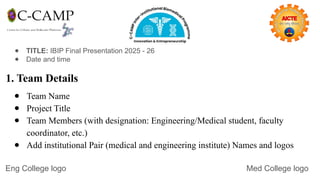
1. Team Details
●Team Name
● Project Title
● Team Members (with designation: Engineering/Medical student, faculty
coordinator, etc.)
● Add institutional Pair (medical and engineering institute) Names and logos
● TITLE: IBIP Final Presentation 2025 - 26
● Date and time
Eng College logo Med College logo
2.
2. Initial ProblemStatement (From Hackathon Stage)
● Brief recap of the original problem statement submitted during the hackathon.
3.
3. Refined ProblemStatement
● Unmet Need
● Affected Population / User Group
● Clinical or Operational Impact Identified
● Desired Outcome of the Solution
4.
4. Proposed Solution(Finalised Approach)
● Key features
● Why this approach was selected (based on feasibility, user feedback, cost,
safety, etc.)
5.
5. Prototype Evolution
Showprogress from concept → alpha → beta prototype
● Initial sketches/concept diagrams
● Alpha prototype (materials, design, limitations)
● Beta prototype (improvements made, new materials, refined
design)
● Images with labels and annotations
6.
6. Landscape Analysis
●Summary of Solutions Considered Earlier
● Current Technologies / Predicate Devices
● Gap Identified After Deeper Research
7.
7. Technical Development
●Engineering design (mechanical / electronics / software)
● Materials and components used
● Software architecture (if applicable)
● Safety considerations
● Design for usability and cost
8.
8. Testing &Validation
● Bench testing performed
● Preliminary test results / observations
● Feedback from clinicians/end-users
● Changes incorporated based on testing
9.
9. Clinical &Market Feasibility
● User persona
● Use-case scenarios
● Market size (if applicable)
● Potential competitors
● Cost estimation
(Keeps the students thinking about translation and feasibility.)
![SIH2024_IDEA_Presentation_Format[1] (3).pptx](https://cdn.slidesharecdn.com/ss_thumbnails/sih2024ideapresentationformat13-250930052207-d5f79d17-thumbnail.jpg?width=640&height=640&fit=bounds)


![SIH2024_IDEA_Presentation_Format[1] (3).pptx](https://cdn.slidesharecdn.com/ss_thumbnails/sih2024ideapresentationformat13-250930051607-43d07864-thumbnail.jpg?width=640&height=640&fit=bounds)


![[DSC Europe 25] Gordana Milutinovic Dumbelovic - From Insight to Oversight: A...](https://cdn.slidesharecdn.com/ss_thumbnails/t7dkjsfxqwwzceropjv4-gordana-milutinovicdumbelovic-from-insight-to-oversight-ai-driven-power-bi-moni-260119121559-9e0bf11b-thumbnail.jpg?width=640&height=640&fit=bounds)


![[DSC Europe 25] Laila Kakar - Leveraging AI for Strategic Excellence: Enhanci...](https://cdn.slidesharecdn.com/ss_thumbnails/eykmhrtsqmaaftwkexh7-dsc-lailakakar-1-260119101520-5f3b5616-thumbnail.jpg?width=640&height=640&fit=bounds)


![[DSC Europe 25] Bojan Banjac - AI is always right when it comes to the matter...](https://cdn.slidesharecdn.com/ss_thumbnails/syoxtqierpydwxm5srcb-4-bojan-banjac-ai-is-always-right-when-it-comes-to-the-matters-of-taste-260119101519-694ee7d7-thumbnail.jpg?width=640&height=640&fit=bounds)
![[DSC Europe 25] Tali Fulman - Guild Meetings, Then What? Building Data Commun...](https://cdn.slidesharecdn.com/ss_thumbnails/fgohhi33rwmhqdowdj5k-tali-fulman-guild-meetings-then-what-building-data-communities-that-actually-ch-260120105855-528492c3-thumbnail.jpg?width=640&height=640&fit=bounds)


