Register Number
Course
Academic Year
Subject
Date
Submitted by
: 381920518
: PHARM D 4th Year
: 2022 - 2023
: PHARMACOTHERAPEUTICS - 3
: __ / __ / 2023
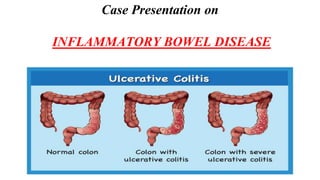
Case Presentation on
INFLAMMATORY BOWEL DISEASE
Mr.XXX, 42 Y/O male patient was admitted with ;
★ H/O Bloody stools, Loose motions, Abdominal pain, Vomiting & Low-grade fever since 4 days.
★ On examination, the patient was conscious, oriented & febrile. CBC, biochemistry, and electrolytes
investigations were examined. Direct Microscopy of the Stool showed the presence of entamoeba histolytica.
Histological Investigations of Colon showed Ulceration. Colonoscopy reveals Erythema with Erosions in the
rectum & Multiple polypoid lesions in the sigmoid colon.
★ He was diagnosed with ULCERATIVE COLITIS & AMOEBIASIS which was confirmed by diagnostic
evidence.
★ He was treated with antipyretic, analgesics, electrolyte supplements, anti-emetic, probiotic, anti-diarrheal &
other supportive care. He was recovered well to the given Tx & discharged with prescribed medications.
SUMMARY
SUBJECTIVE
Patient Name : Mr. XXX
Age : 42 Y/O
Sex : Male
DOA : 07/05/23
DOD : 09/05/23
Chief Complaint (CC) :
He came with H/O Bloody
stools, Loose motions,
Abdominal pain, Vomiting &
Low-grade fever since 4 days .
Social History :
● Non alcoholic
● No-smoker
● Does not exercise
● Auto-driver
Diet :
Consumes fast
and fried food
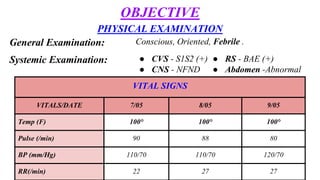
VITAL SIGNS
VITALS/DATE 7/05 8/05 9/05
Temp (F) 100° 100° 100°
Pulse (/min) 90 88 80
BP (mm/Hg) 110/70 110/70 120/70
RR(/min) 22 27 27
OBJECTIVE
PHYSICAL EXAMINATION
General Examination: Conscious, Oriented, Febrile .
Systemic Examination: ● CVS - S1S2 (+)
● CNS - NFND
● RS - BAE (+)
● Abdomen -Abnormal
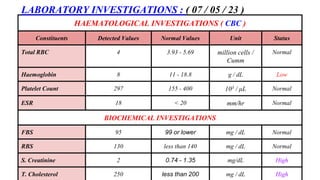
HAEMATOLOGICAL INVESTIGATIONS ( CBC )
Constituents Detected Values Normal Values Unit Status
Total RBC 4 3.93 - 5.69 million cells /
Cumm
Normal
Haemoglobin 8 11 - 18.8 g / dL Low
Platelet Count 297 155 - 400 103 / μL Normal
ESR 18 < 20 mm/hr Normal
BIOCHEMICAL INVESTIGATIONS
FBS 95 99 or lower mg / dL Normal
RBS 130 less than 140 mg / dL Normal
S. Creatinine 2 0.74 - 1.35 mg/dL High
T. Cholesterol 250 less than 200 mg / dL High
LABORATORY INVESTIGATIONS : ( 07 / 05 / 23 )
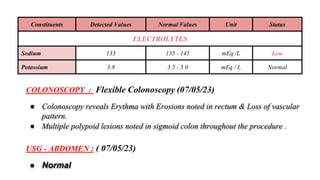
Constituents Detected Values Normal Values Unit Status
ELECTROLYTES
Sodium 133 135 - 145 mEq /L Low
Potassium 3.8 3.5 - 5.0 mEq / L Normal
USG - ABDOMEN : ( 07/05/23)
● Normal
COLONOSCOPY : Flexible Colonoscopy (07/05/23)
● Colonoscopy reveals Erythma with Erosions noted in rectum & Loss of vascular
pattern.
● Multiple polypoid lesions noted in sigmoid colon throughout the procedure .
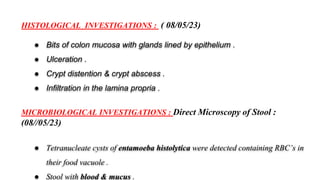
HISTOLOGICAL INVESTIGATIONS : ( 08/05/23)
● Bits of colon mucosa with glands lined by epithelium .
● Ulceration .
● Crypt distention & crypt abscess .
● Infiltration in the lamina propria .
MICROBIOLOGICAL INVESTIGATIONS : Direct Microscopy of Stool :
(08//05/23)
● Tetranucleate cysts of entamoeba histolytica were detected containing RBC’s in
their food vacuole .
● Stool with blood & mucus .
ASSESSMENT
INTERPRETATION
SUBJECTIVE REASON :
● H/O bloody stools, loose motions, abdominal pain, vomiting & low-grade fever since 4
days (CC)
● Consumes fast food and fried diet ( Diet )
● Auto-driver (S/H)
OBJECTIVE EVIDENCE :
● Fever [100°F] & Abdomen - abnormal (P/E)
● Low levels : Hg (CBC) & Na+ ( electrolytes lab test )
● High levels : S.Cr & T.Cholesterol ( biochemical test )
● +ve of entamoeba histolytica & Stool with blood & mucus ( Microscopy test )
● Ulceration of colon ( Histological test )
● Erythma with Erosions in rectum & Multiple polypoid lesions in the sigmoid colon (
Colonoscopy )
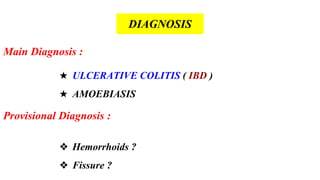
Main Diagnosis :
★ ULCERATIVE COLITIS ( IBD )
★ AMOEBIASIS
Provisional Diagnosis :
❖ Hemorrhoids ?
❖ Fissure ?
DIAGNOSIS
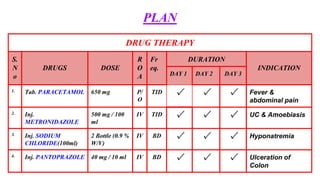
DRUG THERAPY
S.
N
o
DRUGS DOSE
R
O
A
Fr
eq.
DURATION
INDICATION
DAY 1 DAY 2 DAY 3
1. Tab. PARACETAMOL 650 mg P/
O
TID ✓ ✓ ✓ Fever &
abdominal pain
2. Inj.
METRONIDAZOLE
500 mg / 100
ml
IV TID ✓ ✓ ✓ UC & Amoebiasis
3. Inj. SODIUM
CHLORIDE(100ml)
2 Bottle (0.9 %
W/V)
IV BD ✓ ✓ ✓ Hyponatremia
4. Inj. PANTOPRAZOLE 40 mg / 10 ml IV BD ✓ ✓ ✓ Ulceration of
Colon
PLAN
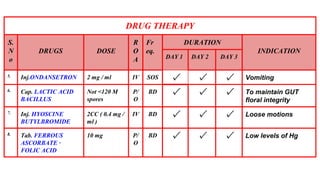
DRUG THERAPY
S.
N
o
DRUGS DOSE
R
O
A
Fr
eq.
DURATION
INDICATION
DAY 1 DAY 2 DAY 3
5. Inj.ONDANSETRON 2 mg / ml IV SOS ✓ ✓ ✓ Vomiting
6. Cap. LACTIC ACID
BACILLUS
Not <120 M
spores
P/
O
BD ✓ ✓ ✓ To maintain GUT
floral integrity
7. Inj. HYOSCINE
BUTYLBROMIDE
2CC ( 0.4 mg /
ml )
IV BD ✓ ✓ ✓ Loose motions
8. Tab. FERROUS
ASCORBATE ·
FOLIC ACID
10 mg P/
O
BD ✓ ✓ ✓ Low levels of Hg
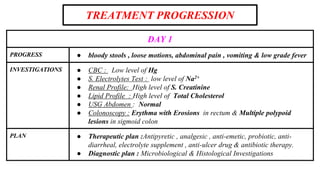
TREATMENT PROGRESSION
DAY 1
PROGRESS ● bloody stools , loose motions, abdominal pain , vomiting & low grade fever
INVESTIGATIONS ● CBC : Low level of Hg
● S. Electrolytes Test : low level of Na2+
● Renal Profile: High level of S. Creatinine
● Lipid Profile : High level of Total Cholesterol
● USG Abdomen : Normal
● Colonoscopy : Erythma with Erosions in rectum & Multiple polypoid
lesions in sigmoid colon
PLAN ● Therapeutic plan :Antipyretic , analgesic , anti-emetic, probiotic, anti-
diarrheal, electrolyte supplement , anti-ulcer drug & antibiotic therapy.
● Diagnostic plan : Microbiological & Histological Investigations
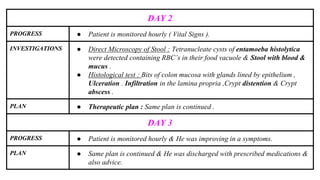
DAY 2
PROGRESS ● Patient is monitored hourly ( Vital Signs ).
INVESTIGATIONS ● Direct Microscopy of Stool : Tetranucleate cysts of entamoeba histolytica
were detected containing RBC’s in their food vacuole & Stool with blood &
mucus .
● Histological test : Bits of colon mucosa with glands lined by epithelium ,
Ulceration . Infiltration in the lamina propria ,Crypt distention & Crypt
abscess .
PLAN ● Therapeutic plan : Same plan is continued .
DAY 3
PROGRESS ● Patient is monitored hourly & He was improving in a symptoms.
PLAN ● Same plan is continued & He was discharged with prescribed medications &
also advice.
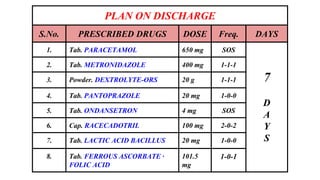
PLAN ON DISCHARGE
S.No. PRESCRIBED DRUGS DOSE Freq. DAYS
1. Tab. PARACETAMOL 650 mg SOS
7
D
A
Y
S
2. Tab. METRONIDAZOLE 400 mg 1-1-1
3. Powder. DEXTROLYTE-ORS 20 g 1-1-1
4. Tab. PANTOPRAZOLE 20 mg 1-0-0
5. Tab. ONDANSETRON 4 mg SOS
6. Cap. RACECADOTRIL 100 mg 2-0-2
7. Tab. LACTIC ACID BACILLUS 20 mg 1-0-0
8. Tab. FERROUS ASCORBATE ·
FOLIC ACID
101.5
mg
1-0-1
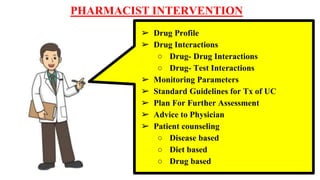
PHARMACIST INTERVENTION
➢ Drug Profile
➢ Drug Interactions
○ Drug- Drug Interactions
○ Drug- Test Interactions
➢ Monitoring Parameters
➢ Standard Guidelines for Tx of UC
➢ Plan For Further Assessment
➢ Advice to Physician
➢ Patient counseling
○ Disease based
○ Diet based
○ Drug based
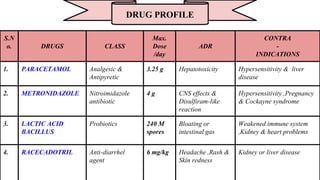
S.N
o. DRUGS CLASS
Max.
Dose
/day
ADR
CONTRA
-
INDICATIONS
1. PARACETAMOL Analgesic &
Antipyretic
3.25 g Hepatotoxicity Hypersensitivity & liver
disease
2. METRONIDAZOLE Nitroimidazole
antibiotic
4 g CNS effects &
​Disulfiram-like
reaction
Hypersensitivity ,Pregnancy
& Cockayne syndrome
3. LACTIC ACID
BACILLUS
Probiotics 240 M
spores
Bloating or
intestinal gas
Weakened immune system
,Kidney & heart problems
4. RACECADOTRIL Anti-diarrhel
agent
6 mg/kg Headache ,Rash &
Skin redness
Kidney or liver disease
DRUG PROFILE
S.N
o. DRUGS CLASS
Max.
Dose
/day
ADR
CONTRA
-
INDICATIONS
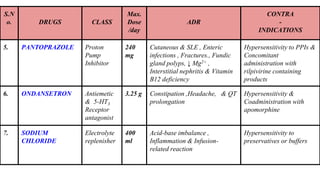
5. PANTOPRAZOLE Proton
Pump
Inhibitor
240
mg
Cutaneous & SLE , Enteric
infections , Fractures., Fundic
gland polyps, ↓ Mg2+ ,
Interstitial nephritis & Vitamin
B12 deficiency
Hypersensitivity to PPIs &
Concomitant
administration with
rilpivirine containing
products
6. ONDANSETRON Antiemetic
& 5-HT3
Receptor
antagonist
3.25 g Constipation ,Headache, & QT
prolongation
Hypersensitivity &
Coadministration with
apomorphine
7. SODIUM
CHLORIDE
Electrolyte
replenisher
400
ml
Acid-base imbalance ,
Inflammation & Infusion-
related reaction
Hypersensitivity to
preservatives or buffers
S.N
o. DRUGS CLASS
Max.
Dose
/day
ADR
CONTRA
-
INDICATIONS
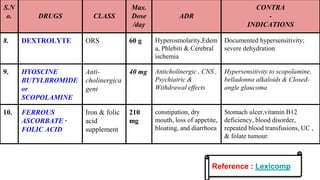
8. DEXTROLYTE ORS 60 g Hyperosmolarity,Edem
a, Phlebiti & Cerebral
ischemia
Documented hypersensitivity;
severe dehydration
9. HYOSCINE
BUTYLBROMIDE
or
SCOPOLAMINE
Anti-
cholinergica
gent
40 mg Anticholinergic ​, CNS ,
​Psychiatric &
​Withdrawal effects
Hypersensitivity to scopolamine,
belladonna alkaloids & Closed-
angle glaucoma
10. FERROUS
ASCORBATE ·
FOLIC ACID
Iron & folic
acid
supplement
210
mg
constipation, dry
mouth, loss of appetite,
bloating, and diarrhoea
Stomach ulcer,vitamin B12
deficiency, blood disorder,
repeated blood transfusions, UC ,
& folate tumour.
Reference : Lexicomp
DRUG
INTERACTIONS
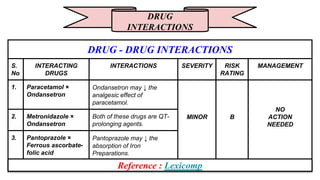
DRUG - DRUG INTERACTIONS
S.
No
INTERACTING
DRUGS
INTERACTIONS SEVERITY RISK
RATING
MANAGEMENT
1. Paracetamol ×
Ondansetron
Ondansetron may ↓ the
analgesic effect of
paracetamol.
MINOR B
NO
ACTION
NEEDED
2. Metronidazole ×
Ondansetron
Both of these drugs are QT-
prolonging agents.
3. Pantoprazole ×
Ferrous ascorbate-
folic acid
Pantoprazole may ↓ the
absorption of Iron
Preparations.
Reference : Lexicomp
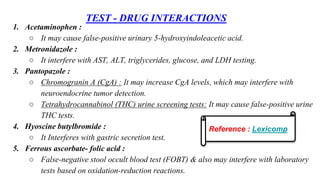
TEST - DRUG INTERACTIONS
1. Acetaminophen :
○ It may cause false-positive urinary 5-hydroxyindoleacetic acid.
2. Metronidazole :
○ It interfere with AST, ALT, triglycerides, glucose, and LDH testing.
3. Pantopazole :
○ Chromogranin A (CgA) : It may increase CgA levels, which may interfere with
neuroendocrine tumor detection.
○ Tetrahydrocannabinol (THC) urine screening tests: It may cause false-positive urine
THC tests.
4. Hyoscine butylbromide :
○ It Interferes with gastric secretion test.
5. Ferrous ascorbate- folic acid :
○ False-negative stool occult blood test (FOBT) & also may interfere with laboratory
tests based on oxidation-reduction reactions.
Reference : Lexicomp
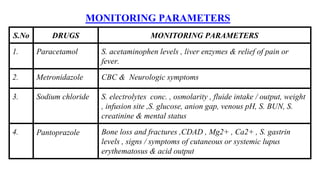
S.No DRUGS MONITORING PARAMETERS
1. Paracetamol S. acetaminophen levels , liver enzymes & relief of pain or
fever.
2. Metronidazole CBC & Neurologic symptoms
3. Sodium chloride S. electrolytes conc. , osmolarity , fluide intake / output, weight
, infusion site ,S. glucose, anion gap, venous pH, S. BUN, S.
creatinine & mental status
4. Pantoprazole Bone loss and fractures ,CDAD , Mg2+ , Ca2+ , S. gastrin
levels , signs / symptoms of cutaneous or systemic lupus
erythematosus & acid output
MONITORING PARAMETERS
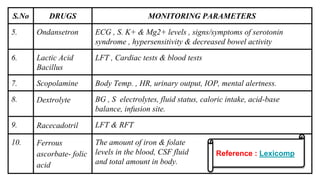
S.No DRUGS MONITORING PARAMETERS
5. Ondansetron ECG , S. K+ & Mg2+ levels , signs/symptoms of serotonin
syndrome , hypersensitivity & decreased bowel activity
6. Lactic Acid
Bacillus
LFT , Cardiac tests & blood tests
7. Scopolamine Body Temp. , HR, urinary output, IOP, mental alertness.
8. Dextrolyte BG , S electrolytes, fluid status, caloric intake, acid-base
balance, infusion site.
9. Racecadotril LFT & RFT
10. Ferrous
ascorbate- folic
acid
The amount of iron & folate
levels in the blood, CSF fluid
and total amount in body.
Reference : Lexicomp
ECCO Guidelines on Therapeutics in Ulcerative Colitis ( UC )
MEDICAL TREATMENT
1. Induction of remission in patients with mildly-to-moderately active UC :
○ 5-aminosalicylate at a dose of ≥2 g/day
○ Use of colonic-release corticosteroids
1. Induction of remission in patients with active distal colitis :
○ Topical [rectal] 5-ASA at a dose of ≥1g/d.
○ Using topical (rectal steroids.
○ Tx with topical (rectal) 5-ASAS over topical rectal) steroids
○ Use of thiopurines as mono- therapy - Immunomodulators
1. Induction of remission in adult patients with active UC of at least rectosigmoid extent :
○ Use of oral 5-ASA [22 g/d] combined with topical [rectal] 5-ASA over oral 5-ASA
monotherapy
4. Maintenance of remission in UC patients :
● use of oral 5-ASA at a dose 22 g/day
5. Maintenance of remission in patients with distal UC :
● use of topical rectal 5-ASA
6. Maintenance of remission in patients with steroid- dependent UC or who are intolerant to 5-ASA :
● monotherapy with thiopurines - Immunomodulators
7. Induction of re-mission in non-hospitalised patients with moderately-to-severely active UC :
● Oral prednisolone - systemic corticosteroids
8. Induce remission in patients with moderate-to-severe UC who have inadequate response or intolerance
to conventional therapy :
● Tx with Anti TNF agents [infliximab, adalimumab, and golimumab]
● Vedolizumab - Integrin Receptor Antagonists
● Tofacitinib - Janus Kinase (JAK) Inhibitors
● Ustekinumab - Monoclonal Antibody
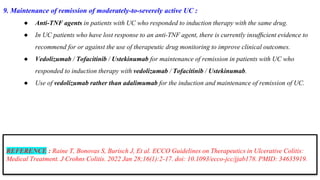
9. Maintenance of remission of moderately-to-severely active UC :
● Anti-TNF agents in patients with UC who responded to induction therapy with the same drug.
● In UC patients who have lost response to an anti-TNF agent, there is currently insufficient evidence to
recommend for or against the use of therapeutic drug monitoring to improve clinical outcomes.
● Vedolizumab / Tofacitinib / Ustekinumab for maintenance of remission in patients with UC who
responded to induction therapy with vedolizumab / Tofacitinib / Ustekinumab.
● Use of vedolizumab rather than adalimumab for the induction and maintenance of remission of UC.
REFERENCE : Raine T, Bonovas S, Burisch J, Et al. ECCO Guidelines on Therapeutics in Ulcerative Colitis:
Medical Treatment. J Crohns Colitis. 2022 Jan 28;16(1):2-17. doi: 10.1093/ecco-jcc/jjab178. PMID: 34635919.
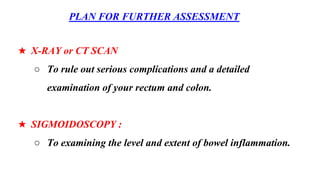
PLAN FOR FURTHER ASSESSMENT
★ X-RAY or CT SCAN
○ To rule out serious complications and a detailed
examination of your rectum and colon.
★ SIGMOIDOSCOPY :
○ To examining the level and extent of bowel inflammation.
ADVICE TO PHYSICIAN
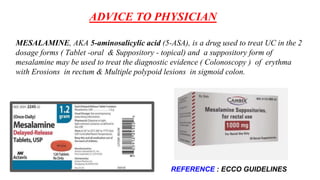
MESALAMINE, AKA 5-aminosalicylic acid (5-ASA), is a drug used to treat UC in the 2
dosage forms ( Tablet -oral & Suppository - topical) and a suppository form of
mesalamine may be used to treat the diagnostic evidence ( Colonoscopy ) of erythma
with Erosions in rectum & Multiple polypoid lesions in sigmoid colon.
REFERENCE : ECCO GUIDELINES
PATIENT COUNSELING
DISEASE BASED
● Educate the patient about disease ( Ulcerative Colitis ) to avoid further complications & increase
the patient adherence.
ULCERATIVE COLITIS:(UC)
A chronic, inflammatory bowel disease that causes inflammation in the digestive tract. UC
is usually only in the innermost lining of the large intestine (colon) and rectum. Forms
range from mild to severe.
STRESS RELIEF :
Although stress does not cause ulcerative colitis, successfully managing stress levels may reduce the
frequency of symptoms .
- EXERCISE:
● Even mild exercise can help reduce stress, relieve depression and normalize bowel
function.
- BIOFEEDBACK:
● This stress-reduction technique helps you reduce muscle tension and slow your
heart rate with the help of a feedback machine.
● The goal is to help you enter a relaxed state so that you can cope more easily with
stress.
-COMMUNICATION :
● Livings with UC can be frustrating & isolating; talking to others can help stress
relief
The following advice may help :
DIET BASED
- REGULAR RELAXATION & BREATHING EXERCISES :
● An effective way to cope with stress is to perform relaxation and breathing exercises.
● You can take classes in yoga and meditation or practice at home using books, CDs or
DVDs.
Anxiety and stress caused by UC can lead to depression.
Although a specific diet is not thought to play a role in causing UC, some changes to your
diet can help control the condition.For example,
● Eat small meals – eating more frequent smaller meals a day, rather than 3 main
meals, may help control your symptoms.
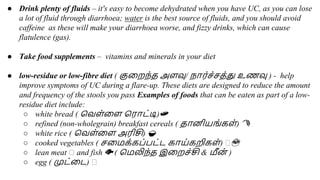
● Drink plenty of fluids – it's easy to become dehydrated when you have UC, as you can lose
a lot of fluid through diarrhoea; water is the best source of fluids, and you should avoid
caffeine as these will make your diarrhoea worse, and fizzy drinks, which can cause
flatulence (gas).
● Take food supplements – vitamins and minerals in your diet
● low-residue or low-fibre diet ( குறைந்த அளவு/ நார்ச்சத்து உணவு ) - help
improve symptoms of UC during a flare-up. These diets are designed to reduce the amount
and frequency of the stools you pass Examples of foods that can be eaten as part of a low-
residue diet include:
○ white bread ( வெள்றள வராட்டி)🍞
○ refined (non-wholegrain) breakfast cereals ( தானியங்கள்) 🌾
○ white rice ( வெள்றள அரிசி) 🍚
○ cooked vegetables ( சறைக்கப்பட்ட காய்கறிகள்) 🥗🍲
○ lean meat 🥗 and fish 🐟 ( வைலிந்த இறைச்சி & மீன் )
○ egg ( முட்றட) 🥗
DRUG BASED
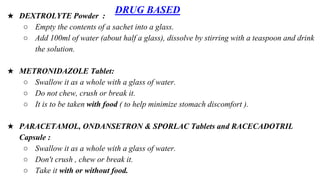
★ DEXTROLYTE Powder :
○ Empty the contents of a sachet into a glass.
○ Add 100ml of water (about half a glass), dissolve by stirring with a teaspoon and drink
the solution.
★ METRONIDAZOLE Tablet:
○ Swallow it as a whole with a glass of water.
○ Do not chew, crush or break it.
○ It is to be taken with food ( to help minimize stomach discomfort ).
★ PARACETAMOL, ONDANSETRON & SPORLAC Tablets and RACECADOTRIL
Capsule :
○ Swallow it as a whole with a glass of water.
○ Don't crush , chew or break it.
○ Take it with or without food.
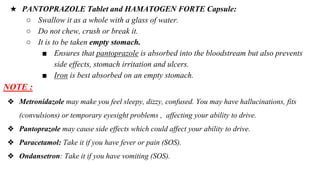
NOTE :
❖ Metronidazole may make you feel sleepy, dizzy, confused. You may have hallucinations, fits
(convulsions) or temporary eyesight problems , affecting your ability to drive.
❖ Pantoprazole may cause side effects which could affect your ability to drive.
❖ Paracetamol: Take it if you have fever or pain (SOS).
❖ Ondansetron: Take it if you have vomiting (SOS).
★ PANTOPRAZOLE Tablet and HAMATOGEN FORTE Capsule:
○ Swallow it as a whole with a glass of water.
○ Do not chew, crush or break it.
○ It is to be taken empty stomach.
■ Ensures that pantoprazole is absorbed into the bloodstream but also prevents
side effects, stomach irritation and ulcers.
■ Iron is best absorbed on an empty stomach.
REFERENCES
1. Lexicomp
2. ECCO guidelines
3. Medscape
4. 1mg.com
5. Mayoclinic
6. NHS.UK
7. Researchgate
8. Roger Walker Book
செய்வன
திருந்தெ்
செய் !!!

IBD [Ulcerative Colitis]

  • 1.
    Register Number Course Academic Year Subject Date Submittedby : 381920518 : PHARM D 4th Year : 2022 - 2023 : PHARMACOTHERAPEUTICS - 3 : __ / __ / 2023
  • 2.
  • 3.
    Mr.XXX, 42 Y/Omale patient was admitted with ; ★ H/O Bloody stools, Loose motions, Abdominal pain, Vomiting & Low-grade fever since 4 days. ★ On examination, the patient was conscious, oriented & febrile. CBC, biochemistry, and electrolytes investigations were examined. Direct Microscopy of the Stool showed the presence of entamoeba histolytica. Histological Investigations of Colon showed Ulceration. Colonoscopy reveals Erythema with Erosions in the rectum & Multiple polypoid lesions in the sigmoid colon. ★ He was diagnosed with ULCERATIVE COLITIS & AMOEBIASIS which was confirmed by diagnostic evidence. ★ He was treated with antipyretic, analgesics, electrolyte supplements, anti-emetic, probiotic, anti-diarrheal & other supportive care. He was recovered well to the given Tx & discharged with prescribed medications. SUMMARY
  • 4.
    SUBJECTIVE Patient Name :Mr. XXX Age : 42 Y/O Sex : Male DOA : 07/05/23 DOD : 09/05/23 Chief Complaint (CC) : He came with H/O Bloody stools, Loose motions, Abdominal pain, Vomiting & Low-grade fever since 4 days . Social History : ● Non alcoholic ● No-smoker ● Does not exercise ● Auto-driver Diet : Consumes fast and fried food
  • 5.
    VITAL SIGNS VITALS/DATE 7/058/05 9/05 Temp (F) 100° 100° 100° Pulse (/min) 90 88 80 BP (mm/Hg) 110/70 110/70 120/70 RR(/min) 22 27 27 OBJECTIVE PHYSICAL EXAMINATION General Examination: Conscious, Oriented, Febrile . Systemic Examination: ● CVS - S1S2 (+) ● CNS - NFND ● RS - BAE (+) ● Abdomen -Abnormal
  • 6.
    HAEMATOLOGICAL INVESTIGATIONS (CBC ) Constituents Detected Values Normal Values Unit Status Total RBC 4 3.93 - 5.69 million cells / Cumm Normal Haemoglobin 8 11 - 18.8 g / dL Low Platelet Count 297 155 - 400 103 / μL Normal ESR 18 < 20 mm/hr Normal BIOCHEMICAL INVESTIGATIONS FBS 95 99 or lower mg / dL Normal RBS 130 less than 140 mg / dL Normal S. Creatinine 2 0.74 - 1.35 mg/dL High T. Cholesterol 250 less than 200 mg / dL High LABORATORY INVESTIGATIONS : ( 07 / 05 / 23 )
  • 7.
    Constituents Detected ValuesNormal Values Unit Status ELECTROLYTES Sodium 133 135 - 145 mEq /L Low Potassium 3.8 3.5 - 5.0 mEq / L Normal USG - ABDOMEN : ( 07/05/23) ● Normal COLONOSCOPY : Flexible Colonoscopy (07/05/23) ● Colonoscopy reveals Erythma with Erosions noted in rectum & Loss of vascular pattern. ● Multiple polypoid lesions noted in sigmoid colon throughout the procedure .
  • 8.
    HISTOLOGICAL INVESTIGATIONS :( 08/05/23) ● Bits of colon mucosa with glands lined by epithelium . ● Ulceration . ● Crypt distention & crypt abscess . ● Infiltration in the lamina propria . MICROBIOLOGICAL INVESTIGATIONS : Direct Microscopy of Stool : (08//05/23) ● Tetranucleate cysts of entamoeba histolytica were detected containing RBC’s in their food vacuole . ● Stool with blood & mucus .
  • 9.
    ASSESSMENT INTERPRETATION SUBJECTIVE REASON : ●H/O bloody stools, loose motions, abdominal pain, vomiting & low-grade fever since 4 days (CC) ● Consumes fast food and fried diet ( Diet ) ● Auto-driver (S/H) OBJECTIVE EVIDENCE : ● Fever [100°F] & Abdomen - abnormal (P/E) ● Low levels : Hg (CBC) & Na+ ( electrolytes lab test ) ● High levels : S.Cr & T.Cholesterol ( biochemical test ) ● +ve of entamoeba histolytica & Stool with blood & mucus ( Microscopy test ) ● Ulceration of colon ( Histological test ) ● Erythma with Erosions in rectum & Multiple polypoid lesions in the sigmoid colon ( Colonoscopy )
  • 10.
    Main Diagnosis : ★ULCERATIVE COLITIS ( IBD ) ★ AMOEBIASIS Provisional Diagnosis : ❖ Hemorrhoids ? ❖ Fissure ? DIAGNOSIS
  • 11.
    DRUG THERAPY S. N o DRUGS DOSE R O A Fr eq. DURATION INDICATION DAY1 DAY 2 DAY 3 1. Tab. PARACETAMOL 650 mg P/ O TID ✓ ✓ ✓ Fever & abdominal pain 2. Inj. METRONIDAZOLE 500 mg / 100 ml IV TID ✓ ✓ ✓ UC & Amoebiasis 3. Inj. SODIUM CHLORIDE(100ml) 2 Bottle (0.9 % W/V) IV BD ✓ ✓ ✓ Hyponatremia 4. Inj. PANTOPRAZOLE 40 mg / 10 ml IV BD ✓ ✓ ✓ Ulceration of Colon PLAN
  • 12.
    DRUG THERAPY S. N o DRUGS DOSE R O A Fr eq. DURATION INDICATION DAY1 DAY 2 DAY 3 5. Inj.ONDANSETRON 2 mg / ml IV SOS ✓ ✓ ✓ Vomiting 6. Cap. LACTIC ACID BACILLUS Not <120 M spores P/ O BD ✓ ✓ ✓ To maintain GUT floral integrity 7. Inj. HYOSCINE BUTYLBROMIDE 2CC ( 0.4 mg / ml ) IV BD ✓ ✓ ✓ Loose motions 8. Tab. FERROUS ASCORBATE · FOLIC ACID 10 mg P/ O BD ✓ ✓ ✓ Low levels of Hg
  • 13.
    TREATMENT PROGRESSION DAY 1 PROGRESS● bloody stools , loose motions, abdominal pain , vomiting & low grade fever INVESTIGATIONS ● CBC : Low level of Hg ● S. Electrolytes Test : low level of Na2+ ● Renal Profile: High level of S. Creatinine ● Lipid Profile : High level of Total Cholesterol ● USG Abdomen : Normal ● Colonoscopy : Erythma with Erosions in rectum & Multiple polypoid lesions in sigmoid colon PLAN ● Therapeutic plan :Antipyretic , analgesic , anti-emetic, probiotic, anti- diarrheal, electrolyte supplement , anti-ulcer drug & antibiotic therapy. ● Diagnostic plan : Microbiological & Histological Investigations
  • 14.
    DAY 2 PROGRESS ●Patient is monitored hourly ( Vital Signs ). INVESTIGATIONS ● Direct Microscopy of Stool : Tetranucleate cysts of entamoeba histolytica were detected containing RBC’s in their food vacuole & Stool with blood & mucus . ● Histological test : Bits of colon mucosa with glands lined by epithelium , Ulceration . Infiltration in the lamina propria ,Crypt distention & Crypt abscess . PLAN ● Therapeutic plan : Same plan is continued . DAY 3 PROGRESS ● Patient is monitored hourly & He was improving in a symptoms. PLAN ● Same plan is continued & He was discharged with prescribed medications & also advice.
  • 15.
    PLAN ON DISCHARGE S.No.PRESCRIBED DRUGS DOSE Freq. DAYS 1. Tab. PARACETAMOL 650 mg SOS 7 D A Y S 2. Tab. METRONIDAZOLE 400 mg 1-1-1 3. Powder. DEXTROLYTE-ORS 20 g 1-1-1 4. Tab. PANTOPRAZOLE 20 mg 1-0-0 5. Tab. ONDANSETRON 4 mg SOS 6. Cap. RACECADOTRIL 100 mg 2-0-2 7. Tab. LACTIC ACID BACILLUS 20 mg 1-0-0 8. Tab. FERROUS ASCORBATE · FOLIC ACID 101.5 mg 1-0-1
  • 16.
    PHARMACIST INTERVENTION ➢ DrugProfile ➢ Drug Interactions ○ Drug- Drug Interactions ○ Drug- Test Interactions ➢ Monitoring Parameters ➢ Standard Guidelines for Tx of UC ➢ Plan For Further Assessment ➢ Advice to Physician ➢ Patient counseling ○ Disease based ○ Diet based ○ Drug based
  • 17.
    S.N o. DRUGS CLASS Max. Dose /day ADR CONTRA - INDICATIONS 1.PARACETAMOL Analgesic & Antipyretic 3.25 g Hepatotoxicity Hypersensitivity & liver disease 2. METRONIDAZOLE Nitroimidazole antibiotic 4 g CNS effects & ​Disulfiram-like reaction Hypersensitivity ,Pregnancy & Cockayne syndrome 3. LACTIC ACID BACILLUS Probiotics 240 M spores Bloating or intestinal gas Weakened immune system ,Kidney & heart problems 4. RACECADOTRIL Anti-diarrhel agent 6 mg/kg Headache ,Rash & Skin redness Kidney or liver disease DRUG PROFILE
  • 18.
    S.N o. DRUGS CLASS Max. Dose /day ADR CONTRA - INDICATIONS 5.PANTOPRAZOLE Proton Pump Inhibitor 240 mg Cutaneous & SLE , Enteric infections , Fractures., Fundic gland polyps, ↓ Mg2+ , Interstitial nephritis & Vitamin B12 deficiency Hypersensitivity to PPIs & Concomitant administration with rilpivirine containing products 6. ONDANSETRON Antiemetic & 5-HT3 Receptor antagonist 3.25 g Constipation ,Headache, & QT prolongation Hypersensitivity & Coadministration with apomorphine 7. SODIUM CHLORIDE Electrolyte replenisher 400 ml Acid-base imbalance , Inflammation & Infusion- related reaction Hypersensitivity to preservatives or buffers
  • 19.
    S.N o. DRUGS CLASS Max. Dose /day ADR CONTRA - INDICATIONS 8.DEXTROLYTE ORS 60 g Hyperosmolarity,Edem a, Phlebiti & Cerebral ischemia Documented hypersensitivity; severe dehydration 9. HYOSCINE BUTYLBROMIDE or SCOPOLAMINE Anti- cholinergica gent 40 mg Anticholinergic ​, CNS , ​Psychiatric & ​Withdrawal effects Hypersensitivity to scopolamine, belladonna alkaloids & Closed- angle glaucoma 10. FERROUS ASCORBATE · FOLIC ACID Iron & folic acid supplement 210 mg constipation, dry mouth, loss of appetite, bloating, and diarrhoea Stomach ulcer,vitamin B12 deficiency, blood disorder, repeated blood transfusions, UC , & folate tumour. Reference : Lexicomp
  • 20.
    DRUG INTERACTIONS DRUG - DRUGINTERACTIONS S. No INTERACTING DRUGS INTERACTIONS SEVERITY RISK RATING MANAGEMENT 1. Paracetamol × Ondansetron Ondansetron may ↓ the analgesic effect of paracetamol. MINOR B NO ACTION NEEDED 2. Metronidazole × Ondansetron Both of these drugs are QT- prolonging agents. 3. Pantoprazole × Ferrous ascorbate- folic acid Pantoprazole may ↓ the absorption of Iron Preparations. Reference : Lexicomp
  • 21.
    TEST - DRUGINTERACTIONS 1. Acetaminophen : ○ It may cause false-positive urinary 5-hydroxyindoleacetic acid. 2. Metronidazole : ○ It interfere with AST, ALT, triglycerides, glucose, and LDH testing. 3. Pantopazole : ○ Chromogranin A (CgA) : It may increase CgA levels, which may interfere with neuroendocrine tumor detection. ○ Tetrahydrocannabinol (THC) urine screening tests: It may cause false-positive urine THC tests. 4. Hyoscine butylbromide : ○ It Interferes with gastric secretion test. 5. Ferrous ascorbate- folic acid : ○ False-negative stool occult blood test (FOBT) & also may interfere with laboratory tests based on oxidation-reduction reactions. Reference : Lexicomp
  • 22.
    S.No DRUGS MONITORINGPARAMETERS 1. Paracetamol S. acetaminophen levels , liver enzymes & relief of pain or fever. 2. Metronidazole CBC & Neurologic symptoms 3. Sodium chloride S. electrolytes conc. , osmolarity , fluide intake / output, weight , infusion site ,S. glucose, anion gap, venous pH, S. BUN, S. creatinine & mental status 4. Pantoprazole Bone loss and fractures ,CDAD , Mg2+ , Ca2+ , S. gastrin levels , signs / symptoms of cutaneous or systemic lupus erythematosus & acid output MONITORING PARAMETERS
  • 23.
    S.No DRUGS MONITORINGPARAMETERS 5. Ondansetron ECG , S. K+ & Mg2+ levels , signs/symptoms of serotonin syndrome , hypersensitivity & decreased bowel activity 6. Lactic Acid Bacillus LFT , Cardiac tests & blood tests 7. Scopolamine Body Temp. , HR, urinary output, IOP, mental alertness. 8. Dextrolyte BG , S electrolytes, fluid status, caloric intake, acid-base balance, infusion site. 9. Racecadotril LFT & RFT 10. Ferrous ascorbate- folic acid The amount of iron & folate levels in the blood, CSF fluid and total amount in body. Reference : Lexicomp
  • 24.
    ECCO Guidelines onTherapeutics in Ulcerative Colitis ( UC ) MEDICAL TREATMENT 1. Induction of remission in patients with mildly-to-moderately active UC : ○ 5-aminosalicylate at a dose of ≥2 g/day ○ Use of colonic-release corticosteroids 1. Induction of remission in patients with active distal colitis : ○ Topical [rectal] 5-ASA at a dose of ≥1g/d. ○ Using topical (rectal steroids. ○ Tx with topical (rectal) 5-ASAS over topical rectal) steroids ○ Use of thiopurines as mono- therapy - Immunomodulators 1. Induction of remission in adult patients with active UC of at least rectosigmoid extent : ○ Use of oral 5-ASA [22 g/d] combined with topical [rectal] 5-ASA over oral 5-ASA monotherapy
  • 25.
    4. Maintenance ofremission in UC patients : ● use of oral 5-ASA at a dose 22 g/day 5. Maintenance of remission in patients with distal UC : ● use of topical rectal 5-ASA 6. Maintenance of remission in patients with steroid- dependent UC or who are intolerant to 5-ASA : ● monotherapy with thiopurines - Immunomodulators 7. Induction of re-mission in non-hospitalised patients with moderately-to-severely active UC : ● Oral prednisolone - systemic corticosteroids 8. Induce remission in patients with moderate-to-severe UC who have inadequate response or intolerance to conventional therapy : ● Tx with Anti TNF agents [infliximab, adalimumab, and golimumab] ● Vedolizumab - Integrin Receptor Antagonists ● Tofacitinib - Janus Kinase (JAK) Inhibitors ● Ustekinumab - Monoclonal Antibody
  • 26.
    9. Maintenance ofremission of moderately-to-severely active UC : ● Anti-TNF agents in patients with UC who responded to induction therapy with the same drug. ● In UC patients who have lost response to an anti-TNF agent, there is currently insufficient evidence to recommend for or against the use of therapeutic drug monitoring to improve clinical outcomes. ● Vedolizumab / Tofacitinib / Ustekinumab for maintenance of remission in patients with UC who responded to induction therapy with vedolizumab / Tofacitinib / Ustekinumab. ● Use of vedolizumab rather than adalimumab for the induction and maintenance of remission of UC. REFERENCE : Raine T, Bonovas S, Burisch J, Et al. ECCO Guidelines on Therapeutics in Ulcerative Colitis: Medical Treatment. J Crohns Colitis. 2022 Jan 28;16(1):2-17. doi: 10.1093/ecco-jcc/jjab178. PMID: 34635919.
  • 27.
    PLAN FOR FURTHERASSESSMENT ★ X-RAY or CT SCAN ○ To rule out serious complications and a detailed examination of your rectum and colon. ★ SIGMOIDOSCOPY : ○ To examining the level and extent of bowel inflammation.
  • 28.
    ADVICE TO PHYSICIAN MESALAMINE,AKA 5-aminosalicylic acid (5-ASA), is a drug used to treat UC in the 2 dosage forms ( Tablet -oral & Suppository - topical) and a suppository form of mesalamine may be used to treat the diagnostic evidence ( Colonoscopy ) of erythma with Erosions in rectum & Multiple polypoid lesions in sigmoid colon. REFERENCE : ECCO GUIDELINES
  • 29.
    PATIENT COUNSELING DISEASE BASED ●Educate the patient about disease ( Ulcerative Colitis ) to avoid further complications & increase the patient adherence. ULCERATIVE COLITIS:(UC) A chronic, inflammatory bowel disease that causes inflammation in the digestive tract. UC is usually only in the innermost lining of the large intestine (colon) and rectum. Forms range from mild to severe. STRESS RELIEF : Although stress does not cause ulcerative colitis, successfully managing stress levels may reduce the frequency of symptoms .
  • 30.
    - EXERCISE: ● Evenmild exercise can help reduce stress, relieve depression and normalize bowel function. - BIOFEEDBACK: ● This stress-reduction technique helps you reduce muscle tension and slow your heart rate with the help of a feedback machine. ● The goal is to help you enter a relaxed state so that you can cope more easily with stress. -COMMUNICATION : ● Livings with UC can be frustrating & isolating; talking to others can help stress relief The following advice may help :
  • 31.
    DIET BASED - REGULARRELAXATION & BREATHING EXERCISES : ● An effective way to cope with stress is to perform relaxation and breathing exercises. ● You can take classes in yoga and meditation or practice at home using books, CDs or DVDs. Anxiety and stress caused by UC can lead to depression. Although a specific diet is not thought to play a role in causing UC, some changes to your diet can help control the condition.For example, ● Eat small meals – eating more frequent smaller meals a day, rather than 3 main meals, may help control your symptoms.
  • 32.
    ● Drink plentyof fluids – it's easy to become dehydrated when you have UC, as you can lose a lot of fluid through diarrhoea; water is the best source of fluids, and you should avoid caffeine as these will make your diarrhoea worse, and fizzy drinks, which can cause flatulence (gas). ● Take food supplements – vitamins and minerals in your diet ● low-residue or low-fibre diet ( குறைந்த அளவு/ நார்ச்சத்து உணவு ) - help improve symptoms of UC during a flare-up. These diets are designed to reduce the amount and frequency of the stools you pass Examples of foods that can be eaten as part of a low- residue diet include: ○ white bread ( வெள்றள வராட்டி)🍞 ○ refined (non-wholegrain) breakfast cereals ( தானியங்கள்) 🌾 ○ white rice ( வெள்றள அரிசி) 🍚 ○ cooked vegetables ( சறைக்கப்பட்ட காய்கறிகள்) 🥗🍲 ○ lean meat 🥗 and fish 🐟 ( வைலிந்த இறைச்சி & மீன் ) ○ egg ( முட்றட) 🥗
  • 33.
    DRUG BASED ★ DEXTROLYTEPowder : ○ Empty the contents of a sachet into a glass. ○ Add 100ml of water (about half a glass), dissolve by stirring with a teaspoon and drink the solution. ★ METRONIDAZOLE Tablet: ○ Swallow it as a whole with a glass of water. ○ Do not chew, crush or break it. ○ It is to be taken with food ( to help minimize stomach discomfort ). ★ PARACETAMOL, ONDANSETRON & SPORLAC Tablets and RACECADOTRIL Capsule : ○ Swallow it as a whole with a glass of water. ○ Don't crush , chew or break it. ○ Take it with or without food.
  • 34.
    NOTE : ❖ Metronidazolemay make you feel sleepy, dizzy, confused. You may have hallucinations, fits (convulsions) or temporary eyesight problems , affecting your ability to drive. ❖ Pantoprazole may cause side effects which could affect your ability to drive. ❖ Paracetamol: Take it if you have fever or pain (SOS). ❖ Ondansetron: Take it if you have vomiting (SOS). ★ PANTOPRAZOLE Tablet and HAMATOGEN FORTE Capsule: ○ Swallow it as a whole with a glass of water. ○ Do not chew, crush or break it. ○ It is to be taken empty stomach. ■ Ensures that pantoprazole is absorbed into the bloodstream but also prevents side effects, stomach irritation and ulcers. ■ Iron is best absorbed on an empty stomach.
  • 35.
    REFERENCES 1. Lexicomp 2. ECCOguidelines 3. Medscape 4. 1mg.com 5. Mayoclinic 6. NHS.UK 7. Researchgate 8. Roger Walker Book
  • 36.