IA
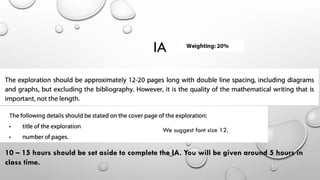
10 – 15 hours should be set aside to complete the IA. You will be given around 5 hours in
class time.
We suggest font size 12.
TECHNOLOGY
Assessment objective 4 for all DP mathematics courses is to “use technology accurately,
appropriately and efficiently both to explore new ideas and to solve problems”. This is not a
requirement for the exploration. In the exploration there are no limitations on the use of
technology. It is reasonable, but not essential, to expect that students, when producing their
explorations, will utilize technology in one or more ways. Examples may include: any kind of
calculators, hand-held or on the internet data-logging devices, simulations and modelling
software word-processing packages, spreadsheets, graphics packages
dynamic geometry software CAS.
IB Guide
A
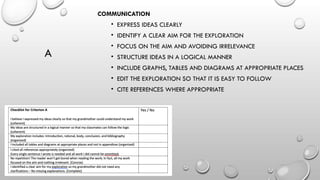
COMMUNICATION
• EXPRESS IDEAS CLEARLY
• IDENTIFY A CLEAR AIM FOR THE EXPLORATION
• FOCUS ON THE AIM AND AVOIDING IRRELEVANCE
• STRUCTURE IDEAS IN A LOGICAL MANNER
• INCLUDE GRAPHS, TABLES AND DIAGRAMS AT APPROPRIATE PLACES
• EDIT THE EXPLORATION SO THAT IT IS EASY TO FOLLOW
• CITE REFERENCES WHERE APPROPRIATE
A
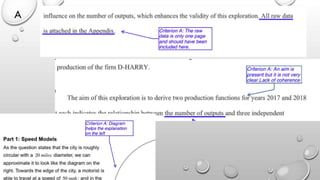
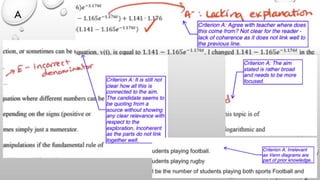
Demonstrates organization in A
First drafts (along with final drafts) will be submitted via managebac. There will be
a Turnitin %. This must be around or lower 20% (there may be exceptions but you will
need to discuss these with your teacher).
A
A
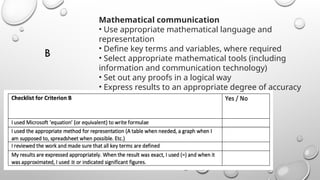
Mathematical communication
• Use appropriate mathematical language and
representation
• Define key terms and variables, where required
• Select appropriate mathematical tools (including
information and communication technology)
• Set out any proofs in a logical way
• Express results to an appropriate degree of accuracy
B
B
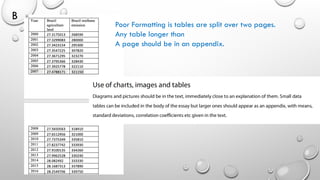
Poor Formatting is tables are split over two pages.
Any table longer than
A page should be in an appendix.
B
B
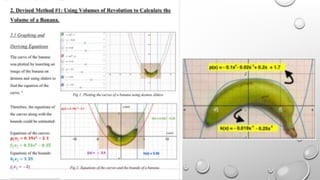
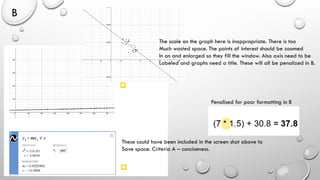
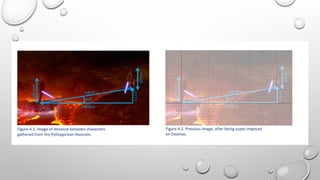
These could have been included in the screen shot above to
Save space. Criteria A – conciseness.
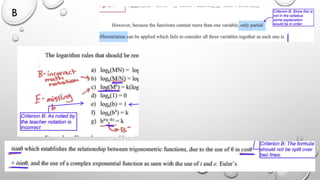
Penalised for poor formatting in B
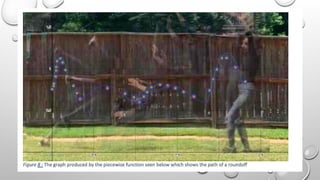
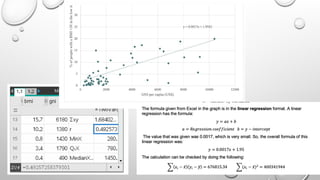
The scale on the graph here is inappropriate. There is too
Much wasted space. The points of interest should be zoomed
In on and enlarged so they fill the window. Also axis need to be
Labeled and graphs need a title. These will all be penalized in B.
B
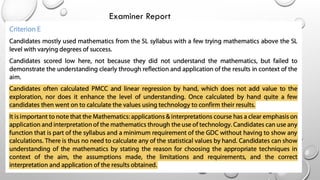
B Examiner Report
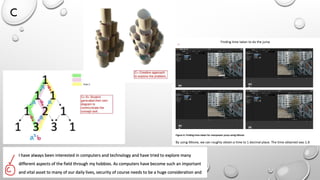
C
Personal engagement
• Ask questions, make conjectures and investigate mathematical
ideas
• Read about mathematics and research areas of interest
• Look for and create mathematical models for real-world situations
• Consider historical and global perspectives
• Explore unfamiliar mathematics
C
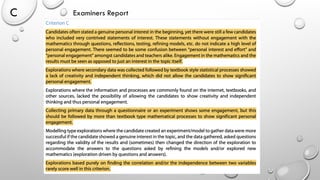
C Examiners Report
D
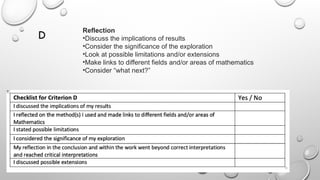
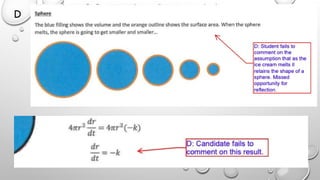
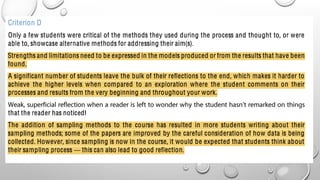
Reflection
•Discuss the implications of results
•Consider the significance of the exploration
•Look at possible limitations and/or extensions
•Make links to different fields and/or areas of mathematics
•Consider “what next?”
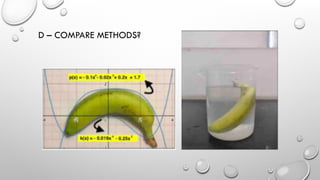
D – COMPARE METHODS?
D
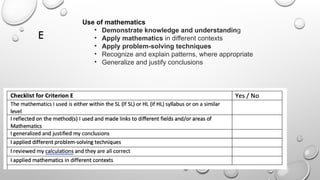
Use of mathematics
• Demonstrate knowledge and understanding
• Apply mathematics in different contexts
• Apply problem-solving techniques
• Recognize and explain patterns, where appropriate
• Generalize and justify conclusions
E
Examiner Report

IB AA Maths exploration Criteria Examples

  • 1.
    IA 10 – 15hours should be set aside to complete the IA. You will be given around 5 hours in class time. We suggest font size 12.
  • 2.
    TECHNOLOGY Assessment objective 4for all DP mathematics courses is to “use technology accurately, appropriately and efficiently both to explore new ideas and to solve problems”. This is not a requirement for the exploration. In the exploration there are no limitations on the use of technology. It is reasonable, but not essential, to expect that students, when producing their explorations, will utilize technology in one or more ways. Examples may include: any kind of calculators, hand-held or on the internet data-logging devices, simulations and modelling software word-processing packages, spreadsheets, graphics packages dynamic geometry software CAS. IB Guide
  • 3.
    A COMMUNICATION • EXPRESS IDEASCLEARLY • IDENTIFY A CLEAR AIM FOR THE EXPLORATION • FOCUS ON THE AIM AND AVOIDING IRRELEVANCE • STRUCTURE IDEAS IN A LOGICAL MANNER • INCLUDE GRAPHS, TABLES AND DIAGRAMS AT APPROPRIATE PLACES • EDIT THE EXPLORATION SO THAT IT IS EASY TO FOLLOW • CITE REFERENCES WHERE APPROPRIATE
  • 4.
    A Demonstrates organization inA First drafts (along with final drafts) will be submitted via managebac. There will be a Turnitin %. This must be around or lower 20% (there may be exceptions but you will need to discuss these with your teacher).
  • 5.
  • 7.
  • 8.
    Mathematical communication • Useappropriate mathematical language and representation • Define key terms and variables, where required • Select appropriate mathematical tools (including information and communication technology) • Set out any proofs in a logical way • Express results to an appropriate degree of accuracy B
  • 10.
    B Poor Formatting istables are split over two pages. Any table longer than A page should be in an appendix.
  • 13.
  • 14.
  • 15.
    These could havebeen included in the screen shot above to Save space. Criteria A – conciseness. Penalised for poor formatting in B The scale on the graph here is inappropriate. There is too Much wasted space. The points of interest should be zoomed In on and enlarged so they fill the window. Also axis need to be Labeled and graphs need a title. These will all be penalized in B. B
  • 16.
  • 17.
    C Personal engagement • Askquestions, make conjectures and investigate mathematical ideas • Read about mathematics and research areas of interest • Look for and create mathematical models for real-world situations • Consider historical and global perspectives • Explore unfamiliar mathematics
  • 20.
  • 21.
  • 22.
    D Reflection •Discuss the implicationsof results •Consider the significance of the exploration •Look at possible limitations and/or extensions •Make links to different fields and/or areas of mathematics •Consider “what next?”
  • 23.
    D – COMPAREMETHODS?
  • 24.
  • 26.
    Use of mathematics •Demonstrate knowledge and understanding • Apply mathematics in different contexts • Apply problem-solving techniques • Recognize and explain patterns, where appropriate • Generalize and justify conclusions E
  • 28.