Department of Business Administration
                  College of Management                                           Course Lecturer: Prof. Chung-Jen Chen

                                                                                                          Seminar


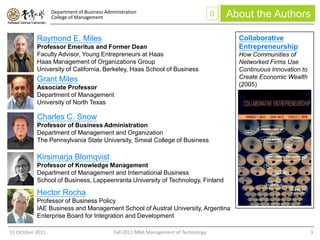
            Raymond E. Miles, Grant Miles, Charles C. Snow,
            Kirsimarja Blomqvist, Hector Rocha
            California Management Review Vol 51, No. 4
            Summer 2009 CMR.BERKLEY.EDU


        Presented by Group 5 吳宣儀 D00741004 江                            懿 B97203032 林玠恒 D00741002

31 October 2011                              Fall 2011 MBA Management of Technology                                  1
Department of Business Administration
                  College of Management


         Outline
                         0      About the Authors
                         1      Abstract
                         2      The Evolution of Organizational Forms
                         3      The Innovation Era and the I-Form
                         4      The I-Form Cases
                         5      Implementing the I-Form
                         6      Conclusion and Remarks


31 October 2011                              Fall 2011 MBA Management of Technology   2
Department of Business Administration
                  College of Management                                               0   About the Authors

           Raymond E. Miles                                                                 Collaborative
           Professor Emeritus and Former Dean                                               Entrepreneurship
           Faculty Advisor, Young Entrepreneurs at Haas                                     How Communities of
           Haas Management of Organizations Group                                           Networked Firms Use
           University of California, Berkeley, Haas School of Business                      Continuous Innovation to
           Grant Miles                                                                      Create Economic Wealth
           Associate Professor                                                              (2005)
           Department of Management
           University of North Texas

           Charles C. Snow
           Professor of Business Administration
           Department of Management and Organization
           The Pennsylvania State University, Smeal College of Business

           Kirsimarja Blomqvist
           Professor of Knowledge Management
           Department of Management and International Business
           School of Business, Lappeenranta University of Technology, Finland

           Hector Rocha
           Professor of Business Policy
           IAE Business and Management School of Austral University, Argentina
           Enterprise Board for Integration and Development

31 October 2011                              Fall 2011 MBA Management of Technology                                    3
Department of Business Administration
                  College of Management                                               1   Abstract

The Phenomenon
 1. a market exploration model that aids in the pursuit of opportunities generated by
    intersecting technologies and markets is emerging in knowledge-intensive environments.
 2. Effective market exploration, in turn, requires the development and use of community-
    based organizational designs and facilitative management approaches that enable firms
    in a particular area of economic activity to collaborate with their customers as well as with
    one another.

The Research and Findings
1. The co-evolution of business and organizational models has been examined.
2. A new organizational form, the Innovation-form (I-form for short), is proposed.
3. An I-form organization can be especially valuable in countries and industries where the
   knowledge base on which business opportunities rest is constantly changing and growing.
4. For a firm to be successful in such an environment, it must have, or be able to develop, the
   capability to continually create, share, and apply knowledge.
5. The I-form organizational design enables firms—especially firms that learn how to interact
   collaboratively within networks and communities—to compete effectively in these complex
   and challenging environments.

31 October 2011                              Fall 2011 MBA Management of Technology                  4
Department of Business Administration
                  College of Management                   2    The Evolution of Organizational Forms

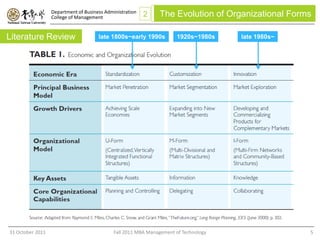
Literature Review                     late 1800s~early 1990s          1920s~1980s     late 1980s~


31 October 2011                              Fall 2011 MBA Management of Technology                 5
Department of Business Administration
                   College of Management                   2    The Evolution of Organizational Forms


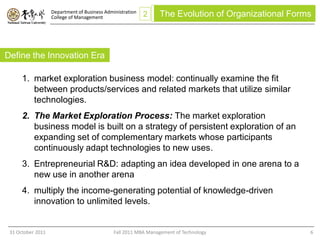
Define the Innovation Era

      1. market exploration business model: continually examine the fit
         between products/services and related markets that utilize similar
         technologies.
      2. The Market Exploration Process: The market exploration
         business model is built on a strategy of persistent exploration of an
         expanding set of complementary markets whose participants
         continuously adapt technologies to new uses.
      3. Entrepreneurial R&D: adapting an idea developed in one arena to a
         new use in another arena
      4. multiply the income-generating potential of knowledge-driven
         innovation to unlimited levels.


 31 October 2011                              Fall 2011 MBA Management of Technology                6
Department of Business Administration
                   College of Management                   2    The Evolution of Organizational Forms


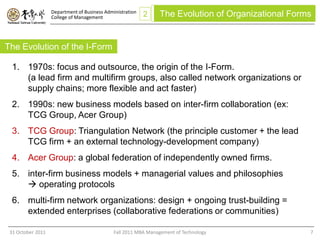
The Evolution of the I-Form

  1. 1970s: focus and outsource, the origin of the I-Form.
     (a lead firm and multifirm groups, also called network organizations or
     supply chains; more flexible and act faster)
  2. 1990s: new business models based on inter-firm collaboration (ex:
     TCG Group, Acer Group)
  3. TCG Group: Triangulation Network (the principle customer + the lead
     TCG firm + an external technology-development company)
  4. Acer Group: a global federation of independently owned firms.
  5. inter-firm business models + managerial values and philosophies
      operating protocols
  6. multi-firm network organizations: design + ongoing trust-building =
     extended enterprises (collaborative federations or communities)

 31 October 2011                              Fall 2011 MBA Management of Technology                7
Department of Business Administration
                  College of Management


    The I-Form Cases -
    Syndicom and Blade.org


31 October 2011                              Fall 2011 MBA Management of Technology   8
Department of Business Administration
                   College of Management                                               4   The I-Form Cases


Case 1


 Collaborative Innovation

        SpineConnect                                       Internet-based software platform

        Consultative comments                                          Information

        CollabComs                                  Entrepreneurial collaboration


 31 October 2011                              Fall 2011 MBA Management of Technology                          9
Department of Business Administration
                   College of Management                                               4   The I-Form Cases


Case 2


Collaborative Community of Firms

  Promote blade server                                      Industry standard
  Not through contracts with suppliers and distributors
  But provide more solution                                         Reputational resources
  Collaboration model (cont.)

 31 October 2011                              Fall 2011 MBA Management of Technology                      10
Department of Business Administration
                   College of Management                                               4   The I-Form Cases


Collaboration Model of Blade.org

     » Bilateral collaboration
                                                                                  Building the
     » Direct collaboration                                                       community
                                                                                  around a shared
     » Pooled collaboration
                                                                                  interest can
     » External collaboration                                                     facilitate the
                                                                                  growth and
                                                                                  effectiveness of
                                                                                  the community.

 31 October 2011                              Fall 2011 MBA Management of Technology                      11
Department of Business Administration
                  College of Management


     Implementing the I-Form


31 October 2011                              Fall 2011 MBA Management of Technology   12
Department of Business Administration
                  College of Management                                  5      Implementing the I-Form


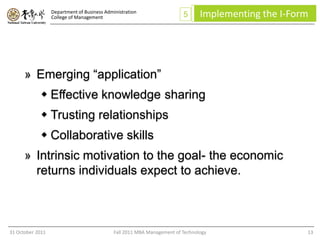
      » Emerging “application”
             Effective knowledge sharing
             Trusting relationships
             Collaborative skills
      » Intrinsic motivation to the goal- the economic
        returns individuals expect to achieve.


31 October 2011                              Fall 2011 MBA Management of Technology                   13
Department of Business Administration
                  College of Management                                  5      Implementing the I-Form


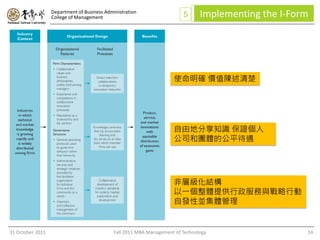
                                                                     使命明確 價值陳述清楚


                                                                     自由地分享知識 保證個人
                                                                     公司和團體的公平待遇


                                                                     非層級化結構
                                                                     以一個整體提供行政服務與戰略行動
                                                                     自發性並集體管理


31 October 2011                              Fall 2011 MBA Management of Technology                   14
Department of Business Administration
                  College of Management                                  5      Implementing the I-Form


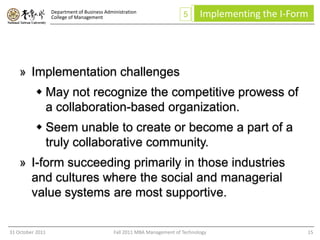
    » Implementation challenges
           May not recognize the competitive prowess of
            a collaboration-based organization.
           Seem unable to create or become a part of a
            truly collaborative community.
    » I-form succeeding primarily in those industries
      and cultures where the social and managerial
      value systems are most supportive.


31 October 2011                              Fall 2011 MBA Management of Technology                   15
Department of Business Administration
                  College of Management                                   6      Conclusion and Remarks


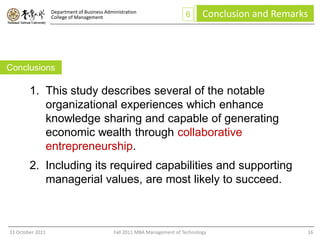
Conclusions

        1. This study describes several of the notable
           organizational experiences which enhance
           knowledge sharing and capable of generating
           economic wealth through collaborative
           entrepreneurship.
        2. Including its required capabilities and supporting
           managerial values, are most likely to succeed.


31 October 2011                              Fall 2011 MBA Management of Technology                   16
Department of Business Administration
                  College of Management                                6      Conclusion and Remarks


Remarks

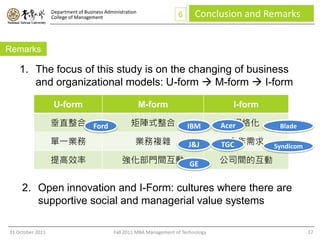
    1. The focus of this study is on the changing of business
       and organizational models: U-form  M-form  I-form

                   U-form                                 M-form                        I-form

                  垂直整合 Ford                         矩陣式整合                  IBM           網絡化
                                                                                      Acer        Blade

                  單一業務                                業務複雜                 J&J          合作需求
                                                                                      TGC        Syndicom

                  提高效率                          強化部門間互動 GE                            公司間的互動


     2. Open innovation and I-Form: cultures where there are
        supportive social and managerial value systems

31 October 2011                              Fall 2011 MBA Management of Technology                         17
Department of Business Administration
                  College of Management


        Q&A
31 October 2011                              Fall 2011 MBA Management of Technology   18

The I-Form Organization

  • 1.
    Department of BusinessAdministration College of Management Course Lecturer: Prof. Chung-Jen Chen Seminar Raymond E. Miles, Grant Miles, Charles C. Snow, Kirsimarja Blomqvist, Hector Rocha California Management Review Vol 51, No. 4 Summer 2009 CMR.BERKLEY.EDU Presented by Group 5 吳宣儀 D00741004 江 懿 B97203032 林玠恒 D00741002 31 October 2011 Fall 2011 MBA Management of Technology 1
  • 2.
    Department of BusinessAdministration College of Management Outline 0 About the Authors 1 Abstract 2 The Evolution of Organizational Forms 3 The Innovation Era and the I-Form 4 The I-Form Cases 5 Implementing the I-Form 6 Conclusion and Remarks 31 October 2011 Fall 2011 MBA Management of Technology 2
  • 3.
    Department of BusinessAdministration College of Management 0 About the Authors Raymond E. Miles Collaborative Professor Emeritus and Former Dean Entrepreneurship Faculty Advisor, Young Entrepreneurs at Haas How Communities of Haas Management of Organizations Group Networked Firms Use University of California, Berkeley, Haas School of Business Continuous Innovation to Grant Miles Create Economic Wealth Associate Professor (2005) Department of Management University of North Texas Charles C. Snow Professor of Business Administration Department of Management and Organization The Pennsylvania State University, Smeal College of Business Kirsimarja Blomqvist Professor of Knowledge Management Department of Management and International Business School of Business, Lappeenranta University of Technology, Finland Hector Rocha Professor of Business Policy IAE Business and Management School of Austral University, Argentina Enterprise Board for Integration and Development 31 October 2011 Fall 2011 MBA Management of Technology 3
  • 4.
    Department of BusinessAdministration College of Management 1 Abstract The Phenomenon 1. a market exploration model that aids in the pursuit of opportunities generated by intersecting technologies and markets is emerging in knowledge-intensive environments. 2. Effective market exploration, in turn, requires the development and use of community- based organizational designs and facilitative management approaches that enable firms in a particular area of economic activity to collaborate with their customers as well as with one another. The Research and Findings 1. The co-evolution of business and organizational models has been examined. 2. A new organizational form, the Innovation-form (I-form for short), is proposed. 3. An I-form organization can be especially valuable in countries and industries where the knowledge base on which business opportunities rest is constantly changing and growing. 4. For a firm to be successful in such an environment, it must have, or be able to develop, the capability to continually create, share, and apply knowledge. 5. The I-form organizational design enables firms—especially firms that learn how to interact collaboratively within networks and communities—to compete effectively in these complex and challenging environments. 31 October 2011 Fall 2011 MBA Management of Technology 4
  • 5.
    Department of BusinessAdministration College of Management 2 The Evolution of Organizational Forms Literature Review late 1800s~early 1990s 1920s~1980s late 1980s~ 31 October 2011 Fall 2011 MBA Management of Technology 5
  • 6.
    Department of BusinessAdministration College of Management 2 The Evolution of Organizational Forms Define the Innovation Era 1. market exploration business model: continually examine the fit between products/services and related markets that utilize similar technologies. 2. The Market Exploration Process: The market exploration business model is built on a strategy of persistent exploration of an expanding set of complementary markets whose participants continuously adapt technologies to new uses. 3. Entrepreneurial R&D: adapting an idea developed in one arena to a new use in another arena 4. multiply the income-generating potential of knowledge-driven innovation to unlimited levels. 31 October 2011 Fall 2011 MBA Management of Technology 6
  • 7.
    Department of BusinessAdministration College of Management 2 The Evolution of Organizational Forms The Evolution of the I-Form 1. 1970s: focus and outsource, the origin of the I-Form. (a lead firm and multifirm groups, also called network organizations or supply chains; more flexible and act faster) 2. 1990s: new business models based on inter-firm collaboration (ex: TCG Group, Acer Group) 3. TCG Group: Triangulation Network (the principle customer + the lead TCG firm + an external technology-development company) 4. Acer Group: a global federation of independently owned firms. 5. inter-firm business models + managerial values and philosophies  operating protocols 6. multi-firm network organizations: design + ongoing trust-building = extended enterprises (collaborative federations or communities) 31 October 2011 Fall 2011 MBA Management of Technology 7
  • 8.
    Department of BusinessAdministration College of Management The I-Form Cases - Syndicom and Blade.org 31 October 2011 Fall 2011 MBA Management of Technology 8
  • 9.
    Department of BusinessAdministration College of Management 4 The I-Form Cases Case 1 Collaborative Innovation SpineConnect Internet-based software platform Consultative comments Information CollabComs Entrepreneurial collaboration 31 October 2011 Fall 2011 MBA Management of Technology 9
  • 10.
    Department of BusinessAdministration College of Management 4 The I-Form Cases Case 2 Collaborative Community of Firms Promote blade server Industry standard Not through contracts with suppliers and distributors But provide more solution Reputational resources Collaboration model (cont.) 31 October 2011 Fall 2011 MBA Management of Technology 10
  • 11.
    Department of BusinessAdministration College of Management 4 The I-Form Cases Collaboration Model of Blade.org » Bilateral collaboration Building the » Direct collaboration community around a shared » Pooled collaboration interest can » External collaboration facilitate the growth and effectiveness of the community. 31 October 2011 Fall 2011 MBA Management of Technology 11
  • 12.
    Department of BusinessAdministration College of Management Implementing the I-Form 31 October 2011 Fall 2011 MBA Management of Technology 12
  • 13.
    Department of BusinessAdministration College of Management 5 Implementing the I-Form » Emerging “application”  Effective knowledge sharing  Trusting relationships  Collaborative skills » Intrinsic motivation to the goal- the economic returns individuals expect to achieve. 31 October 2011 Fall 2011 MBA Management of Technology 13
  • 14.
    Department of BusinessAdministration College of Management 5 Implementing the I-Form 使命明確 價值陳述清楚 自由地分享知識 保證個人 公司和團體的公平待遇 非層級化結構 以一個整體提供行政服務與戰略行動 自發性並集體管理 31 October 2011 Fall 2011 MBA Management of Technology 14
  • 15.
    Department of BusinessAdministration College of Management 5 Implementing the I-Form » Implementation challenges  May not recognize the competitive prowess of a collaboration-based organization.  Seem unable to create or become a part of a truly collaborative community. » I-form succeeding primarily in those industries and cultures where the social and managerial value systems are most supportive. 31 October 2011 Fall 2011 MBA Management of Technology 15
  • 16.
    Department of BusinessAdministration College of Management 6 Conclusion and Remarks Conclusions 1. This study describes several of the notable organizational experiences which enhance knowledge sharing and capable of generating economic wealth through collaborative entrepreneurship. 2. Including its required capabilities and supporting managerial values, are most likely to succeed. 31 October 2011 Fall 2011 MBA Management of Technology 16
  • 17.
    Department of BusinessAdministration College of Management 6 Conclusion and Remarks Remarks 1. The focus of this study is on the changing of business and organizational models: U-form  M-form  I-form U-form M-form I-form 垂直整合 Ford 矩陣式整合 IBM 網絡化 Acer Blade 單一業務 業務複雜 J&J 合作需求 TGC Syndicom 提高效率 強化部門間互動 GE 公司間的互動 2. Open innovation and I-Form: cultures where there are supportive social and managerial value systems 31 October 2011 Fall 2011 MBA Management of Technology 17
  • 18.
    Department of BusinessAdministration College of Management Q&A 31 October 2011 Fall 2011 MBA Management of Technology 18