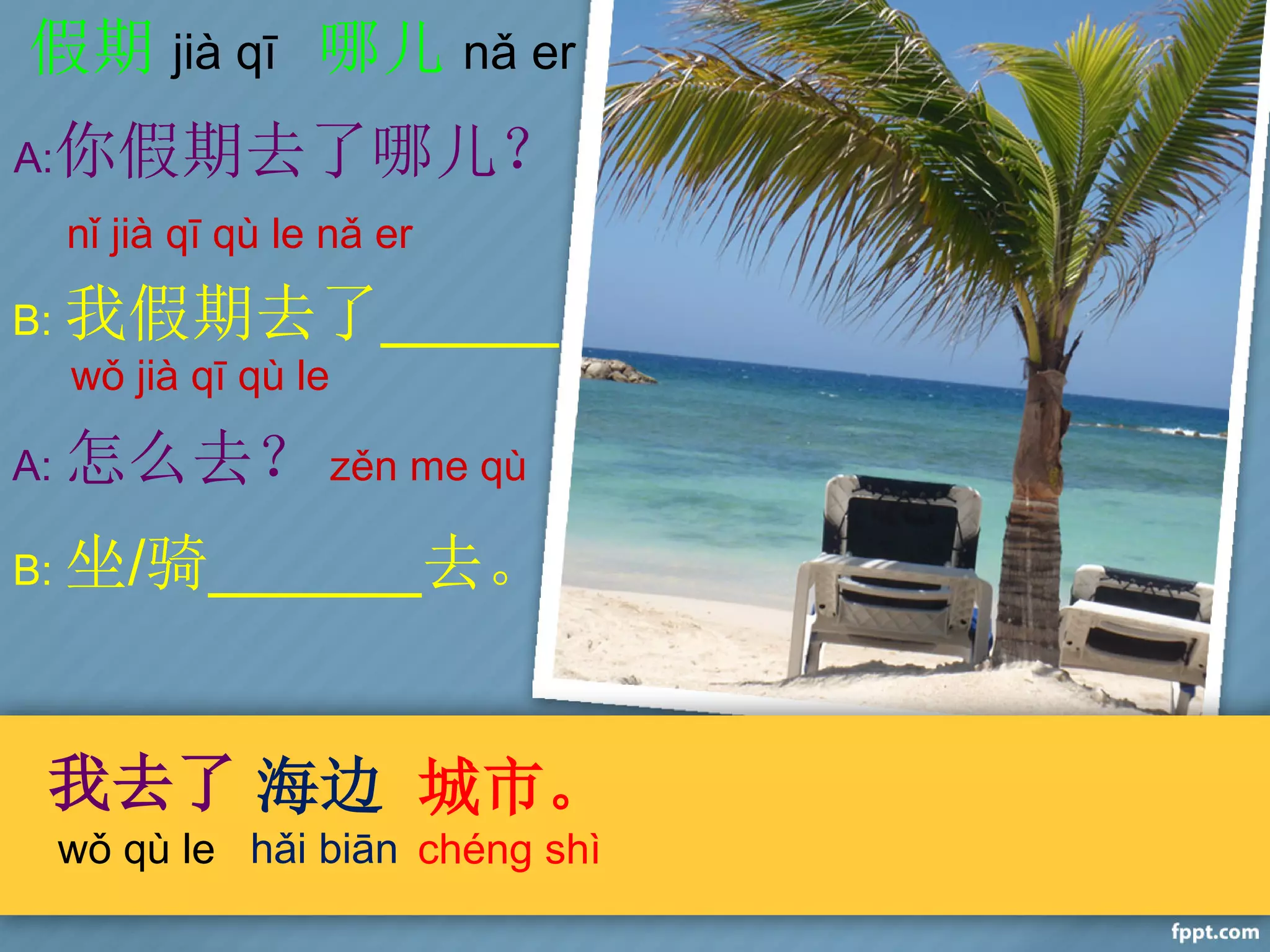
A:你假期去了哪儿?
nǐ jià qī qù le nǎ er
我去了
wǒ qù le
海边
hǎi biān
城市。
chéng shì
假期 jià qī 哪儿 nǎ er
B: 我假期去了_____
wǒ jià qī qù le
A: 怎么去? zěn me qù
B: 坐/骑______去。
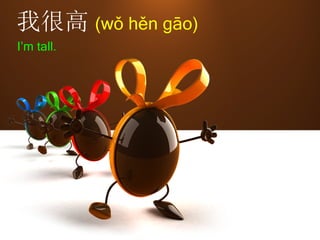
我很高 (wǒ hěn gāo)
I’m tall.
New words and expressions
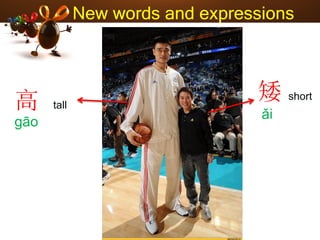
高 tall
gāo
矮 short
ǎi
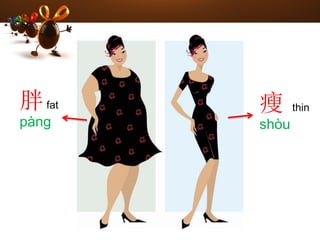
胖fat
pàng
瘦 thin
shòu
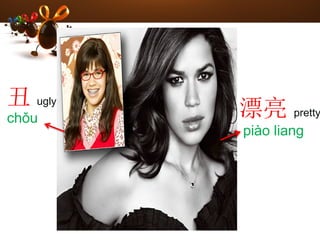
丑 ugly
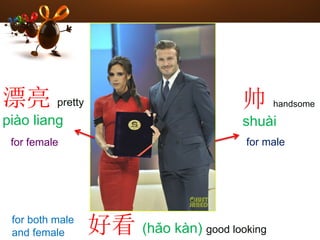
chǒu 漂亮 pretty
piào liang
帅 handsome
shuài
漂亮 pretty
piào liang
for female for male
好看 (hǎo kàn) good looking
for both male
and female
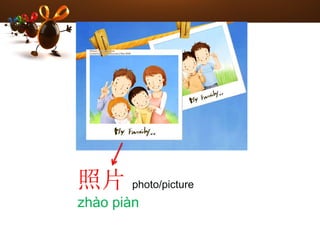
照片 photo/picture
zhào piàn
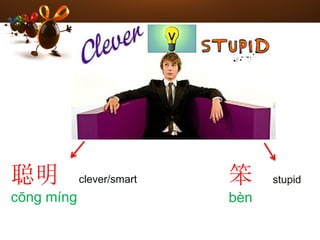
聪明 clever/smart
cōng míng
笨 stupid
bèn
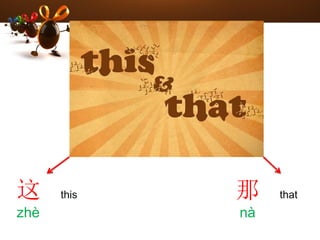
这 this
zhè
那 that
nà
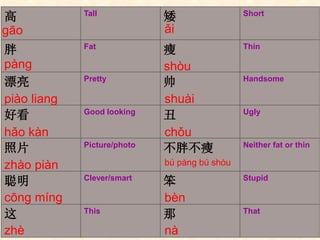
高 Tall
矮 Short
胖 Fat
瘦 Thin
漂亮 Pretty
帅 Handsome
好看 Good looking
丑 Ugly
照片 Picture/photo
不胖不瘦 Neither fat or thin
聪明 Clever/smart
笨 Stupid
这 This
那 That
pàng
gāo
piào liang
hǎo kàn
zhào piàn
zhè
ǎi
shuài
chǒu
bú pàng bú shòu
bèn
nà
cōng míng
shòu
Grammar: Verb-adjectives
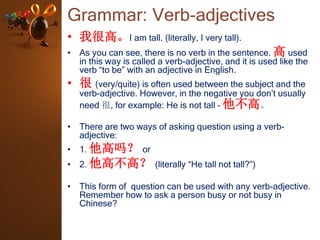
• 我很高。I am tall. (literally, I very tall).
• As you can see, there is no verb in the sentence. 高 used
in this way is called a verb-adjective, and it is used like the
verb “to be” with an adjective in English.
• 很 (very/quite) is often used between the subject and the
verb-adjective. However, in the negative you don’t usually
need 很, for example: He is not tall – 他不高。
• There are two ways of asking question using a verb-
adjective:
• 1. 他高吗? or
• 2. 他高不高? (literally “He tall not tall?”)
• This form of question can be used with any verb-adjective.
Remember how to ask a person busy or not busy in
Chinese?
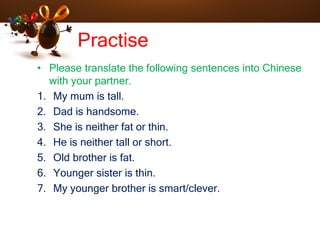
Practise
• Please translate the following sentences into Chinese
with your partner.
1. My mum is tall.
2. Dad is handsome.
3. She is neither fat or thin.
4. He is neither tall or short.
5. Old brother is fat.
6. Younger sister is thin.
7. My younger brother is smart/clever.
Cultural difference
• You’d probably be angry if someone told you that
you’re looking fatter (你胖了).
• In China, however, this not an insult. This is partly
because food shortages used to be common in
China, so being this as a sign of being poor; only
wealthy people were fat.
• This has changed in recent years, but nicknaming
a small child 小胖子 (little fat one) or calling a
young man 胖子 still shows affection.
你胖了。You’ve put on weight!
Grammar: omitting the noun
• As you know, 个 is the most common measure
work in Chinese and is usually used before a
noun.
• However, sometimes you can miss out the noun
when answering a question. For example:
• 我有两个弟弟,一个高,一个矮。(You do not
need 弟弟 before 高 and 矮 if you want to
describe these younger brothers as “one tall, one
short”. You can miss out 弟弟,but you must use
the measure word.)
• 你们吃了几个饺子?我吃了六个,弟弟吃了八个。
(You do not need 饺子 in answering).
• Don’t forget that you must have a measure word
following a number to answer a question.

I am tall

  • 1.
    A:你假期去了哪儿? nǐ jià qīqù le nǎ er 我去了 wǒ qù le 海边 hǎi biān 城市。 chéng shì 假期 jià qī 哪儿 nǎ er B: 我假期去了_____ wǒ jià qī qù le A: 怎么去? zěn me qù B: 坐/骑______去。
  • 2.
    我很高 (wǒ hěngāo) I’m tall.
  • 3.
    New words andexpressions 高 tall gāo 矮 short ǎi
  • 4.
  • 5.
    丑 ugly chǒu 漂亮pretty piào liang
  • 6.
    帅 handsome shuài 漂亮 pretty piàoliang for female for male 好看 (hǎo kàn) good looking for both male and female
  • 7.
  • 8.
  • 9.
  • 10.
    高 Tall 矮 Short 胖Fat 瘦 Thin 漂亮 Pretty 帅 Handsome 好看 Good looking 丑 Ugly 照片 Picture/photo 不胖不瘦 Neither fat or thin 聪明 Clever/smart 笨 Stupid 这 This 那 That pàng gāo piào liang hǎo kàn zhào piàn zhè ǎi shuài chǒu bú pàng bú shòu bèn nà cōng míng shòu
  • 11.
    Grammar: Verb-adjectives • 我很高。Iam tall. (literally, I very tall). • As you can see, there is no verb in the sentence. 高 used in this way is called a verb-adjective, and it is used like the verb “to be” with an adjective in English. • 很 (very/quite) is often used between the subject and the verb-adjective. However, in the negative you don’t usually need 很, for example: He is not tall – 他不高。 • There are two ways of asking question using a verb- adjective: • 1. 他高吗? or • 2. 他高不高? (literally “He tall not tall?”) • This form of question can be used with any verb-adjective. Remember how to ask a person busy or not busy in Chinese?
  • 12.
    Practise • Please translatethe following sentences into Chinese with your partner. 1. My mum is tall. 2. Dad is handsome. 3. She is neither fat or thin. 4. He is neither tall or short. 5. Old brother is fat. 6. Younger sister is thin. 7. My younger brother is smart/clever.
  • 13.
    Cultural difference • You’dprobably be angry if someone told you that you’re looking fatter (你胖了). • In China, however, this not an insult. This is partly because food shortages used to be common in China, so being this as a sign of being poor; only wealthy people were fat. • This has changed in recent years, but nicknaming a small child 小胖子 (little fat one) or calling a young man 胖子 still shows affection. 你胖了。You’ve put on weight!
  • 14.
    Grammar: omitting thenoun • As you know, 个 is the most common measure work in Chinese and is usually used before a noun. • However, sometimes you can miss out the noun when answering a question. For example: • 我有两个弟弟,一个高,一个矮。(You do not need 弟弟 before 高 and 矮 if you want to describe these younger brothers as “one tall, one short”. You can miss out 弟弟,but you must use the measure word.) • 你们吃了几个饺子?我吃了六个,弟弟吃了八个。 (You do not need 饺子 in answering). • Don’t forget that you must have a measure word following a number to answer a question.