The Safety and Efficacy of
Hyperventilation During EEG
a National Service Evaluation
Review of the safety survey
METHODOLOGY
Methodology
• 63 forms were sent out
• 56 completed & returned from all areas of
the country from Plymouth to Inverness
(response rate of 89%)
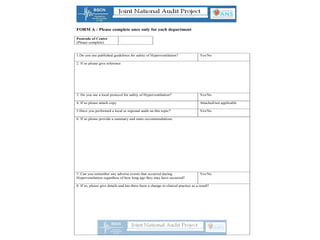
FORM A : Please complete once only for each department
Postcode of Centre
(Please complete)
1.Do you use published guidelines for safety of Hyperventilation? Yes/No
2. If so please give reference
3. Do you use a local protocol for safety of Hyperventilation? Yes/No
4. If so please attach copy Attached/not applicable
5.Have you performed a local or regional audit on this topic? Yes/No
6. If so please provide a summary and main recommendations.
7. Can you remember any adverse events that occurred during
Hyperventilation regardless of how long ago they may have occurred?
Yes/No
8. If so, please give details and has there been a change in clinical practice as a result?
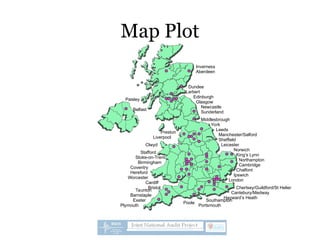
Map Plot
Poole
Northampton
London
Barnstaple
Leeds
Preston
Sunderland
Chalfont
Clwyd
Manchester/Salford
Aberdeen
Norwich
Chertsey/Guildford/St Helier
Cantebury/Medway
Leicester
Plymouth
Sheffield
Hereford
Stoke-on-Trent
Cambridge
Stafford
Coventry
Birmingham
Edinburgh
Cardiff
Liverpool
Bristol
Glasgow
Larbert
Taunton
Worcester
Southampton
Paisley
Inverness
Belfast
Dundee
Middlesbrough
Hayward’s Heath
York
Portsmouth
Ipswich
King’s Lynn
Exeter
Newcastle
RESULTS
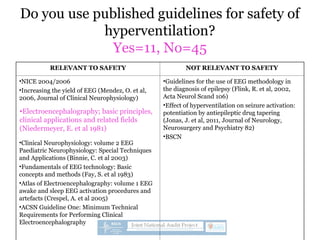
Do you use published guidelines for safety of
hyperventilation?
Yes=11, No=45
RELEVANT TO SAFETY NOT RELEVANT TO SAFETY
•NICE 2004/2006
•Increasing the yield of EEG (Mendez, O. et al,
2006, Journal of Clinical Neurophysiology)
•Clinical Neurophysiology: volume 2 EEG
Paediatric Neurophysiology: Special Techniques
and Applications (Binnie, C. et al 2003)
•Fundamentals of EEG technology: Basic
concepts and methods (Fay, S. et al 1983)
•Atlas of Electroencephalography: volume 1 EEG
awake and sleep EEG activation procedures and
artefacts (Crespel, A. et al 2005)
•ACSN Guideline One: Minimum Technical
Requirements for Performing Clinical
Electroencephalography
•Guidelines for the use of EEG methodology in
the diagnosis of epilepsy (Flink, R. et al, 2002,
Acta Neurol Scand 106)
•Effect of hyperventilation on seizure activation:
potentiation by antiepileptic drug tapering
(Jonas, J. et al, 2011, Journal of Neurology,
Neurosurgery and Psychiatry 82)
•BSCN
•Electroencephalography; basic principles,
clinical applications and related fields
(Niedermeyer, E. et al 1981)
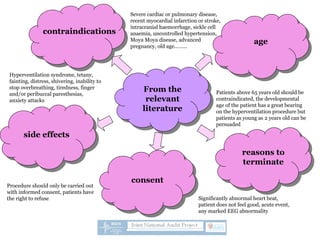
From the
relevant
literature
contraindications
Severe cardiac or pulmonary disease,
recent myocardial infarction or stroke,
intracranial haemorrhage, sickle cell
anaemia, uncontrolled hypertension,
Moya Moya disease, advanced
pregnancy, old age………
age
Patients above 65 years old should be
contraindicated, the developmental
age of the patient has a great bearing
on the hyperventilation procedure but
patients as young as 2 years old can be
persuaded
side effects
Hyperventilation syndrome, tetany,
fainting, distress, shivering, inability to
stop overbreathing, tiredness, finger
and/or peribuccal paresthesias,
anxiety attacks
reasons to
terminate
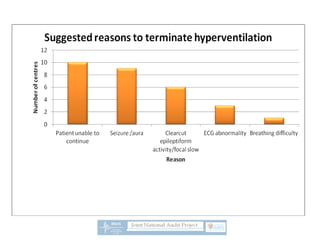
Significantly abnormal heart beat,
patient does not feel good, acute event,
any marked EEG abnormality
Procedure should only be carried out
with informed consent, patients have
the right to refuse
consent
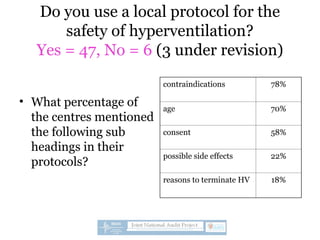
Do you use a local protocol for the
safety of hyperventilation?
Yes = 47, No = 6 (3 under revision)
• What percentage of
the centres mentioned
the following sub
headings in their
protocols?
contraindications 78%
age 70%
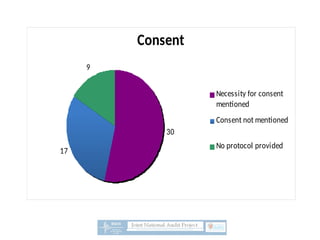
consent 58%
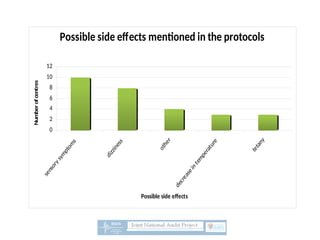
possible side effects 22%
reasons to terminate HV 18%
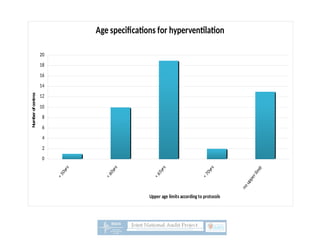
Age specifications for hyperventilation
0
2
4
6
8
10
12
14
16
18
20
Upper age limits according to protocols
Number
of
centres
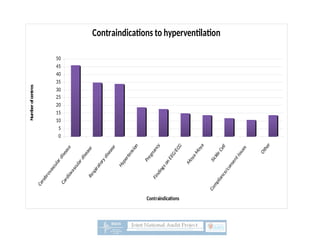
Contraindications to hyperventilation
0
5
10
15
20
25
30
35
40
45
50
Contraindications
Number
of
centres
Possible side effects mentioned in the protocols
0
2
4
6
8
10
12
Possible side effects
Number
of
centres
Consent
30
17
9
Necessity for consent
mentioned
Consent not mentioned
No protocol provided
Have you performed a local or regional audit
on this topic?
Yes =7, No = 49
• 5 of the audits were not related to safety or
efficacy
• 2 of the audits were applicable and both relating
to age limitations
“HV did not provide any additional information in patients above 60 years old
age and therefore patients above this age to not have any activation
techniques performed during their standard EEG”
“HV found not to be very useful in the elderly but no less useful than in other
adults over the age of 30. The only group where HV contributed significantly
to diagnoses was in children and young adults. Recommendation was to
continue to HV all patients regardless of age”
Can you remember any adverse events
that occurred during hyperventilation
regardless of how long ago they may
have occurred?
Yes = 6, No = 50
• Out of the 6 reporting they could, 5 were not considered
to be adverse as they were expected outcomes of the
procedure (seizures/auras/difficulty stopping over-
breathing)
• 1 was an unpredictable event (syncope – bradycardia and
asystole) and therefore considered to be truly adverse
CONCLUSIONS
Summaries & Conclusions
• Very few departments (20%) use published guidelines for
the safety of hyperventilation and of these, only 1 was
referenced
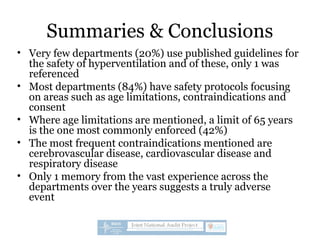
• Most departments (84%) have safety protocols focusing
on areas such as age limitations, contraindications and
consent
• Where age limitations are mentioned, a limit of 65 years
is the one most commonly enforced (42%)
• The most frequent contraindications mentioned are
cerebrovascular disease, cardiovascular disease and
respiratory disease
• Only 1 memory from the vast experience across the
departments over the years suggests a truly adverse
event
Continued…
• Anecdotally, HV appears to be a safe procedure
however the second part of this audit will
provide an evidence base for this
• There are wide variations in protocols and many
are not based on published guidelines.
• The next talk will provide details of the
published literature that we could use to try and
standardise our protocols and procedures
Literature Review
• Physiological Effects of Hyperventilation (aka
Overbreathing or Hyperpnœa).
• Historical Perspective.
• Safety Issues:
– Adverse CVS, Respiratory and CNS events
(including Seizures & NEAD/PNES).
• Efficacy:
– Interictal Epileptiform Discharges (IEDs).
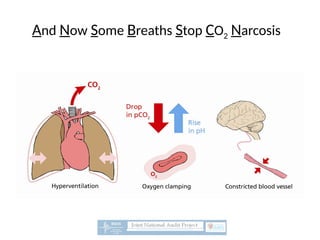
And Now Some Breaths Stop CO2 Narcosis
Physiological Effects
1. ↓PCO2 Hypocapnia → Vasoconstriction → Cerebral Ischaemic Anoxia → EEG
slowing (Meyer & Gotoh 1960). HV → Respiratory Alkalosis → Shift in oxygen
dissociation curve (Bohr effect) & Lowering of ionized calcium.
2. Recent experimental data has questioned the “Anoxia/Hypoxia Theory” and
alternative explanations include an “awake-sleep transitory state” (Patel &
Maulsby 1987) or a subcortical mechanism (Hoshi et al 1999).
3. Other potential (‘epileptogenic’) effects include changes in excitability of cortical
neuronal pathways – as shown by negative DC shifts (Rockstroth 1990) and TMS
in the corticospinal system (Seyal et al 1998).
4. Few attempts to standardize HV technique, but based on maximal EEG slowing
in children: 4 mins at RR of 30/min. and VE of 3x (Konishi 1987). Also blood gas
changes AFTER 3 mins HV reach nadir for PO2 at 5 mins. and recovery for PCO2
at 7mins. (Achenbach et al 1994).
Historical Perspective
• 1924 Otfrid Foerster and Joshua Rosett independently report induction of (partial)
seizures by HV.
– 26 yr male whose “left upper limb was suddenly thrown into a violent spasm”
after 8 minutes of HV.
• 1934 Hans Berger describes a seizure provoked by HV during an EEG.
– 21 yr woman with “genuine epilepsy suddenly stopped hyperventilation,
associated with a reduction in amplitude of the background frequencies and
a loss of responsiveness, and shortly thereafter a seizure developed”.
• 1935 Fred Gibbs, Hallowell Davis and William Lennox demonstrated for the first
time 3 Hz spike wave pattern of ‘Petit Mal’ (absence epilepsy).
– “Over ventilation produces large slow waves in normal subjects, also tends to
precipitate seizures in epileptic persons. The differences in wave pattern,
notably the characteristic form of the EEG in petit mal (“egg and dart”),
made it possible to distinguish between simple loss of consciousness and a
seizure”.
Safety – Methodology and Definition
• Medline (search terms: hyperventilation
complications, side effects = >2,300 articles). Standard
textbooks. Guidelines finder.
• Adverse Events are defined as “an incident or
occurrence from which potential or actual harm
resulted to a person receiving health care” (Stevens
1986).
Adverse Events: cardiovascular, respiratory, CNS –
cerebrovascular, seizures, non-epileptic events.
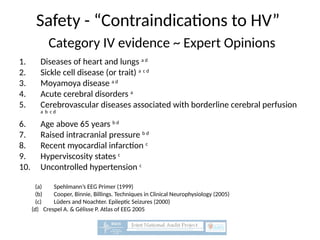
Safety – Standard Textbooks
 Kiloh L & Osselton J. Clinical EEG 1961
 Hill J & Parr G. EEG 1963
 Cooper R, Osselton J, Shaw J. EEG Technology 1974
 Klass DW & Daly D. Current Practice of Clinical EEG 1979 (Guideline
One)
 Hughes J. EEG in Clinical Practice 1982
 Niedermeyer E & Lopes Da Silva F. EEG Basic principles 1993
 Fisch B & Spehlmann’s EEG Primer 1999
 L
Lü
üders H & Noachtar S. Epileptic Seizures (Drury I. Activation of
ders H & Noachtar S. Epileptic Seizures (Drury I. Activation of
seizures by HV). 2000
seizures by HV). 2000** (Review)
 Crespel A. & Gélisse P. Atlas of EEG 2005
 Cooper R, Binnie C, Billings R. Techniques in Clinical Neurophysiology
Cooper R, Binnie C, Billings R. Techniques in Clinical Neurophysiology
2005*
2005* (Practical Manual)
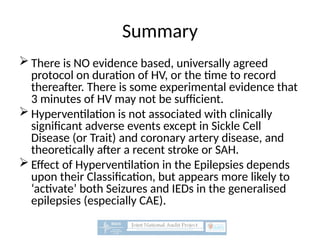
Safety - “Contraindications to HV”
Category IV evidence ~ Expert Opinions
1. Diseases of heart and lungs a d
2. Sickle cell disease (or trait) a c d
3. Moyamoya disease a d
4. Acute cerebral disorders a
5. Cerebrovascular diseases associated with borderline cerebral perfusion
a b c d
6. Age above 65 years b d
7. Raised intracranial pressure b d
8. Recent myocardial infarction c
9. Hyperviscosity states c
10. Uncontrolled hypertension c
(a) Spehlmann’s EEG Primer (1999)
(b) Cooper, Binnie, Billings. Techniques in Clinical Neurophysiology (2005)
(c) Lüders and Noachter. Epileptic Seizures (2000)
(d) Crespel A. & Gélisse P. Atlas of EEG 2005
Safety – “Evidence Based Guidelines”
1. AEEGS 1970/71 & 1986
Minimum Technical requirements for performing Clinical EEG (Guideline One).
Overbreathing should be used routinely unless some medical or other justifiable
reasons contraindicate it (e.g. recent SAH, intracranial hemorrhage, or significant
cardio-pulmonary disease). (>3m >1m)
2. ILAE 2002
Guidelines for use of EEG methodology in the diagnosis of epilepsy.
A standard EEG should aim to include Hyperventilation. HV depends on the
developmental age, and level of co-operation of the child and the experience of the
staff. Photic stimulation should not be performed during HV. (3m >2m)
3. NICE CG 2004 & 2012
The epilepsies: the diagnosis and management of the epilepsies in...
CG 20 Use standard EEG with photic stimulation and hyperventilation, with informed
consent.
CG 137 Photic stimulation and hyperventilation should remain part of standard EEG
assessment. The child, young person or adult and family and/or carer should be made
aware that such activation procedures may induce a seizure and they have a right to
refuse.
Safety – Cardiovascular Events elicited
by HV (Category II & IV)
• Complications in 1000 treadmill tests with HV were reported in 18 patients
with CAD (1.8%); asystole, complete SA block, atrial flutter, hypotension
and severe angina (Malani et al 1993). “TMT is a safe procedure if carried
out after proper patient selection and under supervision of an experienced
team”.
• Coronary artery spasm with ST segment changes in 127 of 206 angina
patients (62%) after 6 m. HV. No reported adverse events (Nakao et al
1997).
• Acute Myocardial Infarction due to coronary vasospasm in a patient
associated with HV (Chelmowski & Keelan 1988).
• Acute Myocardial Infarction in a patient following ‘HV test’ at coronary
angiography (Fragasso et al 1989).
• Asystole with syncope secondary to hyperventilation in 3 young athletes
(Buja et al 1989). “Vagal mechanism”.
Safety – Respiratory Events induced by
HV (Category II & IV)
• Post hyperventilation Apnoea reported in 191 of 1060 patients (18%) – no
significant clinical sequelae (Mangin, Krieger & Kurtz 1982).
Case report of 14 yr with # mandible post HV apnoea with severe hypoxemia
(MacDonald et al 1976).
• Post hyperventilation ‘hyperventilation syndrome’ – breathing in excess of
metabolic requirements (a physiological, psychological or psychiatric condition) can
occur in asthma, chronic bronchitis, emphysema and PE. Symptoms include
giddiness/dizziness, ataxia, blurred vision, headache, paraesthesiae, panic/anxiety,
chest pain, visual hallucinations, tetany, cognitive dysfunction and syncope (Perkin
& Joseph 1986, Lum 1987, and Gardner 1990).
• Post hyperventilation Asthma – HV reduces pCO2 which promotes reflex
bronchospasm (Barnes et al 1981, Hull 2012– personal communication).
• Published Guidelines for Asthma and COPD give no advice about HV.
Safety – CNS cerebrovascular Events
(Category IV)
• Sickle cell disease and Trait (SCD)
– Fatal cerebellar infarction caused by aspirin induced HV (Arnow 1978).
– CVA due to HV in a patient with SCD during EEG recording (Fatunde et al 2000).
– Stroke in Children with SCD during HV EEG review of literature revealed 3 case reports of
4 children with persistent hemi-paresis (Millichap 2006).
• Moyamoya
– “Re-build up” described in over half of 25 children with pre-existent neurological deficits
but no new post HV other than transient confusion (Kodama et al 1979).
– Significant reduction of oxygenated Hb detected by NIRS during EEG re-build up in 5
patients without neurological sequelae (Itoh et al 1994).
– Transient Ischaemic Attacks (TIA) in 2 children during HV with EEG re-build up
phenomena associated with hypoxia on NIRS (Kuroda et al 1996).
– Literature review by Kuroda and Houkin (2008) mention “HV induced ischaemic
attacks”….. but also describe “distinctive pattern on EEG in children”.
– TIA case report of 6 year old crying for 15 minutes during VEEG causing marked truncal
ataxia and right sided weakness with EEG slowing over left parietal region (Diamini et al
2009).
Safety – HV Induced Seizures
(Category III)
• “Petit Mal” in 205 of 234 patients (88
88%) 3/s S&W not in resting record (Dalby 1969).
• Childhood Absence seizures in 8 of 12 (67
67%) newly diagnosed absences, each with their own
critical pCO2 from 19-25 mmHg(Wirrell et al 1996).
• Complex Partial seizures in 11 of 255 (4.3
4.3%) with >3 m. HV (Miley & Forster 1977).
• Complex Partial seizures in 2 of 433 (0.46
0.46%) with proven epilepsy (89% partial & 11%
generalised) with 5 m. HV (Holmes et al 2004).
• Partial onset seizures in 24 of 97 (24.7
24.7%) medically intractable focal epilepsies after AED↓
with 5 m. HV repeated 3 hourly. “Proved safe” (Guaranha et al 2005).
• Partial onset seizures in 6 of 54 (11
11%) localisation related epilepsies after AED↓ with 3 m. HV.
Rate of HV seizure induction is 6x more than without HV. (Arain et al 2009).
• 1o
Generalised seizures in 2 of 475 (0.42
0.42%) patients with epilepsy (79% partial & 21%
generalised) with 3 m. HV (Abubakr et al 2010).
• Partial onset seizures in 14 of 80 (17.5
17.5%) medically intractable epilepsies after AED↓ with 6
m. HV performed hourly. (Jonas et al 2011).
• Seizures in 12 of 580 (2.1
2.1%) after 3 m. HV in 1000 unselected patients for EEG {22 IGE patients
6 (27.3%)}. (Angus-Leppan 2007; EEG Clin. Neurophysiol. 118: 22-30).
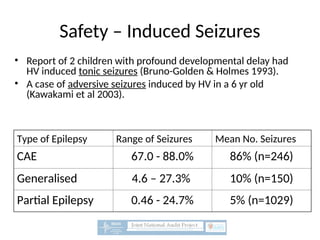
Safety – Induced Seizures
• Report of 2 children with profound developmental delay had
HV induced tonic seizures (Bruno-Golden & Holmes 1993).
• A case of adversive seizures induced by HV in a 6 yr old
(Kawakami et al 2003).
Type of Epilepsy Range of Seizures Mean No. Seizures
CAE 67.0 - 88.0% 86% (n=246)
Generalised 4.6 – 27.3% 10% (n=150)
Partial Epilepsy 0.46 - 24.7% 5% (n=1029)
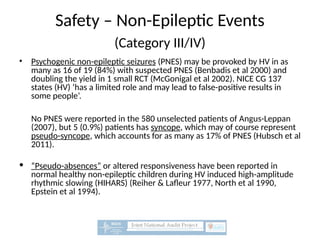
Safety – Non-Epileptic Events
(Category III/IV)
• Psychogenic non-epileptic seizures (PNES) may be provoked by HV in as
many as 16 of 19 (84%) with suspected PNES (Benbadis et al 2000) and
doubling the yield in 1 small RCT (McGonigal et al 2002). NICE CG 137
states (HV) ‘has a limited role and may lead to false-positive results in
some people’.
No PNES were reported in the 580 unselected patients of Angus-Leppan
(2007), but 5 (0.9%) patients has syncope, which may of course represent
pseudo-syncope, which accounts for as many as 17% of PNES (Hubsch et al
2011).
• “Pseudo-absences” or altered responsiveness have been reported in
normal healthy non-epileptic children during HV induced high-amplitude
rhythmic slowing (HIHARS) (Reiher & Lafleur 1977, North et al 1990,
Epstein et al 1994).
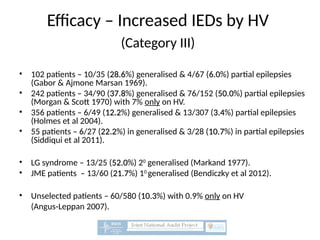
Efficacy – Increased IEDs by HV
(Category III)
• 102 patients – 10/35 (28.6
28.6%) generalised & 4/67 (6.0
6.0%) partial epilepsies
(Gabor & Ajmone Marsan 1969).
• 242 patients – 34/90 (37.8
37.8%) generalised & 76/152 (50.0
50.0%) partial epilepsies
(Morgan & Scott 1970) with 7% only on HV.
• 356 patients – 6/49 (12.2
12.2%) generalised & 13/307 (3.4
3.4%) partial epilepsies
(Holmes et al 2004).
• 55 patients – 6/27 (22.2
22.2%) in generalised & 3/28 (10.7
10.7%) in partial epilepsies
(Siddiqui et al 2011).
• LG syndrome – 13/25 (52.0
52.0%) 20
generalised (Markand 1977).
• JME patients – 13/60 (21.7
21.7%) 10
generalised (Bendiczky et al 2012).
• Unselected patients – 60/580 (10.3
10.3%) with 0.9% only on HV
(Angus-Leppan 2007).
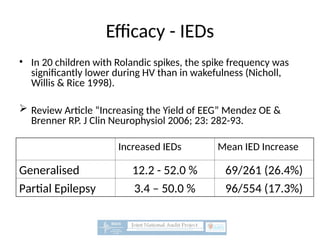
Efficacy - IEDs
Increased IEDs Mean IED Increase
Generalised 12.2 - 52.0 % 69/261 (26.4%)
Partial Epilepsy 3.4 – 50.0 % 96/554 (17.3%)
• In 20 children with Rolandic spikes, the spike frequency was
significantly lower during HV than in wakefulness (Nicholl,
Willis & Rice 1998).
 Review Article “Increasing the Yield of EEG” Mendez OE &
Brenner RP. J Clin Neurophysiol 2006; 23: 282-93.
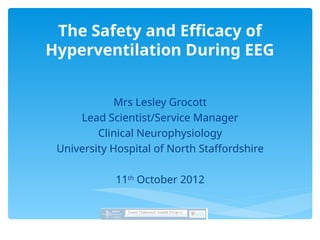
Summary
 There is NO evidence based, universally agreed
protocol on duration of HV, or the time to record
thereafter. There is some experimental evidence that
3 minutes of HV may not be sufficient.
 Hyperventilation is not associated with clinically
significant adverse events except in Sickle Cell
Disease (or Trait) and coronary artery disease, and
theoretically after a recent stroke or SAH.
 Effect of Hyperventilation in the Epilepsies depends
upon their Classification, but appears more likely to
‘activate’ both Seizures and IEDs in the generalised
epilepsies (especially CAE).
The Safety and Efficacy of
Hyperventilation During EEG
Mrs Lesley Grocott
Lead Scientist/Service Manager
Clinical Neurophysiology
University Hospital of North Staffordshire
11th
October 2012
 History of practice and NICE
 Effectiveness as an add on procedure?
 Is it more effective in one age group than
another?
 Is it safe?
 Contraindications
 Possible outcomes & consent processes
Why did we choose to do the HV
Audit?
 The methodology
 Sharing of results and data
 Discussion session and way forward
 Recommendations and national guidelines
The Safety and Efficacy of
Hyperventilation During EEG
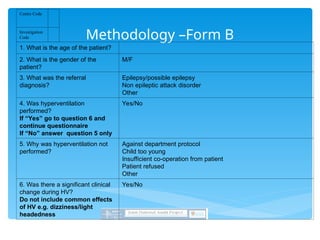
Methodology –Form B
Centre Code
Investigation
Code
1. What is the age of the patient?
2. What is the gender of the
patient?
M/F
3. What was the referral
diagnosis?
Epilepsy/possible epilepsy
Non epileptic attack disorder
Other
4. Was hyperventilation
performed?
If “Yes” go to question 6 and
continue questionnaire
If “No” answer question 5 only
Yes/No
5. Why was hyperventilation not
performed?
Against department protocol
Child too young
Insufficient co-operation from patient
Patient refused
Other
6. Was there a significant clinical
change during HV?
Do not include common effects
of HV e.g. dizziness/light
headedness
Yes/No
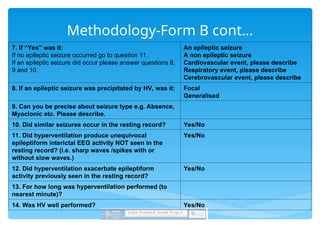
Methodology-Form B cont…
7. If “Yes” was it:
If no epileptic seizure occurred go to question 11.
If an epileptic seizure did occur please answer questions 8,
9 and 10.
An epileptic seizure
A non epileptic seizure
Cardiovascular event, please describe
Respiratory event, please describe
Cerebrovascular event, please describe
8. If an epileptic seizure was precipitated by HV, was it: Focal
Generalised
9. Can you be precise about seizure type e.g. Absence,
Myoclonic etc. Please describe.
10. Did similar seizures occur in the resting record? Yes/No
11. Did hyperventilation produce unequivocal
epileptiform interictal EEG activity NOT seen in the
resting record? (i.e. sharp waves /spikes with or
without slow waves.)
Yes/No
12. Did hyperventilation exacerbate epileptiform
activity previously seen in the resting record?
Yes/No
13. For how long was hyperventilation performed (to
nearest minute)?
14. Was HV well performed? Yes/No
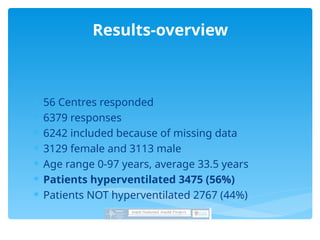
 56 Centres responded
 6379 responses
 6242 included because of missing data
 3129 female and 3113 male
 Age range 0-97 years, average 33.5 years
 Patients hyperventilated 3475 (56%)
 Patients NOT hyperventilated 2767 (44%)
Results-overview
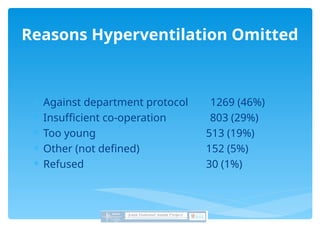
 Against department protocol 1269 (46%)
 Insufficient co-operation 803 (29%)
 Too young 513 (19%)
 Other (not defined) 152 (5%)
 Refused 30 (1%)
Reasons Hyperventilation Omitted
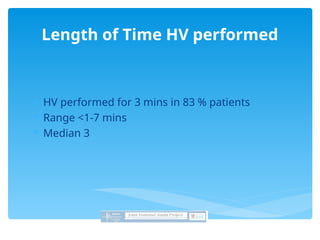
 HV performed for 3 mins in 83 % patients
 Range <1-7 mins
 Median 3
Length of Time HV performed
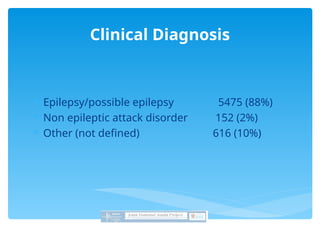
 Epilepsy/possible epilepsy 5475 (88%)
 Non epileptic attack disorder 152 (2%)
 Other (not defined) 616 (10%)
Clinical Diagnosis
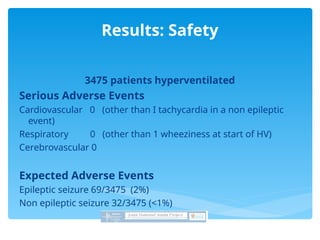
3475 patients hyperventilated
Serious Adverse Events
Cardiovascular 0 (other than I tachycardia in a non epileptic
event)
Respiratory 0 (other than 1 wheeziness at start of HV)
Cerebrovascular 0
Expected Adverse Events
Epileptic seizure 69/3475 (2%)
Non epileptic seizure 32/3475 (<1%)
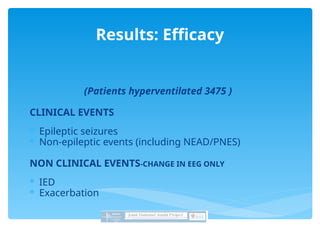
Results: Safety
(Patients hyperventilated 3475 )
CLINICAL EVENTS
 Epileptic seizures
 Non-epileptic events (including NEAD/PNES)
NON CLINICAL EVENTS-CHANGE IN EEG ONLY
 IED
 Exacerbation
Results: Efficacy
National Hyperventilation
Audit
Analysis of Results Categories by Decade
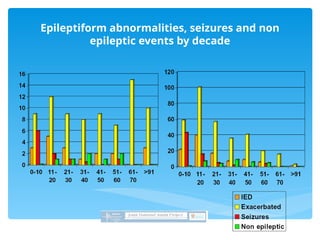
Epileptiform abnormalities, seizures and non
epileptic events by decade
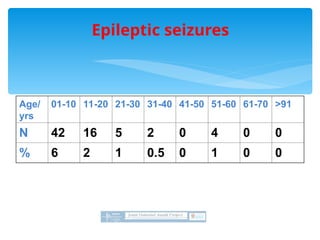
Epileptic seizures
Age/
yrs
01-10 11-20 21-30 31-40 41-50 51-60 61-70 >91
N 42 16 5 2 0 4 0 0
% 6 2 1 0.5 0 1 0 0
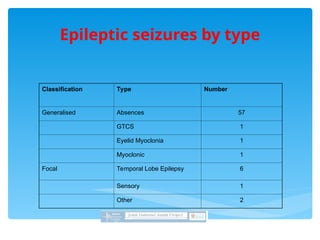
Classification Type Number
Generalised Absences 57
GTCS 1
Eyelid Myoclonia 1
Myoclonic 1
Focal Temporal Lobe Epilepsy 6
Sensory 1
Other 2
Epileptic seizures by type
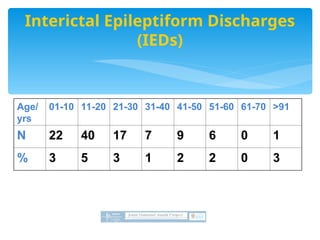
Interictal Epileptiform Discharges
(IEDs)
Age/
yrs
01-10 11-20 21-30 31-40 41-50 51-60 61-70 >91
N 22 40 17 7 9 6 0 1
% 3 5 3 1 2 2 0 3
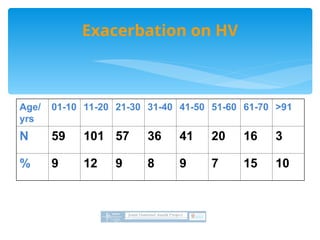
Exacerbation on HV
Age/
yrs
01-10 11-20 21-30 31-40 41-50 51-60 61-70 >91
N 59 101 57 36 41 20 16 3
% 9 12 9 8 9 7 15 10
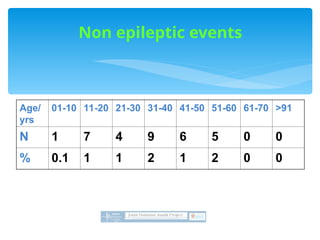
Non epileptic events
Age/
yrs
01-10 11-20 21-30 31-40 41-50 51-60 61-70 >91
N 1 7 4 9 6 5 0 0
% 0.1 1 1 2 1 2 0 0
 Hyperventilation is safe (no significant complications in 3475), though
it does carry a risk in inducing seizures and we have a duty to inform
the patients of this as part of the consent process.
 The yield of clinical seizures in the ? Epilepsy group is 2.2% (69/3170)
which is more than a two foldincrease over the 29 seizures occurring
in the resting record 1% (29/3170)
 HV increases the yield of IEDs 102/3475 (3%)
 HV insignificant induction of non epileptic events 32/3475 (<1%)
 The yield of those with a provisional diagnosis of NEAD displaying
symptoms of a typical attack during the EEG is around 10%
 Exacerbation of IEDs occurred in 323/3170 (10%) of patients
undergoing HV
Conclusions
HV in over 61 year old patients (n=135)
 No increase in adverse events was seen in those
patients later in life and so no exclusion is warranted in
elderly patients.
 Only 1% of over 60 yr olds showed IEDs not in the
resting record
 But 14% of 60 yr olds showed exacerbation of IEDs
 10% of over 91 yr olds showed exacerbation of IEDs
Conclusion 2
 There is no increase in adverse events in later life
and therefore the current practice, in some centres,
of excluding these patients, may be unwarranted.
(Most seizures occur at less than 20 yrs age)
 This gives us additional information to aid
diagnosis and management.
Recommendations
 Develop national guidelines/ minimum standards
to audit against
 Standardisation required for trainees, quality
standards etc
 Consent issues re driving etc (point in the pathway)
 ECG abnormalities-recognition and action
Recommendations
ANS/BSCN Proposal for Guidelines
for Hyperventilation During EEG
Recording
 PRACTICE:
 Three levels of practice are identified:
 Standards – represent the minimum that must be achieved in all cases
 Guidelines – suggestions that may be helpful in some clinical circumstances
 Standard 1 Hyperventilation (HV) should be performed for 3 to 5 minutes in
room air with a respiratory rate of 20 to 30 breaths per minute, with the patient’s
informed consent (or that of the parent or carer), and the EEG recording
continued for at least 3 minutes afterwards.
 Guideline Repeat or even prolonged HV may be undertaken if clinically
indicated (e.g. to induce seizures in a patient strongly suspected of having
absences but who’s initial HV is unremarkable, or a patient undergoing video-EEG
monitoring for medically intractable epilepsy but not having any clinical seizures).
 Standard 2 Qualitatively assess the patient’s HV effort (e.g. poor, moderate
or good), bearing in mind that the technique may need to be modified according
to the patient’s age and ability to undertake the procedure. Children may need
help and encouragement to perform HV, with the use of toy windmills or balloons
for example.
 Guideline Measure the patient’s effort quantitatively (e.g.
plethysmography).
ANS/BSCN Proposal for Guidelines
for Hyperventilation During EEG
Recording
 Standard 3 Monitor the procedure continuously: document and
describe any effects of HV on the condition of the patient, i.e. seizures, non-
epileptic attacks or events, and be prepared to manage them.
 Guideline In certain circumstances it may be valid to use HV as a
provocation procedure to induce a non-epileptic attack or psychogenic
non-epileptic seizure (formerly known as pseudoseizures).
 Standard 4 Contemporaneously record a single lead ECG during HV
and anticipate mild tachycardia, but stop HV if patient experiences chest
pain, ST segment changes or other rhythm disturbances occur on the ECG.
 Standard 5 Absolute contraindications to HV include: recent stroke
(intracranial haemorrhage and SAH) or myocardial infarction (MI),
significant cardiac (i.e. angina) or pulmonary (i.e. COPD) disease, sickle cell
disease or trait.
 Relative contraindications to HV include known stable cerebro-
vascular disease, asthma and Moya-Moya disease, where a risk benefit
analysi should be undertaken with the patient’s involvement and consent.
Acknowledgements
Members of the BSCN/ANS audit team & their
depts
Dr Chris Fisher, Consultant Clinical
Neurophysiologist
Staff at the National Hospital for Neurosurgery
Queens Square
Questions and Discussions

Hyperventilation syndrome in the adults

  • 1.
    The Safety andEfficacy of Hyperventilation During EEG a National Service Evaluation Review of the safety survey
  • 2.
  • 3.
    Methodology • 63 formswere sent out • 56 completed & returned from all areas of the country from Plymouth to Inverness (response rate of 89%)
  • 4.
    FORM A :Please complete once only for each department Postcode of Centre (Please complete) 1.Do you use published guidelines for safety of Hyperventilation? Yes/No 2. If so please give reference 3. Do you use a local protocol for safety of Hyperventilation? Yes/No 4. If so please attach copy Attached/not applicable 5.Have you performed a local or regional audit on this topic? Yes/No 6. If so please provide a summary and main recommendations. 7. Can you remember any adverse events that occurred during Hyperventilation regardless of how long ago they may have occurred? Yes/No 8. If so, please give details and has there been a change in clinical practice as a result?
  • 5.
  • 6.
  • 7.
    Do you usepublished guidelines for safety of hyperventilation? Yes=11, No=45 RELEVANT TO SAFETY NOT RELEVANT TO SAFETY •NICE 2004/2006 •Increasing the yield of EEG (Mendez, O. et al, 2006, Journal of Clinical Neurophysiology) •Clinical Neurophysiology: volume 2 EEG Paediatric Neurophysiology: Special Techniques and Applications (Binnie, C. et al 2003) •Fundamentals of EEG technology: Basic concepts and methods (Fay, S. et al 1983) •Atlas of Electroencephalography: volume 1 EEG awake and sleep EEG activation procedures and artefacts (Crespel, A. et al 2005) •ACSN Guideline One: Minimum Technical Requirements for Performing Clinical Electroencephalography •Guidelines for the use of EEG methodology in the diagnosis of epilepsy (Flink, R. et al, 2002, Acta Neurol Scand 106) •Effect of hyperventilation on seizure activation: potentiation by antiepileptic drug tapering (Jonas, J. et al, 2011, Journal of Neurology, Neurosurgery and Psychiatry 82) •BSCN •Electroencephalography; basic principles, clinical applications and related fields (Niedermeyer, E. et al 1981)
  • 8.
    From the relevant literature contraindications Severe cardiacor pulmonary disease, recent myocardial infarction or stroke, intracranial haemorrhage, sickle cell anaemia, uncontrolled hypertension, Moya Moya disease, advanced pregnancy, old age……… age Patients above 65 years old should be contraindicated, the developmental age of the patient has a great bearing on the hyperventilation procedure but patients as young as 2 years old can be persuaded side effects Hyperventilation syndrome, tetany, fainting, distress, shivering, inability to stop overbreathing, tiredness, finger and/or peribuccal paresthesias, anxiety attacks reasons to terminate Significantly abnormal heart beat, patient does not feel good, acute event, any marked EEG abnormality Procedure should only be carried out with informed consent, patients have the right to refuse consent
  • 9.
    Do you usea local protocol for the safety of hyperventilation? Yes = 47, No = 6 (3 under revision) • What percentage of the centres mentioned the following sub headings in their protocols? contraindications 78% age 70% consent 58% possible side effects 22% reasons to terminate HV 18%
  • 10.
    Age specifications forhyperventilation 0 2 4 6 8 10 12 14 16 18 20 Upper age limits according to protocols Number of centres
  • 11.
  • 12.
    Possible side effectsmentioned in the protocols 0 2 4 6 8 10 12 Possible side effects Number of centres
  • 14.
  • 15.
    Have you performeda local or regional audit on this topic? Yes =7, No = 49 • 5 of the audits were not related to safety or efficacy • 2 of the audits were applicable and both relating to age limitations “HV did not provide any additional information in patients above 60 years old age and therefore patients above this age to not have any activation techniques performed during their standard EEG” “HV found not to be very useful in the elderly but no less useful than in other adults over the age of 30. The only group where HV contributed significantly to diagnoses was in children and young adults. Recommendation was to continue to HV all patients regardless of age”
  • 16.
    Can you rememberany adverse events that occurred during hyperventilation regardless of how long ago they may have occurred? Yes = 6, No = 50 • Out of the 6 reporting they could, 5 were not considered to be adverse as they were expected outcomes of the procedure (seizures/auras/difficulty stopping over- breathing) • 1 was an unpredictable event (syncope – bradycardia and asystole) and therefore considered to be truly adverse
  • 17.
  • 18.
    Summaries & Conclusions •Very few departments (20%) use published guidelines for the safety of hyperventilation and of these, only 1 was referenced • Most departments (84%) have safety protocols focusing on areas such as age limitations, contraindications and consent • Where age limitations are mentioned, a limit of 65 years is the one most commonly enforced (42%) • The most frequent contraindications mentioned are cerebrovascular disease, cardiovascular disease and respiratory disease • Only 1 memory from the vast experience across the departments over the years suggests a truly adverse event
  • 19.
    Continued… • Anecdotally, HVappears to be a safe procedure however the second part of this audit will provide an evidence base for this • There are wide variations in protocols and many are not based on published guidelines. • The next talk will provide details of the published literature that we could use to try and standardise our protocols and procedures
  • 20.
    Literature Review • PhysiologicalEffects of Hyperventilation (aka Overbreathing or Hyperpnœa). • Historical Perspective. • Safety Issues: – Adverse CVS, Respiratory and CNS events (including Seizures & NEAD/PNES). • Efficacy: – Interictal Epileptiform Discharges (IEDs).
  • 21.
    And Now SomeBreaths Stop CO2 Narcosis
  • 22.
    Physiological Effects 1. ↓PCO2Hypocapnia → Vasoconstriction → Cerebral Ischaemic Anoxia → EEG slowing (Meyer & Gotoh 1960). HV → Respiratory Alkalosis → Shift in oxygen dissociation curve (Bohr effect) & Lowering of ionized calcium. 2. Recent experimental data has questioned the “Anoxia/Hypoxia Theory” and alternative explanations include an “awake-sleep transitory state” (Patel & Maulsby 1987) or a subcortical mechanism (Hoshi et al 1999). 3. Other potential (‘epileptogenic’) effects include changes in excitability of cortical neuronal pathways – as shown by negative DC shifts (Rockstroth 1990) and TMS in the corticospinal system (Seyal et al 1998). 4. Few attempts to standardize HV technique, but based on maximal EEG slowing in children: 4 mins at RR of 30/min. and VE of 3x (Konishi 1987). Also blood gas changes AFTER 3 mins HV reach nadir for PO2 at 5 mins. and recovery for PCO2 at 7mins. (Achenbach et al 1994).
  • 23.
    Historical Perspective • 1924Otfrid Foerster and Joshua Rosett independently report induction of (partial) seizures by HV. – 26 yr male whose “left upper limb was suddenly thrown into a violent spasm” after 8 minutes of HV. • 1934 Hans Berger describes a seizure provoked by HV during an EEG. – 21 yr woman with “genuine epilepsy suddenly stopped hyperventilation, associated with a reduction in amplitude of the background frequencies and a loss of responsiveness, and shortly thereafter a seizure developed”. • 1935 Fred Gibbs, Hallowell Davis and William Lennox demonstrated for the first time 3 Hz spike wave pattern of ‘Petit Mal’ (absence epilepsy). – “Over ventilation produces large slow waves in normal subjects, also tends to precipitate seizures in epileptic persons. The differences in wave pattern, notably the characteristic form of the EEG in petit mal (“egg and dart”), made it possible to distinguish between simple loss of consciousness and a seizure”.
  • 24.
    Safety – Methodologyand Definition • Medline (search terms: hyperventilation complications, side effects = >2,300 articles). Standard textbooks. Guidelines finder. • Adverse Events are defined as “an incident or occurrence from which potential or actual harm resulted to a person receiving health care” (Stevens 1986). Adverse Events: cardiovascular, respiratory, CNS – cerebrovascular, seizures, non-epileptic events.
  • 25.
    Safety – StandardTextbooks  Kiloh L & Osselton J. Clinical EEG 1961  Hill J & Parr G. EEG 1963  Cooper R, Osselton J, Shaw J. EEG Technology 1974  Klass DW & Daly D. Current Practice of Clinical EEG 1979 (Guideline One)  Hughes J. EEG in Clinical Practice 1982  Niedermeyer E & Lopes Da Silva F. EEG Basic principles 1993  Fisch B & Spehlmann’s EEG Primer 1999  L Lü üders H & Noachtar S. Epileptic Seizures (Drury I. Activation of ders H & Noachtar S. Epileptic Seizures (Drury I. Activation of seizures by HV). 2000 seizures by HV). 2000** (Review)  Crespel A. & Gélisse P. Atlas of EEG 2005  Cooper R, Binnie C, Billings R. Techniques in Clinical Neurophysiology Cooper R, Binnie C, Billings R. Techniques in Clinical Neurophysiology 2005* 2005* (Practical Manual)
  • 26.
    Safety - “Contraindicationsto HV” Category IV evidence ~ Expert Opinions 1. Diseases of heart and lungs a d 2. Sickle cell disease (or trait) a c d 3. Moyamoya disease a d 4. Acute cerebral disorders a 5. Cerebrovascular diseases associated with borderline cerebral perfusion a b c d 6. Age above 65 years b d 7. Raised intracranial pressure b d 8. Recent myocardial infarction c 9. Hyperviscosity states c 10. Uncontrolled hypertension c (a) Spehlmann’s EEG Primer (1999) (b) Cooper, Binnie, Billings. Techniques in Clinical Neurophysiology (2005) (c) Lüders and Noachter. Epileptic Seizures (2000) (d) Crespel A. & Gélisse P. Atlas of EEG 2005
  • 27.
    Safety – “EvidenceBased Guidelines” 1. AEEGS 1970/71 & 1986 Minimum Technical requirements for performing Clinical EEG (Guideline One). Overbreathing should be used routinely unless some medical or other justifiable reasons contraindicate it (e.g. recent SAH, intracranial hemorrhage, or significant cardio-pulmonary disease). (>3m >1m) 2. ILAE 2002 Guidelines for use of EEG methodology in the diagnosis of epilepsy. A standard EEG should aim to include Hyperventilation. HV depends on the developmental age, and level of co-operation of the child and the experience of the staff. Photic stimulation should not be performed during HV. (3m >2m) 3. NICE CG 2004 & 2012 The epilepsies: the diagnosis and management of the epilepsies in... CG 20 Use standard EEG with photic stimulation and hyperventilation, with informed consent. CG 137 Photic stimulation and hyperventilation should remain part of standard EEG assessment. The child, young person or adult and family and/or carer should be made aware that such activation procedures may induce a seizure and they have a right to refuse.
  • 28.
    Safety – CardiovascularEvents elicited by HV (Category II & IV) • Complications in 1000 treadmill tests with HV were reported in 18 patients with CAD (1.8%); asystole, complete SA block, atrial flutter, hypotension and severe angina (Malani et al 1993). “TMT is a safe procedure if carried out after proper patient selection and under supervision of an experienced team”. • Coronary artery spasm with ST segment changes in 127 of 206 angina patients (62%) after 6 m. HV. No reported adverse events (Nakao et al 1997). • Acute Myocardial Infarction due to coronary vasospasm in a patient associated with HV (Chelmowski & Keelan 1988). • Acute Myocardial Infarction in a patient following ‘HV test’ at coronary angiography (Fragasso et al 1989). • Asystole with syncope secondary to hyperventilation in 3 young athletes (Buja et al 1989). “Vagal mechanism”.
  • 29.
    Safety – RespiratoryEvents induced by HV (Category II & IV) • Post hyperventilation Apnoea reported in 191 of 1060 patients (18%) – no significant clinical sequelae (Mangin, Krieger & Kurtz 1982). Case report of 14 yr with # mandible post HV apnoea with severe hypoxemia (MacDonald et al 1976). • Post hyperventilation ‘hyperventilation syndrome’ – breathing in excess of metabolic requirements (a physiological, psychological or psychiatric condition) can occur in asthma, chronic bronchitis, emphysema and PE. Symptoms include giddiness/dizziness, ataxia, blurred vision, headache, paraesthesiae, panic/anxiety, chest pain, visual hallucinations, tetany, cognitive dysfunction and syncope (Perkin & Joseph 1986, Lum 1987, and Gardner 1990). • Post hyperventilation Asthma – HV reduces pCO2 which promotes reflex bronchospasm (Barnes et al 1981, Hull 2012– personal communication). • Published Guidelines for Asthma and COPD give no advice about HV.
  • 30.
    Safety – CNScerebrovascular Events (Category IV) • Sickle cell disease and Trait (SCD) – Fatal cerebellar infarction caused by aspirin induced HV (Arnow 1978). – CVA due to HV in a patient with SCD during EEG recording (Fatunde et al 2000). – Stroke in Children with SCD during HV EEG review of literature revealed 3 case reports of 4 children with persistent hemi-paresis (Millichap 2006). • Moyamoya – “Re-build up” described in over half of 25 children with pre-existent neurological deficits but no new post HV other than transient confusion (Kodama et al 1979). – Significant reduction of oxygenated Hb detected by NIRS during EEG re-build up in 5 patients without neurological sequelae (Itoh et al 1994). – Transient Ischaemic Attacks (TIA) in 2 children during HV with EEG re-build up phenomena associated with hypoxia on NIRS (Kuroda et al 1996). – Literature review by Kuroda and Houkin (2008) mention “HV induced ischaemic attacks”….. but also describe “distinctive pattern on EEG in children”. – TIA case report of 6 year old crying for 15 minutes during VEEG causing marked truncal ataxia and right sided weakness with EEG slowing over left parietal region (Diamini et al 2009).
  • 31.
    Safety – HVInduced Seizures (Category III) • “Petit Mal” in 205 of 234 patients (88 88%) 3/s S&W not in resting record (Dalby 1969). • Childhood Absence seizures in 8 of 12 (67 67%) newly diagnosed absences, each with their own critical pCO2 from 19-25 mmHg(Wirrell et al 1996). • Complex Partial seizures in 11 of 255 (4.3 4.3%) with >3 m. HV (Miley & Forster 1977). • Complex Partial seizures in 2 of 433 (0.46 0.46%) with proven epilepsy (89% partial & 11% generalised) with 5 m. HV (Holmes et al 2004). • Partial onset seizures in 24 of 97 (24.7 24.7%) medically intractable focal epilepsies after AED↓ with 5 m. HV repeated 3 hourly. “Proved safe” (Guaranha et al 2005). • Partial onset seizures in 6 of 54 (11 11%) localisation related epilepsies after AED↓ with 3 m. HV. Rate of HV seizure induction is 6x more than without HV. (Arain et al 2009). • 1o Generalised seizures in 2 of 475 (0.42 0.42%) patients with epilepsy (79% partial & 21% generalised) with 3 m. HV (Abubakr et al 2010). • Partial onset seizures in 14 of 80 (17.5 17.5%) medically intractable epilepsies after AED↓ with 6 m. HV performed hourly. (Jonas et al 2011). • Seizures in 12 of 580 (2.1 2.1%) after 3 m. HV in 1000 unselected patients for EEG {22 IGE patients 6 (27.3%)}. (Angus-Leppan 2007; EEG Clin. Neurophysiol. 118: 22-30).
  • 32.
    Safety – InducedSeizures • Report of 2 children with profound developmental delay had HV induced tonic seizures (Bruno-Golden & Holmes 1993). • A case of adversive seizures induced by HV in a 6 yr old (Kawakami et al 2003). Type of Epilepsy Range of Seizures Mean No. Seizures CAE 67.0 - 88.0% 86% (n=246) Generalised 4.6 – 27.3% 10% (n=150) Partial Epilepsy 0.46 - 24.7% 5% (n=1029)
  • 33.
    Safety – Non-EpilepticEvents (Category III/IV) • Psychogenic non-epileptic seizures (PNES) may be provoked by HV in as many as 16 of 19 (84%) with suspected PNES (Benbadis et al 2000) and doubling the yield in 1 small RCT (McGonigal et al 2002). NICE CG 137 states (HV) ‘has a limited role and may lead to false-positive results in some people’. No PNES were reported in the 580 unselected patients of Angus-Leppan (2007), but 5 (0.9%) patients has syncope, which may of course represent pseudo-syncope, which accounts for as many as 17% of PNES (Hubsch et al 2011). • “Pseudo-absences” or altered responsiveness have been reported in normal healthy non-epileptic children during HV induced high-amplitude rhythmic slowing (HIHARS) (Reiher & Lafleur 1977, North et al 1990, Epstein et al 1994).
  • 34.
    Efficacy – IncreasedIEDs by HV (Category III) • 102 patients – 10/35 (28.6 28.6%) generalised & 4/67 (6.0 6.0%) partial epilepsies (Gabor & Ajmone Marsan 1969). • 242 patients – 34/90 (37.8 37.8%) generalised & 76/152 (50.0 50.0%) partial epilepsies (Morgan & Scott 1970) with 7% only on HV. • 356 patients – 6/49 (12.2 12.2%) generalised & 13/307 (3.4 3.4%) partial epilepsies (Holmes et al 2004). • 55 patients – 6/27 (22.2 22.2%) in generalised & 3/28 (10.7 10.7%) in partial epilepsies (Siddiqui et al 2011). • LG syndrome – 13/25 (52.0 52.0%) 20 generalised (Markand 1977). • JME patients – 13/60 (21.7 21.7%) 10 generalised (Bendiczky et al 2012). • Unselected patients – 60/580 (10.3 10.3%) with 0.9% only on HV (Angus-Leppan 2007).
  • 35.
    Efficacy - IEDs IncreasedIEDs Mean IED Increase Generalised 12.2 - 52.0 % 69/261 (26.4%) Partial Epilepsy 3.4 – 50.0 % 96/554 (17.3%) • In 20 children with Rolandic spikes, the spike frequency was significantly lower during HV than in wakefulness (Nicholl, Willis & Rice 1998).  Review Article “Increasing the Yield of EEG” Mendez OE & Brenner RP. J Clin Neurophysiol 2006; 23: 282-93.
  • 36.
    Summary  There isNO evidence based, universally agreed protocol on duration of HV, or the time to record thereafter. There is some experimental evidence that 3 minutes of HV may not be sufficient.  Hyperventilation is not associated with clinically significant adverse events except in Sickle Cell Disease (or Trait) and coronary artery disease, and theoretically after a recent stroke or SAH.  Effect of Hyperventilation in the Epilepsies depends upon their Classification, but appears more likely to ‘activate’ both Seizures and IEDs in the generalised epilepsies (especially CAE).
  • 37.
    The Safety andEfficacy of Hyperventilation During EEG Mrs Lesley Grocott Lead Scientist/Service Manager Clinical Neurophysiology University Hospital of North Staffordshire 11th October 2012
  • 38.
     History ofpractice and NICE  Effectiveness as an add on procedure?  Is it more effective in one age group than another?  Is it safe?  Contraindications  Possible outcomes & consent processes Why did we choose to do the HV Audit?
  • 39.
     The methodology Sharing of results and data  Discussion session and way forward  Recommendations and national guidelines The Safety and Efficacy of Hyperventilation During EEG
  • 40.
    Methodology –Form B CentreCode Investigation Code 1. What is the age of the patient? 2. What is the gender of the patient? M/F 3. What was the referral diagnosis? Epilepsy/possible epilepsy Non epileptic attack disorder Other 4. Was hyperventilation performed? If “Yes” go to question 6 and continue questionnaire If “No” answer question 5 only Yes/No 5. Why was hyperventilation not performed? Against department protocol Child too young Insufficient co-operation from patient Patient refused Other 6. Was there a significant clinical change during HV? Do not include common effects of HV e.g. dizziness/light headedness Yes/No
  • 41.
    Methodology-Form B cont… 7.If “Yes” was it: If no epileptic seizure occurred go to question 11. If an epileptic seizure did occur please answer questions 8, 9 and 10. An epileptic seizure A non epileptic seizure Cardiovascular event, please describe Respiratory event, please describe Cerebrovascular event, please describe 8. If an epileptic seizure was precipitated by HV, was it: Focal Generalised 9. Can you be precise about seizure type e.g. Absence, Myoclonic etc. Please describe. 10. Did similar seizures occur in the resting record? Yes/No 11. Did hyperventilation produce unequivocal epileptiform interictal EEG activity NOT seen in the resting record? (i.e. sharp waves /spikes with or without slow waves.) Yes/No 12. Did hyperventilation exacerbate epileptiform activity previously seen in the resting record? Yes/No 13. For how long was hyperventilation performed (to nearest minute)? 14. Was HV well performed? Yes/No
  • 42.
     56 Centresresponded  6379 responses  6242 included because of missing data  3129 female and 3113 male  Age range 0-97 years, average 33.5 years  Patients hyperventilated 3475 (56%)  Patients NOT hyperventilated 2767 (44%) Results-overview
  • 43.
     Against departmentprotocol 1269 (46%)  Insufficient co-operation 803 (29%)  Too young 513 (19%)  Other (not defined) 152 (5%)  Refused 30 (1%) Reasons Hyperventilation Omitted
  • 44.
     HV performedfor 3 mins in 83 % patients  Range <1-7 mins  Median 3 Length of Time HV performed
  • 45.
     Epilepsy/possible epilepsy5475 (88%)  Non epileptic attack disorder 152 (2%)  Other (not defined) 616 (10%) Clinical Diagnosis
  • 46.
    3475 patients hyperventilated SeriousAdverse Events Cardiovascular 0 (other than I tachycardia in a non epileptic event) Respiratory 0 (other than 1 wheeziness at start of HV) Cerebrovascular 0 Expected Adverse Events Epileptic seizure 69/3475 (2%) Non epileptic seizure 32/3475 (<1%) Results: Safety
  • 47.
    (Patients hyperventilated 3475) CLINICAL EVENTS  Epileptic seizures  Non-epileptic events (including NEAD/PNES) NON CLINICAL EVENTS-CHANGE IN EEG ONLY  IED  Exacerbation Results: Efficacy
  • 48.
    National Hyperventilation Audit Analysis ofResults Categories by Decade
  • 49.
    Epileptiform abnormalities, seizuresand non epileptic events by decade
  • 50.
    Epileptic seizures Age/ yrs 01-10 11-2021-30 31-40 41-50 51-60 61-70 >91 N 42 16 5 2 0 4 0 0 % 6 2 1 0.5 0 1 0 0
  • 51.
    Classification Type Number GeneralisedAbsences 57 GTCS 1 Eyelid Myoclonia 1 Myoclonic 1 Focal Temporal Lobe Epilepsy 6 Sensory 1 Other 2 Epileptic seizures by type
  • 52.
    Interictal Epileptiform Discharges (IEDs) Age/ yrs 01-1011-20 21-30 31-40 41-50 51-60 61-70 >91 N 22 40 17 7 9 6 0 1 % 3 5 3 1 2 2 0 3
  • 53.
    Exacerbation on HV Age/ yrs 01-1011-20 21-30 31-40 41-50 51-60 61-70 >91 N 59 101 57 36 41 20 16 3 % 9 12 9 8 9 7 15 10
  • 54.
    Non epileptic events Age/ yrs 01-1011-20 21-30 31-40 41-50 51-60 61-70 >91 N 1 7 4 9 6 5 0 0 % 0.1 1 1 2 1 2 0 0
  • 55.
     Hyperventilation issafe (no significant complications in 3475), though it does carry a risk in inducing seizures and we have a duty to inform the patients of this as part of the consent process.  The yield of clinical seizures in the ? Epilepsy group is 2.2% (69/3170) which is more than a two foldincrease over the 29 seizures occurring in the resting record 1% (29/3170)  HV increases the yield of IEDs 102/3475 (3%)  HV insignificant induction of non epileptic events 32/3475 (<1%)  The yield of those with a provisional diagnosis of NEAD displaying symptoms of a typical attack during the EEG is around 10%  Exacerbation of IEDs occurred in 323/3170 (10%) of patients undergoing HV Conclusions
  • 56.
    HV in over61 year old patients (n=135)  No increase in adverse events was seen in those patients later in life and so no exclusion is warranted in elderly patients.  Only 1% of over 60 yr olds showed IEDs not in the resting record  But 14% of 60 yr olds showed exacerbation of IEDs  10% of over 91 yr olds showed exacerbation of IEDs Conclusion 2
  • 57.
     There isno increase in adverse events in later life and therefore the current practice, in some centres, of excluding these patients, may be unwarranted. (Most seizures occur at less than 20 yrs age)  This gives us additional information to aid diagnosis and management. Recommendations
  • 58.
     Develop nationalguidelines/ minimum standards to audit against  Standardisation required for trainees, quality standards etc  Consent issues re driving etc (point in the pathway)  ECG abnormalities-recognition and action Recommendations
  • 59.
    ANS/BSCN Proposal forGuidelines for Hyperventilation During EEG Recording  PRACTICE:  Three levels of practice are identified:  Standards – represent the minimum that must be achieved in all cases  Guidelines – suggestions that may be helpful in some clinical circumstances  Standard 1 Hyperventilation (HV) should be performed for 3 to 5 minutes in room air with a respiratory rate of 20 to 30 breaths per minute, with the patient’s informed consent (or that of the parent or carer), and the EEG recording continued for at least 3 minutes afterwards.  Guideline Repeat or even prolonged HV may be undertaken if clinically indicated (e.g. to induce seizures in a patient strongly suspected of having absences but who’s initial HV is unremarkable, or a patient undergoing video-EEG monitoring for medically intractable epilepsy but not having any clinical seizures).  Standard 2 Qualitatively assess the patient’s HV effort (e.g. poor, moderate or good), bearing in mind that the technique may need to be modified according to the patient’s age and ability to undertake the procedure. Children may need help and encouragement to perform HV, with the use of toy windmills or balloons for example.  Guideline Measure the patient’s effort quantitatively (e.g. plethysmography).
  • 60.
    ANS/BSCN Proposal forGuidelines for Hyperventilation During EEG Recording  Standard 3 Monitor the procedure continuously: document and describe any effects of HV on the condition of the patient, i.e. seizures, non- epileptic attacks or events, and be prepared to manage them.  Guideline In certain circumstances it may be valid to use HV as a provocation procedure to induce a non-epileptic attack or psychogenic non-epileptic seizure (formerly known as pseudoseizures).  Standard 4 Contemporaneously record a single lead ECG during HV and anticipate mild tachycardia, but stop HV if patient experiences chest pain, ST segment changes or other rhythm disturbances occur on the ECG.  Standard 5 Absolute contraindications to HV include: recent stroke (intracranial haemorrhage and SAH) or myocardial infarction (MI), significant cardiac (i.e. angina) or pulmonary (i.e. COPD) disease, sickle cell disease or trait.  Relative contraindications to HV include known stable cerebro- vascular disease, asthma and Moya-Moya disease, where a risk benefit analysi should be undertaken with the patient’s involvement and consent.
  • 61.
    Acknowledgements Members of theBSCN/ANS audit team & their depts Dr Chris Fisher, Consultant Clinical Neurophysiologist Staff at the National Hospital for Neurosurgery Queens Square
  • 62.

Editor's Notes

  • #21 Bohr –ing. There’s a bit too much information.
  • #22 Patel – reduced activity in the mesencephalic reticular formation
  • #23 In 1925 Foerster presented at a Society meeting that 25/45 (55%) patients suffered seizures during HV
  • #25 Guideline 1: Mike Saunders, John Hughes, Donald Klass, Robert Maulsby, Jean Reiher.
  • #26 Category I – meta-analysis of RCTs, II – RCT or quasi-experimental study, III – non-experimental descriptive studies, IV Expert committee
  • #29 Gold standard for measuring hyperventilation is the arterial or end tidal pCO2 (transcutaneous electrode, catheter into nostril. Expansometry, ventilometry, spirometry, percutaneous non-invasive blood gas analysis.
  • #30 Lancet Neurology review by Satashi Kuroda from Sapporo
  • #31 Non-experimental descriptive studies
  • #33 McGonigal found ‘suggestion’ was more effective in pts prone to “events in medical settings”
  • #38 An activation technique used for many years. New NICE guidance on HV “ Hyperventilation is routinely employed to increase the sensitivity of an interictal EEG. Based on expert committee reports, opinions and/or clinical experience of respected authorities. No details of protocols or contraindications are mentioned. How effective is it in the diagnosis of epilepsy, particularly over and above the use of resting EEG only Is it good for just the youngsters? Any major incidents? Are our lists comprehensive ? Legalities and consent considerations
  • #39 The findings have been very informative and will be relevant to all practitioners. Some will change our preconceptions and many will confirm what we already know, and may share concern about in relation to consent etc. Our aim is to share these results with you and use the discussion session after the presentation to make some initial recommendations, which the audit group will take forward to form the basis of national guidelines/minimum standards for HV.
  • #46  Expected adverse events-none any cause for concern.
  • #47 The term “Adverse” is often used as many view NEAD and PNES as diagnostic events PNES=psychogenic non epileptic seizures-taken for the Angus Leppan study Clinical Neurophysiology 2007 Jan ;118(1):22-30. Epub 2006 Oct 6) “Seizures and Adverse Events during routine scalp electroencephalography;a clinical and EEG analysis of 1000 records” (Royal Free Hospital, London)
  • #50 Younger patients less than 10 yrs have most incidence of seizures at 6% of 1 yr to 10 yr olds (n=43) having seizures. And 2% (n=16) of 11-20 yrs olds having seizures. One would expect this due to the domination of absence seizures in particularly the first group. Over 61 yrs incidence is zero, however, up to 60 there is a yield for inducing seizures, even though at a low level.
  • #52 Peak with 11-20 yr olds 40 cases (5%) Followed by 0-10 and 21-30 yr olds at 3% so emphasis on younger age groups One patient over 90 showed a feature not present in resting record
  • #53 A significant increase in paroxysmal activity with HV over all ages, particularly juveniles (N=101 and & 12%), and perhaps surprisingly in the 61 and over age group where 19 pts showed exacerbation of activity. 333/3475 (9.65) had exacerbation of IEDs during HV. I wonder how well the over 90s performed it!!!!!
  • #54 Highest numbers in 31-40 but with 1-2% occurrence populated across most age groups. No incidence after 61 years in this data set. Examples included dizziness and vagueness (? HV syndrome), twitching calves/lip/mouth and eye lids (?tetany) typical aura
  • #55 1.2% may appear low but we must bear in mind that these are unselected patients in that many of these patients have been referred for EEG and whom do not have epilepsy anyway. This audit has yielded information which would otherwise not be available, and has been done at low risk. The incidence of seizures in HV compared to the resting record corresponds exactly to Heather Angus’Leppan’s study 4th point-HV induces non epileptic events which includes NEAD 32 includes NEAD ad NEAD means different things to different people and some of the descriptions could have been interpreted a number of ways. None of the non epileptic events caused any clinical incident or concern, as far as we are aware. All the above makes a much stronger case for the endorsement of HV as a valuable technique
  • #56 We are unlikely to send the elderly to an early grave and its gives us extra information to aid diagnosis and management to enable a better quality of life..
  • #58  Compare to CTS audit Local protocols, wide variations. Luck so far with low incidence adverse events. Invite letter Consent Consent letter in reception to read whilst wait Further opportunity for withdrawl and/or Qs Applies to Photic Stimulation also Inclusion of receipt of consent in report ECG abnormalities-when possible contraindication for HV-arrange for doctor to see first Can send for 12 lead ECG if one available on site Include this done and any findings available, in the EEG report