An Audit on The Management of
Hypertension In Newly Diagnosed
Patients
Nurdalila Sahidan
5th Year Medical Student
February 2012
Supervisor: Dr Manisha Kumar
INTRODUCTION:
HYPERTENSION
 Hypertension is a major modifiable risk factor for
cardiovascular disease which can be controlled and
monitored through good primary care practice
 1 in 4 middle-age adult in the UK have high blood pressure
 Treatment includes lifestyle changes- losing weight if you are
overweight, regular exercises, a healthy diet, stop smoking,
and a low salt and caffeine intake
 Medication can also be offered to lower the blood pressure
 The clinical management of hypertension is one of the most
common interventions in primary care, accounting for
approximately £1 billion in drug costs alone in 2006.
METHODS
 Data collection
 Newly diagnosed hypertensive patients from
December 2011 to February 2012
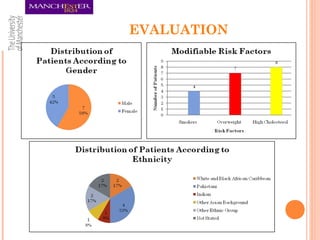
 12 cases reviewed
 Data analysis
 Based on the NICE guidance and The Quality of
Outcomes Framework (QOF)
EVALUATION
RESULTS
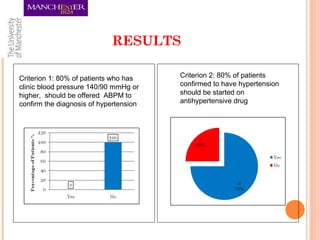
Criterion 1: 80% of patients who has
clinic blood pressure 140/90 mmHg or
higher, should be offered ABPM to
confirm the diagnosis of hypertension
Criterion 2: 80% of patients
confirmed to have hypertension
should be started on
antihypertensive drug
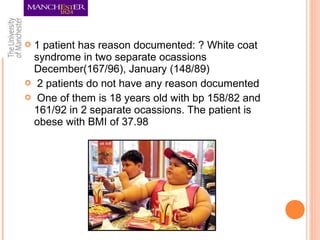
 1 patient has reason documented: ? White coat
syndrome in two separate ocassions
December(167/96), January (148/89)
 2 patients do not have any reason documented
 One of them is 18 years old with bp 158/82 and
161/92 in 2 separate ocassions. The patient is
obese with BMI of 37.98
RESULTS
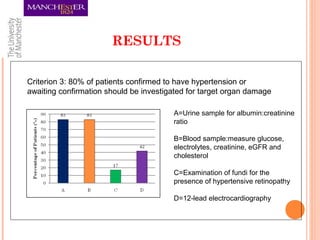
Criterion 3: 80% of patients confirmed to have hypertension or
awaiting confirmation should be investigated for target organ damage
A=Urine sample for albumin:creatinine
ratio
B=Blood sample:measure glucose,
electrolytes, creatinine, eGFR and
cholesterol
C=Examination of fundi for the
presence of hypertensive retinopathy
D=12-lead electrocardiography
RESULTS
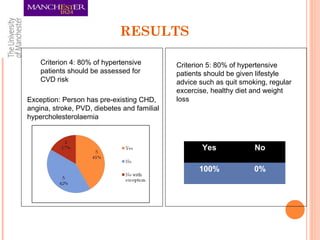
Criterion 4: 80% of hypertensive
patients should be assessed for
CVD risk
Exception: Person has pre-existing CHD,
angina, stroke, PVD, diebetes and familial
hypercholesterolaemia
Criterion 5: 80% of hypertensive
patients should be given lifestyle
advice such as quit smoking, regular
excercise, healthy diet and weight
loss
Yes No
100% 0%
RESULTS
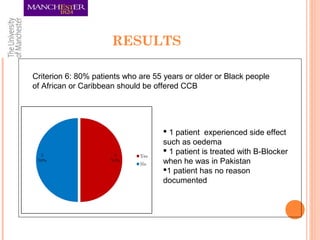
Criterion 6: 80% patients who are 55 years or older or Black people
of African or Caribbean should be offered CCB
 1 patient experienced side effect
such as oedema
 1 patient is treated with B-Blocker
when he was in Pakistan
1 patient has no reason
documented
RESULTS
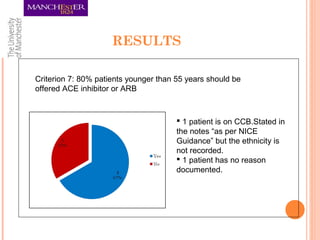
Criterion 7: 80% patients younger than 55 years should be
offered ACE inhibitor or ARB
 1 patient is on CCB.Stated in
the notes “as per NICE
Guidance” but the ethnicity is
not recorded.
 1 patient has no reason
documented.
ASSUMPTION AND LIMITATION
 If the origin of a patient is not stated in the patient’s
notes as African-Caribbean or black origin,
assumption is made to consider that patient as
Caucasian or Asian
 This audit has small number of samples (12) which
might create bias
 Some patients were treated by their previous GP in
their home country with another medication
 Patient does not attend the appointment
RECOMMENDATIONS
 Re-audit with appropriate number of samples
 Increase awareness among GP to check for :i)
urine sample for albumin:creatinine ratio, ii) blood
sample:measure glucose, electrolytes, creatinine,
eGFR and cholessterol, iii) examination of fundi for
the presence of hypertensive retinopathy, iv) 12-
lead electrocardiography, v) CVD risk assessment
 Ensure that patient details such as ethnicity,
smoking status and weight is recorded
 Ensure to document any reason for starting or
discontinue any medication
THANK YOU

Hypertension

  • 1.
    An Audit onThe Management of Hypertension In Newly Diagnosed Patients Nurdalila Sahidan 5th Year Medical Student February 2012 Supervisor: Dr Manisha Kumar
  • 2.
    INTRODUCTION: HYPERTENSION  Hypertension isa major modifiable risk factor for cardiovascular disease which can be controlled and monitored through good primary care practice  1 in 4 middle-age adult in the UK have high blood pressure  Treatment includes lifestyle changes- losing weight if you are overweight, regular exercises, a healthy diet, stop smoking, and a low salt and caffeine intake  Medication can also be offered to lower the blood pressure  The clinical management of hypertension is one of the most common interventions in primary care, accounting for approximately £1 billion in drug costs alone in 2006.
  • 3.
    METHODS  Data collection Newly diagnosed hypertensive patients from December 2011 to February 2012  12 cases reviewed  Data analysis  Based on the NICE guidance and The Quality of Outcomes Framework (QOF)
  • 4.
  • 5.
    RESULTS Criterion 1: 80%of patients who has clinic blood pressure 140/90 mmHg or higher, should be offered ABPM to confirm the diagnosis of hypertension Criterion 2: 80% of patients confirmed to have hypertension should be started on antihypertensive drug
  • 6.
     1 patienthas reason documented: ? White coat syndrome in two separate ocassions December(167/96), January (148/89)  2 patients do not have any reason documented  One of them is 18 years old with bp 158/82 and 161/92 in 2 separate ocassions. The patient is obese with BMI of 37.98
  • 7.
    RESULTS Criterion 3: 80%of patients confirmed to have hypertension or awaiting confirmation should be investigated for target organ damage A=Urine sample for albumin:creatinine ratio B=Blood sample:measure glucose, electrolytes, creatinine, eGFR and cholesterol C=Examination of fundi for the presence of hypertensive retinopathy D=12-lead electrocardiography
  • 8.
    RESULTS Criterion 4: 80%of hypertensive patients should be assessed for CVD risk Exception: Person has pre-existing CHD, angina, stroke, PVD, diebetes and familial hypercholesterolaemia Criterion 5: 80% of hypertensive patients should be given lifestyle advice such as quit smoking, regular excercise, healthy diet and weight loss Yes No 100% 0%
  • 9.
    RESULTS Criterion 6: 80%patients who are 55 years or older or Black people of African or Caribbean should be offered CCB  1 patient experienced side effect such as oedema  1 patient is treated with B-Blocker when he was in Pakistan 1 patient has no reason documented
  • 10.
    RESULTS Criterion 7: 80%patients younger than 55 years should be offered ACE inhibitor or ARB  1 patient is on CCB.Stated in the notes “as per NICE Guidance” but the ethnicity is not recorded.  1 patient has no reason documented.
  • 11.
    ASSUMPTION AND LIMITATION If the origin of a patient is not stated in the patient’s notes as African-Caribbean or black origin, assumption is made to consider that patient as Caucasian or Asian  This audit has small number of samples (12) which might create bias  Some patients were treated by their previous GP in their home country with another medication  Patient does not attend the appointment
  • 12.
    RECOMMENDATIONS  Re-audit withappropriate number of samples  Increase awareness among GP to check for :i) urine sample for albumin:creatinine ratio, ii) blood sample:measure glucose, electrolytes, creatinine, eGFR and cholessterol, iii) examination of fundi for the presence of hypertensive retinopathy, iv) 12- lead electrocardiography, v) CVD risk assessment  Ensure that patient details such as ethnicity, smoking status and weight is recorded  Ensure to document any reason for starting or discontinue any medication
  • 13.