About 70 million American adults (29%) have
high blood pressure—that’s 1 of every 3
adults.1
More than 360,000 American deaths in 2013
included high blood pressure as a primary or
contributing cause.2 That is almost 1,000
deaths each day.
What is Hypertension?
High blood pressure is a common condition in
which the long-term force of the blood against your
artery walls is high enough that it may eventually
cause health problems, such as heart disease.
High blood pressure increases your risk for dangerous health
conditions:
â—Ź 1st heart attack: About 7 of every 10 people having their first heart
attack have high blood pressure.2
â—Ź 1st stroke: About 8 of every 10 people having their first stroke
have high blood pressure.2
â—Ź Chronic (long lasting) heart failure: About 7 of every 10 people
with chronic heart failure have high blood pressure.2
â—Ź Kidney disease is also a major risk factor for high blood pressure.
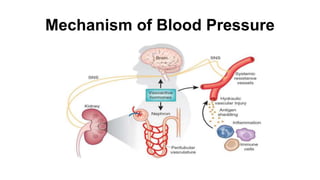
What goes on in the body?
Mechanism of Blood Pressure
Only about half (52%) of people with high blood
pressure have their condition under control.1
How is hypertension diagnosed?
If one’s blood pressure is above 140/90, then one will more likely to diagnosed with hypertension.
Device: sphygmomanometer, which consists of a stethoscope, arm cuff, dial, pump, and valve.
Nearly 1 of 3 American adults has
prehypertension—blood pressure numbers that
are higher than normal, but not yet in the high
blood pressure range.1
How can hypertension be
prevented?
1. Follow a healthy diet. Limit the amount of sodium (salt)
and alcohol that you consume.
2. Be physically active. Routine physical activity can lower
HBP and reduce your risk for other health problems.
3. Maintain a healthy weight.
4. Learn to manage and cope with stress.
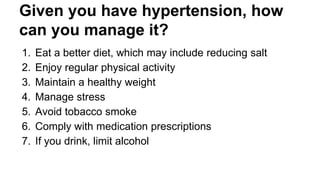
Given you have hypertension, how
can you manage it?
1. Eat a better diet, which may include reducing salt
2. Enjoy regular physical activity
3. Maintain a healthy weight
4. Manage stress
5. Avoid tobacco smoke
6. Comply with medication prescriptions
7. If you drink, limit alcohol
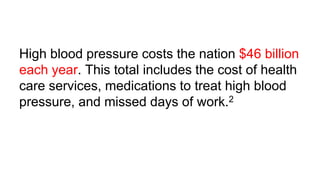
High blood pressure costs the nation $46 billion
each year. This total includes the cost of health
care services, medications to treat high blood
pressure, and missed days of work.2
Works Cited
"How Can High Blood Pressure Be Prevented?" - NHLBI, NIH. N.p., n.d. Web. 27 June 2015.
Nature.com. Nature Publishing Group, n.d. Web. 27 June 2015.

Hypertension

  • 2.
    About 70 millionAmerican adults (29%) have high blood pressure—that’s 1 of every 3 adults.1
  • 3.
    More than 360,000American deaths in 2013 included high blood pressure as a primary or contributing cause.2 That is almost 1,000 deaths each day.
  • 4.
    What is Hypertension? Highblood pressure is a common condition in which the long-term force of the blood against your artery walls is high enough that it may eventually cause health problems, such as heart disease.
  • 5.
    High blood pressureincreases your risk for dangerous health conditions: â—Ź 1st heart attack: About 7 of every 10 people having their first heart attack have high blood pressure.2 â—Ź 1st stroke: About 8 of every 10 people having their first stroke have high blood pressure.2 â—Ź Chronic (long lasting) heart failure: About 7 of every 10 people with chronic heart failure have high blood pressure.2 â—Ź Kidney disease is also a major risk factor for high blood pressure.
  • 6.
    What goes onin the body?
  • 7.
  • 8.
    Only about half(52%) of people with high blood pressure have their condition under control.1
  • 9.
    How is hypertensiondiagnosed? If one’s blood pressure is above 140/90, then one will more likely to diagnosed with hypertension. Device: sphygmomanometer, which consists of a stethoscope, arm cuff, dial, pump, and valve.
  • 10.
    Nearly 1 of3 American adults has prehypertension—blood pressure numbers that are higher than normal, but not yet in the high blood pressure range.1
  • 11.
    How can hypertensionbe prevented? 1. Follow a healthy diet. Limit the amount of sodium (salt) and alcohol that you consume. 2. Be physically active. Routine physical activity can lower HBP and reduce your risk for other health problems. 3. Maintain a healthy weight. 4. Learn to manage and cope with stress.
  • 12.
    Given you havehypertension, how can you manage it? 1. Eat a better diet, which may include reducing salt 2. Enjoy regular physical activity 3. Maintain a healthy weight 4. Manage stress 5. Avoid tobacco smoke 6. Comply with medication prescriptions 7. If you drink, limit alcohol
  • 13.
    High blood pressurecosts the nation $46 billion each year. This total includes the cost of health care services, medications to treat high blood pressure, and missed days of work.2
  • 14.
    Works Cited "How CanHigh Blood Pressure Be Prevented?" - NHLBI, NIH. N.p., n.d. Web. 27 June 2015. Nature.com. Nature Publishing Group, n.d. Web. 27 June 2015.

Editor's Notes

  • #4 References Nwankwo T, Yoon SS, Burt V, Gu Q. Hypertension among adults in the US: National Health and Nutrition Examination Survey, 2011-2012. NCHS Data Brief, No. 133. Hyattsville, MD: National Center for Health Statistics, Centers for Disease Control and Prevention, US Dept of Health and Human Services, 2013. Mozzafarian D, Benjamin EJ, Go AS, et al. Heart Disease and Stroke Statistics-2015 Update: a report from the American Heart Association. Circulation. 2015;e29-322. Heidenreich PA, Trogdon JG, Khavjou OA, et al. Forecasting the future of cardiovascular disease in the United States: a policy statement from the American Heart Association. Circulation. 2011;123:933–44. Palar K, Sturm R. Potential societal savings from reduced sodium consumption in the U.S. adult population. Am J Health Promot. 2009;24:49–57. Guide to Community Preventive Services. Cardiovascular disease prevention and control: team-based care to improve blood pressure control.
  • #5 Discuss primary v. secondary.
  • #14 References Nwankwo T, Yoon SS, Burt V, Gu Q. Hypertension among adults in the US: National Health and Nutrition Examination Survey, 2011-2012. NCHS Data Brief, No. 133. Hyattsville, MD: National Center for Health Statistics, Centers for Disease Control and Prevention, US Dept of Health and Human Services, 2013. Mozzafarian D, Benjamin EJ, Go AS, et al. Heart Disease and Stroke Statistics-2015 Update: a report from the American Heart Association. Circulation. 2015;e29-322. Heidenreich PA, Trogdon JG, Khavjou OA, et al. Forecasting the future of cardiovascular disease in the United States: a policy statement from the American Heart Association. Circulation. 2011;123:933–44. Palar K, Sturm R. Potential societal savings from reduced sodium consumption in the U.S. adult population. Am J Health Promot. 2009;24:49–57. Guide to Community Preventive Services. Cardiovascular disease prevention and control: team-based care to improve blood pressure control.