Hyperspectral Imaging Camera usingWavefront
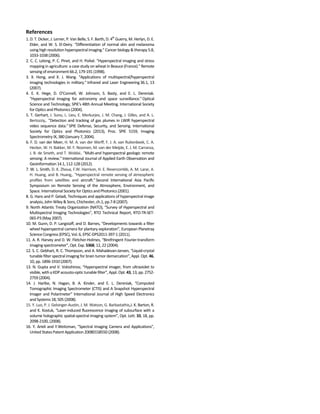
Division Interference (WDI)
ERAN BAHALUL,1
ASAF BRONFELD,1
SHLOMI EPSHTEIN,2
YORAM SABAN,2
AVI
KARSENTY,1
YOEL ARIELI
1,*
1
Jerusalem College of Technology, Havaad Haleumi 21, Jerusalem 9116001, Israel
2
Ben-Gurion University of the Negev, Beer Sheva 8410501, Israel
*Corresponding author: arieli.yoel@gmail.com
Received XX Month XXXX; revised XX Month, XXXX; accepted XX Month XXXX; posted XX Month XXXX (Doc. ID XXXXX); published XX Month XXXX
A new approach for performing hyperspectral imaging is
introduced. The hyperspectral imaging is based on
Fourier transform spectroscopy, where the interference
is performed by wavefront division interference rather
than amplitude division interference. A variable phase
delay between two parts of the wavefront emanating
from each point of an object is created by a spatial light
modulator (SLM) to obtain variable interference
patterns. The SLM is placed in the exit pupil of an imaging
system, thus enabling conversion of a general imaging
optical system into an imaging hyperspectral optical
system. The physical basis of the new approach is
introduced, and an optical apparatus is built.
OCIS codes: (140.3490) Lasers, distributed-feedback; (060.2420) Fibers,
polarization-maintaining; (060.3735) Fiber Bragg gratings; (060.2370)
Fiber optics sensors.
http://dx.doi.org/10.1364/OL.99.099999
A multispectral or hyperspectral imaging system images an object
and provides the emanating light spectrum from each pixel of the
object. The different wavelengths emitted or reflected from the object
characterize the substance of the examined object, and hence, the
different parts that compose the object can be identified. Multispectral
or hyperspectral imaging provides a 3D data cube of information
regarding the object by combining the two-dimensional image of the
object with its spectral data. Hyperspectral imaging is used in several
domains of applications, such as medical science [1] agriculture [2],
defense [3], astronomy and space surveillance [4], detection [5],
geology [6], and earth observation [7]. Moreover, due to the
continuously growing importance of hyperspectral imaging, complete
reference books have already been published [8], as well as
comparativeinternationalreports[9].
Because hyperspectral imaging provides a 3D data cube of
information, despite the imaging sensor being inherently two-
dimensional, a scanning operation is usually adopted to construct the
3D spectral image data cube. Many methods have been developed to
fulfill this requirement. The early methods include spectral scanning (λ
scan)usinganopticalfilterwheel[10],pushbroomscanningalongone
spatial axis (y axis) of a line spectral image (x–λ image), and
interferometer spectral imaging (such as mechanical scanning Fourier
transform (FT) spectrometry[11]and staticFT). There aresomeother
methods using dynamic tunable filters, such as liquid crystal tunable
filter [12] and acousto-optic tunable filter (AOTF) [13], which do not
involve mechanical scanning motion. Those scanning-based
approaches have a relatively long 3D image acquisition time, making
them only suitable for imaging relatively stable stationary objects. For
applications on time-varying objects or moving scenes, approaches for
acquiring spectral image data in a single image snapshot have been
reported, such as computed-tomography imaging spectrometer (CTIS)
[14]andholographicspectralimagingsystem(HSIS)[15].
In this article, we present a new approach for performing
hyperspectral imaging [16]. The hyperspectral imaging is based on
Fourier transform spectroscopy, where the interference is performed
by wavefront division interference (WDI) rather than amplitude
division interference (ADI). This approach enables the conversion of a
general imaging optical system into an imaging hyperspectral optical
system by introducing a thin SLM in any plane in the imaging system.
This addition of the SLM only slightly diminishes the optical
performanceoftheimaging systemandthus does notrequire a special
opticaldesign.
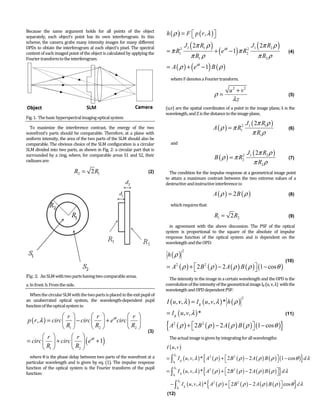
The basic hyperspectral imaging optical system is shown in Fig. 1.
The light from each point of the object is imaged to the image plane to
form the image. On its path, the light's wavefront originated from each
point is divided by the SLM into two parts, with one part of the
wavefront being delayed relative to the other part. The relative phase
delayθbetweenthetwopartsisgivenby:
2π
θ
λ
= Δ (1)
where λ is the wavelength and Δ is the optical path difference (OPD)
betweenthetwopartsofthewavefront.
When the two parts of the wavefront intersect to obtain the imaged
object’s point, they interfere according to the relative phase delay
between them. As the OPD between the two wavefront's parts is
increased progressively, each wavelength in the object’s light oscillates
between destructive and constructive interference states. The integral
intensity of all wavelengths detected by the detector as a function of
the OPD performs the interferogram at a certain object's point.
Be
se
sch
OP
co
Fo
Fig
T
wa
un
co
SL
su
ra
Fi
a.
W
an
fun
p
=
w
pa
fun
fun
ecause the sam
eparately, each o
heme, the camer
PDs to obtain th
ontent of each ima
ouriertransformt
g.1. Thebasichy
To maximize th
avefront’s parts
niform intensity,
omparable. The o
LM divided into t
urrounded by a r
adiusesare:
ig. 2. AnSLMwi
Infront.b.Fromt
Whenthecircula
n unaberrated o
nctionoftheopti
( )
1
,p r circ
r
circ
R
λ =
 
= + 
 
where θ is the ph
articular wavelen
nction of the op
nction:
me argument ho
object’s point ha
ra grabs many in
e interferogram
aged point of the
totheinterferogr
yperspectralimag
he interference
should be comp
the area of the tw
obvious choice of
two parts, as sho
ring, where, for
2R =
thtwopartshavi
theside.
arSLMwiththetw
optical system,
icalsystemis:
(
1
2
r
c circ
R
r
circ e
R
 
− 
 
 
 
 
hase delay betwe
ngth and is given
ptical system is t
olds for all poi
as its own inte
ntensity images
at each object’s
e object is calculat
ram.
gingopticalsyste
contrast, the e
parable. Therefor
wo parts of the S
f the SLM configu
own in Fig. 2: a c
comparable area
12R
ingtwocompara
wopartsisplaced
the wavelength
)
2
1
i
i
r
c e c
R
e
θ
θ
 
+ 
 
+
een two parts of
n by eq. (1). The
the Fourier tran
nts of the obje
rferogram. In th
for many differe
pixel. The spectr
ted by applying t
m
nergy of the tw
re, at a plane wi
SLM should also
uration is a circul
circular part that
as S1 and S2, the
(
ableareas.
dintheexitpupil
h-dependent pu
2
r
irc
R
 
 
 
(
f the wavefront a
e impulse respon
nsform of the pu
ect
his
ent
ral
the
wo
ith
be
lar
t is
eir
(2)
lof
upil
3)
at a
nse
upil
( )
(
h
R
A
ρ
π
ρ
=
=
wher
(u,v) ar
wavelen
and
The c
to attain
destruc
whic
in ag
system
respons
wavelen
( )
2
h
A
ρ
=
The in
convolu
wavelen
(
(
({ 2
,
g
I u v
I
A ρ
=
Thea
(
2
1
2
1
2
1
,I u v
I
I
λ
λ
λ
λ
λ
λ
=
=
−



(12)
) (
(
) ( )
1 12
1
1
,
2
1i
F p r
J R
R
R
eθ
λ
π ρ
π ρ
ρ
= 
+ −
reFdenotesaFo
re the spatial coo
ngth,andZisthe
condition for the
n a maximum c
ctiveandinstructi
chrequiresthat:
greement with th
is proportional
se function of t
ngthandtheOPD
)
( ) (
2
2
2Bρ + 
ntensity in the im
utionoftheintens
ngthandOPDde
) (
( )
) (2
, ,
, , *
2
gv I u
u v
B
λ
λ
ρ ρ
=
+ 
actualimageisgiv
)
( ) {
( ) {
( ) {2
, , *
, , *
, , *
g
g
g
I u v A
I u v A
I u v
λ
λ
λ
λ
)
)
( )
) ( )
1i
e
B
θ
λ
ρ
π
ρ

+ −
ouriertransform.
2
u
z
ρ
λ
+
=
ordinates of a poi
edistancetotheim
( )A Rρ π=
( )B Rρ π=
impulse respons
contrast between
iveinterferencei
( ) 2A Bρ =
1 22R R=
he above discus
l to the square
the optical syste
D:
( ) ( )2Aρ ρ−
mage in a certain w
sityofthegeome
ependentPSF:
) ( )
) ( )
, , *
2
v h
A B
λ ρ
ρ ρ−
venbyintegrating
( ) (
( ) (
( )
2 2
2 2
2 2
2
2
2
B
B
A B
ρ ρ
ρ ρ
ρ
+ 
+ 
+ 
(12
2
2
2J R
R
R
π
π
π ρ
2
v+
int in the image
mageplane,
(1 12
1
1
2J R
R
R
π ρ
π ρ
(1 22
2
2
2J R
R
R
π ρ
π ρ
se at a geometric
n the two extrem
is:
( )B ρ
2
ssion. The PSF o
e of the absolut
em and is depen
) ( ) (1 cB ρ  −
wavelength and t
etricalimageIg (u,
)
( ) (
2
1 coB ρ  −
gforallwaveleng
) ( ) (
) ( ) (
( ) ( )
2
2
2
A B
A B
A B
ρ ρ
ρ ρ
ρ ρ
−
−
−
)2R ρ
ρ
(4)
(5)
plane, λ is the
)ρ
(6)
)ρ
(7)
cal image point
me values of a
(8)
(9)
of the optical
te of impulse
ndent on the
)cosθ
(10)
the OPD is the
,v,λ) withthe
)}osθ
(11)
gths:
( ) (
( ) }
( ) }
1 cos
cos
d
B d
ρ θ
ρ λ
ρ θ
 −


)}d
d
θ λ
λ
us
se
gI
wh
ce
of
Ac
th
PS
ha
be
gr
op
MA
eq
int
int
Th
at
wa
co
pr
int
sim
of
th
sp
th
Fig
of
wa
th
This equation is
sing Fourier spec
econdtermrepres
( ) {, , *g u v Aλ
hich represents
ertain wavelength
ftheinterferogram
ccording to the e
e object is convo
SF. However, this
as some effect of
ecause the PSF i
reater than that
pticalsystem.
The first step pe
ATLAB simulatio
quivalent to the
termediate focal
troducing an OPD
he object was def
two different w
as executed by
onvolving the im
rocedure was o
terferograms, i.e
mulatedinthree
f the object, and i
e Fourier tran
pectrograms of ea
esystemforλ=50
g.3. ThePSFsof
Fig. 4 shows the
f the three points
avelength 750 nm
eborderregionb
s similar to the
ctroscopy, where
sentstheinterfer
( )2 2
2A Bρ + 
a certain monoc
h, can be calculat
m,similartothec
equation, each ca
olved with the w
s convolution also
the neighboring
includes the term
of an aberratio
erformed to asse
onof a4Fimaging
LCD componen
l plane of the o
D between these
fined as two part
wavelengths (750
calculating the
mage with the PS
obtained repeat
e., the intensity
points:attheima
in the border reg
nsform of the
ach point. Figure
00nm,intwodif
opticalsystemfo
e interferograms
s of the object; th
m, the part eman
betweenthem(u
equation of the
the first term is
renceeffect. The
( ) ( )2Aρ ρ−
chromatic image
ted by the invers
conventionalFTS
alculated monoc
wavelength and th
o states that each
pixels due to the
ms 2B2(ρ)-2A(ρ)
on-free conventio
ss this approach
goptical system.
nt was simulate
optical system in
e two parts, as de
ts attached to eac
0 nm and 380 nm
system’s PSF at
SF and integratin
tedly for incre
as a function
ageplane,atthem
gion between the
e interferogram
3 presents exam
fferentOPDs.
orλ=500nmfortw
(right) and the s
he part of the ob
nating the wavele
ptodown).
intensity obtain
a constant and t
term:
( ) }B ρ  (13
e of the object at
se cosine transfor
S.
chromatic image
he OPD-depende
h pixel in the ima
e spread of the P
B(ρ). This effect
onal hyperspect
was a ZEMAX an
Anoptical eleme
ed by dividing t
nto two parts an
escribed in figure
ch other, emanati
m). The simulati
t each waveleng
ng the results. Th
easing OPDs. T
of the OPD, w
middleofeach pa
e two parts. Taki
ms provided t
mples of the PSFs
wodifferentOPD
spectrograms (le
bject emanating t
ength 380 nm, an
ned
the
3)
t a
rm
of
ent
age
PSF
t is
tral
nd
ent
the
nd
e 2.
ing
on
gth,
his
The
was
art
ng
the
of
Ds.
eft)
the
nd
Fig. 4.
(right) f
part em
parts(u
The s
imaging
setup w
configur
interfer
optical s
such th
the wa
obtaine
two inte
point pr
calculat
interfer
twice,o
Fig.5. S
Figs.
imaging
theobje
Simulated inter
for three points o
manating λ=380n
uptodown)..
second step was
g system. Becaus
was based on
ration of the ex
rometer was loc
system where th
hat each mirror r
avefront. While
ed at each detecto
erferometer’s mi
rovided the inter
ted by applying
rogram. The obje
oncebyaHe-Nela
Schematicdescrip
6 and 7 show t
g setup. Fig. 6 sho
ectilluminatedby
rferogram (left)
of the object; the
nm, and the bord
as to build a 4F
se we did not hav
a Michelson in
xperimental stag
cated at the inte
he mirrors of the
returns different
moving the adj
or varied as a fun
irrors. The intens
rferogram. The s
g an inverse F
ect measured wa
aserandonceby
ptionoftheexper
the results of th
ows the interfero
ytheHe-Nelaser
and normalized
part emanating λ
der between the
F setup for the
ve access to a suit
nterferometer. Th
ge is illustrated i
ermediate focal
interferometer w
t and complemen
ustable mirror,
nction of the OPD
sity measured at
spectrogram of ea
Fourier transfor
as a white scree
whitelight.
rimentalstage.
e experimental
ogram and the sp
r.
d spectrogram
λ=750nm, the
e two object's
hyperspectral
table LCD, the
he schematic
in Fig. 5. The
plane of the
were covered,
ntary parts of
the intensity
D between the
t each object's
ach point was
rm over the
en illuminated
hyperspectral
pectrogram of
Fig
im
A
sp
Fig
im
A
wa
be
ob
an
m
ob
yie
ob
be
su
ac
de
Re
1.
2.
3.
4.
S
f
5.
6.
g. 6. The measur
mageplane,when
Asacomplemen
pectrogramofthe
g. 7. The measur
mageplane,when
A new approach
avefront division
etween two parts
bject obtains the
nd tested in expe
ethod can be us
bject is spectrally
elds uniform res
btaining the spe
ecause the intens
urrounding point
ccurate, and a mo
eveloped.
eferences
D. T. Dicker, J. Lern
Elder, and W. S. El-
C. C. Lelong,
environment 66.2,
X. Hong, and X. J. W
E. K. Hege, D. O’C
Science and Techn
for Optics and Pho
T. Gerhart, J. Sun
Bertozziy, SPIE De
Optics and Photon
(January 7, 2004).
F. D. van der Mee
Hecker, W. H. Bak
red interferogram
ntheobjectisillum
taryanalysis,Fig
eobjectilluminate
red interferogram
ntheobjectisillum
h for performing
n interference is
s of the wavefron
interferograms.
rimental setup. T
sed for hyperspe
y uniform, convol
sults; as a resul
ctrum of an obj
sity at each point
ts, the reconstruc
ore sophisticated
ner, P. Van Belle, S.
-Deiry, Cancer biol
P. C. Pinet, an
,179-191 (1998).
Wang, Infrared and
Connell, W. Johnso
nology, SPIE's 48th
otonics (2004).
nu, L. Lieu, E. Merk
efense, Security, a
nics (2013), Proc. SP
er, H. M. A. van de
ker, M. F. Noomen
m and spectrogra
minatedbyHeNe
g.7showstheinte
edbythewhiteli
m and spectrogra
minatedbyawhi
g hyperspectral
introduced. A va
nt emanating fro
The new approa
The results show
ectral imaging. H
lving a uniform o
t, this approach
ject. Another dis
has a contributio
cted spectrum at
reconstruction a
. F. Barth, D. 4th
Gu
ogy & therapy5.8,
nd H. Poilvé, R
d Laser Engineering
on, S. Basty, and E.
Annual Meeting.
kurjev, J. M. Chan
and Sensing. Inter
PIE 5159, Imaging S
er Werff, F. J. A. v
n, M. van der Meij
am of a point in t
elaser.
erferogram andt
ight.
am of a point in t
itelightsource..
imaging based
ariable phase del
m each point of
ach was simulat
w that the propos
However, when t
object with the P
h has difficulties
sadvantage is th
on of light from t
t each point is n
algorithm should
uerry, M. Herlyn, D
, 1033-1038 (2006)
Remote sensing
g 36.1, 13 (2007).
. L. Dereniak, Opti
International Socie
ng, J. Gilles, and A.
rnational Society f
Spectrometry IX, 3
van Ruitenbeek, C.
de, E. J. M. Carran
the
the
the
on
lay
an
ted
sed
the
PSF
in
hat
the
not
be
. E.
).
of
cal
ety
. L.
for
380
A.
za,
J. B. d
Obser
7. W. L.
H. Hua
Remo
Intern
8. G. Han
analys
9. North
SET-06
10. M. G
Congr
11. A. R.
12. S. C.
10, pp
13. N.Gu
14. J. Ha
of Hig
15. Y. Lu
and K.
16. Y. Ar
(2008)
de Smeth, and T
rvation and Geoinf
Smith, D. K. Zhoua
ang, and B. Huang
ote Sensing of
national Society for
ns and P. Geladi, T
sis, John Wiley & So
h Atlantic Treaty Or
65-P3 (May 2007).
Gunn, D. P. Langs
ress (EPSC), Vol. 6,
Harvey and D. W.
Gebhart, R. C. Tho
p.1896-1910(2007
upta and V. Volosh
artke, N. Hagan, B.
h Speed Electronic
uo, P. J. Gelsinger-A
. Kostuk, Opt.Lett.
rieli and Y.Weitzm
).
T. Woldai, Interna
formation14.1, 112
a, F.W. Harrison, H
g, Second Internat
the Atmospher
r Optics and Photo
Techniques and ap
ons, Chichester, ch
rganization (NATO
.
staff, and D. Barn
EPSC-DPS2011-39
Fletcher-Holmes,
ompson, and A. M
7).
hinov, Appl.Opt. 43
A. Kinder, and E.
cs and Systems 18,
Austin, J. M. Watso
. 33, 18, pp. 2098-2
an, United States
ational Journal of
2-128 (2012).
H. E. Revercombb,
tional Asia Pacific
re, Environment,
nics (2001).
pplications of hyper
h.1, pp.7-8 (2007).
O), RTO Technical R
nes, European Pla
7-1 (2011).
Opt. Exp. 5368, 12
Mahadevan-Jansen
3, 13, pp. 2752-275
L. Dereniak, Intern
505 (2008).
on, G. Barbastathis
2100, (2008).
Patent Application
Applied Earth
A. M. Larar, A.
Symposium on
and Space.
rspectral image
Report, RTO-TR-
anetray Science
2, 22 (2004).
, Appl. Opt. 46,
59 (2004).
national Journal
s,J. K. Barton, R.
n 20080158550
References
1. D. T. Dicker, J. Lerner, P. Van Belle, S. F. Barth, D. 4th
Guerry, M. Herlyn, D. E.
Elder, and W. S. El-Deiry. “Differentiation of normal skin and melanoma
using high resolution hyperspectral imaging."Cancer biology & therapy 5.8,
1033-1038 (2006).
2. C. C. Lelong, P. C. Pinet, and H. Poilvé. "Hyperspectral imaging and stress
mapping in agriculture: a case study on wheat in Beauce (France)." Remote
sensing of environment66.2, 179-191 (1998).
3. X. Hong, and X. J. Wang. "Applications of multispectral/hyperspectral
imaging technologies in military." Infrared and Laser Engineering36.1, 13
(2007).
4. E. K. Hege, D. O’Connell, W. Johnson, S. Basty, and E. L. Dereniak.
"Hyperspectral imaging for astronomy and space surveillance."Optical
Science and Technology, SPIE's 48th Annual Meeting. International Society
for Optics and Photonics (2004).
5. T. Gerhart, J. Sunu, L. Lieu, E. Merkurjev, J. M. Chang, J. Gilles, and A. L.
Bertozziy,. "Detection and tracking of gas plumes in LWIR hyperspectral
video sequence data." SPIE Defense, Security, and Sensing. International
Society for Optics and Photonics (2013), Proc. SPIE 5159, Imaging
Spectrometry IX, 380 (January 7, 2004).
6. F. D. van der Meer, H. M. A. van der Werff, F. J. A. van Ruitenbeek, C. A.
Hecker, W. H. Bakker, M. F. Noomen, M. van der Meijde, E. J. M. Carranza,
J. B. de Smeth, and T. Woldai.. "Multi-and hyperspectral geologic remote
sensing: A review."International Journal of Applied Earth Observation and
Geoinformation 14.1, 112-128 (2012).
7. W. L. Smith, D. K. Zhoua, F.W. Harrison, H. E. Revercombb, A. M. Larar, A.
H. Huang, and B. Huang,. "Hyperspectral remote sensing of atmospheric
profiles from satellites and aircraft." Second International Asia Pacific
Symposium on Remote Sensing of the Atmosphere, Environment, and
Space.International Society for Optics and Photonics (2001).
8. G. Hans and P. Geladi, Techniques and applications of hyperspectral image
analysis, John Wiley & Sons, Chichester, ch.1, pp.7-8 (2007).
9. North Atlantic Treaty Organization (NATO), “Survey of Hyperspectral and
Multispectral Imaging Technologies”, RTO Technical Report, RTO-TR-SET-
065-P3 (May 2007).
10. M. Gunn, D. P. Langstaff, and D. Barnes, “Developments towards a filter
wheel hyperspectral camera for plantary exploration”, European Planetray
ScienceCongress (EPSC), Vol.6, EPSC-DPS2011-397-1 (2011).
11. A. R. Harvey and D. W. Fletcher-Holmes, “Birefringent Fourier-transform
imagingspectrometer”, Opt. Exp. 5368, 12, 22 (2004).
12. S. C. Gebhart, R. C. Thompson, and A. Mahadevan-Jansen, “Liquid-crystal
tunable filter spectral imaging for brain tumor demarcation”, Appl. Opt. 46,
10, pp.1896-1910(2007).
13. N. Gupta and V. Voloshinov, “Hyperspectral imager, from ultraviolet to
visible, with a KDPacousto-optictunable filter”, Appl. Opt. 43, 13, pp. 2752-
2759 (2004).
14. J. Hartke, N. Hagan, B. A. Kinder, and E. L. Dereniak, “Computed
Tomographic Imaging Spectrometer (CTIS) and A Snapshot Hyperspectral
Imager and Polarimeter” International Journal of High Speed Electronics
and Systems 18, 505 (2008).
15. Y. Luo, P. J. Gelsinger-Austin, J. M. Watson, G. Barbastathis,J. K. Barton, R.
and K. Kostuk, “Laser-induced fluorescence imaging of subsurface with a
volume holographic spatial-spectral imaging system”, Opt. Lett. 33, 18, pp.
2098-2100, (2008).
16. Y. Arieli and Y.Weitzman, "Spectral Imaging Camera and Applications",
United States Patent Application20080158550 (2008).

Hyperspectral Imaging Camera using Wavefront

  • 1.
    Hyperspectral Imaging CamerausingWavefront Division Interference (WDI) ERAN BAHALUL,1 ASAF BRONFELD,1 SHLOMI EPSHTEIN,2 YORAM SABAN,2 AVI KARSENTY,1 YOEL ARIELI 1,* 1 Jerusalem College of Technology, Havaad Haleumi 21, Jerusalem 9116001, Israel 2 Ben-Gurion University of the Negev, Beer Sheva 8410501, Israel *Corresponding author: arieli.yoel@gmail.com Received XX Month XXXX; revised XX Month, XXXX; accepted XX Month XXXX; posted XX Month XXXX (Doc. ID XXXXX); published XX Month XXXX A new approach for performing hyperspectral imaging is introduced. The hyperspectral imaging is based on Fourier transform spectroscopy, where the interference is performed by wavefront division interference rather than amplitude division interference. A variable phase delay between two parts of the wavefront emanating from each point of an object is created by a spatial light modulator (SLM) to obtain variable interference patterns. The SLM is placed in the exit pupil of an imaging system, thus enabling conversion of a general imaging optical system into an imaging hyperspectral optical system. The physical basis of the new approach is introduced, and an optical apparatus is built. OCIS codes: (140.3490) Lasers, distributed-feedback; (060.2420) Fibers, polarization-maintaining; (060.3735) Fiber Bragg gratings; (060.2370) Fiber optics sensors. http://dx.doi.org/10.1364/OL.99.099999 A multispectral or hyperspectral imaging system images an object and provides the emanating light spectrum from each pixel of the object. The different wavelengths emitted or reflected from the object characterize the substance of the examined object, and hence, the different parts that compose the object can be identified. Multispectral or hyperspectral imaging provides a 3D data cube of information regarding the object by combining the two-dimensional image of the object with its spectral data. Hyperspectral imaging is used in several domains of applications, such as medical science [1] agriculture [2], defense [3], astronomy and space surveillance [4], detection [5], geology [6], and earth observation [7]. Moreover, due to the continuously growing importance of hyperspectral imaging, complete reference books have already been published [8], as well as comparativeinternationalreports[9]. Because hyperspectral imaging provides a 3D data cube of information, despite the imaging sensor being inherently two- dimensional, a scanning operation is usually adopted to construct the 3D spectral image data cube. Many methods have been developed to fulfill this requirement. The early methods include spectral scanning (λ scan)usinganopticalfilterwheel[10],pushbroomscanningalongone spatial axis (y axis) of a line spectral image (x–λ image), and interferometer spectral imaging (such as mechanical scanning Fourier transform (FT) spectrometry[11]and staticFT). There aresomeother methods using dynamic tunable filters, such as liquid crystal tunable filter [12] and acousto-optic tunable filter (AOTF) [13], which do not involve mechanical scanning motion. Those scanning-based approaches have a relatively long 3D image acquisition time, making them only suitable for imaging relatively stable stationary objects. For applications on time-varying objects or moving scenes, approaches for acquiring spectral image data in a single image snapshot have been reported, such as computed-tomography imaging spectrometer (CTIS) [14]andholographicspectralimagingsystem(HSIS)[15]. In this article, we present a new approach for performing hyperspectral imaging [16]. The hyperspectral imaging is based on Fourier transform spectroscopy, where the interference is performed by wavefront division interference (WDI) rather than amplitude division interference (ADI). This approach enables the conversion of a general imaging optical system into an imaging hyperspectral optical system by introducing a thin SLM in any plane in the imaging system. This addition of the SLM only slightly diminishes the optical performanceoftheimaging systemandthus does notrequire a special opticaldesign. The basic hyperspectral imaging optical system is shown in Fig. 1. The light from each point of the object is imaged to the image plane to form the image. On its path, the light's wavefront originated from each point is divided by the SLM into two parts, with one part of the wavefront being delayed relative to the other part. The relative phase delayθbetweenthetwopartsisgivenby: 2π θ λ = Δ (1) where λ is the wavelength and Δ is the optical path difference (OPD) betweenthetwopartsofthewavefront. When the two parts of the wavefront intersect to obtain the imaged object’s point, they interfere according to the relative phase delay between them. As the OPD between the two wavefront's parts is increased progressively, each wavelength in the object’s light oscillates between destructive and constructive interference states. The integral intensity of all wavelengths detected by the detector as a function of the OPD performs the interferogram at a certain object's point.
  • 2.
    Be se sch OP co Fo Fig T wa un co SL su ra Fi a. W an fun p = w pa fun fun ecause the sam eparately,each o heme, the camer PDs to obtain th ontent of each ima ouriertransformt g.1. Thebasichy To maximize th avefront’s parts niform intensity, omparable. The o LM divided into t urrounded by a r adiusesare: ig. 2. AnSLMwi Infront.b.Fromt Whenthecircula n unaberrated o nctionoftheopti ( ) 1 ,p r circ r circ R λ =   = +    where θ is the ph articular wavelen nction of the op nction: me argument ho object’s point ha ra grabs many in e interferogram aged point of the totheinterferogr yperspectralimag he interference should be comp the area of the tw obvious choice of two parts, as sho ring, where, for 2R = thtwopartshavi theside. arSLMwiththetw optical system, icalsystemis: ( 1 2 r c circ R r circ e R   −          hase delay betwe ngth and is given ptical system is t olds for all poi as its own inte ntensity images at each object’s e object is calculat ram. gingopticalsyste contrast, the e parable. Therefor wo parts of the S f the SLM configu own in Fig. 2: a c comparable area 12R ingtwocompara wopartsisplaced the wavelength ) 2 1 i i r c e c R e θ θ   +    + een two parts of n by eq. (1). The the Fourier tran nts of the obje rferogram. In th for many differe pixel. The spectr ted by applying t m nergy of the tw re, at a plane wi SLM should also uration is a circul circular part that as S1 and S2, the ( ableareas. dintheexitpupil h-dependent pu 2 r irc R       ( f the wavefront a e impulse respon nsform of the pu ect his ent ral the wo ith be lar t is eir (2) lof upil 3) at a nse upil ( ) ( h R A ρ π ρ = = wher (u,v) ar wavelen and The c to attain destruc whic in ag system respons wavelen ( ) 2 h A ρ = The in convolu wavelen ( ( ({ 2 , g I u v I A ρ = Thea ( 2 1 2 1 2 1 ,I u v I I λ λ λ λ λ λ = = −    (12) ) ( ( ) ( ) 1 12 1 1 , 2 1i F p r J R R R eθ λ π ρ π ρ ρ =  + − reFdenotesaFo re the spatial coo ngth,andZisthe condition for the n a maximum c ctiveandinstructi chrequiresthat: greement with th is proportional se function of t ngthandtheOPD ) ( ) ( 2 2 2Bρ +  ntensity in the im utionoftheintens ngthandOPDde ) ( ( ) ) (2 , , , , * 2 gv I u u v B λ λ ρ ρ = +  actualimageisgiv ) ( ) { ( ) { ( ) {2 , , * , , * , , * g g g I u v A I u v A I u v λ λ λ λ ) ) ( ) ) ( ) 1i e B θ λ ρ π ρ  + − ouriertransform. 2 u z ρ λ + = ordinates of a poi edistancetotheim ( )A Rρ π= ( )B Rρ π= impulse respons contrast between iveinterferencei ( ) 2A Bρ = 1 22R R= he above discus l to the square the optical syste D: ( ) ( )2Aρ ρ− mage in a certain w sityofthegeome ependentPSF: ) ( ) ) ( ) , , * 2 v h A B λ ρ ρ ρ− venbyintegrating ( ) ( ( ) ( ( ) 2 2 2 2 2 2 2 2 2 B B A B ρ ρ ρ ρ ρ +  +  +  (12 2 2 2J R R R π π π ρ 2 v+ int in the image mageplane, (1 12 1 1 2J R R R π ρ π ρ (1 22 2 2 2J R R R π ρ π ρ se at a geometric n the two extrem is: ( )B ρ 2 ssion. The PSF o e of the absolut em and is depen ) ( ) (1 cB ρ  − wavelength and t etricalimageIg (u, ) ( ) ( 2 1 coB ρ  − gforallwaveleng ) ( ) ( ) ( ) ( ( ) ( ) 2 2 2 A B A B A B ρ ρ ρ ρ ρ ρ − − − )2R ρ ρ (4) (5) plane, λ is the )ρ (6) )ρ (7) cal image point me values of a (8) (9) of the optical te of impulse ndent on the )cosθ (10) the OPD is the ,v,λ) withthe )}osθ (11) gths: ( ) ( ( ) } ( ) } 1 cos cos d B d ρ θ ρ λ ρ θ  −   )}d d θ λ λ
  • 3.
    us se gI wh ce of Ac th PS ha be gr op MA eq int int Th at wa co pr int sim of th sp th Fig of wa th This equation is singFourier spec econdtermrepres ( ) {, , *g u v Aλ hich represents ertain wavelength ftheinterferogram ccording to the e e object is convo SF. However, this as some effect of ecause the PSF i reater than that pticalsystem. The first step pe ATLAB simulatio quivalent to the termediate focal troducing an OPD he object was def two different w as executed by onvolving the im rocedure was o terferograms, i.e mulatedinthree f the object, and i e Fourier tran pectrograms of ea esystemforλ=50 g.3. ThePSFsof Fig. 4 shows the f the three points avelength 750 nm eborderregionb s similar to the ctroscopy, where sentstheinterfer ( )2 2 2A Bρ +  a certain monoc h, can be calculat m,similartothec equation, each ca olved with the w s convolution also the neighboring includes the term of an aberratio erformed to asse onof a4Fimaging LCD componen l plane of the o D between these fined as two part wavelengths (750 calculating the mage with the PS obtained repeat e., the intensity points:attheima in the border reg nsform of the ach point. Figure 00nm,intwodif opticalsystemfo e interferograms s of the object; th m, the part eman betweenthem(u equation of the the first term is renceeffect. The ( ) ( )2Aρ ρ− chromatic image ted by the invers conventionalFTS alculated monoc wavelength and th o states that each pixels due to the ms 2B2(ρ)-2A(ρ) on-free conventio ss this approach goptical system. nt was simulate optical system in e two parts, as de ts attached to eac 0 nm and 380 nm system’s PSF at SF and integratin tedly for incre as a function ageplane,atthem gion between the e interferogram 3 presents exam fferentOPDs. orλ=500nmfortw (right) and the s he part of the ob nating the wavele ptodown). intensity obtain a constant and t term: ( ) }B ρ  (13 e of the object at se cosine transfor S. chromatic image he OPD-depende h pixel in the ima e spread of the P B(ρ). This effect onal hyperspect was a ZEMAX an Anoptical eleme ed by dividing t nto two parts an escribed in figure ch other, emanati m). The simulati t each waveleng ng the results. Th easing OPDs. T of the OPD, w middleofeach pa e two parts. Taki ms provided t mples of the PSFs wodifferentOPD spectrograms (le bject emanating t ength 380 nm, an ned the 3) t a rm of ent age PSF t is tral nd ent the nd e 2. ing on gth, his The was art ng the of Ds. eft) the nd Fig. 4. (right) f part em parts(u The s imaging setup w configur interfer optical s such th the wa obtaine two inte point pr calculat interfer twice,o Fig.5. S Figs. imaging theobje Simulated inter for three points o manating λ=380n uptodown).. second step was g system. Becaus was based on ration of the ex rometer was loc system where th hat each mirror r avefront. While ed at each detecto erferometer’s mi rovided the inter ted by applying rogram. The obje oncebyaHe-Nela Schematicdescrip 6 and 7 show t g setup. Fig. 6 sho ectilluminatedby rferogram (left) of the object; the nm, and the bord as to build a 4F se we did not hav a Michelson in xperimental stag cated at the inte he mirrors of the returns different moving the adj or varied as a fun irrors. The intens rferogram. The s g an inverse F ect measured wa aserandonceby ptionoftheexper the results of th ows the interfero ytheHe-Nelaser and normalized part emanating λ der between the F setup for the ve access to a suit nterferometer. Th ge is illustrated i ermediate focal interferometer w t and complemen ustable mirror, nction of the OPD sity measured at spectrogram of ea Fourier transfor as a white scree whitelight. rimentalstage. e experimental ogram and the sp r. d spectrogram λ=750nm, the e two object's hyperspectral table LCD, the he schematic in Fig. 5. The plane of the were covered, ntary parts of the intensity D between the t each object's ach point was rm over the en illuminated hyperspectral pectrogram of
  • 4.
    Fig im A sp Fig im A wa be ob an m ob yie ob be su ac de Re 1. 2. 3. 4. S f 5. 6. g. 6. Themeasur mageplane,when Asacomplemen pectrogramofthe g. 7. The measur mageplane,when A new approach avefront division etween two parts bject obtains the nd tested in expe ethod can be us bject is spectrally elds uniform res btaining the spe ecause the intens urrounding point ccurate, and a mo eveloped. eferences D. T. Dicker, J. Lern Elder, and W. S. El- C. C. Lelong, environment 66.2, X. Hong, and X. J. W E. K. Hege, D. O’C Science and Techn for Optics and Pho T. Gerhart, J. Sun Bertozziy, SPIE De Optics and Photon (January 7, 2004). F. D. van der Mee Hecker, W. H. Bak red interferogram ntheobjectisillum taryanalysis,Fig eobjectilluminate red interferogram ntheobjectisillum h for performing n interference is s of the wavefron interferograms. rimental setup. T sed for hyperspe y uniform, convol sults; as a resul ctrum of an obj sity at each point ts, the reconstruc ore sophisticated ner, P. Van Belle, S. -Deiry, Cancer biol P. C. Pinet, an ,179-191 (1998). Wang, Infrared and Connell, W. Johnso nology, SPIE's 48th otonics (2004). nu, L. Lieu, E. Merk efense, Security, a nics (2013), Proc. SP er, H. M. A. van de ker, M. F. Noomen m and spectrogra minatedbyHeNe g.7showstheinte edbythewhiteli m and spectrogra minatedbyawhi g hyperspectral introduced. A va nt emanating fro The new approa The results show ectral imaging. H lving a uniform o t, this approach ject. Another dis has a contributio cted spectrum at reconstruction a . F. Barth, D. 4th Gu ogy & therapy5.8, nd H. Poilvé, R d Laser Engineering on, S. Basty, and E. Annual Meeting. kurjev, J. M. Chan and Sensing. Inter PIE 5159, Imaging S er Werff, F. J. A. v n, M. van der Meij am of a point in t elaser. erferogram andt ight. am of a point in t itelightsource.. imaging based ariable phase del m each point of ach was simulat w that the propos However, when t object with the P h has difficulties sadvantage is th on of light from t t each point is n algorithm should uerry, M. Herlyn, D , 1033-1038 (2006) Remote sensing g 36.1, 13 (2007). . L. Dereniak, Opti International Socie ng, J. Gilles, and A. rnational Society f Spectrometry IX, 3 van Ruitenbeek, C. de, E. J. M. Carran the the the on lay an ted sed the PSF in hat the not be . E. ). of cal ety . L. for 380 A. za, J. B. d Obser 7. W. L. H. Hua Remo Intern 8. G. Han analys 9. North SET-06 10. M. G Congr 11. A. R. 12. S. C. 10, pp 13. N.Gu 14. J. Ha of Hig 15. Y. Lu and K. 16. Y. Ar (2008) de Smeth, and T rvation and Geoinf Smith, D. K. Zhoua ang, and B. Huang ote Sensing of national Society for ns and P. Geladi, T sis, John Wiley & So h Atlantic Treaty Or 65-P3 (May 2007). Gunn, D. P. Langs ress (EPSC), Vol. 6, Harvey and D. W. Gebhart, R. C. Tho p.1896-1910(2007 upta and V. Volosh artke, N. Hagan, B. h Speed Electronic uo, P. J. Gelsinger-A . Kostuk, Opt.Lett. rieli and Y.Weitzm ). T. Woldai, Interna formation14.1, 112 a, F.W. Harrison, H g, Second Internat the Atmospher r Optics and Photo Techniques and ap ons, Chichester, ch rganization (NATO . staff, and D. Barn EPSC-DPS2011-39 Fletcher-Holmes, ompson, and A. M 7). hinov, Appl.Opt. 43 A. Kinder, and E. cs and Systems 18, Austin, J. M. Watso . 33, 18, pp. 2098-2 an, United States ational Journal of 2-128 (2012). H. E. Revercombb, tional Asia Pacific re, Environment, nics (2001). pplications of hyper h.1, pp.7-8 (2007). O), RTO Technical R nes, European Pla 7-1 (2011). Opt. Exp. 5368, 12 Mahadevan-Jansen 3, 13, pp. 2752-275 L. Dereniak, Intern 505 (2008). on, G. Barbastathis 2100, (2008). Patent Application Applied Earth A. M. Larar, A. Symposium on and Space. rspectral image Report, RTO-TR- anetray Science 2, 22 (2004). , Appl. Opt. 46, 59 (2004). national Journal s,J. K. Barton, R. n 20080158550
  • 5.
    References 1. D. T.Dicker, J. Lerner, P. Van Belle, S. F. Barth, D. 4th Guerry, M. Herlyn, D. E. Elder, and W. S. El-Deiry. “Differentiation of normal skin and melanoma using high resolution hyperspectral imaging."Cancer biology & therapy 5.8, 1033-1038 (2006). 2. C. C. Lelong, P. C. Pinet, and H. Poilvé. "Hyperspectral imaging and stress mapping in agriculture: a case study on wheat in Beauce (France)." Remote sensing of environment66.2, 179-191 (1998). 3. X. Hong, and X. J. Wang. "Applications of multispectral/hyperspectral imaging technologies in military." Infrared and Laser Engineering36.1, 13 (2007). 4. E. K. Hege, D. O’Connell, W. Johnson, S. Basty, and E. L. Dereniak. "Hyperspectral imaging for astronomy and space surveillance."Optical Science and Technology, SPIE's 48th Annual Meeting. International Society for Optics and Photonics (2004). 5. T. Gerhart, J. Sunu, L. Lieu, E. Merkurjev, J. M. Chang, J. Gilles, and A. L. Bertozziy,. "Detection and tracking of gas plumes in LWIR hyperspectral video sequence data." SPIE Defense, Security, and Sensing. International Society for Optics and Photonics (2013), Proc. SPIE 5159, Imaging Spectrometry IX, 380 (January 7, 2004). 6. F. D. van der Meer, H. M. A. van der Werff, F. J. A. van Ruitenbeek, C. A. Hecker, W. H. Bakker, M. F. Noomen, M. van der Meijde, E. J. M. Carranza, J. B. de Smeth, and T. Woldai.. "Multi-and hyperspectral geologic remote sensing: A review."International Journal of Applied Earth Observation and Geoinformation 14.1, 112-128 (2012). 7. W. L. Smith, D. K. Zhoua, F.W. Harrison, H. E. Revercombb, A. M. Larar, A. H. Huang, and B. Huang,. "Hyperspectral remote sensing of atmospheric profiles from satellites and aircraft." Second International Asia Pacific Symposium on Remote Sensing of the Atmosphere, Environment, and Space.International Society for Optics and Photonics (2001). 8. G. Hans and P. Geladi, Techniques and applications of hyperspectral image analysis, John Wiley & Sons, Chichester, ch.1, pp.7-8 (2007). 9. North Atlantic Treaty Organization (NATO), “Survey of Hyperspectral and Multispectral Imaging Technologies”, RTO Technical Report, RTO-TR-SET- 065-P3 (May 2007). 10. M. Gunn, D. P. Langstaff, and D. Barnes, “Developments towards a filter wheel hyperspectral camera for plantary exploration”, European Planetray ScienceCongress (EPSC), Vol.6, EPSC-DPS2011-397-1 (2011). 11. A. R. Harvey and D. W. Fletcher-Holmes, “Birefringent Fourier-transform imagingspectrometer”, Opt. Exp. 5368, 12, 22 (2004). 12. S. C. Gebhart, R. C. Thompson, and A. Mahadevan-Jansen, “Liquid-crystal tunable filter spectral imaging for brain tumor demarcation”, Appl. Opt. 46, 10, pp.1896-1910(2007). 13. N. Gupta and V. Voloshinov, “Hyperspectral imager, from ultraviolet to visible, with a KDPacousto-optictunable filter”, Appl. Opt. 43, 13, pp. 2752- 2759 (2004). 14. J. Hartke, N. Hagan, B. A. Kinder, and E. L. Dereniak, “Computed Tomographic Imaging Spectrometer (CTIS) and A Snapshot Hyperspectral Imager and Polarimeter” International Journal of High Speed Electronics and Systems 18, 505 (2008). 15. Y. Luo, P. J. Gelsinger-Austin, J. M. Watson, G. Barbastathis,J. K. Barton, R. and K. Kostuk, “Laser-induced fluorescence imaging of subsurface with a volume holographic spatial-spectral imaging system”, Opt. Lett. 33, 18, pp. 2098-2100, (2008). 16. Y. Arieli and Y.Weitzman, "Spectral Imaging Camera and Applications", United States Patent Application20080158550 (2008).