Hypergeometric
Probability Distribution
Group members:
K22ES004 K22ES10 K22ES12
Introduction to Hypergeometric Distribution
• The hypergeometric distribution is used to
determine the probability of a certain number of
"successes" in a series of draws made without
replacement from a fixed population. The
distribution depends on the size of the
population, the number of draws, and the
number of "successes" in the population.
• This distribution can be used as a model for
various scenarios which involve a series of
dependent trials that result in either a "success"
or a "failure".
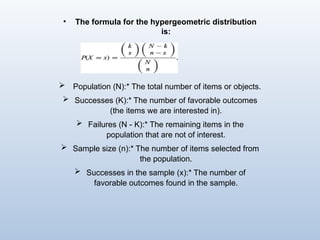
• The formula for the hypergeometric distribution
is:
 Population (N):* The total number of items or objects.
 Successes (K):* The number of favorable outcomes
(the items we are interested in).
 Failures (N - K):* The remaining items in the
population that are not of interest.
 Sample size (n):* The number of items selected from
the population.
 Successes in the sample (x):* The number of
favorable outcomes found in the sample.
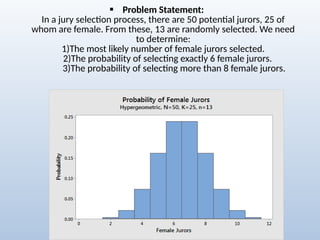
 Problem Statement:
In a jury selection process, there are 50 potential jurors, 25 of
whom are female. From these, 13 are randomly selected. We need
to determine:
1)The most likely number of female jurors selected.
2)The probability of selecting exactly 6 female jurors.
3)The probability of selecting more than 8 female jurors.
• Solution:
Key Information:
• Population size (N): 50 jurors
• Number of female jurors (K): 25 females
• Sample size (n): 13 jurors selected
• Random variable: Number of female jurors selected
• The hypergeometric distribution is used to model the probability of a
specific number of successes (female jurors) in a sample drawn from a
population, without replacement.
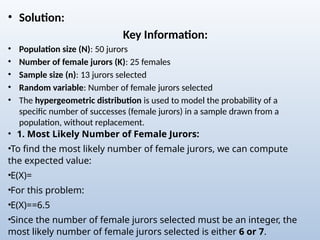
• 1. Most Likely Number of Female Jurors:
•To find the most likely number of female jurors, we can compute
the expected value:
•E(X)=
•For this problem:
•E(X)=​
=6.5
•Since the number of female jurors selected must be an integer, the
most likely number of female jurors selected is either 6 or 7.
2. Probability of Selecting Exactly 6 Female Jurors:
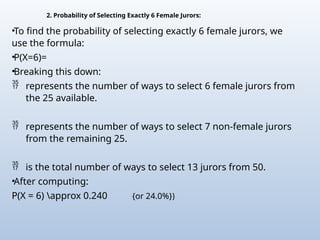
•To find the probability of selecting exactly 6 female jurors, we
use the formula:
•P(X=6)=
•Breaking this down:
 represents the number of ways to select 6 female jurors from
the 25 available.
 represents the number of ways to select 7 non-female jurors
from the remaining 25.
 is the total number of ways to select 13 jurors from 50.
•After computing:
P(X = 6) approx 0.240 {or 24.0%})
3. Probability of Selecting More than 8 Female Jurors
•The probability of selecting more than 8 female jurors is the sum
of the probabilities of selecting 9, 10, 11, 12, or 13 female jurors:
•P(X>8)=P(9)+P(10)+P(11)+P(12)+P(13)
•Using the same formula for each term, and summing them up:
•P(X > 8) approx 0.098 (or 9.8%)
HYPERGEOMETRIC DISTRIBUTION USES
• Hypergeometric distribution is used when the
probability of success in each trial changes as to find
the probability of successes.
• In acceptance sampling, hypergeometric distribution
plays a very important role and it is widely applied.

Hypergeometric_ Distribution 044444.pptx

  • 1.
  • 2.
    Introduction to HypergeometricDistribution • The hypergeometric distribution is used to determine the probability of a certain number of "successes" in a series of draws made without replacement from a fixed population. The distribution depends on the size of the population, the number of draws, and the number of "successes" in the population. • This distribution can be used as a model for various scenarios which involve a series of dependent trials that result in either a "success" or a "failure".
  • 3.
    • The formulafor the hypergeometric distribution is:  Population (N):* The total number of items or objects.  Successes (K):* The number of favorable outcomes (the items we are interested in).  Failures (N - K):* The remaining items in the population that are not of interest.  Sample size (n):* The number of items selected from the population.  Successes in the sample (x):* The number of favorable outcomes found in the sample.
  • 4.
     Problem Statement: Ina jury selection process, there are 50 potential jurors, 25 of whom are female. From these, 13 are randomly selected. We need to determine: 1)The most likely number of female jurors selected. 2)The probability of selecting exactly 6 female jurors. 3)The probability of selecting more than 8 female jurors.
  • 5.
    • Solution: Key Information: •Population size (N): 50 jurors • Number of female jurors (K): 25 females • Sample size (n): 13 jurors selected • Random variable: Number of female jurors selected • The hypergeometric distribution is used to model the probability of a specific number of successes (female jurors) in a sample drawn from a population, without replacement. • 1. Most Likely Number of Female Jurors: •To find the most likely number of female jurors, we can compute the expected value: •E(X)= •For this problem: •E(X)=​ =6.5 •Since the number of female jurors selected must be an integer, the most likely number of female jurors selected is either 6 or 7.
  • 6.
    2. Probability ofSelecting Exactly 6 Female Jurors: •To find the probability of selecting exactly 6 female jurors, we use the formula: •P(X=6)= •Breaking this down:  represents the number of ways to select 6 female jurors from the 25 available.  represents the number of ways to select 7 non-female jurors from the remaining 25.  is the total number of ways to select 13 jurors from 50. •After computing: P(X = 6) approx 0.240 {or 24.0%})
  • 7.
    3. Probability ofSelecting More than 8 Female Jurors •The probability of selecting more than 8 female jurors is the sum of the probabilities of selecting 9, 10, 11, 12, or 13 female jurors: •P(X>8)=P(9)+P(10)+P(11)+P(12)+P(13) •Using the same formula for each term, and summing them up: •P(X > 8) approx 0.098 (or 9.8%)
  • 8.
    HYPERGEOMETRIC DISTRIBUTION USES •Hypergeometric distribution is used when the probability of success in each trial changes as to find the probability of successes. • In acceptance sampling, hypergeometric distribution plays a very important role and it is widely applied.