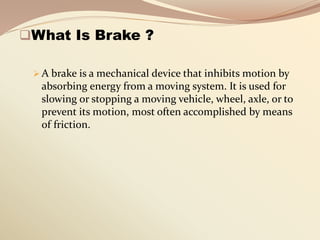
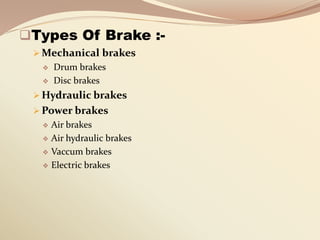
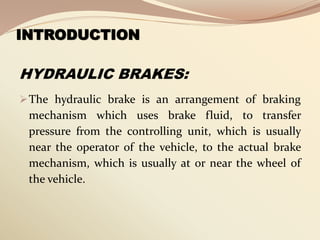
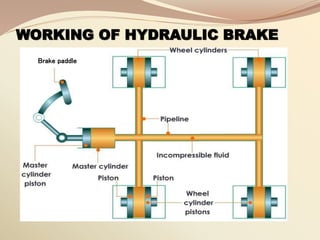
This document discusses hydraulic brakes. It begins by defining brakes as mechanical devices that inhibit motion by absorbing energy. It then lists different types of brakes, including mechanical, hydraulic, power, air, and electric brakes. The document focuses on hydraulic brakes, explaining that they use brake fluid to transfer pressure from the brake pedal to the actual brake mechanism at the wheels. It describes the principles and components of hydraulic brakes, including how Pascal's law allows for uniform braking pressure. The advantages are equal braking force and increased mechanical advantage, while the disadvantages include system failure if fluid leaks and higher initial costs.



![1580661880868_Braking_systems.ppt[1].pptx](https://cdn.slidesharecdn.com/ss_thumbnails/1580661880868brakingsystems-240906080221-a4f00321-thumbnail.jpg?width=640&height=640&fit=bounds)


![DESIGN AND FABRICATION OF THE IBM 90-90 SEAT BELT CLAMP KIA VEHICLE[1].pptx 2...](https://cdn.slidesharecdn.com/ss_thumbnails/designandfabricationoftheibm90-90seatbeltclampkiavehicle1-260116160442-70ff67fc-thumbnail.jpg?width=640&height=640&fit=bounds)


